Hours 0:00 – 2:50, 3/18/25

Citizen Comment:

Main topics:

  1. Malachi Williams: Seven speakers, including family members. They want justice for Malachi. Several of the speakers focus on the detail that Malachi ran because a cop pulled a gun on him. Before the videos were released, this detail wasn’t mentioned. It shows how the officer escalated the situation instead of de-escalating it, which then ended in tragedy.
  2. Human Services Advisory Budget funding: Council is thinking about increasing HSAB funding for next year. Three speakers advocated for this.
  3. Cape’s Dam and the Mill Race: Two people talk about how much they love the river, east of I-35 and want council to keep it. We’ll unpack all of this!
  4. Tenants’ Bill of Rights: The San Marcos Civics Club made this a focus, and got Council to put this in their visioning statement. Now council will need to make it happen. Two speakers focus on this.
  5. Ceasefire in Palestine: four speakers. They still want the city to pass a resolution calling for a ceasefire in Gaza.

Onto the meeting!

Items 1-4: A bunch of audits and investment reports.

We got the audit reports for CDBG funding and the 23-24 fiscal year.  Plus the quarterly financial report and investment report.

Everything looks normal. No rude surprises. (Apparently we’ve gotten awards for excellence for the past 35 years, on our yearly fiscal audit. OH YEAH BABY.)

Item 18: Rezoning about 15 acres

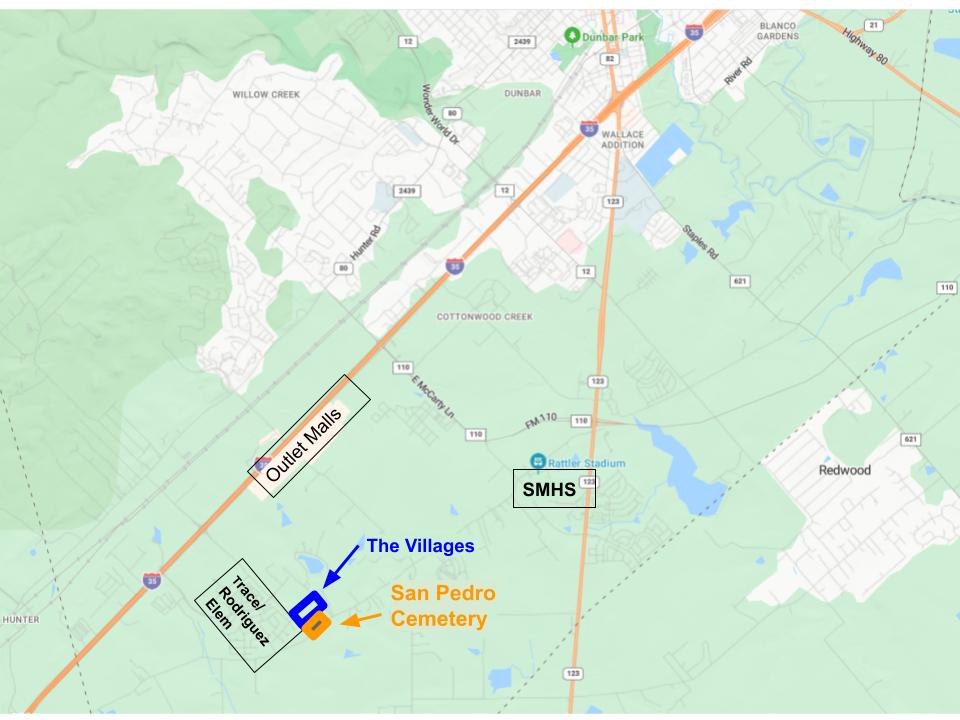
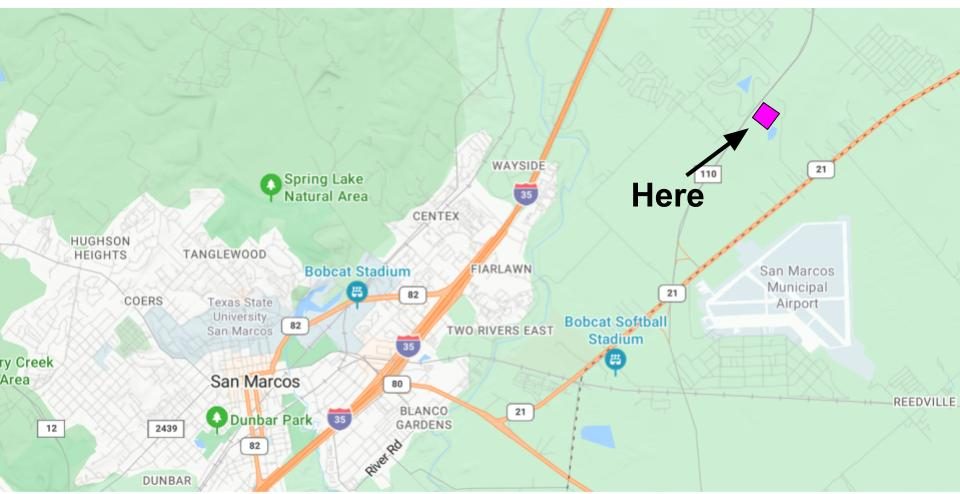
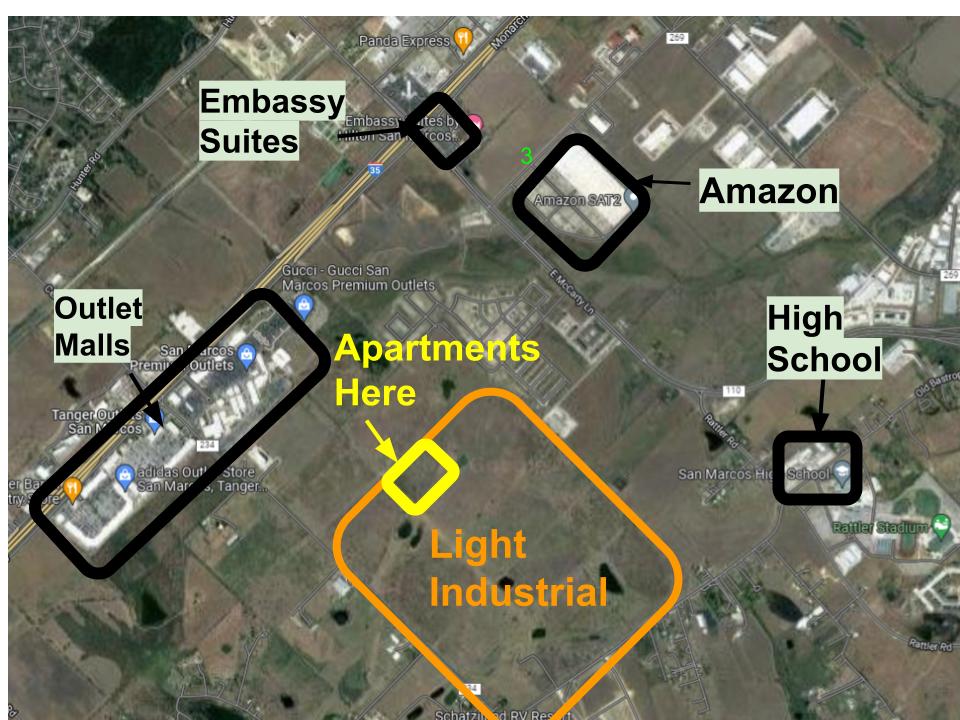
This property is way up north:

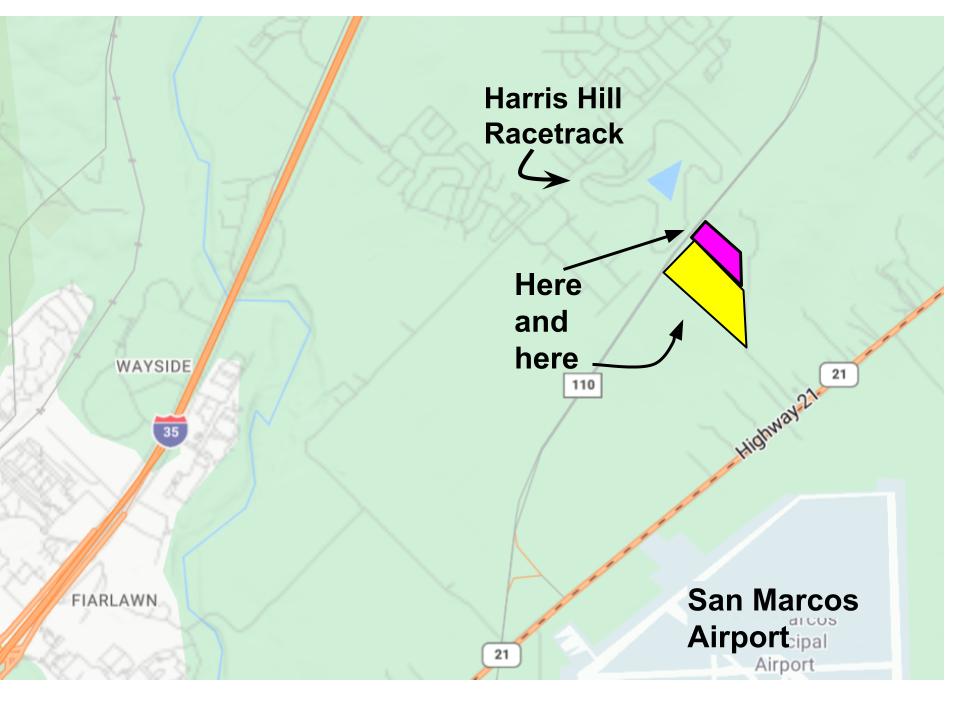
Back in 2020, we annexed this yellow and pink bit:

The yellow was zoned Manufactured Home, and the pink was zoned Light Industrial.

There were some concerns then – do we really want to make the folks in the mobile home community live right against an industrial park? But we let it ride.

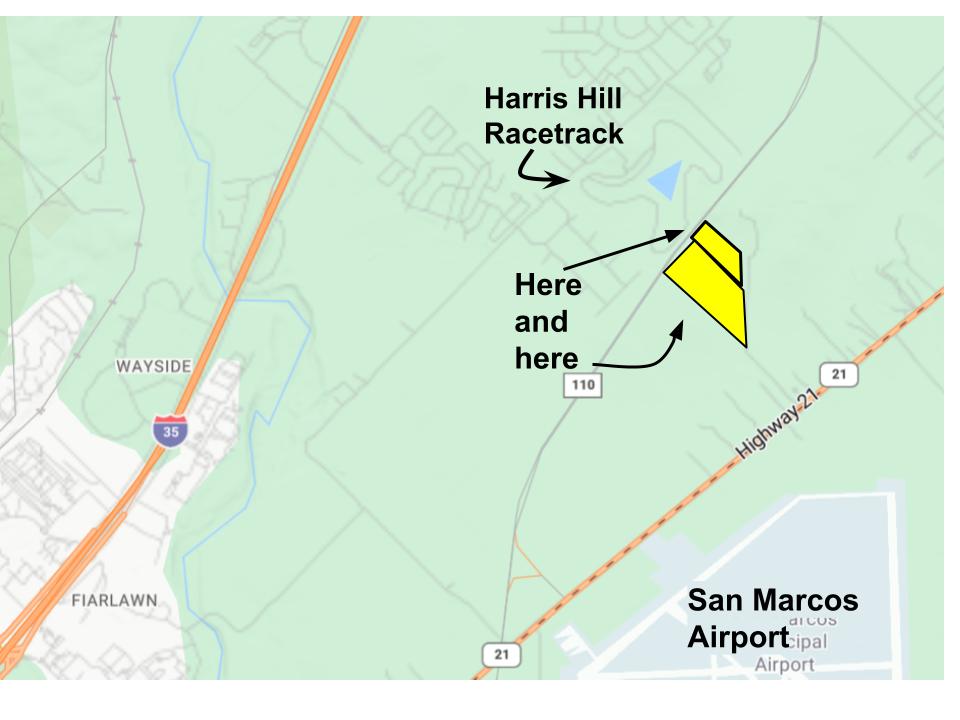
Now the pink part is coming back for a rezoning – they want to switch it from Light Industrial to Manufactured Home.  In other words:

Great! Now nobody has to live near an industrial park.

Item 20: Budget Policy Statement

We’re working on the Fiscal Year 26 budget.

First: There was a two days Visioning workshop in January, which lead to approving the Strategic Plan.

The nex workshop was at the end of February. Today we’re approving the thing from that: the Budget Policy Statement.  

What’s a Budget Policy Statement?

This is like the guard rails for building the budget over the summer. Most of it is pretty dry? Like “Do you want to budget to maintain 150 days worth of recurring operating expenses in the budget, or just 90?”  “Are we okay using the General Fund for Stormwater projects over $5 million?” Etc.

There are two interesting bits:

  1. Each year, the city sets the rate for electricity, water, sewer, trash, etc.  To do this, they have to predict what their costs will be. Then they pick a rate that will cover all their costs.

From the Budget Policy Statement

What does this mean? If your utilities get turned off, you have to pay extra late fees to get your utilities back on. All of the late fees, taken together, add up to big chunk of revenue.

The question is: Suppose we are predicting that we’ll bring in $100K in late fees. (I’m making that number up.) Should we use that $100K to lower the rates for the rest of the customers?

Argument in favor: It’s more economical to include the late fees in your calculation. It allows you to set lower rates for the whole city.

Argument against: It’s kind of icky to count on late fees, for two reasons. First, you’re charging your most desperate customers – the ones who already can’t keep up – an extra fee, and then using that fee to help out all the other, less-desperate customers.

Second, it creates an incentive to creep up your late fees over time. When budgets are lean, it’s tempting to lean on late fees as an extra source of revenue you can tap, like cities that ticket their poorest residents into oblivion in order to balance their budgets.

The current council has already been going in the opposite direction. They are already trying to lower the late fees, to make it easier for residents to get their electricity turned back on.

To the original question: they decide that we are not going to use the late-fee revenue in computing utility rates. Then, when late fees come in anyway, they’ll put that money towards the Utility Assistance program.

It’s a small touch, but a good one.

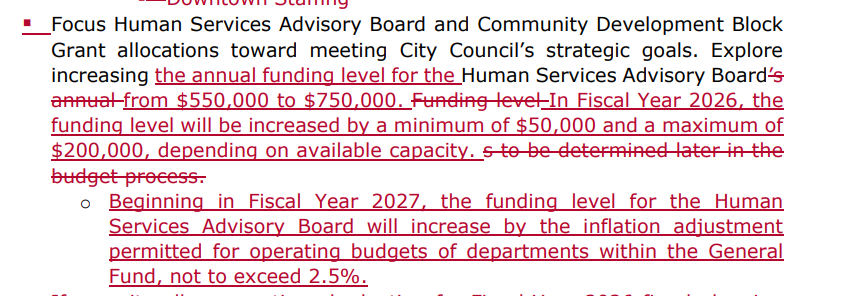
2. Here’s the other one worth paying attention to:

This is what the speakers during Citizen Comment were talking about.

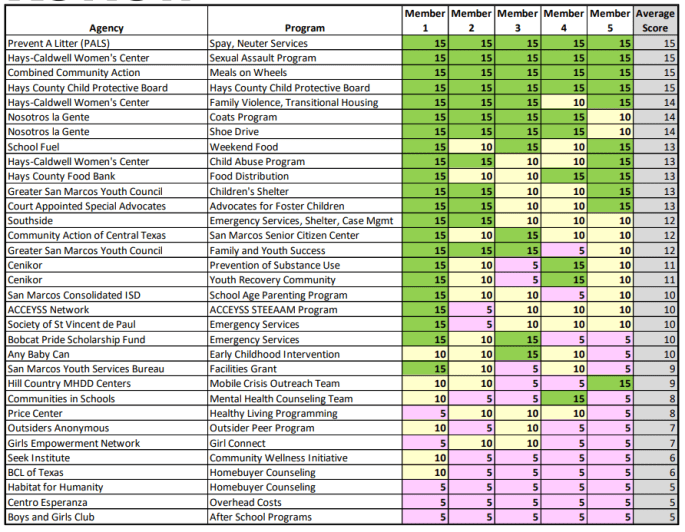
Last December and January, HSAB funding was a total mess. There was too little funding, and Council ended up pitting nonprofits against each other. It was clear that we need to significantly ramp up city funding of nonprofits.

Right now, HSAB gets $550K. Council sets a range of additional funding, between $50K-$200K. When we find out what kind of money we’re getting from property taxes this July, then we’ll determine where we land in that range.

This part makes me extra happy:

Yes!! Peg the HSAB budget to inflation. We do it in contracts with for-profit entities all the time. It should be universal.

(The failure to peg minimum wage to inflation was one of the greatest policy near-misses of the 20th century. Having a federal minimum wage of $7.25/hour is such a mockery.)

Item 21: Cut-and-fill in La Cima

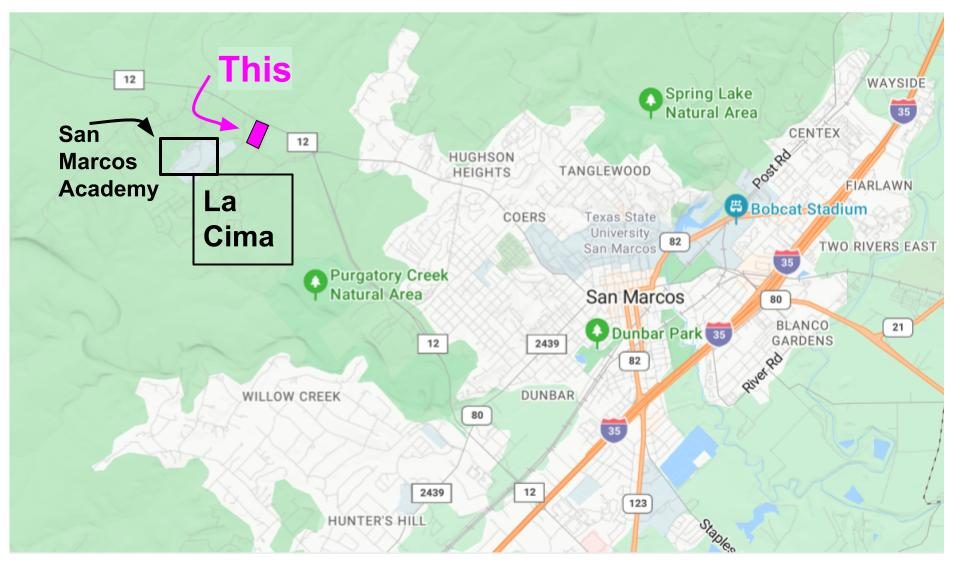
Pedernales Electric wants to build a substation here:

But it’s on a hill. Like we saw last time, it’s hard to build on a hill. So they also want to do a cut-and-fill.

This time, no one is worried about flooding.
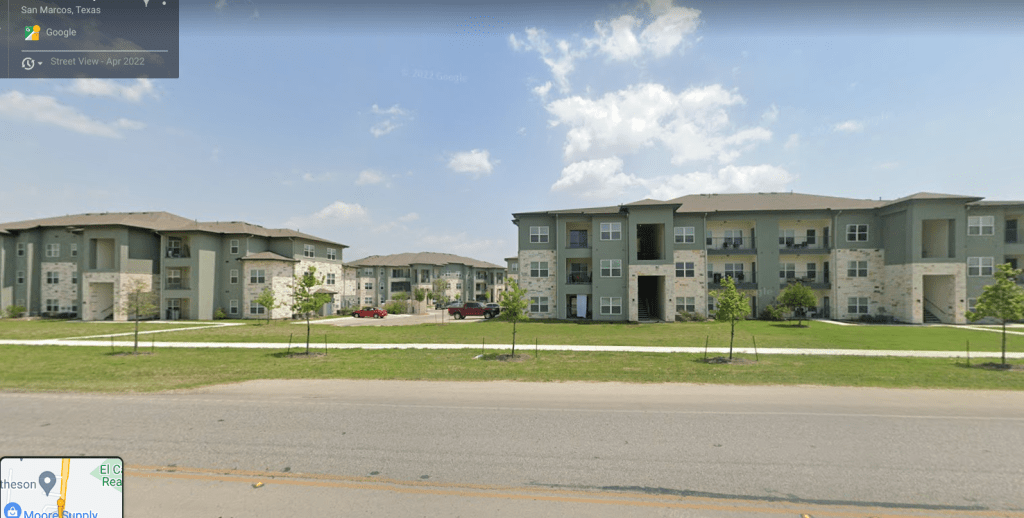
Matthew Mendoza is a little worried that the people in La Cima might have to look at a substation, though.

Staff reassures him that there is another building, and then the La Cima apartment complex, all separating the substation from the houses. So their eyes won’t be hurt by the substation.

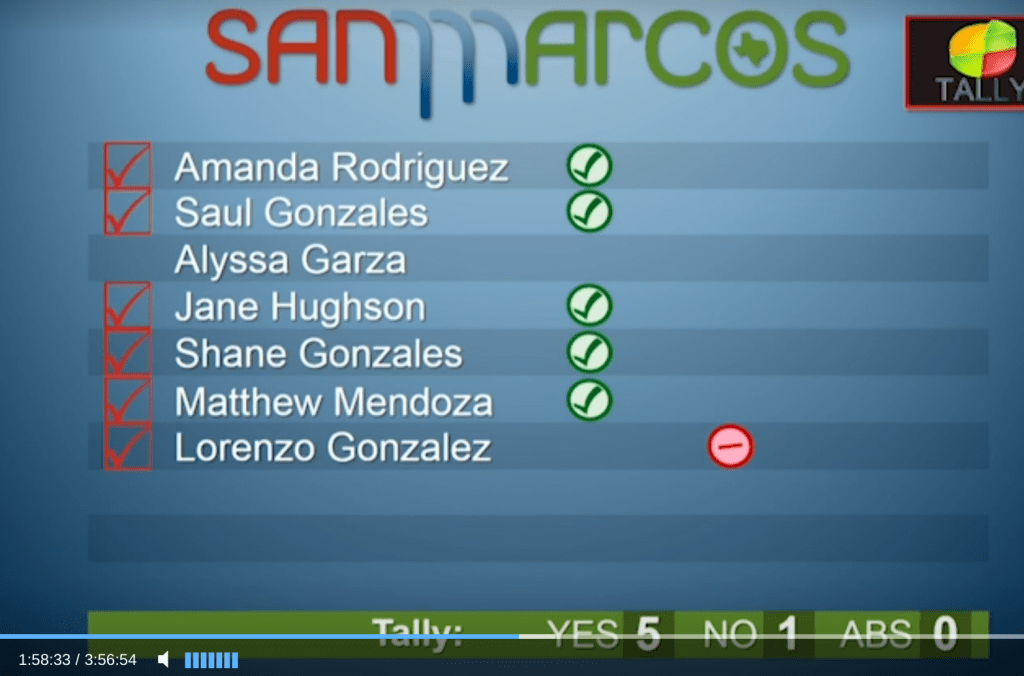
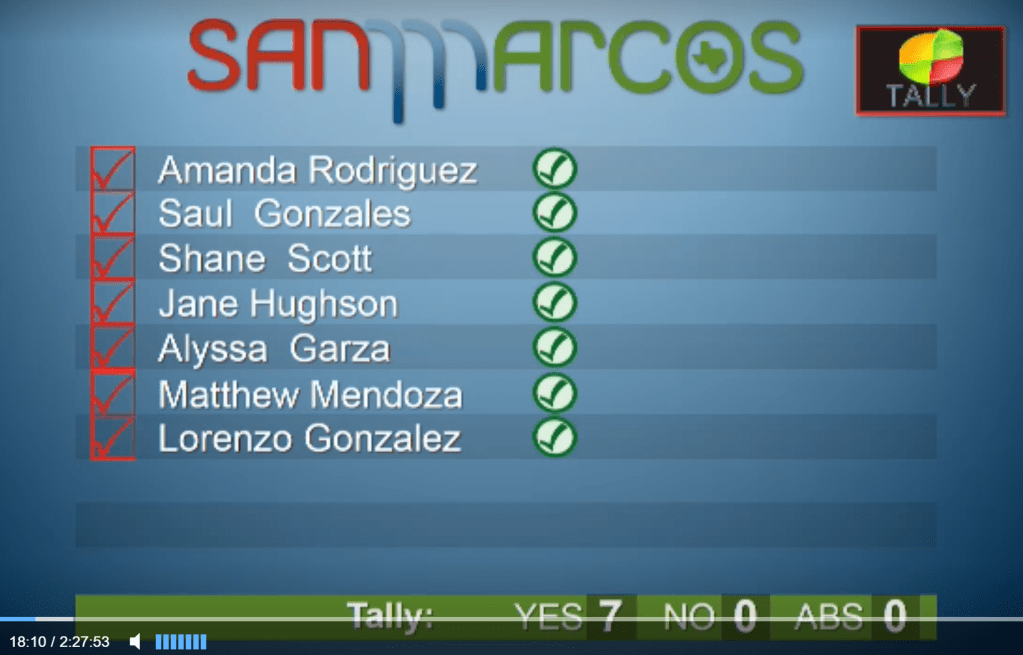
This passes 6-0.

Item 5: Council Compensation

This was so weird. 

Quick Recap: (Full story here.)

Councilmembers get three kinds of money:

  1. Monthly stipend
  2. Travel and expenses
  3. Flex money (either)

Shane Scott proposed doubling the flex money and travel money, and he wanted it effective IMMEDIATELY. Like, something lit a fire under his butt.

Last time, they went in circles forever, but ultimately landed here:

Travel budget

  • There’s plenty of travel money already.  The total council travel doesn’t go over budget.
  • Council members can lend each other travel money if one is going over.
  • If they STILL go over, there can be an extra $15K in a special travel fund that any of them can apply for.
  • AND, they each get an extra $2K for travel.

Flex budget

  • Double the Flex amount from $7.5K to $15K.

In other words: right now, a council member earns $24.9K a year, if they choose to take their flex pay as income. This would increase it to $32.4K.

The item was put on the consent agenda, which means, “Staff thinks this will sail through.” After all, they hammered out all the votes last time.

Jane said nope! and pulled it off the council agenda. She gives a speech about how none of this is needed, there’s plenty of money in the travel budget.  And how we certainly shouldn’t be doing this mid-year.

Amanda agrees on the mid-year part. More responsible to start it with the next fiscal year. She makes that amendment: Delay this until next year’s budget?

The vote: Postpone changes until next year’s budget?

Ok, great.

But then Shane – who started this whole conversation back in December! – says, “Let’s just kill the whole thing, who cares. We don’t need it anymore.” 

(This is when I first thought, “What the hell is happening? Was this whole thing a ploy to get some quick money?”)

Jane sees her chance and makes a motion to kill both the travel increase and flex spending increase.

On the flex spending, Amanda pleads, “But why?”

Amanda has been quite open about having to resign her state job to take this position, and the impossibility of surviving on $24.9K per year.

Jane: “We don’t need it. We already raised it in 2023.”

What she means is that before 2023, council members got $23.4K per year, if they took their flex money as pay. They gave themselves a raise of $1500 then.

Amanda: I agree on the travel. But on the living expense, who here – anyone? – can live on this little?”

Jane: “It’s not supposed to be a fulltime job.”

Amanda: “Fully agree.  But we both know that it is actually a fulltime job.”

Jane: “For some people it is.  Not everybody.” 

Amanda: “Oh trust me, I understand that too. And I wish everybody shared full interest.”

Jane: “I do too.” 

Amanda: “But again, please tell me, who can survive on this?  Would anybody in this room? 

<crickets>

Then conversation dies.  

The key issues is this: Is being a councilmember a fulltime job? We pretend it isn’t, but in order to do it well, it definitely is.

If we pay poverty wages, then council members have three options:

  1. Be independently wealthy or have someone who can support you.
  2. Try not to neglect your council job as you juggle multiple jobs
  3. Live in poverty

This is not how you get the best possible council members. This is how you get mostly wealthy and/or distracted council members.

But anyway, then they vote:

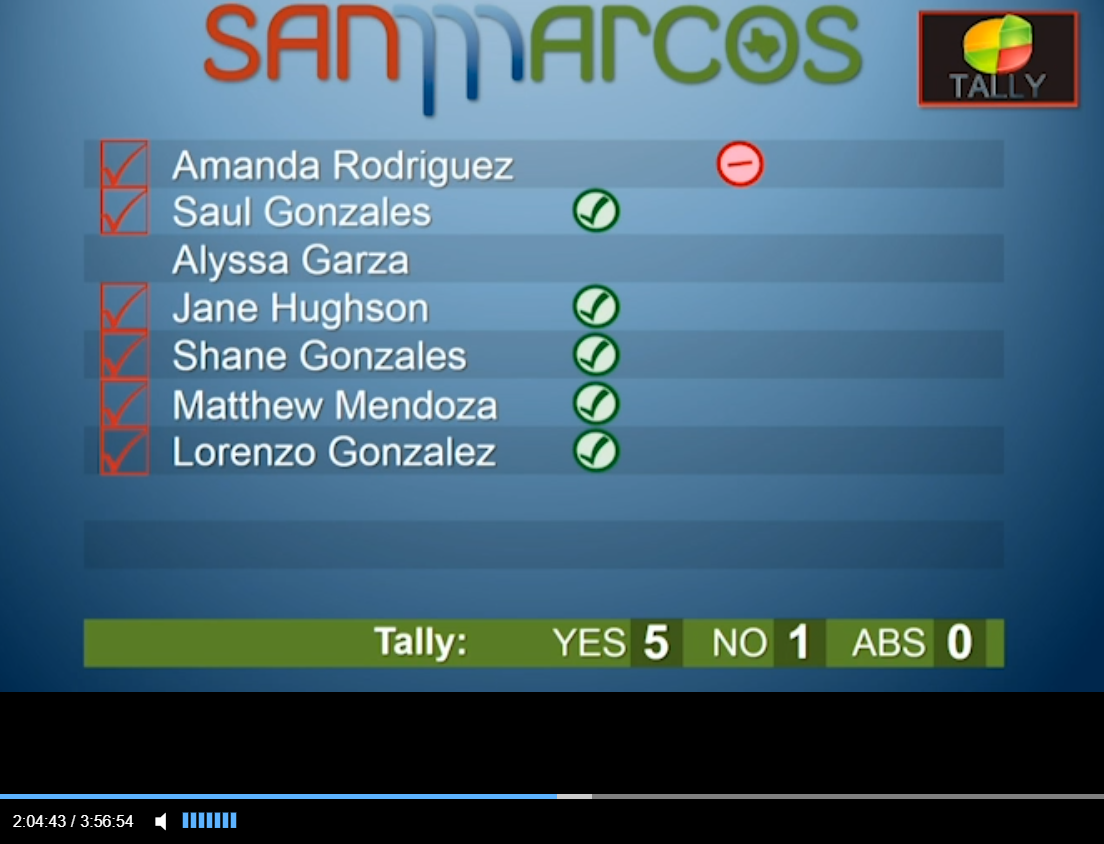
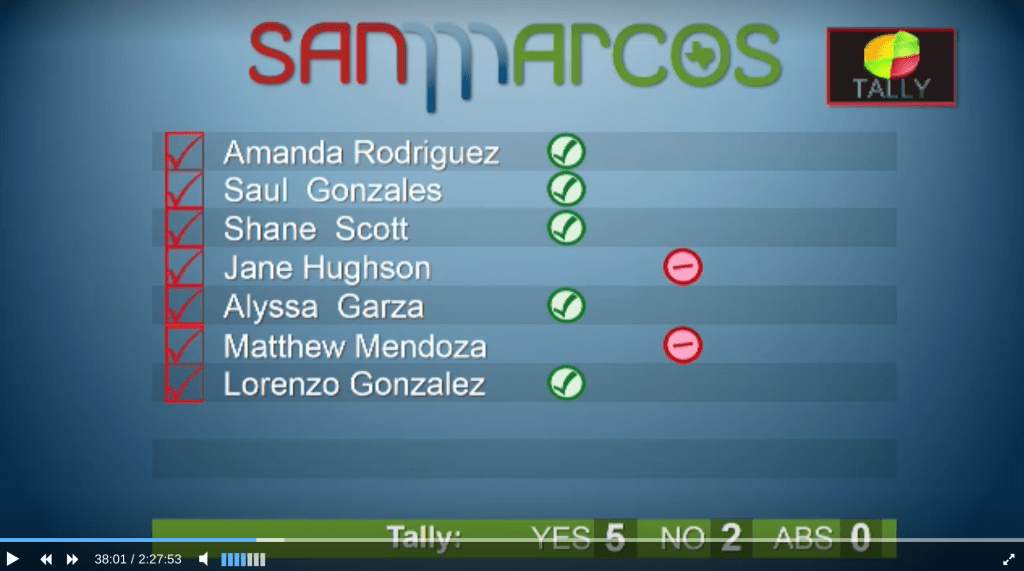
The vote: Should Councilmembers survive on $24.9K per year?

So yeah, no raise.

I’m so baffled.  Two weeks ago, Shane and Lorenzo both thought it was reasonable to increase flex spending, and now they don’t? What the hell happened?

….

Then they vote to roll back the travel funds increase:

This one doesn’t bother me so much. There is plenty of travel money, if you allow people to donate funds to each other.

Bottom line: After all these meetings, everything is back where it started, aside from a special bonus travel fund.  

Clearly I have no idea what happened, but it felt like petty bullshit, to be honest.

….

Item 24: SMCISD stormwater voucher

This is a continuation from last time.  (Full backstory here.)

Super quick background:

Statewide, the legislature is intentionally starving the school districts. This is not hyperbole. Abbott is hellbent force-feeding school vouchers down everyone’s throat. He’s denying funding to the public schools is a way of increasing the pressure on the state legislature to vote for his deal.

Funding hasn’t increased since 2019, but there have been several unfunded mandates that cost a lot. Plus inflation.

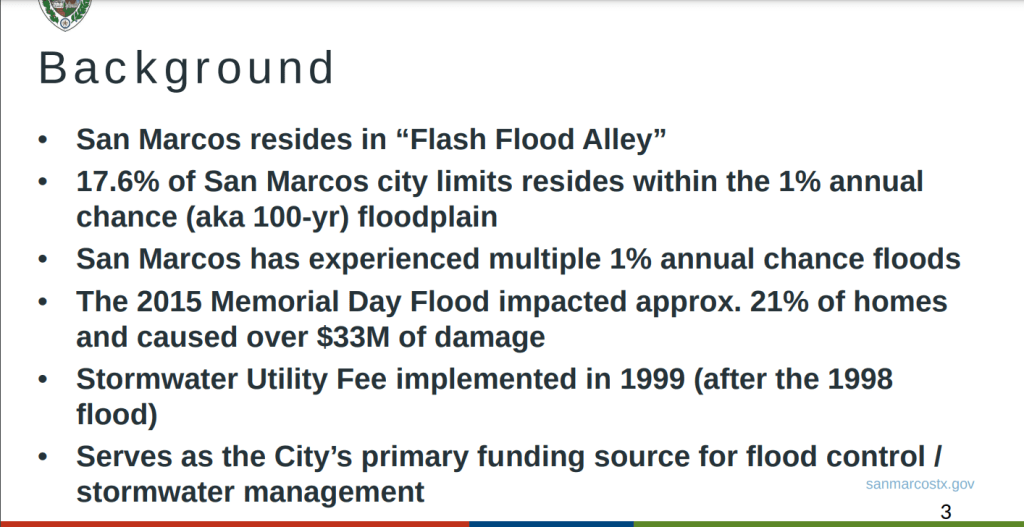
SMCISD is in a $9 million budget crisis. They’ve asked for the city for a stormwater waiver, which would save them about $350K.

Which brings us to today.

First there’s a presentation about the stormwater fund:

Immediately after San Marcos created the stormwater fund, Texas State University asked the State Legislature to grant them an exemption.  They were the very first university in Texas to ask for one!  What go-getters.

After that, all the other universities thought it was a pretty good idea.

Here’s the total list of state-wide exemptions:

So basically, empty lots, lakes, universities, and ….El Paso school district.  Who knows.

The state law says that stormwater fees must be equitable. They go into a fair amount of detail about how we put ours together. 

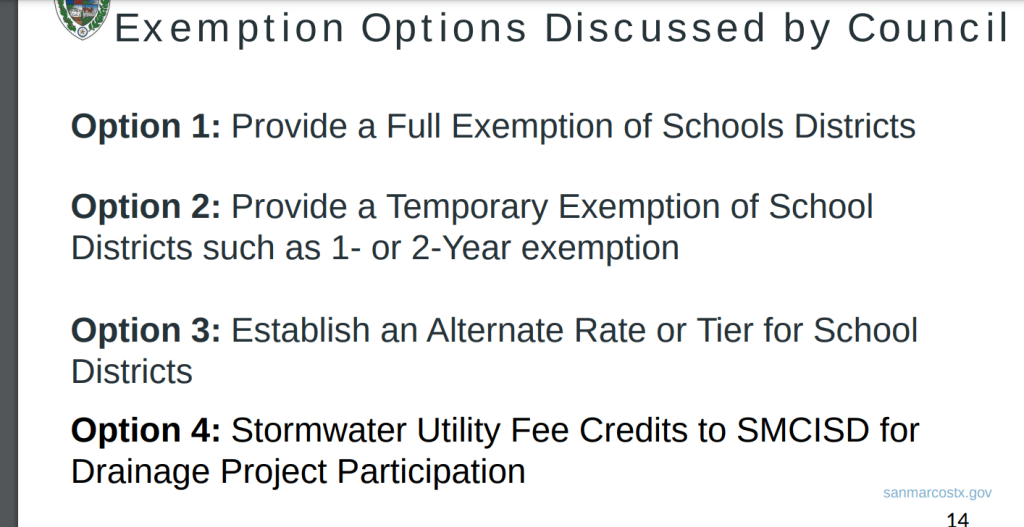
Basically, if we want to help out SMCISD, here are the four options:

Option 1 would cost a lot and open the door to other nonprofits asking for a waiver, too.

Option 2 would cost some, and open the door.

Option 3 might open us up to legal challenges of being non-equitable.

Option 4 is the one that Staff clearly favors. In fact, city staff and SMCISD staff have already met, and they’re both open to this.

Option 4 is about Mendez Elementary. Mendez is located in Sunset Acres, which has terrible flooding. The city wants to build a detention pond on Mendez property, to help with the flooding.
All the council members are on board with pursuing 4. 

The only thing is that Mendez Elementary is being renovated. Until SMCISD knows the new footprint of the building, they can’t donate the land.

(Now, SMCISD has already submitted the Mendez plans to the city for permitting. So the city could literally go look right now at the Mendez plans.  It’s not a mystery. We can see exactly how much space there might be for a drainage pond.)

There’s a long, weirdly circular conversation where Lorenzo and Amanda keep saying, “We should meet occasionally with the school board, just to stay informed on what we’re each up to.”

Jane keeps responding with, “It’s no use.  Alyssa and I keep trying to think of a reason that all three entities – city, county, schools – should meet, and it’s very hard to think of issues that need attention from all three groups.”

Ok?  That’s a different thing?  That’s not what Amanda and Lorenzo are suggesting?

Anyway, they vote for 4. 

Item 25: Redwood/Rancho Vista

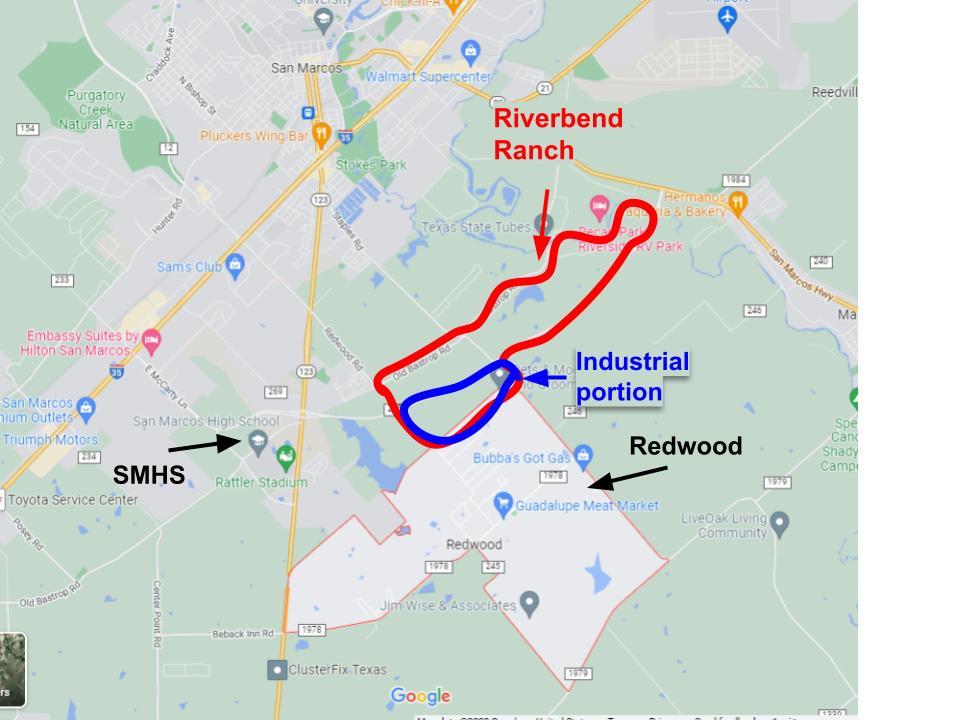
Last time, we discussed this property, immediately north of Redwood and Rancho Vista:

We were trying to figure out if that industrial portion would make flooding worse in Redwood.

Redwood and Rancho Vista have severe septic and flooding issues, which leads to a parasite living in the soil. It’s a big health issue, and it usually only happens in developing countries. But the community is quite poor and vulnerable, so it’s happening here. Any solution is going to be very expensive.

Last time Council tried to have it both ways: “We’ll let this development through, but we promise to take action on Redwood.”

So tonight is that action: A strongly worded letter to Guadalupe County about how the septic issue and parasites is a public health and safety issue, which has been going on for years and years.

Jane suggests that we let them know about the Texas Water Development Board, which has a specific Economically Distressed Areas Program. Maybe Guadalupe County could get some money from there.

City Manager Stephanie Reyes mentions looping in SMCISD – after all, these families go to our schools and are part of our community.

So staff will draw something up, and it will come back.

My two cents: this is fine as a first step, but not as a last step.

Hours 0:00 – 2:73, 2/4/25

Citizen Comment

No one spoke this week.

Moving on!

Item 9: Rezoning some land.

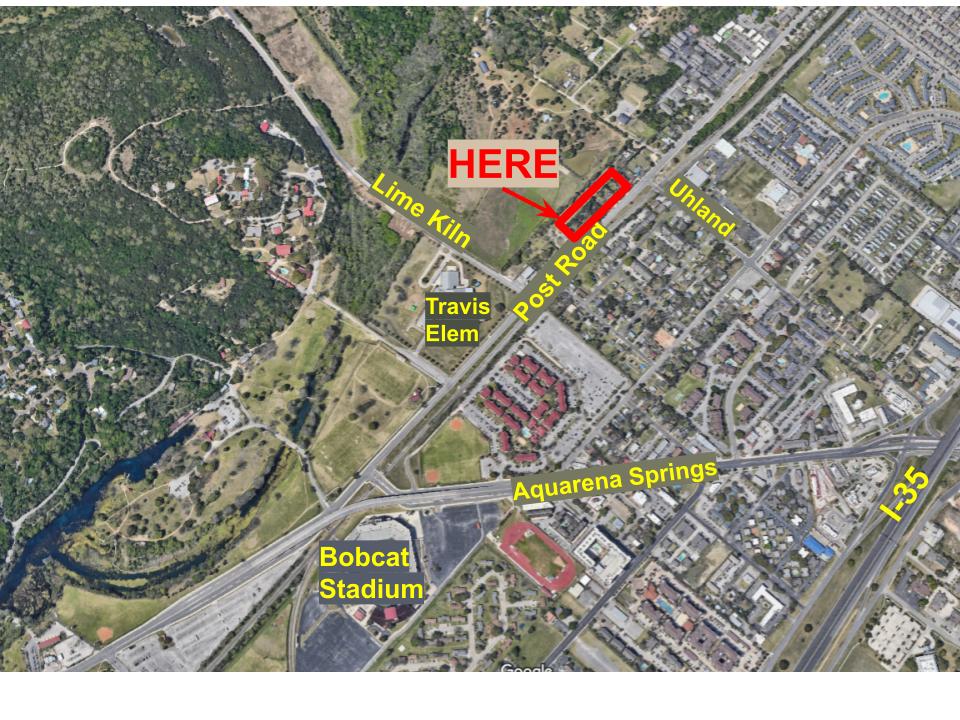
A developer wants to develop this stretch: 

and turn it into townhomes.

Up close, it looks like this:

It includes the old Bismark filling station: 

I went hunting for photos of the old Bismark Filling Station back in its heyday, but came up empty handed. I did find this deep dive on the history it, though.

Q: Are there any concerns about flooding?

Answer: It’s partially in the floodplain, and it is near the headwaters, which is very sensitive. But the land is actually angled so that the water runs away from the sensitive stuff.  The water runs away from other houses on Post Road, and towards the stadium.

Q:  Are there any concerns about buried gas tanks?

Answer: no, the station is too old. They checked the records. They didn’t bury tanks back then.

Q:  Are you going to preserve the gas station?

Answer: We are working with the Historical Preservation Committee on this! Hoping to save the facade and columns, and put it somewhere where it can be memorialized.

Note: This is how you make best friends with Council. Who knows if it will actually happen or not, but Old San Marcos is happy to hear this guy say the right things.

One other note:  

The developer is asking for CD-4 zoning.  He’s saying he wants to build townhomes:

Ok, maybe not quite that beautiful. But maybe like these, near Wonderworld:

which are also pretty cute. (via)

But CD-4 zoning can also mean large scale apartment complexes like so:

When you zone land, you don’t get to pick and choose which use the developer ends up doing.   The developer can do anything included in the zoning.

Now, this particular lot isn’t very big:

So my guess is that he will probably build townhomes or condos.  But he is allowed to sell it to someone else, and that other person can do anything allowed under CD-4 zoning.

The vote:

Great! That’s how I would have voted, too.

Item 6: License plate recognition cameras.

Should the city spend $124K for SMPD to have cameras that read license plates for one year? 

Maybe! We need to unpack some stuff first.

Backstory:

Budgets get approved in September.  But the planning starts nine months earlier.  So at the end of January, Council had a two day workshop where they started laying out big ideas.

They go into great detail on the strategic goals:

Under each goal, Council decides what they want to prioritize for the next year.

On Day 2, they tackled Public Safety. Amanda proposed the following outcome:

  • Establish clear guidelines and protections governing the use of technology to ensure transparency, accountability, and respect for the personal privacy and civil rights of the public.

(Around 3:05 if you want to watch.)

Everyone was in favor of this! It sounds great!

Next: let’s talk about license-plate cameras:

So these cameras that SMPD wants to buy. They are Automatic License Plate Readers, and they read your license plate when you drive by.

The ACLU does not like them one bit:

A little-noticed surveillance technology designed to track the movements of every passing driver is fast proliferating on America’s streets. Automatic license plate readers—mounted on police cars or on objects like road signs and bridges—use small high-speed cameras to photograph thousands of plates per minute.

The information captured by the readers—including the license plate number and the date, time, and location of every scan—is being collected and sometimes pooled into regional sharing systems. As a result, enormous databases of innocent motorists’ location information are growing rapidly. This information is often retained for years, or even indefinitely, with few or no restrictions to protect privacy rights.

Although they do say there are some appropriate uses:

We don’t find every use of ALPRs objectionable. For example, we do not generally object to using them to check license plates against lists of stolen cars, for AMBER Alerts, or for toll collection, provided they are deployed and used fairly and subject to proper checks and balances, such as ensuring devices are not disproportionately deployed in low-income communities and communities of color, and that the “hot lists” they are run against are legitimate and up to date.

Now, what the ACLU really doesn’t like is this particular company, Flock Safety:

Unlike a targeted ALPR camera system that is designed to take pictures of license plates, check the plates against local hot lists, and then flush the data if there’s no hit, Flock is building a giant camera network that records people’s comings and goings across the nation, and then makes that data available for search by any of its law enforcement customers. Such a system provides even small-town sheriffs access to a sweeping and powerful mass-surveillance tool, and allows big actors like federal agencies and large urban police departments to access the comings and goings of vehicles in even the smallest of towns.

And yes, Flock is exactly the company we’re buying cameras from. And it’s not just the ACLU: other folks also don’t like Flock Safety one bit.

Look, ICE raids have already started. (Not as intensely as Trump would like, but they’ve started.) Do we really think this universal surveillance data will be off-limits? It wasn’t off-limits back in 2019.

Sure might be nice to have a clear policy! Maybe we should “Establish clear guidelines and protections governing the use of technology to ensure transparency, accountability, and respect for the personal privacy and civil rights of the public.”

This brings us to Tuesday’s meeting

Amanda makes a motion: Postpone the purchase of the cameras until we’ve established the policy that focuses on privacy and civil rights when it comes to the public. (After all, it was literally five days earlier that Council agreed this is a priority!)

Chief Standridge says, “No worries! We already have such a policy! It’s four pages long and follows all the best practices in Texas! This is what all the departments across Texas are doing.”

I think he’s referring to this: Policy 5.4: Automated License Plate Readers.

Amanda: “I’ve read the policy. Those may be the best practices in Texas, but they’re not the best practices nationwide. Things like data usage, data retention, data sharing – we should address those things, and then we can bring back the vote on the cameras.”

They get into it a little bit, over how long data should be stored. Is 30 days too long? Just right? (That same article on Flock Safety has recommended legal language specifically for this kind of situation.)

“Furthermore,” Chief Standridge says, “this is already underway. We got the first batch of cameras in 2022, and then we got a grant for some more…” he kind of trails off.

Amanda: “The cameras have already been purchased? The cameras that require council approval?”

Chief Standridge: “The Flock representative is here online, they can confirm or deny if the cameras have been purchased.”

Jane tries to smooth it over: “It was probably something like it was initiated because they thought they’d be under 100K, and then it turned out to be over 100K, so they need needed approval!”

Standridge: “Close enough!”

Note: I think it was because of this:

The original contract was not discussed when Council approved it, in April, 2022. Later on, SMPD applied for some grants, and Council didn’t discuss those, either. My guess is that since the grants were in motion, SMPD assumed it was fine to move forward with the cameras.

(This also happened with the Total Bullet Containment System. It had been purchased before Council actually authorized the purchase.)

Back to the conversation:

Jane: I’m game to have a work session on this policy, but I don’t want to hold up the purchase of the cameras in the meantime.

No one else (besides Alyssa) weighs in.

The Vote: Should we postpone the purchase of these cameras?

WHOA!   I was not expecting that, but I’m thrilled to see it!

Items 10-13: An enormous number of appointments. 

The vast majority of the meeting was spent making appointments:

Those are all boards where they appoint community members.

The most public of these is P&Z. P&Z had three open spots. David Case and Maraya Dunn were both re-upped for a second term, and “Rodney” got the last spot.

No one in the meeting ever used Rodney’s last name, and I don’t have access to the applications, so I guess we’ll all find out which Rodney in a few weeks, when he starts attending the meetings.

Item 14: Attendance on External Boards

There are a bunch of committees in the city and county that have a representative from city council.

Sometimes you have one of these external boards with a city council rep, but that council member never shows up to any of the meetings, and sometimes his name is Shane Scott. 

(Specifically at the January 7th council meeting, where Shane found out that he’s been on the Convention and Visitor’s Bureau Board for the past year, and had missed all of the meetings. Shane was kind of sheepish about the whole thing.)(Around 4:18 in this video. It’s pretty funny.)

Jane: Do we want some sort of attendance policy for these situations? Like you can’t have more than three unexcused absences in a row? That’s the policy for the rest of our boards and commissions. 

Everyone is on board. So this will come back around.

Hours 0:00 – 2:10, 9/17/24

Citizen Comment:  

  • One speaker spoke on some one-off issues – closing Cheatham street, lending police for football games, etc.
  • A second speaker talked about the utility rate hikes. Specifically, he told Council that we should have separate rates for rich people.

This connects to a thought I’ve had.  We do kind of have separate rates for rich people!

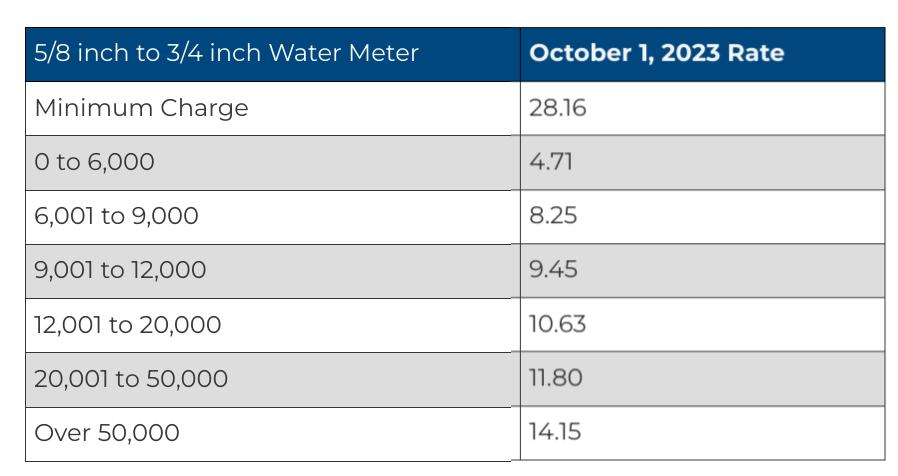
Take water as an example: 

As you use more water, the water gets more expensive. This is good! It incentivizes people to use less water.

Right now, we’re raising utilities 5% across the board. If Council had wanted to, they could have tinkered with these marginal rates. But I bet it gets complicated, fast.

(Electricity doesn’t have tiered brackets like this, though. )

….

Not exactly Citizen Comment, but a general concern from a community member: the San Marcos Housing authority put out a statement saying that they were going to open up the waitlist for housing vouchers on Wednesday morning.

So everyone showed up! Apparently something like 250 people turned in pre-applications for housing vouchers that were supposed to open up on Wednesday morning. A bunch of people even spent the night outside the Housing Authority, in order to be there when the doors opened at 8:30.  There was supposed to be a lottery to accept new applications. 

And…. it just didn’t happen. The Housing Authority did not actually accept any applications.   All the people needing housing just got sent away.

I don’t know what went wrong, but I guarantee there’s a throughline between having chronically underfunded housing assistance for decades, and this kind of mess. And Texas especially relishes underfunding programs for the poor.  

….

Item 1: New City Hall steering committee

Last time we had a big song and dance about the composition of the committee. Should we do things the way we always do them? Or should the DEI coordinator steer us in a more equitable direction?

Here’s what the DEI coordinator says at the beginning of the conversation:

A good general principle is that the composition of your committee should match the composition of San Marcos. So you look at things like race, gender, ethnicity, and try to match the overall population of San Marcos. (As your friendly marxist blogger, I’d toss wealth on that list, too. Socioeconomic status is should be included in DEI initiatives. Poor people are underrepresented!)

Here’s what Council settles on:

  1. Each councilmember will pick two community members to be on the committee
  2. The mayor and two councilmembers will be on the committee
  3. The committee will have some specific roles filled:
    • Someone from P&Z
    • From the library board
    • Someone representing the disability community
    • SMRF representative
    • Texas State representative
    • Downtown association rep
    • Chamber of commerce rep.
    • Two people from Rio Vista neighborhood

So depending on how much overlap there is between 1 and 3, there could be as few as 17 members or as many as 26  members.

The DEI coordinator tentatively pipes up: “The more prescriptive we are with roles, the harder it will be to achieve the DEI goals.” 

What she means is that the Library Board, P&Z, Texas State admin, SMRF, the Downtown organization, and Chamber of Commerce are generally less diverse than San Marcos as a whole.  The more you stack your steering committee with folks from these organizations, the harder it will be to make the composition of your steering committee match with the composition of San Marcos.

Jane misunderstands what the DEI coordinator means, and says, “Inclusion of these partners doesn’t mean exclusion of others! We’re not excluding anyone.” 

She also says (tellingly), “This just follows the pattern of how we do appointments in San Marcos.”

It does follow the pattern! Councilmembers pick people they know and put them on committees. This is how power perpetuates itself.  This is why you have to deliberately not follow the pattern of how we do appointments in San Marcos, if you want change.

The plan is to collect applications, and then have councilmembers select their two special besties from the pool.

Anyone can apply! Would YOU like to give your two cents on the new city hall?  Submit an application here, why dontcha? They’re due in 30 days. (The application is not up yet, but I’ll edit this when it goes live.)

Item 20: Parking by permit

The good people of Sturgeon are fed up with non-residents parking on their street.

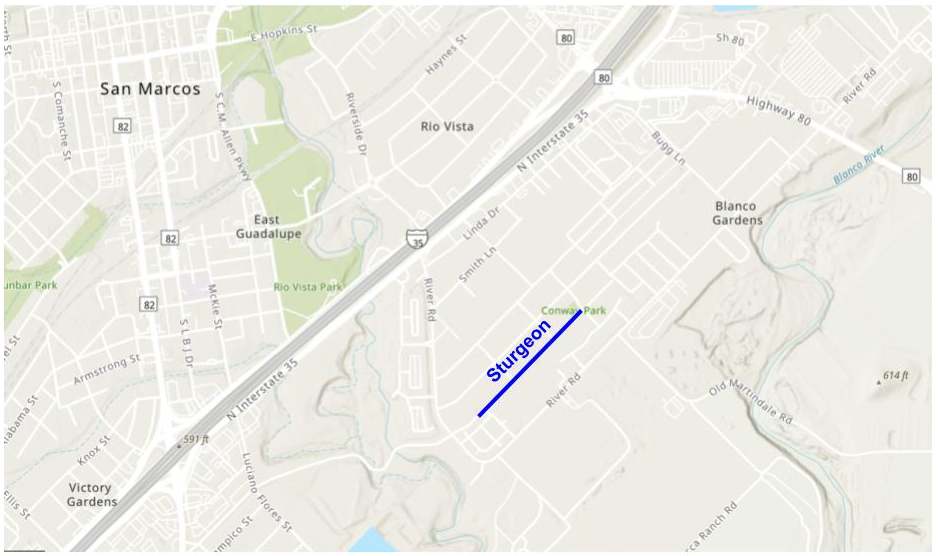
Sturgeon is this street, in Blanco Gardens:

They filed a petition to make the street permit parking, so only residents could park there.  This is the area they want permitted:

My guess is they’re either sick of college students or river-goers parking there.

To be honest, I hate this kind of thing.  Everyone pays for roads!  We don’t own the curb in front of our houses. It’s not yours.

Occasionally, there is an extreme situation puts an undue burden on residents.  I can understand that. But here? Seven of those parcels are empty! Why are we banning the public from parking in front of empty lots? It makes me cranky.   (All the tan lots are empty in the diagram above.)

I just don’t like the privatization of something that’s public.  Public spaces belong to the public, end of story. 

Items 21-23: 51 acres off McCarty and 123

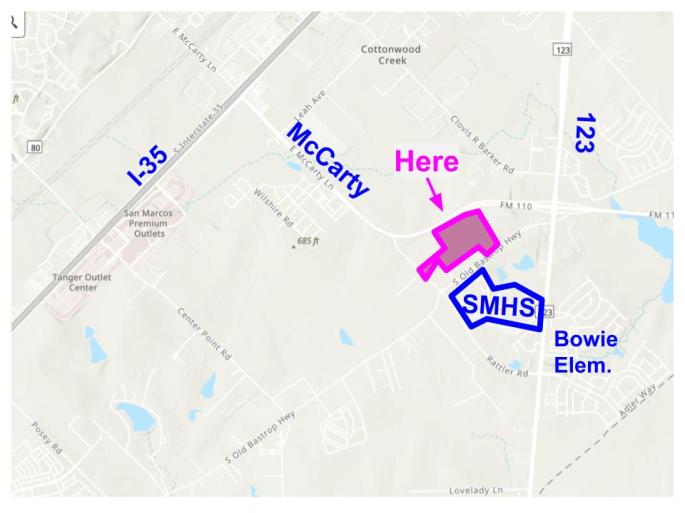
This bit is getting annexed and zoned:

It’s right by the high school, here:

Everybody knows we need more commerce on the east side of town.  For years, residents have asked for this.

(Quick sidebar: But don’t forget! Council removed commerce from Cottonwood Creek here, and then two months later Council removed commerce from the giant future development on 123 here. For Cottonwood Creek, residents wrote letters and showed up to say that they wanted to keep the commercial! And yet Council killed it anyway, because the developer asked nicely.)

Anyway, in general there’s very few stores east of I-35. These guys are committing to putting commerce on this corner:

It’s being zoned Commercial.

The rest of it is being zoned CD-4:

CD-4 is a Character District. That means that city staff is really hoping it will look like this:

Little shops mixed with apartments, and oodles of charm.

But it actually usually looks like this:

Not terrible, and the housing is needed, but not quite as charming as Sesame Street.

….

You know what would be fun? Dusting off our five criteria for zoning! C’mon, guys, let’s see if we agree with our councilmembers.

1. Price Tag to the City: Will it bring in taxes that pay for itself, over the lifespan of the infrastructure and future repair? How much will it cost to extend roads, utilities, on fire and police coverage, on water and wastewater?

Who knows! No one ever provides this information!

But my educated guess is yes.  The main problem is with single family detached homes – they don’t pay enough taxes to cover their roads and services. Since this will have apartments and commercial, it should be fine.  It’s also along existing roads with existing utilities and coverage areas.    

2. Housing stock: How long will it take to build? How much housing will it provide? What is the forecasted housing deficit at that point? Is it targeting a price-point that serves what San Marcos needs?

We also have no info here! But it doesn’t sound like giant $500K McMansions.  It sounds like apartments plus stores.  

3.  Environment: Is it on the aquifer? Is it in a flood zone? Will it create run off into the river?Are we looking at sprawl? Is it uniformly single-family homes?

Environmentally sound.  Not near the river.  Not sprawl. Not all single family homes.

Social: Is it meaningfully mixed income? Is it near existing SMCISD schools and amenities?

I doubt it will be mixed income.  It is near schools, and hopefully near amenities. 

The San Marxist Special: Is it a mixed-income blend of single family houses, four-plexes, and eight-plexes, all mixed together? With schools, shops, restaurants, and public community space sprinkled throughout?

I don’t know how charming this will be.  We can hope.

So overall: I approve. It seems more good than not.

Council does, too. It all passes 6-0.  (Shane Scott is absent.)

“YAY COMMERCE!” council cheers.

Items 24-27:  All the budget and tax rate final details. (Discussed here and here previously.)

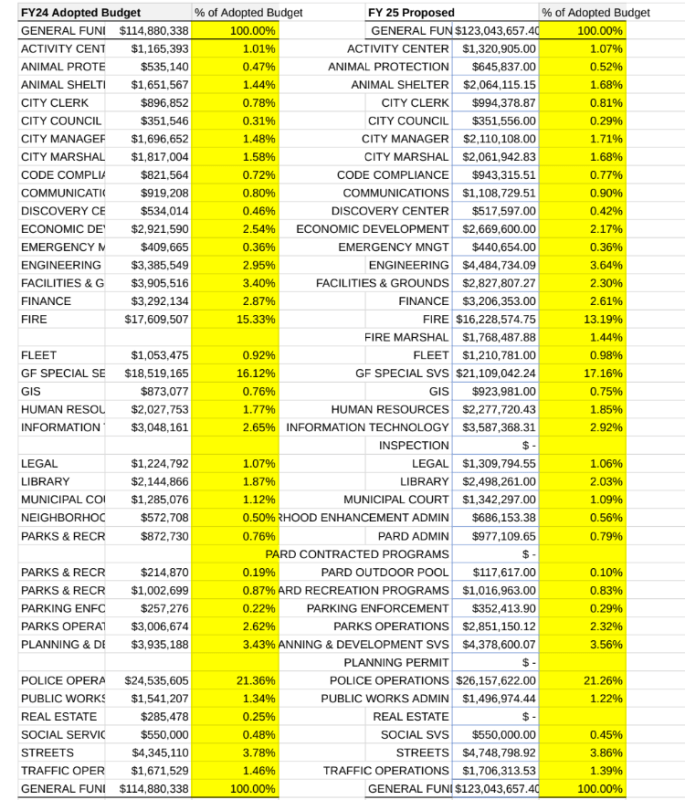
First things first! The good people at City Hall were able to give me the General Fund breakdown.  

I put together this side-by-side comparison for last year and this year:

Budgets are complicated. I don’t have any great takeaways here.

Next: We’re taxing ourselves less than we thought we were. We made an error in an obscure tax computation, and just now fixed it.

Here’s the quick version:  You’ve got your existing taxable buildings, and you’ve got your new builds.  Texas state law cares about the total amount you’re getting each year from the existing taxable buildings. (So you’re ignoring tax revenue from new buildings, for now.) 

Is the total revenue from existing buildings going up or down?  Sometimes it goes up because you raised taxes.  Other times it goes up because your housing prices are going up.  Either way, you’ve got to jump through some extra hoops if that total is going up.

We drew up our budget, and we thought it was going up, but…. <drumroll> it turns out it’s going down!  Hooray?  Since we didn’t change our tax rate, that means home values are falling.  

(Jude: THIS IS A REALLY BIG DEAL! THIS NEVER HAPPENS!

Mark: IT’S THE GROWTH!)

….

You know me: I just always have to rant a little bit about taxes.  (I swear this will be a very tiny soapbox.  Two minutes, tops.)

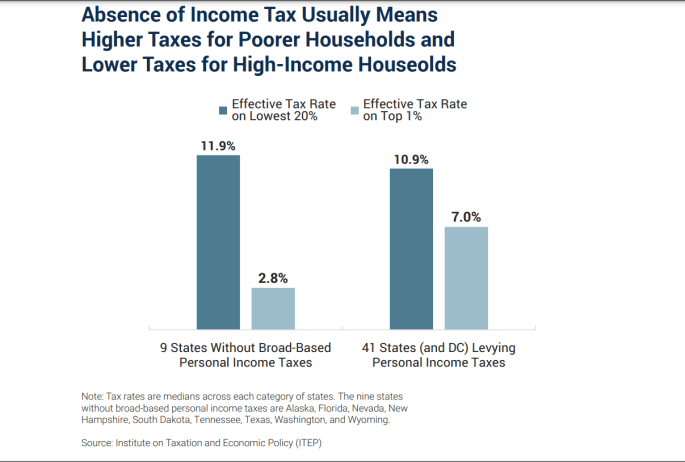
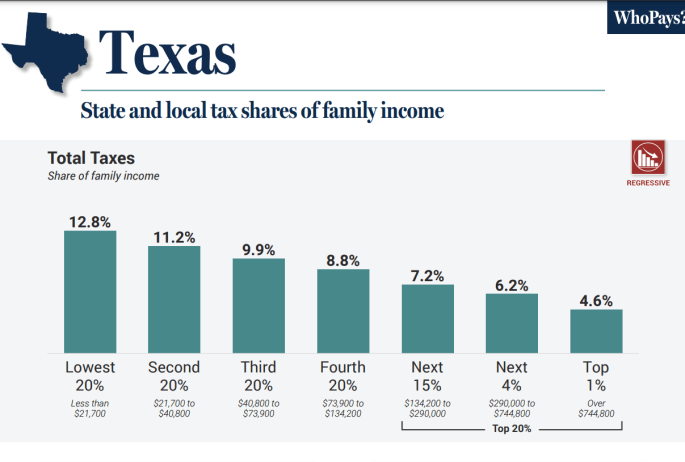
Taxes are good! That’s how you fund your government, and take care of your community. The problem is that we won’t tax wealthy people in Texas. First off, the poorest people are paying the most taxes:

And this is worse than in other states!

Notice that Texas is one of the states on the left part of that graph.

People complain about high property taxes, but those aren’t the unfair part.  The unfair part is the sales tax.  (Both state and local.) Sales taxes really are the worst! Poor people end up paying a much higher percentage of their income than wealthy people.  Literally, it’s capitalism for the poor and socialism for the wealthy.

End rant! I promised you I’d keep it short.

Anyway: only one person speaks at citizen comment and nothing gets debated.  The end! We have a new budget and next year’s tax rate.

The vote: 5-1.  Alyssa Garza votes against everything, presumably because of the utility rate hikes.  

Item 28: Mowing, landscaping, and litter around city buildings. It is a giant task. 

We contract out parts of it to Easter Seals of Central Texas, to the tune of $1,432,702.54.

Item 29:  Purgatory Creek Channel improvements

We had a whole workshop all about the Purgatory Creek channel improvements last time! This meeting, we’re kicking off $3,281,773.35 towards engineering for Phase 1.  

Saul Gonzales asks, “There’s a bunch of stagnant water in the side channels through Dunbar. Will this help with that?”

Answer: Sort of yes! Part of the project is raising some of the low-water crossings.  That is a major reason why water can’t drain downstream.  But also sort of no! This is supposed to recreate natural channels, and they do pool some. 

The city applied for grants to cover a lot of the costs. We should find out next month if we get them. If we get them, we’ll start construction next year.

….

Item 32: Filling a bunch of vacancies on different committees.

There was one moment that ticked me off.   There’s a vacancy on the Animal Shelter Advisory Committee. We only had one application. 

Matthew Mendoza pointed out that on the application, this volunteer stated that they have only lived in San Marcos for two months. Matthew is uncomfortable with this, and Jane agreed.  Matthew likes it when people have lived here longer. They decided to re-open applications and see if anyone else applies.

GUYS! Stop this rudeness.  First off, you should be welcoming to new people.  

Second off, if this were a vacancy on P&Z or the new City Hall steering committee? Sure, require 5 year residency.  You want people with some roots and community background. (I guess.) 

But that’s not this.  This is the ANIMAL SHELTER.  A new person moved to town and wants to volunteer their time to help the doggos! We should be appreciative, but instead we’re crapping on them for not having roots in the area.  That’s dumb.

Item 33: What night will city council meet, on election week?

The election is on a Tuesday. You don’t want to hold a council meeting the same day as an election. We don’t want to get in the way of anyone voting.

So should the council meeting be shifted to Monday or Wednesday? Historically we switch to the Monday. But Jane Hughson is suggesting that this year, council should meet on the Wednesday instead.

I want to emphasize two things:

  • When I say that Jane is good at details, this is a perfect example of what I mean.  She explained her thinking: “Suppose I am a community member who doesn’t know that the meeting was moved, and I show up on Tuesday.  If the meeting already passed on Monday, then I’m out of luck.  But if the meeting is not till Wednesday, I can come back tomorrow.”  

This is really thoughtful and detail-oriented.  Jane Hughson is unusually good at this sort of thing.

  • It’s worse for me, your friendly blogger.  I need every last minute to crank out these posts!  If the meeting is on Wednesday, then I get crunched, which gives me a sad. But in my heart of hearts, I know Jane is right. 

Hours 0:00 – 5:18, 4/2/24

Citizen comments:

Let’s organize this by topic.

  1.  Calling for Council to pass a resolution for a ceasefire in Gaza.

There were 9 speakers on this topic.  That’s a LOT!  Especially because different activists have shown up pretty much every meeting since January.

One speaker said she’d met with Mayor Hughson about this. Apparently Jane’s response was, “What good can little old San Marcos do?” and worrying over internal division.  It’s easy to see where Jane is coming from – why bother going out on a limb, when it doesn’t benefit the San Marcos directly? 

But the thing is, it does matter to people who live here – they’re showing up and telling you this, over and over again – and they’re correct that US taxpayers are contributing towards this is a horrific bloodbath. The reason that cities should call for a ceasefire is to amplify the voices of its citizens towards the federal government. (It’s not just San Marcos. 100 cities have done so already and here’s a partial list from February.)

And look: the grassroots pressure is working – Biden’s relations with Netanyahu are getting increasingly frosty.  It’s going extremely slow, but Biden is responding to public pressure. 

Here’s the other thing: ignoring this many speakers is a REALLY bad look.  Why not call for a ceasefire? It’s very easy and respects the voices in your community. 

……

Fast-forward six hours. It’s almost midnight and everyone is tired. At the very end of the meeting, there was one person left for Q&A. She asked Council, “Would you vote yes for a ceasefire resolution, if it were before you right now?”

Alyssa Garza said yes, of course.

As the question hung in the air, the lawyer spoke up and said something like, “This item is not on the agenda for discussion, and it’s most likely a violation of the Texas Open Meetings Act if you all discuss it in public, without it being posted with advance notice so that anyone can attend.”

Jane Hughson said she’d wait to discuss it until it is properly on an agenda. (Guess who controls the agenda?)

Shane Scott shrugged and said sure – he’d sign anything that has the word “peace” in it.

Mark Gleason said he’d vote no, this is a local government and it’s a waste of taxpayer money and everyone’s time to weigh in on international matters.

Saul Gonzales, Jude Prather, and Matthew Mendoza just stayed quiet, and let the moment pass.

  1.  One speaker talked about civil discourse, and how it’s deteriorated. The claim was that pre-social media, speakers used to hug and mingle in the hall, and then put their differences aside after they spoke. 

    But now they get skewered ruthlessly online.  It’s very nerve-wracking to talk at City Council, and the rude treatment online doesn’t help. Threat of retaliation, intimidation, vitriol, even from people you might otherwise agree with. We should support the people who speak up at council and respond civilly.

So I am probably part of the online crowd being referred to here? I feel ambivalent about this.  

It does take courage to speak at city council meetings! We need people in the community willing to step up and present their point of view.  If I’m over here jeering and mocking from the cozy sanctity of my blog, it could make people less likely participate.

But on the other hand, speakers are advocating for a particular policy outcome.  They are trying to tip how an issue plays out. That affects other people.  If I think they’re peddling crap, I want to explain this to my readers, because I’m also advocating for particular policy outcomes.

(Ok fine, but do I have to be so mean about it?  I try not to be mean exactly, but it’s kind of lifeless and dull to write a blog without any kidding around. But I do try to stick to ripping on people’s positions and arguments, and never make personal attacks.)

  1. Lindsey Street apartments.  This is what we’re spending nearly all the meeting on. Let’s not make that part even longer than it needs to be.

Items 8-11: Those dang Lindsey Street Apartments. 

Quick backstory:

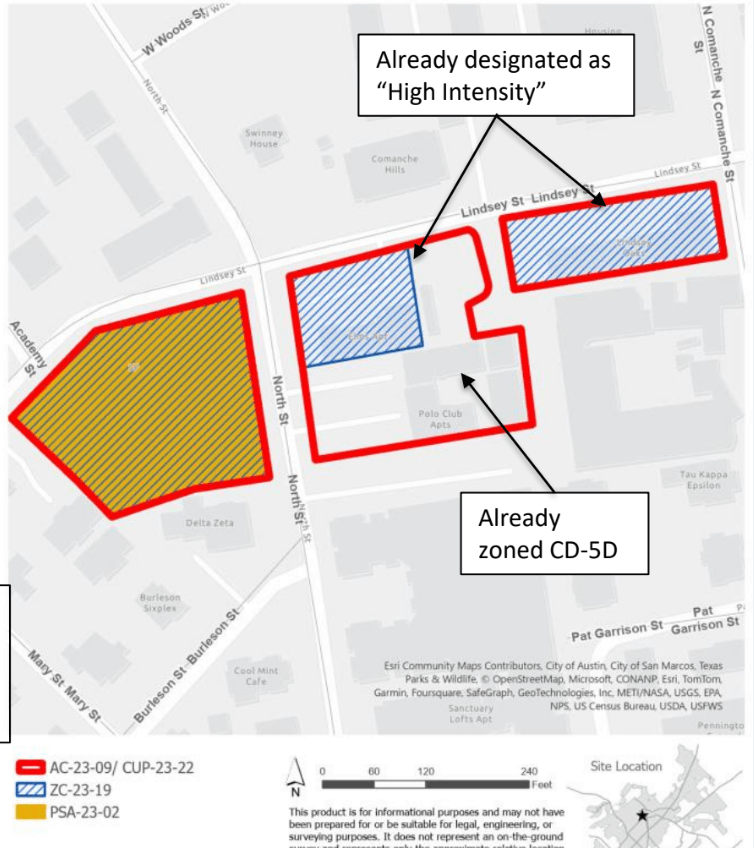
Should we allow student apartments here?

The street dividing the two pink parts  is North Street, and it’s also the official boundary for downtown.

So we end up having separate conversations about the West Half, the pentagon on the left, and the East Half on the right.

What did P&Z say?

For the West Half: P&Z said “Get outta here, ya punk.”  No to everything that the developer asked for. (Discussed here.)

For the East Half, P&Z hedged:

  • They agreed to rezone it CD-5D, instead of the mishmash of antiquated zonings that we don’t use any more.  
  • They agreed to permit it for Purpose-Built Student Housing.
  • They said no to 7 stories of height.  

Last week, Council discussed the property west of North Street, but didn’t vote.

The Citizen Comments:

Look: my whole shtick is that I care about all the little San Marcos issues, right? Every two weeks I get down in the weeds with you. And yet …I just don’t care about these apartments.  At all. I just don’t. I can’t muster any enthusiasm either way. 

But other people do! So let’s get into it. First, public comments:

Arguments that I just don’t get:

  • Student housing is full of mold, foundational issues, pest infestation, water problems, and other maintenance issues. Complexes won’t address these issues.
  • Halt any developments that might worsen gentrification in San Marcos.
  • Do not build more student housing without resolving the existing problems of student housing.
  • RBB leasing process is exploitative because students view an immaculate show apartment and not the actual apartment that they end up leasing. When students move into their actual shitty new digs, they lack recourse. They must document every issue within 48 hours or be held liable. This is predatory and manipulative.
  • RBB undermines student retention at Texas State.
  • 90% of the leasing-related conflicts that go to the attorney for students at Texas State involve RBB. [Note: you can’t evaluate this claim unless you know the percent of Texas State students who live in RBBs.]
  • Roommate matching programs are problematic. Sometimes students get placed with families.
  • Students are asked to sign leases up to 10 months ahead of time. This is predatory.
  • Housing is a human right. Therefore we are calling for a 5 year moratorium on RBB housing. This would allow us to focus on fixing the existing problems.
  • Restart the city subcommittee on student housing.
  • Implement a variety of housing options for low-income residents.
  • Invest in code enforcement.
  • There is a housing shortage for students and rents have risen 40% from pre-pandemic levels.
  • This is a Texas State problem, not a San Marcos problem.
  • We are overbuilt on student housing. There are 45 student complexes in town. If you crunch the numbers, we have 20,000 RBB bedrooms, and only 13,000 students trying to find off-campus housing. The further away from campus you get, the more vacancies there are.
  • There is a housing shortage for students and rents have risen 40% from pre-pandemic levels. (I don’t understand how this is an argument against.)
  • Riding shuttles isn’t that bad.
  • This is just like the Blackland neighborhood in Austin.

Look, I’m not trying to be difficult here. I’m just mystified by the arguments above. A lot of them are legitimate problems that need solving. But voting against this complex doesn’t solve any of them!

I suppose the argument is that Council should vote “no” as a protest vote? But against who, themselves? They already have the power to prioritize these issues. You can just directly advocate for council to tackle these issues.

Here’s our city website on tenant resources. Council could spend a lot more money supporting tenants, enforcing code, and combating delinquent leasing agencies and landlords.

Arguments that at least seem relevant to me:

  • Do not displace residents who are currently living in affordable housing.
  • This will be a domino effect. If this is approved, then next will be the land next it it, then next to that, and eventually it will cross Moore street and eat away the historic neighborhood.
  • There have been occasions when apartments weren’t finished being built, but they’d already leased units to students, and so when August came around, the students had nowhere to live.
  • This will be sold to the University immediately, and we’ll lose the tax revenue, just like we did for Santuary Lofts and Vistas.
  • Historic houses need preservation.
  • Traffic and parking will get worse
  • Flooding will get worse

The city and the developer end up working out conditions that sort of address most of these. We’ll discuss this further below.

Arguments in favor:

  • we have student housing, but not enough within walking distance of campus. All the complexes close to campus are full.
  • Good spot for students
  • Tax money is nice.
  • They’re willing to make concessions on some of those points above.

[Technical note: Jude Prather recused himself last week.  Since then, he checked with the lawyer and with the Ethics Review Committee. Everyone gave him a thumbs’ up to participate with a clean conscience. So he’s back in the game.]

Council dives in:

Jude: I’m all in! What a kind and generous developer! I love it.

Saul: Can you guarantee that you won’t turn around and sell this to the University?

Developer: I talked to the bank.  They won’t guarantee my loan if I sign something that says I won’t sell it. The reason is that if I go bankrupt or die or something, the bank wants to be able to sell to the highest bidder.  But they said that they could give me 5-7 years. For the first 5-7 years, I could sign something agreeing not to sell to any entity that doesn’t pay taxes. 

Saul: I’m worried about traffic.

Developer. We did a traffic study.  Students work weird hours at jobs like serving and bartending, and walk to class, so they’re actually not contributing to rush hour traffic.  They don’t tend to have 9-5 jobs. 

Saul: Is this going to be affordable?

Developer: Not really. But there are about 4-5 families that currently live there, and I could extend affordable leases to them in the new building. 

Matthew: I protect the single-family neighborhoods.  My constituents keep telling me “keep the students way over there!”  And students deserve options!

At one point Matthew says, “I never feel right about denying anybody a place to live.”  Can we put that on a t-shirt for the next time he starts talking about occupancy restrictions?!?


“I never feel right about denying anybody a place to live.”

Matthew Mendoza, 4/2/24, 1:53:55

Mark Gleason: This doesn’t encroach on the historic district. It’s a great place for students. The tax dollars will help.  He’s on board.

He asks if we can improve some of the sidewalk gaps in this area, while we’re at it? This is a good thought!

Finally, Mark’s angry that people invoke “flooding” as a weapon to tear down projects they don’t like, because it cheapens the real experience that he and so many others went through. Flooding is not an issue here, because it’s already completely paved. Making it higher doesn’t change the flood-math. (This is correct.) However, speakers kept bringing up the flood risk throughout the night, and eventually Mark lost his temper and snapped at them.

Jane Hughson: Can’t bring herself to do CD-5D west of North street.  What about a lesser zoning like ND4? CD5?

Answer: ND4 has a lot of restrictions. Their architect couldn’t get more than 55 units in.  CD-5D allows for 100 units.

How about CD5? It’s nearly the same as CD-5D, but it doesn’t have the extra D, which literally stands for “Downtown”. This allows Council to say that technically, they didn’t enlarge downtown. They just switched to the non-downtown kind of high intensity zone.

They settle on CD-5D on the east half and CD-5 on the west half. There are some differences in design standards and parking requirements, which we’ll get to in a moment.

….

For a five hour meeting, remarkably little happened. It was incredibly repetitive. So I don’t want to lay it out chronologically because I’d put myself to sleep. Let’s see if I can boil this down enough.

List of Concessions

Tentatively, here’s what the developer is agreeing to do.

  1. The development would be on the rental registry.

This came from P&Z and gets no discussion. No problem.

  1. There are two moderately old, cute houses and one very cute old house on the west side:

The developer is planning on having them moved elsewhere.  Right now they have two parties that are interested in relocating them. 

If both of those fall through, the developer agrees to a 1 year demolition delay instead of a 6 month demolition delay, to give time for another person to come forward. 

3. All the normal code requirements still apply. This is normal.

4. Parking, part 1.

Should a parking space be included in your rent, or should we allow them to charge an additional fee for parking?

The argument goes like this: in places like The Parlor, students don’t use the garage because they don’t want to pay a monthly parking fee. Then they clog up all the parking spaces that the local businesses need for their customers.  Whereas if the parking garage is already included to residents, then students will use the garage and get out of the street spots.

The developer has a ridiculous argument: we don’t want to disincentivize students who may not want to bring a car to campus!  Because we’re environmentalists!

The actual reason is that it drives up their rates, of course, and gives them a competitive disadvantage. Council votes and lets the developer off the hook on this one.

5. If the place is pre-leased and construction isn’t done, you have to provide housing and let tenants out of the lease.  (This is true for all new construction, a change we implemented because it has happened before.)

6. Parking, Part 2.

How many parking spaces should they be required to build?

The East Half is CD-5D. In that zone, you have to build 1.05 spaces per bedroom. The West half is CD-5, and in that zone, you have to build 1 spot per unit, which is way less.

If you’re building a parking garage, each space costs $30K (according to the developer) so they want to provide as little as possible.  They were already discussing parking breaks, before CD-5 was on the table.

Now everyone’s going to crunch the numbers, and finalize this next time.

  1. The CUP will expire in 3 years if they don’t make progress. (This is also standard)
  1. The complexes will offer both Rent By the Bedroom (RBB) and conventional leases on both sides.

Jane asks: Will the conventional leases be priced less than RBBs?

In other words, if you’re charging $1000 per bedroom, and $3000 for a 3-bedroom apartment, you’re not actually offering a conventional lease that anyone will ever sign.  

Developer: Of course we wouldn’t do that! Of course I am just saying random stuff and who knows what I’ll actually do!

  1. They have to build to the silver level in the LEED green building program.
  1. On displacing current tenants and tearing down affordable housing:

Current tenants will given 6 months advance warning .

Up to 5 families will be given a comparable rent in the new development.  (Of course, they’ll have to find other housing for the 3-4 years, while it’s being built.)

12. West of North Street: 

They will cap it at 4 stories. There will only be 1, 2, and 3 bedroom units. At most 80% impervious cover on the ground.

This is all an effort to make the west half less student-y and more general public.

Typically in student housing, there’s one bathroom per unit. In non-student housing, there isn’t. Jane Hughson asks what bathroom ratio he’s thinking for the west non-student side? The developer admits 1 bathroom per bedroom. (More clues that this is just all going to be student housing. Which is fine with me.)

13. On selling to Texas State:

Developer will not sell the property to a non-tax-paying entity for 7 years. The clock starts running at approval, not occupancy.

14. West of North Street will not be designed and marketed to students. It is not permitted as Purpose Built Student Housing. Students can obviously still live there, but the developer has to pretend that it’s regular housing.

…….

HOWEVER! This list of goody concessions is only available to Council if Council agrees to let him go up to 7 stories on the east side. And P&Z said no to this.

What would this look like? 

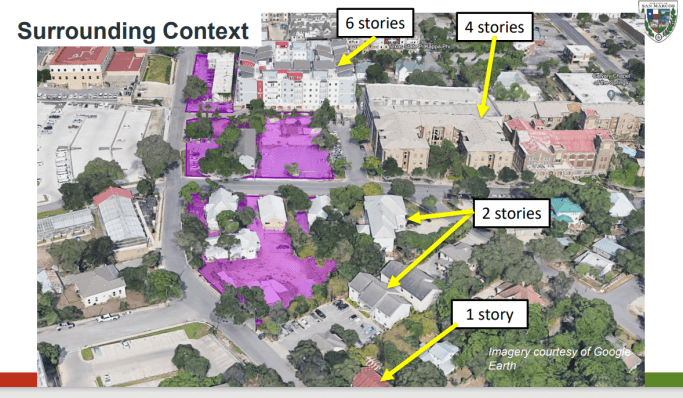
Here’s the city staff’s slides, showing the heights nearby:

That first one is if you’re standing at Texas State, looking south.

Here you’re standing on the west, looking east. Campus is on the left.

This is similar – you’re standing southwest, looking northeast. Campus is on the top left corner.

Here’s the developer’s mock-up of a 7 story building:

This is the view if you’re standing on the west, looking east, with campus on your left again. Currently the 5 story mock-up in the foreground will actually be 4 stories.

I thought Council would balk at the 7 stories, but they zipped through it and passed it, 5-2.  Of course, it was past 11 pm at that point.  Saul Gonzales and Jane Hughson voted against it.

So here’s where it stands:

  1. The developer got the high intensity PSA they needed on the west side.
  2. The developer got CD-5 on the west, but not CD-5D. This is a meaningless distinction that allows Council to say that they stood firm and refused to extend downtown. 
  3. Council postpones the permit for Purpose Built Student Housing until next time.  This is where everyone agrees to the 14 conditions listed above. Everyone can sleep on it and think it over for an extra week or two before signing off on it.
  4. The developer got their 7 stories on the East half, and 4 stories on the West.

Hours 1:44 – 3:40, 3/19/24

Item 19:  Last time, we dove into the P&Z meeting where they discussed this:

The developer wants to put student housing there. (The developer is Shannon Mattingly, former head of the San Marcos Planning Department, which is pretty shady, yes. She was hired by The Dremer Group out of Austin about two years ago.)

There were actually four decision points at the P&Z meeting:

  1.  Should downtown include that pentagon on the left?  (No.)
  2. Should the mishmash of different zonings all be consolidated to a single zoning?  (Somewhat.)
  3. Should they be allowed to have Purpose Built Student Housing? And is this the same as Rent by the Bedroom?  (Yes.)
  4. Should they be allowed to go to 7 stories?  (No.)

This week, council tackled the first question. The rest of the questions are being saved for next time.

So today, we’re only talking about the yellow, striped pentagon:

Basically, if you start at Zelicks, and walk uphill past North Street, and keep going until you hit the university, we’re talking about the houses on the left when you reach Texas State.

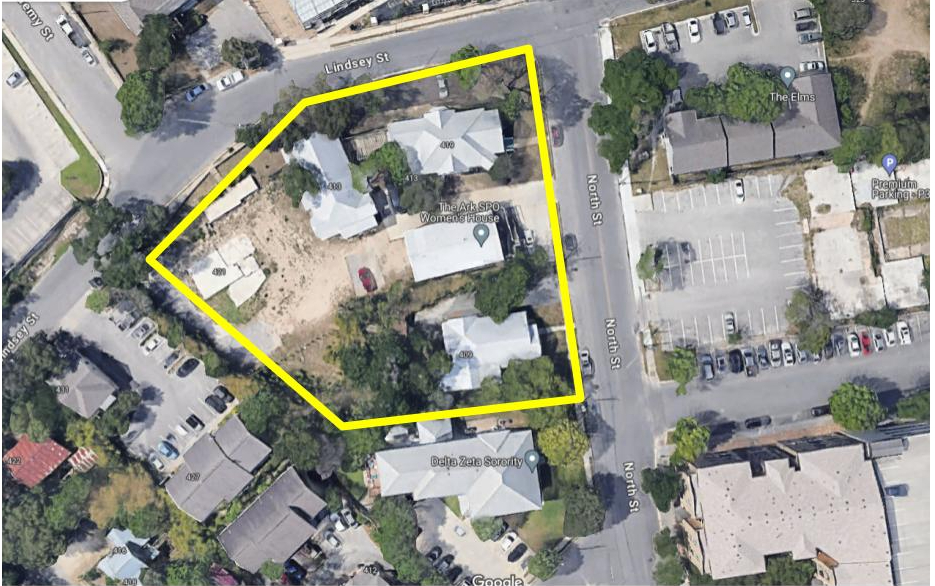
I believe it’s these houses:

One of them burned down maybe five years ago. One of them was transplanted from Riviera Street about ten years ago. Two are bungalows from the 1920s, and one of them is considered a High Priority Historical Resource from around 1900.

This one is the high priority one:

It is very cute!

First off, Jude Prather recuses himself because his wife works for the university, in a building close to this spot.  This is probably a reasonable recusal, but it affects the vote calculation coming up.

Second: today is just discussion. No vote until next time.

So: should downtown include that yellow, striped pentagon to the left?

If Council says yes, then they can apply for a zoning (CD-5D) that lets them build up to 5 stories and have 100% impervious cover.

If Council says no, then the developer might back out, and not buy the property. (Or they could build whatever they’re allowed to under the current zoning, which does allow apartment complexes.)

Public Hearing:

Against: Four speakers.

Similar to the P&Z meeting, they were concerned about student housing, expanding downtown to encroach on neighborhoods, and the preservation of historical buildings.

In favor: 10 speakers.

Some of these speakers made sense to me – the current owner, the developers, etc.

But a bunch were totally ludicrous. Lots of students spoke about how passionate they were about this housing complex. “Simple laws of supply and demand!” they kept saying, as if they’d all been given the same script. One collected 1200 signatures of students who are also super passionate. One of the hardcore Historical Preservation Committee people, who would usually spit on this sort of thing, instead turned up and openly raved about only having heart-eyes for this project.

I mean… come on. The developer must have paid students $15/hour to all read from a script.  “We students are just madly in love with the application of supply and demand curves to the inelasticity of housing supply near campus! Please, ya gotta approve this Preferred Scenario Amendment, mister! For the kids!” Come again?

The developer is offering some new concessions, since the P&Z meeting.  For the left hand yellow-striped pentagon:

  • they’ll cap at 4 stories now,
  • only have 1, 2, and 3 bedroom units, 
  • no Rent by the Bedroom leases,
  • limit impervious cover to 80% instead of 100%. 
  • Have the cute old historic houses relocated elsewhere, instead of demolishing them.

Would that sweeten the pot? 

Matthew Mendoza kicks things off: he talked to constituents in traditionally Latino neighborhoods. They all say, “Keep students away from me. Why aren’t the students by campus? Why aren’t students staying on their side of town?”   

He went over to the proposed neighborhood. The whole character of the neighborhood is university.  This makes sense. Alyssa Garza agrees with him.

Saul Gonzales goes next: 

I see it just a little bit different. I’ve lived here almost 62 years, and I saw the town when I was on P&Z many years back. It was only a few bars, and that’s all we were going to have.  And before you knew it, it spread and it spread and it spread. Now there’s no stopping it.  It’s too late.

With a property like this, I see the same thing.  Where does this stop? This is still a neighborhood, as far as I can see it. People that I talked to tell me, “Saul, what happened to downtown? What happened? Look at all these apartments. Look at this, look at that.” And I’m going to tell them this time “well, we just put another one up.”

I’m just not in favor of it. There’s other reasons – the flooding, the parking, and I just don’t think… It has to stop. I’ll be voting against it, just because it has to start with me voting no.” 

Saul, my good man, what the utter fuck are you talking about.  Are you really trying to tell me that in your adult lifetime, San Marcos didn’t used to have a lot of bars? In the 1980s, this was a sedate little sober town?  Dude, this town has been soaked to the gills since Prohibition.  That is some wishful thinking.

More earnestly: Saul is making a slippery slope argument.  He’s saying he doesn’t mind any one particular development, but over time, the neighborhood will hit a tipping point where it starts to feel like a university student housing neighborhood, instead of a traditional neighborhood of houses.

The problem is that this ship has sailed. This neighborhood is already university housing.

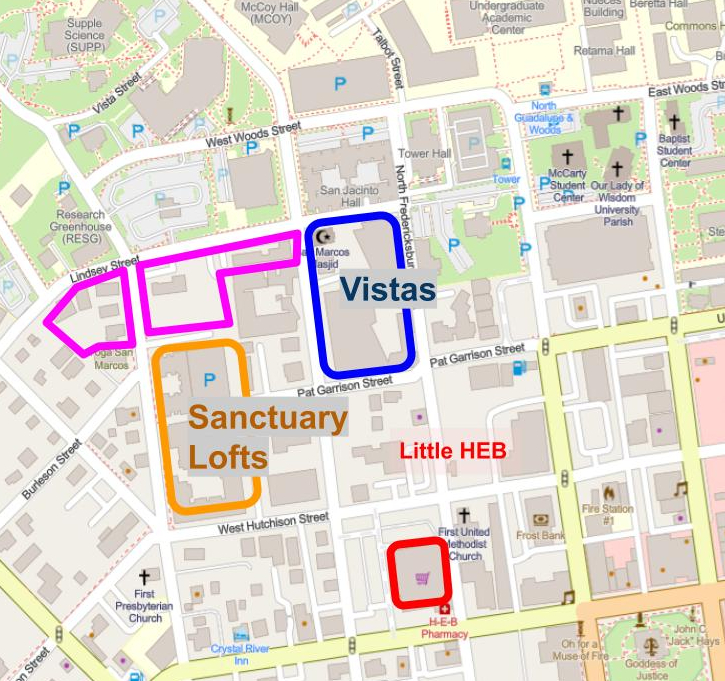
Literally, the university owns Sanctuary Lofts and the Vistas apartments now. Everything north of Lindsey street is campus.

Let’s pause to count the votes:

 P&Z denied this motion.  This means that council must have 6 votes to overturn P&Z.  Since Jude recused himself, that means it has to be unanimous to override the P&Z denial. 

If Saul really is a hard NO, then this whole item is sunk.

(The actual vote is not until next meeting. Today is just discussion.)

Back to Council discussion:

Mark Gleason talks next: I take each case individually. I haven’t made up my mind.  But the bright line between downtown and the neighborhoods is not North Street. That’s absurd. C’mon, you all know that I will fight for the neighborhoods. This isn’t that.  Clearly Moore Street is the bright line.   I will need restrictive covenants to enforce the offer that the developer made, and I haven’t totally made up my mind, but I’m here for it.

Mark Gleason is making the most sense.  He’s entirely right. 

Jane Hughson asks about the flooding? 

Answer: the reason there’s flooding in this area is that it’s coming down from Texas State in waves. This property would have to follow city code, which says you can’t make flooding worse. But you can’t fix flooding from Texas State with this project.

Jane: North Street is a bright line for downtown, for me.  But maybe a lesser zoning?

Quick lesson: all the zonings have confusing names. CD-5D, CD-5, CD-4, ND-4, and many more.

As far as I tell, all anyone cares about (in this situation) is the number of stories and the percent impervious cover. Loosely speaking, the choices are:

  1. Up to 5 stories and 100% impervious cover (CD-5D or CD-5)
  2. Up to 3 stories and 80% impervious cover. (CD-4 or ND-4)

The developer is asking for the Option 1, and offering to only build 4 stories at 80% impervious cover. It sounds like Jane is going to try to build a coalition to get them Option 2 under a lesser zoning.

Maybe Saul will go for that! Maybe the developer won’t! Exciting times.

There’s no vote this time – it’s just discussion. Stay tuned!

….

Item 15:  American Rescue Plan Act (ARPA) money is coming to an end. The first deadline is the end of 2024: you have to have contracted out all your money by the end of 2024, and it must be spent by the end of 2026.

San Marcos put $900K from ARPA money for homelessness initiatives. We then hired Robert Marbut to tell us how to proceed. We discussed it here, and I was not a fan of him.

(It’s not just me:

In 2019, journalists just could not stop writing bad articles about this guy.)

After the study, $800K was left to actually carry out Marbut’s plan. You can read his San Marcos study here. It’s loosely stated enough that it has wiggle room – it all depends on whether it gets implemented humanely or not. The council homelessness committee determined that Southside is the best organization to implement Marbut’s plan.

Southside wants to use $50K of the $800K to hire two part-time people to write the implementation plan. One of them worked under Dr. Marbut before. Southside has to have this implementation plan written by June 2024, and so they’re under the gun to get it done quickly and well. 

Jane Hughson is skeptical about what the city is getting for this $50K. Just an implementation plan? That’s all?

The counterargument is that we are investing in Southside and setting them up for success. Everyone goes with it in the end.

I’m not bothered by the $50K, but I am definitely nervous about whether Marbut’s worst instincts will show up in the details of the implementation.

Item 20: Short Term Rentals (STRs)

We saw this at a council workshop, back in January. Our current regulations are illegal: you can’t outlaw parties and you can’t require that the owner live on site. So we have to pass something new.

The new proposal states:

  • All STRs would need a permit. 
  • Owners can only have one STR.
  • Only one STR on a block, or at least 600 ft apart.
  • Short-term tenants can have parties, but not excessively noisy ones, just like any other resident.
  • Everyone who lives within 400’ gets a postcard with a hotline number to call if you’re having any trouble.

Shane Scott and Alyssa Garza are opposed to the proposal, but they’re extremely cagey about why.  Alyssa says the zones are weird.  Shane is opposed on general libertarian grounds.

Look: hand-wavy arguments like that are lazy. Spell out your reasons. If you can’t spell out your reasons, go think harder about why you’re arguing your case.

Anyway:  Jude Prather gives the impression that probably what’s bothering Shane and Alyssa is the bit about how STRs must be 600 feet apart.

Jane makes the same point as I made – Alyssa and Scott should specify what they don’t like in the ordinance, so that we can modify it instead of throwing the whole thing out.

Alyssa is kinda prickly in her response – she doesn’t have unlimited time or any staff to go work on this ordinance.

Confidential to all council members: you can always consult your friendly Marxist blogger for sound guidance, when you’re short on time! I got you.

….

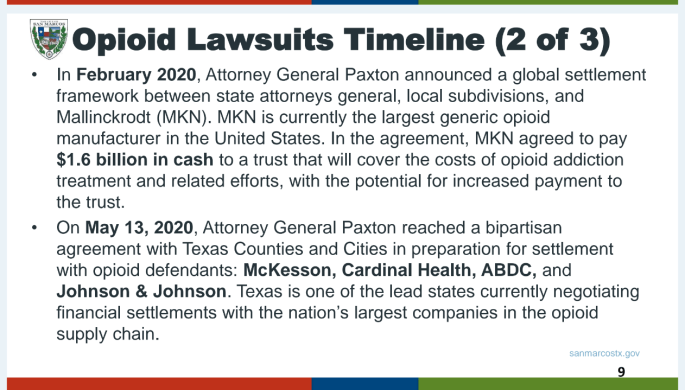
Item 23: There have been a lot of opioid settlements:

We’re contracting with Cenikor to start spending the $325K-ish we’ve got:

That’s running us about $100K. Seems like as good a place to start as any.

Bonus! Feb 27th P&Z meeting

We have to unpack this.  The center of gravity has shifted on P&Z.

Let’s start with the end of the meeting:  the committee voted on their new chair.

Jim Garber has been the chair of P&Z since 2016 (aside from one year when he cycled off P&Z).  He’s literally been elected seven times.  It’s been quite a run.  Jim Garber was the main driving force behind the re-write of VisionSMTX.

But at this meeting, Garber lost re-election to David Case.

David Case is [updated: used to be] on the San Marcos Area Chamber of Commerce, and is the local VP for Schertz Bank. So it’s safe to say he’s pro-business. The pendulum has officially swung from anti-development towards pro-development. 

Is this good or bad?

It depends!

I am Goldilocks! I want us to land in the middle. I want us to have calm quiet neighborhoods, but they must include affordable apartments for lower income folks.  I want us to have gentle densification and to have nearby stores, so that you don’t have to drive a long way for your basic needs. Jim Garber was blocking a lot of this with the VisionSMTX re-write.

However, back in the early 2000s, we were haphazardly approving all kinds of giant apartments complexes. The danger is that P&Z will start recklessly greenlighting every proposal again.

How do I feel about giant apartment complexes? They should be carefully scrutinized on a case-by-case basis. 

There are good parts: they do not contribute to sprawl, they are more environmentally efficient than houses, you get some economy of scale, you can have amenities like pools and exercise rooms, and it’s easier to include wraparound services for low-income housing. 

But they are also a mechanism to enforce segregation by wealth, which makes me very cranky. And the scale matters: it’s jarring to put a giant complex immediately alongside a quiet neighborhood. Location is a major consideration.

Anyway: the NIMBY old guard was voted out, and a new tide has taken hold.  It’s just too early to know exactly how far it’s going to swing.

There was also one big, complicated zoning case:

Should we build student housing here?

This came up back in October. It was memorable because Shannon Mattingly was the director of the San Marcos Planning Department until 2022, and then jumped over to this developer. It’s a pretty clear conflict of interest.

Here is a close-up:

One more background issue:

The university recently purchased Sanctuary Lofts and Vistas Apartments, which are very close to this:

They are going to turn them into dorms. The city is pissed off, because we used to get a lot of property tax from those apartments, and the university doesn’t have to pay local taxes.

So this looms on everyone’s minds: in five years, will the university just buy this, too?

Onto the issues

There were a lot of citizen concerns, which I’ll categorize:

  1. Complaints that student housing is exploitative:
  • Aspire (13 stories) charges $1k/bedroom
  • Rent by the Bedroom (RBB) means inadequate/subpar living conditions
  • Roommate matching is not legally binding
  • All roommates share liability for damages to common areas.
  • RBB is predatory
  • Student housing means subpar construction and craftsmanship

I find these complaints mystifying. Do these people think that the rest of the landlords are glorious noblesmen? All tenants need protection. Plenty of non-student apartment complexes are unsafe and unsanitary. All roommates always share liability for damages to common areas! All landlords will try to extract the highest rent they can.

I just am not clear why student housing is especially bad. Why not build a broader coalition across all renters?

2. Complaints about San Marcos housing in general:

  • We need diverse housing options
  • Downtown housing is solely being built for students, serious lack of other housing.
  • There is plenty of student housing available: 40 RBB complexes in San Marcos, with over 20K bedrooms.

We do need diverse housing options. Developers are not our friends, and they will not build diverse options unless it’s in their financial interests. This means simplifying the approval process and creating incentives for small-scale apartments and condos.

But those are all larger issues than this one complex.

3. Mostly legitimate concerns that are specific to this project:

  • This will make downtown encroach on nearby neighborhoods.
  • This will be a large corporate structure on an already congested street
  • The smalltown feel and skyline is being eaten up by big developments. 
  • They should provide regular leases alongside RBB.
  • We will be tearing down existing affordable housing and displacing people in order to build more expensive housing.

I find most of these compelling.

4. Concerns that I don’t know how to categorize:

  • we should not destroy this town for the convenience of students!

It was a LOT.  

So what did P&Z do? They basically landed somewhere in the middle. I thought they handled it well.

The request has four parts:

  1. Extend “Downtown” to include the west side of their property, that pentagon piece west of North Street.
  2. Change a mishmash of old zonings – multifamily 12, multifamily 18, multifamily 24 – to all match the standard downtown zoning, CD-5D.
  3. Get a permit to have Purpose Built Student Housing.
  4. Get an alternative compliance to go up to 7 stories.

Here we go:

  1. Extend “Downtown” to include the bit west of North Street.

In terms of this picture:

we’re talking about the pentagon on the left hand side. Should that be part of the designated official Downtown District?

The vote: All 9 vote to deny. West of North Street is not downtown.

2. Change a mishmash of old zonings – multifamily 12, multifamily 18, multifamily 24 – to all match the standard downtown zoning, CD-5D.

First, the lefthand pentagon, west of North Street: No. This passes 9-0.

Next, the right and middle bits, east of North Street: there’s some good discussion.

  • Will this make flooding worse? CD-5D zoning is 100% impervious cover, like downtown. Currently they’re allowed up to 75% impervious cover.

Probably not: it’s actually 100% impervious already, because there’s a parking lot covering all the land. It pre-dates the 75% regulation.

  • What about the affordable housing already there? It would be torn down.

The vote: 5-4 in favor of changing the zoning to CD-5D.

(This is the first pro-development vote.)

3. Get a Conditional Use Permit to have Purpose Built Student Housing.

Important: this is not the same as Rent by the Bedroom. They can already do RBB leasing if they want. Purpose Built Student Housing lets them go up to 5 stories and have four bedrooms per unit, instead of 4 stories and up to three bedrooms per unit.

Arguments: We just passed the Downtown Area Plan. The Downtown Area Plan calls for no student housing downtown. We need to set a precedent of respecting the area plans.

The counterargument comes from William Agnew, who says, “I was on the Downtown Area Plan committee. I thought it was absurd to pretend we don’t want student housing downtown. That’s who lives downtown! I’m in favor of this CUP.” I love his bluntness.

The developer says they will offer regular leases alongside RBBs. For what that’s worth.

The vote: 7-2 in favor.

4. Get an alternative compliance to go up to 7 stories.

It gets pointed out that this is already uphill of Sanctuary Lofts, which is 5 stories. So if this were seven stories, it would loom even higher, due to the hill.

The vote: 8-1 opposed. They will have to stop at five stories.

In conclusion…

Approving this apartment complex has its negative trade-offs. It does make the area more congested. It does destroy some cheaper housing in exchange for more expensive housing.

That said, I think that overall, P&Z landed in a reasonable spot on the four items.

Hours 0:00 – 1:30, 2/6/24

Citizen Comment:

  • We just picked land for the fire station that is supposed to cover the SMART Terminal land. Why did we go with the only choice that is outside San Marcos ETJ, and in the Martindale ETJ?
  • Hooray for can ban
  • Hooray for the can ban, but take a closer look at the No Zones and Go Zones please. On a windy day, all that trash is going to blow from the Go Zones into the No Zones.
  • Hooray for bringing back PDDs. Consider charging fees to cover staff time.

I’m also surprised that we’re moving forward with the fire station, although I guess you want to pick out land long before anything gets built. There have not been any public updates on the SMART/Axis Terminal since last summer.

Items 3-5: This little triangle at the corner of East McCarty and Rattler Road:

was annexed and zoned.

The plan is for it to be a gas station with car wash along the part facing McCarty, and then a strip mall along the back part that opens onto Rattler Road.  The developer is hoping for things like restaurants, medical offices, some commerce, etc.

There’s a larger context:

this whole dead spot between the high school and the city is supposed to someday turn into a thriving East Village city center.  (According to the Area Plans, which are in progress. This is supposed to accompany VisionSMTX.)

Point being: this is a good spot for a gas station and some commerce.  You have my blessing, Young Developer.

No one really has any questions, and the vote is 6-0. (Mark Gleason is absent for this part.)

Item 6: Here comes your can ban!

So first, here are the Riverfront Parks that we’re talking about:

The plan is to carve out “No Zones” and “Go Zones”. 

In a No Zone:
– Only reusable beverage containers
– Only coolers under 30 qts in size
– No containers under 5 oz, which is a little redundant, but we’re just doubling down on jello shots and mini-liquor bottles.

In a Go Zone:
– Go nuts. Have all the single-use beverage containers and giant coolers you want.
– Still no glass or alcohol or charcoal grills, but that’s not new.

So what are the boundaries? 

It’s fuzzy! I thought there’d be a big conversation about it, but nope. None of the councilmembers had anything to say about these boundaries.

Here’s what was provided:

There are some trails to the right of Ramon Lucio park, in the map above. Those would all be No Zones, because there are so many river access points throughout.

Loosely speaking, it sounds like the big trails along the river will be the boundary of the No Zones. If you’re beyond the trails, you can pop that tab. If you’re closer to the river, you can’t.

My 2 cents? This is probably as good a starting point as any. It allows for plenty of big family picnics. The paths are already a big, visible feature, so it makes sense to use them as a boundary.

If we do a great job with the signs and communicate this boundary loud and clear, it’ll probably work. If we half-ass it, it’ll take a lot more effort to get people to change their behavior.

More details:
– It’ll kick in on May 1st
– The first year will be focused on education. Citations, etc won’t really kick in hard until 2025.

At the January workshop, there was a lot of conversation about hiring more staffing. Specifically, are we going to hire city marshals (who dress like cops), or will we hire park rangers (who dress like park rangers)? Nobody discussed this on Tuesday. So it’s still an open question.

Jane Hughson had a few questions, but they were extremely detail oriented – definition of banks of the river, clarity of exemptions for people cleaning up the river, that kind of thing. 

The vote:

YAY for the can ban: everyone
Screw the river: no one.

This was a first vote, so it will come back around next meeting.  But most likely, it’ll be here this summer! 

Hours 0:00-0:52, 1/16/24

Citizen Comment

  • A few people spoke in favor of a city resolution calling for a ceasefire in Gaza
  • A few people spoke against high rises along the river

Neither topic comes up during the actual meeting tonight, but both might in the future.

Item 1: Gateway Signs

Other cities have gateway signs, like so:

So we want one, too. 

Back in November 2022, city staff brought forward a few options:

Council smiled politely and sent them back to do more work.

So in April, staff showed these options:

Council hemmed and hawed, and asked staff to bring two more final choices back.

So these are the two finalists:

I like these rocks better! These look like river rocks, not suburban masonry. But the new heron is worse. It was better off-center with the blue outline, I think. 

The one on the left reads: “State Park, but make it Business-Professional.” I’m okay with that vibe.

They will be located at these two locations:

I always enjoy it when staff draws the city sideways.  Look at that wonky compass in the corner:

What’s reality anyway, man? Time is a construct! North is an illusion! You’re not the boss of me!

What does Council think?

Mayor Hughson, with a pained expression: So these are our only two choices?

Staff: You literally told us to only bring back two.

Mayor, deep sigh, clearly repressing the urge to say, “But I didn’t mean this crap.”

Matthew Mendoza: Maybe it’s because I live in Rio Vista, but I love the heron!  It symbolizes conservation and the environment.  Option B for Bird.

Alyssa Garza: I like the bird.  Ever since I first visited San Marcos, I’ve seen those beautiful white birds. Option B.

Jane Hughson: The bird does not represent the whole city. It could be a neighborhood sign, but I don’t like it here. Option A.

Mark Gleason:  The bird is not the mascot of San Marcos. It’s distracting. Option A.

Saul Gonzalez is also for Option A.  (Jude and Shane are absent.)

So it’s 3-2. Council argues about whether to wait until Jude and Shane are back, so that one option can get a full four votes.  Alyssa weighs in: “I truly don’t care. We are spending way too much time on this. I’ll switch my vote.”

So the State-Park-But-Business sign wins with a clean four votes. And City Council gave the bird to the bird.  (Ba dum ching.)

….

Matthew: Can we cycle through different colors for the lighting? Purple on Rattler nights, Maroon on Bobcat nights, holiday colors around the holidays?

Answer: Yes! As long as it’s static. TxDOT just says no moving parts. 

So there you have it. At some point this year, these harmless little welcome signs will appear on I-35.

Item 9: Rezoning 18 acres behind the outlet malls.

This has come up before.  It’s part of a larger chunk of land:

In 2016, someone wanted to build houses there, so we annexed it and called it the Gas Lamp District. The houses were never built.

In August 2022, it got rezoned:

Mostly light industrial, but with this one little piece for apartments. These were never built, either!

The current owners want to change the yellow square to Light Industrial, to go along with the rest.

Saul is the only one who asks questions:

  1. What is the expected tax revenue for this?

Staff says, “We can’t give an estimate.”   

  1. What is the impact on the neighbors?

Answer: They’re all doing the same thing.

It passes 5-0.

Item 11:  We are fiddling with little parking details, as discussed here.

Among other things, we are raising the parking ticket fees, for the first time in 50 years:

I didn’t really know what to make of this.  Are the little cities price gouging? Or are the big cities subsidizing bad behavior? So I emailed the chair of the parking committee (Rosalie Ray), who tells me:

– By state law, your fine for illegally parking in a handicap spot must be at least $500. So those cities with cheaper fines in that category just haven’t updated their fees since 2009, when that law was passed. (We hadn’t updated ours since 1974!)

– To avoid price-gouging, the committee has a couple things in place: 

  • you can opt for community service instead of a fine,
  • you can get a payment plan, and
  • you can get your fine cut in half by responding within 14 days. (Council could extend the 50% discount to double-parking and blocking alleys, if they want.)

– The main targets are things like FedEx and delivery trucks. They’re the ones blocking alleys and bike lanes or double-parking. So we want them to pay their fair share.

There you have it. 

Hours 0:00 – 1:51, 12/5/23

Citizen comment: The two main topics are the Can Ban and HSAB grants.

Can Ban:
– A bunch of people speak in favor, many who have spent years cleaning up the river
– Can it be a restriction on single-use beverages but not single-use food containers? Texas Water Safari folks need some single-use food containers,
– City Council member from Martindale describes how well their can ban has worked.
The Eyes of the San Marcos River does regular clean ups just past where city contractors stop picking up trash. It’s a lot.

Speakers promoting their nonprofits for HSAB Grants:
Outsiders Anonymous representative describes their free addiction recovery program.
PALS for free spay/neutering and low cost pet care

All these things in due time!

Item 9:  We are rezoning about 1 acre here:

Currently it looks like this:

That is the restaurant Sakura.

Sakura is staying, but it’s gaining a bunch of little apartments behind it.  They can put up to 9 apartments there.  This seems like a good place for apartments!  Infill does not need to be scary.

Item 10:   There’s a little road you’ve never heard of here:

called Flustern Road.  It’s up in Whisper Tract:

Whisper tract is gigantic, and slowly getting built out.

Flustern Road has exactly one resident, a company called Manifest Commerce. They asked if they could get the name changed from Flustern Road to Manifest Way.  

However, Flustern Road will eventually cross Opportunity Blvd, and connect with Celebration Way: 

 From the POV of the fire department and EMS, it’s better to have roads that don’t change names.  So as long as we’re changing the name anyway, we’re going to go with Celebration way. 

Also, don’t the names all sound like someone from the 1960s was dreaming of a brighter tomorrow? Celebration Way, Opportunity Blvd, Technology Way, Manifest Way… Flustern never really fit in, did it.

Nevertheless: would you like to know what Flustern means? [drum roll] ….it means “to whisper.” And it was in Whisper Tract. Aww, very cute. But over!

Item 11: Consolidated CBDG funding report.

All of our CBDG money originates with the Federal Housing and Urban Development (HUD) department. We have to regularly write reports to them, documenting that we’re using the money according to the rules.

Alyssa Garza feels like the report isn’t widely circulated enough. Maybe fewer neighbors would harass her about wasting money if they saw how meticulously nonprofits have to account for every last nickel.

I’m more cynical than she is. People just like to gripe.

Item 5: We’re buying a generator, for $445K:

Technically, we’re buying a 600-kilowatt diesel generator, automatic transfer switch, electrical installation, and associated engineering services.

Technically, it’s Covid money that’s paying for it.

And technically, it will be located in San Marcos High School, so that the high school can serve as an emergency shelter in the future.

Item 12: Citizen Comment will now be called Community Perspectives.  (Mentioned before here.)

  • We’re getting rid of “Citizen” because you do not have to be a citizen to have a comment. This is good!
  • We didn’t want to name it “Public comment” because we already have “public hearings”, and those might sound too similar.
  • Not sure why we didn’t go with “Community Comment”. “Community Perspectives” sounds a little bit like a hokey small town newspaper op-ed column, but hey, sometimes we are a hokey small town. Did you have a chance to stop by Sights & Sounds this weekend?

Item 13: Human Services Advisory Board  (HSAB) Grants.

We put $550,000 of our city budget towards grants to nonprofits. This year, we also have $100,000 of the last bit of Covid money to distribute as well.  HSAB is the committee that meets, looks over applications, and recommends to council who should get money.

Last year – for reasons I was never quite clear on – the process was deemed a shitshow. Council made HSAB go back and do it all over again. Then Council tinkered with the results anyway.   After all that, HSAB thoroughly revised their process for evaluating grant applications. 

It seems everyone likes the new process! You can read all the applications yourself here, as well as a bunch of other reports and information.

So this year:

  • 34 nonprofits applied.
  • 5 board members rated them independently on a huge matrix of things:
    • All the nonprofits pass the Risk Assessment
    • One nonprofit needed to get their nonprofit status back
    •  They were ranked according to some evaluation criteria

Here’s the evaluation criteria:

The committee met weekly, all fall long, and discussed all of the nonprofits individually. They heard presentations from all the nonprofits. It sounds like a massive amount of work.

Here’s the full scoring matrix on the Evaluation Criteria, if you’re so inclined:

(I know it’s tiny, but you should be able to zoom in and scroll around.)

And here’s the summary table of the scores:

(scores were re-centered across committee members, for consistency.)

Finally, here’s HSAB’s complete funding recommendations:

So what does Council think? Let’s dive in.

Council Discussion

Alyssa Garza: Last year, Council deviated from the recommended HSAB funding in a really haphazard way.  I’m glad to see a really systematic process. This is good work, I support the recommendations. 

Matthew Mendoza: Great job! But I want to tinker with it.  Any Baby Can is centered out of Austin.  Let’s deduct $7K from them and give it to the San Marcos Youth Services Board, because that’s centered in San Marcos.

Jane Hughson: Any Baby Can has an office here in San Marcos. Make it $5K and I’ll support it.

The Vote:  Should we take $5K from Any Baby Can and give it to SMYSB?

Yes: Shane Scott, Mark Gleason, Jane Hughson, Matthew Mendoza
No: Alyssa Garza (who explains that she just wants to stick with HSAB process)

Abstain: Jude Prather, because his wife serves on the board of the food bank.

So now:
– Any Baby Can requested $30K, recommended $25K, and will get $20,000.
– SMYSB requested $39K, was recommended $20K, and will get $25,000.

This is a good example of haphazard meddling. They’re both good organizations!

But let’s take a moment anyway:

Any Baby Can is providing early childhood intervention for birth-3 year olds, for kids with medical diagnoses, developmental delays, or any impairments.  (Getting interventions in early is huge.  This majorly redirects the trajectory of kids’ lives.)  According to their application, they served 159 children and families in San Marcos last year, over 29,600 hours. They expect to serve 165 children in San Marcos this next year.

SMYSB is an afterschool program for 11-17 year olds in San Marcos. They’re asking for rent for their new facilities, which is $2700/month.  Their application doesn’t say how many kids they’ve served, but looking at their progress report from last year, SMYSB got $10,000, and served 16 kids in the spring and summer.  They used to be located at Southside Community center, so I’m guessing that they’re working with kids dealing with housing instability or homelessness. This is a super vulnerable population! They need this kind of one-on-one care to navigate what they’ve gotten handed to them.

Both are good programs, staffed by hard-working, underfunded organizations!   But the committee took their job seriously when they evaluated the benefit to San Marcos.

I guess I’m harping on this because it’s, well, haphazard. It didn’t feel like Matthew Mendoza read all the applications super closely and then felt compelled to shift this money around. It felt like someone from SMYSB picked up the phone and asked him if he couldn’t find a few more dollars for them. He did, but it comes out of someone else’s funding.

The vote on the entire thing:
Yes: Everyone but Jude
No: No one
Abstain: Jude Prather

Because I’m an insufferable prig, may I make a comparison?  

  • Just now, we generously gave out HSAB grants which cost the city $550,000.
  • We also give all homeowners a $15,000 homestead exemption on their property tax.

How much does that cost the city?

Basically, the city is donating of $1,100,000 towards the worthy charity of home owners.

  • The elderly and disabled people get a tax exemption of $35,000. This works out to a $211 discount on their tax bill.
  • Everyone else gets a $15,000 tax exemption. This works out to a $90 discount on their tax bill.

This is fine! I’m not mad about this. But it’s invisible. And we don’t call it “charity”, we call it a tax break.

Bear with me for a moment more:

  • We’ve got about 7000 owner-occupied houses (as of 2021) who get to share that $1.1 million. There’s a tiny bit of paperwork, but that’s it. Each person gets either $211 or $90, no strings attached.
  • There are 22,219 people below the poverty line (as of 2021). The HSAB money isn’t exclusively for poor people, but it’s a good place to start.  That works out to $25 per person.

And there are SO MANY STRINGS attached. Thirty-four nonprofits fill out extensive paperwork. A six person committee meets for weeks and scrutinizes the applications. Council scrutinizes the recommendations further. Afterwards, each nonprofit writes ongoing grant reports on each person they helped. It’s an extremely labor-intensive, highly visible process. Someone has to maintain the website charting all these details.

To recap:

  • $1,100,000 on charity for 7000 homeowners.
  • $550,000 on charity for at least 22,000 people in poverty.

Haha, weird, right!  [hard stare at city council.]

Hours 0:00 – 1:39, 11/6/23

Citizen Comment: 

VisionSMTX++ is supposed to be approved tonight. The public has opinions:

  • Go back to the original. The new version constrains the housing market, forces sprawl, and jacks up prices!
  • Keep the new version! We love sprawl and jacked up housing prices.
  • Renters need protection!
  • We live in a cottage court. Stop pretending these don’t exist in existing neighborhoods.

Downtown Area Plan is also supposed to be approved tonight.

  • Protect the river!
  • Protect against flooding!
  • Too much asphalt!
  • We’re going to become Baltimore!
  • The water table is very shallow under CM Allen. And there are a bunch of endangered species in the river here.
  • If you plan for development, you can specify environmental improvements you want. If you plan for parks, you’ll get stuck with the land owner’s choices when they develop it anyway.

But before we get to all that, we have a zoning case.

Items 8-9: This is an 18-acre patch at the corner of 123 and Wonderworld:

It’s right behind this little strip:

It sounds like they want to put a little retirement village there. 

Saul Gonzales definitely had something on his mind, but I couldn’t figure out what.  Here’s how the conversation goes: 

First, Saul asks about the cost and tax revenue of the future plot.

Staff answers:
1. the cost to the city is $0! They’re responsible for any extensions of water, sewer, and electricity. 
2. We can’t know the tax revenue until it’s built!

This is not a good answer. It evades what Saul is getting at.   What Saul wants to know is, “Will this help or hurt the budget, in the future after it’s built?”  Right now the costs are extensions of water, sewer, and electricity, but once it’s built, there will be ongoing services, namely police and firefighters.  

Here’s my guess at the real answer: 
1. Cost: This will not require much from future city budgets. We’re already providing police and fire department coverage to things that are further out than this development – this is infill.
2. Revenue: Since this will be apartments, it should bring in more tax revenue than we spend on it.

So my expectation is that this will be good for the budget. 

Next, Saul asks about flooding. He’s told that it’s not in a flood plain, they’ll do an environmental analysis, and everything looks fine.

The Vote:
Yes: Everyone but Saul
No: Saul

Clearly the answers that Saul got didn’t resolve whatever he’s worried about. So either:

  1. He doesn’t believe the answers, in which case I’m interested to know why.
  2. There’s another reason he’s voting against it, in which case I’m interested to know why.

Just for funsies, let’s apply the five criteria:

Price Tag to the City: Will it bring in taxes that pay for itself, over the lifespan of the infrastructure and future repair? How much will it cost to extend roads, utilities, on fire and police coverage, on water and wastewater?

Per Saul’s questions, I’m guessing that it will pay for itself, yes.

Housing stock: How long will it take to build? How much housing will it provide? What is the forecasted housing deficit at that point? Is it targeting a price-point that serves what San Marcos needs?

As always, we need a regularly updated housing report. It sounds like the city has picked back up on the one they dropped in 2019, so maybe this will materialize?

Environment: Is it on the aquifer? Is it in a flood zone? Will it create run off into the river?Are we looking at sprawl? Is it uniformly single-family homes?

Not in a flood zone. Not environmentally sensitive. It’s supposed to be one-story apartments for seniors, which doesn’t sound like sprawl.

Social: Is it meaningfully mixed income? Is it near existing SMCISD schools and amenities?

No idea on the mixed income part. Potentially it’s near some future retail, but currently not much.

The San Marxist Special: Is it a mixed-income blend of single family houses, four-plexes, and eight-plexes, all mixed together? With schools, shops, restaurants, and public community space sprinkled throughout?

It never is.

But on the whole, it’s more good than bad, in my opinion.

….

After items 8 and 9, we doubled back to Items 1, 2, and 5. These were pulled off the consent agenda for discussion.

Item 1: VisionSMTX++

Your two-second summary:
Original community plan: weakly opposed to sprawl and jacked up housing costs.
P&Z rewrite: we LOVE sprawl and jacked up housing costs!

Read all about it here, here, here, and here.

The Final Approval:

Immediately Alyssa Garza moves to postpone. 

Alyssa: Too many people are expressing frustration with the process.  She’s gotten a flood of feedback in the past two days.  There are too many barriers for people to engage.

Saul agrees: he’s getting input, more time won’t hurt. 

Jude says he doesn’t want to postpone.  He thinks just a few tweaks are needed to get it done.  He’s got some amendments proposed for some of the missing middle stuff: cottage courts, multiplexes, etc.  

I would be very interested to know what these amendments were going to be! But legally, they can only discuss the postponement. Since there’s a motion to postpone, you can’t discuss amendments to the actual plan.

Eventually they settle on January 16th, with a committee to discuss the matter.  The committee will be Shane Scott, Alyssa Garza, and Matthew Mendoza. 

The vote to postpone to January: 6-0.   (Mark Gleason is absent.)  

My $0.02:

  1. Yes, the procedure was total garbage. The P&Z-plus-Jane subcommittee rewrote a document that had reflected the input from the town.
  2. But also, the new content is total garbage. It’s not just a problem of procedure. The subcommittee inserted a ton of NIMBYism that made the comprehensive plan worse.  

Yes, I would like us to fix the procedure and solicit a bunch more input from the community. But I’m nervous about it all being performative. If nothing actually changes in the comprehensive plan, then we’re just playing a game called Let’s All Perform Community Input. If the garbage content stays, then this was an empty exercise.

Item 2: The Downtown Plan

Your two-second summary: (Discussed previously here and here.)
There are four properties along CM Allen.

Right now they’re owned by private citizens who can do whatever they want. But would we really like those to be parks, instead?

Options 1, 2, and 3:

This choice sort of landed like a bomb out of nowhere, and conversation has been intense and emotional.

The Final Approval:

Everyone wants to postpone this, as well.  Clearly the community is all worked up over Options 1, 2, and 3.  This whole thing unfolded in just one month, unlike VisionSMTX++, which has taken three years, so everyone feels panicked and rushed to weigh in. Taking a beat is a good idea.

  • Jude wants to nail down specific environmental benefits to Option 3.
  • Jane wants us to land somewhere between Options 2 and 3.

Staff comes forward with a proposal to break off the CM Allen district from the rest of the downtown plan, and pass the remaining bit.  Everyone is glad about this, and it passes 6-0.

So what’s next?

The CM Allen District will then become its own area plan, possibly combined with the rest of the riverfront properties along CM Allen to make a River District. But there are six area plans queued up ahead of it, so it’s not going to happen for another year or two.