
Citizen Comment:
Six people spoke at 6 pm. Main points made:
- Three homebuilders: these impact fees will destroy affordable housing! Please delay these!
- There will be an October 16th Halloween party at the activity center for adults with disabilities.
- Ken Paxton’s suit against the ADA is barreling forward.
- A data center in Caldwell County applied for San Marcos water and was approved. Voters should have been informed.*
- We should bring in more businesses to stabilize our budget.
- It is harder for kids today to buy their first house.
- My family has owned land here since 1909, but we’re being priced out.
- Encourage naive plants instead of increasing water rates.
*I was unable to find any information about this.
Two other people spoke at 3 pm:
- The director of the Hays County Food Bank promotes Homeless Awareness Month, with a bunch of events all September.
- The director of the San Marcos River Foundation has some recommendations for Quail Creek park, to keep debris out of the Blanco River. Namely, relocate the baseball fields and put grass fields in the floodway, instead.
…
Item 1: City EMS
Backstory: Back in 2022, Hays-San Marcos EMS covered three Emergency Service Districts of Hays County. They decided to unionize, asking for benefits such as extra pay for bilingual EMS workers and stable work hours.
The local Emergency Service Districts lost their minds, and basically dissolved the combined EMS program
- Northern Hays and Dripping Springs vote to leave in 2024, and form their own EMS
- Kyle also votes to leave in 2024 as well
Then it was just San Marcos.
This past spring, we had to decide whether or not to keep using Hays-San Marcos EMS or build our own. We decided to build our own. We’ve been hiring people and figuring out logistics and buying equipment.
Starting October 1st, San Marcos residents will receive San Marcos EMS ambulance rides. That’s what this is about.
…
Today’s issue: Suppose you have an emergency and call 911, and get taken to the hospital. Later on, San Marcos needs to cover the costs of this ride. How much should our new EMS charge?
The total cost to run San Marcos EMS is estimated to be roughly $9.1 million/year.
Here are the possible sources of money:
- City taxpayers
- Insurance companies
- Medicare and Medicaid
- Sending a bill to the person who needed the ambulance
Here’s the general strategy:
- Try to get as much money as possible out of insurance companies and Medicare/Medicaid.
- Have city taxpayers cover a lot of the rest for people in the city.
- When some random out-of-towner is driving down I-35 and has an accident, they get the bill for any extra costs, instead of passing it on to tax payers.
This is easier said than done!
Step 1: Set rates with a the goal of maxing out insurance payments and Medicare/Medicaid.
Here’s what’s being proposed:
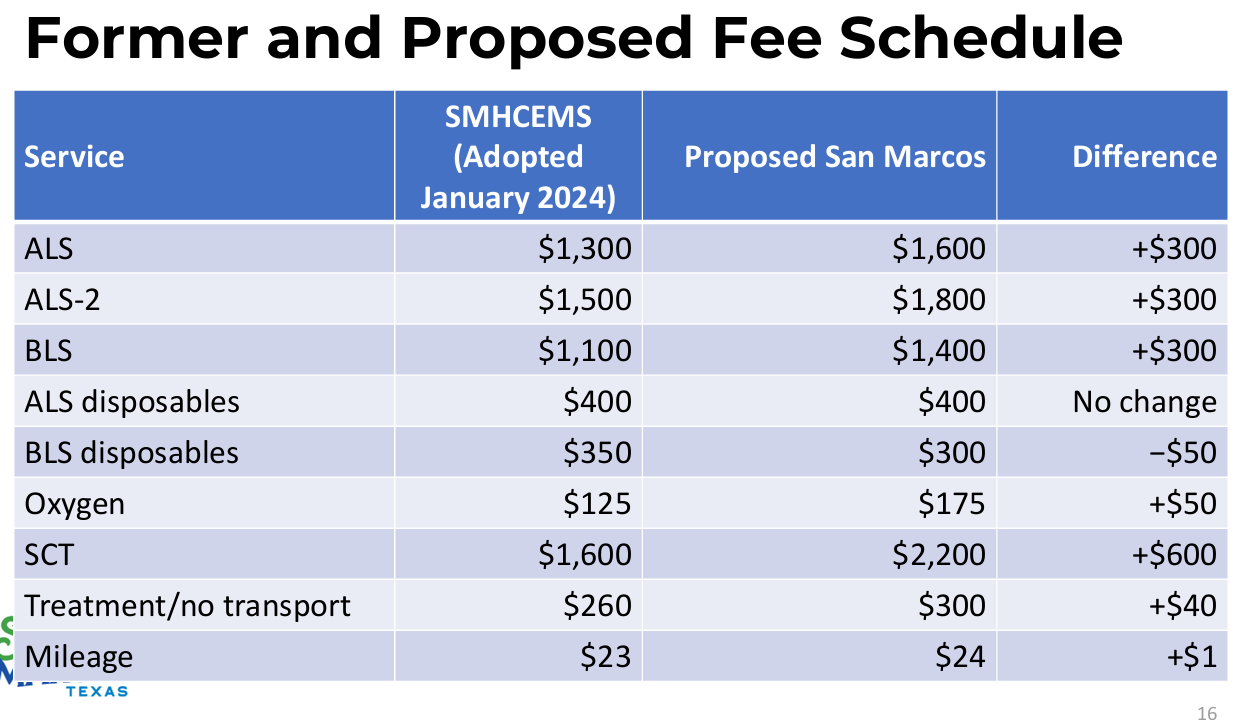
“ALS” is Advanced Life Support, “BLS” is Basic Life Support. They said $1600 is the most common base rate, and then it might go up from there.
This is pretty similar to what everyone else charges:
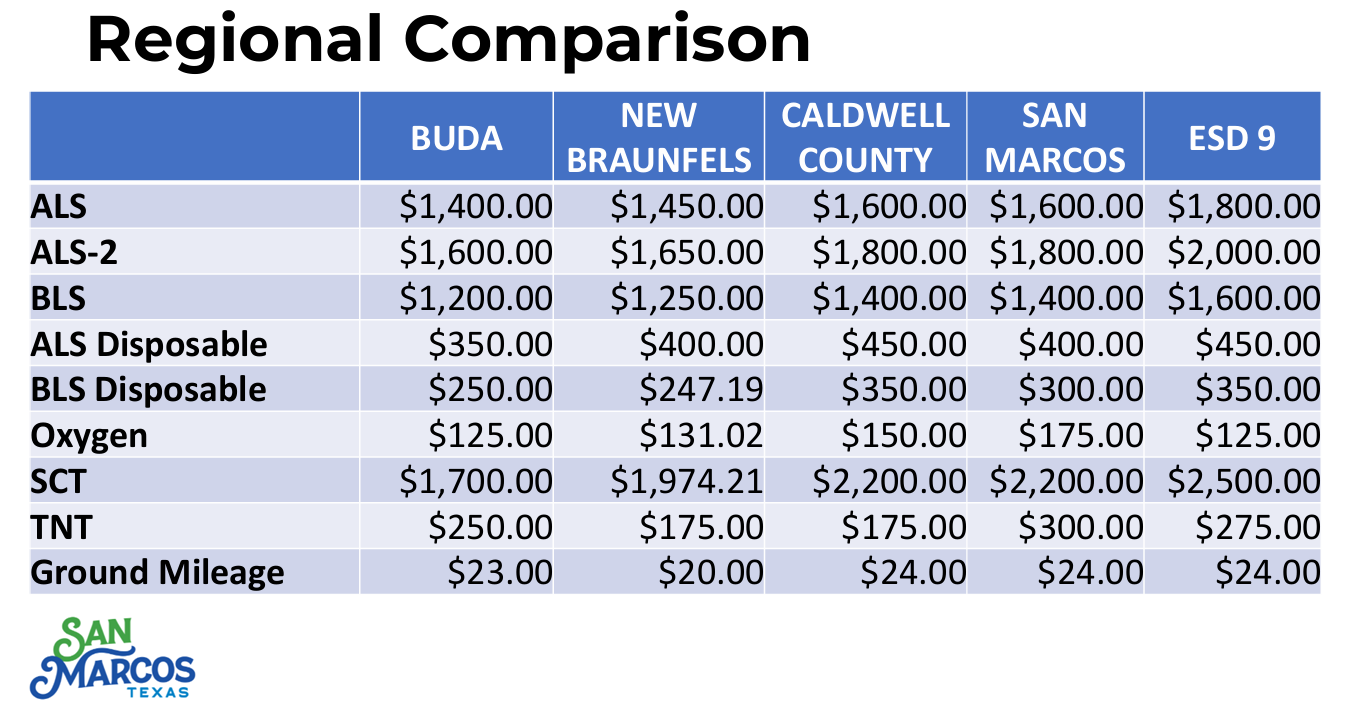
So San Marcos charges insurance or Medicare/Medicaid with the $1600 bill.
I tried to find how much of the $1600 the city could expect to get out of Medicare/Medicaid/insurance, but it’s tricky.
For example: “Medicare Part B covers 80% of approved ambulance service costs after patients meet the annual Part B deductible of $257 in 2025. Beneficiaries remain responsible for the remaining 20% coinsurance plus any costs exceeding Medicare-approved amounts if providers don’t accept assignment.”
Insurance companies often claim they cover 80%, but between copays, deductibles, and other bullshit, I’m not sure how much of that the city actually sees.
Step 2: Whatever the insurance companies and Medicare/Medicaid doesn’t cover gets sent to the patient.
If the insurance or Medicare actually pays 80%, then the patient would get billed for $320. But it could be a lot more.
Step 3: Somehow we want to help local people that got billed, but not help rando out-of-towners driving down I35.
This is where Council gets bogged down.
- Which residents do we want to help?
- How do we want to verify who lives where?
- Do we automatically knock off their bill, or do we require the resident to call the city and negotiate?
- Do we want to help people who live outside of San Marcos, but are part of the community?
- Do we want to help people who live outside San Marcos, and have nothing to do with San Marcos? Like, they were just cruising down I-35, or they came to watch a PAC 12 Texas State football game?
The answers are a little spotty:
For people in the city limits:
We cannot automatically knock the rest off the bill. This is a problem! Suppose you take an ambulance ride and get a bill for $700. On the bill, it would say, “You can call the city to discuss a payment plan or other assistance.”
But it would not say, “Hey! This $700 is not real! You’ve been paying taxes to cover it. You need to call us so we can knock the bill down.”
Most of San Marcos would stress out about the $700.
For people nearby the city:
There is some momentum on Council to help nearby people with the rest of their ambulance costs. They don’t pay property taxes to the city, but they pay some sales tax to the city when they visit San Marcos.
There is not much appetite to subsidize true out-of-towners.
If someone is driving from Austin to San Antonio and gets in a wreck here, they’re just going to go through the billing process.
….
It is estimated that insurance, Medicare, Medicaid, and people paying their bills would bring in about $3.16 million:
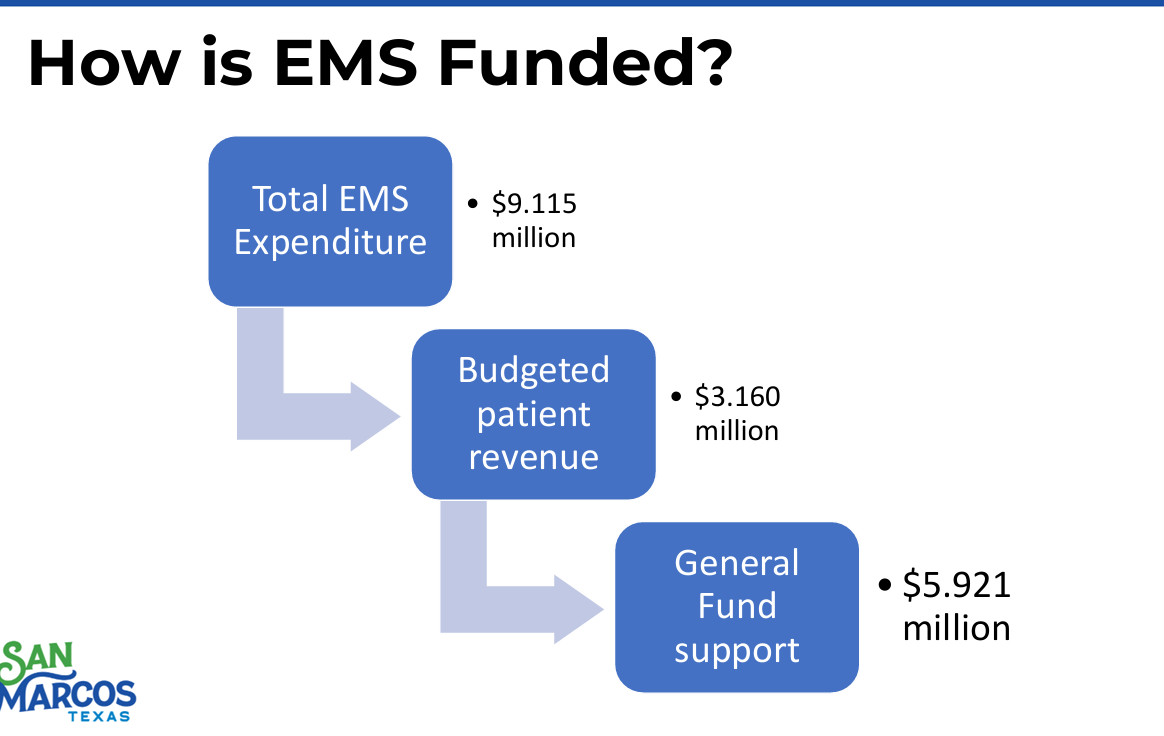
That means that the last $5.9 million falls to local taxpayers.
My back-of-envelope math is that half of that gets covered by sales tax and half by property tax.
- $3 million over 9000 households is about $330 per home owner, in property taxes.
- $3 million over 70,000 adults is about $43 per adult, in sales tax.
There are no other sources of money. The total has to come to $9.1 million.
…
Just for funsies, let’s daydream about socialized medicine:
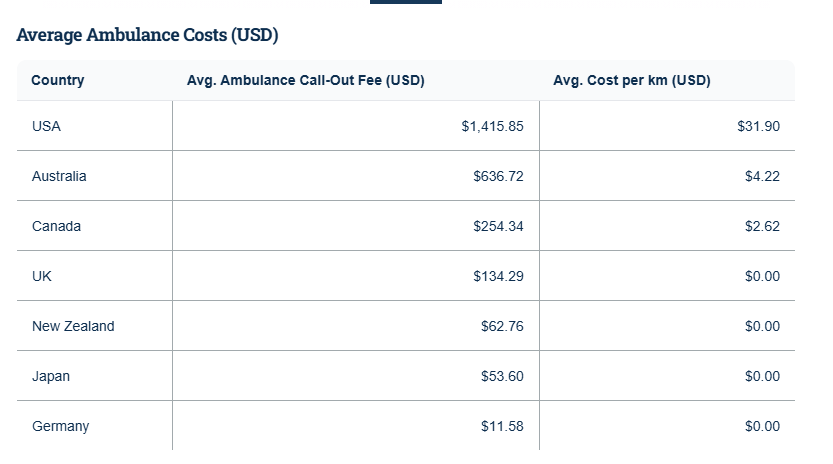
It’s almost as though insurance companies aren’t helping! So weird. It’s as if they are just extracting profit, without providing better health care.
…
Bottom line: We’re going to look to see how New Braunfels handles residency issues, and come back with more precise scenarios.
Alyssa: New Braunfels does not think about residence as generously as we do.
Answer: It will just be a starting off point.
….
Items 14 – 19, and 3: All the Budget Stuff
This is where the meeting gets hairy. We’re about to hold votes on:
- Setting the 2027 budget
- Setting the tax rate
- Raising the electric utility rate
- Raising the water and wastewater rate
- Raising the stormwater fee
- Raising the trash/recycling rate
- Charging developers an impact fee
NONE OF THIS IS BINDING! This is all the first vote.
Last year, everything went off the rails a few minutes before the second vote. There is still plenty of time for everything to unravel.
….
The theme this year seems to be: Lorenzo wants to dismantle local government. I don’t know how else to interpret what goes down.
Lorenzo and I chatted for a few minutes in 2024, when he was running for office. (He most likely does not remember this.) He reassured me that he was liberal, progressive, all the things I’d want in an elected official.
As far as I can tell, he is actually a 1980s Republican: “I don’t want to abolish government. I simply want to reduce it to the size where I can drag it into the bathroom and drown it in the bathtub.”
Note: Shane Scott also does not give a shit about city services! It’s just that I expected that from him. (And Matthew is… erratic, this evening.)
It was a weird night! Let’s dive in.
…
Setting the 2027 budget:
Last year, the property tax rate was 65.15¢. This year’s budget was built on the same tax rate, 65.15¢.
- City services and programs have been cut back, because department budgets have not been increased in 3 years, despite inflation.
- We are spending $5 million on our new EMS.
- Abbott is signaling that he wants to screw over city budgets when the legislature meets next year.
My $0.02: we should always raise property taxes a teeny bit, rather than digging ourselves into a big hole and hitting the community with a big hike every few years. But here we are, digging! Oh well.
We’ve been over the details back in March, and in May, and in August. There is basically no additional discussion tonight.
The non-binding vote:
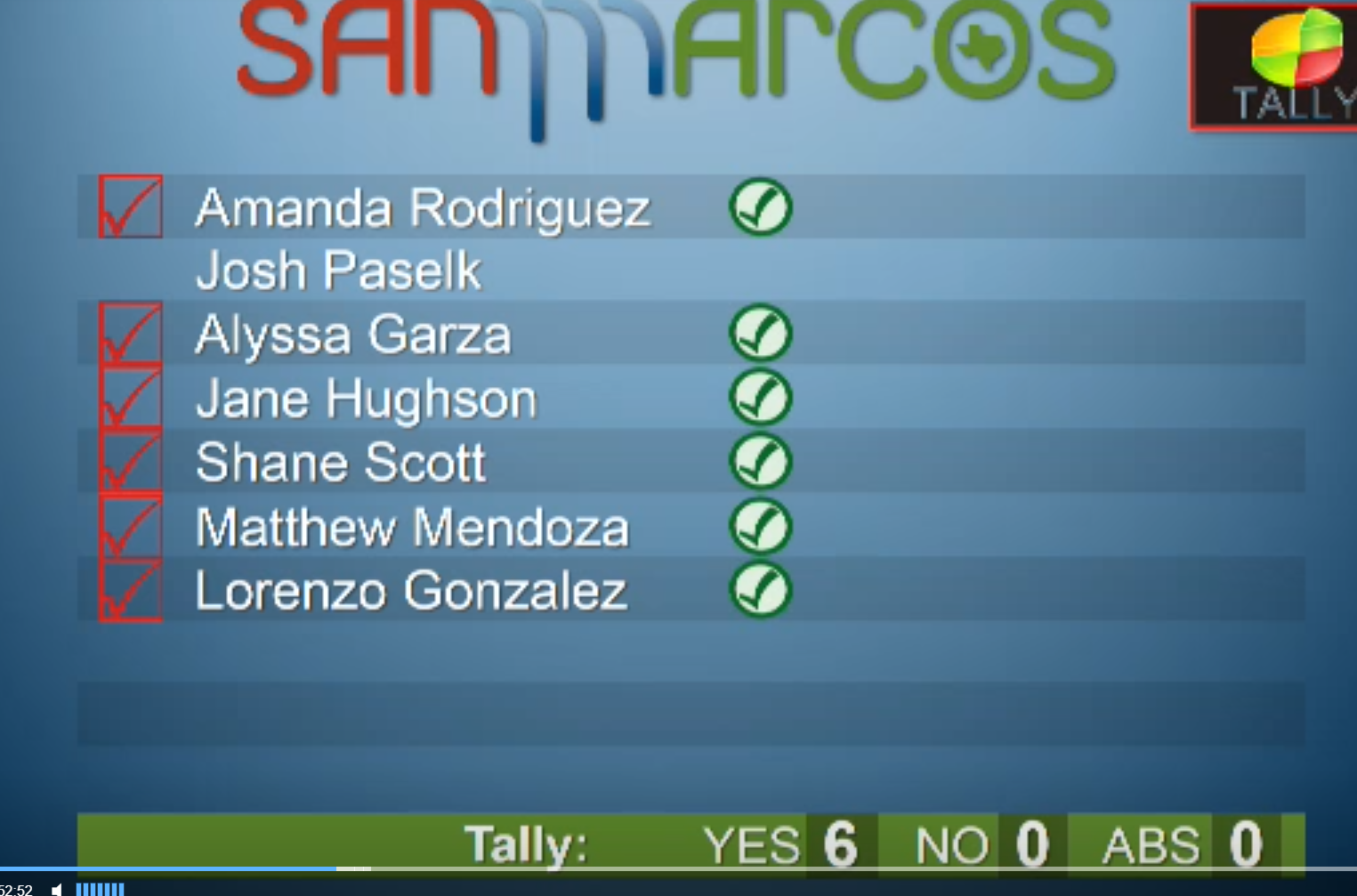
(Josh Paselk is absent.)
Great. Non-binding, but fine. The real vote will be September 15th.
……
Progress:
Setting the 2027 budget- Setting the tax rate
- Raising the electric utility rate
- Raising the water and wastewater rate
- Raising the stormwater fee
- Raising the trash/recycling rate
- Charging developers an impact fee
…
Moving onto the tax rate.
Now they need to vote on the tax rate, 65.15¢.
Home prices have fallen a little bit, so the expected tax bill will fall a little, too:
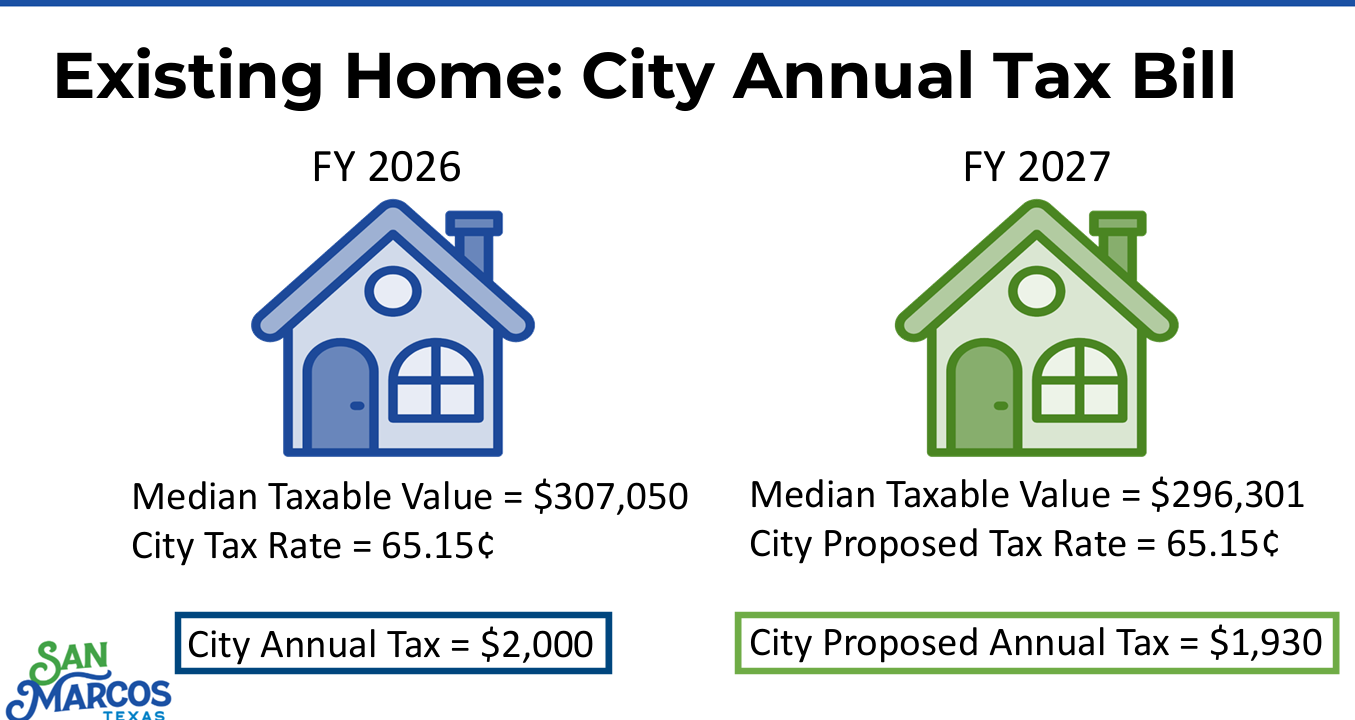
Note: This is just the city property tax.
You also pay into the school district and county:
- Hays County tax rate: 0.3999¢
- SMCISD tax rate: 1.0152¢, but with a $140K exemption from the state
On a $296,301 house, you’d pay:
- total property tax bill: $4701
- $1,930 to the city
- $1185 to the county
- $1586 to the school district
Ok, fine.
Note: Renters pay property taxes indirectly, because landlords generally set rent that will cover their costs and turn a profit.
…
Humor me while I gripe:
San Marcos subsidizes home owners:
- Every home owner gets $15K exempt from their appraisal, or about $97 knocked off their tax bill.
- Home owners over 65 years old get a $35K exemption, or about $228 knocked off their tax bill.
Some senior citizens are living close or below the poverty line, and desperately need that $228.
Every member of Kissing Tree is over 65, and none of them are close to or below the poverty line! The average Kissing Tree home was worth $500,000 in 2025:
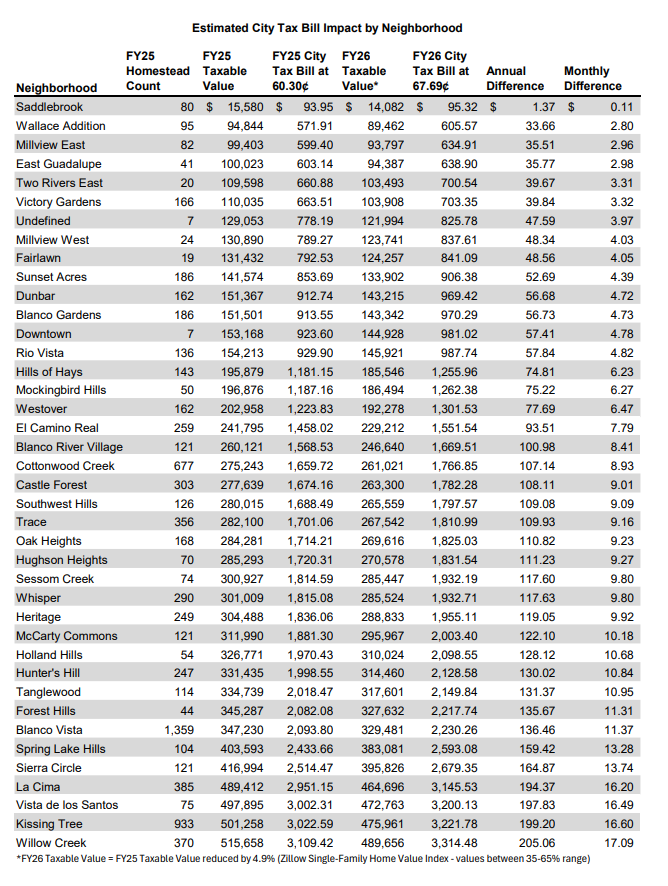
Every home owner of Kissing Tree gets an extra $228 per year, for being over 65 years old. Just some nice pin money for the ice cream shoppe. (This is on top of the $1.7 million TIRZ subsidy!)
There are 933 homes in Kissing Tree. Every year, San Marcos gives Kissing Tree an extra $212K, for being over 65 years old.
…
Total, these tax exemptions add up to $1.6 million:
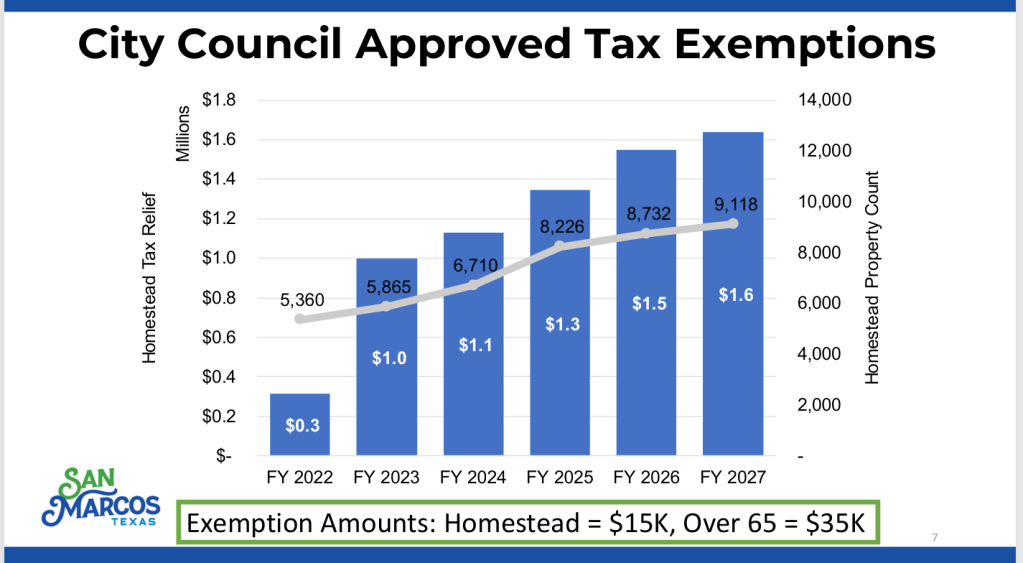
Remember: this is a gift to home owners. The city spends $1.6 million subsidizing home owners every year!
…
The reason we are not raising the tax rate is that Council decided this, back in January 2026, at their visioning session.
Over the next 9 months, we heard over and over again:
- Council does not want to raise taxes.
- Department budgets will not change for the 4th year.
- We’re spending $5 million on EMS now.
- This is unsustainable.
Last meeting, we locked in the max possible tax rate. This is a weird Texas rule: council has to set a maximum ceiling tax rate, in August. Council picked 65.15¢, (ie the same tax rate that the budget is based on).
Tonight, Matthew says, “You know what guys? I’m going to put my head on the chopping block and do the right thing. Let’s be responsible and set the tax rate at 67 cents!”
Everyone looks at him, gobsmacked. Like, “Where have you been? You’ve been on council since 2022. You know how this works. You literally voted for a max rate of 65.15¢ two weeks ago. You could have spoken up then, but now it’s too late.”
There are two possibilities:
- Matthew pays zero attention to what’s going on. He is literally ignorant, after four years on Council.
- Matthew is scheming, and trying to look like a good guy when he knows it’s too late.
I don’t know what the answer is, but neither one is a good look!
….
The non-binding vote on setting the tax rate at 65.15:
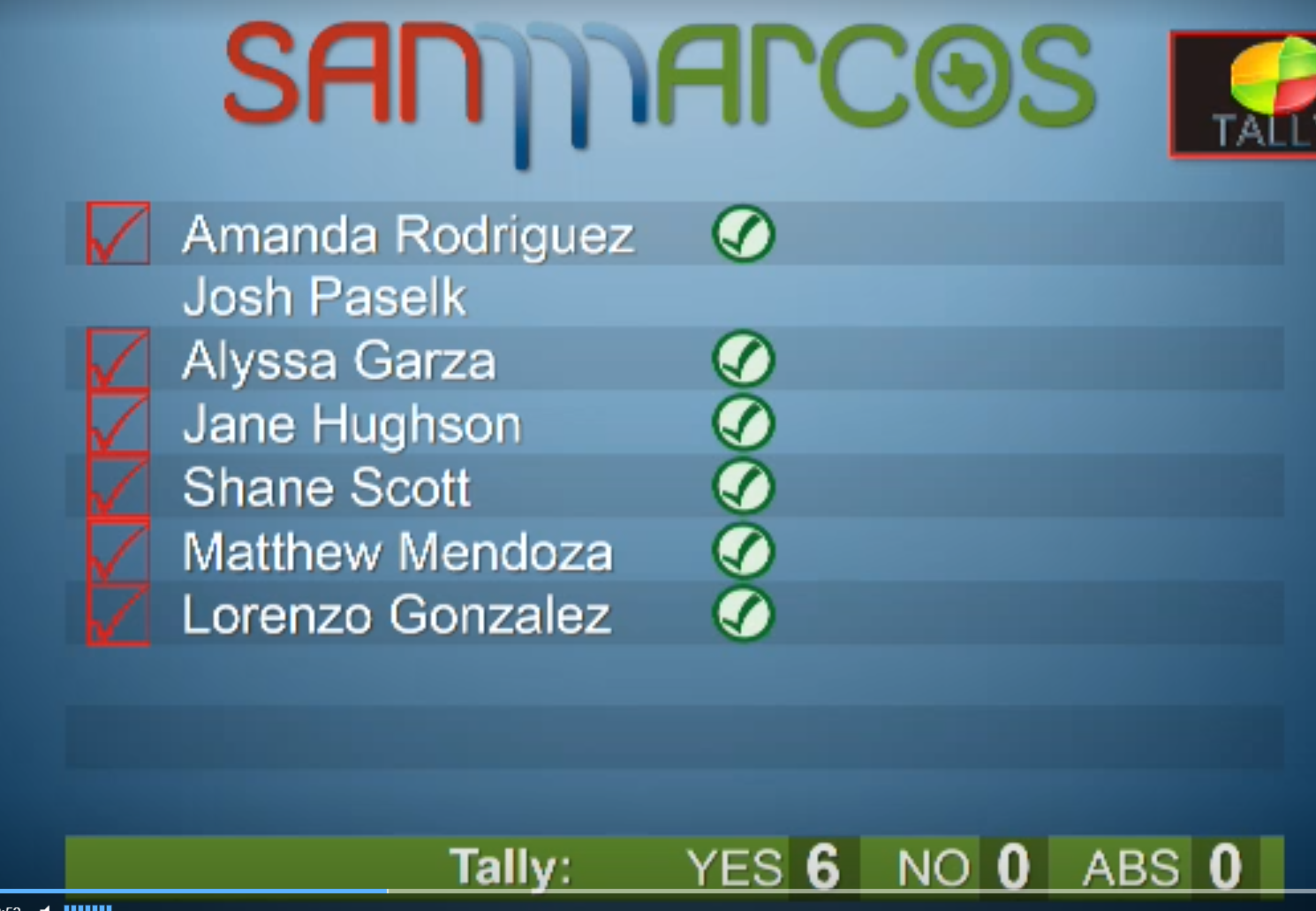
Great. The real vote will be September 15th.
…
Progress:
Setting the 2027 budgetSetting the tax rate- Raising the electric utility rate
- Raising the water and wastewater rate
- Raising the stormwater fee
- Raising the trash/recycling rate
- Charging developers an impact fee
Two down!
…
Electric rates, Water/wastewater rates, Stormwater fee, Trash/recycling rates:
There are rate increases being proposed in every category. Here is what we’re talking about:
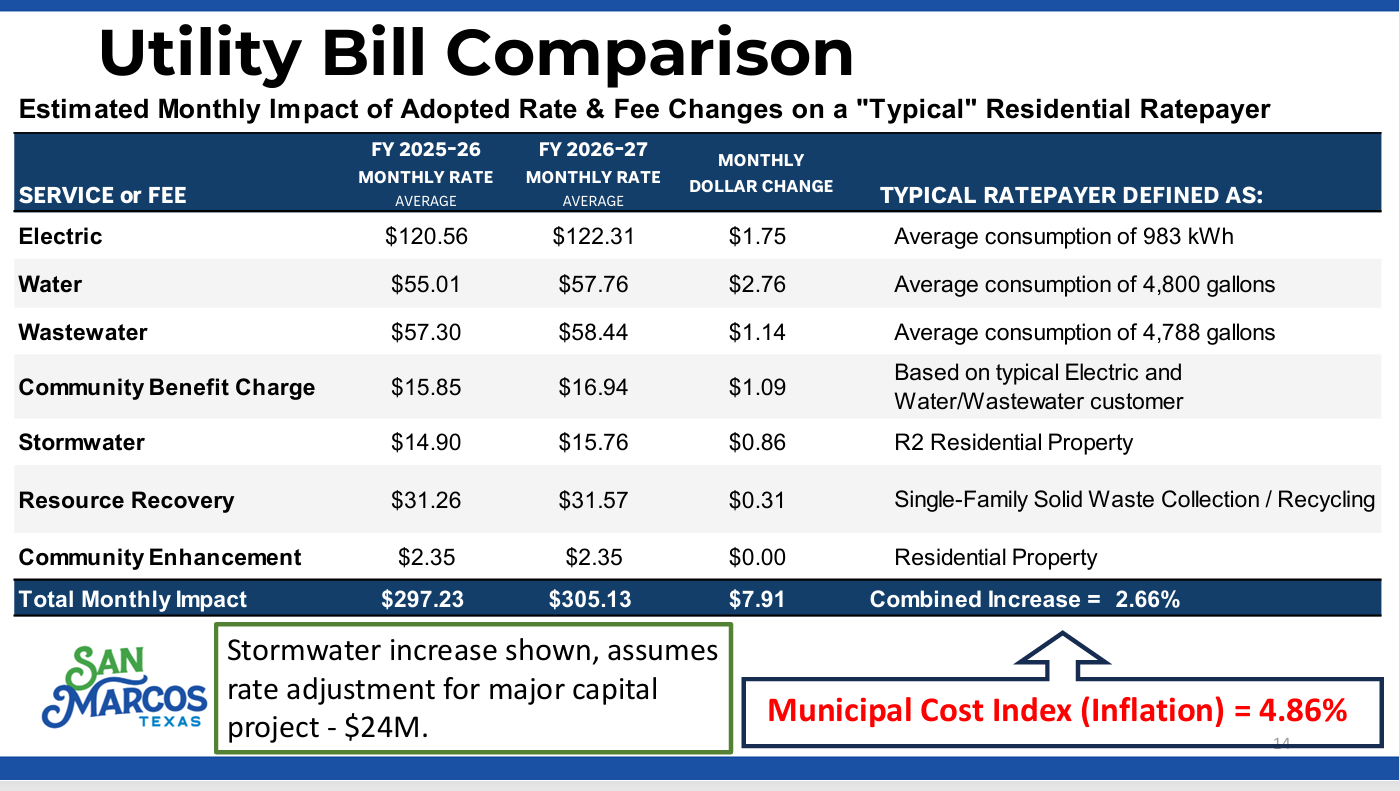
An average household would see bills increase by $8 a month. (But in the peak of summer, a large household would see bills much higher than this.)
Here is the problem: If you don’t raise rates, the tax payers will still foot the bill. San Marcos residents will paying these costs, either through your utility bill or through your tax bill. There just is no squirming out of this.
Here is Lorenzo and Shane:

I also debated using this meme:

You get the picture. We have to pay for the cost of providing electricity, water, etc, and there’s no magical thinking that will undo this.
…
First up is the Electric Rates:
Here’s the increase being proposed:

This is an increase of 1.3%. The Community Benefit Charge is a flat fee, which will go to replacing streetlights and adding new streetlights.
What happens if we don’t raise rates by 1.3%?
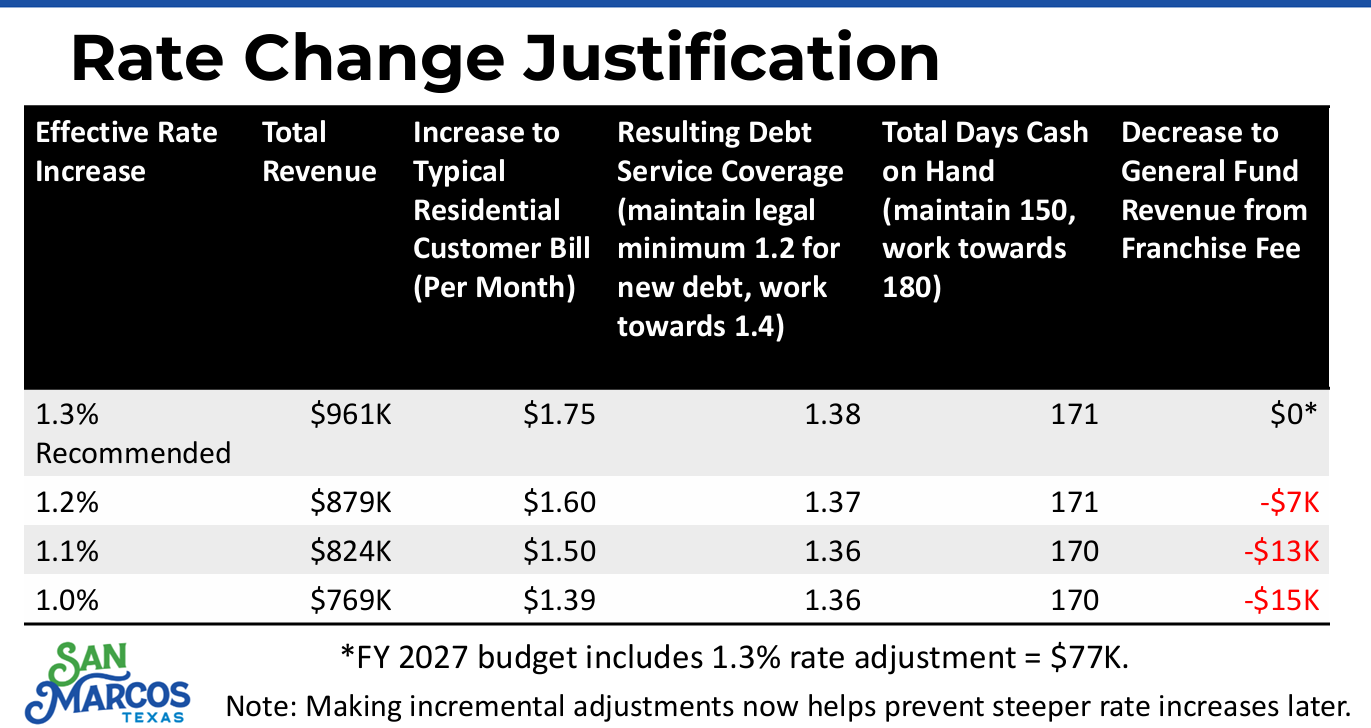
If we don’t go for this hike, then taxpayers still pay the difference. It’s just that it comes from the General Fund, instead. There is just no way around it – we pay for our electricity and infrastructure.
Second problem: the Electric Utility Bond Rating. If our bond rating gets worse, costs go up. If our bond rating gets better, costs go down.
Small regular rate increases help your bond rating. This will help keep our costs low, over time.
Finally: we have worked really hard over the last few years to fully fund an accessible utility assistance program. This is supposed to help those residents who are financially precarious.
The vote: Raise rates by 1.3%?
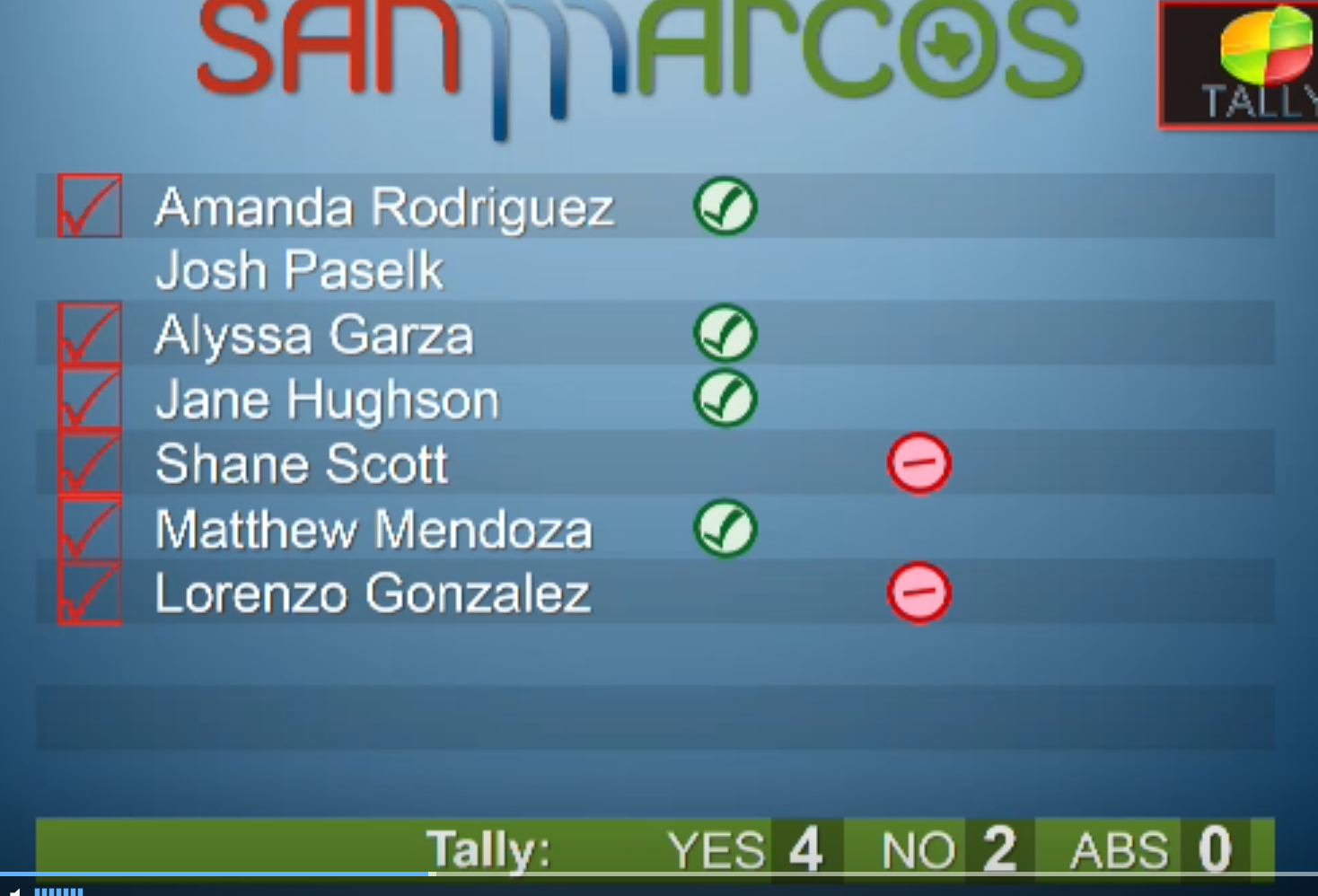
Shane and Lorenzo:
But it passed anyway, so fine. Great. Nonbinding, but great.
…
Water and Wastewater:
The meeting starts to deteriorate in this next item.
Here are the proposed rate hikes:

These are recommended by CUAB, which stands for Citizen’s Utility Advisory Board.
Here is the big issue to understand:

In other words, we legally have to raise rates. We do not have a choice.
Furthermore, we have the bond rating problem again. If this doesn’t pass, it will be more expensive to borrow money for infrastructure projects.
Lorenzo: I don’t care. We shouldn’t be borrowing money if we’re broke.
Answer: You’ve already borrowed the money. You have already signed the contracts for a new wastewater treatment plant by Redwood.
Lorenzo voted for the water treatment plant in June, and he voted for all the developments that need the new treatment plant in March 2025, December 2025 , January 2026, and July 2026. There is no surprise! You have to pay for the infrastructure once you sign the contract!
[You feel how frustrated I am getting??]
Alyssa: I still have questions. My neighbors and constituents say that this chart of rate hikes does not match their lived experiences of what they get billed.
The vote:
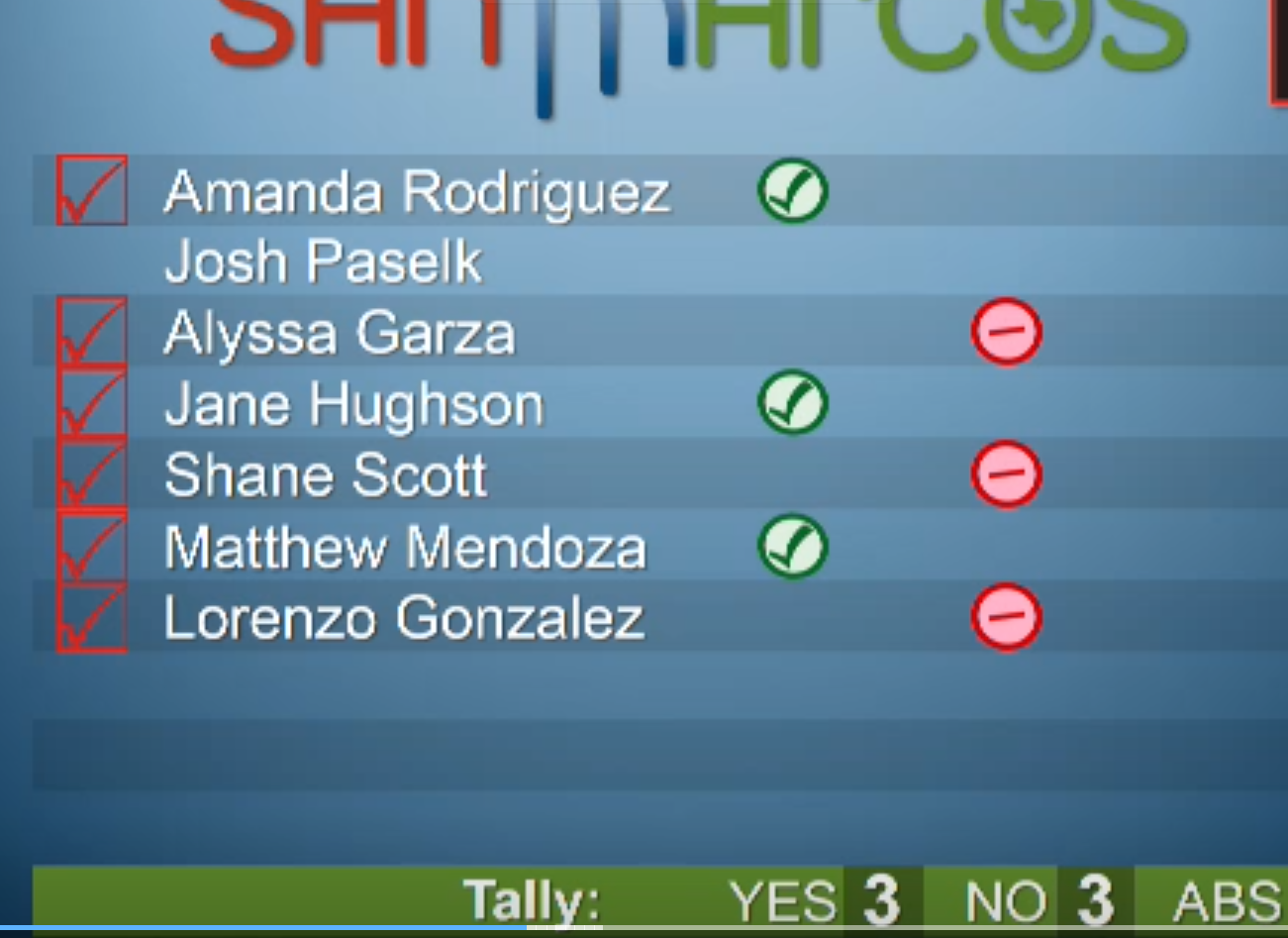
That means it fails.
Well, fuck!
I keep saying “These are nonbinding votes”. But they’re only nonbinding if it passes, because then it advances to the real vote. If it fails, it tanks the whole thing.
….
What do we do now?
This is one of those moments where it gives lie to the bullshit. Everyone knows that it is bad for everyone in San Marcos if it fails. Therefore we have to find a way to allow these chickenshit votes to keep from actually screwing everyone over.
What do we decide to do?
We phone Josh Paselk. Literally, we phone a friend like we’re on Who Wants to Be a Millionaire.
Josh had some emergency and was not able to attend the meeting. But he sees the Bat Signal, and hops on the phone.
Hi Josh:
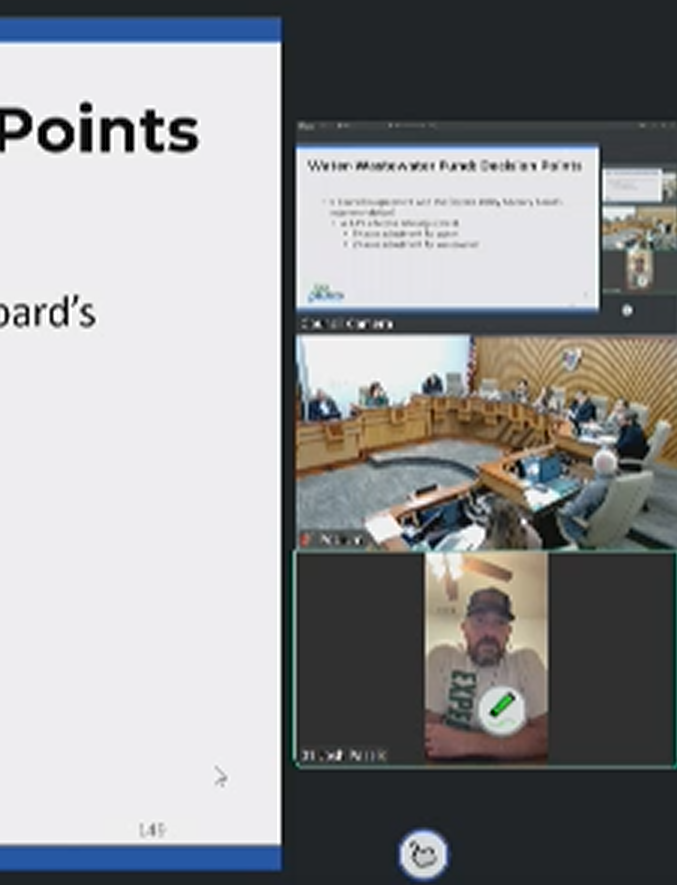
Sorry to bother you like this.
We reopen the vote, and ask him over the phone how he votes:
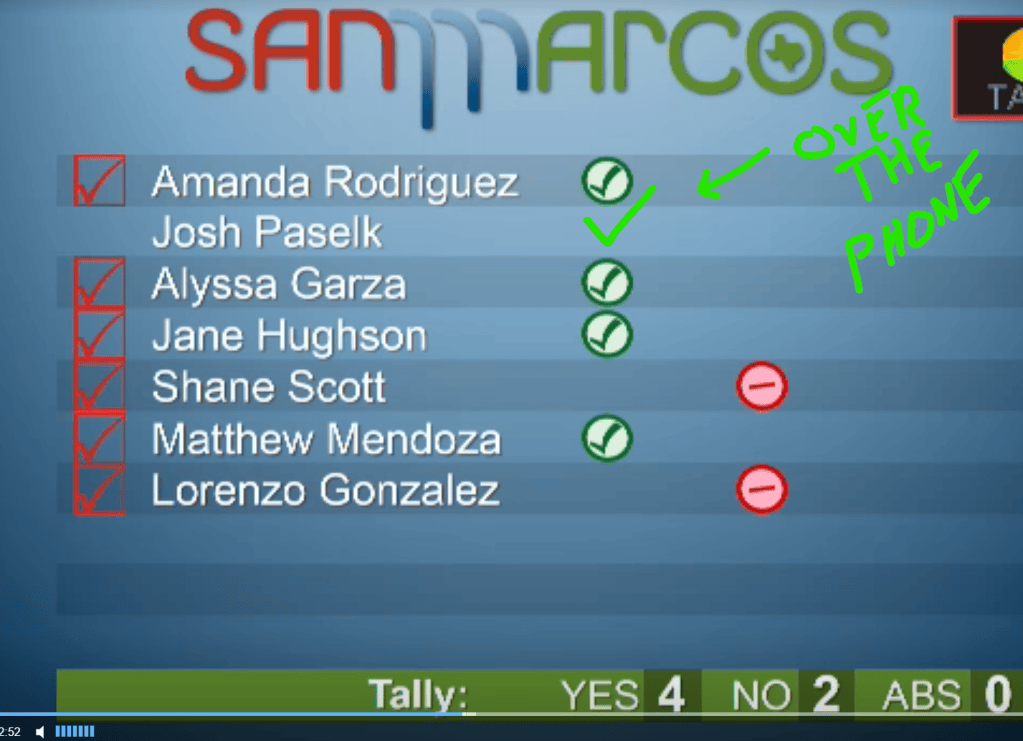
Alyssa also switched her vote.
However, remember: this is non-binding. This allows us to get through to the real vote, on September 15th. Both Alyssa and Josh say that they have major reservations, but they want to move it forward.
Good fucking grief.
…
On to the Stormwater fee:
Unlike most of the other fees, this is a flat rate. This is to fund projects to stop floods from flooding people’s houses.
Right now, the people of Sunset Acres are especially impacted – they’ve been flooding for decades.
Construction started years ago, but it is a big, slow project to fix the flooding:
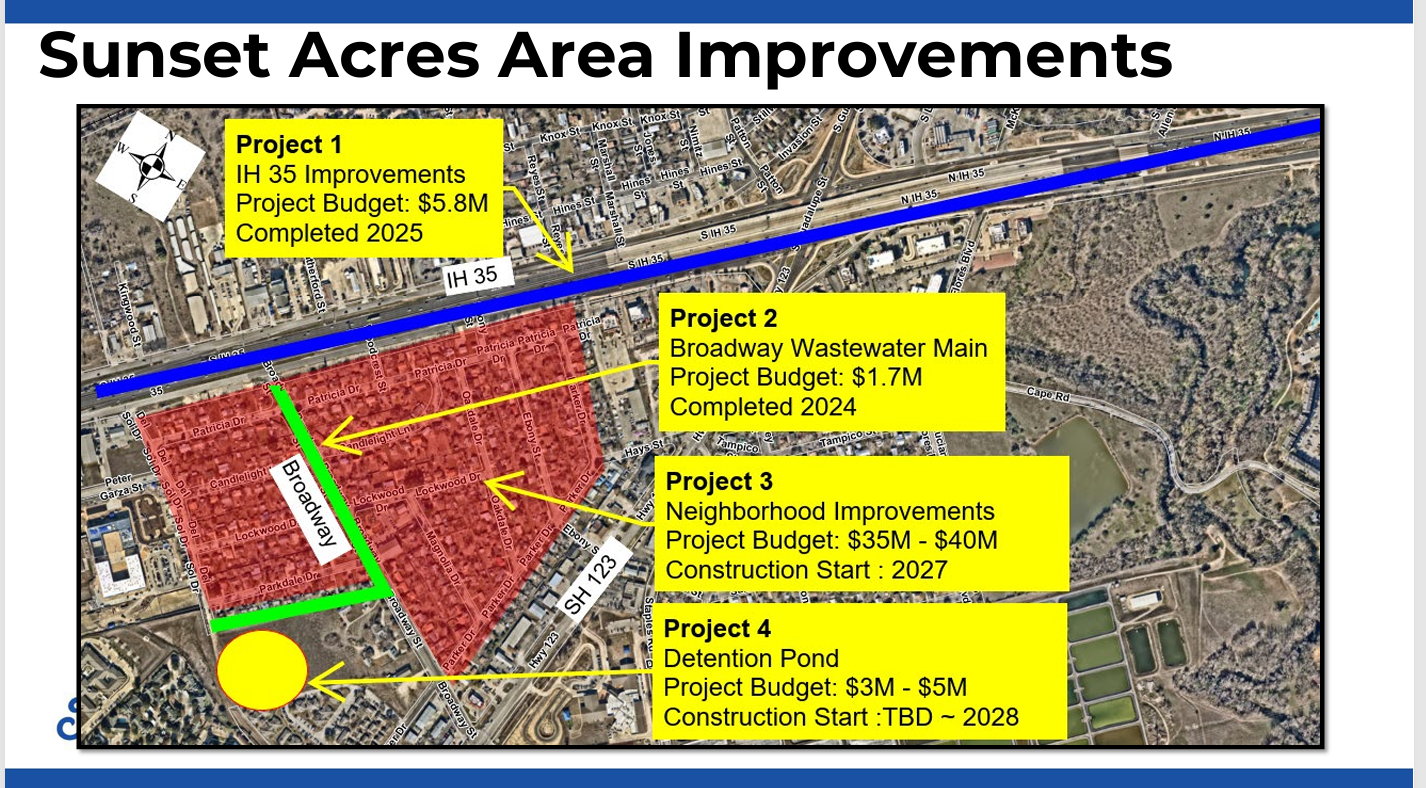
Before this, Blanco Gardens had their flooding addressed, with years of construction following the 2015 floods. Rio Vista had a lot of stormwater work done in their neighborhood in the early 2010s. Bishop and Belvin have had stormwater work done. There are other neighborhoods still waiting their turn.
Getting water in your home is soul-crushing. These projects are big and slow, but so deeply important.

Everyone’s stormwater fee would go up 86¢ cents per month.
Lorenzo: this is all because you all didn’t have the gumption to raise the tax rate! We’re robbing Peter to pay Paul, but worse, because this is rate payers and not home owners.
City Manager Stephanie Reyes: Raising the tax rate does not help with stormwater projects. Property tax goes to the General Fund. Flooding projects are paid for from the Stormwater account. These are separate funds.
I’m going to actually transcribe Amanda’s and Lorenzo’s fight here:
Amanda: This is where I sort of get frustrated, because I have been saying this from the very beginning, and we are all – everybody on this dais – privy to the way the budget process works. When you say that you don’t want to raise taxes, under the guise of saving taxpayers money, there are consequences to passing that dime over, and over, and over again.
We were all afforded the opportunity to raise taxes that way earlier, and no one made that motion.
Lorenzo: I voted to NOT raise the tax rate and I have consistently voted not to raise utility rates either. If y’all want more money, y’all should just have the balls to raise the tax rate.
Amanda: Arguably the hardest thing we do as elected officials is address the budget and address rates. And I don’t think any of us approach this as if it’s easy. The scenarios that Ms. Garza is talking about, I have lived, my mother lived. These are not easy decisions.
But inaction has consequences. We are required to make tough decisions, looking at the financial viability of our city.
(Lightly edited.)
Lorenzo does not want to raise taxes, nor raise rates, nor pay for stormwater projects. That is why I said that he wants to “drown the government in the bathtub” above.
How much will this 86¢ help?
Raising the stormwater fee by 86 cents a month would allow us to borrow $24 million to fund stormwater projects.
The vote:
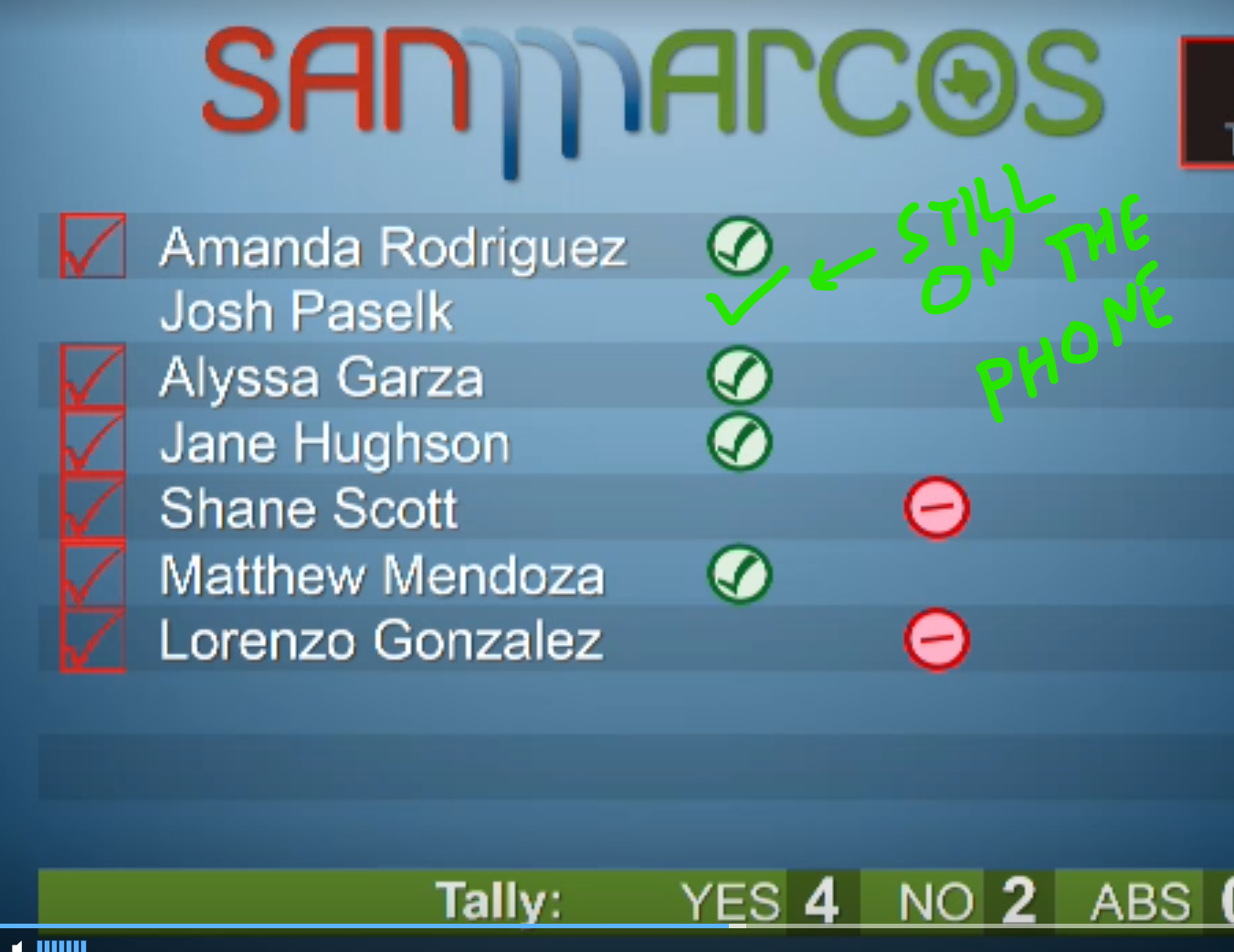
Yes, Shane and Lorenzo, we see you:
Like, do they not believe that people’s houses flood every time it rains?
Anyway, it passed. Great. Nonbinding. Great.
…
Last is Trash and Recycling.

Everyone is sick of discussing these same things. Here’s how the (nonbinding) vote goes:
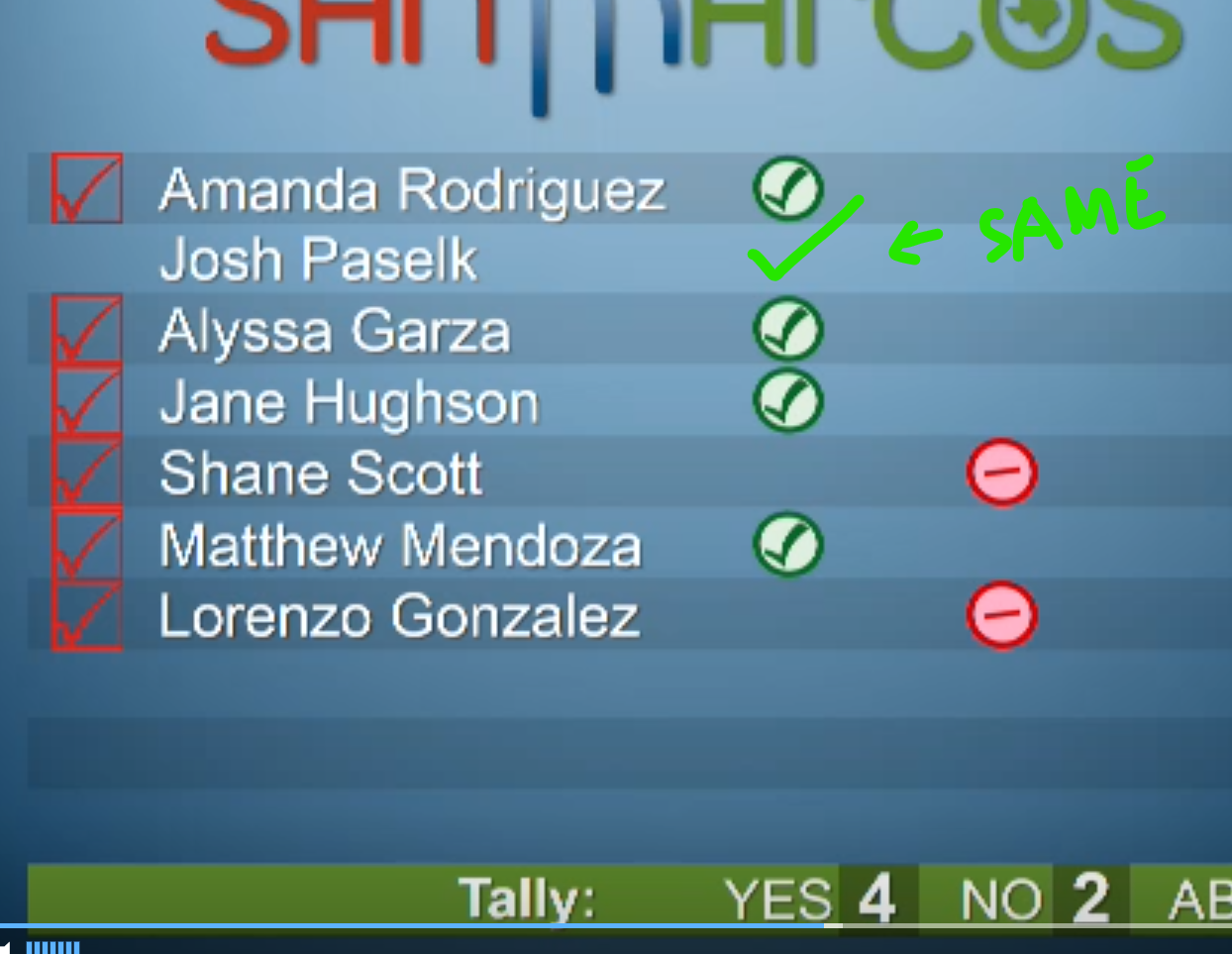
Great.
…
Progress Report:
Setting the 2027 budgetSetting the tax rateRaising the electric utility rateRaising the water and wastewater rateRaising the stormwater feeRaising the trash/recycling rate- Charging developers an impact fee
One left!
…
Next we have Impact Fees
Good news! Finally something you don’t pay!
Background:
Remember this map?
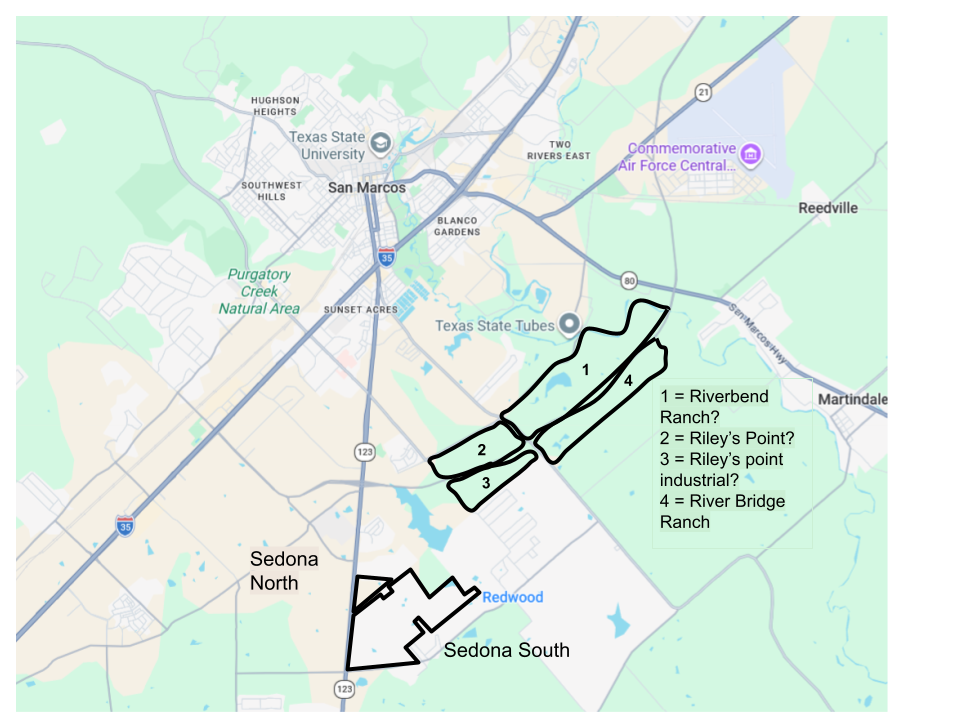
These are just some of the future developments coming for San Marcos.
We’ve seen it a LOT lately. (Most recently here, in August.)
These developments cost San Marcos taxpayers more money than they will bring in. Sprawl is very expensive! The people who will someday buy those houses will not pay enough taxes to cover the cost of running electricity, water, wastewater, roads, fire, police coverage, and EMS out to them. (Plus longterm maintenance of all those things.)
We do need housing! We need:
- affordable housing,
- housing closer to town and in town
- environmentally friendly housing.
We should subsidize the impact fees in these cases, because this is the kind of housing that San Marcos needs.
But for sprawl? impact fees cover the costs associated with sprawl. Developers should pay them.
…..
We have not raised impact fees in a very long time. Things have spiraled out of control. This is costing taxpayers a lot.
To get things back under control, we are proposing to raise impact fees by a lot:
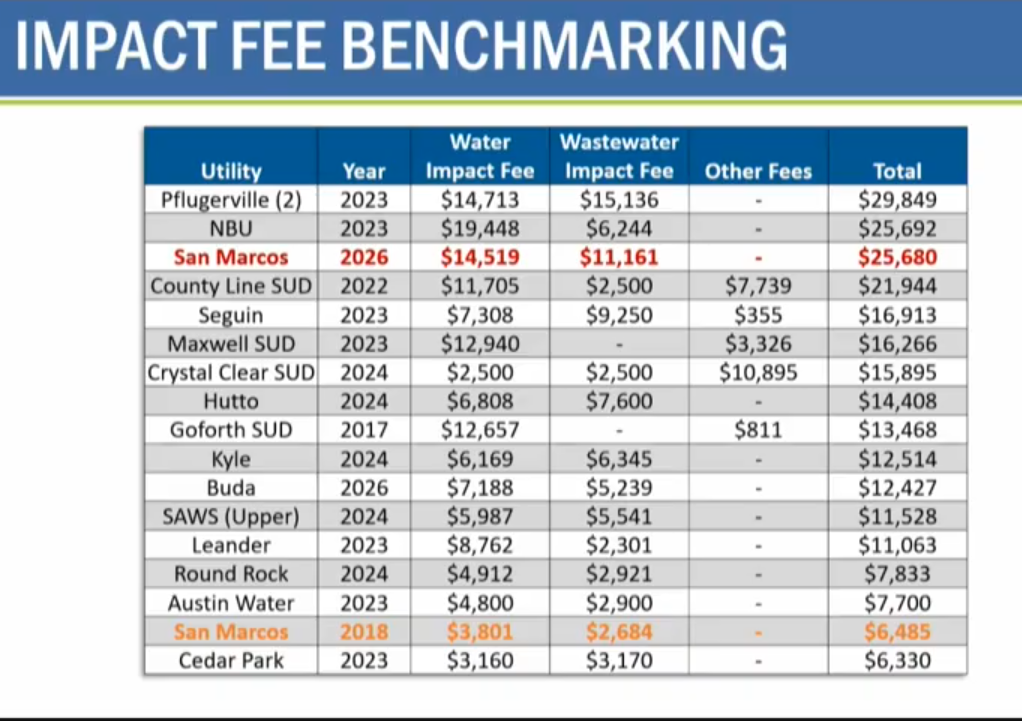
So in 2018, we set fees at $6486 for an average house. Now the fee would be $25,680 for an average house. (This is huge! This is why regular small increases are better. But here we are.)
….
Developers are losing their fucking minds! Their argument is “This will raise home prices by $20K! Do you really want to punish young families?”
Listen: we do need more housing. But developers are grown ups! They decide what to build and where to build it. They can build cheaper housing, if San Marcos residents can’t afford what they want to build.
To save $20K, developers could:
- reduce square footage by about 100 square feet. Instead of selling an 1800 square foot house, they’d have to build a 1700 square foot house.
- Or they could remove a half-bath.
- Or build a carport instead of a garage.
I’m not a builder! Let them figure it out. They are grown ups.
San Marcos is a Target/Old Navy city, not an Anthropologie/Nordstrom city. These developers are crying because they want to make Nordstrom houses and sell them in an Old Navy city, and have the tax payers pick up the $20K difference in cost.
Developers: Feel free to lobby the city for smaller lot sizes! Feel free to lobby the city for more opportunities to build quad-plexes and other small scale apartments as infill! These things would help affordability. Just don’t pretend that San Marcos has to subsidize your large sprawling bullshit.
I’m sorry. I’m very, very cranky by this point.
….
One wrinkle: what about those developers who have already designed their houses and can’t easily go back and make them smaller and cheaper?
City Staff say there are 28 developers who could finish pretty quickly. These 28 projects have already been substantially started under the old fees. Fine.
…
If we don’t pass these impact fees, what happens?

Each time we give developers a break, we are going to have to raise rates on the rest of us.
How much are we talking?
These are the projects that we have to pay for:
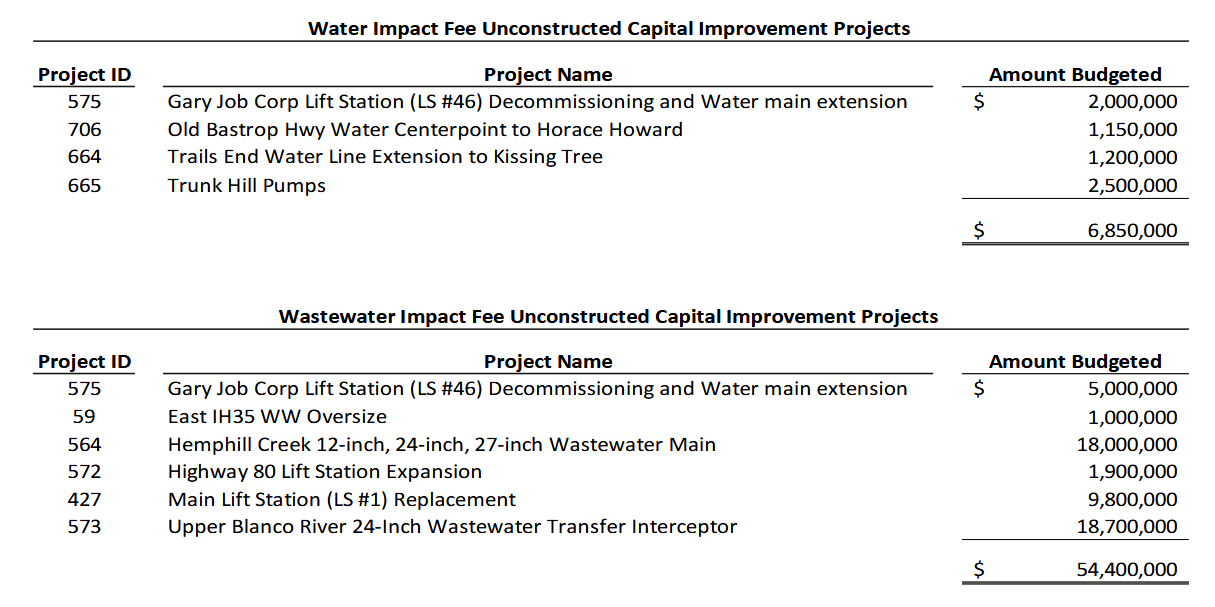
We need to cover roughly $60.5 million over the next 10 years.
These developments are definitely coming! We already approved them! The infrastructure has to be built.
…
The wheeling and dealing begins:
Jane: I propose that we delay implementation until December 1st, to let those 28 developers in the pipeline use the old rates.
Lorenzo: I intend to vote no on every possible option. I do not want any impact fees, whatsoever.
Amanda: What about credits and rebates for infill, green development, and affordability?
Yes! Do this! Taxpayers should subsidize housing that benefits San Marcos. But no one appears interested in discussing this, so it dies on the vine.
Matthew, Josh, and Lorenzo are hashing out all these different possibilities.
- What if we wait till January?
- What if we do half the increase today, and half in 12 months?
- What if we kill this entire thing altogether, and start over from scratch? (yes, this was Lorenzo)
Alyssa: No one brought this kind of energy to our neighbor’s utility bills.
…
Matthew makes a proposal that everyone listens to: Put 60% of the new fees in place on October 1st. Save 40% of the new fees for October 1st, 2027.
Matthew: “This is for the mom and pop builders, that only build 3 houses per year. I’m thinking of them!”
Amanda: Your amendment is a giant giveaway to the huge homebuilders. Why not just carve out the mom and pop builders?
Matthew: Yes, but I’m thinking about the mom & pop builders.
Amanda: This is not saving money. This will drive up costs for tax payers.
My back of the envelope math:
We’re trying to cover $60.5 million over 10 years. So in 2027, we’re hoping to bring in $6 million. Our old rates are about 20% of what’s proposed, so let’s say the old rates would bring in $1.2 million.
Matthew is proposing to let developers cover an additional $3.8 million next year, and have San Marcos residents cover the other $2 million.
The vote on Matthew’s proposal:
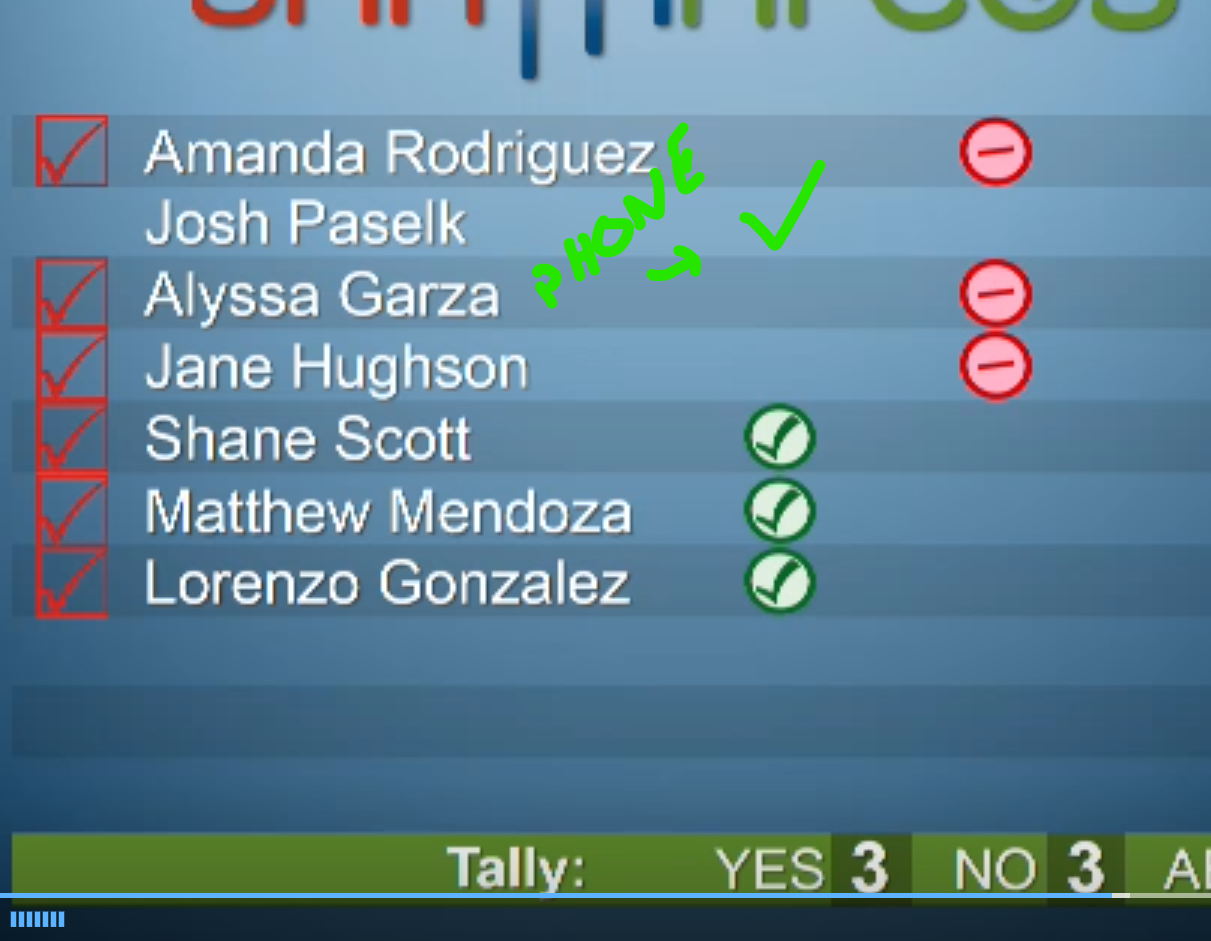
Just WOW.
Look: I’m not actually anti-developer! We really do need housing built!
But we shouldn’t subsidize sprawl. We should subsidize infill, affordable housing, and sustainable housing.
…
But wait! There’s more!
It seems to drive Matthew crazy that Jane voted against his proposal, even though his proposal passed. The two of them keep wheeling and dealing.
Jane: One year is too long.
Matthew: I could do May 1st.
Jane: How about April 1st?
Amanda: How about February 1st?
In the end, they decide to split the difference: March 17th, St. Patty’s Day.
The vote: 60% until St. Patty’s day, and then 100% after that:
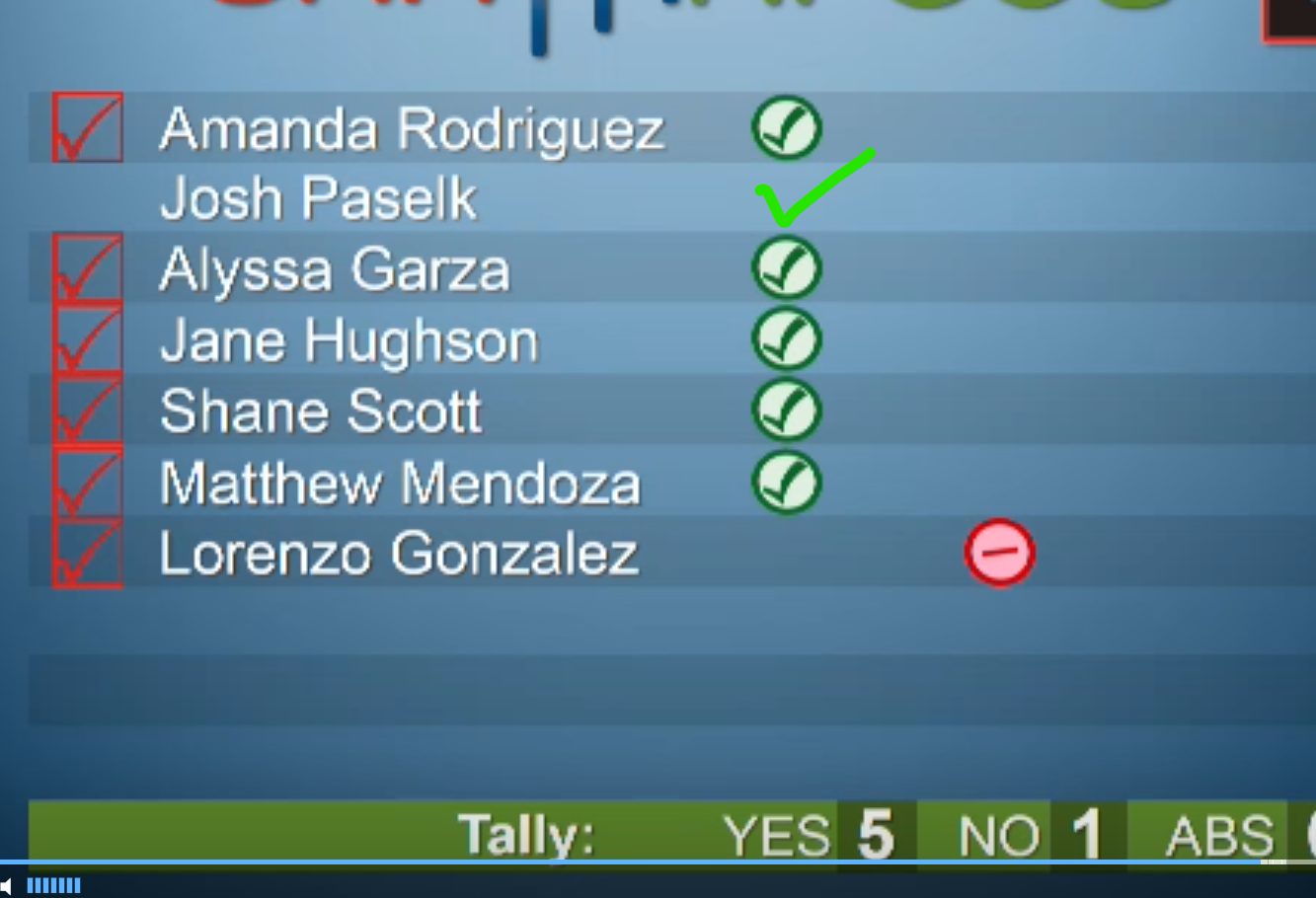
According to my ballpark math, this will roughly mean rate-payers are covering $1 million, instead of $2 million. Better!
This is the end of the discussion. This is what sticks.
….
Note: Currently, there are no subsidies for:
- affordable housing
- Infill
- environmentally green housing
We are not subsidizing housing that is good for San Marcos!
I sincerely hope we change that! But after this clusterfuck, I doubt it will come back around. JFC.
….
This is me:
This is the end of all the budget stuff.
(Till next time! This was all non-binding!)
……
Items 10-11: SMPD funding requests
- Expedited drug testing of evidence
We pay to speed up evidence drug testing, so that it gets completed in 30 days instead of 150 days. We contract with DPS to do this. In other words, if cops seize a bunch of pills during an arrest, they send it off to verify whether it’s aspirin or ecstasy.
The current funding being requested to do this is $130K, which is large enough to come to council.
Amanda: Has this amount changed? Is it getting more expensive?
Answer: Actually, Hays County forgot to bill us for two years. So this is more expensive than that.
(What. What on earth.)
Amanda: Are we going to be back-charged for those two years?
Answer: Nope. They’ve been cleared.
Lorenzo: Why are we paying for expedited services? This should come out of county money, because it benefits them.
There’s a kernel of truth in what Lorenzo is saying. The Hays County DA benefits if we pay for expedited 30 day evidence testing. But it’s stingy as hell and bad for maintaining good relationships with other governmental entities. It’s good to exonerate our residents quickly if the evidence comes back clean.
Here’s what Lorenzo is missing: the world runs on relationships. If you can approach other agencies with grace when something is small potatoes, then you’ll have a better time holding on to your convictions when important issues go down.
This is small potatoes.
The vote:
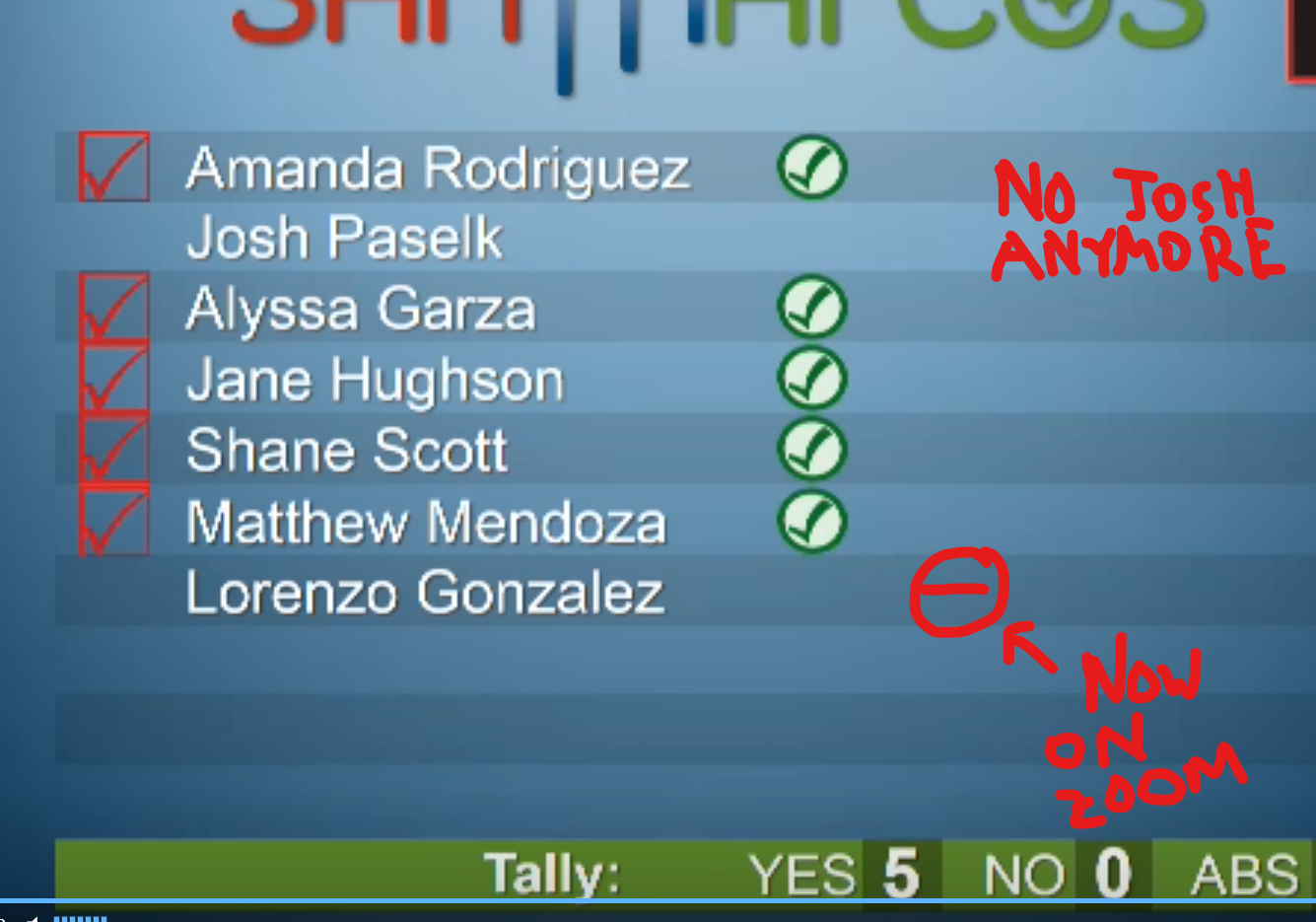
Josh has since hopped offline, and Lorenzo has switched to remote.
Anyway, it passes.
2. an SMPD contract with Axon Enterprises
Axon has been in local news lately as a data center that the county may or may not have signed a contract with. It’s confusing. (There are not enough hours in a year for me to cover Hays county politics.)
Anyway: This isn’t that. This is evidence storage.
Any time police take evidence, they have to legally hold it for a certain number of years. If they confiscate a computer or a phone or an apple watch, they have to upload the data as evidence and save it somewhere.
This is where they save it – we’re paying $46K yearly to store digital evidence with Axon.
Alyssa: there’s a bit in the contract about using data for product enhancement. Can we opt out of that?
Answer: Yes we can!
This will come back around with that provision.
…
Item 20: CARTS
CARTS stands for Capital Area Rural Transportation System.
It’s these guys:

CARTS covers:
- Free bus rides around town
- Free paratransit for people with disabilities
- $4 rides to Austin, or $6 daily pass.
Routes and frequency aren’t great, but the city is working on it.
….
We split costs with the state and the federal government:

Great! That’s how government should work.
…
We are about to begin our Transit Master Plan, and so if I may:
Please address in the Transit Master Plan
There’s no public transportation to get back and forth between San Marcos and New Braunfels, or San Marcos and Seguin.
Here’s the problem: we’re on the southern tip of the Austin Cap Metro service area:
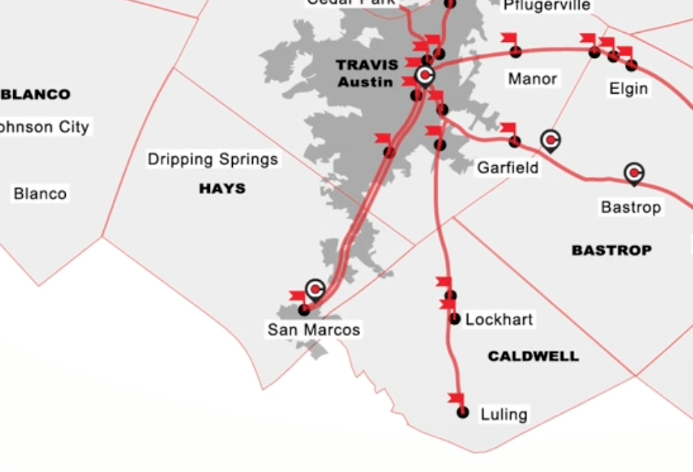
(We do have a bus that runs to Redwood, just outside this area.)
New Braunfels and Seguin are on the northern edge of the San Antonio Alamo Regional Transit:
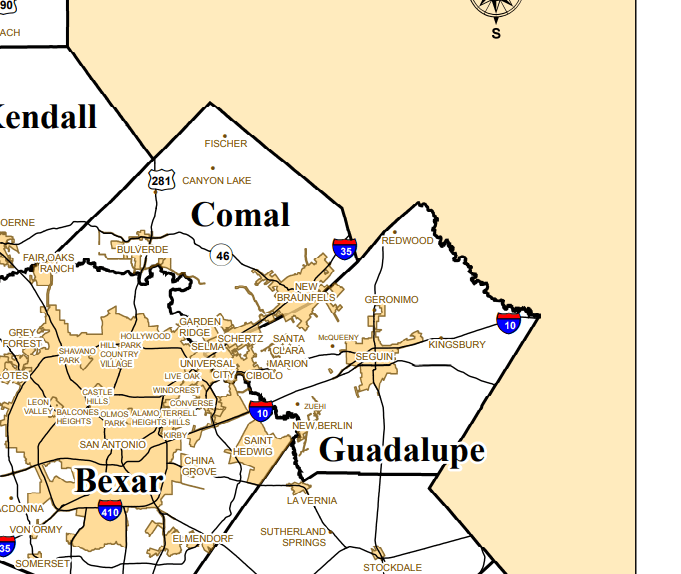
And the two systems don’t overlap or coordinate on their boundaries, so there’s just this cliff dividing San Marcos from its neighbors:

Puzzle pieces! (I had fun making that picture.)
Suppose you use the shuttle service because of your physical disability. How are you supposed to get from San Marcos to Seguin? There are a lot more mental health resources in New Braunfels than in San Marcos, but only if you’ve got the means to get yourself there and back.
Listen: Seguin, New Braunfels, and San Marcos need to triangulate on some shared public transit along I-35 and 123. Austin Metro is not meeting our needs here.
…
Item 24: Food vendor fees
This is just a very quick item, because it was already past midnight.
Amanda: When people want to sell food, it’s $79 for a 14-day mobile food permit. Could we see about reducing this, to help our everyday people?
Answer: Yes!
This will come back around as a future item.

