
Citizen Comment
Three speakers. Main topics:
- The city funding of HSAB is generous, but there is a much greater need. Southside is getting less than half of what they need to continue their Homeless Action Plan. There is a matching grant proposal from the McCoys, if the city can match it.
- We have a new budget. Meetings are too long. Staff does a great job, but Council talks too much. The speaker has great respect for SMPD and has always been treated respectfully by police in many different situations, over many decades.
- Council Candidate Lisa Prewitt – Could we pull items 6,7, and 8 for the Transit details? When she was last on Council, San Marcos became direct recipients of federal grants. They developed the Hutchison Mobility Hub and focused on connectivity along the I35 corridor.
That’s a wrap!
….
Consent Agenda
The consent agenda is the “bulk items” agenda. Council votes on 10-15 items all together as a package, without discussion. (It’s not mandatory. Any item can be pulled for discussion.)
All these feisty items from last time got bundled together in the consent agenda this week:
- Raising the electric rates
- Raising water/wastewater rates
- Raising trash/recycling rates
- Community benefit charge
Specifically almost all of this:
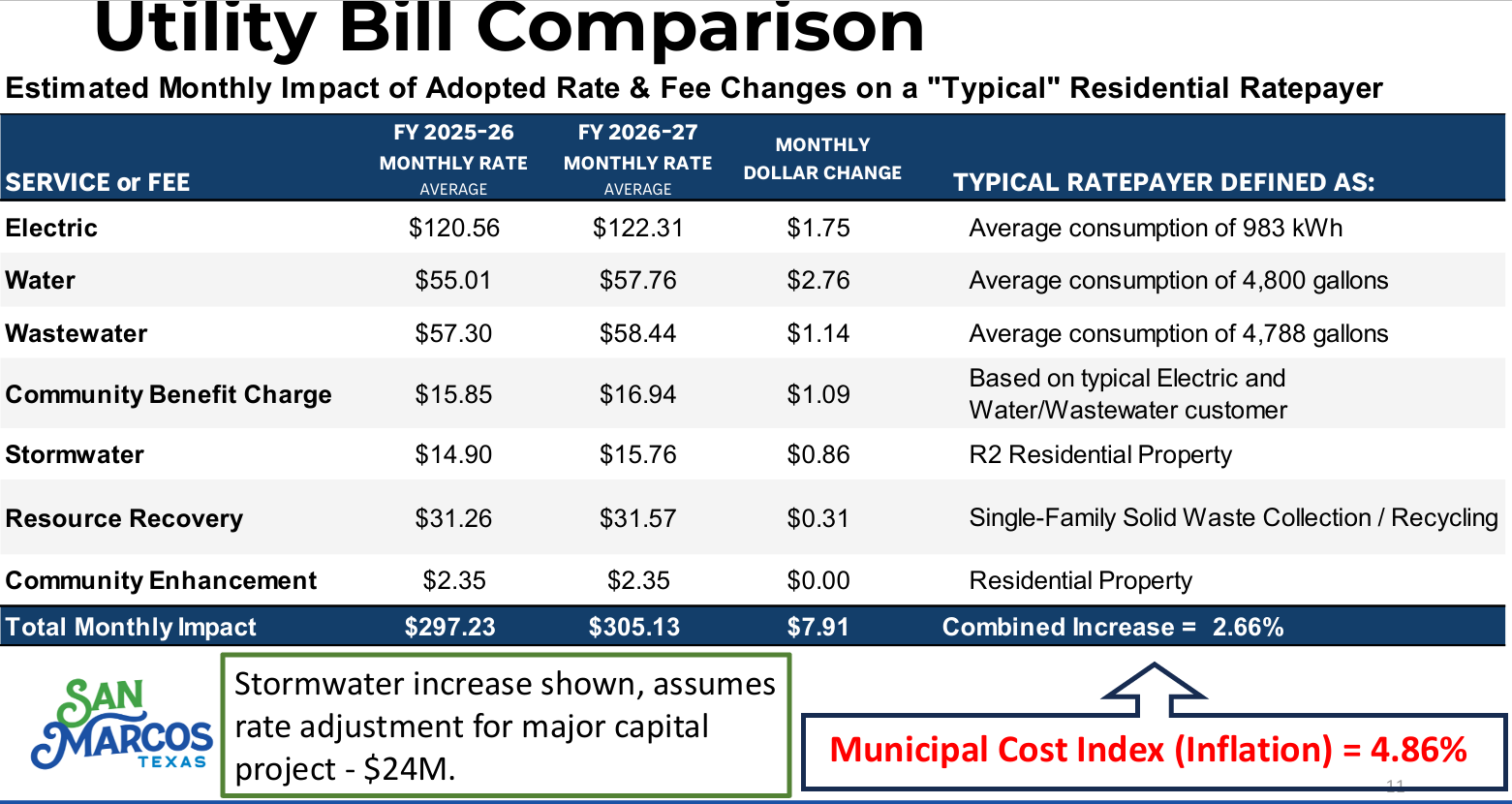
(But not Stormwater. That got pulled and discussed separately.)
Last time, Alyssa complained “Look, this doesn’t match what my constituents get on their bills. This may be the average, but I need to see more details. What is someone paying in a multi-generational household?”
Staff tried to help. They organized utility bills by neighborhood:
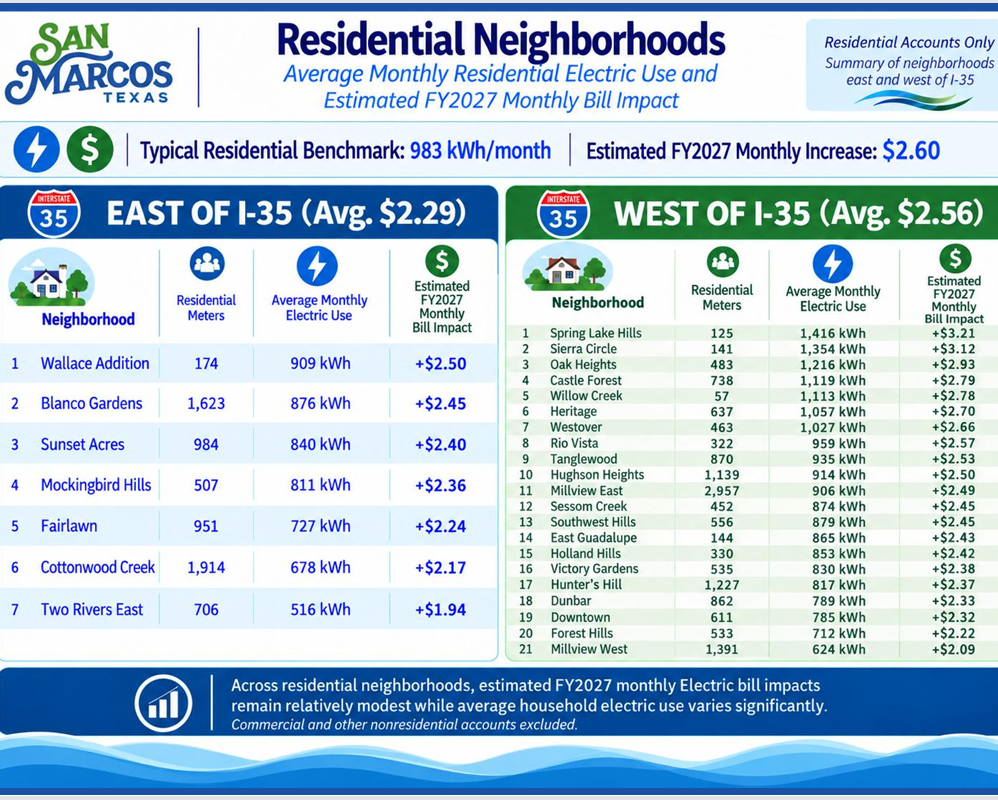
That’s a pretty big spread of electric rates, from 516 kilowatt-hours, to 1416 kWh. Here’s roughly what different neighborhoods will get billed:
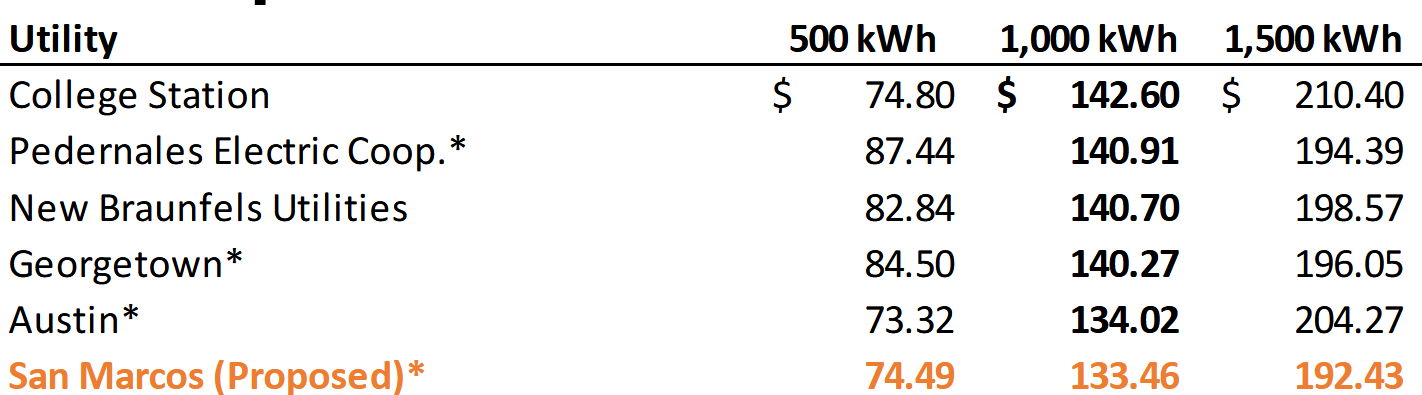
(The rate increase is pretty similar across the board, though.)
Here’s the neighborhood breakdown for water:
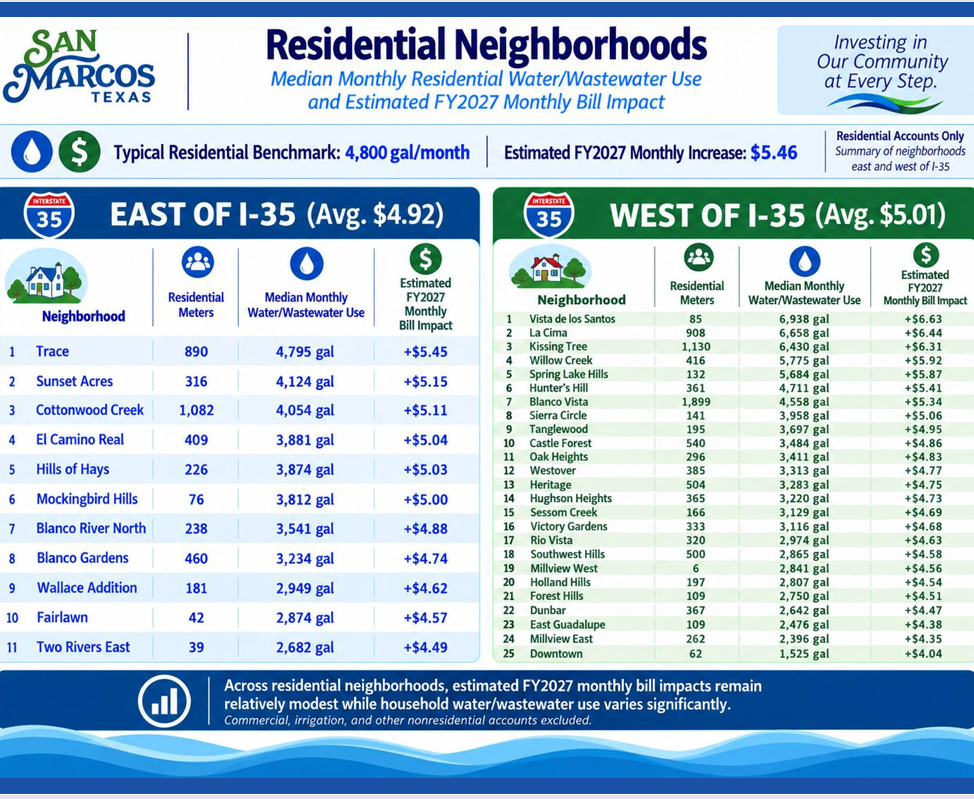
So the spread is from 1,525 gallons to 6,938 gallons per month. If I’m reading this chart and this chart correctly, you’d most likely pay:
- $37.13 for water and $32.40 for wastewater, on the low end
- $41.22 for water and $41,74 for wastewater, on the high end
I don’t think we’re incentivizing people to use less water! It costs you maybe $10 extra to TRIPLE your water use.
I mean, JFC these guys use a lot of water:
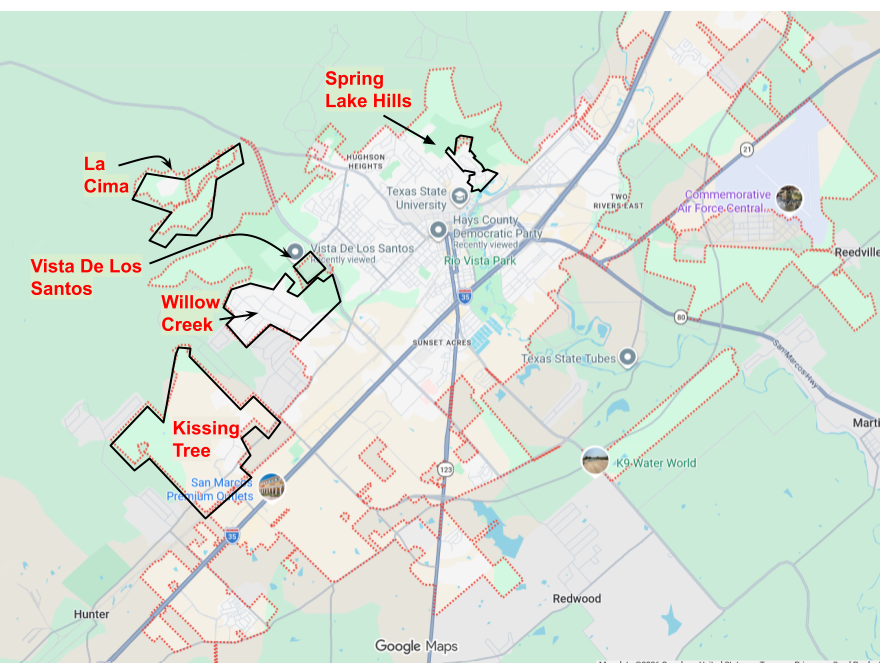
My dudes. Maybe invest in some drought-resistant native plants.
….
Anyway, like I said, there was no discussion during the consent agenda, so I’m just noting the vote here:
Increase utility rates, water/wastewater rates, and trash/recycling rates?
Yes: Jane, Amanda, Josh, Matthew
No: Shane, Alyssa, Lorenzo
To be clear: The “no” votes are chickenshit. These contracts have already been signed. These council members approved the new developments. We have a wastewater treatment plant already being built!
They are only voting “no” because they know the other four council members will suck it up and vote yes. If these votes actually failed, we’d be up a creek and scrambling for a re-vote. That’s what makes this cowardly.
OH WELL!
…
Separate thought: those charts above are very AI, but it’s nothing compared to this one:
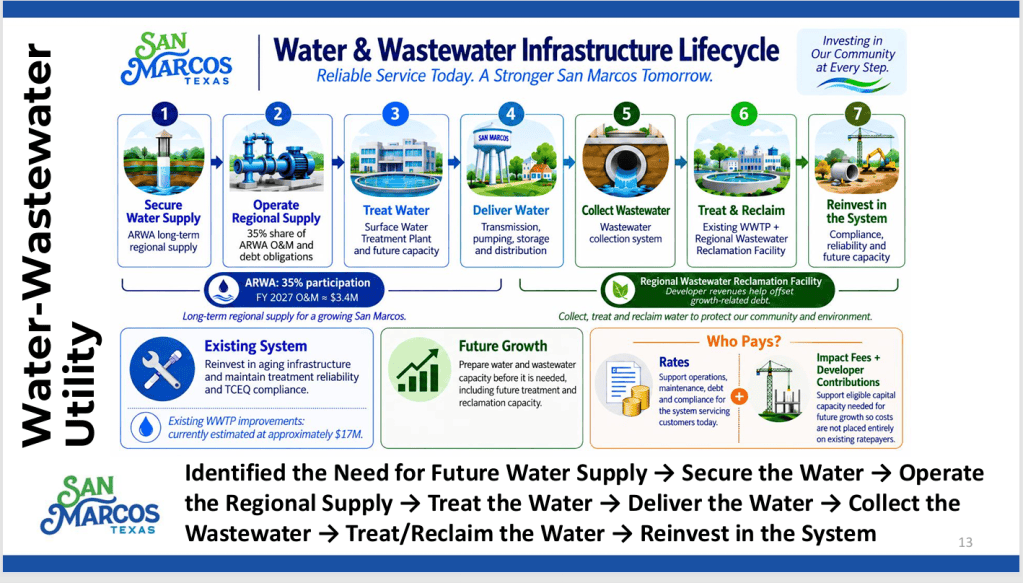
Holy AI, batman! Someone found the Copilot key on their keyboard.
…
Item 14: El Camino Way
El Camino Way is way down here:
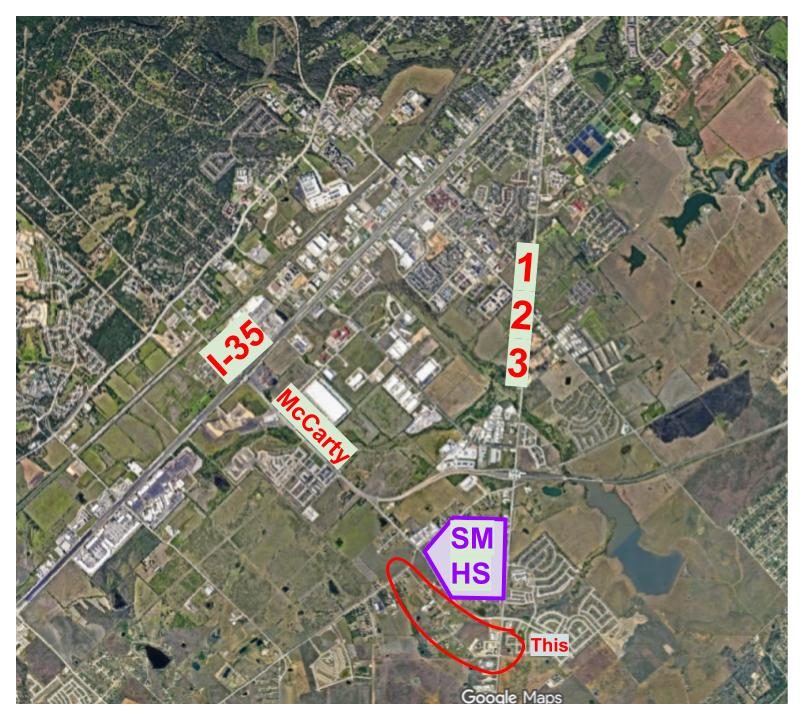
Some day, El Camino Way will be extended. Right now, it’s in pieces:
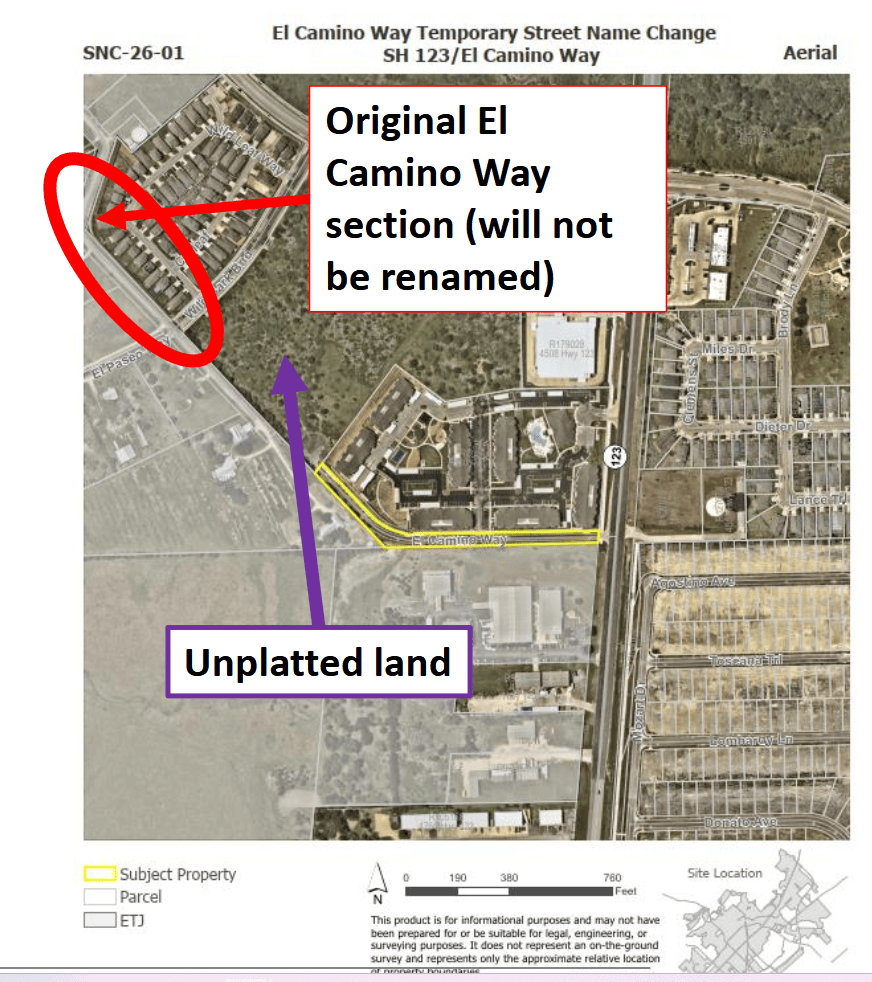
The yellow part and the red part don’t yet connect, but they’re both called “El Camino Way”.
This is a bad idea because you don’t want EMS calls going to the wrong piece of a street, and being unable to get to the right piece of the street. (Discussed before here.)
Solution: temporarily rename the new, little yellow piece where no one lives. Then it will switch back to El Camino Way when it is connected.
Options:
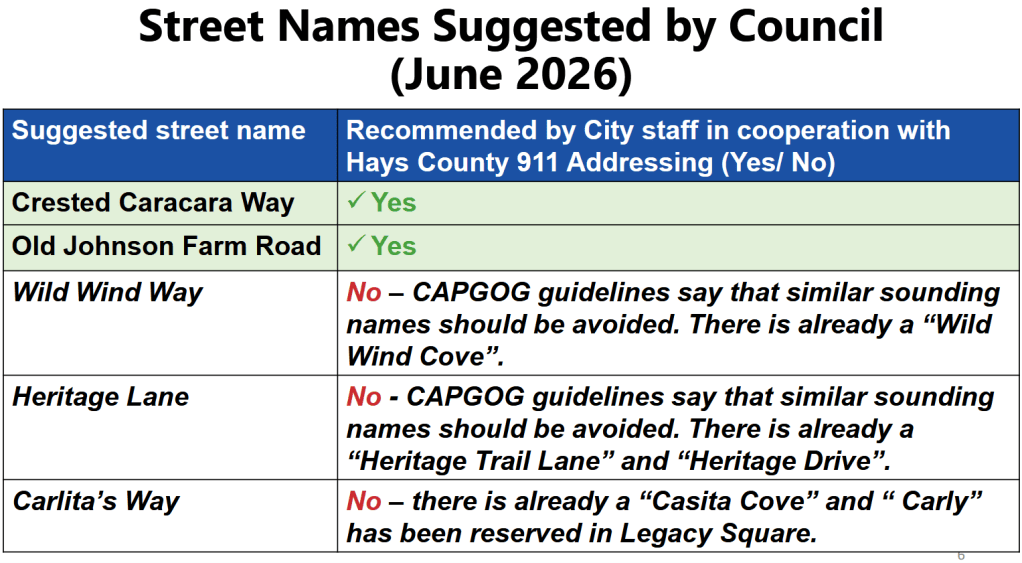
- Carlita’s Way
- Crested Caracara Way
- Old Johnson Farm
- Wild Wind Way
- Heritage Lane
Some of these got ditched already:
These are Caracaras:

I like them!
Council goes with Old Johnson Farm Road.
(At P&Z, one of the commissioners had to recuse herself, for being a Johnson of Old Johnson Farm. I thought that was neat.)
…
Item 4: Stormwater Rates
This is the one rate increase that Council did pull to talk about. We saw this last time. Should everyone pay 86¢ more, to pay for projects to help with flooding?
This time, we go a little deeper into the rates. Not everyone would pay 86¢ more:

So home owners might only pay 53¢ more, or 86¢, or $1.26.
It’s based on the paved footprint of your home. If you’ve got a big home and driveway, you’re causing more water run-off than someone with a small home and no driveway.
Today’s discussion is about the last category: Non Residential. In other words, businesses.
Your business gets also charged according to how big it is. Anything impermeable will cause water run-off. So parking lots, pavement, and your building footprint all get counted. It’s measured in ERUs, which stands for “Equivalent Residential Units”. In other words, how many houses equals the same amount of paved ground as your business?
By state law, you have to charge stormwater fees in a way that scales with size. You can’t carve out different rates for home owners and businesses.
So how much are we charging local businesses?
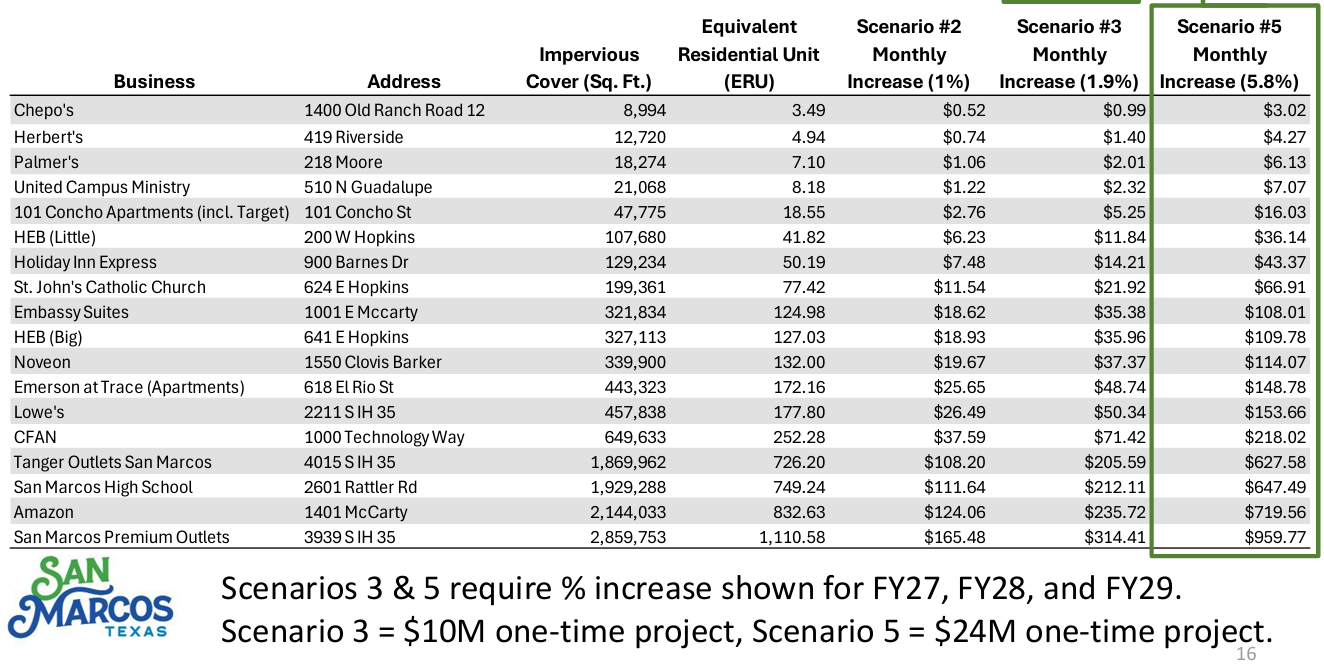
So Chepo’s bill would go up $3 a month, from $52 to $55.
Premium Outlets would go up $960 a month, from $16,547 to $17,503.
Jane Hughson feels awful about this. She focuses in on San Marcos High School, but she’s also concerned about the outlet malls and Amazon, and the rest. SMHS would go up $647.49 a month, from $11,163 to $11,808 per month.
…
Let’s talk about SMCISD.
I’m not so worried about this $650 increase, like Jane is, but it is true that the high school pays $11K/month to the city. It works out to $133K/year. That’s a lot! On the other hand, there is a huge amount of paved parking there.
Two notes for context:
- In March 2025, SMCISD came to the city and asked for a waiver on their stormwater bill. Their yearly bill was $372K to the city, and they were facing a $4 million budget shortfall.
The city didn’t say no, but they didn’t say yes, either. They said, “Can you donate some Mendez land for flood run-off in Sunset Acres?”
The school district didn’t agree, but they didn’t disagree. They said, “We’re starting Mendez renovations and we don’t have final plans yet. We’ll get back to you.”
The new larger Mendez opened this year, so these questions all have answers now. Maybe it’s a good time to revisit this trade-off! (Presumably it’s been happening behind the scenes. Presumably it’s still in a stalemate, or else it would have come up at a meeting.)
Let’s be clear: the villain in the story is the state of Texas, which has refused to keep up with basic inflationary costs in their school funding formula. They starve public schools of resources, and then everyone scrambles locally to cover costs.
2. SMCISD pays stormwater fees, but Texas State university doesn’t have to.
Texas has laws that state that their universities don’t have to pay fees. Their pavement causes more stormwater run-off than anywhere else in the city, because it’s at the top of the hill! It’s far worse than the high school or the outlets, both east of I35
How much money are we losing here?
Texas State is about 517 acres in town, which is mostly paved. This works out to 8739 ERUs. They would be charged $137,727 monthly, if they paid local fees, or $1.65 million every year.
That would probably help with stormwater projects!
(Always! Always! The problem with San Marcos is Texas.)
….
Back to the meeting:
Jane’s concern is a little weird. She’s not upset that SMHS is paying $11K every month, but she does think the extra $600 increase is too big, too fast. She proposes a 3% increase, across the board.
By law, you can’t just cut businesses a break. So residential fees would get cut in half, too.
Josh: These rates seem appropriate. Premium Outlets is a huge business with a ton of stores. $12K for them doesn’t seem crazy.
(I agree!)
Amanda: This will save us money long term. Floods are super expensive.
Alyssa: Where was all this concern for SMCISD a year ago?!
The vote: should we cut this from a 5.8% increase to a 3% increase?
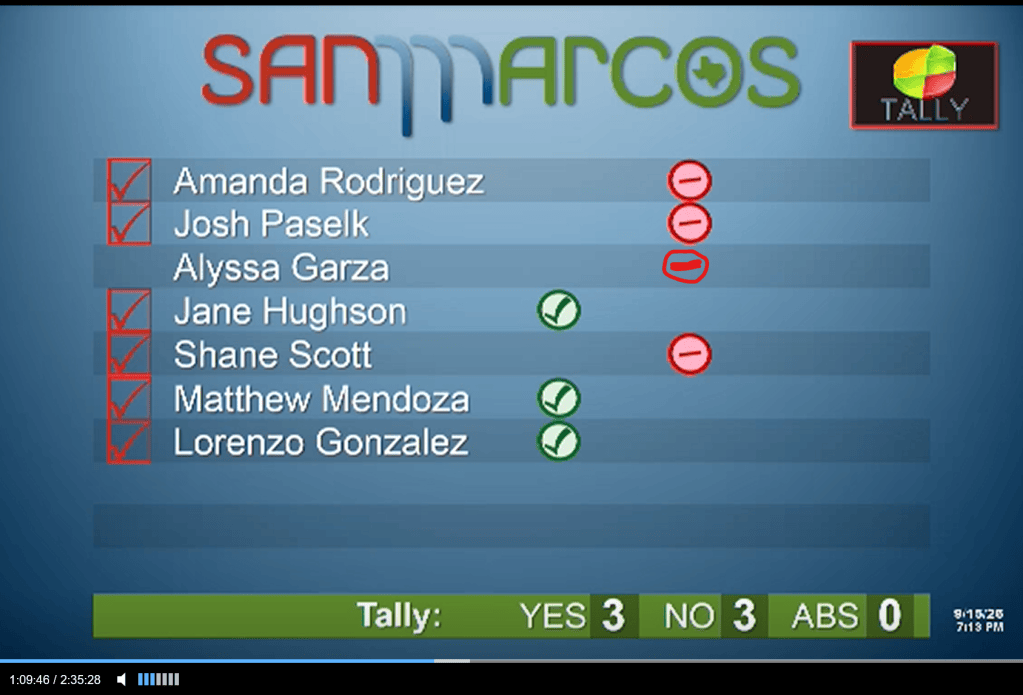
So Jane’s amendment fails. (Alyssa voted outloud, over zoom, because she was home sick.)
Final vote: Should we increase stormwater fees by 5.8%?
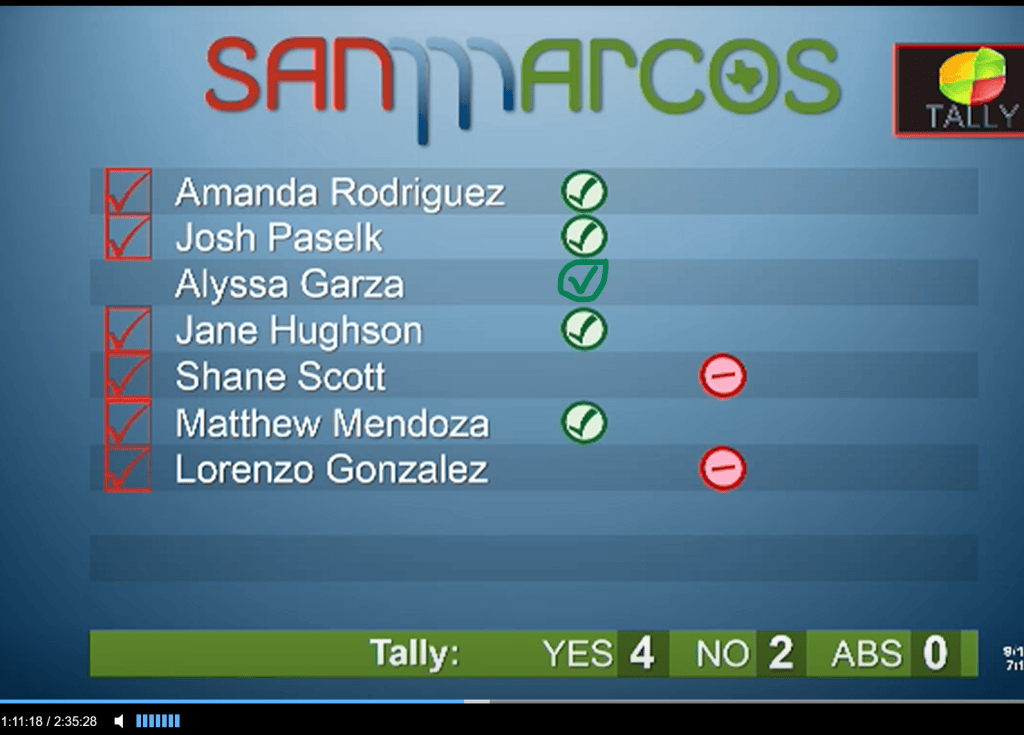
great.
…
Items 15-17: The budget and the tax rate
All of these sail through. The tax rate (65.15¢) is not changing from last year.
Property values went down a little, so home owners will get slightly smaller bills:
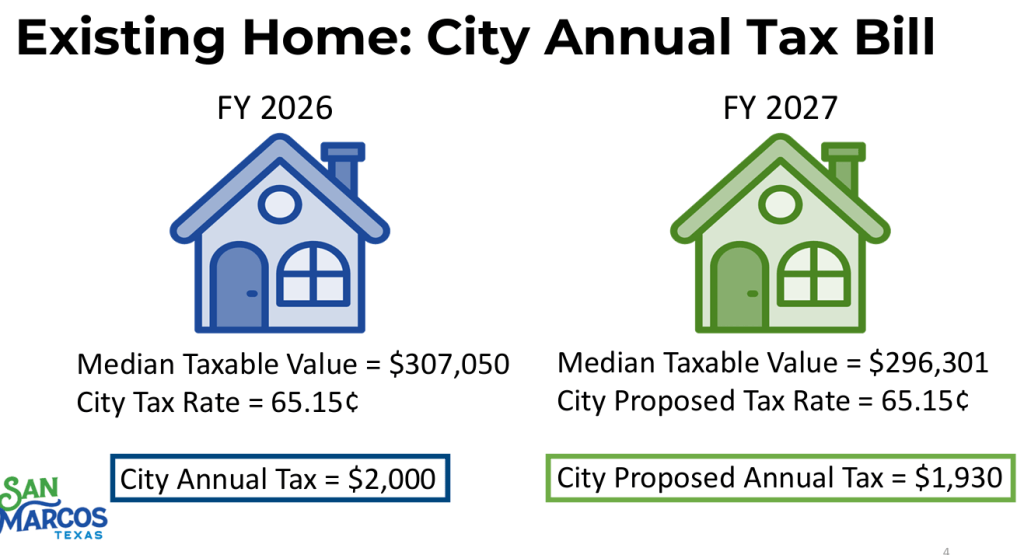
But business values went up a little, so the city is going to bring in a little extra money.
Because of this, the Texas government has laws about the exact words that council members must utter. It’s so bizarre and micromanaging. The council member has to say these words:
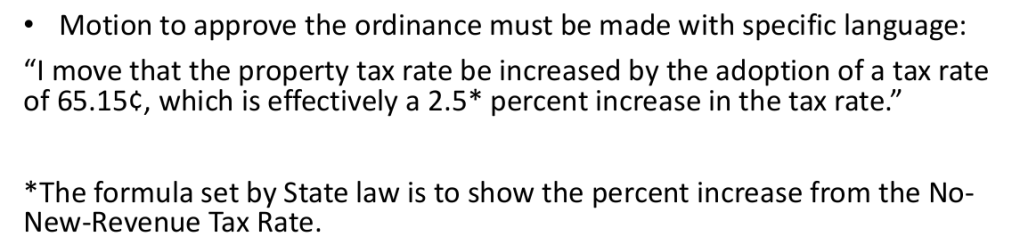
This state is wild. Your taxes will go down, but the state is so obsessed with Performing Conservatism, that they literally are controlling the words that must be said outloud, even though the words are very misleading in this case.
…
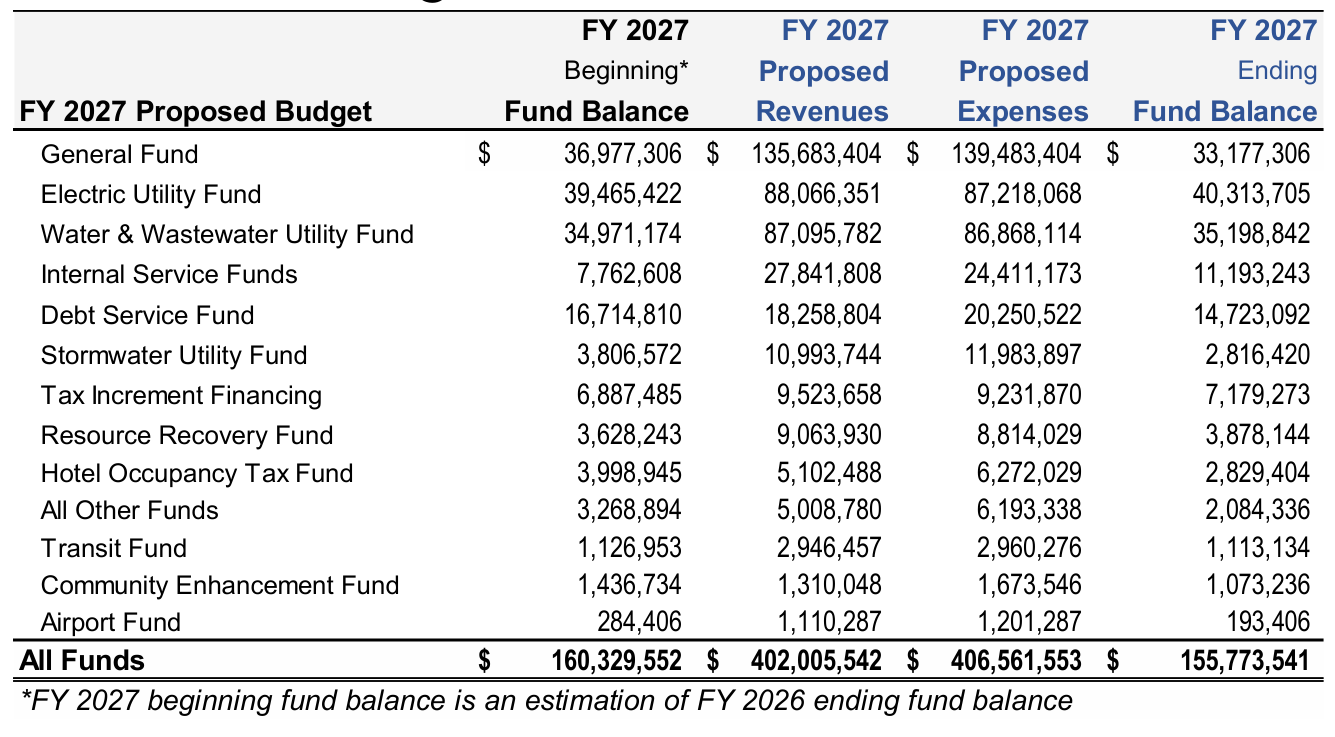
Here’s the whole budget:
Here’s the General Fund:
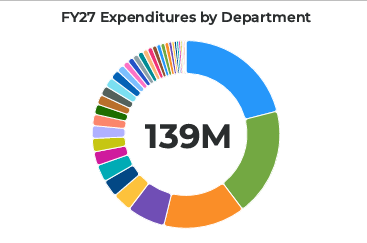
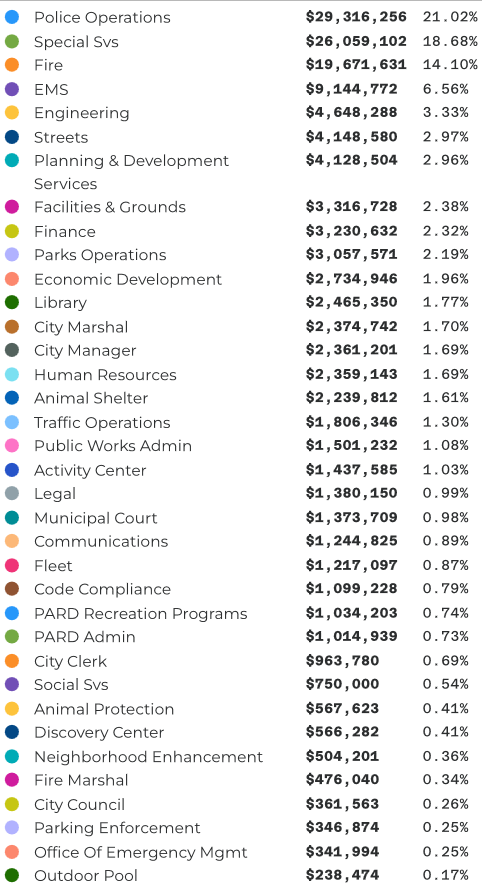
We eliminated 20 positions and kept department budgets flat for the 3rd year running. That’s not sustainable or responsible, you guys.
The vote:
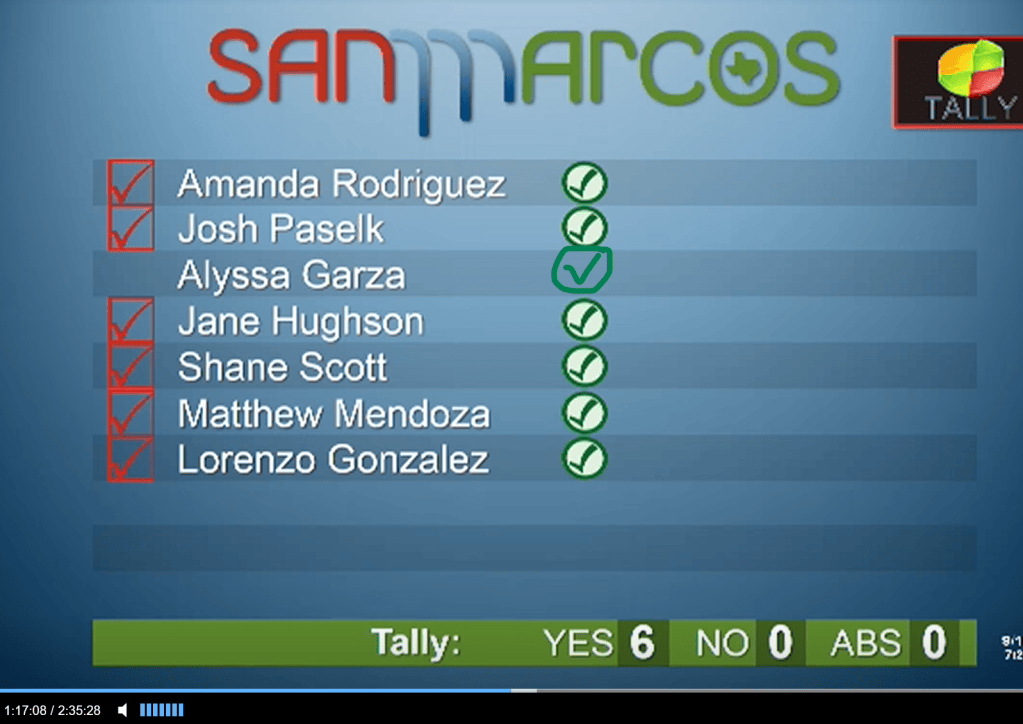
(Both the budget and the tax rate go the same way.)
…
Item 18: Fees and Fee Schedule
San Marcos has about seven pages of fees, across all departments. We’re talking things like:
- what’s the Jumpy Castle permit fee at Rio Vista?
- what’s the False Alarm fee with SMPD?
- the library card fee, the copying fee at the library
- the rabies vaccine or microchip fee at the animal shelter,
- burial lot fee at the cemetery
- building permit fees with the planning department
and so on. There’s a LOT.
The plan:
- increase all fees by 3% every year. (Otherwise inflation costs will get passed onto taxpayers.)
- Review fees every three years, to make sure they still make sense and don’t need specific adjustments.
Everyone is fine with the automatic 3% fee schedule.
The reviewing is done on a rotating basis. This year it’s Parks and Library.
Library:
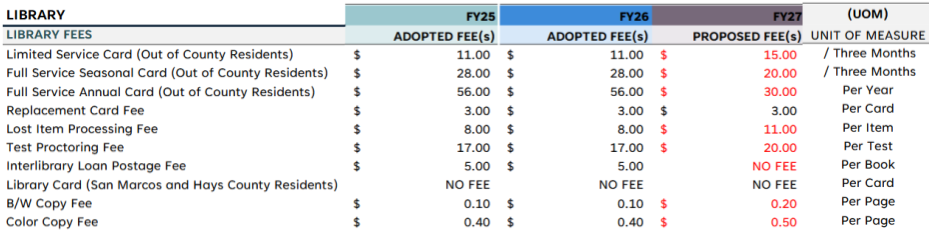
Parks & Rec:
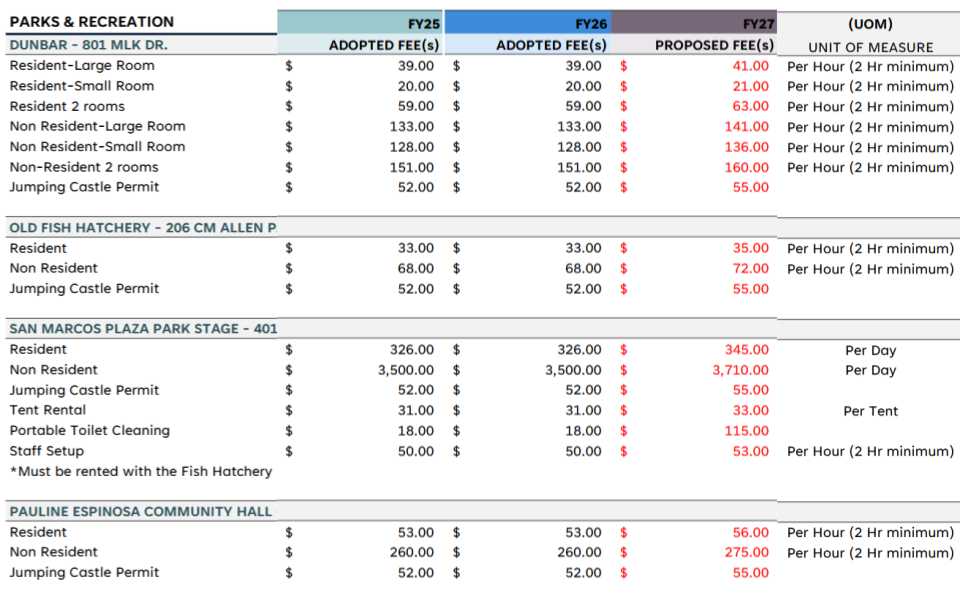
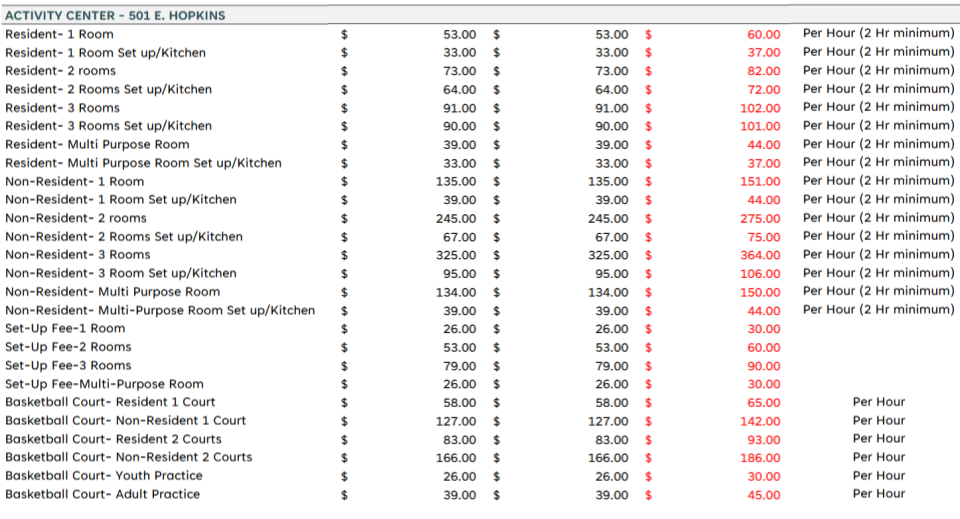
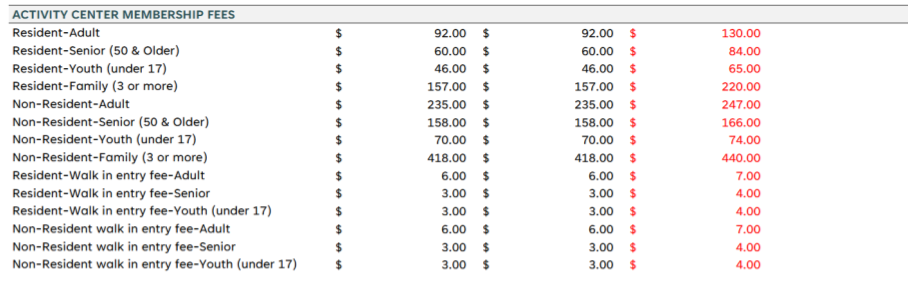
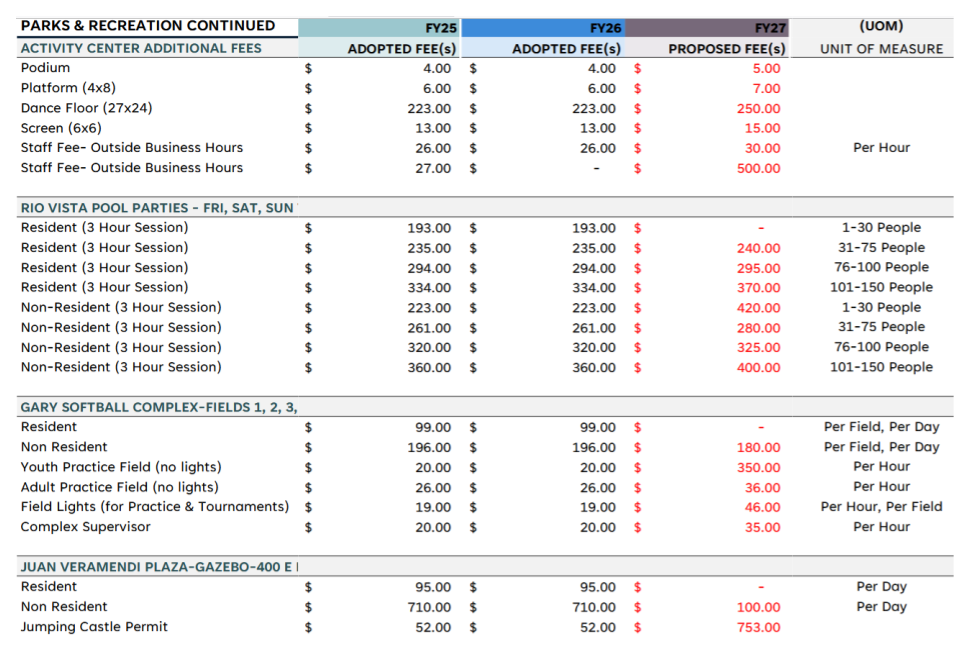
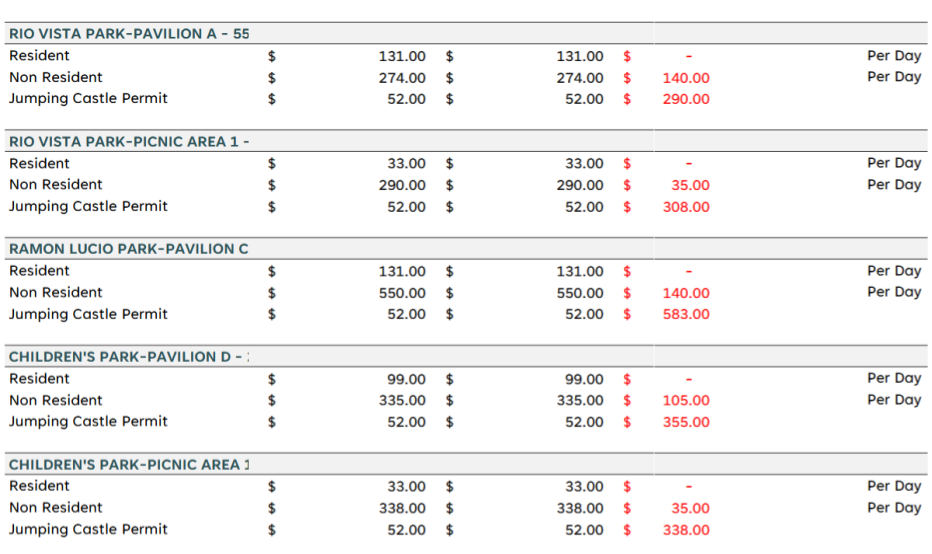
Here’s what the slideshow says about how they got the new rates:
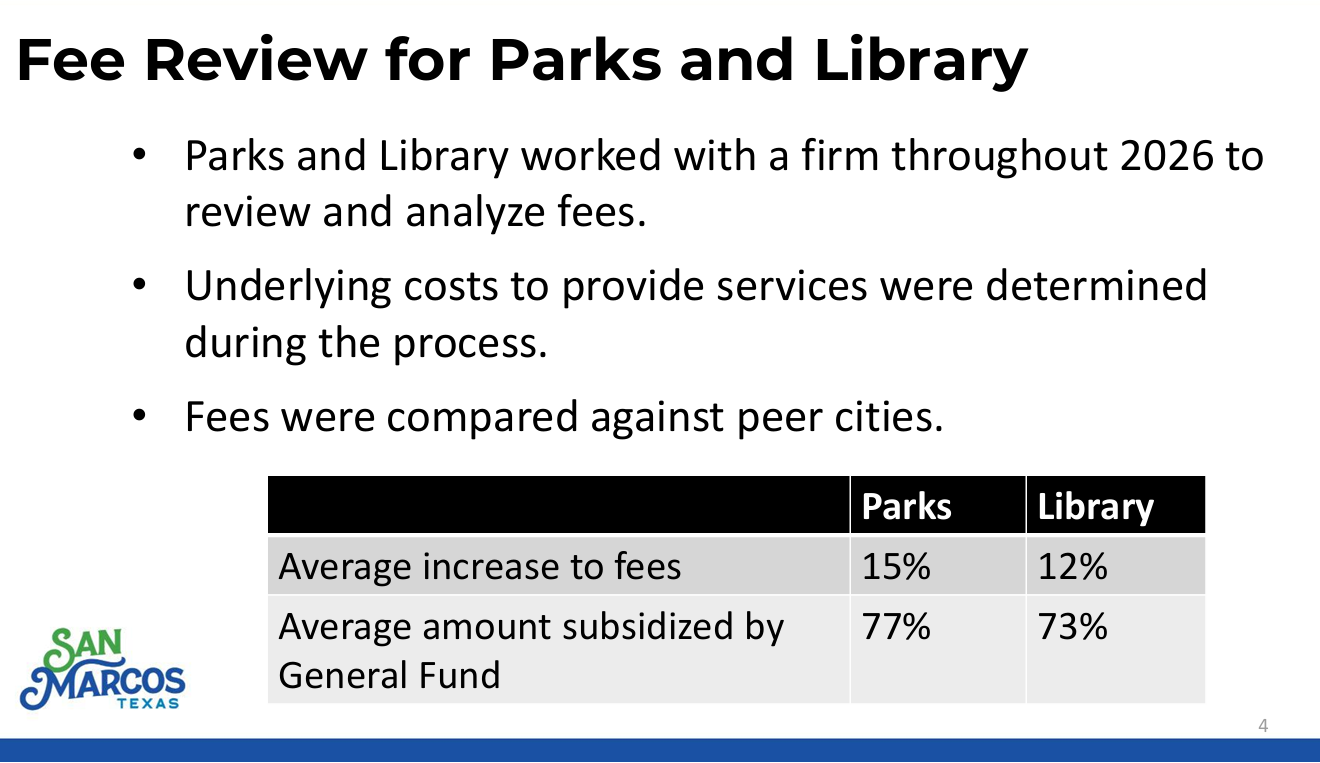
The actual study wasn’t in the packet. So I don’t have any details about how it was run.
What does Council say?
Amanda: When you looked at peer cities, did you look at poverty rates? Are we really comparing apples-to-apples here? Some of these rate hikes are really significant.
Answer: We did not look at poverty rates, no. We were just comparing and also thinking about recouping costs.
They discuss the port-a-potty rental rate, which is increasing five-fold from $18 to $115. Apparently that’s just the reality of the vendor fees – it costs San Marcos $115 for the portable toilet cleaning, so we just pass that on to whoever is holding the event.
They discuss the Activity Center. It’s very popular and bursting at the seams! Yearly membership would go from $92 to $130.
Question: Can we offer a monthly payment plan?
Answer: yes, but we eat the credit card fees every month.
….
I have thoughts! The Activity Center is incredibly popular and bursting at the seams. And it is also closed on Sundays
This is a weird combination of facts:
- It’s always packed.
- It’s sitting empty for half the weekend, every weekend.
Sounds like the Activity Center needs more funding! Right now their budget is $1.4 million. So maybe it would cost $200,000 to stay open on Sundays?
This is peanuts. This is budget dust. Free the Activity Center from its Sunday chains! Double their weekends!
…..
Bottom line:
Council postpones the Library and Parks fee increases until October 20th, to give the community time to weigh in.
My $.02: Subsidizing the library and parks is one of the most tangible ways that San Marcos improves the lives of the residents. They should not be trying to recoup their costs through fees.
This is philosophically different than utility rate increases:
Water and electricity: Environmentally, you want to incentivize people to use less. However, you also want to support people who are financially precarious. This means you want:
- Rates that reflect the reality of the resource constraints.
- Utility assistance programs for people with financial need
Parks and Library: This is totally different! We want people to use these, as much as possible!
- We want to remove obstacles on using these.
- Your entire community gets bigger and better parks and libraries when they are well-used. Everyone wins!
- People who are broke stand to benefit the most.
You don’t want Parks and Libraries to be self-funding, out of user fees. Subsidizing them out of taxpayer funds is the right mechanism. Keep them as cheap as possible.
…
Item 20: HSAB funding
San Marcos gives money to nonprofits in a few different ways:
- HSAB Funding (Human Services Advisory Board) – $750K
- CDBG Funding (Community Development Block Grants, money from the federal government) – ($775K)
- Museums, Core 4, Project Graduation, Crimestoppers, Arts, Special Events, Utility Payment Assistance Program all get funding from the General Fund. (As of 2024, this was about $500K)
There’s a lot of overlap between who gets HSAB and who gets CDBG funding, but they occur at different times of the year. The CDBG funding has to go to the federal government over the summer, and the HSAB funding gets voted on in September.
To deal with the calendar mismatch, Council did both back on July 7th.
Today is mostly a formality, then. Here’s how the funding is shaking out:
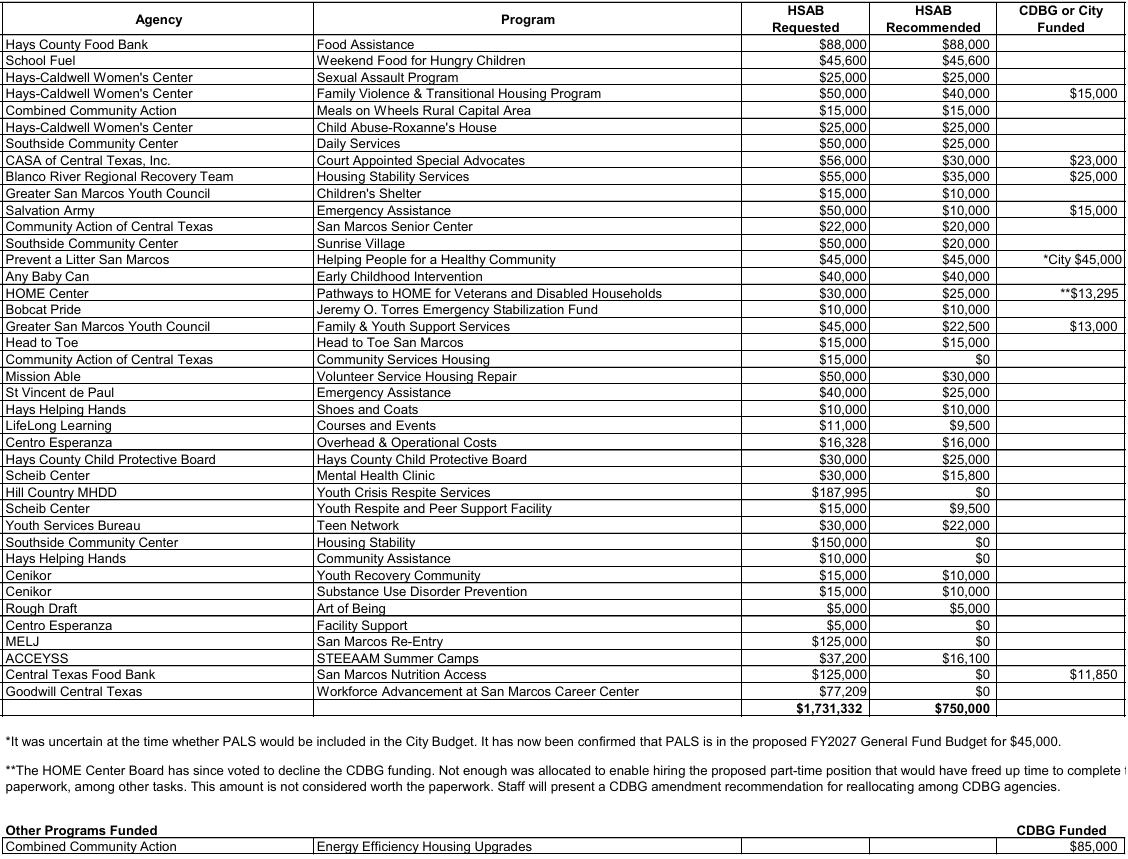
(Sorry, I know that’s tiny. Find the whole chart here.)
The only tweak is that Hays Helping Hands gets their two applications consolidated, so that they can spend their grant between either project, as they see fit. (I believe Hays Helping Hand is formerly known as Nosotros La Gente?)
No one has much else to say! It passes, 7-0.
The city HSAB process used to be full of drama and fireworks. But now there is:
- an independent board that works for months
- a scoring rubric and documentation of all their discussions
- a clear and transparent time frame
- etc.
Lots of great procedural improvements.
Bureaucracy is super annoying! Everything takes forever, moves incrementally, and systems have momentum that keep perpetuating the status quo. But the alternative is favoritism, unpredictability, and chaos.
It’s kind of like that Churchill quote about democracy: “Democracy is the worst form of government, except for all the others.”
…
Items 6-8: Transit
They sped through these pretty quickly – Triennial Review of some Federal Transit stuff – but I think the takeaway is that the Transit Development Plan is starting!
Here is the website: 2026 Transit Development Plan | City of San Marcos, TX
So I imagine there will be lots of surveys and public outreach to watch for, over the next year.


Regarding Kissing Tree and use of water, Brookfield the builder says they have to install sprinkler systems & sod because of code regulations. Many home buyers, including myself would have rather had drip system xeriscapes installed at build. Personally I let my lawn die with the water restrictions and can’t see having to rip out what was just installed to have curb appeal, but many owners have done just that. I also wish that homeowners could buy into the reclaimed city water that is used for the golf course.
LikeLike
Really? I’m appalled to hear the builder say that – we should definitely be allowing for xeriscapes in our code if we’re not already doing so! I’m glad you’re conscientious about water use.
I also wish the reclaimed city water was piped to individual houses! The more available reclaimed water, the better.
LikeLike