P&Z Comprehensive PlanWorkshop, 6/21/23

Note: I mostly try not to call out P&Z members by name, because they’re not public officials the way that City Council members are. But there are nine of them, and they’re not all equally frustrating. Last time, I gave William Agnew a hard time, and I give Jim Garber a hard time in this post. What can I say? They’re staking out positions that I disagree with, hard.

Markeymoore does the best job of gently pushing back against the crap that I’m describing below. Griffen Spell sometimes does, as well. #notallp&zcommissioners

Quick Timeline:
– 2020-December 2022: Team of community members plus consultants and city staff spend two years putting together a comp plan. A huge amount of community input goes into it.
– February 2023: P&Z says, “This plan is an utter disaster. We will form a subcommittee to rewrite it.”
– May 2023: Now there are two versions of the Comprehensive Plan. The changes are so extensive that they need a workshop to get through them

This workshop was so exasperating.   It was aggravating for the exact same reasons that the previous P&Z comp plan discussion was aggravating.

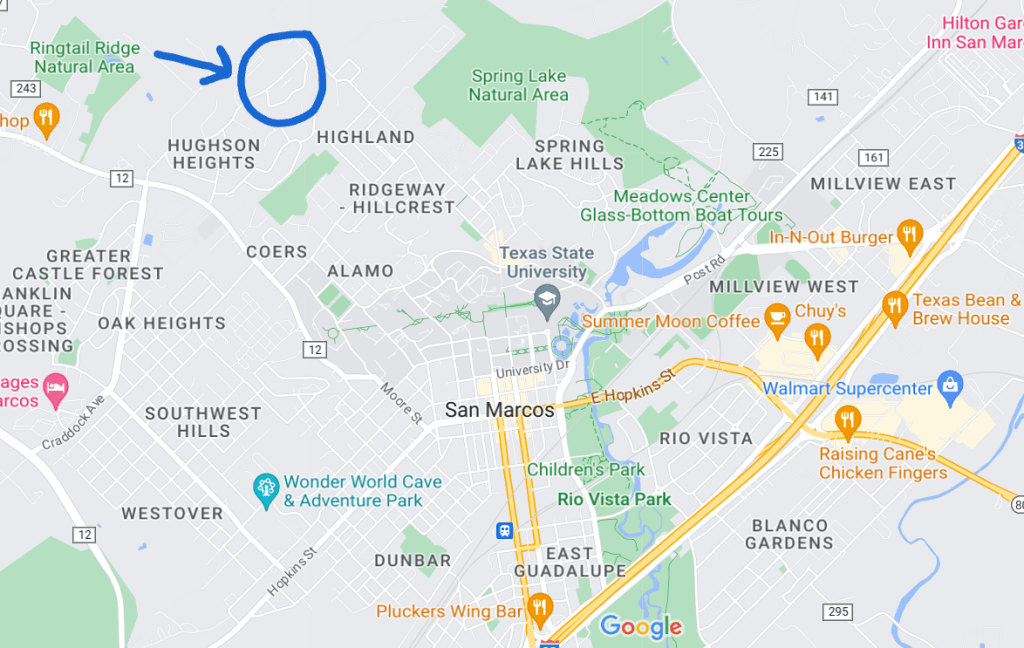
More background: There’s an area of condos called Sagewood. It’s roughly here:

on the edge of an older, beautiful neighborhood.

The landlords of Sagewood have let Sagewood get really rundown: buildings seem to slant, broken fences don’t get fixed very quickly, trash cans get knocked over and trash stays strewn about, etc.

Here’s what Google Streetview has to say about the matter:

(It actually looks fine in that photo.) It’s mostly college students living here.

The point is: many of your older San Marcos NIMBYs close their eyes at night, and dream of Sagewood taking over their own neighborhood, and presumably wake up screaming.

In the 2000s, tons of new giant apartment complexes were approved: The Retreat, The Cottages, Redwood/The Woods, and probably some I’m forgetting. This angered a lot of citizens, including me! I think it was criminal to build The Woods on the river. (Here’s some backstory if you’re curious.) Many NIMBY types feared that Sagewood was taking over the city.

This is what you must understand, if you want to understand fights over the comp plan: many P&Z members are stuck in 2010, fighting against The Cottages, and suffering from Sagewood night terrors when they try to close their eyes and rest.

What else was 2010 like? I did my best to find some data:

  • Median rent in 2009: $741/month. (Median is more useful than average – this means that half the units rented for less than $741, and half for more than $741.)
  • In 2011, the median house in San Marcos sold for $140K.
  • There were 165 total listings for houses on the market
  • the 2010 census puts San Marcos at 44K people.
  • Median household income in 2009: $26,357

So that’s the world that most of P&Z believes we’re living in: 44K people in San Marcos, many houses cost less than $140K, and median rent is around $700/month.

Here’s the most current numbers I could find:

This is a wildly different world! Rent has almost doubled, home prices have more than doubled, and there are fewer houses on the market.

The comp plan has got to deal with the actual San Marcos in 2023:

  • we need affordable housing,
  • we need public transit and safe biking options, and
  • we have a moral obligation to give a shit that the world is quickly overheating.

The way you do this is by controlling sprawl and increasing density, in small-scale ways. Build 3- and 4-plexes throughout single family neighborhoods. Increase public transit options. Put commerce near where people live, so you can drive less.

This is why the Comp Plan discussions are so frustrating. There are three main coalitions:

  • Old San Marcos, fighting the battles of 2010.
  • Developers, who would still love to build those giant apartment complexes that piss everyone off
  • Progressives, trying to wrangle developers into building small scale, dense housing, and simultaneously trying to convince Old San Marcos not to sabotage it.

I’m really not exaggerating. The chair, Jim Garber, literally states that this is his position at roughly 0:43:00:

  • The apartment complexes approved in the 2000s drove him to local politics: he got involved in the last Comp plan, in order to save San Marcos neighborhoods from giant student apartment complexes.  
  • This last Comp plan was approved in 2012. In order to get it passed, the Planning Department promised to conduct Neighborhood Character Studies. Every neighborhood was going to get to come together and declare what its personality is. Your personality is things like “no duplexes” and “no carports”. In other words, it’s mostly class-based.  The goal is to enshrine these wealth signifiers for all eternity. 
  • However, the neighborhood character studies were never carried out.  Jim Garber has been steamed up about this ever since; the planning department cannot be trusted; etc etc.
  • He just doesn’t understand why “protection of existing neighborhoods” is not in this plan.
  • He wants to divide all neighborhoods into “existing” and “new”. Once a brand new patch of land has been platted, it switches from “new” to “existing”, and then it’s personality is enshrined, never to be touched again. 
  • What’s the difference? Existing neighborhoods should not have duplexes, triplexes, townhomes, and condominiums.  In other words, no small-scale, dense, affordable housing.

Jim Garber is so mad about The Retreat, The Cottages, and other gigantic apartment complexes that he is fighting tooth-and-nail against small-scale affordable housing that would blend in to a neighborhood.   He is stuck fighting the battles of 2012, and can’t empathize with 30 year olds in 2023 who can’t afford to live in a little residential neighborhood.

Amanda Hernandez is the planning department director.  She responds thoroughly to his points:

  • First off, she has only been the director for three months. Most of his complaints span previous admins.
  • She wrote most of the comp plan in 2012, and she now thinks it’s a terrible plan.  They started the neighborhood character studies and spent a year or two on them, and then she was told to abandon them and to switch and work on the new Code Development.
  • But! Now! They are now finally doing character studies. Blanco Gardens and Dunbar are underway.  Victory Gardens and north of campus are coming up next.
  • You know the Cottages, the Retreat, Sagewood, and The Woods? Big complexes in residential areas? Those have not been approved since 2012. The old Comp Plan worked. Those were all passed under the even-older comp plan, two comp plans ago.
Bottom line: we have effective mechanisms to prevent giant apartment complexes from being built in residential neighborhoods.  This is no longer happening.  The fight against giant apartment complexes is going to sabotage efforts to bring small-scale affordable housing into neighborhoods.

Finally, I’m going to be blunt: the utter narcissism of the Historic District is exhausting.  To hear P&Z speak, there is no neighborhood that could merit planning, besides this one. All Historic District, all the time.  It’s extremely tiresome and means that nothing else ever gets considered. 

At the public comments, speakers try to explain that no one wants to change the Historic District. The Historic District is actually the gold standard of a neighborhood!  It’s got small scale tri-plexes and four-plexes sprinkled around, it’s got neighborhood commercial, and nearly every house has an ADU – a mini-house in the back.  It is the dream of small scale, dense living!

One of the speakers, Rosie Ray, made some handouts for P&Z, to try to convey this point. She was kind enough to share them with me:

Cottonwood Creek does not have diversity of housing. The residents keep telling the city that they want some stores nearby. The Historic District is chock full of different kinds of functionality. It works great.

When this is brought up, the P&Z folks say, “Yes, but the Historic District happened naturally.”

Basically: Historic Districts usually are older than land use codes. Single-family zoning originated to make sure white, wealthy neighborhoods stayed that way. So along with red-lining, you wanted to make sure there was nothing affordable. Hence you specify that lots have to be big, and houses have to be big and spread out. This is the problematic origin of single-family zoning.

So sure, the Historic district happened naturally, because it’s older than single-family zoning.  And now we will prevent that from happening anywhere else. 

Bottom line:

  • P&Z wants to separate all existing neighborhoods and freeze them in carbon, like Hans Solo. Future neighborhoods, in a galaxy far far away, can be built like the Historic District.
  • Developers will not build future neighborhoods like the Historic District, because the way you maximize profit is to build yet another sprawling single family neighborhood or a giant apartment complex. (Good link on how to get builders to fill in these missing middle housing types. The problem really is single-family zoning.)
  • In ten years, we’ll have another comp plan, and we’ll beg and plead for this all over again.

I’m struggling to avoid making “OK Boomer” jokes about P&Z, but gerontocracy is a real thing in the US, and in San Marcos. The members of P&Z do not seem attuned to the idea that the financial hurdles of 30 year olds in 2023 are wildly different than the financial hurdles of 30 year olds in 1990.

(I didn’t have a good place to put it, but Rosie also passed out this map:

It’s pretty stark!)

Hours 0:00-2:40, 5/16/23

The Invocation

I’ve never blogged the opening prayer before! I usually just skip past it.

If you’re going to have prayers in your public space, you’d better allow any church, or else you’re definitely opening yourself up for a lawsuit. Which is how we found ourselves in the delightful position of having Mayor Hughson introducing Lanzifer Longinus, co-congregation head of the Satanic Temple, and I hope he doesn’t mind me borrowing this photo from his facebook post:

Here’s a transcription of what he said:

Let us stand now, unbowed, and unfettered by arcane doctrines, borne of fearful mind and darkened times. Let us embrace the Luciferian impulse to eat of the tree of knowledge, and dissipate our blissful and conforming delusions of old. Let us demand that individuals be judged for their concrete actions, not their fealty to arbitrary social norms and illusory categorizations. Let us reason our solutions with agnosticisms in all things, holding fast to only that which is demonstrably true. Let us stand firm against any and all arbitrary authority that threatens the personal sovereignty of one or all. That which will not bend must break, and that which can be destroyed by truth should never be spared its demise. It is done. Hail Satan.

The sharp-eyed reader will note that everything he said is entirely sensible and reasonable.  (The Satanic Temple generally fights for a lot of great political causes.  If you haven’t yet, you should familiarize yourself with them.)

Onto Citizen Comment!

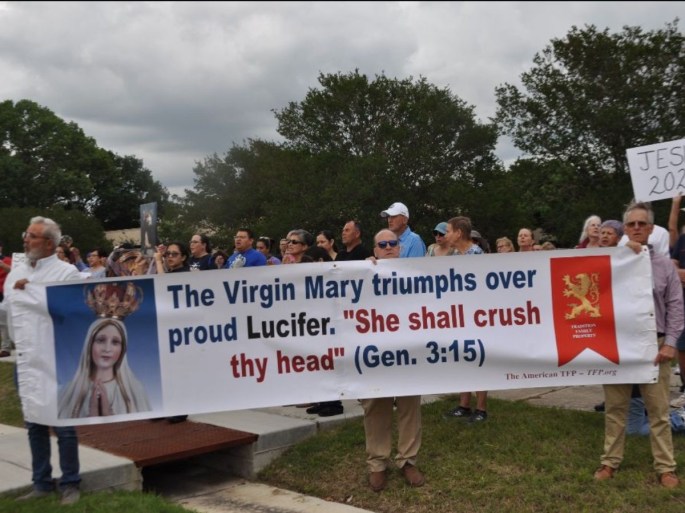
Well yes, there were a number of speakers who were very freaked out over the idea of Satan.  There was a whole protest out front:

Photo taken by Shannon West

Crushing thy head! That seems like a disproportionately violent response – he only asked that we be judged by concrete actions and reason our solutions. Gee.

(PSA for the kids: there was once a wonderful sketch show called Kids In the Hall, which had a relevant Crushing Your Head skit. If you’re so inclined.)

There were several fire & brimstone prayers during Citizen Comment. I wanted to cherrypick extreme lines from the most frantic prayers, but I started to feel bad.  I think these guys honestly are picturing slithering little oily shadows emanating from an air conditioning grate, like 90s era Buffy animation, spreading all over the room and maybe even getting in your nostrils.  Must be stressful; let’s just let them be.

Next! Several speakers have some serious conspiracy theories going about Mano Amiga.  These speakers were not just pro-police or pro-Meet and Confer contract, but genuinely deranged about Mano Amiga specifically.

A few themes:

  • Why do they all say “Mano Amigas”, with an extra “s” on the end?! Why pluralize “amiga”?  (And wouldn’t the plural be “manos amiga”?)
  • They are convinced that Mano Amiga is getting millions of dollars, and one of them specifically cited George Soros. (As well as the VERA institute and the Institute of Justice, which are both good organizations, incidentally.)
  • Several of them mentioned the Marxist agenda.  Aw, shucks, guys! I couldn’t help but feel flattered. Now, I’m not actually affiliated with Mano Amiga, but… [bats eyes invitingly in all directions]

Finally we had some regulars: a number of members of Mano Amiga and other pro-transparency speakers spoke up against the current Meet-and-Confer contract. The Meet-and-Confer contract gets voted on tonight. Other speakers are pro-police and pro-contract. And several regular anti-SMART Terminal speakers to give updates.  

SMART doesn’t really come up on the agenda tonight, so let me give some updates:

  • Last time, Council reopened the development agreement and said, “let’s send the entire citizen list of requests over to the negotiation table!”
  • The developers wrote back a short letter: “Fuck off.  PS: You signed a contract, dumbass.”  (You can read it here.)
  • The developers announced that they were changing their name to Axis Logistics and also that they are now open for business.
  • (Keep in mind that they haven’t actually gotten their zoning for Heavy Industrial passed yet.)

To summarize: Council worked on this project secretly for years, and totally lost track of the fact that the public had no idea this was coming. They then announced and passed the development agreement before the community had had their first cup of coffee that morning.  The community is absolutely furious, and Council is shocked, shocked that it played out like this.

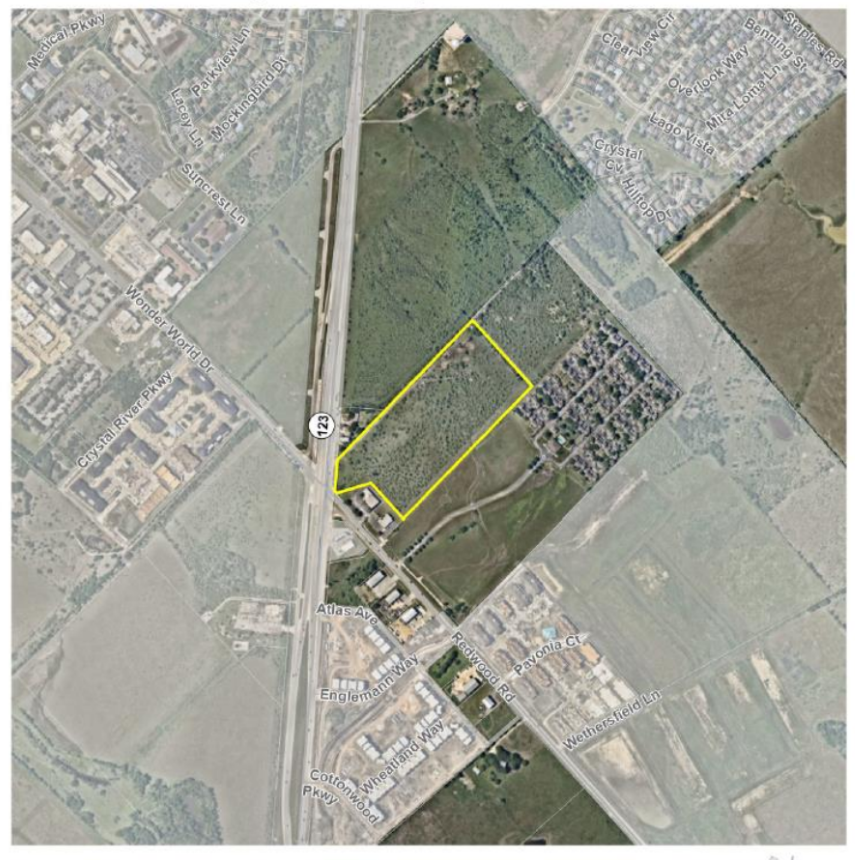
Item 15: Rezone 104 acres of a giant parcel, out on 123.

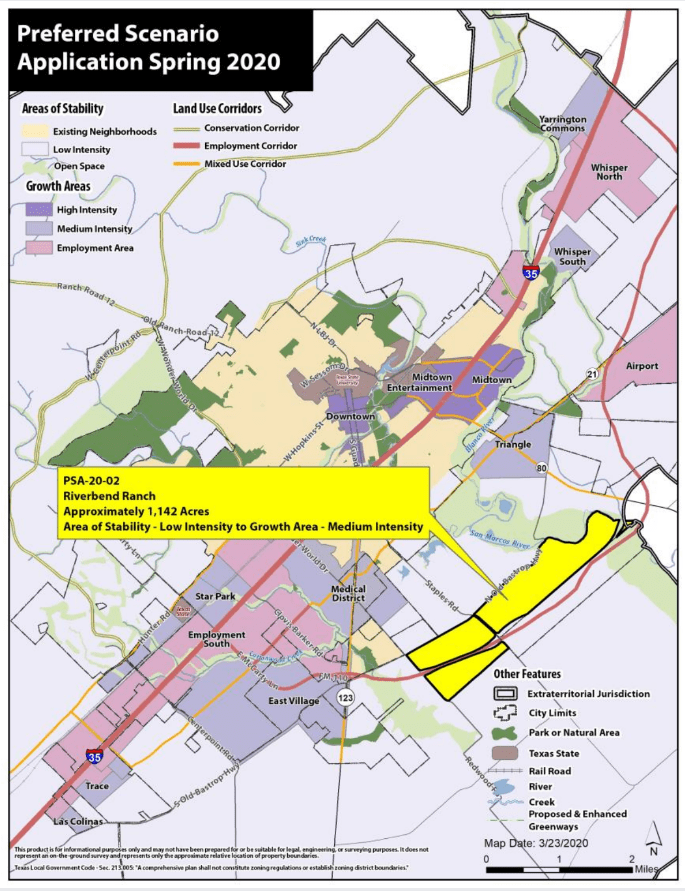
This is weird and infuriating.  So there is a giant housing development that’s been approved, called Riverbend Ranch.  It won’t materialize for a while.  We’ve discussed it here and here.

Here’s the original plot from when it first came up in April 2022

It’s very big – 1,142 acres.  It runs adjacent to Redwood on the southern end, which is a concern, but possibly there’s an opportunity to get some sewer infrastructure to the good people there. 

The plan has always been for it to be mostly housing, above the red line. (McCarty extension/Loop 110) (The part south of the red line is zoned industrial, which is the concern for the people of Redwood.)

Here’s how it’s currently zoned:

What do those letters mean? CD-3 is single family sprawl.

via

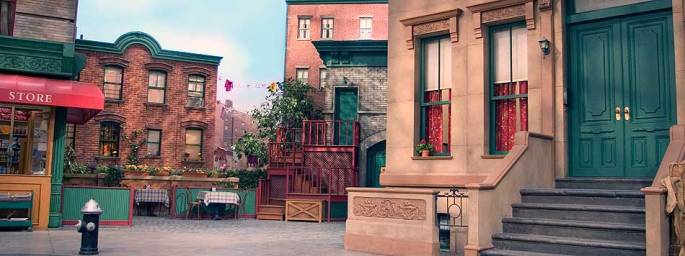
CD-4 and CD-5 supposedly look like so:

ie the charming mixed use downtown from Sesame Street. Or picture San Antonio street.

But in reality it usually looks like so:

Large scale apartment complexes. This is because our land development code lumps together those two types of zonings. So you can’t approve charming Sesame Street-scapes without giving developers the right to build large scale complexes. This is an unforced error – no one made us lump those together in the code.

Anyway, back to this picture:

The striped bits are supposed to be apartments and commercial. The developer is asking to change them the CD4 and CD5 bits to also be CD3. In other words, instead of having pockets of commercial and apartments, the whole thing should be single family sprawl.

THIS IS 1200 ACRES! It will now be 1200 acres of relentless single use housing! This is really shitty! The planning department knows better, because when Riverbend Ranch originally came up for zoning, they had to offer up certain percents at denser amounts, and they had to talk about amenities and commercial areas.

It turns out that you just have to wait a few years until everyone forgets, and then politely ask to get it rezoned into the cheapest and most profitable suburban sprawlscape.

THIS MADE ME SO MAD. This is why we need the comprehensive plan already in place. This should never have been allowed.

Hours 2:04-2:58, 5/2/23

Item 10: McCoy’s new headquarters:

This has come up before.  They’re building a fancy new campus here:

Those two red highlighter marks are future roads, according to the Transportation Master Plan.

But if McCoy’s wants their campus, the roads are in the way.

So the hypothetical roads must go.  DONE!

(The vote was unanimous and this really isn’t a very big deal.)

Item 11:  67 acres here:

They want to turn it into apartments that feel like houses.  It will be a complex, with the clubhouse and pool and all of that kind of stuff, but each apartment is a standalone house.  I went hunting on the company’s website but I couldn’t find a sample photo.

The part I found mildly delusional was that they expect wealthy renters.  Their typical renter has an $85K annual salary and wants a multi-year lease.   That sounds like a pleasant fantasy version of San Marcos.  

Shall we play The Six Criteria For Housing Developments game? YES!

Price Tag to the City: Will it bring in taxes that pay for itself, over the lifespan of the infrastructure and future repair? How much will it cost to extend roads, utilities, on fire and police coverage, on water and wastewater?

Good location.  This is infill.

Housing stock: How long will it take to build? How much housing will it provide? What is the forecasted housing deficit at that point? Is it targeting a price-point that serves what San Marcos needs?

We need an ongoing housing needs assessment.  We need to know this.

Environment: Is it on the aquifer? Is it in a flood zone? Will it create run off into the river?Are we looking at sprawl? Is it uniformly single-family homes?

Not on the aquifer.  Environmentally reasonable.

While I haven’t seen photos, I get the picture that the units have smaller yards than a house. So denser than single family housing, but less dense than apartments. Not the worst.

Social: Is it meaningfully mixed income? Is it near existing SMCISD schools and amenities?

I can’t imagine their target clientele is going to materialize. They’re imagining something wealthy-ish, though, which is not mixed income.  It’s sort of near Hernandez and Rodriguez elementary school, and sort of near Miller middle school.  (The developer is imagining adults without kids, though.)

The San Marxist Special: Is it a mixed-income blend of single family houses, four-plexes, and eight-plexes, all mixed together? With schools, shops, restaurants, and public community space sprinkled throughout?

Not really. I suppose you have the outlet mall right there, but they’re not exactly a charming little public gathering space. 

(Remember when you used to be able to ride a gondola back and forth for about 100 yards? Good times.

via

I never actually got to ride the silly thing.)

My overall opinion: This is a reasonably good use of space. It’s hard to put housing in between I-35 and some railroad tracks.

The vote:
Yes: everyone except Matthew Mendoza
No: Matthew Mendoza

I am not sure what he was opposed to!

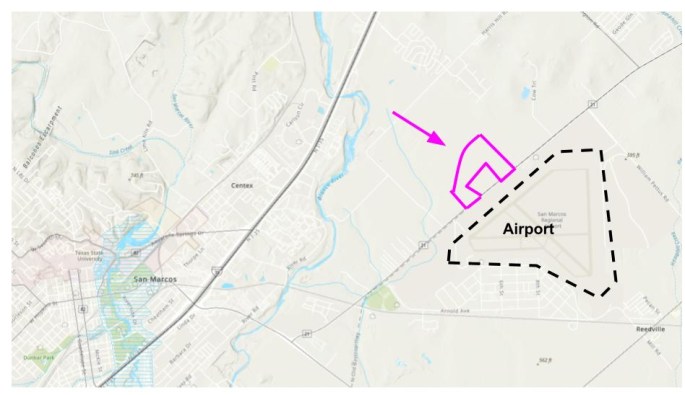
Item 12: 169 acres at the end of the airport:

It’s got a weird cut out due to an airport runway easement, and there are some FAA height restrictions also because of the runway. The developer wants it zoned Light Industrial.

Max Baker spoke during the public hearing, and raised issues of pollution. He kept mentioning the future airport expansion.  I don’t think this particular item is the airport expansion? But maybe it’s in the pipeline?

Anyway, apparently it’s easy to measure pollution, but hard to determine the source, and usually it’s vehicle traffic.  (Maybe we should reconsider all this sprawl!)

The vote:
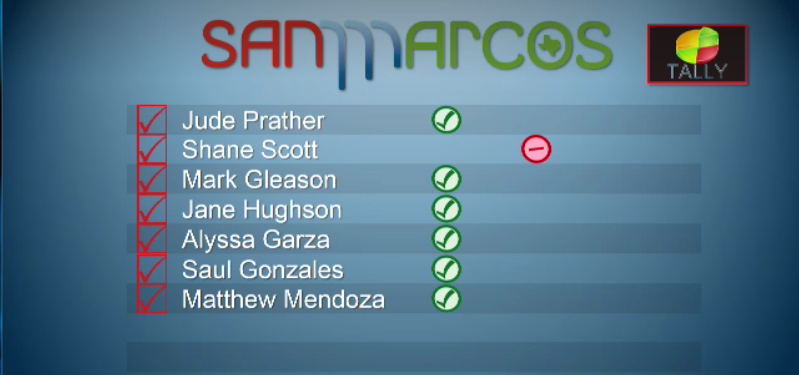
Yes: Matthew Mendoza, Jude Prather, Shane Scott, Mark Gleason, Jane Hughson
No: Alyssa Garza, Saul Gonzales

One last thing:

You can speak during the public hearing, but not during council discussion, unless a council member specifically calls you up to the podium to answer a question.

Which brings me to my favorite moment of the night:  Alyssa Garza saying – very deadpan but not mean – “Is it possible for Mr. Baker to tell us what he has ants in his pants about?” I’ve been laughing about that ever since.

(Max was glad to comply, and went to the podium to talk further about CAPCOG and purple machines and air quality.)

Hours 4:50-5:25, 4/18/23

The SMART Terminal took almost 5 hours of a 5 1/2 hour meeting. So what else was there?

Items 8 and 9:  Zoning a chunk next to the high school:

Literally adjacent to the high school. It’s going to be apartments.  

Just because it’s been awhile, let’s walk through our criterion for evaluating residential zoning:

Price Tag to the City: Will it bring in taxes that pay for itself, over the lifespan of the infrastructure and future repair? How much will it cost to extend roads, utilities, on fire and police coverage, on water and wastewater?

Great location.  Fully covered in terms of infrastructure and services.

Housing stock: How long will it take to build? How much housing will it provide? What is the forecasted housing deficit at that point? Is it targeting a price-point that serves what San Marcos needs?

Probably? Sure would be nice if we had an ongoing housing needs assessment!

Environment: Is it on the aquifer? Is it in a flood zone? Will it create run off into the river?Are we looking at sprawl? Is it uniformly single-family homes?

Not on the aquifer.  Environmentally reasonable.

Social: Is it meaningfully mixed income? Is it near existing SMCISD schools and amenities?

Not mixed income.  That’s the only drawback: I want to intersperse people from all different economic levels.  But couldn’t be closer to SMCISD! 

The San Marxist Special: Is it a mixed-income blend of single family houses, four-plexes, and eight-plexes, all mixed together? With schools, shops, restaurants, and public community space sprinkled throughout?

Nope. It never is. Bummer.

Overall, this is a reasonably good thing to build here.

Items 12-13: we need some equipment.

Specifically, we are leasing (1) 41′ Digger Derrick-Tracked Backyard, five (5) Ford F350 Supervisor Trucks, two (2) 47′ Digger Derricks (DC47), one (1) AM55 Overcenter Aerial Device, four (4) Articulating Telescopic Aerial Devices (AT41M), for the Electric-Utilities department.

via

Those look like fun.

Item 15: Carports. 

Saul Gonzales brought this item up for discussion:

via

Apparently, carports are mostly not allowed in San Marcos.

The problem is setbacks:

from the San Marcos Land Development Code.

As one of these Odes to Enshrined Sprawl, you can’t build too close to the edge of your property. The size of your setback varies, depending on your zoning.

You are allowed to park your car in your setback, but you can’t put a structure in it. So where does that leave carports? Carports count as a structure that’s not allowed in your setback zone, even though they house your car. So unless your yard is huge, you probably don’t have room for a carport.

So why? What’s so bad about a carport?

First off, setbacks are different from easements and right-of-ways. Easements and right-of-ways are needed for water lines and future sidewalks and things like that. You definitely can’t put structures up over those.

So what’s the reason for banning carports in the setbacks?

The polite version is “neighborhood character”. The blunt version is that people who care about status think they look trashy.

(Do I think they look trashy? No! They’re fine! Protect your cars from the hail. Who cares.)

Mark Gleason phrases it as, “Some neighborhoods are going to hate carports, while they’re fine in other neighborhoods.” Can’t argue with that. HOAs are the worst!

Bottom line: this will get discussed in the future. If you want a carport, try to live in the right kind of neighborhood.

Hours 0:00-2:03, 4/4/23

Onto the actual meeting!

Citizen comment: Mostly community members talking about the SMART Terminal. None of us can stop talking about it! But I think I should go on to other topics.

Items 1-4: Quarterly financial reports and audits and investment reports, etc.

Everything looks fine.

Item 14: East McCarty and Leah.

Developers want to make something of this land:

That yellow L-shape.

This item first came up last summer. The developer applied for Heavy Commercial zoning. P&Z said yes, and then Council said no. Council was concerned about Embassy Suites and the conference center, our beautiful prized jewel of the city. (Which the city is still paying off for another 10+ years or something, by the way.)

In November, the developer applied for Light Industrial. This time, P&Z denied it.  That means that it will take 6 votes at council to override P&Z.

So it went to Council in December. Rather than deny it, they formed a committee to try to work something out with the developer.  And now the committee is done, and it’s back for the vote.

The committee and the developer made a lot of compromises, but they got stuck on one thing: nighttime truck traffic.  Council wants Quiet Hours after 10 pm, because of the people sleeping at Embassy Suites. The developer was saying it’s too restrictive for their business model, because warehouses need to load and unload their wares overnight. Council pointed out that it’s annoying to try to sleep and hear BEEP BEEP BEEP all night long.

Finally the vote:

The vote: Should this be zoned Light Industrial?
Yes: Jude Prather, Shane Scott
No: Mayor Hughson, Mark Gleason, Alyssa Garza, Saul Gonzalez, Matthew Mendoza

So it failed. The developer can try something else, or sell it off.

Let’s just marvel at the close compassion offered to the weary travelers at Embassy Suites, shall we? What tender thoughtfulness. You can understand that a business traveler might not want to sleep next door to a 43 acre industrial site. What were you saying about the SMART Terminal again?

One final note:

At 1:25:10, the developer is trying to say that we should approve this project because no one else will want to develop it. And he says this exact quote:

“No large grocery store chain will consider this property because of the new HEB which is across the street.”

UH WHAT NEW HEB ACROSS WHICH STREET?

Across I-35? Across McCarty? Across Leah Ave (towards Amazon)? What does he know that I don’t know?

The location of a 3rd HEB has been controversial. First, constantly we’re talking about how few resources there are on the east side. The east side needs amenities.

But also, there’s history here. Back in 2016, City Council approved an HEB going in on the corner of Wonderworld and Hunter. People were furious. The main reasons:

  • The 2015 floods were just a year earlier, and now we were talking about paving a massive bit of land along Purgatory Creek
  • this would require a bunch of curb cuts on Wonderworld, which violated the agreement when the greenway was developed.

Quick digression on the Wonderworld extension. Wonderworld used to stop at Hunter Road. You took Old RR12 to go west towards Wimberly. It took decades to design and extend Wonderworld west, because it’s cutting through Purgatory Creek, which is really sensitive area. There was a complicated deal involving donation of greenbelt land and promises to take care of this area.

Given all that, this quote is hilarious:

“We couldn’t find a more environmentally sensitive area to go through,” said Sabas Avila , the city’s assistant director of public services. The area includes a flood control dam, caves, endangered species such as the golden-cheeked warbler and black-capped vireo, aquifer recharge zones and a Native American burial site, Avila said.

“Believe me, we tried! But this was the best we could do.”

(I’m being a jerk, taking the quote out of context. The speaker is probably an environmentalist.)

Anyway: it appears the proposal for the Wonderworld HEB is still on hold.

Bottom line: this developer appears to know about some new HEB, relatively close to Embassy Suites. Eeeeenteresting.

Hours 0:00-1:01, 3/7/23

Citizen comment:

  • Several people spoke about the HSAB money.  We’ve seen this item several times this year; it finally gets concluded tonight.
  • Two people talk about the Pick-a-pet ordinance, also coming back around tonight.
  • Two people talk about the SMART Terminal re-zoning. Not up tonight, though.
  • One person talks about Joshua Wright and the Hartman reforms

I had a stray thought about the SMART Terminal. I was on Charles Austin, next to the baseball stadium, stopped at a train. The train was going slower and slower, headed east towards 35. I was doing the thing where you try to figure out if the train is going to come to a complete stop before it gets across your path and trap you, or if the last car will make it across and set you free.

It occurred to me that the train was probably headed in the general direction of the future SMART Terminal. And I remember that it takes a train 1-2 miles to come to a stop. So imagine if we have a new SMART train intersection just east of town? The number of stopped trains is going to go through the roof. Traffic is going to be hella gummed up by stopped trains, if the SMART Terminal delivers on what they’re claiming.

I mean, we should still focus on the river pollution and massive amount of concrete, and all the rest of the questionable parts. But let’s save a little angst for worrying about the future train stoppings of San Marcos.

On to the meeting!

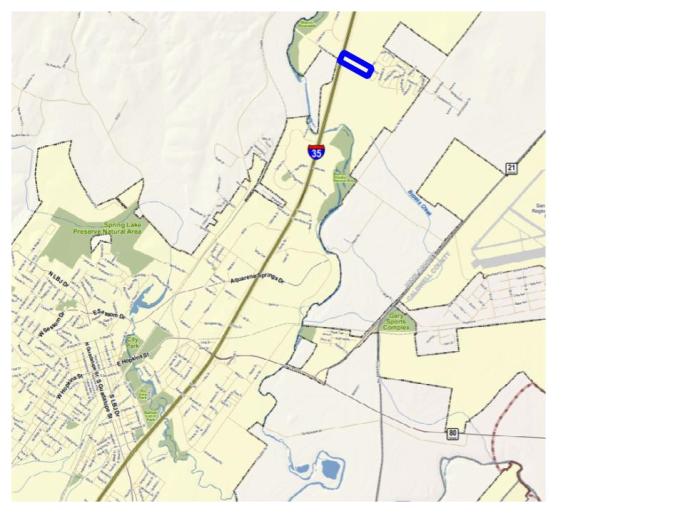
Item 6:  Way up by Whisper Tract, some developers want to rezone this little blue piece:

It used to be partly zoned Manufactured Homes, and partly zoned Future Development. They want to make it all Heavy Commercial.

Here’s what’s at the eastern tip of that little blue rectangle:

That is, the Saddlebrook mobile home community.

So is it fair to build heavy commercial next to them? Let’s put it this way: it would never be proposed next to wealthier neighborhoods.  At the same time, the western edge of that little blue rectangle is along I-35, and it’s reasonable to put Heavy Commercial along the highway.  Finally, the folks at Saddlebrook might like some commercial services like restaurants or laundromats or whatever nearby. (But there’s no guarantee this will be restaurants or laundromats.)

Jane Hughson and Mark Gleason aren’t sure about the size of the project on the east side being so close to the community. A 40 foot building with 30 foot setbacks is still pretty looming, even with a privacy wall.

The developer talks in person.  He and his partner are from central Texas, and they make little spec buildings that can later be configured for small businesses. So it’s unclear what would end up there.  

In the end, council approves it unanimously.  Hopefully it turns out the businesses that move in make good neighbors.

Item 7: Two acres in Cottonwood Creek, off 123.  This one kind of pissed me off.

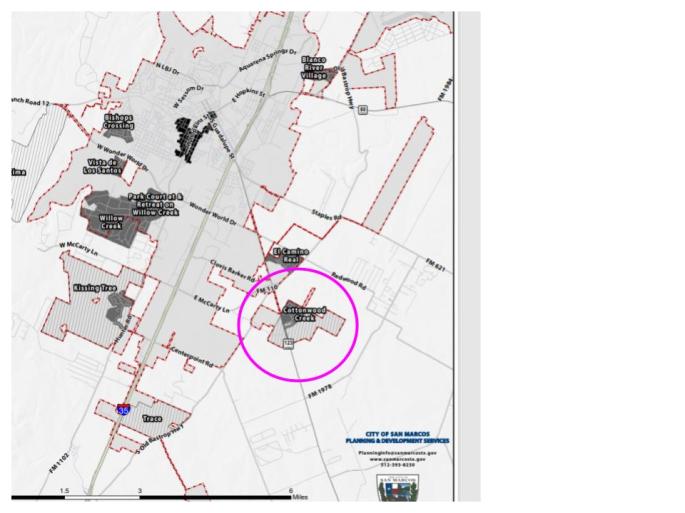
Here’s Cottonwood Creek: 

It’s down by the high school.  Bowie Elementary is in Cottonwood Creek.  (I realized I could get some useful maps off the planning department website.)

Here’s a close up. Today’s proposed rezoning is for that little red trapezoid, in the yellow circle:

This area has seen tons of development in the past 2-3 years. In fact, this little red piece in that blue circle:

is right where this new Chevron just went in:

So back to the subject property: right now it’s zoned General Commercial. The developer wants to re-zone it CD-4.  In theory, you can still put commercial in CD-4, but that’s not what will happen. It will be townhomes or apartments. 

Here’s the thing: the east side desperately needs commercial. They shoudn’t have to drive so far for grocery stores and basic retail.  And that’s not just my opinion – the city planners are constantly saying that people on the east side tell them this.  

And furthermore, many residents wrote in on this very item so say so!  Apparently Council got letters from people in Cottonwood Creek saying to please keep it commercial. This is not hypothetical!  They were told exactly what the neighbors want!

The developer is arguing that the property has sat there for 20 years and nobody has wanted to put commercial there, so therefore he should be able to re-zone it. But he’s being a twerp. He knows that commercial lags behind residential, and residential is finally just now getting built.   If you don’t set aside land and earmark it for commercial uses, an entire area will get zoned residential and by the time someone might like to put a restaurant in, there won’t be viable places left.  

Mark Gleason seems to be toting water for the developer. He knows the neighborhood wants commercial there. First, Mark asks what commercial is allowed in CD-4.  He’s told that all kinds of commercial is allowed – offices, restaurants, etc.  Could be a lot of possibilities! (But it won’t.)

Next, Mark asks the developer directly: “Are you looking to build housing? Or are you looking for more flexibility?”

Here’s what that means, “I have constituents that don’t want housing there. I want to be able to tell them I voted for flexibility. Could you supply me with my excuse?”

The developer cheerfully agrees that he is all for flexibility! We love flexibility!

Jane says dryly,  “Clearly they are going to reduce the amount of commercial and add housing.  Otherwise they’d just stick with the existing commercial zoning.”

Mark says, “I’m a yes on this one. I hate to lose commercial, but I trust the developer!”

Gentle Reader, listen to me: do not trust developers.

Alyssa Garza weighs in: she’s opposed, because of all the letters they’ve gotten from residents who are opposed to this. They all want commercial services to be built there.

Mark and Jane tut over how it’s a weird place for commercial, because it’s not on 123 directly.  It’s a little off 123.  

The vote: Should the little red trapezoid become apartments/townhomes?
Yes: Mayor Hughson, Mark Gleason, Saul Gonzales, Shane Scott, Matthew Mendoza, Jude Prather
No, keep it commercial: Alyssa Garza

This is really hypocritical.  Right now, the VisionSMTX comprehensive plan is working it’s way through P&Z and City Council. The historic district has turned out in large numbers to complain. Several members of P&Z and Jane Hughson are going through the proposed plan closely, with an eye to preserving neighborhoods and preventing anything from happening to them.

The most sacred thing in the world, based on all language being used to criticize VisionSMTX stuff, is the voice of a neighborhood for self-determination. Neighborhood plans! Neighborhood character studies! Ask the neighborhood if Zelick’s should get a CUP! Neighborhoods are sacred.

But this vote tells the lie: we didn’t mean all neighborhoods! Sorry for the confusion. We just meant that we should pander to the noisy, wealthier neighborhoods west of I35. Cottonwood Creek wants to preserve that red trapezoid of commercial on the corner? Sorry, suckers!

Finally: we do need housing. There are multiple, competing needs here. But you shouldn’t pit one need against another. The whole city needs housing, but it doesn’t need to come out of Cottonwood Creek’s limited options for commercial development.

Hours 1:50-3:22, 2/7/23

Next we have a whole bunch of zoning and land use items.

Items 12-13:  Trace Development (Scroll down here for quick explainer on Trace.)

There’s a little rectangular patch of 5 acres which is surrounded on three sides by Trace. You can see it down at the bottom:

The Trace developers didn’t own it when they started Trace, but now they do. They can’t formally absorb it into Trace, but they basically want it to feel like it’s part of Trace.

The developers want to build townhomes.  This sounds great – I like townhomes. Still, let’s hit the five questions:

Price Tag to the City: Will it bring in taxes that pay for itself, over the lifespan of the infrastructure and future repair? How much will it cost to extend roads, utilities, on fire and police coverage, on water and wastewater?

  • Development is already planned for three sides. Infill is very useful.

Housing stock: How long will it take to build? How much housing will it provide? What is the forecasted housing deficit at that point? Is it targeting a price-point that serves what San Marcos needs?

  • Townhomes hit an underserved price point

Environment: Is it on the aquifer? Is it in a flood zone? Will it create run off into the river?Are we looking at sprawl? Is it uniformly single-family homes?

  • Not anywhere close to the river, not environmentally sensitive, not single-family homes. Great.  
  • Trace itself is sprawl, but that ship has sailed. 

Social: Is it meaningfully mixed income? Is it near existing SMCISD schools and amenities?

  • Trace is decently mixed income, yes.  There’s an elementary school in the middle of it. 

The San Marxist Special: Is it a mixed-income blend of single family houses, four-plexes, and eight-plexes, all mixed together? With schools, shops, restaurants, and public community space sprinkled throughout?

  • Closer than normal.  No shops or restaurants nearby.  Rather than have four-plexes and eight-plexes, they segregate the apartments into a giant apartment complex section, which I don’t love. But that’s where we’re at.

One detail irritated me: P&Z recommended that council nix 3 story apartments in this small patch, because it is adjacent to future single family houses.  

The houses aren’t built yet! No one’s beautiful view is getting thwarted. There is nothing intrinsically offensive about apartments!  But city council agrees and passes a restriction.

It doesn’t really matter – the developer is going to build townhomes, and I think townhomes are generally a good, dense-ish product.  I just get irritated at displays of contempt towards apartment-dwellers.

The whole thing passes unanimously.

Items 14-15: Ringtail Ridge

Ringtail Ridge is a tiny little park off Old 12, outlined in yellow below: 

It’s hidden and hard to get to, but very pretty!

Country Estates is the neighborhood next to it, outlined in green.  It’s just outside the city limits. A bunch of libertarians live there.

This red part is owned by the city:

It was acquired in 2017/2018.  Since it’s owned by the city, the city decided to annex it.  This doesn’t really affect anything, but it’s tidier this way. 

The plan is to zone it CD-1, which means keeping it as undeveloped as possible. The whole point is that it was acquired for conservation purposes, so they want to keep it natural. 

There were a number of speakers from Country Estates on this item at P&Z, on January 10th, and one more at City Council this past Tuesday (who was very annoyed that we were three hours deep in the meeting by the time we got to this item.)

The speakers wanted their natural countryside preserved, but they’re also libertarians, so they were very skeptical about whether or not government can be trusted to help.  Sorry, dude-ertarians, the free market is not going to preserve your beautiful nature! But local government to the rescue – the land will now be kept undeveloped, and the longterm goal is to make it available for trails and such.

Item 17-18:  Tiny houses!  What fun.  

This is out on Post Road:

There’s going to be a small portion of town homes (6 acres) and then a larger portion of tiny homes (24 acres).  

Tiny homes seem delightful, because who doesn’t love a dollhouse? But they only work for a very small portion of people:

  • you can’t really live with a kid in one.  
  • You have to figure out a plan for all those household items that you need monthly or a few times a year.  Either you need disposable income to replace things all the time, or you really need to commit to a spartan existence.  Which is tricky, because you’re stuck in the US, which is not set up that way.

However: if you are too prickly to share a wall with someone else and you are a serious minimalist, then it’s perfect.  Go live your dreams, Freebird.

One last thing:  This property is on the SMCISD side of the boundary between Hays CISD and SMCISD.   This is something that Council never talks about, but it ends up affecting San Marcos schools a lot.  

SMCISD needs more kids, basically. Tiny houses are going to be for kid-free adults. So it’s a bit of a bummer that this is in SMCISD, whereas all of the families right over in Blanco Vista go to Hays CISD.

(It’s because of the state funding formula. Because of the university, we look like a wealthier district than we are, and so we’re always on the brink of having to send money back to the state.  But we’re actually a Title 1 district, because our students are largely poor.  We need more families to keep the state of Texas from sabotaging us.)  

….

Item 19: Blanco Riverwalk

These guys have come up before, most recently in June 2021, when they were swatted down for proposing an apartment complex in a flood zone.

This time they are proposing… an apartment complex in a flood zone.  It went about as well as it did last time.  (Mumble mumble definition of insanity.)

It’s actually very close to the tiny houses, but you can see that it’s like two inches from the Blanco River.

P&Z denied the request on January 10th, so it would require 6 votes from Council to overturn the outcome.  Council denied it unanimously. 

Hours 0:00-1:01

Citizen comment: The intersection of Hunter and Wonderworld is deadly and needs to be fixed. The speaker kept mentioning “new paint” as a solution, which made me think that she specifically meant that weird little island blocking what used to be the right turn lane from Wonderworld, north onto Hunter (on the corner with the CVS store.) I’m glad we’ve added bike lanes, but I also see cars bumble over that island every time I’m at that intersection. And there do seem to be a lot of accidents.

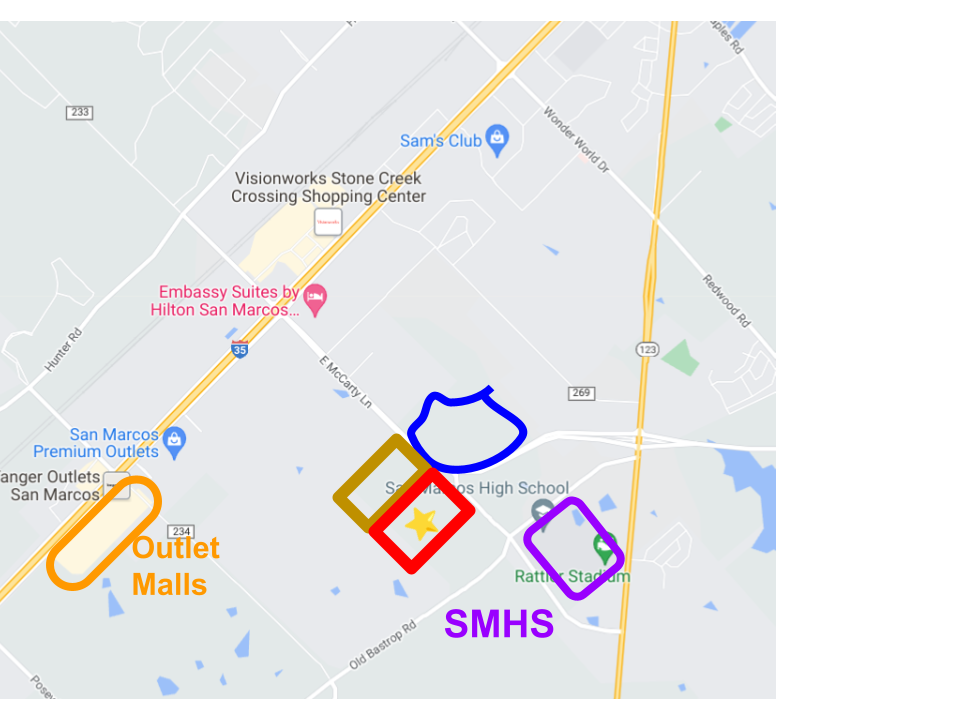
Item 11-12:  Annexation and zoning 65 acres on the corner of Rattler Road and McCarty. It’s this little red square with the star in it:

We’ve seen this area several times recently. It’s been a zoning bonanza:

  Back in September, these other folks wanted (and got) a cut-and-fill exemption for that blue region.  And back in August, the neighboring property (in that yellow-puke color) was zoned CD-5. It’s going to be apartments. (Also, a gigantic development was approved behind the outlet malls at that same meeting.)

The red rectangle is proposed to be CD-4. In that zoning, you’re allowed to build duplexes, townhomes, apartments, cottage courts, and other things that are denser than traditional neighborhoods but still feel small scale. (But you can also just build apartments, I think.)

The red rectangle and the yellow-puke rectangle are owned by the same people. So they’re selling the city on a larger vision where the yellow-puke one is dense, traditional apartments, and then this red one is more varied with all the duplexes and townhomes. Sort of transitional in scale towards single family houses.

Is this a good idea? Let’s apply our criteria:

Price Tag to the City: Will it bring in taxes that pay for itself, over the lifespan of the infrastructure and future repair? How much will it cost to extend roads, utilities, on fire and police coverage, on water and wastewater?

This is a good spot for infill. There is already infrastructure and coverage for this area.

Housing stock: How long will it take to build? How much housing will it provide? What is the forecasted housing deficit at that point? Is it targeting a price-point that serves what San Marcos needs?

Some day, the planning department will read my blog and hastily fall all over themselves in an effort to answer this question.

Environment: Is it on the aquifer? Is it in a flood zone? Will it create run off into the river? Are we looking at sprawl? Is it uniformly single-family homes?

Not on the aquifer. Not in a flood zone. No run off to the river or any other environmental hazards, as far as I can tell.

Given the duplexes, townhomes, apartments, cottage courts, and other things, it has the potential to be very good. It won’t be uniformly single-family detached houses.

Social: Is it meaningfully mixed income? Is it near existing SMCISD schools and amenities?

It is very close to SMHS, and not that far from Goodnight and elementary schools.

As for whether it’s mixed income, that depends on the developer. If the developer takes advantage of what they’re allowed to build, it could be mixed income. But just because they sell a compelling vision during the approval phase does not make it binding.

The San Marxist Special: Is it a mixed-income blend of single family houses, four-plexes, and eight-plexes, all mixed together? With schools, shops, restaurants, and public community space sprinkled throughout?

The larger region has the potential to become this. We shall see.

Final judgement: It sounds mostly good. Go for it.

So what did council do?  

There was a little discussion about including a buffer at the back of the property, as a courtesy for the homes right there, which are outside city limits. Staff will bring back a proposal at the next meeting.

And then they voted, and it passed 7-0. (Where’d the clickers go?)

I personally think this project passed all the criteria with flying colors.  But you know Max would have had a dozen questions about it.  Perhaps all the questions got settled in Secret Executive sessions – it’s just really hard to know.

Item 13: Trace PDD

A few months ago, we did a deep dive into La Cima.  Time for a Trace Deep Dive? Let’s do it.

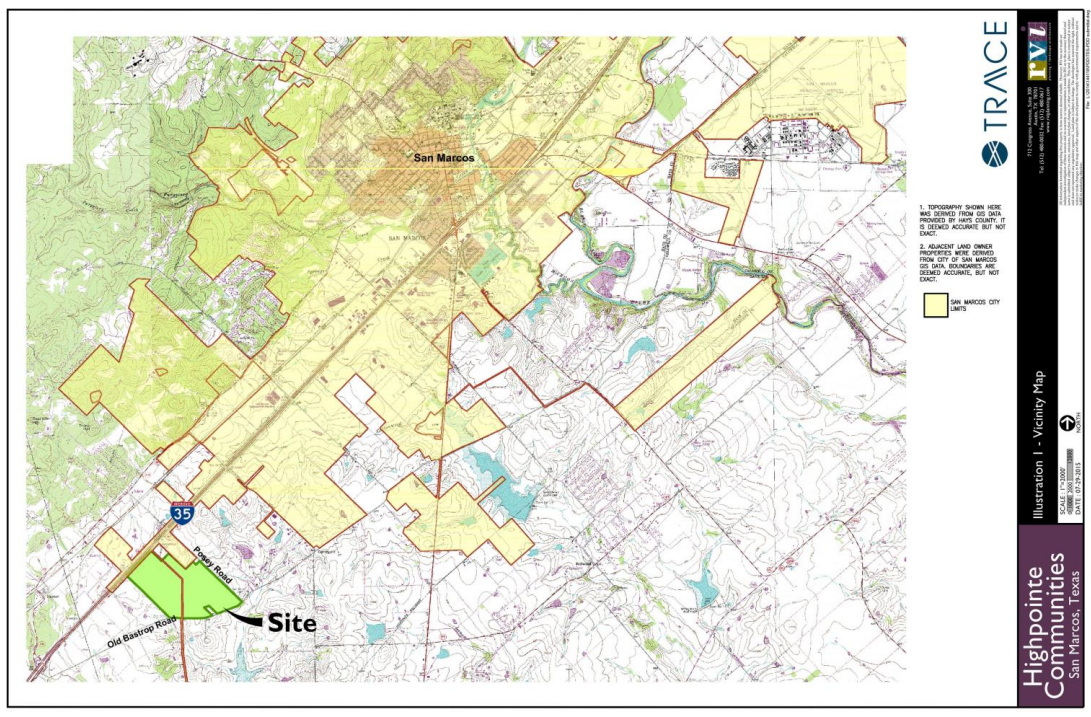
Trace was approved in October 2015.  It’s about 417 acres big: 

That’s not my usual chicken-scratch map – this is the map from the developers. I love our city staff, but their maps are truly for shit.

It’s supposed to be a whole community – houses, apartments, parks, an elementary school, some stores. Mixed income. My only real gripe is that it contributes to sprawl – you’re kinda far from everything out there.

In 2017, there was a bond election to fund an elementary school there, and Rodriguez elementary school opened in August 2019.  

 It was next amended in 2019 and 2022.  All the amendments were kind of finicky and detail-oriented – what should the heights of the apartment buildings be? Can we relocate sidewalks to this other side of the street? That sort of thing.

On the whole, it seems fine. It seems to need far fewer tweaks than La Cima or Whisper. (At some point, we’ll have to unpack Whisper Tract.)

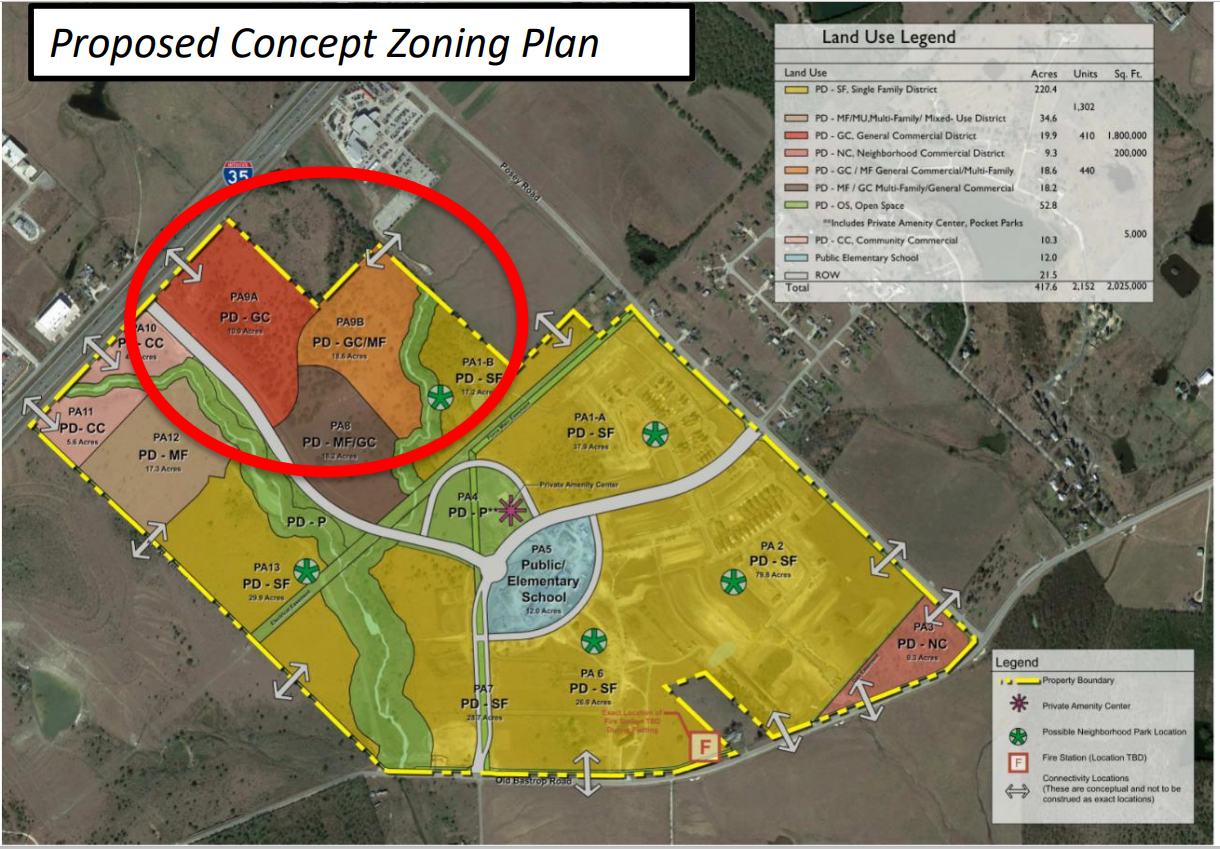
So what’s up now? It’s coming up because they want to rezone part of it. Here’s the original zoning of Trace:

The dark orange part facing I-35 is General Commercial, about 44 acres.  

Now they want to convert about 37 of those acres to apartments:

Both the light orange and brown parts of that red circle could now be apartments.  

Is this good or bad?  It’s complicated.  At the P&Z meeting in December, Griffin Spell an excellent point:  yes, we need housing. But Trace has not fully built the apartment complexes that they’re already allowed to build.

Furthermore, we also need amenities on the east side.  It is a huge problem in this town that the east side lacks an HEB and the normal sort of shopping options.  People are constantly talking to council and P&Z members about needing more commercial on the east side.

Griffin’s point is basically, “Let the developers finish building the apartment complexes that they’ve already agreed to build. If they still can’t find commercial occupants at that point, they can bring the rezoning back.”

The developer basically says, “Unfortunately, commercial is just not viable in that spot! It’s not visible from I-35!” 

To which Griffen dryly responds, “You’re the one that put it there back in 2015, and nothing has changed since it was approved.”

The developer gave a weasely answer about communities maturing. It left me with the impression that they always planned on converting it to apartments, and the original commercial zoning was just there to make it look good.

So what did council do?

At City Council, there was no discussion of this point at all. They just approved it, 7-0.   It gives the impression that they are not scrutinizing developers at all.  The issue Griffin raised is complex, and at least deserves some air time. On this item, I’m giving the stink-eye to this new Max-less council.

Hours 2:50-3:40, 12/14/22

Item 20: Campaign Funding, redux.

So you want to raise money for your city council campaign! Right now there are a few caps:

  1.  Individuals cannot contribute more than $500.
  2. If you contribute more than $300, then your councilmember has to recuse themself when anything that you’re connected to comes up.
  3. There’s an overall limit, based on the number of registered voters.  Councilmember’s cap is 50¢ per registered voter, and mayor’s cap is 75¢ per registered voter.

Jude Prather and Shane Scott brought this issue up.

Jude Prather goes first.  “It’s not the cap that’s the issue. It’s just confusing and too complicated. Things keep getting more expensive, and we’re going to have to revisit this year after year.  Make it simpler. What if you get a lot of contributions?  There should just be a max of $300 per person.”

Jane: We currently have a limit of $500 per person.

Jude: This is just so complicated. I mean, cost per voter

Jane explains, “It’s just supposed to grow as San Marcos grows. If they just had a hard cap, the amount wouldn’t grow as San Marcos grows. We could change the scaling factor, though.”

(They keep saying “Teepo signs” when they talk about campaign costs. I have no idea what a Teepo sign is.)

Jude keeps going. He’s on quite a tear. What about ballot initiatives? And PACs? This doesn’t apply to them! What if a ballot initiative affects a race? (He was worried about this with marijuana decriminalization, if you’ll recall. What if we turn out young, liberal voters??)

Jane: I’m having trouble following what your solution is. 

Jude Prather: I want it simpler. Just $300 cap per person. Get rid of the complicated charts with different numbers and amounts.

(OH!! T-Post signs! Got it.)

Jane Hughson was my favorite councilmember of the evening. She cannot get over the accusation that the funding cap is “too complicated”.  She keeps saying things like, “I’m really trying to understand what you mean.  You take the number of voters, and multiply by 50¢.  What is the complicated part?” and “I can understand if you want to change 50¢ to $1 or $1.25.  But what is the complicated part?” 

Eventually Shane and Jude have enough dignity to stop asserting that it’s too complicated, when it’s plainly not.  (And they’re not shameless enough to just bluntly say they want unlimited campaign spending.)

Everyone weighs in on what they’d like the scaling factor to be:

Shane Scott and Alyssa Garza: $1.25 per voter, for both mayor and councilmembers
Matthew Mendoza and Mark Gleason: $1 per voter, for both mayor and councilmembers
Saul Gonzales and Jane Hughson don’t seem to care.

Everyone seems to settle on the simplicity of $1 per registered voter.  There! We did actually make it simpler!

One final note: last time, there was also griping that the number of registered voters fluctuates with different election cycle. No one really pursued that this time, which is good, because it is a pretty lame complaint.

I was surprised that Alyssa Garza is opposed to spending caps.  Her argument goes that more money means hiring more local neighbors who might otherwise be disengaged, and increase local involvement.  

I can see her point, but I don’t think that outweighs the built-in advantage for candidates with wealthy friends. I put a higher weight on making sure anyone can run a competitive campaign, regardless of economic background. (On the other hand, Alyssa has run for city council and I haven’t. So she has relevant knowledge.)

As a side note, apparently in Texas it is illegal to cap self-donations to one’s own campaign.  So wealthy candidates will always have an advantage.

Item 13:

The Ethics Review Committee seems to always be a thorn in the side of Shane Scott, and to a lesser degree Jude Prather and Mark Gleason.  I don’t know if they’ve been busted for something, or if they just don’t like the idea that they’re being watched.

Right now, councilmembers have to turn in two sets of documentation:

  1. Yearly financial disclosure
  2. Campaign contributions disclosure

The ERC looks over these, and flags anything that looks fishy.  They’ve been doing this for years, but it’s not formally city policy. Jane Hughson wanted to formally codify the practice.

Shane Scott moves to deny. “The ERC does not need to meddle,” he says, “There are state rules, and the state will get involved.”

Jane explains where it came from, “After we passed the $500 cap, there was a candidate who took $1000, not knowing about the cap, and people were asking, “What do we do? Where do we report this?” It didn’t violate state rules, so you can’t report it to the Texas Ethics Commission.”

Shane Scott: “We shouldn’t be more restrictive than the state.”

Jane: “Okay, but we are. We just discussed the campaign caps. So…?”

Shane Scott removes his motion to deny, and Mark Gleason makes a motion to approve.

Next, Shane Scott makes an amendment to remove all the parts where the ERC looks at financial disclosure statements. “The state will take care of it!” he says again.

Jane again asks, “How would the state take care of it?”

Shane says, “FOIA requests, etc.”

The lawyer, Michael Consantino, says nope.  The state would not get involved.

No one seconds Shane Scott’s amendment, and so it dies. 

The overall vote to let the ERC review financial disclosures and campaign contributions:

There you have it.

Item 21: Jane Hughson wants a new zoning.  There are a lot of applications for Heavy Commercial or Light Industrial where council has to write up a bunch of good-neighbor exceptions because there are residents living nearby. Usually they want to rule out uses based on loudness/smell/vibrations/etc. The method is to make a “restricted covenant agreement,” which sounds religious, but isn’t.

Jane is proposing something that she calls “Business Park”. Maybe not storefronts, but businesses that you wouldn’t mind living next door to.  Smaller in scale and height, regulations on where loading docks could be, cranking down on noise/smell/vibrations/etc. 

Everyone likes this idea. It’ll come back in some form.

Hours 0:00-1:40, 12/6/22

Citizen Comment: the San Marcos activist community is a force. It warms a blogger’s heart to have a dozen activists show up and speak passionately against the proposed curfew.  (You can read about why I loathe the curfew ordinance here.) They make the right arguments – keep kids out of the criminal justice system, it’s not equitably enforced, it can be traumatizing to kids, etc. In addition, a ton of homeschool parents signed on some quick petition, worrying that their kids might get tangled up in the daytime curfew.

One speaker – Bucky Couch – did show up to talk in favor of the curfew ordinance.  I believe he’s the owner/developer of lots of things in town, maybe including the Kissing Tree? His kids own Cody’s restaurant, maybe? The Couches are in on many, many profitable projects around town.

Item 9: First up is a zoning request.  You may remember this, from August:

Today we’re looking at the green square, #3, again, between Amazon and Embassy Suites.

Last time, the developer wanted to rezone it from General Commercial to Heavy Commercial.  P&Z approved the zoning change, but then City council swatted them down, citing the beauty of Embassy Suites.  We do not want clanky old Heavy Commercial zoning next to our prized and glorious tourist conference space.

Now they’re back, changing their request to Light Industrial.  This time, P&Z denied it (due to the beauty of Embassy Suites), and Council felt stuck.  It would now require 6 votes to overturn P&Z. 

Council would like things like restaurants and service-related businesses to go in. They don’t want a bunch of warehouses. The developers want to include restaurants, but also a bunch of warehouses.

In the end, Council decided to form a committee and punt the matter to them. Stay tuned.