This week at council: You’ll come for the death of Flock Cameras, but you’ll stay for the deliciously petty Price Center mural discussion! Exciting meeting this week.
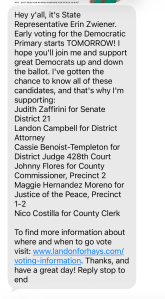
First, though: VOTE FOR SAUL in the council run-off. Details below.
….
Onto the meeting!
Hours 0:00 – 1:17: Everything but Flock Cameras! Some zoning, and some TIRZ stuff. But mostly, please let me tell you a very funny story about the Price Center mural.
Hours 1:17 – 3:50: FLOCK CAMERAS go down in flames! Plus a new speed limit on FM 110, and some suburban sprawl.
Bonus! 3 pm workshops: Should we be sister cities with Inverness, Scotland? What about Monclova, Mexico?
And that’s a wrap.
…..
It’s Council run-off time! Please do go vote!
Details
Early Voting:
Monday and Tuesday, 8:00 am – 5:00 pm
Location: Hays County Election Office (the old Car Museum, on Stagecoach and Hunter.)
Election day:
Saturday, December 13th, 7 am – 7 pm
Locations: Broadway Polling Location (401 Broadway Street #A) Hays County Election Office (the old Car Museum, on Stagecoach and Hunter.)
Saul Gonzales: I’m endorsing Saul. He’s willing to state his positions. He promised to vote no on the data center, to remove Cape’s Dam, to remove Flock cameras. Has shown his cards about how he’s going to vote.
And he’s kept his word! This past Tuesday, he voted against renewing the Flock Cameras contract.
Josh Paselk: No. First off, he never sent answers in. He won’t say how he’ll vote on anything.
All they seem to care about is that wealthy donors should be able to hoard their wealth:
LISTEN YOU NUMBSKULLS. It is better for business when poor people have a little extra money to spend! A rising tide lifts all boats. You can pay your fair share and grow your wealth!
And then they’ve gotten deeply gross with the mailers this past week.
There were 12 speakers, and only one topic: Flock Cameras
10 people: they’re authoritarian and hijacked by ICE. Hard no.
2 people: they keep us safe! yay cameras.
Lots and lots of details when we get to that item.
…
Item 10: The Downtown TIRZ
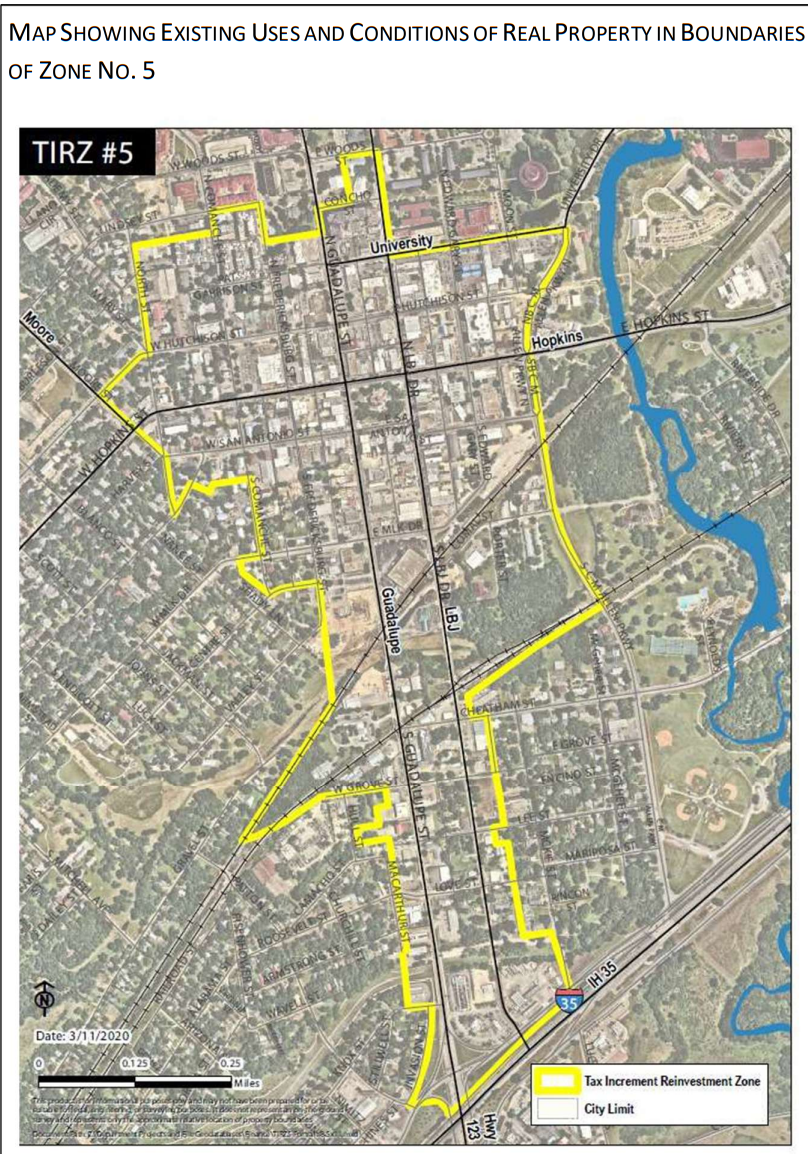
TIRZ stands for “Tax Increment Reinvestment Zone”. What this means is that we’re going to put more resources into a fixed area. TIRZ #5 is the Downtown TIRZ.
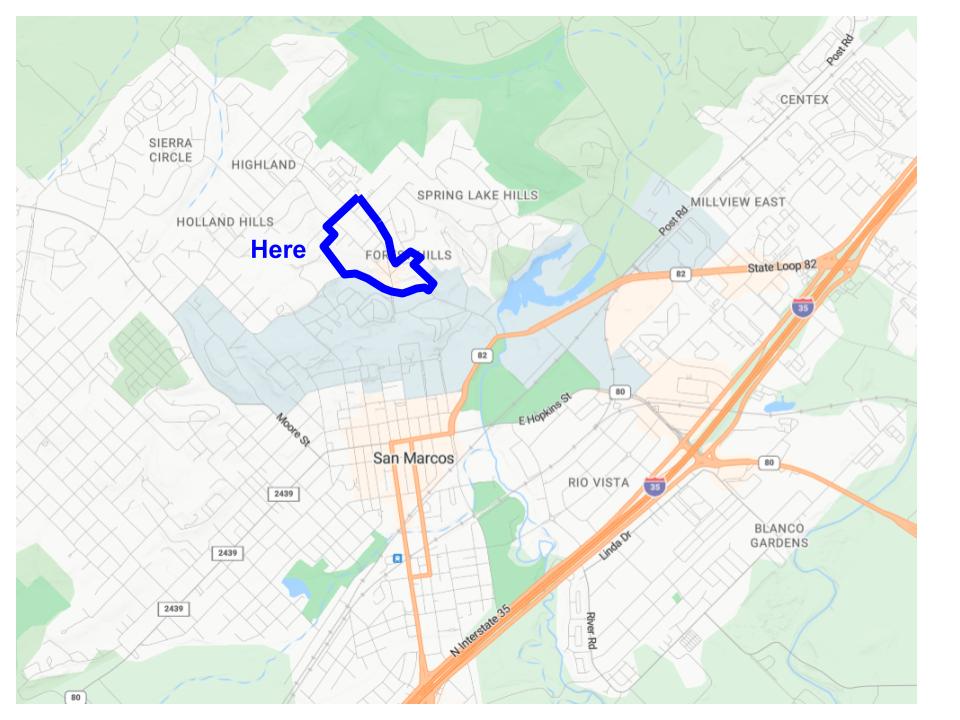
Here is the boundary of it:
Here’s how a TIRZ works: First, you fix a baseline year. For the downtown, it’s 2011. Back then, the whole region had a taxable value of $103 million.
San Marcos always gets to keep the taxes on $103 million. But the value of the land keeps growing. San Marcos agrees to split the taxes 70-30 on all the value added above $103 million, until the TIRZ runs out. (Hays County is also part of the deal.)
So in 2025, the land is now worth about $550 million. San Marcos keeps the taxes on the $103 million base, and then splits the taxes on the other $447 million. All told, the TIRZ gets about $1.2 million from San Marcos, and another $600K from the county, in 2025.
What does the TIRZ do with the money? The rules are that they have to spend it all on enhancing the downtown, which is supposed to increase its tax value all over again.
Today they’re adding a little bit extra to their plan. Here’s what they want to do:
The TIRZ expires in 2027. After that, the city keeps all the tax revenue on that district.
Fine! Everyone likes it.
…
Item 12: Rezoning 24 acres on Wonderworld and 123.
Here’s a little patch of land:
Here’s what it looks like if you’re going south on 123, on the Wonderworld overpass:
The developers want to make it CD-5.
What is CD-5?
In theory, CD-5 is supposed to feel like a cozy, dense downtown area where you have shops and apartments and all kinds of nifty things, kinda like on Sesame Street:
But inevitably, it always ends up looking like this:
Relentlessly giant apartment complexes.
…
What about some stores and restaurants?
I’m not actually opposed to giant complexes! Housing is great. But this intersection is a great spot for some stores and commerce, no? It’s a constant drumbeat that the east side needs more commerce.
Jane brings this up: “Will you all put in some commerce?”
Developer: “Who can say? We’re so mysterious!”
Jane: “It would be really great.”
But then no one on Council actually does anything.
COUNCIL!! You have powers! There are zoning overlays and Planned Development Districts, where developers agree to make some portion of a development into commerce.
But here’s Council:
So Council just tells the developer, “Fingers crossed! Thoughts and prayers for commerce!” and leaves it at that.
….
Is this re-zoning a good idea? Let’s be a little systematic about it:
Price Tag to the City: Will it bring in taxes that pay for itself, over the lifespan of the infrastructure and future repair? How much will it cost to extend roads, utilities, on fire and police coverage, on water and wastewater?
There’s a lot of development around this already, and this will be dense. This is a good financially for the city. A+
Housing stock: How long will it take to build? How much housing will it provide? What is the forecasted housing deficit at that point? Is it targeting a price-point that serves what San Marcos needs?
We’re still in a housing deficit, and more housing is good. So I’m fine with this.
Environment: Is it on the aquifer? Is it in a flood zone? Will it create run off into the river?Are we looking at sprawl? Is it uniformly single-family homes?
Not environmentally sensitive, not a flood zone. And it won’t be sprawl, because CD-5 has to be dense. So doing well here, too.
Social:Is it meaningfully mixed income? Is it near existing SMCISD schools and amenities?
I doubt it will be meaningfully mixed income. Developers don’t care. It drives me crazy though – wealth segregation is a societal problem.
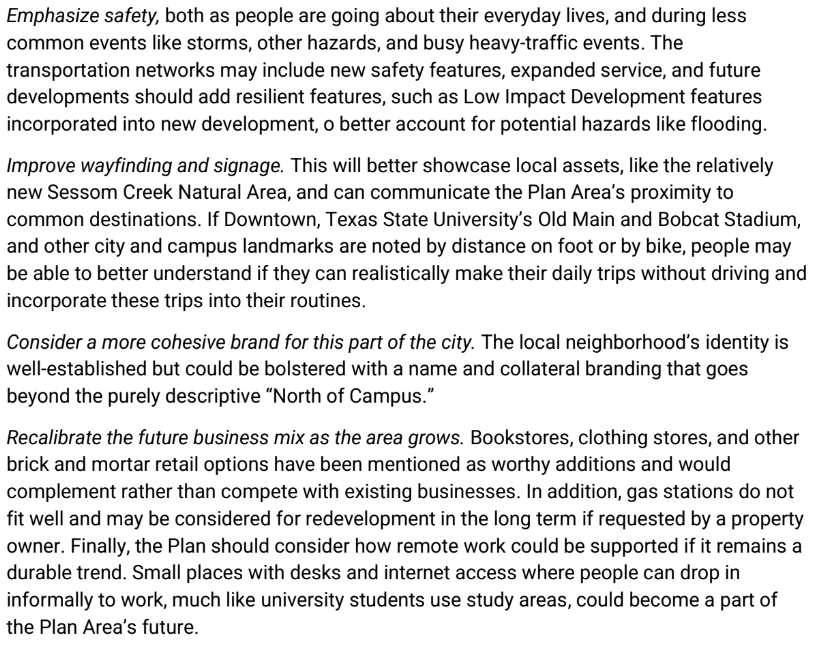
It is very close to two elementary schools, Goodnight middle school, and SMHS, and also Bonham pre-K. There are some restaurants near those schools.
The San Marxist Special: Is it a mixed-income blend of single family houses, four-plexes, and eight-plexes, all mixed together? With schools, shops, restaurants, and public community space sprinkled throughout? Is it walkable?
This is literally what CD-5 should be. A Marxist blogger can dream.
My $0.02: If I were on Council, I’d push hard for a zoning overlay that guaranteed some commerce. But if that was impossible, I’d vote yes, anyway.
…
The vote on rezoning:
Everyone: YES!
No one: no.
So there you have it.
…
Item 6: Mural at the Price Center. (Cousin to Panic! at the Disco.)
This item is peak ridiculous, in all the best ways. This is why I love local politics: everyone’s a regular person, and regular people are totally absurd.
This is the Price Center:
It’s right behind Tantra, facing San Antonio St:
It’s mostly a public event space – there are concerts and shows inside, people rent it out for parties, there are market days where you can buy stuff from vendors, etc.
Here’s the front steps:
No one ever uses this entrance. You walk around through the garden to go in.
Today’s item is about a mosaic mural to go on the front steps. In other words, it’s a single picture that will be cut into strips, and go on the risers, like this:
Maybe you’ve seen a photo of the proposed mosaic! If you haven’t yet seen it, I’m going to withhold it until the end of this item, for maximum comedic value.
Because this is what Jane Hughson posted to the message boards ahead of time:
This mosaic definitely involves cacti, and Jane is NOT a fan.
During the meeting, Jane brings up more points:
The mural is beautiful! But the cactus? Hard no.
We’re trying not to have spiky plants like yucca downtown, because they are hazardous if someone falls in them.
We’re not Arizona. Feh, Arizona!
Cacti are prickly and unwelcoming.
Lorenzo agrees: it does hurt to fall in a cactus.
City Staff: Some artists like cacti! It’s subjective.
Amanda: Cacti stand for our cultural heritage in Mexico!
Alyssa: I love ’em. Also they’re delicious.
Shane: If we asked the artist to take out the cactus and re-do it, and they said no, what are the sunk costs? Answer: $1000.
Saul: I guess I’m a yes, because I don’t want to waste $1000.
…
ARE YOU READY TO SEE SOME CACTI?
Pause for a second.
Before you see it, I want you to picture an unwelcoming, prickly mayor cactus. Get a good visual image in your head, before you scroll down. What kind of cactus would be too hostile for the front steps?
⋮
⋮
⋮
Ready??
⋮
⋮
⋮
⋮
⋮
⋮
⋮
⋮
READY??
⋮
⋮
⋮
Here’s the proposed artwork:
Guys. GUYS. It’s so beautiful. It’s mostly prickly pear flowers, more than anything else. There’s nothing remotely hostile here.
This is the mural that we almost killed for being too prickly! What a world.
….
The vote on the beautiful mural:
Yes, we love it!! : Amanda, Alyssa, Saul, Shane, and Matthew
Flock cameras are Licence Plate Readers, or LPR. They sit at intersections like so:
We have 14 of them in San Marcos, and they’re located here:
(We also have 8 downtown cameras that are not Flock cameras. The city owns these cameras.)
What makes everyone so mad about Flock cameras?
Every single time you drive by a Flock camera, your license plate gets tagged and recorded. Then Flock takes all this data, and pools it all together across the nation, into one big, sloppy data fest.
When your police department agrees to share all their data , they are given access to all the data about everyone who drives anywhere in all of the US.
Privacy rights are a tricky thing to talk about, because of a few things:
1. Our private lives started getting tracked extensively about 20 years ago. Now it’s like being mid-avalanche – we’ve all gotten used to things that are extremely abnormal.
This is the frog in boiling water scenario – as a society, how do we claw our private data back? (Europe has passed laws.)
2. The consequences are fuzzy and abstract for a long time…. until suddenly they’re really, really bad.
Your data is out there. Corporations sell it. It spreads like smoke. Nothing happens until it gets into the wrong person’s hands. Right now, because Trump has weaponized ICE and the FBI, people who want to abuse Flock data know they probably won’t be punished for it.
3. Freedom and safety are always in tension with each other. If you want to end all crime, you could put every single young man between ages 14 and 35 in jail. Your crime rate will drop to <1%.
But one of our core American ideals is freedom. Freedom is so important that we’re willing to accept some loss of safety. (“Innocent until proven guilty” literally means that we think it is wiser to let some guilty people go free than to risk locking up someone innocent.)
Where do you draw the line between freedom and safety? That is the heart of this discussion.
How did we get here?
April, 2022: Original Council agreement with Flock.
It was actually never discussed at that council meeting. It was put on the Consent Agenda with 15 other items. That means all sixteen items get one single vote, unless a council member pulls an item for discussion.
December 29, 2023: The first contract ends, and city staff signs a second contract with Flock Cameras.
This contract never went to Council for approval. Alyssa is pretty salty about this!
But honestly: in 2023, council was very very pro-cop. Jude Prather and Mark Gleason were still on Council, plus Matthew Mendoza.
All taken together, Council was extremely deferential to expanding SMPD in 2023. Hypothetically, if they’d voted on Flock Cameras, it would have been 6-1. I promise you, that’s what would have happened. (Alyssa would have been the only No vote.)
Well, Trump, obviously. Biden certainly deported a huge number of undocumented people! But he did not weaponize ICE with the kind of cruelty that we see from Trump.
This is what I meant above, about consequences. During the Biden administration, the loss of privacy didn’t feel as real to many people. Now we hear how Flock shares their data with ICE. We hear how Flock data tracks women who are leaving the state. The abuses are systemic.
Which brings us to today
The 2023 contract is up at the end of this year. Renewal was due by December 1st.
But city staff needs Council direction before they can renew, for two reasons:
All decisions over $100K go to council for approval
Clearly this has gotten contentious in a way that it wasn’t in 2023.
For unclear reasons, it did not get on the agenda in November. That means that we missed our deadline to renew.
Tonight’s topic: What is Council direction to staff? Do we want to renew after all, or modify, or just shut down Flock in San Marcos all together?
What does the public have to say?
Two speakers were pro-Flock cameras. Their main points:
What about other technology that helps capture criminals? Do you want to ban that, too?
Ten speakers were anti-Flock. Their main points:
Flock cameras are reactive, not proactive. They respond to crimes that have already occurred, but they do not prevent future crimes. (More on this below)
Their networks get hacked all the time. Their data is not secure. (True, true.)
Peter Thiel is one of the creepiest billionaires around, and has funded ⅓ of the flock network. (Yes)
There is no accountability for Flock.
ICE has access to Flock data.
Anecdotes of stalking incidents and tracking women who are leaving states to get abortions (for example)
But Flock cameras are aimed at intersections. They just record license plates. They don’t prevent the victim from being shot on the square – they just help find the shooter afterwards.
However, it does appear that Flock Cameras help solve crimes. Or as Chief Standridge puts it, we can solve the crime much faster, at least. It saves detective time.
What does Council have to say?
First off, Lorenzo recuses himself due to employment conflict of interest.
Next, Alyssa and the city manager go back and forth on the timeline for a while. (About the 2023 contract, discussed above.)
Amanda goes next. Her main points:
We had a community town hall on public safety. There were diverse opinions!
Opposing flock is a pretty mainstream opinion
Surveillance doesn’t prevent crime.
This is about Flock, not SMPD. Focus on Flock.
Lots of people would be okay with a strictly internal SMPD camera system.
Flock opens us up to expensive lawsuits. Lawsuits are way more expensive than the cost-savings from the cameras.
Saul: Are the city-owned downtown cameras LPRs? Are they License Plate Readers? Answer: No, they aren’t. You have to go and watch them to get information out.
Saul: If the National Guard or martial law comes to San Marcos, can they access the data? Answer: Legally, it would require a subpoena. Illegally, yes, systems can always be hacked or accessed. No guarantees against that.
Jane: Data is stored for 30 days, and we don’t share data with the rest of the Flock network? Answer: Right, we stopped sharing after June. Now other agencies have to fill out a specific request and send it to us.
Jane: How often do we get requests from out-of-town PD? Answer: We’ve gotten 20 since July. We denied two of them.
Alyssa: Hays County tried really hard to create some safeguards, and Flock is not interested. The Flock representative laughed when Hays requested some mild modifications to their system. They won’t do anything and won’t disclose anything.
Jane: I love Law & Order, but this one company makes me nervous.
Jane’s main points:
I’m okay with cameras, but not Flock.
Can we get some non-Flock cameras?
Let’s renew with Flock while we source non-Flock cameras, so that we don’t have a gap in surveillance. Then we can switch in 2026.
Matthew: Samesies! No longterm Flock, but I’m okay with short-term Flock. No gap in surveillance, please and thank you!
Amanda: If we’re so focused on avoiding gaps, what about our major gaps in crime prevention? How about the gap on mental health care? How about the gap in homelessness prevention? Those would actually prevent crimes from occurring. Reacting does not make us safe.
Question: How much does Flock cost? Answer: About $43K for a year.
They get into the nuts-and-bolts of transitioning to a different company. How long does it take to solicit proposals? Could we piggyback on an existing contract? Could we get a pro-rated or month-to-month contract with Flock in the meantime? (Answers: 12 months, maybe, and maybe.)
Extra details:
Back in the spring, there were five cameras that may have gone live without Council approval. They were definitely mounted up on poles. Council is very interested to know whether or not they were turned on and recording data? Or just mounted up there? We never got a firm answer on this.
Question: Could we create our own, internal system? Answer: Maybe! Seems plausible.
Jane: The story about Evanston, Illinois is creepy. If we’re signing a new contract, put in a clause to avoid that.
What she’s referring to is this: Evanston took down their Flock cameras due to privacy violations. Then Flock put them back up again. It took a court cease-and-desist order to get Flock to stop putting the cameras back up, on their own.
Question: How do you measure the effectiveness of Flock? Answer: It’s mostly anecdotal, because Flock won’t share the information that you’d need to know this.
Saul specifically says that he supports SMPD and his own son is an officer, but he’s a no because of the risk of lawsuits.
THE VOTE:
Let’s sign a whole new contract!: nobody. We want a short term contract with Flock, while we hunt for new options: Jane, Shane, Matthew Absolutely no contract with Flock at all: Amanda, Alyssa, Saul
So it’s a 3-3 tie.
What does that mean??
It takes a little bit of time to untangle this. Basically, it takes 4 votes for Council to take action. Neither side got 4 votes. So nothing happens.
But what’s the outcome then?
We have to go back to the timeline. December 1st was the deadline to renew, and we couldn’t renew without Council approval. So that deadline came and went. We did not renew.
And now… nothing happens. Which means we’re done with Flock!
….
Look, I loathe authoritarian microsurveillance and I think the threat from tech billionaires and ICE is far greater than the danger of unsolved crimes. So I’m good with this!
…
Item 15: Speed limits
Here’s the new FM 110, going east of San Marcos:
On that red stretch, should we increase the speed limit from 60 mph to 65 mph?
This is pretty nutty:
Here’s what I think that means: TxDOT came to us and said, “We think your speed limit is too low. If too many people are speeding, you have to raise the speed limit.”
So we had to do a study, and the study did show that too many people were speeding! So now we have to raise the speed limit, so that they’re not speeding anymore.
How ass-backwards is that?
(Also: when national speed limits went from 55 mph to 65 mph, fatalities rose by 20%. It’s the whole freedom vs safety trade-off, again!)
Council votes:
Stay at 60 mph: no one.
Go up to 65 mph: everyone.
I mean, I wouldn’t want to take on TxDOT either. 😦
River Bridge Ranch is always hopelessly confusing to me, because it is right next to Riverbend Ranch, and they both have had a hundred different names over the years. (Riley’s Point, The Mayan Tract, Baugh Ranch, etc etc)
This is mostly for my benefit:
For years I didn’t even realize these were separate properties.
Short little meeting this week! A little bit of zoning, a lot of HSAB grants, and a little bit of Paul Laurence Dunbar.
Here we go!
Hours 0:00 – 2:04: Blanco Gardens is getting some new houses, we unpack the HSAB grants to nonprofits, and we talk about the guy behind the Dunbar name.
Tonight’s the night that Council determines their HSAB grants, and so almost everyone speaking was representing nonprofits – one speaker from School Fuel, and three from Southside. I’ll save it for that item.
One last speaker talked about Meet and Confer, and whether or not it was okay for Council to make recommendations to the negotiators who represent the Council in the negotiations.
…
Item 13: Rezoning a little street in Blanco Gardens
Here’s Blanco Gardens:
It’s a very cute old neighborhood with gorgeous trees.
For an old neighborhood, there’s a surprising amount of undeveloped land in the middle of it:
(I wondered briefly if that was because homes had been torn down after the floods. But nope, you can see on the 2014 satellite image that there’s just always been space there for years.)
They would look and feel like duplexes, but they’re technically different, because of how they can be bought and sold. The property line runs through the two halves of the house, so you can purchase one half of it, while someone else owns the other half. (It’s called a “zero lot-line house”.)
Basically it’s a good way to fit more, smaller homes onto a street, and they tend to be a little cheaper, too.
What does Council say?
Question: will fit the character of the rest of the neighborhood? Developer answer: We have good intentions!
(One block over, there are some extremely modern houses. The neighborhood is salty about this.)
Question: Will the alley still exist? Answer: nope.
…
Nobody really asked about flooding. The 2015 floods are starting to fade from memory for the rest of San Marcos. But not in Blanco Gardens – they were the epicenter of the floods.
I would have liked to know what the 2015 flood water line was for nearby houses – I bet it was about 3-4 feet of water deep. How elevated will these houses be? Will they be above the 2015 water line?
My memory is that, in a 100-year flood plain, you have to build 1-2 feet above the Base Flood Elevation, based on FEMA flood maps. Does that get you to 3-4 feet off the ground? I just don’t know.
…
The vote on this cute row of sorta-duplexes:
Yes: Everyone No: nobody
The good news is that Council is enthusiastic about infill housing. (When I first started blogging in 2022, Council wouldn’t let a home owner build two small houses on a subdivided lot, on Lockhart street. That was crazy.) They’ve definitely gotten the message that San Marcos needs more housing.
As long as the homes are safely elevated, I’m okay with this project. But the flooding risk makes me very uneasy.
…
Item 14: HSAB Funding
HSAB stands for Human Services Advisory Board.
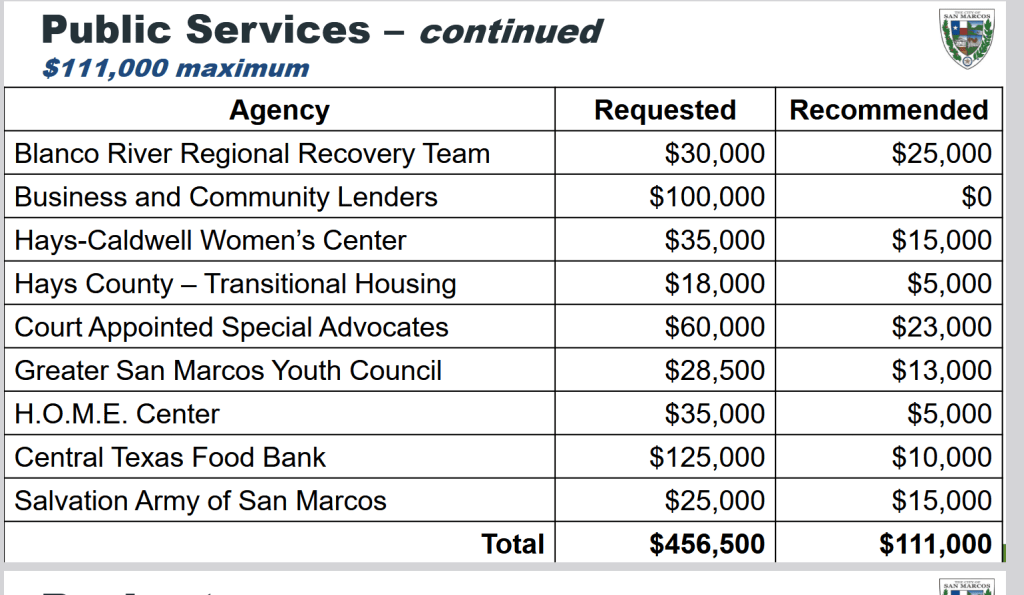
These are city grants to nonprofits, for things like food assistance, eviction prevention, domestic violence help, mental health services, etc. For the past few years, we’ve given out $500K in grants. This year, Council bumped it up to $750K. (Of course, federal funding has gotten slashed, so the need has also grown. THANKS OBAMA.)
It’s always a grueling process. All the nonprofits all do incredibly important work.
In the past, we kinda made non-profits cagefight against each other. [Read all the gory details for thepast few years.] The process was murky. The recommendations would come to council, and council members would start horse-trading around.
It was a bad look! It always seemed very fickle – “Oh, we’ll take $20,000 from those guys and give it to these guys!” It felt like the main criteria was being friendly with council members.
We’ve been working on tightening the process. It’s a super time-intensive:
the HSAB board meets weekly from August to October
They hear presentations from all 32 applications
Each one gets discussed and each board member ranks them on a bunch of different criteria
Eventually they recommend how much of each request to fund.
Here’s the criteria:
After all the ranking and discussion, they bring it to Council.
…
Just for funsies, let’s add up how much other non-HSAB money is getting allocated in this meeting!
All this was approved in one single vote, on Tuesday:
“On-Call Title Research Services Contract with Hollerbach & Associates, Inc., to increase the price by up to $200,000.00, resulting in a total contract amount not to exceed $299,999.00”.
“RMO P.C. for legal services associated with land acquisitions to increase the price by up to $300,000.00, resulting in a total contract amount not to exceed $699,000.00”.
“Change in Service to the agreement with Baker Moran Doggett Ma & Dobbs, LLP for legal services associated with land acquisitions to increase the price by up to $300,000.00, resulting in a total amount not to exceed $600,000.00”.
“STV Incorporated to provide On-Call General Engineering Services for various projects in the amount of $900,000.00”.
“Halff Associates, Inc. to provide On-Call General Engineering Services for various projects in the amount of $900,000.00”.
“a 2025 Ford F550 Crew Cab Chassis from Rush Truck Center, through a Sourcewell Purchasing Cooperative Contract, in the amount of $82,043.63, and outfitted by E.H. Wachs, through a BuyBoard Contract, in the amount of $156,865.65, for a total purchase cost of $238,906.28”.
“SHI Government Solutions, through Omnia Partners, for a City of San Marcos job application tracking software system in the annual amount not to exceed $112,000.00, and up to four one-year renewals with a total amount of $560,000.00”.
It comes to about $2.95 million. I’m not saying any of those were a mistake! I trust the city officials. Most likely, those are all totally reasonable.
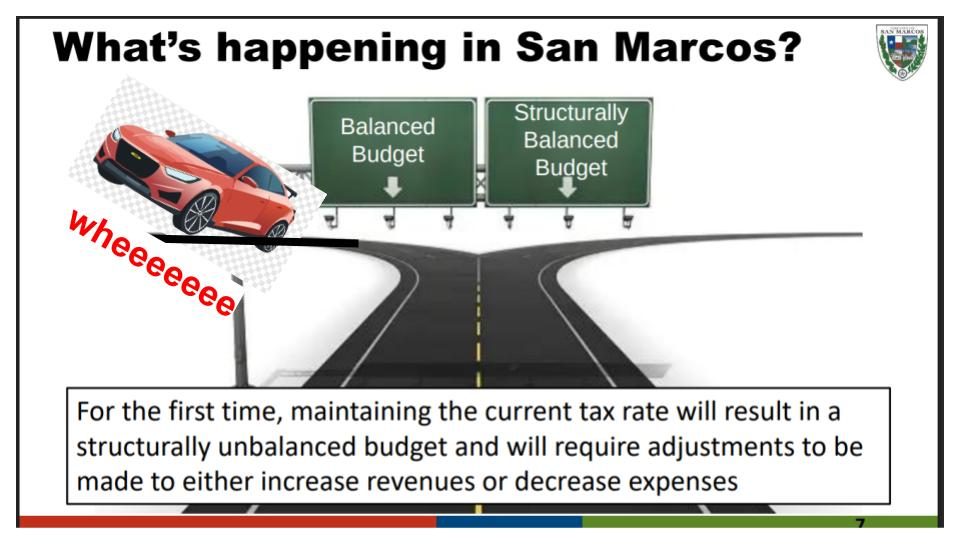
I’m just pointing out who gets scrutinized, in society, and who doesn’t. We approved almost $3 million without blinking, when it goes to those contracts above. But if it’s hungry kids, homelessness, mental health emergencies, etc, we rigorously grind these applications into pulp.
…
Back to the grant grind!
There were 32 applications, and the total amounts requested added up to $1.2 million.
Here’s the full list of scores and funding:
In the presentation, they went through all of them, and why the committee might not have fully funded the request.
For example:
The rest of their thoughts are on pp 435-437, here.
They were very thorough.
…
Back to Citizen Comment
Three speakers from Southside show up to talk. Here’s what they say:
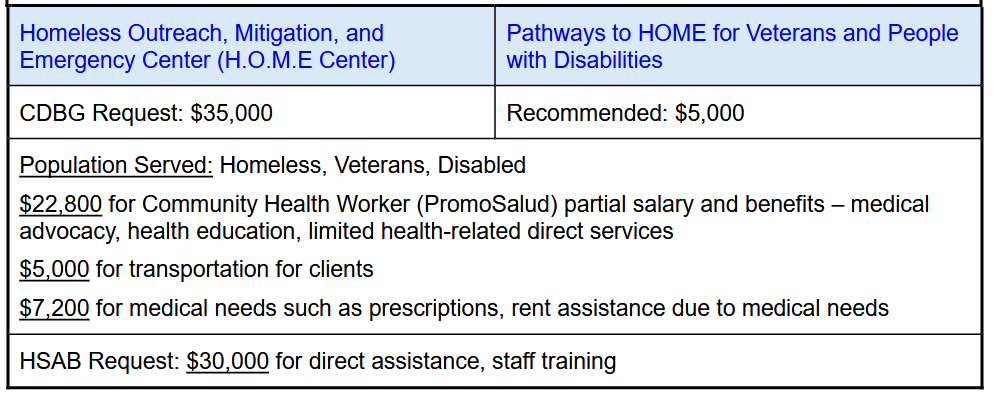
Southside is in a funny position. In 2024, the city gave Southside $800K of Covid money to implement a Homeless Action Plan.
They came up with a plan and put in all the work to get it up and running. Now they’re trying to sustain it over time. They asked for $100K from HSAB, but were only granted $50K.
The $100K is for their homeless prevention program – giving families $1000-2000 to get through a one-time financial crisis, so that they don’t get evicted.
…
Let the horse-trading begin!
Matthew kicks it off. He wants to try to get Southside back up to the full $100K that they asked for, for homelessness prevention.
Matthew proposes:
Take $4500 from Rough Draft
Take $5000 from Lifelong Learning
Take $10,000 from Hill Country MHMR
Give that $19,500 to Southside.
Ok, what are these things?
Rough Draft:
Their funding would go to $0.
Lifelong Learning:
Ok. Their funding would go from $9000 to $4500.
Hill Country MHMR
Their funding would go from $60,000 to $50,000.
….
What does Council think?
Question: How many people would Southside be able to help, with this $19K? Answer: About ten families. Average cost to stabilize someone after a financial emergency is $2k.
It’s actually a huge bargain. If they’d been evicted, it would cost $15-30K+ to stabilize a family once they become homeless. (Plus, y’know, becoming homeless is awful. This is way more humane for the families.)
Question: Are you all applying for other grants? Answer: SO MANY. Funding is scarce, and federal funds have been slashed.
Alyssa: The entire premise of horse-trading these dollars is problematic. Most agencies didn’t send someone here tonight to answer questions. We don’t have context and expertise. This is haphazard. I am not on board with any of this.
Amanda: Matthew, what about moving some money from the School Age Parents Program? They said they’d be able to keep the program open on $7,500, but they’re being awarded $15K.
Matthew: How dare you. Abso-fucking-lutely not!
[I’m paraphrasing. Matthew just said something like, “They do great work!”.]
Amanda: I’m trying to throw you a bone here!
Matthew: Hard no.
Amanda: Well, I’m a no on Hill Country MHMR especially. Their work is desperately needed. We are in a mental health services desert, and this program will fund teenagers without insurance.
Alyssa: I’m a NO on all of this, but especially NO on Hill Country MHMR. Homelessness and mental health are completely intertwined. There’s so much need here.
The votes are each held individually:
Move all $4500 from Rough Draft to Southside Homelessness Prevention?
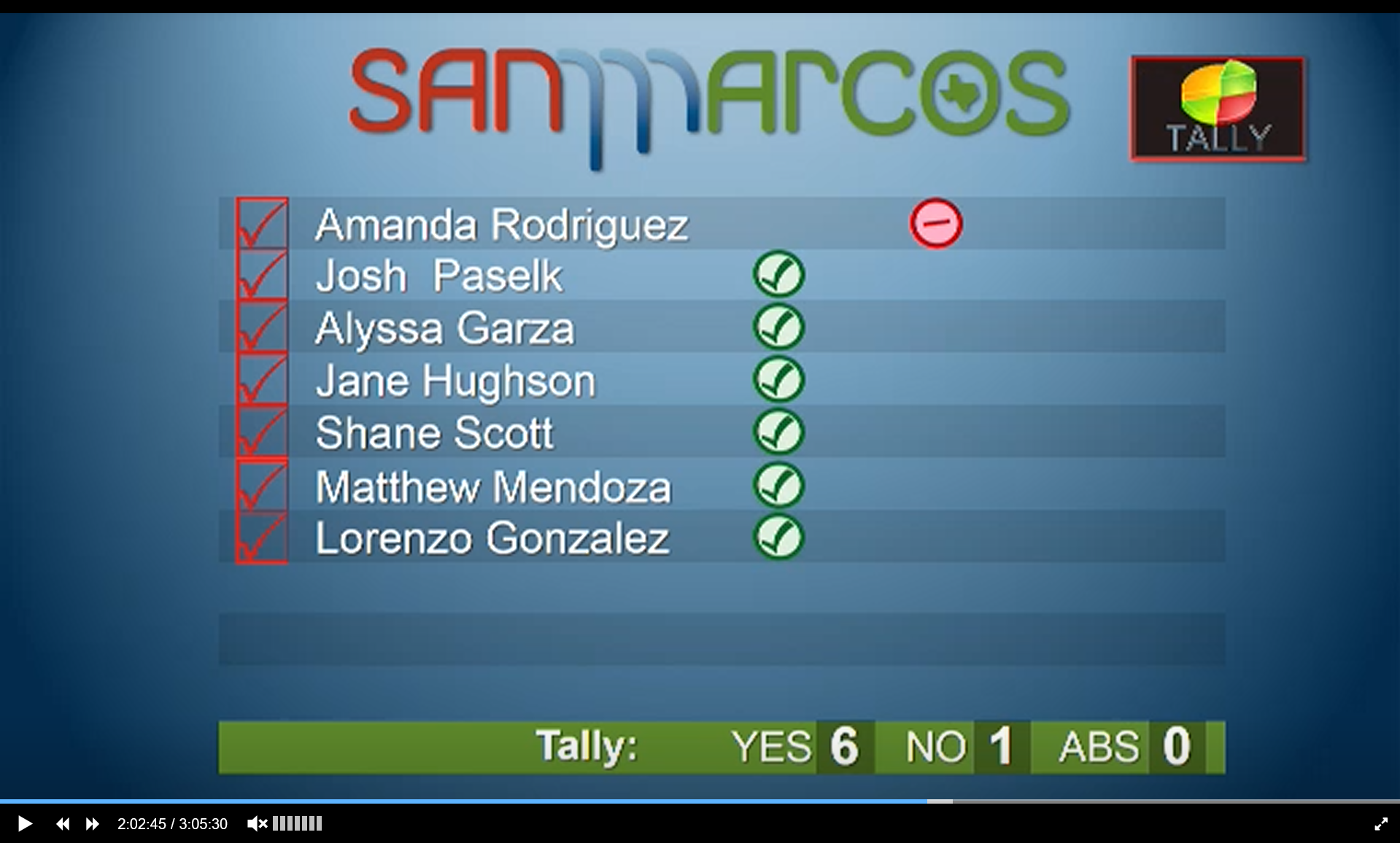
Yes: Matthew, Jane, Amanda, Lorenzo, Saul
No: Alyssa, Shane
2. Move $5000 from Lifelong Learning over to Southside?
This motion dies without getting a second. So it never comes to a vote. That kinda surprised me.
3. Move $10K from Hill Country MHMR over to Southside?
Yes: Matthew
No: Everyone but Matthew
4. Amanda throws in a vote on the SMCISD School Age Parents Program:
They get $15K.
Should we take $5K from them, and give it to Southside?
Yes: Amanda, Saul
No: Matthew, Lorenzo, Alyssa, Jane, Shane
So that fails.
..
Me, personally: It’s an awful decision to make. I probably would have taken money from Rough Draft, Lifelong Learning, and maybe SMCISD School Age parents. But not Hill Country MHMR.
….
So that’s where it lands. Southside picked up $4500 more, and Rough Draft went to $0.
The final official vote on HSAB funding passes 7-0.
…
One more note!
We just spent $750K on the poor and vulnerable.
But we also spend $1.1 million on tax breaks to home owners every year:
About 30% of San Marcos owns their own home. That $1.1 million is just for them.
People who want to slash property taxes never seem to appreciate how much of their own lifestyle is being subsidized.
….
Item 19: Dunbar Recreation Center
Dunbar was named for Paul Laurence Dunbar. He was the first black poet to get widespread recognition. (He was not from San Marcos in any way. He’s from Ohio.)
Originally, the Dunbar neighborhood did not have a specific name, besides being called “the colored neighborhood”. The school was called The Negro School. In 1961, that was renamed after Paul Laurence Dunbar, and then gradually the whole neighborhood came to be known as Dunbar. So the Dunbar Rec Center just got the name “Dunbar”.
Would we like to include the poet’s full name here? Everyone says yes.
Great!
Lots of interesting history on the Dunbar neighborhood here and here!
….
Item 20-21: Jorge’s Mexican Restaurant.
Jorge’s is on Hunter Road:
Separately, Miller Middle School is on Foxtail Road:
Their front doors are far apart:
…but they share a back fence.
This causes all kinds of problems for Jorge’s, because there are extra-strict rules for selling alcohol within 300 feet of a school.
This means that Jorge’s has to do a lot more:
Renew their alcohol permit every year, instead of every three years like everyone else.
Renew their distance variance every year, which grants them an exception to the 300 foot rule.
The main problem is the fees – both of those cost $750, so Jorge’s is paying $1500 every year.
Why is it so expensive?!
Mostly because of postage. The city has to notify everyone within 400 ft. The rest of the cost is to cover staff time, to process the paperwork.
Everyone wants to at least refund half of Jorge’s fees, since the city can save costs by processing both the alcohol permit and distance variance at the same time.
They’re going to try to come up with a long term solution, too.
Workshop: Heritage Tourism and Preservation Grants
“HOT” stands for Hotel Occupancy Taxes. How shall we spend our HOT money?
The city is proposing offering some grants to nonprofits who have some kind of historical preservation project.
City staff goes through a long list of slides. Who would be eligible? What kinds of projects are okay? How much are the grants for? What’s the rubric for evaluation? What’s the timeline? It’s very detailed.
What does Council say?
“Let’s kill this whole thing and just use the money for repairing the Dunbar School Home Education Building.”
It’s not a bad idea! I felt a little bad for the presenter, though.
It’s the only building left from the original campus of the Dunbar School.
We just talked about the Dunbar School a moment ago – it’s the original school for black children during segregation, named for the poet Paul Laurence Dunbar.
The Dunbar School was put on the National Register of Historic Places in 1983.
This week: contracts for SMPD and SM Fire Fighters, with a win for transparency. Also a Dunbar Historic Walk, some election talk, and a call to support our school librarians.
Here we go!
Hours 0:00 – 2:29: Basically all about contracts for SMPD and SMFD. How transparent should the process be?
But first! Two quick bits on the election and school libraries.
1. Well, we had an election.
Matthew Mendoza won re-election against Chase Norris.
Saul Gonzales and Josh Paselk are headed to a run-off, on December 13th.
I’m still grossed out by that PAC dumping $50K to sway a local election towards their preferred candidates.
Here’s the problem: we actually have some local limits on campaign donations:
If you receive more than $300 from someone, you must recuse yourself from votes related to that.
No one can donate more than $500 to any campaign, period.
Now look at the donor amounts to the Brighter Future for San Marcos PAC. Almost all are over $300, and most are between $600-$10,000. (And that list is not up to date.)
That PAC spent $35,000* supporting Matthew Mendoza and Josh Paselk. But they don’t donate it to campaigns, so the local laws don’t apply. The PAC just directly buys mailers and newspaper ads. So Matthew and Josh benefit, but would not be required to recuse themselves from votes that benefit the donors.
This is legal, but it’s deliberately sabotaging the intent of our local laws. What bullshit, right?
*also out of date. My understanding is it’s more like $50K+.
2. Our school libraries
At the past two school board meetings, around 10 or so people from New Braunfels, Seguin, Corpus, etc have shown up to harass our district. They find the spiciest parts of any book at any school library, and berate our school board for it. (They also post the spiciest parts to social media! Everyone gets titillated at the thought of saying such naughty words in public.) Then there’s a whole procedure where they flag books, we have to pull the books, review them, and bring the recommendations to the school board.
It might be nice to have some local voices supporting our librarians, our libraries, and our school district at these meetings?
Obviously say whatever you want, but if you’re stuck, I think the major points are things like:
you trust the judgement of our school librarians that they’re only including books with mature themes when there’s age-appropriate value to the book.
Parents are free to monitor the reading choices of their own children, but shouldn’t enforce their personal rules on everyone else.
Want to speak in person?
The next meeting is at 6 pm on Monday, November 17th, at the Felipe Reyna District Offices located at 1331 Hwy 123. (Right by Goodnight Middle School.)
You are supposed to sign up ahead of time. Swing by the Superintendent’s office (same address) or call (512) 393-6700 ext. 6767.
Three people show up, plus one more at the 3 pm workshop. The basic themes are:
Yes on pay raises for police and fire fighters
What’s with the shootings and mayhem downtown?
If we’re so broke, why are we spending money on Kissing Alley and other frivolous things?
Remember, Mark Gleason got reprimanded by the Ethics Review Commission in 2023. This was because he received campaign contributions above the limit from SM fire fighters, but then didn’t recuse himself from the vote on their contract. Any council members need to recuse themselves?
That last point is exactly the problem with the PAC!
There’s also a short note from the city manager about the shootings downtown. Condolences to those grieving, thank yous to first responders, that sort of thing.
….
Items 4-5: Contract Extensions and Raises for SMPD and Fire fighters
Let’s start with some backstory!
Backstory
Unions are massively constrained in Texas. This is because:
Texas is a right-to-work state. You can’t make joining a union automatic. But unions are still required to represent all employees.
Texas allows at-will employment, so it’s easy to find a pretext to fire people
Public sector unions are especially helpless in Texas. In addition to the constraints above, there are explicit laws:
No collective bargaining. Literally, you can’t have your union negotiate contracts on behalf of the employees.
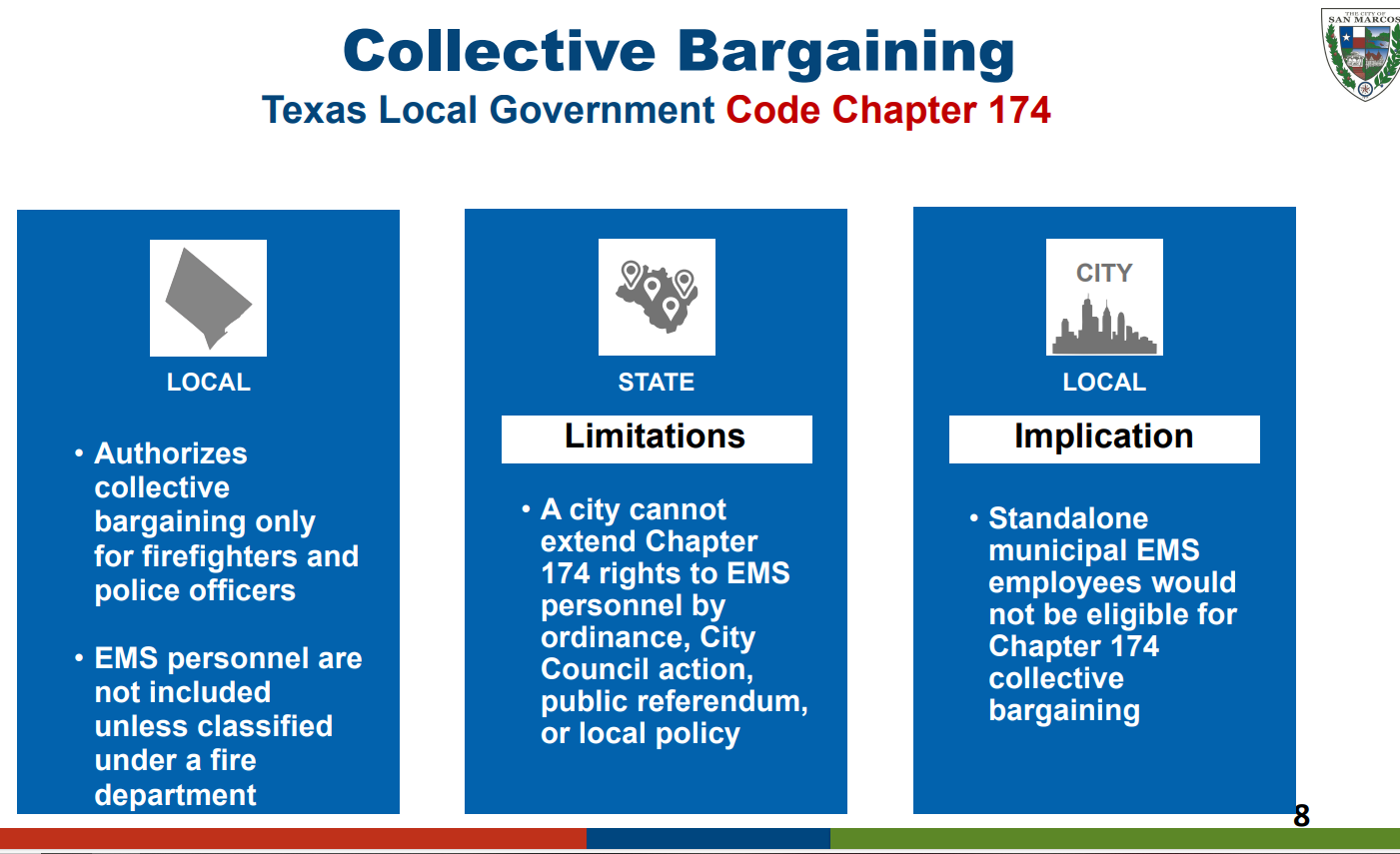
That all is a massive bummer. It means that public employees can’t speak in a coordinated, unified voice. (For a state that claims to worship freedom, it seems a bit off to outlaw employees from coordinating their actions, yes?)
Anyway, there are two exceptions: Fire fighters and police departments are allowed full strength unions! They get a special carve out! How nice for them, and no one else.
You’ll need some vocabulary: SMPOA: San Marcos Police Officers Association, which is their union. SMPFFA: San Marcos Professional Fire Fighters Association, the fire fighter union.
“Meet and Confer” – the collective bargaining process. This is the negotiation process to come up with new SMPD and SMFD contracts.
More backstory
In 2021, SMPD officer Ryan Hartman blew through a stop sign and killed a woman, Jennifer Miller, in Lockhart. He was treated with kid gloves. He had an open container in his car, but wasn’t given a breathalyzer test. Etc. This all happened right when Chief Standridge was first arriving at SMPD. Hartman wasn’t indicted, and got right back on the force. (Hartman was later fired for excessive force in a separate incident.)
Mano Amiga was FURIOUS at how poorly the Hartman investigation was run. In response, they came up with five Hartman Reforms that they wanted the city to adopt:
In 2022, the SMPD contract was up, and it was time for Meet and Confer. The city ignored the Hartman Reforms and just passed a standard contract.
Spring 2023: Negotiations re-open. Some mild concessions are made towards the Hartman Reforms, and the contract is passed.
That’s a breezy summary, but trust me – this was a huge production. Probably hundreds of hours of citizen engagement, all told.
The 2023 contracts expire next October 2026. That means we should start Meet and Confer this spring.
Which brings us to today!
Should we sign a one year extension until October 2027? It includes a 4.5% raise for fire fighters, and a 5% raise for SMPD, effective in October 2026.
Meet and Confer meetings should be open to the public, recorded, and broadcast
There should be a citizen comment portion
Documents should be made publicly available.
Question: How is this different from the current situation? Answer: Really, only the citizen comment would be new. We started recording and broadcasting meetings in 2023, and documents are always available under the Texas Open Records policy.
Why do this?
There are lots of good reasons!
First off, legally there is a clause in Meet & Confer laws that requires transparency and openness to the public. So this is consistent with how these things are supposed to go.
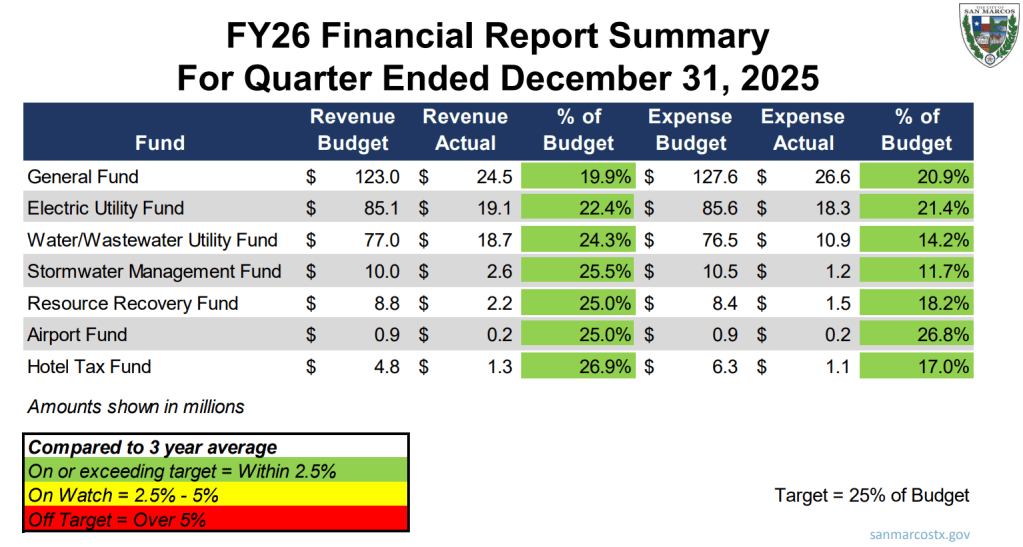
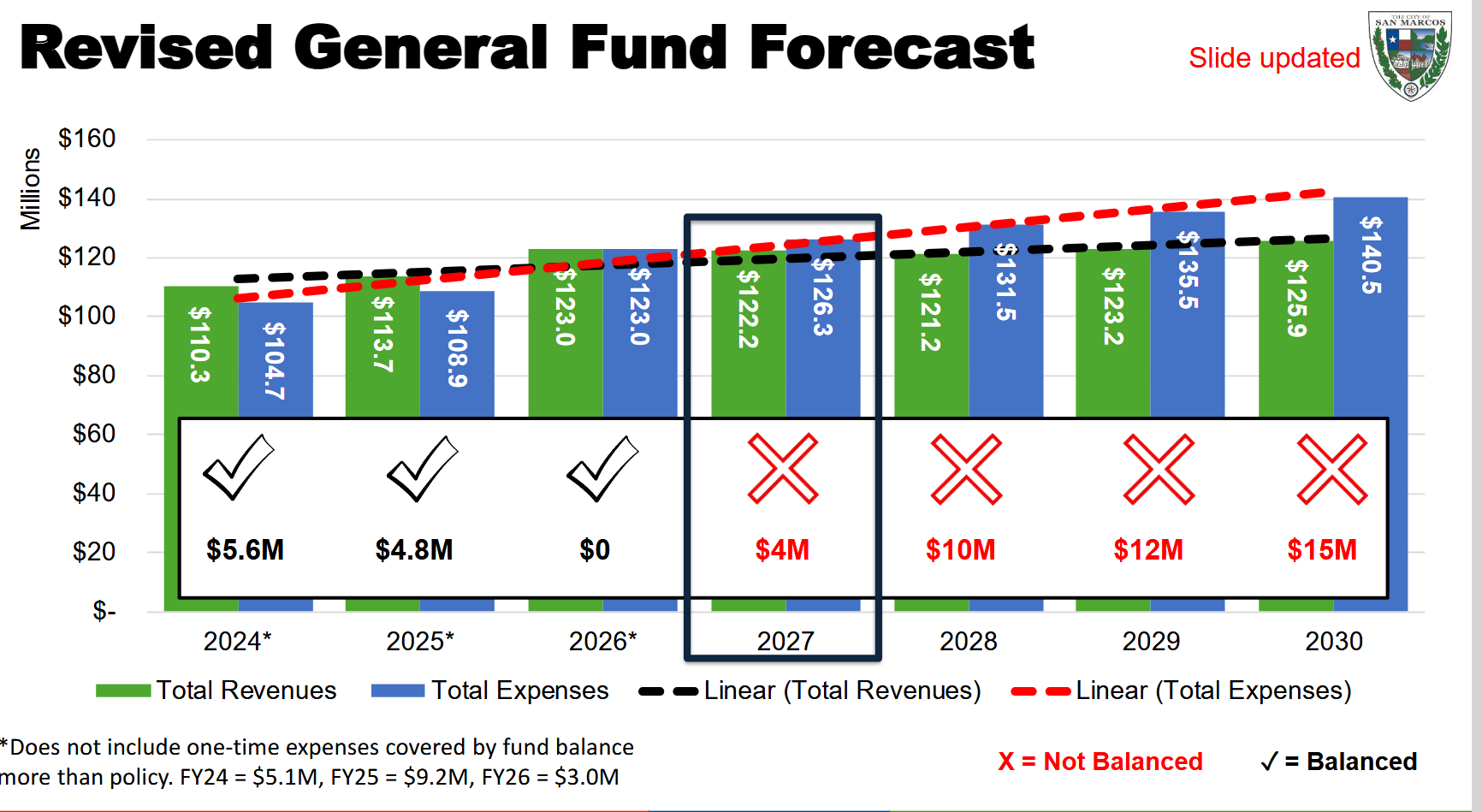
Those big blue and orange slices above are SMPD and SMFD. They make up about 36.7% of the General Fund, and combined, they are about $45 million. Citizens should get to speak up, just as they do for the rest of the budget.
Third, this one-year extension is occurring with virtually no community discussion. It’s a good faith gesture by council to acknowledge the outcry in 2023, and make a move towards transparency.
Finally, Austin has a similar resolution that applies to PD, Fire, and also their labor unions. It seems to work fine.
How would this work?
This is where conversation stalls out for about an hour. I’m going to give your the super abbreviated version.
What would the details of the citizen comment actually be?
Should each person who wants to speak get 1 minute? Should it be capped at 30 minutes? Should it be at the beginning and at the end of each meeting? Should it be on another night altogether, and recorded as a forum? Should there be an email address?
Amanda’s pitch: Let’s leave these details to the negotiating team. Council does not need to micromanage.
Jane is extremely uncomfortable leaving it vague. She wants to know how it will play out. She’s worried if the ground rules aren’t quite right, it will sabotage the collaborative spirit of the negotiations.
2. How exactly does the timeline work?
Does SMPOA and SMPFFA have to agree now, before the extension is approved? Or can this just be where our negotiators start, when Meet & Confer starts, in the spring of 2027?
They settle on the latter. This is the starting point for the future discussion, where they lay the ground rules for the 2027 Meet & Confer contract. It got discussed a LOT, though.
Here are the basic Council member reactions:
Jane: I’m all for transparency but I’m allergic to leaving unspecified details like this.
Saul: I’m all for it. Sounds great.
Shane: This is government overreach. I’m tired.
Alyssa: This shows the community that we are responding to the activism of 2023. This is a good-faith gesture that makes progress towards transparency and community trust.
Lorenzo: I have a lot of detailed technical questions about the legality and timeline, but I’m not exactly opposed to the premise.
Matthew: <crickets>
…
Time to vote!
Here’s the official language they settle on:
And here’s the vote on the amendment:
Should City Representatives start negotiations with a request for transparency and citizen comment?
It sails through.
Hey look – there’s that Matthew guy! The one who was literally just re-elected the day before, with 57% of the vote. He absolutely does NOT want your input on SMPD and SMFD.
(SMPFFA and SMPOA were two separate votes, but everyone voted the same way on both.)
…
And then, the actual vote:
Yes on a one year contract extension and pay increases?
Great.
(Again, there were separate votes for SMPOA and SMPFFA, but they went the same way.)
…
That’s basically the whole meeting! There are some appointments to committees and things, but nothing big.
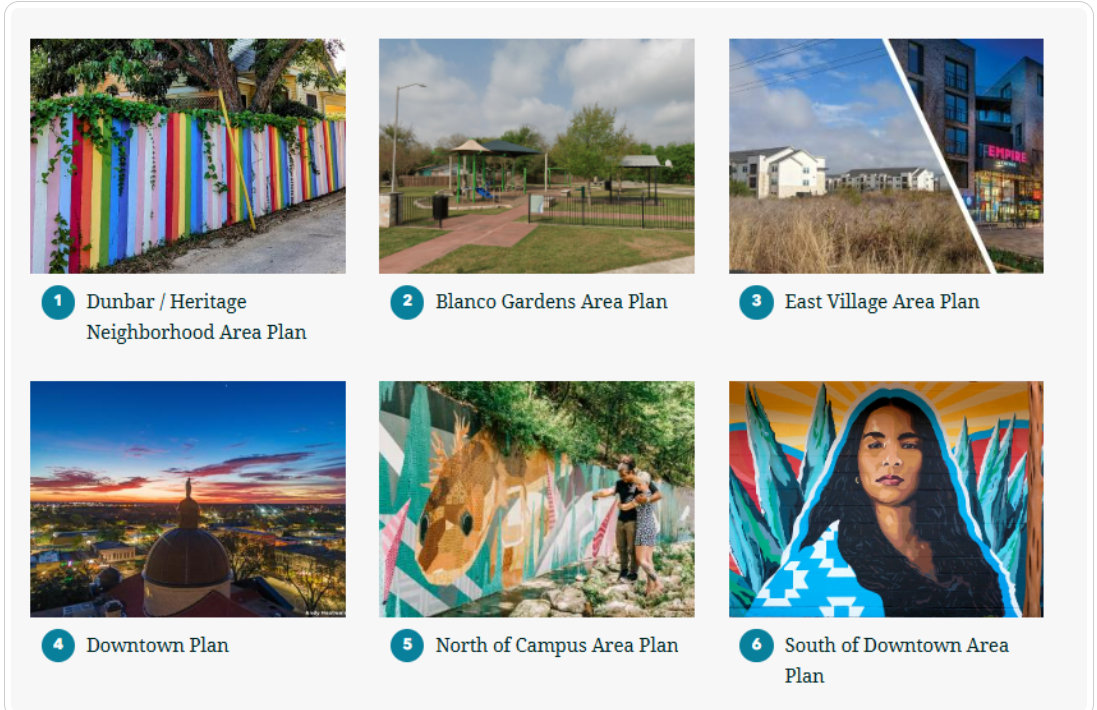
So the Dunbar Sistas are a group of women who played softball together as teens, decades ago, and are now some of the community anchors in San Marcos. They are the ones who originally came up with this idea. Two of them – Mittie Miller and Deborah Giles Webster – both spoke at the meeting about their process.
Here’s the plan:
This sounds great! So all those little plaques would commemorate important people, businesses, churches etc.
One thing that the Dunbar Sistas stress is the process for determining who will be featured on the walk. There’s a large network of Dunbar alumni, people who grew up in Dunbar over the past century, who may now be scattered across the country. They want decision-making to go to Dunbar alumni, as opposed to people who may be recent transplants to Dunbar. This seems reasonable.
The plan is to roll it out next fall:
Anyway, there weren’t any other neat pictures in the presentation for me to clip for you, but there is a ton of history at the Calaboose Museum and Dunbar Heritage Association.