Max Baker wants there to be more outreach for election workers and better pay. Both seem reasonable.
The county appoints election workers, and Max would like it to be a joint appointment with the city, in order to diversify the workers. (Really, it’s hard to find people besides retirees).
The pay is very low ($11-$12/hour). Could that be made more reasonable?
A small bit of pettiness: Max brings this up during Item 38, but it’s a better fit for Item 37, so he moves to reopen Item 37. Everybody votes yes except Mark Gleason, who snips “no” , appearing to aim to be a petty little thorn poking Max in the side.
The vote: County and city joint appointment of election workers? Yes: Everybody but Mark Gleason No: Mark Gleason
The joint selection passes.
For raising the pay, Max suggests the Hays County average wage, in order to give a changing benchmark which moves with inflation. Mark Gleason frets that this will be just too hard to implement, due to the shared math between Hays County and San Marcos.
The vote: Yes: Max Baker, Alyssa Garza No: Mayor Hughson, Mark Gleason, Saul Gonzalez, and Shane Scott.
So this one gets voted down. (Mayor Hughson and Saul Gonzalez both say that they’d support it in the future, just not for this fall.)
…
Item 41: City Representatives to the Greater San Marcos Partnership (GSMP) committee. GSMP is the business community. There will be the Mayor, City Clerk, and two city council members.
Max Baker, Alyssa Garza, Mark Gleason, and Shane Scott all volunteer. So there are two progressive and two conservative choices. Alyssa makes a rather cute plea for support. (Right at 4:50:10.)
She gets five votes and Shane comes in second, and so they’ll be the representatives.
A small bit: Mayor Hughson voted for Mark Gleason and Shane Scott. That annoyed me, to go for the two conservative dudes. I’d expected her to vote for one from the left and one from the right. She was the only person not to vote for Alyssa Garza.
…
Item 42: The Library board is proposing going fine-free. Ending fines is very important – besides being an equity issue, it also drives people away due to the shame that lingers when they owe money. They state that fines make up 0.25% of the library budget.
City Council agrees to bring this forward as an issue that they’re interested in discussing.
While we’re on the subject of libraries: we have a terrific library staff and lovely new facility, but very short library hours. It’s got this beautiful lobby which should offer extended hours with free internet, but instead the library doesn’t open until 1 pm on Sunday, 10 am on Saturday, and 9 am during the week.
Also, the number of books in circulation is too low, particularly in the children’s section, and the supply of e-books is low, and they are frequently unavailable. None of this is the library’s fault – it’s all funding – but it would be nice if it had more books and longer lobby hours.
Item 45: We got a letter from the Mayor of Austin! We’re so fancy. The letter is from mayors across Texas, together with Amtrak. We’re going to sign it.
Here’s the letter:
Will it do any good? I am pretty pessimistic about this state’s ability to ask for free money to help improve the lives of Texans. (See also: why don’t we expand medicaid, Greg Abbott?)
Comparing I-35 to the Hamburg-Berlin train line seems so ill-suited for a Republican audience that, to me, it reads like a tacit acknowledgment that the Texas Department of Transportation is going to wad this letter up and throw it in the trash. But maybe not!
Having a functional rail system in Texas would be amazing, and I’d love to take the train all over the place.
The big topic of the night is the film studio to be built out in La Cima, and what kind of tax breaks they should get, and what kind of expectations should come along with it. Someone from SMRF spoke about holding them to high environmental standards. Another speaker spoke in favor of it.
Rodrigo Amaya talked about one specific police officer who is known to racially profile and harass Hispanic community members at Rio Vista.
Remember the dangerous intersection in front of the Methodist Church? That was on April 19th. There is now a stop sign, and the head of WalkSMTX came to profusively thank the city for their quick action. That is some responsive governance right there.
(Some financial reports, an annexation into La Cima which is just more houses and not the film studio.)
Item 29: ’22-’23 CBDG Grant Allocations
There is about $850K in Community Block Development Grant (CBDG) money to be allocated this August. Tuesday’s presentation gave preliminary recommendations about how to divvy it up. Applicants are the Hays-County Women’s Shelter, Habitat for Humanity, CASA, Salvation Army, about four different city programs, and Southside Community Center.
One of the city programs – the homebuyer assistance program – has been a flop, because there aren’t any affordable houses. So that is discussed, but not axed.
Max Baker tackles Southside Community Center. Basically, there are a lot of reasons to feel warmly towards Southside Community Center – they’ve been serving the homeless for a very long time, and doing so when no one else was. As Jude Prather put it, “their heart is in the right place.” There are also a lot of reasons to be critical of Southside – in recent years, it sounds like the director had his hands full with medical issues, and the management has fallen apart.
Southside asked for $115K of CBDG money, and staff is recommending $55K. However, Southside is apparently sitting on $392K, unspent, from prior years. Max Baker wants to know why we’re even considering giving them an additional 55K.
He starts by reading this bit that city staff posted to the message board, after Max asked about the $400k:
Staff: As a subrecipient, Southside is essentially a “staff extension” – they must handle a program exactly like staff would handle it. Staff is responsible for setting them up for success, ensuring they are trained. In 2019, all City staff responsible for development and oversight of the program left. In 2020, the HUD monitoring had an extensive 15 findings that included every part of the program – such as documenting whether contractors were procured competitively, whether homeowners received information appropriately, and what each expenditure included. HUD required that City staff completely rewrite the policies and procedures and retrain Southside. Staff also chose to take on some of the actions such as procuring contractors, in order to ensure it was done correctly. Southside has been on hold since, waiting for 1) policy and procedure rewrite 2) retraining 3) contractor procurement. In addition, Southside was responsible for the application intake and income verification process and that did not go well; staff has taken this over as well and is working to receive the correct income documentation from applicants.
Max goes on to say “…This is the first time I remember hearing that there is this large pot of money that is being unused because of Southside’s – I’m going to put it bluntly – incompetence in managing a program, or having the staff necessary, to deal with this. … If staff is doing so much of this work, why are we still working with Southside? My assumption is that it’s because they have the building.”
(The answer to this is supposed to be posted to the message boards, but it’s not up yet.)
As usual, Max is right, but kind of hostile and undiplomatic about it. Southside isn’t run by bad people. Staff is not bad people. Maybe we shouldn’t be awarding Southside more money at this moment, but maybe we can say it more nicely?
…
On a different note, Max Baker has an excellent suggestion that the CBDG money could be used to provide 24 hour restrooms available for homeless people and the general public. This is really important. We can ameliorate some of the worst difficulties of living on the streets, while simultaneously working to get people off the streets.
Item 31: the film studio in La Cima. It’s already entitled legally to be built. The question tonight is what kind of tax incentives should they get.
By the end of this write up, Max Baker is yelling “I AM ASHAMED THAT SOME OF YOU WOULD NOT VOTE TO ADD-” and Mark Gleason cuts him off to yell “I’M NOT GOING TO TAKE THESE ACCUSATIONS ANYMORE!!”
(“Yelling” is probably overstating it, but at least seething with anger. It starts at 3:27:00 if you’re curious.)
Buckle up! It’s a long drive to get there.
First off: Apparently council-members were deluged with emails from the public. But this is not a public hearing, and so there was not a dedicated citizen comment period. And only 2-3 people spoke on this issue at the beginning of the meeting. So while many people cared enough to write in, we have no way of knowing what they said.
Here’s my best guess:
First, I suspect a lot of people wrote in against the whole idea. The city staff presenter went on for a bit about how the studio itself is not up for debate tonight.
Second, I’m guessing that a number of letter writers took their cue from SMRF, and wrote in based on the SMRF recommended points:
That’s taken from the SMRF newsletter. Those seem reasonable to me.
The staff presentation goes like this:
Please stop discussing whether or not there should BE a studio. Focus on the tax incentive agreement.
All of La Cima is limited to 19% impervious cover.
This will bring in 22 jobs at 100K, on average, and “up to 1,400 contract workers with an average of 1,200 on production projects at $80k average salary”
Note: “average” is a really bad way to describe salaries. If you have one person making $400k/year and four people making $25k/year, then the average salary is $100k. Averages don’t tell you when your distribution is wonky.
What you actually want is the range and the median. The range tells you the highest and lowest salary. The median works like this: if you lined up all the employees according to what they earn, who is standing in the middle? How much does the middle person earn? That is the median salary. If I tell you that the range is $25K-$500K, and the person in the middle earns $40K, then you can tell there is a lot of inequality and a lot of low salaries. Whereas if the range is $60K-$100K and the median is $80K, then the salaries are distributed more fairly.
With a film studio, it’s very easy to imagine a wonky distribution of salaries.
The city says that the proper comparison is with commercial development like you’d see with big box stores, etc, since this project will come out of the allotted commercial zoning.
The aesthetics of a studio will be much better than the aesthetics of commercial strip mall, because the studio will be set back much further and have much more landscaping.
“Landscaping”, of course, is a term that gives me the willies – do we mean golf course green lawns? Or do we mean swoles and natural grasses and things which slow down water sheet run-off?
The environmental impact. Compared to a strip mall, this will have 89% Total Suspended Solids (TSS) instead of 85% TSS, and impervious cover will go from 80% to 48%.
The TSS increase is meaningful! It’s very important to get all the pollution out of the water before it runs into the ground.
The impervious cover is a red herring, though. Overall, La Cima will be 19% impervious cover. If they save some ground cover here, they’ll use it elsewhere. (The presenter does acknowledge this.)
City Council digs in
Max Baker talks first. There are two articles that one community member sent to City Council, questioning whether the economic predictions are overly optimistic. (This is why it would be nice if emails could be available somewhere! I’d like to see these articles.) My best guess is that it’s maybe this one or maybe this one?
Max Baker comes out of the gate swinging: Why hasn’t staff prepared a response to these articles? Staff doesn’t have a response. It comes out that Max emailed staff at 2 pm that day. I’m guessing that Max himself only got the email that day.
There’s no reason for Max to be so aggressive at this point. Everyone is behaving reasonably. This is how you burn bridges. I agree with him – most likely, the economic predictions are overly rosy. But are they exaggerated enough to tank the project? Not necessarily. (I have no idea.)
Jude Prather, Mark Gleason, and Shane Scott all weigh in to champion the whole project. The economy! The creative class! The bragging rights! Listen, I’m not necessarily opposed to a film studio, either. I’m mostly neutral on it.
Max Baker brings up some technical budget issues – MNO and INS? – which catches Mayor Hughson’s attention, and they work together to untangle it. I didn’t really follow this part, but I bring it up to note that both Max and Jane Hughson are behaving in good faith at this point.
Shane Scott moves to call the question. This is super big bullshit. The discussion has only been going on for about 30 minutes. Shane is basically trying to shut Max up. He doesn’t get a second, though, so the motion dies.
Next, Max makes the SMRF amendment. As best I can tell, this should be a slam dunk. Everybody has said that they got millions of emails from concerned citizens. Either this is a slam dunk, or it should be explained to the public what the issue is.
But instead…crickets. No one seconds Max’s amendment.
Mayor Hughson even snaps, “I might second it if I could only find the language in the code!” but since she can’t quickly find the language in the code in time, she declares the motion dead without a second. Max tells her that she has the email, and yelps for staff to bring up the language, and Jane gets mad at him for that.
Honestly: this is supremely dysfunctional. Max has alienated his colleagues, and colleagues are refusing to grant him any grace when he has a legitimate point.
Next Max starts throwing spaghetti at the wall to see what sticks. He’s concerned about:
Environmental spills and hazards
Extra strain on security and police
Creating a food desert for the residents of La Cima
That we are claiming to be comparing this to community commercial development, but in fact we approved measures in November that allowed for this kind of use.
The first two are vague and seem to apply to nearly any industry. The third is something I’d idly wondered as well. The last is true, but not an argument against the studio.
Throughout all this, Max frequently implies that his coworkers don’t bother to read their emails and come prepared, don’t actually care about the aquifer, are hypocritical, and so on. If he limited himself to just one of these accusations, it could sound grounded and would maybe pack a punch. But the relentless stream comes across as antagonistic drivel.
Alyssa Garza now has had time to read the articles that Max brought up at the beginning. She weighs in that they aren’t terribly generalizable – these articles don’t fit with our unique culture and situation. They use different key terms and different levels of analysis. They don’t include a policy recommendation. They’re good articles for what they are, but not terribly compelling as evidence one way or the other for San Marcos.
Mark Gleason gently asks the studio if they’d be willing to consider any extra environmental concessions that he could take back to his constituents, in light of the absolute onslaught of emails he got. The guy demurs and cites the 48% impervious cover. Gleason praises the applicant and asks about rain barrels. The guy is a fan of rain barrels. And of limiting pesticides. So Gleason has two wins to take back to his constituents, I guess. It’s the most timid environmental win I’ve ever seen, but sure.
Some quick bits: – Saul Gonzalez asks if San Marcos bargained on these tax rebates. We are told yes, we did. – Max asks if there is still commercial available to be developed at La Cima. We are told yes, there is. – Max asks about if jobs will be required to be local? And can we require internships?
Alyssa Garza points out that there’s a difference between having out-of-town people relocate and be considered locals, and actually hiring people who already lived locally, and that what makes the difference is often jobs trainings and career pathway programs. Will there be those?
The beginning of the end
Max makes a motion that the studio must have 50 internships. Then he says 50 for Texas State and 50 for the high school. He finally gets a second, from Saul Gonzalez.
Alyssa tactfully recommends that he not pick numbers out of thin air, and suggests that he require an internship plan by year 2? Max amends his motion.
The applicant squirms and protests that they’ll be contracting out with yet-undetermined 3rd parties, and can’t possibly commit to an internship program now.
Alyssa mutters “This is a hot mess.” And then elaborates: The educational tie-in is a substantial part of their pitch. It feels like a con if they’re not prepared to actually back it up with any concrete plan. She specifically says that this is a strong application and they didn’t need to bullshit like this, and it chafes.
Vote: Should the studio be obligated to provide an internship plan after two years? Yes: Max Baker, Saul Gonzalez No: Mayor Hughson, Shane Scott, Jude Prather, Mark Gleason, and Alyssa Garza.
So it fails.
By this point, the discussion has been going on for over an hour. No one is taking Max seriously. Max makes a motion to require job training. Does not get a second.
Max asks about the studio’s discrimination policy: why doesn’t it match that of San Marcos? It leaves out protecting gender identity and sexual orientation. (This is a great catch!)
The city lawyer, Michael Cosantino, affirms that this is a problem, and he adds that the studio also left out age discrimination. He recommends that council fix these omissions.
So Max makes a motion to add in protections for gender identity, sexual orientation and age. Jude Prather seconds it, but chides Max about going on for too long and dragging things out.
The vote: Should the anti-discrimination clause cover gender identity, sexual orientation, and age? Yes: Jude Prather, Alyssa Garza, Saul Gonzalez, and Max Baker No: Shane Scott, Jane Hughson, Mark Gleason.
That’s right: the lawyer literally just told them to pass this amendment. Shane Scott, Jane Hughson, and Mark Gleason all vote no, seemingly just to spite Max Baker.
Listen carefully everybody: that is the sound of City Council decompensating. That is a globby, burbling mess of a City Council.
Which brings us to Max Baker declaring, “I AM ASHAMED THAT SOME OF YOU…!” and simultaneously Mark Gleason shouting “I WILL NOT TAKE THIS!” Mark Gleason shouts about abuse, and filibustering, and calling the question. Max Baker shouts about the actual definition of filibustering. Jane Hughson shouts about people talking over each other and who has the floor. It is not pretty.
At this point, Jude Prather moves to call the question. This passes with a 6-1 vote. (I bet you can infer how that played out.) So the discussion (yelling) is finally over.
The actual vote on the tax incentive plan for the studio: Yes: Everyone but Max. No: Max.
Max Baker spits, “Thank you all for not working very hard on this!”
What is my analysis?
That in a pissing match, everyone gets pretty smelly and wet?
Ok, here goes:
I can’t tell what Max Baker’s actual position on the studio is. Does he think it’s fundamentally a bad idea? Does he think that it’s fundamentally a good idea, but the agreement is sloppy? Is he open to being persuaded, if these amendments were taken seriously?
If you think the studio should not exist, you should make a concise and clear argument why not. Since it’s clearly going to pass without your vote, pick one or two mitigating amendments, and try to coax others to go along with these changes. In my opinion, the SMRF amendment and fixing the anti-discrimination language should have been easy wins, or at least thoughtful discussions.
If you think the studio should exist, then say so and provide a balanced list of pros and cons. Work to iron out the cons.
What Max Baker is doing is treating the proposal as though a procrastinating college student wrote it overnight on the last day of spring break. Max is the professor who takes it as a foregone conclusion that the paper is crap. He then nitpicks every last sentence through a lens of finding proof that justifies his beliefs. Any single correction is probably fair, but as a whole, it’s overkill to eviscerate a paper like that.
To be clear: Max Baker’s moral compass is generally pointed in the right direction. It’s just that he’s got no sense of scale. Everything is a calamity of the same proportion.
Nevertheless, the rest of city council has an obligation to wade through Max’s crises and evaluate each one on its merits. It’s extremely poor form to vote against him, out of spite.
Item 35: Future Diversity, Equity, and Inclusion (DEI) and team-building workshop.
Council sorely needs some help. The plan is to have a workshop in August. There are two main issues:
1. Diversity, Equity and Inclusion
Most of the council has an abysmal understanding of DEI issues – how are racial and economic inequalities baked into the ways we live? Where did they come from? How do we begin to fix it? Alyssa Garza is the main proponent of DEI issues, and really pushed for this workshop altogether. Max Baker is generally on board.
Ok: Hearing Jane Hughson speak on DEI is my favorite thing. She is genuinely trying, and she truly is approaching the whole thing in good faith. And yet she’s such a beginner. You can see the gears turn in her head as she tries to figure out what language to use. “I see this as educational. There are things Ms. Garza says and I don’t understand because they are new to me. As I understand more of these concepts that are becoming popular and important, that’s going to help me understand her.” It is so clunky, but so earnest.
2. Team-Building
Can the council and Max bridge the hostility and become less dysfunctional? Here is my diagnosis of the current animosity:
It’s easy to blame Max Baker. When he’s fired up, he attacks everyone relentlessly and frequently insinuates that people are lazy, incompetent, and unethical.
Sometimes people are lazy, incompetent, and unethical, but that’s also what it looks like when you’re overworked, under-trained, or being pulled in several directions. People are complex. A single situation can be both bad and sympathetic.
Like I said in the last item, Max Baker’s moral compass is pointed in the right direction, but he has no sense of scale. Everything is a calamity of the same proportion. He can generate 50 moral crises out of a trip to the grocery store. This is very tiring if you’re trying to just make dinner.
When things are going sideways, Jane Hughson has a tendency to act authoritarian towards him and pick fights with him. This is exceptionally counterproductive.
The rest of city council has an obligation to wade through Max’s crises and evaluate each one on its merits. It’s poor form to vote against him out of spite.
Max has legitimate reasons to be angry with other councilmembers. Sometimes they vote in shitty ways. I find it easy to believe that they are nicer for the camera, and act like asses to him behind the scenes. Politicians are known for this kind of thing.
(For the record, these dynamics do not really involve Alyssa Garza. Nor Saul Gonzales or Jude Prather, even though they vote against Max more often.)
If Max could prioritize the biggest problems and let little things go, and if he could use honey to catch flies instead of vinegar, he would be much more successful in implementing his agenda. As is, he is not terribly effective at convincing the majority of council to buy his arguments.
I don’t know what the path to functionality looks like. People are generally not very good at re-inventing their group dynamics. Hopefully this workshop helps.
The landlords are very mad about the three-month eviction moratorium. It was implemented in March 2020. We’re one of the few holdouts that haven’t lifted it yet, mostly because Hays County did a spectacularly abysmal job giving rental assistance to tenants. The idea was that with a few extra months, maybe more money could be dispersed and keep people in their homes. Evictions lead to homelessness, which derails lives permanently.
This time, the landlords were arguing that the moratorium is bad for tenants, because it allows them to rack up more debt, which then counts against them when they are eventually evicted anyway. Their other argument is that the job insecurity caused by the pandemic is long gone. (Their actual argument is that they would like to collect rent every month. This isn’t itself a crazy argument!)
Look, landlords are generally a problematic group. They leach off renters’ income by virtue of the fact that they had wealth earlier than the renter did. They benefit from a housing crisis and generally try to absorb as much of someone’s disposable income as they can. However: asking landlords to forgo the money that they’re legally entitled to is also a problem.
So here is the key question: is the eviction delay a worthwhile way to prevent homelessness?
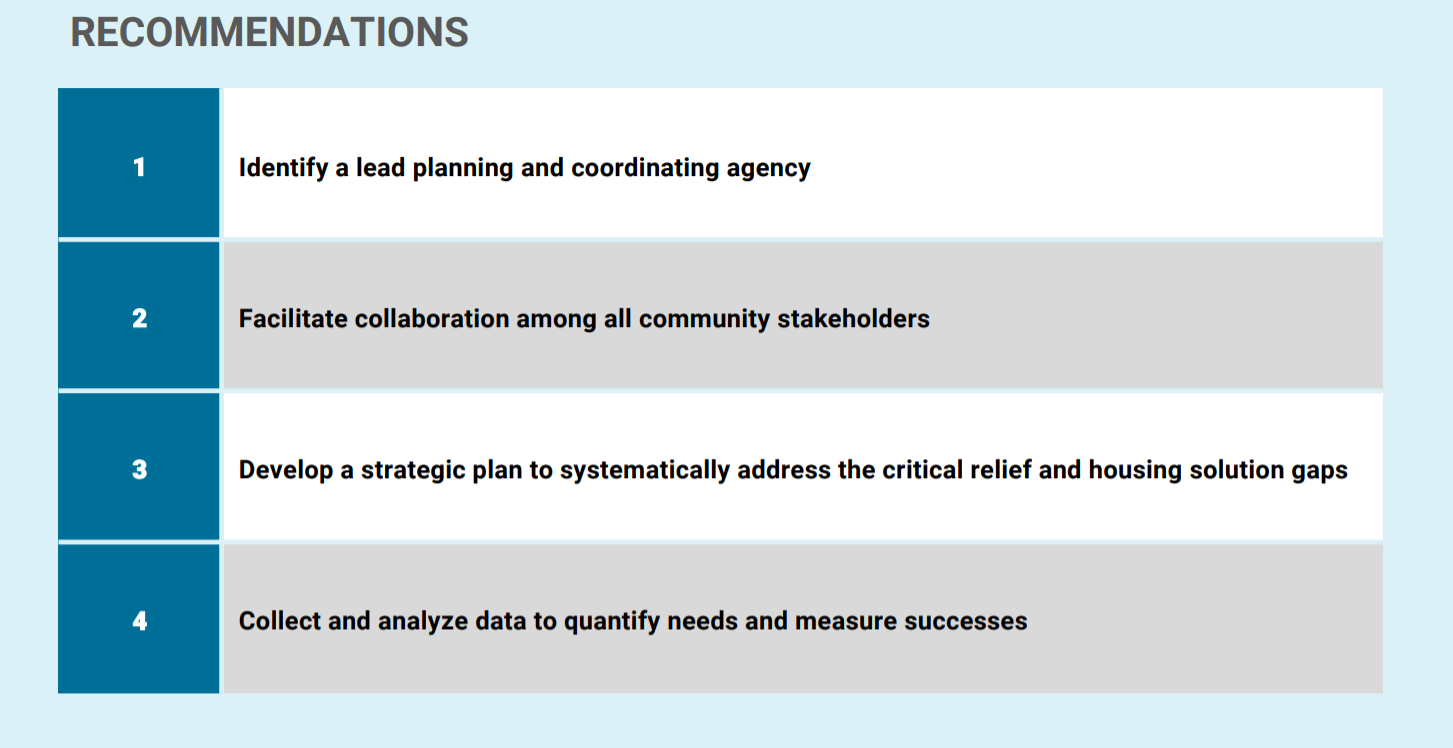
Glad you asked – we actually had a council workshop on homelessness just two weeks ago! What are their recommendations?
Those questions should be front and center, every time we are discussing zoning, housing, short-term homelessness, or affordability.
In 2019, San Marcos did a major housing needs assessment. There is tons of good data in it, most of it from 2017. We desperately need to be updating this every year.
So for example, here is our rental stock from 2017:
This should be updated every 2-3 years! – the 3rd/4th columns should come from Census and American Community Survey data, which is released every few years. – We know the number of new units that get occupancy permits each year. This is already aggregated here and here.
But the hard part would be finding out how much apartments are being rented for. Since 2017, those 15,884 total apartments have all risen in cost, so they’re not in the same categories as they used to be. For example, the 4163 units that were under $875/month in 2017? Those must all be in the < $1250 or < $1875 categories by now.
So the gap is presumably way worse in 2022 than it was in 2017, but we don’t know by exactly how much. Still, two questions down.
What is our total housing stock, broken down by affordability?
What is our total housing need, broken down by affordability?
So did we really spend a year and drop a bunch of money on consultants, and then just…never adopt the plan? It’s just sitting there in draft form? Or is it just that the website was never updated?
Oh, this is such a riot.
At this point I was rabidly curious. I found the city council minutes from October 15th, 2019, but it wasn’t there. It turns out that it didn’t go to P&Z until October 23rd, and it finally went to council on November 6th, 2019.
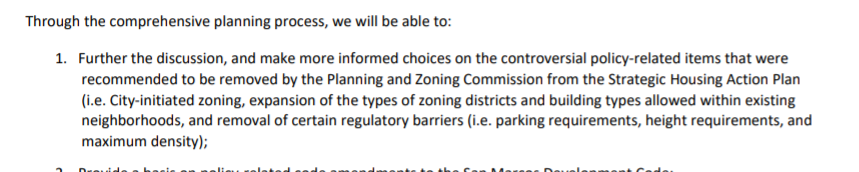
The Strategic Housing Action Plan came from P&Z with a number of edits. At council, they discussed it, and punted to a Council Workshop.
So I went hunting for the workshop. Finally I found it, 12/3/19. It wasn’t a workshop on the Strategic Housing Action Plan, it was on the new Comprehensive Plan. Workshops don’t have minutes, and I didn’t watch the video. But this is taken from the packet:
So it was never approved, because it got absorbed into the Comprehensive Plan process, which is in progress. This is VisionSMTX. It still has at least another year to go. And Comprehensive Plans are vague – they’re not going to promise funding or commit to specific details. So it will be years until someone puts together a new housing plan. (I have vivid memories of the SMTX4All housing project – I just assumed it had been passed and implemented!)
To recap: we’re sitting on housing recommendations from 2019, with data from 2017, while we dither about what we might like to look like in 2050.
I really do believe in longterm planning. But waiting to address a housing crisis like this is just lazy and infuriating.
The problem is those “controversial policy-related items” referenced in the workshop snippet. You can read what P&Z wanted to kill here, on pages 17 and 18. The Strategic Housing Plan was seen as a money grab by realtors, and only interpreted as a fight between realtors and the integrity of existing single family neighborhoods. There was no actual focus on the struggle of people in San Marcos to find homes. Basically, it’s a lot of nimbyism and fear of infill. (Infill can be done in a shitty way! Infill needs to be done very carefully! But the recommendations from P&Z just ignored the actual problem.) But at least P&Z actually passed the damn thing, unlike Council.
So we held a massive housing plan and never implemented anything. And rental rates exploded in the meantime. That sounds about right.
(What were we talking about again? Should we end the 3-month eviction moratorium? At some point we’ll have to, but it sure would be nice if we could get rental assistance to those in need beforehand.)
…
Item 1: Presentation by GSMP
The Greater San Marcos Partnership gets $400k/year from the city of San Marcos, per this contract. For context, the entire city budget for 2022 is $260.5 million dollars. So while GSMP is exasperating, we really are only talking about 0.0015 of the city’s budget.
Per the contract, GSMP has to come get updates to the city. GSMP is doing a lot of outreach and education. They’re holding workshops – financial literacy, a mentorship thing, innovations, cybersecurity. Sure. A resources database. Strengthen! Produce! Support! Identify challenges! My brain just turns to mush when I hear corporate verbs.
Max Baker is worried that GSMP will bring businesses in that aren’t good for San Marcos, and attempts to pin him on the quality of jobs at, say, Amazon. But the speaker is perfectly skilled at side-stepping questions.
For example: “You claim you’re working to bring in big businesses and supporting small businesses. Don’t companies like Amazon undercut small businesses that you claim to support?” asks Max, quite rightly.
“The large companies diversify our economy! There are spin offs! Different intellectual properties spin off and source locally!” the GSMP guy responds cheerfully. Which is an irrelevant answer – new spin-off companies don’t protect existing small businesses in any way. He actually has the cajones to claim that Amazon is known for having good labor practices, from what he hears. You can practically see the smoke pour out of Max’s ears.
Anyway, GSMP is dumb, but this whole thing is small potatoes. The speaker doesn’t do anything wrong exactly, but it’s unsatisfying.
So what is the resolution of the Camacho Street Warehouse? Well, the owner pulled the application.
Is this a win? It’s hard to say! Did he pull the whole project, or just decide to go forward without the permit?
What needs to happen is that the entrance on Camacho needs to be closed. The property should be accessed via Black’s BBQ parking lot. I am guessing we don’t have any mechanism to make that happen.
…
Item 24: Downtown Parking Committee
They’re going to set up a park-and-ride shuttle to help move employees back and forth.
2. Paid Parking is not coming to downtown, at least for the foreseeable future.
City Council has four appointees, four people who answer directly to Council. These are the City Lawyer, the City Manager, the City Clerk, and one more that I’m not sure about. Maybe the municipal judge?
When city employees all get Cost of Living Adjustments, these four don’t. Mayor Hughson proposes to change that.
I am not particularly invested in this issue either way. Salaries should be egalitarian, and COLAs should be automatic. The question is: are these four salaries so outsized that we shouldn’t automatically give them COLAs?
Commissioner Baker points out that COLAs on a $200K salary are way more than most San Marcos residents would get in COLA adjustments. One phrase that Max frequently uses is: “Budgets are moral documents,” which I think is very insightful. Budgets are statements of priorities and goals, judgments made by people. His point is that the range of salaries is immoral, and it’s immoral that a 2% COLA adjustment on $200K is $2k, but a 2% COLA adjustment on $50k is only $500.
I can sharpen Max’s argument: inflation does not impact all people equally. Homeowners are locked into a monthly payment that was established whenever they bought their home, so they get a 30 year pass on housing inflation. Whereas renters are drastically more affected, immediately and repeatedly.
(If you really want to up-end conventional wisdom, consider this point: inflation is great for people with debt. If you’ve got large student debt or a large mortgage, the money you owe gets eaten up as the dollar loses value. This is great!
To state the obvious, inflation sucks because prices go up and wages don’t. One of our biggest moral failings as a society was not to automatically peg the minimum wage to inflation, when it was first established. If jobs always pegged wages to inflation, then the workers would have some protection against the worst parts of inflation.)
Anyway: should these four individuals receive COLA adjustments whenever the rest of the city does? It matters a lot what the City Clerk makes, vs the City Manager or City Lawyer. In the end they decide to wait on the issue until after they get some numbers.
…
Should the performance evaluations of those same four appointees be open to the public? Didn’t we discuss this semi-recently? We did.
I hadn’t agreed with the outcome then, to publish every detail of performance evaluations. This week they changed their mind, and will only publish a summary of evaluations, written by a 3rd party consultant. So now I do approve of their decision. Great! (Why exactly did Mayor Hughson put it back on the agenda? How did councilmembers Gonzalez and Garza come to change their mind? I agree with the outcome, so I’m not too worried, but clearly conversations occurred behind the scenes. Which is part of how the sausage is made.)
I did also listen to the 3 pm workshop, mostly on Capital Improvement Projects, or CIP projects.
There are a group of five houses or so on San Antonio street, right where Bishop meets San Antonio, and they all flood regularly. This has been going on for years and years. Several people spoke and asked if their project could be accelerated.
The answer was “no, not really.” Basically the CIP list gives the wrong impression on timelines. It only tracks how much money will be dedicated to each project in each year. But that is not the actual timeline of the project, because the design phase doesn’t need a big allotment of money. What that means is that the project is already in progress, even though it doesn’t look like it has started yet according to CIP funding. When it’s time to spend money, the money will appear as scheduled. However, the projects can’t be sped up, because they’re already in motion and each step holds up the next step.
To me, this means something deeper: City Council and P&Z are being asked to put their input into a document that has very little flexibility. Therefore their input is coming at the wrong stage. If the city staff were systematically biased in favor of certain parts of the city, that would not be visible from the CIP list, because we have no way of knowing which projects aren’t ever rising into the conversation about potential future projects.
The answer has to be something about a supervised process to determine which projects are rising to attention in the first place, with attention to making it equitable. That’s the part that needs public scrutiny.
Item 1: The Sidewalk Maintenance and Gap Infill Program:
If you don’t know Lisa Marie Coppoletta – or LMC – then you are missing out on one of the more memorable of town personalities. She speaks up at far more City Council meetings than anyone else in town. She ran for mayor a few years ago. She tends towards libertarian beliefs – lower taxes, individualism – and so she can veer into ideas that I am vehemently opposed to. But she also picks a few key issues that are personal to her, and focuses like a laser beam on them. What I am saying is that she is the most ever-loving persistent person you’ve ever met. And this item is her shining moment in the sun.
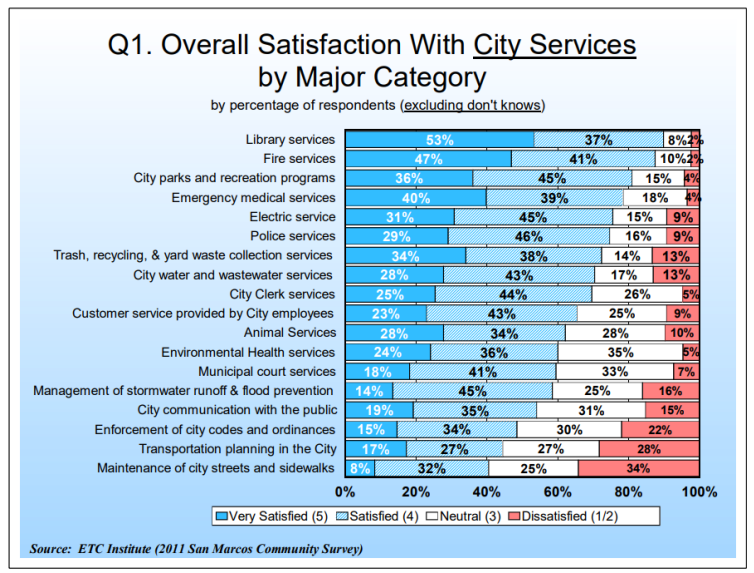
Apparently San Marcos had a survey back in 2011, and road and sidewalk maintenance faired dismally:
Whoops. So we decided to become more walkable. So we needed sidewalks. In 2013, we started the Sidewalk Maintenance & Gap Infill program. They’ve got a teeny budget – 150K-200K per year. They survey the town, look at where we’re not wheelchair-accessible, or where parks aren’t connected to neighborhoods, etc, and generally chip away at the streets of San Marcos.
At some point in the last 5-6 years, Belvin got sidewalks. LMC lives on Belvin, and something happened with the sidewalks and LMC’s trees in her front yard. (I literally do not want to fully understand this issue.) Since then, this has been her number one talking point, and this presentation is the pinnacle of her time and effort spent wearing everyone down on the topic.
But she is successful, and I don’t mean that dismissively! There are four proposed changes to the Sidewalk program, and one is: “Develop protocol for tree inspection and analysis prior to construction, inspection during construction, and follow-up.” This is a good idea. Local activism at work!
Then the question arises: Who gets to vet upcoming sidewalks? Should they go to neighborhood commissions? Historical Preservation Committee? City Council?
Alyssa Garza asks how well the citizen input has been going. Answer: lately it’s been pretty poor. They’ve tried to reach out, and people just don’t show up.
All the councilmembers agree: Sidewalks should go to neighborhood commisions, HPC, and yes, to city council.
Here is my question: Suppose staff is planning a sidewalk project, and brings it to the neighborhood commission. And suppose the neighborhood says no, we don’t want sidewalks. Does it still come to council? Can Council override a neighborhood vote? Would it require a supermajority?
Here is my problem – I’m cynical about neighborhood associations. I’m worried that individuals will focus on the twenty yards of sidewalk along their property, and will only be mad about that. I can imagine a neighborhood full of people who are mildly enthusiastic about sidewalks in general, but passionately mad about the portion in front of their own house.
This could easily be the death knell of the sidewalk program altogether, which is then a huge collective loss.
People are averse to change, and they will overestimate how much it will sting to lose their street easement. But once it’s built, it’s not going to be a thorn in their side. Don’t let their fears wreck what’s best for the whole.
CIP projects are Capital Improvement Programs. This is basically public works – which major water/wastewater/electric/roads/facilities projects are coming down the pipeline in the next year? What about the next three or next ten years? It’s big and complicated. We’re looking at roughly $10 million of projects this coming year.
(There are so many projects that I’m not prepared to do a super deep dive, but if you want to know when a project on your street will be completed, this is where you look. For example, Hopkins will be reopened in 2050.)(Kidding. But really, just email the city and ask about whatever project you care about.)
Then there are a bunch of annexation and zoning cases.
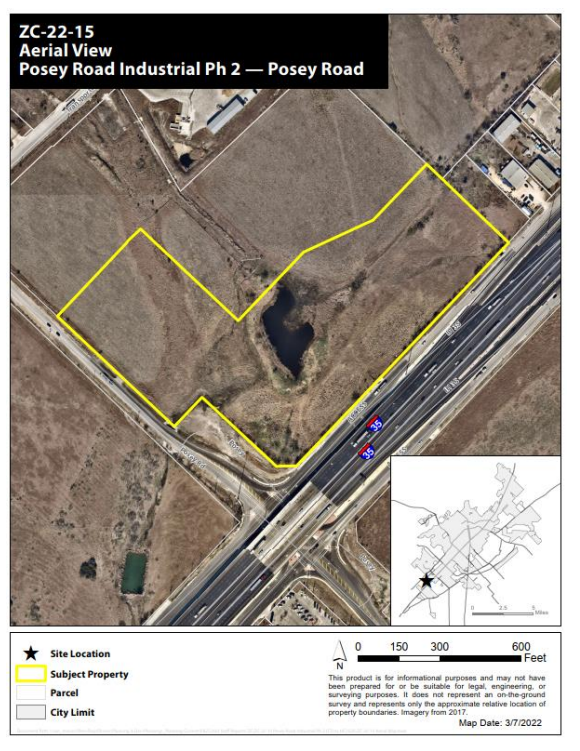
Here’s the first:
That’s I-35 and Posey, right near Trace. They are asking for Heavy Commercial. Think retail and businesses, but they’re allowed to be car shops or other industrial-ish things, like you’d see along I-35.
Max Baker takes issue with how these are such fossil fuel heavy uses. Mark Gleason offers up a proposal: “No waste-related services.” (This is animal waste processing, landfill, composting, recycling, solid and liquid waste, incineration, etc.)
Vote on allowing waste-related services? No: Mark Gleason, Max Baker, Alyssa Garza It’s fine: Jude Prather, Shane Scott, Jane, Saul.
So it’s fine.
Next Max proposes nixing truck stops. Vote on allowing truck stops? No truck stops: Max Baker, Alyssa Garza They’re fine: Jude Prather, Shane Scott, Jane Hughson, Saul Gonzalez, Mark Gleason.
So they’re fine.
Next, this chunk of land:
Which fits like a tetris piece alongside the last one.
This is going to be heavy industrial. This means basically anything goes – manufacturing, warehouses, etc.
The vote: Yes: All of them except Max Baker. No: Max Baker
Here’s the last one:
That is 123 running north-south, on the right hand side of the photo. In other words, if you’re driving out of town on 123, you’ll get to the overpass over Wonderworld, and you’d be at the top of the photo.
If you keep driving south, the site will be on your right, but set back a little ways, and before you get to the intersection with McCarty.
The owners want to do Light Industrial on part of it and leave the rest vacant. Max Baker proposes an amendment to nix waste-related services.
Vote to allow waste-related services? No: Max Baker, Mark Gleason, Alyssa Garza, Saul Gonzalez, Jane Hughson Keep them! Jude Prather, Shane Scott.