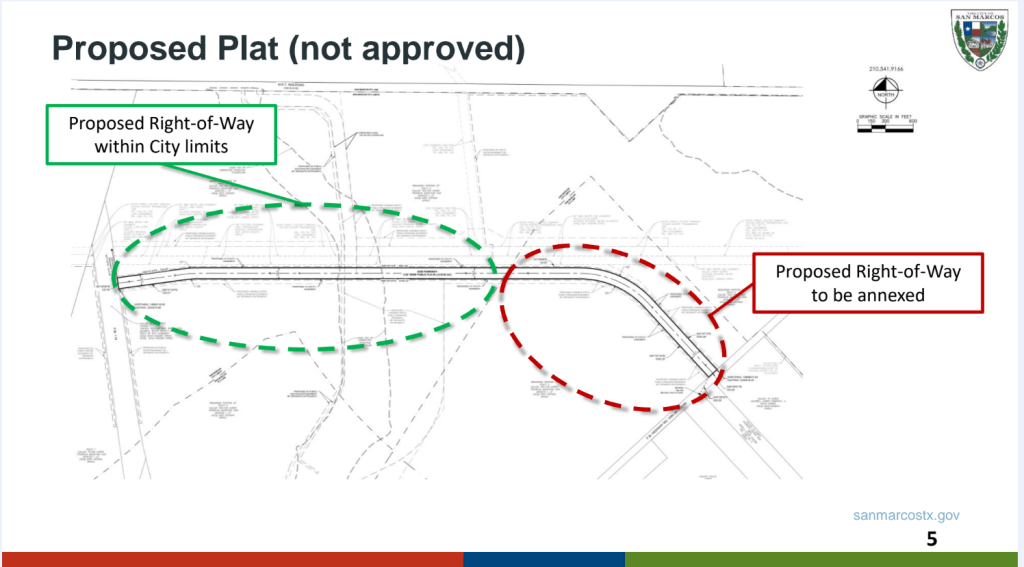
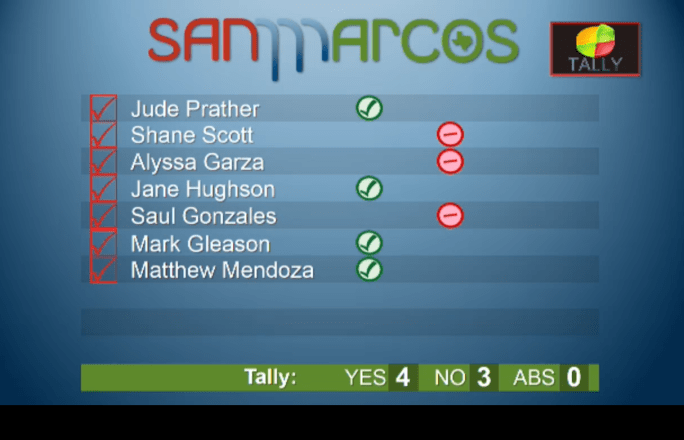
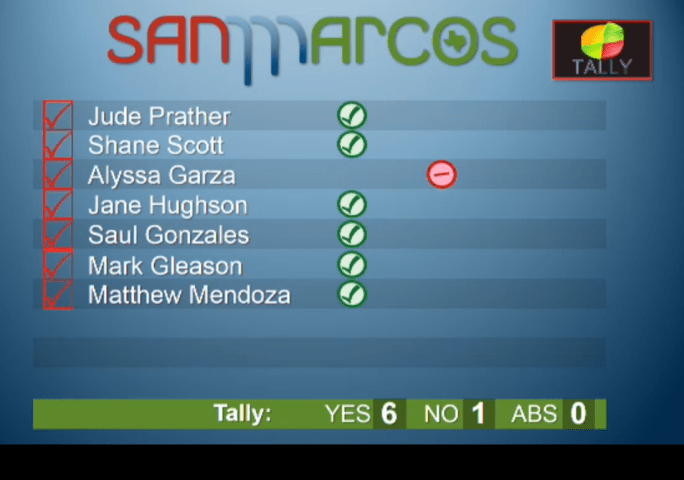
Hours 0:00 – 2:50, 3/18/25

Citizen Comment:

Main topics:

  1. Malachi Williams: Seven speakers, including family members. They want justice for Malachi. Several of the speakers focus on the detail that Malachi ran because a cop pulled a gun on him. Before the videos were released, this detail wasn’t mentioned. It shows how the officer escalated the situation instead of de-escalating it, which then ended in tragedy.
  2. Human Services Advisory Budget funding: Council is thinking about increasing HSAB funding for next year. Three speakers advocated for this.
  3. Cape’s Dam and the Mill Race: Two people talk about how much they love the river, east of I-35 and want council to keep it. We’ll unpack all of this!
  4. Tenants’ Bill of Rights: The San Marcos Civics Club made this a focus, and got Council to put this in their visioning statement. Now council will need to make it happen. Two speakers focus on this.
  5. Ceasefire in Palestine: four speakers. They still want the city to pass a resolution calling for a ceasefire in Gaza.

Onto the meeting!

Items 1-4: A bunch of audits and investment reports.

We got the audit reports for CDBG funding and the 23-24 fiscal year.  Plus the quarterly financial report and investment report.

Everything looks normal. No rude surprises. (Apparently we’ve gotten awards for excellence for the past 35 years, on our yearly fiscal audit. OH YEAH BABY.)

Item 18: Rezoning about 15 acres

This property is way up north:
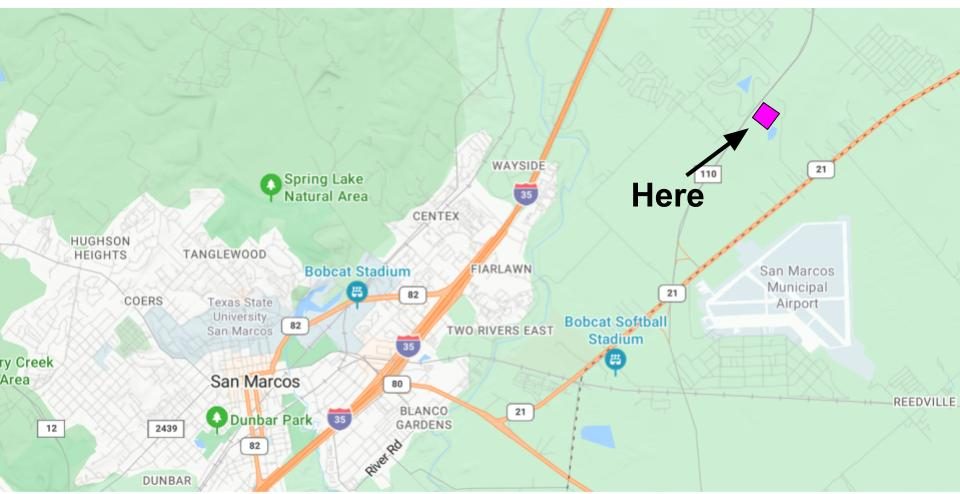
Back in 2020, we annexed this yellow and pink bit:
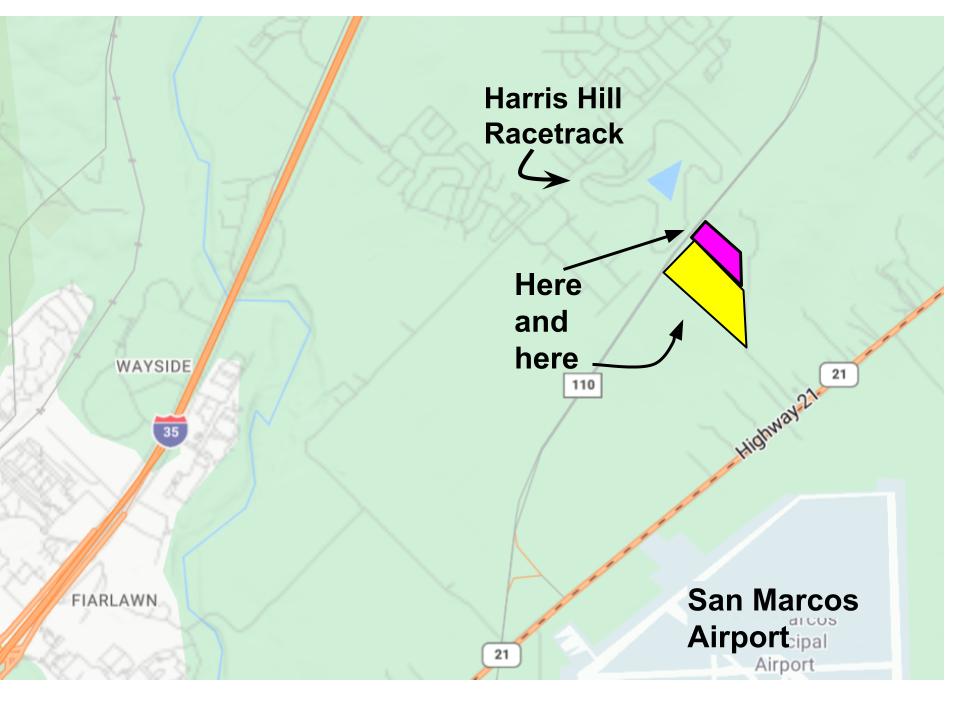
The yellow was zoned Manufactured Home, and the pink was zoned Light Industrial.

There were some concerns then – do we really want to make the folks in the mobile home community live right against an industrial park? But we let it ride.

Now the pink part is coming back for a rezoning – they want to switch it from Light Industrial to Manufactured Home.  In other words:
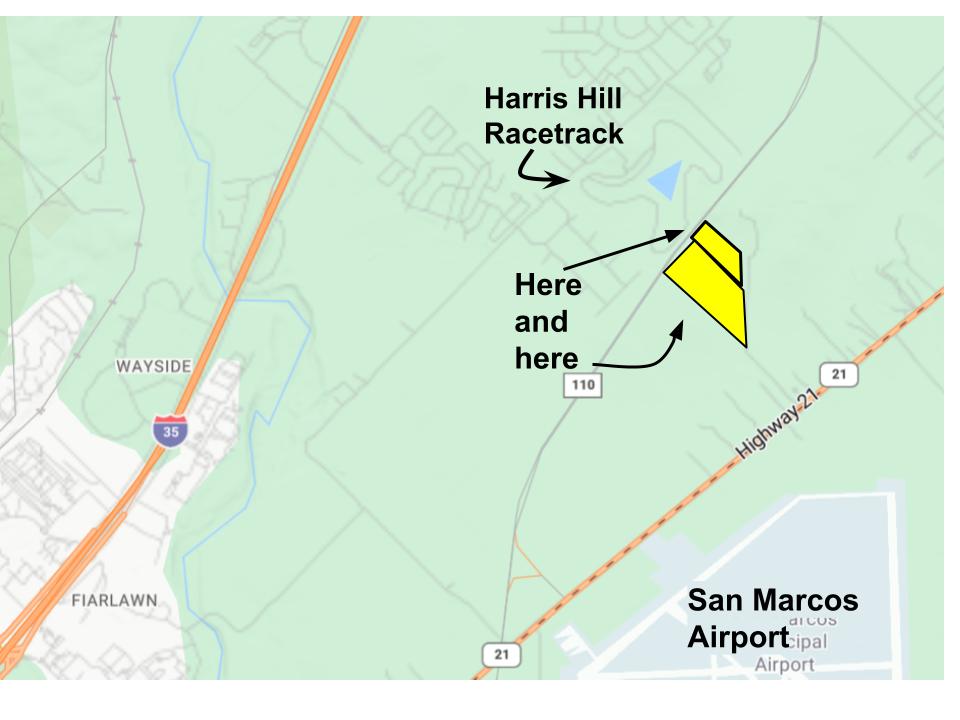
Great! Now nobody has to live near an industrial park.

Item 20: Budget Policy Statement

We’re working on the Fiscal Year 26 budget.

First: There was a two days Visioning workshop in January, which lead to approving the Strategic Plan.

The nex workshop was at the end of February. Today we’re approving the thing from that: the Budget Policy Statement.  

What’s a Budget Policy Statement?

This is like the guard rails for building the budget over the summer. Most of it is pretty dry? Like “Do you want to budget to maintain 150 days worth of recurring operating expenses in the budget, or just 90?”  “Are we okay using the General Fund for Stormwater projects over $5 million?” Etc.

There are two interesting bits:

  1. Each year, the city sets the rate for electricity, water, sewer, trash, etc.  To do this, they have to predict what their costs will be. Then they pick a rate that will cover all their costs.

From the Budget Policy Statement

What does this mean? If your utilities get turned off, you have to pay extra late fees to get your utilities back on. All of the late fees, taken together, add up to big chunk of revenue.

The question is: Suppose we are predicting that we’ll bring in $100K in late fees. (I’m making that number up.) Should we use that $100K to lower the rates for the rest of the customers?

Argument in favor: It’s more economical to include the late fees in your calculation. It allows you to set lower rates for the whole city.

Argument against: It’s kind of icky to count on late fees, for two reasons. First, you’re charging your most desperate customers – the ones who already can’t keep up – an extra fee, and then using that fee to help out all the other, less-desperate customers.

Second, it creates an incentive to creep up your late fees over time. When budgets are lean, it’s tempting to lean on late fees as an extra source of revenue you can tap, like cities that ticket their poorest residents into oblivion in order to balance their budgets.

The current council has already been going in the opposite direction. They are already trying to lower the late fees, to make it easier for residents to get their electricity turned back on.

To the original question: they decide that we are not going to use the late-fee revenue in computing utility rates. Then, when late fees come in anyway, they’ll put that money towards the Utility Assistance program.

It’s a small touch, but a good one.

2. Here’s the other one worth paying attention to:
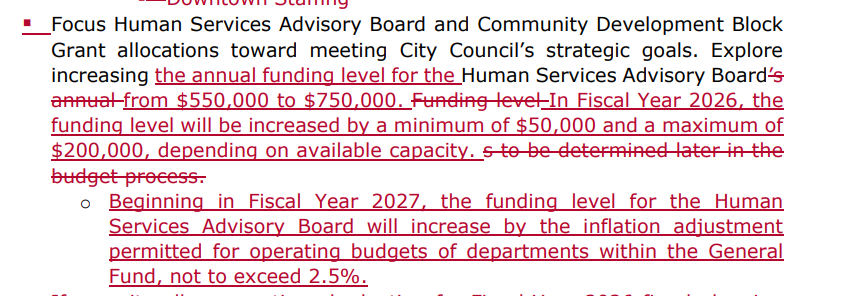
This is what the speakers during Citizen Comment were talking about.

Last December and January, HSAB funding was a total mess. There was too little funding, and Council ended up pitting nonprofits against each other. It was clear that we need to significantly ramp up city funding of nonprofits.

Right now, HSAB gets $550K. Council sets a range of additional funding, between $50K-$200K. When we find out what kind of money we’re getting from property taxes this July, then we’ll determine where we land in that range.

This part makes me extra happy:

Yes!! Peg the HSAB budget to inflation. We do it in contracts with for-profit entities all the time. It should be universal.

(The failure to peg minimum wage to inflation was one of the greatest policy near-misses of the 20th century. Having a federal minimum wage of $7.25/hour is such a mockery.)

Item 21: Cut-and-fill in La Cima

Pedernales Electric wants to build a substation here:
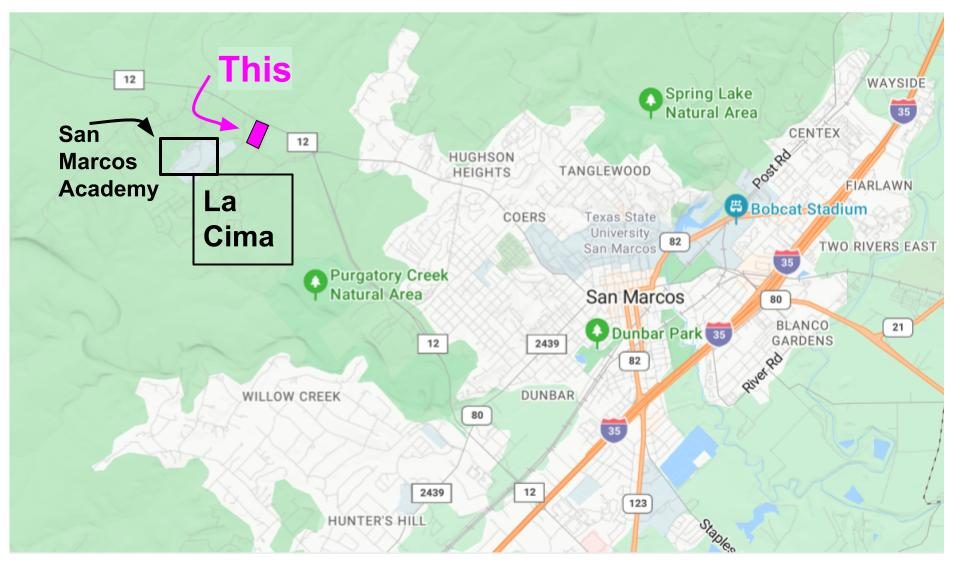
But it’s on a hill. Like we saw last time, it’s hard to build on a hill. So they also want to do a cut-and-fill.

This time, no one is worried about flooding.

Matthew Mendoza is a little worried that the people in La Cima might have to look at a substation, though.

Staff reassures him that there is another building, and then the La Cima apartment complex, all separating the substation from the houses. So their eyes won’t be hurt by the substation.

This passes 6-0.

Item 5: Council Compensation

This was so weird. 

Quick Recap: (Full story here.)

Councilmembers get three kinds of money:

  1. Monthly stipend
  2. Travel and expenses
  3. Flex money (either)

Shane Scott proposed doubling the flex money and travel money, and he wanted it effective IMMEDIATELY. Like, something lit a fire under his butt.

Last time, they went in circles forever, but ultimately landed here:

Travel budget

  • There’s plenty of travel money already.  The total council travel doesn’t go over budget.
  • Council members can lend each other travel money if one is going over.
  • If they STILL go over, there can be an extra $15K in a special travel fund that any of them can apply for.
  • AND, they each get an extra $2K for travel.

Flex budget

  • Double the Flex amount from $7.5K to $15K.

In other words: right now, a council member earns $24.9K a year, if they choose to take their flex pay as income. This would increase it to $32.4K.

The item was put on the consent agenda, which means, “Staff thinks this will sail through.” After all, they hammered out all the votes last time.

Jane said nope! and pulled it off the council agenda. She gives a speech about how none of this is needed, there’s plenty of money in the travel budget.  And how we certainly shouldn’t be doing this mid-year.

Amanda agrees on the mid-year part. More responsible to start it with the next fiscal year. She makes that amendment: Delay this until next year’s budget?

The vote: Postpone changes until next year’s budget?
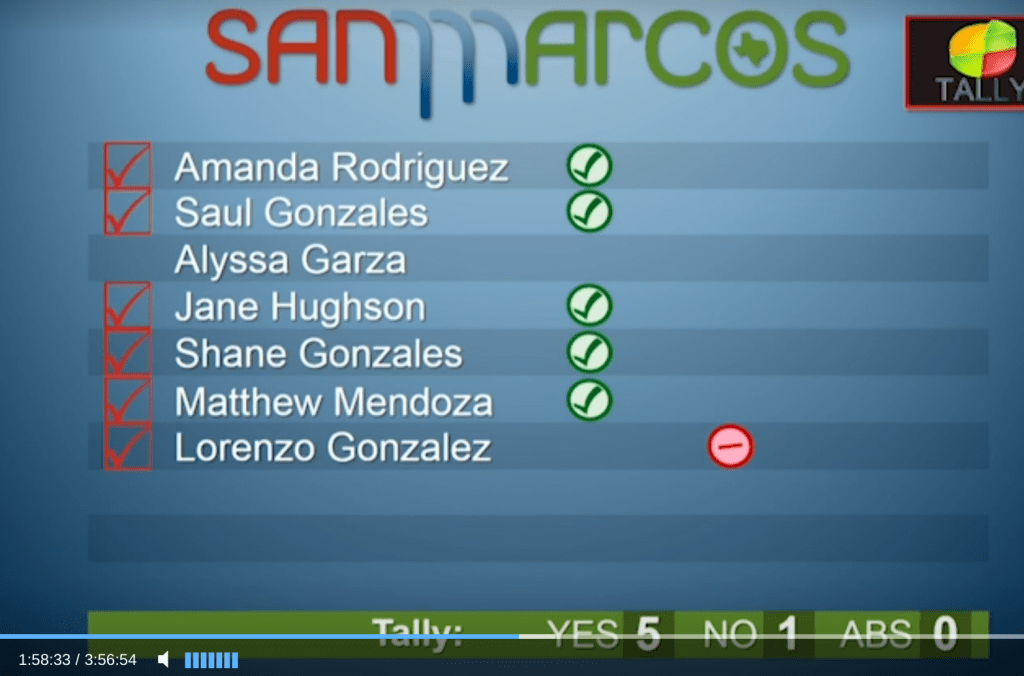
Ok, great.

But then Shane – who started this whole conversation back in December! – says, “Let’s just kill the whole thing, who cares. We don’t need it anymore.” 

(This is when I first thought, “What the hell is happening? Was this whole thing a ploy to get some quick money?”)

Jane sees her chance and makes a motion to kill both the travel increase and flex spending increase.

On the flex spending, Amanda pleads, “But why?”

Amanda has been quite open about having to resign her state job to take this position, and the impossibility of surviving on $24.9K per year.

Jane: “We don’t need it. We already raised it in 2023.”

What she means is that before 2023, council members got $23.4K per year, if they took their flex money as pay. They gave themselves a raise of $1500 then.

Amanda: I agree on the travel. But on the living expense, who here – anyone? – can live on this little?”

Jane: “It’s not supposed to be a fulltime job.”

Amanda: “Fully agree.  But we both know that it is actually a fulltime job.”

Jane: “For some people it is.  Not everybody.” 

Amanda: “Oh trust me, I understand that too. And I wish everybody shared full interest.”

Jane: “I do too.” 

Amanda: “But again, please tell me, who can survive on this?  Would anybody in this room? 

<crickets>

Then conversation dies.  

The key issues is this: Is being a councilmember a fulltime job? We pretend it isn’t, but in order to do it well, it definitely is.

If we pay poverty wages, then council members have three options:

  1. Be independently wealthy or have someone who can support you.
  2. Try not to neglect your council job as you juggle multiple jobs
  3. Live in poverty

This is not how you get the best possible council members. This is how you get mostly wealthy and/or distracted council members.

But anyway, then they vote:

The vote: Should Councilmembers survive on $24.9K per year?
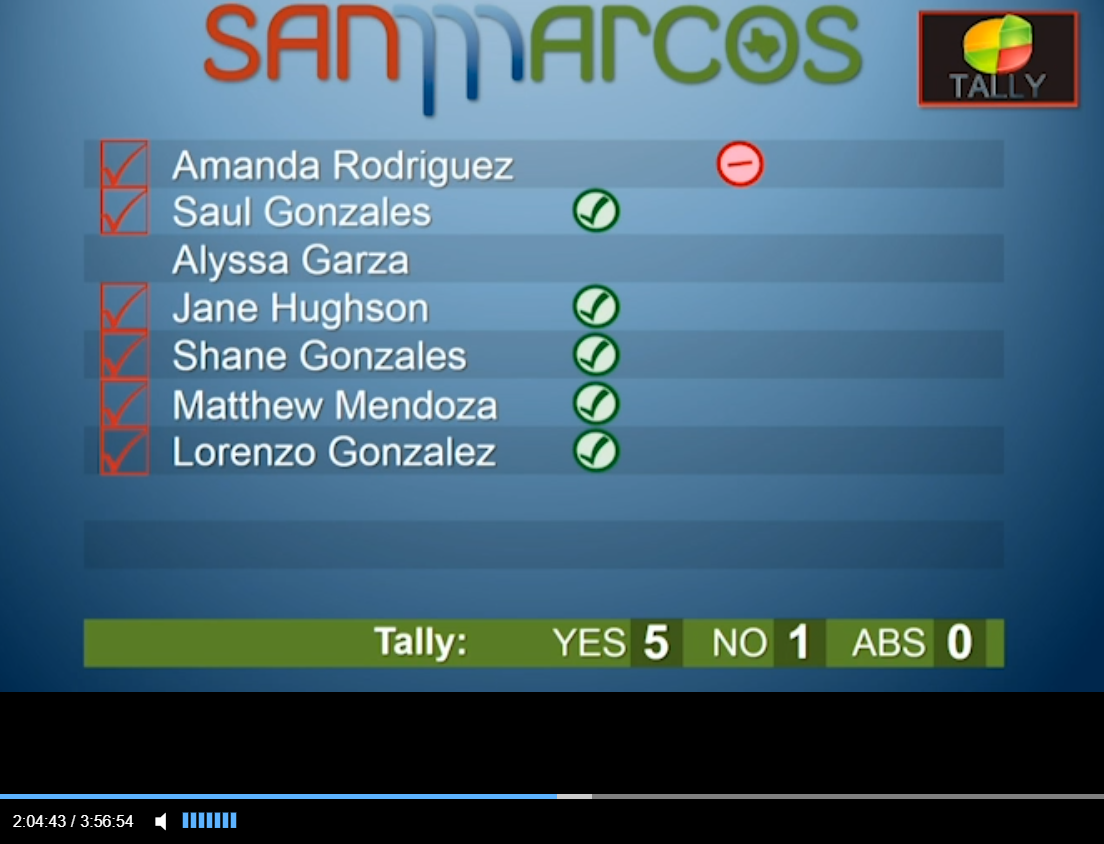
So yeah, no raise.

I’m so baffled.  Two weeks ago, Shane and Lorenzo both thought it was reasonable to increase flex spending, and now they don’t? What the hell happened?

….

Then they vote to roll back the travel funds increase:

This one doesn’t bother me so much. There is plenty of travel money, if you allow people to donate funds to each other.

Bottom line: After all these meetings, everything is back where it started, aside from a special bonus travel fund.  

Clearly I have no idea what happened, but it felt like petty bullshit, to be honest.

….

Item 24: SMCISD stormwater voucher

This is a continuation from last time.  (Full backstory here.)

Super quick background:

Statewide, the legislature is intentionally starving the school districts. This is not hyperbole. Abbott is hellbent force-feeding school vouchers down everyone’s throat. He’s denying funding to the public schools is a way of increasing the pressure on the state legislature to vote for his deal.

Funding hasn’t increased since 2019, but there have been several unfunded mandates that cost a lot. Plus inflation.

SMCISD is in a $9 million budget crisis. They’ve asked for the city for a stormwater waiver, which would save them about $350K.

Which brings us to today.

First there’s a presentation about the stormwater fund:
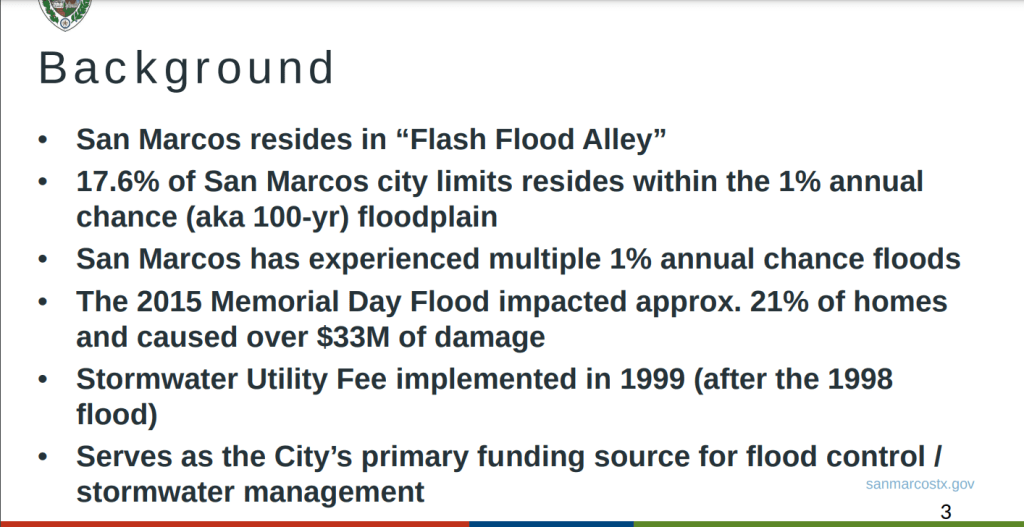
Immediately after San Marcos created the stormwater fund, Texas State University asked the State Legislature to grant them an exemption.  They were the very first university in Texas to ask for one!  What go-getters.

After that, all the other universities thought it was a pretty good idea.

Here’s the total list of state-wide exemptions:

So basically, empty lots, lakes, universities, and ….El Paso school district.  Who knows.

The state law says that stormwater fees must be equitable. They go into a fair amount of detail about how we put ours together. 

Basically, if we want to help out SMCISD, here are the four options:
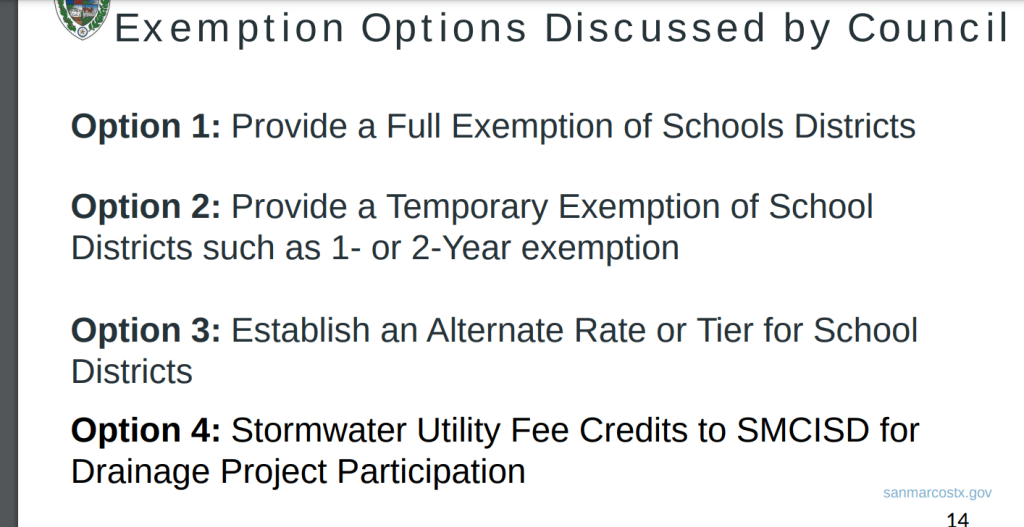
Option 1 would cost a lot and open the door to other nonprofits asking for a waiver, too.

Option 2 would cost some, and open the door.

Option 3 might open us up to legal challenges of being non-equitable.

Option 4 is the one that Staff clearly favors. In fact, city staff and SMCISD staff have already met, and they’re both open to this.

Option 4 is about Mendez Elementary. Mendez is located in Sunset Acres, which has terrible flooding. The city wants to build a detention pond on Mendez property, to help with the flooding.

All the council members are on board with pursuing 4. 

The only thing is that Mendez Elementary is being renovated. Until SMCISD knows the new footprint of the building, they can’t donate the land.

(Now, SMCISD has already submitted the Mendez plans to the city for permitting. So the city could literally go look right now at the Mendez plans.  It’s not a mystery. We can see exactly how much space there might be for a drainage pond.)

There’s a long, weirdly circular conversation where Lorenzo and Amanda keep saying, “We should meet occasionally with the school board, just to stay informed on what we’re each up to.”

Jane keeps responding with, “It’s no use.  Alyssa and I keep trying to think of a reason that all three entities – city, county, schools – should meet, and it’s very hard to think of issues that need attention from all three groups.”

Ok?  That’s a different thing?  That’s not what Amanda and Lorenzo are suggesting?

Anyway, they vote for 4. 

Item 25: Redwood/Rancho Vista

Last time, we discussed this property, immediately north of Redwood and Rancho Vista:
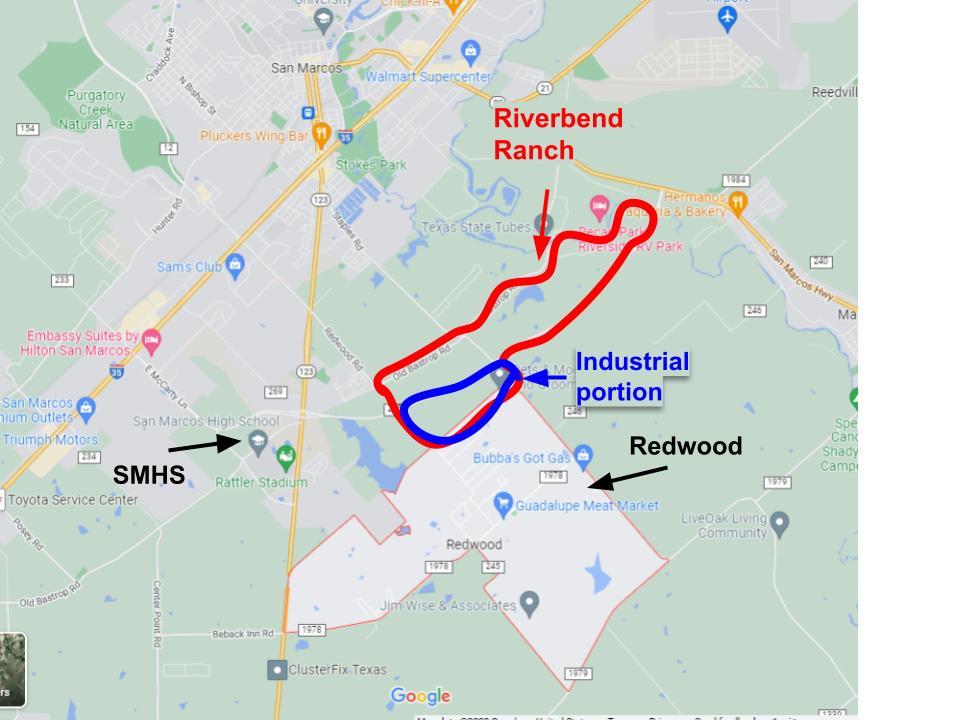
We were trying to figure out if that industrial portion would make flooding worse in Redwood.

Redwood and Rancho Vista have severe septic and flooding issues, which leads to a parasite living in the soil. It’s a big health issue, and it usually only happens in developing countries. But the community is quite poor and vulnerable, so it’s happening here. Any solution is going to be very expensive.

Last time Council tried to have it both ways: “We’ll let this development through, but we promise to take action on Redwood.”

So tonight is that action: A strongly worded letter to Guadalupe County about how the septic issue and parasites is a public health and safety issue, which has been going on for years and years.

Jane suggests that we let them know about the Texas Water Development Board, which has a specific Economically Distressed Areas Program. Maybe Guadalupe County could get some money from there.

City Manager Stephanie Reyes mentions looping in SMCISD – after all, these families go to our schools and are part of our community.

So staff will draw something up, and it will come back.

My two cents: this is fine as a first step, but not as a last step.
Hours 0:00 – 2:10, 9/17/24

Citizen Comment:  

  • One speaker spoke on some one-off issues – closing Cheatham street, lending police for football games, etc.
  • A second speaker talked about the utility rate hikes. Specifically, he told Council that we should have separate rates for rich people.

This connects to a thought I’ve had.  We do kind of have separate rates for rich people!

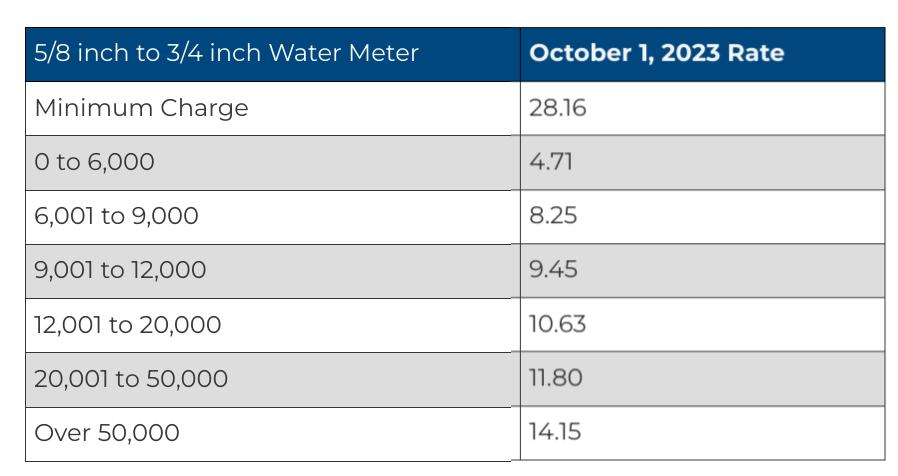
Take water as an example: 

As you use more water, the water gets more expensive. This is good! It incentivizes people to use less water.

Right now, we’re raising utilities 5% across the board. If Council had wanted to, they could have tinkered with these marginal rates. But I bet it gets complicated, fast.

(Electricity doesn’t have tiered brackets like this, though. )

….

Not exactly Citizen Comment, but a general concern from a community member: the San Marcos Housing authority put out a statement saying that they were going to open up the waitlist for housing vouchers on Wednesday morning.

So everyone showed up! Apparently something like 250 people turned in pre-applications for housing vouchers that were supposed to open up on Wednesday morning. A bunch of people even spent the night outside the Housing Authority, in order to be there when the doors opened at 8:30.  There was supposed to be a lottery to accept new applications. 

And…. it just didn’t happen. The Housing Authority did not actually accept any applications.   All the people needing housing just got sent away.

I don’t know what went wrong, but I guarantee there’s a throughline between having chronically underfunded housing assistance for decades, and this kind of mess. And Texas especially relishes underfunding programs for the poor.  

….

Item 1: New City Hall steering committee

Last time we had a big song and dance about the composition of the committee. Should we do things the way we always do them? Or should the DEI coordinator steer us in a more equitable direction?

Here’s what the DEI coordinator says at the beginning of the conversation:

A good general principle is that the composition of your committee should match the composition of San Marcos. So you look at things like race, gender, ethnicity, and try to match the overall population of San Marcos. (As your friendly marxist blogger, I’d toss wealth on that list, too. Socioeconomic status is should be included in DEI initiatives. Poor people are underrepresented!)

Here’s what Council settles on:

  1. Each councilmember will pick two community members to be on the committee
  2. The mayor and two councilmembers will be on the committee
  3. The committee will have some specific roles filled:
    • Someone from P&Z
    • From the library board
    • Someone representing the disability community
    • SMRF representative
    • Texas State representative
    • Downtown association rep
    • Chamber of commerce rep.
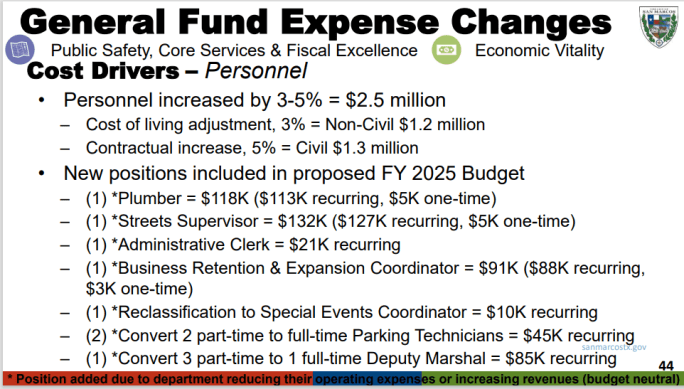
    • Two people from Rio Vista neighborhood

So depending on how much overlap there is between 1 and 3, there could be as few as 17 members or as many as 26  members.

The DEI coordinator tentatively pipes up: “The more prescriptive we are with roles, the harder it will be to achieve the DEI goals.” 

What she means is that the Library Board, P&Z, Texas State admin, SMRF, the Downtown organization, and Chamber of Commerce are generally less diverse than San Marcos as a whole.  The more you stack your steering committee with folks from these organizations, the harder it will be to make the composition of your steering committee match with the composition of San Marcos.

Jane misunderstands what the DEI coordinator means, and says, “Inclusion of these partners doesn’t mean exclusion of others! We’re not excluding anyone.” 

She also says (tellingly), “This just follows the pattern of how we do appointments in San Marcos.”

It does follow the pattern! Councilmembers pick people they know and put them on committees. This is how power perpetuates itself.  This is why you have to deliberately not follow the pattern of how we do appointments in San Marcos, if you want change.

The plan is to collect applications, and then have councilmembers select their two special besties from the pool.

Anyone can apply! Would YOU like to give your two cents on the new city hall?  Submit an application here, why dontcha? They’re due in 30 days. (The application is not up yet, but I’ll edit this when it goes live.)

Item 20: Parking by permit

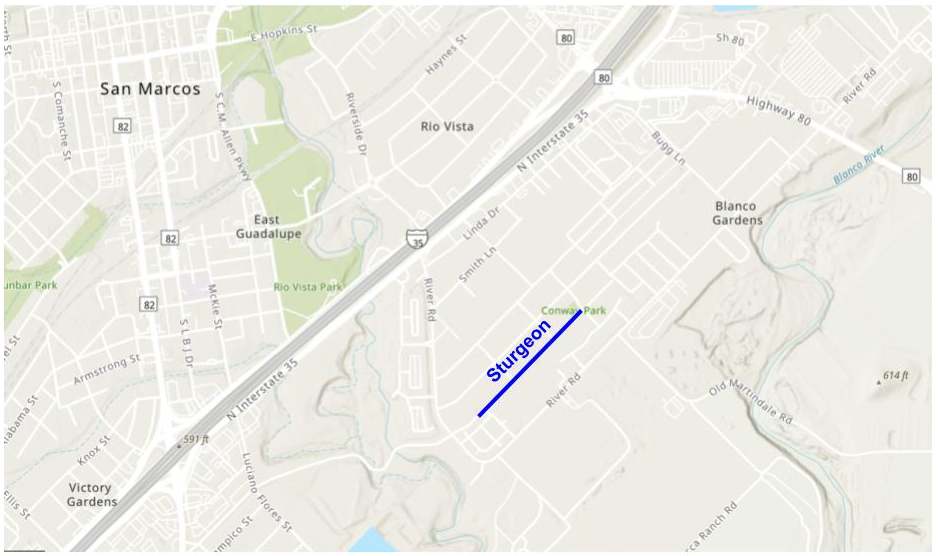
The good people of Sturgeon are fed up with non-residents parking on their street.

Sturgeon is this street, in Blanco Gardens:

They filed a petition to make the street permit parking, so only residents could park there.  This is the area they want permitted:

My guess is they’re either sick of college students or river-goers parking there.

To be honest, I hate this kind of thing.  Everyone pays for roads!  We don’t own the curb in front of our houses. It’s not yours.

Occasionally, there is an extreme situation puts an undue burden on residents.  I can understand that. But here? Seven of those parcels are empty! Why are we banning the public from parking in front of empty lots? It makes me cranky.   (All the tan lots are empty in the diagram above.)

I just don’t like the privatization of something that’s public.  Public spaces belong to the public, end of story. 

Items 21-23: 51 acres off McCarty and 123

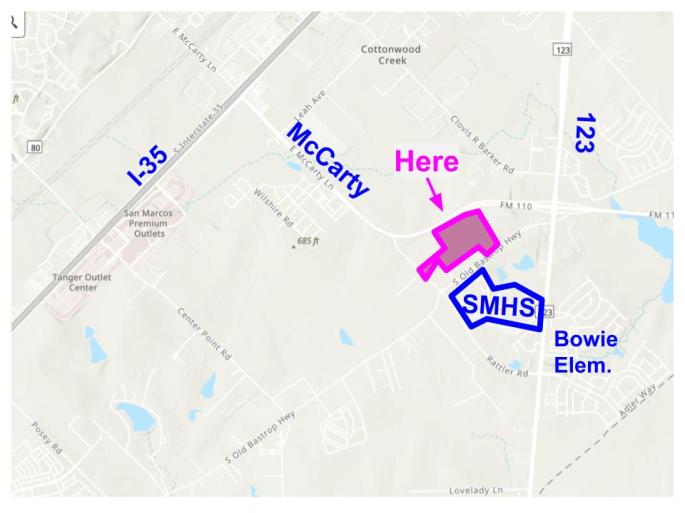
This bit is getting annexed and zoned:

It’s right by the high school, here:

Everybody knows we need more commerce on the east side of town.  For years, residents have asked for this.

(Quick sidebar: But don’t forget! Council removed commerce from Cottonwood Creek here, and then two months later Council removed commerce from the giant future development on 123 here. For Cottonwood Creek, residents wrote letters and showed up to say that they wanted to keep the commercial! And yet Council killed it anyway, because the developer asked nicely.)

Anyway, in general there’s very few stores east of I-35. These guys are committing to putting commerce on this corner:

It’s being zoned Commercial.

The rest of it is being zoned CD-4:

CD-4 is a Character District. That means that city staff is really hoping it will look like this:

Little shops mixed with apartments, and oodles of charm.

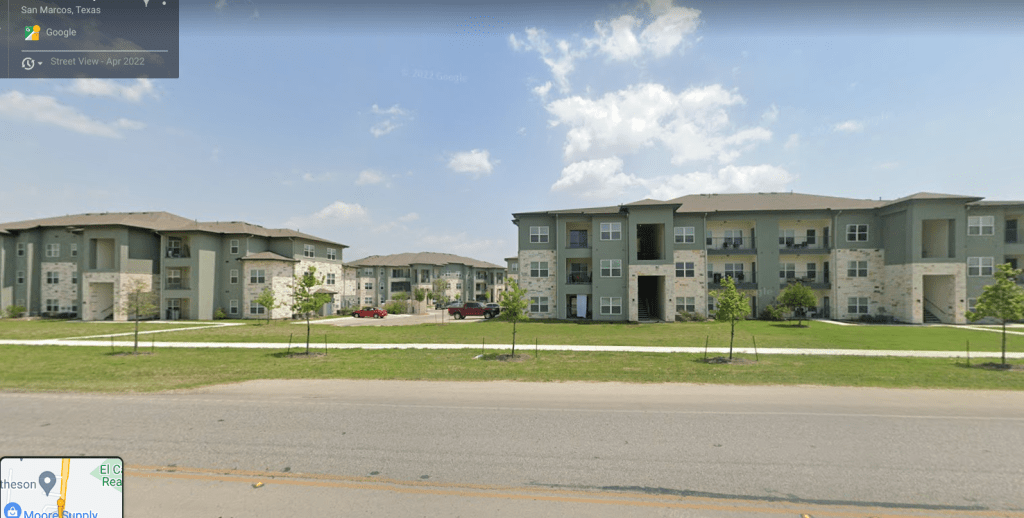
But it actually usually looks like this:

Not terrible, and the housing is needed, but not quite as charming as Sesame Street.

….

You know what would be fun? Dusting off our five criteria for zoning! C’mon, guys, let’s see if we agree with our councilmembers.

1. Price Tag to the City: Will it bring in taxes that pay for itself, over the lifespan of the infrastructure and future repair? How much will it cost to extend roads, utilities, on fire and police coverage, on water and wastewater?

Who knows! No one ever provides this information!

But my educated guess is yes.  The main problem is with single family detached homes – they don’t pay enough taxes to cover their roads and services. Since this will have apartments and commercial, it should be fine.  It’s also along existing roads with existing utilities and coverage areas.    

2. Housing stock: How long will it take to build? How much housing will it provide? What is the forecasted housing deficit at that point? Is it targeting a price-point that serves what San Marcos needs?

We also have no info here! But it doesn’t sound like giant $500K McMansions.  It sounds like apartments plus stores.  

3.  Environment: Is it on the aquifer? Is it in a flood zone? Will it create run off into the river?Are we looking at sprawl? Is it uniformly single-family homes?

Environmentally sound.  Not near the river.  Not sprawl. Not all single family homes.

Social: Is it meaningfully mixed income? Is it near existing SMCISD schools and amenities?

I doubt it will be mixed income.  It is near schools, and hopefully near amenities. 

The San Marxist Special: Is it a mixed-income blend of single family houses, four-plexes, and eight-plexes, all mixed together? With schools, shops, restaurants, and public community space sprinkled throughout?

I don’t know how charming this will be.  We can hope.

So overall: I approve. It seems more good than not.

Council does, too. It all passes 6-0.  (Shane Scott is absent.)

“YAY COMMERCE!” council cheers.

Items 24-27:  All the budget and tax rate final details. (Discussed here and here previously.)

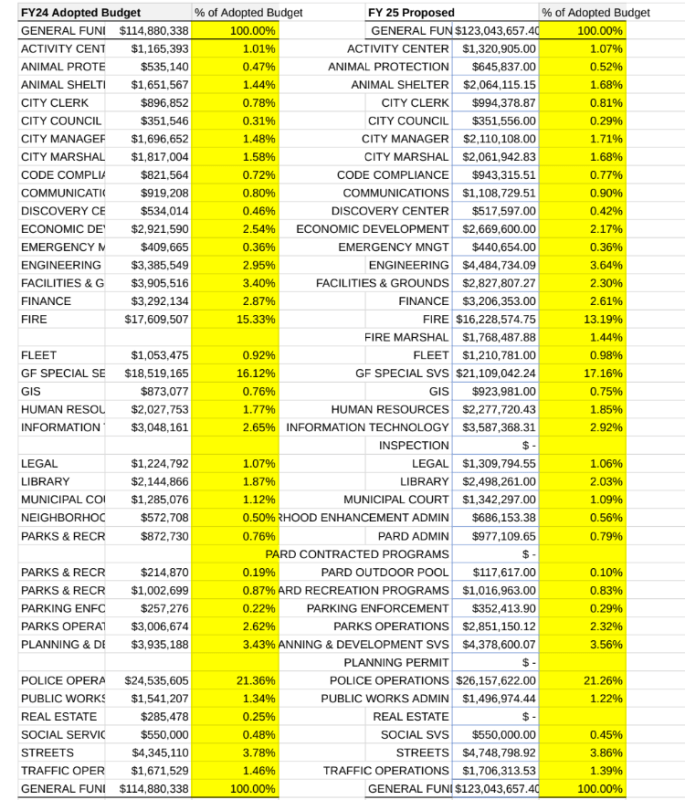
First things first! The good people at City Hall were able to give me the General Fund breakdown.  

I put together this side-by-side comparison for last year and this year:

Budgets are complicated. I don’t have any great takeaways here.

Next: We’re taxing ourselves less than we thought we were. We made an error in an obscure tax computation, and just now fixed it.

Here’s the quick version:  You’ve got your existing taxable buildings, and you’ve got your new builds.  Texas state law cares about the total amount you’re getting each year from the existing taxable buildings. (So you’re ignoring tax revenue from new buildings, for now.) 

Is the total revenue from existing buildings going up or down?  Sometimes it goes up because you raised taxes.  Other times it goes up because your housing prices are going up.  Either way, you’ve got to jump through some extra hoops if that total is going up.
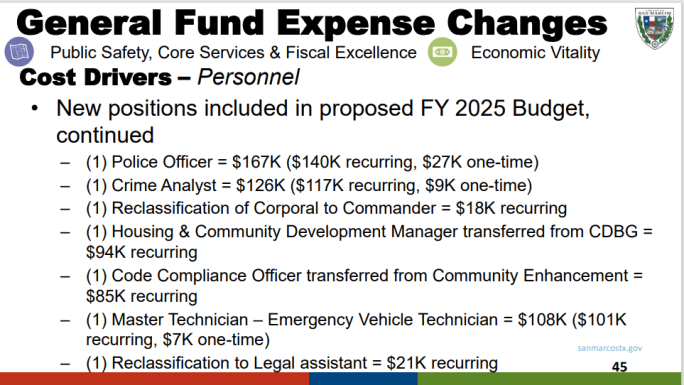
We drew up our budget, and we thought it was going up, but…. <drumroll> it turns out it’s going down!  Hooray?  Since we didn’t change our tax rate, that means home values are falling.  

(Jude: THIS IS A REALLY BIG DEAL! THIS NEVER HAPPENS!

Mark: IT’S THE GROWTH!)

….

You know me: I just always have to rant a little bit about taxes.  (I swear this will be a very tiny soapbox.  Two minutes, tops.)

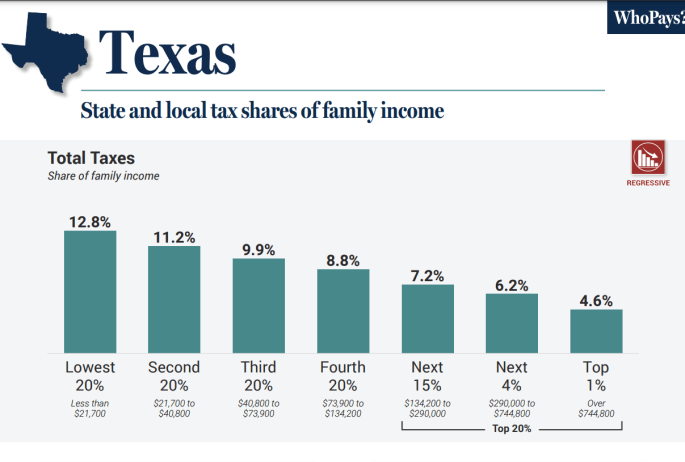
Taxes are good! That’s how you fund your government, and take care of your community. The problem is that we won’t tax wealthy people in Texas. First off, the poorest people are paying the most taxes:

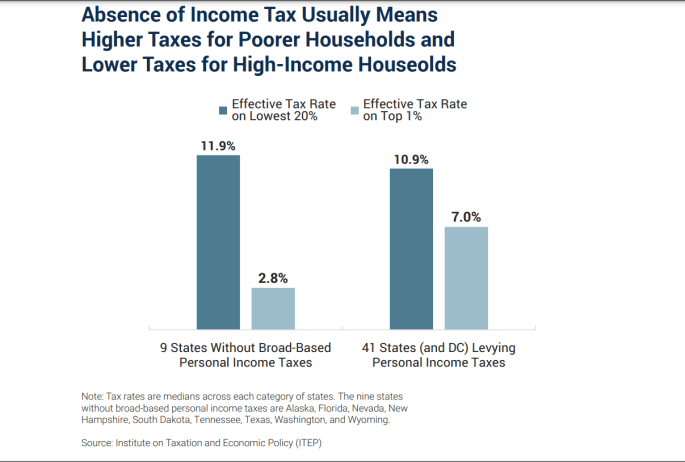
And this is worse than in other states!

Notice that Texas is one of the states on the left part of that graph.

People complain about high property taxes, but those aren’t the unfair part.  The unfair part is the sales tax.  (Both state and local.) Sales taxes really are the worst! Poor people end up paying a much higher percentage of their income than wealthy people.  Literally, it’s capitalism for the poor and socialism for the wealthy.

End rant! I promised you I’d keep it short.

Anyway: only one person speaks at citizen comment and nothing gets debated.  The end! We have a new budget and next year’s tax rate.

The vote: 5-1.  Alyssa Garza votes against everything, presumably because of the utility rate hikes.  

Item 28: Mowing, landscaping, and litter around city buildings. It is a giant task. 

We contract out parts of it to Easter Seals of Central Texas, to the tune of $1,432,702.54.

Item 29:  Purgatory Creek Channel improvements

We had a whole workshop all about the Purgatory Creek channel improvements last time! This meeting, we’re kicking off $3,281,773.35 towards engineering for Phase 1.  

Saul Gonzales asks, “There’s a bunch of stagnant water in the side channels through Dunbar. Will this help with that?”

Answer: Sort of yes! Part of the project is raising some of the low-water crossings.  That is a major reason why water can’t drain downstream.  But also sort of no! This is supposed to recreate natural channels, and they do pool some. 

The city applied for grants to cover a lot of the costs. We should find out next month if we get them. If we get them, we’ll start construction next year.

….

Item 32: Filling a bunch of vacancies on different committees.

There was one moment that ticked me off.   There’s a vacancy on the Animal Shelter Advisory Committee. We only had one application. 

Matthew Mendoza pointed out that on the application, this volunteer stated that they have only lived in San Marcos for two months. Matthew is uncomfortable with this, and Jane agreed.  Matthew likes it when people have lived here longer. They decided to re-open applications and see if anyone else applies.

GUYS! Stop this rudeness.  First off, you should be welcoming to new people.  

Second off, if this were a vacancy on P&Z or the new City Hall steering committee? Sure, require 5 year residency.  You want people with some roots and community background. (I guess.) 

But that’s not this.  This is the ANIMAL SHELTER.  A new person moved to town and wants to volunteer their time to help the doggos! We should be appreciative, but instead we’re crapping on them for not having roots in the area.  That’s dumb.

Item 33: What night will city council meet, on election week?

The election is on a Tuesday. You don’t want to hold a council meeting the same day as an election. We don’t want to get in the way of anyone voting.

So should the council meeting be shifted to Monday or Wednesday? Historically we switch to the Monday. But Jane Hughson is suggesting that this year, council should meet on the Wednesday instead.

I want to emphasize two things:

  • When I say that Jane is good at details, this is a perfect example of what I mean.  She explained her thinking: “Suppose I am a community member who doesn’t know that the meeting was moved, and I show up on Tuesday.  If the meeting already passed on Monday, then I’m out of luck.  But if the meeting is not till Wednesday, I can come back tomorrow.”  

This is really thoughtful and detail-oriented.  Jane Hughson is unusually good at this sort of thing.

  • It’s worse for me, your friendly blogger.  I need every last minute to crank out these posts!  If the meeting is on Wednesday, then I get crunched, which gives me a sad. But in my heart of hearts, I know Jane is right. 

Hours 0:00 – 3:38, 9/3/24

Citizen Comment:

  • Five people spoke against the SMART/Axis road annexation.
  • A guy from the airport asked about his lease rate for his hangar

That was about it.

Items 2-3:  Quarterly financial and investment report.

This is the official report for Jan 1st – March 31st went.  Back in May, we got a sneak preview: sales tax was tanking below projections and we were scrambling to reign in spending. 

This is more re-hashing of that same news. Sales tax was down, so everything got pulled back.

Item 19:  It takes two public hearings to approve the budget.  This is the first, and then final approval will be on September 17th.

Here’s the big picture:

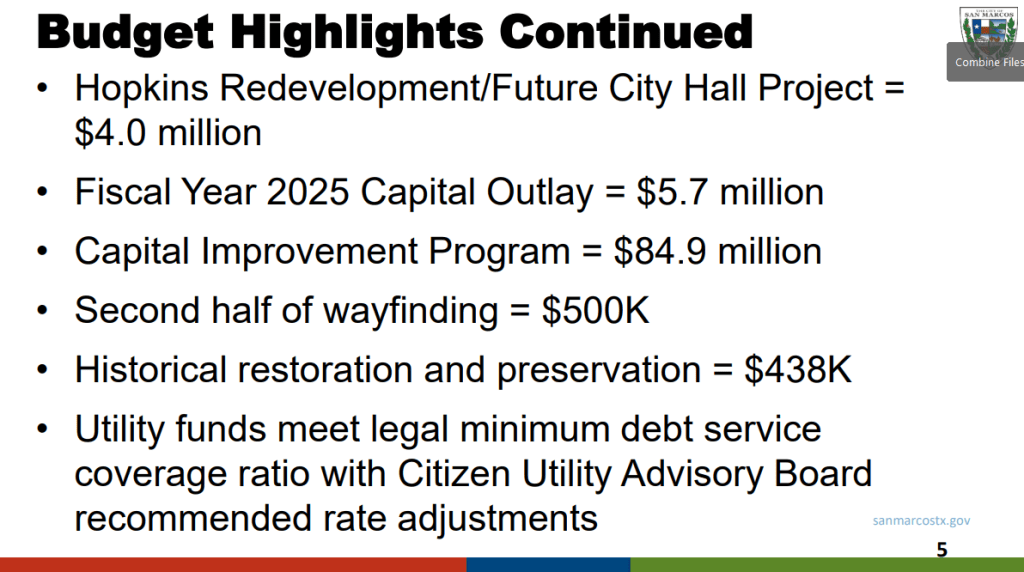
With highlights:

For me, the highlights are only somewhat helpful. I need context in order to makes sense of these notes. What helps me most is a breakdown of the general fund, by department.

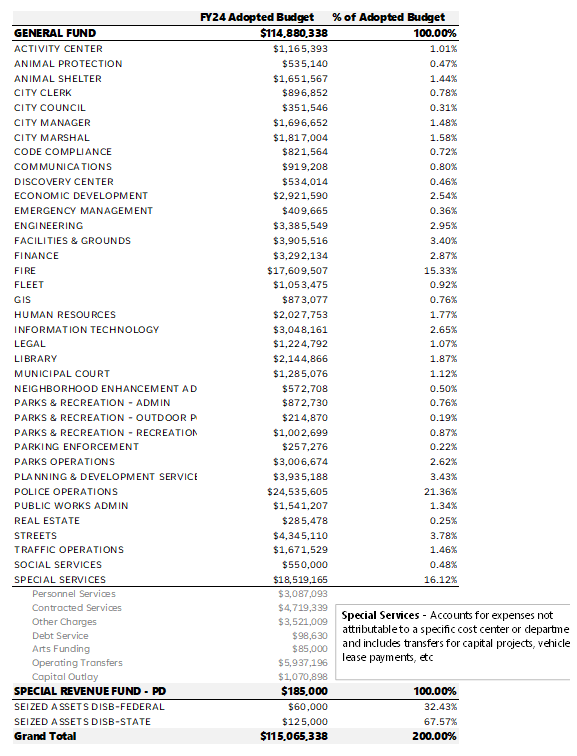
Last year’s breakdown of the General Fund, by department:

I got that by submitting a FOIA request last year. I’ve requested this year’s General Fund breakdown, but haven’t yet gotten it.

[Let me put on my tinfoil hat for just a moment. Indulge me in the dullest conspiracy theory of all times:

– The 2024 draft budget has the General Fund breakdown by department, starting on page 82.
– But the 2024 adopted budget has no General Fund breakdown anywhere!
– the 2023 draft budget has the General Fund breakdown by department, starting on page 88.
– But 2023 adopted budget also has no General Fund breakdown anywhere!

For the past two years, it’s disappeared from the actual budget, once it was approved. What on earth.

Finally, even the 2025 proposed budget does NOT have the General Fund breakdown included. This annoys me, hence the FOIA request mentioned above.

I submitted the request back on August 22nd, so we’re past the normal FOIA response time. The information is in the budget, but it’s scattered. It would take hours of work for a layperson to extract it from the online budget, one department at a time.

END OF MY MILDLY EXASPERATING CONSPIRACY THEORY!]

Back to budget discussions. Utility rates are going up:

The average home-owner will pay $13.46 more per month. There’s a big discussion in the workshops about utility assistance, so I’ll cover some details later on.

We’re using the same tax rate as last year, 60.3¢.

Listen: I cannot stress enough how little conversation there is about any of this. Partly this is because there have been a lot of budget workshops already.  Partly this is because the community didn’t show up to complain. (Although they have one more chance.) But mostly because this council is so used to each other that they all know exactly where they all stand.  There’s nothing left to say.

Matthew Mendoza asks a great question. During the section on the Water and Wastewater Fund, he asks: “These contract costs keep increasing every year. Why do we keep contracting out? There’s like 4 water and wastewater contracts. Why not do these things internally?”

The answer has a few parts:

  • Some contracts are management contracts, others are infrastructure and CIP
  • The contracts for the surface water plant and the wastewater treatment plant both have automatic inflation adjustments built in
  • On the wastewater treatment plant, we’re at the end of a 20 year contract. We’re putting a provision in the new contract to have an exit clause, so we could convert staffing to in-house in a few years if we want. When it was built in the 90s, it actually was operated by city staff. We started contracting it out in the 2000s.

This is SUPER interesting! Let’s highlight some things:

  • It’s so common for contracts to have built-in, automatic inflation adjustments! You know what doesn’t? The minimum wage. Failure to peg the minimum wage to inflation is one of the most underappreciated policy failures of the 20th century.
  • The wastewater treatment plan used to be city-run! We privatized it in the 2000s! What. Privatization is not your friend. Let’s get that back.

Mark Gleason asks if trash and recycling contracts also have automatic inflation adjustment?

Answer: Yes on refuse collection.

Alyssa still votes no on the utility fund votes, because of the rate increases. But she acknowledges the workshop on emergency utility assistance. (We will cover this below.) If it were working as it should, she says she’d be able to vote for the regular rate increases.

Item 4:  Axis Logistics (aka SMART Terminal) road annexation.

Backstory. The giant Axis Logistics/SMART company:

wants Council to annex city land for a road:

However, the company has made total enemies of the surrounding community, by always being super secretive about their plans. In this case, the road has jumped locations. Originally it was further from houses and now it’s closer to them.

At the August 5th meeting, there was a fair amount of discussion. Everyone seemed concerned. Nothing was resolved.

At the August 20th meeting, it was mysteriously postponed.

Time for the exciting conclusion! So much drama! Buckle up for…

…zip, zero, zilch. Literally, Council spends four minutes total on this item.

The vote:

No one ever asked in public about whether the road could be moved back to the original location.  No one explained whatever Mark needed more time to research since the last meeting.

This is what I mean when I say this council is stale. Everyone knows where everyone stands on everything, and so no one bothers to say anything outloud.

Item 24: School Resource Officers are back, baby!  (School Resource Officers = SROs)

Last meeting, the city approved the SRO contract

Two changes had been proposed by SMCISD:

  • The SRO contract should be two years instead of one
  • The contract can be renewed administratively, without Council approval. 

Council renewed the contract, but nixed those two changes. They wanted to see the contract, in person, every year.

Since then, the school board met: they really want the two year contract and admin renewal.  So they held the line on those two details, and punted it back over here.

Remember last time how I pointed out that Jude Prather should really recuse himself, because his wife is the director of the organization that oversees all SROs, statewide?  

  • He didn’t recuse himself this time, either. 
  • He actually was the one who made the motion to approve
  • Superintendent Cardona even mentioned that Prather’s wife wrote the officer training.
  • At Q&A at the end, a community member (LMC) asked about this conflict of interest.
  • By that point, Prather had gone home.  LMC said it was a question for the city lawyer, but Jane Hughson ended the meeting without giving the lawyer a chance to answer the question.

This is getting into more egregious territory!  Jude certainly knows better. He recuses himself over absurdly flimsy pretexts all the time.

ANYWAY.  Chief Standridge says he could include SROs in his yearly update to Council.  Superintendent Cardona talks about how closely everyone meets and supervises the SROs.

Mark Gleason politely says “I told you so! Stability. Safety. Etc.”

The vote: Should we switch to two year SRO contracts and administrative renewal?

… 

Item 25:  This was a little confusing.

Gather ‘round, children.  Once upon a time, there was a little Municipal Utility District, on the north end of town:

That’s east of I35, on Yarrington road. The year was 2014.

It was actually kind of gigantic if you zoomed out:

But none of the townspeople ever did. 

Here’s what the developers pretended it would look like, some day:

Look at all that water! What the hell is going on here. Here’s the satellite photo of this area:

So much less water!

(Were those lunatics planning on a great new lake? Were they going to tap the Blanco, where it runs underground, to create a watery playground for rich people? Maybe!)

Back to our story.

The village council elders put a weird clause in the development agreement that allowed landowners to opt out.  Usually council elders wouldn’t do such a thing, but in this case they did.

By 2023, these owners had opted out:

The red parts had opted out.

In 2023, the rest of the land owners opted out:

So at Tuesday’s council meeting, the little village dissolved the Municipal Utility District altogether. There’s no development agreement. There’s no lake.

THE END! 

The moral of the story is: there is no moral. 

Item 26: New City Hall and Hopkins Redevelopment project

Back in July, we saw some pretty pictures about what the new City Hall could look like, and what Hopkins could look like, maybe someday:

Today’s task: we’re going to form a steering committee, to help shape the vision. 

Who does Council want to be on the steering committee?

Jane: We could have each councilmember pick a person, and then have a representative from some key constituents – Texas State, River Foundation, Downtown Association.

Alyssa:  Before we have this conversation, we need the DEI coordinator. Otherwise we’ll do what we always do. That leads to the status quo, and the same old people still have the same old power. 

Mark Gleason: I like each councilmember picking two people, plus the key organizations should all have representatives.

Alyssa:  Hey! You guys. We need to stop and get input from the DEI person, before we have this conversation. 

Jane: And councilmembers themselves. What about the mayor?

Alyssa:  Listen. Stop. The DEI coordinator is not here.
Matthew Mendoza: Why should Texas State get a seat on the committee?

Jane Hughson: It’s just part of being good neighbors. They also have a representative on the downtown committee.

Alyssa:  Hello? Anyone? Bueller?

Shane Scott: You know how councilmembers get their names in the building? I think we should have little bobbleheads of ourselves, instead.*

Alyssa:  LALALALALALA AM I SHOUTING INTO THE VOID HERE?

Matthew: We should require that members have lived in San Marcos for at least five years!

Alyssa:  [mumbles to self about DEI coordinator]

Jane: How about a P&Z representative?  How about a library representative?

Alyssa:  [draws pictures of a council consulting the DEI coordinator, and holds them overhead, in the style of Lloyd from Say Anything.]

Saul: Should we require that they be caught up on their taxes?

Jane, dryly: We don’t require that for elected officials. 

Alyssa:  [Launches little confetti cannons. Sends in carrier pigeons with tiny notes tied to their legs, which read “Let’s consult with the DEI coordinator”. Does an interpretive dance for the letters “D”, “E”, and “I”.] 

In the end, everyone agrees to come back next time with their final ideas for the composition of the steering committee.  City staff is going to talk with the DEI coordinator and get best practices from her, and they’ll share those next meeting.

Here’s the thing: You have to get the DEI coordinator to talk to everyone before the brainstorming. Otherwise the brainstorming will perpetuate the same old power imbalances as always.  The point of the DEI coordinator is to gently get everyone to cut that shit out, and redirect them into new territory.

*This is a real comment. I did not make this up.

Hours 1:54 – 5:32, 8/20/24

Item 20: The Budget

This one item is nearly three hours long.  

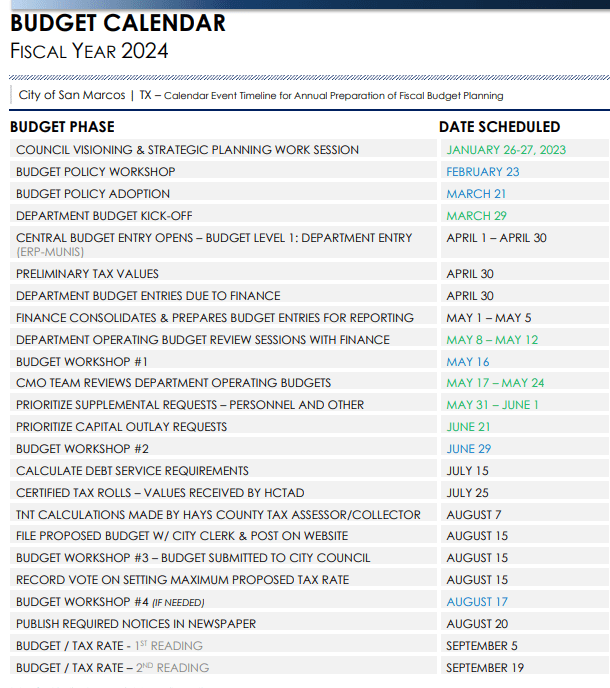
The budget is long and complicated.  First off, city starts having workshops in January and runs them through the end of September, when they pass the budget.  

These workshops are deathly boring and I am unable to sit through them.  I’m sorry about this.

Notice that they present twice to the Neighborhood Commission:

heh. (via)

Anyway! Here are the strategic goals:

Sure, why not.

The budget is split across a bunch of different funds:

Each of those colored headers is a different fund. So you can see the General Fund on the left is the big one, and there are a lot of little ones as you move right.

Revenue

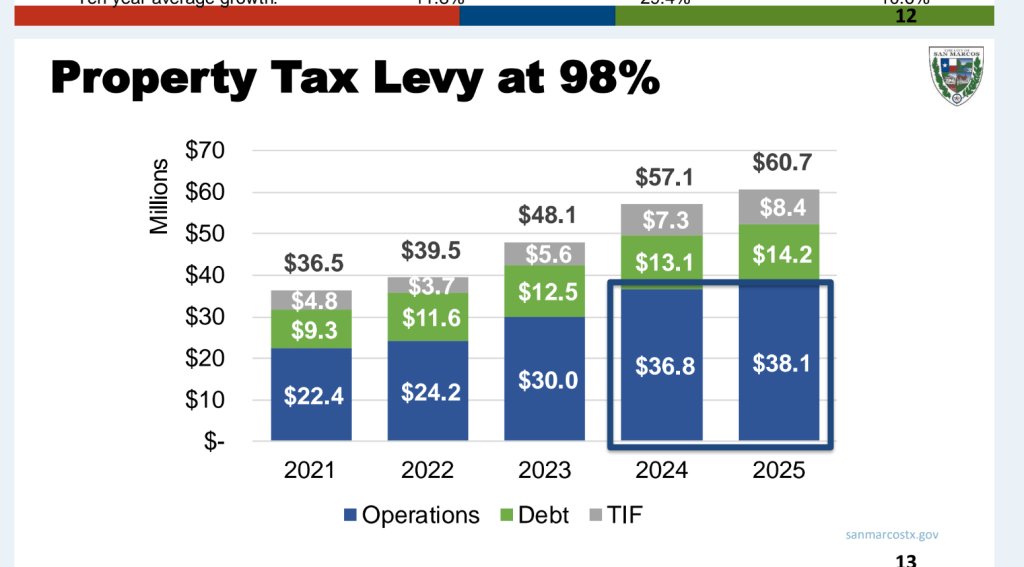
Last year, we took in $37 million in property tax, and $42 million in sales tax.  So sales tax is huge for us.

The problem is that sales tax revenue took a big hit this spring:

I know that’s not very dramatic-looking.  Here’s how they presented it over the summer:

They kinda know what went wrong now. Here’s the biggest sources of sales tax:

Basically, some of the top sales taxpayers had unusually high sales for the past few years, and now they’re reverting back to normal. But we had banked on those returns to keep increasing. Whoops. (I’m guessing it was post-covid supply chain kinks working themselves out, especially Matheus Lumber.)

We’re going to start a sales tax volatility fund to help hedge against this kind of fluctuation.

Most departments are going to have the same budget as last year.  Since inflation is about 3% and the town is growing, that means they have to cover more ground with less money. So that sucks.  

We’re doing a little hiring.  These are the budget-neutral positions being added:

These are the ones that aren’t budget neutral:

I find it extremely hard to get a handle on the General Fund budget. So last year, I filed a FOIA to have them send me a list of how much each department gets from the General Fund.

This is what they sent me:

This is really helpful! This is how my brain works. That’s very clear to me.

What I plan on doing is put this side-by-side with next year’s proposed budget, so we can see what areas are growing and what is shrinking.  (I filed a FOIA for the new one, but it’s still being processed.)  

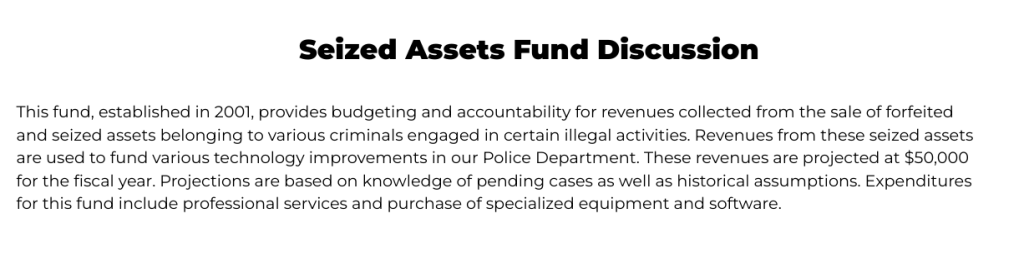
Another day, we should have a conversation on the $185K of seized assets, at the bottom of that chart. Seized asset forfeiture is wildly unethical! Have another link. It’s really bad.

Here’s what it says in the 24-25 budget:

There are not enough details on the $185K – what’s it being spent on? Was that all seized in San Marcos? Why is there a state and federal part? I have no idea.

….

Let’s talk about TIRZes. These also aren’t discussed much.

A TIRZ is a Tax Increment Reinvestment Zones. What this means is that the taxes from those zones mostly go back to those zones. We have six of them, maybe?

The example you’ll hear about most often is the Mainstreet Downtown TIRZ, because we can all appreciate it. We all want a thriving downtown! Taxes from downtown stay downtown, to keep downtown nice and vibrant.

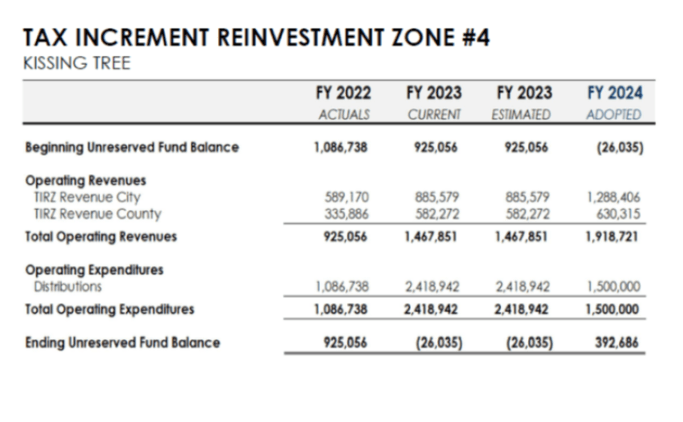
But let’s focus on the Kissing Tree TIRZ, instead. Here are the details from the 23-24 budget:

So San Marcos sent $1,288,406 of tax dollars back to this one single gated community last year. Did you enjoy a thriving Kissing Tree or a thriving downtown more? Which ones benefit all of San Marcos? Feel free to compare $1,288,406 to your favorite category in the General Fund, above.

The other TIRZes are Loop 110, the Downtown plan, the Embassy Suites Conference Center, and maybe Blanco Vista? I can’t tell if that one ended in 2022 or not.

This year’s budget does not have a TIRZ breakdown either, which I find annoying. 

Let me be clear: city staff does an amazing job trying to clearly communicate the budget. No one is withholding anything maliciously.  

I just think that the breakdown of the general fund is a bit of a blindspot. It would help if it were there. 

Here’s the city budget webpage, if you’re curious to poke around yourself.

I’m skipping over a lot – there’s SO MUCH.  

Utility rate increases are being discussed.  It’s generally much wiser to raise rates by small amounts every year, rather than letting it accumulate and then needing a giant increase.

Alyssa Garza is opposed, out of economic concern for our neighbors.  I think she’s wrong here.  Starving your government is how you let capitalism run unfettered. Don’t be a shill for Reagan.

That said, we do have a utility assistance program.  The DEI coordinator gives a presentation on it.

The city puts about $230K from various sources into utility assistance:

And here’s what we handed out:

There is lots of anecdotal evidence that we do a mediocre job connecting with community members who need help:

One thing that makes it complicated is that there are two kinds of people who need assistance.
– First, people who need wraparound services in lots of areas. These people benefit from filling out the mountain of paperwork needed for federal programs. Community Action does this.
– Second, people who just need a one-time boost to get out of a hard spot. These people benefit from a low-barrier process and quick payment, so that their utilities don’t get turned off.

There is going to be a work session to try to make all this more effective.

Final notes:

  • There’s some discussion on how the Airport has been in the red for a long time, but I can’t find this info in the slides. 
  • As ARPA money comes to a close, we’ll have to pick up a bunch of slack in the budget next year.  So more expenses are looming.

That’s the end of the three hour budget discussion!

But wait! There’s more!

Item 21: Setting the max tax rate for the new budget.

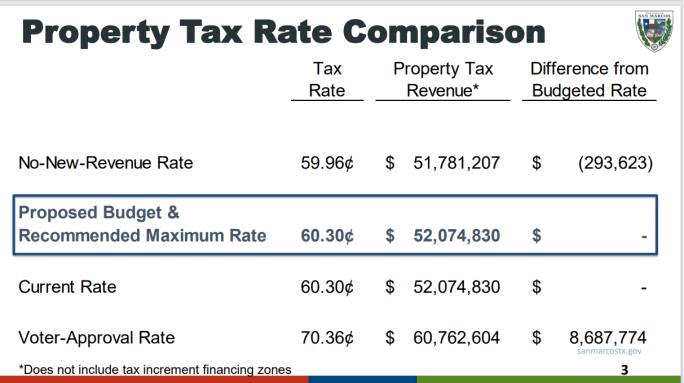
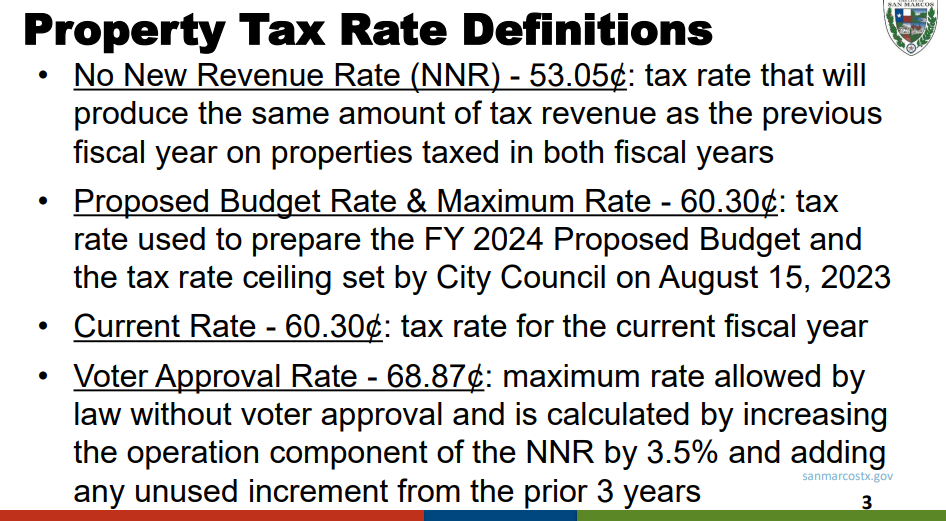
Background: here are some different tax rates: 

That’s all just different vocabulary for levels of property tax rates. City Council can pick any number it wants, although if they go over 70.36 ¢, they’d have to get voter approval.

This whole budget above has been planned on the 60.3¢ number. Here’s how it would affect the budget if we raised or lowered the tax rate:

The 60.3¢ rate is the same rate as last year. Of course, if your home value goes up, then your taxes go up, even if the rate stays the same.

Home values really have shot up:

So how much more is the average home owner paying?

If Council goes with the 60.3¢ rate, the average homeowner will pay $164 more this year, or $14/month.

My prediction: The next few meetings will see a lot of focus on home owners in poverty, and whether its fair to ask them to pay $14 more per month. Some considerations:

  • Most people in poverty do not own homes. But there are definitely some, and they deserve compassion. However, they’re likely to own less expensive homes. So if $14/month is the average increase, maybe for a homeowner in poverty, it’s more like maybe $10/month.
  • Focusing on home owners in poverty allows us to avoid a conversation about wealthy home owners.

Today: just setting a ceiling.  What’s the upper bound for the tax rate this year?   (This is just a weird Texas quirk.)

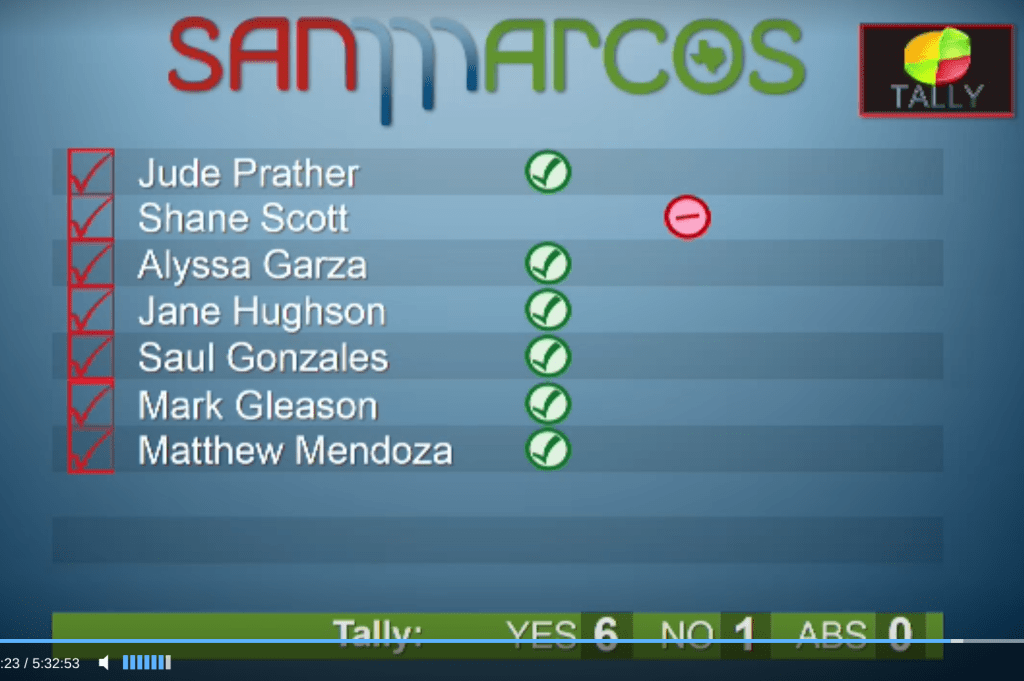
The vote to set the maximum at 60.3¢:

I have no idea why Shane voted no. 

Item 26: We’re giving Southside $800K to Southside from ARPA money to implement the Homelessness plan.  

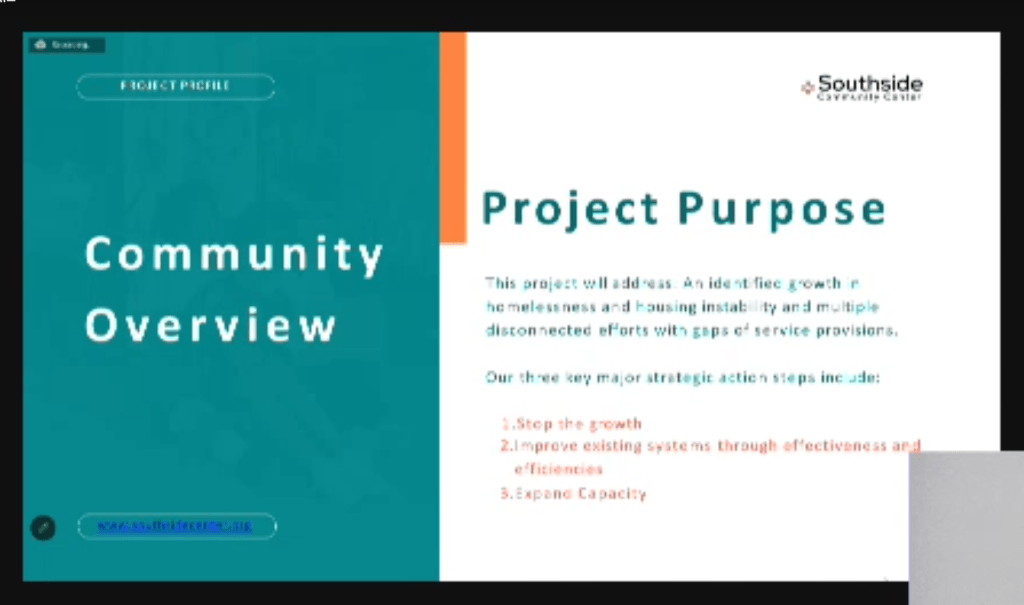
Over the summer, we fronted them $50K to come up with a working plan, which they’re now presenting. It’s really thorough! Unfortunately, the slides aren’t in the packet, so I’m relying on screenshots.

The three strategies:

  1. Stop the growth
  2. Improve existing systems through effectiveness and efficiencies
  3. Expand Capacity

Honestly, I’m not an expert, but she sounded way better than Robert Marbut. Feel free to listen, starting at about 4:56 here.

These are just some of the slides:

” – We will hold a community-based network to help neighbors in need.
– We will use best practices and data-driven decisions to guide our work
– We will implement collaborative technologies to support coordinated services
– We will honor the humanity and dignity of all people and help the entire community to thrive”

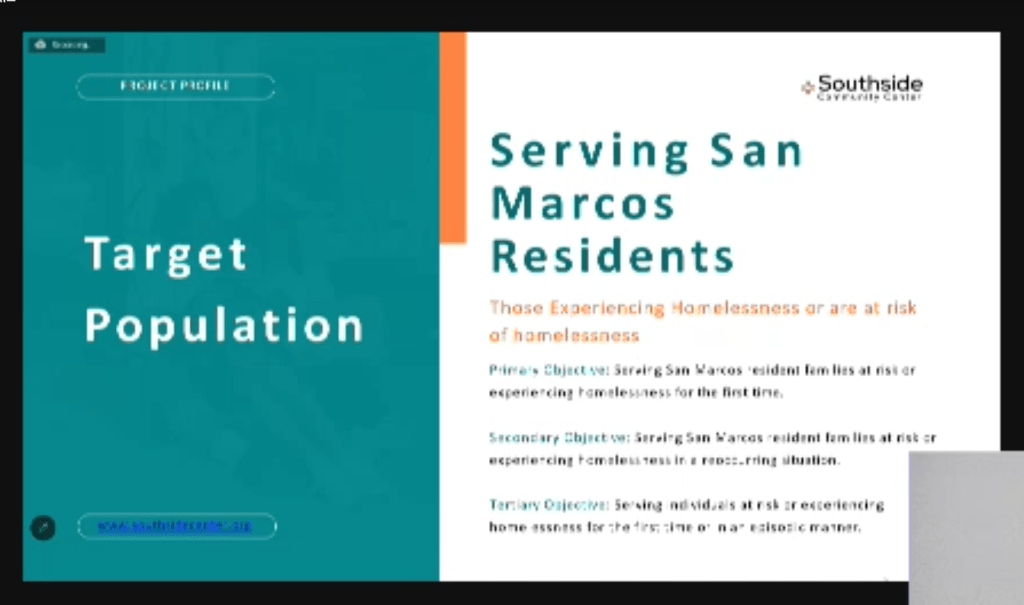
Target population: Those experiencing homelessness or at risk of homelessness

  • San Marcos resident families at risk or experiencing homelessness for the first time
  • Those with a recurring situation
  • Individuals at risk or experiencing homelessness for the first time, or in an episodic manner.

Key Deliverables:

  • Activate a network of community partners and volunteers to help neighbors in need
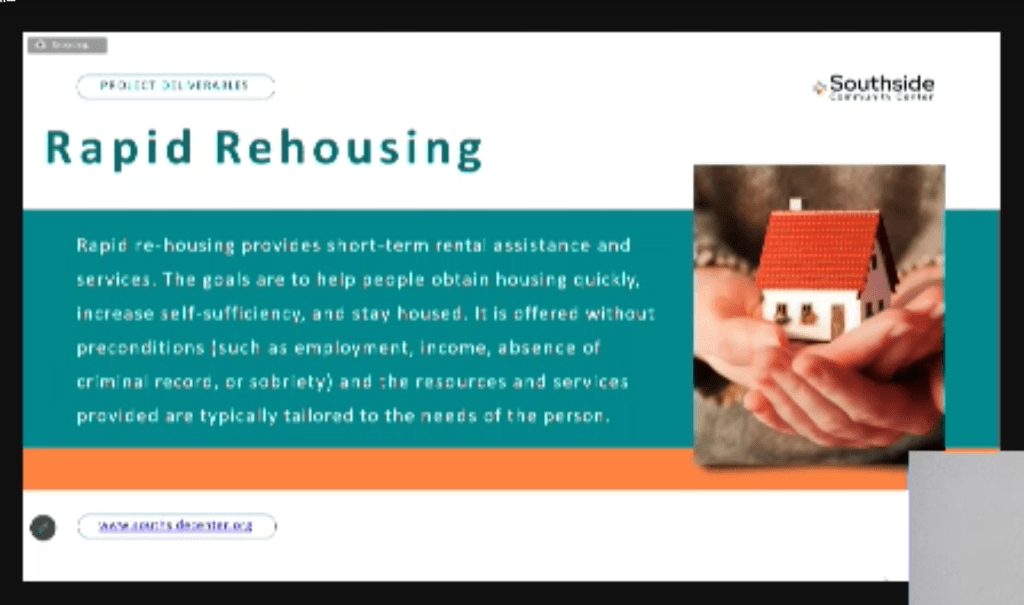
  • Develop a homelessness prevention and rapid rehousing framework
  • Implement coordinated entry processes for easier access to services
  • Establish standard intake procedures for streamlined client onboarding and information sharing
  • Implement a client management system, like HMIS, for secure data storage and reporting

So you don’t want homeless people having to supply data and information to a dozen different people in order to get help. You want to get someone in the system one single time, and then let the providers talk to each other and coordinate a response to get help to that person.

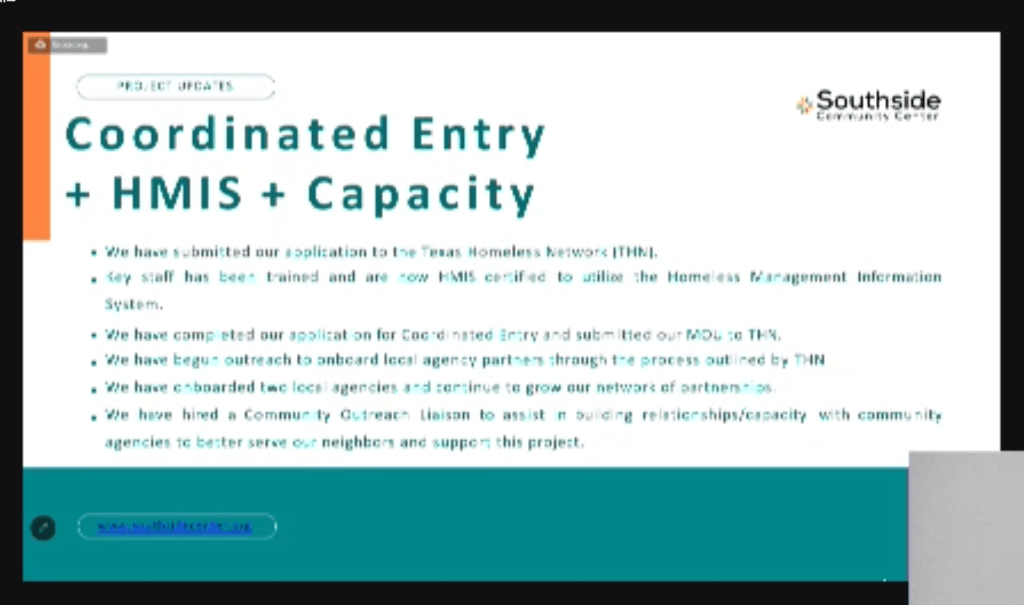
It sounds like we’re going to use HMIS:

A big piece of this is stabilizing people who are right on the brink of becoming homeless, or who just went through a crisis:

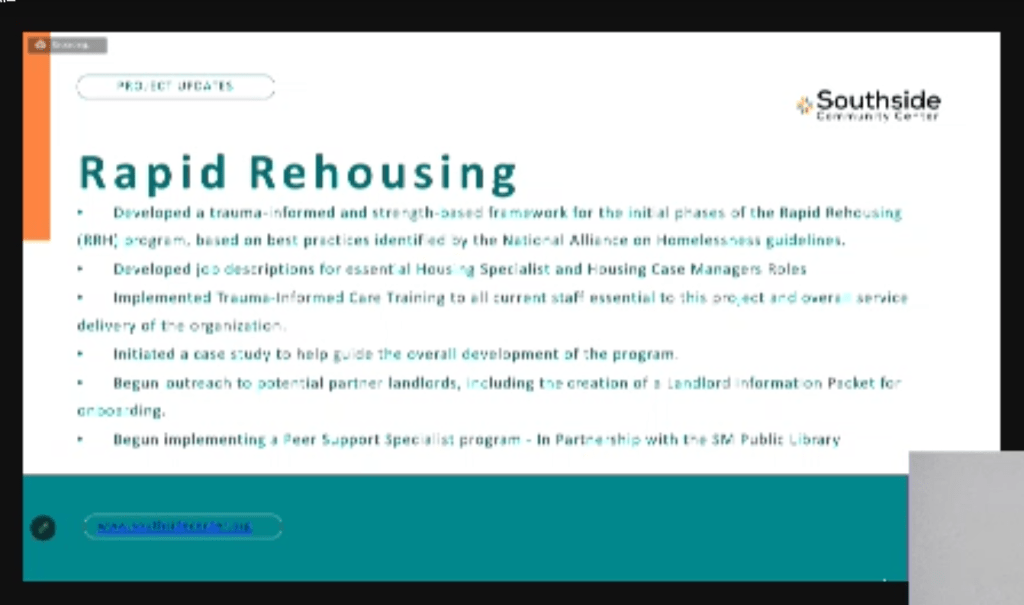
They’ve already started on this:

It’s just an extremely complicated problem that requires lots of human scale collaboration to put all this together.

One big piece of this is expanding capacity – we literally need more beds.

Again, it’s probably worth it just to listen for yourself. I’m struggling after a long meeting here.

….

After this, Council zips through a ton of items super quickly:

  • Whisper North and South, and Trace all get their annual thumbs-up. (Whisper North and South are giant planned neighborhoods on the east side of 35, at Yarrington Road. Trace is down south, past the outlet malls, also east of I35. These are all PIDs: Public Improvement Developments. It’s similar to a TIRZ. This is where my knowledge ends. Maybe they’re smaller? idk.)
  • The Intralocal Agreement with CARTS to provide transit in San Marcos gets re-upped for another year. Also one with the university.
  • Something something new roles on the Finance and Audit committee, we’re all pretty drowsy at this point. Shane Scott tries to kill off the whole Finance and Audit committee, but its very existence was not on the agenda, so he’s stymied.

That’s about it!

Bonus! 3 pm workshop, 5/21/24

Presentation 1: Our budget is not doing well. Let’s look at some slides.

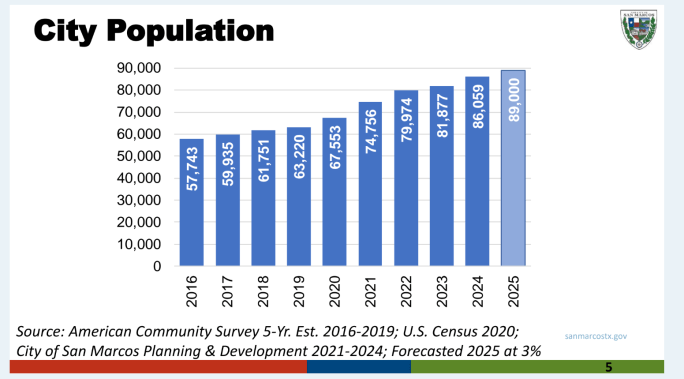
First, San Marcos keeps growing:

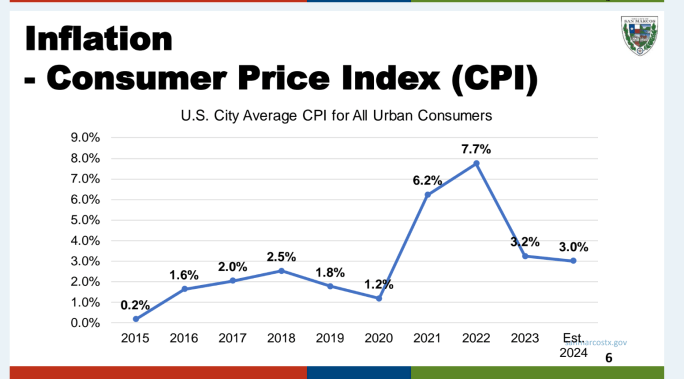
And while inflation is back to a normal healthy amount, it still exists:

So due to a larger population and 3% inflation, it will cost more to run the city more next year, even if we don’t change what we’re doing.

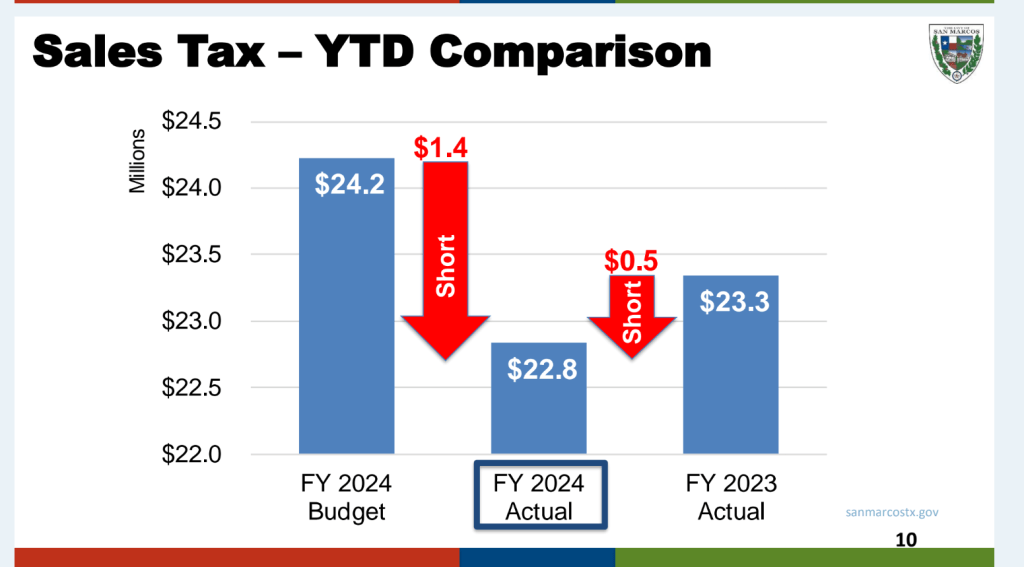
But unfortunately, we took a big hit on sales tax:

This is sort of a cumbersome chart. It’s doing a few things simultaneously.

So you see where it says October 2023 is 6.6%? What that means is:

  1. Average all the sales tax revenue from October 2021 to October 2022.
  2. Average all the sales tax revenue from October 2022 to October 2023.
  3. Work out the percent growth from the first average to the second average. For October, the past 12 months were 6.6% bigger than the previous 12 months. Great!

But you can see how this plays out over 2024 – we kept shrinking and then turned negative. So the average the sales tax income from April 2023 to April 2024 is smaller than it was over April 2022-April 2023. That is not good.

Who’s coughing all this up, anyway?

I would not have guessed that!

(I would say it’s their customers, not the business, but you get the point.)

No one else is having this problem. Just San Marcos:

No one offers up an explanation, because I don’t think anyone has one? Nobody knows if this is a shortterm fluke, or if it’s the beginning of something bad. We can’t know until it plays out a little more.

Anyway, here’s the bottom line:

We do not have the money we thought we’d have this year.

So we have to do two things simultaneously:

  1. Figure out how to tighten our budgets mid-year. There are established contingency plans on how to do this, but it’s not, like, fun to do.
  2. Figure out how to plan for the 2025 budget, if we’ve got more people and slightly higher prices, but less revenue.

Can property taxes make up the difference? Basically no.

First off, sales tax is a bigger chunk of our budget than property taxes:

But second, even though homestead prices are going up:

they’re not going up by as much as they had been going up.

The blue portion is the key amount:

So the city is expecting to collect 1.3 million more dollars next year than this year. It’s growing, but not enough to keep up with inflation and a larger population. Not like the past two jumps: from 2023 to 24, we jumped 6.8 million, and the year before that, an extra 5.8 million dollars.

So here’s the bottom line:

We are looking at being 2.3 million short this year, and 1.12 million short next year, if we don’t do anything different. Ouch.

I mean, we’re going to tighten belts, etc. The city is smart, there are plans to implement. But they involve hard choices and going without good things.

Here’s how we’re handling 2024:

Basically, that’s how they’re handling it. And they’re working on making next year’s budget work on a shoestring, as well.

One last thing:

There’s a new law that caps the how much business property appraisals can increase each year. Any non-homestead can’t grow more than 20% in a year. Or rather, the appraisal can come in higher than that, but you won’t be taxed on the excess.

Now, this only affects businesses appraised under $5 million. The problem is that we have a high number of small rental properties, and they all qualify. So we’ve lost $123 million of taxable land value, which works out to $745K from the budget.

Bottom line: the city has to tighten the budget. Kinda a giant bummer.

Presentation 2: There was also a presentation on the 2025 Capital Improvement Plan.

The CIP plan is all the major city projects, like re-doing the drainage for a street so it doesn’t flood anymore, or whatever. Basically it takes a lot of longterm planning. I don’t have much to say about it besides that they emphasized how much they’re trying to apply for lots of grants.

Hours 0:00 – 2:08, 4/16/24

ANOTHER FIVE HOURS MEETING! They’re trying to kill me over here!

Citizen Comments:

There was a full hour of citizen comments.   It was basically a repeat of last week:

  • Yes we love these Lindsey Street apartments! (9 speakers, but many work for the developer)
  • No, we hate them! (Seven speakers)
  • Ceasefire now in Palestine! (Four speakers)

Also Virginia Parker, from the San Marcos River Foundation, but I’ll save her comments for that section.

I mean, people did say some new stuff. I’ll save the relevant parts for the Lindsey Street discussion.

And, really, pass a ceasefire resolution already.

….

Next up we have some financial reports. 

Items 1-3:  Q1 Financial reports, Investment Reports, CBDG audit.

Here’s how our general fund is doing:

Just a note: “2024 YTD” is weird and confusing! Just to be clear, we’re talking about October, November, and December of 2023. It’s Q1 of Fiscal Year 2024. And “2023 YTD” means the last three months of 2022.

Anyway: The green bar is a little low. This is because property tax payments are coming in more slowly than last year. The speaker didn’t say why, but I assume it’s because Prop 4 passed in November, and so people got their tax bill later than usual. But the guy reassured us that it’s fine.

There’s also six Enterprise Funds: electric, water/wastewater, stormwater, resource recovery, airport, and hotel. They’re all fine! Everything’s fine!

Item 4: Short Term Rentals

We discussed short term rentals here and here already. We used to ban parties and require that STRs be owner-occupied, but (I think) the courts struck this down and so we had to rewrite our rules?

Loosely speaking, here’s what’s being proposed:

  • All STRs would need a permit. 
  • Owners can only have one STR.
  • Only one STR on a block, or at least 600 ft apart.
  • Short-term tenants can have parties, but not excessively noisy ones, just like any other resident.
  • Everyone who lives within 400’ gets a postcard with a hotline number to call if you’re having any trouble.

At the March meeting, both Shane Scott and Alyssa Garza voted no, but they didn’t exactly say why.  Jane Hughson chided them to come back with amendments that make it work for them.

To his credit, Jude Prather did come back with amendments to make it work. This is good governance! Let’s problem-solve! 

Jude proposes that we strike the limit per block.  In other words, anyone can have an STR wherever they want.  His reasoning goes that everyone should be able to rent out their own home, regardless of whoever pulled a permit on your street already.

Matthew Mendoza doesn’t like it.  You could have whole blocks which are full of STRs! It’s happened before, like on Riviera Street!

This is Riviera Street: 

You might recognize this backyard from the river:

right when you’re floating here:

I got those two images from the VRBO listing, so feel free to rent it yourself if you want.

Riviera’s probably the only place in central San Marcos where backyards open up right on the river, so yeah, I can believe Matthew when he says that they’re all STRs.  (And he also says they each have different owners – it’s not a case of one outside developer buying up the whole block.)

What do I think?  Eh, I think it’s fine.  I don’t think entire blocks are going to get bought up, in general. The other rule – “1 rental per owner” – is really much stricter than the “1 per block” rule, as far as preserving your housing supply. 

And it seems reasonable to allow everyone to at least rent out their own homestead. If I had an ADU and I couldn’t rent it out because someone down the block was already renting theirs out, I’d be annoyed.

The vote to strike the “1 per block” rule:

Yes: Alyssa Garza, Jane Hughson, Mark Gleason, Jude Prather, Shane Scott
No: Saul Gonzales, Matthew Mendoza

The vote on the whole set of STR rules, all together:

Yes: Alyssa Garza, Jane Hughson, Mark Gleason, Jude Prather, Shane Scott
No: Saul Gonzales, Matthew Mendoza

So there you have it. Done.

Item 7: Water Restrictions:

We’re writing new water stages.  Twenty years ago, we got a bunch of money from the state to start up ARWA, which drills from the Carrizo-Wilcox aquifer and requires a little more treatment before you drink it.  

That investment is finally showing up:

I’m guessing that’s the reason we’re re-writing our drought stages? Maybe not?

(Confidential to city staff who deal with water stuff: your slide is a few years out of date and it’s throwing me off, because I thought we weren’t getting ARWA water until later this year?)

Now:

The main thing that’s happening is that we’re going from 5 drought stages to 3 drought stages. This is supposed to make it simpler for everyone.

But there’s one other thing I want to discuss.

Last time, Virginia Parker from SMRF spoke about how the drought stage triggers were being recalculated.  The staff person said hey, no worries! We look at all the sources! The details aren’t in the ordinance, but it’s department policy. No worries! So I didn’t worry.

This time, Virginia Parker spoke again and made the same point.  However, this time it was a different staff member, and his answer was VERY different.  So let’s dive in.

Background for Parker’s concern:

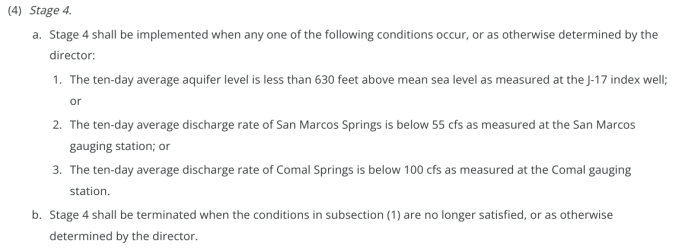
There are triggers that cause you to go from one drought conservation stage to the next. Under the old rules, we checked the Edward’s Aquifer level, the Comal level, and the San Marcos Springs level. If any of those were low, we moved to the next stage.

For example these were the triggers for stage 4:

(Full text here. ) The J-17 well is the Edward’s Aquifer. So we measured three sources, and if any of them were low enough, it would trigger stage 4.

Under the new rules, the drought triggers are very different. What we do now is combine all the sources first, and then check how much of the total we’re using. So if one source is running low, another source can compensate, and we don’t enter drought restrictions.

Here’s the specific text:

It’s way less detailed than the old triggers.  Take Stage 2: “The average daily water consumption reaches approximately 75% of the rated available water production capacity for a seven-day period.”

In other words, now we take Edward’s Aquifer, Comal, and our new water source Carrizo, and we add all those together. Any one of them can be really low, but maybe the others compensate. If we’re using 75% of the combined total, then we’ll go into Stage 2.

You can see the scenario that Parker is worried about: The Edwards Aquifer could be way down, and our river is super low, but we’re not under any drought restrictions because the supply from Carrizo.

Here’s the answer we were given this time:  

We’re allowed to use a certain fixed amount of Edward’s Aquifer water until the Edwards Aquifer Authority says otherwise. And dagnabbit, we’re going to use it, because it’s the cheapest water we’ve got, and the way our pipes are set up means that we can’t easily switch from one source to another.  The EA water keeps our system pressurized.

When the Edwards Aquifer Authority tells us we have to cut back, we cut back. But otherwise we just take the same amount every week.

Jane Hughson: Would it be possible that Edwards Aquifer is in severe drought, like stage 3 or 4, and we’re still in stage 1? 

Answer: Yes! That could happen.

Jane: What about people in San Marcos on well water that comes exclusively from the aquifer? We’d be telling them that San Marcos is Stage 1, but they’d need to know that Edward’s Aquifer is in Stage 3.

Answer: We’ll have to publicize both stages. But we include the usage of people on well-water in our budgeted Edward Aquifer totals.

Jane does not like this. Neither does Jude Prather or Matthew Mendoza.  Neither do I!  It just feels icky to say that “haha, we’re going to use all this LUSH PLENTIFUL WATER no holds barred” in the middle of a drought, because we’re shipping it in from another part of the state.

I see what the city staff guy is saying, too – our Edwards Aquifer usage doesn’t fluctuate. End of story. Conservation doesn’t help the aquifer and being wasteful doesn’t hurt it.  But he’s being a cold engineer about how real people internalize drought stages.  Drought stages are also about setting people’s expectations and communicating to people that we need to be good stewards of our environments. 

Yes, we’ve planned well and gotten into a healthy water supply situation.  But if you zoom out, the entire state needs clean drinking water for decades to come, so let’s not be all “WE GOT OURS, SUCKS TO SUCK!” to everyone else. 

In the end, everyone votes to approve the plan, 7-0. As Jane puts it, “I have concerns, but I’m willing to see where this goes.”

Hours 0:00 – 1:44, 3/19/24

Citizen Comment period:

People spoke on:

  • the proposed student housing on Lindsey street (much, much more to come)
  • San Marcos Civics Club, inviting Councilmembers to drop in.
  • In favor of turning the Mitchell Center into an African-American History museum, overseen by the Calaboose board. (This is an item on the Executive Session agenda, so I don’t have any other info on it.)
  • Five people spoke in favor of a council resolution calling for ceasefire in Gaza. (Discussed a bit last time.)

Items 1-3: Financial reports.  All about Q3 2023, which is last June-September.

How did last summer go?

We came in under-budget and over-revenue.  Great.

They also went through the special funds: Electric, Water/Wastewater, Stormwater, Resource Recovery, Airport, and Hotel Tax.  It all seemed like normal fluctuations to me, but knock yourself out if you’re curious to know more.

The auditors gave us a clean bill of health for 2023. You’re welcome to read that, too.

Item 16: We’re knee-deep in next year’s budget. I haven’t watched ANY of the budget planning sessions, because they’re dull as rocks, and I say this as someone who finds council meetings riveting.

I think this is the key part of the Budget Policy Statement:

What does “Eviction Services” mean? We’re helping the tenant and not the landlord, right? We’re not the baddies, are we?

In part A, “Mental Health Diversion” sounds promising. None of this got any discussion at Tuesday’s meeting, though.

I’m not sure what distinguishes As, Bs, and Cs. Funding level? Different departments? Urgency?

Item 17: The city bought Quail Creek back in 2022.

We bought it, but it wasn’t inside city limits. So now we’re annexing it. 

Google maps tells me that it looks like this:

Nothing I enjoy better than the derelict remains of former wealth, as it returns to the common good!

….

Item 18: LIHTC projects are low income housing complexes, where the developer gets some tax breaks in exchange for building affordable housing.  (We talked about LIHTC projects last month.)

These guys want to build affordable housing right behind the high school:

Great!  

How affordable is “affordable”?  

What this means is that there are 348 apartments, and all of them will be priced so that they are affordable for people making $58,401 – $70,080.  

What does “51-60% AMI” mean?

AMI stands for “Area Median Income”. In other words, the AMI is the middle income in the town. So then “51-61% of AMI” means these apartments are for people earning roughly half of the middle income, or a little more. On the poor side of the AMI though, for sure.

Hopefully you’re thinking, “Wait, what? How is $58K-$70K on the poor side, for San Marcos!?”

It’s not! Here’s where the hocus-pocus comes in. San Marcos is part of the Greater Austin-Round Rock Metro statistical area. The median income for a family of four in Austin is $122K. And therefore 51-60% of that gives you $58,401 – $70,080.

Now! What about down in San Marcos? Well, our median income is $47,394.   In San Marcos, 50-61% of $47,394 would be $24,170-$28,436.

People earning $58K-$70K in San Marcos are above the median income. These households are on the richer half of San Marcos. Not actually rich, but relatively well off for San Marcos.   It’s completely absurd to call this apartment complex “affordable” or “low-income”.  These are regular, market rate apartments for regular, old San Martians. 

But here’s the thing: they’re not applying for tax breaks from the city. They’re only applying to state tax breaks. So this isn’t costing the city anything. 

Still, they’re getting tax breaks from the state. Are they at least providing services that go above and beyond?

Eh, not really. Pretty bog-standard. 

City Council is happy with this because we’re not giving away any money. So they give it a thumb’s up.

Look, as far as San Marcos goes, this is fine. It’s housing.

But they’re still jerks! They’re diverting funding that would otherwise subsidize actual low-income housing. They’re getting a subsidy, without helping the people it’s supposed to help. It’s not technically illegal – we’re within the Austin MSA, so officially our median income is $122k. Just kinda shitty of them.

Hours 0:00-3:19, 9/19/23

Citizen Comment:

There was a big turnout tonight!   21 speakers total, and more speaking at public hearings later during the meeting. The whole citizen comment lasted over an hour.

The main topics were:

  1. The can ban, by far. People who do the work of pulling trash out of the river have a lot to tell you about why we need to ban single use containers.  16 of the speakers talked about this, including the mayor and some councilmembers from Martindale.

Some notes:

  • It would actually be a ban on all single-use containers.
  • New Braunfels and Martindale both have bans, and they’ve made a huge difference. Plus you save money on trash clean up.
  • The key is to educate and get buy-in from residents. Not just ticketing people.

2. Selling our water from the Edward’s Aquifer to Kyle

  • For the second year in a row, Kyle has run out of water and wants to buy some from us.
  • Virginia Parker, from the San Marcos River Foundation, talks a lot about this: their conservation efforts are shoddy. Sell them the water, but make it contingent on tighter water conservation.
  • The city doesn’t agree with SMRF’s criticism. We’ll talk about this when we get there.

3. The taxes are too dang high

  • There weren’t actually a ton of people who showed up in person, but council comments give the impression that they’ve been swamped with complaints behind the scenes.

4. Notification radius for development agreements – it should be appropriately large

  • This is mostly about the SMART Terminal, and how no one knew ahead of time that it was a thing, until it was too late. But it’s also happened with other issues, too.
  • The city is going to start sending notifications to neighbors in these situations. They’re offering a 400′ notification radius. The problem is that the SMART Terminal is supposed to be 2000 acres, which is 87,120,000 ft2. The 400′ notification is the tiniest sliver around something that big.
  • As we’ve said before, the notification radius should be proportional to the size of the project.

Finally, Dr. Rosie Ray offers some good improvements for the Comp Plan, but I’m going to save those for the VisionSMTX discussion so that I can put them in context.

… 

Items 5-8, 16-18The budget, the tax rate, and the rate hikes.

We talked a lot about the budget here last time, and I was an insufferable blowhard about the virtues of paying your taxes. (I still am! Sorry!)  So I don’t think we need to recap all of that. 

The short version: the tax rate is steady, but housing prices went up, and so the amount everyone pays is going up. Also utilities are going up.

Clearly councilmembers got an earful about property taxes and the appraisal process. I can’t tell if people are mad that appraisals are so high, or that appraisals are done poorly. If it’s incompetence, that’s a different problem than skyrocketing costs.

This is a useful slide, which is totally illegible:

Would you like it to be clearer? ME TOO. Unfortunately, this slide is not in the packet, and so I had to take a shitty screenshot. 

If you promise that I’m your favorite blogger, I’ll transcribe the damn thing for you:

2022-2023: Average monthly bill2023-2024: Avg monthly billMonthly increase
Electric$93.01$94.72$1.71
Water$56.47$59.29$2.82
Wastewater$48.26$50.67$2.62
Stormwater$14.90$14.900
Resource Recovery (ie trash and recycling)$28.80$29.55$0
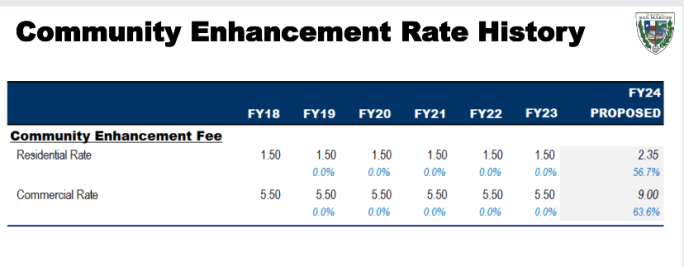
Community Enhancement$1.50$2.35$0.85
Property Tax$160.53$182.42$21.89
Total$383.47$414.01$30.54

All of those are based on a $338K house and average usage.

Listen: $414 is a lot of money per month.  I don’t want to be flippant about that.  In addition, you’re paying SMCISD and Hays county taxes, at a rate of $1.133782 and $0.3125, respectively. So that’s another $3832.18 to SMCISD and $1056.25 to Hays County, which works out to a monthly total of $821.38 per month.

That stings! BUT.

1. The first problem is that we’re bringing the sting of paying $821.38 to a conversation which is really only about the property taxes part, which is $182.42.

2. The next problem: there’s actually not much to cut. Core services are really important. The city actually runs a lean budget. You are getting mostly-maintained roads. You are getting smart people with degrees to make sure that the buildings are safe and conform to what we have all agreed that we want buildings to do.  You’re getting libraries and librarians. You’re getting a phenomenal park system and park staff that work there.  You’ve got cops that will (mostly) show up if you’re in danger and (hopefully) arrest the right person (that’s a conversation for a different day.) You’ve got firefighters to show up if you have a fire.  And you’ve got to pay all these people fairly. That $182 is going to really important stuff, and I’m sorry that it’s invisible, but it’s as important as keeping the lights on in your house. 

3. We can reduce the tax burden through city planning – increase density in gentle ways.

Listen: single family neighborhoods do not bring in enough tax revenue to pay for themselves. Cities compensate by taxing apartments and business at a higher rate. If you live in a house, you are already being subsidized by apartments and businesses.

We’ll talk about this a LOT later.

4. You should absolutely be angry, because the rich should be paying so much more.

Both locally and statewide, taxes are super regressive – 2nd worst in the country, in fact! The poorest 20% of Texans pay 13% of their income in taxes. The middle 60% pay 9.7% of their income, and the wealthiest 20% of Texans pay only 3% of their income in taxes.  This is utter bullshit.  

This is because the main tax at the state level is a sales tax. Sales taxes are the most unfair taxes. If you live paycheck to paycheck, you get taxed on your entire paycheck because you spend everything you earn. But the wealthier you are, the more buffer you have between the money you spend (and get taxed on), and the money you put in investments, tax free.

San Marcos also has a 2% sales tax. Obviously this is in order to cash in on the outlet malls, but it’s also another flat tax hitting our poorest residents the hardest. In fact, we actually bring in more money from the sales tax than property taxes: the sales tax brings in $42 million, the property tax brings in $37 million.  

Remember the part about how poor people pay 13% of their income in state and local taxes? They are only earning $14,556 a year. The state makes $2037.84 off that poor guy.

Whereas the top quintile paying 3% of their income? They earn $228,924 on average. The state makes $6,867.72 off the rich guy.

If you taxed the rich guy at 13%, Texas would get $29,760, and he’d still have almost $200K left! We could do so much more to alleviate poverty and help communities, if we taxed the rich fairly.

5. Property taxes are not as unfair as sales taxes. They’re not great, but they’re not the worst. But you know what’s the ACTUAL WORST? The state proposal to use a surplus from sales tax to refund property taxes. Texas is literally going to redistribute money from the poor to the rich. This makes me lose my goddamn mind.

(If you think that landlords will lower rents with that money, you are high on your own supply.)

And the state needs that money! Might I suggest using it to REPAIR THE GODDAMN FOSTER CARE SYSTEM?

You guys, this conversation is making me sweaty. I need to bring it back to local issues again.

Sorry. I got really shouty. Ahem.

Let’s start from the beginning.

Utility rate hikes: water, wastewater, trash/recycling, and community enhancement are all going up a little. On average, you’ll pay $8/month more.

The Vote (tucked inside the consent agenda)

Raise them rates! Jane Hughson, Shane Scott, Jude Prather, Matthew Mendoza, and Mark Gleason
Don’t you dare: Saul Gonzales and Alyssa Garza

I strongly disagree with Saul and Alyssa on this vote. These are four areas where responsible use can drive down costs.  We need to be mindful when we’re taking a long shower, or lowering the AC, or watering the lawn.  Don’t subsidize people being wasteful.

These rates should be priced so that each fund is self-sustaining. Separately, we should fund utility assistance for those who can’t afford the cost. In other words, we should keep doing exactly what we’re doing.

Next, the budget conversation.  

The public hearing:

  • City staff made some 3 minute videos to explain the budget process to the public. They got like 50 views total. [Scroll down here if you want to see them.] That’s not successful. None of you shared those videos on social media or anything. None of you held town halls.
  • We pay money to contractors to do big surveys and we don’t use the results.
  • City staff is paid too much under this budget.
  • We’re taxing people out of their homes!
  • There’s no transparency and no environmental accountability!

Let me single out one speaker, Noah Brock, who is making a very different, specific point:

  • The Highway 80 Utility project only connects to two properties: some city property and the SMART Terminal property
  • The water and wastewater funds directed to this project have spiked hugely:
    – It’s going to use $10 million /60% of the water fund. This was 1.5 million last year.
    – It’s going to use $15 million /49% of wastewater.
  • Why are you raising rates 5%, and then directing $25 million for the SMART Terminal?

I have no answers.

Council discussion

Saul Gonzalez asks about freezing property taxes for anyone over age 65.  He brings this up several times throughout the night. Do other cities do this?

Answer: Yes, cities like Killeen do this.

Saul asks how they make up the revenue?

Answer: their tax rate is higher. 

(I don’t think Saul likes this answer.)

Next up is Alyssa: She is a no on this budget.  We’re not fixing our problems. Incremental change is not meaningful change. There’s a lack of transparency and participation. We need a more equitable process and we need to provide tax relief.  We’ve got big problems – we need good paying jobs, we need affordable housing, we need to help the homeless. We’re doing nothing on those problems.

Jude Prather: This budget achieves those five goals we laid out! It’s great.

Mark Gleason: I wouldn’t be voting for this budget if we weren’t going to get all this property tax relief from the state.

(Yes – that sales tax surplus from all Texans that will go to just property owners. How nice for some.)

Shane Scott is totally in campaign mode. He hasn’t given a speech all year.  But here we go:

  • Since he was first on council, the budget has gone from 1.5 million to 3.5 million
  • He fights for the lowest costs.
  • “They should be paying for OUR lifestyle – we were here first!” I have no idea who he has in mind with this, but sure.
  • Cost of food, single moms
  • He doesn’t want to risk lowering our bond rating.
  • Safety, hooray!
  • Participation, hooray!

And my favorite part: voting on this budget literally makes Shane Scott puke… but he’s a yes.

Jane Hughson: Look, the property taxes are going up $22/month.  I’m a yes.

Matthew Mendoza: I want to puke too, just like Shane! But I’m a yes.

So everyone has staked out their basic positions on the budget.

The conversation then turns meta

What went wrong that everyone is so unhappy at the final stage? We’re going to have a big conversation on this. Here’s the positions that everyone stakes out:

  • There’s an 9 month process and we’ve given you tons of opportunities to share why you’re unhappy. This is bullshit to bring it up now.  (Jane, City Manager Stephanie Reyes)
  • We’ve said that we’re unhappy at every step of the process! And we have an obligation to represent the unhappiness of the community, and the community is freaked out by property taxes. (Saul, Alyssa)
  • It’s no one’s fault – it’s the appraisal calendar and the tight turnaround, and how difficult it is to communicate with the public. We feel great shame. (Mark Gleason, Matthew Mendoza)
  • Wait, I thought we agreed that everything was great. (Jude)
  • I already gave my one speech, why are we still doing this (Shane)

Here is how the conversation unfolds:

Jane Hughson says to council, “Save these speeches for January, when the next budget process starts up again.  Voice these issues during the Visioning Process.”

In other words, if you all are mad about different things, use the budget process. Bring this up from day one.

Alyssa counters, “The Visioning Process does not work. It has nothing to do with the actual needs of San Marcos. It’s tone-deaf. Stop romanticizing the strategic goals and using them to accept the status quo.”

This is true – the budget process takes last year’s budget, and tweaks it incrementally, according to Council direction. It cements the status quo for another year. It’s never going to produce transformational change, which is what Alyssa is here for.

Alyssa believes sincerely and deeply in citizen participation – this is how she’d fix the budget process.  This is where I disagree. First, I’m a little more cynical: everyone’s busy.  I don’t think there’s an outreach effort on the planet that will engage a real number of citizens until they see the price tag, at the very last minute. (And frankly, people can be idiots about how to run a town when they do show up.)

But note: Alyssa is not proposing a concrete, alternative budget with different priorities that she can point to. This is why I’m interpreting her vote as a protest vote against a complacent status quo, and not a counter-proposal for a realistic alternative.

This next exchange is really crucial:

City Manager Stephanie Reyes:

“This is disheartening. This did not happen in a vacuum. We rely on each of you, as elected officials, to talk with our neighbors. You represent your constituents within the community. We expect to hear a diverse set of thoughts and ideas at every meeting. Every budget meeting has been in an open forum, with citizen comment and Q&A afterwards.

“You hear a lot about the things that city staff does not-so-good, and there’s not a lot about the things that we are doing that are going very well within our city. And that is very frustrating, because that is what staff hears. Staff gets a lot of bad raps, but they’re carrying out Council direction that you all make as a group.

“I also hear “hey, we can’t tax our neighbor out of their home” but I also hear “oh we don’t want commercial development” or “oh we don’t want these things”. We can’t have more and more and more and not have anybody to pay for it. Somebody’s got to pay for it. So either expectations need to come down, and what gets asked of city staff to do more, or we need to temper our expectations in a way that is within what we can afford.

“Staff is not formulating this budget in a vacuum. It’s a conversation, it’s been a dialogue, there have been different junctures, we’ve gotten direction from each one of you, every step of the way. And now at the end to make it look like it’s just our budget? I just don’t think that’s necessarily a fair way to portray that.”

(I shortened and edited her words, but I don’t think I misrepresented her. It’s at 1:53 if you want to listen for yourself.)

Alyssa replies:

“I hope you’re not trying to imply that my discontent is news to you or anybody else. I hear your frustrations. Let me take a second to share mine. I feel that staff feelings are constantly weaponized to foster this sense of guilt about speaking up. That’s my perception. I think the way I treat staff every day speaks to the fact that I value staff. I try to give kudos whenever kudos are merited, I try to have grace, I try to advocate for better things for them. Staff works hard, strides have been made on this process. That’s a fact.

“But multiple truths can exist at once. They don’t have to be in contradiction of each other. All that’s true. But it’s also true that it’s very little and these concerns from our community are not new. It sucks that you guys inherited this. I’ll just share this: when you know the caliber of what you’re working with and you know the possibility of what could be delivered , you just have really high expectations, and I think that’s what our neighbors are expecting with this whole new leadership and leadership style.

“So if it’s coming across as being dismissive or trying to intentionally hurt staff’s feelings, that’s not my intention. It’s my responsibility to echo my constituents’ frustrations. And it’s not just the ones I see, it’s decades worth of historical frustrations. And again, it sucks that you guys inherited this, but that’s just the way it is.”

(Not really edited at all. Alyssa’s very eloquent.)

They really are both right, and it’s not a contradiction. Staff solicits council input. Council ignores Saul and Alyssa and votes to stick with the status quo. Staff takes council direction and implements it. The community gets mad and blames staff.

[Here is one more truth: you will never escape “the community gets mad and blames staff.” No matter how amazing your process is, that’s how it will always end.]

Their exchange was so powerful and raw. It kind of cracked me up to hear everyone else chime in after for a piece of it:

Mark: omg omg! I’m so sorry. It’s just the calendar of when numbers become available! You guys get so many kudos. Covid AND inflation! Huge kudos. Teams. It’s just communication.

Jane Hughson: hooray for staff!

Saul: I too heart the staff! My constituents are broke. Let’s freeze taxes for those over 65.

Matthew Mendoza: We all failed. We didn’t fight hard enough. I blame me. 

The vote on the budget:

Yes: Jane Hughson, Jude Prather, Shane Scott, Matthew Mendoza, Mark Gleason
No: Saul Gonalez and Alyssa Garza

But wait! There’s more!

Next, they have to vote specifically on the property tax increase. By Texas state law, this has to pass by 5 votes. (Last year, Saul, Alyssa and Max all voted against it, and almost blew up the process. In the end, Saul switched his vote. Alyssa and Max were protesting all the extra cops.)

More public hearings
Max Baker packed 50 ideas into three minutes. LMC channeled Milli Vanili. Former councilmember Lisa Prewitt and former school board member Juan Miguel Arredondo both showed up to talk.

I don’t know how to boil it down, so I’m just writing it out.

Max Baker:
– We don’t have it’s own economic development person. We rely on GSMP.
– Maybe there are technology solutions! Why don’t we fight for those solutions to the budget?
– Why wait for January? Start now.
– Community blames staff because staff are the experts. We’re stuck with what you give us, and you get defensive.
– People also ask for FEWER Cops. The Cops are the ones that ask for more cops. Other conceptualizations of safety.
– when do we stop giving big corporations all these tax breaks?
– Appraisal problem, cover for “not raising taxes”
– why don’t we make sure people get their appraisals, and why don’t we help people protest their appraisals?
– Y no accountability? Burt Lumbreras said we should stop giving tax breaks, because it will blow a hole in the budget, but GSMP said we need it, so we did it.
– year after year, you claim you’ll fix it next year.

(This is generally what I mean when I say Max puts 50 ideas into 3 minutes. It’s a lot.)

LMC
– Sings Milli Vanilli. Staff uses a big city consultant to give themselves a 5.5% raise. And we have to cut costs. Waste in the budget. You all don’t read your packets.

Juan Miguel Arredondo
– Tax rate: I represent people who live on the margins. Those who have trouble fixing their car and buying groceries. They don’t get to decide that they are going to get pay raises to keep up with inflation. There’s no fund balance. They just have to do more with less. That’s what you have to do, too. Your choice will cause poor people to make hard choices.

Lisa Prewitt
– ditto everything. everyone is right from their own perspective and we can’t judge. But I did the Visioning workshop for six years and we did talk about freezing seniors. We’re all in this together. We’re all trying to budget ourselves at home. Medical, medicine, groceries, utilities. Our seniors are vulnerable. They can’t get a second job or come out of retirement. When do people get a break? Another 5-10K per year? You can’t tax people out of their homes!

Look: clearly I disagree with these speakers. I don’t think that we should slash the budget to give people a tax break.

I know times are tight. But you absolutely cannot lift someone out of poverty with a tax break. You can break poverty by raising the minimum wage to keep up with inflation, and implementing well-designed social programs, affordable healthcare and housing, and wealth redistribution. But not with a $500 tax cut.

City staff deserve to be paid fairly. The budget is lean. Nevertheless, we’ll talk in the next section about how to reduce the tax burden.

Spoiler: no one wants to do it.

Council conversation

It’s more of the same:

Saul

Saul goes back to his thing about freezing taxes for seniors: I want to ask Juan Miguel Arredondo about how the school board freezing taxes for seniors. Did you all do that?
JMA: I wasn’t there, and it’s complicated, and we went into debt. 

Saul: How do appraisals work, anyway? 

Answer: Houses are appraised on January 1st. And remember, there’s a 10% cap. And remember, you can protest your appraisal and get it adjusted downward.

Saul: All my appraisals went up and I had to raise all my rents.

Jude

Jude: Look at all these good things! Tax rate is steady, homestead exemptions, state tax relief will be retrospective!

Alyssa

Alyssa: What should I say to our neighbors when they say that we should use the general fund to close the shortfall?
Answer: Tell them it’s not sustainable. The general fund is for one time expenses, not recurring expenses. 

Alyssa: How are we helping renters? I’m concerned about utility increases, which disproportionately impact renters.

Note: this is not entirely true. Living in an apartment is much more environmentally efficient than a house. You get some savings on heat and AC because you’re insulated by other apartments. You’re not playing dumb games trying to keep your yard green in a historic drought. You’re presumably sharing the trash/recycling bill in some form.

Mayor Hughson

Jane: Appraisals are legally required to rise and fall with what people are actually paying for houses. The sales prices skyrocketed last year. Nothing sneaky happened.   They seem to be cooling, they could come back down.

Mark

Mark Gleason, being smart: I’m not in favor of freezing property taxes for those over 65.  Instead, we can increase their homestead exemption on a regular basis. That helps the poorest homeowners more than it helps the wealthiest homeowners.  

Note: I agree 100% with this. Some seniors are rich and have million dollar homes, and you don’t need to freeze their taxes. Homestead exemptions help house-poor home owners more than wealthy home owners.

The Exciting Conclusion

Alyssa: Can we change the tax rate?

Answer: Yes. It would blow a hole in our budget.  But we’re under a time crunch – if we don’t pass a budget by September 30th, we automatically revert to the 0.503 tax rate. This would cost us $6 million. 

Stephanie Reyes: THE TIMELINE. THIS DID NOT HAPPEN IN A VACUUM!

Alyssa: OUR NEIGHBORS. THEY ONLY JUST HEARD ABOUT THIS AND ARE VERY MAD!

Shane Scott: Can we make it up in sales tax? 

Answer: We’ve gotten a $1.6 million surplus recently, but we really can’t use that for recurring expenses. 

Alyssa: I’m a no. I’d take vacation and do whatever it takes to rework the budget by October.

Mark Gleason: The time for this was two months ago. I know the public doesn’t become aware until the 11th hour.  When we have overages, it goes to public safety, like I wanted. We just literally can’t change it at this late an hour.

Saul: My constituents want more services for less tax.

Jude: Political instability is bad for fiscal stability! This should be a 7-0 vote. We should have hammered this out all year.

Alyssa: I’ve been saying this ALL YEAR. And these are my neighbor’s concerns, not mine.

Matthew: How would not-passing the tax rate work? 

City Manager Stephanie: DON’T YOU DARE. Please.

The vote:
Set the tax rate to pay for the budget we already passed: Mayor Jane, Shane, Mark, Matthew, and Jude
Blow it up to smithereens! Saul and Alyssa

One Final Note

The thing that kills me about this conversation is that no one connects it with the VisionSMTX conversation.   Single family housing sprawl is a wildly expensive way to run your city!! Every single aspect of your city costs more!  Running infrastructure down to Trace, out to La Cima, up to Whisper, and out east to the new Riverbend Ranch is what’s stretching our resources so thin.

You must put more people in these areas. Gently densify things – allow duplexes and triplexes, allow ADUs – you share the tax burden among more people, and tax rates can go down. 

(Also, quit just putting giant apartment complexes on the edge of single family sprawl. Economic integration is important.)

Hours 0:00-2:36, 9/5/23

Citizen Comment:

The main topic of the night is the budget, so the main complaint during citizen comment is that taxes are too high. Taxes are too high, and also the city isn’t solving all our problems, which is basically the municipal equivalent of “the food was terrible and the portions were too small!”

(And also, people hating on the bike lanes.  Everyone loves to hate the bike lanes.  If you love bike lanes, I suggest you let City Council know, because the anti-bike lane people are kicking up dust.)

Confidential to city council: I like the bike lanes. Let’s keep bikers alive.

Back to taxes. I’m going to tell you a little parable of my cat: 

I had a lovely tomcat who was scared of the vacuum cleaner. Whenever I ran the vacuum cleaner, he would lose his mind and attack my shoes.  He would just beat my poor shoe all to hell. (I tried not to vacuum very often.)

That’s the end of the story!

Here’s the thinly veiled moral: Being mad about taxes is like my cat attacking my shoe.  Don’t be mad at taxes for your justifiable economic woes.  You are neck-deep in capitalism! Be mad at that! You are right to feel worried that a medical disaster could undo everything you’re working for, or that you might be destitute in your old age, or unable to help out your kids.  The real crime is that someone can work fulltime and not be able to cover their basic needs.

If you know, if you truly 100% trust, that you’ll always have clean safe housing, healthy food, and free medical care readily available, then your life is much freer.  That’s the paradox: we pretend this is freedom while paralyzing ourselves with anxiety.  We’re such a mess.

Anyway, hooray for taxes.  Hooray for a social safety net, and if only it were much stronger. We’ll talk more about who gets tax breaks, and what kind of charity that is, a little later on. In the meantime, if you’re still mad about taxes, scroll through this little demo on the scale of economic inequality and get back to me. 

One comment that’s not about taxes: Virginia Parker spoke on behalf of the San Marcos River Foundation. Basically:

  • Everyone is freaked out by the river and parks right now
  • The summer was so hot, the river is so low, the parks are so overused
  • We desperately need more park staff and marshalls.  (These are her words. I’m not totally clear on what the marshalls do.)
  • We should have paid parking with free passes for residents to help offset costs
  • Only remaining vegetation are those fenced off Habitat Protection areas, and keeping that vegetation is crucial to keeping the river clear
  • We’re spending a bunch of money to promote tourism, but with the river in its current state, that’s kinda irresponsible. 

Item 13: The 2024 $315 million dollar city budget.

It takes 9 months to birth a budget. Here’s the basic timeline:

At the workshop last January, Council came up with their goals that are supposed to shape the whole process: 

They are all important, but public safety was the one that council really hammered, over and over again.  “Public safety” can mean so many different things to different people!  Do we mean lifting people out of poverty? Do we mean vocational training for ex-offenders as they transition to private life? Do we mean hiring more cops? (We definitely mean hiring more cops.)

The budget has a ton of moving parts, obviously.  Here’s the bird’s eye view of the whole thing:

Here are the major points that were emphasized:

Note:

  • The compensation study is to help us retain city staff. This is important – high turnover is incredibly expensive. Also, it’s just good manners to compensate people fairly.
  • The Human Services Advisory Board money is the money that the city gives to local nonprofits.
  • New city hall: there’s a state law that you can’t borrow money for a city hall building. (It’s wild what the state legislature will micro-manage.) So if your city hall was built in 1975 and you’ve outgrown it, you have to sock money away under a mattress until 2075, when you’ll be able to afford your new city hall.
  • Capital Improvements Program: this just means city projects and repairs. Fix the stormwater drainage in this neighborhood, add in sidewalks over there, etc.

So is this a good budget? Does it achieve those five goals? I don’t know!

Last year, city staff presented Council with 2 similar plans, and they debated them. Would we go with 59.3¢ or 60.3¢ tax rate? Would we use the extra $700K on cops and firefighters?  Last year, Chief Stephens and Chief Standridge came in person to plea for personnel. This made it easier for me to understand those aspects of the budget being discussed.

This year, there was just one budget and just one tax rate proposed. No debates. No lingering questions posed.  City council basically didn’t say anything besides thanking staff for their hard work. (And I listened to most of the workshops, and never heard much arguing there, either.)  There are two possibilities:

  1. Staff is just great.  They’re producing top notch budgets, and there’s not much to argue about.
  2. No one on council has strong feelings about these things, and no one has an angle to dig in and get heated up about anything.

Probably both are true? It’s very hard to figure out what people are thinking when no one says anything substantive.  

Here is the actual budget. It’s pretty readable!  It’s just hard to evaluate.

Item 14: the tax rate

We’ve been over the different tax rates before, so I’m going to save my pixels and just use the city’s slide:

The 60.3¢ rate is the same as last year.  Of course, inflation’s been a thing.  So how much are taxes going up? 

The average home went from $294K to $338K, so the average homeowner’s city property taxes are going from $1,686 in 2023 to $1,949 in 2024. 

Details:

(Now, this is only part of your tax bill. You also pay SMCISD and Hays property taxes.)

Let’s talk about the (15,000). That’s the homestead exemption.  In other words, you get a 15K discount before we charge you property tax.  This was created in 2022. It also gave seniors and people with disabilities a 35K deduction. 

Was this a big deal? Yes and no:

It costs us about $1.1 million dollars, out of $315 million budget, to do so.  Every home owner in San Marcos gets to evenly split $1.1 million dollars. None of them think that they just got a $90 bonus check from the city, but they did.

Here’s the thing:  We spend $550K on funding various nonprofits around town.  (This is the whole Human Services Advisory Board thing.)  We hem and haw and dole out $15K here and $25K there, and make nonprofits put in a ton of work for little amounts of money.  

At the same time, we spend twice as much on charity to people who own their own homes as we spend on all other nonprofits, combined. San Marcos is 75% renters! That handout is only going to 25% of the population!

Some home owners are rich. Others are definitely not. Being house-poor is definitely a real thing, and we need to help house-poor home owners. All I want is for the homestead exemption to feel like the city sent you a physical $90 check. It should not be invisible.

If I had a magic wand, I’d say that everyone must pay their full tax bill – federal and local – and then any deductions would get mailed back as a refund.  Subsidizing the rich should feel as tangible as subsidizing the poor. 

(Why not just cure poverty with your magic wand? oh hush.)

Items 15-18: Your utility and water rates are going up.  I’m sorry.  Sort of.  Channel your anger towards structural inequality.

For electric, we’re still the cheapest around:

Don’t let anyone ever talk about privatizing public utilities.  

Here’s our water rate:

Well, it’s mid, as the kids say.

Staff says that one of our biggest water expenses is a $1.4 million contract with Alliance Regional Water Authority.

I can’t actually find the contract in the budget, so I don’t know what we’re paying yearly:

I see Alliance Water Revenue, but not an expense. (I must be looking in the wrong place, idk.)

What is this contract? Basically, in 2007 we got some funding from the state to build this organization with Kyle, Buda, and the Canyon Regional Water Authority.  We drilled 4 wells, and we’re laying a bunch of segments of pipes, and some storage tanks, and a water treatment plant.

The water looks like it comes from the Carrizo-Wilcox Aquifer, which is here:

So not TOO far away.  

Carrizo water needs to be treated – it’s got more minerals and salt in it than surface water or Edwards Aquifer water.  But it sounds like there’s a LOT of it.  During the Council meeting, staff says that this is supposed to be a 40 year plan for getting us water.  I can’t find that promise written down anywhere though.

Either way: water rights are going to be a big, messy fight coming up in the future.  It’s good that we’ve got at least somewhat of a plan. 

Along with water and electric, there’s also garbage and recycling:

and also a Community Enhancement Fee:

So if I’m ballparking all that, your rates for all these services is going from:

58.20+49.27+28.80+1.5 = $137.77

to

59.43+51.71+29.66+2.35 = $143.15

So your monthly bill is going up $5.38.

(This isn’t exactly right, because I don’t know how much electricity and water the average household uses each month. I have to assume the city gave us monthly quantities.)(They actually mentioned the total increase at one point, but I missed it, and now I can’t find it.)

San Marcos is not rich. If you are struggling, consider the Utility Assistance Program, why doncha? (That’s Community Action, but the city partners with them.)

Full disclosure: the Utility Assistance application form is a little intimidating, at least to me. It is not Community Action’s fault that their application is cumbersome. It’s the culmination of a maze-like system of scrabbling for peanuts that we impose on nonprofits.

When I say my fantasy is a strong social safety net, my fantasy is also that it will be very easy to use.

There were two moments that I want to share:

  1. The vote to raise the utility rate by 5%:

Yes: Jane Hughson, Mark Gleason, Jude Prather
No: Shane Scott and Saul Gonzalez
Absent: Matthew Mendoza, Alyssa Garza.

WHOOPS. It takes four votes to pass. So since Matthew Mendoza and Alyssa Garza were absent, it failed. 

You could practically hear City Manager Stephanie Reyes’ stomach plummet through the floor, although she is the most poised person on the planet. She politely explained that we’ve now blown a giant hole in the budget, and we’ll need to revise it, and that we may need a special session in order to get everything passed by October 1st.

With that, Shane Scott offered to switch his vote, which I’m sure was a massive relief.  He explained that he just reflexively is a “no” on rate hikes, but didn’t actually want all those consequences to come crashing down.

The re-vote:

Yes: Jane Hughson, Mark Gleason, Jude Prather, Shane Scott
No: Saul Gonzalez
Absent: Matthew Mendoza, Alyssa Garza.

Phew.

  1. Matthew Mendoza was absent during the utilities conversation, but he arrived in time for the Community Enhancement Fee conversation. This is small, but it irritated me: 

Matthew asked, “What if an evicted person decides to throw all their stuff all over their front yard? Can this fee help with that kind of thing?”

Listen: don’t phrase it like that. A yard full of possessions is mostly a sign that someone’s problems are too big for them, and I don’t mean the landlord.

Also, it’s just plain wrong. Evicted people don’t throw all their stuff all over their front yard.  Evicted people just left their stuff exactly where it was, and did not move it one inch. Someone else got mad – like an ex-boyfriend or ex-girlfriend – and threw out their stuff, or the landlord moved it all to the curb.

(The answer was no, Matthew, you cannot use this money for that purpose, why would public money be used to help landlords clean up after tenants.)

Hours 0:00-1:13, 3/21/23

Citizen Comment:  Mostly of the speakers are people angry about the SMART Terminal. 

A big fight is (hopefully) brewing.  However, the development agreement was already discussed (in a pretty pathetic discussion) in January, and then approved back in February.

This is the same problem that happened with the La Cinema studio over the aquifer last year: by the time the public hears about something and has time to organize and respond, the development agreement has already sailed through Council.

With the SMART Terminal, the developer does still need more approvals. The new land isn’t yet zoned Heavy Industrial. So there are still intervention points. But the foundation has been set, and it’s very frustrating how quickly the basic agreement gets sealed.  

In February, the SMART Terminal went to P&Z to be zoned Heavy Industrial. Because so many community members showed up and spoke at that meeting, P&Z delayed the vote a month, to give the developer time to meet with neighbors and gain their buy-in.

The speakers this week described how the meetings are going. It sounds like the developers are being giant pricks about meeting with neighbors, let alone gaining their buy-in.

When they finally met, the neighbors learned some interesting things. First, recall that SMART stands for San Marcos Air Rail Transit. It’s located right where the airport, railway – and unfortunately the river – all meet.

Anyway, here’s what the developers said to the neighbors:

  1. There’s no rail.  There’s not going to be any rail. The developers haven’t reached out to the railroad company and have no intention of incorporating the railroad into any of the five stages to be built.
  2. There’s no air traffic, either. And no plan for any future airport tie-in. 

So basically they’re planning a 2000 acre truck loading and unloading industrial site, right on the river?  It’s gone from SMART to SMT?  (Maybe the R was supposed to stand for River. The San Marcos All runs down to the River Terminal. Wheeeee.)

In response, the developers say, “Look, back in 2018, council told us this was the right place for heavy industrial.”

But let’s check that for a second:
– First off, in 2018, it was 900 acres, and now it’s 2000 acres. 
– Second, clearly in 2018, the whole point was that the airport is right next to the railroad. Otherwise, you’re just building a massive industrial complex on the river.

So as best I can tell, that is the plan: a massive industrial complex on the river.  This really seems to be a terrible idea.  Unfortunately, this council (minus Alyssa) really has heart eyes for corporations. 

Items 16 and 18: Starting on next year’s budget.

Council and department heads had a big two day workshop, where they envisioned the city for the next year in broad terms.  This statement is the result, and it’s supposed to be the starting point for the new budget.  

Here’s what they came up with: 

Each of those has 5 or 6 sub-points, and then each of those has another 2-3 sub-sub-points. So for example, under Quality of Life & Sense of Place, it says:

The whole thing is pretty long. If you’re curious, read it all here. That document is supposed to be the scaffolding for the actual budget, which gets built over the spring and summer.

As for last Tuesday, there was not much more additional discussion. Max Baker spoke during the public hearing portion, and made some points:
– Weren’t you all going to do an Equity-based budget through a DEI lens?
– Annexing distant neighborhoods blows a hole in your future budget. As soon as they’re built, you have to provide fire/EMS/PD, as well as utilities, and it costs more to staff new far-flung firehouses than you’re bringing in with taxes. Sprawl is expensive for the city.
– Budgets are moral documents.

These are all good points!

Alyssa asks her colleagues to consider a participatory budget process next year. Get the community involved. This would be great. Maybe CONA reps could solicit input from their neighborhoods, and then contribute ideas when Council puts together their strategic goals.

(Because I’m a pessimistic jerk, I can also imagine neighborhoods coming up with goals that I’d find awful, like “let’s keep poor people far, far away.” So there need to be checks and balances.)