Hours 0:00-3:44

Items 21, 24, and 25: If you want to understand the budget, it’s probably worth going back and listening to the August 18th budget workshop. But I’ll do my best.

First off:  it all comes down to property taxes. Property taxes are steep.  But let’s zoom out for a second:

  • Most of San Marcos rents.  Indirectly, property taxes get passed on to renters, but that’s not the main reason rent goes up. Rents have gone up because landlords realized they could get away with it.  When we talk about property taxes, we’re mostly ignoring renters.
  • Texas taxes are regressive.  Poor people pay 10.9% of their income in taxes, whereas the wealthiest people pay 3.1% of their income in taxes. Details here.
  • Texas could do a lot to alleviate poverty. For example:  

The United States can easily afford for every person to have a safe home, free healthcare, and access to healthy food and education.  This country is extremely wealthy.  Collectively, we can afford to lift everyone out of basic poverty.  But we don’t choose to do so. 

So: do property taxes force people from their homes? In one sense, yes. A $5000 tax bill is huge, and it can be the final straw, for a financially precarious person or family.

So should we be mad about property taxes? No. Poverty forces people from their homes. Be mad at the state and national elected officials who are complacent about poverty. Do not misplace your anger about poverty onto property taxes.  

We should work hard to keep property taxes from being the final straw that forces anyone out of their home. But the actual problem is not the local property taxes themselves.

Let’s break down property taxes:

Last year, the city had a property tax rate of 60.3¢ per $100.  Let’s say you have a house, you lucky home-owner.  Now, city taxes aren’t the only property taxes you pay.  Total, you would have paid $2.0492 per $100 of value. (Source.) Then that gets divvied up between the city, SMCISD, the county, and the special roads district.

Say your house was worth $250,000.  Then you paid $5123 in taxes. It breaks down like so:

$ 2868.88 to SMCISD  (56%)

$ 1485.67 to the city of San Marcos (29%)

$ 717.22 to Hays County (14%)

$ 51.23 to Special Roads District (1%)

So far, so good.  

The problem is that home prices went through the roof last year, right?

Suppose your $250K house is now appraised at $400K.  You should not freak out!  First of all, the state of Texas caps the increase for property taxes at 10%.  So you aren’t going to be taxed on $400K.  The most you could get taxed on is $250,000 x 1.1 = $275,000.   

Second, the city has a homestead exemption. If you live in your house (as opposed to renting it out), then you can file the paperwork and get a deduction for $15,000.  So instead of getting taxed on $275,000, you’re now getting taxed on $260,000.  Fine.  (If you’re a senior citizen or have a disability, you can get another $35,000 taken off.)

The city has boiled it down to two scenarios:

  1. They could charge you the same rate,  60.3¢ per $100, and this time you’d pay them $1567.80, based on your house being worth $260,000.
  2. They could charge you one penny less, 59.3¢ per $100, and you’d pay $1541.80.  

The city has drawn up a budget based on  59.3¢ per $100.  The big issues are:

  • What’s in the 59.3¢ budget?
  • What would be done with the extra penny, if we went for the 60.3¢ rate?

What’s in the 59.3¢ budget? 

Obviously, everything is in it. It’s a budget.  That said, they emphasized a few things in the presentation:

  • Personnel challenges: We’re terribly understaffed, across the board, and it leads to burn out and people taking jobs elsewhere, which perpetuates the problem.  So, personnel challenges.  The budget includes a 5% raise for all non-civil service employees.  (Ie, the less highly paid public employees.) Everyone gets a one-time retention incentive. Funding for an additional 47 positions (2 funded from elsewhere).
  • Additional funding for CASA, GSMP/Splash co-working, art center
  • Squirrel some money away for future City Hall.  (There’s a state law that you can’t borrow money to fund you city hall, and the voters will never approve a bond for a new city hall building. So you have to squirrel money away for it.) (Which is actually financially not great, but there you have it.)
  • All the regular business as usual, of course: CIP projects, parks, planning department, utilities, police, fire department, municipal courts, etc.

What would be done with the extra penny? 

If rates are  60.3¢ per $100, then the city will bring in an extra $700,000 with this.  According to the city presentation, the average house is worth $245,197, after all the deductions and everything.

– At 59.3¢ , city taxes would be $1,454.02
– At 60.3¢,  city taxes would be $1,478.54

So, a difference of $24 per household, on average.

The $700K would be used for six new positions, which could be either fire fighters or police officers.

Mayor Hughson suggests going for the 60.3¢ rate and letting staff decide how the six positions should be split between SMPD and fire fighters.

Alyssa Garza says she’ll vote against the 60.3¢ rate until she’s consulted with more community members.

Shane Scott says he wants the 60.3¢ rate, and he specifically wants 3 firefighters and 3 cops.

Saul Gonzalez is in favor of the 60.3¢ rate.

Jude Prather is in favor of the 60.3¢ rate.

Max Baker is opposed.  Largely, he argues that having more cops does not make us safer. Instead, it increases petty citations. He criticizes the outreach efforts of “playing basketball” and instead wants to see more town halls and more data driven discussions.

Max is way off on that last point. “Playing basketball” is shorthand for taking time to build trust and relationships with teenagers in neighborhoods. This is how you begin to counteract the cop mindset that young men are all potential criminals. Cops and young adults need to have healthy, non-punitive interactions and build relationships.

Max Baker says two other things: we should be reviewing officer duties and seeing what can be removed. (I like this!) And he praises the presentations that Chief Standridge has given at the Criminal Justice Reform committee meetings.

Mark Gleason’s take is interesting.  He feels tortured over the decision, but comes out against the 60.3¢ rate, at this point.  His neighbors are getting forced out of their homes due to property taxes. (Later, he’ll change his mind. But his angst is real.)

Mayor Hughson says she’s also worried, but this is a $24 difference. That’s $2 a month.

Chief Stephens and Chief Standridge both get a chance to plea their cases.

Fire Chief Les Stephens talks:

  • In 2009, 46% of the city was outside of the effective coverage area of all the fire stations
  • He’s relocated firestations and done his best, but with the growth, etc, it’s still just slightly lower than 46%
  • Worst part: far northern part. 
  • Firestation 5 is the northern most station.  Blanco Vista plus Whisper Tract.
  • Currently, it takes 15 minutes and 10 seconds to get from Firestation #5 to the deepest part of Blanco Vista. That’s the best case scenario.
  • If Firestation #5 out on any other call, Station #1 downtown is the next best. It will take them 21-22 minutes, in a best case scenario.

I know you know where Blanco Vista is, but look: it’s not close.

This image has an empty alt attribute; its file name is blanco-vista-e1662829554528.jpg

Sprawl is a really big problem! It takes 15 minutes to get to someone having a heart attack in the upper corner of that blue region!

And in this VERY SAME MEETING, we approve the little development by the Hays Power Plant, discussed here:

Equally far away, but in the opposite direction. WHY?!? The Chief just said he needs 27 firefighters to cover the existing city, and we’re funding three of them.  The problem is the sprawl!

A few other points from Chief Stephens:

  • Insurance rates are tied to ratings. If our PPC safety rating goes down, everyone’s insurance goes up. So saving $24/year in taxes could cost you more in insurance, later on.
  • We want to buy a run down beater firetruck to use as a blocker, on I-35 or any time traffic is blocked, so that they can use their expensive trucks for calls. Takes 1 person to staff instead of 3. Seems like a good idea! 

Next, Chief Standridge talks about SMPD:

Philosophically, can a police chief be progressive? Or are they doomed because they’re trapped in a toxic culture? I don’t know.  But if it’s possible, Chief Standridge is making an appealing case.

He validates everything that Max says. He agrees that more cops don’t equal less crime, and he builds a case that we are already implementing the crime-reduction things that don’t require extra officers:

Since he got here:

  • Implementing intelligence-led policing (I love names like this that insult the alternative. What exactly had we been doing before?)
  • Build an intranet database of everything a cop might need to know
  • Twice-monthly collaborative crime meets to work on highest repeat offenders and highest repeat call locations (This is really important.)
  • Stopped sending officers to minor crashes that do not result in injury
  • Stopped sending officers to child custody calls. The idea is to keep custody disputes in family court, and out of criminal court.

So, to Max’s point about looking to see what duties can be removed, Chief Standridge is saying we are doing that.

  • Doing some kind of big legwork thing to keep high-repeat violent offenders locked up
  • Redid the downtown unit.  During the afternoon and evening, they serve as a Crime Reduction Unit – preventative violent crime measures. Then they head downtown as the town square heats up.
  • Re-imagining mental health. Next week someone from some state org will come in to help re-invent how we respond to mental health and our behavioral advisory team
  • Homeless outreach team. We have 5 members focused on homeless help. Not issuing citations.
  • Used to have 1 internal affairs manager. Now we have 4 internal affairs investigators, all with state training. (I do NOT approve! Misconduct should be reviewed by external, independent investigators. But still, 4 is better than 1.)
  • Extra officers needed for in-progress violent 911 calls. Right now, it takes 8.5 minutes to get there, on average. Takes 3 minutes just to find an available officer. We need 10 officers.
  • Civilian liaisons: this is a new program where SMPD will hire regular civillians to take incident reports and direct traffic, and free up cops to do cop-things. (I am worried about George Zimmerman types being attracted to this job.)

Chief Standridge’s bottom line is that he’d like four more officers to respond in-progress violent 911 calls, and three to work on community outreach. If the $700K goes through, he’d probably get three new hires towards 911 calls.

Council discussion:

Shane Scott asks the cutting questions: SHOULD POLICE OFFICERS BE REQUIRED TO HAVE COLLEGE DEGREES???

Standridge cries, “no! We can incentivize it, but please don’t reduce our applicant pool!”

Saul asks if annexation cause problems?

Standridge answers: “We’re doing a cost study to answer that.” (But seriously. How could it not?!)

Mark Gleason says he’s now in favor of the 60.3¢ rate, after all.

Saul Gonzales says he’s in favor of the 6 new positions, at the 59.3 tax rate.

Jane Hughson tells him he can’t do that.  The six new positions come from the 60.3¢ rate. It’s a package deal.

Saul says he’s doing it anyway! He’s in favor of cops, firefighters, and lower taxes, and opposed to staking out unpopular positions. Gotta love Saul-on-the-campaign-trail.

The vote on the budget:
Yes:  Jane Hughson, Mark Gleason,  Jude Prather, Shane Scott
No: Alyssa Garza, Saul Gonzalez, Max Baker

Alyssa reiterates that her intent is to find out more from the community, and then base her decision on that. So here’s my two cents:

At the moment, I have a fairly high degree of trust in Stephanie Reyes, Chief Standridge, and Chief Stephens.  So I’m mildly in favor of the 60.3¢ rate, although I won’t be heartbroken if we decide against it.

…….

Item 22: Stormwater Rates

We have $25 million of flood projects to be done.  We have about $6 million so far. They are proposing raising stormwater rates to help pay for a little more of it.  If you have a small house (less than 2000 sq feet), your rates would go up $10/year.   

Increase stormwater rates?

Yes: Alyssa Garza, Shane Scott, Max Baker, Jane Hughson, Mark Gleason
No: Saul Gonzalez
Absent: Jude Prather

It feels like Saul is being weaselly for re-election. What is this.

Item 23: Trash and recycling

Here they will probably not raise rates. There’s some 3% surcharge that we’re contractually obligated for, but the recommended rate hike above that will get voted down.

Hours 3:44 – 4:30, 9/6/22

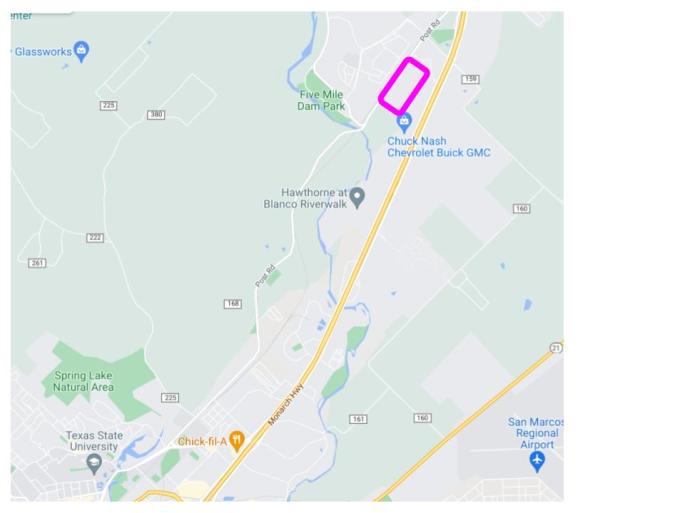
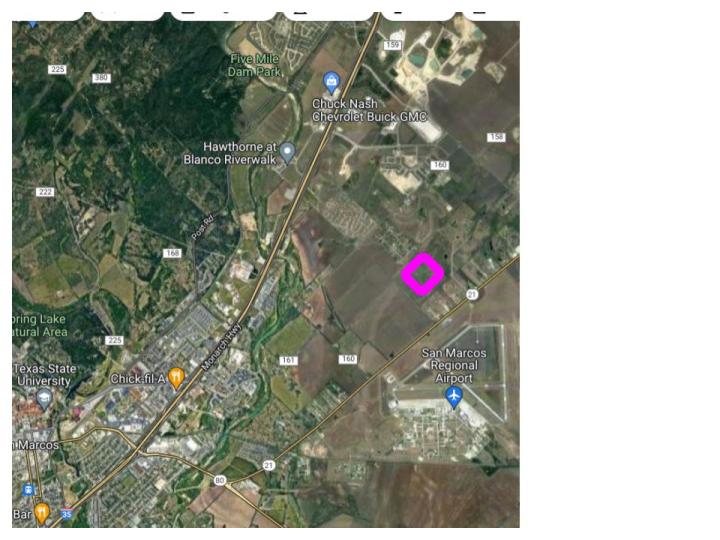
Item 27:  We zoned this piece of land during the August 8th meeting:

Now it’s back and we’re giving it tax credits.

If you turn that orange square so that it lays flat, it breaks down like this:

The light blue section is “Light Industrial”.  Council is voting on a giant package of tax breaks for a developer to build a bunch of light-but-industrial buildings there.

There’s so much that happens in top-secret Executive Session.  As far as we plebes know, this land was just zoned during this very meeting, and now there’s a near-instantaneous agreement with someone calling themselves Majestic Reality Co. The project was code-named “Project Thin Mint,” in case you like code names, and thin mints.

Basically, they’ll get a bunch of tax breaks for a while, and then we’ll start to collect taxes on the buildings and businesses that eventually move in.  That’s the plan. 

Is this good for San Marcos? I have no idea!  It depends what gets built and what businesses move in. Ultimately, we lose a ton of control when we approve things like this, and we have very little information about how it will go.  (And this is standard, for Texas at least.  Texas is set up to let private developers shape cities, instead of elected officials, all the time, because we value their profit so much.)

Max Baker does grill the developer a bit, and comments on how secretive the Chapter 380 process is. 

The vote: 
Yes: Mayor Hughson, Shane Scott, Alyssa Garza, Mark Gleason, Saul Gonzalez
No: Max Baker
Absent: Jude Prather

….

Item 28: Blanco Riverine Flood Mitigation Project

Today they’re awarding some contract to some builder, and it is given all of 15 seconds during the meeting.   However, I wanted to give some background to this, because it’s interesting.

In 2015, we had the deadly Memorial Day floods, of course.  (More detail here, if you’re new to town.)  The Blanco Riverine Flood Mitigation project is supposed to create some extra channels for flood waters to go, instead of running into Blanco Gardens.

Here’s where it will be:

I don’t really know what’s involved, but this picture comes up a lot:

So I picture a massive drainage ditch through that periwinkle-colored rectangle, designed to catch the flood water, and then also, a long earthen hill that makes a wall between the ditch and the neighborhood.  So that’s coming.

Presumably when it’s not flooding, this should have trails and green space on it.

Item 29: We need a new downtown firestation. 

Firestation 1 is this one, downtown:

It’s not big enough and there are problems with that street.   So we’re moving it.

The new one will someday be here, in this building:

That is the old Diaz Martial Arts center, right across from Toma Taco.  Industry is to the left of that photo, and in the background is the old Golden Chick.  You’re on LBJ, heading west towards the town square.

Hours 4:30-5:10, 9/6/22

Item 30: Meet and Confer agreement

The SMPD has a union, SMPOA, which negotiates contracts for cops with the city.

No one else gets to do this, because unions have been undermined in Texas.  First, it’s a right-to-work state, which means you can’t be forced to join a union, even though you may benefit from the outcomes.  (This is bad, in my book.)  Second, unions aren’t allowed collective bargaining powers.  If you’re not allowed to bargain for contracts and legal matters, then you’re basically an advocacy group.  Underfunded advocacy groups don’t generally have much power.  

The exceptions is police and fire fighters (and Houston municipal employees?)  Meet and Confer is how the city of San Marcos negotiates contracts with the police and fire fighter unions.

The Ryan Hartman issue:  Ryan Hartman was a police officer with SMPD. In 2020, he was in off-duty in Lockhart. He was speeding, ran a stop sign, probably under the influence, and crashed into Pamela Watts and Jennifer Miller, and Miller was killed in the crash.  He had an open container in his car, but refused a breathalyzer for a few hours.

He wasn’t indicted in Lockhart, and Chief Standridge was brand new, and dithered on the issue until the 180 day time frame expired, and Hartman was put back on the force. Somewhere in here, Mano Amiga takes up the cause on behalf of Miller’s partner, Pam Watts.  Mano Amiga begins a full press assault on Hartman.  Back on the force, Ryan Hartman tazes someone under sketchy circumstances, and is suspended again this past January.  Finally he’s terminated, this past June.

Mano Amiga has a list of five “Hartman Reforms” that they want implemented (and that are incredibly hard to find online.)  Based on this article, I’m pretty sure they are:

  • End the 180-Day Rule
  • repeal of the statute of limitations on investigating wrongdoing by officers
  •  “End Delay of Interviews for Misconduct,” due to officers being allowed 48 hours to prepare answers and review materials before giving an official statement.
  • Public Transparency for Personnel Files
  • End Third-Party Arbitration.

(I’m not really sure how 1 and 2 are different from each other.) In the Meet and Confer agreement, they are proposing to extend the 180 day rule to a 360 day rule. The other reforms are all ignored.

Max Baker asks about the rest of the Hartman Reforms. 

City staff says that the Hartman Reforms were announced on June 15th, but the negotiation meetings had already run from April-May 27th. Max Baker says that the Hartman Reforms overlap with reforms he’s brought up in the past, but he hadn’t gotten the support of council on those.

In Citizen Comment, Mano Amiga made it clear that they do not think this contract holds officers accountable. They’re going to collect signatures to get a repeal of this agreement on a future ballot. Stay tuned!

What do I think?   Here are some reforms that I think are important:

  • Reviews of police misconduct need to be done by independent, external investigators
  • End qualified immunity for police officers (Currently, officers can’t be sued for violating someone’s civil liberties. San Marcos can’t just unilaterally change this, but it’s important)
  • Ongoing de-escalation training (this may already be happening, I don’t know) and cops need to be immersed in neighborhoods and build positive relationships with young adults.
  • Prioritizing mental health of police officers, keeping ongoing relationships with therapists or counselors
  • Redirect mental illness emergencies to first responders with social work or mental health backgrounds

On one slide in the presentation of the Meet and Confer contract, it says, “Applicants with degree in social work, sociology, psychology, human services, or human relations will receive additional points.”    This is good!  You want officers with backgrounds in areas that humanize people. 

By all appearances, Chief Standridge is implementing progressive principles into SMPD. This seems like an opportunity to collaborate and make progress.

….

Item 32: Chris Cardoza is voted onto the Arts Commission.

Item 33: Should renters get notified when there’s a proposed zoning change? This is sent to a committee.

Yearly Clean-up, Summer ’21-Summer ’22

This is the first time I’ve attempted a retrospective summary post, and it is very rocky.  I went back through my notes, but I can guarantee that I missed things. I wasn’t even consistently taking good notes! Life’s a dance you learn as you go, right?

Here are my three categories:

  1. Major legislation from the past year, and how each councilmember voted

Oh god this was hard to carry out.  Full set of caveats at the link.

  1.   Unfinished business.  Lots of things feel like they got accomplished, but haven’t been formally turned into policy and can still stall out. For example:
    – Ending the ban on more than two unrelated people living together
    – Banning sales of pets from puppy mills
    Both of these were discussed, but not yet implemented.

Again, my list is super spotty and incomplete! It’s also possible some of these did wrap up, and I missed it. 

  1. Developments that have been approved, but who knows how long until they materialize. This list is also very incomplete.

God I feel so apologetic about this whole entry! My goal is to get better at this kind of thing over time.

Anyway, city council meets next on Tuesday. Regular city council coverage will resume!

Major Policies from the Past Year

  1.  What was the major legislation that was passed this past year, and who voted for what?

This is so hard. Sometimes major legislation is discussed privately in executive session, and the public part is brief.  Sometimes it’s been cloaked in legal language, or I haven’t had the backstory, or I just didn’t realize that it was important.  It’s easy for me to blog things that spark a big fight. But being controversial is not the same as being important. 

For example, last December, Council passed the Development Agreement on the huge tract that runs adjacent to Redwood.  I totally missed its importance. In May, Council expanded La Cima from 2,550 to 3,800 acres. I missed that, too!  I don’t yet know how many other important things I missed. 

Next: Knowing how councilmembers voted does not tell you the whole story. Who was an advocate who won others over? Who watered it down with stupid amendments? Who initiates legislation and who is mostly passive?  Who initiates little frivolous ideas, and who initiates important ideas? I don’t know how to summarize all those sorts of details. 

Also: what about things that are done yearly, like renewing a contract with GSMP or creating and approving a budget? They’re routine but they’re important, and having good councilmembers makes better outcomes. What about ARP money? Or CBDG money? It matters greatly, but it’s hard to summarize.

Here’s my attempt. (You should be able to scroll around.)

Unfinished Business, Summer ’21-Summer ’22

2. What was begun, but not completed? 

Very often Council tells staff to go research something and bring it back. I haven’t necessarily made a note of all of those.  My impression is that, under Bert Lumbreras, sometimes the assignments just disappeared into the ether.  Under Stephanie Reyes, I get the picture that things will eventually get done, but they’re slow due to being understaffed. But I’m not on the inside and I don’t actually know.

Approved but not yet built, Summer ’21 – Summer ’22

3. What kinds of developments were approved, and are now part of some developer’s infinite timeline? 

It took me most of this past year to get a handle on how to write about zoning cases, so I don’t have a great handle on this question, either. There were conversations about gas stations that I didn’t record. This is not exhaustive.

August 16th City Council Meeting

Election season is coming up! Here are the candidates so far:

Mayor: Jane Hughson is facing John Thomaides, the former mayor.

City Council Place 1: Max Baker vs Matt Mendoza

City Council Place 2: Saul Gonzalez vs Adam Arndt

Last day to file is Monday. I will be posting on the specifics of these candidates, but not right now.  Stay tuned!

However: San Marcos City Council elections are really problematic.  I decided this deserved its own post. Enjoy.

Onto the City Council meeting!

Hours 0:00 – 0:30ish: Citizen Comment Period. Let’s spend some time talking about the community in Redwood/Rancho Vista.

Hours 0:30-3:00: A small rezoning case that I was not very interested in, and city council pay raises.

Hours 3:00-3:50: Cops in schools, and what on earth is Shane Scott waving around?!

Hours 3:50-6:00: The Lobbying Ordinance dies a frustrating, fishy death. Also Boyhood Alley, and some smaller odds & ends.

Two final thoughts:

  1. Almost every single vote taken this evening was Max Baker & Alyssa Garza against the other five councilmembers. This is why we need a progressive coalition. They can’t go it alone.

    Last year, Jude Prather was elected over Zach Sambrano, and Mark Gleason was elected over Markeymoore. [Update: Jude v. Markeymoore, Zach v. Gleason. Correction from Mark Rockeymore in the comments.] If Zach and Markeymoore were on the council, we’d have a lobbying ordinance right now. We need to build a progressive coalition. It doesn’t work to consistently have two voices losing to five voices every night.

    2. Mark Gleason’s conservative grandstanding is sucking the life force out of me. Every single item, he rambles on, in his particular brand of Aw Shucks Humble Everyman, Who Just Loves Cops and Capitalism.  I just get weary of it.

    (To be fair, Max Baker has equally many rants, but I more often agree with him.)

San Marcos City Council Elections are Problematic

Why are San Marcos City Council elections so bad?

First, every person in the city can vote for every city council position.  (In other words, they’re all at-large.)  At-large elections have a very problematic, racist past.  Generally, it works like this: Suppose your city is 70% white and 30% black.  The white majority can elect their favorite candidate in every single council election, and so a city ends up electing a 100% white city council.  

What’s the solution? Usually, single-member districts. This means dividing the city into six equal parts, and each part gets to elect one city council member. We do this for school board elections already. (Probably the mayor would still be elected at-large.) If we had single-member districts, then the candidate would have to live in the district they represented, so we would have city council members from all over San Marcos. It’s also easier on the candidate, because they can focus on a smaller region and concentrate their efforts.

So, lawsuits get filed. The SMCISD school board was sued in the mid-90s for having all at-large elections. (Could not find any record of it online, beyond #60 listed here by the lawyer who brought the lawsuit. That’s when they went to 5 single-member districts and 2 at-large positions.) Austin, San Antonio, New Braunfels, and Seguin are all single-member districts because they’ve all been sued or struggled over it.  Austin here, San Antonio here. There’s a whole chapter on Seguin here. And here is a fascinating Washington Post article from 1983, on MALDEF bringing lawsuits against Lockhardt, Corpus Christi, and Lubbock. The last sentence in the article is:

Last week MALDEF filed suits affecting city council systems in Pecos and Port Lavaca, and school districts in New Braunfels, Port Lavaca and Pecos.

So there you have it: 1983.  ANYWAY. Who still has all at-large districts in 2022? We do! Boo, hiss! 

But wait! There’s more! We have a peculiar system of declaring places.  Right now, we have four candidates for city council – Max Baker, Matt Mendoza, Saul Gonzalez, and Adam Arndt.  Suppose my favorite candidates are Max and Matt, and I don’t like Saul or Adam.  Well, I’m stuck, because Place 1 is Max vs Matt, and Place 2 is Saul vs Adam.  I can’t vote for my favorite slate of candidates.  That’s not the best way to elect a council that reflects the choice of the people.

Declaring places does not serve a purpose for elections. We could say that Max, Matt, Saul, and Adam are competing for two spots, and all the voters get to cast two votes. (We do this with judges, for example.) Then the top two candidates would win the two slots.

In my opinion, we should switch to single-member districts. (But you could easily convince me to try Ranked Choice Voting, also known as Instant Run-off Voting, or multi-member districts, or one of the other innovative electoral systems out there.)

Hours 0:00 – 0:36, 8/16/22

Citizen Comment:

A few people speak on renaming an alley as Boyhood Alley, in homage to the movie Boyhood, which was filmed in San Marcos. 

However, the comment I want to focus in on is from a person from Rancho Vista/Redwood.  She also spoke at P&Z last week, along with probably ~30 residents who wrote letters in. This deserves some extra attention.  She raised two separate issues:

  1. The proposed industrial development immediately adjacent to Redwood
  2. The intractable health problems facing Redwood

As best I can tell, these only somewhat connected, insofar as Redwood gets generally neglected and ignored.

  1. The proposed industrial development immediately adjacent to Redwood

Last week at P&Z, probably 30 residents from Redwood wrote letters against a developer who’s trying to put an industrial development in the bottom half of this:

It was an astonishing turnout.  (Quick note: City council doesn’t read letters outloud at meetings.  P&Z does.  This is annoying – the public should know who took the time to communicate.)

The Development Agreement had been approved last December, which put an industrial zoning right here:

But no one noticed. (I even blogged it, and didn’t notice.)

So why didn’t anyone turn out from Redwood, last December? Because Development Agreements don’t trigger notifications the way that zoning changes do. This is insane. The community in Redwood had no way of knowing that they were now downhill of a massive industrial complex, until just before the P&Z meeting. 

(I went back and watched the December meeting again. There was barely any public discussion about it, although clearly a lot had happened in Double Secret Executive Session. Max Baker and Alyssa Garza voted against it.) 

So the Development Agreement is already in effect. Two weeks ago, at P&Z, the developer came forth asking for two exemptions – a block perimeter exemption and a cut-and-fill exemption. Basically, this would allow them to build a gigantic thing instead of a normal-sized thing. 

But like I said, there was a giant turnout by the Redwood/Rancho Vista residents, describing the current flooding and sewage problems, and how this would exacerbate them. P&Z voted both down.  This is great! 

Either the developer will appeal to council, or they’ll go back and reconfigure their plans. Either way, this needs to stay on the radar of San Marcos residents who live inside city limits, because we can hold council accountable more easily than Redwood residents can.

2. The Health Problems Facing Redwood

There was an article in The Guardian about the parasites endemic in Rancho Vista/Redwood: 

Although it can be symptomless, Strongyloides is the deadliest of soil-transmitted parasites. If an infected person takes immune-suppressing drugs such as steroids or chemotherapeutics, or has a lowered immune system because of a disease like leukemia, the worm can rapidly multiply throughout the body and cause death.

In Rancho Vista, the 16 positive blood tests from a group of 97 residents is the highest percentage of positive blood samples found in a non-refugee population in the US, according to Singer, though the sample is relatively small. (A positive blood test can also occur in someone who was previously infected but no longer is.)

Apparently the problem is that we just should never have put septic tanks in this location – they leak and are impossible to maintain.  However, the residents can’t really afford to deal with and fix the raw sewage.

There’s two things that need to happen:
1. funding needs to be acquired ( but from where? federal, state, local?), and
2. the neighborhood needs to tie in to San Marcos city sewage.  

I don’t know exactly how this all will unfold, but this would be a good issue to ask about during the debates and the campaign season. It’s not okay for vulnerable community members to lack basic health and sanitation provisions.

The Riverbend Development should be structured with an eye to getting San Marcos city sewage access to Redwood. That’s not profitable, and so it won’t happen without some activism.