Hours 0:00-1:01, 3/7/23

Citizen comment:

  • Several people spoke about the HSAB money.  We’ve seen this item several times this year; it finally gets concluded tonight.
  • Two people talk about the Pick-a-pet ordinance, also coming back around tonight.
  • Two people talk about the SMART Terminal re-zoning. Not up tonight, though.
  • One person talks about Joshua Wright and the Hartman reforms

I had a stray thought about the SMART Terminal. I was on Charles Austin, next to the baseball stadium, stopped at a train. The train was going slower and slower, headed east towards 35. I was doing the thing where you try to figure out if the train is going to come to a complete stop before it gets across your path and trap you, or if the last car will make it across and set you free.

It occurred to me that the train was probably headed in the general direction of the future SMART Terminal. And I remember that it takes a train 1-2 miles to come to a stop. So imagine if we have a new SMART train intersection just east of town? The number of stopped trains is going to go through the roof. Traffic is going to be hella gummed up by stopped trains, if the SMART Terminal delivers on what they’re claiming.

I mean, we should still focus on the river pollution and massive amount of concrete, and all the rest of the questionable parts. But let’s save a little angst for worrying about the future train stoppings of San Marcos.

On to the meeting!

Item 6:  Way up by Whisper Tract, some developers want to rezone this little blue piece:

It used to be partly zoned Manufactured Homes, and partly zoned Future Development. They want to make it all Heavy Commercial.

Here’s what’s at the eastern tip of that little blue rectangle:

That is, the Saddlebrook mobile home community.

So is it fair to build heavy commercial next to them? Let’s put it this way: it would never be proposed next to wealthier neighborhoods.  At the same time, the western edge of that little blue rectangle is along I-35, and it’s reasonable to put Heavy Commercial along the highway.  Finally, the folks at Saddlebrook might like some commercial services like restaurants or laundromats or whatever nearby. (But there’s no guarantee this will be restaurants or laundromats.)

Jane Hughson and Mark Gleason aren’t sure about the size of the project on the east side being so close to the community. A 40 foot building with 30 foot setbacks is still pretty looming, even with a privacy wall.

The developer talks in person.  He and his partner are from central Texas, and they make little spec buildings that can later be configured for small businesses. So it’s unclear what would end up there.  

In the end, council approves it unanimously.  Hopefully it turns out the businesses that move in make good neighbors.

Item 7: Two acres in Cottonwood Creek, off 123.  This one kind of pissed me off.

Here’s Cottonwood Creek: 

It’s down by the high school.  Bowie Elementary is in Cottonwood Creek.  (I realized I could get some useful maps off the planning department website.)

Here’s a close up. Today’s proposed rezoning is for that little red trapezoid, in the yellow circle:

This area has seen tons of development in the past 2-3 years. In fact, this little red piece in that blue circle:

is right where this new Chevron just went in:

So back to the subject property: right now it’s zoned General Commercial. The developer wants to re-zone it CD-4.  In theory, you can still put commercial in CD-4, but that’s not what will happen. It will be townhomes or apartments. 

Here’s the thing: the east side desperately needs commercial. They shoudn’t have to drive so far for grocery stores and basic retail.  And that’s not just my opinion – the city planners are constantly saying that people on the east side tell them this.  

And furthermore, many residents wrote in on this very item so say so!  Apparently Council got letters from people in Cottonwood Creek saying to please keep it commercial. This is not hypothetical!  They were told exactly what the neighbors want!

The developer is arguing that the property has sat there for 20 years and nobody has wanted to put commercial there, so therefore he should be able to re-zone it. But he’s being a twerp. He knows that commercial lags behind residential, and residential is finally just now getting built.   If you don’t set aside land and earmark it for commercial uses, an entire area will get zoned residential and by the time someone might like to put a restaurant in, there won’t be viable places left.  

Mark Gleason seems to be toting water for the developer. He knows the neighborhood wants commercial there. First, Mark asks what commercial is allowed in CD-4.  He’s told that all kinds of commercial is allowed – offices, restaurants, etc.  Could be a lot of possibilities! (But it won’t.)

Next, Mark asks the developer directly: “Are you looking to build housing? Or are you looking for more flexibility?”

Here’s what that means, “I have constituents that don’t want housing there. I want to be able to tell them I voted for flexibility. Could you supply me with my excuse?”

The developer cheerfully agrees that he is all for flexibility! We love flexibility!

Jane says dryly,  “Clearly they are going to reduce the amount of commercial and add housing.  Otherwise they’d just stick with the existing commercial zoning.”

Mark says, “I’m a yes on this one. I hate to lose commercial, but I trust the developer!”

Gentle Reader, listen to me: do not trust developers.

Alyssa Garza weighs in: she’s opposed, because of all the letters they’ve gotten from residents who are opposed to this. They all want commercial services to be built there.

Mark and Jane tut over how it’s a weird place for commercial, because it’s not on 123 directly.  It’s a little off 123.  

The vote: Should the little red trapezoid become apartments/townhomes?
Yes: Mayor Hughson, Mark Gleason, Saul Gonzales, Shane Scott, Matthew Mendoza, Jude Prather
No, keep it commercial: Alyssa Garza

This is really hypocritical.  Right now, the VisionSMTX comprehensive plan is working it’s way through P&Z and City Council. The historic district has turned out in large numbers to complain. Several members of P&Z and Jane Hughson are going through the proposed plan closely, with an eye to preserving neighborhoods and preventing anything from happening to them.

The most sacred thing in the world, based on all language being used to criticize VisionSMTX stuff, is the voice of a neighborhood for self-determination. Neighborhood plans! Neighborhood character studies! Ask the neighborhood if Zelick’s should get a CUP! Neighborhoods are sacred.

But this vote tells the lie: we didn’t mean all neighborhoods! Sorry for the confusion. We just meant that we should pander to the noisy, wealthier neighborhoods west of I35. Cottonwood Creek wants to preserve that red trapezoid of commercial on the corner? Sorry, suckers!

Finally: we do need housing. There are multiple, competing needs here. But you shouldn’t pit one need against another. The whole city needs housing, but it doesn’t need to come out of Cottonwood Creek’s limited options for commercial development.

Hours 1:01-2:06, 3/7/23

Item 15: Human Services Advisory Board . This is an item that’s dragged out for months. 

The city allocates $500K from the General Fund for nonprofits every year. A bunch of nonprofits apply for it.  HSAB reads the applications and recommends to council who should get how much. Council takes the recommendations and then redoes it all, re-allocating money all over the place, which is what happened tonight. 

The difference this year is that the first set of HSAB recommendations made everyone so mad that Council came up with new guidelines and then asked HSAB to meet again and re-do everything. So the allocations are several months behind schedule this year.

I think HSAB tried to be exceedingly objective and impartial, and ended up being rather algorithmic.  What I can’t tell is:

  1. Does council want HSAB to go deeper than this algorithm approach, and evaluate the merits of each individual nonprofits?  In other words, is Council annoyed that HSAB kept it so formulaic?
  2. Or does Council ultimately always want to be the ones to make the individual judgements about the merit of each nonprofit? In other words, this is exactly how it’s supposed to go, and no matter what, Council is going to re-do everything HSAB does?

Anyway, they re-do it all.

In case you’re curious, here are the recommendations from HSAB – both last December’s recs, and then revised for Tuesday’s meeting (but not necessarily what Council adopted):

“CORN” is in a big circle because that nonprofit doesn’t exist anymore. (I guess it didn’t have the juice.)(Sorry, that was corny.)(I’ll stop now.)

This discussion started during the 3 pm workshop, and then wrapped up during the official council meeting.  

First, Council reduced the funding for a bunch of agencies:

Reductions:

MELJ/Iron Sharpens Iron: from $33K to $0.

HOME Center/Emergency Motel Program: from $20K to $15K.

Treasured Protégé /Protégé  Program: from $13K to $0

Rough Draft/Superhero Art Program: from $3K to $0.

Communities in Schools/Counseling SMCISD: from $7K to $3.5K. 

ACCEYSS: From $35K to $30K

Here are some things to note:

  • Every agency has a worthwhile mission
  • I am not closely tied enough to the nonprofit world to know how to tease apart the effectiveness of different nonprofits.
  • But neither is most of Council.
  • Except for Alyssa Garza, who is not happy about many of these reductions.

Rationales weren’t given for every reduction. Of the ones that were:

  • HOME Center duplicates Southside, which has been doing emergency housing longer.
  • Treasured Protégé  is just one school. Not all the schools. (I can’t tell what that means from the website.)
  • Rough Draft isn’t a basic need, like food and housing.
  • Communities in Schools should be funded in collaboration with SMCISD.  

So if my math is right, that saved them roughly $70K to dole out. (Including the CORN money.) During the 6 pm meeting, they increased funding like so:

Increases: 

Hays County Food Bank: $30K to $40K

Combined Community Action/Meals on Wheels: $3K to $15K

Nosotros La Gente/”Viva Zapatos” Shoe Drive (no website): $5K to $10K 

Salvation Army/Emergency Assistance: $27.5K to $35K

St. Vincent de Paul: $16.5K to $20K

School Fuel/Weekend Food: $19.5K to $24K

Youth Service Bureau: $4.4K to $10K

Southside Community Center/Specific Assistance: $4K to $16K

One last one that Jane referred to as “Emergency” to $30K .  I lost track of what this was and can’t figure it out. I can’t tell if this is something that was reduced to $30K or increased to $30K. 

Alyssa reiterates that she’s particularly angry about reducing MELJ/Irons to $0, and HOME Center from $20K to $15K. In my summaries above, I didn’t really convey how frustrated she was with the fickle and random shuffling of money above.

On MELJ/Iron Sharpens Iron, I agree: Council really dropped the ball.  (Also, they kept calling it “MELI” instead of “MELJ”, which doesn’t instill a whole lot of trust.) Here’s the blurb from their application:

Iron Sharpens Iron uses a multi-faceted approach to address the challenges that reentry poses for nearly 40,000 individuals annually in the city of San Marcos. Iron Sharpens Iron program model assists those persons who’ve been incarcerated by determining what their needs are during the intake process that will enable them to be successful in the community in which they are living. We have support mechanisms in place that will enable this population and their family members to have somewhere to go to seek assistance with financial issues, substance abuse referrals as well as discussion of academic interests, employment and any legal situation that may have not been resolved. This includes sharing ideal strategies and best practices for living a crime free life. This particular project will have a large reach to multiple entities including those that have been or parole and their families. We’ve learned that those persons who have lived experience that are included become the best educators on social justice change as it refers to “imprisonment” and successful re-entry back into their respective communities. This project will allow us to increase awareness to corporations and municipalities to participate in inclusion of those labeled a felon-as well supportive things for the population that we are currently serving and extend more to the family members.

Council keeps saying that community safety is their highest priority, and they’re freaked out about crime. But they only seem aware of punitive, authoritarian ways to combat crime. They don’t seem to see the point of nurturing and supporting people who have committed crimes in the past. (Except Alyssa. All of this is except Alyssa.) It’s like it’s off-putting for them to consider the humanity of people who’ve been incarcerated.  

First, that’s gross. You judge a society by how it treats its prisoners, not its princes.  

But second, it’s impractical.  If you want crime recidivism to decrease, you should do things that help people transition out of incarceration and into stable lives.  Instead, we’re taking an authoritarian approach.  Keep making life harder for them!  The beatings will continue until morale improves, as they say.

One final thought, and I hope I don’t offend anyone: I feel a little weird about School Fuel.  Kids get sent home with brown bags of food that is supposed to help with food insecurity over the weekend.  But it puts poor kids in a weird, possibly stigmatizing position to have to get a Poor Kid’s Food Bag right in the middle of a social situation, and take it home on the bus with a bunch of other kids.  

I’m not really criticizing anyone who is taking time to help others in this community. There’s a lot of need, and it’s important that a kid knows they’ve got some dependable food over the weekend. And there’s probably not that much stigma in a community that’s pretty used to widespread poverty. It’s just something that crossed my mind.

Updated to add: The 40K number in the MILJ application above – “nearly 40,000 individuals annually in the city of San Marcos.” – can’t possibly be right. The whole town is only around 70K. I don’t know where they got that from, but it’s nonsensical.

Hours 2:06-2:51, 3/7/23

Item 12: The long-awaited conclusion to the Pick-a-Pet Problem!  

This is over a year in the making.  It first came up last February, and then again in November, and then the second time in November, when it got kicked back to the Animal Services Committee.

Here’s what the animal experts want:

  • Pet stores shouldn’t get pets from puppy mills, only from shelters or non-profits. Breeders can sell directly to individuals. 
  • Mandatory microchipping for all animals over 4 months
  • Dogs would get sterilized the 2nd time they’re picked by the shelter.
  • Trap-Neuter-Release for cats, or TNR. If a cat gets picked up, you check for a microchip or other traceable ID. If there’s no id, you spay or neuter the cat and return it to wherever they were picked up. If they have ID, they’re held for three days so that the owner can re-claim them.

The idea with that last one is that cats are really unhappy in animal shelters, and it’s terrible for their health, and only 2% of cats are reclaimed.  Usually, if you return the cat to wherever you picked it up, it’ll find its way home.

In the past meetings, all of these points were contentious. Gleason in particular was uncomfortable with every bullet item above, although he wasn’t alone. The puppy mills were debated at length last February, and the microchipping/TNR/sterilization were debated this past November. The idea is that hopefully during the Animal Services Committee meetings Jane Hughson, Alyssa Garza and Mark Gleason all reached consensus on those issues, and now the full council can vote.

So here we are!

Mark starts off: I now can support this bill! Here’s the changes that make me okay with it:

  • We’ll ban sourcing selling puppies from puppy mills, but we’ve got this Canine Care Certification from Perdue University that will help connect ethical breeders to pet stores.
  • We’ve got a 5 day hold for cats now, even if they don’t have traceable ID, to give owners a chance to reclaim their pet
  • Your dog won’t get sterilized until the 3rd pick up by the animal shelter
  • Pet stores will have a year to get into compliance before the ordinance goes into effect.

Jane Hughson says firmly, “The Canine Care Certification thing isn’t actually in the ordinance.”

Mark: “I know, but we can look into it in the future.”

Alyssa says, “I thought at the last committee meeting, we walked back the 5 day holds for cats?”

Jane agrees. She thought the TNR superceded it. Plus, the logistics of spaying and neutering mean that cats end up held for 2-3 days anyway, before being returned to their neighborhoods.

The animal guy says community cats will be TNR’d, and household cats will be held for five days. 

Mark Gleason asks, “How can you tell the difference?”

The animal guy admits it’s murky sometimes, but you do your best. Thankfully, they don’t go down the path of going in circles on the murkiness of distinguishing house cats from community cats again, like they did in November.

Mark feels very strongly that any cat that isn’t a known community cat should be held for five days. He fundamentally doesn’t like the part where a housecat gets returned to its neighborhood. 

Alyssa and Jane both support shortening the five days, per the experts’ advice, but they also agree not to pick this battle.  In other words, let’s pass something, and see how much this helps.  If in six months, we need to take further action to reduce the number of cats in shelters, let’s do it then.

I think this is good governance.  Let’s not make the perfect the enemy of the good. Don’t hold up a lot of important changes over this.  Implement what we can, and then the experts can build a case for reducing the cat stray-holds if the shelters are still overburdened.

Matthew Mendoza brings up sterilizing dogs on the second impoundment instead of the third.  Last year, Mark Gleason had changed it to three.

They discuss some of the exemptions – old dogs, specialty dogs – and they discuss how the shelter is understanding about times of crisis or fireworks, and how the shelter will pay for fence materials to repair your fence, and that kind of thing. 

The vote: should the shelter spay/neuter occur the second time your dog is picked up?
Yes: Everyone but Mark Gleason
No: Mark Gleason

And then finally! We have a vote on the entire animal ordinance. I’m pretty sure this is what they end up voting on:

  • No pets from puppy mills, only from shelters or non-profits. Breeders can sell directly to individuals. 
  • Mandatory microchipping for all animals over 4 months
  • Dogs get sterilized the 2nd time they’re picked by the shelter.
  • TNR for community cats. 5 day stray-hold for any cat that isn’t clearly a community cat.
  • One year delay for pet stores to get into compliance, before the ordinance goes into effect.

And here’s how it goes:

The vote on the whole animal bill: 
Yes: It’s unanimous.

Hooray! No more puppies from puppy mill animals in San Marcos (starting in 2024)!  Other good changes to reduce overcrowding in shelters!

Fundamentally, this is a nerve-wracking topic.  I love my pets with all my heart.  No matter what is implemented, the animal shelter staff is going to have to use their best judgment, and it’s scary that you just have to trust that they have the best interests of animals at heart.

There’s an analogy to be made with policing.  No matter what is implemented, police officers are going to be placed in situations where they have to make judgment calls.  The breakdown around police  is that there is widespread disagreement on whether police officers keep the best interests of all community members at heart, or if they show bias against some.  They have not earned the trust of the entire community.  

The two situations are quite different, but the uneasiness around trusting someone’s judgment in unsupervised situations is parallel.

Item 16:  The city is still filling a few last vacancies on various boards and commissions.  

I want to note one comment from Alyssa. First, you need some background: it happens sometimes that a vacancy is for a partial term.  So when these appointments are being made, Council sometimes has to decide who gets appointed to a full term and who gets appointed to a partial term.

This happened on Tuesday, and Alyssa asked if this would be fully communicated to the person that got the shorter term. She was told it would be.

Alyssa then said something like, “Because I do not want another incident like the one that happened recently with Zach Sambrano on P&Z.”

So using my context clues, here’s what it sounds like happened: back in 2021, Zach Sambrano was appointed to P&Z, but he wasn’t told that he’d been given a partial term.  So he planned on re-applying for another term in 2024.  

But then, surprise! He discovers that he’s no longer on P&Z and they’ve appointed a new commissioner to his spot!  

The problem is that this happens to Zach Sambrano and not William Agnew.  (Nothing against William Agnew; I just wanted an example of someone who promotes the status quo.) This may have been truly accidental. But no one double-checked with Zach when he failed to submit an application, they way they would have done with someone over 60 who is presumed to maybe need an extra hand with technology.  

This is how the status quo perpetuates itself – lots of soft decisions that all seem to tip in favor of the status quo.  Individually, every instance has plausible deniability.  No one can say with certainty that Zach wasn’t reminded to re-apply because of his outgroup status.  But there is a pattern of behavior that all seems to tip towards preserving the status quo. The effect is that outsiders are shut out, and insiders reap extra benefits.

February 21st City Council Meeting

It was a very short meeting! Mark Gleason was leading the meeting, although Mayor Hughson was still present. (She had shoulder surgery the day before. Hope she’s mending well.)

Hours 0:00 – 50:31: Citizen Comment, a bit on SMART and the notification radius, a bit on the speed limit for 123, and a little bit more on civil forfeiture and why it’s so gross.

Hours 50:31 – 1:22: Stephanie Reyes is officially your new city manager!  And new rules for governing council committees.

Bonus: 2/13/21 Mini-meeting and 2/21/21 Workshop: In which we note the new P&Z appointments and discuss bike lanes on Craddock and on Sessom.

That’s all for February! See you bright and early next month.

Hours 0:00-50:31

Citizen Comment:

Several people (mostly from Mano Amiga) speak on Josh Wright, the guy killed by a corrections officer at the hospital a few months ago.  (Six shots in his back, while wearing leg shackles. There’s no way to parse that as anything but cold-blooded murder.) 

Several of the speakers point out that none of the councilmembers, besides Alyssa Garza, have issued statements on Joshua Wright’s death, nor offered condolences to the family. It’s true that the corrections officer is part of the Hays County system, not the city system, but councilmembers are still public officials with a platform and influence. Right now, they’re using that influence to quietly twiddle their thumbs. 

Several people speak on the SMART Terminal.  SMART Terminal was approved two weeks ago. Last week, at P&Z, the SMART Terminal was up for re-zoning to Heavy Industrial. An even bigger turnout of people showed up to speak against it.  A ton of people shared stories of flooding downstream of the proposed SMART location. I do not see how Council could have thoroughly vetted stories of flooding before approving the terminal, given the vast number of personal stories that popped up last week.

P&Z ended up postponing it for a month, to give the developer time to meet with community members and gain their support.

As an aside:  A lot of people are upset because the SMART Terminal was approved before they even heard it was coming. This is a big problem: how can a city notify the public about a project in their area? The city does actually try pretty hard: there are supposed to be signs posted, in big font, and there are supposed to be notifications mailed out to residents nearby. The problem is that these things are time-consuming, expensive and still don’t work that well. Signs blow over, mailers go out to home owners and not renters, people live further than 400 yards away but still will be affected, etc. (Council is fixing the renter problem – they will start getting notifications too.)

I want to talk about mailing notifications. The notification radius is 400 yards. Everyone who lives within 400 yards of the boundary of a project is supposed to get a notification in the mail. It used to be 200 yards.  It was expanded a few years ago.  City staff was stressed out by increasing the radius – it increases their workload, and also gets expensive.

So look, here’s an easy solution: the notification radius should be proportional to the size of the project.  Rare gigantic project like the SMART Terminal or the entire Riverbend Ranch Development? Should have a very large notification radius.  Frequent, ordinary, small scale project? Should have a proportionally smaller notification radius.  It’s very weird that the notification for Sean Patrick’s CUP is the same radius as for the Martindale-sized massive-slab-of-concrete-by-the-river future SMART Terminal.

Item 17: The speed limit on 123 is going to be reduced from 60 mph to 55 mph. 

I mean, this is basically the stretch that half the high school students take to get to the high school.  It doesn’t seem crazy to me to knock the speed down just a hair. 

(There was an awful tragedy at Goodnight Middle School on Friday, involving a car. We are all so fragile, and the people we love are so fragile, too.)

Item 18:  Apparently the state of Texas wants to give us $45,000 for us to build a metal awning to protect police cars. Nothing wrong with a metal awning to protect cars.

The problem is that the source of the $45k is deeply tainted: it’s from State Seized Asset Funds. Civil asset forfeiture is a giant gross mess.  Basically cops are allowed to confiscate anything potentially related to a crime.  But then, regardless of whether the owner was innocent, guilty, or completely unrelated to the crime, the cops end up keeping the property.  Police departments end up profiting hugely off it, which then motivates them to grab property even more aggressively and ever so tenuously connected to an actual crime.

Do I think we should turn down the money? I don’t know. This state is so broken on this topic that I don’t think it would do any good, frankly, except as protest.  Whether we accept the money has zero bearing on whether or not Texas ever reforms its civil forfeiture policies.  But it’s worth adding this to your mental rolodex of ways that police abuse community members.

Hours 50:31-1:22, 2/21/23

Item 21: Stephanie Reyes is being promoted from Interim City Manager to Actual City Manager. She’s been Interim for about a year, since Bert Lumbreras retired.

Everyone – literally everyone – falls all over themselves to be the most enthusiastic in congratulating her.  But seriously: everyone is correct. She is great.  I kinda want to fall all over myself and be the most enthusiastic, fawning cheerleader for her, too. 

Obviously I have no idea what people are like off-camera, so I never know the whole story. But what I’ve seen on camera, Stephanie is always extraordinarily prepared, organized, and poised during meetings. She’s smart and speaks carefully, and her words generally indicate that she’s considering many different perspectives.  She knows San Marcos very well. She comes across as a hugely competent leader.  And a great leader is worth their weight in gold, no joke. 

….

Item 23: Rules and procedures to committees.  This was such vague-booking.  There was no presentation and no background.  I couldn’t figure out what was going on and had to dive into the packet. 

Council has a bunch of committees, to study little issues outside of regular council meetings. Think things like the Workforce Housing Committee, or the La Cima Committee, Criminal Justice Reform, or Sustainability. Here, council is amending the rules that govern these committees. In other words, this is dry, dry, in-the-weeds business.  They want to divide committees into three categories, and then further subdivide the types of meetings each committee may have into sub-categories.   Each subcategory has different rules. And then post the recordings of many city council meetings, which would be new (I think).

Mayor Hughson has a few more amendments:

  1. If a councilmember misses more than two consecutive committee meetings, they get booted from that committee
  2. The staff liaison and the committee chair are in charge of screening which agenda items fit with the purpose of the committee, and which ones don’t.  Before it just said, “Agenda items must fit the purpose of the committee” and left it there.
  3. (And some other minor ones.)

This would have seemed like minor organizing, except that Alyssa Garza was clearly biting her tongue. 

At one point, Alyssa asked Jane Hughson what her conceptualization of a “subject matter expert” is.  Jane gives a few examples from the homelessness committee and the animal welfare committee.

That’s all that is said on that. But I’m reminded of Max Baker raising the point that experts on police reform were being excluded from different meetings, because others didn’t think they qualified as experts. There’ve been implications, although never fully explained on camera.

The key moment comes at 1:07, and look, I’ll just quote Alyssa wholesale:

“I just want the record to reflect that I find the entire packet fundamentally problematic. I think it’s restrictive and unnecessary and quite frankly I have expressed my frustrations over this for the past three years, on multiple occasions. These rules are not applied across the board. We got the receipts, okay. My other question is then who is responsible for ensuring that these committee rules – if approved – are applied across the board?

So historically, as they have not been applied across the board, where is there some sort of road map or guide that shows how to proceed from there? Because historically this is just business as usual. We just ignore the blatant not-following of the committee rules.”

The other committee members respond to the easy parts of what she’s saying: Who will enforce the rules?  The committee chair will enforce the rules! How will items get on future agendas? There’s a rule that the last agenda item now to plan future agendas!  Everyone ignores the scathing accusation of structural bias behind the scenes.

There’s a complete mismatch in tone: Alyssa is clearly seething.  Everyone else is mild and upbeat, like we’re choosing which typefont to use on next year’s internal memos.  

I don’t know the backstory, but here’s my guess: Rules can entrench the status quo.  People on the inside know the rules well, and they know how to play them. Rules are enforced strictly on outsiders, but loosely on insiders, and that’s how you perpetuate a status quo.   My guess is that Alyssa has come to committee meetings ready to roll up her sleeves and get to work, and she’s finding herself cut off by committee rules enforced very strictly, while other councilmembers are given grace and flexibility to work around committee rules in order to get their work done.

It sounds like she raised this point to Jane Hughson, and Jane has responded by saying, “Let’s make the rules more detailed and prescriptive,” and Alyssa is saying, “You’re missing the point. You’re not responding to the underlying problem.”

I actually do think that Jane is acting in good faith, in this moment. She believes that strict, well-written rules enable people from different backgrounds to come together and solve problems. So that’s the philosophy that she’s applying to this problem: let’s tighten up the rules.

But she’s not acknowledging Alyssa’s basic point: that rules have been applied capriciously in the past (and possibly by Jane herself). So I’m skeptical that anything will change in the future.

Bonus: 2/13/21 Mini-meeting and 2/21/21 Workshop

2/13/21 Mini-Meeting

Last Monday, the 13th, they met and appointed people to various commissions. The most visible of these is Planning & Zoning.

There were four positions to fill:

  • Matthew Mendoza’s vacant spot has two years left on it, since he moved to council
  • Zach Sambrano is cycling off, and it sounds like he didn’t re-apply. (As far as I can tell – they didn’t put a packet online.)
  • Griffin Spell is reapplying for another three year term
  • Amy Meeks is also reapplying for another three years

Both Griffin Spell and Amy Meeks were easily reappointed.  (In general, I’m highly reluctant to criticize individual P&Z members on this blog, since they are citizen volunteers who are still mostly-private, as opposed to council members who have stood for public election. So I’m not passing judgement on Griffin and Amy one way or the other. I appreciate their service!)

So there are two other spots to fill.  Total, P&Z has nine people.  Including Griffin and Amy, the seven filled spots are not very representative of San Marcos:

  • Six of the seven are white
  • Five of the seven are male
  • I’d guess five of the seven are probably over 50 years old.

The two remaining spots are filled by Michele Burleson and Mark Rockeymoore, which helps balance out the whiteness (although the Hispanic community is still underrepresented).   I’m not familiar with Michele, but they gave a long list of community activism and participation. Markeymoore is familiar to me, though! Hi Mark, congratulations on your appointment. You’re a great pick.

Alyssa Garza is concerned with the process, and how we keep perpetuating a mostly older/white/male pool of applicants for committees. She’s bringing something forward next month to look at possible reforms.

2/21/23 Workshop: Bike lanes on Craddock.  The trial period is over, so how do we like them? 

Fears of traffic snarls turned out to be overblown.  To his credit, Mark Gleason mentions his own opposition, and how his fears have not come to pass.

The biggest effect is traffic-calming: cars have slowed down.  You can’t swerve around someone who is going the speed limit when there’s only one lane. There still isn’t much bike traffic out there. Arguably, that’s because the lanes don’t connect to other lanes that would help you get places.  

Craddock is a weird road. It connects two major roads – RR12 and Old 12 – but not in a particularly useful way. Usually either Old 12 or Hopkins is going to be a more direct route, except for a few residential areas specifically along Craddock. It probably didn’t need to be made that big in the first place. (Which is to say: there’s probably not ever going to be a ton of bikers on it.  But that’s okay.) 

Bike lanes are also coming to Sessom Drive – painted, not with a physical barrier, and it will be one lane in each direction. I think the long term plan is for proper, separated bike lanes. But in the meantime, they are going to just paint on bike lanes, which help slow cars down, because the lanes are narrower. This is called “traffic-calming.”

It seems harrowing to bike down Sessom, period, unless there’s an actual physical barrier separating you from the cars. Drivers, please please please look out for bikers. We are all so fragile.

February 7th City Council Meeting

Welcome to last Tuesday. The big story of the night is that Meet and Confer is repealed!

Hours 0:00 – 1:50: The whole complicated story of the Mano Amiga petition, and how council ended up rescinding the Meet-and-confer agreement with SMPOA

Hours 1:50 – 3:22: Mostly a lot of zoning cases.

Hours 3:22 – 4:16: In which we have a CUP, and a tiny bit on the SMART Terminal and committee appointments. And some speculation about the Top Secret Executive Committee session.

This blog is not intended to be the cheerleader section for Alyssa Garza. But the fact is that we’ve got one progressive council member, and she’s generally right. I’m just stating the facts, ma’am.

Hours 0:00 – 1:50, 2/7/23

Citizen comment:

Most people were there to talk about the repeal of Meet & Confer, and the implementation of the Hartmann reforms.  We’ll get to that shortly. A few people were there to talk against the SMART Terminal, or about the sprinkler systems in the new fire codes.

Items 23 and 25: Repeal of Meet & Confer

First item of the day!

Background

How did we get here? Most unions are legally hamstrung in Texas, but cops and fire fighters unions are privileged. They’re allowed to bargain collectively. The San Marcos PD union is SMPOA.

Every year, SMPOA negotiates a contract with the city, through a process called Meet and Confer. They’ve done this since 2009. So each year, they build on last year’s contract, and then they add a little. Each side gives a little and each side gets a little. How nice for cops.

In theory, the city is bargaining on behalf of the people San Marcos. Last summer, Mano Amiga put forth a list of reforms. The city ignored the reforms and passed a meet-and-confer contract without them.

So Mano Amiga vowed to repeal the meet-and-confer agreement. They rounded up 1300 signatures and submitted a petition to repeal the meet-and-confer agreement. That petition is the issue of the night.

So what are the proposed reforms? Here’s their graphic:

They are all fairly reasonable. (Honestly, if you want to understand the Hartman Reforms, go listen to minutes 8:00-25:00 of this video. It’s the citizen comment period of the January 17th City Council workshop, and members of Mano Amiga show up and explain each reform. I found it super helpful.)

(Background on who Ryan Hartman is and how he killed Jennifer Miller by driving drunk and later got in trouble for excessive force, for tazing a compliant community member and was eventually fired, under immense pressure from Mano Amiga.)

Onto Tuesday’s meeting.

The Hartman Reforms are not actually on the table tonight.  It’s only about whether or not to repeal the current Meet-and-Confer agreement.

Council has two options:

  1. Undo the contract and return to negotiations, or
  2. Send it to the voters.

Right off the bat, Mark Gleason moved to deny, and Matthew Mendoza seconds it.  Not a good start.

Next, the Director of San Marcos HR gives a presentation: Basically, if the entire Meet-and-confer agreement was burned to the ground, the default agreement is called the Civil Service agreement. The Civil Service agreement is very weak and lacks a lot of good parts to our current agreement. We’d be very sad to burn it all down, because we’d lose 14 years worth of negotiations. But that’s the choice before council tonight: keep the current agreement, or burn it all down and feel really sad about it.

This is so dumb that I found it confusing at first. Why are we talking about burning anything down? Mano Amiga doesn’t care about burning down the past 14 years of negotiations. They just want to add in five extra conditions, on top of the past 14 years.

But the HR director was fixated on the idea that repealing Meet-and-Confer meant that the past 14 years of foundational agreements will instantly be tossed in the trash.  “These poor Mano Amiga shmucks don’t realize they’re playing with fire! Once you realize what’s at stake, you surely won’t throw away the entire negotiation!” 

For example, this was the slide used for most of the presentation:

Over and over again, different staff members say things like, “All of the accountability structures in the current agreement that you all really like, will go away if you repeal” and “Without meet-and-confer, we won’t be able to hire retired cops on a part time basis for Blue Santa anymore.”

Saul Gonzalez, Matt Mendoza, and Jude Prather all ask questions comparing the current 2022 Meet-and-Confer agreement with the burn-it-all-down Civil Service agreement.

  • Saul asks if the chief has more power to discipline cops under the 2022 agreement than under the Civil Service one?  

Answer: Yes! So much better!

Then an interesting thing happened: At 1:23, Saul asked, “Negotiations are supposed to be a win-win for both sides. Let’s say it gets rescinded. There’s things the other side wants and things that we want. It could change a little bit. It’s not guaranteed that it’s all going to go away? It’s going to benefit our interests as well as theirs.”

I think Saul is asking, “Are we allowed to build on the current agreement? If both sides want that, it doesn’t have to go away, right?”

But here’s how it’s answered: “When we meet-and-confer, we use interest-based bargaining, where we all talk about an issue. Both sides come with a list and we work as a team. We get our issues lists from council. Then it’s a give-and-take to come to an agreement.” That’s an answer to an entirely different question. It’s an answer about the normal summer process, not about whether or not we will be forced to burn down 14 years of negotiations if we vote to rescind

  • Matthew Mendoza asks if a cop can drag out arbitration forever?
    Answer: No. Both sides have to agree to arbitration.
  • Jude Prather says, “So there are lots of good things in Meet and Confer?” 

The city manager, Stephanie Reyes, steps in.  A lot of the good things in Meet and Confer have been there ever since 2009!  Therefore if we rescind it, we’d be going back to square one.” ….[ominous music plays]

Finally, Alyssa Garza is the one who untangles the mess. She point blank asks, “Let me see if I’ve got this straight. The fear is that if we rescind, we think SMPOA will erase the whole agreement?” and basically points out that that’s nonsensical.  “Why wouldn’t they start from where they are?”

Stephanie Reyes says, “Well, it’s a bargaining process. They’ll expect something in return.”

That’s a very different argument! Sure, if we re-enter negotiations, they’ll ask for something in return. That’s how negotiations work. Nowhere does that imply burn-it-all-down.

Next Chase Stapp speaks up: The reason that the city ignored the Hartman reforms last summer is because Mano Amiga missed a key deadline. The city had already submitted its lists of interests by May 27th.  The Hartman reforms didn’t come out until June 10th.  

Alyssa speaks pointedly: council regularly does whatever the hell it wants. If we’d wanted to negotiate the Hartman Reforms, we would have negotiated the Hartman reforms. The fact is we ignored them and hoped they’d go away. (She says it far more diplomatically, at 1:37:15 if you want to watch.)

That was pretty much the entire discussion! Even though I knew the outcome already, it still felt like Alyssa was the only person fighting for repeal.

And yet….

The vote:
  Deny the petition:  Mark Gleason, Jane Hughson, Matthew Mendoza
  Repeal Meet-and-Confer:  Alyssa Garza, Saul Gonzalez, Shane Scott, and Jude Prather

I still feel shocked and elated! There was no advance warning in the discussion at all that Saul, Shane, and Jude were listening and open-minded on this topic.   Complete surprise to me, at least!

Saul and Jude give brief justifications after the vote:

  • Saul says he’d rather renegotiate before giving up, and maybe we can come up with a win-win for everyone.
  • Jude says that under the constitution, citizens have a process to file a grievance against government, and since Mano Amiga used that process, they should get to see due process followed.

After the dust settles, Mark Gleason speaks up again. He just wanted this to go to the voters. He finds it highly ironic that Mano Amiga is being so inconsistent. They wanted Prop A on marijuana decriminalization to go to the voters, but now they want to skip the voters and go straight to renegotiations.  So ironic! His contempt for Mano Amiga is palpable.

But let’s take his words at face value for a sec: Mark is being a twat. Mano Amiga is fighting for police and criminal justice reforms. They’re not dedicated to the ballot box per se. If council had decriminalized marijuana, they wouldn’t have wept over the lack of a public vote. If council had voted to send this to a vote, they would have geared up for a fight.

Anyway, big congratulations to Mano Amiga for all their hard work and persistence. Of course, the Hartman Reforms are not actually part of any contract yet. I have no idea how the renegotiations will play out.

….

One last thing: Matthew Mendoza seems to be positioning himself as a yes-man to Mark Gleason, who himself is a yes-man to Jane Hughson. 

Confidential to Matthew (if I may call you Matthew): you’ve picked the Dwight Shrute of the bunch to emulate. Maybe back away slowly and reconsider someone a little less authoritarian and preachy?

Hours 1:50-3:22, 2/7/23

Next we have a whole bunch of zoning and land use items.

Items 12-13:  Trace Development (Scroll down here for quick explainer on Trace.)

There’s a little rectangular patch of 5 acres which is surrounded on three sides by Trace. You can see it down at the bottom:

The Trace developers didn’t own it when they started Trace, but now they do. They can’t formally absorb it into Trace, but they basically want it to feel like it’s part of Trace.

The developers want to build townhomes.  This sounds great – I like townhomes. Still, let’s hit the five questions:

Price Tag to the City: Will it bring in taxes that pay for itself, over the lifespan of the infrastructure and future repair? How much will it cost to extend roads, utilities, on fire and police coverage, on water and wastewater?

  • Development is already planned for three sides. Infill is very useful.

Housing stock: How long will it take to build? How much housing will it provide? What is the forecasted housing deficit at that point? Is it targeting a price-point that serves what San Marcos needs?

  • Townhomes hit an underserved price point

Environment: Is it on the aquifer? Is it in a flood zone? Will it create run off into the river?Are we looking at sprawl? Is it uniformly single-family homes?

  • Not anywhere close to the river, not environmentally sensitive, not single-family homes. Great.  
  • Trace itself is sprawl, but that ship has sailed. 

Social: Is it meaningfully mixed income? Is it near existing SMCISD schools and amenities?

  • Trace is decently mixed income, yes.  There’s an elementary school in the middle of it. 

The San Marxist Special: Is it a mixed-income blend of single family houses, four-plexes, and eight-plexes, all mixed together? With schools, shops, restaurants, and public community space sprinkled throughout?

  • Closer than normal.  No shops or restaurants nearby.  Rather than have four-plexes and eight-plexes, they segregate the apartments into a giant apartment complex section, which I don’t love. But that’s where we’re at.

One detail irritated me: P&Z recommended that council nix 3 story apartments in this small patch, because it is adjacent to future single family houses.  

The houses aren’t built yet! No one’s beautiful view is getting thwarted. There is nothing intrinsically offensive about apartments!  But city council agrees and passes a restriction.

It doesn’t really matter – the developer is going to build townhomes, and I think townhomes are generally a good, dense-ish product.  I just get irritated at displays of contempt towards apartment-dwellers.

The whole thing passes unanimously.

Items 14-15: Ringtail Ridge

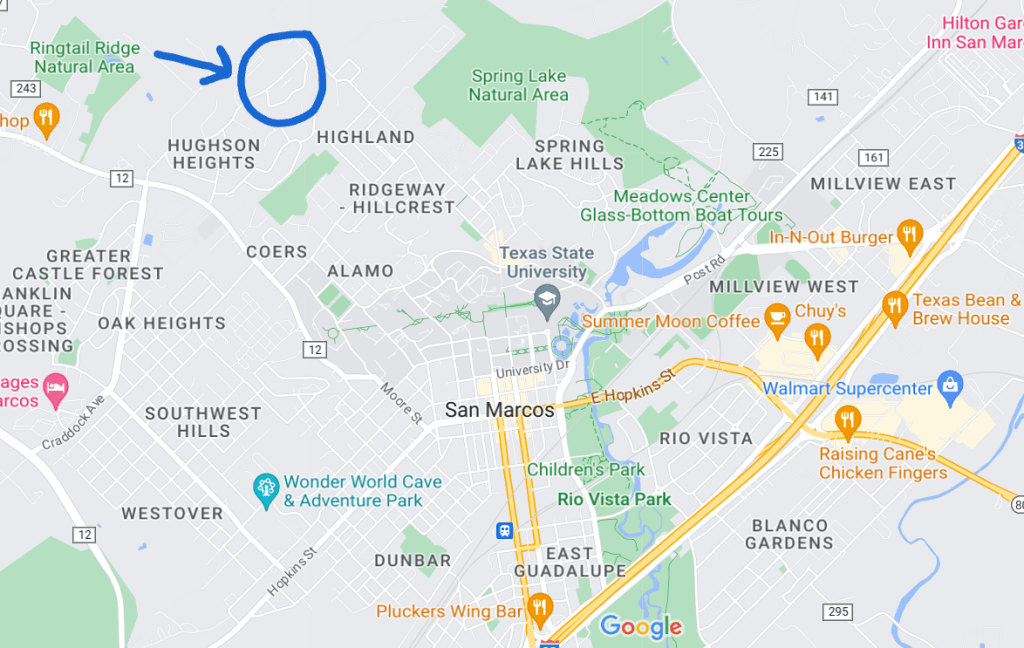
Ringtail Ridge is a tiny little park off Old 12, outlined in yellow below: 

It’s hidden and hard to get to, but very pretty!

Country Estates is the neighborhood next to it, outlined in green.  It’s just outside the city limits. A bunch of libertarians live there.

This red part is owned by the city:

It was acquired in 2017/2018.  Since it’s owned by the city, the city decided to annex it.  This doesn’t really affect anything, but it’s tidier this way. 

The plan is to zone it CD-1, which means keeping it as undeveloped as possible. The whole point is that it was acquired for conservation purposes, so they want to keep it natural. 

There were a number of speakers from Country Estates on this item at P&Z, on January 10th, and one more at City Council this past Tuesday (who was very annoyed that we were three hours deep in the meeting by the time we got to this item.)

The speakers wanted their natural countryside preserved, but they’re also libertarians, so they were very skeptical about whether or not government can be trusted to help.  Sorry, dude-ertarians, the free market is not going to preserve your beautiful nature! But local government to the rescue – the land will now be kept undeveloped, and the longterm goal is to make it available for trails and such.

Item 17-18:  Tiny houses!  What fun.  

This is out on Post Road:

There’s going to be a small portion of town homes (6 acres) and then a larger portion of tiny homes (24 acres).  

Tiny homes seem delightful, because who doesn’t love a dollhouse? But they only work for a very small portion of people:

  • you can’t really live with a kid in one.  
  • You have to figure out a plan for all those household items that you need monthly or a few times a year.  Either you need disposable income to replace things all the time, or you really need to commit to a spartan existence.  Which is tricky, because you’re stuck in the US, which is not set up that way.

However: if you are too prickly to share a wall with someone else and you are a serious minimalist, then it’s perfect.  Go live your dreams, Freebird.

One last thing:  This property is on the SMCISD side of the boundary between Hays CISD and SMCISD.   This is something that Council never talks about, but it ends up affecting San Marcos schools a lot.  

SMCISD needs more kids, basically. Tiny houses are going to be for kid-free adults. So it’s a bit of a bummer that this is in SMCISD, whereas all of the families right over in Blanco Vista go to Hays CISD.

(It’s because of the state funding formula. Because of the university, we look like a wealthier district than we are, and so we’re always on the brink of having to send money back to the state.  But we’re actually a Title 1 district, because our students are largely poor.  We need more families to keep the state of Texas from sabotaging us.)  

….

Item 19: Blanco Riverwalk

These guys have come up before, most recently in June 2021, when they were swatted down for proposing an apartment complex in a flood zone.

This time they are proposing… an apartment complex in a flood zone.  It went about as well as it did last time.  (Mumble mumble definition of insanity.)

It’s actually very close to the tiny houses, but you can see that it’s like two inches from the Blanco River.

P&Z denied the request on January 10th, so it would require 6 votes from Council to overturn the outcome.  Council denied it unanimously.