Hours 0:00-2:36, 9/5/23

Citizen Comment:

The main topic of the night is the budget, so the main complaint during citizen comment is that taxes are too high. Taxes are too high, and also the city isn’t solving all our problems, which is basically the municipal equivalent of “the food was terrible and the portions were too small!”

(And also, people hating on the bike lanes.  Everyone loves to hate the bike lanes.  If you love bike lanes, I suggest you let City Council know, because the anti-bike lane people are kicking up dust.)

Confidential to city council: I like the bike lanes. Let’s keep bikers alive.

Back to taxes. I’m going to tell you a little parable of my cat: 

I had a lovely tomcat who was scared of the vacuum cleaner. Whenever I ran the vacuum cleaner, he would lose his mind and attack my shoes.  He would just beat my poor shoe all to hell. (I tried not to vacuum very often.)

That’s the end of the story!

Here’s the thinly veiled moral: Being mad about taxes is like my cat attacking my shoe.  Don’t be mad at taxes for your justifiable economic woes.  You are neck-deep in capitalism! Be mad at that! You are right to feel worried that a medical disaster could undo everything you’re working for, or that you might be destitute in your old age, or unable to help out your kids.  The real crime is that someone can work fulltime and not be able to cover their basic needs.

If you know, if you truly 100% trust, that you’ll always have clean safe housing, healthy food, and free medical care readily available, then your life is much freer.  That’s the paradox: we pretend this is freedom while paralyzing ourselves with anxiety.  We’re such a mess.

Anyway, hooray for taxes.  Hooray for a social safety net, and if only it were much stronger. We’ll talk more about who gets tax breaks, and what kind of charity that is, a little later on. In the meantime, if you’re still mad about taxes, scroll through this little demo on the scale of economic inequality and get back to me. 

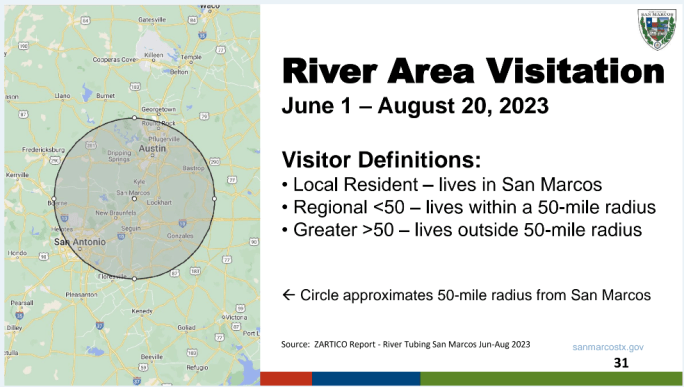
One comment that’s not about taxes: Virginia Parker spoke on behalf of the San Marcos River Foundation. Basically:

  • Everyone is freaked out by the river and parks right now
  • The summer was so hot, the river is so low, the parks are so overused
  • We desperately need more park staff and marshalls.  (These are her words. I’m not totally clear on what the marshalls do.)
  • We should have paid parking with free passes for residents to help offset costs
  • Only remaining vegetation are those fenced off Habitat Protection areas, and keeping that vegetation is crucial to keeping the river clear
  • We’re spending a bunch of money to promote tourism, but with the river in its current state, that’s kinda irresponsible. 

Item 13: The 2024 $315 million dollar city budget.

It takes 9 months to birth a budget. Here’s the basic timeline:

At the workshop last January, Council came up with their goals that are supposed to shape the whole process: 

They are all important, but public safety was the one that council really hammered, over and over again.  “Public safety” can mean so many different things to different people!  Do we mean lifting people out of poverty? Do we mean vocational training for ex-offenders as they transition to private life? Do we mean hiring more cops? (We definitely mean hiring more cops.)

The budget has a ton of moving parts, obviously.  Here’s the bird’s eye view of the whole thing:

Here are the major points that were emphasized:

Note:

  • The compensation study is to help us retain city staff. This is important – high turnover is incredibly expensive. Also, it’s just good manners to compensate people fairly.
  • The Human Services Advisory Board money is the money that the city gives to local nonprofits.
  • New city hall: there’s a state law that you can’t borrow money for a city hall building. (It’s wild what the state legislature will micro-manage.) So if your city hall was built in 1975 and you’ve outgrown it, you have to sock money away under a mattress until 2075, when you’ll be able to afford your new city hall.
  • Capital Improvements Program: this just means city projects and repairs. Fix the stormwater drainage in this neighborhood, add in sidewalks over there, etc.

So is this a good budget? Does it achieve those five goals? I don’t know!

Last year, city staff presented Council with 2 similar plans, and they debated them. Would we go with 59.3¢ or 60.3¢ tax rate? Would we use the extra $700K on cops and firefighters?  Last year, Chief Stephens and Chief Standridge came in person to plea for personnel. This made it easier for me to understand those aspects of the budget being discussed.

This year, there was just one budget and just one tax rate proposed. No debates. No lingering questions posed.  City council basically didn’t say anything besides thanking staff for their hard work. (And I listened to most of the workshops, and never heard much arguing there, either.)  There are two possibilities:

  1. Staff is just great.  They’re producing top notch budgets, and there’s not much to argue about.
  2. No one on council has strong feelings about these things, and no one has an angle to dig in and get heated up about anything.

Probably both are true? It’s very hard to figure out what people are thinking when no one says anything substantive.  

Here is the actual budget. It’s pretty readable!  It’s just hard to evaluate.

Item 14: the tax rate

We’ve been over the different tax rates before, so I’m going to save my pixels and just use the city’s slide:

The 60.3¢ rate is the same as last year.  Of course, inflation’s been a thing.  So how much are taxes going up? 

The average home went from $294K to $338K, so the average homeowner’s city property taxes are going from $1,686 in 2023 to $1,949 in 2024. 

Details:

(Now, this is only part of your tax bill. You also pay SMCISD and Hays property taxes.)

Let’s talk about the (15,000). That’s the homestead exemption.  In other words, you get a 15K discount before we charge you property tax.  This was created in 2022. It also gave seniors and people with disabilities a 35K deduction. 

Was this a big deal? Yes and no:

It costs us about $1.1 million dollars, out of $315 million budget, to do so.  Every home owner in San Marcos gets to evenly split $1.1 million dollars. None of them think that they just got a $90 bonus check from the city, but they did.

Here’s the thing:  We spend $550K on funding various nonprofits around town.  (This is the whole Human Services Advisory Board thing.)  We hem and haw and dole out $15K here and $25K there, and make nonprofits put in a ton of work for little amounts of money.  

At the same time, we spend twice as much on charity to people who own their own homes as we spend on all other nonprofits, combined. San Marcos is 75% renters! That handout is only going to 25% of the population!

Some home owners are rich. Others are definitely not. Being house-poor is definitely a real thing, and we need to help house-poor home owners. All I want is for the homestead exemption to feel like the city sent you a physical $90 check. It should not be invisible.

If I had a magic wand, I’d say that everyone must pay their full tax bill – federal and local – and then any deductions would get mailed back as a refund.  Subsidizing the rich should feel as tangible as subsidizing the poor. 

(Why not just cure poverty with your magic wand? oh hush.)

Items 15-18: Your utility and water rates are going up.  I’m sorry.  Sort of.  Channel your anger towards structural inequality.

For electric, we’re still the cheapest around:

Don’t let anyone ever talk about privatizing public utilities.  

Here’s our water rate:

Well, it’s mid, as the kids say.

Staff says that one of our biggest water expenses is a $1.4 million contract with Alliance Regional Water Authority.

I can’t actually find the contract in the budget, so I don’t know what we’re paying yearly:

I see Alliance Water Revenue, but not an expense. (I must be looking in the wrong place, idk.)

What is this contract? Basically, in 2007 we got some funding from the state to build this organization with Kyle, Buda, and the Canyon Regional Water Authority.  We drilled 4 wells, and we’re laying a bunch of segments of pipes, and some storage tanks, and a water treatment plant.

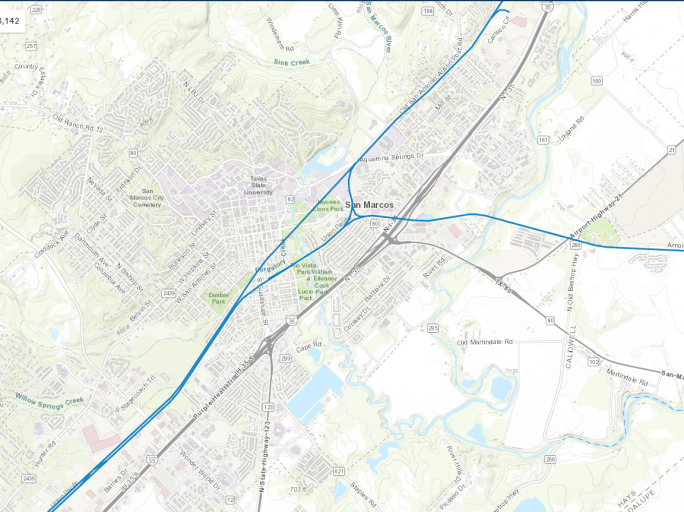
The water looks like it comes from the Carrizo-Wilcox Aquifer, which is here:

So not TOO far away.  

Carrizo water needs to be treated – it’s got more minerals and salt in it than surface water or Edwards Aquifer water.  But it sounds like there’s a LOT of it.  During the Council meeting, staff says that this is supposed to be a 40 year plan for getting us water.  I can’t find that promise written down anywhere though.

Either way: water rights are going to be a big, messy fight coming up in the future.  It’s good that we’ve got at least somewhat of a plan. 

Along with water and electric, there’s also garbage and recycling:

and also a Community Enhancement Fee:

So if I’m ballparking all that, your rates for all these services is going from:

58.20+49.27+28.80+1.5 = $137.77

to

59.43+51.71+29.66+2.35 = $143.15

So your monthly bill is going up $5.38.

(This isn’t exactly right, because I don’t know how much electricity and water the average household uses each month. I have to assume the city gave us monthly quantities.)(They actually mentioned the total increase at one point, but I missed it, and now I can’t find it.)

San Marcos is not rich. If you are struggling, consider the Utility Assistance Program, why doncha? (That’s Community Action, but the city partners with them.)

Full disclosure: the Utility Assistance application form is a little intimidating, at least to me. It is not Community Action’s fault that their application is cumbersome. It’s the culmination of a maze-like system of scrabbling for peanuts that we impose on nonprofits.

When I say my fantasy is a strong social safety net, my fantasy is also that it will be very easy to use.

There were two moments that I want to share:

  1. The vote to raise the utility rate by 5%:

Yes: Jane Hughson, Mark Gleason, Jude Prather
No: Shane Scott and Saul Gonzalez
Absent: Matthew Mendoza, Alyssa Garza.

WHOOPS. It takes four votes to pass. So since Matthew Mendoza and Alyssa Garza were absent, it failed. 

You could practically hear City Manager Stephanie Reyes’ stomach plummet through the floor, although she is the most poised person on the planet. She politely explained that we’ve now blown a giant hole in the budget, and we’ll need to revise it, and that we may need a special session in order to get everything passed by October 1st.

With that, Shane Scott offered to switch his vote, which I’m sure was a massive relief.  He explained that he just reflexively is a “no” on rate hikes, but didn’t actually want all those consequences to come crashing down.

The re-vote:

Yes: Jane Hughson, Mark Gleason, Jude Prather, Shane Scott
No: Saul Gonzalez
Absent: Matthew Mendoza, Alyssa Garza.

Phew.

  1. Matthew Mendoza was absent during the utilities conversation, but he arrived in time for the Community Enhancement Fee conversation. This is small, but it irritated me: 

Matthew asked, “What if an evicted person decides to throw all their stuff all over their front yard? Can this fee help with that kind of thing?”

Listen: don’t phrase it like that. A yard full of possessions is mostly a sign that someone’s problems are too big for them, and I don’t mean the landlord.

Also, it’s just plain wrong. Evicted people don’t throw all their stuff all over their front yard.  Evicted people just left their stuff exactly where it was, and did not move it one inch. Someone else got mad – like an ex-boyfriend or ex-girlfriend – and threw out their stuff, or the landlord moved it all to the curb.

(The answer was no, Matthew, you cannot use this money for that purpose, why would public money be used to help landlords clean up after tenants.)

Hours 2:36 – 3:14, 9/5/23

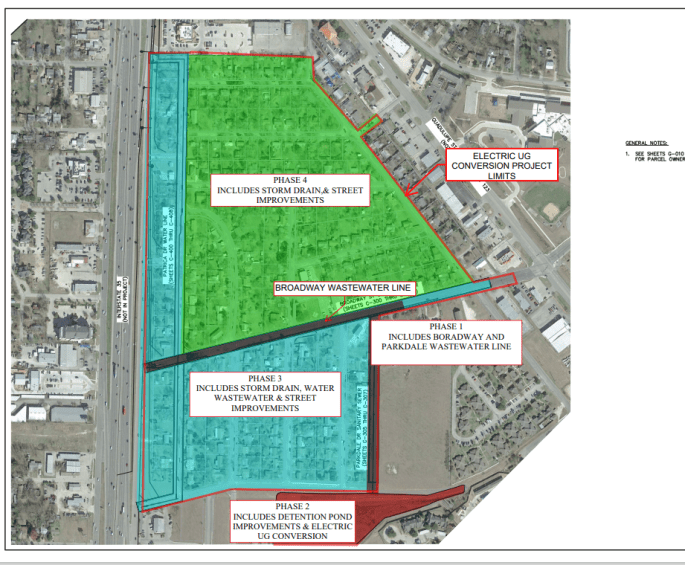
Items 10-12:  This spot seems to come up a lot at Council and P&Z meetings:

Here’s a close up of the section we mean, today:

In this case, three little roads are being demolished, and a new one being added in:

Now you know.

Item 20: Speed Cushions!

You know that phenomenon where you hear something for the first time, and then you hear it a bunch more in quick succession? (I’ve heard this called the plate of shrimp theory, from the movie Repo Man.)  

I’m having Plate of Shrimp phenomenon with Horace Howard Drive right now.  Here’s Horace Howard Drive:

It’s a little circular road that goes around a tiny lake:

Two weeks ago, a developer wanted to put a bunch of mobile homes on Horace Howard Drive, here:

P&Z gave this a very forceful NO, mostly because the neighbors all showed up, fearing the increase in traffic.  

Then this week, Horace Howard comes up again! Council granted them some new speed cushions, to complement the old ones:

How nice!

Coincidence? Why is Horace Howard showing up twice in two weeks? Is it in the ether?  I have no idea.

Item 22: Ending the five day hold for cats at the shelter.

This is a big deal, I think, and I almost missed it.   (The volume on the recording was really lousy this week.)

Last year, after many meetings and postponements, we banned puppy mills and implemented Trap/Neuter/Release for cats.  One of the recommendations from the animal folks was “Do not keep cats in the shelter, unless they are microchipped or have ID on them.”  Spay or neuter the cat and then just release them where they’re found, and let them find their way back to their familiar setting.

The problem is that cats without ID are almost never reconnected with their owners, and it’s really stressful for cats to be in shelters, and their health suffers. Whereas they do just fine if you put them back where you found them – they’ll either re-join their cat colony or find their way home.  So rather than holding them for five days and then letting someone adopt them, you should just spay or neuter the cat, and then return it to wherever you picked it up. This is Trap/Neuter/Release.

But Council debated this endlessly.  Mark Gleason was particularly nervous about lost cats.  Ultimately they kept the 5 day hold, and decided to revisit the issue six months later.

Lo and behold, six months passed. And in all of 30 seconds, they ended the 5 day hold and fully implemented Trap/Neuter/Release. What good councilmembers.

Item 25: Yearly CARTS contract

It costs $2.26 million to run CARTS for a year.  The city of San Marcos pays $515K of that, so a little under a quarter of it.  The rest of it gets covered by state and federal funding.

Shane Scott asked the hard-hitting questions: “How well utilized is this? What if we just had everyone take an uber instead? Wouldn’t it create jobs if we had uber drivers? Would that be more cost-effective?”

Jane Hughson says, “Buses have drivers.”

Shane falters and admits that buses do have drivers. He persists: “But would it be cheaper?”

The staff member said, “We have about 90K riders annually. But that would be a whole different transit model. This is a routes-based transit system. That would be on-demand, point-to-point system.  We do currently have an on-demand component to our system.”

Shane Scott mumbled thanks.  

You know I love public transportation.  I believe in public transportation.  So it hurts me to point out that the math here looks awful:  if CARTS costs $2.26 million for 90K riders, that rings in at $25 per ride. Of that, San Marcos is covering $5.73 of each ride.  

I am probably missing something basic here. The actual contract just says we pay $86 per bus-hour of operation, which seems reasonable. (And that all works out if there’s ~15 people on the bus at any point, which also seems reasonable.) Still, I must be missing something.

I am really hoping this partnership with Texas State boosts ridership, and helps get us momentum towards a system which is used by more people.  Let’s make my public transit dreams come true.

Update: posted by Rosalie Ray, on FB, in response:

Re: transit. You’re correct that $25 a ride is not great. The issue is that the city operates a coverage model, where we prioritize giving most neighborhoods access to a bus over giving some neighborhoods access to a bus that comes frequently. This approach makes sense if you view transit as a lifeline service and assume that your riders have a lot of spare time and a few essential appointments in their week. We can see the alternative approach with Texas State, where they will deny service to student housing complexes if doing so compromises their ability to maintain 10-15 minute frequencies. Ideally, you want a balance of the two approaches-some level of service to all communities and investment in high frequency service on key corridors. In general, Uber-style service can rarely be provided for less than $15 a ride cost to the city, and it doesn’t have economies of scale-that is, more riders mean more cost, whereas with a bus, more riders (up to a point) means cheaper cost per ride. It’s also currently somewhat unclear if you can use federal funding for an Uber-style service-you can if it’s serving folks who are physically or mentally unable to use buses and live within a quarter mile of a bus route, but beyond that is murky. Tl;dr the CARTS contract is not a bad deal given the current structure, but if we want to build ridership, our next transit plan needs to prioritize certain corridors to improve frequency, while finding a solution for those neighborhoods that might lose coverage.

Including this here because it’s worth sharing, but also so that I’m more likely to retain this information and remember it the next time I’m talking about this stuff.

Item 26:  More cats! This one is less about five day holds at the shelter, and more about renting your mini-excavator from Holt Cat, LTD.

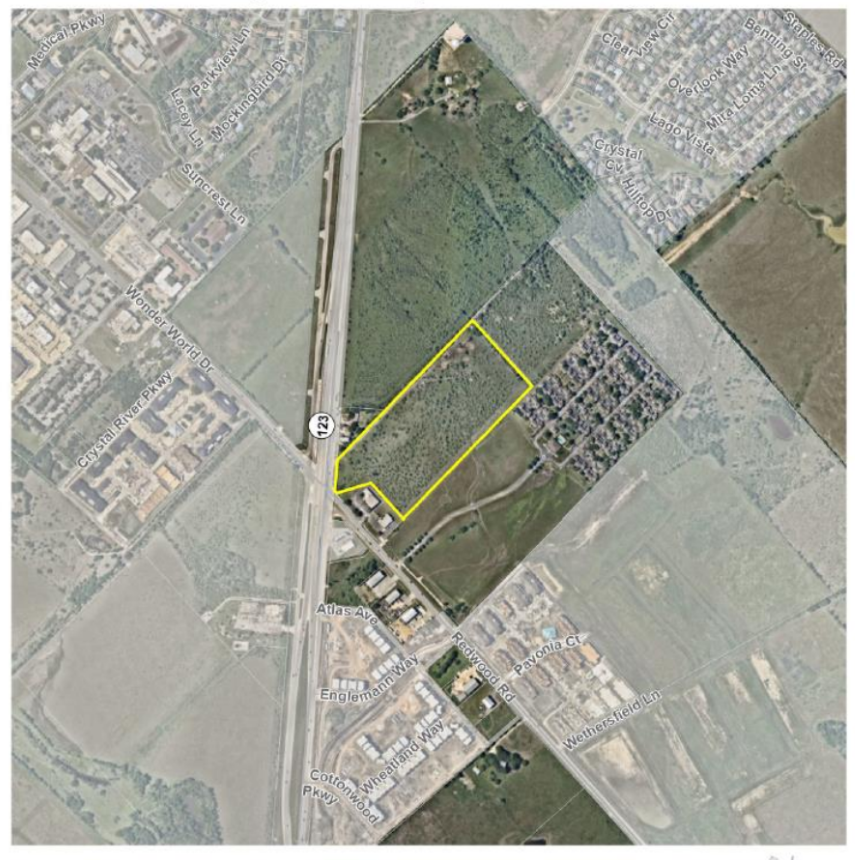
York Creek Road meets S. Old Bastrop road way down south:

It’s even further south than Horace Howard Drive, by about five miles.

These Holt Cat guys want to do this to it:

That is, turn a bunch of it into heavy industrial.  

There’s going to be some sort of development agreement coming around. In the past few years, Council has gotten into hot water with development agreements – La Cinema, SMART – where it passes them quietly and then everyone gets angry when they find out. Some day in the future, the city will send out notifications to residents within a 400 yard radius when a big development agreement is in the works. But that day is not yet here.

Council has not yet signed anything. Council just formed a committee with Jane Hughson, Mark Gleason, and Matthew Mendoza to look into it. So direct your Cat hopes and dreams to them.

August 15th City Council Meeting

This was a very short meeting! Some weeks are like that. Let’s hop to it. 

Hours 0:00 – 1:26: In which we talk about Leah Avenue and Rattler Road. We worry about flooding in Hills of Hays, and the low water level in the river. And some property taxes and public transit.

Some election talk:

Place 3: Alyssa Garza is the incumbent. There’s currently no one running against her. Griffin Spell had filed to run against her, but he withdrew his candidacy.

Vote for Alyssa! She is great, and she’s your only choice! Win-win.

Place 4: Shane Scott is the encumbent. Adam “Atom Von” Arndt is running against him.

Preliminary thoughts:
Shane is basically your standard libertarian. He likes businesses, he does not like authority, and he really does not like council discussions that exceed his attention span.

Adam “Atom Von” Arndt is very green. Or at least, he was when he ran against Saul Gonzalez last year. I’m curious to know what he’s done in the past year to grow as a candidate. (If he wants to learn city politics, may I politely recommend this very blog?)

If Atom wants to have a prayer against Shane, he needs to get out there and shake a lot of hands. Shane is very well known at this point, and I don’t think many people have any idea who Atom is. Lots of signs help too, but shaking hands and meeting voters one at a time is how this town still functions.

August 21st is the last day to file to run, so we’ll know by Monday night if there’s any wild cards. But my guess is that this is it.

Hours 0:00 – 1:26, 8/15/23

Citizen Comment: Max Baker was the only speaker. He showed up to comment on several things:

  • Damage to the river at Sewell park – litter, wild rice.
  • Working with Chief Standridge: do our cops run unnecessary background checks?
  • Upcoming elections: will the student center be properly staffed?

All good points!

Item 17: Platinum Drive

First, Leah Ave is one of those streets that you know you’ve been on a million times, but you may be vaguely confused about. That’s because there are two parts to Leah Ave, and they don’t currently connect:

The top half starts behind the hospital, crosses Wonderworld, and ends after Lowe’s and Petsmart and Marshalls.

The other half picks up again by Amazon:

I assume at some point the plan is to connect the two Leahs. But not today!

Today we’re talking about this little street that never got a name:

The solid part is the unnamed street, the dotted part is private. There’s a company, PGM, down that road and no one can find them, because their address is on I-35.  

So that little road is now getting christened “Platinum Drive”.

According to the Transportation Master Plan, that road may some day hook up with Rattler Road:

The transportation master plan is tiny and detailed, but someday Rattler Road will in fact cross McCarty, head over to Leah Ave and connect with Platinum Drive. But not any time in the next decade or so.

So for now, the fire marshalls did not want to name it Rattler Road, lest there be confusion in an emergency.  I guess the folks on Leah Ave can just deal with a disconnected street.

Item 18: Cut and Fill

This is a development going in next to the Hills of Hays neighborhood:

They want an exemption for cut-and-fill. Cut-and-fill means you’re building on a hill and you need it to be flat. So you want turn it into level pieces. If you have just a few large stair steps, then each riser is taller. If you have more stair steps, then each riser is smaller.

The problem with cut-and-fill is that this affects how water flows. You don’t want to cause someone else to flood. The code places a limit on how big the riser can be. You’re not allowed to cut-and-fill more than eight feet. Here, they want to cut to 22 feet and fill to 18 feet.

The Hills of Hays neighborhood is right next door:

That neighborhood has a lot of drainage and flooding problems with stormwater. This is exactly the type of thing that can get worse if some developer does a bunch of cut-and-fill uphill from you.

Back in May, the cut-and-fill permit came to P&Z. Several residents from Hills of Hays showed up and talked about their constant flooding problems. P&Z voted unanimously to recommend denial to City Council.

Now, there is a big city project to fix the flooding in Hills of Hays, and in fact it got started this summer. So this is what city staff tells council on Tuesday: hey, we met with the residents of Hills of Hays. Construction on their drainage project got started since the P&Z meeting. Things are different now!

No one from Hills of Hays showed up to comment on Tuesday, but Saul Gonzalez asked a good question – Did they think the issue was settled when P&Z voted it down? Staff said that they’d sent out more notices for this hearing, so probably not? (Only the back street of Hills will be in the 400′ notification radius, though. Not the entire neighborhood.)

Here’s my question: the drainage project for Hills of Hays has been planned for years. Did the engineers re-tool the stormwater drainage models to account for this cut-and-fill? How much excess capacity is being built into the new drainage system?

The vote:

Yes: Mayor Hughson, Jude Prather, Shane Scott, Matthew Mendoza

No:  Alyssa Garza, Saul Gonzalez

I probably would have voted “no”, because developers can follow the goddamn rules. But I do think that Jane at least was torn.

(The items go out of order because the Items 17 and 18 were Public Hearings, and so those go first.)

Item 8: the Interlocal Agreement (ILA) with the university over the river.

The city and the university have an agreement on river management. It’s not new, and they’re just minorly updating it this time around.

The city pays Texas State $276K a year, and the university does things like:
– non-native plant removal
– planting more Texas Wild Rice
– managing recreation and educating river users
– removing floating plant mats and any litter that’s part of them.

This isn’t changing much. I just bring this up because the river is incredibly low right now, and it’s upsetting.

Here’s the water level over the past year, compared to the previous 27 years:

via

The speaker at City Council said it’s the lowest in 25-30 years. This article from June said that the June level was the lowest in 70 years.

It’s all very anxiety-provoking!

Item 19: Property tax rate for the new year.

Last year, the city tax rate was 60.3 ¢ on every $100 of property value.

The budget isn’t decided yet, but the city sets an upper limit on the tax rate. 

There’s a couple possible property tax rates that get discussed:

  1. Last year’s rate: 60.3 ¢ on every $100.
  2. “No New Revenue Rate”: 53.05 ¢ per $100.  This is the rate that undoes the effect of inflation.  If you lowered the tax rate to 53.05 ¢, then you’d get the same amount of money from the properties that were taxed in both years, even though the value of those properties have gone up.
  3. “Voter approval rate”: 68.87 ¢ per $100: By state law, the is the highest you can go without having to hold a citizen vote on it.

Every penny increase brings in about $800K in tax revenue to the city.  So Option 2 is about $6 million lower than Option 1, and Option 3 is about $7 million higher than Option 1.

Here’s an interesting chart from the presentation:

Hence everyone complaining that their property taxes are going up, even when the rate doesn’t change.

Useful things I feel compelled to remind everyone about:

  • We have no state income tax! Wealthy people benefit the most from this. 
  • Property taxes are somewhat regressive.
  • Sales taxes are really regressive.

Today’s task is just to set an upper limit on the tax rate. I’m not sure exactly why Texas requires city council to do this, but here we are. 

City staff has proposed a budget based on a 60.3 ¢ tax rate, so Council sets 60.3 ¢ as their upper bound.  I’m also not sure why they wouldn’t give themselves a little wiggle room on this vote. Why not set your upper bound at 61 ¢, and then approve the lower amount when the budget actually gets approved?

….

Item 20: Public transit is a great thing.  But only when it works well. When it doesn’t work well, nobody uses it unless they’re in a bind. 

What makes public transportation easy to use?

  • Frequency.  If you don’t need to consult a schedule because busses come every 15 minutes, it’s easier to use.
  • Lots of stops: no one wants to walk very far in this heat.
  • Range: it has to get you where you’re going, preferably without too many changes

There is federal money available for all this, if you can demonstrate ridership.  This is the tricky part – how do you demonstrate demand, if your system is underfunded?  It’s a little bit of a catch-22.

ENTER: THE INTERLOCAL AGREEMENT WITH TEXAS STATE UNIVERSITY! 

A few years ago, Texas State started reporting its ridership numbers to the federal agency that keeps track of these things. Now we’re going to pool our systems. So we get a giant boon because Texas State has high ridership. 

This opens up a lot of funding and growth opportunities! This is great!  Hooray!

August 1st City Council Meeting

I just want to point out a pattern. Several times in this meeting, this happens:

“Look, here’s a problem!”
“Yes, yes! We all agree that this is a problem!”

Then we sit, waiting for someone to make a motion to fix the problem.

No one makes a motion.

Everyone shrugs and moves on. It drives me crazy. You all just acknowledged it was a problem! You got to third base, but then got bored and never got to home plate.

Oh well, moving right along:

Hours 0:00 – 1:29:  A bunch of fiddly little items.  And my favorite: the curfew is dead!
Hours 1:29 – 2:57:  In which the Land Development Code is scrutinized.  Some important changes are coming.
Bonus workshop: There’s some nasty chemicals in the ground near the town square. Read all about our plan to do nothing!  We’re doing it responsibly, though. 

Welcome back!

Hours 0:00-1:29, 8/1/23

Citizen comment:

Several people from the SMART protest community showed up to talk about Item 18, the revision to the San Marcos Development Codes. We’ll get to this.

A few people talked about different good projects for the CBDG money.

Item 10: CBDG money for 2023-24.

This is $712K of federal money from HUD that’s intended to help community programs for low-income folk.

Here’s the requested amounts, and what ends up being awarded:

The “rec” amounts end up being approved by council.

On the Habitat House Counselling program: The federal department, HUD, requires housing counselling in certain situations. Habitat offers an online course and then individual counselling thereafter. A rep from Habitat for Humanity shows up to explain all this. But it wasn’t persuasive, because the cost is wild: Last year, Habitat charged San Marcos $13,000, and only 11 San Marcos households participated.

HUD offers a free online house counselling course. Sso we’re going with that. (We still work with Habitat on housing construction. Just not counseling.)

Shane Scott asks if we can boost CASA to $60K. The problem is that HUD has categories for this money, so you can’t dip into any project you want to move funds around. They decide that they’ll just boost CASA from the other money they dole out – the city money (HSAB) or the last bit of Covid money (ARP).

Item 11: Running wastewater from Whisper Tract down through Blanco Shoals natural area, to connect with the city wastewater system.

I’m only including this item because it annoyed me. LMC spoke during the public hearing, and asked if this involved tree removal. Would the city hold itself to the standards that it holds its citizens?

Mark Gleason follows up: Will this require tree removal?
Answer: It could!
Mark: Is there a remediation procedure?
Answer: nope!
Jane Hughson: Can we add a remediation procedure in?
Answer: It’s not in the development agreement with Whisper. [Translation: you can’t make the developer pay for tree remediation.]

Ok, fine, but we can certainly pay for tree remediation. But it just gets dropped, exasperatingly.

This is the Council Dance:
– Here, we identified a problem.
– Let’s all sit uncomfortably for a sec
– Rather than fix it, just pat it on the head and go on our merry way.

Also: Add in tree remediation to your goddamn development agreements, Council!

Item 12: Issuing $3.7 million dollars in bond debt.  I didn’t really follow the details, but our AA bond rating was affirmed by Standard & Poors, which was presented as a thing we should feel good about.

Item 14: CURFEWS ARE BACK. This is delicious.

If you’ll remember, there was a three part giant shitstorm over renewing the curfew, last year.  Mark Gleason decried the roving gangs of minors in his neighborhood.  Mano Amiga turned out a large number of people speaking out against it. I myself made the case that curfews are dumb and wrong. 

The final vote on curfews, back on 12/14/22:

So it passed. (I miss the clickers.) In theory, the Criminal Justice Reform committee was going to study the issue and bring it back.

However, the good hypocrites at the state level, in their quest to micromanage cities, felt differently!

H.B. 1819 seeks to ensure that all young Texans have opportunities to succeed without the burden of a criminal record early in life by eliminating the authority of political subdivisions to adopt or enforce juvenile curfews.

It’s really an oddly specific thing for the State Legislature to care about. Based on this flyer, it was supported by a real mix of groups: a conservative think tank, homeschoolers, youth services and racial and social justice organizations.

The common thread seems to be anti-authoritarianism. Works for me.

Upshot: in order to comply with the new state law, the curfew has now been repealed. Hooray!

Item 15: Ending the contractor test requirement to pull a permit.  This came up before as a discussion item, and now it’s happening.  This is a good thing. Anyone can pull a building permit now.

Item 16:  Firefighter Meet & Confer. 

Meet & Confer came up a lot last year, but for SMPD. It was approved, then Mano Amiga filed a petition, council voted to reopen negotiations, the proposed changes were very weak, and ultimately it became clear that the city sand-bagged the whole process. (Everyone but Alyssa Garza voted to ratify the new contract.)

Firefighters also get to unionize and collectively bargain for their contracts. The firefighter’s union is SMPFFA. Since firefighters aren’t known for systematically stopping, harassing, and abusing people of color, SMPFFA gets a lot less attention than the police. 

Here’s the summary:

It didn’t get much in the way of comments from the Council peanut gallery, and I don’t have much to say, either.

Hours 1:29-2:57, 8/1/23

Item 18: Updating the San Marcos Development Code

This is big and interesting. It has four parts:

  1. Compliance with State Laws
  2. Business Park Zoning
  3. Process Improvements
  4. Clarification and Corrections

Part 1: Compliance with State Laws

The state just passed a bunch of laws, like repealing all curfews. What else do we need to fix to be legal?

  • Plats: A plat is the drawing that shows things like roads, bus stops, parks, parking lots, and things like that. Everything but the details of the actual building.

    Right now plats get approved by P&Z. But P&Z is legally not allowed to make a judgement call. They’re only allowed to consider if the plat meets the conditions in the land development code.

    In the future, plats won’t go to P&Z anymore. City staff will approve them. We’re told this is because the state legislature tightened the shot clock, so we have less time to approve applications. We need to streamline processes to comply. They will publish the plats on a website

Okay: this is a small thing, but city staff is mildly bullshitting their case to City Council here. The shot clock was tightened back in 2019 to 30 days. This most recent bill says it’s okay to skip P&Z approval. So P&Z approval used to be required by the state, but now we’re allowed to let staff approve plats.

What else?

  • More appeals procedures added in to land at City Council, and we modified the timeline
  • Private schools must be zoned just like public schools.

City staff is misleading us a teeny bit here, too. This says “Municipalities will be required to treat charters as they would an independent school district for the purposes of permitting, zoning, etc.” It does not say private schools. Just charter schools. We’re allowed to zone private schools however we want, but don’t pretend that the state is making us do this.

Listen: the city staff work hard and they’re good people. I’m just being persnickety here.

Part 2: A new zoning district, called “Business Park”.

To me, this is a business park:

via

That’s not what we’re talking about. What Jane Hughson means is, “Hey, if you want to put industrial next to residential, it has to be super mild and chill.”

I think she actually means little warehouses, like this:

via

I would call it “Good Neighbor Industrial”.

Either way, it’s going to be capped at 35′ high, and excludes a lot of bad neighbor uses. If you wanted it higher than 35′ or to include warehouse and delivery, you’d have to get a Conditional Use Permit from P&Z.

Part 3: Process improvements

City council keeps getting bit in the butt over Development Agreements. They pass something in the dead of night, and then when everyone finds out the details, they’re furious.

In recent memory:

  • La Cinema. Council modified the Development Agreement with La Cima to allow for movie studios back in December 2021. There were no notifications sent out and no one noticed. Then it came time to negotiate tax credits, and everyone got super mad that movie studios were allowed over the aquifer. But it was too late.
  • The SMART Terminal. They doubled the size of the SMART Terminal back in January. But there were no notifications to the public. Afterwards, everyone was furious. I would have to link to every single meeting from the past six months to flesh this out.

Clearly we need to mail out notifications for Development Agreements and for amendments. We’re finally going to start doing this.

How many people should get notified? They’re proposing a 400 foot radius – everyone who lives within 400′ gets mailed a notification. That matches what we do for zoning changes.

Listen: It should not be 400′. It should be proportional to the size of the project. Tiny projects get a tiny notification radius. Giant projects need a larger notification radius.

If you’re looking at the 2000 acre SMART/Logistics park, 400 feet is a tiny sliver around it. If you’re talking about a little 4-plex, 400 feet is plenty.

Note to Council: Since you’re tinkering with Development Agreements, why not also add in tree remediation?

Other changes

  • Historical Preservation Commission (HPC) can postpone things now.
  • Timeline for Demolition by Neglect is increased from 30 to 45 days
  • Park land dedication – this one is a bit weird. Let’s spend a moment here.

Right now, if you want to build anything residential, you have to set aside some land for parks. The equation is 5.7 acres per 1000 people.

The old code says this: “A minimum of 50% of the parkland required under this ordinance shall be dedicated to the City of San Marcos as a neighborhood or regional park under Section 3.10.2.1. The remaining 50% may be owned and managed by one of the entities under Section 3.10.1.6.”. Those entities are the city, a land conservancy or land trust, an HOA, or a public easement.

The new code says: “Appropriate plat notes describing the ownership and maintenance of all proposed parks are provided on the plat.”

In other words, maintenance is expensive and we want to pawn it off onto HOAs. But then the city doesn’t actually own the land. We could just make the developers and HOAs cover the costs, but we still own the land. But that’s not what’s proposed.

Jane Hughson asks: Will the park still be open to the public?
Answer: Yes, dedicated parkland is required to be open to the public.

Mark Gleason asks: What can we do if it’s not maintained?
Answer: We withhold their final permits until the park looks good.
Mark: No, I mean like five years later. What if the bathrooms are all broken and there’s garbage all over the place? What can we do?
Answer: [squirming in the uncomfortable silence]

Looking in the code, I see this bit:

That doesn’t quite apply here.

No one offers a motion and the motion passes.

See? This is the Council Dance again:
– Here, we identified a problem.
– Let’s all sit uncomfortably for a sec
– Rather than fix it, just pat it on the head and go on our merry way.

  • Occupancy restrictions: let’s dish on this.

We have an occupancy ban in San Marcos. No more than two unrelated people can live in the same house. This is an extremely shitty policy that punishes poor people, out of fear that college students will throw wild keggers next door. There is a housing crisis, and people need to be able to move in with each other. (Furthermore, this dumb policy is totally unenforceable, so it only gets trotted out when someone has an axe to grind. It’s the worst!)

Listen: you cannot govern San Marcos solely out of fear of beer cans from college kids. That is a code compliance issue. That is not the basis for good policy.

Back in April ’22, Alyssa Garza fought hard to get everyone to consider relaxing the occupancy ban. Eventually she built consensus: council asked city staff to bring back a policy loosening the restriction to 3 unrelated people. Hooray, sort of.

Somehow it took city staff 15 months to bring it back, so here we are. However, during that 15 months, Max Baker was voted out and Matthew Mendoza was voted in. And Matthew Mendoza is very salty on this issue.

The more he talks, the more conservative Matthew seems. He sees this all the time in his neighborhood: a bunch of unrelated people live together, and it reduces home values for families in his neighborhood, which is how you buld generational wealth. He was calling this New Urbanism and claiming this was a gateway for big apartment complexes. It was kind of unhinged.

Everyone reassured him that there’d been a big conversation. Matthew did not get any traction re-opening the topic. But it was still a weird rant.

  • Awnings can be now be 7′ clearance instead of 9′ minimum clearance. This is in response to the owner of Chances R Bar downtown, who pointed out that the building literally isn’t tall enough for a 9′ awning.
  • Mark Gleason is super mad at his neighbor.

Apparently there’s a house in Mark’s neighborhood which is lifted off the ground and is two stories high. It’s got a flat roof, and they made a little patio up there. Mark is livid that they can see into other people’s backyards, but you can’t really legislate that, so instead he is livid that there is a structure up there – “with shingles!” – that allows them to hang out and see into people’s backyards.

Shane Scott says, “Our house in Mexico is like that. It sounds pretty cool.”

This is the Shane I like best, when he needles Mark for being a prig. You can practically see them in the same high school cafeteria, circa 1991: Shane wearing a Metallica t-shirt and black jeans, Mark wearing the same khakis and golf shirts that he wears to city council meetings. Shane leaves his lunch trash behind on the table when he leaves, and Mark urgently flags down the teacher to let them know that it was Shane.

Amanda Hernandez, the planning department director, strongly suspects that this house is probably already violating city code. The top of a house can’t be more than 35′ off the ground. If this is elevated and two stories already, you’ve got to be pretty close. Mezzanine structures count if they’re at least 30% of the area.

Mark makes a motion to measure height from the ground to top of rooftop structures.

Yes: Everyone besides Shane Scott.  
No: Shane Scott
(Jude Prather is absent.)

I prefer to live in a world that facilitates rooftop patios and rejects Mark’s killjoy tendencies. So I’m a “no”, if anyone asks.

Bonus! Council Workshop 8/1/23

3 pm Workshop: This is very interesting! 

The city acquired three derelict properties in 2020.  It’s these three:

You can totally see it from the town square. It’s very close.

It looks like this from ground:

That is The Rooftop to the right, and to the left is Solid Gold used to be. (Let’s have a moment of silence for the closure of that store.)

The city bought it because there were a bunch of contaminants in the ground.  It had been a dry cleaners for years and years. From the late 1940s-1980s, they were dumping some awful stuff into the ground. 

So what do you do with a bunch of toxic shit in the ground? There are procedures, it turns out.  You need some information:

  • What contaminants exactly got dumped?
  • How far underground has it spread? How deep is it, and how far north/east/west/south?
  • Is it staying put? Or is it moving?
  • How exactly do you clean up these chemicals?
  • If you don’t clean up these chemicals, what do they decompose into, and how long does it take for it to decompose?

It turns out we have answers to all these questions! 

  1. The chemicals: 
    Tetrachloroethene (PERC)
    Trichloroethene (TCE)
    Vinyl Chloride (VC)

Chlorinated solvents are synthetic chlorinated chemicals, I’m told. Bacteria won’t touch them, but they’ll break down on their own over time.

I have no background in chemistry, but if the chemists tell me to stay away from these, I’m going to believe them.

  1. Where are these nasty chemicals currently?

We dug a bunch of different types of wells:

I’ll explain the “MSD” acronym in a bit.  

So here’s what you find when you drill down: 

  • The normal soil or whatever on top. Very dense silt and clay. No moisture.
  • About 22’-23’ down, you get fine sand.  It’s got groundwater in it. That’s called silten clay.
  • Below that, you get Navarro Clay.  The Navarro Clay is super thick and water doesn’t pass through it.  (The vocabulary word is aquitard, which sounds like an insult but isn’t.)

The Navarro Clay is a shield, and then below is the aquifer water.  

So the contaminants – the PERCs, the TCEs, and the VCs – they are all heavier than water, and they sink through all that wet sand and puddle on top of the Navarro Clay.  That tells us how deep these things are.

Note: the geologists made it sound like the aquifer was hundreds of feet further below the Navarro Clay, so far away that we should sleep easy at night.

But this makes it look not-so-far-away:

via

So we are really trusting the aquitardiness of that Navarro Clay.

What about how far north/east/south/west?

The skinny red line is the boundary of the PERC plume:

And here the TCE plume:

And the VC plume:

  1. Is it staying put? Or is it moving? 

It is moving incredibly slowly in this direction:

Because it’s resting on the Navarro Clay, and it’s all gunked up in there, it’s moving incredibly slowly. It won’t reach Purgatory Creek for another 89-8900 years. It won’t reach the San Marcos River for another 188-18,800 years.  

  1. How exactly would you clean this up? 

They didn’t actually answer this. They basically said it would be impossible, because of all the sand in the way, and the gunkiness of the Navarro Clay.

  1. What would it decompose to?  

The PERC is the stuff that was dumped by the drycleaners. The PERC breaks down into the TCE, which is also nasty. The TCE breaks down into two dichloroethylenes, also bad. That breaks down into VC, still bad. But then after that you get carbon dioxide, a little chlorine, and water, which is not nasty anymore.  This process will happen over the next 50-100 years. 

Listen: I am sharing what was presented. I am not a scientist. If you are a scientist, and we are being told an overly optimistic picture, please fill me in.

So what do we do?

So if the PERCs and TCEs and VCs will all break down before they reach anything sensitive, what do we do?

You declare an MSD: Municipal Settings Designation. 

Back to this slide, which has the perimeter of the MSD:

This means that within these borders, no one is allowed to drink well water.  Everyone has to be on city water.  

It also means that within a few years, we can “achieve regulatory clearance”. 

Congratulations! You have nasty stuff in the ground, but your regulatory conscience is clear!

… 

So what happens up top, where people wander around? This was the second half of the presentation.

Again, this is what it looks like:

It’s fine, as long as you don’t dig up that concrete.

We’re proposing a short term plan: the left and right would be city parking, and the middle will be a little public area. Shade, seating, bathrooms, bike and scooter parking. Room for extra booths for the farmer’s market or Art Squared.

Council was nervous about having a stage there, but liked the rest of it. So this will come back around as an agenda item in the future.

Yearly Clean-up, Summer ’22-Summer ’23

I’m trying something different with this year’s retrospective: I picture it functioning like a table of contents, to help organize the past year into a coherent timeline. (Find last year’s retrospective here.)

It’s really dry, boring reading. Sorry! Tune in next week, when our courageous city council members return to their normal shenanigans, on the 23-24 season premier of the San Marcos City Council.

One more thing: Election season is coming up! Two city council seats are up for election:
Seat 3: Alyssa Garza (our noble, lonely progressive representative)
Seat 4: Shane Scott (loves small government and business interests)

Currently, Griffin Spell has filed to run against Alyssa Garza. I have lots of thoughts, but I’ll save them for the future.

No one has filed yet to run against Shane Scott. The last day to file is August 21st.

I am not plugged in enough to know if anyone is thinking about challenging Shane Scott. But I’m hoping!

Yearly Summary

Caveat:
– Many items show up at multiple meetings. I’m usually listing an item at the meeting that you’d want to consult if you went back to look up details.
– when relevant, I’ll include how each person voted
– San Marcos is 15 months behind on posting the minutes to city council meetings. The most recent is May, 2022. What’s up with that?

August 2022:

1st meeting:

  • Four separate zoning cases near the Outlet Malls and Amazon
  • Zoning for housing sprawl approved waaaaaay south, absolutely in the middle of nowhere, near the Hays power plant
  • Decriminalizing weed makes it on the ballot, due to Mano Amiga’s petition
  • Form a committee to talk about a San Marcos GRACE act, which has never come back around again
  • Quail Creek Park is purchased

2nd meeting:

  • San Marcos elections are problematic
  • Riverbend Ranch tries to put exemptions on the industrial part, upstream of Redwood
  • School Resource Officers are renewed.
    • Yes: Mayor Hughson, Shane Scott, Mark Gleason, Saul Gonzalez
    • No: Alyssa Garza, Max Baker
  • Shane brings 3 oz of weed to a city council meeting
  • The Lobbying ordinance dies
    • Yes: Alyssa Garza, Max Baker
    • No: Mayor Hughson, Shane Scott, Mark Gleason, Saul Gonzalez, and Jude Prather

September 2022

1st meeting:

  • Budget and property tax rate discussions
  • Tax credits for a giant tract of sprawl out behind the outlet malls
  • New firestation approved downtown
  • Meet and Confer with SMPOA is approved

2nd meeting:

  • Election discussion
  • Property tax rate set at 60.3 cents, 7 extra police/fire fighters are funded
  • Boyhood Alley renamed
  • Library Fines go away
  • Loquat Street is traded to the University for undisclosed purposes that make me nervous.

October 2022

1st meeting:

  • Noise ordinance and alcohol subcommittee formed. Has not come back around yet.
  • Eviction delay sustained

November Election: my city council candidate recommendations

2nd meeting:

  • EDSM conflicts of interest with GSMP
  • Workshop on the Edwards Aquifer and purple pipe

November 2022

1st meeting:

  • Election results
  • Zoning some new apartments near 5 mile dam
  • Rehousing a few people from the 2015 floods into Sunset Acres
  • The pick-a-pet problem

2nd meeting:

  • Curfews (recently outlawed at the state level!)
  • Puppy mill discussion paused on the second reading.

December 2022

1st meeting:

  • Curfew ordinance is approved. There are two votes:
  • Voters have approved marijuana decriminalization

2nd meeting:

  • Free electric cabs approved downtown
  • Curfew is approved.  (May now be illegal). In theory, CJR committee is studying the issue
  • Very first discussion of SMART Terminal: should 660 acres be moved from the Cotton Center to the SMART Terminal? 
  • Campaign funding and ERC review

January 2023

1st meeting:

  • More apartments on near the intersection of Rattler Road and McCarty
  • Trace gets rid of some of its commercial zonings

2nd meeting:

  • SMART Terminal development agreement is updated. It gets the mushiest, least critical treatment from council. 
    • Yes: Mayor Hughson, Saul Gonzalez, Jude Prather, Mark Gleason, Matthew Mendoza
    • No: Alyssa Garza
      That vote aged poorly!
  • Fire department codes updated
  • Riverbend Ranch subcommittee formed to support Redwood
  • Paid parking at Lion’s Club
  • Human Services Advisory Board grant money new guidelines

February 2023

1st meeting:

  • Repeal of Meet & Confer agreement, re-entry into renegotiations with SMPD
    • Repeal: Alyssa Gara, Saul Gonzalez, Shane Scott, Jude Proather
    • Deny the petition: Mayor Hughson, Mark Gleason, Matthew Mendoza
  • Some townhomes in Trace
  • Preserving land next to Ringtail Ridge park
  • Tiny houses out on Post Road
  • SMART officially approved in an extraordinarily brief discussion (Alyssa is the only no vote)

2nd meeting:

  • Stephanie Reyes is promoted
  • P&Z appointments 
  • Bike lanes on Craddock and sessom

March 2023

1st meeting:

  • Rezone a bit between I35 and the Saddlebrook mobile home community as Heavy Commercial
  • Got rid of some commercial zoning in Cottonwood Creek, despite residents writing letters wanting it to stay commercial
    • Rezone/Tote water for developer: Mayor Hughson, Mark Gleason, Saul Gonzales, Shane Scott, Matthew Mendoza, Jude Prather
    • Keep commercial/listen to residents: Alyssa Garza
  • HSAB grant money finally parcelled out
  • Puppy mills are banned! (Final vote is unanimous)

2nd meeting:

  • Citizens protesting SMART are ramping up
  • McCoys will be building a new headquarters campus in town
  • New murals!
  • Committee-on-committees is formed. Alyssa, Matthew, Mark
  • Vacancy taxes are floated by Max in public Q&A. Will hopefully come back around

April 2023:

1st meeting:

  • P&Z approves the Heavy Industrial zoning for SMART Terminal
  • Little square behind Embassy Suites is officially denied Light Industrial zoning.
    • Deny: Mayor Hughson, Alyssa Garza, Matthew Mendoza, Mark Gleason
    • Approve: Shane Scott, Jude Prather

2nd meeting: 

  • SMART Terminal zoning ends up with Council agreeing to revisit the development agreement, due to community outcry
  • More apartments by the high school, along 123.

May 2023:

1st meeting:

  • Presentation on the new Meet & Confer agreement
  • Clubhouse style apartments across from the Outlet Malls
  • The SMART development agreement is re-opened
  • The city can boot cars with too many unpaid parking tickets

2nd meeting:

  • P&Z members rewrite their own Comp Plan, I am annoyed 
  • Satanic Temple leads the council in prayer
  • Remove 104 acres of commercial from Riverbend Ranch, because why not let developers build 1200 acres endless uninterrupted sprawl like they want?
  • Meet & Confer comes back around.  Negligible changes were made. Council did not bring the Hartmann reforms to the negotiation table in any meaningful sense.
    The vote:
    • Yes: Mayor Hughson, Jude Prather, Shane Scott, Mark Gleason, Matthew Mendoza, Saul Gonzalez
    • No: Alyssa Garza
  • Eviction delay is set to end
  • Ending the General Contractor testing requirement to pull permits

June 2023
Only 1 meeting:

  • CBDG money delegated
  • 4 hour parking in limited locations downtown
  • The last $3 million of ARP dollars is parceled out
  • New art installation in Ramon Lucio Park

July 2023
Only 1 meeting:

  • SMART Terminal/Axis Logistics withdraws its zoning request
  • La Cinema land is annexed and zoned
  • P&Z has an extremely frustrating workshop on the new Comp Plan.
  • Homeless action plan workshop

July 3rd City Council Meeting

Hello everybody from the dregs of summer! Who wants to talk shop about your friendly city council reps over at city hall?

The meeting was unexpectedly short, and so I added in some extras: the P&Z Comprehensive Plan Workshop, and the City Council workshop. You know how I like to do that.

Hours 0:00-1:21: The whole city council meeting.  From the end of the SMART chapter, to La Cinema, to some gas company talk. 

P&Z Comp Plan Workshop: In which I’m irritated by our NIMBY representatives. 

City Council workshop: a presentation on a homeless action plan, and our long-slumbering Housing Action Plan reawakens, and it’s hungry.

That’s a wrap! That’s the only meeting until August, too. Maybe I’ll add in some extra posts though – like a year end summary thing again…