The first workshop was an update on the budget side of the CIP projects, which is kind of weedy and wonky, so I’m skipping that. But feel free to watch here.
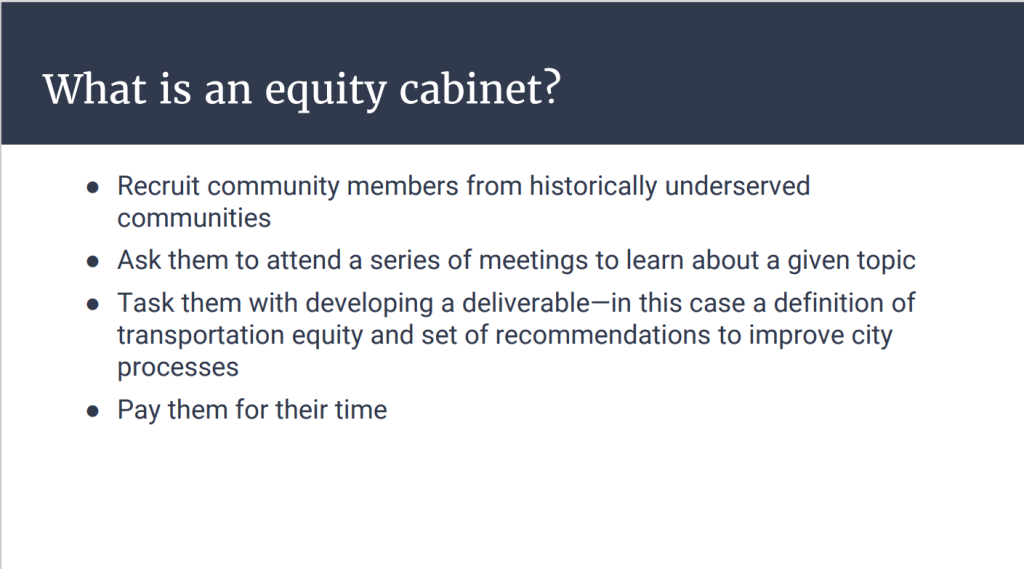
So basically, DEI is hard to do well. It takes time, energy, funding, and expertise. An equity cabinet is one model that the research-folk like, as a way to do it well.
Ours is studying transportation.
Here’s what I got out of it: there’s a lot of expertise about transportation by city staff, and there’s a lot of lived experience by people who don’t have cars, out in the community.
If you want to incorporate their experience into city policy, you need to do a lot of things:
Give people rides to meetings and compensate them for their time. The whole point is to focus on people with barriers to participation, so you’d better address the barriers.
Have the cabinet go into detail about what problems they face.
Have city staff give the cabinet a rundown about how city planners organize and work on transportation issues.
At this point, the cabinet has both sides of the equation: lived experience plus expertise. Then the cabinet members can really identify the sources of the problems and understand what it would take to solve them
Eventually they arrive at a set of recommendations, which the city can then incorporate into their plans.
That’s why it’s a big, drawn out process involving time, money, and energy! But it sounds like it went really well.
First: You have to know exactly what you’re aiming for, if you want a concrete, productive conversation:
The participants were giving the presentation, for what it’s worth.
Here’s their experience:
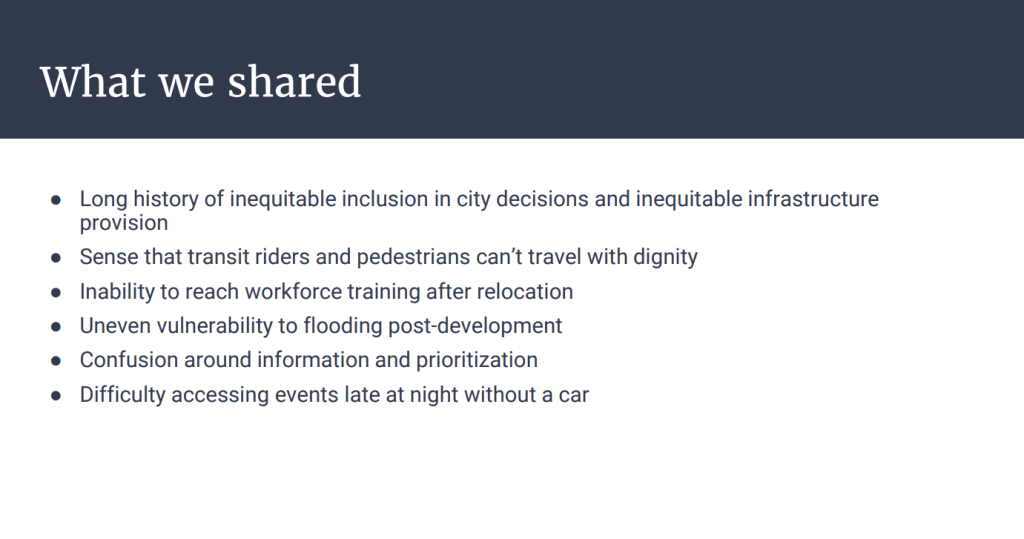
Life is really not easy in San Marcos, without a car. Like, Workforce Solutions that’s supposed to help you train and find a job, cover childcare, etc, is located way out on Posey Road.
This is the participants incorporating the expertise of city planners into their understanding of San Marcos:
So taking expertise plus lived experience together, they identified some key problems:
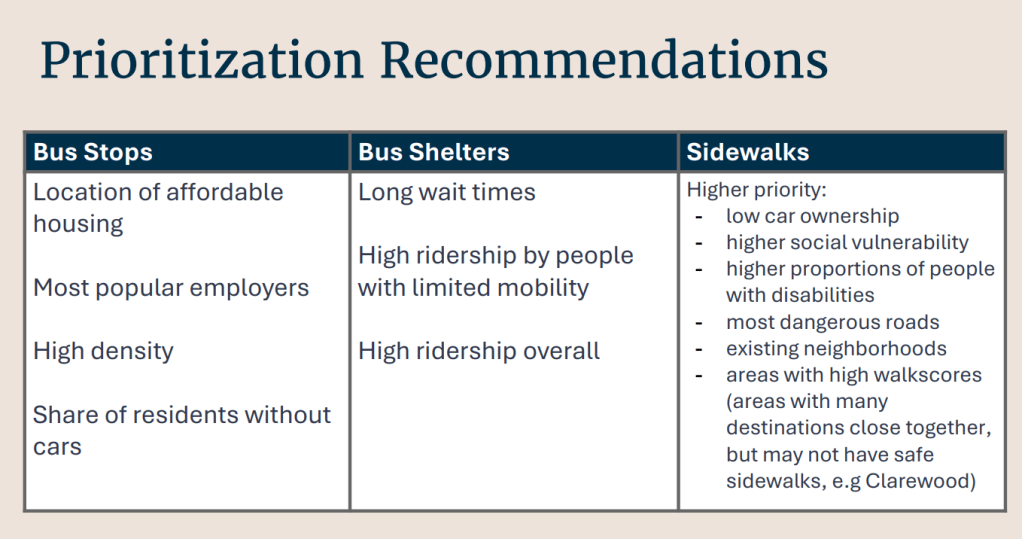
Those are categories.
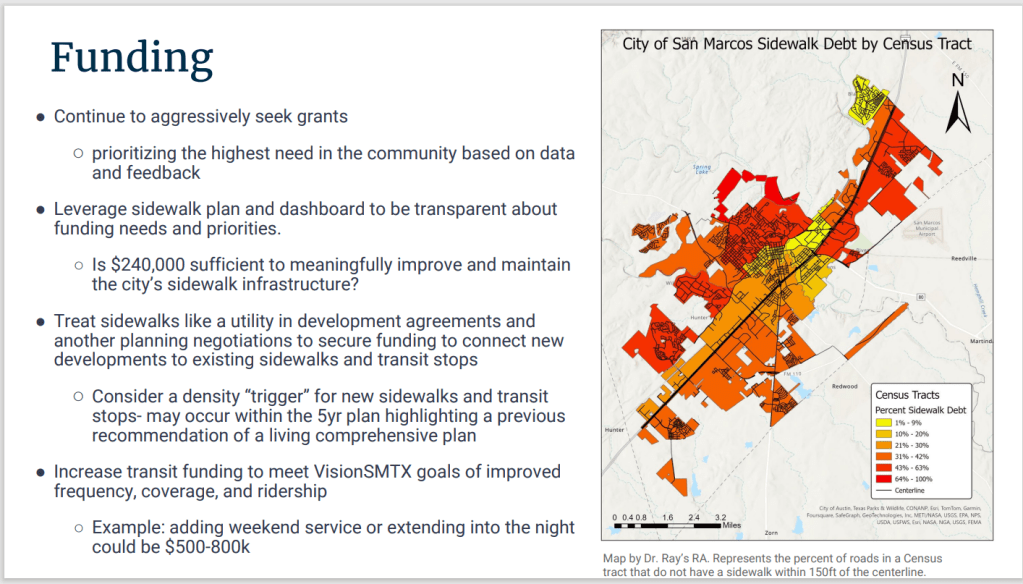
Here’s their specific recommendations in each of those five categories:
Again, it’s a great presentation, so feel free to go listen yourself here.
Council had a few questions:
Jane asks about sidewalk priorities and bus shelter status? Answer: We have 18 sheltered bus stops already. We want more, but we’re holding off because we’re about to re-do the Transportation Master Plan, and we don’t want to put something in that we immediately have to tear out.
Amanda: Are other cities doing anything that we should start doing? Answer: Sometimes when there’s not enough space for a full shelter, they anchor two seats to the bust stop pole, with a little shade on top.
As Amanda put it, these recommendations are all so feasible! There’s nothing impractical to any of this.
There’s two big plans coming up: TXDOT is doing a transit plan, and the city is re-doing our transportation master plan. Both TXDOT and the city were involved in the Equity Cabinet, and want to incorporate the recommendations into their new plans. Hooray!
In 2018, we updated the Transportation Master Plan. We noted a bunch of dangerous intersections, and put in a bit about safe biking lanes. Since then, you’ve seen all sorts of bike lanes pop up.
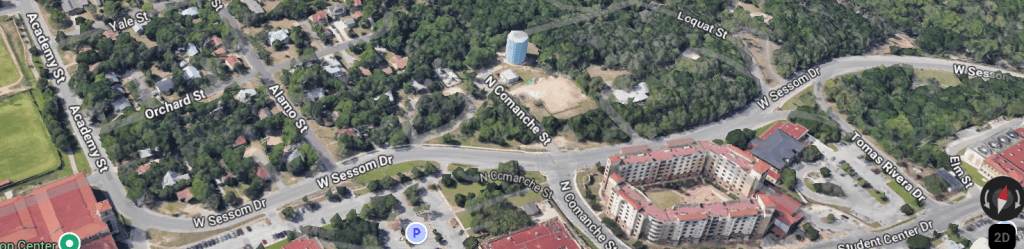
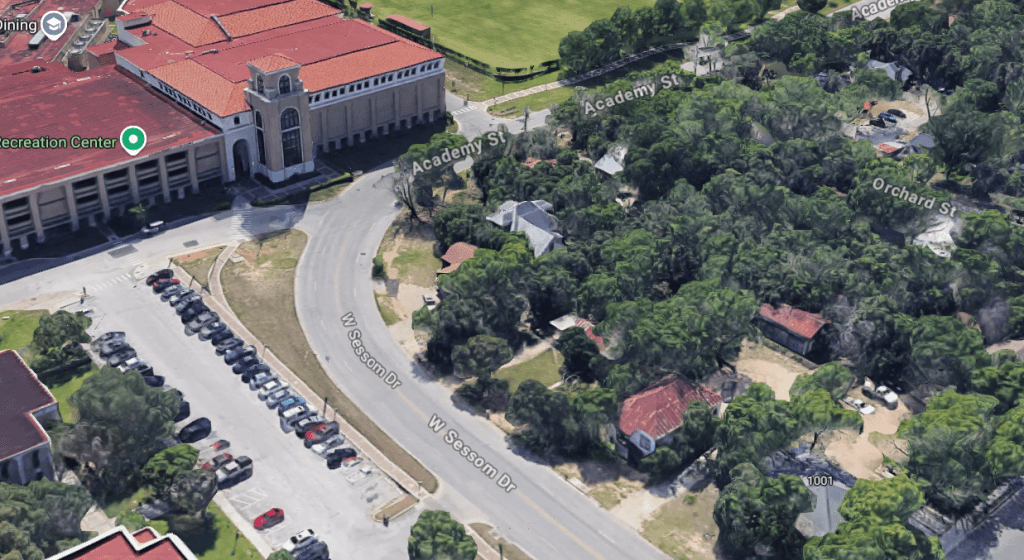
Academy and Sessom was flagged as one of the dangerous spots to improve. This is the stretch we’re talking about:
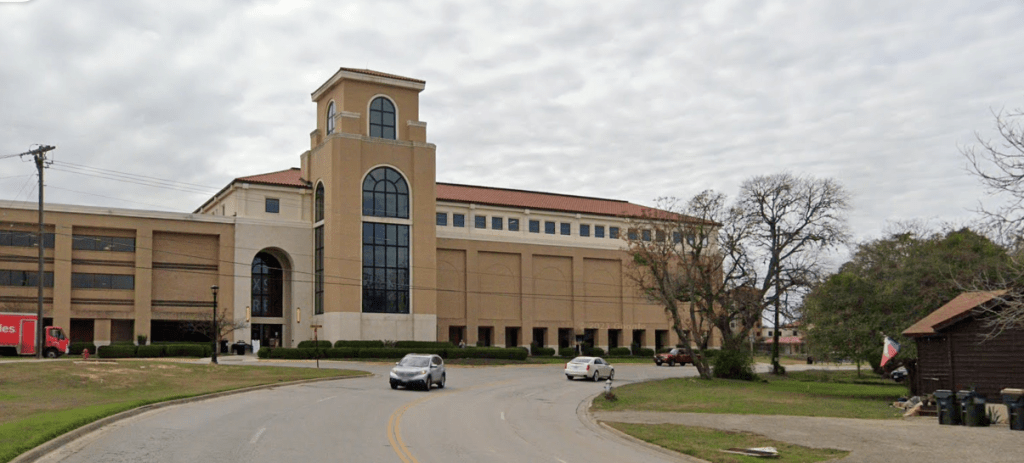
It’s always seemed super dangerous to me! Drivers are so zippy through this:
wheeeee!
Here’s what was done:
Here’s a little before and after. Four skinny zippy, windy lanes, in 2021:
I worry for all the bikers!
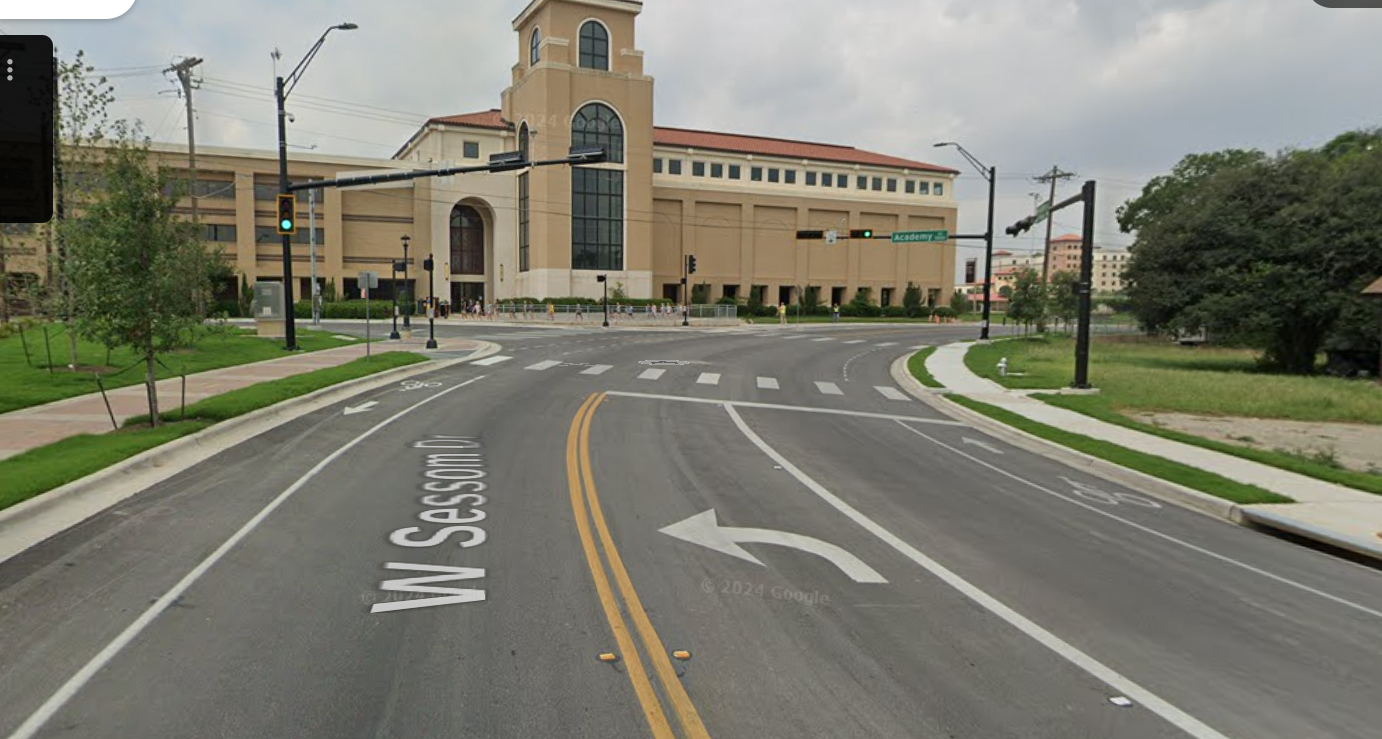
After:
A light, bike lanes, single lanes, a left turn lane: so much safer.
Here’s another before-and-after:
Hopefully bikers don’t feel like they’re going to be run over anymore!
…
Did it work?
Looks like it worked great! (“Level of Service” means how much traffic can you handle.)
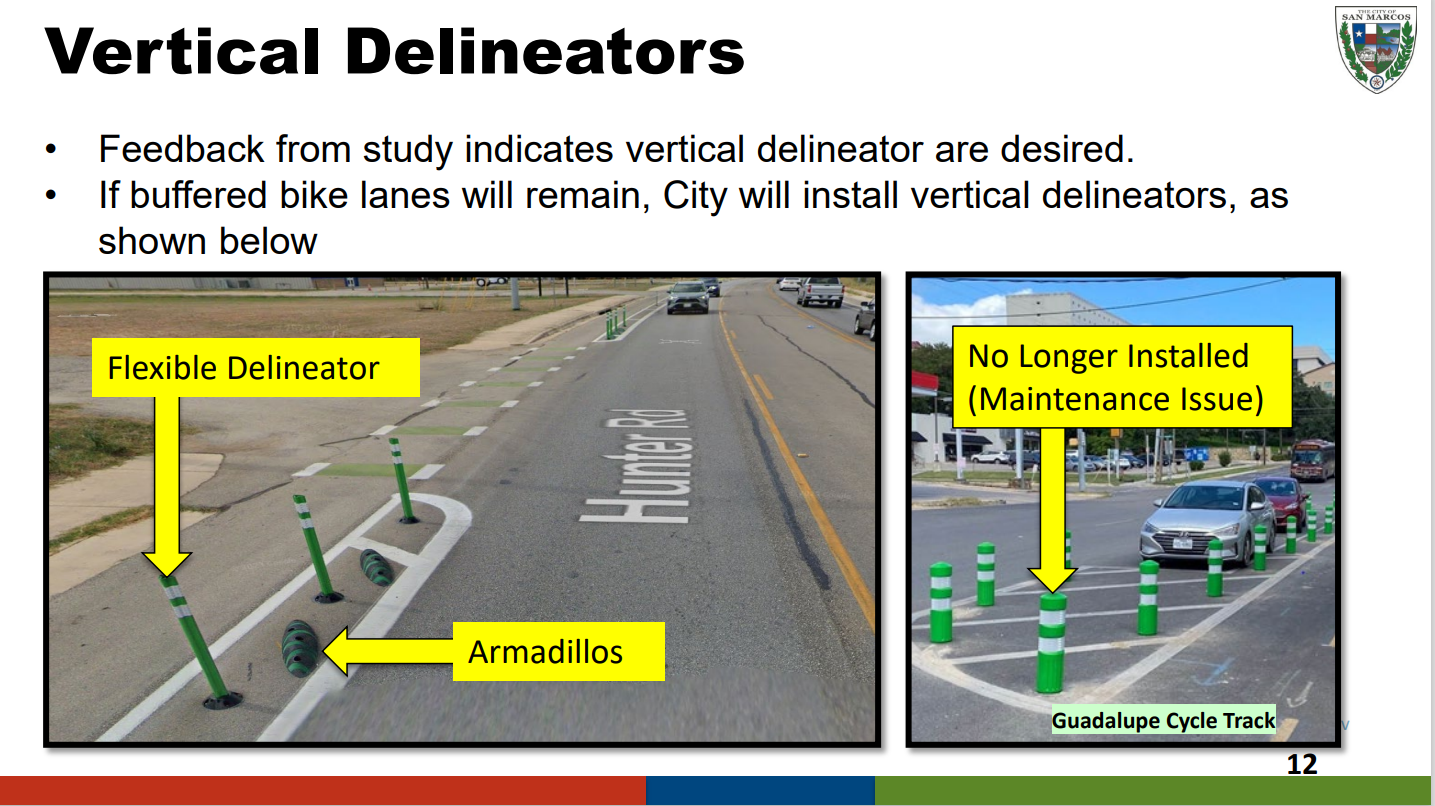
The bikers have concerns, though. What are “vertical delineators” that the cyclists want?
These things. You’ve seen them all over town.
The city was trying out different kinds, and it seems like the armadillos work best. (The other kinds require extra maintenance – they don’t pop back up after awhile, or they get torn off and leave bolts sticking up in the road, etc. The armadillos are just glued down.)
….
So this brings us to the next question! We’re going to be improving Sessom down to Aquarena:
We just completed the yellow part. We are about to work on the blue part to the right. We have some choices:
Go back and undo the bike lanes and safety measures in the yellow part.
Keep them, and extend them to the blue part.
[Updated to add: I got this part wrong – there’s no option to extend the bike lanes to the new part. They’re just deciding on the yellow part, and if they should add armadillos. Also fixed below.]
Jane Hughson reminisces about when they agreed to try bike lanes on the yellow part. (This was the very first meeting I blogged publicly, back in 2022! – Shane, Mark, and Saul all voted against the bike lanes on Sessom and Craddock. – Jane, Alyssa, Jude and Max Baker all voted to try the bike lanes out. Jane was reluctant, but she decided since it’s just paint and easily reversible, we might as well try them out.)
So what should we do?
Undo the old bike lanes: No one Keep the bike lanes and add armadillos: Everyone
Hooray! That was a test, Council, and you passed. Good job.
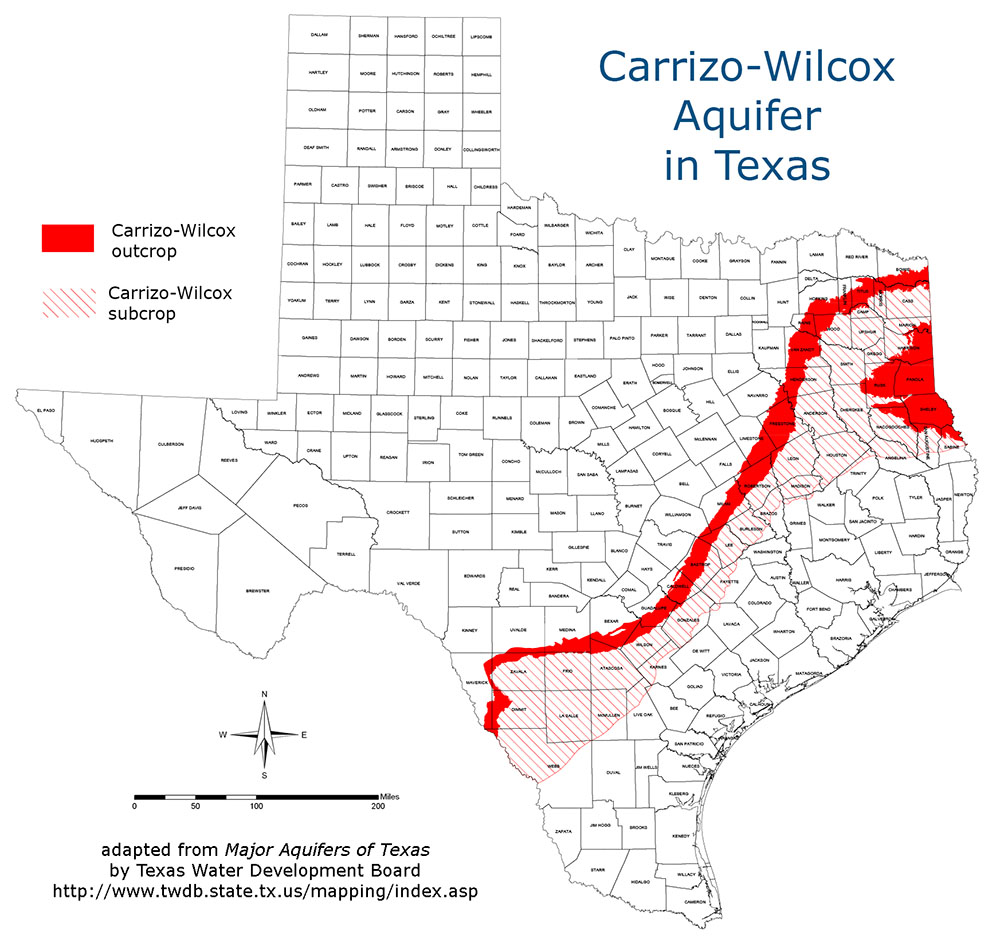
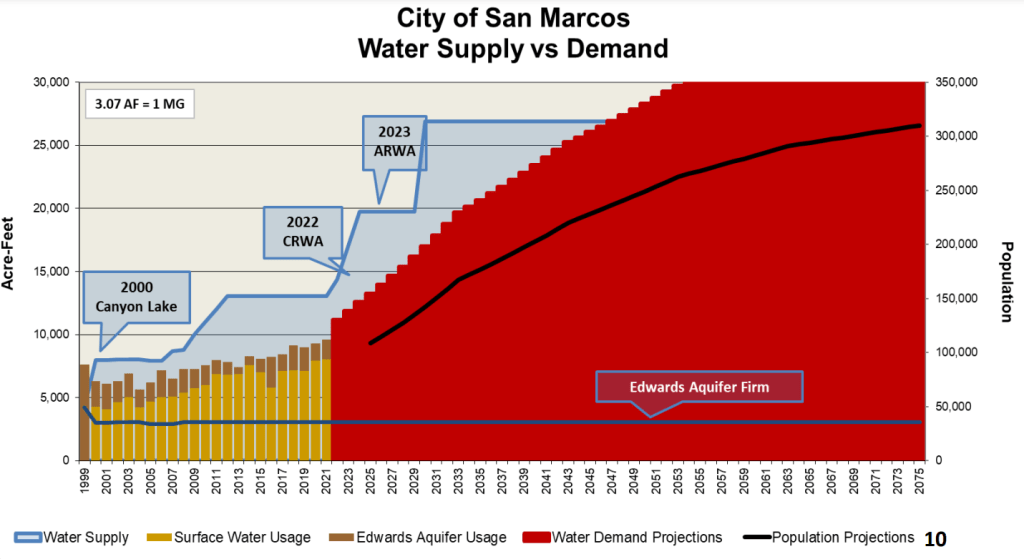
Until 2000, San Marcos exclusively got Edwards Aquifer water. Then we signed on to get some surface water from Canyon Lake, and in the mid 2000s, we joined ARWA water. (More on ARWA in a moment.)
“MGD” means a million gallons of water per day.
…
What is ARWA?
ARWA is kind of crazy. Basically, in 2006, San Marcos, Kyle, Buda, and the Canyon Regional Water Authority got together and tried to figure out a longterm plan. They formed ARWA, the Alliance Regional Water Authority.
The crazy part is that this started in 2006, and they knew they wouldn’t be delivering water until 2023. This was a very longterm plan! That is really good foresight by the councils that agreed to this.
There was all sorts of infrastructure that had to be built. I think this is the whole project:
So we’re getting all the water from the green oval on the far right. Then it has to be treated, at the blue dot, so that it’s drinkable. All those red lines are pipe that had to be laid down, and it gets run out to Lockhart, Buda, Kyle, San Marcos, and New Braunfels. That’s why it took so long.
But now it’s here! This is great!
….
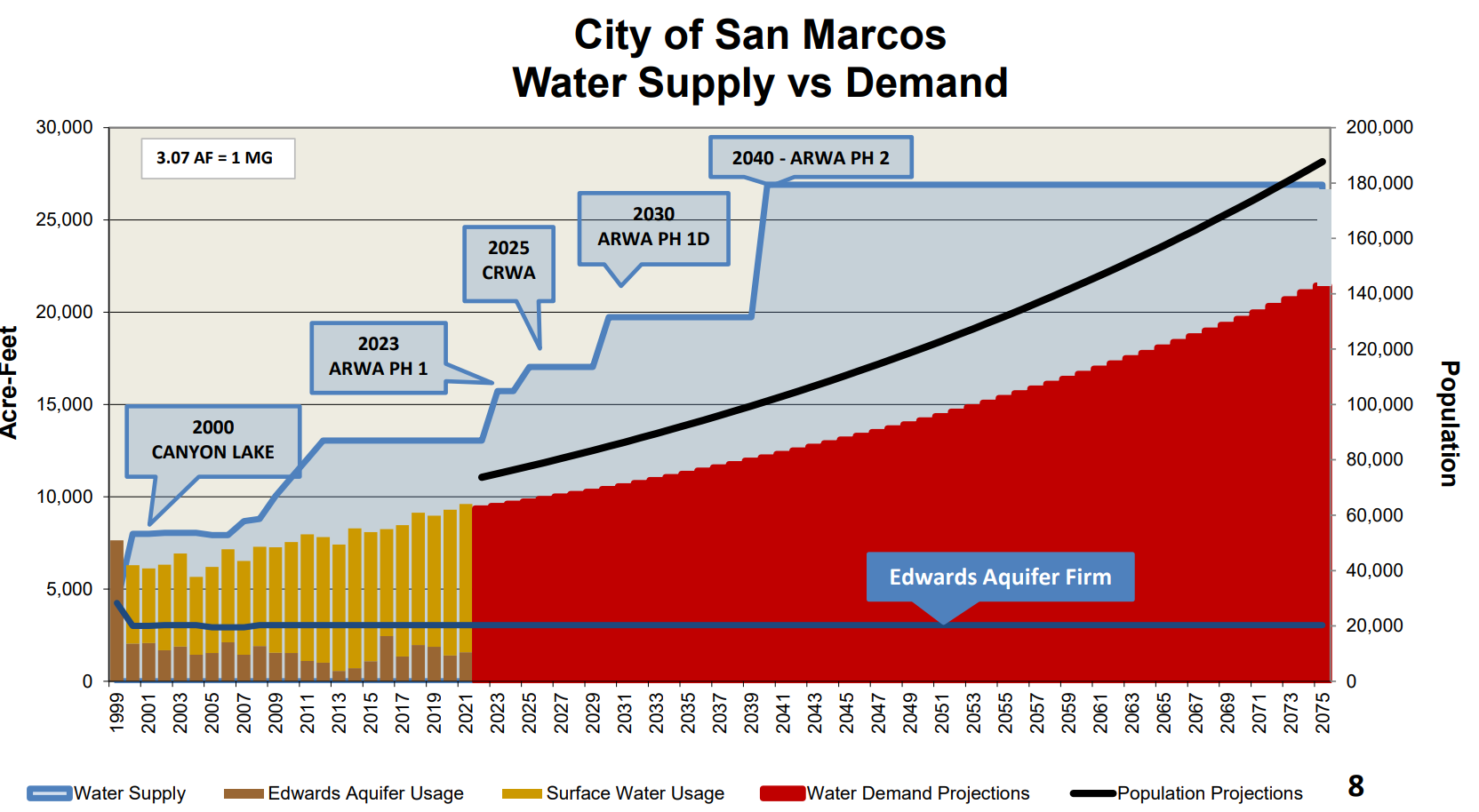
So we’ve got all this water – Edwards, Canyon, and now ARWA. Is it enough?
It depends! How many people are trying to use this water?
This is the population projection, based on 2017 data:
In other words, the black line is the projected population, and the red part is how much water we’d need. So in 2055, we’re expecting to have 140K people and need about 16K acre-feet of water each day. (An acre-foot means take an acre of land, and fill it with water that is 1 foot deep.)
Here’s the water supply, according to when each of those sources kicked in:
So this looks great! So in 2055, when we need 16K acre-feet of water, and we’ll have access to about 27K acre-feet of water. Through 2075, we’ve always got more water than we need.
This is great!
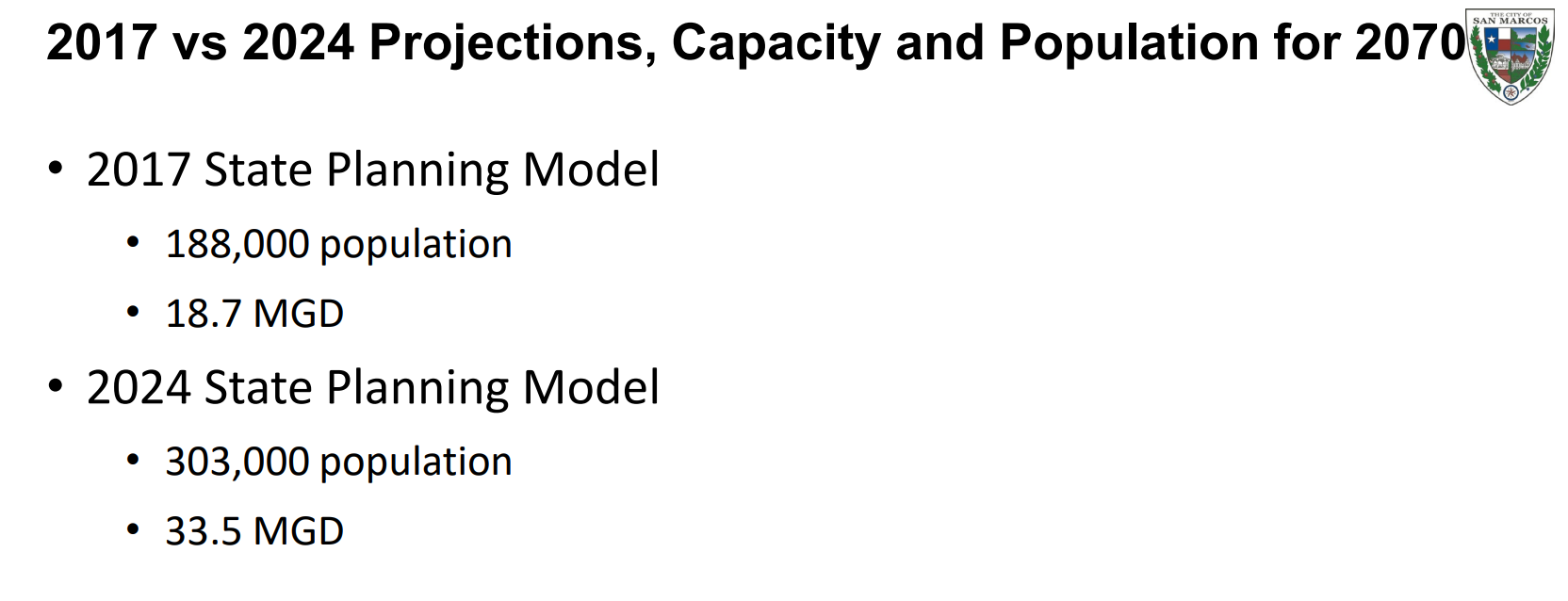
But then…. we had to update our projections. Between 2017 and 2024, this region grew even more than expected. So we had to ramp up our projections, accordingly:
So if we’ve got the same amount of water planned, but a ton more people, the graph now looks like this:
Whoops. Now we are scheduled to run short on water in 2047.
So what do we do?
The good news is that we’ve got plenty of planning time, and we’re putting it to good use. There are basically two ways to address this:
Find more water
Use less water
We’re going to do both.
First, more water:
Apparently Buda and Kyle are even shorter on water than we are. Everyone is interested in collaborating and shoring up supplies. An ARWA Phase 3? Maybe a different source?
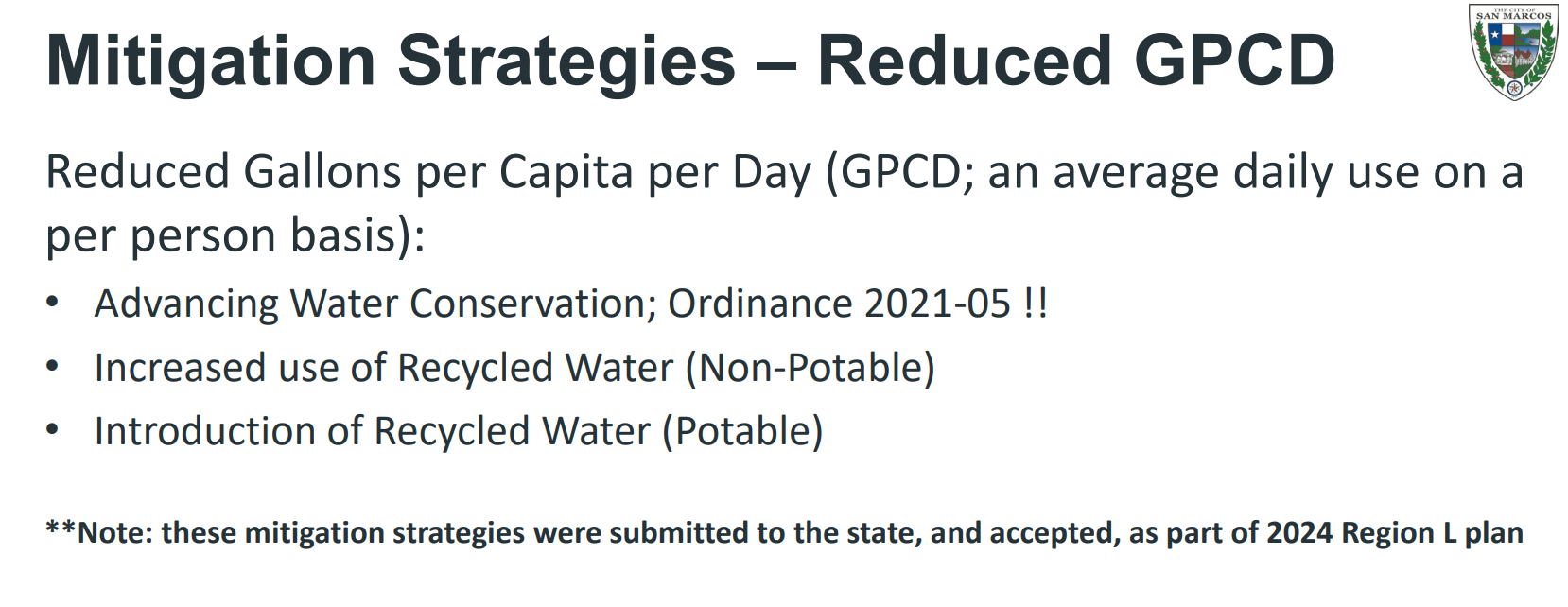
Second, reduce water usage:
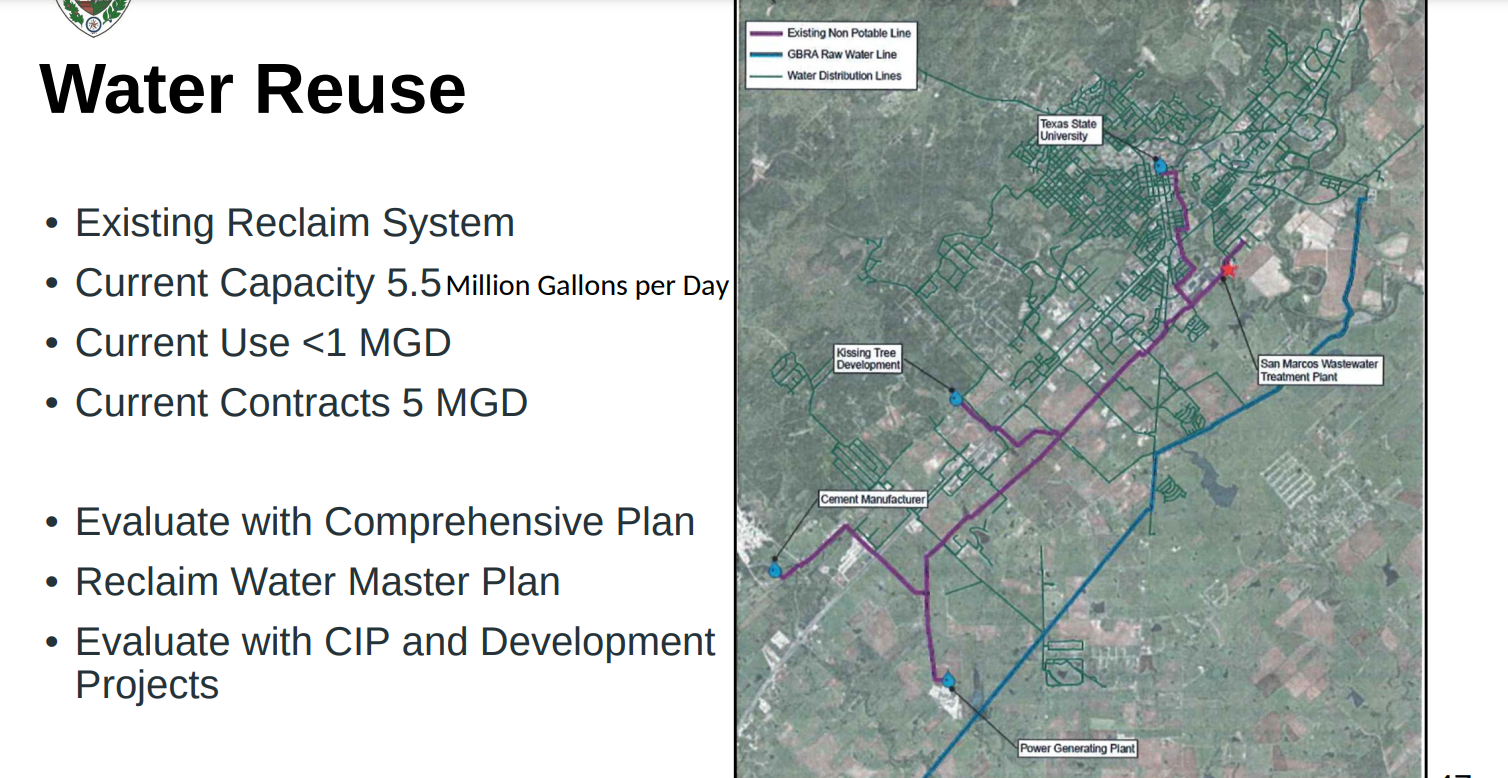
The second two bullet points are huge: reclaiming used water. We’ve already got some reclaimed water already:
(That slide is from a 2022 presentation, here.) All that purple is where we can send reclaimed water to. We currently have about 5.5 million gallons per day of reclaimed water.
The problem is that it’s not drinkable. So you can use it to water the golf course at Kissing Tree (which they do!) but you can’t send it to people’s houses.
The holy grail will be when we can get reclaimed water clean enough to drink. Then we can really ramp up our water re-use.
(I read once that one of the grand failures of midcentury America was not double-piping all the houses, so that we weren’t mixing our toilet water with our sink water. Then we wouldn’t be watering our lawns with drinking water, and we wouldn’t be trying to clean and re-use toilet water.)
Here’s what we think we can get to:
Notice that the water supply hasn’t changed. But the red part – our water use – is smaller. The red part dips down again around 2050 because we think we’ll be able to get the reclaimed water clean enough to drink by then.
What does Council say?
Amanda asks if we have a problem with water leakage from pipes? Answer: We’re actually pretty good on this. It happens, but we’ve got one of the lowest rates in the state.
Amanda: Can we get a graph of the top ten biggest water users? Answer: Yes! We don’t have it on hand, but we’ll email it to you.
(I love this question. Amanda said she’ll send the graph over when she gets it, but she hasn’t gotten it yet.)
Amanda: Do we still do rebates for rain barrels? Answer: Yes! Details here.
The City Manager Stephanie Reyes also mentions this: San Marcos water rates are a little higher than those around us, but it’s because of all this advance planning. We are in a much more secure longterm position that most others.
You might have heard about a giant clusterfuck with vouchers and waitlists, back in September? This workshop is that. Council is attempting to figure out what the hell happened.
Background
SMHA is funded by the Housing and Urban Development Agency. (HUD). So it runs on federal dollars and doesn’t have any formal partnership with the city.
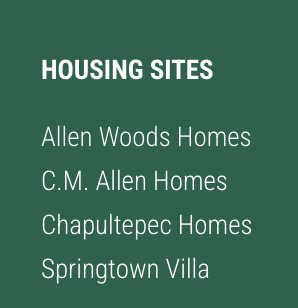
SMHA owns about 200 properties, at these sites:
as well as some individual rental houses around town. In addition, they have 251 Section 8 vouchers. This means that SMHA subsidizes your rent, so that you’re only paying according to your income.
To be eligible for a Section 8 voucher, you must earn under 30% of the median income for our region:
The median income in San Marcos is $47K/year and the poverty rate is 27%, so I’m going to ballpark that there are about 19,000 people in San Marcos who would qualify for housing assistance.
Anyway! We’ve got 451 apartments and vouchers total, to spread out over those 19,000 people. What could go wrong?
….
Naturally, there’s a super long waitlist. Once you get a voucher or an apartment, you can keep it as long as you qualify. So the waitlist moves very, very slowly.
None of this is SMHA’s fault so far. It’s basically the fault of voters and federal elected officials, who don’t properly fund HUD.
SMHA has an internal policy that everyone on the waitlist should get a voucher within 12-18 months. So they cap the waitlist. It’s very rare that they open up the waitlist and let people on.
The last time they opened up the waitlist was in 2016. They had 500 pre-applicants join the waitlist. That was too many – it took 8 years to whittle it down. Over that time, half the people dropped off the waitlist. There are still 30 people remaining, from that 2016 batch.
…
Ok, we’re getting to the September mess now.
So back in September, they finally decided to open up the waitlist. They ran this notice in the newspaper:
Nothing in that posting is faulty or misleading. But listen: it is so, so hard to get clear messages out to the public. This is not that.
Here’s how it was supposed to work:
Between Sept 9th and Sept 22nd, 250 people stop by and pick up a pre-application.
On Sept 14th, all 250 people drop off their completed pre-application, between 8:30 am-5 pm.
Those 250 people are now on the waitlist.
That’s just not a realistic plan, when it comes to guiding actual people? Organizing people to follow a game plan is really difficult! People are not good at paying attention and following detailed rules. You have to build a lot of redundancy and safeguards into systems.
Here’s what happened:
250 people did successfully pick up a pre-application.
Tons of people showed up on September 14th. They were hoping for actual vouchers. Chaos reigned and the rumor mill picked it up. People were sent away. People were incredibly frustrated and heartbroken. There was an air of chaos and disorganization.
In the end, about 180 of those original 250 got on the waitlist.
Listen: The biggest failure is having 451 subsidized housing units for 19,000 people who qualify. When you have that kind of massive scarcity, every mistake that follows takes on epic proportions. So yes, their roll-out had lots of problems, but it’s magnified because of the huge need.
…
What is Council’s take on all this?
Council takes three basic approaches:
What the hell?! How was this so poorly planned? [Jane Hughson]
Gingerly asking, “Is there any way we can help? Are there major obstacles that are preventing SMHA from running smoothly?” [Alyssa, Amanda]
There are a lot of broken elevators, broken cameras, and generally crappy living conditions in these apartments [Saul]
What the hell?! How was this so poorly planned?
Jane just cannot get over the fact that they intended to accept 250 people onto the waitlist, but then required a drop-off between 8:30-5 pm on a single Wednesday. “Why not open it up all week? You controlled the number of pre-applications that were out there! You knew for sure that you wouldn’t go over 250.”
There’s not really a good answer, no many how times Jane tries. (And she tries.)
Many towns in Texas only open their waitlist for a day.
By 3 pm, they weren’t getting people anymore.
You could also fax it in! You don’t have to come in, in person!
All of these just make Council’s head spin.
“But what if someone works? Or has childcare issues?”
“Who the hell has a fax machine in 2024?! Why can’t they email their pre-application paperwork in?”
When they ended with only 180 applications, why didn’t they give out more pre-applications to get up to 250?
Ultimately, there are not any satisfying answers. A lot of these are SMHA policy, and the speakers don’t have the power to change the policy. Only the SMHA board can change the policy.
They do plan to do things differently next time:
Give away preapplications to all
Allow online preapplications
Select people for the waitlist by lottery.
Again: Yes, the roll-out was poorly done. But the scarcity is the real problem. If we had 19,000 low-income housing options for 19,000 people, then this would be a hassle, but not a catastrophe. But 451 housing units is just crumbs.
….
“Is there any way we can help? Are there major obstacles that are preventing SMHA from running smoothly?”
Alyssa and Amanda ask variations on this several times, but never get a clear answer.
They also ask:
What’s the best way for community feedback?
What is the best way for Council and SMHA to partner? Whose lane is whose?
None of these have particularly good answers. Alyssa encourages them to put email and phone numbers on their website.
…
“There are a lot of broken elevators, broken cameras, and generally crappy living conditions in these apartments”
They have four maintenance workers for the public housing units. They try to do all repairs on vacant apartments within 30 days.
Like with everything else, they’re underfunded and understaffed. (That’s my language, not theirs. They most repeat their policies.)
…
Going forward, the plan is to have a joint meeting between City Council and the SMHA Board, probably in February, to iron all this out.
This is new! I can’t ever recall someone from the university giving this kind of presentation before.
(That said, the speaker did not supply his slides to the city, and so all I could get were crappy screenshots of the interesting slides. )
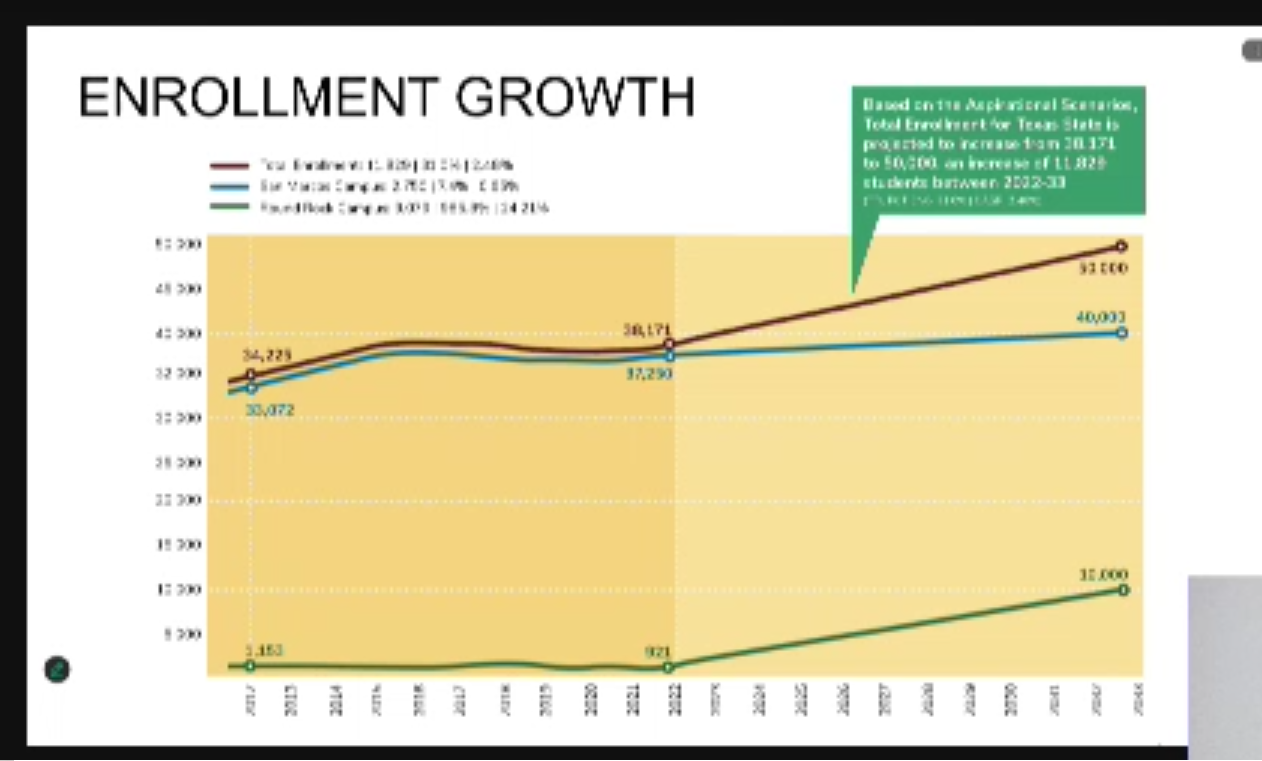
Enrollment Growth
Uh, yeah. Sorry about the quality! I bet it looked great in person!
They’re projecting to grow from 40K to 50K students, but most of that is at the Round Rock campus and online.
The green line at the bottom is Round Rock. The blue line in the middle is San Marcos. The San Marcos campus is projected to grow from 37K to 40K over the next ten years.
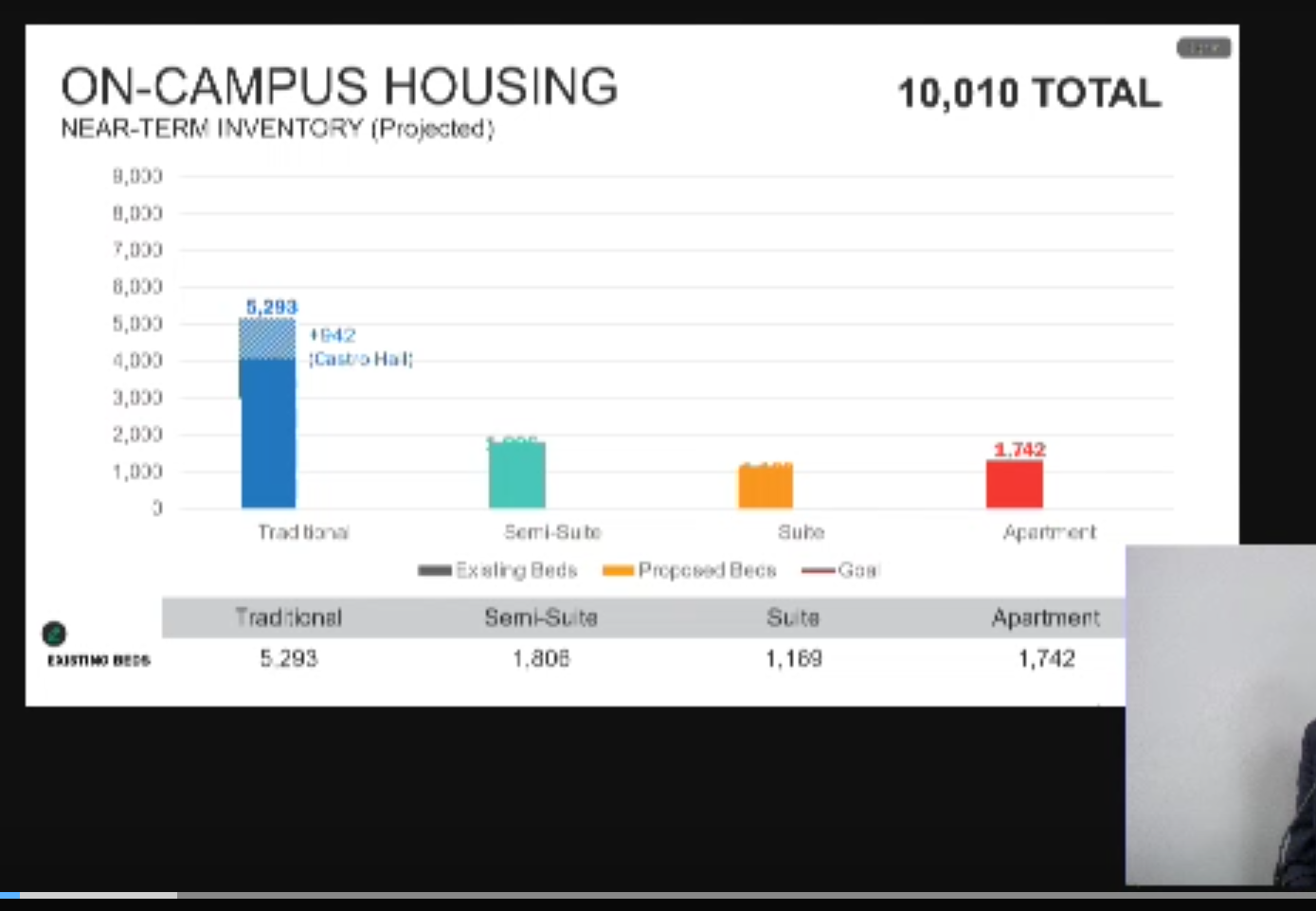
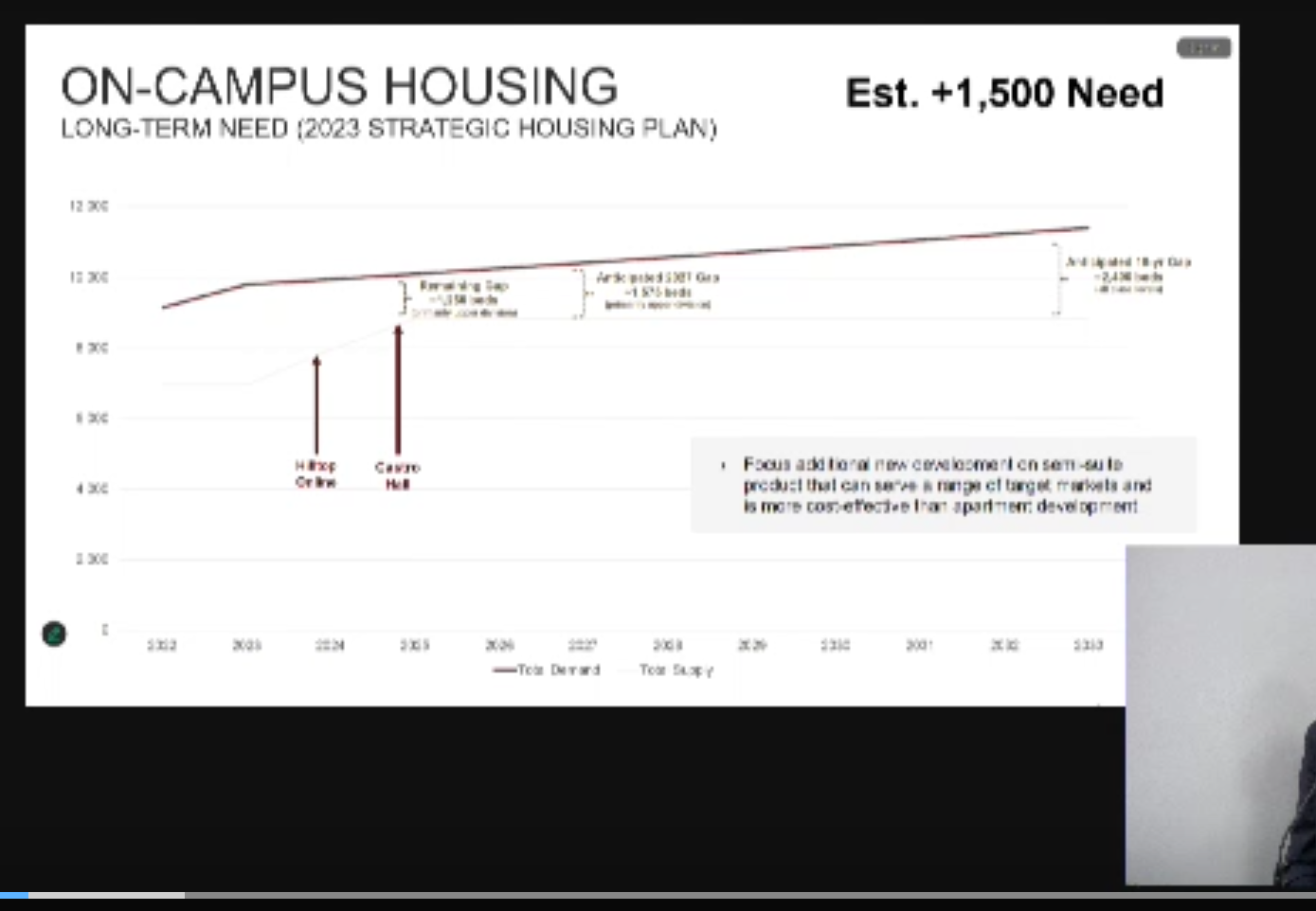
Housing need
They’ve got about 10K beds on campus right now.
They’re going to need about 1500 more beds by 2027. They’re building more dorms to cover that.
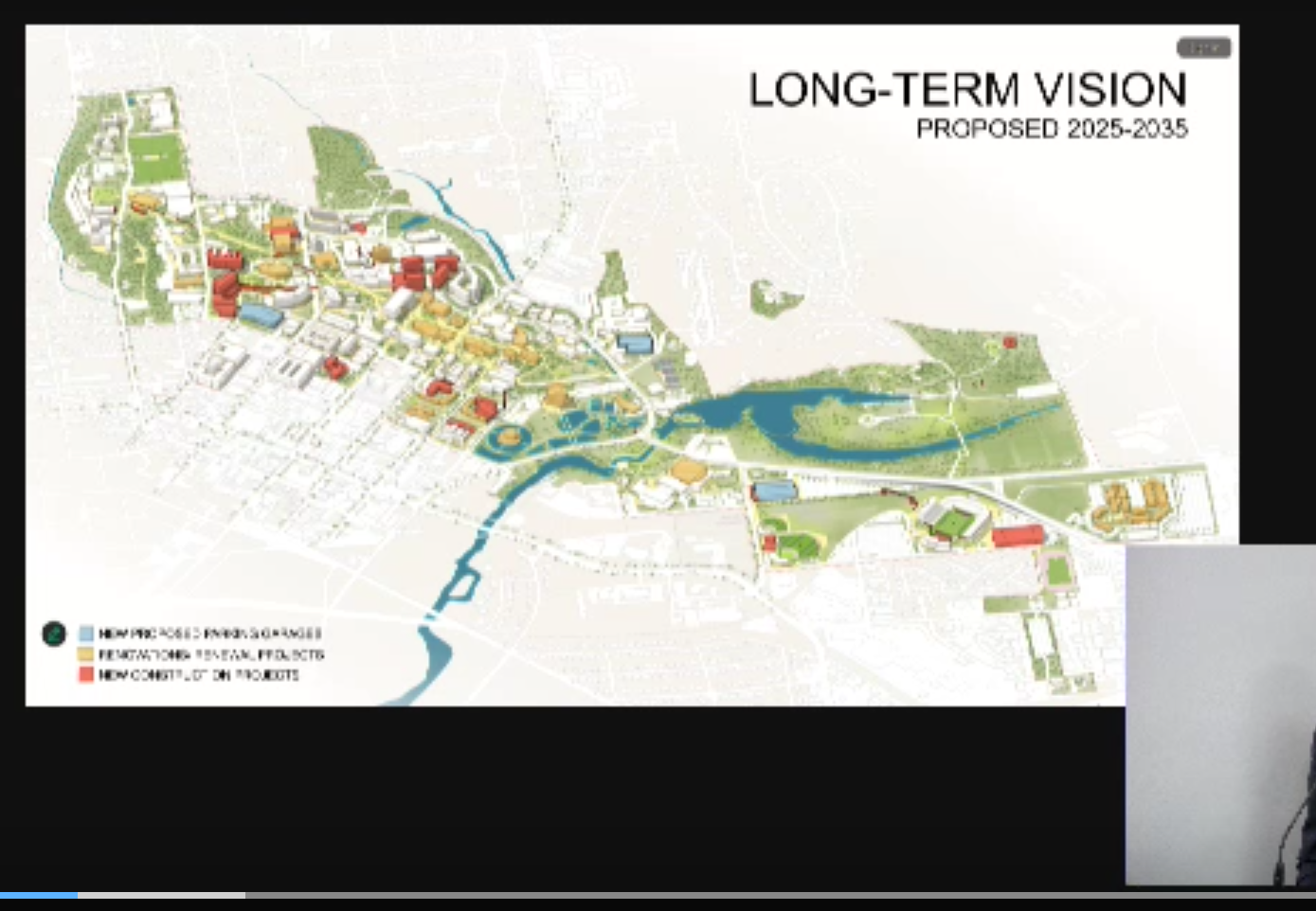
Construction, etc:
The dark red are new buildings that are under construction or are planned.
The light orange are getting major renovations.
So they’re not really planning to acquire any more land. Aside from those red buildings, they’re mostly going to reconfigure existing buildings to handle more capacity.
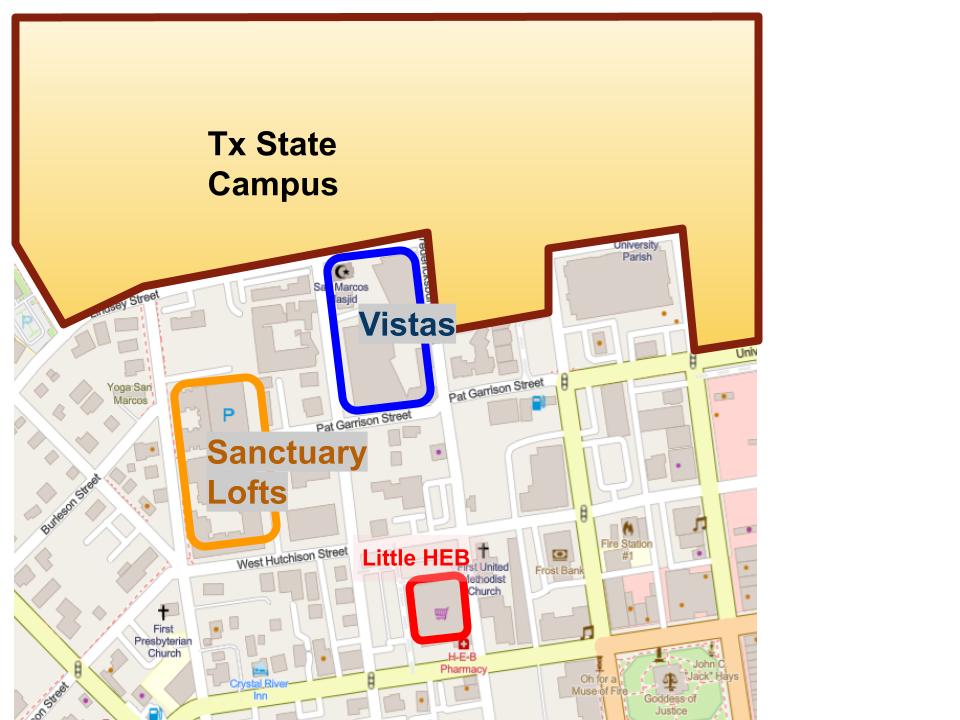
Note: This is supposed to comfort city council. The city is mad that the university purchased two downtown apartment buildings, in order to convert them into dorms:
Texas State doesn’t pay local taxes. And downtown apartment buildings are worth a lot of money. So the problem is that when Texas State bought those buildings, San Marcos lost a lot of tax revenue.
Light blue boxes might end up being parking garages. Bottom right is Thorpe Lane.
They’ve got 48 busses, 90,000 weekly ridership. It’s a pressure point for the university.
The plan is to merge the city and university bus system. This benefits San Marcos hugely. When the university started reporting their ridership to the feds, San Marcos got about $13 million in funding.
The speaker talks about having an app showing all busses, at any moment, all free for everyone in San Marcos. That sounds amazing!
Spring Lake:
There will be a lot more trails and improvements coming to Spring Lake:
but again, the slides are so murky. It’s hard for me to provide details.
Council questions:
Amanda: Is there any talk about capping growth at 40K?
Answer: That’s as much capacity as we can accommodate. But the regents want to grow all the universities to handle 60% of Texans by 2030. They tell us what they want, and they want to grow.
This is all taken from the next Master Plan, which will be approved in 2025.
Affordability: Recently, UT went free for families earning up to 100K. Can we do that?
Answer: Right now we’re free for families up to 50K. We’re asking to see if we can get funding to be free up to 100K, like UT. We expect that would be similar – 5-10% of our student body would fall in that 50K-100K range. (That is WILD. 85% of their student body comes from families making more than 100K?)
This plan has not been finalized yet. I think the master plan gets voted on next year.
Workshop #2:
Every four years, San Marcos has to review the City Charter.
Council will appoint seven people to the charter review commission. They only have six months to do a ton of work, because it has to be done in time for the fall election.
The community can also add charter amendments to the ballot, like when we outlawed fluoride in 2015. (We were RFK junior before RFK junior even had a brainworm.) Maybe we can undo that!
If you would like to be considered, they will be opening up for applications.
Council approved it, but vowed to look at the predatory leasing practices and see what could be done. So here we are!
For what it’s worth, I think Council handled this correctly. – We need physical housing to be built. – We need landlord reform.
You shouldn’t hold the former hostage in order to accomplish the second, but the second is also urgently needed.
…
So let’s dive in! The speaker was Shannon Fitzpatrick (and these are her slides). She’s been a lawyer for Texas State, working with students, for the past 25 years or so. (Go listen here! I’m not doing it justice. It’s so interesting.)
Here’s what we’re basically comparing:
This part isn’t that bad. A student might not want to be on the hook for their roommates’ share of the rent.
Installment Contracts
This is where things start to get sleazy:
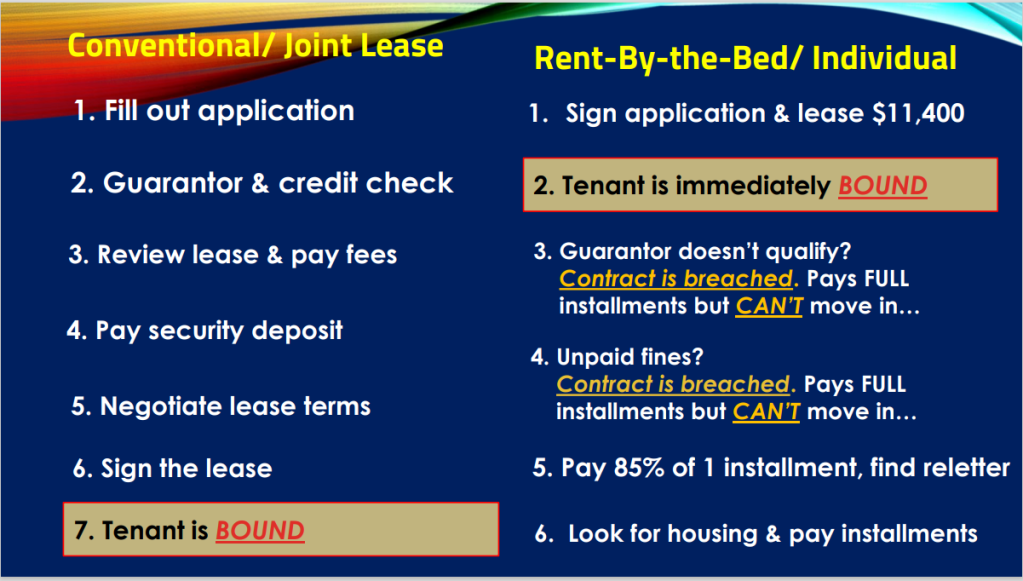
First, this “installments” contract.
The point is that it’s a different legal concept than a regular lease. This lets landlords skip out on the state laws that protect renters. And listen: Texas barely has any renter protections, so if you’re finding ways to cheat those, you are seriously trying to slumlord your way to profit.
Okay, so this installments contract. The basic idea is that you could sign a contract for $11,400, and then they break it into 12 monthly payments.
They show up on campus in October, and sell students hard on these apartments:
They’re going fast! You’re not going to have a place to live next year!
Your mom will be so proud that you’re making a grown up decision by yourself!
No security deposit if you sign right now! (We’ll come back to this.)
So the kid flips through some pages (OF A 60 PAGE LEASE!) and signs.
Already, things are rotten and different than normal:
In general, you have to qualify to lease an apartment. If your income is too low to qualify, or your guarantor’s (parent, aunt, etc) income is too low to qualify, then you can’t rent the apartment.
BUT HERE, YOU’VE ALREADY SIGNED! So you can’t live there and you still owe $11K!
Next: regular leases have a “mitigation” clause. If you break your lease, you have to cover the rent until they re-rent the apartment. The landlord has to attempt to rent out the apartment.
Installment contracts do not have this clause. You break your lease, the company still gets their $11k. They can re-rent the apartment, and now they’re getting another $11K for the same room.
Also: They don’t pro-rate partial months. So you would owe rent on August 1st, even if you can’t move in until August 20th.
Next: “As-Is” Clauses
So the kid signed the lease in October.
Usually when you sign a lease, you look at the apartment. You say things like, “Are there any apartments on the second or third floor?” The leaser says, “Sure” and shows you one. You say something like, “Nah, I don’t want to be this close to the dumpster, I’ll go with the first floor apartment, after all.”
The point is that you’ve seen the actual apartment, and you know if it has mushrooms sprouting in the closets.
“As-is” clauses mean “You get the apartment in its current state, not in a pristine state.” But those are only valid if the tenant can inspect the premises. Since these kids are signing in October without seeing the actual apartment, they’ve signed all kinds of rights away.
They show up in August, see the mold, mushrooms, broken furniture, broken locks, etc, and they have no recourse. They’re not able to request a different apartment, because of the “as-is” clause.
Security Deposits
“Sign now and we’ll waive your Security Deposit! You’d be a fool not to sign!” – me, pretending to be a sleazy landlord.
So this is another scam. They waive the security deposit, and tenants lose some rights. Texas has specific laws that state that if you put down a security deposit, you’re entitled to some protections.
For example, you lose your right to a 30-day move out inspection. So they can come after you for up to four years for damages to your apartment. And they sometimes do! The speaker said that what happens is these complexes get sold every three or four years. Sometimes the new owners look at the past few years of tenants and shake them down for damages.
Also: #notallcollegekids but some college kids are little shits. Since they didn’t pay a security deposit, they don’t think they’re on the hook for damages. Chairs in the pool, trash the place, etc.
Roommate matching
In theory, this is fine. This is what happens in a conventional dorm.
But here, it’s done… maliciously? it’s pretty surreal. Here’s the understated tone from the speaker:
In practice it means that they don’t give a shit if you have allergies and the roommate has a cat, or if you are a quiet person and the roommate throws keggers.
But then it gets worse!
You can’t move to a different apartment if you need to. She told a story of a kid who found his roommate, killed, gory, awful, in the living room. They made him stay in that unit.
You can be moved even if you don’t want to! You dared to complain? Fine, you’re being moved. Pack up.
The companies are generally retaliatory and vindictive. You called us in for having cockroaches? We’re going to try to charge you for fumigating the building. Etc.
Just straight up being illegal:
For example:
Legally, they have to tell tenants who the owner is. But they don’t.
The very few protections that Texas law does offer, they can just skip out on doing them. Nobody holds them accountable. (Of course, this applies to all of San Marcos rentals! Not just students!)
What about the rest of San Marcos?
It is really important that we don’t limit this to college students! All renters need protections. San Marcos is mostly renters!
Many, many landlords are vindictive and retaliatory, or don’t provide a safe, clean environment. There’s a huge power imbalance between landlords and tenants. Tenants get exploited.
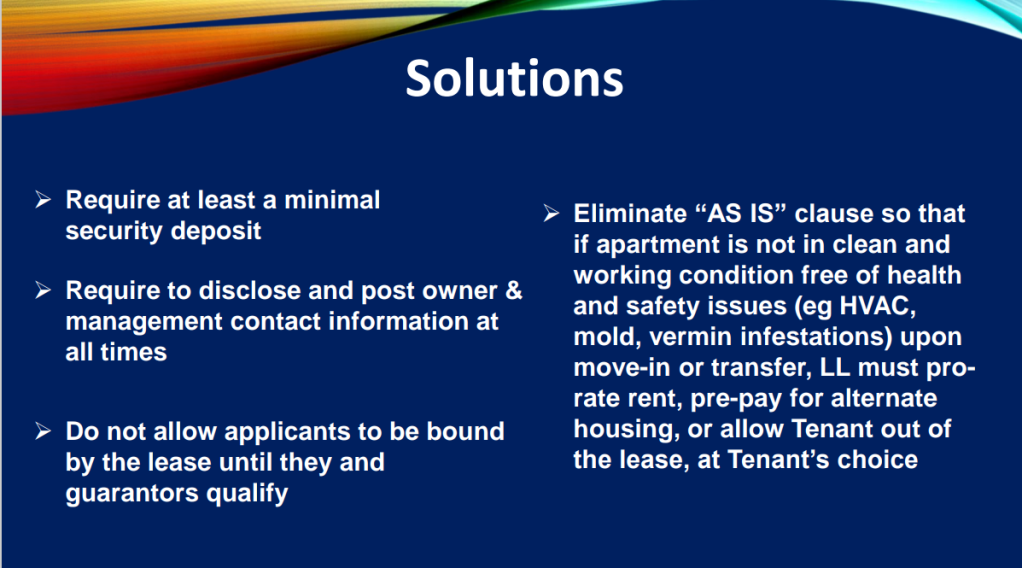
So what can be done?
Here’s what the speaker suggests:
and
The city lawyer is quick to mention that these are all uncharted territory. Most cities are not in this situation. We can research and explore these ideas further, but there’s not much in the way of precedents.
Council also discusses:
Capping security deposits so they don’t get exploitative
Publishing a list of complexes and grade them, based on complaints to Code Compliance
Making a central complaint spot, where tenants can then get directed to one of the legal aid resources or code compliance, or whatever
Requiring three months notice before forcing someone to move, or forcing companies to give choices (break your lease, stay, or move to this other unit)
Hence this workshop! Let’s find out if we can afford to help vulnerable residents. (Spoiler: we can.)
More Background:
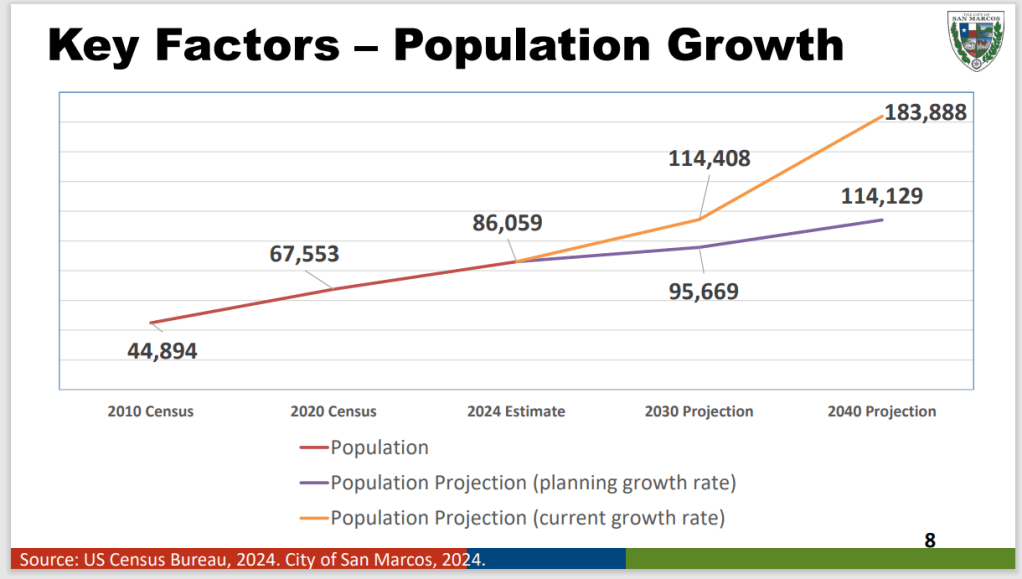
San Marcos is booming!
So we’ll end up somewhere between the purple and the orange, most likely.
You can look at it this way:
The blue parts are our new sprawl.
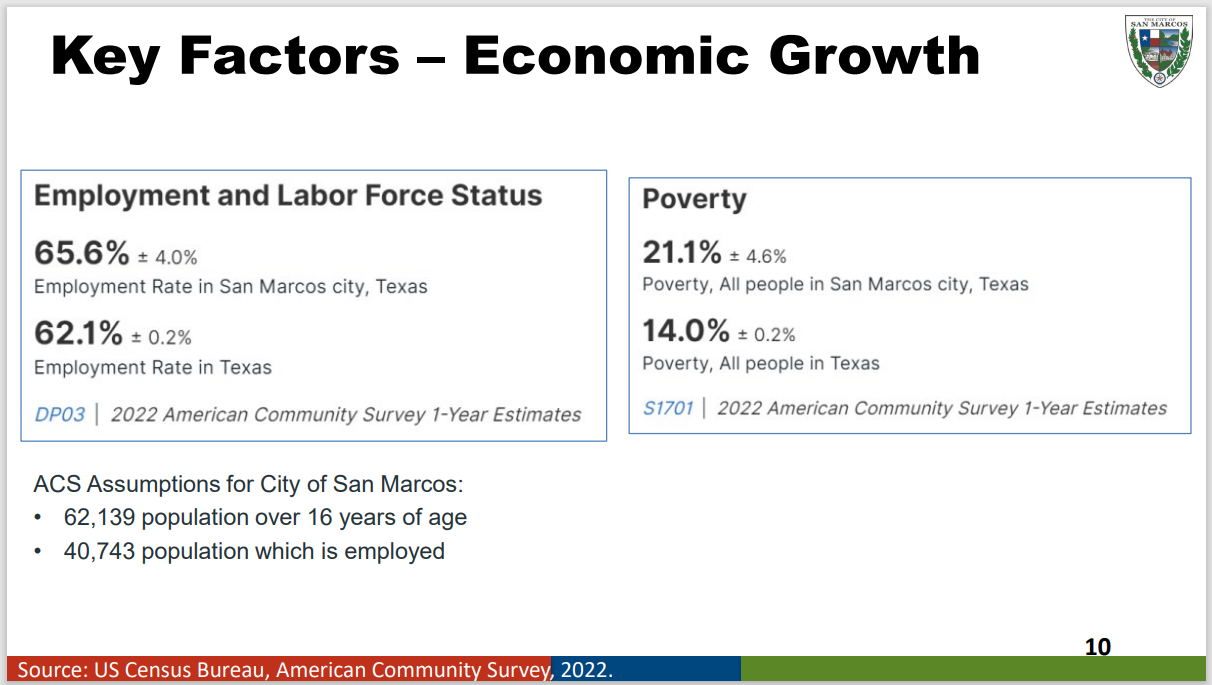
San Marcos has a good employment rate, but high poverty rate:
This means that our jobs are not good jobs. The cure for this is raising the minimum wage. (Raising the minimum wage does not cause inflation. Paying a living wage turns a bad job into a good one!)
Anyway!
Here’s where the jobs are:
This is fascinating:
In other words:
Only 6700 of us actually live and work in San Marcos
18K of us live in San Marcos, but we work outside of town.
28K people commute into San Marcos, but live elsewhere.
In my humble opinion, this is two things:
people who live here can’t find good jobs here, and
the University has good jobs, but parents who work for Tx state are scared of SMCISD for problematic reasons. (I have lots of opinions on that. Support SMCISD!)
Anyway, those are my own conclusions. City staff did not lob those accusations.
…
So are LIHTC projects breaking our budget?
The city gets both sales tax and property tax.
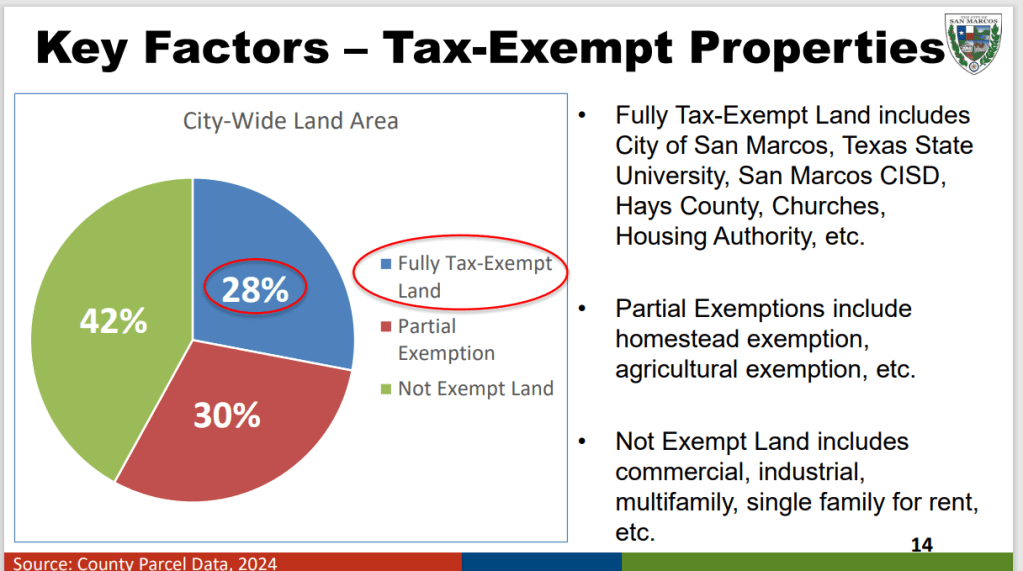
When it comes to property tax, there’s a lot of tax-exempt property:
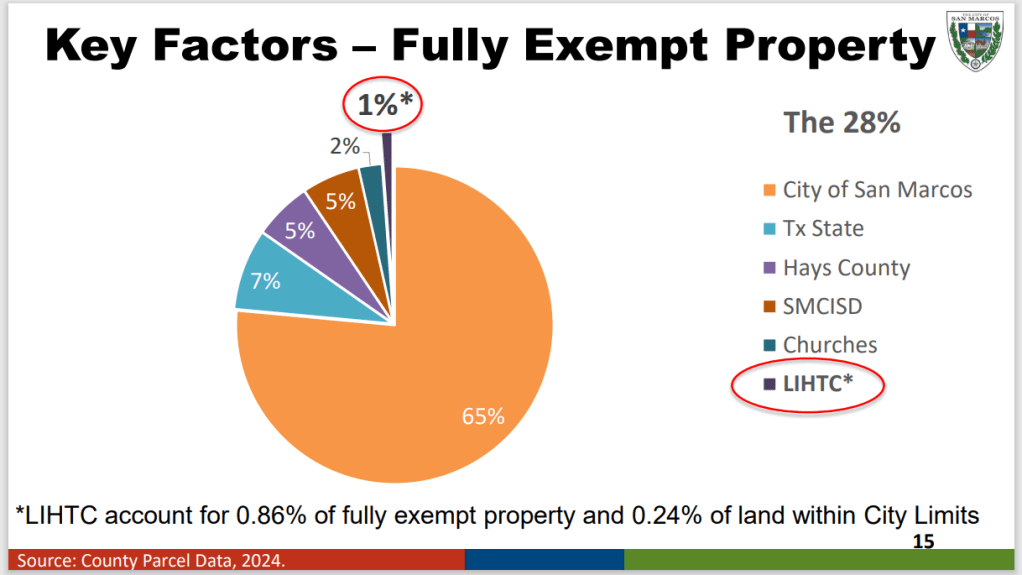
So some LIHTC projects don’t pay city taxes, but neither does city land, Texas State land, SMCISD, County land, Churches, Housing Authority, and others.
(One difference is that most of those are nonprofits. LIHTC developments aren’t necessarily nonprofits.)
So how bad is the dent in our budget??
Not very bad!
You are allowed to ask for a lump sum payout. (Payment In Lieu of Taxes = PILOT). So we do this sometimes:
LIHTC apartments are still full of people, so you still have some fire and SMPD costs. But not particularly different than any other apartment complex.
In general, apartments are much cheaper infrastructure for the city than single family housing.
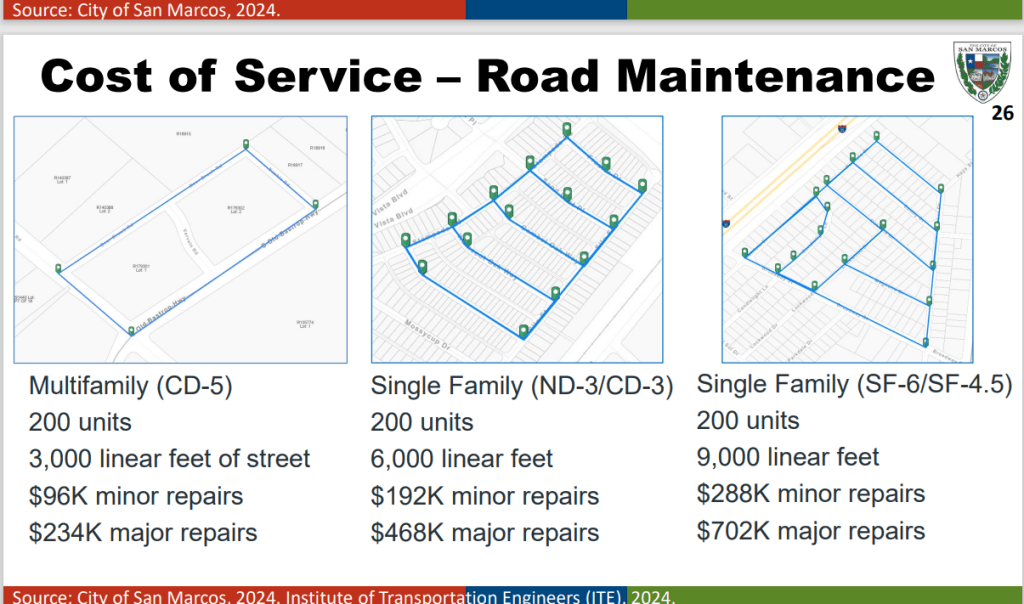
This is a great illustration of why:
I want to love this graphic, but I can’t. The scale is all off.
A 3-4 story apartment building is about 20-30 units per acre. The diagram on the left should be 7-10 acres.
Single Family (ND-3/CD-3) are things like town homes and smaller lots – at most 10 units per acre. So that middle diagram is 20 acres big.
Single Family (SF-6/SF-4.5) are big traditional lots – at most 7 houses per acre. So that right hand diagram is over 28 acres big. That’s three times as big as the one on the left!
Fixed it:
(I am so smug and insufferable. It’s a miracle you all put up with me.)
Anyway: there are also some city costs for things like libraries and transit. Same as for any residents.
…
How much need is there in San Marcos?
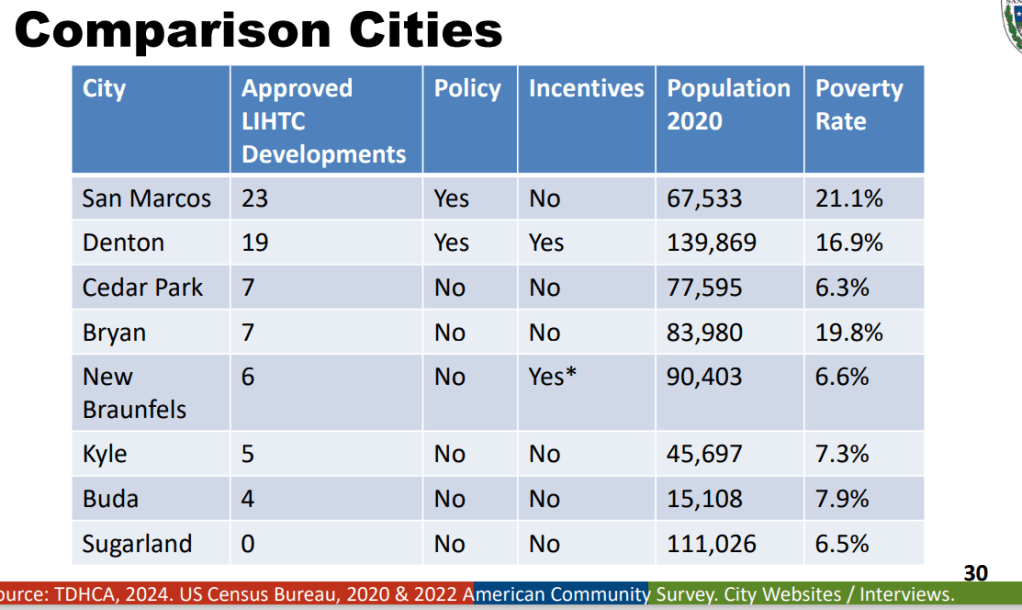
More than elsewhere:
…
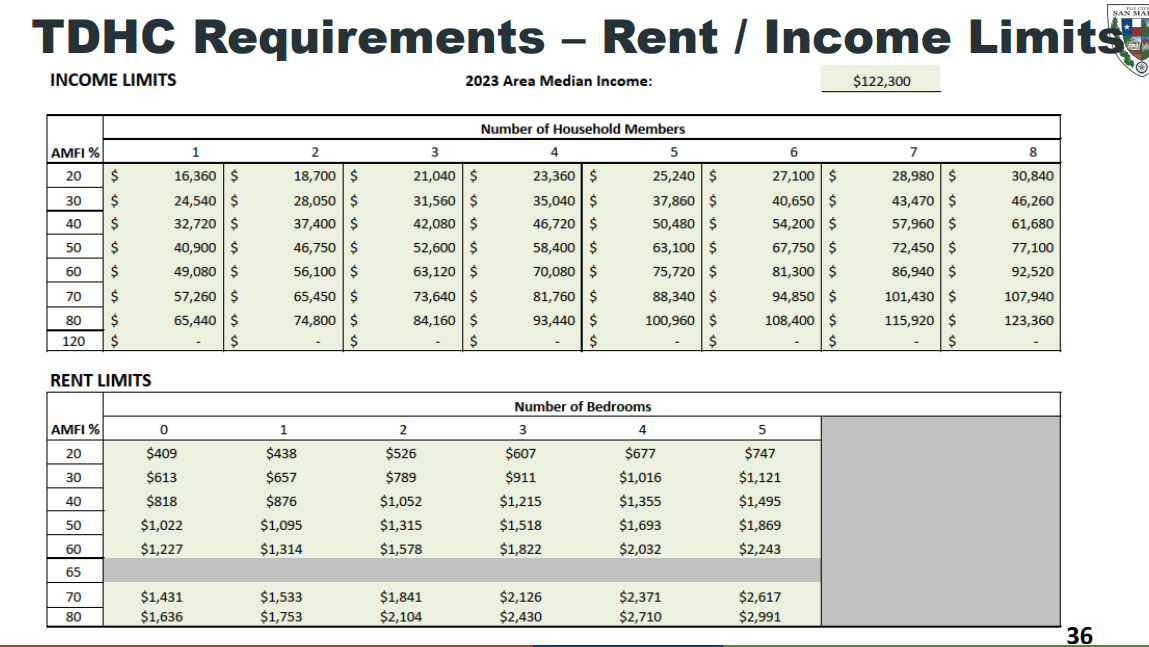
Onto the state requirements for their tax credits.
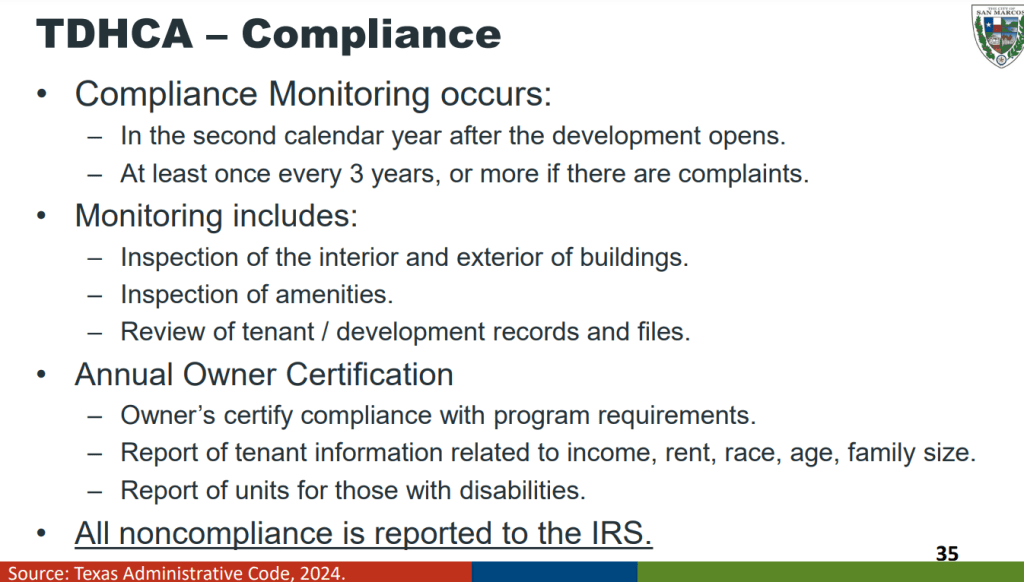
The state organization is TDHCA. (Texas Department of Housing and Community Affairs.)
They care about:
Location. You can’t put your low income housing in a crappy location.
Clustering – you can’t put them too close together
Flood plain – nope
They must have at least 15 hours each week of an after-school learning center
They must supply a shuttle if they’re not on a bus route
San Marcos does not get those reports, currently. It would be nice if we did.
…
If you’ll recall, we did a big Housing Needs Assessment back in 2019, and came up with a housing plan to work on housing affordability. This is great! And…. council then buried it six feet underground.
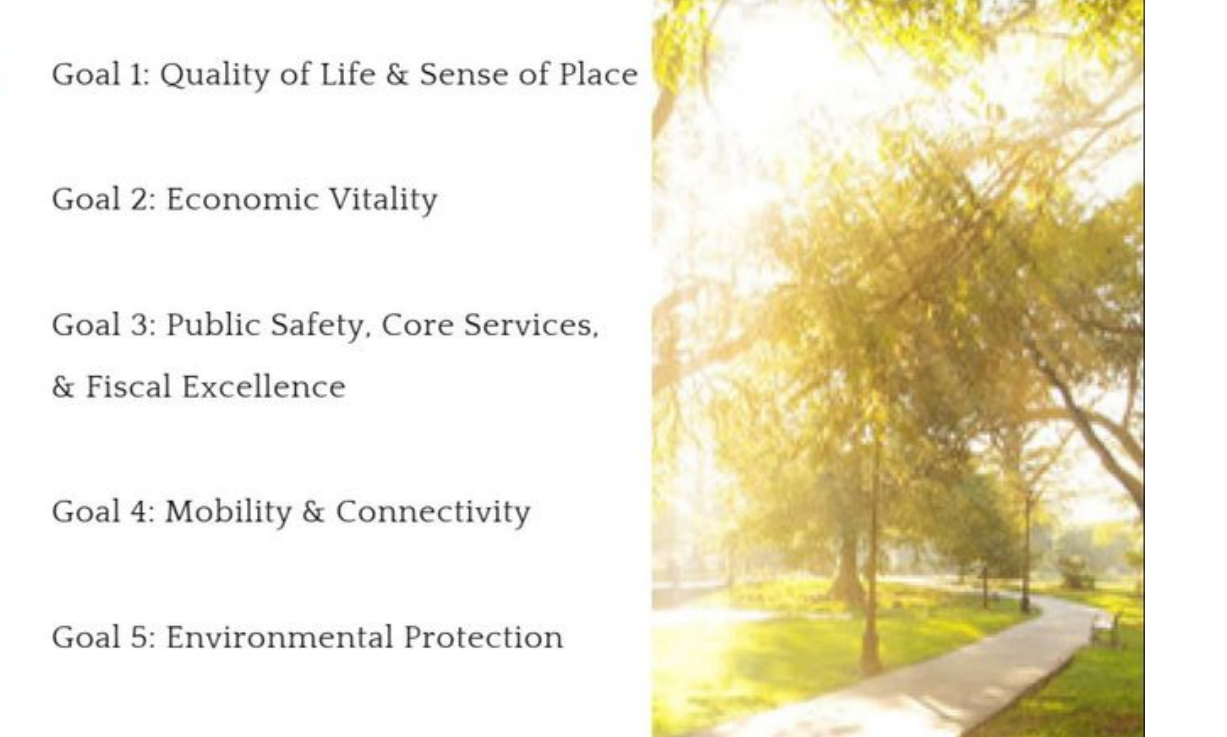
Housing affordability has not been a major priority of this council for the past five years. (Except Alyssa Garza.) In the budget we passed in October – two months ago! – our Strategic Plan Goals were:
None of those are affordable housing.
Council did not care until this election cycle, when it became clear that you could lose your election if you didn’t hear the clamor for affordable housing. It was suddenly the #1 issue.
Anyway: We’re finally doing it, five years late. The first step is updating the data for the Housing Needs Assessment, which is almost ten years out of date.
Listen: this workshop was fascinating, and councilmembers asked good questions. I’m not doing it justice. But it was a 5 hour meeting and a 2 hour workshop, and your poor little marxist is tired.
We got $18 million dollars from the federal government during Covid. This is called ARPA money. It all has to be obligated by December 31st, 2024. Not spent, but under contract.
Here’s how we spent our ARPA money:
Some of the projects have come in under budget:
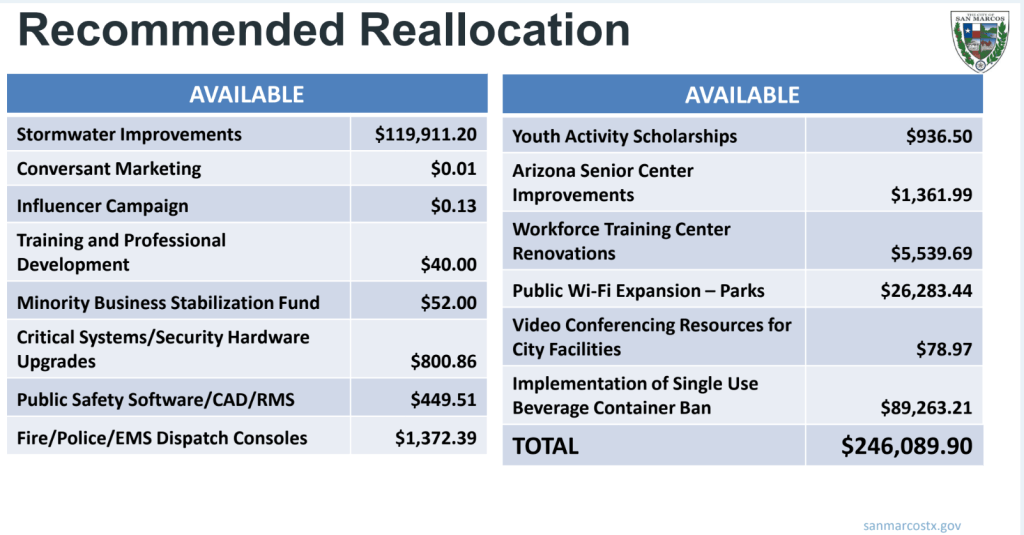
The can ban came in $89K under budget?! But… but we didn’t get rid of the cans…
Anyway, we’ve rounded up all the scraps and put them back in the pot to hand out.
(True story: my mom would collect all the slivers of bar soaps, and put them in a mesh bag to use as one big bag of bar soap. It’s gross! You should try it some time! The connection being that we are putting all the last little ARPA slivers into a mesh bag to use as one final ARPA slushfund.)
So what should we do with this last $246K?
Here’s what City staff recommends:
Every time this comes up, over the past four years, Alyssa Garza argues for direct aid to neighbors. We should use covid money on things like rental assistance, utility assistance, emergency grants for car repairs, etc. But somehow these things never materialize.
The conversation gets bogged down. – Is it because council doesn’t agree on the direction they give staff? – Is it because it’s very hard to implement these direct aid measures? – Is it because the federal restrictions make it really hard for residents to find all the correct paperwork and documentation?
It goes in circles for awhile.
Eventually Alyssa convinces everyone to try to redirect the Dunbar bathroom money towards emergency rental assistance. If staff can’t make that work, Plan B is still the Dunbar bathrooms. B is for Bathrooms.
It’s kind of tucked away in the Dunbar Neighborhood:
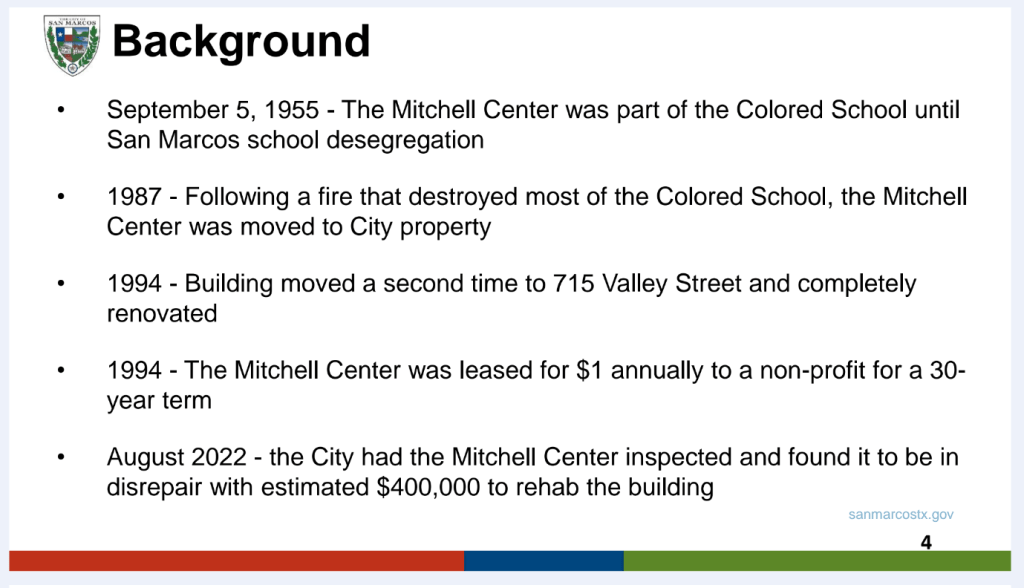
It’s got deep historical roots:
Since the 30 year lease is coming to an end, the City decided to open up for bids to nonprofits:
In the end, staff recommended the Calaboose African American History as the best choice.
I’m not exactly sure where the $400K is going to come from for the estimated repairs, but certainly the Calaboose folks will be good stewards of this property.
…
Workshop #2 was about the Utility Billing Assistance program. It’s still being hashed out; I’m going to leave this alone for now.
This week’s workshop was all about the river and parks. It was both so interesting and so depressing.
The big question is: How’d the can ban go?!
The big answer is: We broke our river. We were so overwhelmed with record-breaking crowds that we couldn’t even get to the can ban. The river got really damaged.
Out-of-town crowds were too big. Bad behavior was high. There was more trash and destruction than ever before. We might have to fence in the river parks and start charging admission. It’s all very depressing!
Let’s dive in.
Preparations. We planned on doing the can ban! (There was a can ban plan.)
Here’s what we did ahead of time to prepare:
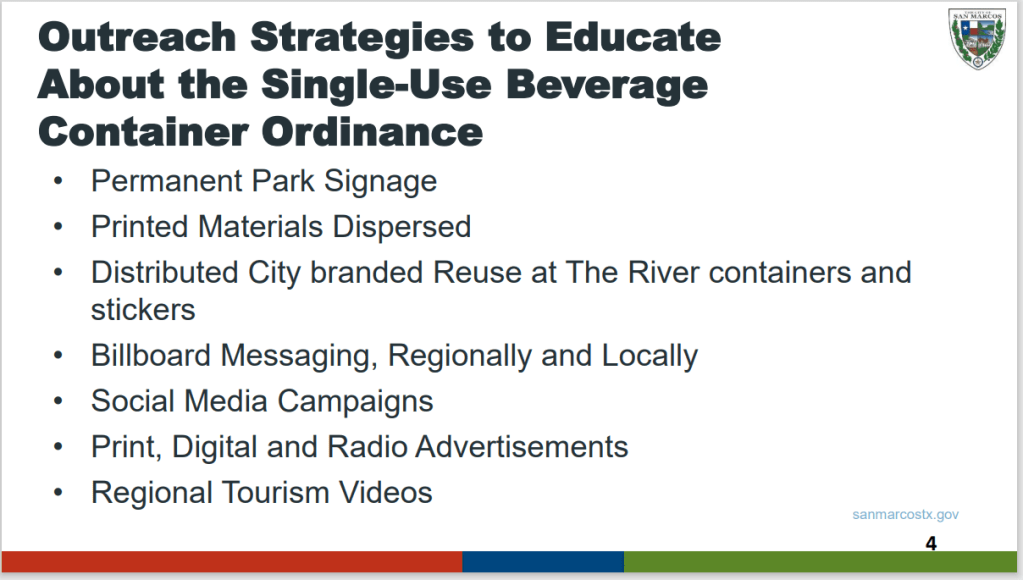
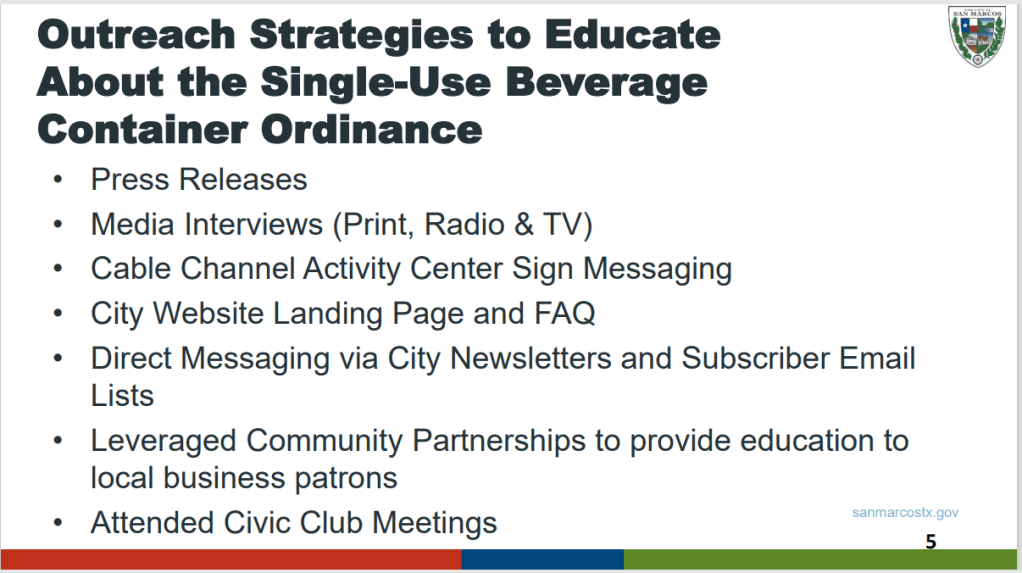
We tried to promote the ban every way we knew how, ahead of time.
We put these signs up in the park:
There were also sidewalk stickers, pointing towards the Go Zones and the No Zones.
You could quibble that the signs and stickers weren’t great at demarcating the Go Zones and No Zones, but this was supposed to be the trial year, where we try things and see what works. ♫ Life’s a dance you learn as you go ♪, and all that.
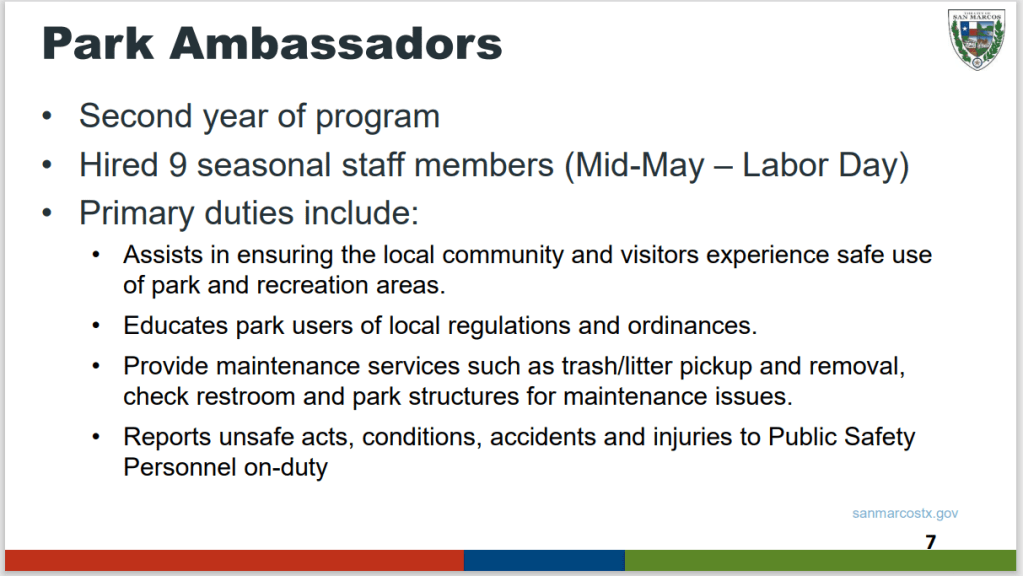
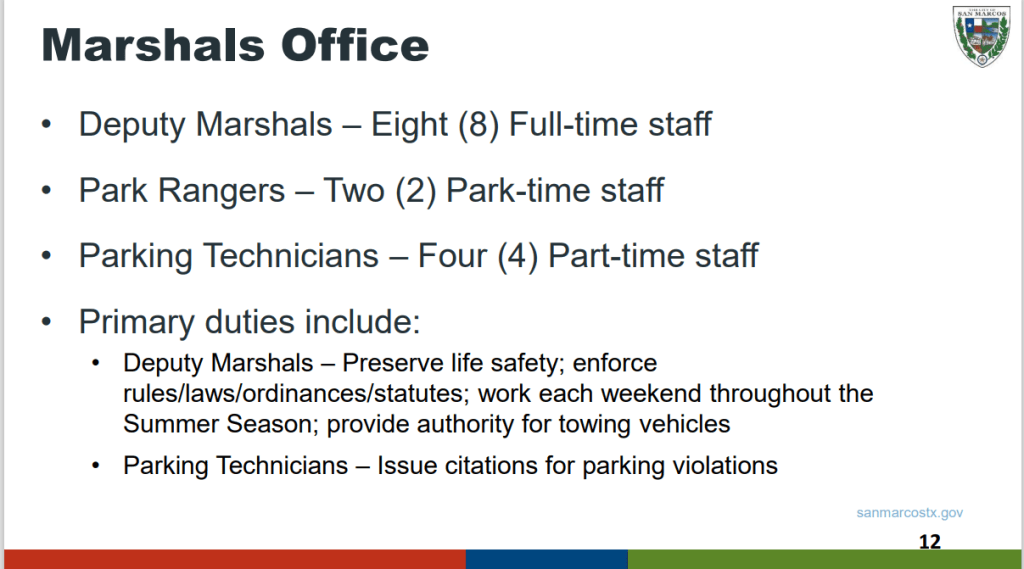
Generally there are both marshals and park ambassadors at the park:
And marshals:
(The can ban plan began.)
But things went really badly:
The big problem is drunk people – they fight, they trip and fall and hurt themselves, they get heatstroke or other medical issues from the heat. Just lots of safety issues that preoccupy city marshal attention. No one has any bandwidth to get to the can ban.
Overparking is a problem, too. And there’s lots of litter that gets left wherever people go to find parking.
Memorial day was a particular disaster:
So in response to Memorial Day, they changed things up for 4th of July weekend and Labor Day weekend.
Mainly, they shut down Cheatham street. This helped with the drop-off and pick-up mess, and the aggressive U-turns that cars make. They had to staff both ends of the street, so that used up more staffing.
The other big thing was contracting with off-duty police officers. We pulled $100K out of Covid money and spent it on extra staffing.
Finally, they blacked out the dates for the baseball fields, so we weren’t hosting a baseball tournament at the same time. This freed up some parking for the rivers.
…
So how bad did things go?
Deputy Marshals have a dashboard:
This is the total for the whole summer. Highlights:
329 park evictions.
48 citations. You can see that the most common one is alcohol, by far, and next is parking violations.
Only 2 arrests! But that’s because a marshal has to then leave with the person, which leaves the park even more understaffed. So ususally they just kick the person out of the parks.
69 medical incidents. Most of those are drunk people who succumb to the heat.
It sounded pretty grim. They were so understaffed. All the marshals and park ambassadors worked every single weekend, no exceptions, all summer long, no vacations.
Staff also said that most of the behavior problems are out-of-towners. Local residents are less likely to cause problems.
This is the main reason the can ban kinda died – we were in survival mode for making sure that everyone stayed alive and safe.
3.Sowhy???
Why is all of this happening? What changed in the past few years?
The problem is all the other river parks. The other cities have fenced in their parks and started charging admission. We’re the only free river park left, in the San Antonio-Austin general region.
I hate all of this so much. It pits two things I care deeply about against each other:
Recreation should be available to all people.
You must take care of your river.
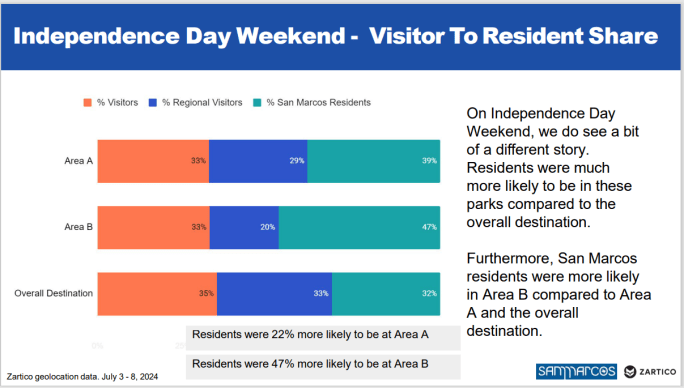
So who exactly uses the river parks so much? We hire these guys to track cell phone data. Here’s what they tell us:
First:
Area A is downstream – the falls, near the baseball fields, near the children’s park. Area B is upstream – near the Lion’s Club and the general Sights and Sounds part of the park. (I don’t know what Overall Destination means.)
Next, the colors:
Teal means they are San Marcos residents. Blue means they come from this radius:
Orange means they’re from outside of that circle.
So roughly 60% out-of-towners. I’m kinda surprised by how many people drive in from Houston:
So how many people actually are showing up on these busy weekends? It wasn’t in the presentation, so I emailed city staff to see if we knew.
They kindly answered: Nope, unfortunately, we don’t. You can’t get that data from this company, because they’re just sampling cell phone data. To know the total number of people, you’d have to have staff literally out there counting by hand.
Crowds looked a little different on the 4th of July weekend, but you get the picture:
Anecdotally, the speakers said the vast majority of the drug/alcohol/behavior problems were out-of-towners. Also depressing!
…
4. Onto the poor river.
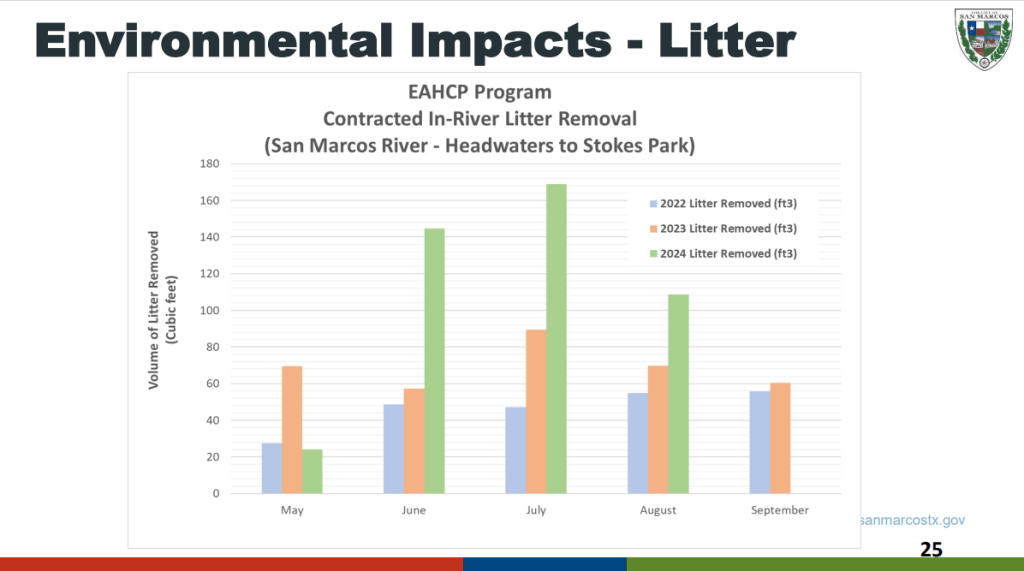
First up, litter:
It looks like it went through the roof. But staff said that this graph is misleading, because we doubled our clean up efforts to twice weekly instead of once a week. Some of that is old trash from years past.
So maybe some of the tubers were bringing re-usable containers after all? And the can ban helped? Who knows.
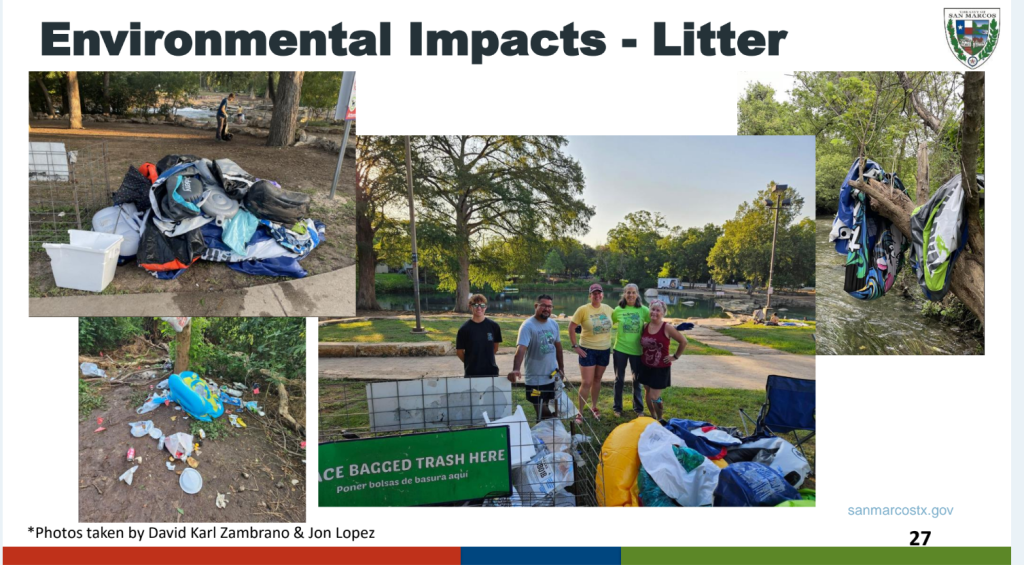
Look at this stuff. Ugh ugh ugh.
They said that usually on Saturdays and Sundays, they pulled about 50 old dead tubes out of the water each day.
Apparently Lion’s Club rentals were way down, too. Two years ago, they rented 48,000 tubes. This year they rented 36,000 tubes. Same with shuttle service. People are buying tubes from stores and walking back up to the top of the river, instead.
…
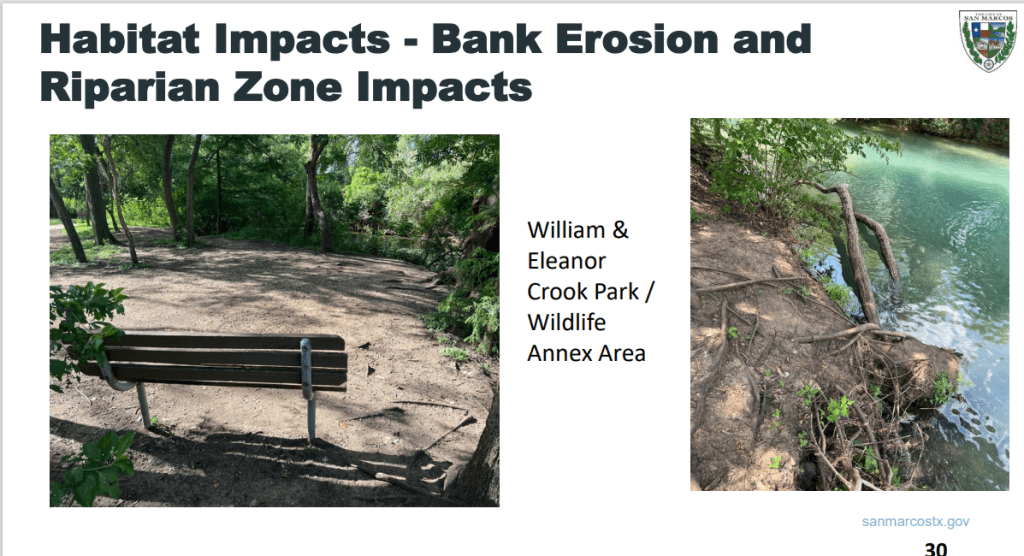
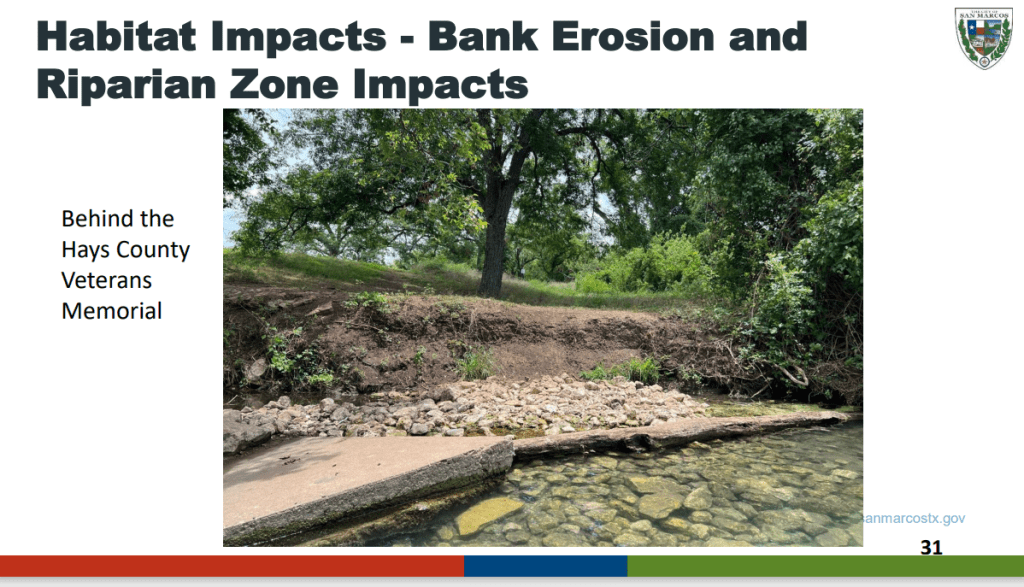
A really big problem is that people find new ways to get into the river, and then they destroy the river at these access points.
The bank erosion looks like this:
And the wild rice, ecosystem, etc everything gets destroyed.
I told you it was depressing.
They put lots of photos in, so I’ll pass them along:
This presentation was a major bummer. You only get one river!
Staff only has one proposal: You fence in your parks, you charge nonresidents for admission, and you use the revenue to hire more staff.
Apparently New Braunfels brings in enough money to pay for it’s entire parks system. That’s a lot more financially sustainable than redirecting $100K of Covid money to contract out with off-duty police officers.
Here’s the thing: inevitably, it will limit access poorer people with fewer resources more than it limits access for wealthier people. Even if you make it free for residents, there will be hoops to jump through.
But what else can you do? I have no other good ideas, either.
So now we turn to Council discussion.
(Only Mark, Matthew, Saul and Jane were here.)
Mark Gleason goes first: he has serious reservations about fencing in the park and charging admission.
There’s no such thing as “aesthetically pleasing” perimeter fencing.
It might be inevitable, but it’s got such a cost associated with it.
Can we fully implement paid parking and the can ban first, and see if that helps?
Fences become dams in a flood! They clog with leaves and debris and prevent water flow.
I am really sympathetic to him here. I also want anything but blocking off the parks.
Staff responds to some of these: paid parking is not going to generate the kind of income stream we need to staff these crowds.
Jane Hughson: “Yes on managed access. This is breaking my heart.”
What would a perimeter fence and managed access look like?
There’s nothing concrete to talk about yet. Staff wanted to check with Council before beginning research. So we can’t say where the fences would go, or where the entrances would be, or anything.
How far up would it start? Texas State is having problems at Sewell and the headwaters, and so they want to coordinate with us on this.
How far down would it go? Probably to I-35, at first. Mark Gleason points out that this will drive people to over-use the river on the east side of 35. Staff responds that they’ll have more staff available to cover these other areas, once we get a stable revenue stream.
Apparently New Braunfels does have a problem with people slashing the fence, to sneak in. They have to constantly pay for repairs. So we’d probably have that problem, too.
Some possibilities to explore:
Free for residents
Free during the week
My read on the mood in the room was that this is inevitable. We will have to fence off the river parks and charge admission.
…
Top Secret Executive session: Another ridiculous code name: Project Jolly Rancher!











































 The San Marxist