Bonus! 3 pm workshops, 8/5/24

Presentation 1: Hays County Health Department

    I assume all you readers here already agree that health care should be free. Americans pay way too much for way too little, for vague reasons about “freedom”, as if anyone is excited about the freedom to be sick or die early.

    Everyone deserves affordable health care, as a basic right. Great.

    Here’s a second reason that health care should be free and universal: you need a coordinated response in order to launch the best fight against contagious diseases. Do we really want each person to get sick with tuberculosis and see if they can recover, with good old fashioned rugged individualism? Or do we want tuberculosis to actually be eradicated, for everyone, like a bunch of dirty socialists? Maybe grandma doesn’t need to hack up a lung in the first place.

    This is what we mean by public health: often it’s better for everybody when everybody gets basic health care. It’s better for rich people, when poor people aren’t sick! Seems basic, but it’s mindblowing if you’re used to punishing poor people for being poor.

    So we have a Hays County Health Department.

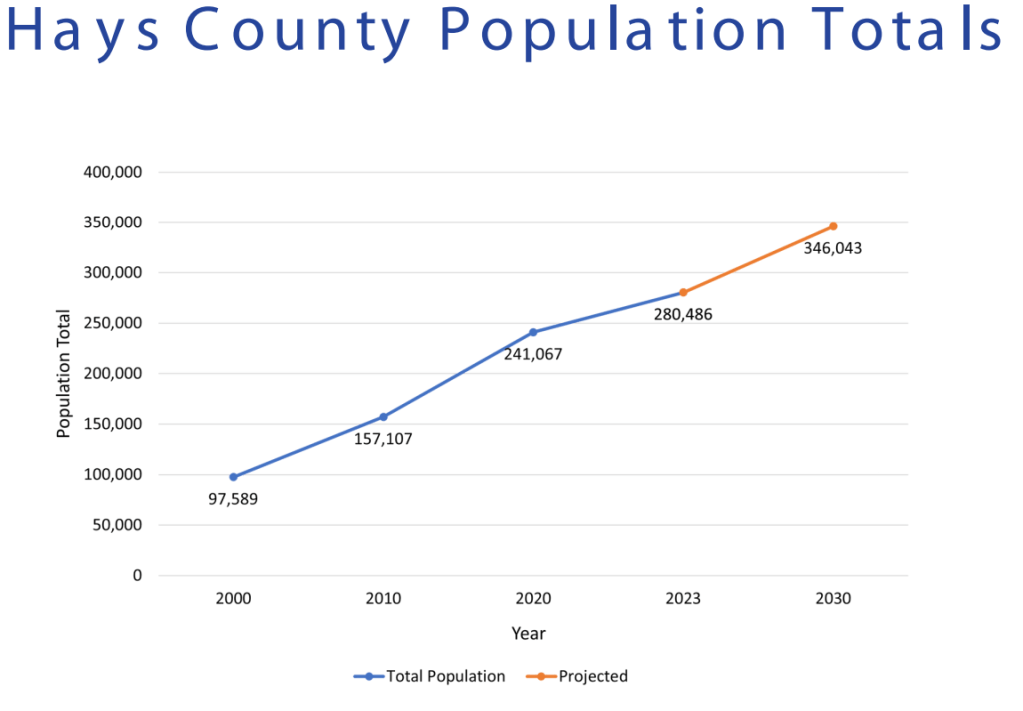
    What’s the need like in Hays County? Well, first, we keep growing:

    Second, we’re in need:

    Some notes:

    1. San Marcos has about 70K people, and Hays County has about 269K people. So the poverty rate is only 12.4% for all of Hays County, because there’s a lot of wealth in the north and west parts of Hays County.

    Most of the poverty is concentrated in San Marcos and Kyle. The poverty rate in San Marcos is about 27%.

    2. Let’s just note that the poverty rate is 12.4%, but unemployment is only 3%. Can you believe that we allow companies to hire people without paying them a living wage? Me neither.

    You’d think we’d be storming the castle over this kind of exploitation, but instead we all just wake up in this world every day, as usual, stressed out over our meager salaries.

    3. That housing crisis is a disaster. Spending half of your meager income on housing is no joke.

    “TVFC” is Texas Vaccines for Children. “ASN” is …American Supplemental Nutrition? American Nephrology Society? Autonomous System Number? I got nothing.

    “TB” is definitely tuberculosis, and we definitely do not want TB cases to be rising.

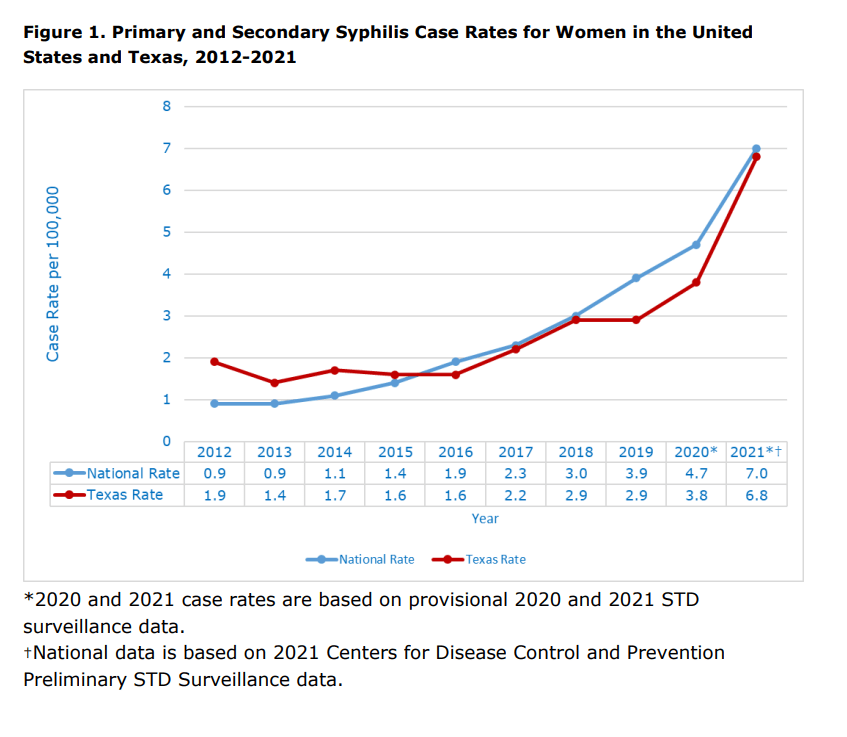
    The presenter stopped and talked about syphilis for a little bit. It is definitely on the rise in Hays County, across all age groups, ethnicities, and economic classes.

    Here’s statewide syphilis data:

    from here. (The linked report focuses on women, because one of the worst risks is congenital birth defects if she has a baby.)

    In conclusion: the health department does a lot on a shoestring budget, but they could do a lot more if the state funded public health like we should.

    ……………….

    Presentation 2: American Rescue Plans (ARPA) money and Covid Relief money.

    Covid money is running out. It has to all be budgeted by this December, and it has to all be spent by the end of 2025. We started with $22 million, and we’re down to about $1 million. Most of that is because of projects that came in under budget.

    Here’s how staff is recommending we spend the money:

    The LCRA tower is a bargain that came out of nowhere. It’s to give radio access to fire/EMS/etc on the southeast side of town. It was going to cost $4-5 million, but in the last moment, we looped in Guadalupe County and some other partners. So the fire chief Chief Stevens is a big advocate for that.

    Jane Hughson asks about the running list of side-projects that council keeps, to be funded whenever we stumble into some money. Staff does not have that list available.

    Alyssa Garza asks about some of the programs she’s tried to fund with ARPA money, where money never seems to materialize in a meaningful way. Specifically, funding for the Parent-Liaison SMCISD program and translation services. In both cases, money has gone to the program, but not in a way that addresses things well. Like, it’s all well and good to translate the website, but we’re not making events bilingual and bringing parity into public spaces.

    Alyssa points out that the whole Council is being steamrolled into saying yes, for the tower they’ve never heard of before. Chief Stevens pleads that the stars aligned in a special way.

    I get what Alyssa is saying: this is part of a larger pattern. Whose priorities get fast-tracked and whose priorities limp along, half-heartedly? The tower is not a bad project! It’s just a convenient example of a problematic, ongoing pattern.

    Bonus! 3 pm workshops, 7/2/24

    Presentation 1: New City Hall Project

    The city needs a new City Hall. (Discussed here and here.)

    Laurie Moyer was handling the new City Hall project, but she is retiring. The new person basically gave a presentation to introduce herself and pitch how she sees things unfolding.

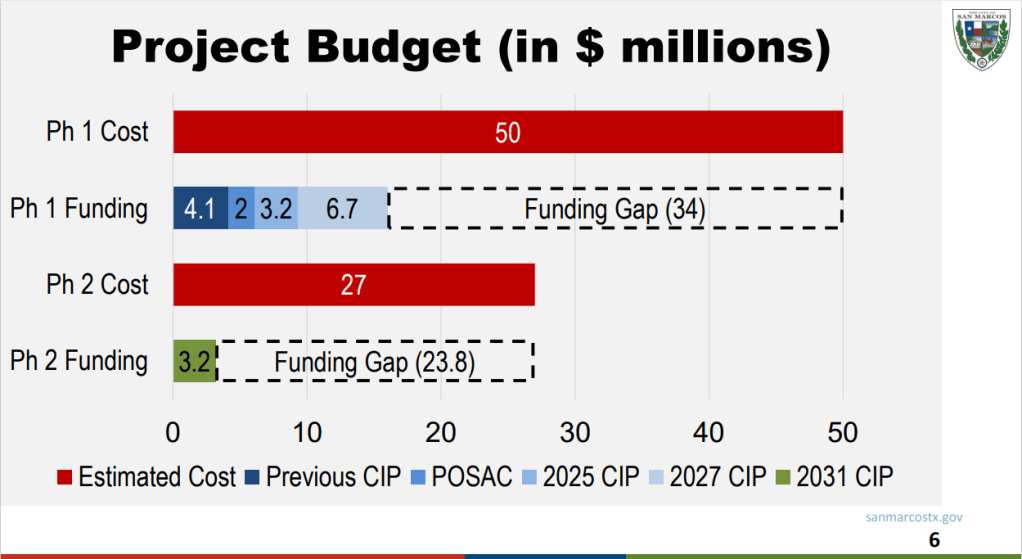
    Here’s what she was handed:

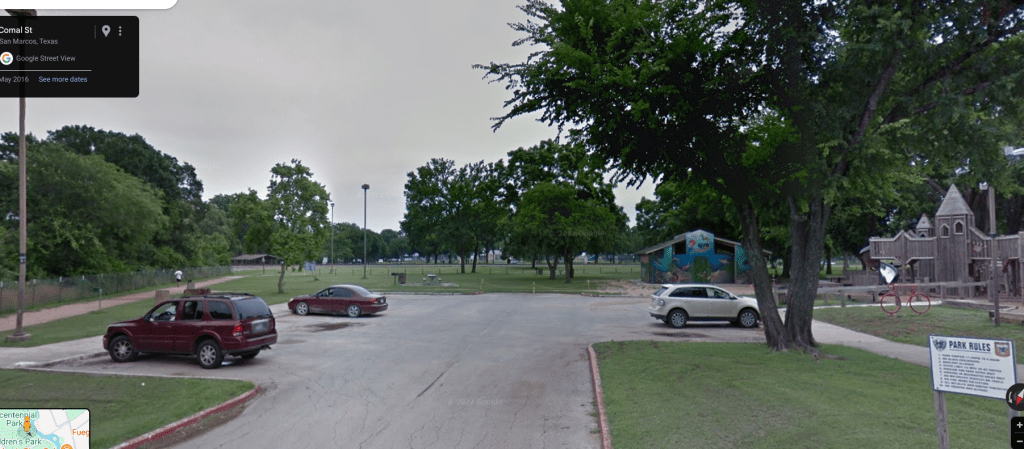
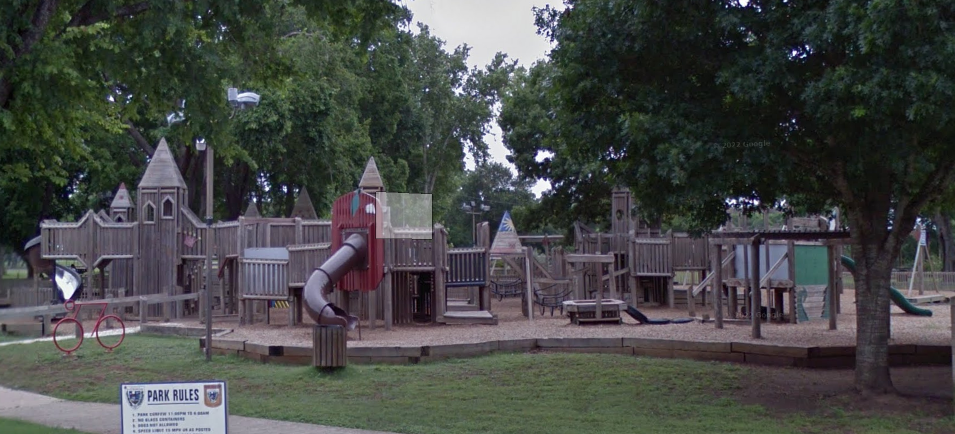
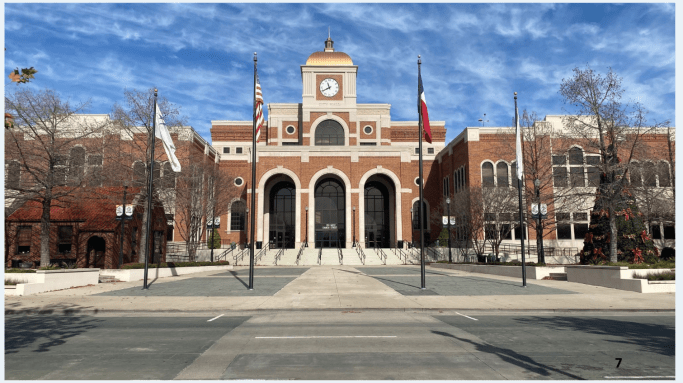
    In other words, City Hall is going here:

    across the street from Old City Hall.

    So apparently this location is settled? I don’t know how I feel about this. I also have concerns about what might happen to the old site.

    However: they’ll need voter approval in 2025 to re-purpose park land as City Hall, so I guess we’ll be hearing some sales pitches. In the end, the voters will decide whether or not it sounds ok.

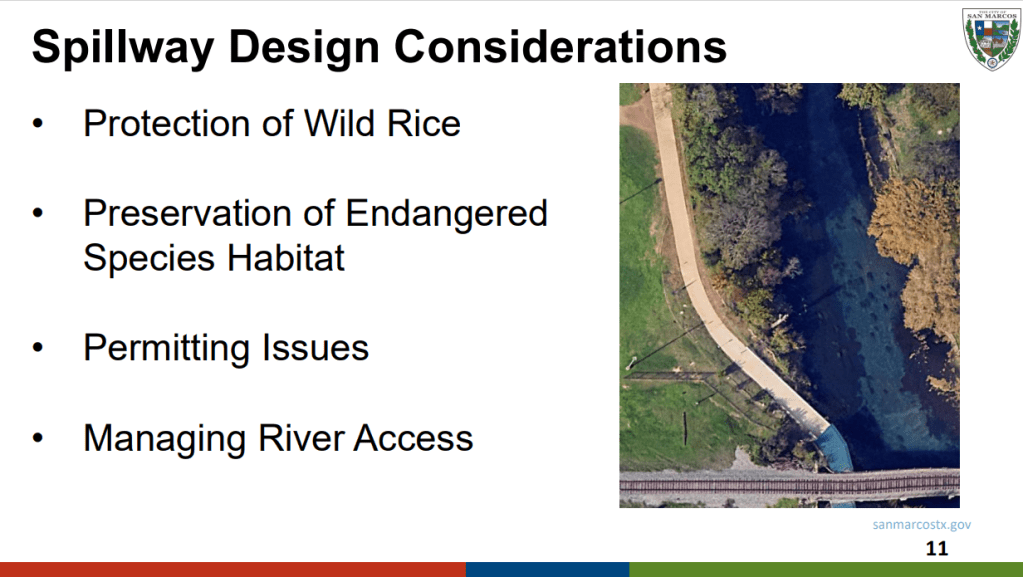
    The new person is imagining making a whole Hopkins Project out of it:

    Parts of this sound good to me!

    I like the idea that Hopkins could look more like CM Allen.

    P3 means “Public-Private Partnership”. This part is inevitable because the city doesn’t think that the voters would pass a bond in an election. So they want to bring in private partnerships. (More things that I feel weird about.)

    This whole thing will take forever to complete. If the stars align, it will take seven years.

    Presentation #2: It’s Sidewalk Maintenance time!

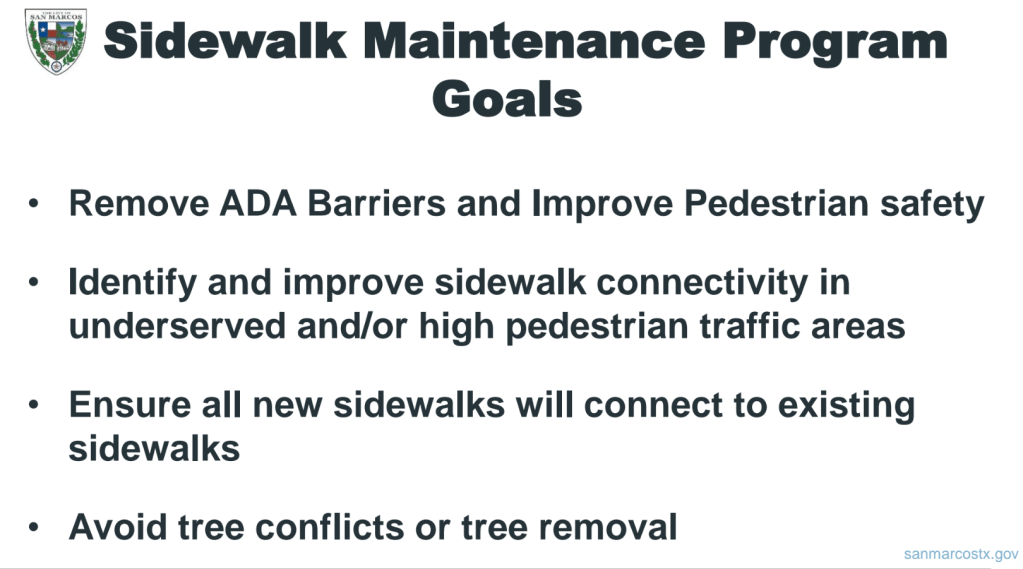
    Here’s the game plan:

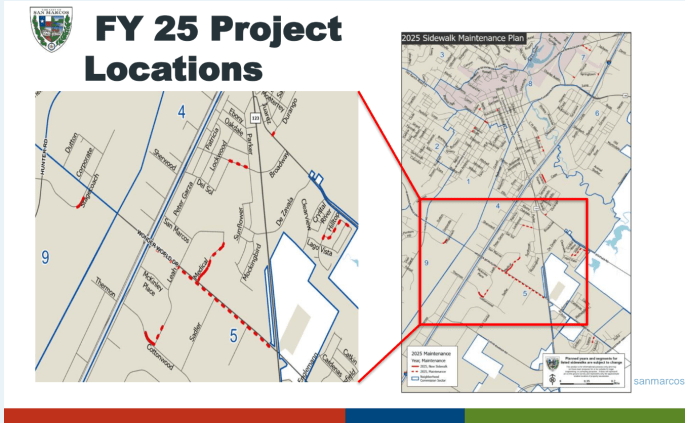
    Here’s what’s coming up in 2025:

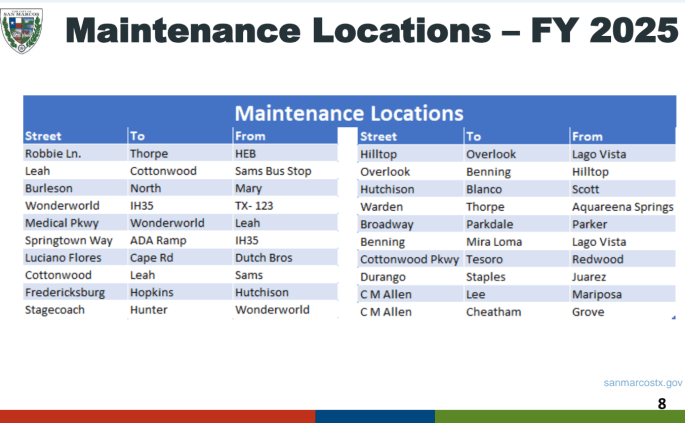
    or if you prefer a chart:

    Would you like to play along at home, over the next year? Go here:

    www.sanmarcostx.gov/306/StreetsSidewalks

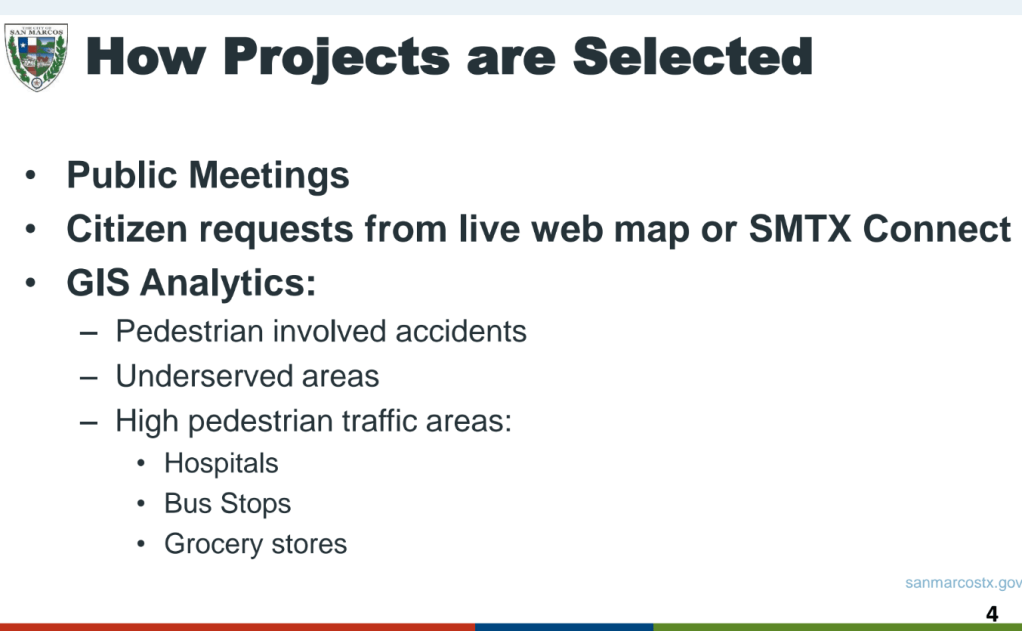
    Would you like YOUR pet peeve to be selected for a project in 2026?

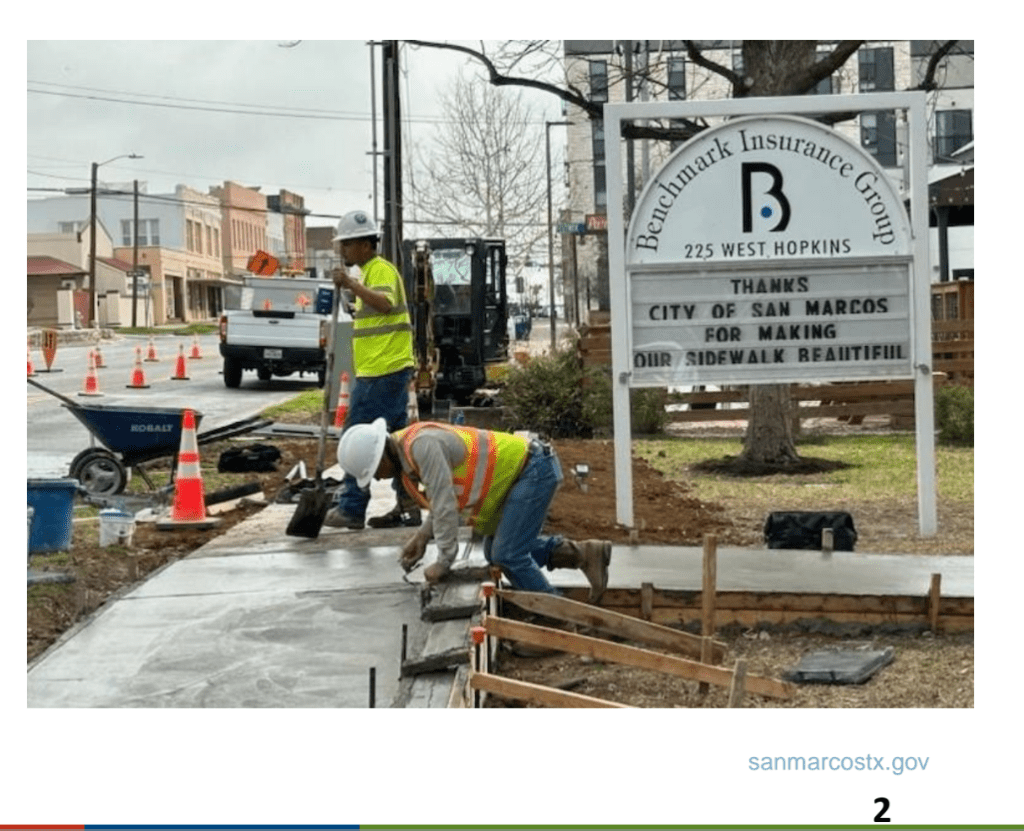
    Would you like some more photos?

    here you go. Enjoy!

    Bonus! 3 pm workshop, 6/4/24

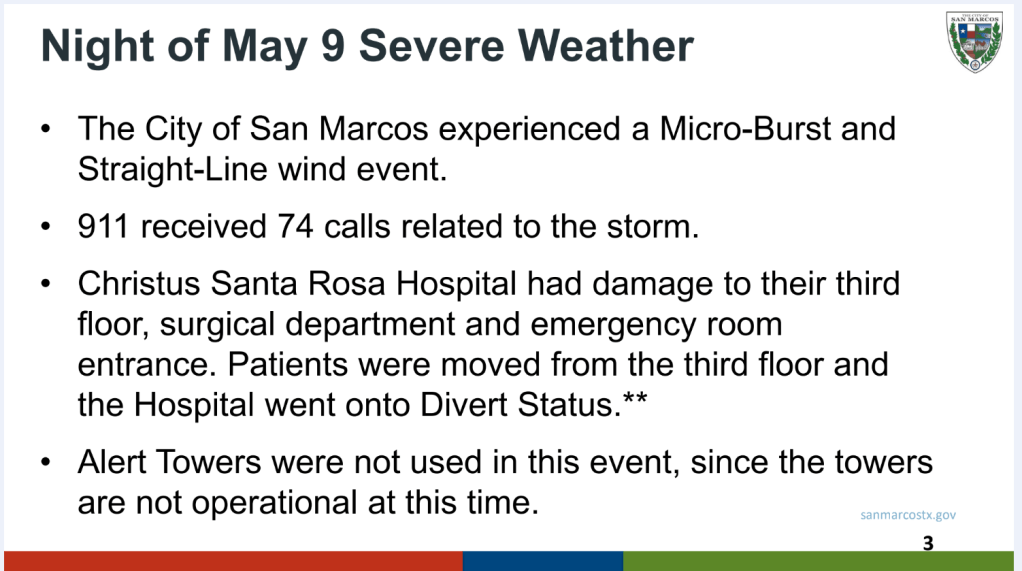
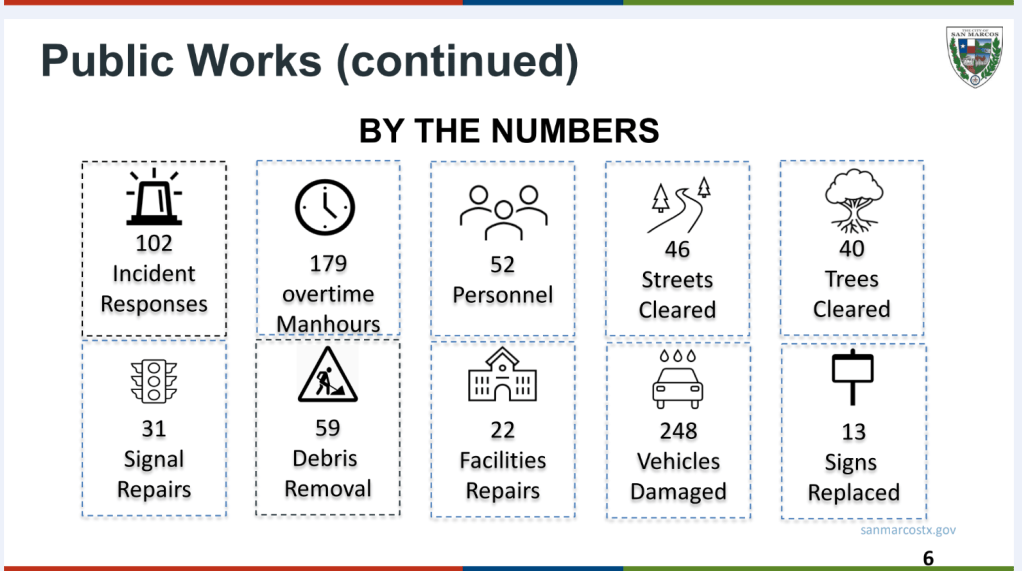
    How’d the city do during the May 9th storm? I’m just going to run through some of the slides.

    These are the Alert Towers. They’re being tested, but haven’t come online yet. (I think they used to be used years ago, but have been broken for a long time, and now we’re bringing them back?)

    So a ton of work was done overnight and into Friday.

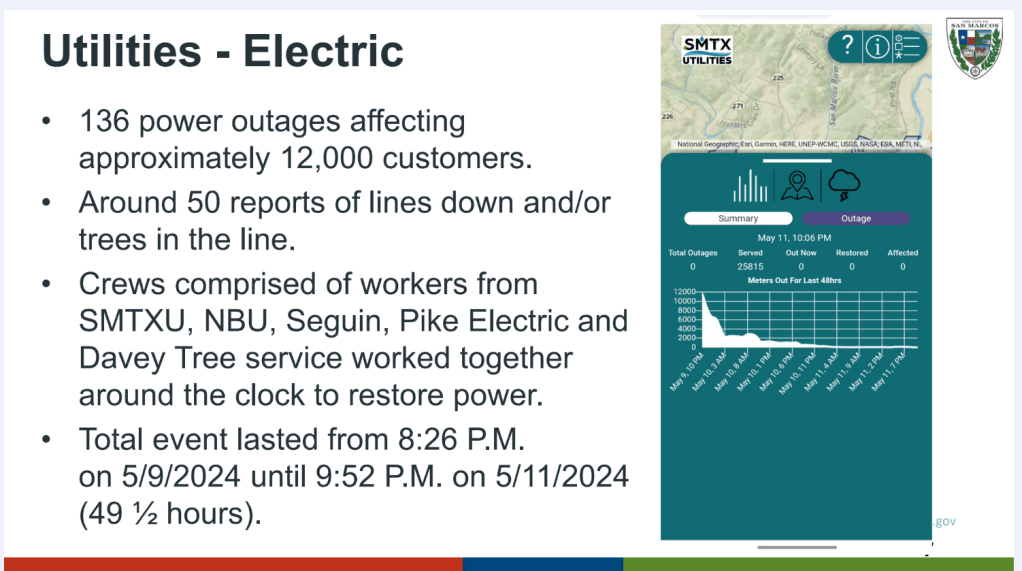
    There were a ton of people without electricity:

    The last people didn’t get their power back for two full days.

    There were a lot of anecdotes about the city not knowing about different outages, and people reaching out directly to councilmembers. Staff says that often the resident is talking to a field worker who doesn’t have access to the master map of all outages. So the resident thinks the city is ignorant about an outage, but really they weren’t talking to the right person.

    Still, they conceded they need to do a better job of staying in touch with residents who call in to say they’ve lost power.

    Kind of a bummer to see all those trees down.

    Lots and lots of community volunteers.

    Some plans for what to do better, next time.

    Bonus! 3 pm workshop, 5/21/24

    Presentation 1: Our budget is not doing well. Let’s look at some slides.

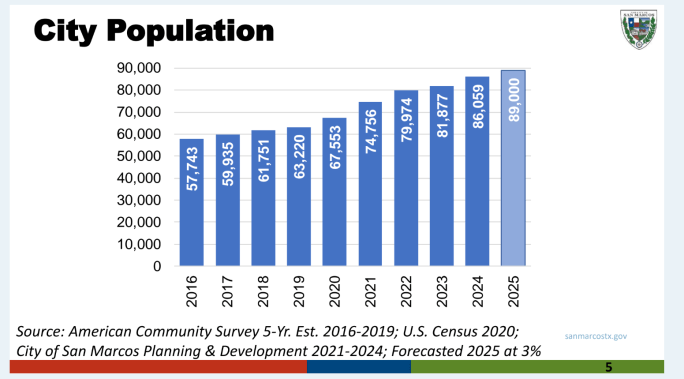
    First, San Marcos keeps growing:

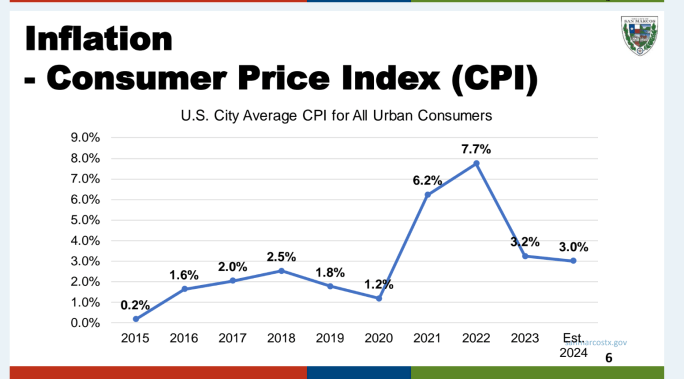
    And while inflation is back to a normal healthy amount, it still exists:

    So due to a larger population and 3% inflation, it will cost more to run the city more next year, even if we don’t change what we’re doing.

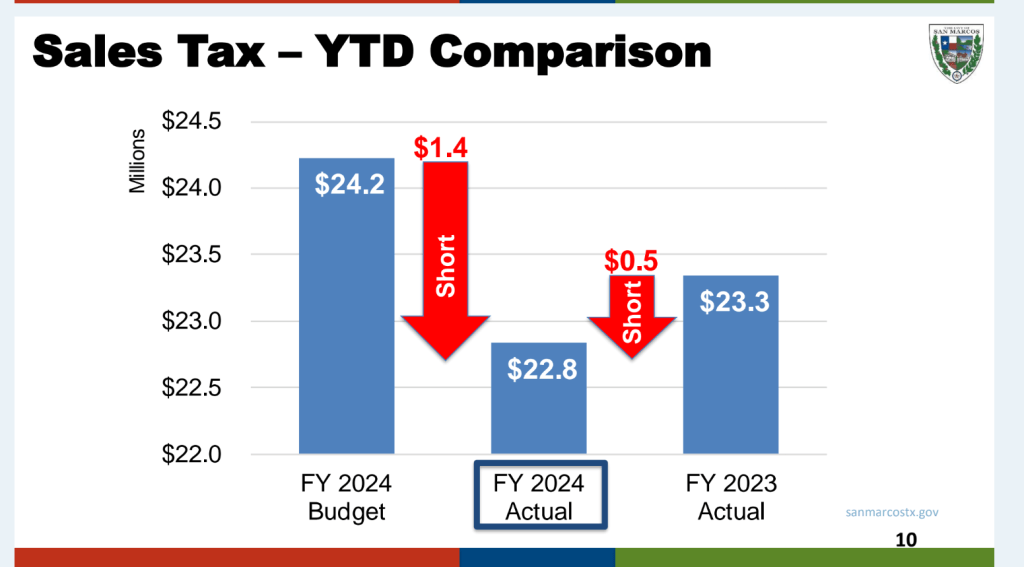
    But unfortunately, we took a big hit on sales tax:

    This is sort of a cumbersome chart. It’s doing a few things simultaneously.

    So you see where it says October 2023 is 6.6%? What that means is:

    1. Average all the sales tax revenue from October 2021 to October 2022.
    2. Average all the sales tax revenue from October 2022 to October 2023.
    3. Work out the percent growth from the first average to the second average. For October, the past 12 months were 6.6% bigger than the previous 12 months. Great!

    But you can see how this plays out over 2024 – we kept shrinking and then turned negative. So the average the sales tax income from April 2023 to April 2024 is smaller than it was over April 2022-April 2023. That is not good.

    Who’s coughing all this up, anyway?

    I would not have guessed that!

    (I would say it’s their customers, not the business, but you get the point.)

    No one else is having this problem. Just San Marcos:

    No one offers up an explanation, because I don’t think anyone has one? Nobody knows if this is a shortterm fluke, or if it’s the beginning of something bad. We can’t know until it plays out a little more.

    Anyway, here’s the bottom line:

    We do not have the money we thought we’d have this year.

    So we have to do two things simultaneously:

    1. Figure out how to tighten our budgets mid-year. There are established contingency plans on how to do this, but it’s not, like, fun to do.
    2. Figure out how to plan for the 2025 budget, if we’ve got more people and slightly higher prices, but less revenue.

    Can property taxes make up the difference? Basically no.

    First off, sales tax is a bigger chunk of our budget than property taxes:

    But second, even though homestead prices are going up:

    they’re not going up by as much as they had been going up.

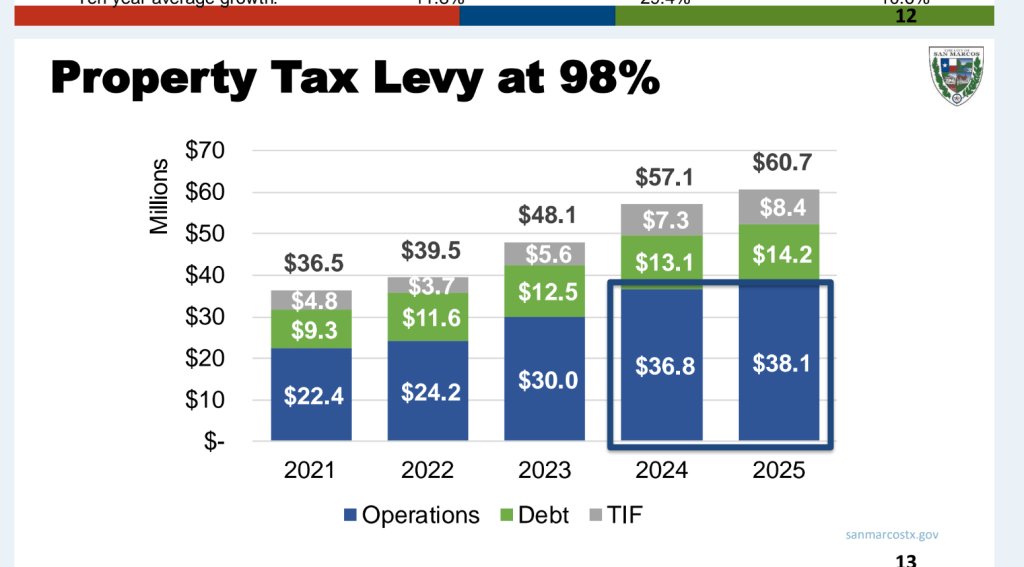
    The blue portion is the key amount:

    So the city is expecting to collect 1.3 million more dollars next year than this year. It’s growing, but not enough to keep up with inflation and a larger population. Not like the past two jumps: from 2023 to 24, we jumped 6.8 million, and the year before that, an extra 5.8 million dollars.

    So here’s the bottom line:

    We are looking at being 2.3 million short this year, and 1.12 million short next year, if we don’t do anything different. Ouch.

    I mean, we’re going to tighten belts, etc. The city is smart, there are plans to implement. But they involve hard choices and going without good things.

    Here’s how we’re handling 2024:

    Basically, that’s how they’re handling it. And they’re working on making next year’s budget work on a shoestring, as well.

    One last thing:

    There’s a new law that caps the how much business property appraisals can increase each year. Any non-homestead can’t grow more than 20% in a year. Or rather, the appraisal can come in higher than that, but you won’t be taxed on the excess.

    Now, this only affects businesses appraised under $5 million. The problem is that we have a high number of small rental properties, and they all qualify. So we’ve lost $123 million of taxable land value, which works out to $745K from the budget.

    Bottom line: the city has to tighten the budget. Kinda a giant bummer.

    Presentation 2: There was also a presentation on the 2025 Capital Improvement Plan.

    The CIP plan is all the major city projects, like re-doing the drainage for a street so it doesn’t flood anymore, or whatever. Basically it takes a lot of longterm planning. I don’t have much to say about it besides that they emphasized how much they’re trying to apply for lots of grants.

    Bonus! 3 pm workshops, 5/7/24

    We had great workshops this week!

    Item 1: Equity Cabinets

    (Jude Prather recused himself from the discussion, due to his wife’s employment at Texas State. As far as I can tell, there’s nothing remotely conflict-of-interest about this – but sure, why not.)

    I learned that there’s something called an “equity cabinet”.  You pull together a bunch of people who represent traditionally underrepresented groups in your community, and have them thoroughly study a problem in the community, and make policy recommendations.  (Here is the example from the presentation of where it’s been done before.)

    Dr. Rosie Ray is a researcher at Texas State (and we’ve seen her before: here and here and here and here and here). She got some funding to partner with the city of San Marcos – if the city is interested – to put together an equity cabinet to study all things transportation-related.

    Who exactly are the traditionally underrepresented groups?  Biden defines it like so:

    Who are the local partners who can put forth good candidates for this cabinet?

    What would they be focusing on? 

    So about 10 people would be chosen to work closely together over five months.  They’d get paid, it would be structured and well-planned, etc etc. The cabinet would have to get up to speed on the challenges that the city faces and what we’re currently doing.

    So what does council think?

    Everyone’s on board!  Sounds like it’s a go. 

    Here’s the timeline:

    I look forward to hearing the recommendations from the cabinet!

    ….

    Item 2: PIT Count

    How many homeless people are there? It’s not an easy question to answer, for obvious reasons. 

    One way you do it is with a “Point in Time” count (ie, a PIT count). You pick one day (in January, per HUD requirements) and get as many volunteers as possible to go out into your county and try to lay eyes on as many homeless people as possible. But also, you talk to the people and try to get a snapshot of the people who are homeless that night.

     Homeless Coalition of Hays County conducted ours on January 25th this year.  They’re part of the Texas Homeless Network.  It took 50 volunteers that day, and 17 more doing background work.
    It’s not perfect:

    But it’s still useful!

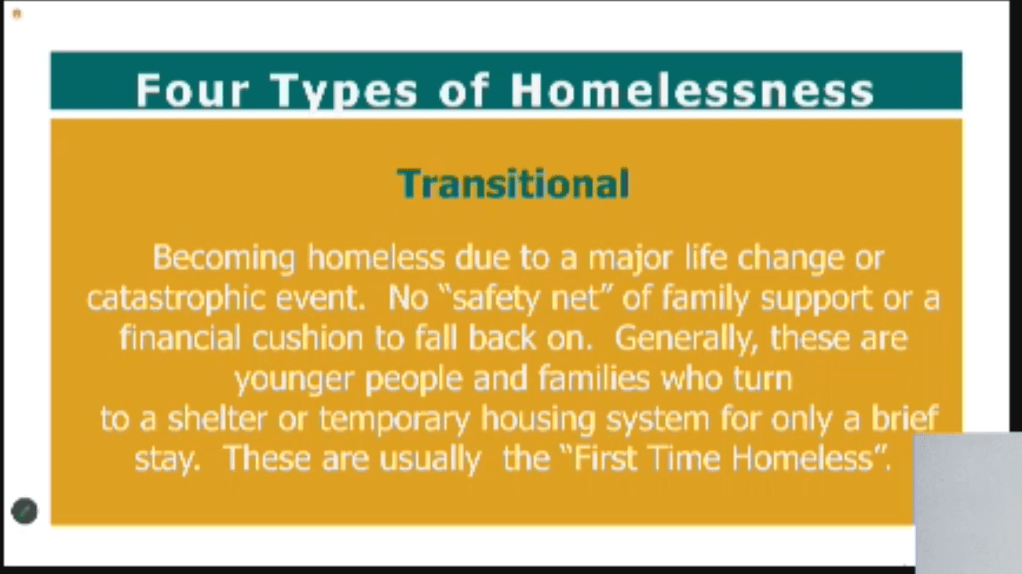
    Keep in mind that homelessness is complicated:

    The chronically homeless people are the most visible. These are the people you see along I-35 or in public areas. These are the people most likely to get counted in the PIT count.

    The hidden or transitional homeless people are much harder to count. Who knows if you’re couch-surfing, or living in your car? Especially if it’s on-again, off-again? A lot of these people are holding jobs and functioning in society, but can’t afford housing.

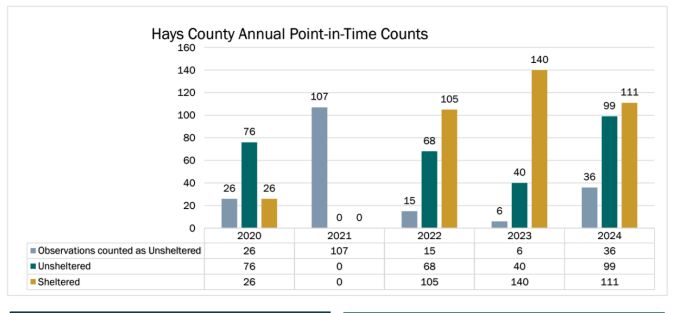
    Results: 

    “Sheltered” means Hays County Women’s Shelter or Southside Community Center/BR3T program with motels.

    So why is the number of unsheltered people going up? Most likely, it’s two things:

    • we’re getting better at locating and counting homeless people, and
    • rising housing costs are displacing more people, so there are actually more homeless people.

    Where are the homeless people in Hays County?

    Mostly in San Marcos.

    This also has a couple reasons! We’ve got most of the resources here. But also, the people conducting the PIT count know San Marcos mostly thoroughly. They know where to check in town. We need cooperation from people with deep knowledge of Dripping Springs and Wimberly homeless communities, if we’re going to find and locate people there.

    On that day, the PIT Count volunteers make 4 sweeps, but all during daylight, for safety reasons. They also chat with the homeless people, if the person is interested in chatting. So we get some informal survey data.

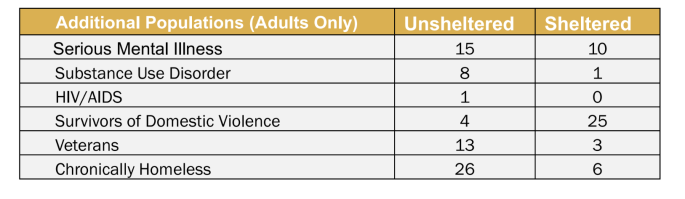
    Survey results:

    So what good is this? First, it allows us to apply for lots of funding.

    Quick Detour: Remember Robert Marbut, from here and here? He was Trump’s homelessness expert, and then we tapped him to write a Homeless Action Plan for San Marcos.

    Marbut advocates for “Treatment First” programs. You do not house someone until they’re stable enough to keep the housing. (If this seems cruel, you might have spotted the fly in the ointment.)

    Under the Biden Administration, HUD funds “Housing First” programs. You get someone off the streets, first. Once they have some basic safety and security, then you can work on mental health and addiction issues. (The main argument against this is, “If you offer housing with no strings attached, you’re threatening capitalism! Workers won’t hustle and turn a profit if they’re not scared of having their life crumble!” Mm-hmm.)

    Presidents matter. They install people to run all the major organizations, like HUD, the EPA, Dept of Education, DoE, etc. Under Biden, you will have sane people implementing humane policies. Those policies affect things like how cities help homeless people. It really matters.

    Anyway, here are the slides from the presentation on why Housing First is more effective than Treatment First:

    It’s more effective and less cruel! Win-win.

    The PIT count is not the only measure of homelessness. There’s also the McKinney-Vento report for kids enrolled in public schools:

    The McKinney-Vento report measures things slightly differently than the PIT Count. They try to record how many kids are couch-surfing, which is the “doubled up” category, and who is temporarily living in a hotel or motel. Whereas the PIT count doesn’t catch either of those unless Southside is paying for the hotel room.

    One last note: Jude Prather volunteered at the PIT count, and works in his job to get vets housed, and he deserves some kudos for that hard work.

    He also made a point of advocating for increased funding for organizations that provide individual case work for homeless people, which I think is a reference to H.O.M.E. Center.

    I agree! They do great work.

    Item 3: Spin Cycles

    You might recognize these scooters from such hits as:

    “I’m abandoned, blocking a sidewalk” or “I hope you didn’t need to use a wheelchair on this sidewalk”.

    All kidding aside, they popped up in San Marcos back in 2021.

    (It’s kind of weird – there’s no history about these scooters on the blog. Council did not discuss them when they were approved in 2021, nor when they were re-upped in 2022. No workshop, no discussion, nada. Did they go straight from Executive Session to the Consent Agenda, with zero public discourse? I think so!)

    I’m actually in favor of this kind of thing! I mostly think the program is great (aside from blocking sidewalks).

    This is my best guess as to how it works: you download an app. It shows you where the nearest scooter is. You can activate the scooter and ride it within a certain zone. The company is supposed to maintain and insure the scooters, and make sure they get tidied up on a regular basis so that they don’t prevent people in wheelchairs from using the sidewalk once they’re discarded.

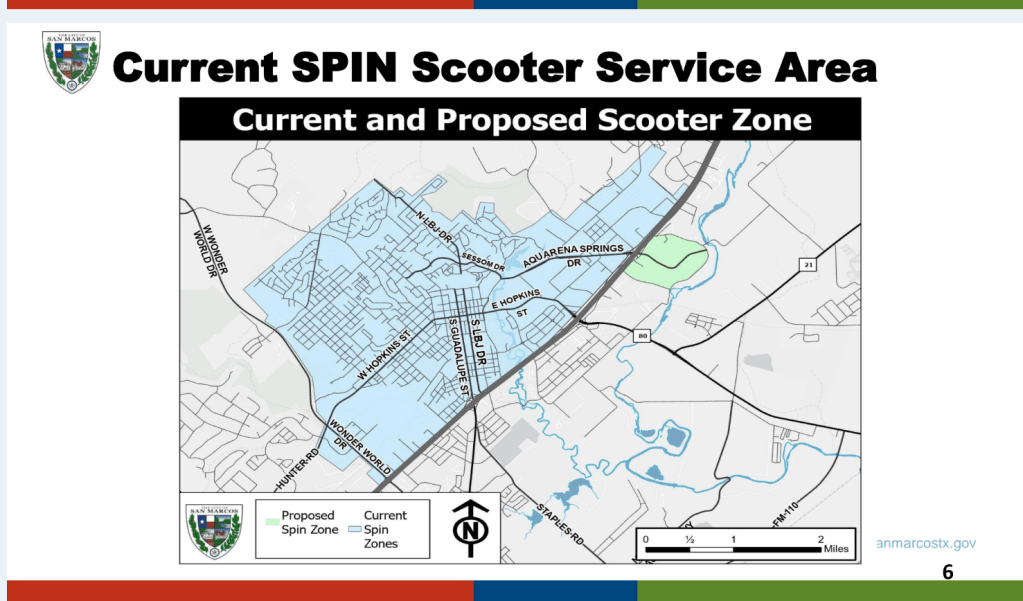
    Here’s the current boundary of where they work:

    I assume when you hit a boundary, they just deactivate, like a sad ghost who hit the wall of their haunting-perimeter.

    They max out at 15 mph, and the company has slow-zones where they max out at 10 mph.

    Overall, the program is successful!

    • They’re heavily used.
    • They’re significantly cheaper than owning a car
    • They’re better for the environment.
    • They’ve had 1 reported safety incident in 2022-2023.
    • They’re great at preventing people in wheelchairs from using the sidewalk. (Kidding. But this is my one major gripe.)

    The company is asking for a two things:

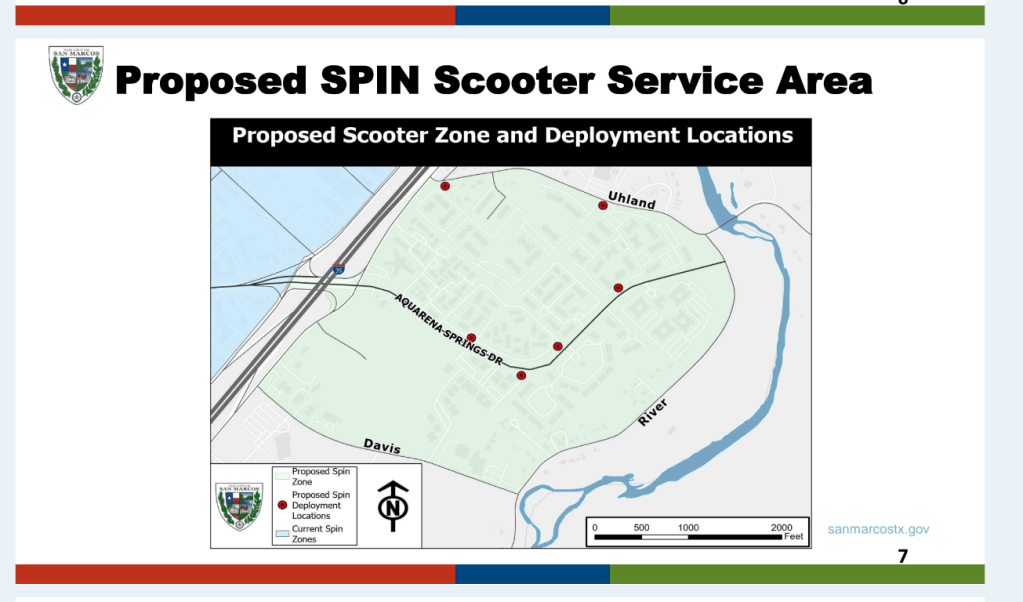
    1. Bigger service area. They want to cross I-35, at Aquarena Springs Road:

    This is a great area to include. There are tons and tons of students there, going back and forth to campus.

    The big issue is I-35, of course. (I sometimes fantasize about what it would be like if I-35 had never split this town in half.)

    Here’s what they’ll have to navigate safely:

    The intersection of Aquarena and I-35 does technically have a sidewalk path that riders can take the entire way, to navigate it.

    [Confidential to anyone who drives a car, truck or SUV: People are fragile. Please drive your 2000 lb vehicle timidly.]

    2. Their second ask is to operate 24/7.

    Right now, the scooters only work 5 am-midnight. So they’re not restricted to daylight hours, but they’re not available when the bars close at 2 am, either. But they’d like to be!

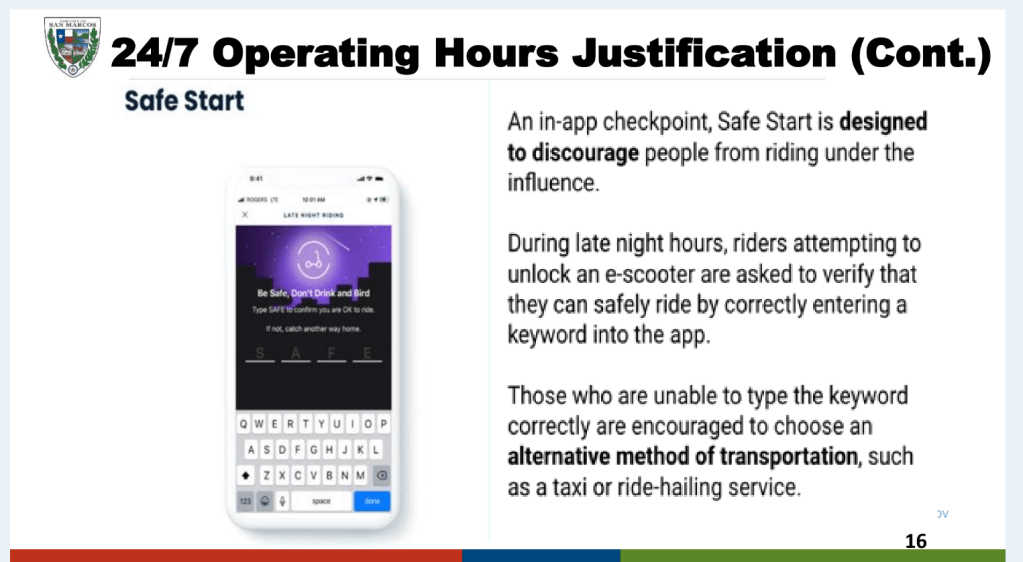
    They have some safety options to mitigate things:

    So I guess you can’t be so drunk that your vision is blurring? This seems like a low bar to clear, but at least they’re not getting behind the wheel of a car?

    They can also throttle the max speed, and cap them all at 10 mph during overnight hours.

    What does Council think?

    Jane Hughson is a little wary of the I-35 exchange, and asks if we can put up some signs or markers directing scooters to take that specific sidewalk path.

    Answer: sure.

    Mark Gleason has some reservations about I-35 as well, but is mostly enthusiastic about looping in the east side and connecting them across 35. He asks if they can extend the zone to Walmart.

    (I agree that stretching it to Walmart is a great idea.)

    Saul Gonzales asks if you can get a DUI on one of these.

    Answer: Yes you can!

    In the end, everyone’s on board with this. Also, it’s a pilot program that will come back in 6 months, so we can see how it’s doing.

    Bonus! Workshop, 3/19/24

    We get our water from a bunch of different sources:

    We’re actually in pretty good shape, because we invested in ARWA water about twenty years ago. That is water from the Carrizo-Wilcox aquifer. It took a while to get the drilling and treatment set up, but it’s about to start coming online.

    Here’s what our water supply looks like, over the next 50 years:

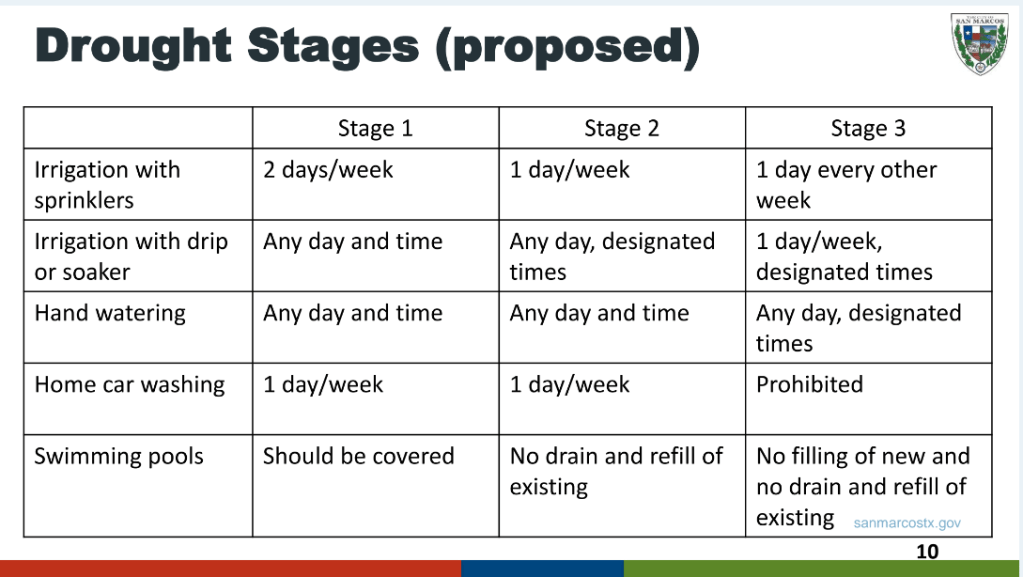
    The main point of the presentation is our drought stages: right now we have five, and life would be simpler if we only had three.

    The five:

    The three:

    Jane Hughson makes an excellent point: it used to be that Stage 2 was mild, and now Stage 2 is serious. It used to be that Stage 3 was Medium, and now Stage 3 is The Worst. It’s hard to get people to update their priors. This is going to require a high degree of messaging.

    (Nevertheless, it’s probably simpler to have 3 stages instead of 5.)

    Updated to add: Someone pointed out to me that the new proposal never bans sprinkler systems, even during the worst droughts. This seems like a bad move. Even if there’s plenty of ARWA water, it’s still resource-intensive to clean and treat it.

    But listen: we can be doing more. Johnson City held an Ugliest Lawn contest, to promote the idea that it’s okay to let your lawn turn yellow. We could have Yellow is the new Green signs, or some other sort of messaging about letting your lawn go fallow.

    Traditional green lawns are an environmental disaster, right? Let’s change the discourse around them, and give people permission to quit watering.

    City Council! Tell the water guys to include this kind of messaging, stat!

    Bonus bonus! 3 pm workshop

    Two presentations, about Green Guy Recycling and SMPD.

    Green Guy Recycling

    We’re renewing our 5 year contract with Green Guy recycling. We’ve been working with them since 2009.  

    San Marcos residents get some free drop-offs per year, because of this contract.

    Per year, you get recycling for: 

    • 24 hour drop off for common items
    • 5 passenger tires
    • 1 TV
    • 2 CRT screens
    • 2 appliances with Freon
    • 2 mattresses or box springs per year

    This costs you $1.85/month.

    They also provide a ton of long dumpsters for recyclables at Community Clean Ups throughout the year, and other things, like nuisance vehicle recycling, for the city.  It all sounds good to me.

    ….

    Police Chief report

    Congratulations! If you made it this far, you get a personal anecdote.  

    I actually come from a family of communists. Literally, Marxists on both sides of my family.  At one point in the early 2000s, I was arguing with my uncle about the 2000 election.  He did not live in the US, but he was saying he would have voted for Bush over Gore.  I was outraged.

    He explained to me why:  he felt that the entire capitalist system is so rotten that the only recourse is a revolution.  Electing Al Gore would placate everyone and delay the revolution by releasing steam, whereas electing Bush would make life worse, and thus hasten the revolution. 

    To an abolitionist, small improvements are counterproductive because they distract from the revolution. When things get worse, it lights a fire under people to fight for a revolution.

    (I still don’t agree with my uncle: I think it would have been better to elect President Gore, and I’m guessing 150,000 Iraqis might agree with me. But here we are.)

    At the same time, sometimes the abolitionists are right, and you need a revolution. This is the WEB Dubois and Booker T. Washington debate about civil rights: can you fix things incrementally? Or do you have to fight for revolution? There wasn’t really an incremental fix for Jim Crow laws – people risked life and safety to fight for the civil rights movement.

    So now we’re talking about SMPD, and there’s a split in philosophy:

    • Small improvements to police departments are good, because it improves policing.
    • Small improvements to police departments are bad, because the whole system is rotten and needs to be thrown out.  Small improvements prevent the fire from building that will motivate real change.  In other words, an abolitionist approach. 

    Here’s where I stand: I’m okay with incremental improvements to SMPD. Waiting for a revolution leaves too many vulnerable people stranded in 2024.

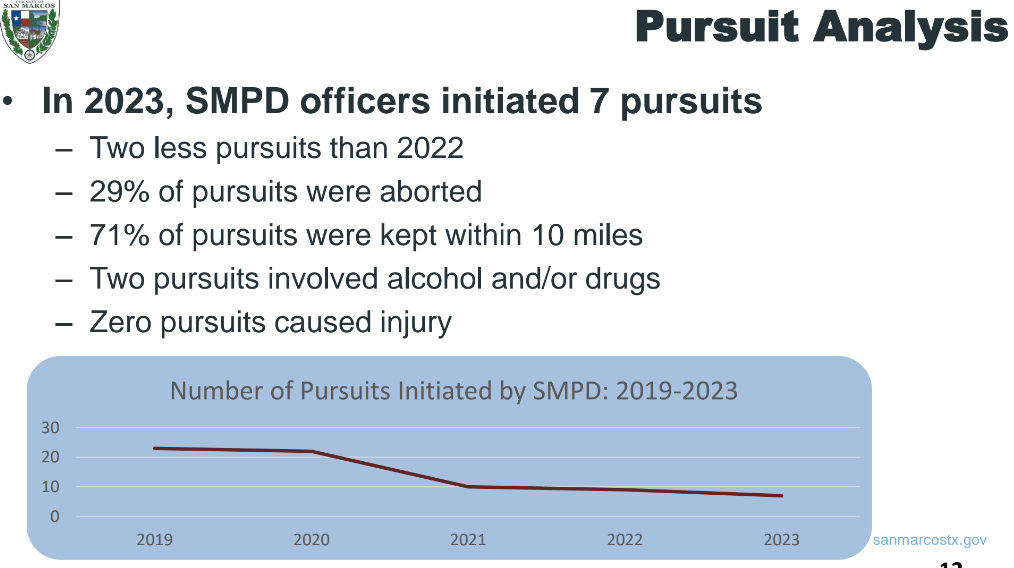
    Chief Standridge’s entire presentation is “Look at these positive incremental changes we’ve implemented, and the modest successes we’re showing!” 

    Here are Chief Standridge’s main talking points:

    • We did a huge amount of community events and outreach in 2023. 
    • We have 60 active volunteers. 
    • School marshall program for the elementary schools, officers for the middle and high schools. (bleagh, but that is a different conversation.)
    • Brought in a qualified mental health professional to respond alongside the mental health unit.  (This is good!)

    Accountability:  

    It sounds like they’re documenting and investigating any significant incident. Do I have the proper context to analyze this stuff? no, of course not.

    We hired a bunch of new people:

    Our crime stats are trending down:

    Two comments:

    1. Nationally, violent crime went down, because we’re getting further away from Covid life disruptions. But the drop in San Marcos does seem bigger than the national average.
    2. Chief Standridge says something like, “You can’t credit the police for a drop in crime, and you can’t blame the police for an increase in crime. Crime is due to complex socio-economic factors.” I give him credit for framing everything in terms of grounded evidence like this.

    There are a bunch of mental health initiatives, collaborations, and new hires made, both to support the mental health of the officers and to take a holistic approach to crime reduction in San Marcos. These are good things!

    There was one interesting question: Shane Scott asks about reserve officers.  Do we let volunteers be officers on the streets?

    Chief says diplomatically, “I’m not comfortable with that. This city is still pretty …challenging.”

    GOOD. I would be worried about George Zimmerman-style volunteers.

    Bonus! 3 pm workshop, 2/20/24

    At 3 pm, there was a workshop on the future city hall.  We’ve discussed this before, back in 2022.

    Basically, we can’t afford a new city hall, and Texas has a law that you can’t take out a bond to pay for a city hall. [Edit! I got that wrong. The law is that you have to get voter approval for a bond. City staff and city council don’t think that San Marcos voters would approve a bond for a city hall. Correction based on the 2022 presentation here.]

    So they’re left with public-private partnerships, where some private entity goes in halvsies with you. You end up building something with both government and commercial appeal.  Bleagh, but here we are.

    The first decision is location. 

    This is the leading contender on location:

    ie, across the street from the current city hall.

    This is supposed to be a mock-up of what City Hall would look like if it were in that spot:

    You’re looking at Hopkins. The old location is the lower right, and that would be converted to commercial and residential. Across Hopkins is the new City Hall, next to the retention pond. You can see the Bobcat baseball stadium in the background.

    So that’s possible location #1.

    Possible location #2 is where the current city hall is located, on the south side of Hopkins.

    Nobody says what’s wrong with the southern side of Hopkins. What they say is, “If City Hall is on the northern side of Hopkins, it will welcome everybody coming from I-35! It will form a Civic Road of City Hall, the library, and the Activity Center.”

    I guess the southern side is less welcoming because of how Hopkins bends? You’d think a big, snazzy, new building would feel big and snazzy on either side of the road, but I guess it’ll feel extra big and snazzy on the northern side.

    Possible location #3 is somewhere downtown. The appeal of this is to bring back some daytime workers back to downtown. When Hays County Courthouse moved out to Wonderworld, the downtown lost a ton of people who would eat lunch at the restaurants and keep the downtown bustling during the day. It would be hard to pull off, though – we only own a tiny bit of land, and it would be pricey to acquire more.

    ….

    Laurie Moyer is one of the assistant city managers, and she gave an extremely charming presentation about her Christmas vacation, which was spent driving all over Texas, observing the City Halls in comparable cities.

    For example:

    and then, her personal photo:

    I was delighted by the whole thing. You should watch it here, if this is also your brand of nerdiness.

    Bottom line: All these cities had city halls built in the past 20 years, and ours is 50 years old. The whole process will move extremely slowly, but we’re going to hire a consultant and get the ball rolling.

    Bonus! 3 pm Workshop, 1/30/24

    All about short term rentals!  (STRs)

    We are updating our rules about AirBnB type places. We used to require that they be:

    • Permitted in some places, but not others.
    • Owner-occupied (where a permit was required)
    • Parties were prohibited

    Somehow in Executive Session, they decided that “owner-occupied” was no longer okay, so we’re trying to find workarounds.  Also, a court ruled that you can’t prohibit parties. 

    So now:

    • All STRs would need a permit. 
    • Owners can only have one STR.
    • Only one STR on a block, or at least 600 ft apart.
    • Short-term tenants can have parties, but not excessively noisy ones, just like any other resident.
    • Everyone who lives within 400’ gets a postcard with a hotline number to call if you’re having any trouble.

    So on that last point, we’re paying Granicus to be a hotline for us.  They’ll do a bunch of things:

    • Watch the websites for any unregistered STRs.
    • Staff the hotline, 24/7.  
    • If you call the hotline, they’ll track down the contact person for the STR and tell them there’s a problem. If they can’t get ahold of the contact person, they’ll reach out to SMPD. 
    • They’ll keep a running list of which properties are having recurring problems. 

    If an owner keeps renting to people that cause problems, the owner can have their license suspended or revoked.

    This hotline will get paid for out of STR permit fees. 

    So there you have it. Staff will write all this up, and it will come before council in a regular meeting at some point.

    Bonus! 3 pm Workshops, 1/16/24

    The Can Ban: let’s hammer out some of the details.

    First, Texas State has agreed to put can-ban rules in Sewell Park that match whatever the city comes up with for the River Parks. So that’s good!

    Next, there was a long bit on enforcement, by the City Marshal’s office. The City Marshal’s office has two sergeants, eight marshals, and two part-time park rangers. It was basically a big pitch on why we need to hire more marshals.

    Here’s the main differences between marshals and park rangers:

    • Marshals can arrest people, park rangers can just give minor citations.
    • Marshals are hired fulltime, park rangers are just hired for the summer.  During the off-peak months (ie during the school year), marshals help out SMPD.
    • Marshals wear blue uniforms and look like cops, park rangers wear green uniforms and look like nerds.  (Kidding! Sorry!)

    That last point is the most important one: Marshals wear blue, rangers wear green. 

    So when it comes to the can ban, why do we need more Blue, instead of more Green? Here’s what it says on the slide:

    Park rangers writing citations isn’t enough? We need law enforcement officers who can arrest people? This is ludicrous.

    Alyssa asks if we could hire more park rangers, instead of marshals. She points out that we’re not planning on enforcing the can ban via arrests.

    The answer given is that it’s very hard to hire park rangers, because they’re part time. 

    Surely the city can invent some sort of, idk, FULL TIME park ranger? If we are interested in finding ways not to over-police this town, we’d reach for Green Uniforms over Blue Uniforms when they’re equally qualified to do the job at hand.

    Here’s the plain truth: the City Marshal’s office already wanted more marshals hired. (They said this explicitly.) They are using the can ban as an opportunity to lobby for the marshals they already wanted. It just rings a little phony to pretend that a can ban is a dangerous crisis that can only be solved with more cops.

    Mark Gleason feels very strongly in favor of hiring more marshals, regardless of whether or not we pass the can ban. The whole presentation pulled at his heartstrings.

    ….

    A few decision points for Council:

    1.  Should it be a ban on single-use beverages, or all single-use containers?

    The consensus is just beverages.  I’m okay with this.  

    1. Should it be on the river alone, or only in the parks, or should it be both river and parks?

    Everyone thinks it must include the river.

    One possibility is “go zones and no zones” – little carved out areas where you may have single-use beverages, like inside the playground at the children’s park, or inside the fence of the baseball fields, at the pool, or at picnic tables set back from the river.  Everyone is open to the idea of go-zones/no-zones.

    Coolers: should we limit cooler size?

    No, we shouldn’t. Next question!!

    Why would you even? New Braunfels limits cooler size, because they’ve got a tight exit on the river, and giant coolers cause tubing traffic jams. But that’s not our situation. We’ve got large multi-generational families holding large picnics. Are we really going to make Mom/Dad/Aunt/Uncle/Grandma each bring their individual cooler? That seems dumb as shit.

    What does council think?

    Jane Hughson: This is just another thing to enforce. But why does anyone need a giant cooler?

    (See, she’s missing the bit about large groups bringing one big cooler.)

    Mark Gleason: Yes on limiting cooler size. 30 quart limit for both river and the parks.

    He means this:

    So you are not going to be able to bring your big tray of shredded pork for sandwiches, or your tub of potato salad, or much of anything. 

    Seriously: this is more about shutting down big family gatherings than about controlling litter. Maybe Council doesn’t intend that, but that’s the effect. It’s kinda racist and classist because the river parks are a free way to have large, inter-generational family gatherings.

    Matthew Mendoza: 30 quarts on the river, no restrictions for coolers in the parks.

    (I’d be okay with that.)

    Alyssa Garza: No restrictions anywhere.

    (and this.)

    Saul Gonzales: 30 quarts in both the river and the parks.

    Jane Hughson: If we say 1 cooler per person, can two people bring a 60 quart cooler?

    No one answers.

    Jane: Okay, I’ll say 30 quarts in both river and parks, too.

    So there you have it: 3-2 for banning big coolers, both in the river and in the parks. (Shane Scott and Jude Prather are both absent.)

    Note: the amendment that Alyssa or Matt should offer is to tag coolers to the “go zones”. In go-zones, you can have your big cooler. In no-zones, you can’t.

    What about jello shots?

    The way New Braunfels banned jello shots was by banning containers that hold less than 5 oz.

    Everyone likes this, besides Alyssa, who says she needs to go talk to her constituents.

    My two cents: sure, ban the jello shots and mini-liquor bottles. These seem like single use beverage containers to me, anyway. 

    When should this go into effect?

    Everyone wants to aim for this summer, instead of waiting for 2025. 

    The next step is for staff to write up a proposed policy, and bring it to city council for a vote.

    WE’RE DOING THIS! STAY TUNED!