This came up before here. Now we’re workshopping it.
The basic idea is that tenants should be able to meet up and talk about their landlord, or their living conditions, without fear of getting evicted.
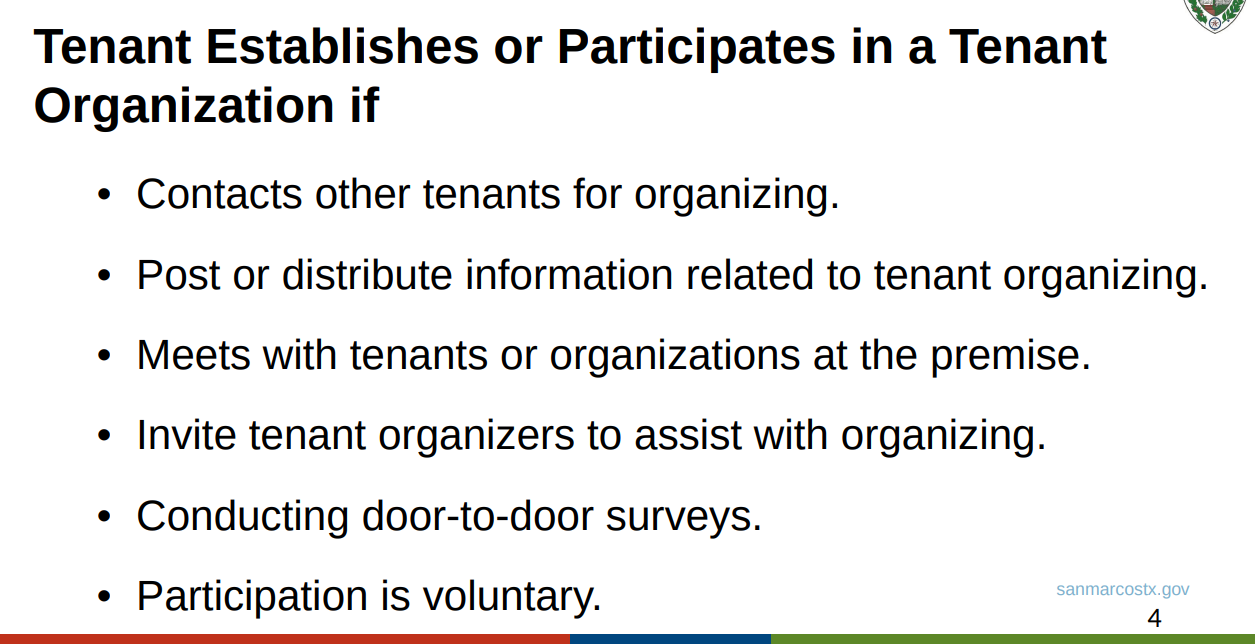
This is the type of behavior that is protected:
Great!
And here’s the type of thing a Landlord is not allowed to do:
Sounds reasonable.
On the other hand, landlords also have some rights:
Seems reasonable.
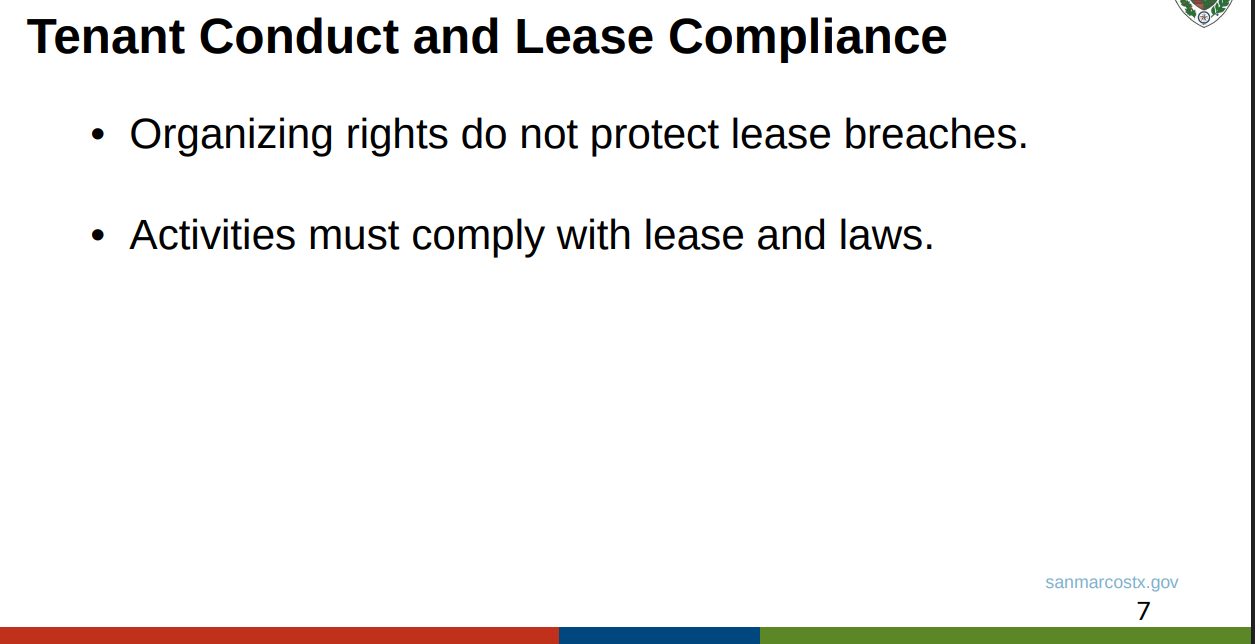
Finally, you still have to abide by your lease.
….
My main question is about Rent-By-the Bedroom. We had a fantastic presentation on these, last year.
RBB complexes skirt rules by avoiding certain legal terms. Tenants don’t sign a “lease”, they sign an “installment contract”. So a lot of laws about tenants and landlords don’t apply to them.
Since that’s their game – swap out magic words to avoid legal status – we need to make very sure that our language is broad enough to include them.
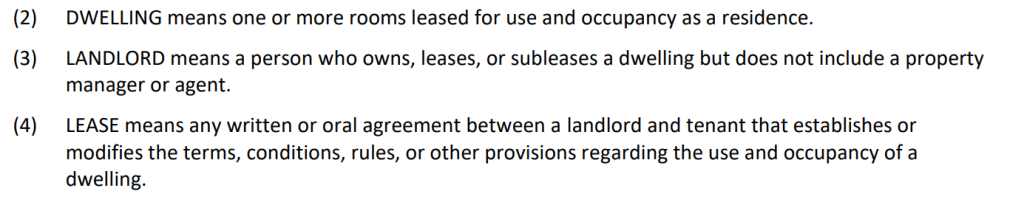
I’m looking at the definitions section from the proposal:
“Dwelling” and “landlord” don’t seem broad enough to include “Installment Contracts”.
(Also: the definition of “Lease” uses the word “Landlord”, and the definition of “Landlord” uses the word “Lease” so things are getting circular here.)
Other than that, this is a great step forward!
…..
Workshop #2: SMPD Vehicle rental policy:
This has also been in the works – literally for years. Here’s where they’re landing:
Great!
….
Workshop #3: Update to the Airport Master Plan:
We have an Airport Master Plan that was approved in 2021.
(Honestly, I’m kind of guessing what they said, based on the slides. I was distracted. Sorry about that!)
This runway is going to get a glow up:
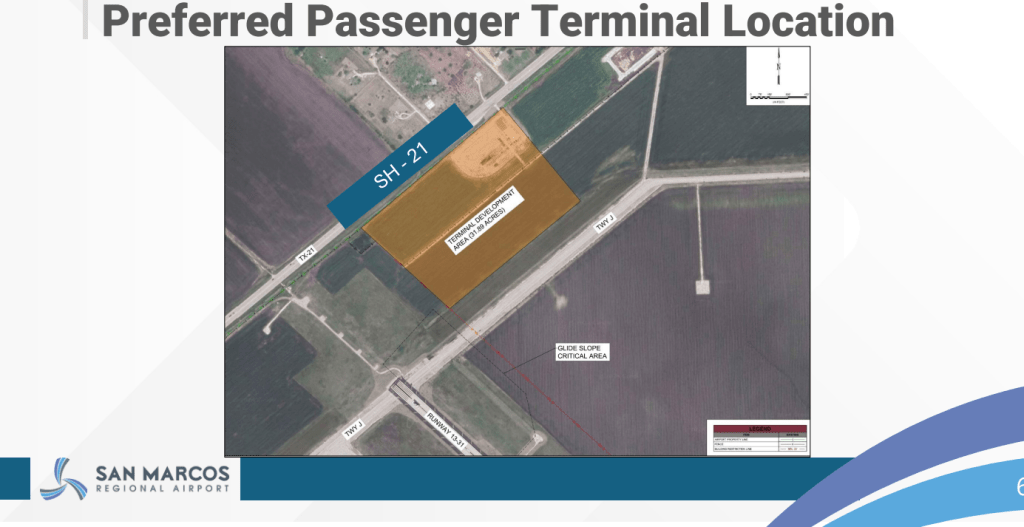
And it sounds like there will some day be a passenger terminal out front:
This will come around for approval during a regular council meeting.
We get money from property taxes and sales taxes. In San Marcos, we’re split pretty much 50-50 between the two:
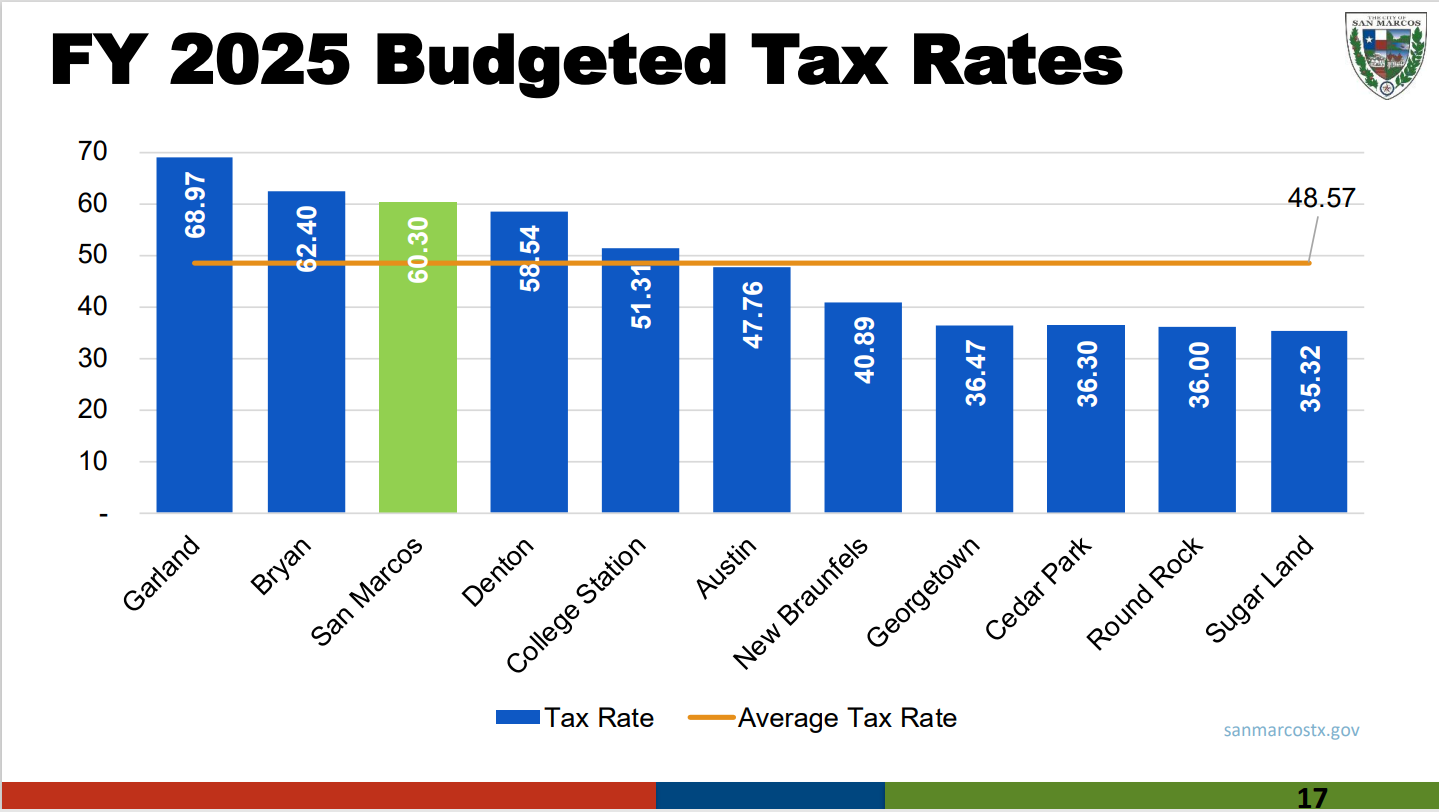
Our property tax rate is on the higher side:
but there are some reasons for that. For example, we have a lot of tax-exempt property:
particularly because of the university. You can also see Gary Job Corp on that map.
(I always love it when I-35 is drawn East-West.)
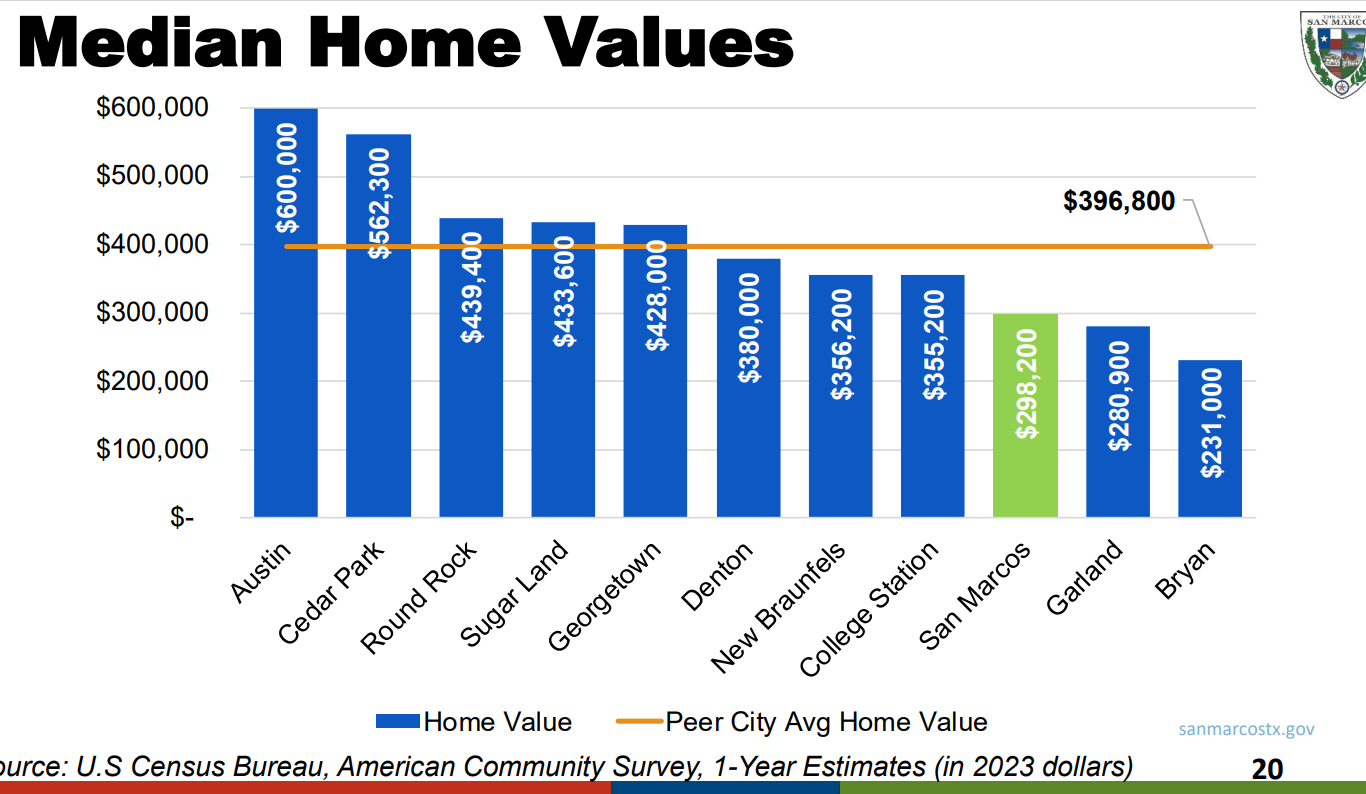
and also because our houses are less expensive on average:
and so we struggle to pull in enough revenue.
So altogether, here’s what an average person pays in property taxes:
Now if you’re a homeowner, your property taxes also include schools, county, and special roads district. So it’s actually significantly higher than that. That’s just the part that goes to the city.
Here’s how we’re doing on property taxes:
Sales tax dropped in 2024, and it sent our budget into a bit of a tailspin. But it’s working its way back up.
Here’s how much the city spends on each person, on average:
hey, that’s a bargain! $4610 worth of services for only $1798. That’s a better ROI than you’ll get from the stock market.
The state legislature is always trying to make everything harder on the cities:
because they are counterproductive twats.
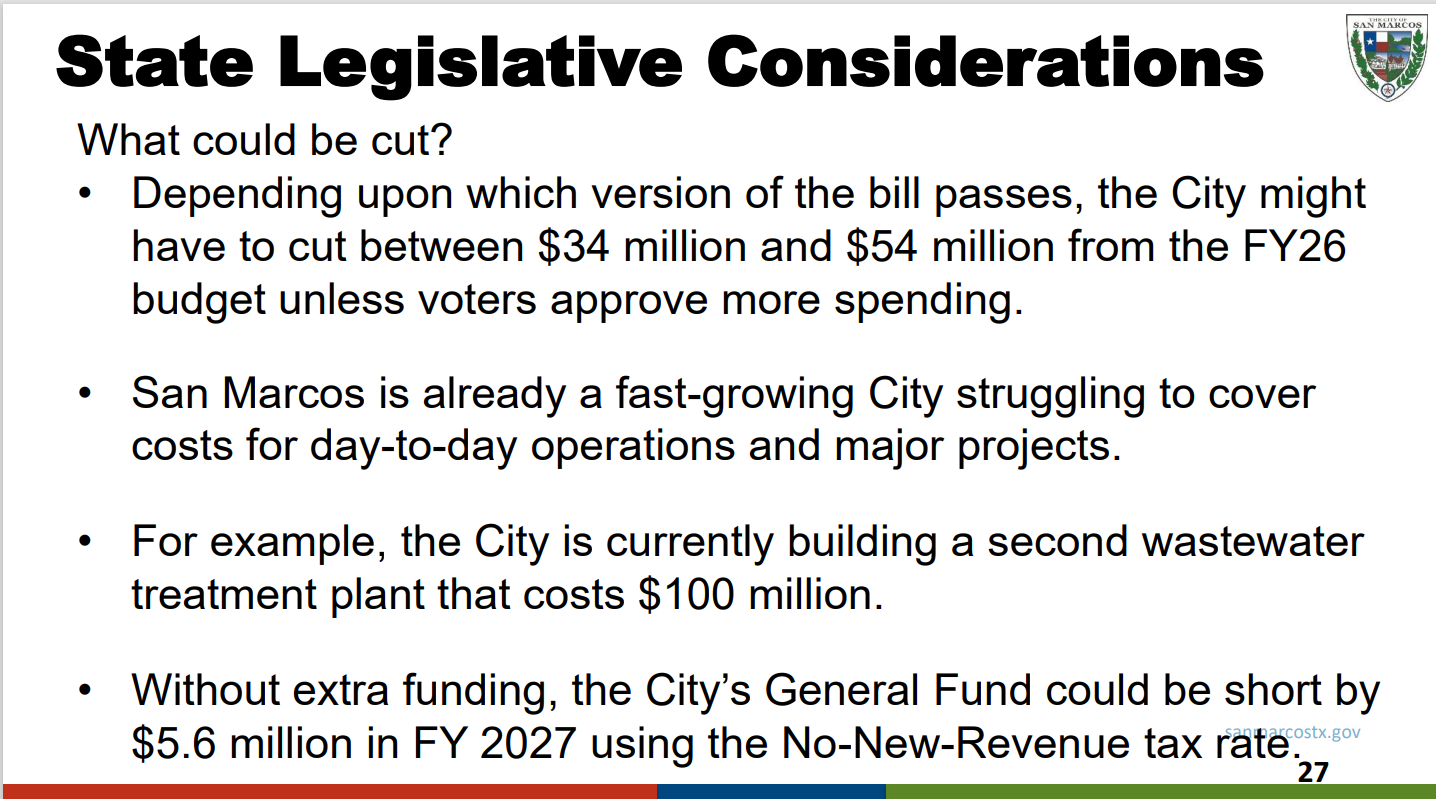
Here’s how it might affect San Marcos:
…
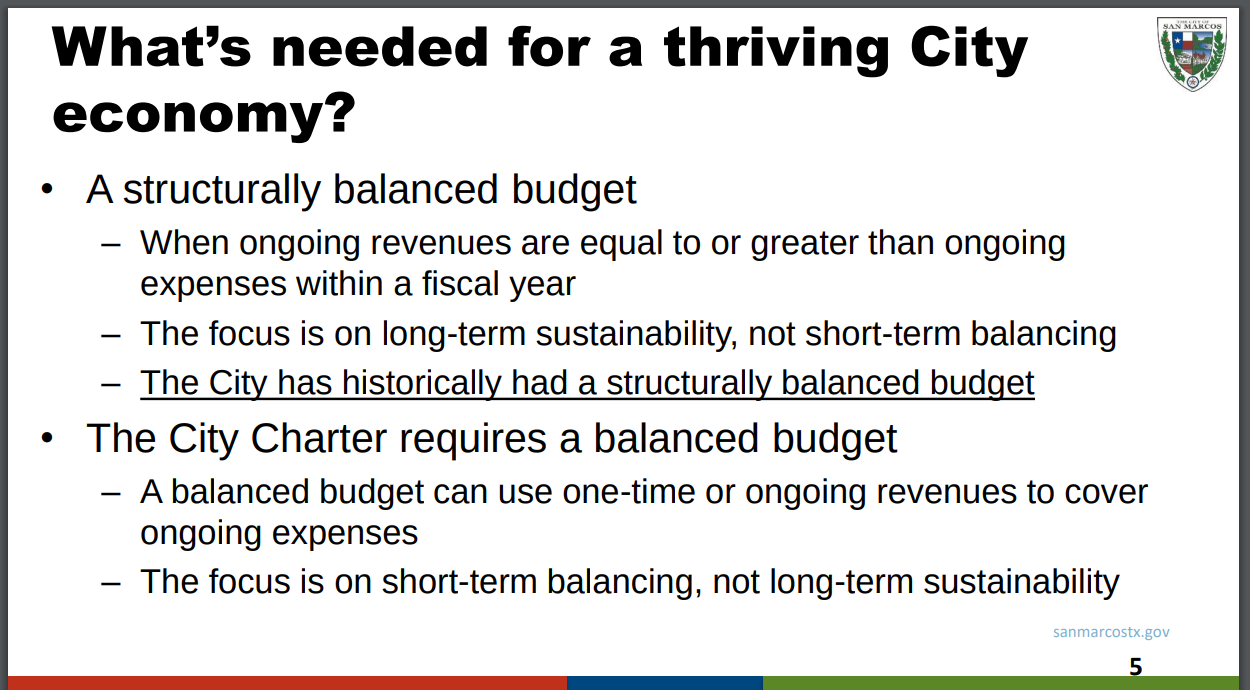
Basically, we’re in a bind. Here’s two slides describing how we’re caught between a rock and a hard place:
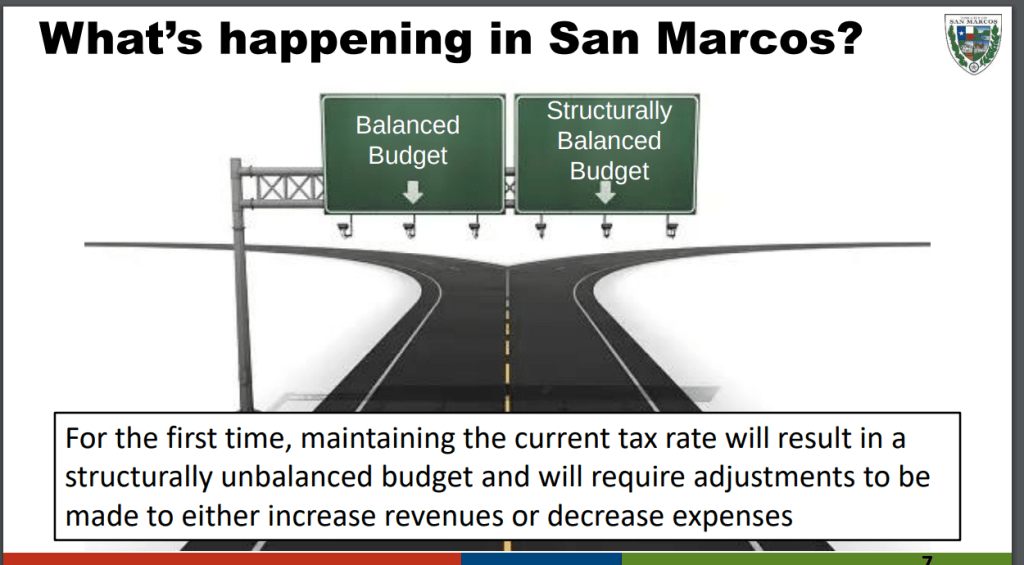
and
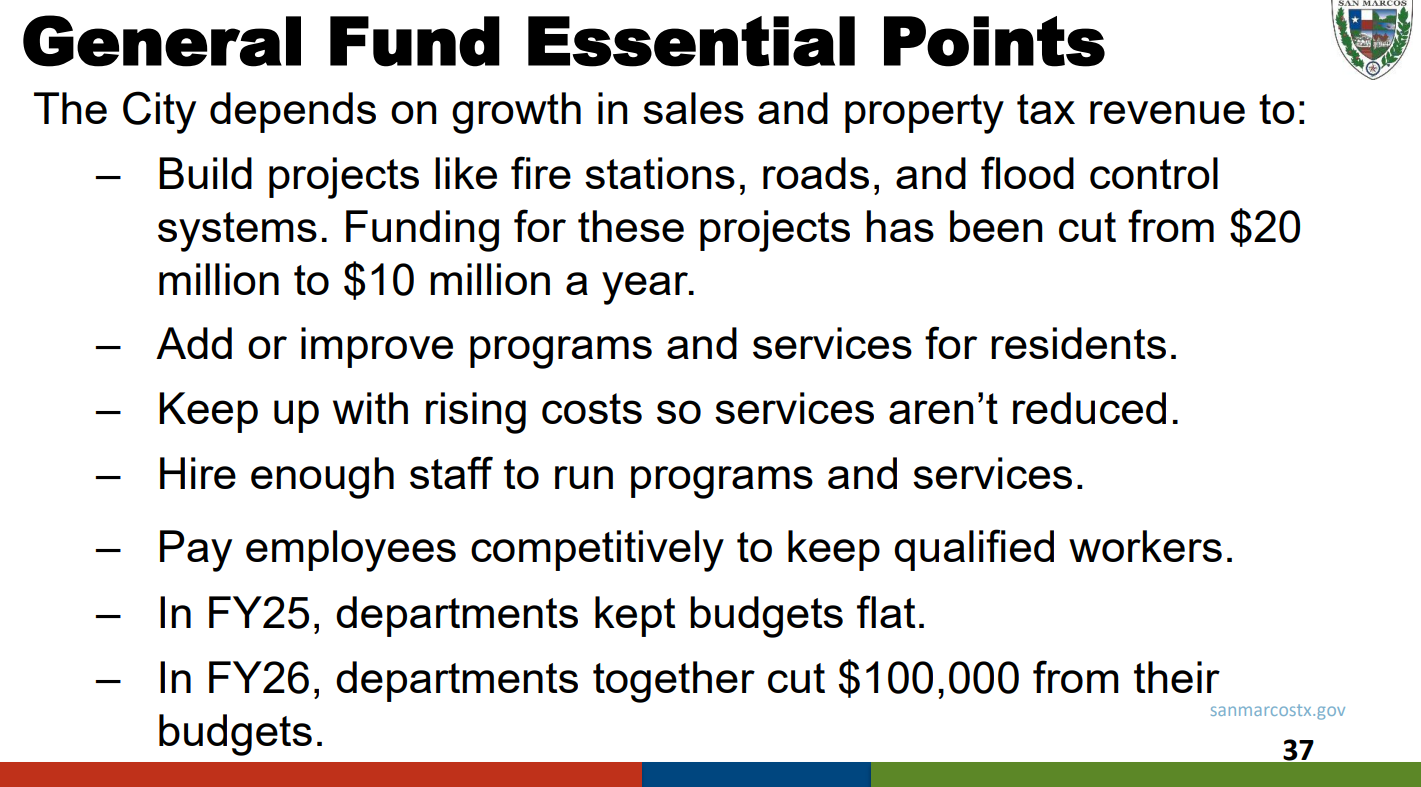
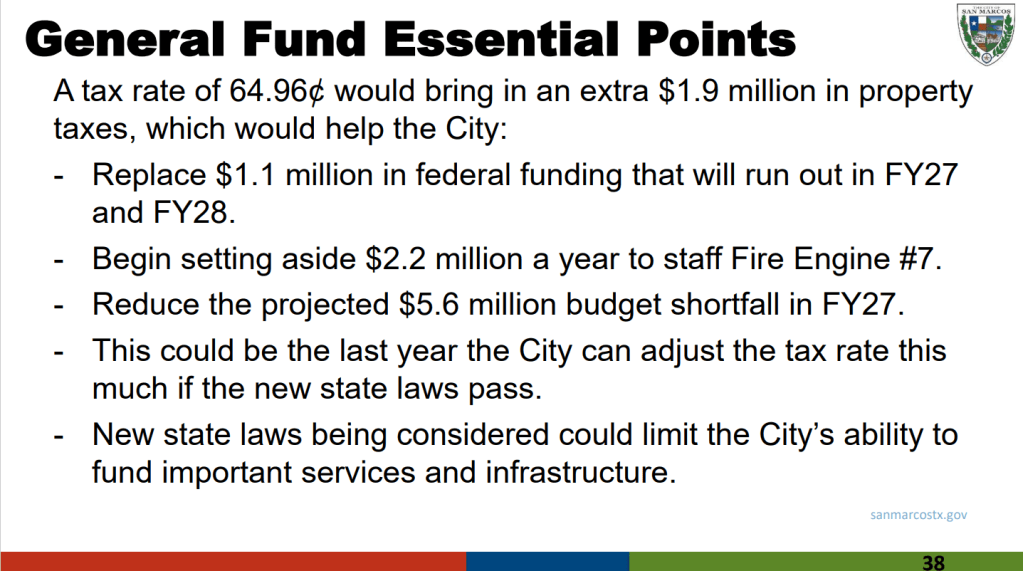
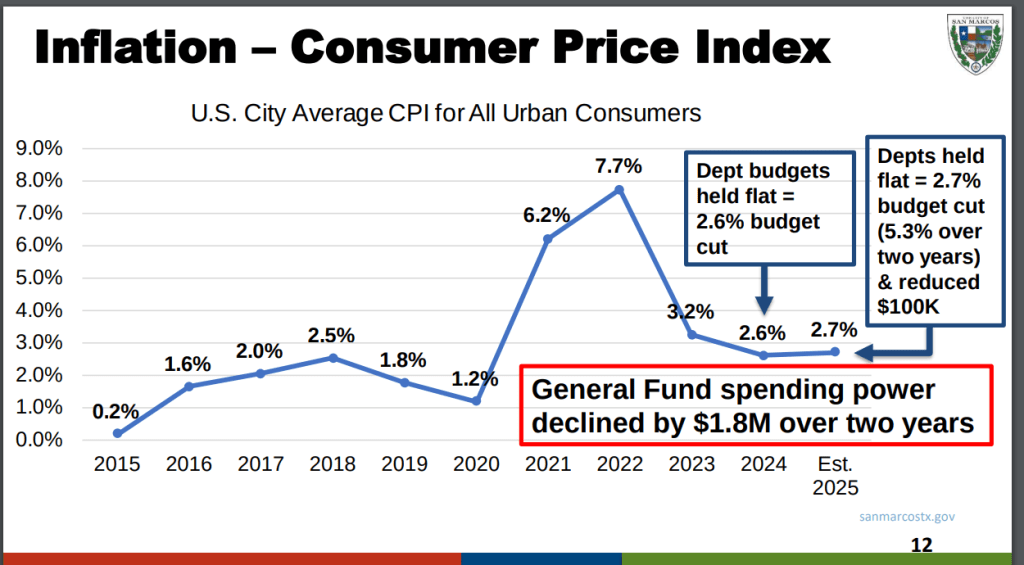
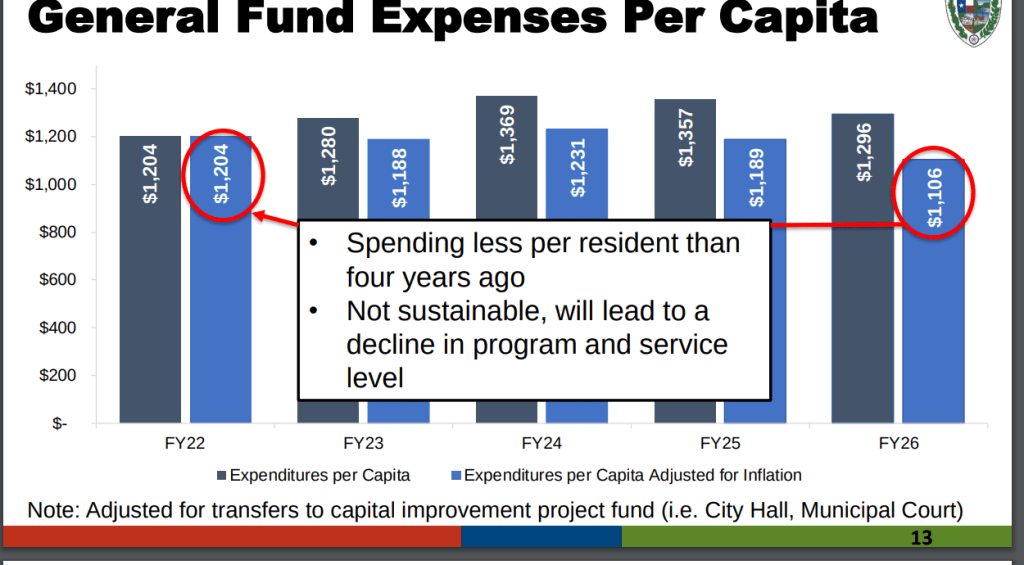
Especially notice those last two bullets. The city is growing and inflation has been a big thing, and yet budgets have gotten leaner. This is not sustainable.
This brings us up to the current scenario. Council has a few choices:
The first one is the “No-New-Revenue” rate. If the property tax rate is 62.78¢, the average home owner will pay the same amount they paid last year.
In this case, we can skate by this year, and we’d be in the hole next year.
The next one is the Long-Term Focused Tax Rate, 64.96¢. This helps us keep up with inflation and growing expenses, over a longer term.
The last one is the Voter-Approval tax rate, 70.47¢. They’d never go for this, but in theory it would bring in a lot of money. Anything above 70.47¢ requires voter approval at the ballot box.
[Note: The (3,000,000) isn’t what it looks like. That’s balanced out by the “Fund balance in excess of 25%” line above.]
So what would we do, if we did the middle column of 64.96¢?
It helps plan for some financial cliffs that are looming.
…
Here’s these three tax rates, again:
The middle column buys us an extra year to plan for the looming financial cliffs. (The rate in the third column ends up lasting until 2028, and then we go to the red.)
…
You can probably see why that $9 million from the data center looks so helpful. 😦
…
What does Council think?
Matthew: I’m going with the ¢64.96 rate. Saul: Same. ¢64.96
Lorenzo: If we go with the middle rate, will we be up this same creek without a paddle next year? Answer: Somewhat. The state legislature may hamstring us, yes.
Lorenzo: How does tax rates translate into revenue? Answer: Every penny brings in about $800K.
Lorenzo: I want to pick a number that heads off a projected shortfall in 2027. So I think roughly ¢67-68.
Jane: How would we prioritize cuts? Answer: It starts getting into staff, because we’re already so lean. That’s a very hard question.
Alyssa: I don’t know.. I don’t have enough information. I’m willing to lean towards the middle, but I need to know more about how we’d use that extra $1.9 million. Answer: Council can prioritize how we use it. Alyssa: Then I can go with the ¢64.96.
Amanda: The legislative damage is highly likely to pass this session. Originally I was thinking ¢64.96, but I’m open to Lorenzo’s point about the ¢68. I want to take care of our employees, and making sure we’re keeping up there.
Jane: I want to see the impact on the average voter.
Amanda: Is it possible to see the impact on the average renter, as well?
Jane: I’m comfortable with the ¢64.96. And if the state school tax exemption passes in November, I can go a little higher.
They all want to see the impact on the average tax bill. How much would these new rates increase the tax bill?
…
They also discuss utility rates and other things. The Citizens Utility Advisory Board is recommending a 4% increase in electric rates.
This is slightly less of an increase than last year. Everyone’s goal is to make slow, smooth, steady increases, because otherwise after a few years, you have to make a giant leap in rate increases. That’s much worse
Commercial rates are a little higher:
Similar for the water/wastewater rates, trash, and community enhancement.
Here’s how all these increases will impact your monthly bill:
…
I’m returning to the end of the regular meeting, now. In Item 19, city staff returned with the answers to some of the questions above.
How would these different property tax rates affect someone’s property tax bill?
2. A list of possible things Council could fund with the extra money. (I couldn’t get a clear screenshot of this, though.)
Everyone has to weigh in with their max tax rate. 67.69¢: Alyssa, Matthew, Saul, Jane 68.17¢: Shane, Lorenzo, (but not committing. Just to give wiggle room), Amanda (same)
So! 67.69¢ is the upper bound this year for the tax rate.
Back in 2022, the city put out a community survey, to find out how happy people are with life in San Marcos and with city services. Now it’s time for the 2025 follow-up survey.
This workshop was mostly about tinkering with the five freebie questions that the city gets to individualize. It was pretty mundane, so I didn’t bother to write it up.
Keep an eye out for the survey over the next few months! And share it with people who don’t generally respond to city surveys.
…
Workshop 2: Utility late fees and reconnection fees.
This has been a discussion for the past year, most recently here. Bascially, there was a lot of money available to help people pay their utility bills, but very little of it was getting spent on people who needed help. They’ve (hopefully) fixed that by making the application form much shorter and easier.
The second issue was late fees and reconnection fees. If you already can’t pay, do we really need to charge you more as punishment? The Citizens Utility Advisory Board (CUAB) is bringing back recommendations on what we could change.
There are two main questions:
How much of a penalty do we want to charge people, once their bill is overdue?
How much does it cost the city to disconnect and reconnect someone’s water/gas/electricity?
Penalty:
We used to charge a 10% late fee. CUAB is recommending a 5% late fee.
Disconnect/reconnect:
Here we’re just trying to cover our costs. It’s not a punishment. Back in 2014, we set $40 as the fee. In 2025, it now costs $95 to reconnect the utilities.
The problem is that if you decrease the late fee by 5% and then increase the reconnection fee by $55, they kind of cancel each other out:
So Council is a little bummed out over this.
Jane: Can people get late fees and reconnection fees paid for by the Utility assistance program? Answer: Just late fees, but not reconnection fees.
Jane: That was an oversight. I wish we’d talked that out when we were dealing with utility assistance.
…
They end up going in circles for awhile – should they send it back to CUAB? Should they split out water from electricity? Should they subsidize disconnection/reconnection fees? What if the state passes restrictions affecting late fees?
In the end, they decide to accept the proposal for now, and also reduce the water disconnection fee to $40. This will come back around for final approval during a council meeting.
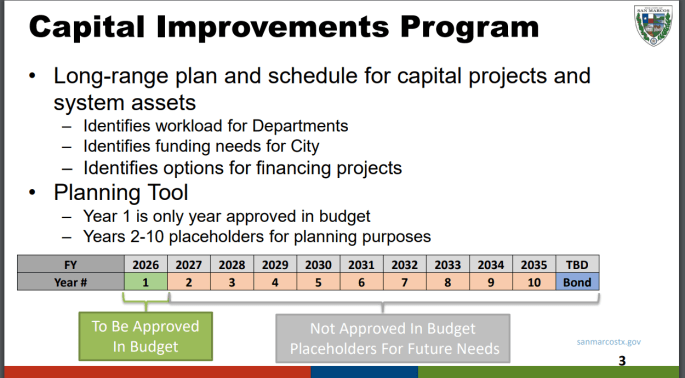
CIP stands for Capital Improvement Plan. These are all the big city projects – like, more than $100K – where you have to cover them with a bond and they span multiple years.
There’s basically a fuzzy 10 year plan, a better 5 year plan, a focused 3 year plan, and then an actual budget for the next year.
There are quick easy projects, long difficult projects, and some that are mid:
Loosely speaking, these are the categories for the projects:
Look, here’s some nice photos of projects that have gone great!
woo-hoo!
Here’s some of the bigger upcoming projects:
The hard part is wading through the hundreds of projects, and figuring out what you think about them. That’s what Council has to do.
So what does Council think about them? Not much! They’re eager to get to Workshop #2.
…
Workshop #2: SMPD Vehicles
How do police vehicles work when officers are off-duty? How much wear-and-tear gets put on them? What about when the officer picks up a second job?
Basically, we’ve been letting officers take their vehicles home since 1983:
…
What’s the benefit of letting police officers take their vehicles home?
I found the slides confusing, so I’m just going to summarize Chief Standridge’s arguments:
1. “If it ain’t broke, don’t fix it!” We’ve had a drop in crime since Covid, so don’t meddle with things that work.
2. 79 of SMPD employees are on-call sometimes, so it makes sense for them to have a vehicle at home. Otherwise they’d have to re-route to the station, check out a car, and go from there, which is a big delay.
Officers are supposed to keep their radios on, when they’re driving to or from work. He gives a lot of examples of cops that respond to calls nearby, when they happen to be commuting home.
3. Financial considerations:
a. If we tried to park all the vehicles in our lot, we’d run out of parking lot space at the station.
b. If we had cars in use 24 hours a day, we’d have to replace them every 3 years, instead of every 5 years, because they’d wear out more quickly. (This is kind of silly. The force is driving the same number of hours either way. Replace one car after 3 years, or replace two cars every 6 years – you aren’t changing anything.)
c. This slide:
I’ll definitely give the Chief this point. Having vehicles spread out over town is good when the station gets flooded in, which happens semi-frequently.
4. So much time would be wasted checking vehicles in and out. It would take an officer 30 minutes to do a check-out vehicle inspection, and then 30 minutes to do another check-in vehicle inspection at the end! That extra hour would add up to $25,000 in hourly pay per year.
(This one also seemed silly. Maybe check with the Parks Department or Maintenance Department, and see how they manage to make it work.)
5. Officers are a little kinder to the vehicle if they know they’re stuck with it for five years, instead of getting rid of it after each shift.
This one is easy to believe.
…
Chief Standridge never answers the main question: Is this cost-neutral? On the whole, if you compare a take-home fleet vs an on-site fleet, how does the total cost compare?
Here’s what I personally care about: Is this policy similar to the kind of frugality we expect from other departments? Are we keeping SMPD as lean as we keep Parks & Rec, or the library, or maintenance, or anyone else?
We never really got an answer to that, either.
….
Part 2, same workshop: SMPD Vehicles being used when cops have second jobs.
This is what Council cares about more. How much wear-and-tear is getting put on the vehicles when officers go on second jobs? Like SMCISD hires them to work a basketball game, or Amazon hires them to direct traffic? What about the wear and tear on the cars that occurs then?
This is pretty common:
The problem is the jobs that need the cop to keep his vehicle on and idling. For example, you get hired to direct traffic at Amazon. That ages a vehicle, and means that SMPD has to replace the car sooner.
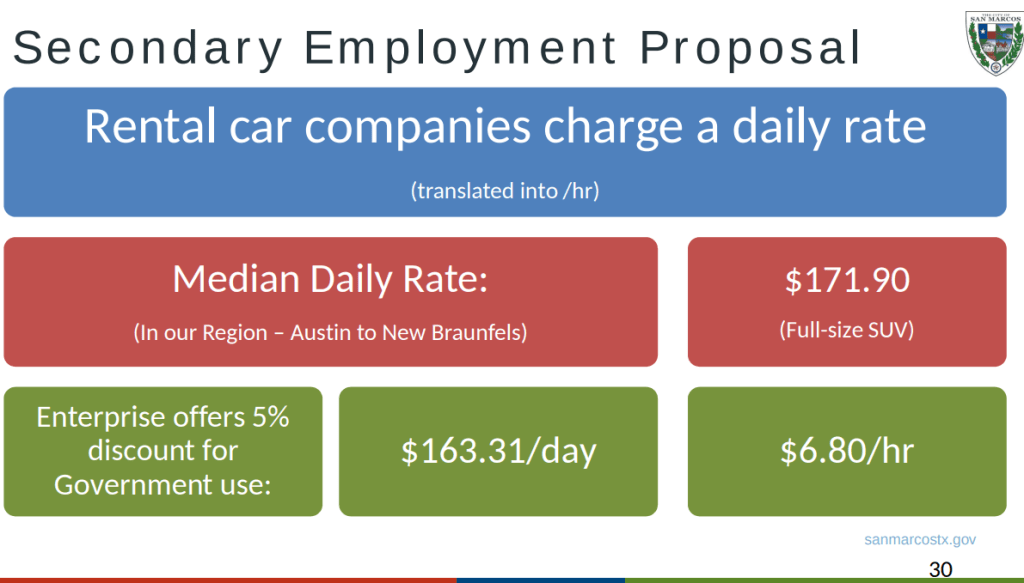
So they’re going to charge officers a little rental fee:
They figured that a rental car company would charge them $163 for 24 hours, so that works out to $6.80 per hour.
Here’s what we’re going to do:
Council is fine with this. They’re going to draw up a formal policy and go from there.
My two cents: Two hours of discussion was way too much for this topic. I lost interest in the finer details of which officer stops for an iced tea on the way to HEB or whatever.
Just three speakers. Two in favor of fencing off the river and making people enter through managed entry points.
San Marcos River Foundation Director (Virginia Parker): Last weekend, the river was busier than it ever was last year. Water quality is terrible. Lots of glass and styrofoam and trash. Swimmers get stuck under tubes. It’s dangerous. Residents don’t want to go on the summer weekends, but we’re the ones who pay. Monday’s clean up was worse than any clean up last year. In favor of managed access.
Board member of Eyes of the San Marcos River. In favor of managed access. Clean up does not suffice. You must protect the river. Monday morning clean up was astonishing. Piles of glass bottles in water. Cypress trees stuffed full of cans. Trashed tubes everywhere.
One speaker on the AI Data Center:
3. The data center is going to be built, either way! Your choice is this: is the data center going to be in the city – regulated and taxed – or the county – unregulated, untaxed? It’s not bitcoin mining, it’s LEED Certified!
Workshop 1: Fiscal Budget Bad News
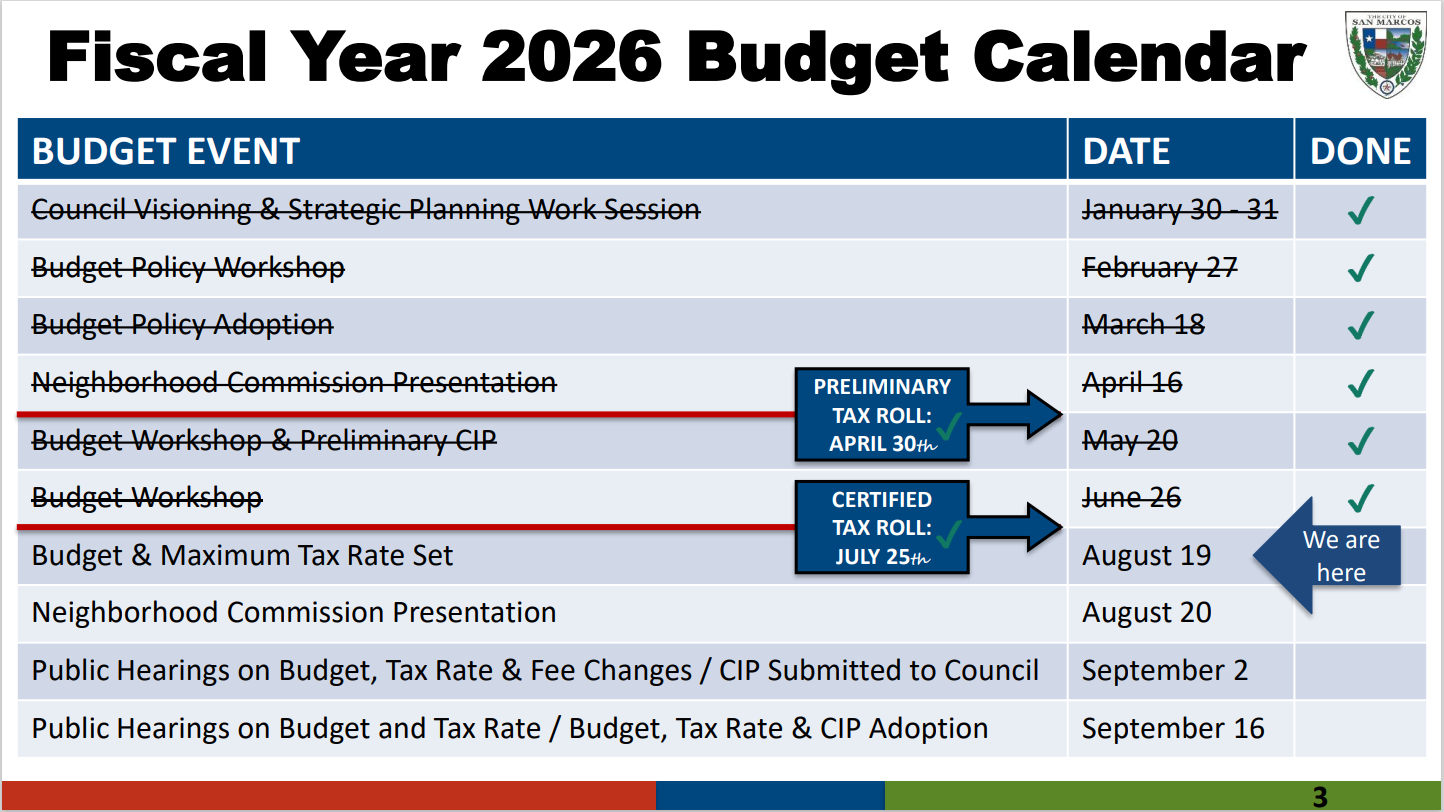
Council starts planning the budget in January, and passes the budget at the end of September. Here’s where we are in the process:
So we’re starting to get our tax revenue estimates, but we don’t know for sure how much we’ll get until the end of July.
Ok… this sounds worrisome…
Ruh-roh, Shaggy.
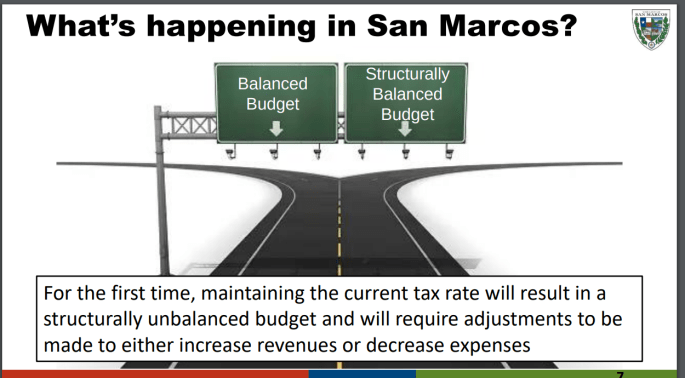
So basically, our budget is has a big gash in it? We can balance the budget with a bandaid, or we can stitch it up and balance the budget responsibly.
One hurts a lot more, but leaves us in better shape longterm. Yikes.
Good lord. It is not a good sign when your city staff is putting melodramatic visuals like this in your slide show.
…
So why is this happening?!
Ok, so property values are falling from their post-Covid peak. This is good in some ways – it’s getting a little more affordable to live here! But it does mean that the city gets less property tax income.
Next, we didn’t build as much this past year, so we’re not adding as many new properties to the tax roll as we have in the past. Also sales tax is down, and inflation is up.
And yet, we keep growing:
Our budget stayed flat while inflation took a bite out of everything:
Amanda: Did all departments hold their budgets flat? Answer: there were some exceptions last year, due to existing contracts, but no exceptions this year. All departments held flat this year.
Mid-year, the city reduced spending by $100K, across all departments.
Alyssa: How did you all reduce $100K? Answer: They looked at the unspent budgets over the past three years, and used that to proportionally allocate the cuts.
These are not one-time cuts – they’re permanent cuts. But departments are allowed to make requests for reinstatements.
So we have less money to spend per resident:
…
Some details on the tax revenue
We get both sales tax and property tax. Let’s take these one at a time:
This chart is a little complicated. Each of those numbers is its own computation. So you see where it says “December 24, -2.3%”? What that means is that they added up the twelve months in all of 2023, and added up all twelve months in 2024, and found that the 2024 year was 2.3% less than the 2023 year.
Some cities are up, some are down:
Here’s who does the most business in town, and hence pays the most sales tax:
And here’s how much different industries have tanked recently:
Dang.
Onto property taxes:
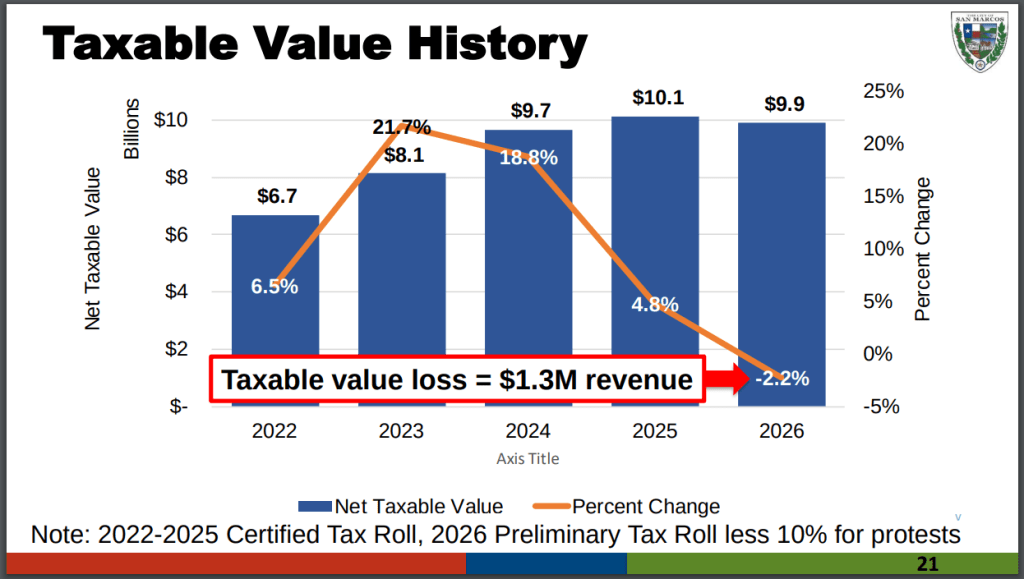
(This isn’t the clearest visual aid, perhaps? I’d probably separate the orange line and the blue bars into two separate graphs.)
Basically, the total property values increased a lot from 2022 to 2023. Then they started slowing down from 2023 to 2024 and 2025. And now, heading into 2026, they’re going backwards.
This is a big bummer.
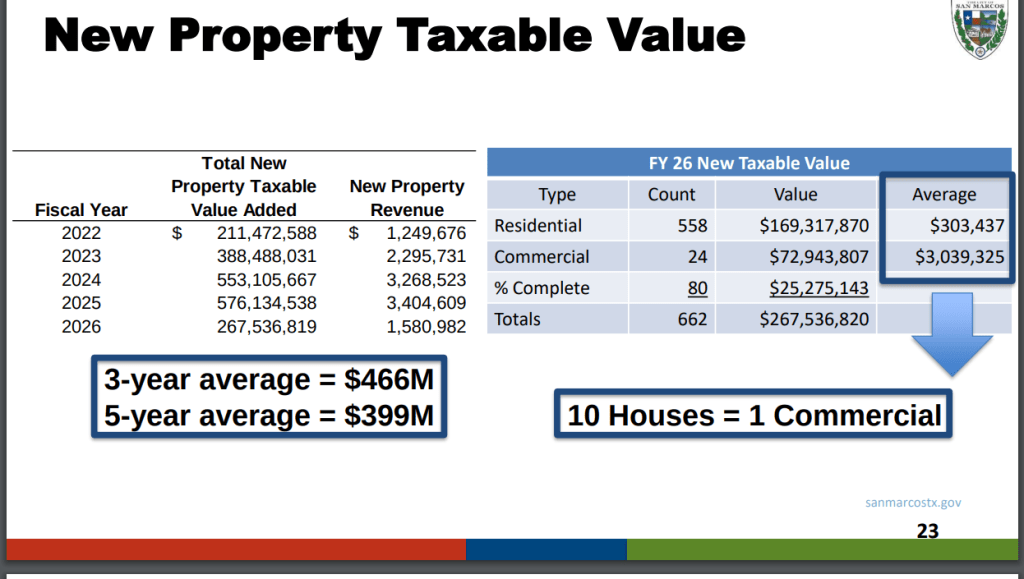
We’ve built some new stuff, so that helps bring in more revenue:
This is again a wee bit confusing, but let’s take a crack at it:
This is the difference from year-to-year. If it’s positive, then you got more money than last year. If it’s negative, you got less money than last year. You can see that lately, blue has gone negative. Next year, it’s projected that blue is so negative that it outweighs the green.
Lorenzo: Do we have any commercial products on the horizon? City Manager: Yes… you already heard from the AI dude. But there’s a lot more in the pipeline. Buccee’s, IKEA, HEB, multifamily, warehouse buildings. Lots of stuff will get added to the payroll over the next few years.
Ok, let’s shift to tax payers.
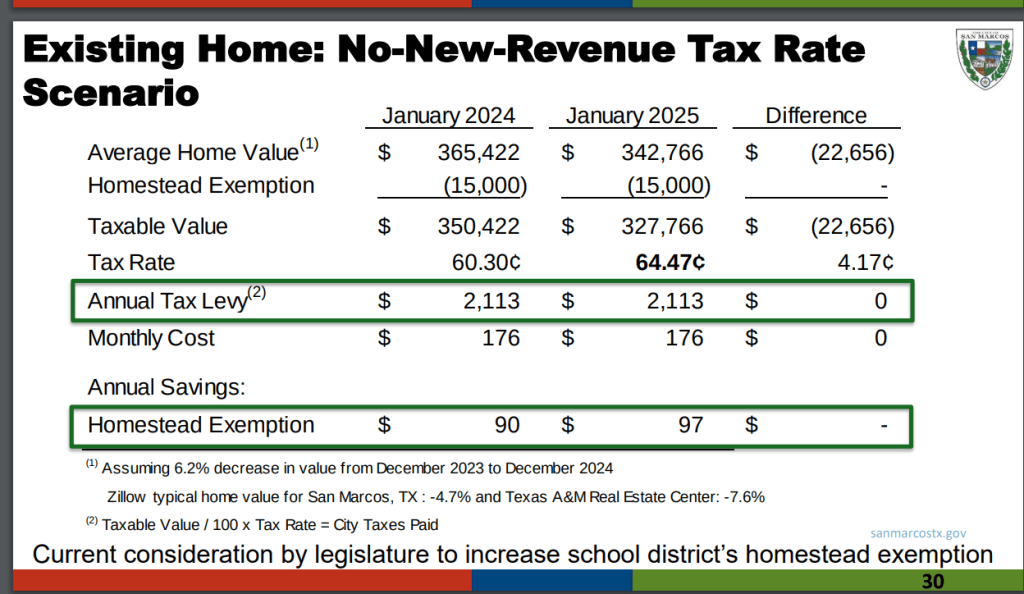
We have not raised the tax rate in the past few years. But property values have fallen. If we want to bring in the same amount of money, we would have to charge a little more:
So here, the tax rate jumps by 4%, and the average person pays the same amount in property taxes. This is called the “No New Revenue” rate.
We already made some midyear cutbacks, because we got reports that things were going badly:
Also yearly fee reviews.
Here’s where this leaves us:
Ok, all that shaves us down from $12 million over budget to $1 million over budget. (The blue “$3 million shift” is balancing the budget without being structural about that.)
Also ARPA and other Covid money is going away in 2027. That $1.4 is money the city will have to pick up.
How much does it help to raise taxes?
So each cent increase helps a lot.
…
So now let’s go back to this conversation:
Are we going to take the bandaid on the left, or the painful, responsible path on the right?
Note that in Option 4, everyone’s taxes stay flat. The extra $900K comes from new buildings. It would help offset inflation and implement council priorities.
….
Look, I believe in government. I believe that the role of government is to redistribute wealth and use it to solve collective problems. Starving your government makes inequality worse.
I get that San Marcos has endemic poverty, and people need every possible cent to make ends meet. People resent taxes. But I still believe in them. So I would vote for options 3 or 4.
….
Hang in there! There’s still a whole ‘nother workshop on fencing off the river!
…
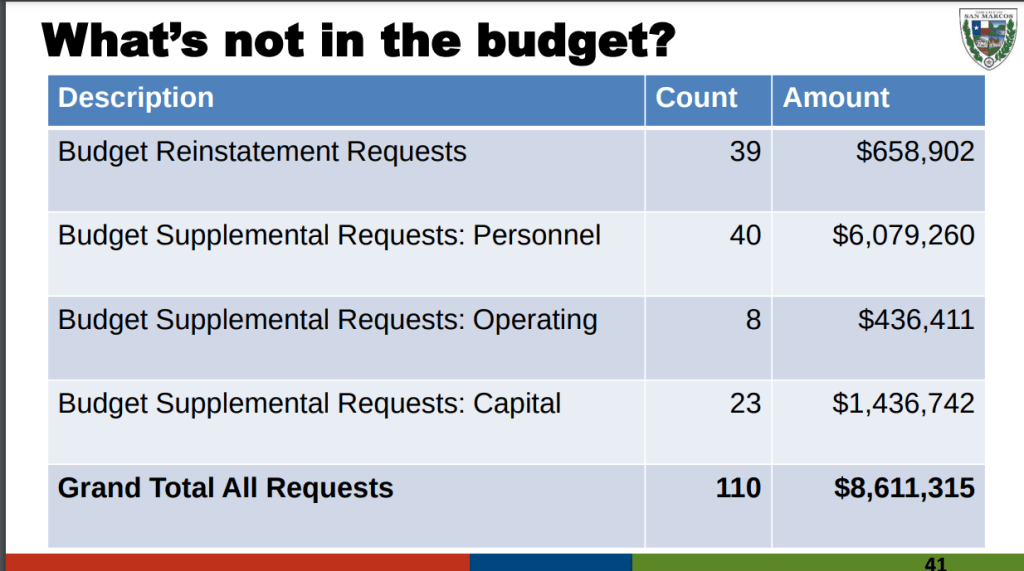
What’s not in the budget?
So the departments made $100K in permanent cuts. They’re allowed to request it back, though. These are scrutinized to see if they’re “needs” or “wants”. (Council asks to see a list of all these cuts, as well.)
What else isn’t in the budget?
Remember back in January, when Council dreamed big? We got all excited about things like:
Tenants Bill of Rights and advocacy program
Office of Violence Prevention
Increasing HSAB funding for social programs
None of those are in the budget yet.
….
One last thing: Back in January, we talked about how San Marcos was going to move towards a participatory budget model. The idea is to get the community input, and particularly those people who generally are disenfranchised by government. (In other words, don’t just go and ask all of Mayor Jane’s BFFs what they think about the budget.)
How’s that been going?
Staff did three things:
Consult with the Neighborhood Commission
Have a bunch of Dream Sessions
Have an online survey
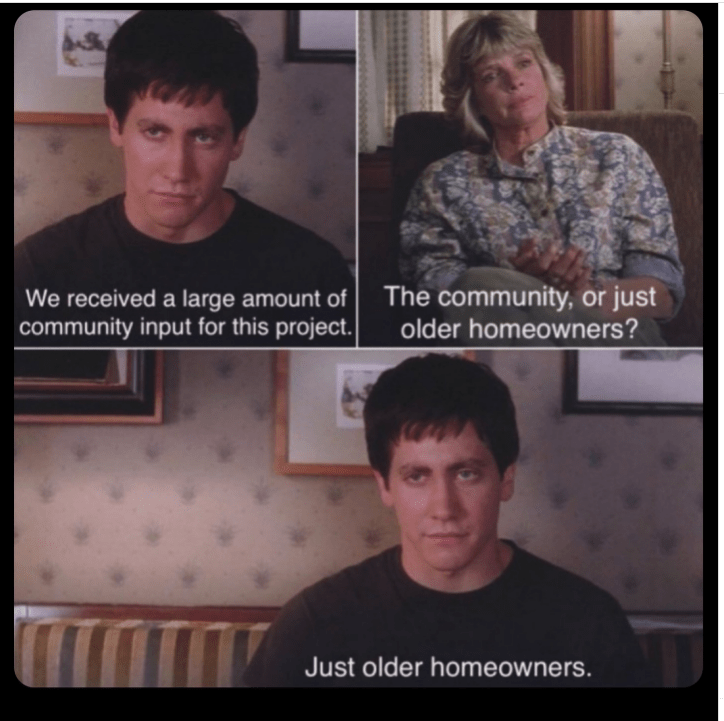
Amanda and Alyssa are FURIOUS over this. All of the outreach methods have gotten hijacked by the same old people who always have the ear of Council. This did not connect with the people on the east side.
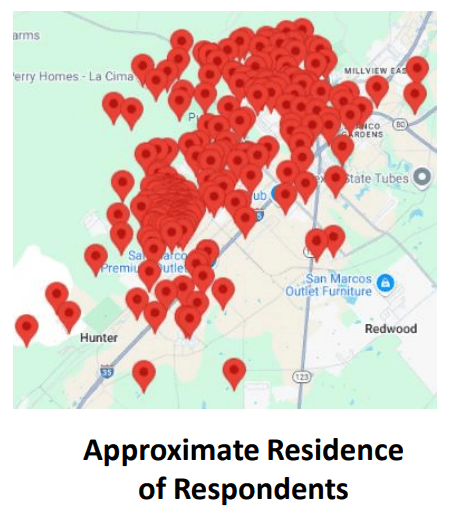
For example, here’s where the survey responders live:
See that densest cluster in the southwest? That would be Kissing Tree, ie a bunch of wealthy old white retirees. That is not who we mean when we say “get the input of hard-to-reach San Marcos residents”.
In the city’s defense, this is an incredibly difficult problem to solve. What you have to do is form relationships with community leaders in your hard-to-access regions – church leaders, barber shops and hair salons, etc. It is extremely time-intensive.
…
Time for Council direction! Roughly speaking, which road do we want to take?
More specifically, which scenario is Council leaning towards?
This isn’t a final, binding decision. But you don’t want city staff to go in a completely different direction from what Council is willing to approve. You want staff to prepare options that are aligned with what Council is thinking.
Lorenzo has a good question: is that extra $900K enough address the budget requests and council initiatives? Answer: Yes, it’s roughly enough to get us to a stable place, and to implement council priorities:
Tenants Bill of Rights and advocacy program
Office of Violence Prevention
Increasing HSAB funding for social programs
Council direction
Jane: Somewhere between #3 and #4. Lorenzo: #4 Shane: #4 Alyssa: #4, as long as the extra is dedicated to social services, public facing programs, and council priorities. I have to be able to explain this to my neighbors. Matthew: #3 Amanda: between #3 and #4. People must see tangible benefits to their tax dollars. That can only happen through the tenants rights and HSAB funding, ie council initiatives. If it doesn’t include council initiatives, I can’t justify this to my constituents. Saul: #3
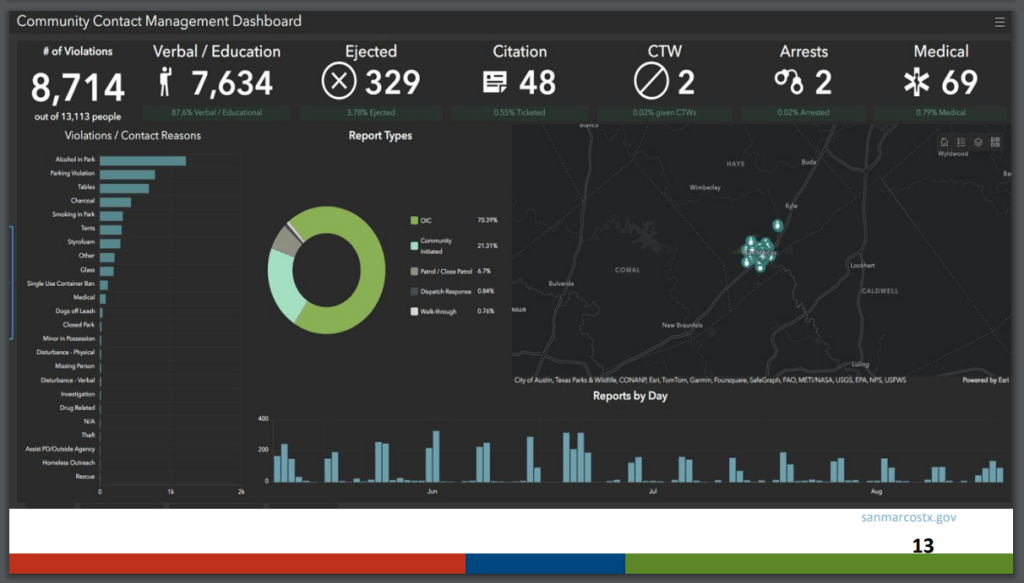
The arrests are low, because the marshals can’t take the time to arrest someone.
We saw these sad photos from the river last year, too:
and
It’s very depressing.
Trying to keep up with the crowds is super labor intensive:
Also there are a ton of volunteers, like the The Eyes of the San Marcos River, that show up weekly and pick up the massive amount of litter left behind.
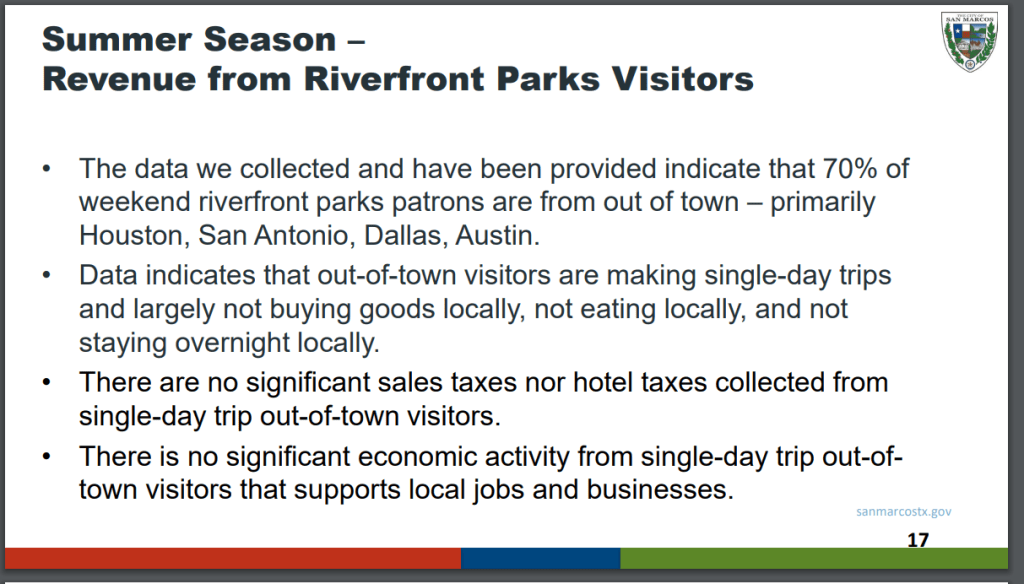
Basically, San Marcos residents have stopped using the river on the weekends. It’s used by tourists from San Antonio, Houston, Austin, and other out-of-towners:
But we don’t collect any tax revenue from them, because they don’t stop at the restaurants or spend the night.
So residents are footing the bill, while the river is over-used by others to the point of destruction.
…
What happened is that there used to be lots of free river parks in Central Texas. But one-by-one, they all got fenced off and started charging admission. This put the pressure on families to travel further and further to get some free recreation and relief from the summer heat.
We’re the last park that is still free. So now we’re getting more people than our river can handle.
This is a collective action problem, specifically a kind called the tragedy of the commons. People have destroyed many, many finite natural resources throughout history. It would be great not to add our river to that list.
I hate this situation so much. I want people to have free recreation to escape the Texas heat! I want families to have fun together! And yet we absolutely have to keep our river healthy and clean.
(The actual solution is that Central Texas needs a lot more free water recreation options available for residents in the summer. The heat is brutal. If we had a functional state government that tried to improve things for their residents, they could solve that problem.)(If my aunt had wheels, she’d be a wagon.)
…
So what are we doing differently this year?
First off, for holiday weekends:
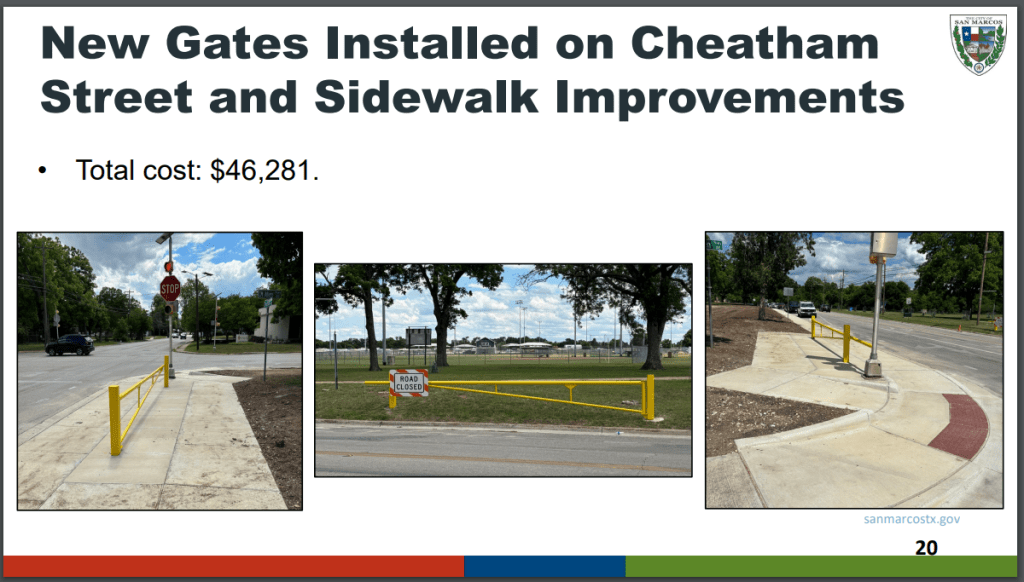
blocking off Cheatham on either end. We started doing this on holiday weekends last year, and it helped keep people safer.
Next: getting the shuttles out of the neighborhoods:
So now the Lion’s Club shuttle takes the I-35 frontage road, instead of going down Riverside.
…
Those are both good, but what about the BIG problems?
After last fall, Council was timidly open to the idea of fencing off the river and charging admission. But they had lots of questions. It was very preliminary.
But then it hasn’t come up since then.
So this was kind of a surprise! The park staff want to try some stuff out this year:
WHOA. That’s this weekend! This is pretty short notice!
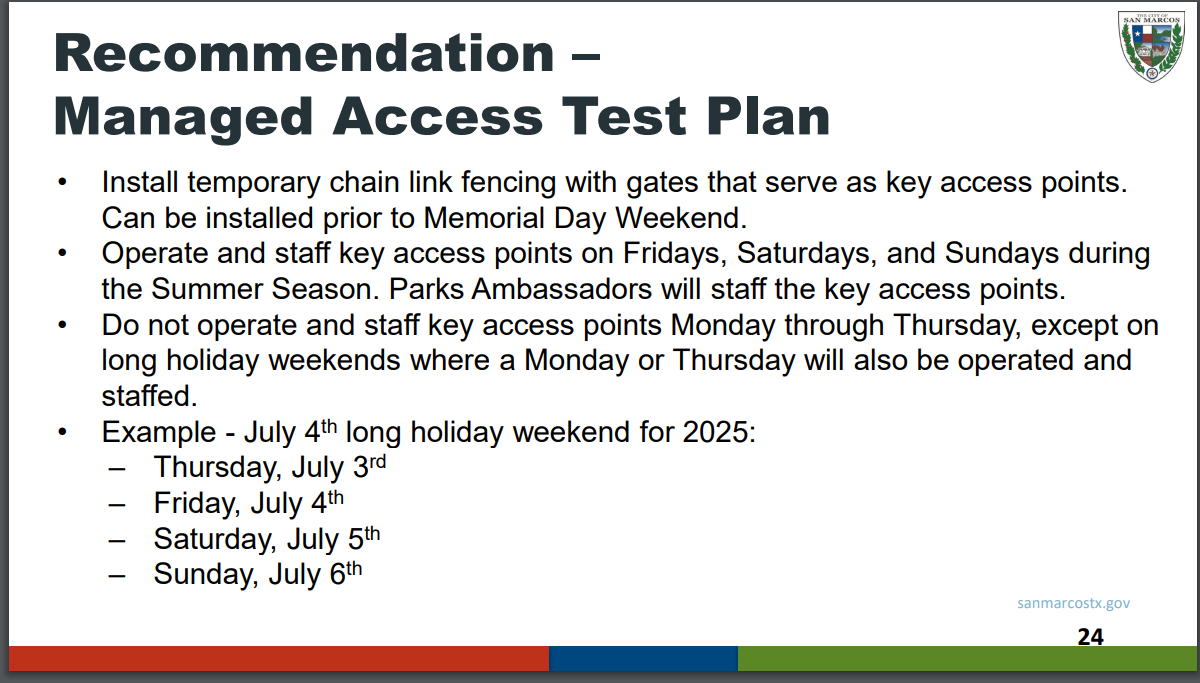
The plan:
They want to test out fencing off this one part of the park, by the falls:
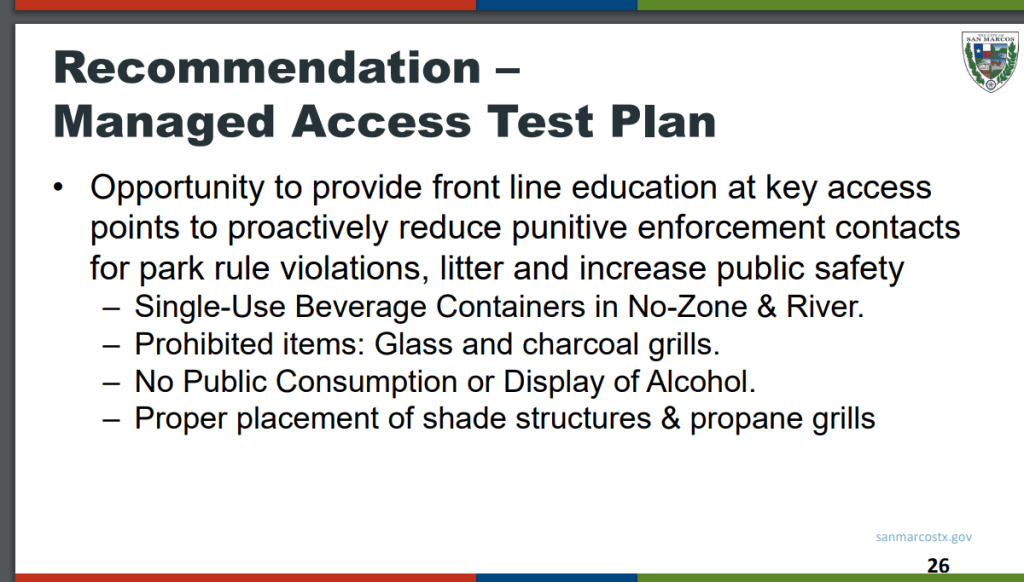
You would only be able to get in at those four green entries. You’d have to talk to someone, who reminds you of the rules, like the ban on charcoal grills, and single-use containers, and alcohol.
Maybe we could we keep things from getting less out of hand?
….
I think this is a pretty good idea? I’m surprised that it materialized so fast, but this is a good test run.
…
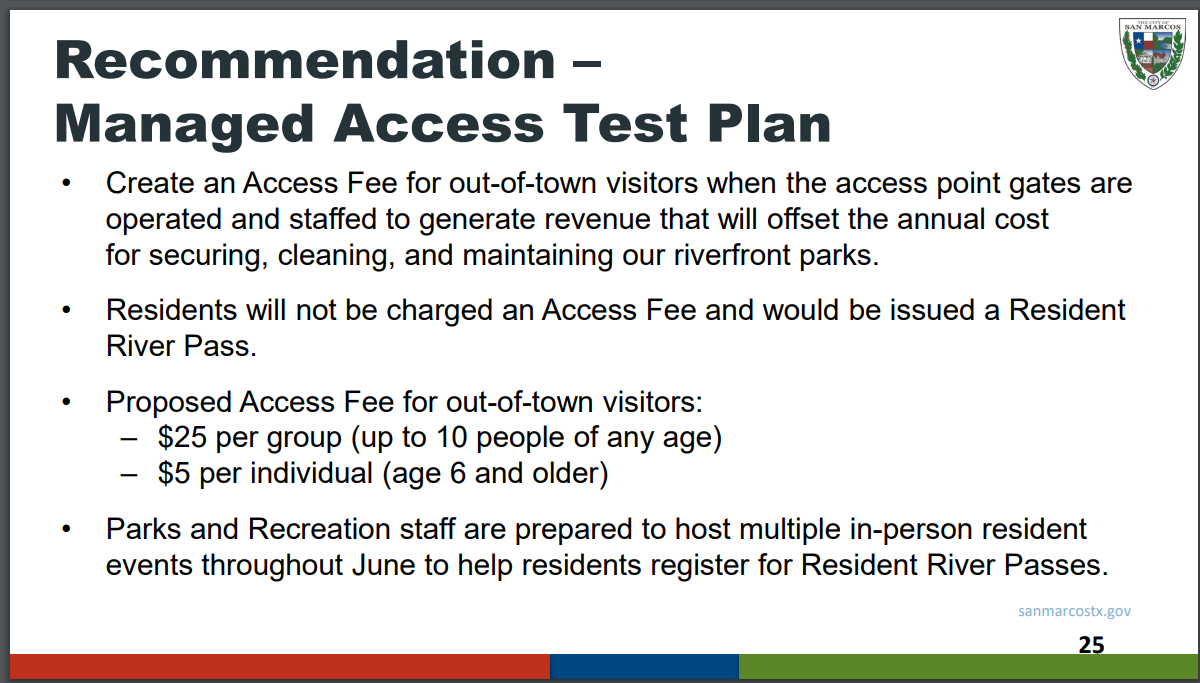
City staff also floats the idea of charging admission to out-of-towners on weekends? Not residents, just tourists:
Residents would have to register for a pass.
…
Also they want to be able to tow people more easily:
Right now, only Marshals or police can get a vehicle towed. They want to make it easier for the Parking Enforcement Techs to get a vehicle towed, so that the Marshals can keep dealing with the park.
…
What does Council think?
Amanda and Alyssa both: This is all super rushed. This is way too fast. We also have major concerns about staffing – there were some marshals that were overly aggressive and problematic?
City manager Stephanie Reyes: The park marshal that was in the news was fired. But listen: it’s super dangerous there. We’ve gotten very lucky, but please take this seriously.
Jane: All these decisions have to come back, though, with precise definitions.
Parks Director: You can defer the fee. We don’t need to charge people. We just want to have the fence so that we can talk to people before they go in. You can send someone to go put contraband in their car if you catch them on their way in, but once they’ve set up and are midway through the day, it gets dicey.
Saul: Do we own the fence? Answer: no, we’re renting it. But it’s rolled in to the cost of the Porta-potties. We got a great deal.
…
There are three questions for Council to answer:
Do they want to try fencing off Rio Vista park?
Do they want to charge admission to out-of-towners?
Do they want parking techs to be allowed to get vehicles towed?
Let’s take these one at a time:
Fencing off Rio Vista Park, around the falls?
Yes: Saul, Jane, Amanda, Lorenzo, Shane, Matthew No: Alyssa, who says she cannot sign onto anything without more details.
I think this is a good idea.
2. Charging an admission fee for out-of-towners?
No. There is not much appetite for charging a fee immediately. There are too many unknown details about how exactly we’d pre-register residents.
What about having a future conversation about charging an admission fee?
Yes to a conversation: Saul, Jane, Lorenzo, Amanda, Matthew No: Alyssa, Shane
3. Parking techs allowed to get someone towed?
Yes: Jane, Matthew, Lorenzo No: Saul , Amanda, Shane, Alyssa
So this fails.
…
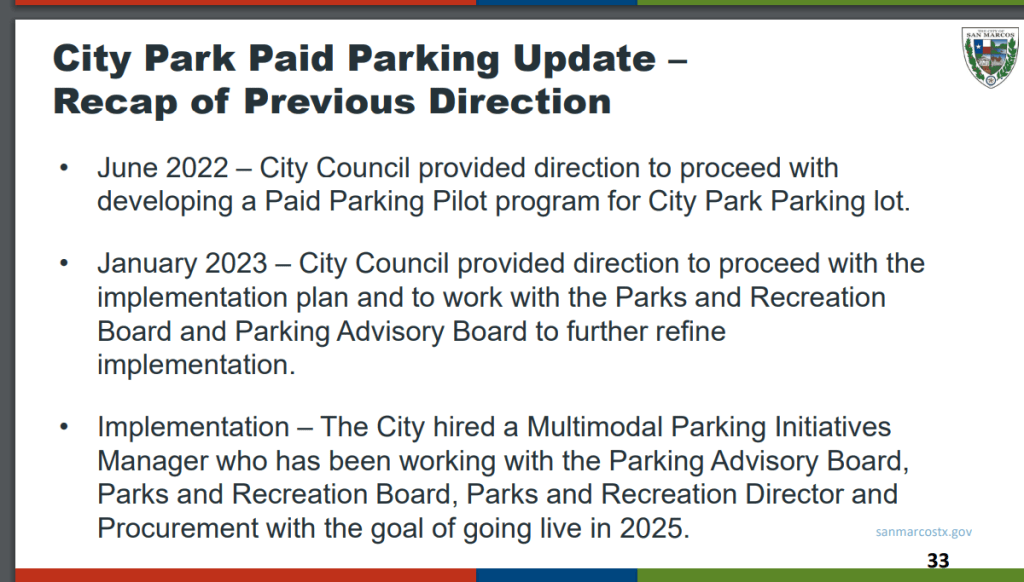
We’re also moving forward with paid parking at the Lion’s Club:
So the idea is that it’s free for residents, as long as you register ahead of time:
You can also register online.
…
The workshop ran way over time. They didn’t start the council meeting until almost 7 pm.
We need a new city hall. Ours was built back in the 1970s, when San Marcos had 25K people. It’s falling apart and tiny. (Discussed in 2022 and in 2024.)
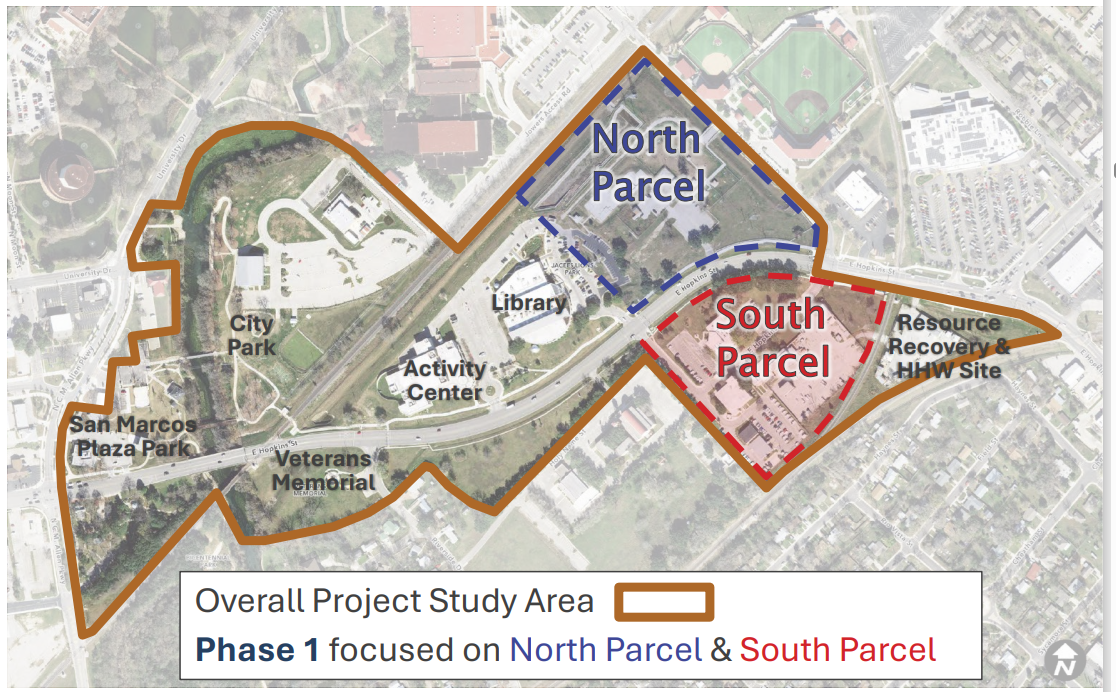
The big decision for today: should we build it on the north side or south side of Hopkins?
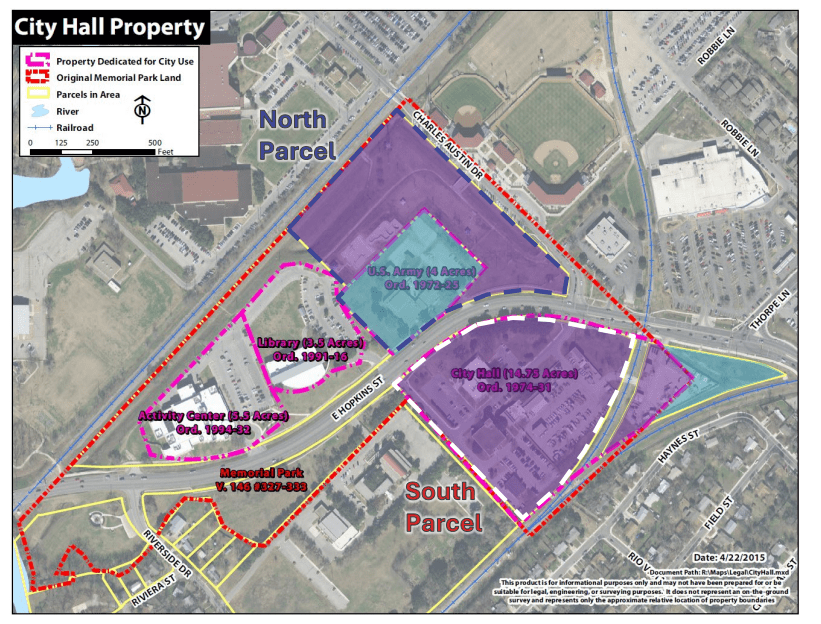
And here’s where the controversy kicks in. Here’s the city’s versions of those two spots:
Zooming in on the north parcel:
So this is the crux of the controversy – what happens to the skate park and dog park? The city posted about this to Facebook, where it blew up.
…
Citizen Comment: About 12 people show up to defend the parks. This is actually a huge number – both because this is a workshop, and because it’s at 3 pm on a Tuesday.
About halfway through, City Manager Stephanie Reyes breaks in and says:
Early on, consultants talked about maybe moving the skate park and dog park. But listen: We are NOT recommending moving the skate park! We really are not. The dog park, maybe. But definitely not the skate park!
I don’t know how this grew legs – it was just a committee discussion. This wasn’t concrete plans to move the skate park! Anyway, we hear you loud and clear. No one is moving the skate park.
And in all the drawings – like above – and even in this very presentation:
So anyway, the community uses the skate park really heavily. City staff heard many, many comments about how much everyone loves the skate park.
The skate park will NOT be moved. Great!
…
Confidential to council: Seeing how heavily it is used, you could even expand the skate park! That would be pretty popular. Add some bathrooms and shade?
…
Ok, now that the skate park is safe, what is the presentation about?
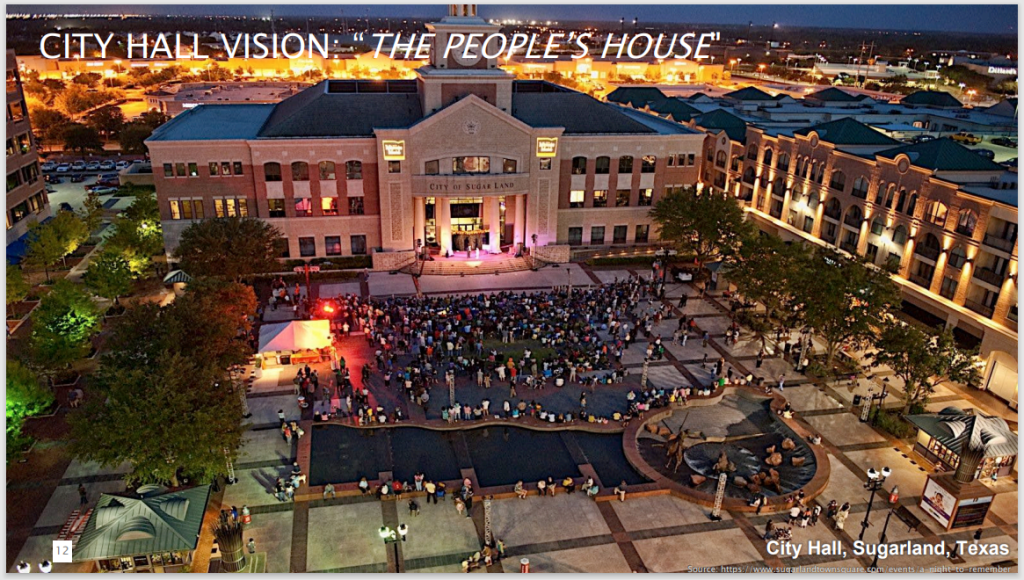
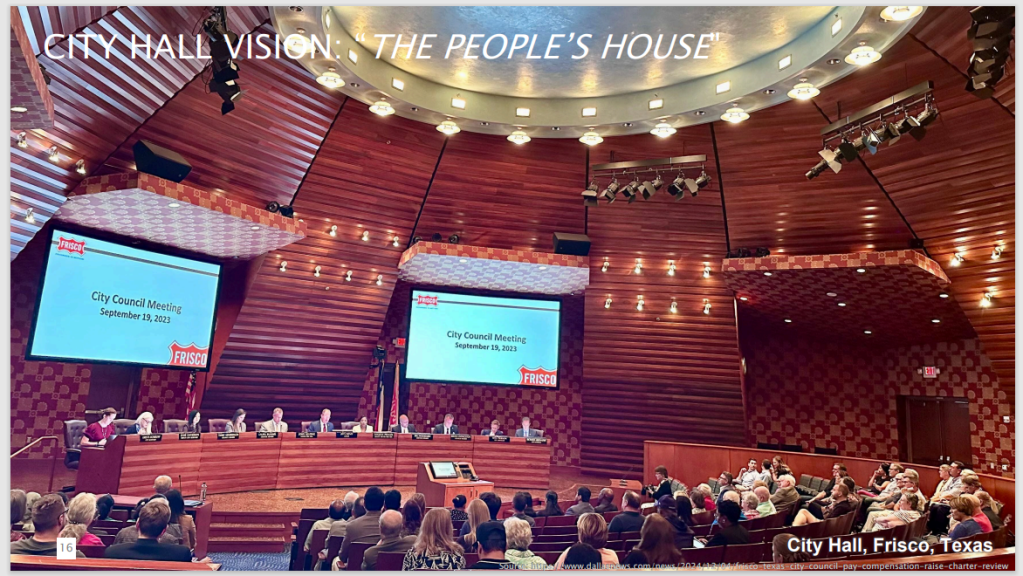
The steering committee has been meeting over the spring. They’re inspired to bring the old razzle-dazzle:
Sugarland, Wylie, Southlake, and Frisco are all bringing it.
…
So back to the two parcels:
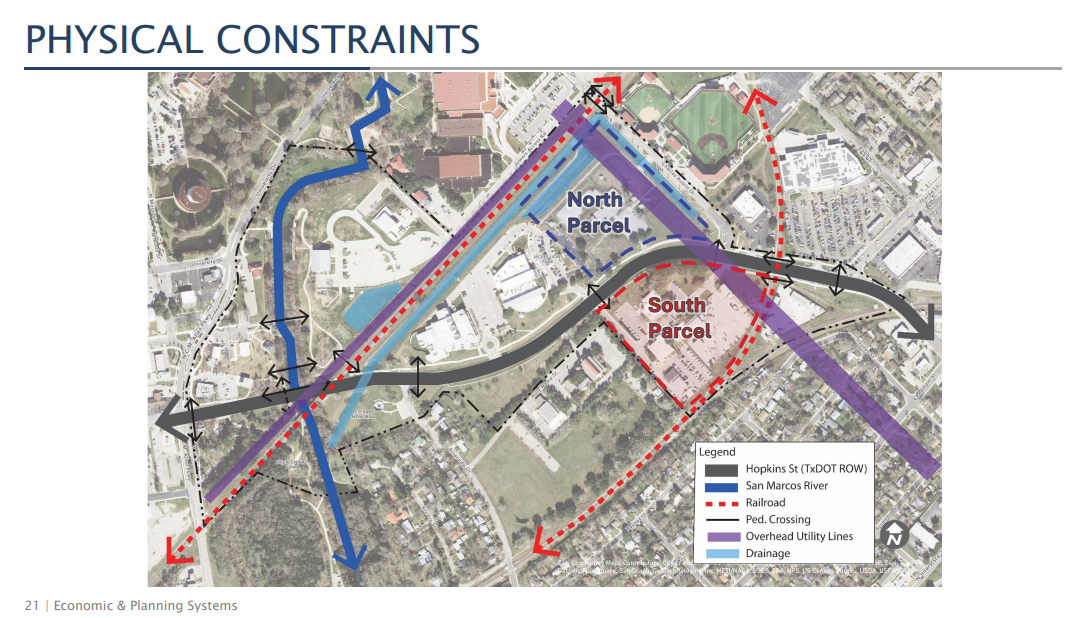
This area has the river, lots of railroads, and Hopkins running through it:
So there are some challenges. Like flooding:
And finicky rules, like this purple part:
The purple part is dedicated park land. In order to build a razzle-dazzle City Hall, you have to have a Public-Private-Partnership. In other words, it’s a city hall with some stores, or coffee shops, or sell some city land to a developer to do whatever.
But the city needs voter approval on the purple part. Since it’s parkland, it stays public unless the voters approve letting private companies use it.
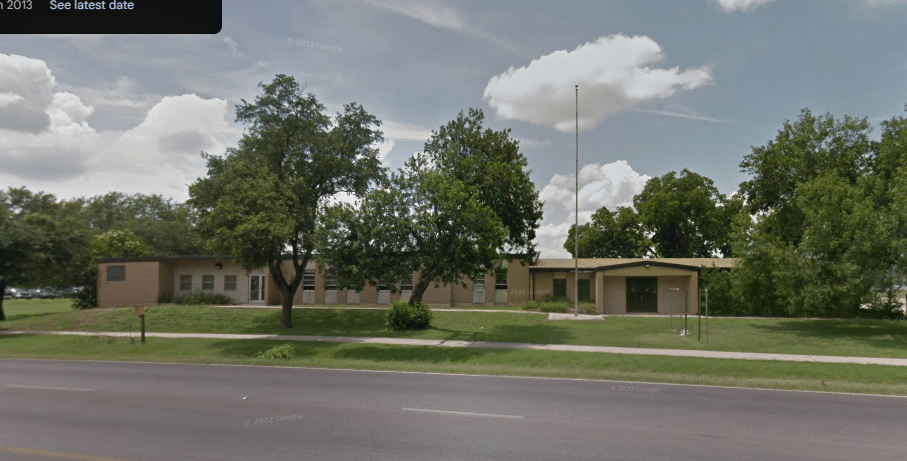
See that little blue square in the middle? It is not dedicated parkland. It’s more flexible.
It used to be the Armory Building:
That’s Google Maps, from June 2013.
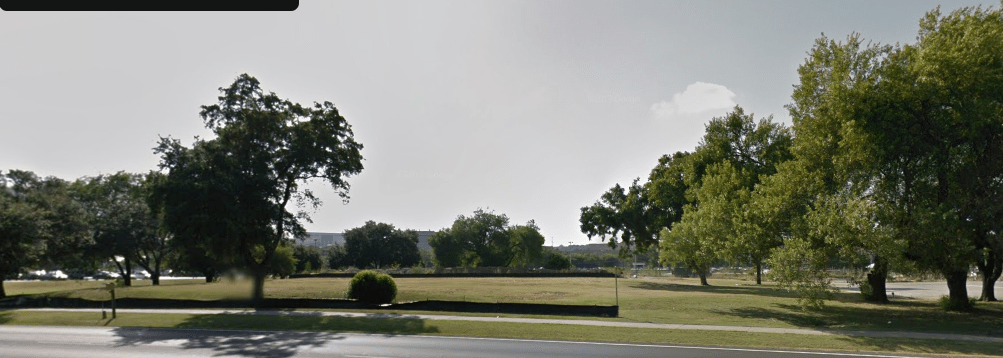
Here’s April 2014:
And here’s June 2015:
Going, going, gone!
So that little field already has voter approval – that was dedicated back in 1959. We could put a private company there, without voter approval.
(I don’t like that option.)
….
How much will all this cost, anyway?
So the cost is the same, either way.
There are still plenty of decisions for the future:
Surface parking or underground parking?
Public-Private-Partnership or go it alone?
Where would Council temporarily relocate, if we went with the south side?
Would it be a beautiful gateway on the North Side?
Here’s what the Advisory Committee said:
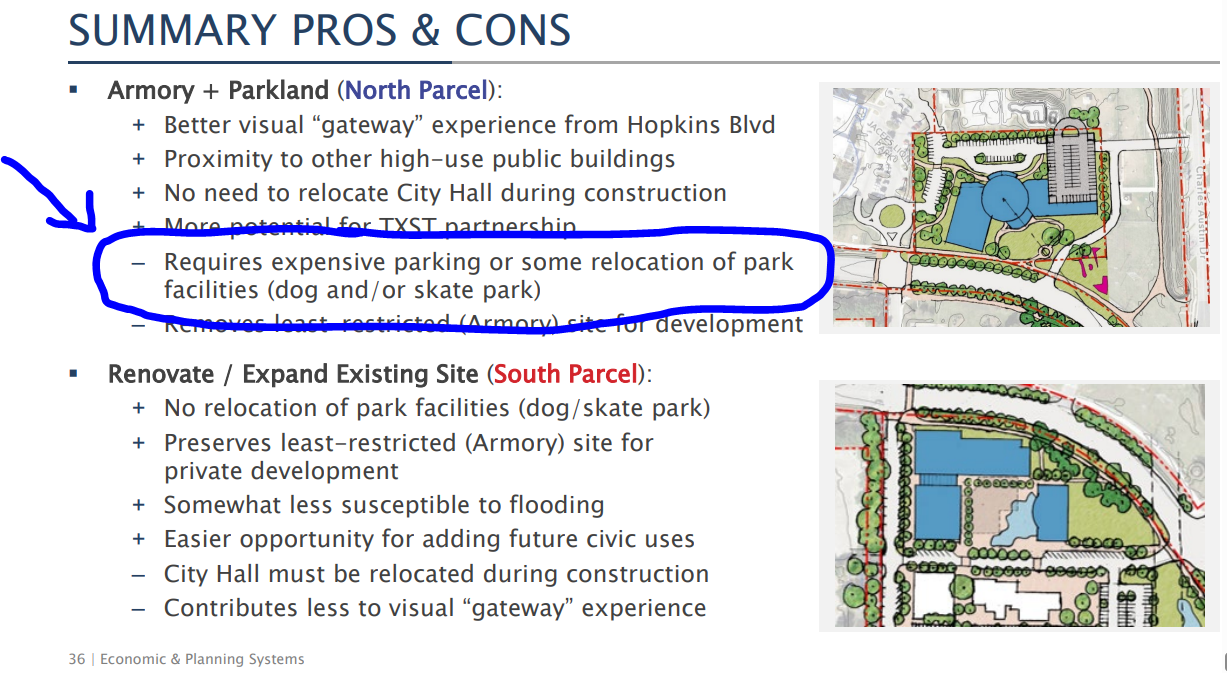
Here’s the summary of pros and cons:
The Advisory Committee settled on the North Parcel, but still felt good about the South Parcel:
…
So what does Council think?
Matthew: North side!
I’m a neighborhood man! My main concern is drainage. Water runs into Rio Vista neighborhood. Put City Hall in the north side, and install a state of the art drainage system in.
I like the idea of a Civic Corridor, with City Hall, the library, the activity center, and the parks all in a row.
Staff clearly states that the drainage will be all new, on either side.
Jane: South side!
I do like the idea of a big Northside Gateway.
Let’s do two uses: Keep all the business uses on the south side. The public only comes here for birth certificates and developers. On the north side, add some more recreational uses that complement the dog park and the skate park. Restrooms, improvements, etc.
Make the south side entrance more prominent, though.
The north side really does flood, too. Do we want our new City Hall to get flooded? The railroad forms a dam on the back side.
Note: I agree with Jane!
Lorenzo: Is structured parking going to drive up the cost? Answer: Yes, but it’s probably off the table either way. Underground parking will flood. Parking garages are expensive.
Amanda: I’m freaked out by the price tag, and prices are only going to go up. I’m with the Mayor, here.
Shane: I like the North Side because I like new construction! The old one looks dreary and old.
Amanda: The north side loses the dog park, unless you pay a huge price tag for a parking garage. City Manager: We have options for relocating the dog park . This will free up the Parks and Rec building and possibly the land near the Veteran’s Memorial. So the dog park would stay in this same corridor.
Saul: Are the structural problems of the current building caused by the train? That’s my concern with the South side. Answer: Yes, but current architecture would be built to deal with that.
Lorenzo: If we build on the South Side, would we actually improve the north side? Answer: Depends what kind of partnerships we can build. That’s Phase II.
Alyssa: I’m voting for the North Side.
Lorenzo and Matthew are really determined to make an economic argument that really isn’t there. They keep guessing about demolition costs or whatever. City staff keep gently correcting them – no, those costs are very small, relative to all the design decisions yet to come.
…
My two cents: The north side is a terrible idea. Really.
First: You don’t get more park land in town. This is it. Don’t use it up.
Second: a massive number of people turned up to defend the skate park. A giant, razzle-dazzle building will loom over it, literally. It will change the vibe. A skate park is not going to feel the same if it is nestled in the backside of a flashy new business park.
Build up the park side for the people! Add bathrooms, add water refill stations. Rebuild the business half of City Hall on the south side.
…
The vote
North Side: Shane, Matthew, Lorenzo, Alyssa
South Side: Saul, Jane, Amanda
Honestly, I was surprised by this! The steering committee was lukewarm in their recommendation. Their decision reads as “Both options are good, but I guess we tip towards the north.”
The public, then, said cried out, “We feel STRONGLY about keeping the north side as park land.”
And council went with the advisory committee??
…
Q&A from the press and public:
Even knowing the skate park will stay, people are pretty angry! No one seems to like this decision.
I love the skate park. Why was there no representation of the dog park or skate park on the steering committee?
Time line? And will you still push for recreation?
A big building with concrete and fountains is not usable by the public the way the current corridor is.
I have thoughts but not a formal question
I don’t buy the economic argument and I don’t like going with the decision that doesn’t inconvenience you personally.
How does having a flashy new building benefit the citizens of San Marcos?
Why not have the Gateway be beautiful parkland over a flashy parkland? The foundations and drainage, why not address that?
How do we get on this committee? What’s up with this committee?
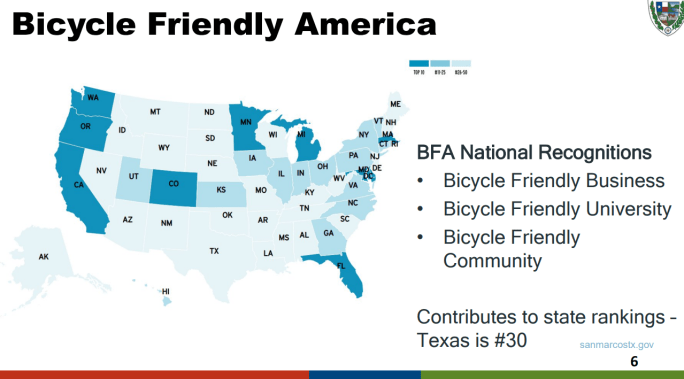
The League of American Bicyclists hands out awards. We’re bronze! We’ve been bronze since 2018, actually. But we were renewed!
Overall, Texas is mid.
It takes a fair amount of work to get this designation. Along the way, we got some survey data:
They also gave us a report card:
Ouch. Hmm. Maybe I don’t know what “bronze” actually means. That we’re trying?
They included 17 recommendations. We’re a work in progress. Read ‘em all here.
Council asks a few questions: – Bike incentives? Access? (no) – Do we reach out to businesses? (no) – Demographics of survey responses? (no)
I’m being pretty negative, but the city is doing good work on a shoestring budget.
Remember: on average, it costs about $1,015/month to own a car, whereas it’s about $29/month to commute by bike. San Marcos is full of people who might prefer to bike – but only if it feels safe, and only if they actually have a bike.
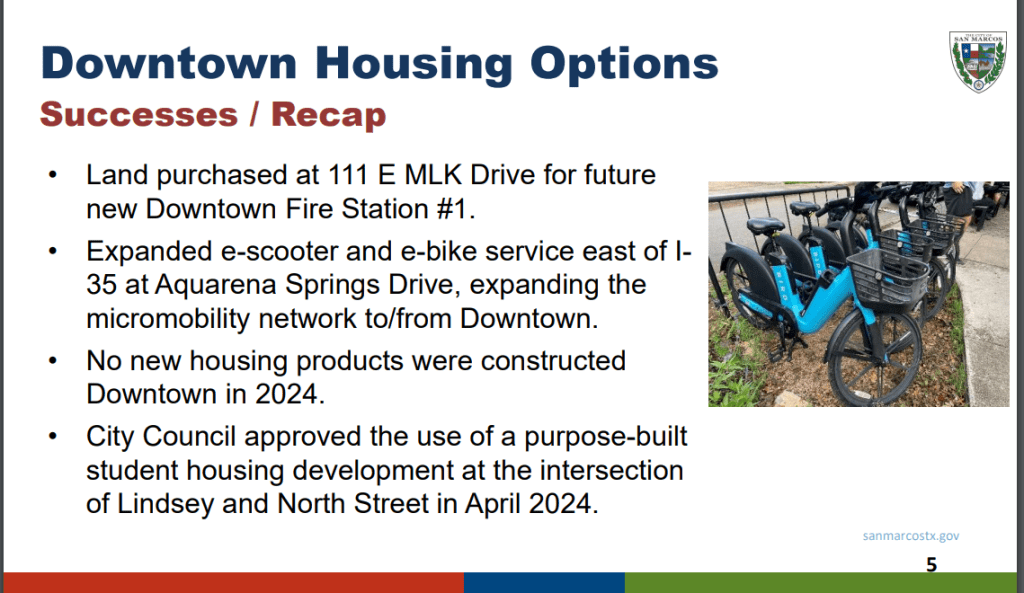
You download an app, and it tells you where the closest one is, and you can rent it and ride around the Scooter Zone.
Originally they were contained to this blue area:
Last May, the Scooter People asked if they could grow. So we gave them a 9 month pilot period to extend to this region:
Also we allowed them to become 24/7. Before, they shut down overnight.
So how did the pilot program go?
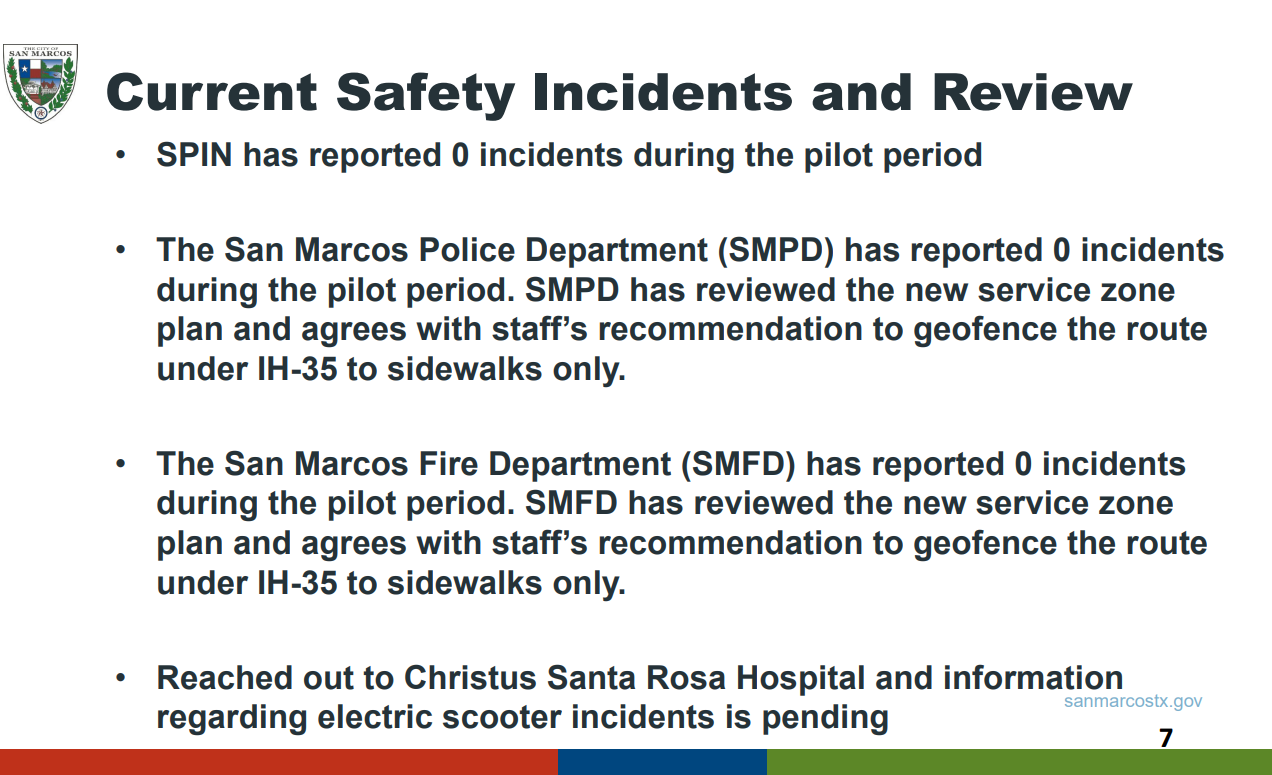
There haven’t been any incidents!
Everyone is fine making that region permanent.
Would we like to fire up a new pilot region, here?
Sure.
One final note: Are these actually affordable?
It costs $1 to unlock, and then $.30 plus taxes per minute. So let’s ballpark that it costs $6 for a 15 minute commute. That means that one daily trip would cost about $360/month.
That’s actually kinda pricey. Still cheaper than owning a car, but not, like, frugal.
…
Workshop 3: Edwards Aquifer Habitat Conservation Plan
Okay, this topic is always fascinating.
So back in 1991, there was a lawsuit by the Sierra Club against the U.S. Fish and Wildlife Service. The Sierra Club sued for neglect under the Endangered Species Act. Their case was that if the Edwards Aquifer drops too low, then the endangered species in the Comal and San Marcos rivers could go extinct. And they won!
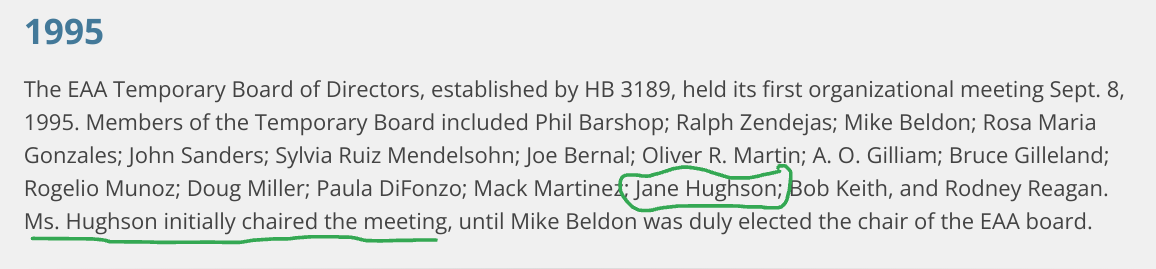
So the Edwards Aquifer Authority was created, and they got some legal power. This is important!
Probably some of you know all those names, but Jane’s jumped out at me. Good on her.)
Here’s the key: The EAA is allowed to cap much water gets used, and they are allowed to charge organizations to use the water. They sell credits to San Antonio, New Braunfels, San Marcos, Texas State University, Kyle, and so on. Then they use that revenue to fund conservation measures.
Today’s presentation is on the Edwards Aquifer Habitat Conservation Plan, or EAHPC. This is how they actual take care of the rivers.
So what do they do?
SO MUCH! They spent about $10 million on San Marcos alone.
They do a bunch of underwater gardening, to make sure there’s enough habitat for the little endangered fishies, and also the endangered wild rice:
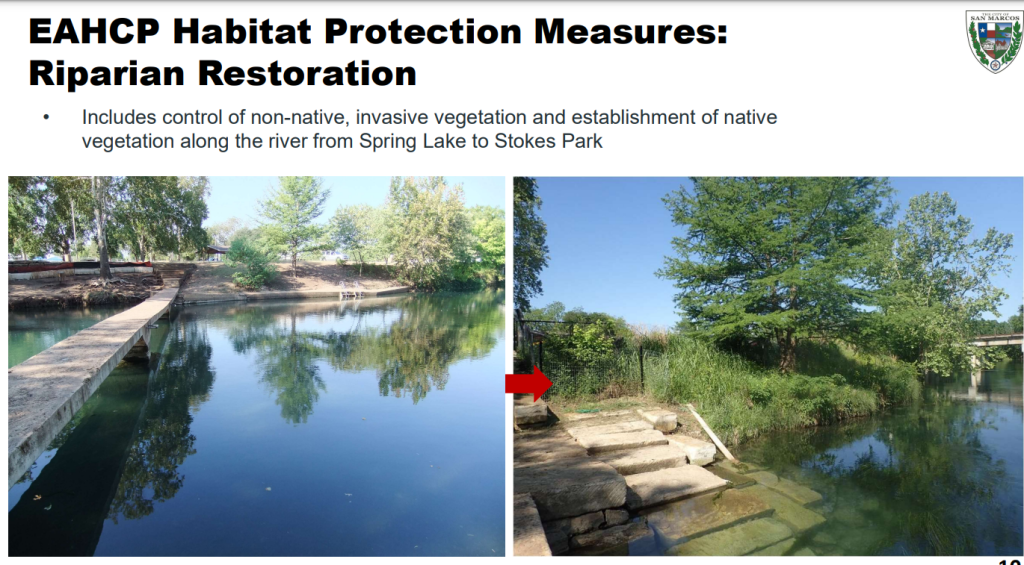
They fence off the spots where the bank is getting eroded and trampled to death, and nurture it back to life:
That photo is just upstream of the falls. It’s as if you’re standing on the island with the big cypress trees, looking back towards the bank.
They hire people to go spear-fishing for non-native species:
The one on the left is those little sucker-fishes that people put in their aquariums to eat the algae and keep in clean. The one on the right is tilapia.
Council asks: what happens to the fish? Answer: The guy who does the spear-fishing holds a big fish fry and serves tilapia fish tacos, down at Ivar’s river pub.
Council: What about the sucker-fish? Answer: Don’t eat those. Gross.
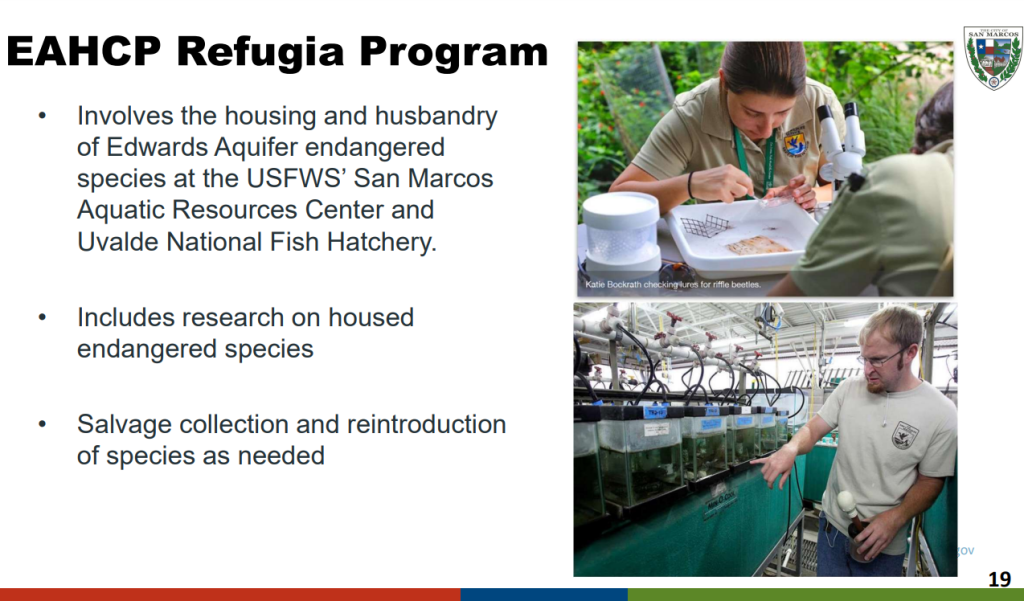
But also: the San Marcos Discovery Center has a fish shelter! Like they’ll take your old fish if you don’t want an aquarium any more, and if you are getting started, you can go adopt fish for free from them.
Don’t dump your old fish in the river, everybody. Take them to the fish library.
…
What else?
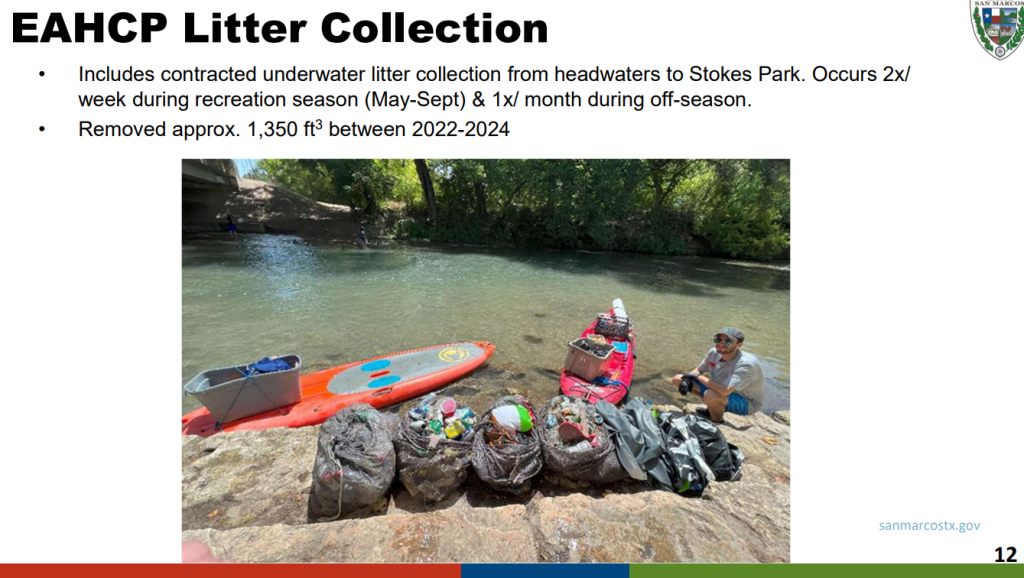
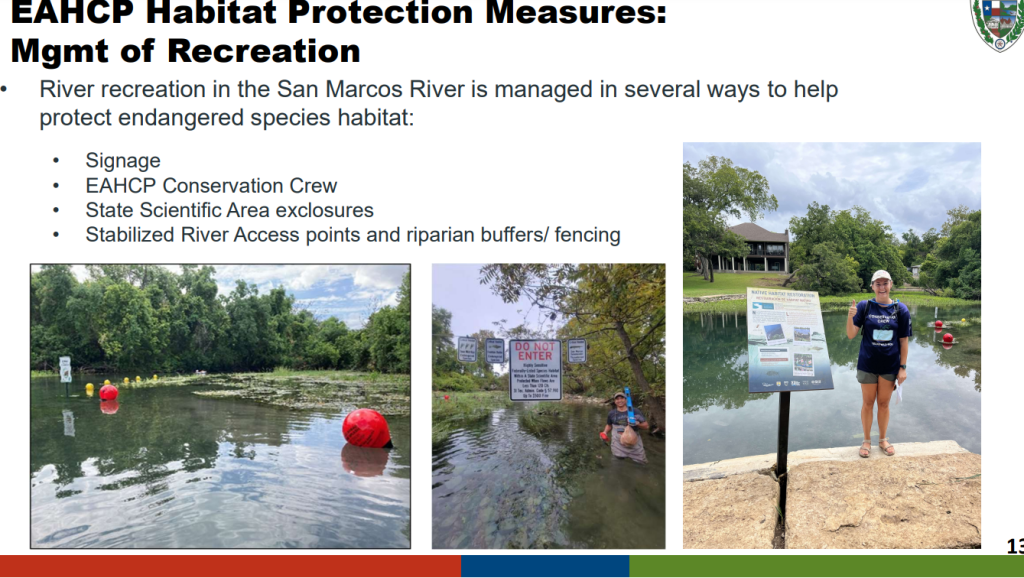
They pay for scuba divers and snorkelers to collect trash out of the river, twice a week, all summer long:
They keep those red bobbers around the wild rice and sensitive spots:
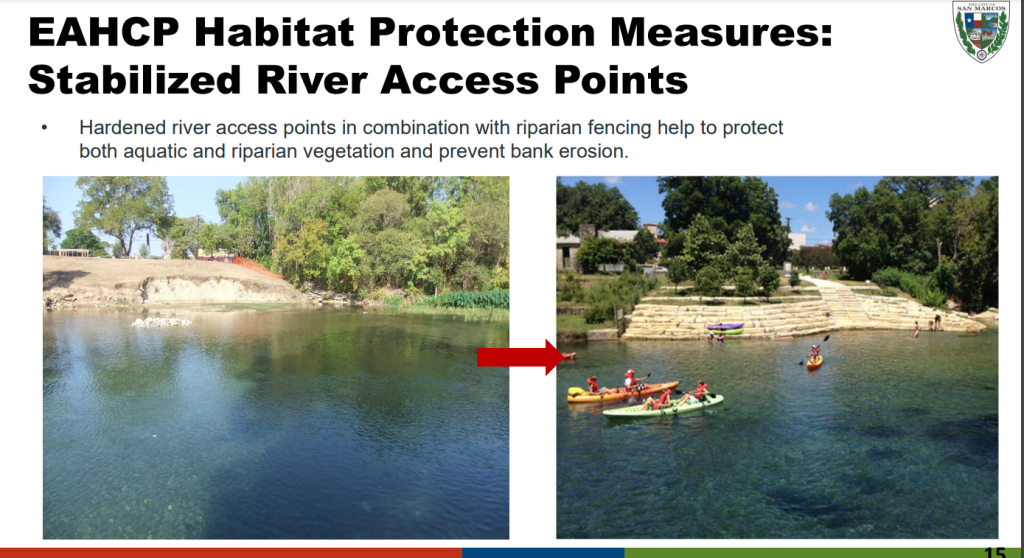
They put the big limestone rocks in at certain river swim spots, and then fenced off a bunch of the other spots:
In other words, they were like “Let’s contain the swimming to a few really great swimming spots, and not worry about vegetation there. Then we’ll protect the rest of the river for vegetation.”
Also the limestone rocks keep the bank from eroding.
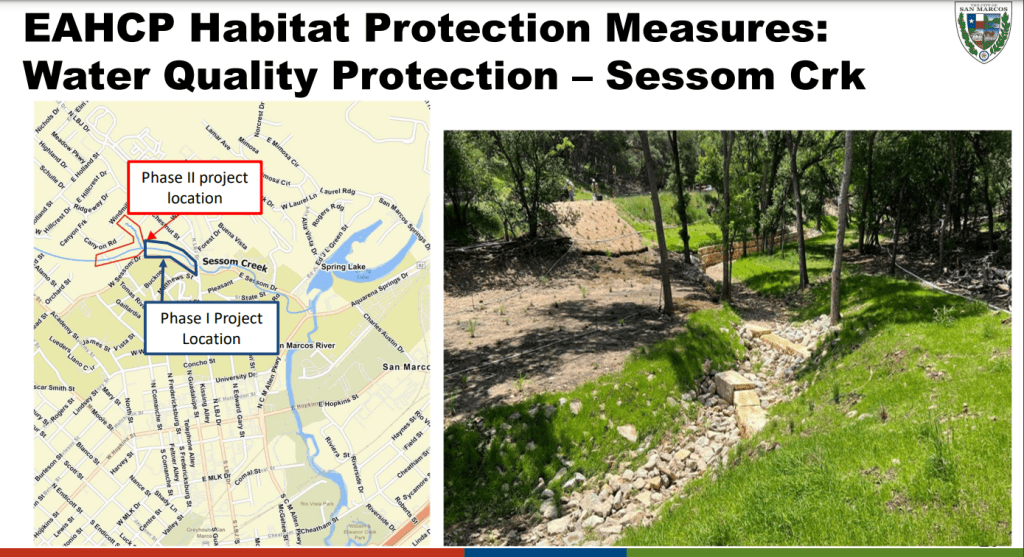
They did a bunch of stormwater detention that keep the nasty stuff from running into the river:
and they also fixed up Sessom’s Creek:
…
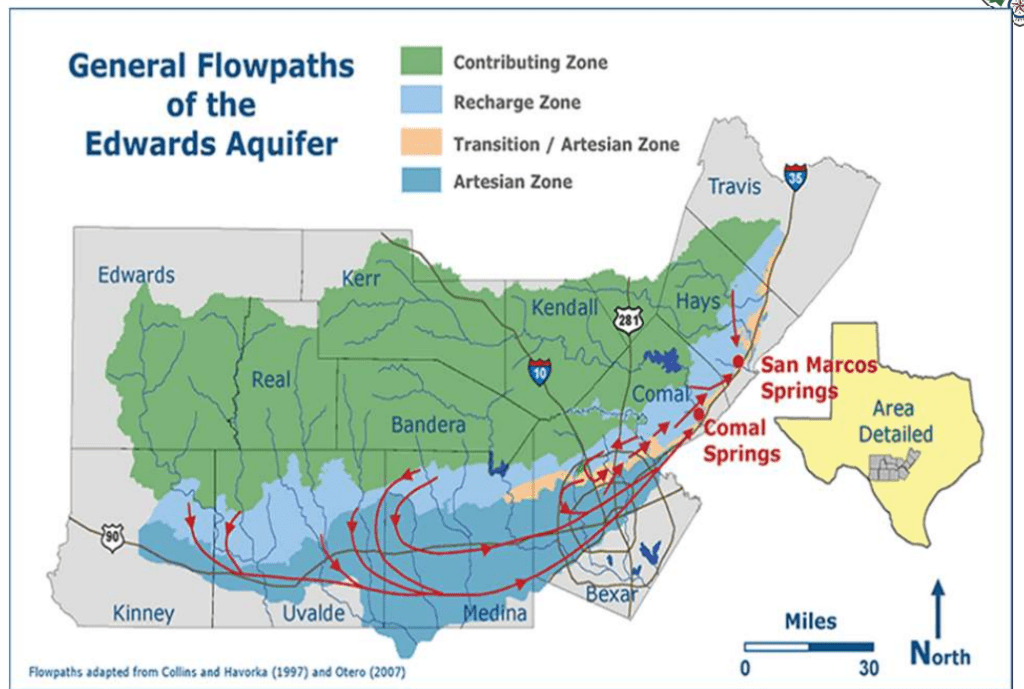
I mean, let’s pause here. This is wild, right? This is the Edward’s Aquifer:
Everyone in that dark blue region would just be draining the aquifer dry, if the EAA wasn’t around. Instead there’s been this massive coordinated effort, resulting in $10 million worth of projects to protect our river?!
That’s insane and beautiful. You’ve got to cherish this and really breathe it in.
(Especially during this larger dark time. I hope this program is not dependent on federal funding.)
…
But wait, there’s more! You can’t hold these deals back!
The scientists study and monitor all the endangered critters:
They scoop them up and take them on field trips, over to McCarty Lane or down to Uvalde:
That way, if there was a massive natural disaster or chemical spill or something, they could re-introduce the species after the river was healthy and cleaned up again.
…
What’s next? The current EAHCP plan runs from 2013-2027. So it’s about to expire, and they’re mapping out the next one to run from 2028 – 2058.
They’ll do a lot of the same stuff – make sure the river stays flowing, make sure the people don’t destroy the environment, make sure the endangered species are still paddling around in healthy numbers. But they’ll also have to respond to a hotter, drier world, which makes this all harder.
There’s some technical details to the new plan, and honestly, you should just watch the whole presentation here. (Or read all the slides here.) 10/10, no notes.
Workshop #1: Update on Downtown plan Workshop #2: Privacy policy on SMPD License Plate Scanners
….
Workshop #1: Listen, this was great. I just ran out of time to write it up properly, so it’s a little short.
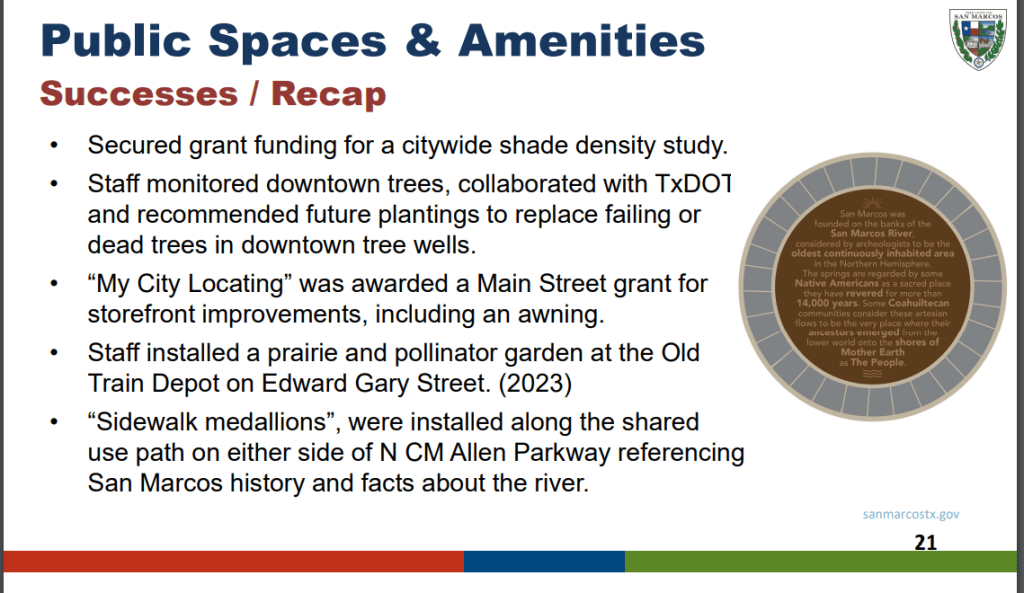
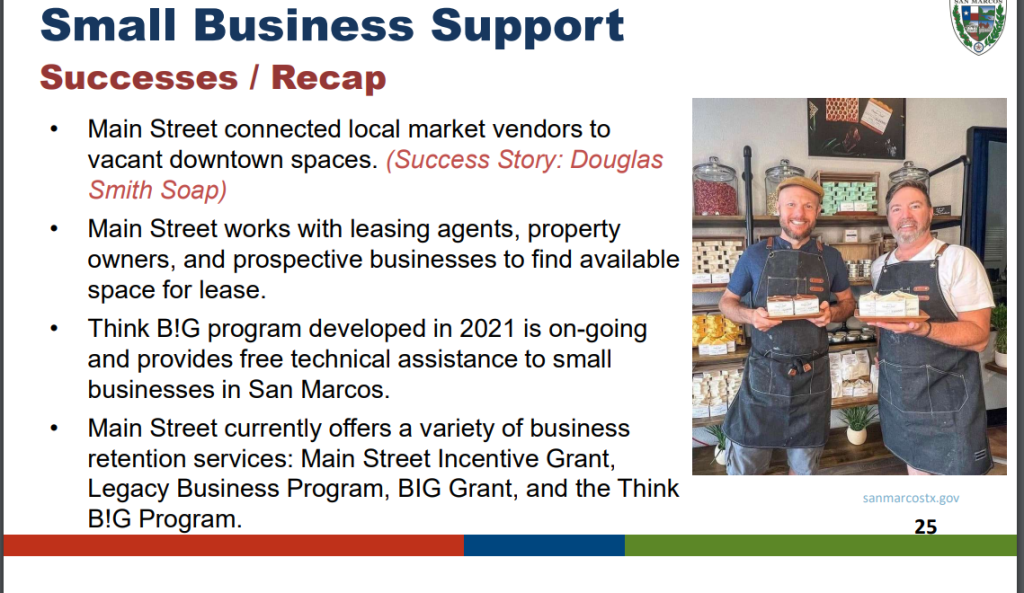
We approved the Downtown plan in 2023.
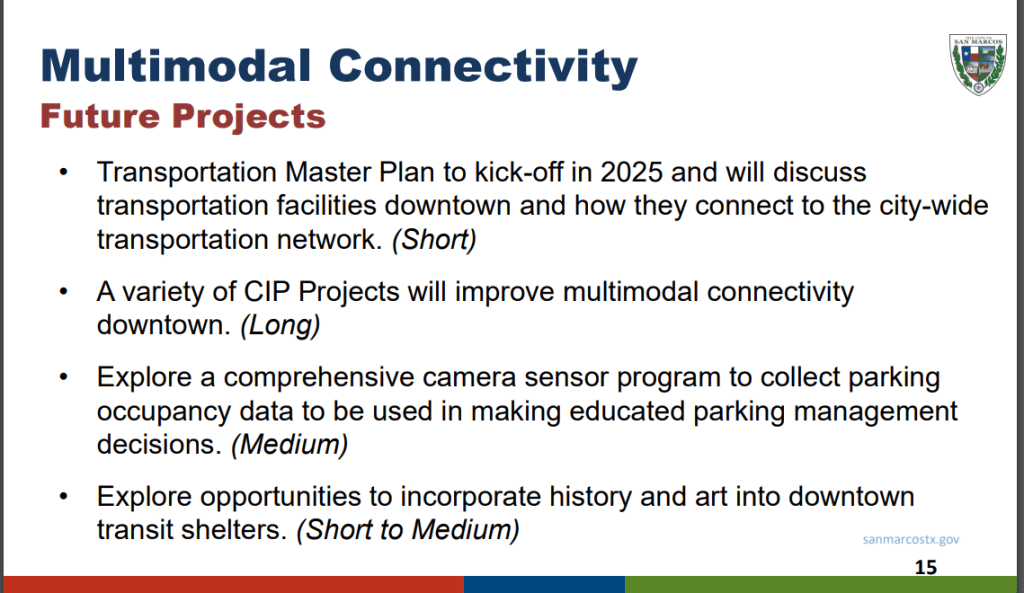
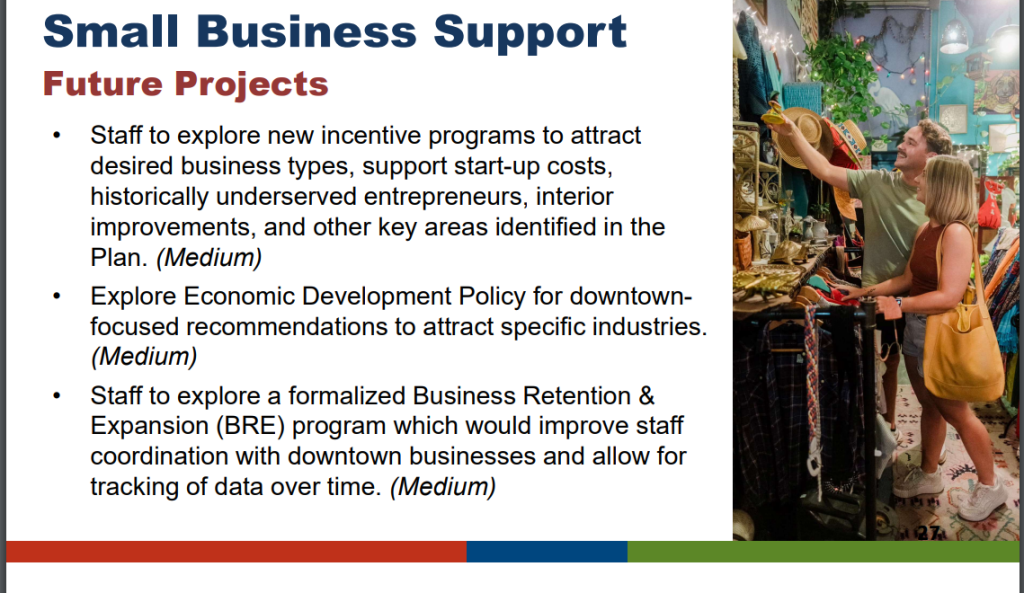
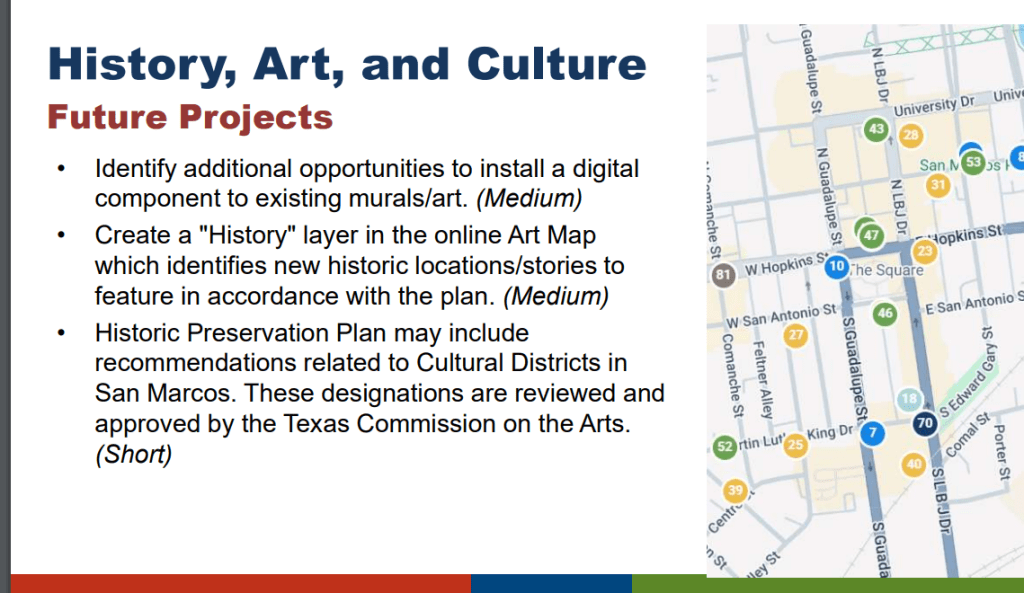
So now we’re implementing it:
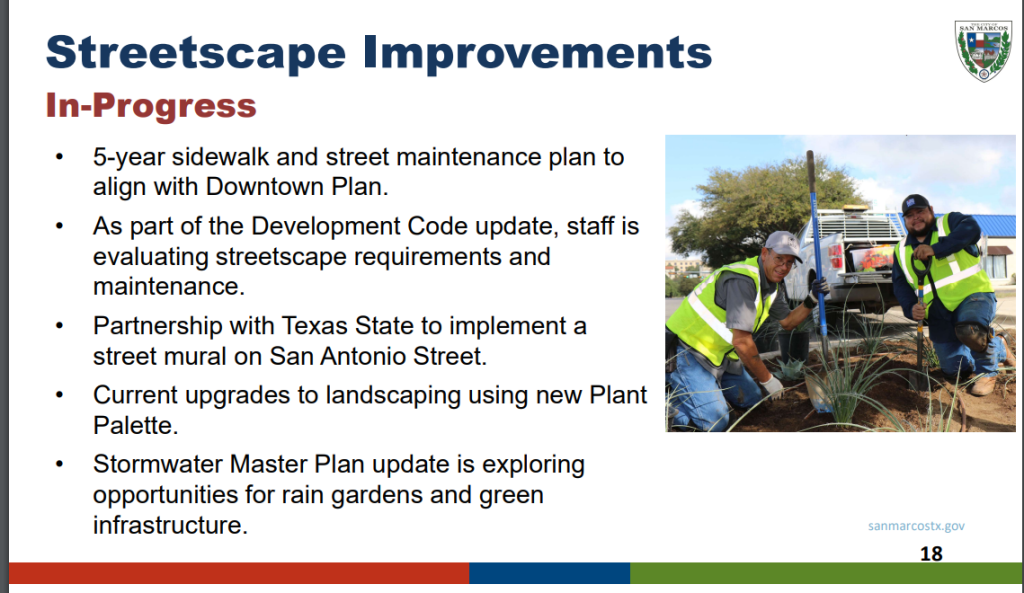
So far, we’ve done a bunch of great stuff!
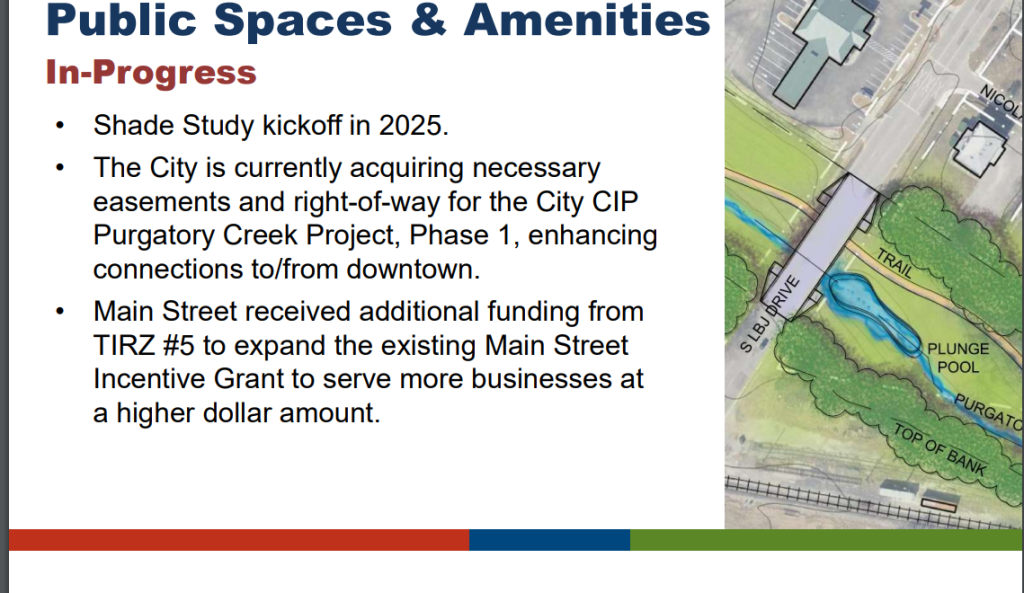
Here’s what we’re in the middle of doing:
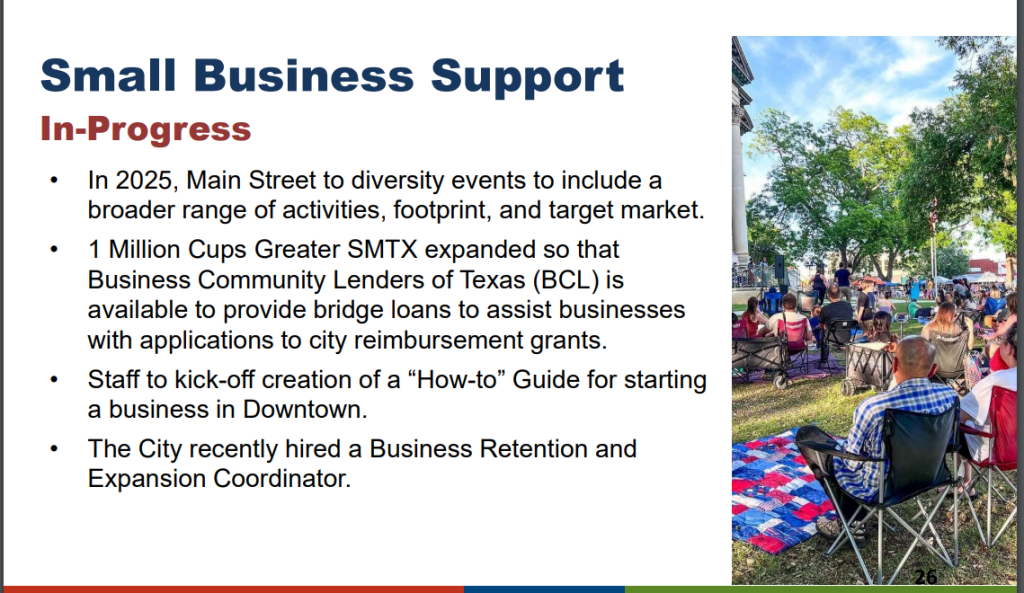
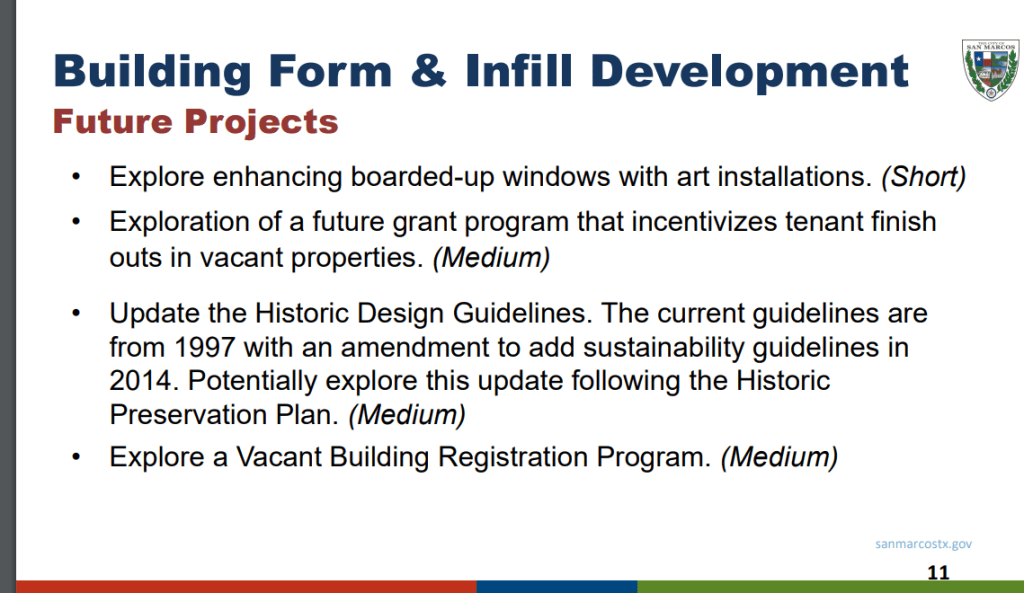
And here’s what we’re going to do next:
And here’s what we need, to do it:
Like I said, I’m shortchanging a really enjoyable presentation. Go listen!
…
Workshop #2: License Plate Readers
In February, SMPD asked Council to approve a bunch of license plate readers.
We had literally just talked about privacy with respect to technology, and these definitely require privacy protections. So we postponed the purchase until we had an updated privacy policy.
Here we are! Policy time.
…
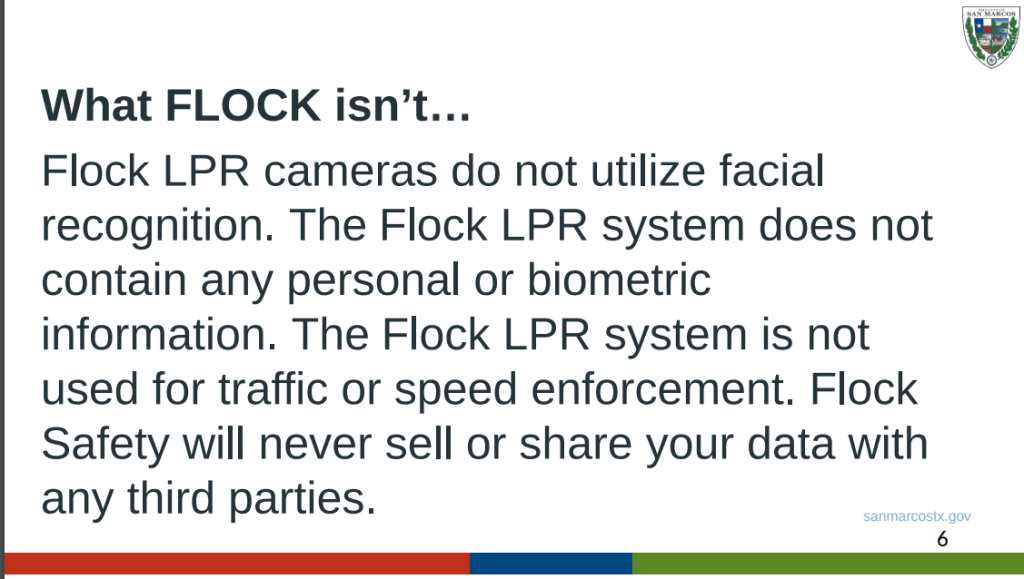
What is FLOCK?
So in other words, there are seventeen intersections in San Marcos that are recording your license plate every time you drive by. (And soon there will be thirty locations.)
So basically, SMPD owns the data, but it’s located on the FLOCK system. If you have a crime in mind, you log in and run a query, and then it tells you which license plates were at that location, or it tells you all places a specific car went, or whatever.
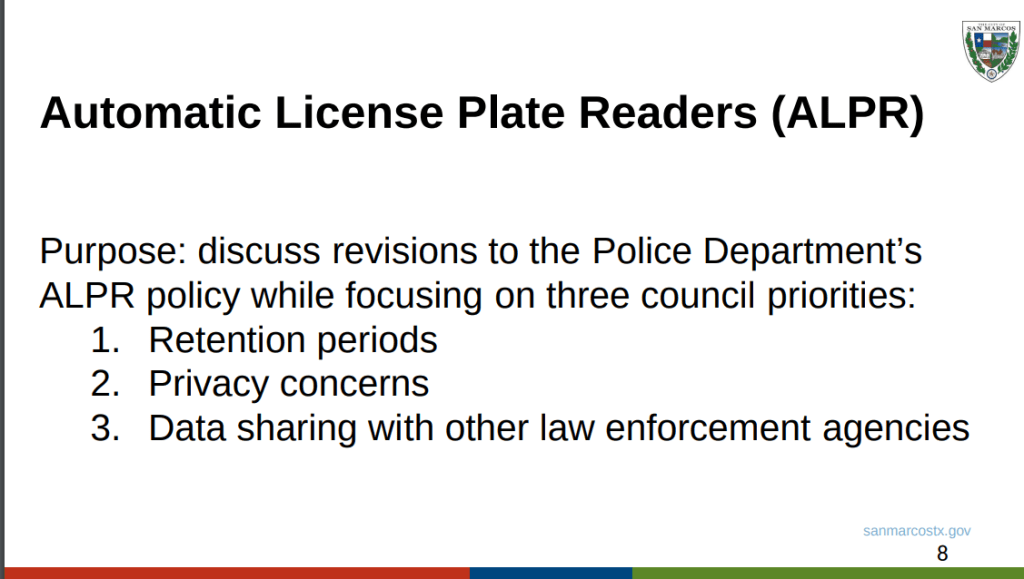
Council had three big concerns:
We’ll take these one at a time.
Retention periods: how long do they keep the data?
We’re currently 30 days, and Chief Standridge makes the case that we need to stay at 30 days.
There’s no slide for this part, but he’s basically saying, “People don’t report crimes right away. Sometimes the crime isn’t even discovered for a week or two. If you don’t have the crime reported for two weeks, that eats up a lot of your time to query the data base for the license plate.”
He had his crime analyst go back into the system and pull the average length of time people waited to report various crimes, in 2024 in San Marcos. He says:
Criminal sexual contact: average 513 days delay
Forcible rape: average 640 days delay
Credit card ATM fraud (ie, steal your wallet or purse from your car and go to the nearest ATM): delay of 103 days
Shoplifting: average 21 days delay. (This is because stores submit the theft to corporate, and corporate decides whether or not it meets the threshhold to bring in the local SMPD.)
I mean, ok. This makes the case that the cameras aren’t actually helping you solve most of these crimes, but point taken on the delay in reporting.
…
Onto 2: Privacy Concerns:
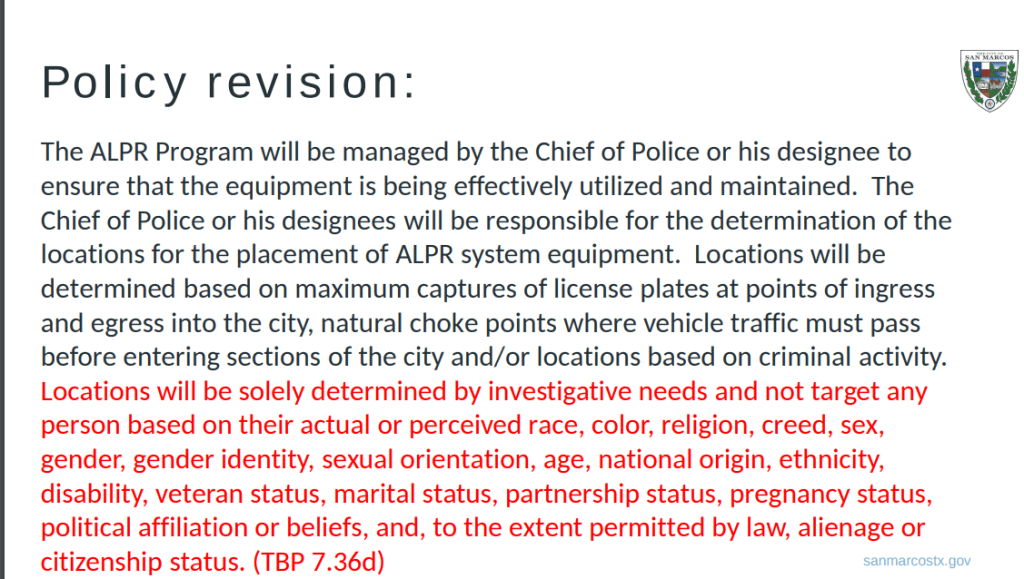
They’re proposing a bunch of amendments to current policy.
Great.
The “TBP” bit stands for “Texas Best Practices”, which is an accreditation thing.
Amanda asks if we can include “economic status” to the list of protected statuses? In other words, no targeting an intersection because it’s known that homeless people are camping near there.
Sounds great to me! Everyone is on board with this.
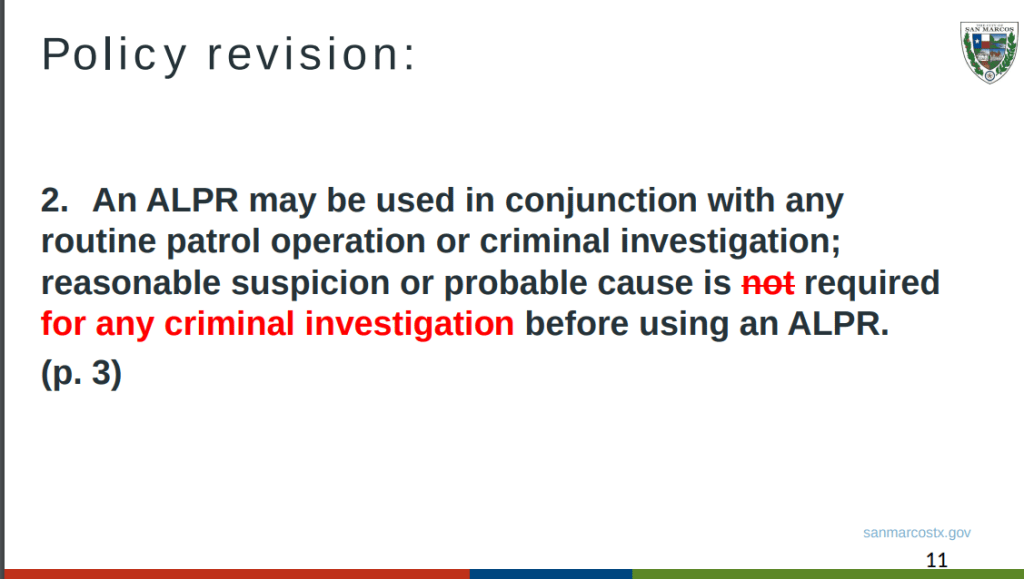
Next:
What the hell – until now, you didn’t need reasonable suspicion or probable cause to run a query?!
Anway, now you do.
There’s a bunch of details here!
You get regular training.
You have to supply a case number when you run a query.
Later on, someone else in SMPD will be double-checking all the queries to make sure they make sense.
SMPD will not give the data to any private entity.
These are definitely huge improvements.
…
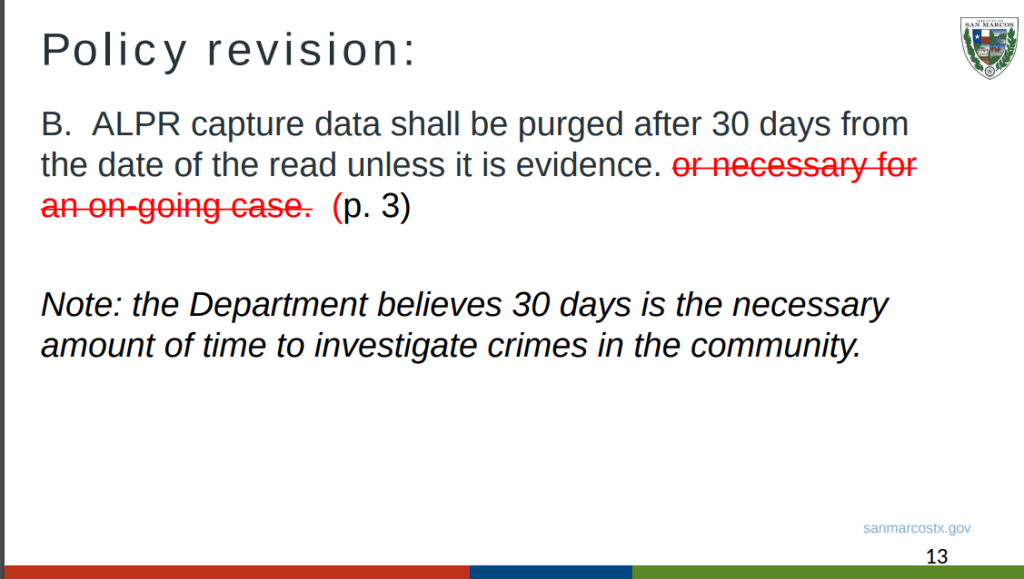
We’re sticking with 30 days, but we’re no longer going to grant exceptions:
3. Data sharing with other organizations:
There’s going to be an MOU, or Memorandum of Understanding. Any other law agency that wants San Marcos data has to sign this MOU.
The MOU isn’t written yet. But it’s going to require that officers in other jurisdictions follow all the same rules as us. Specifically, there must be a case number. You can’t just be looking people up.
And there will be a portal with general information available to the community.
Finally, misusing the system is a crime:
and you can get punished for it:
…
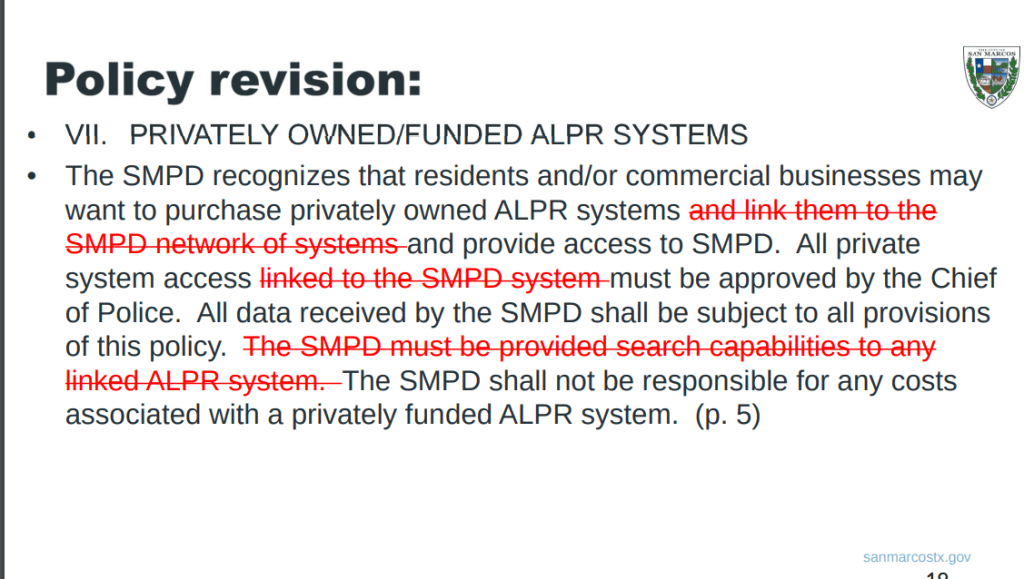
One weird thing about Flock Cameras is that anyone can buy them and join in. The outlet malls probably have them, your apartment complex or HOA could have them. Anyone who cares enough about who is coming and going can buy one.
Will we share our data with any old HOA or shopping mall?
Not anymore!! (But JFC, we sure used to play fast and loose with this data. The deleted part in red is wild.)
There’s some discussion of ICE in all this. We’ve opted out of immigration tracking. But there are some laws (SB4) which may or may not make this more complicated.
…
My opinion: These are really big amendments that make the system safer. I am still wary about license plate readers and Flock Safety, but this is at least much better.
There are two workshops: one very short and one very long.
Evoke Wellness.
Back in December, Council had a lot of questions for these guys. They offer mental health and addiction treatment for people referred over by the police. We’ve allocated 150K of Covid money for this. This is a follow up discussion with the director at Evoke.
Amanda: What’s it look like if you’re receiving services?
The director gives an extremely detailed answer!
Prescreen for eligibility. Detox? Residential? Intensive Outpatient?
Say we’re starting with detox. Then there’s an evaluation and intake process.
Then you’re seen by nursing staff to get orders from the medical director on the detox protocol, medication regimen
Detox lasts 5-7 days. Completely voluntary. You’re free to leave at any point.
Residential: 21-28 days. Could be detox and then residential.
In the residential part: first there’s a biopsych-social assessment: trauma history, drug use history, family relationships, everything. You need a full picture to treat the whole person.
Clinical team and medical team working together to monitor the patient 24/7.
During the day: like school, 6 hours a day. Learn about substance abuse and mental health conditions, tools, coping skills to hopefully achieve longterm sobriety.
Breakfast, meds, 9:30-5:30 programming, community involvement with 12-step panels holding meetings with clients.
You also get a therapist and case manager. The case manager will help with the discharge process.
Therapist meets weekly and as needed.
6 hours/day of group therapy.
Longer lengths of stay produce better outcomes. Typically 28-35 days.
Discharge plans: typically clients take the clinical recommendation for a sit down placement in a PHP (partial hospital hospitalization) – lower level of care, higher level of freedom, and so own down the levels of care.
Amanda: How often is the intake the first time the person’s ever run through their trauma? Answer: Depends if they’ve ever had treatment before. Could be first time, could have relapsed.
Amanda: Typical client to staff ratio? Answer: 8:1 ratio, plus nursing staff and on-call medical director and leadership team.
Amanda: On the discharge plan: If you don’t want to go through everything, can you still get a discharge plan? Answer: Yes. And if they won’t accept the discharge plan, our case managers will help connect them with resources that work for them.
Amanda: What about people that are indigent? How does medication work upon discharge? Answer: For all clients, detox meds are covered for free, for 5-7 days. They are responsible for their medications, but if they have no resources, we will keep providing it. The discharge coordinator will work with them to find the community resources to stay on their medications.
Alyssa: Last year, I asked for info about Evoke. They were in the process of getting a mental health license – did that happen? Answer: We are licensed for co-occuring disorders. There must be substance disorder with a mental health disorder. Actually pretty rare to have a substance issue without a mental health issue, so this is pretty much all our patients. We do not currently serve clients that only have a mental health issue and no substance abuse.
Alyssa: This helps San Marcos? Chief Standridge: The goal is jail diversion. We’re using funds from both San Marcos and Hays money. If they have insurance, we use that first. If they’re indigent, we try to use our funds. But only if they’re residents of San Marcos.
Everyone is really pleased by the high quality of the answers given by the director.
Alyssa: I’m very hopeful? There’s a lot of structural root causes and obstacles that have to be overcome, and we have to think about those when it’s time to budget. And the public defenders office has been really helpful in locating resources. But I am anxious about the rise in need for support services. We’re setting people up for failure if we don’t supply resources.
Shane: I’m tickled to death! How it all came together, as a team.
(This is Covid money, so we’ll have to figure out how to fund it going forward.)
…
Workshop 2: SMPD. This is a 2 hour presentation!
This is SMPD’s opportunity to put their best foot forward. This is a description of all the trainings and guard rails in place at SMPD. Everything is couched in really positive terms – “Do we make mistakes? Sure! But we then unpack it and learn from it.”
This isn’t bad! It’s totally fine. It’s what any other department would do. However, a police department requires an extra level of skepticism, because of the sordid history leading up to this moment in time.
Usually I’d use Council questions to look for cracks in the presentation. But they ran out of time, because the council meeting starts at 6 pm.
So this is a very glowing presentation, without any opportunity to give a counter-narrative. Anyway, I’m just the messenger. Don’t shoot me.
…
Chief Standridge came here four years ago. We’re kind of summarizing the internal protocols that he’s implemented over this time.
There are five different speakers.
Speaker #1: Internal changes
“ABLE” stands for Active Bystander for Law Enforcement. This is basically like “Friends Don’t Let Friends Drive Drunk.” How do you create an environment where cops will tattle on each other?
The goal is for the consequences of not intervening to be bigger than the consequences of intervening. They do some training around interventions as well.
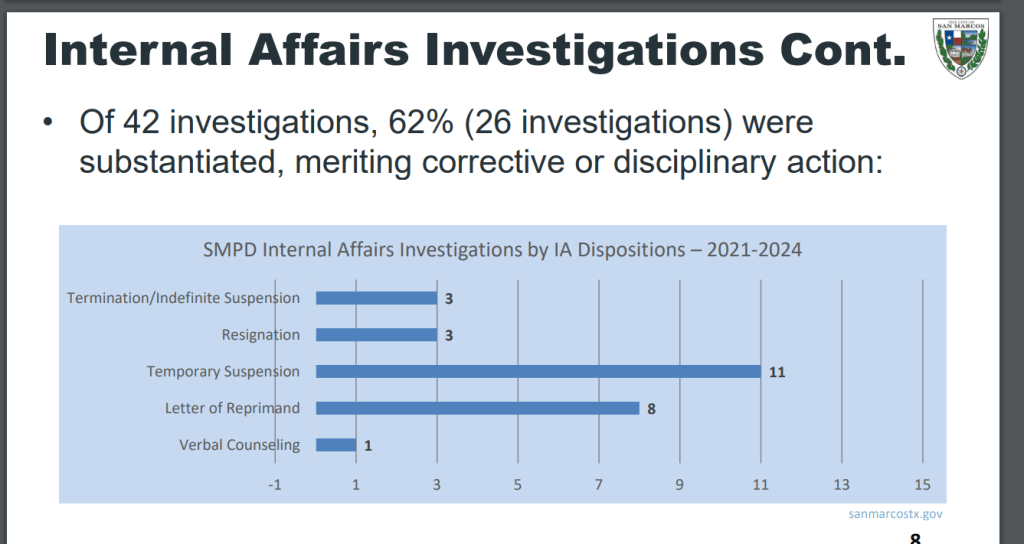
Here’s how many internal cases they’ve dealt with:
I mean, it’s absolutely impossible to interpret this. Is this a lot, or a little? How often are incidents going unreported? Would I agree with the outcomes if I knew all the details of the incidents?
There’s no way that PD could answer these questions! But it also means that we can’t really makes sense of this data.
It’s like if five people go to the doctor for measles, and the doctor treats three of them, and diagnoses one with allergies and one with mumps.
That doesn’t tell you much about the number of measles cases in the rest of the town
It also doesn’t tell you if the doctor is making correct diagnoses
Both those things would be much harder to figure out.
Here are the investigations that were found to be substantiated:
In 2021, we had one IA investigator. Now we have four. So that definitely helps have more eyes looking out for bad behavior.
…
The Event Review Board
The Event Review Board reviews every incident, use of force, pursuit, and preventable accident. They try to see what the department could change to reduce these events.
It’s a broad group of people and they’re supposed to look at any potential event, no matter how minor.
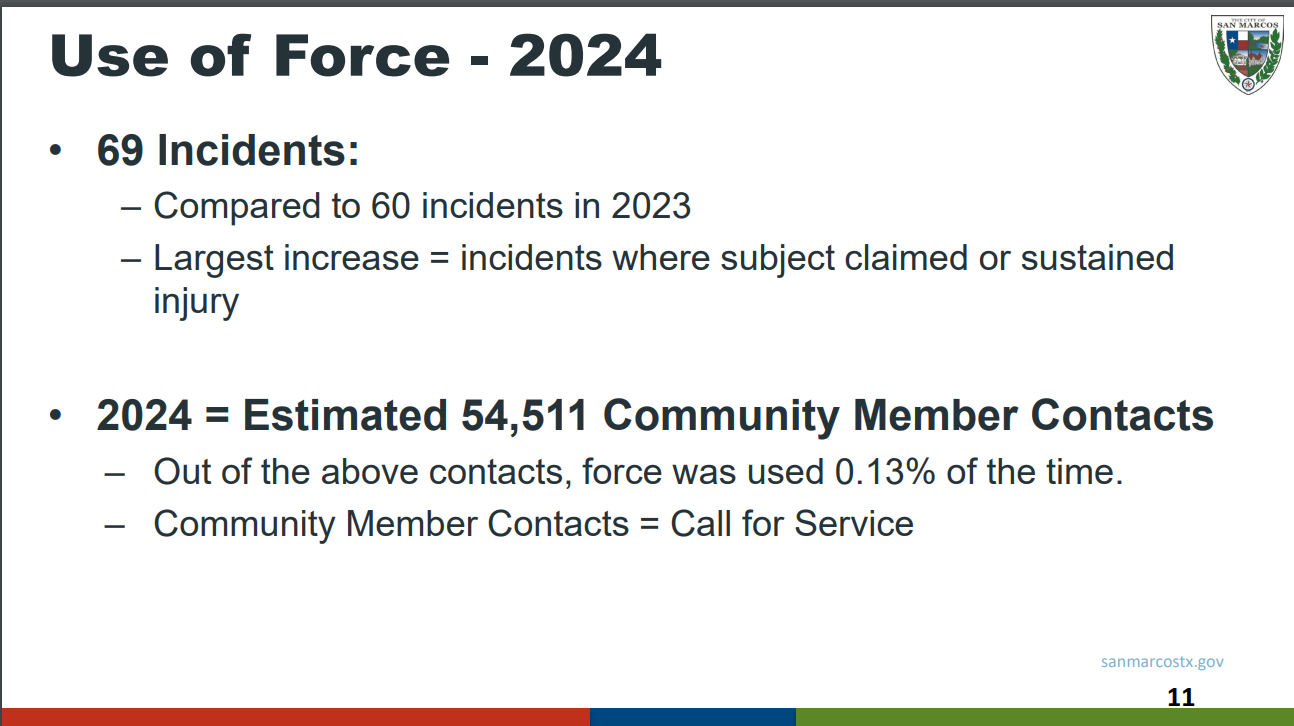
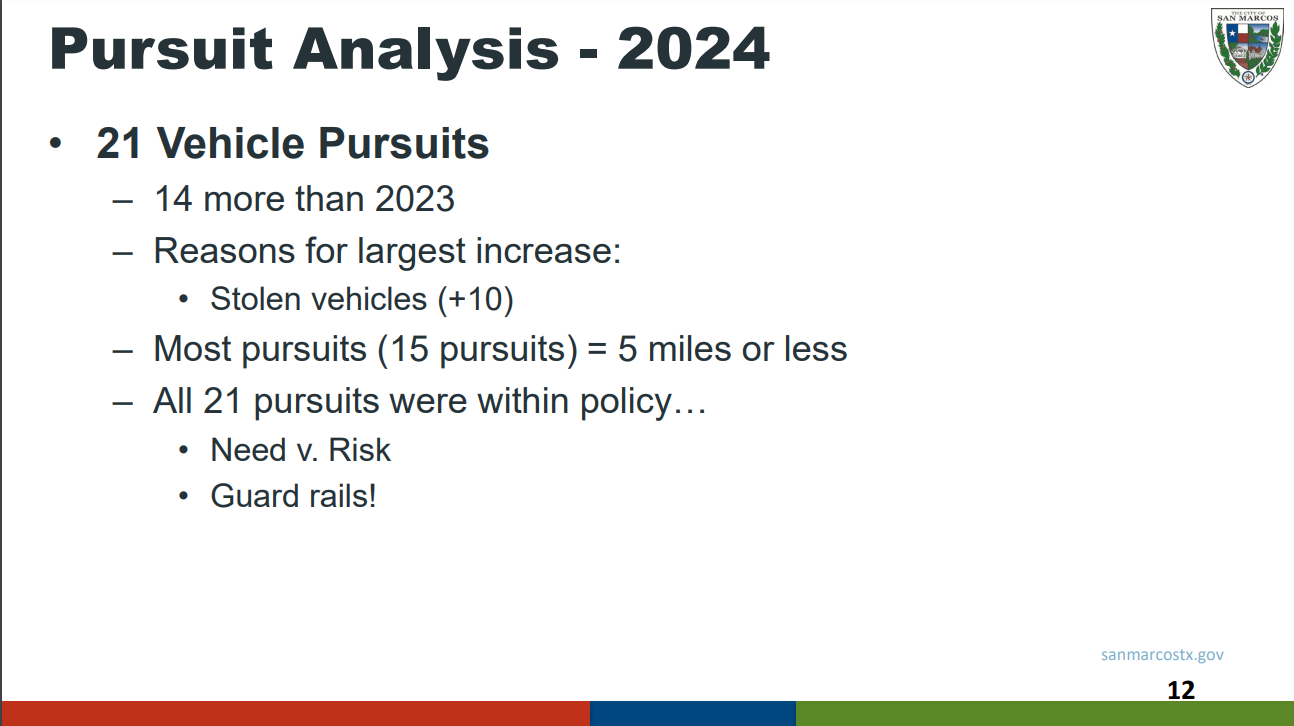
Some data:
Again, I just don’t have enough context to make sense of these numbers.
The speaker might have said given good context! But this was a three hour presentation, and if she did, I didn’t jot it down in my notes.
Also:
None of these were available last April, when Malachi Williams was killed. Alyssa brings this up.
Amanda asks about the costs of these?
Taser 10: $343K for 123 officers, or about $2789 per officer, per year. (Includes the Taser 10, body cameras, unlimited video storage, training, and software licensing.) BolaWrap: $1,299.99 each, and $38.99 each for cartridgets 40 mm foam bullet launcher thing: $1,273.50 each
I don’t know if each officer gets each thing, but that would come to $5362 per officer. With 123 officers, it’s about $660K.
Look, I want the officers to use less lethal force. I’m just pointing out that SMPD spends bigger sums of money, and they do it much more quickly and easily than any other department.
…
This next thing is actually really great.
Suppose you stop someone and they don’t speak English. You open up this Voyce app, and there’s a live translator. You pay by the minute.
Notice they can provide sign language as well. (But it only works if officers remember that people can be deaf. This would not have helped John Kelley, the deaf man that was tased in 2019 for not responding when SMPD told him to stop.)
The speaker says that there was one time that they needed a Mandarin translater at 3 am. This is pretty invaluable for that. (It was originally designed for the medical community. Seems invaluable there, too.)
This app doesn’t help you figure out what language the other person is speaking though. You have to use google or something.
That was all the first speaker!
…
Next speaker: Accreditation
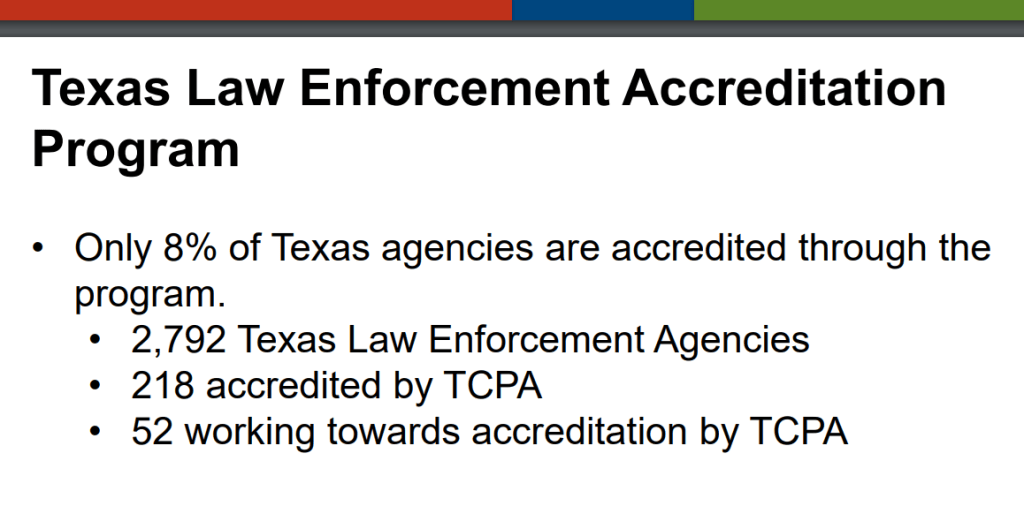
So I guess not all the PDs are accredited, but now we are?
We’re not there yet, but we’re working towards it.
Basically you have to come up with policies that satisfy the agency in these areas:
You have to show compliance with 173 best practices.
(This meeting was the day when it was super windy and there was all the spooky smoke and dust hanging over the city. Everyone’s alarms kept going off for the evacuations up in Kyle.)
Anyway, it sounds like it’s a ton of work:
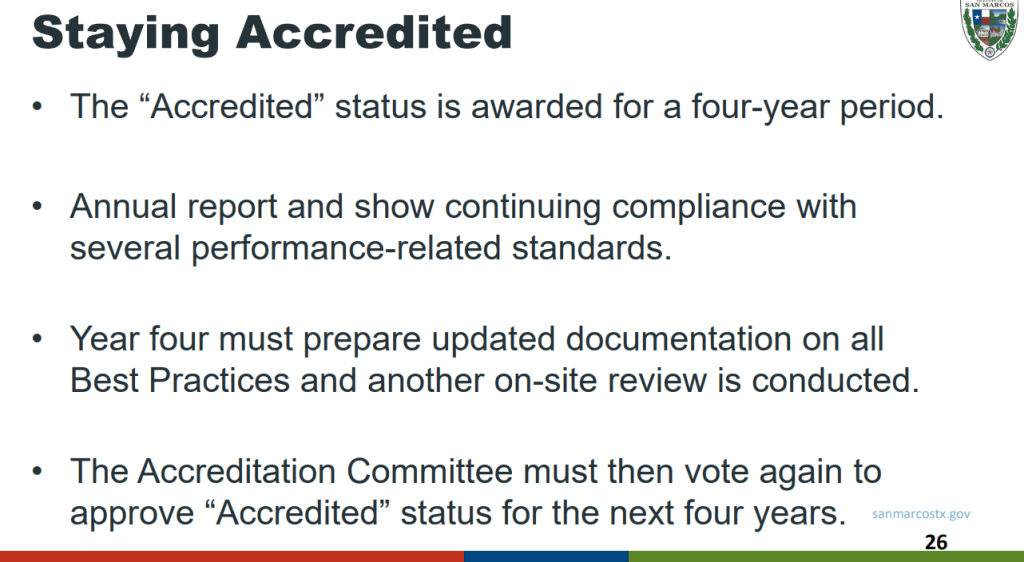
And then you have to stay accredited:
…
Onto the next speaker!
This one is super interesting – it’s on our 911 call center.
Basically, there’s a nationwide shortage of 911 dispatchers. We used to have 9 vacancies. We filled over half of them, and we’ve got a current batch of highers to fill the rest.
What happened is that we started paying a reasonable salary, and got a reputation as a good place to work. So we’re in a much healthier spot now.
911 callers also have language barriers. Instead of the VOYCE app, they use something called CyraCom:
Alyssa points out that this happened in the original 911 call involving Malachi Williams. The caller only spoke Spanish. While they were connecting with CyraCom, there was just this awful dead silence, where the caller had no idea whether or not they were going to get any help.
Alyssa suggests having a few pre-scripted lines like, “One moment while we connect with a translator” or something. This is a great idea.
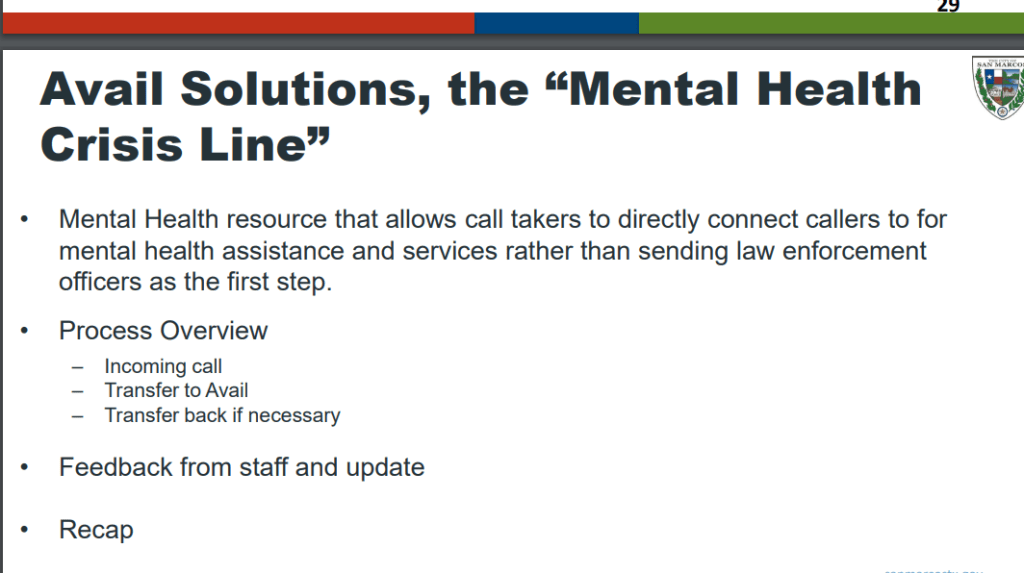
We’re also trying a new program:
This is a program where they transfer mental health calls out to trained mental health providers, who will connect the person with local resources, or stay on the line and talk the person through whatever’s going on.
They can also transfer the call back to 911, if they think we need to send out an emergency response, after all. The responder then goes right out, because the call is already in the system.
They’ve been doing it since November. It turns out that most of the calls do come back to us, after all? And we end up sending someone out. It’s a work in progress!
…
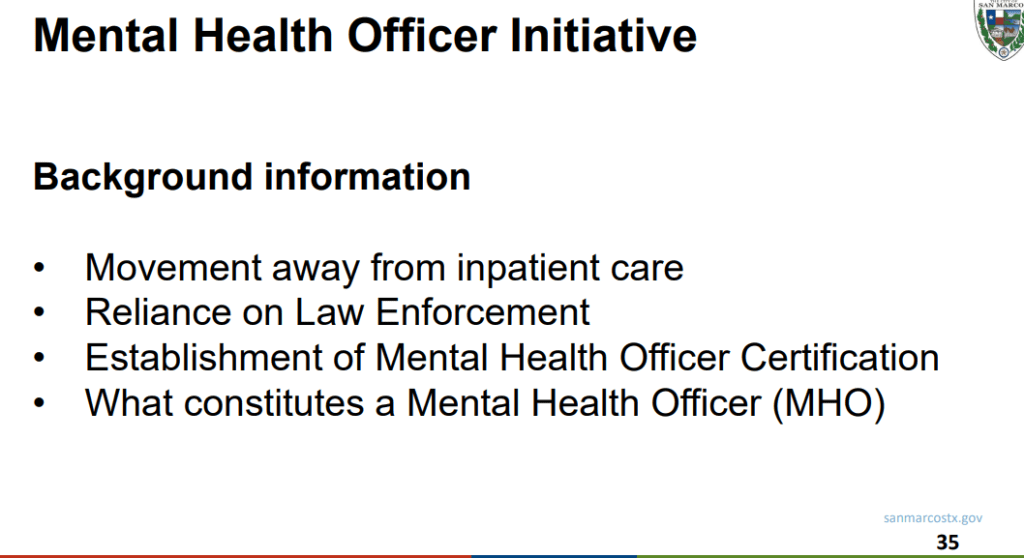
Next speaker! The SMPD Mental Health Unit.
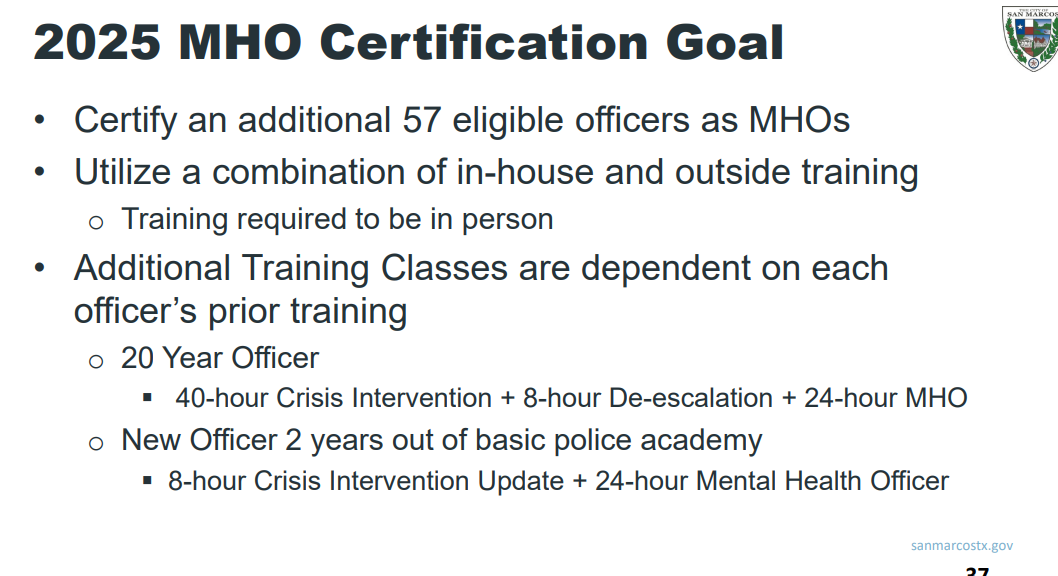
I don’t know what the training to be a Mental Health Officer really means. Is it a course? Is it multiple courses? Is it like a Master’s degree? Are you supervised by a mental health professional?
(I’m sure I could look it up, but I’m just trying to first get this whole entry out on time.)
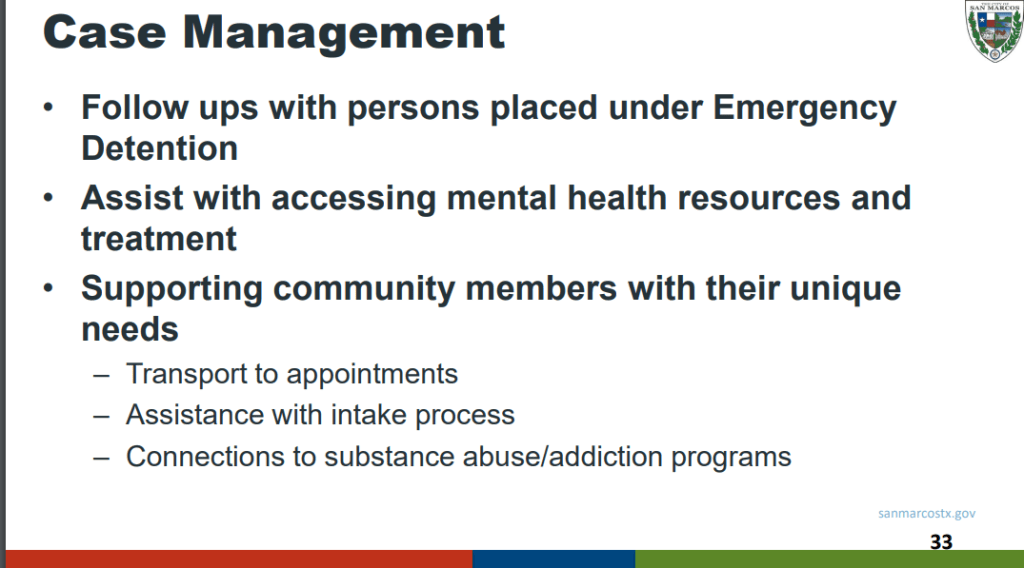
It sounds like they do good things: they sit with people who are scared and nervous before testifying or going to court. They get food boxes from Hays County Food Bank if someone needs it. They’re generally problem-solving and checking in on people’s well-being. They will sometimes stay with someone for months, making regular follow ups to help manage someone’s care.
Here, have some data:
An “emergency detainment” is if someone is an immediate danger to themselves of others. They try to avoid doing that, though. It may mean taking them to an ER or a substance abuse facility. (But not jail.)
…
Next speaker! What comes next with Mental Health Officers?
Here’s what the state is doing:
It used to be that officers had two options:
Take someone to an emergency room
Take someone to jail and go through courts.
Now we’ve got more options. The state created a big Mental Health Officer framework in 2015.
Here’s what we’ve got so far:
Here’s what we’re aiming for:
…
Next speaker! Context of Crime.
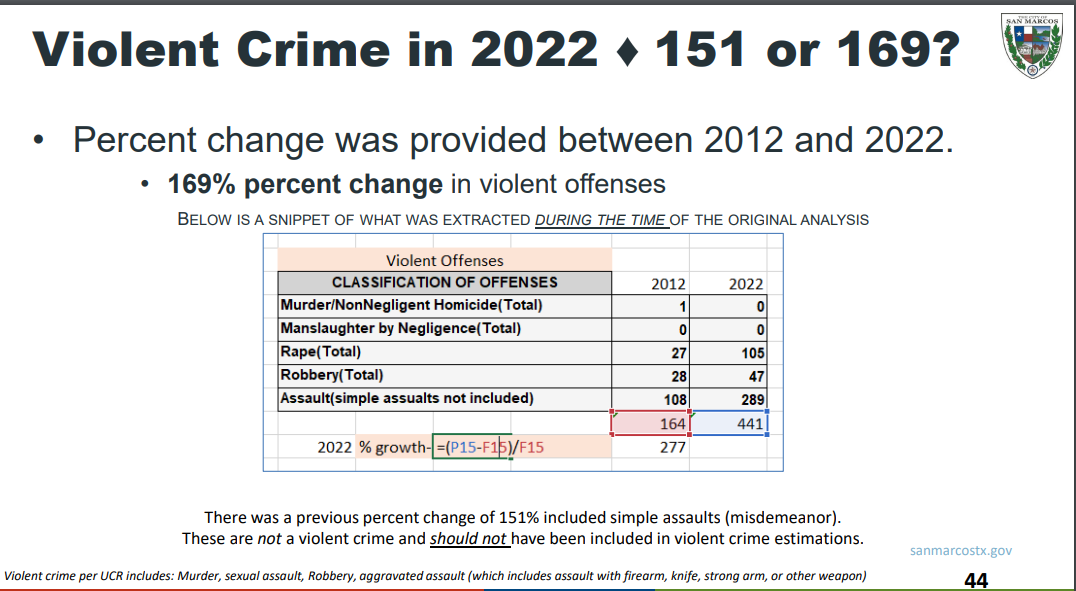
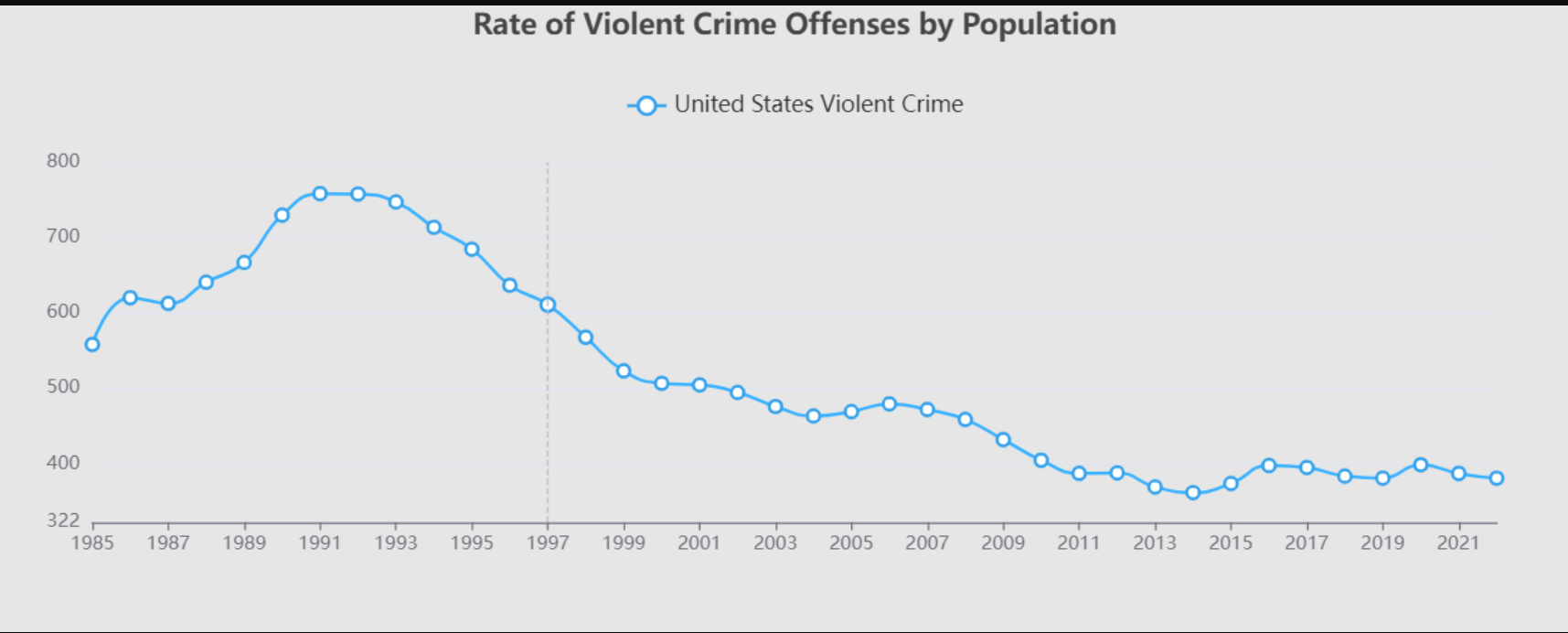
We report crime in two ways:
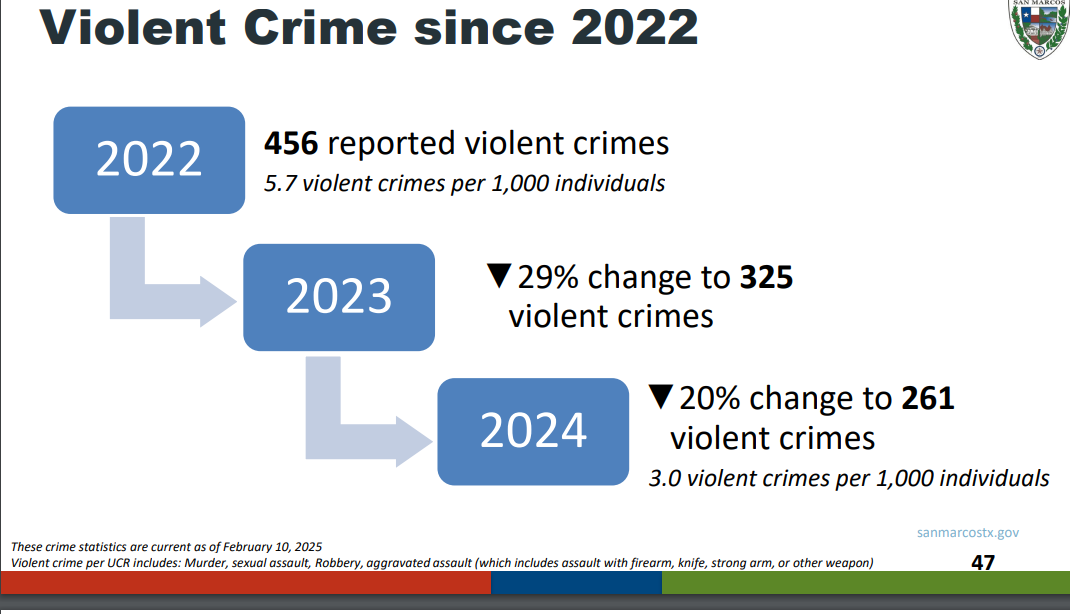
We are transitioned in 2018/2019 from UCR to NIBRS, which is better data. But any longterm comparison requires UCR data.
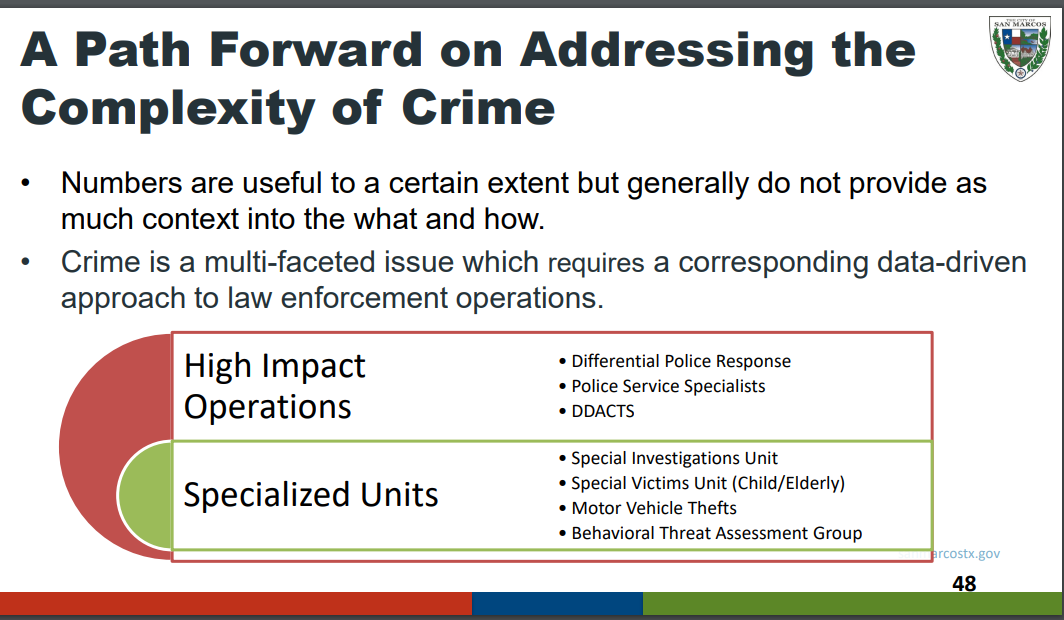
This recent data also corresponds time-wise with Chief Standridge arriving in 2021. So we are simultaneously implementing new strategies:
There’s a special victims unit:
They partner with Hays-Caldwell Women’s Shelter.
…
Next up is Chief Standridge! He is very apologetic.
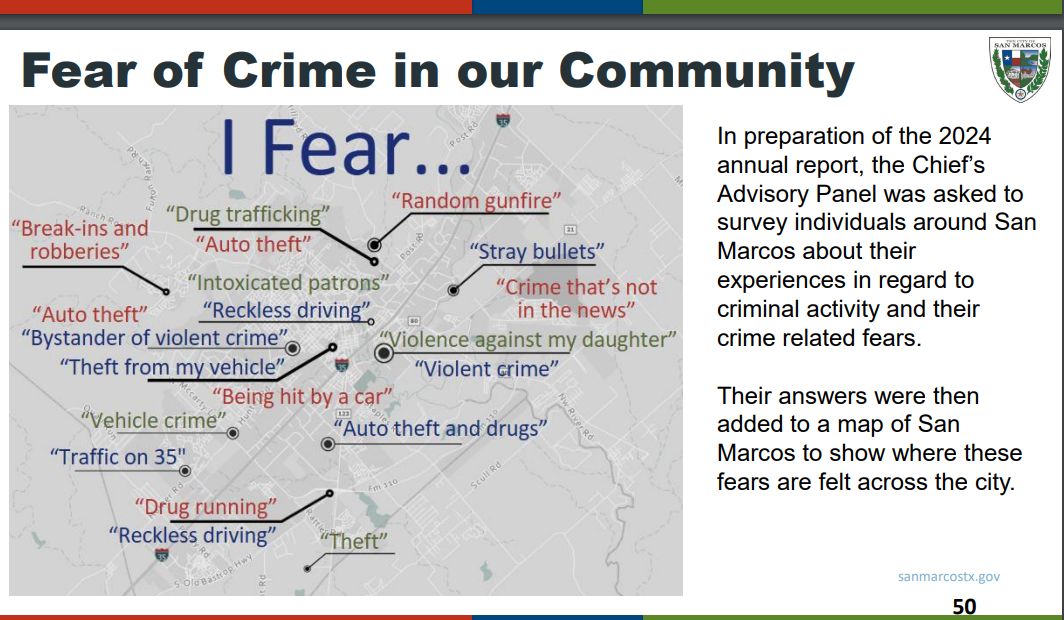
There is a specific Chief’s Advisory Panel. In order to get community feedback, they drew up some questions about the public’s crime-related fears.
The plan was for everyone on the panel to chat up their neighbor and get some informal feedback. Max Baker offered to digitize the survey and share it with the San Marcos Civics Club.
When staff got the responses, they threw out anything that didn’t seem relevant to the question at hand. Chief Standridge is extremely apologetic to this. He apologizes profusely and specifically to Max and the public.
Here are the remaining answers:
He promises to get the full data, including the extra answers, out as quickly as possible.
(My personal answer is car crashes on I-35. That terrifies me.)
…
By this point, it is 5:30, and the looming 6 pm meeting starts to take over the presentation.
Councilmembers have lots of questions, but there’s not really time for them.
…
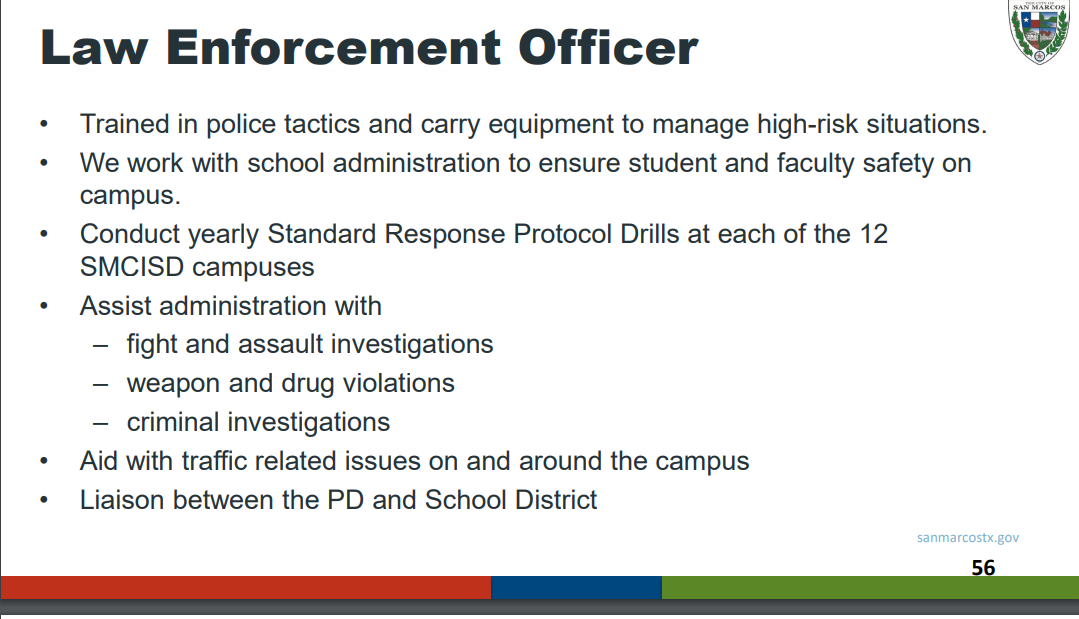
Next presentation! School Resource Officers.
SROs are supposed to be three things: Counselor, educator, and law enforcement:
But not these things:
We have five total:
We’ve been doing this since Columbine, and most of the community is pretty happy with it:
…
Back to Chief Standridge:
He sums up with this program for the next year:
At this point, they are almost out of time. There are slides on the Marijuana Decriminalization Dashboard, but he doesn’t get to them. But it’s all publicly available here.
































































































.png)