
Citizen comment:
One speaker!
Max Baker, organizer of the San Marcos Civics Club: We’ve been trying to put people on boards and commissions. But the city website has a lot of problems, like:
– HSAB still says they meet Thursdays, 2 months out of the year. They actually meet Wednesdays for longer than 2 months.
– the online calendar is out of date on library meetings
– etc
SMCC told the city about these details back in 2023, and they’re all still problems.
(Max is definitely a details guy.)
…
Workshop 1: Budget Update
Next year’s budget it chugging along! It takes 9 months to birth a budget:
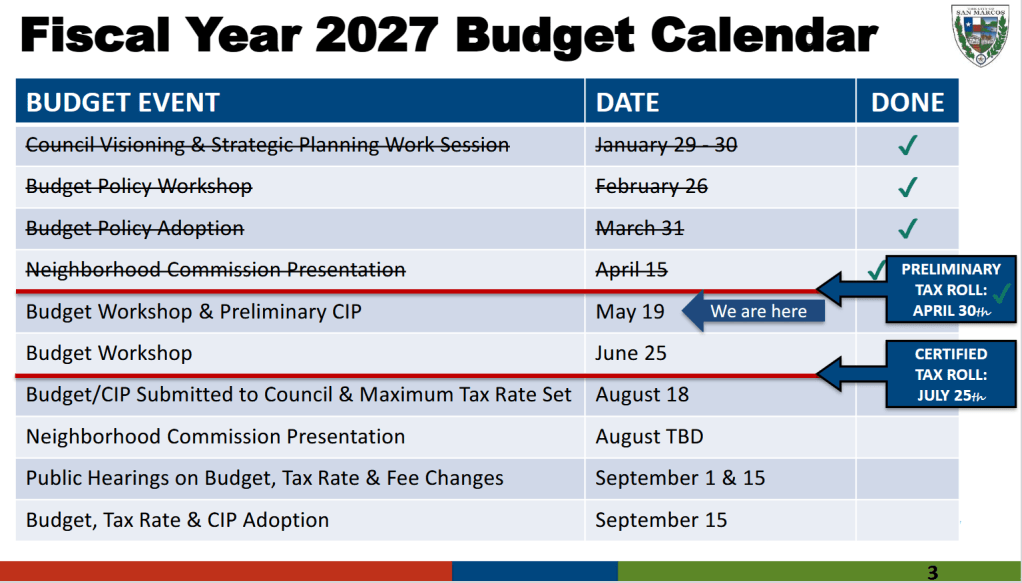
Our little budget fetus is about 15 weeks old. It’s the size of an avocado.
…
So how does it look?
First off, San Marcos is growing:
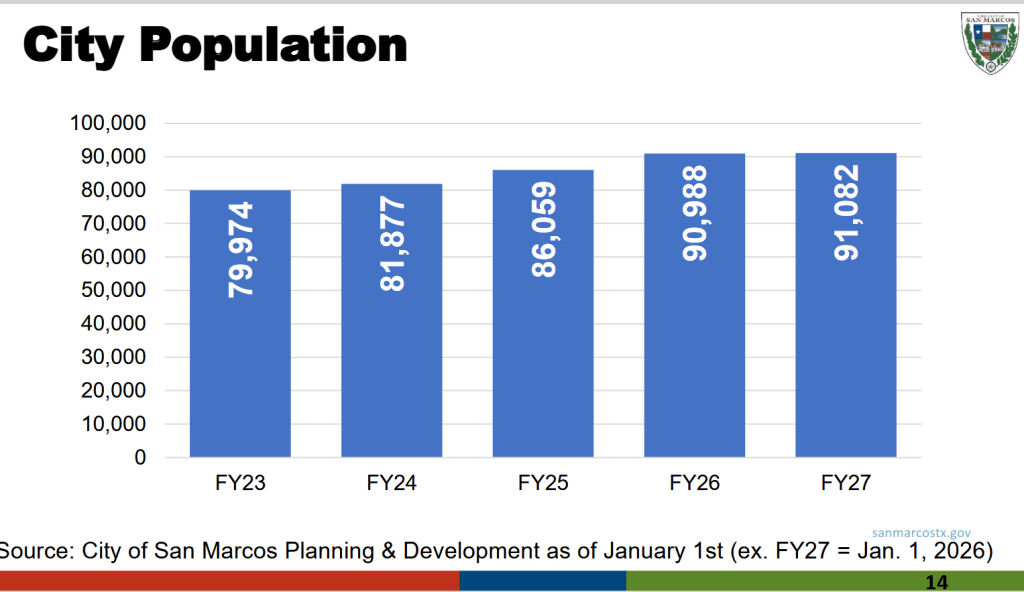
Our budget has not been keeping up.
This is city spending, per resident:
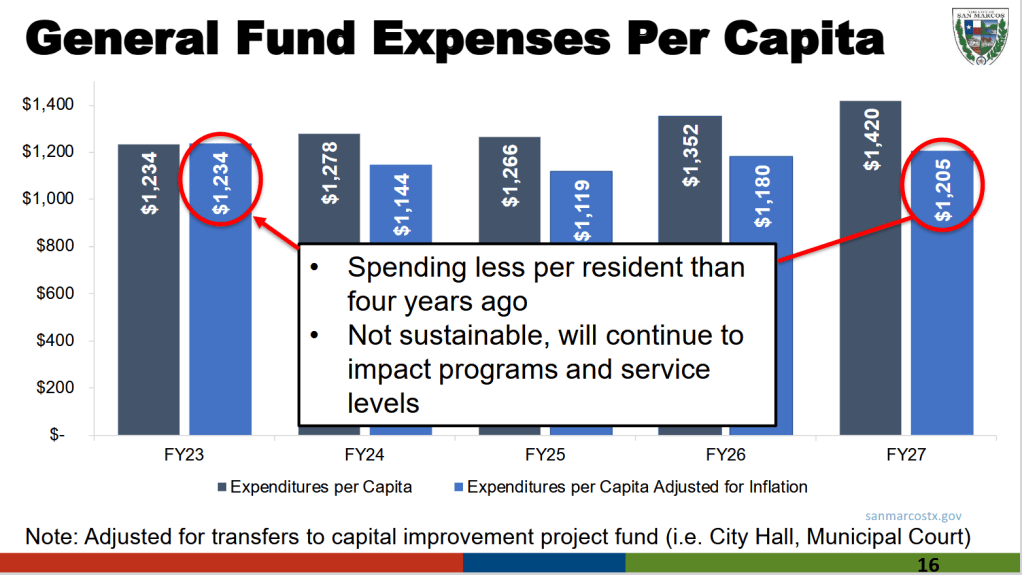
So we’ve had a balanced budget, but we’re stretched more thin than we were a few years ago.
…
What’s the revenue look like next year?
We get two kinds of revenue:
- Sales tax
- Property tax
First, sales tax:
We’re up from last year.
- Last year, we pulled in $ 22,567,986 by this point in the year.
- This year, we’re at $23,442,368 so far.
That’s great! It’s also good because we had about 1.5 years of declining sales tax, so it’s good that we’ve finally turned that around.
I am just including this slide because I was entertained by how incomprehensible it is.
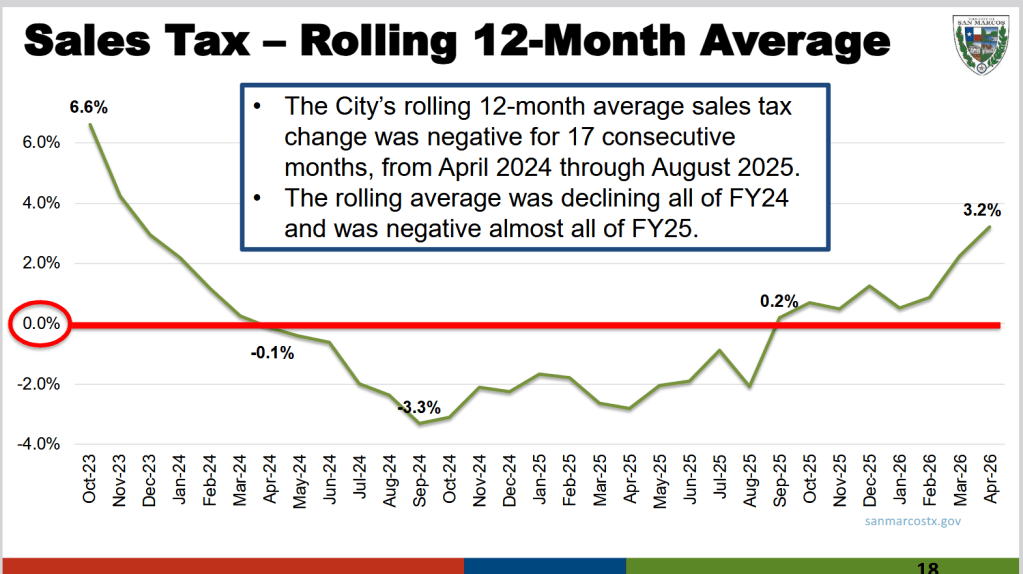
It’s labeled as though it’s giving you the revenue from sales tax, smoothed out using a 12-month average. But that’s not at all what the graph is showing! The graph is showing the rate of change of the rolling average.
[Confidential to staff: Yes, yes, you’re very smart. But listen: no one wants to wrestle with the graph of the first derivative! Put the calculus away, and just show the actual rolling 12-month average sales tax graph.]
On to property tax:
Property tax value also went up! But in an uneven way.
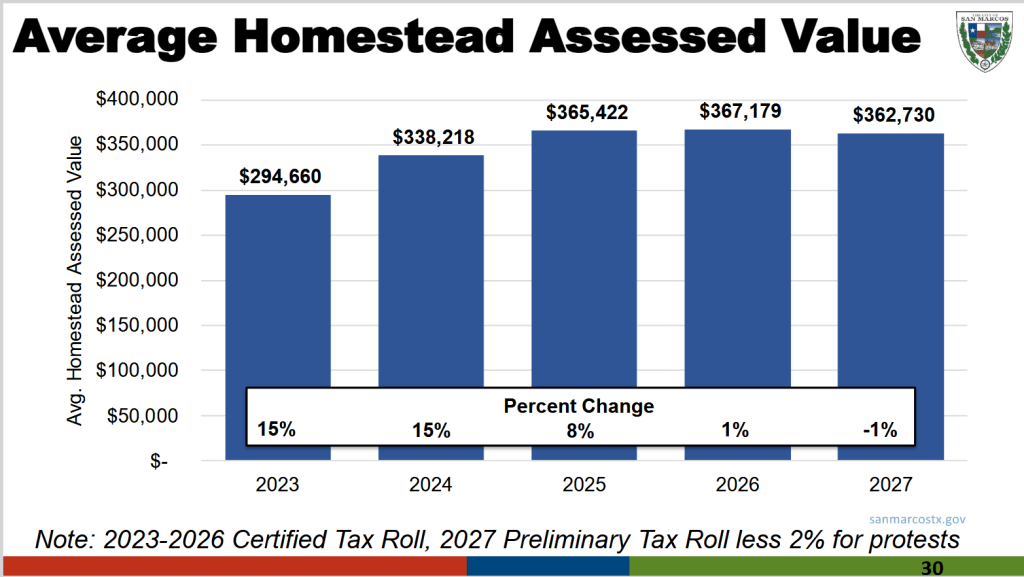
First, home values went down a little:
But there were new builds, as well:
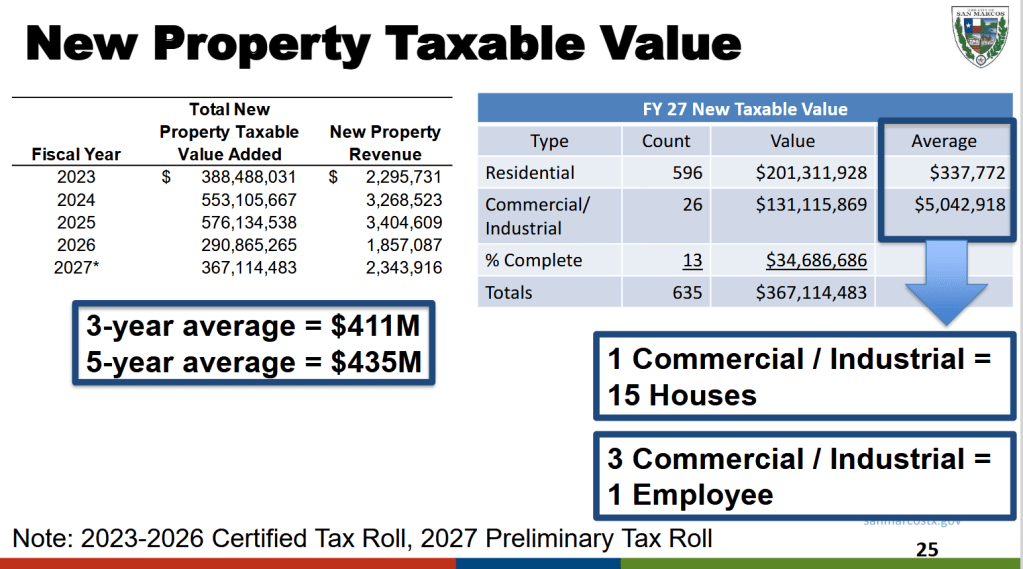
About 2/3 of the new value comes from residential, and the other 1/3 comes from commercial.
So the total of all property value in San Marcos went up a little bit. Not a ton, but a bit.
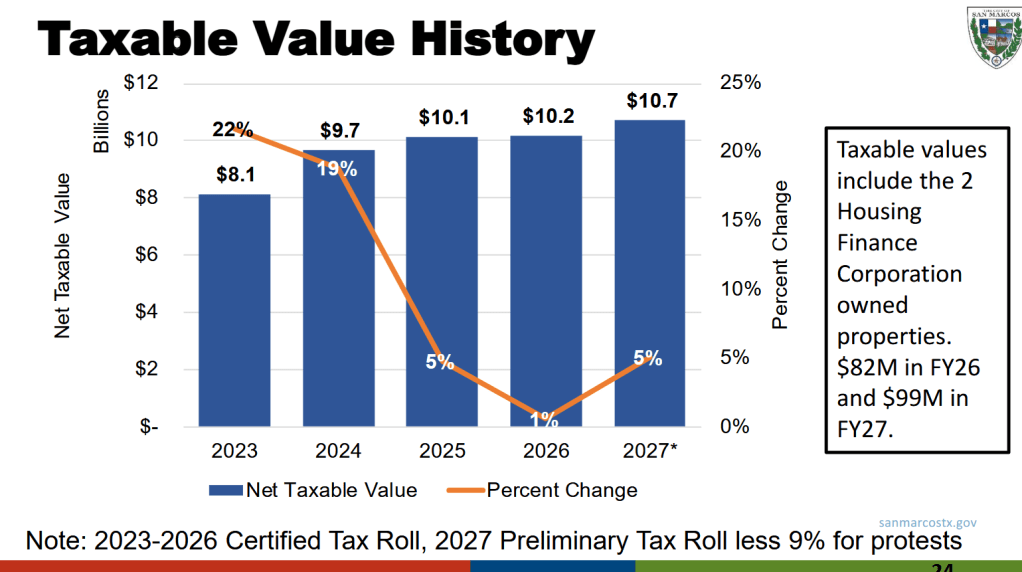
So we’re also expecting a little more in property taxes.
….
Overall, we think we’ll have a little more breathing room than we thought we would.
Here’s where we thought we were at, back in February:
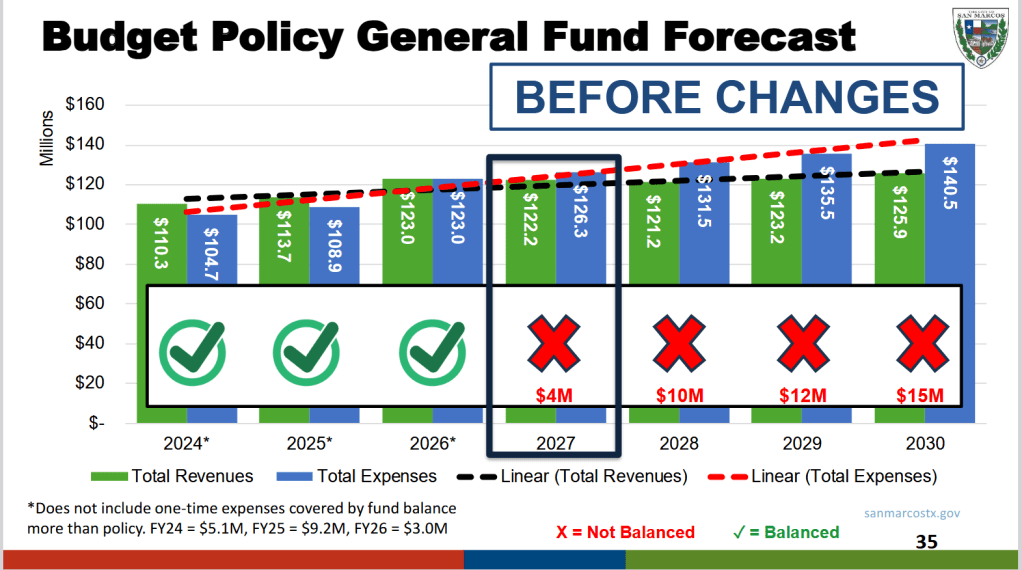
And here’s how the revenues and expenses have changed since then:
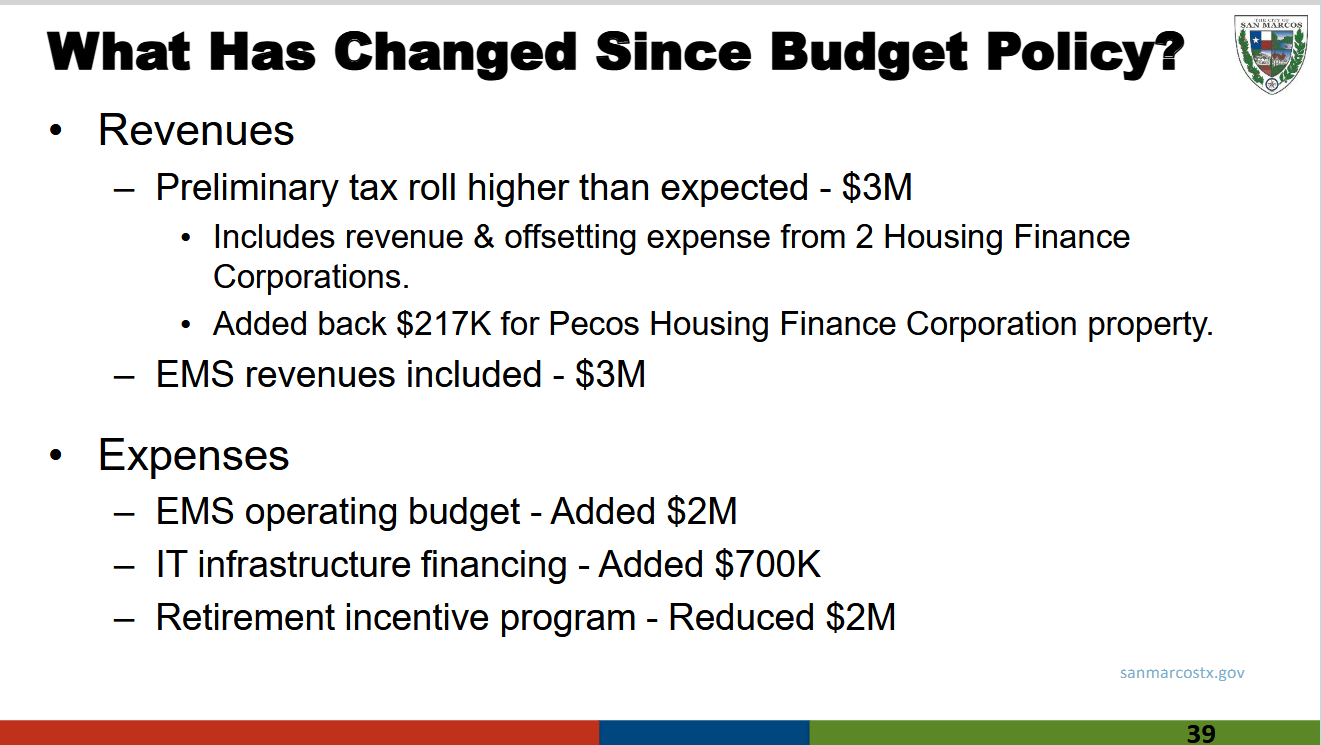
and here are the main budget cuts that we have made:
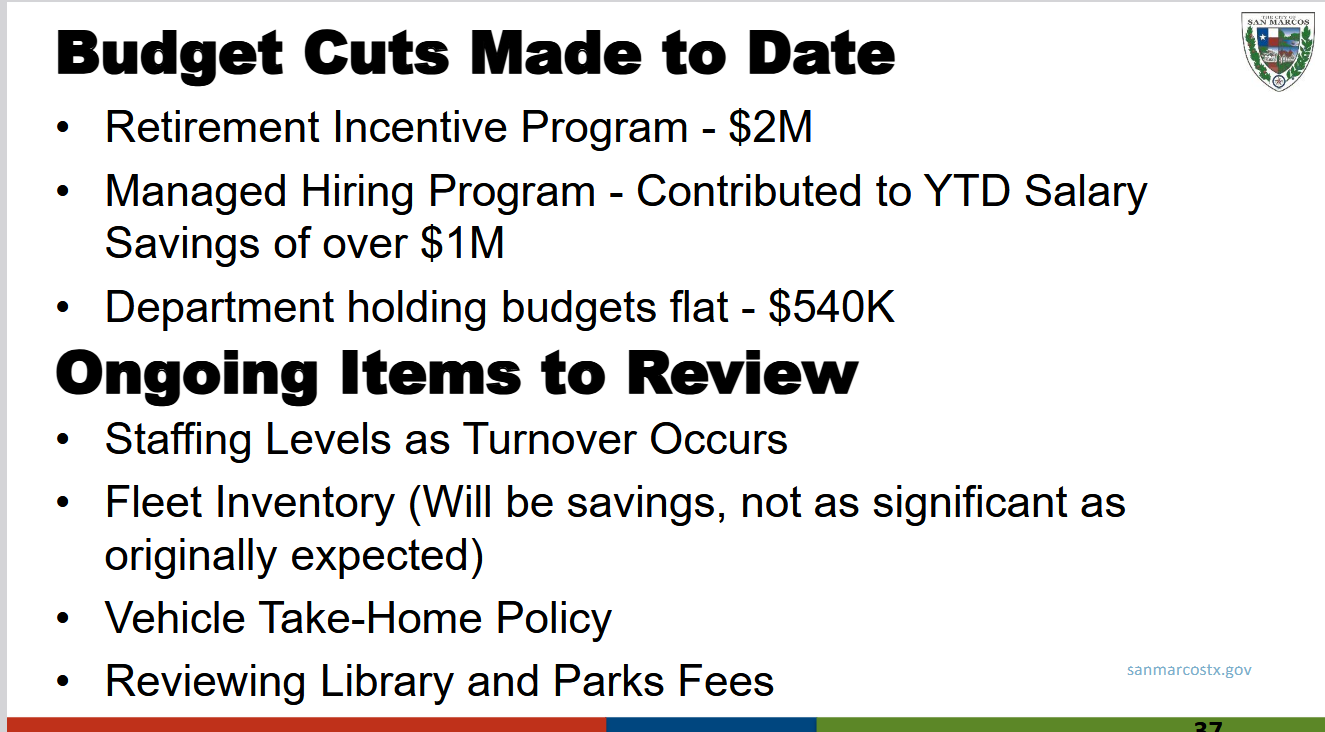
And there are still a lot of unfunded needs:
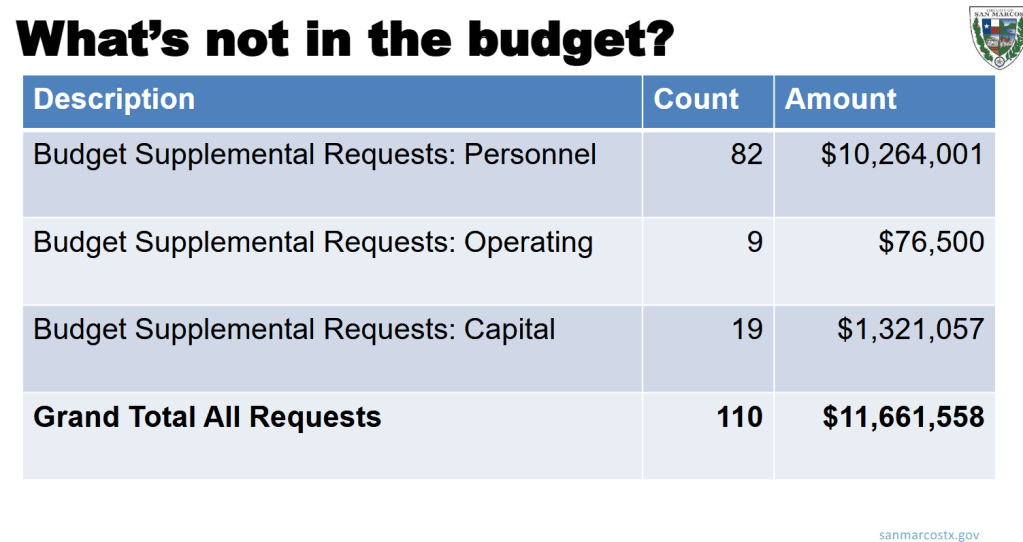
As they say, nothing is more expensive than deferred maintenance.
But nevertheless, all of that taken together probably gets us to a balanced budget this year:
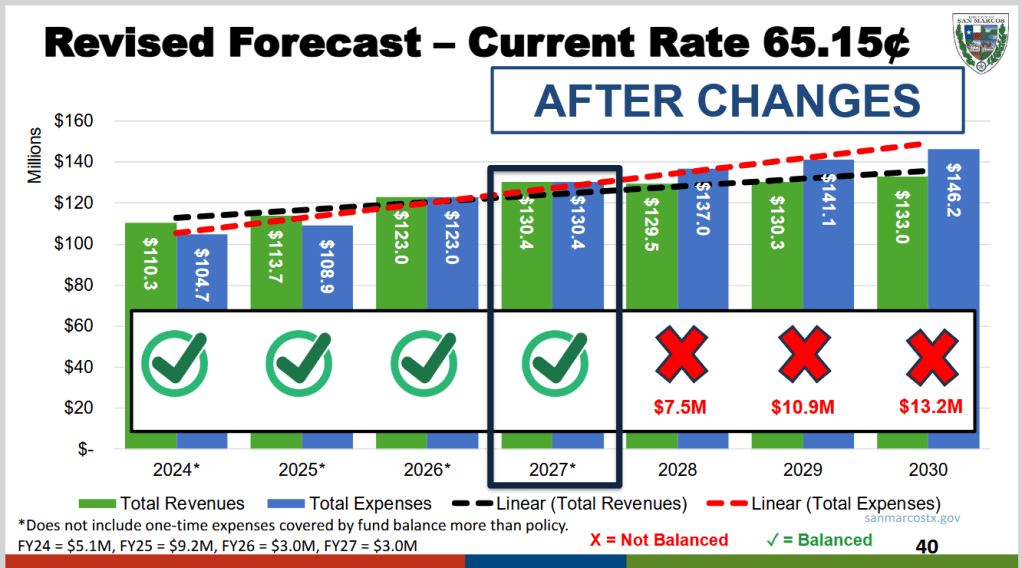
This is great!
Now, there’s still a looming $7.5 million budget hole in 2028. But we’d be okay in 2027.
…
Amanda: Our fees increase incrementally every year, so that no one ever gets walloped with a giant increase. Have we applied that philosophy to property taxes? A very small, regular increase, to prevent a giant shock?
Answer: No one answers this.
Although no one said so at the meeting, the answer is definitely “yes, we should”.
Tax hikes are unpopular! People are broke. Better not to shock everyone’s budget, but still show fiscal responsibility.
…
Also in the first workshop, two small unrelated items:
Announcement #1: Community Benefit Charge:
If you’re getting a city utility bill, there’s going to be a new line, called the “Community Benefit” fee:
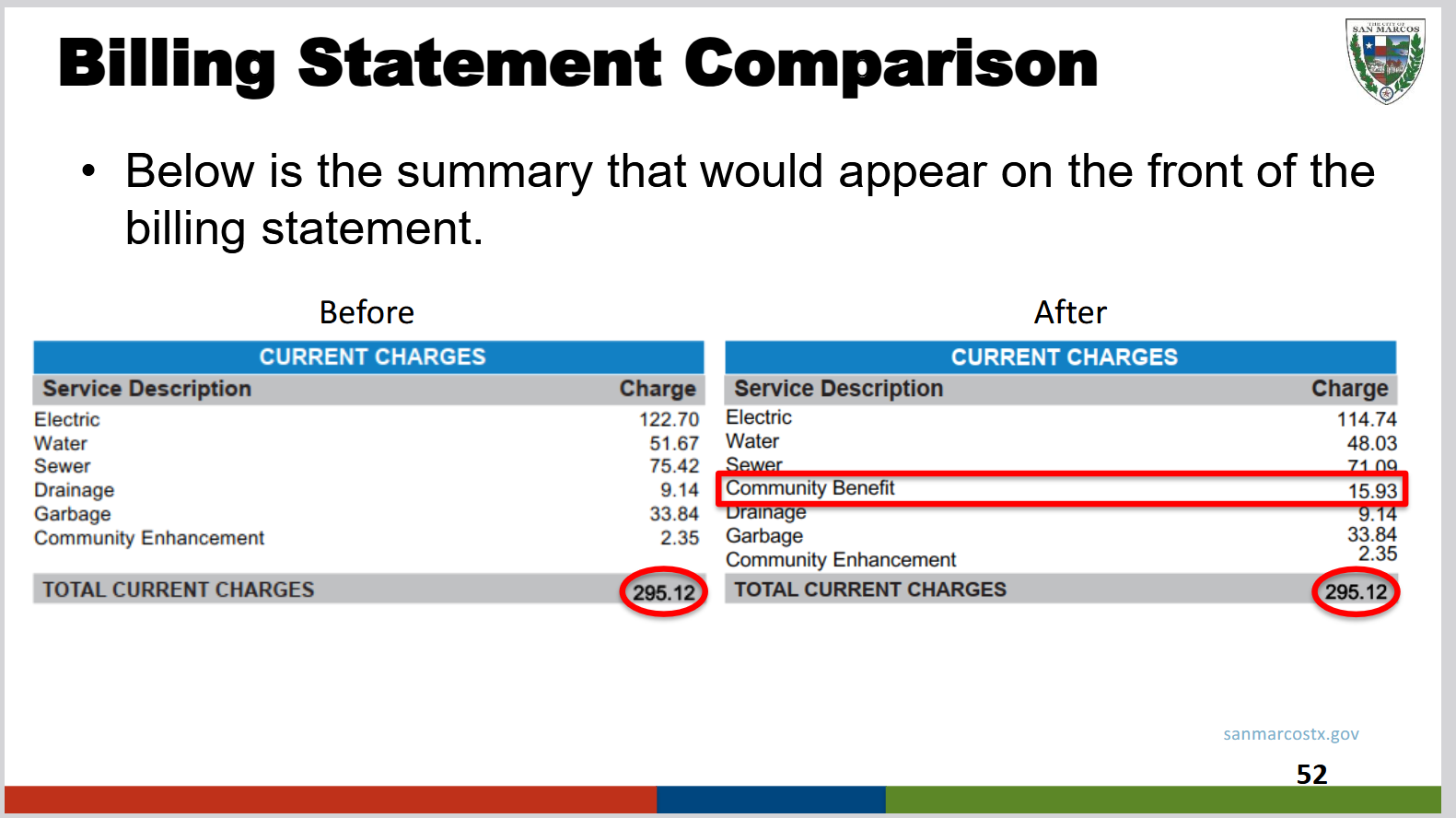
You’re not paying any extra money, though. It used to be rolled into the other charges, and now they’re itemizing it.
Then when you go to look at the details, you can see exactly what’s getting covered in the Community Benefit charge:
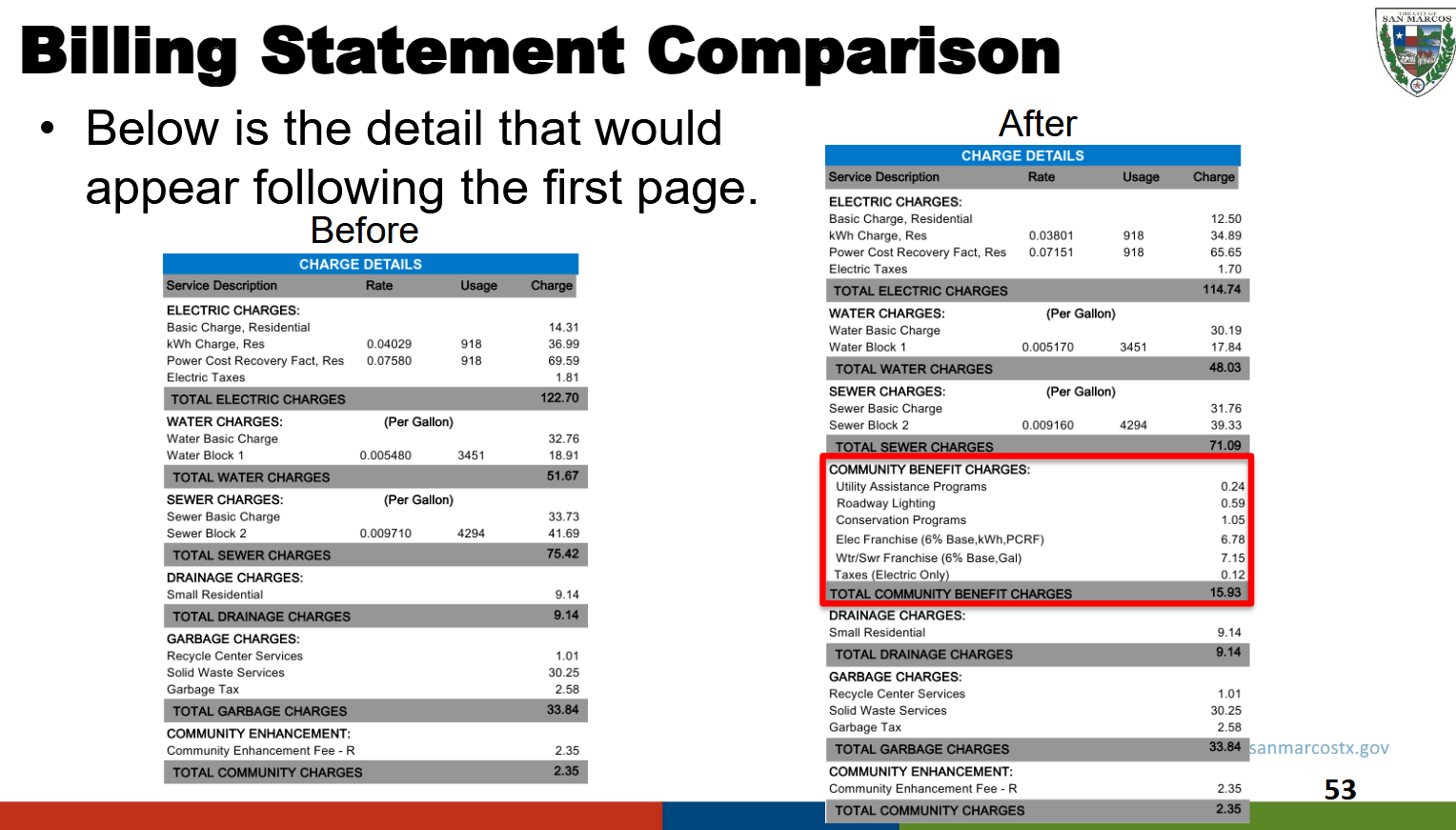
Council is worried about how to explain this on a large scale so that no one freaks out. How about a mailer inside of all the envelopes?
Josh: How about a QR code right on the bill?
Answer: Maybe!
Announcement #2: Destination services:
The Convention and Visitor Bureau wants to rebrand itself as “Visit San Marcos!”
Great. Done.
…
Workshop 2: Utility assistance program
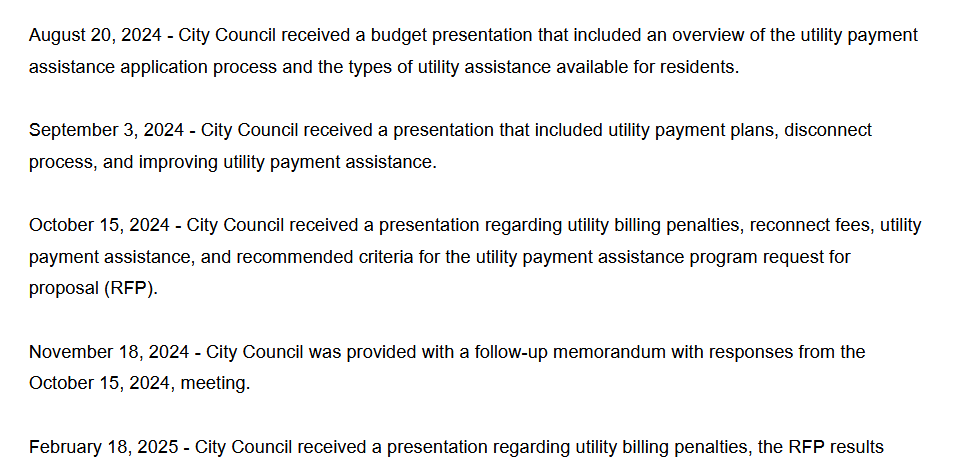
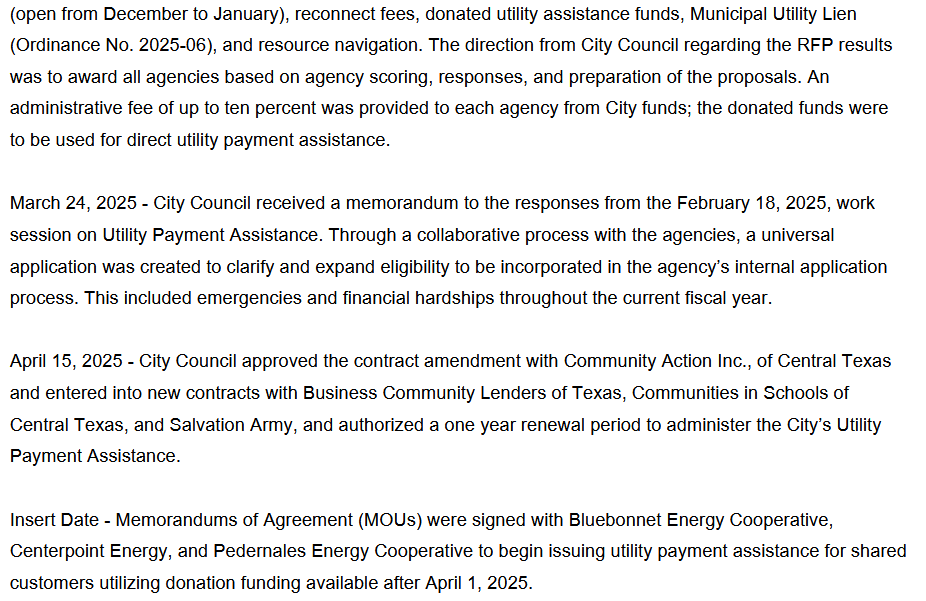
This has been going on a LONG time:
…
Basically, we had a pretty big utility assistance program, but people kept getting disconnected anyway. And we had $45K in customer donations, but it never got spent helping people.
This is mostly because we were giving the money to Community Action. Community Action is a great organization! But not a good fit for utility assistance.
The problem is that Community Action gets federal money, which means they require a massive amount of paperwork from anyone who needs assistance. They can get you help in six weeks, but by then, your power might have gotten shut off a month ago.
Alyssa was really the driving force in reforming this. She kept drilling down into the details over and over again, until the program finally started to work.
So here are some of the changes:
In 2025, council decided to give money to three more groups for utility assistance:
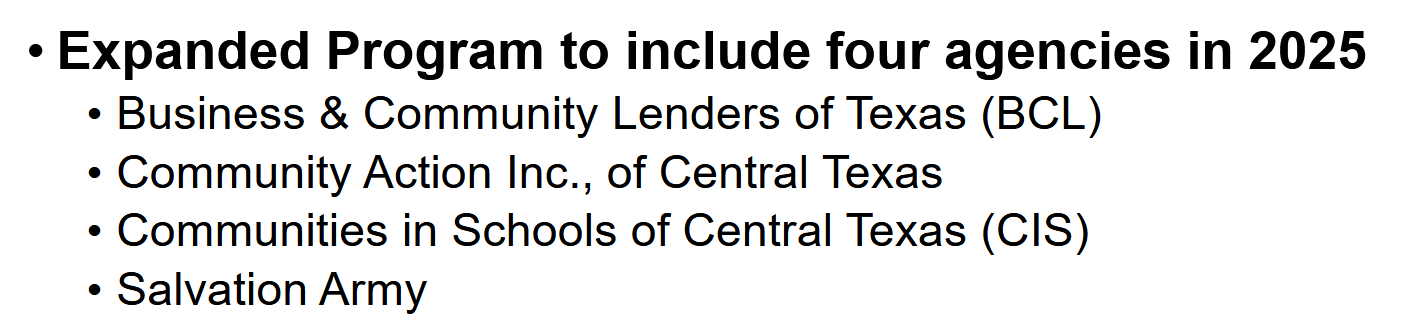
This is great! Those other three organizations can hand out money on a quick turnaround.
A bunch more improvements:
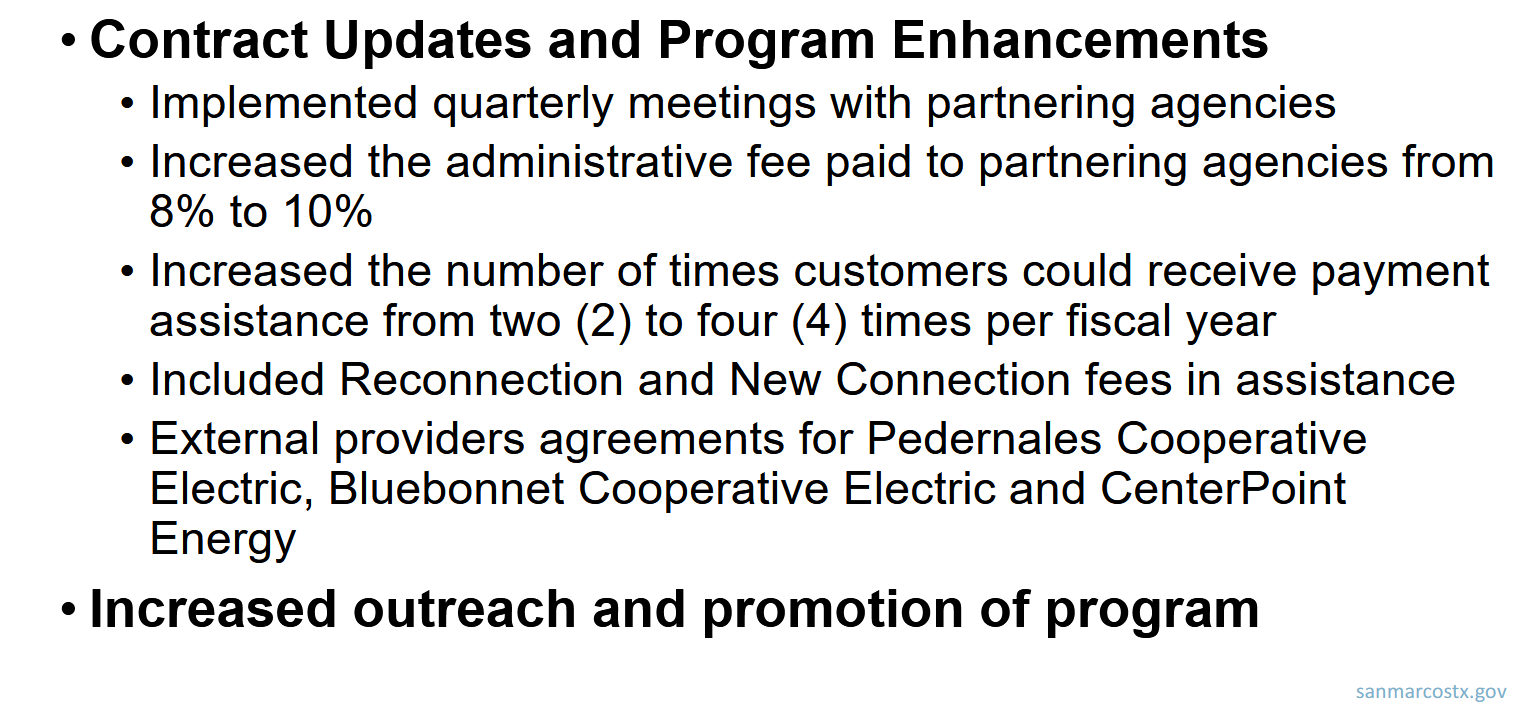
Great.
Here’s some nitty-gritty on how it gets administered:
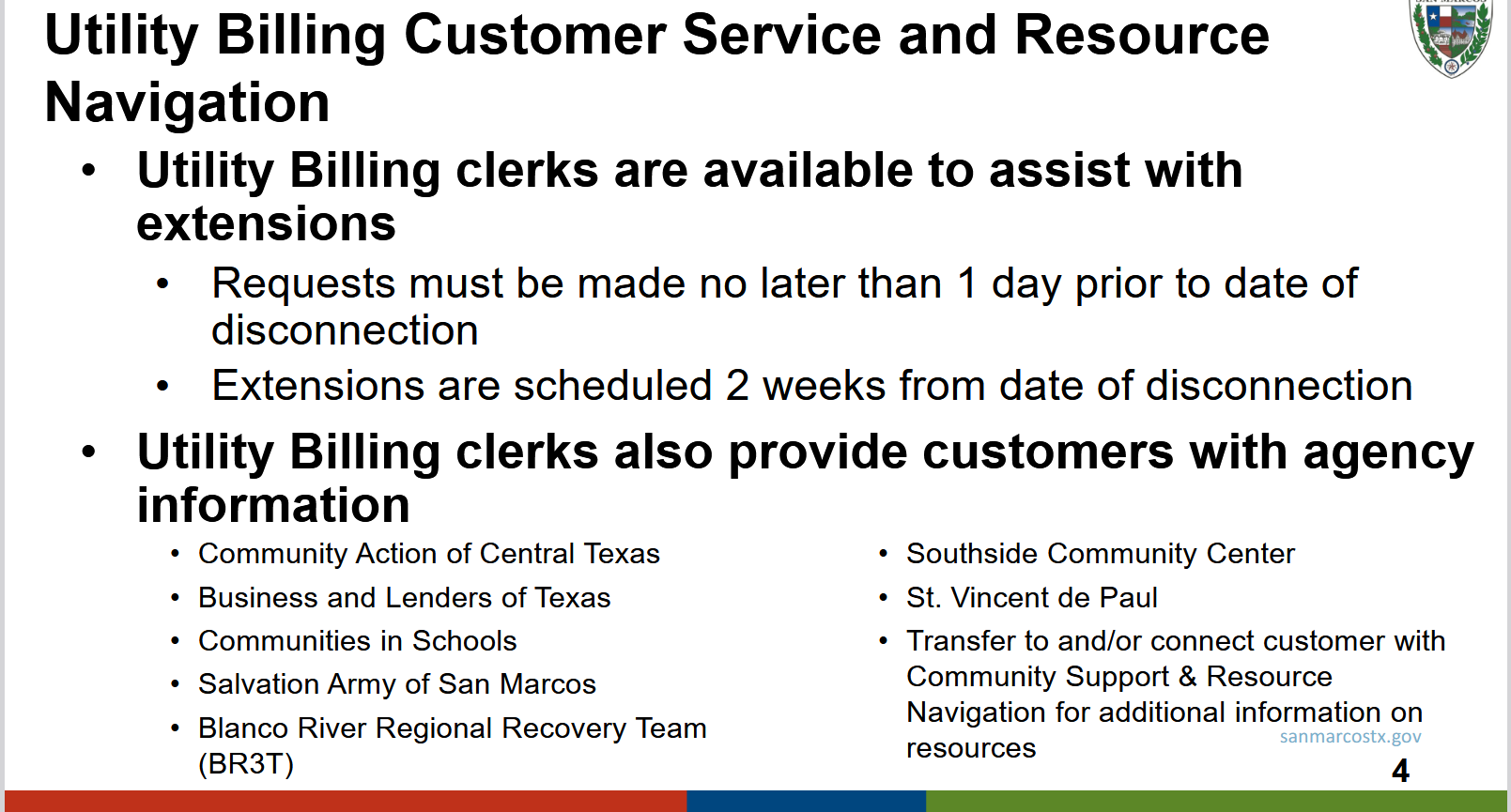
Basically everyone who needs help gets sent somewhere.
When they do have to disconnect utilities, they avoid certain situations:
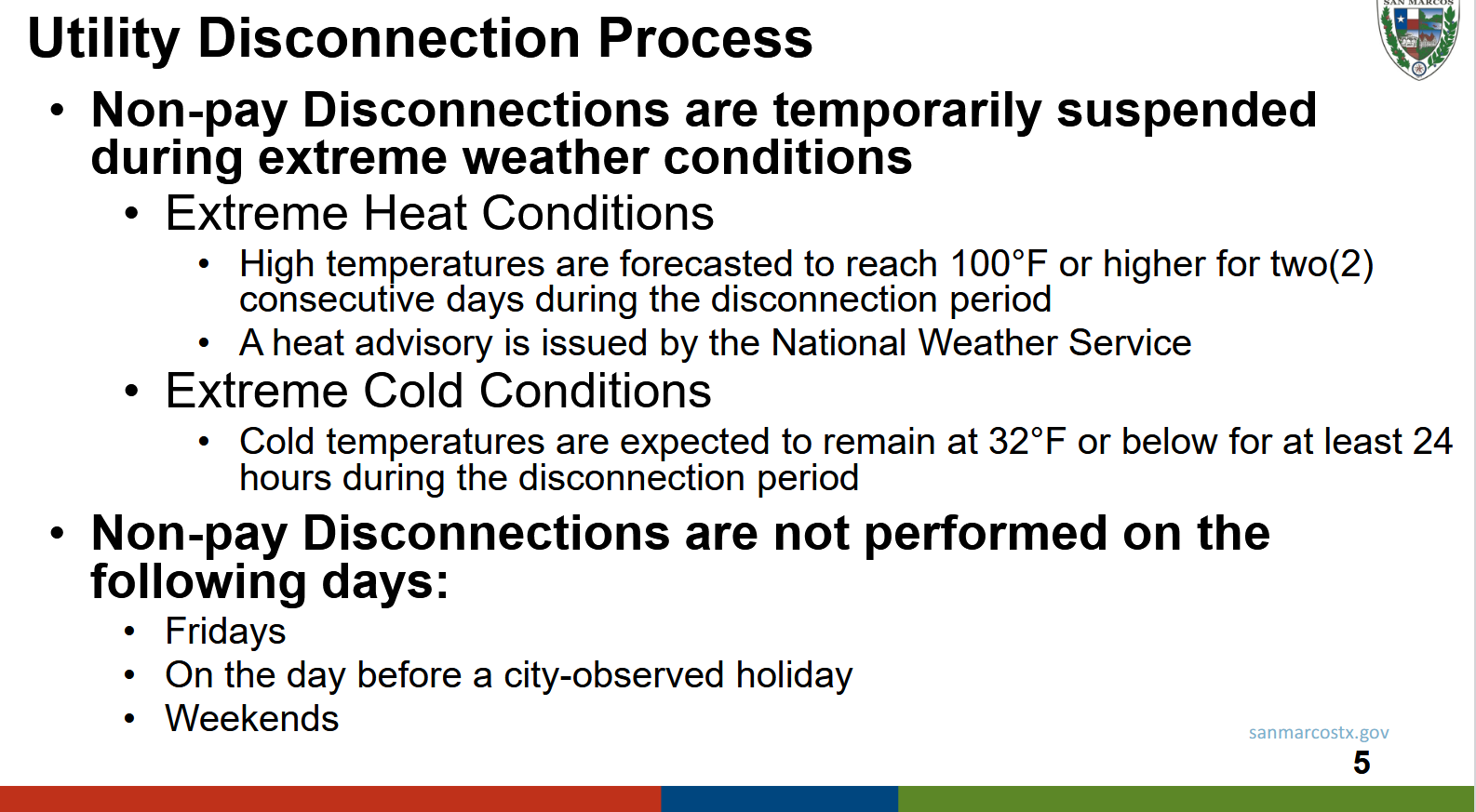
So they’re not going to disconnect you in extreme heat, cold, or right before a weekend.
…
How many people are we helping?
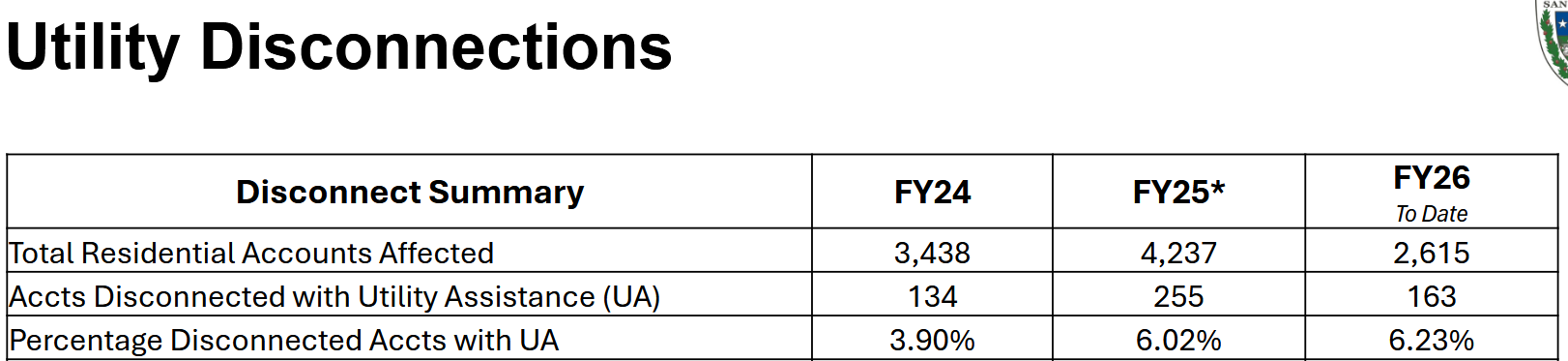
So people are still getting disconnected, even with utility assistance.
and here’s how many people are getting assistance:

Here’s a snapshot of the demographics of who gets assistance:
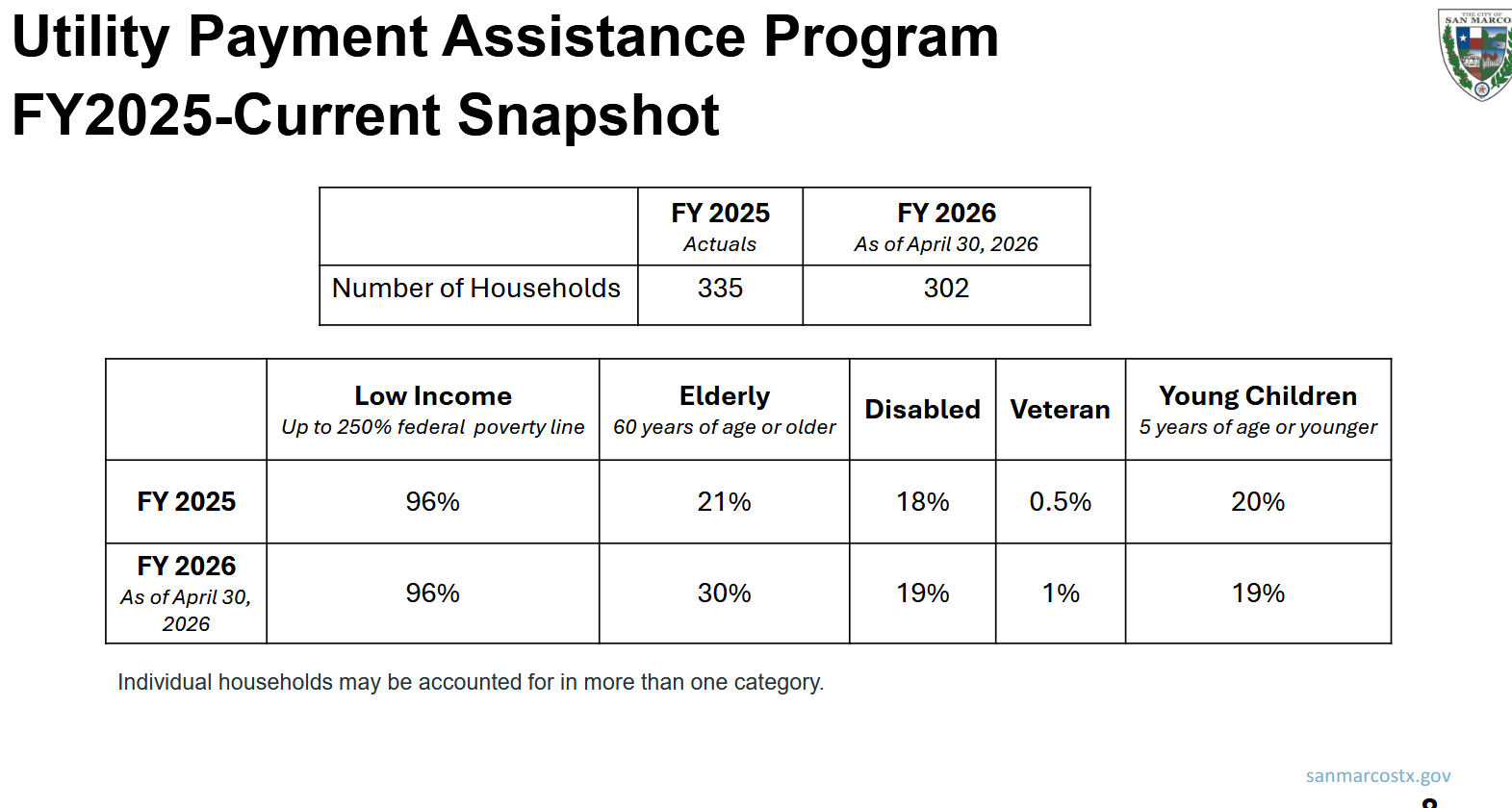
Seniors are struggling more, recently.
Communities in Schools connects directly with students. One problem is that some SMCISD students live outside of city boundaries, and so their families aren’t eligible for this money.
(Community Action and Salvation Army have other sources of funding to help these families, but it may come with more paperwork.)
….
Here’s the biggest problem:
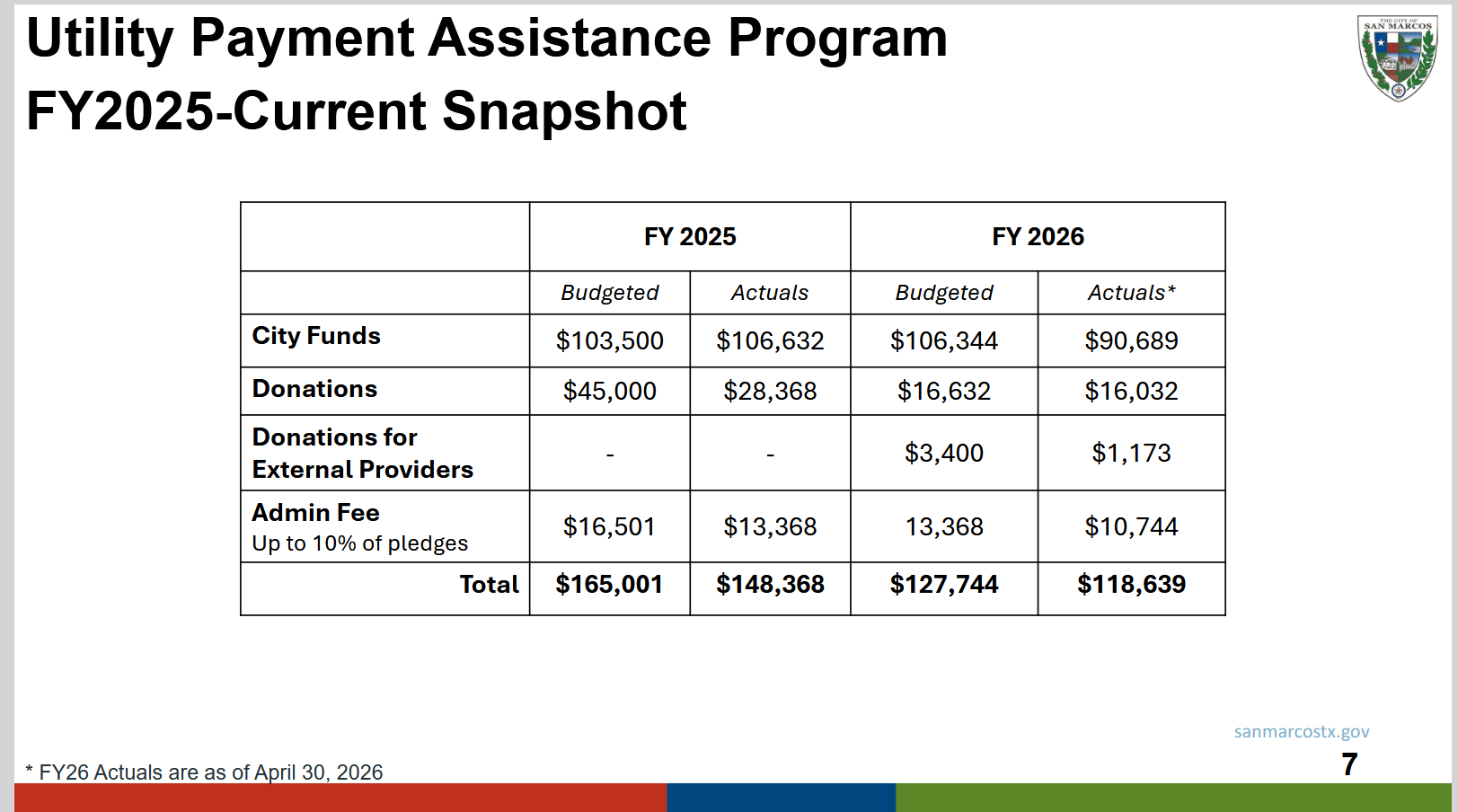
They’re blowing through their money.
At the start of FY2026:
- BCL gave out all their money, $21K, in 28 days. They got an extra $11K in March, and gave it out in 18 days.
- Salvation Army gave out $45K in 4 months.
- Communities in Schools can only assist students that are enrolled in their program, and can’t help in the summer.
- Community Action is SUPER slow, because of the whole Federal paperwork deal.
On the one hand, you WANT agencies to give out the money. You don’t want agencies to hoard funds like a dragon. But there’s also nowhere to go for help right now, and it’s about to be summer.
Fundamentally, we probably need to quadruple the funding in this program.
Listen: La Cima has an $86.7 million bond. Their city services are locked down and guaranteed for 30 years. Kissing Tree gets $1.8 million every year, and they are entirely gated off! They could be spending that money on Day-Glo lights for golf carts, and we wouldn’t know.
If it takes $400K to keep the lights on for all residents, doesn’t that seem do-able?
…
Since that’s not on the table, Staff had a few suggestions to try to stretch the money a little further.
Discussion item 1: How often can people get assistance?
Right now, they help you with back payments and the current bill, so you can get help on 3 months worth of bills. You can also come back four times a year.
Council settles on saying that if you get help with back payments on your, it uses up two of your instances. Soevery year, you can come in four times if you just need help with 1 month payment, or you can come in twice a year with a big backlog.
Discussion item 2: What counts as hardship?
They’re looking at this slide:
Jane doesn’t like the “children under 5” category. Specifically, if you’re not low income, why should you get assistance just because you have small children?
Everyone explains that it’s about childcare costs. You may have a pretty good job, but if you’re paying for daycare on two kids, you still can’t make ends meet.
Jane says she understands, but what about actually wealthy people with babies cashing in on this?
Everyone: That’s not a thing. That just never happens. Wealthy people with small children do not spend half a day at the Salvation Army to get help with their electric bill.
Jane wants more time to think about this one.
Discussion item 3: Reconnection fees and late fees
Right now, the utility assistance covers reconnection fees and late fees. However, this money is going in a circle: the city is giving money to the utility assistance program, to pay for the city reconnection fees and late fees.
Can the city just waive these fees altogether, in these cases? It would help the utility assistance dollars stretch further.
Everyone likes this.
Discussion item 4: Do we want to split the pot of money into four chunks for each season?
That way the agencies would have a little money available at the start of each season, instead of running out for the whole year.
I think council was interested, but wanted more info.
…
Basically, this will all come around for an official vote in a future meeting.


Thank you for sitting through these meetings!
LikeLike
you’re welcome!! I generally listen to the recordings, so that I can bump it up to 1.5x speed on the slow parts, haha. And thank you – sincerely – for reading.
LikeLike