By the end of 2024, it all had to be contracted out. We did that.
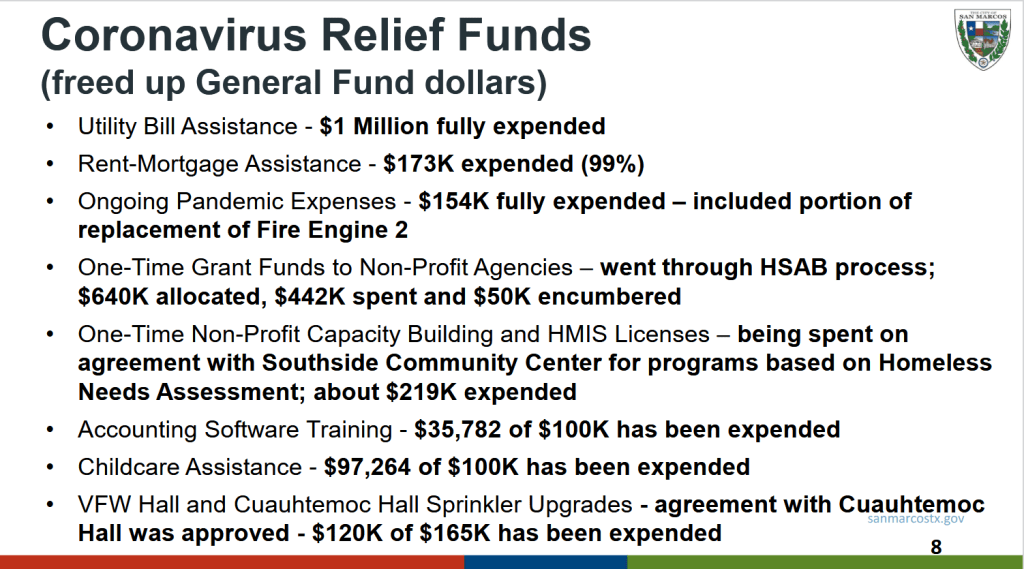
Here’s what the Covid Relief money went to:
(Note: For the Covid Relief money, they only mention $2.67 million of the $6 million in today’s presentation. I assume the rest got spent years ago.)
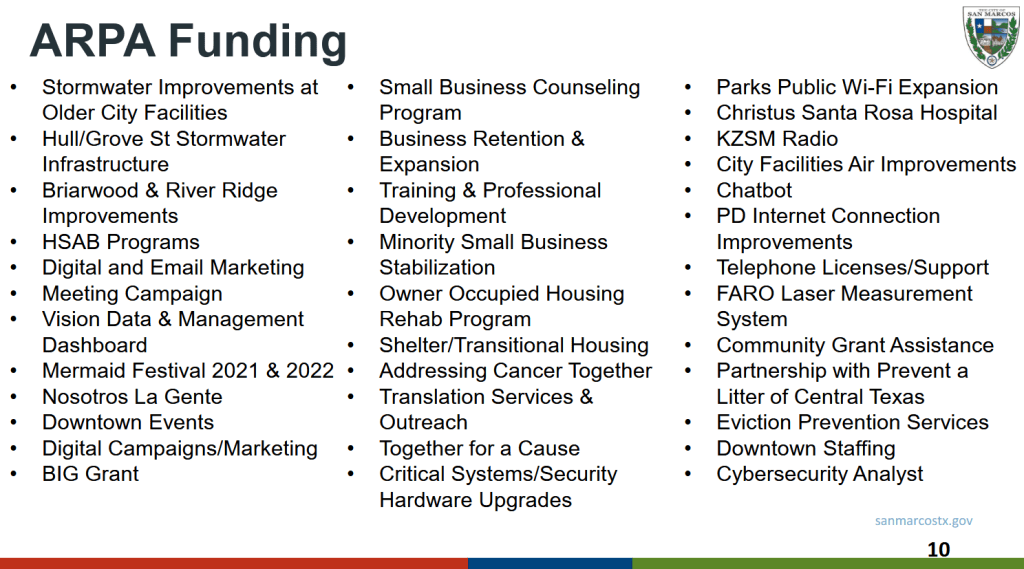
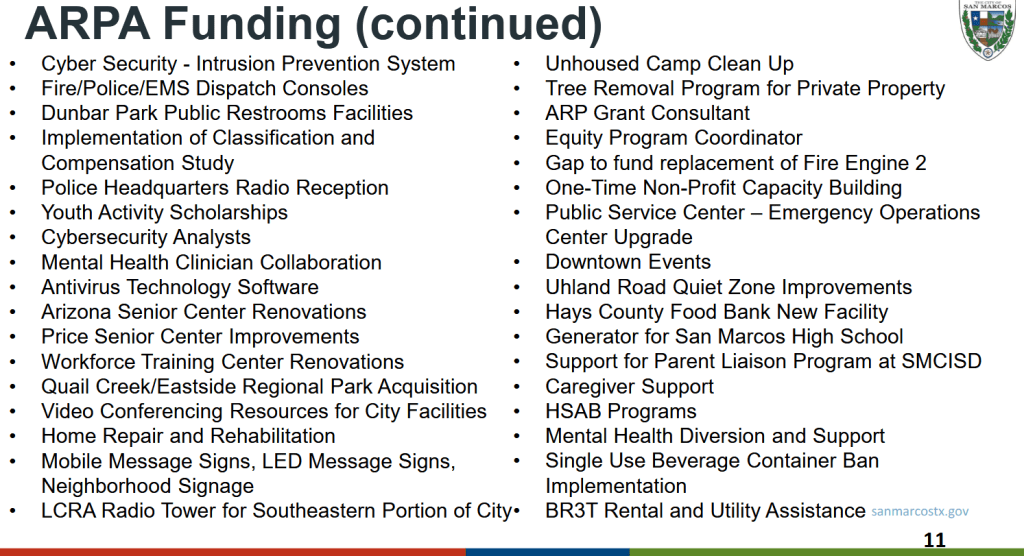
Here’s what we’ve spent the $18 million ARPA money on:
It has to all be spent by the end of 2026. So everything is wrapping up.
Which brings us to today
As projects finish up, there’s often a little bit of money left over. We’re allowed to put that towards one of the existing contracts, but you can’t start anything new.
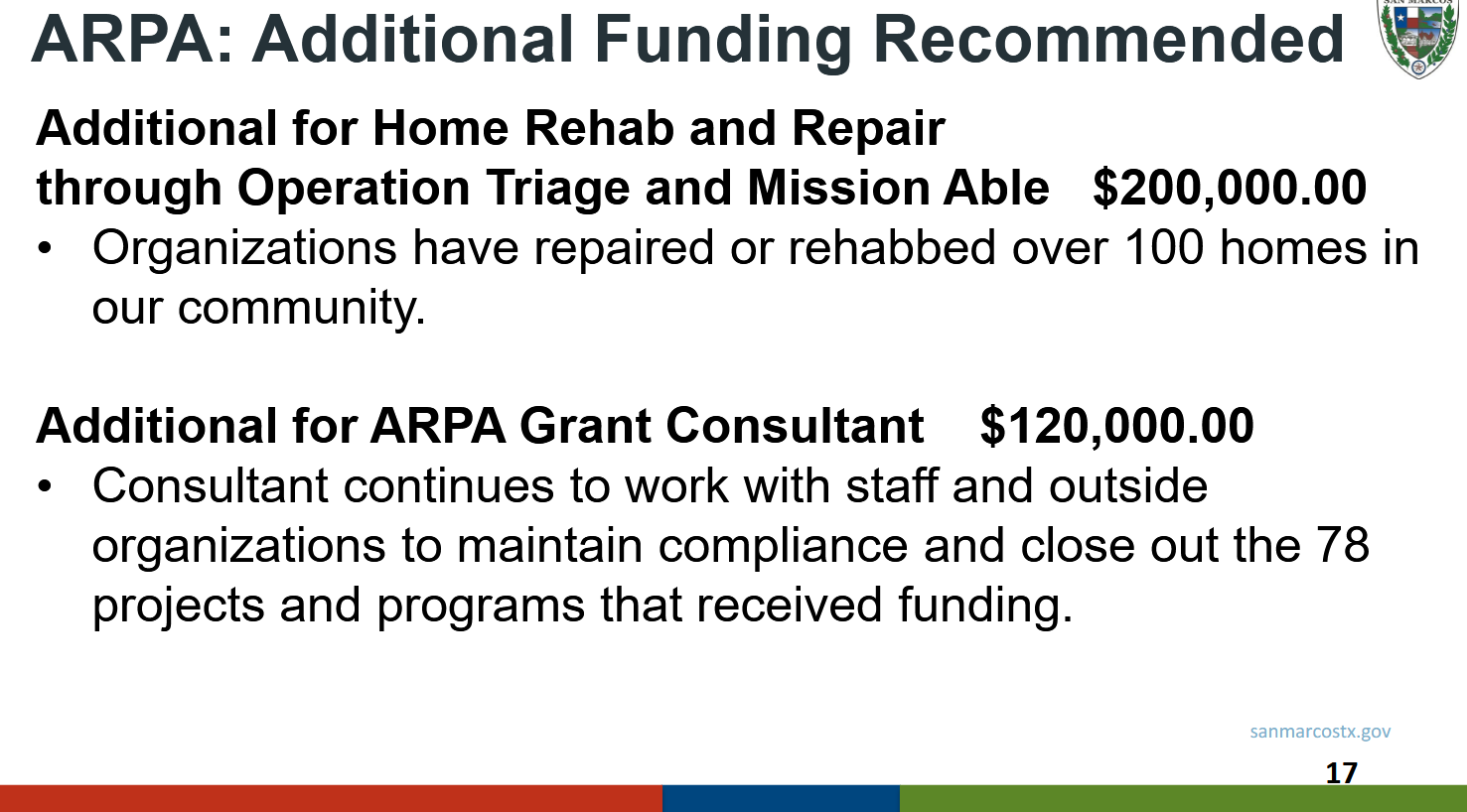
We’ve got about $320K freed up from these projects:
In other words: suppose you’re 70 and you bought your house in 1980, and you’ve worked low-wage jobs your whole life, and now you’re in danger of being homeless because your house needs $50K in repair so that it’s not condemned. This is the kind of program that comes in, fixes your foundation and your air conditioning, so that you can safely and happily stay in your home.
The grant consultant is the person who understands all the federal rules, so that we don’t risk losing this money due to mismanagement. We were going to have to pay this $120K either way.
What does Council say?
Jane: How about $5K to buy pet food for the PALS pet food drive program? That’s allowed because we had a covid contract with them already.
Alyssa: I need way more information. What are the deliverables? What’s the selection process? What’s the socioeconomic status of the recipients? Is this equitable? Where in the city do the recipients live? Do our neighbors trust them? I have so many questions.
Amanda: I’d like the extra info, but I’m good with Mission Able and Operation Triage.
Lorenzo: How about the food bank and BR3T?
(Note: BR3T is rent assistance and homelessness prevention.)
Alyssa: Can we get info on those, too? I want info on everything. BR3T funding is evaporating.
Jane: Maybe the consultant will come in under budget, and we can find $5K for PALS pet food from there.
Josh: I’m fine with the staff recommendations.
Shane: Me too.
Matthew: Me too.
Bottom line: This will come back at a city council meeting. Staff will bring back lots of information on Mission Able, Operation Triage, PALS, the food bank, and BR3T.
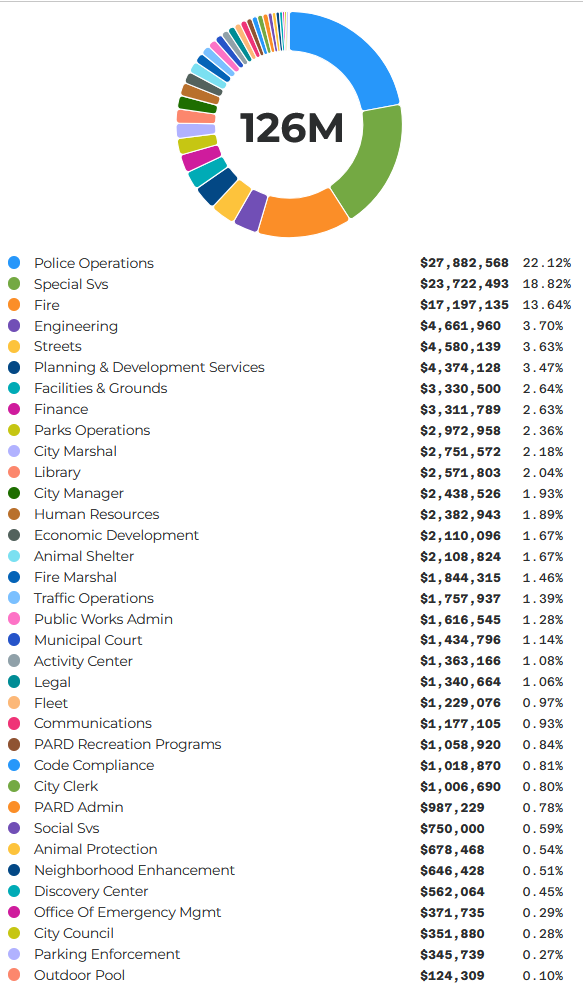
SMPD is a rather large chunk of the general fund. The General Fund this year is $126 million:
and SMPD is the biggest chunk of that, at 22%.
…
Obviously there’s huge disagreement within the community on this point. Maybe you think all cops are trigger-happy jerks with daddy issues, or maybe you think cops are upright citizens with a zest for being helpful. Most likely, you’re somewhere in between.
At any rate, as a community, we have to come together and make decisions.
Here’s a question: does SMPD need more staff?
(First off, yes: all of our city departments need more staffing.) But anyway, in order to answer this in an unbiased manner, we hired some consultants.
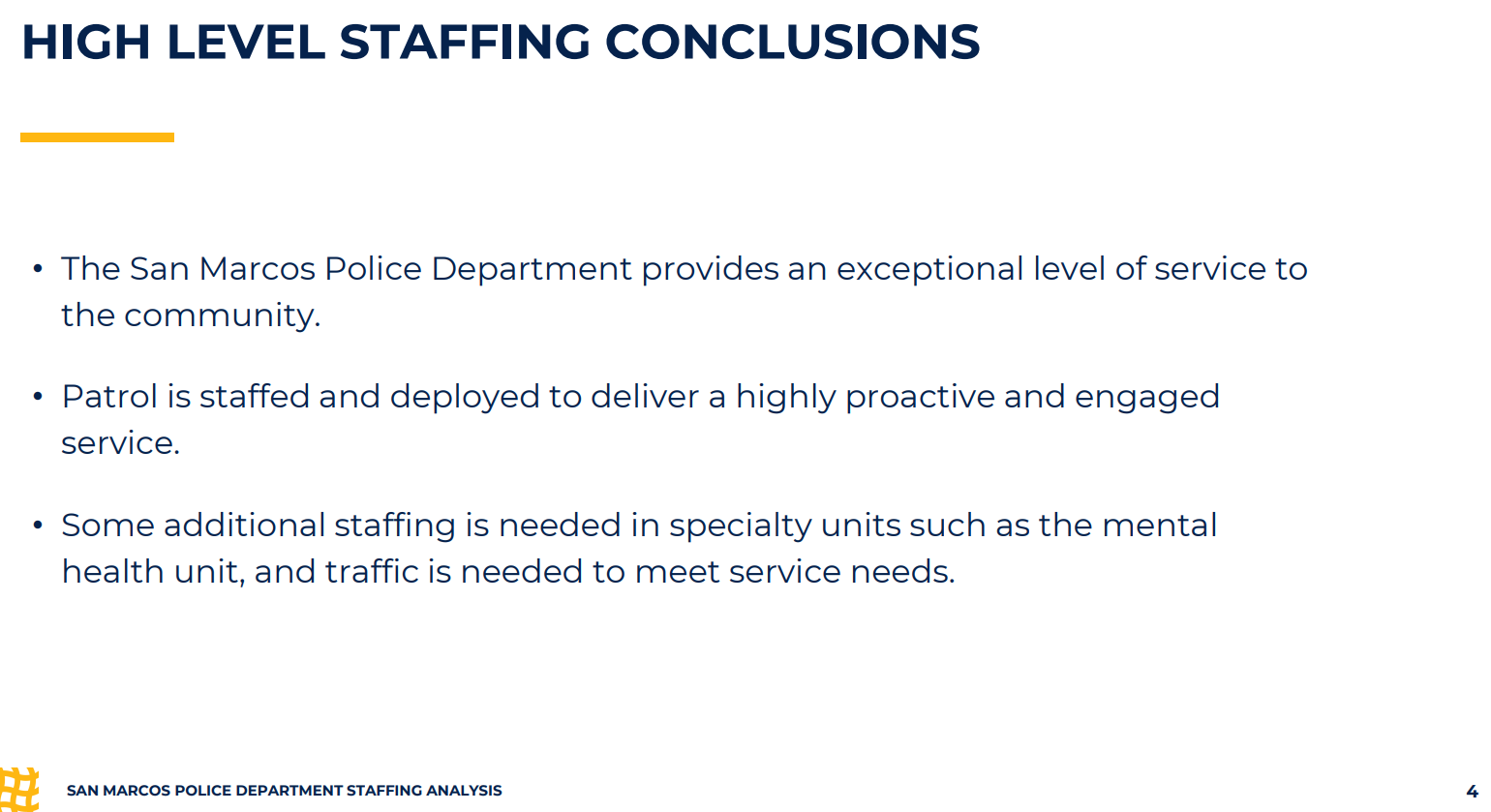
Here’s what they say:
and
You can read the whole report here (scroll down past the slides). It’s very detailed.
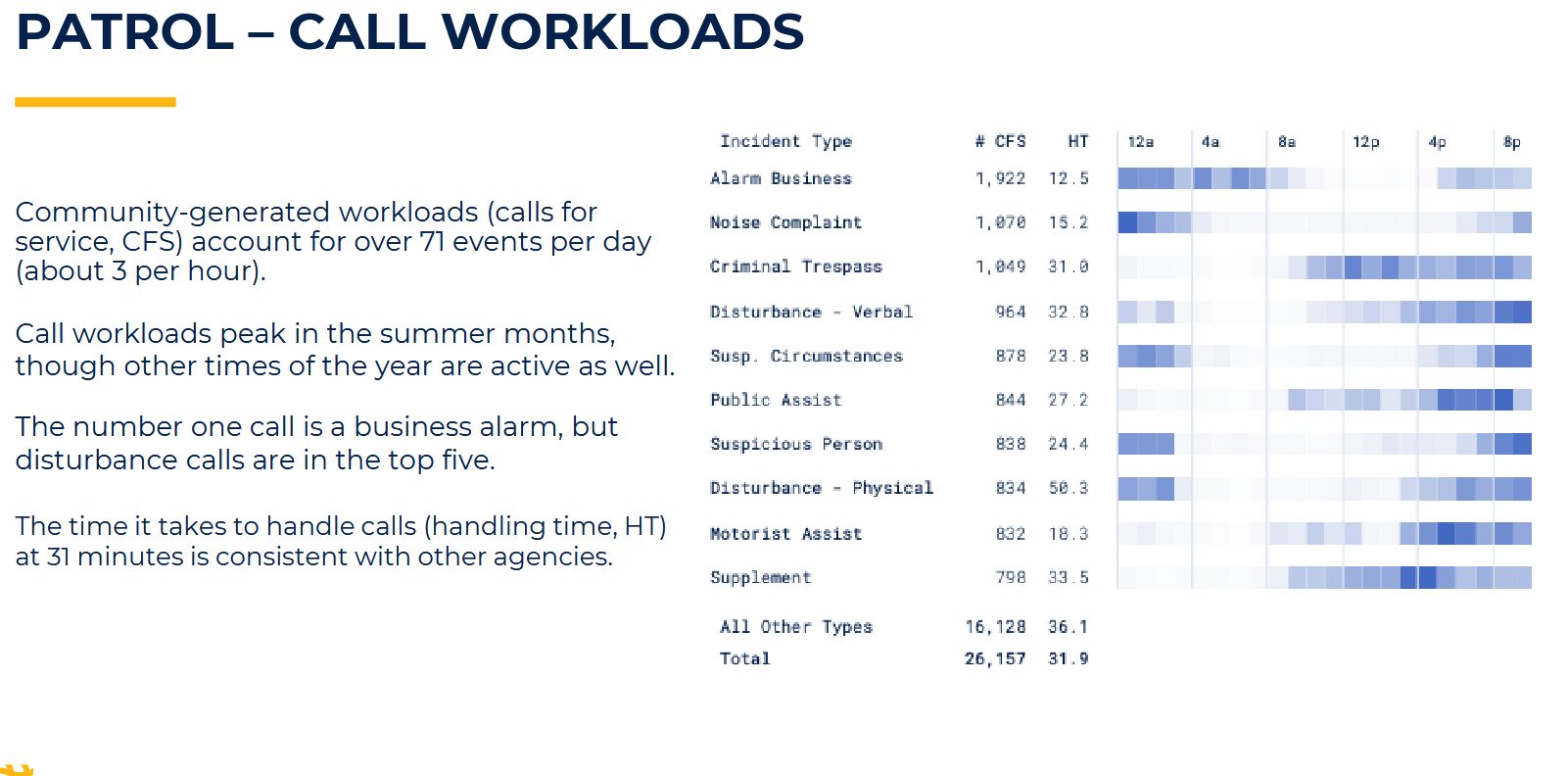
Here’s just a highlight of the slides:
Afternoons and late night is when they get the most calls.
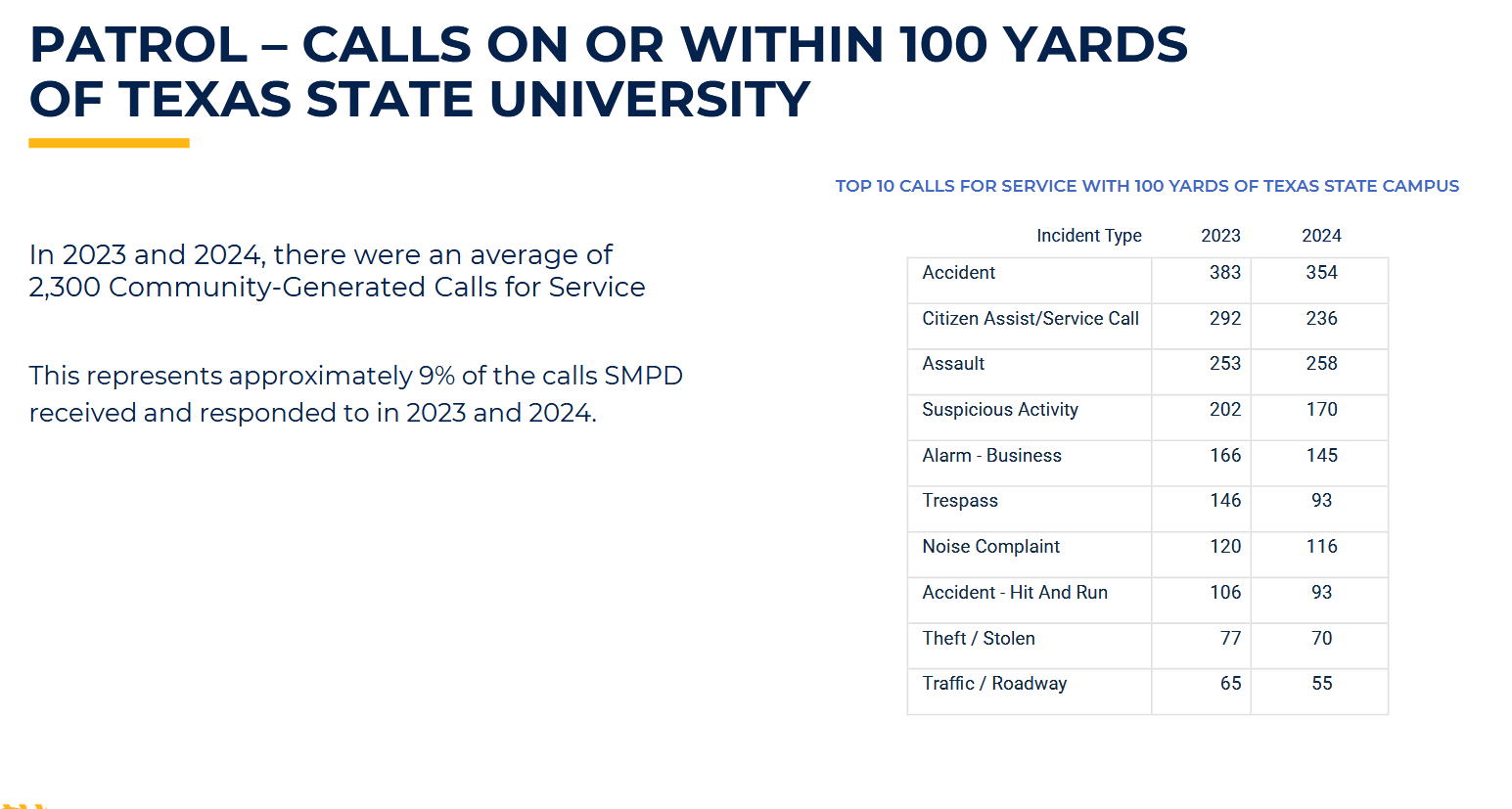
The university has its own separate police force with its own rules. But they sort of overlap and cooperate around the edges:
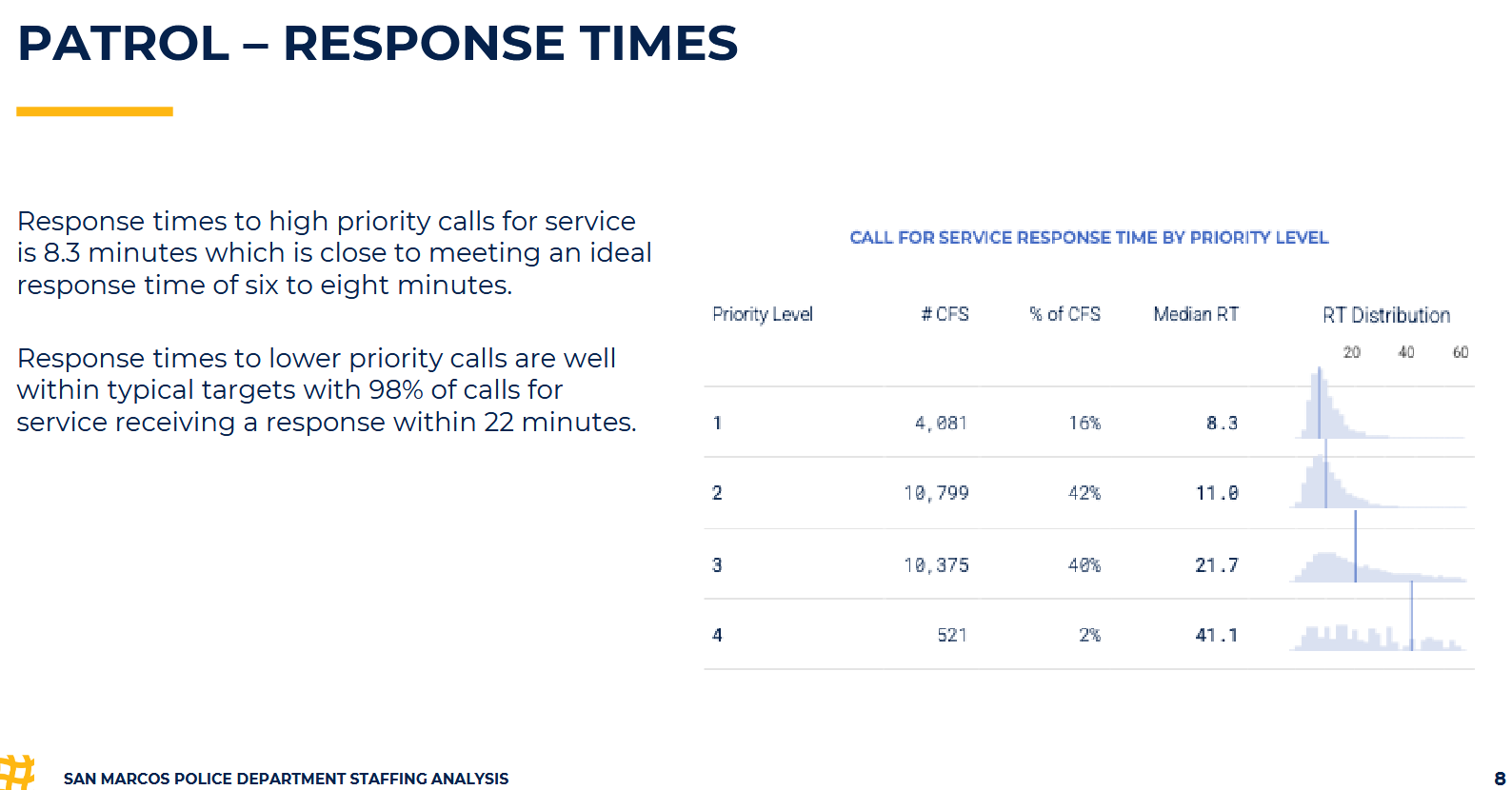
So how long does it take for police to show up?
They do not show up to minor car crashes anymore, because of those budget cuts we’ve been talking about.
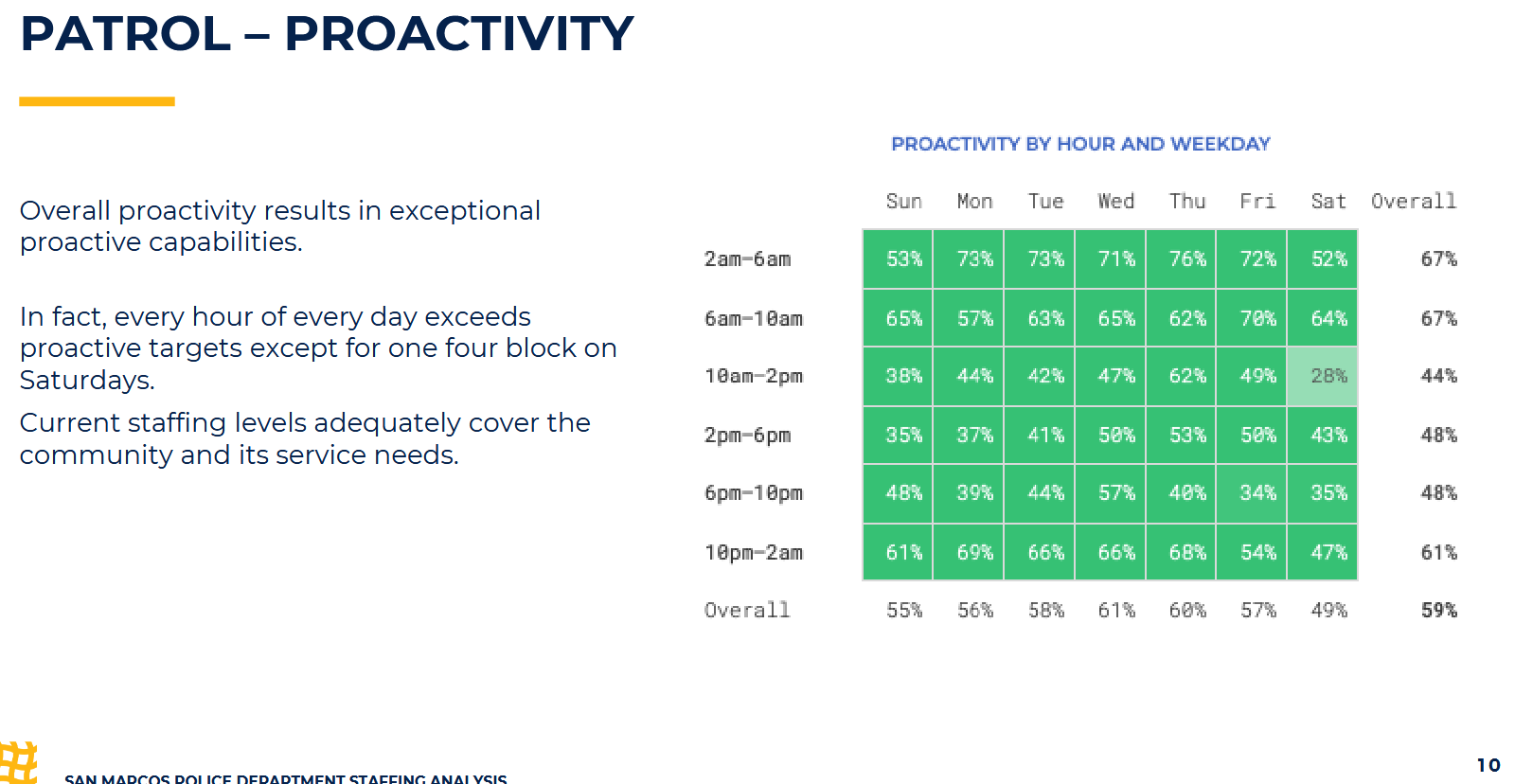
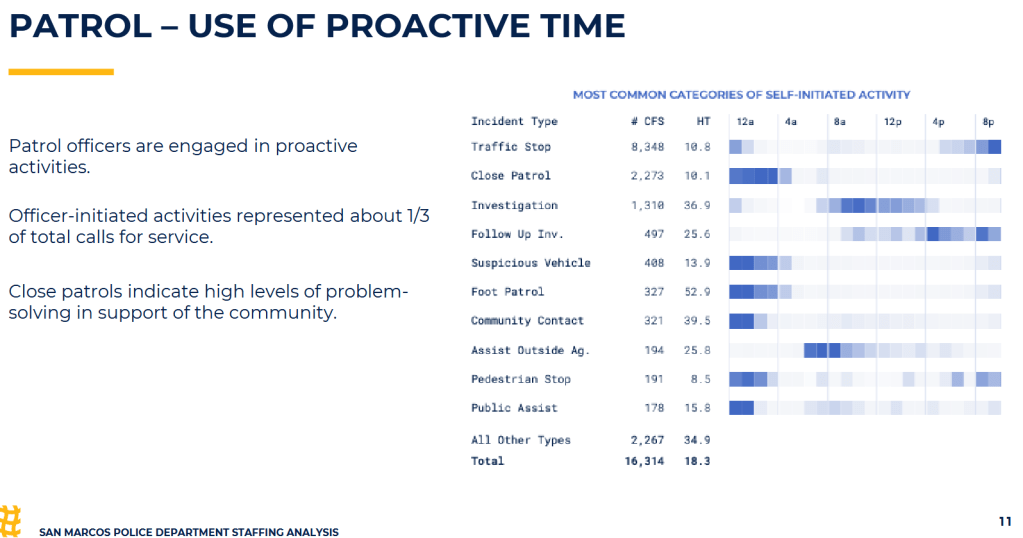
The consultants made a big deal out of “proactivity”.
It’s basically the things that get done in between crises. If you’re always swinging wildly from crisis to crisis, you can never harass brown people for broken tail lights assist the grandmothers when they have a flat tire.
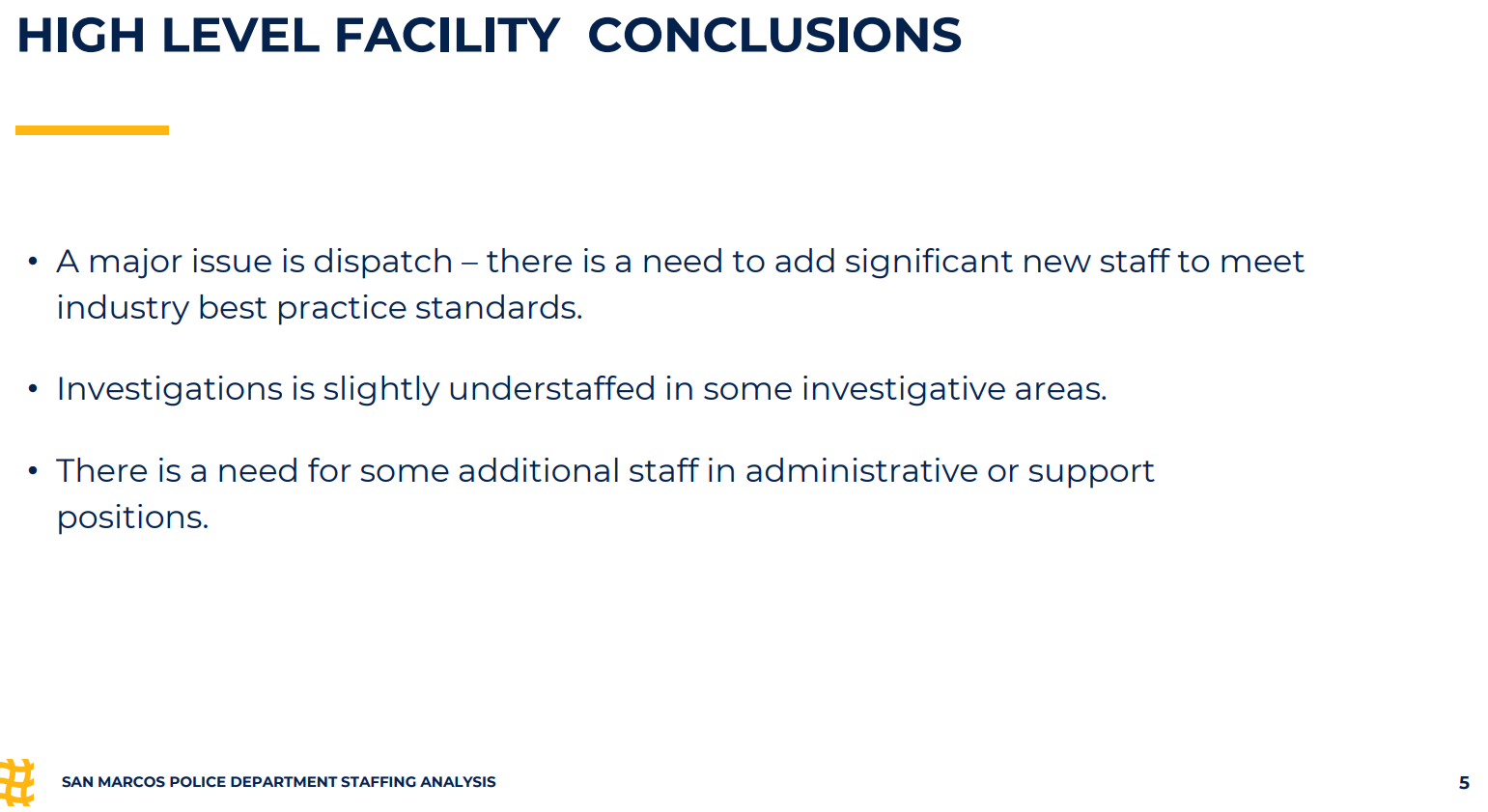
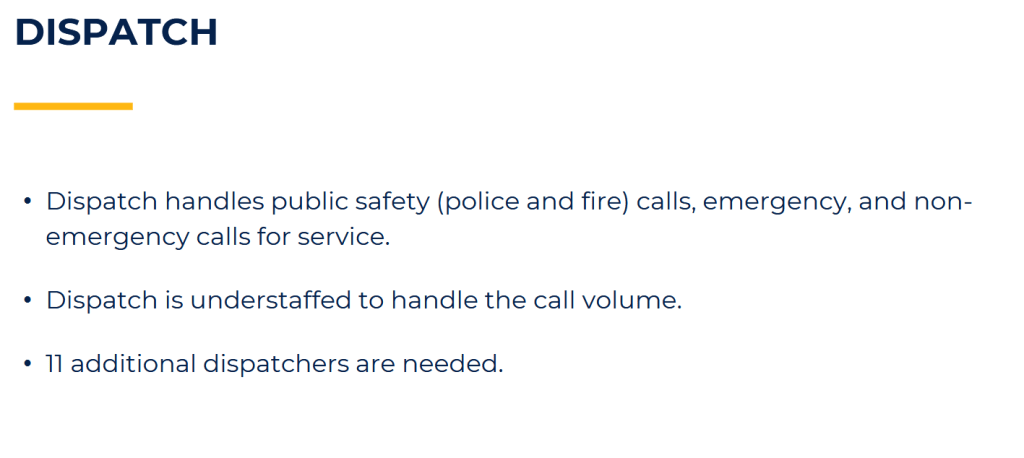
Next up is Dispatch:
That seems very sympathetic.
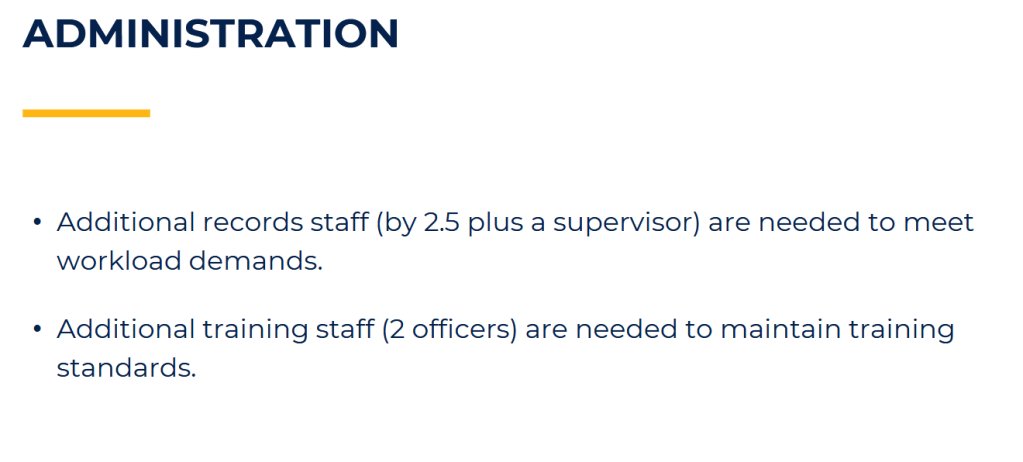
and admin:
Ok.
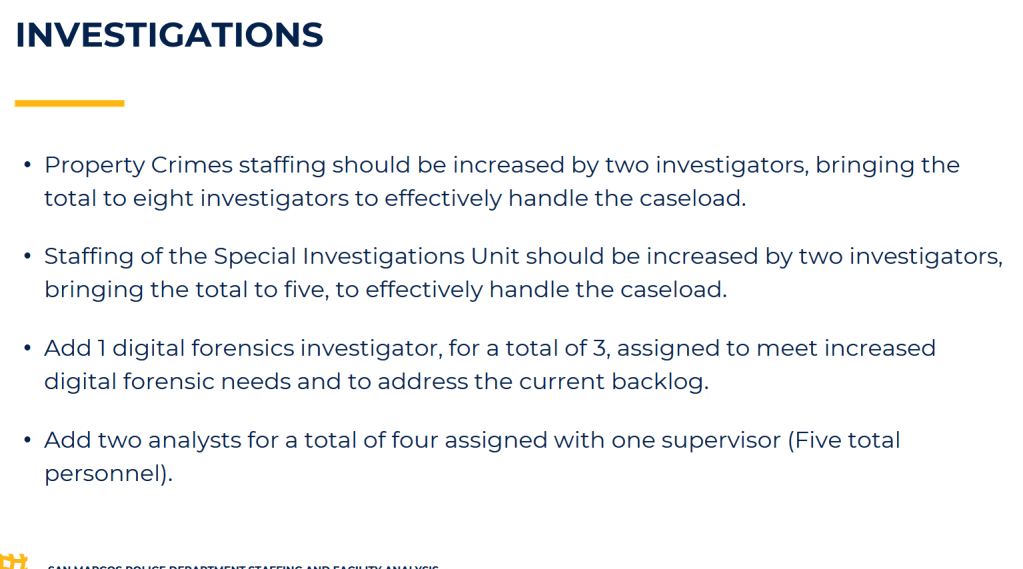
And investigations:
Sure.
…
Loose, disorganized thoughts:
It’s good to have this information
This whole report is inherently pro-cop, because it is pro-status quo. This is not a conversation about how we can re-imagine safety in San Marcos. However, a majority of San Marcos does support SMPD.
All departments are being squeezed right now. If we conducted staffing studies on all departments, we’d get big needs across the board.
Here’s my best attempt to reconstruct the timeline:
1983: San Marcos-Hays County EMS is formed as an independent non-profit. All the nearby towns and Hays County all contribute to funding it.
2009: We hire Fire Chief Les Stephens. When he’s hired, he’s told that the SMHC EMS is a total mess, and we want to be prepared in case we need to bail on them. So he starts making sure that all his fire fighters are trained as paramedics.
2010: Buda bails on SMHC EMS, and splits off to run their own program.
SMHC EMS gets its act together and becomes a high-quality organization. So we end up not needing to split off. But we still require that fire fighters be paramedics, because it’s best practices. A lot of times, they’re the first ones on the scene.
This is the big theme of the night: the EMS workers are getting screwed, no matter how you slice it.
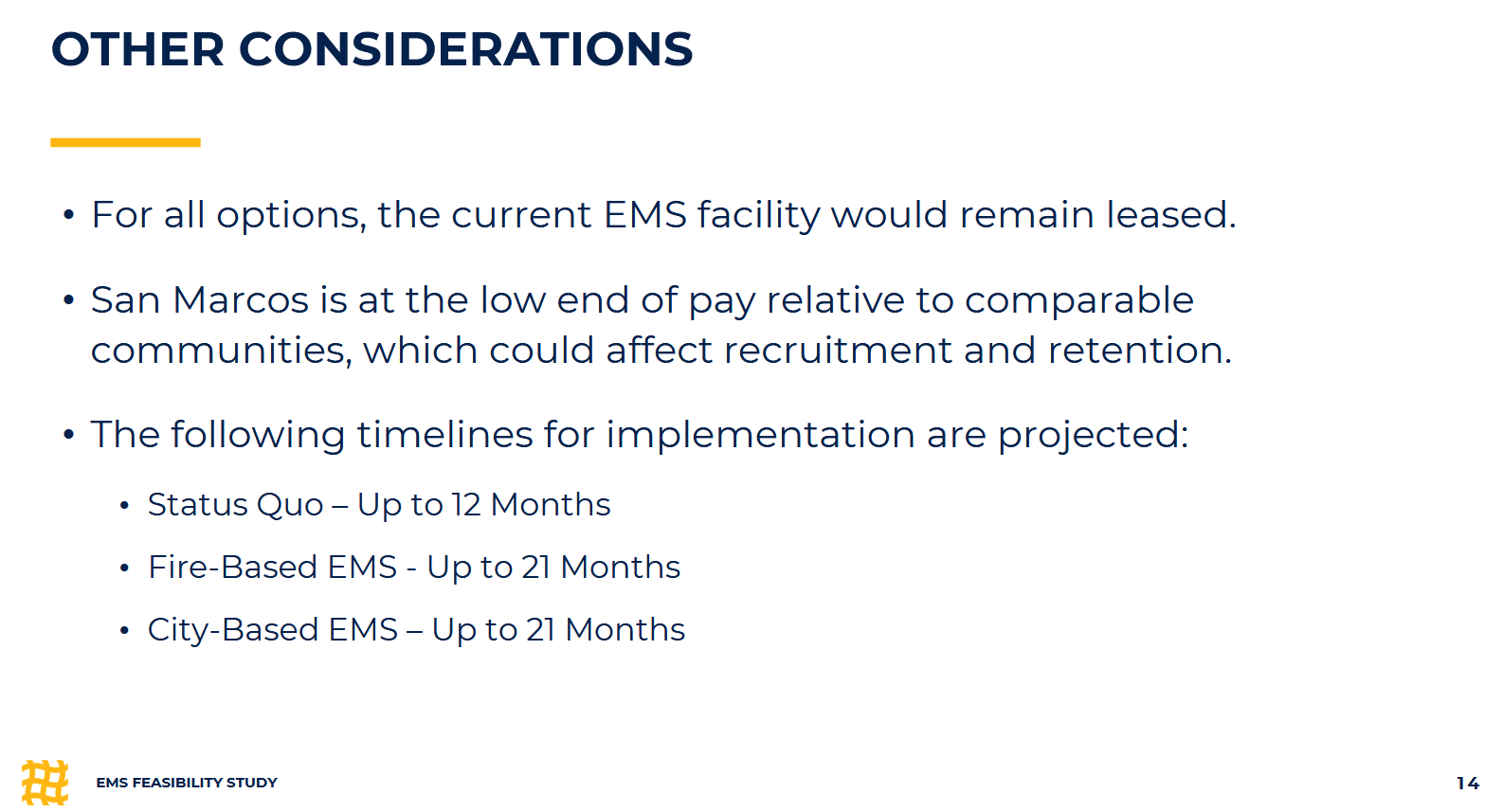
2025: San Marcos asks Kyle and Hays to give us 12-18 months to put together an EMS plan.
2026: The clock is ticking. The first ambulances will be removed in April, and they’ll all be gone by October.
…
Which brings us to today
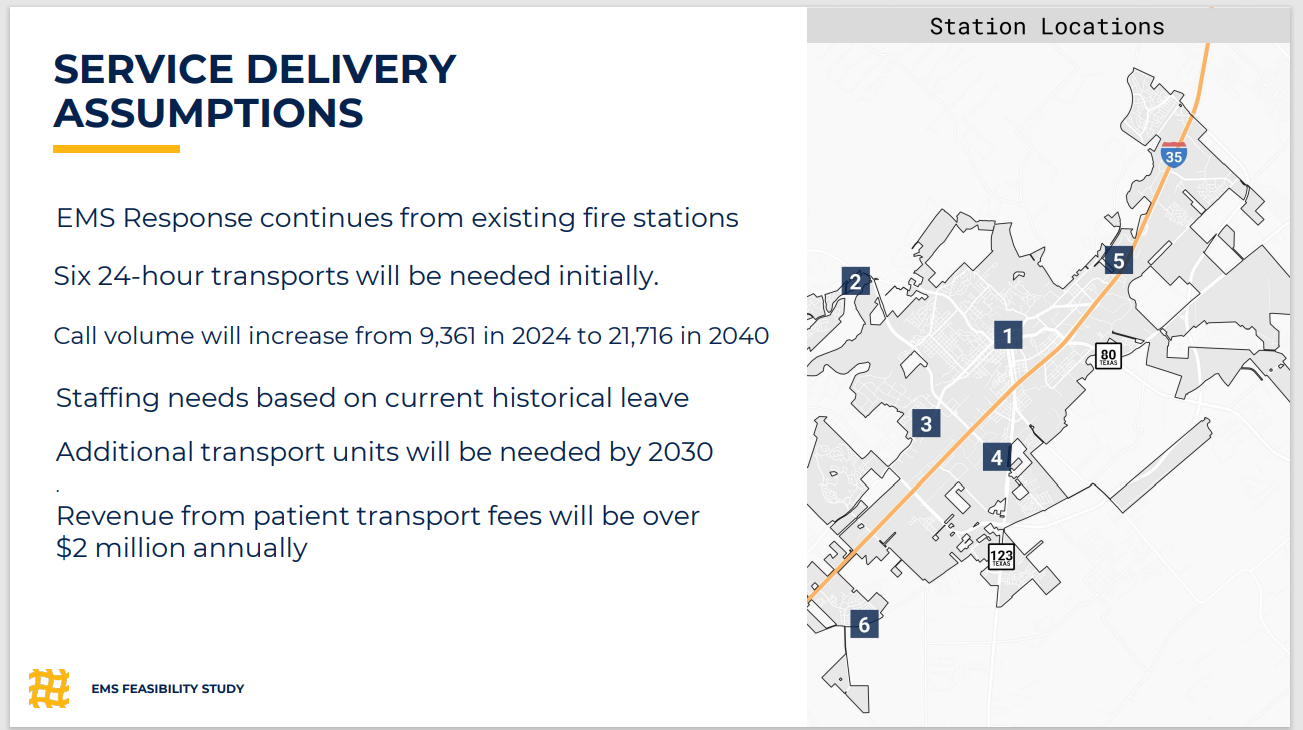
All the partners left, and now it’s just San Marcos. We have to figure out how we want to provide EMS services to San Marcos residents.
So we commissioned a 6 month EMS study. This workshop is about that study.
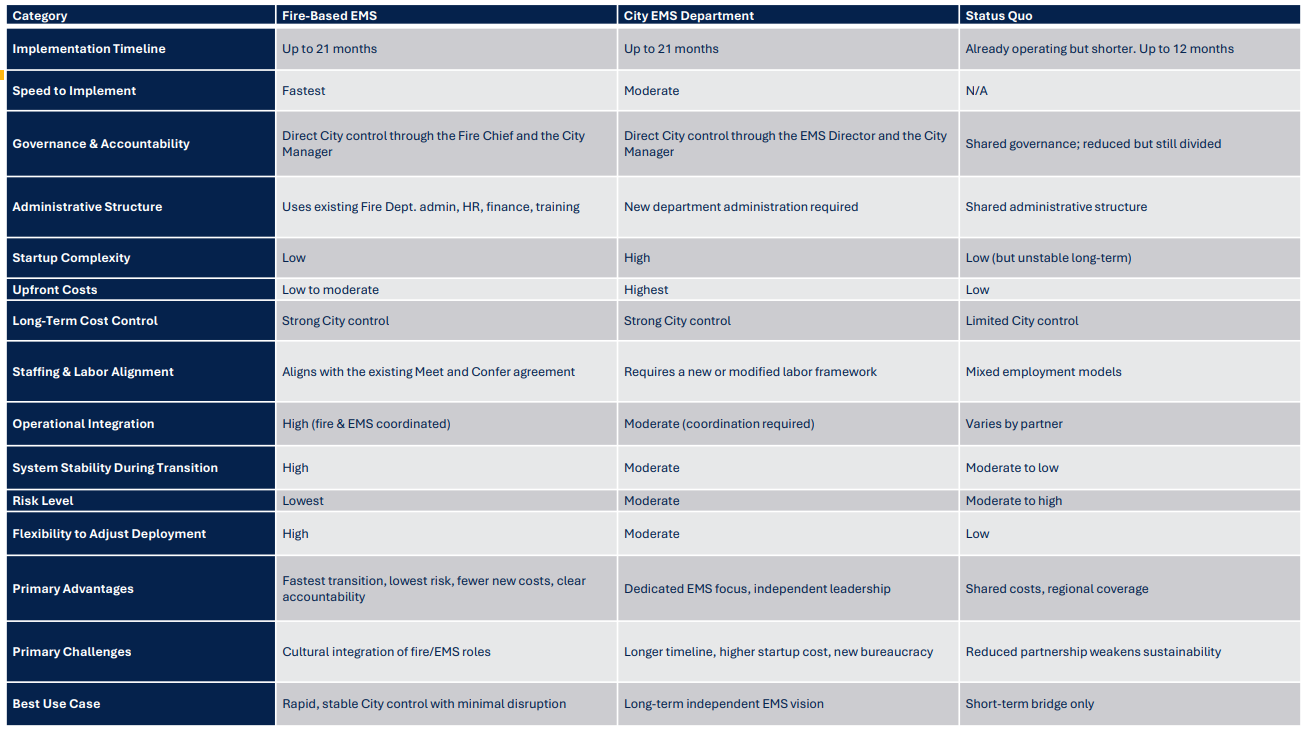
These are the three choices:
Renew the contract with SMHC EMS and just carry on.
Roll EMS into our fire department. This is called Fire-based EMS.
Make a new standalone City EMS department.
No matter what, San Marcos needs to be able to provide some basic things:
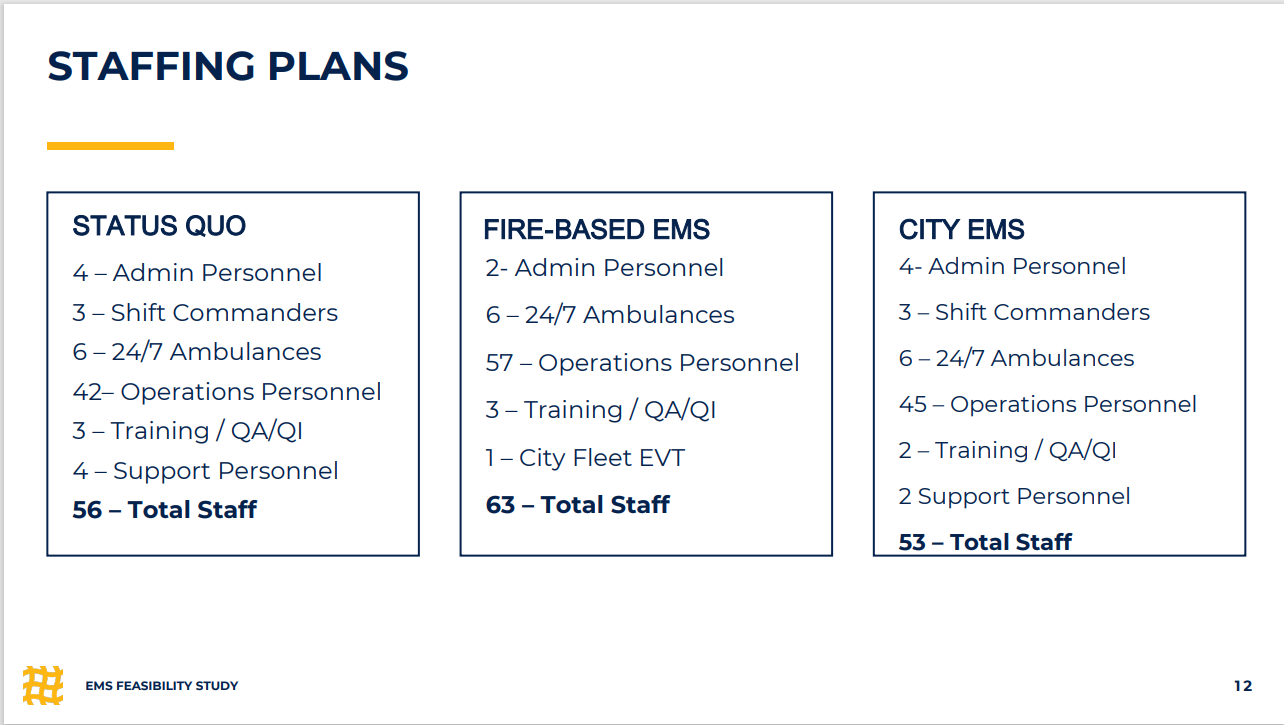
Here’s how much personnel is required under each model:
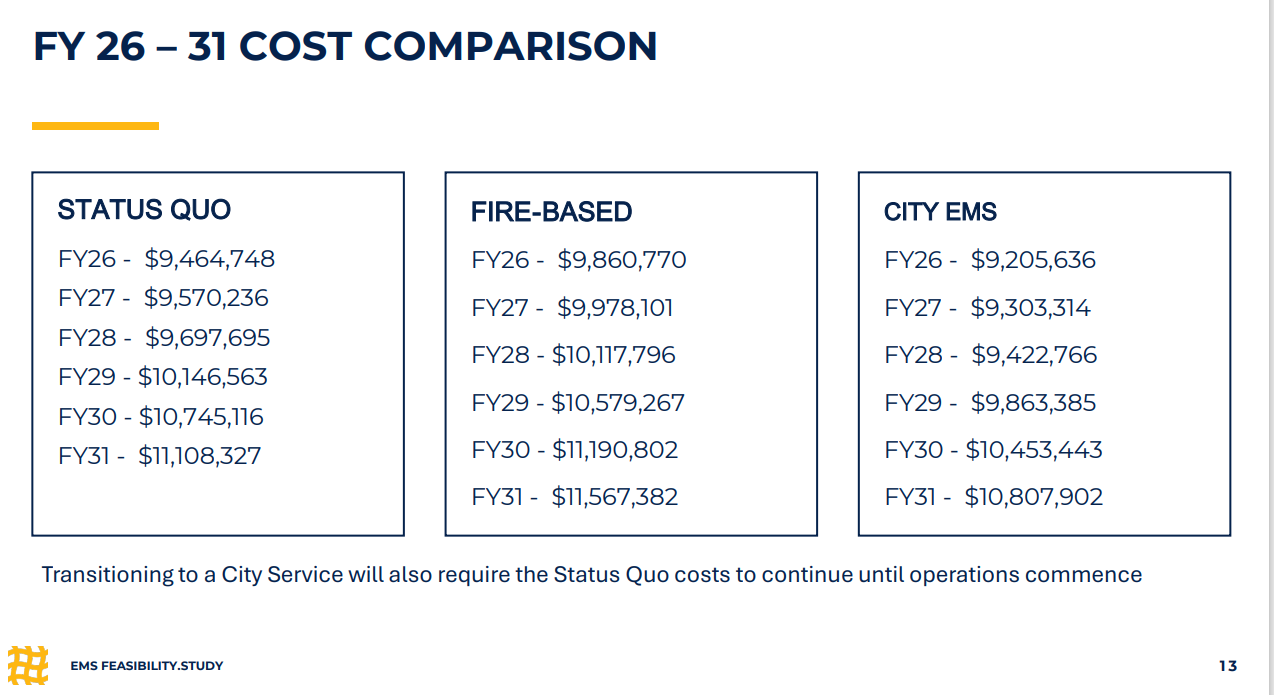
Here are the costs:
The reason City EMS is cheaper is partly because it requires less staff, but also because EMS workers would get paid less.
Status quo? SMHC EMS is unionized. They can demand higher wages
Fire-based EMS? Our fire department gets partial union perks, like collective bargaining. This is the whole “meet-and-confer” thing. So they can also arrange higher wages.
City EMS: they’ll get paid along with all the other city employees.
Sorry, I know it’s small. It’s slide 15 of this presentation, or page 153 on this PDF, if you want to scroll.
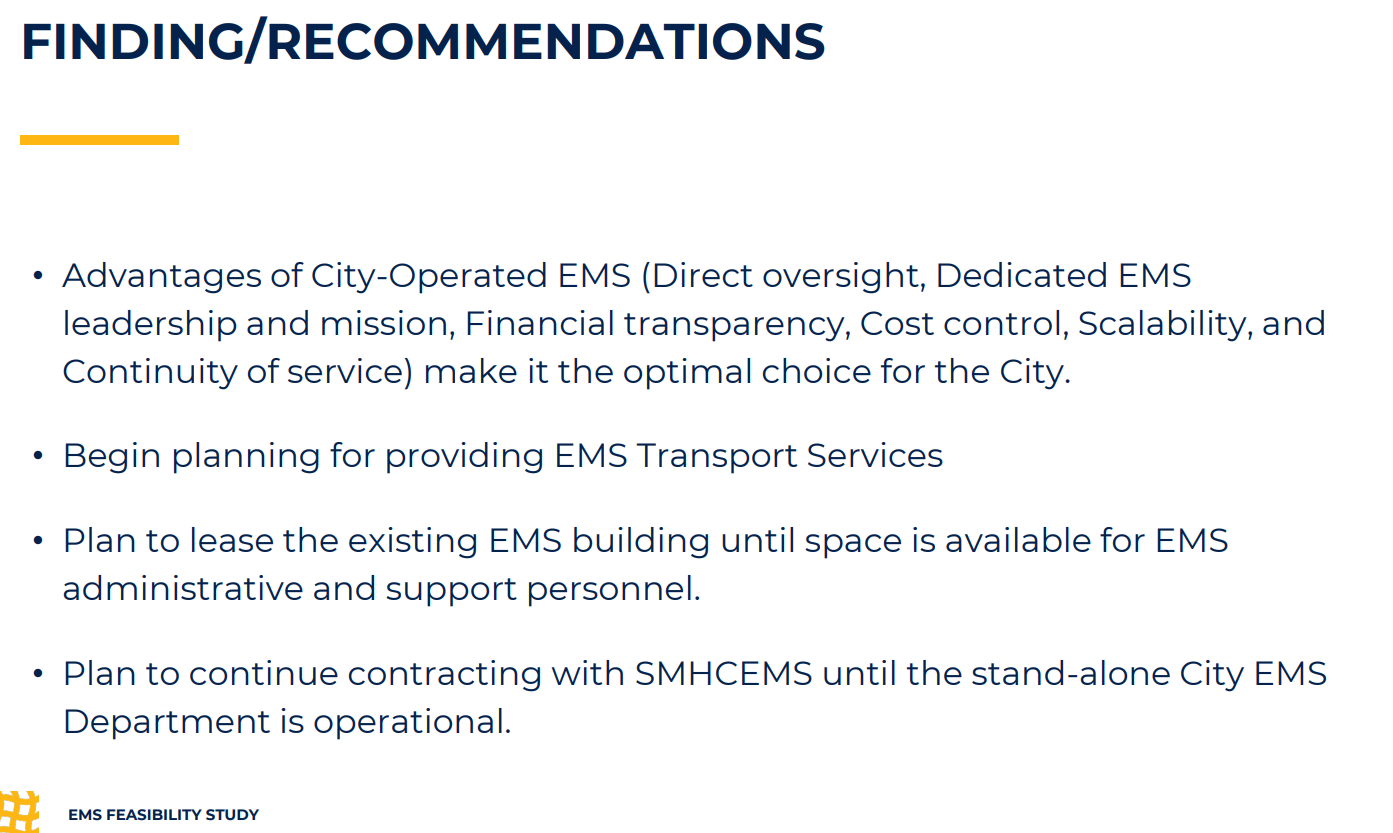
The consultants are recommending that we go with City EMS.
And, of course, this is all very urgent. As the contracts dissolve, everyone will start taking their supplies.
The first ambulances will start to leave in April, and the last of the ambulances will be gone by October.
….
What does everyone say?
Zach Phillips is the president of the SMHC EMS union. He says:
There are inconsistencies in the EMS study. We’d like you to postpone.
If postponing isn’t an option, our goal is workforce continuity.
Our priority is providing high quality care. We can best do that by keeping the experience and expertise of our employees together. We know San Marcos really well.
What does Council say?
Amanda: I’m worried about the destabilization of the workforce. What transition process would be recommended? Answer: The EMS workers would go through the normal city application process, but we’d work closely with them to align expectations and make it as smooth as possible.
Josh: My big concern is the transition. – You can’t do good work without good people, but our salaries are lower. – Taking on a whole company in-house is expensive – We have to be fiscally responsible, but if we’re going to do this, we need it to be rock-solid. – How would insurance and liability work? Answer to that last bit: We get insurance through Texas Municipal League.
Shane: When Chief Stevens was hired back in 2009, the plan was to convert to Fire-based EMS. Chief, how do you feel about all of this?
Chief Stevens: Fire fighters do not want to be EMS, and EMS workers don’t want to run into burning buildings. When you talk to the people that work in these departments, they generally do not want to be merged.
Note: This is the biggest argument against fire-based EMS. Several different speakers say the same thing: Medical EMS people like doing the medical stuff, and fire fighters like doing the fire-fighting stuff. They do not want to merge.
Shane: Well, did we waste a bunch of money then preparing SMFD to be ready to convert to EMS? Chief: No. It’s best practices to get fire-fighters trained as paramedics. We’re usually first on the scene, so we can start medical care while EMS gets here. We’re going to keep requiring paramedic certification.
…
Jane: How would the finances work out? Answer: We’ve been paying $2.5 million to SMHC EMS. You all allocated an extra $2 million last September.
Jane: But that still leaves about $9 million? Answer: Well, you bring in some money from patient care.
Lorenzo: City EMS is cheaper because the workers get a worse deal. If we do Fire-based EMS, they’d get 4% raises every year, along with FD and SMPD. I’m against City EMS.
Amanda: What’s the time frame here? Answer: We’re a little freaked out! Last July, we asked them to give us 12-18 months. But they’re going to start removing ambulances in April. The dissolution will be complete in October.
Amanda: I’m fine with the recommendation in the report.
Josh: Can I call the union president back up? Sir, what is the union’s position on transitioning to non-union jobs?
Union President Zach: One of our concerns is that all employees are able to transition, assuming they want to. – Like Chief Stephens said, not all EMS want to be fire fighters. I personally prefer EMS and medical things, and not fire. – We want to make sure all individuals can come over with their existing seniority. – We’re worried about the timeline. If it drags out, you’ll lose people with a lot of local expertise because they’ll look for other jobs.
Josh: If you had a way to do it, what’s your preference on the transition? Assuming it’s options 2 or 3? Zach: Right now, we have collective bargaining. – The state does not allow public employees to collective bargain. – But city councils can vote to allow meet-and-confer for City EMS. – We just want to be able to negotiate. – There’s no way we could go on strike, and we would not ever try to go on strike.
City Assistant Manager Anderson: I’ve been trying to figure this out. My read on state rules is that City EMS can have an employee association, but they aren’t allowed collective bargaining.
City Lawyer: I need to read up on some of these legal details. I don’t think collective bargaining is allowed. Some of the bigger cities have a similar thing to meet-and-confer between other employees. I just need to look stuff up.
City Manager Reyes: Each option carries budget consequences, so just be mindful.
…
Shane: I’m torn. I need more time, too.
Matthew: how do you transfer seniority? Answer: We’d have to work it out. We’ve worked it out in other contexts, though.
Matthew: I’m for City EMS then. I want to explore these meet-and-confer options though.
Bottom line:
City EMS plus labor protections: Matthew, Josh, Amanda, Jane
Need more time: Alyssa, Lorenzo, Shane
So we’re going with City EMS, but city staff will bring back some details:
the inconsistencies in the study that Zach referenced,
Labor protections, whether we can do a meet-and-confer option
At the beginning of January, Council had some workshops. The topics were:
Paid parking at the Lion’s Club
Fencing and charging an entry fee at Rio Vista
Let’s dive in!
…
Workshop 1: Paid Parking at the Lion’s Club:
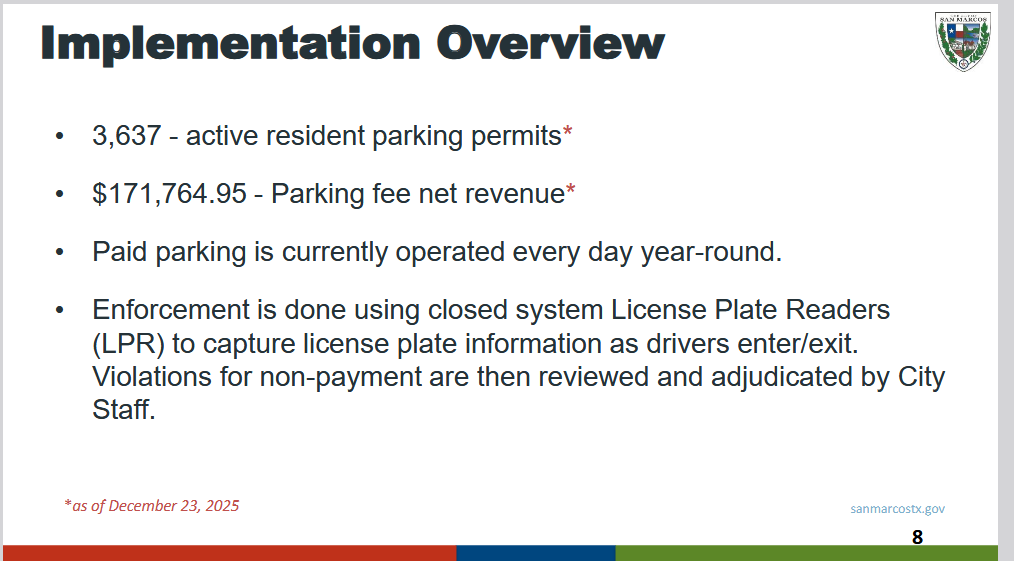
We started charging for parking this past summer. Do we want to keep doing it?
In theory, residents are free. But only if you’ve gone online ahead of time and register your car. (Register your car here!)
If you don’t register, or you don’t live in San Marcos, you’re supposed to pay at the kiosk.
If you don’t register and you don’t pay at the kiosk, you’re going to get a ticket in the mail.
Your license plate is scanned when you come and go, any time between 6 am and 11 pm. The ticket gets automatically processed and mailed out.
How well is it going?
Is that good or bad?
3637 isn’t very many, in a town of 70,000. That’s not good.
It’s only been six months, though. Give it time.
Apparently 25% of those tickets went to San Marcos addresses. That’s bad! Locals are supposed to be free.
But again, patience.
If you get a ticket, you can just call the city. Staff will walk you through the registration process and then cancel the ticket. That’s good! But not everyone knows that’s something they can do.
Amanda and Alyssa are both concerned: Who is getting rejected from the system? What barriers are there to getting the permit?
Answer: We’ve had 345 applications rejected. Most were rejected because they didn’t provide a driver’s license, or the photo ID plus address.
Some were out-of-towners
Some might have gone back and completed it later
We don’t really know how many people gave up or were turned off by the process.
(Jane asks a zillion oddball, detailed questions of the form, “If a person does X and then Y happens, can the system do Z?” The answer is always, “No, the system cannot do that.”)
Question for Council: do we want to exempt people close to San Marcos?
One of the major complaints has been from people who have come to the river for years every morning, but they live outside of town.
Council decides to exempt all of SMCISD. So all San Marcos residents and all SMCISD residents can park free at the Lion’s Club. But you do have to go register first.
…
Workshop 2: Fencing and charging admission at the river
Background: We’ve been destroying the river for the past half-dozen years. It seems to be mostly out-of-towners taking day trips to San Marcos.
The major problems are:
Safety: People get super drunk, people get heat stroke, there are lots of rocks and lots of deep water, and the crowds are too packed and unsupervised.
Cost: it’s super expensive to hire enough marshals and staff to keep things safe, and then we can’t even hire enough people to fill the slots. The out-of-town visitors tend to just visit for the day, and leave without spending money in town.
Environmental: wild amounts of litter, erosion of the banks, and destruction of the wild rice and other underwater things. The little endangered fishies need their habitats.
In 2024, we tried a can ban. But things were worse than ever! Nobody enforced the can ban because staff was so overwhelmed by the safety issues. They spent all their time dealing with crises.
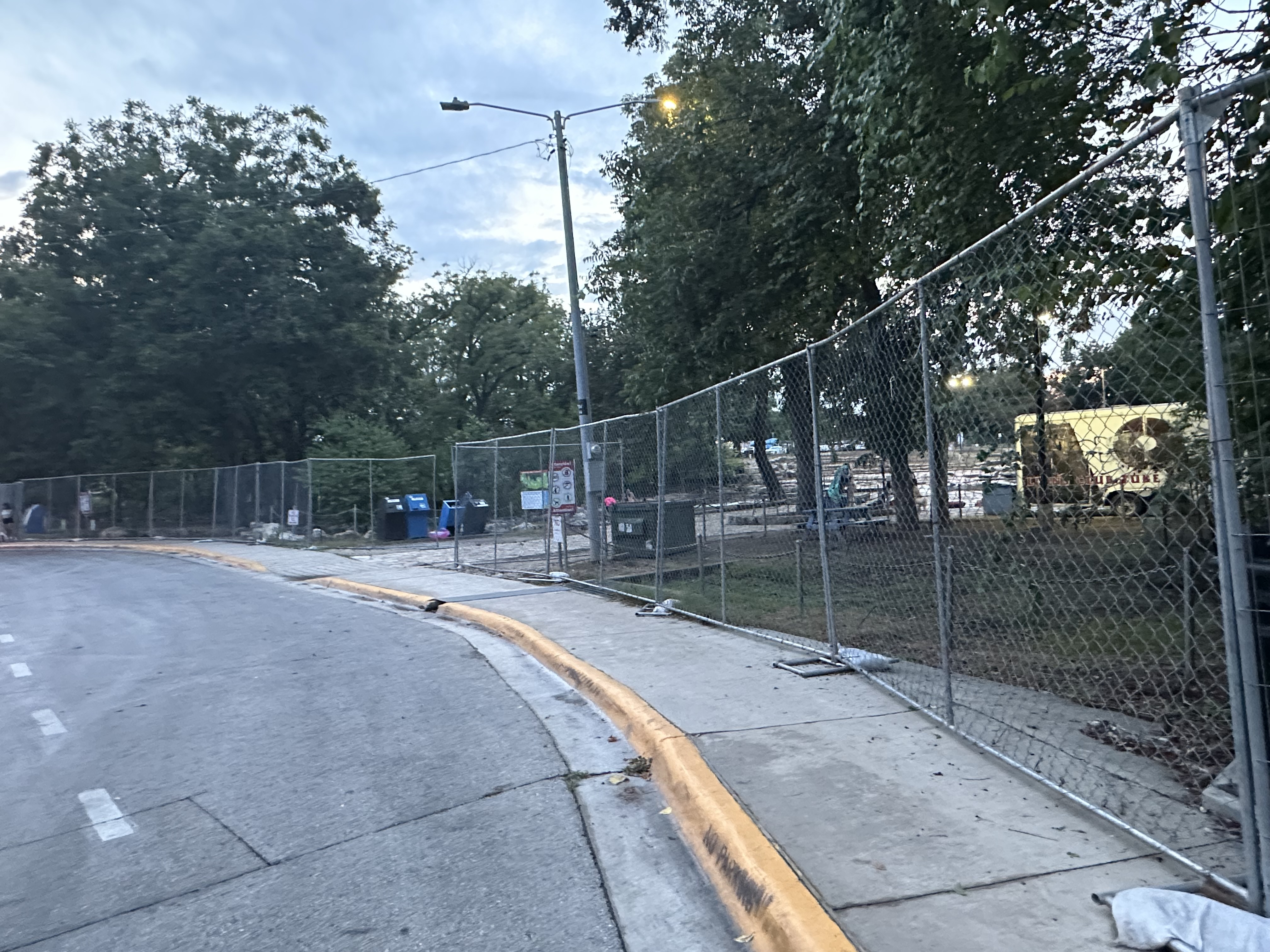
This past summer, 2025, we tried fencing off the river:
In my mind, this was a big success!
The river was still free. On weekends and holidays, staff was stationed at the entrances. They could stop you, tell you about the styrafoam ban, make sure you’re not bringing alcohol in, and so on. Basically, they just educated visitors on the park rules.
This seemed to help! The crowds were a bit smaller and less out of control.
The city saved money because it took way less staff.
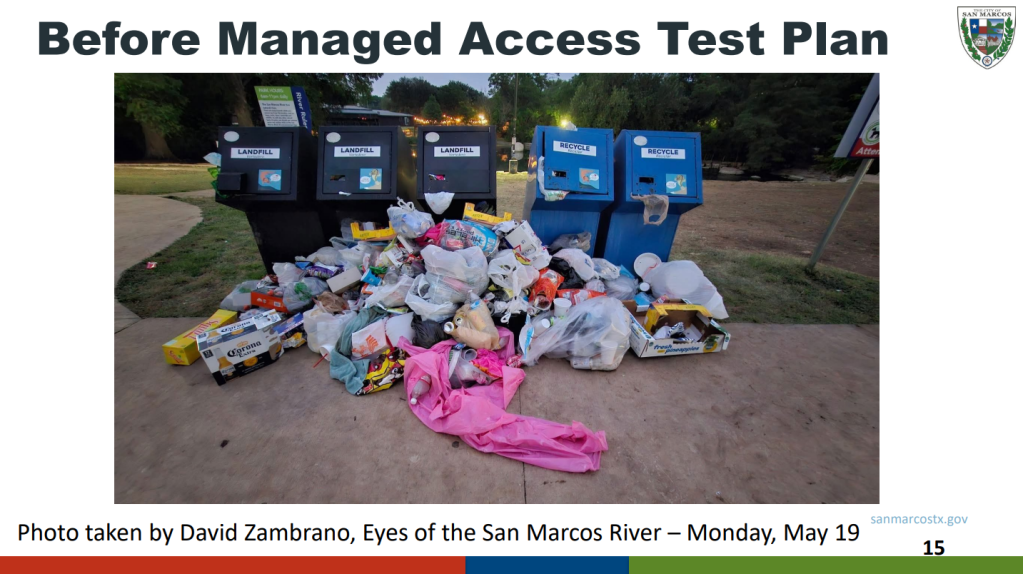
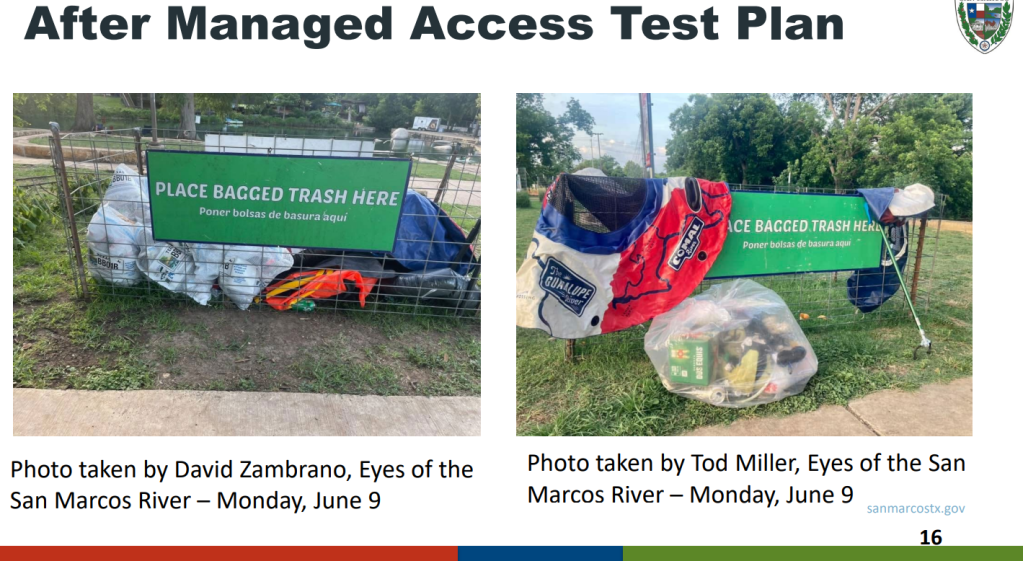
The litter was less intense.
The crowds were less intense.
It was partially due to the very rainy July, but also the fences.
(My theory is kinda depressing: I think people stopped coming because they couldn’t easily bring alcohol in.)
Which brings us to this workshop.
Two main questions to deal with.
Does Council want to keep having the fences?
Does Council want to keep it free, or start charging out-of-towners? (Nobody is interested in charging local residents.)
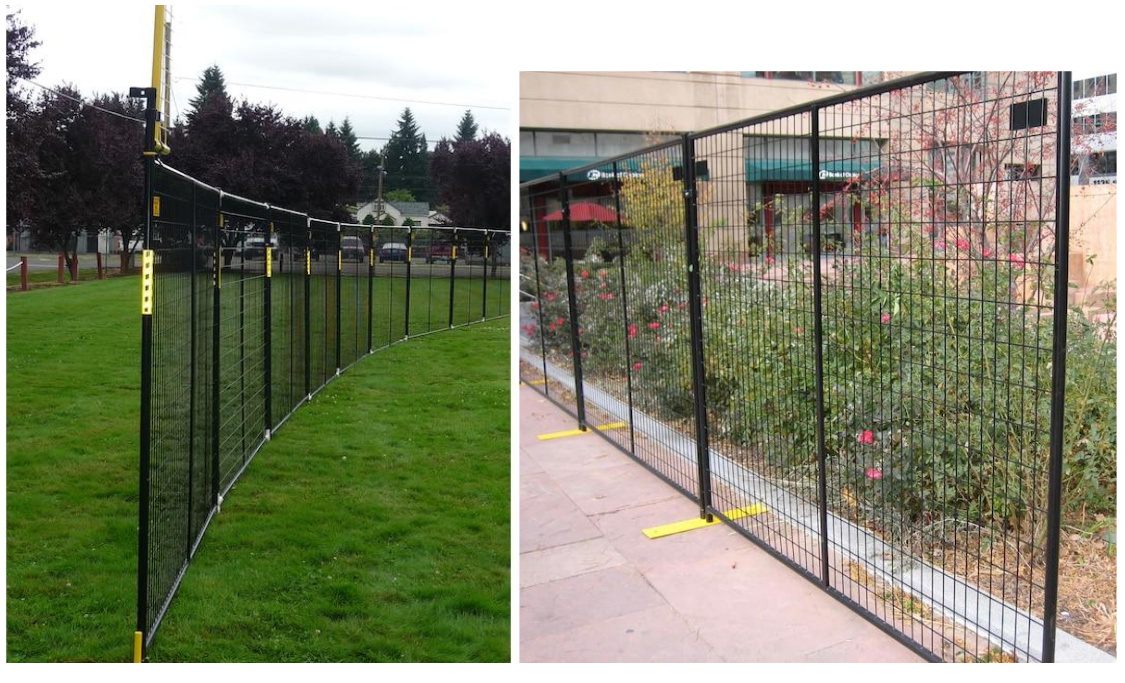
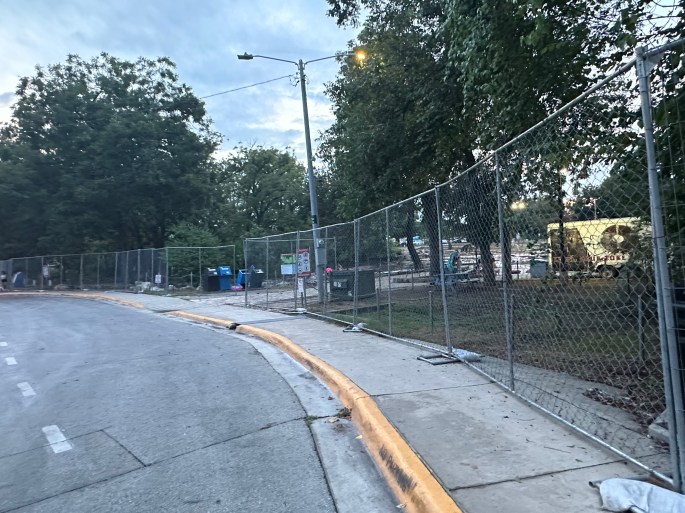
Last year, the fence was ugly.
This year, they’re proposing something less ugly:
It would still be temporary! It would go up in May and come down in September.
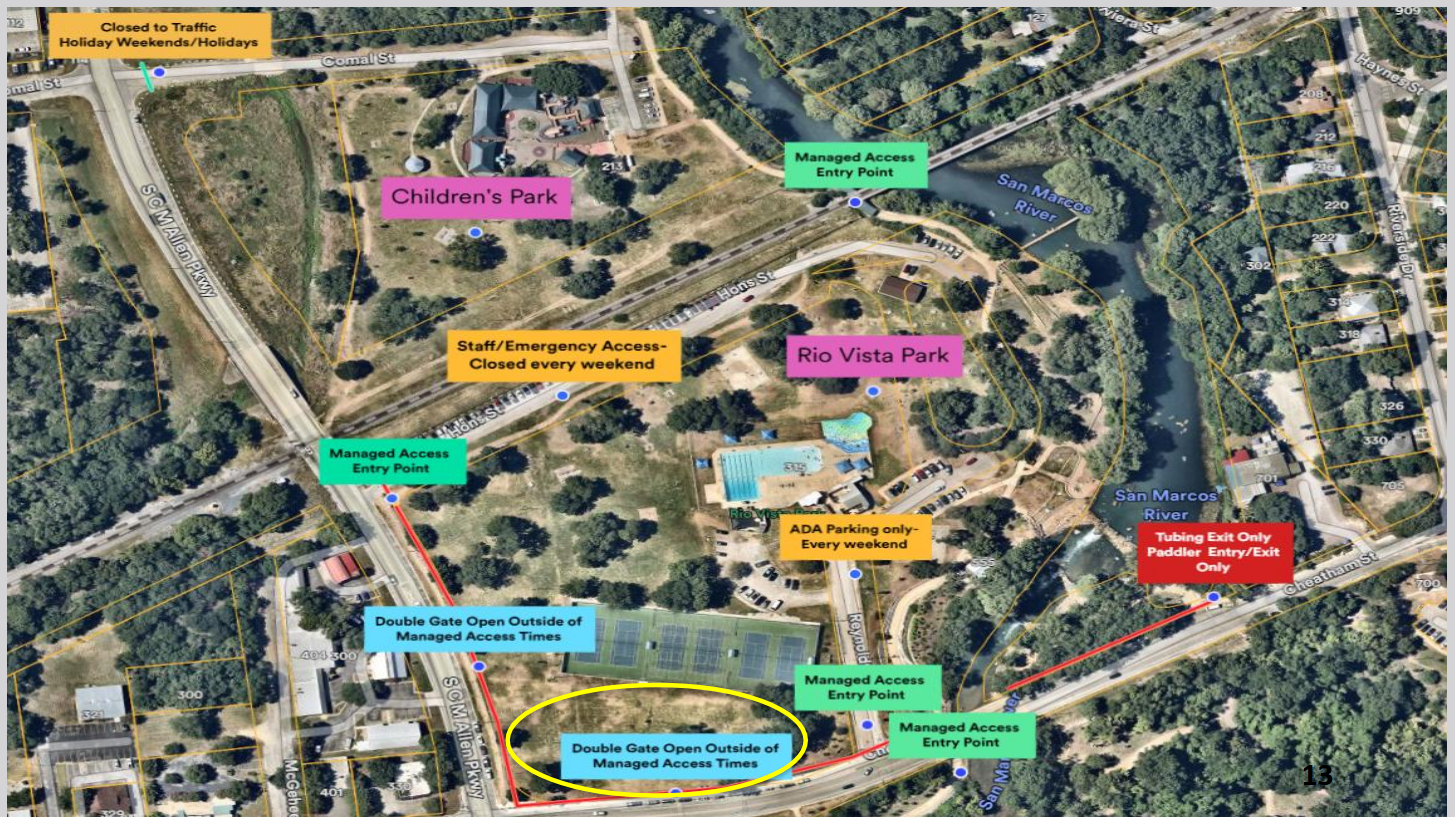
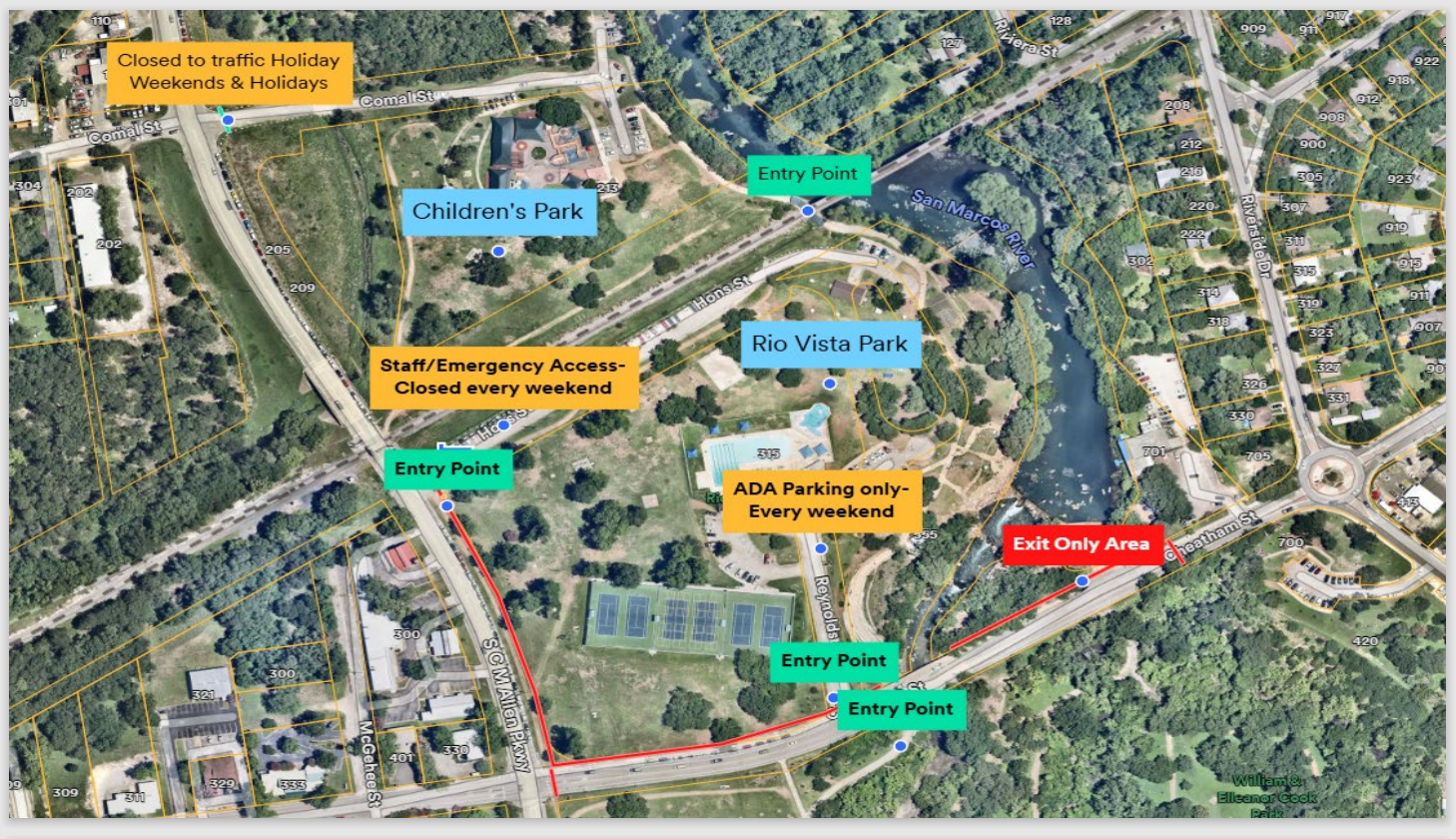
Here’s where the fence would go:
Basically the same as 2025.
They’re going to add in two gates, at those blue squares by the tennis courts. But only for during the week, so that people can easily walk into the park. On the weekends, they’ll be closed, so that we don’t have to hire more staff to sit there.
It’s got some drawbacks – like taking kids to the Children’s Park is more difficult on holiday weekends – and staff is going to try to work through some of those issues.
Should we charge an entry fee?
I loathe the idea of charging money for the river. The problem is that we’re the last free river park.
When all the river parks in all of central Texas were free, the crowds could disperse evenly. One by one, each park started charging entrance fees. This increased the pressure on the remaining parks.
If I had a magic wand, Texas would properly tax its wealthy citizens, and then we would use that money to subsidize public parks, and they would stay free.
Since that’s not going to happen, and since San Marcos just voted for candidates who ran on lower taxes, we are stuck choosing between three things:
Use a huge chunk of our budget keeping the river parks safe and clean
Let the river get destroyed and let visitors get hurt.
Charge out-of-towners for using the river
So here we are.
…
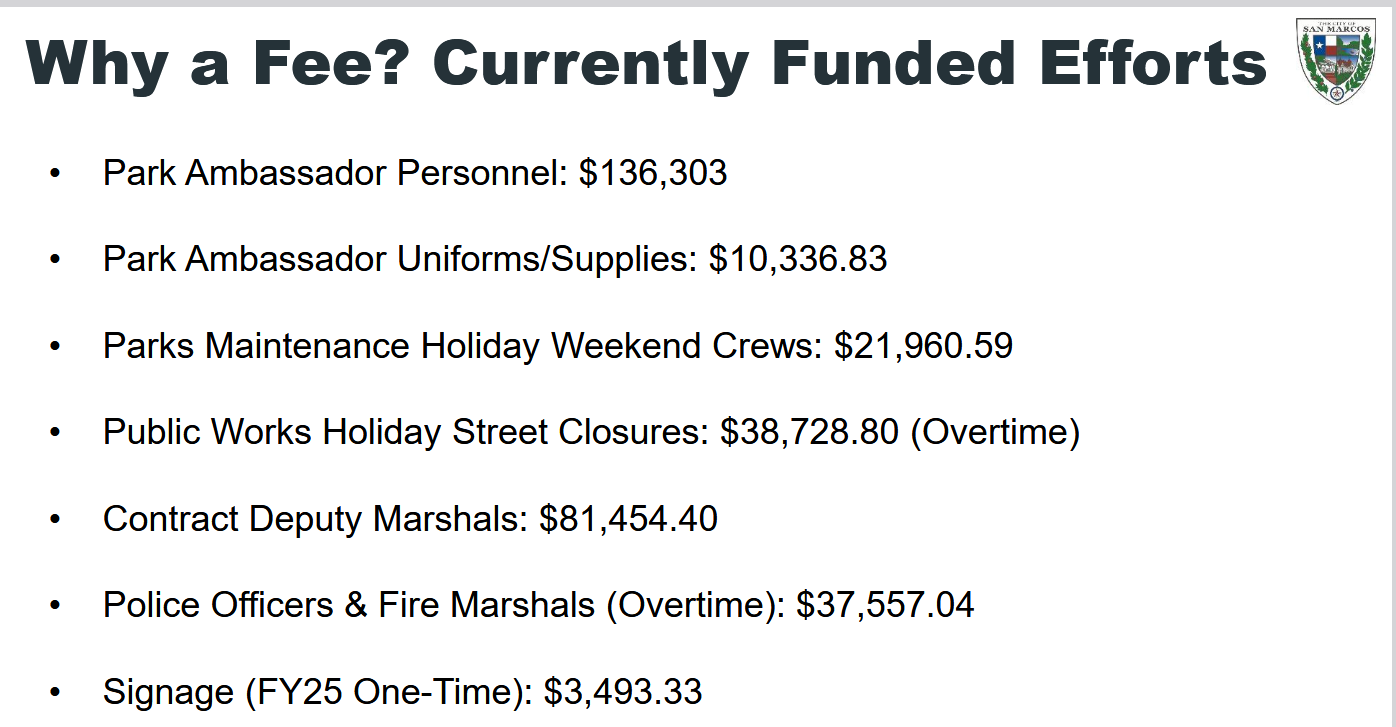
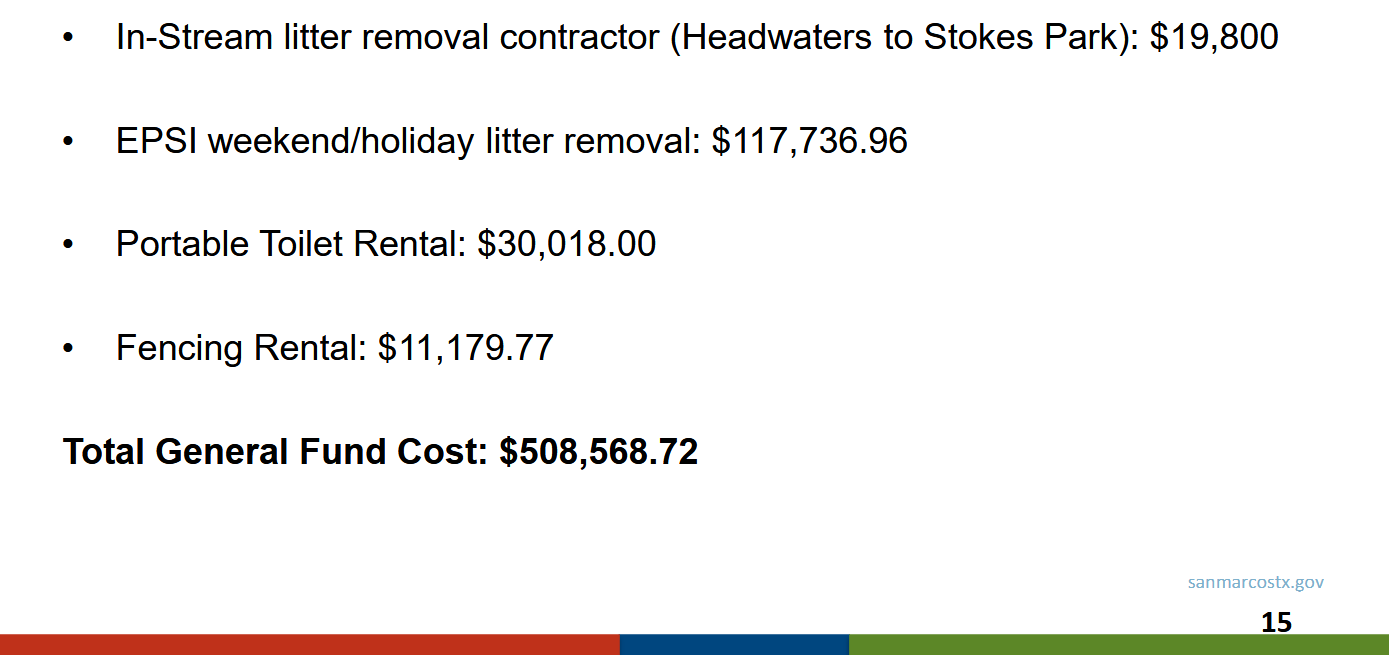
How much does it cost to staff the river?
A lot!
About $500K.
How would charging people even work?
First off, it’s supposed to be free if you live in town. It would be similar to parking at the Lion’s Club: – Register online ahead of time. – Get a QR code on your phone to show the people at the gate. – Or just show your ID at the gate to get in.
Note: But I don’t want to bring my phone OR my wallet to the river! This already sucks.
Out-of-town people would pay online ahead of time, and get a QR code.
Alyssa and Amanda have a lot of concerns with people having to navigate this process. It’s similar to the parking problem – every time you put friction into a system, you lose your vulnerable people.
…
How much money will this bring in?
We don’t know! It costs $30K to get the software.
We don’t really know how many out-of-towners come to the park. And we don’t know how many people will stop coming if it’s not free anymore.
…
There are a few different questions:
Does Council want to charge anybody?
If so, who counts as an out-of-towner?
How much do we want to charge?
We’ll take these one at a time.
Does Council want to charge out-of-towners?
Yes: Jane, Shane, Matthew, Josh, Lorenzo
Postpone for a year to collect data: Alyssa, Amanda
So that passes.
Who should get in for free?
Everyone agrees: All of San Marcos and all of SMCISD.
How much should we charge?
Everyone wants staff bring back options.
…
Just to note: New Braunfels charges $2 to get in the river, and $25 to stop and put a blanket down on the grass.
TWENTY FIVE DOLLARS! We will not be doing that. That’s nuts.
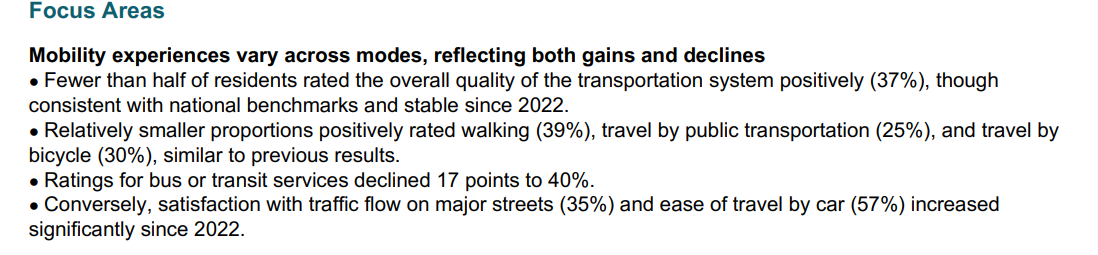
Every three years, we run a community survey. The first one was in 2022, and so 2025 is the second.
Methods:
They try to get a random sample of people by sending mailers out to households. They also open the survey up to anyone, online.
The responses are overwhelmingly older white homeowners in Kissing Tree.
I’m really not kidding:
where “Charlie” is the blue #3 area below:
and yes, they are mostly white home-owners:
This is a well-understood phenomenon by people who run surveys – different groups of people respond to surveys with different participation rates.
So they correct for it. What you do is you take the actual composition of San Marcos, based on census data. Then you weight your survey responses until they match the actual proportions.
For example:
Loosely speaking, if you’re 18-34 and you filled out the survey, your answers will get multiplied by 3. If you’re 35-54, your answers will get multiplied by 1/2, and if you’re 55+, your answers will get multiplied by 1/3.
Workshop: Heritage Tourism and Preservation Grants
“HOT” stands for Hotel Occupancy Taxes. How shall we spend our HOT money?
The city is proposing offering some grants to nonprofits who have some kind of historical preservation project.
City staff goes through a long list of slides. Who would be eligible? What kinds of projects are okay? How much are the grants for? What’s the rubric for evaluation? What’s the timeline? It’s very detailed.
What does Council say?
“Let’s kill this whole thing and just use the money for repairing the Dunbar School Home Education Building.”
It’s not a bad idea! I felt a little bad for the presenter, though.
It’s the only building left from the original campus of the Dunbar School.
We just talked about the Dunbar School a moment ago – it’s the original school for black children during segregation, named for the poet Paul Laurence Dunbar.
The Dunbar School was put on the National Register of Historic Places in 1983.
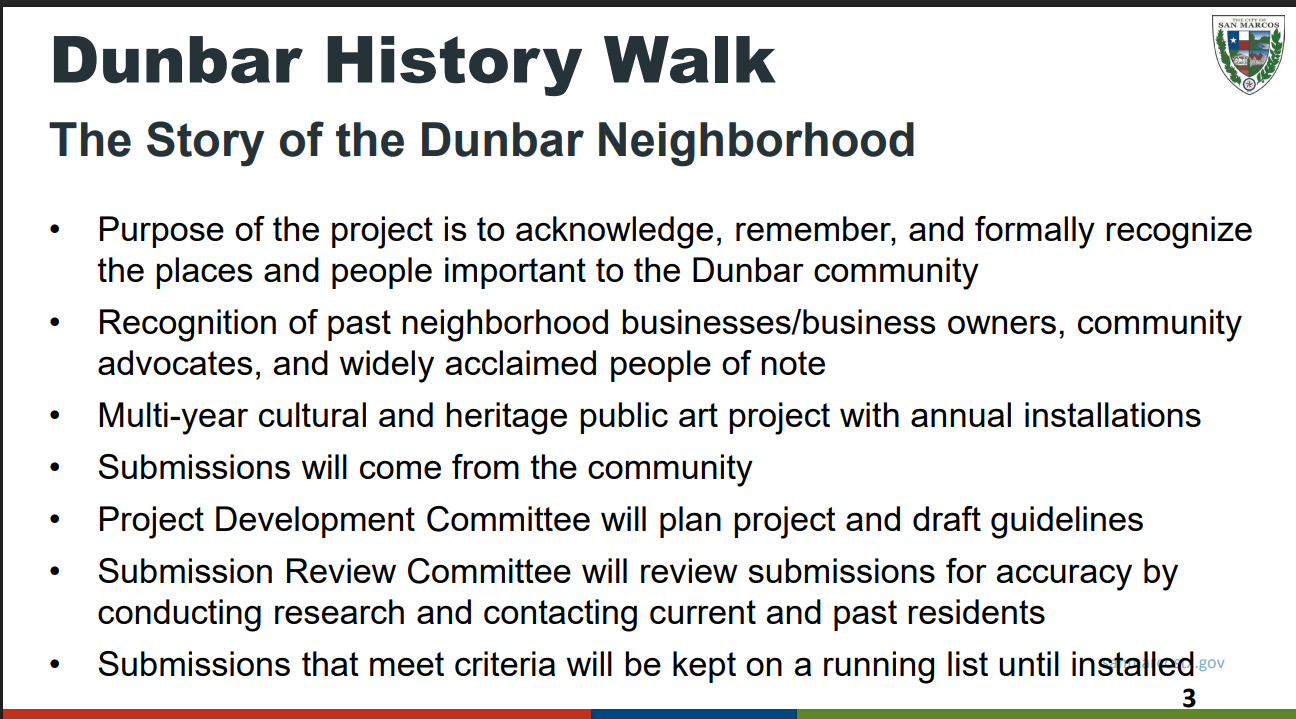
So the Dunbar Sistas are a group of women who played softball together as teens, decades ago, and are now some of the community anchors in San Marcos. They are the ones who originally came up with this idea. Two of them – Mittie Miller and Deborah Giles Webster – both spoke at the meeting about their process.
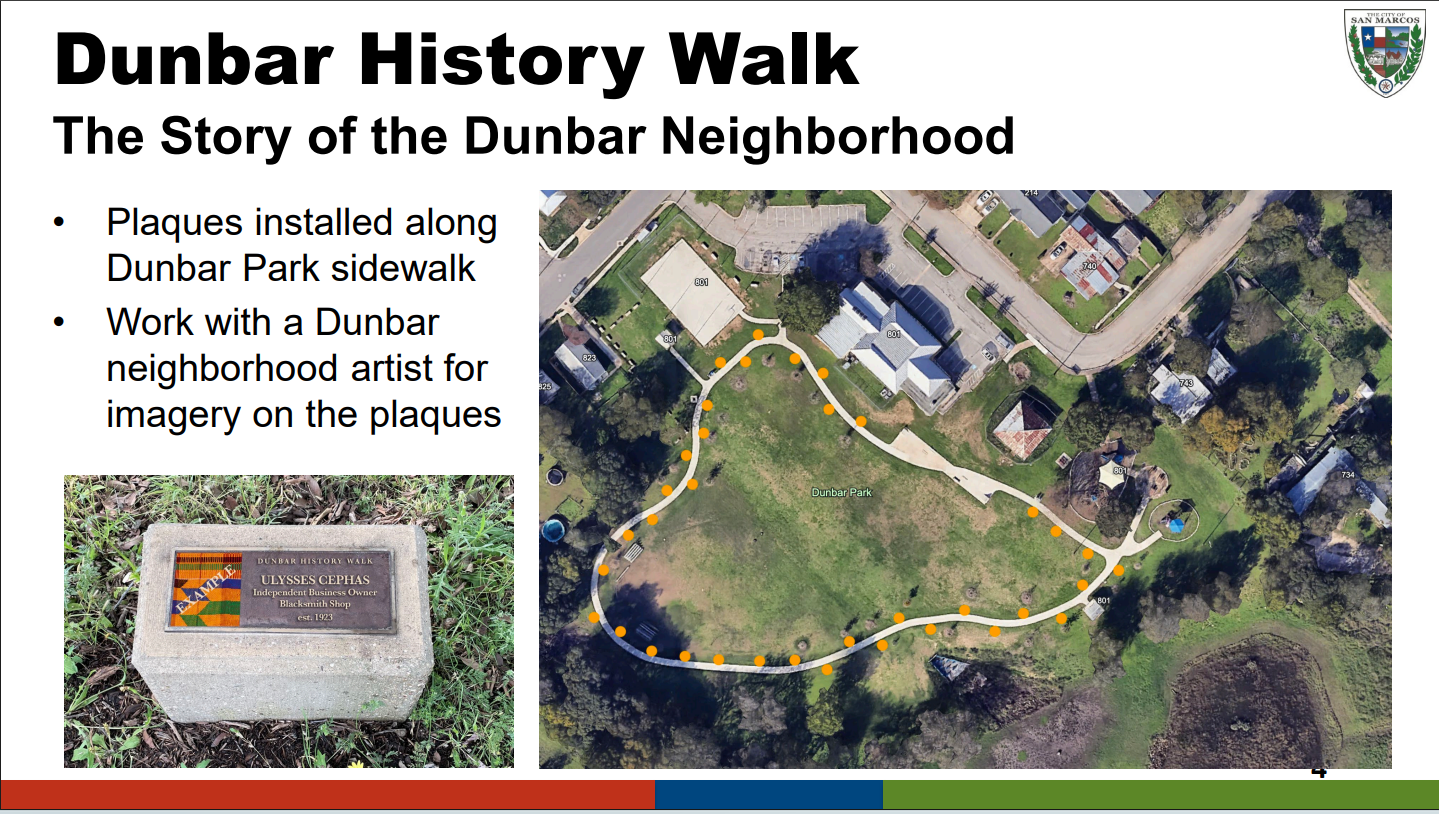
Here’s the plan:
This sounds great! So all those little plaques would commemorate important people, businesses, churches etc.
One thing that the Dunbar Sistas stress is the process for determining who will be featured on the walk. There’s a large network of Dunbar alumni, people who grew up in Dunbar over the past century, who may now be scattered across the country. They want decision-making to go to Dunbar alumni, as opposed to people who may be recent transplants to Dunbar. This seems reasonable.
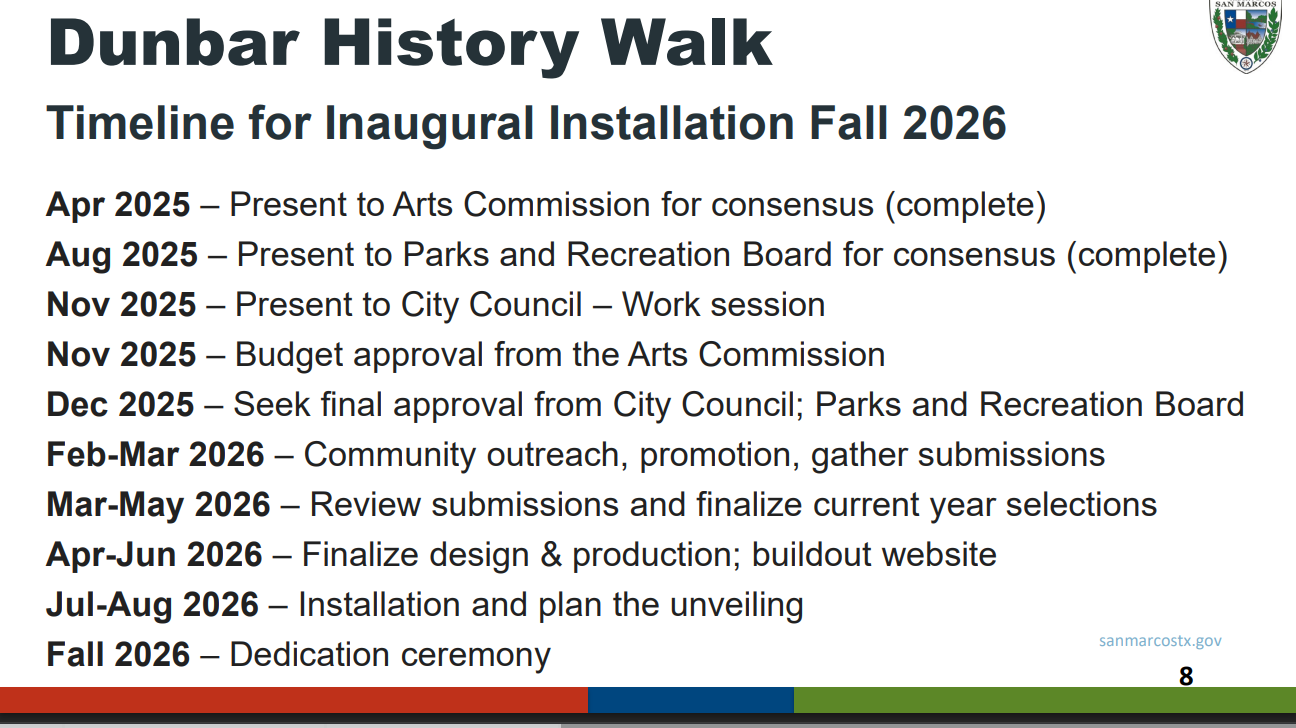
The plan is to roll it out next fall:
Anyway, there weren’t any other neat pictures in the presentation for me to clip for you, but there is a ton of history at the Calaboose Museum and Dunbar Heritage Association.
We are putting together a Historic Preservation Plan. This will be pretty quick.
First off, I thought this background was interesting:
The presentation itself was mostly “How to Read the Preservation Plan” as opposed to the actual San Marcos content. But the plan is pretty readable, so I’ll just grab one or two interesting bits from it, and send you over.
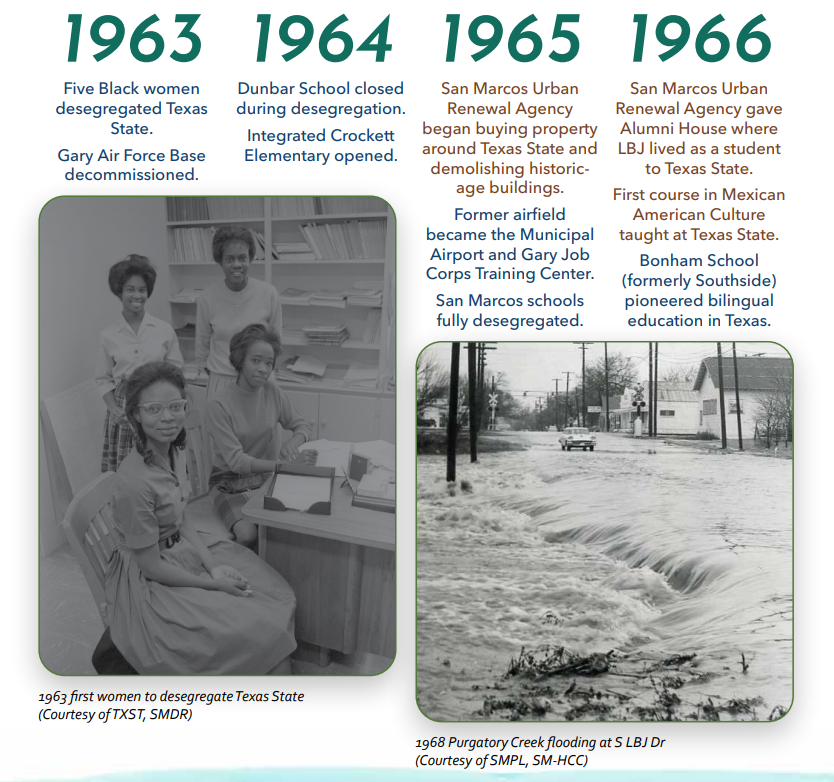
For example, there’s a very detailed timeline, starting in time immemorial, with bits like so:
(Amanda Rodriguez: Could we add the names of the women to this photo? Staff: Absolutely!)
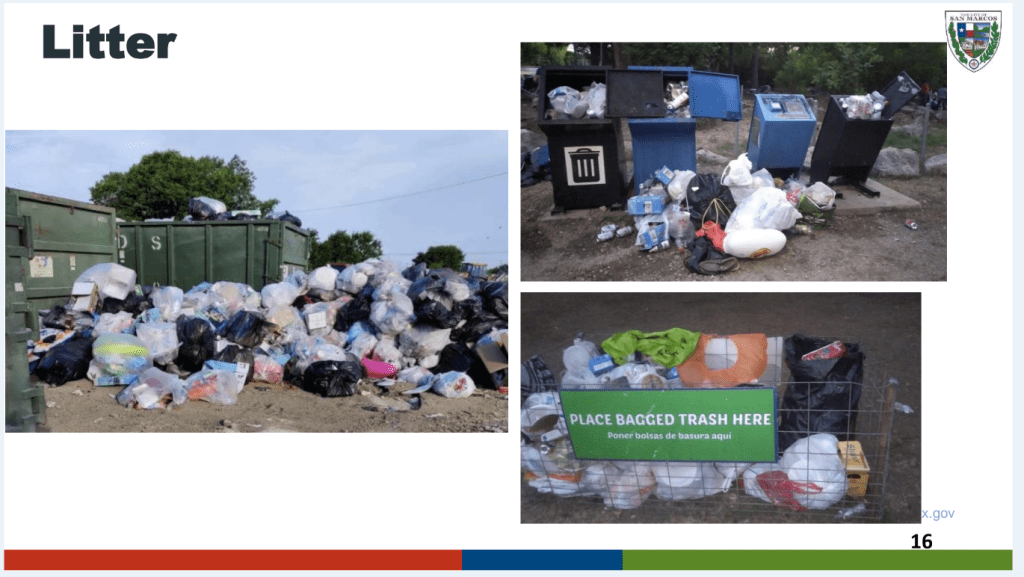
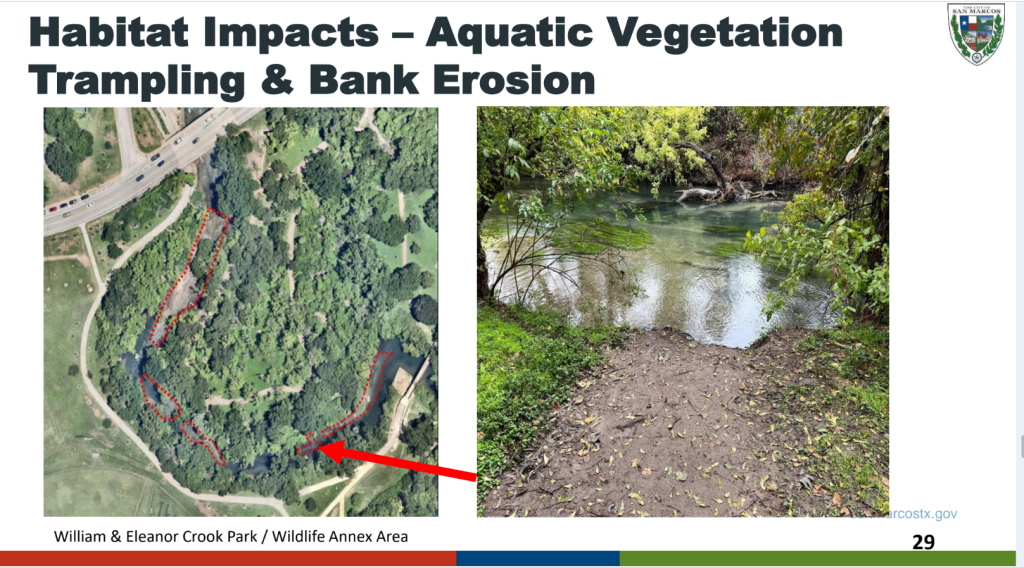
It’s all of the litter, and all of the repeated trampling of the banks, and the erosion of the aquatic wild rice and habitats for endangered species. It’s all bad.
3. The cost.
City staff really haven’t even brought up the price tag in the past few years, because the litter, damage to river, and lack of safety were so off the rails.
But of course, all solutions require people, and people’s labor costs money. So this is looming.
…
Solutions
The 2023 season was so bad that Council realized we need to do something. So in 2024, we passed a can ban. Summer 2024 was the first implementation.
So this spring, Council cautiously agreed to try Managed Access for 2025.
That means this:
around Rio Vista and the falls.
Everyone thinks these fences are very ugly and sad! They’re not wrong. But I’m going to make the case that the fences are a good first step. It is a work in progress.
Basically, the falls, swimming pool, and tennis courts at Rio Vista were fenced off. In order to access them, you had to walk to one of the three entrances:
On weekends and holidays, those entrances were staffed. They’d check to make sure you weren’t bringing in anything banned, like alcohol or a bunch of styrofoam plates.
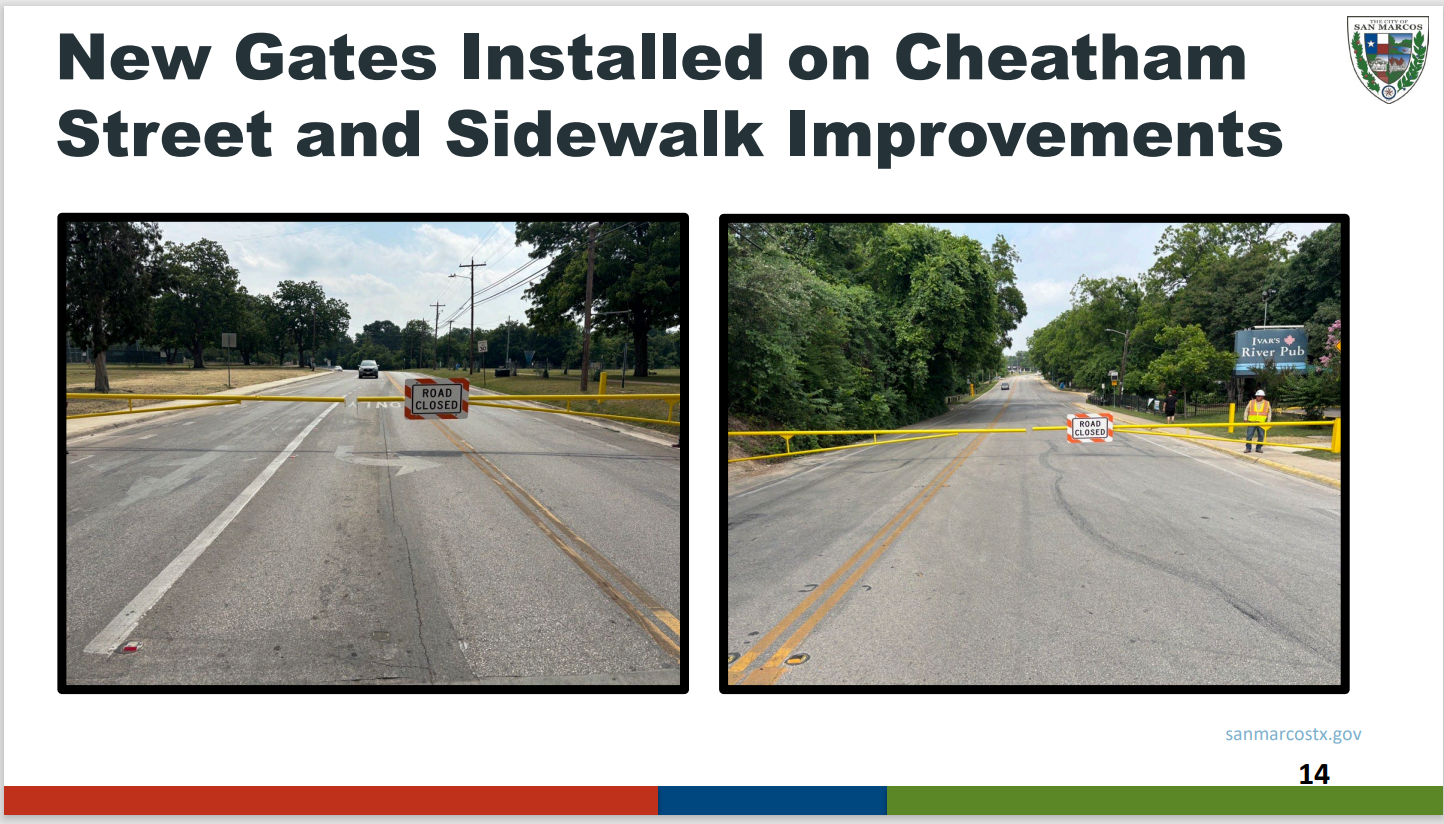
On the big holiday weekends – Memorial Day, 4th of July, and Labor Day – they also closed off Cheatham street altogether:
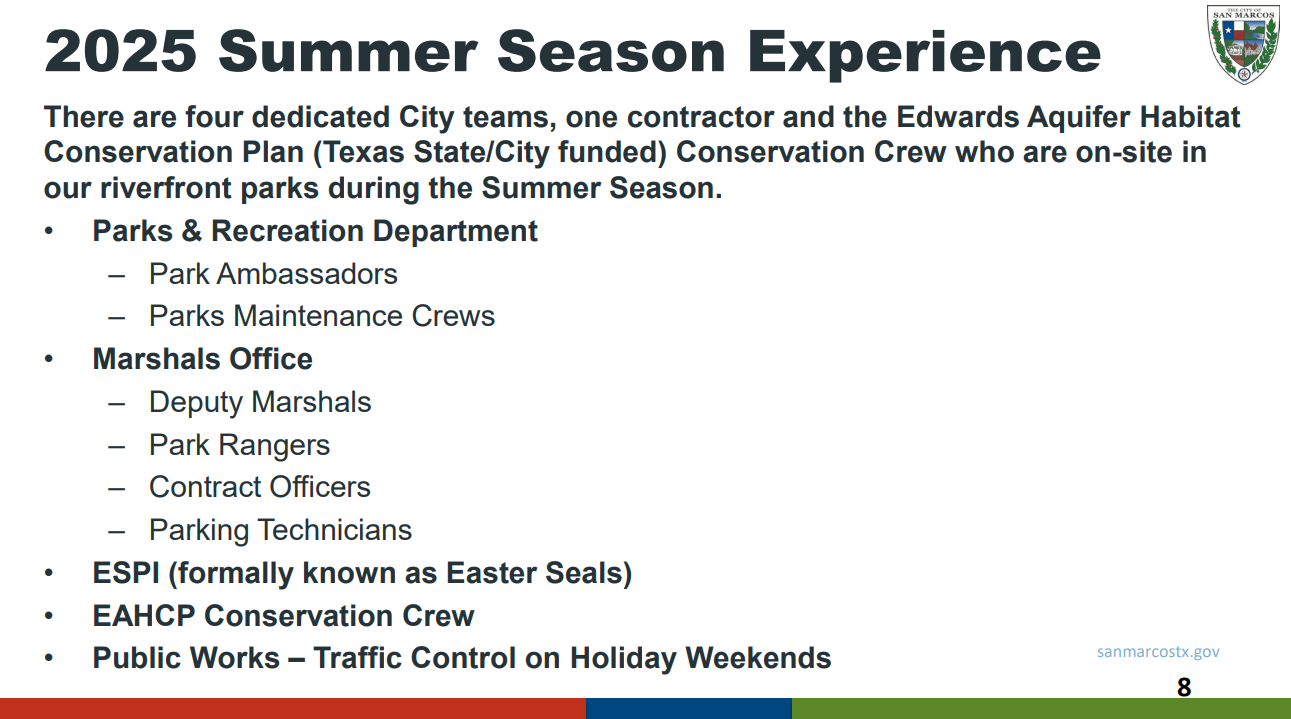
They also increased staffing. There were at least ten more employees just to staff the entrances and exits on weekends and holidays. There are a lot of hands on deck, picking up trash, monitoring situations, and available for emergencies:
It’s a really big operation.
…
What does the public think?
At citizen comment for the workshop, three people spoke. I think they are all very involved in river clean-up efforts.
Major themes:
Fences significantly reduced the size of the crowds
Fences significantly reduced the amount of trash in the river
Fences significantly protected the riparian zones of the river, ie the wild rice and other environmental spots.
There is more work to do. There was still a ton of litter.
Let’s look at places that have done this well – for example, Copenhagen has a sustainable tourism program. Tourists can get perks if they pick up litter or take public transportation.
….
What does city staff say?
Litter started off rough, at the beginning of the summer.
Fences were put up at the end of May. Then:
Looking good!
And some data:
Note: July was much rainier and less-hot than usual. The 4th of July was pretty much rained out (while the tragedy was unfolding in Kerr County and elsewhere). So it wasn’t just strictly the fences.
Did visitors just go to a different part of the river?
Staff said no, they did not see an increased number of problems upstream or downstream from Rio Vista. It seems like everyone wants to be at the falls.
(It could still happen after a few years, of course. But it has not happened yet.)
…
Overall, everything seems optimistic!
That is my personal belief, too – that this year, things were less dangerous and destructive than they’ve been in the past.
…
So that’s 2025. What about the future?
Here are the big questions for Council today:
1. Do they want to keep fencing off Rio Vista in the future? (ie “Managed Access”)
2. Do they want to start charging out-of-towners for river access?
Let’s take these one at a time.
The fencing.
Another angle:
Everyone hates the big, bulky chain link look. Including me!
Can we at least make it look a little nicer?
Maybe!
Staff is not proposing that we put up permanent fencing. This would only go up between Memorial Day and Labor Day.
Council questions:
Q: Would we rent or buy the prettier fencing? A: We’d buy it. It would cost about $75K. Renting the fences this past summer was roughly $15K.
Q: People were cranky about the tennis courts being inside the fencing . Can we find a way to make them easier to access? A: Yes, we can definitely explore this for next year.
Bottom line: Does Council want to continue with the fences?
Mostly yes. Alyssa and Amanda are both a little squirrelly on the question, but they’re more yes than no.
Note: I am a hard yes. You only get one river, and overuse will kill your river. This is a dead on, textbook-example of a Tragedy of the Commons.
….
2. Should we charge admission?
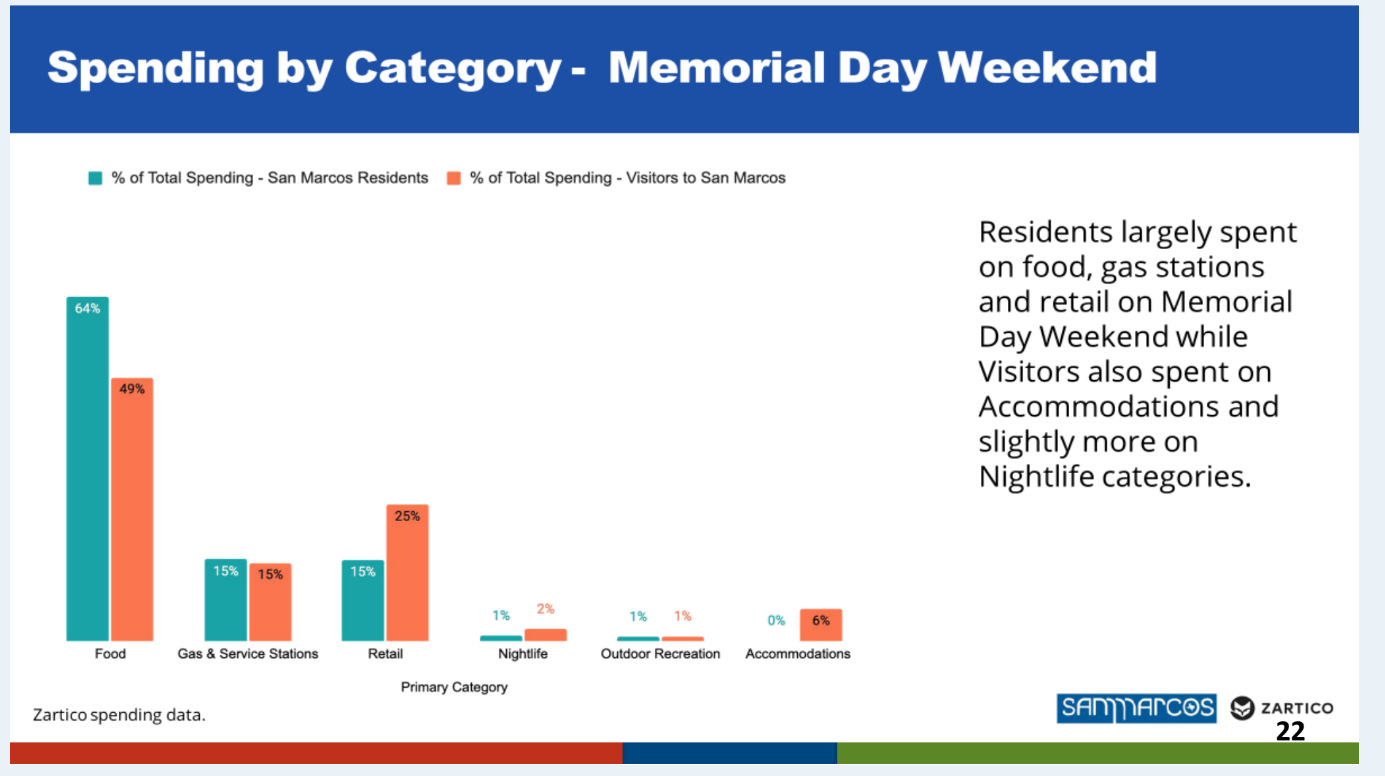
The problem is that we’re running a giant operation here, all summer long, and it requires a lot of staff. Furthermore, it mostly isn’t San Marcos residents using the river.
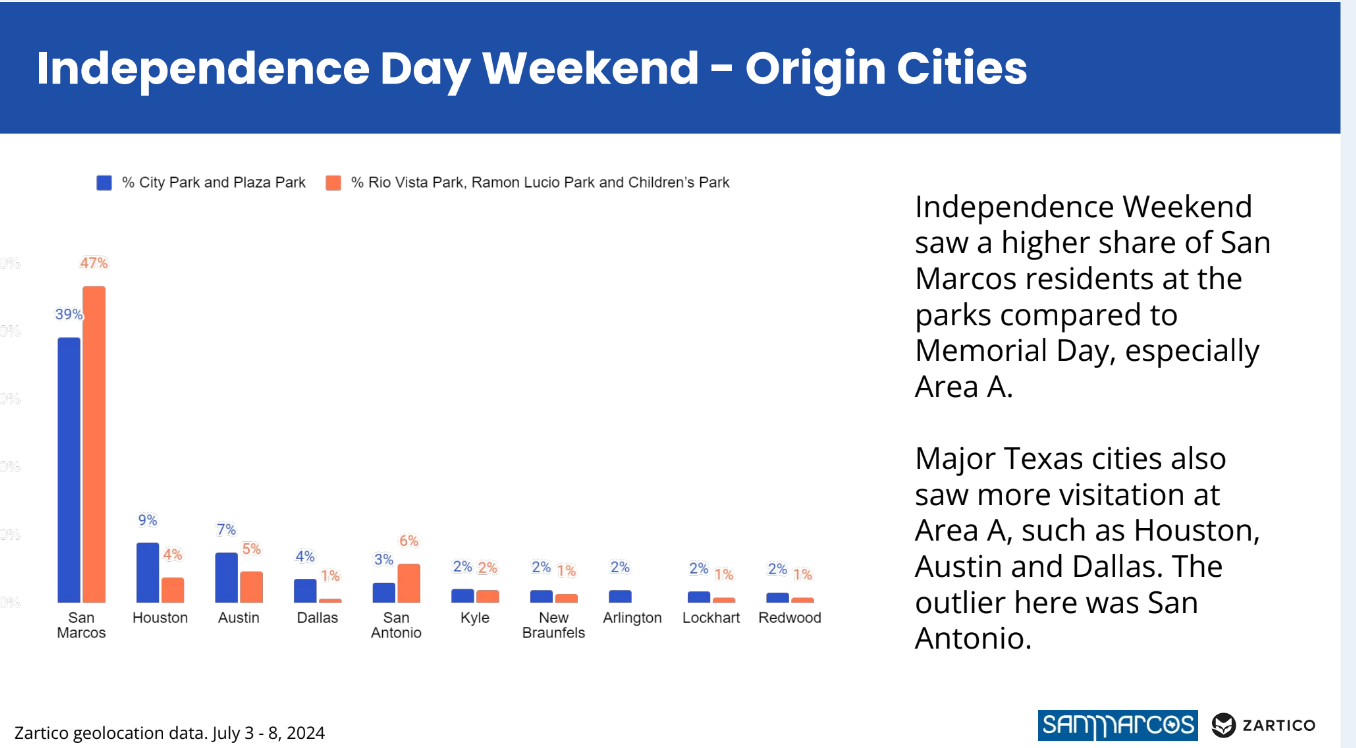
This is an old slide from 2024:
(Zartico is a company that tracks cell phone data. We paid them to track people on the river and tell us where people went afterwards. Yes, it’s a teeny bit creepy.)
The point being, about 1/3 of the park visitors were local, and 2/3 were in from out of town. Here’s 4th of July from 2024:
More from San Marcos, but still under 50%.
No one is proposing that we charge admission to San Marcos residents. But should we charge out-of-town visitors an admission fee?
What does everyone else do?
Lots of cities charge fees:
….
And so now, San Marcos?
City staff is recommending yes, we should start charging.
Here is what they propose to council:
What does Council think?
Jane: we should start our season earlier than Memorial day. Answer: That just costs even more.
Alyssa: How would residents get a river pass? Answer: You’d sign up in person or online. Like getting a library card. It would be a physical hard copy.
Alyssa: One per household or one per person? Answer: Per person. Alyssa: Even kids? Answer: I mean, you all are council. You tell us what you want.
Amanda: I have strong reservations about this. The river is a natural resource. I don’t like the idea of commodifying it. I don’t like the precedent it sets. New Braunfels probably started out only charging a little, and now it’s $25 to set out a blanket. And their river is still trashed.
Jane: Our out-of-town visitors aren’t spending money here. They’re not contributing to the tax base that pays for these parks. I don’t want to charge residents, but I’m okay charging out-of-town guests. They need to share the cost.
Saul: How much revenue would this bring in? Answer: We have no idea. It’s hard to even figure out how many people go to the river.
Let’s break it into categories
1. San Marcos Residents
No one is proposing that we charge San Marcos residents. But there’d have to be some sort of free pass system.
Every time you add a layer of inconvenience, you trip up vulnerable residents. (Think: undocumented community members who don’t feel safe signing up, or harried single mothers who keep forgetting to sign up. Etc.) Alyssa and Amanda voice some of these concerns.
2. People just outside the city limits.
What about people who live nearby? Like you have a San Marcos mailing address, but you’re not officially in city limits?
Jane, Shane, Saul, Matthew: They should get a reduced admission price. Alyssa, Amanda, Lorenzo: they should be free.
3. Actual out-of-town visitors?
Lorenzo: Yes. We should charge them. Jane: Yes. Same. Alyssa: I don’t know. This needs more work. Amanda: Kids at least should be free. Saul: I agree on the free kids. Matthew: I’m fine with what staff proposed. Shane: [never turns on his microphone, I have no idea] Alyssa: Who’s gonna pay $100 for a season pass? Come on. This needs work.
Fair point, Alyssa.
Overall: It’s a little hard to follow, but I think this is where everyone lands:
Yes, charge out-of-town guests: Jane, Lorenzo, Shane, Saul, Matthew
Maybe. We’re not sure yet: Alyssa, Amanda
No one is a hard no.
What do I think?
I’m on the fence. I hate the increase in bureaucracy and bookkeepping, and I wish for a state where we just properly funded parks and local governments. (See also: socialized health care is much cheaper than private insurance because it’s so much less paperwork, bureaucracy, and red tape.)
I also hate the idea that everyone on the river would have to keep a plastic card on a lanyard around their neck.
On the other hand, here we are – with actual bills to pay and actual rivers to save, people to keep safe – and that all costs money.
Maybe the river pass can be made into a little bracelet?
…….
Lorenzo: can we hold an evening workshop instead of a 3 pm workshop, so that more residents can attend?
Everyone agrees this is a good idea.
Bottom line: City staff will bring back more rate models and Council will have another workshop. But it looks like the writing is on the wall. I think it’s likely.
…..
One last workshop topic.
Paid parking at the Lion’s Club
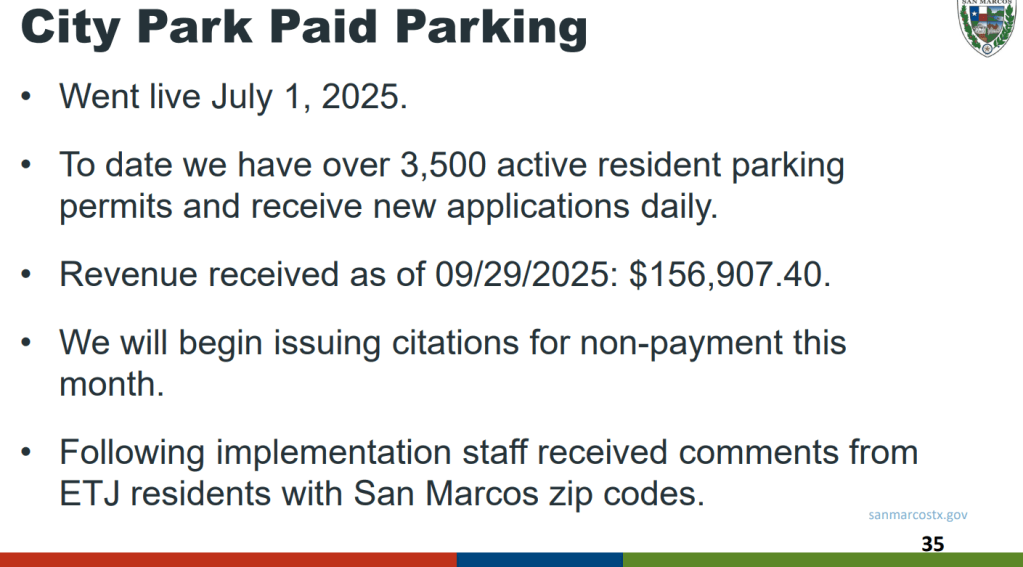
We’re midway through a pilot year of paid parking at the Lion’s Club. It’s free for all residents, but you do have to register. (Register here!)
How’s it been working?
Ok, so it just started.
A few notes:
They have not yet been ticketing anyone, but they’re about to start. (Apparently there have been problems with Texas State students. Students can park there, as residents who want to use the parks, but not to go attend class at Texas State. I have no idea how they can tell who is doing what.)
“ETJ” stands for extra-territorial jurisdiction, ie the people who live nearby the city, but not in the actual city limits.
The main question: do we want to charge people less if they live in the ETJ? On the one hand, they don’t pay property taxes. On the other hand, they do come to San Marcos to go shopping, and so they pay sales tax.
How do we want to handle people who live close to San Marcos?
Charge a reduced fee: Matthew, Shane, Jane
Keep it free: Alyssa, Amanda, Saul, Lorenzo
There’s some minor quibbling about what “close” should mean. Anyone in who lives in SMCISD? Anyone with a San Marcos mailing address? some third option? I think they settled on SMCISD.