Short little meeting this week! A little bit of zoning, a lot of HSAB grants, and a little bit of Paul Laurence Dunbar.
Here we go!
Hours 0:00 – 2:04: Blanco Gardens is getting some new houses, we unpack the HSAB grants to nonprofits, and we talk about the guy behind the Dunbar name.
Tonight’s the night that Council determines their HSAB grants, and so almost everyone speaking was representing nonprofits – one speaker from School Fuel, and three from Southside. I’ll save it for that item.
One last speaker talked about Meet and Confer, and whether or not it was okay for Council to make recommendations to the negotiators who represent the Council in the negotiations.
…
Item 13: Rezoning a little street in Blanco Gardens
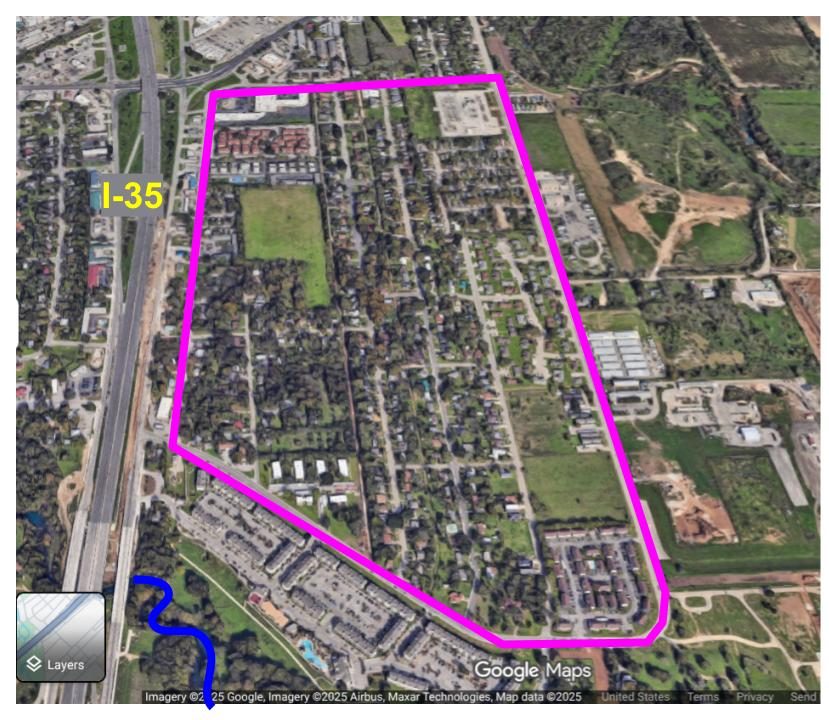
Here’s Blanco Gardens:
It’s a very cute old neighborhood with gorgeous trees.
For an old neighborhood, there’s a surprising amount of undeveloped land in the middle of it:
(I wondered briefly if that was because homes had been torn down after the floods. But nope, you can see on the 2014 satellite image that there’s just always been space there for years.)
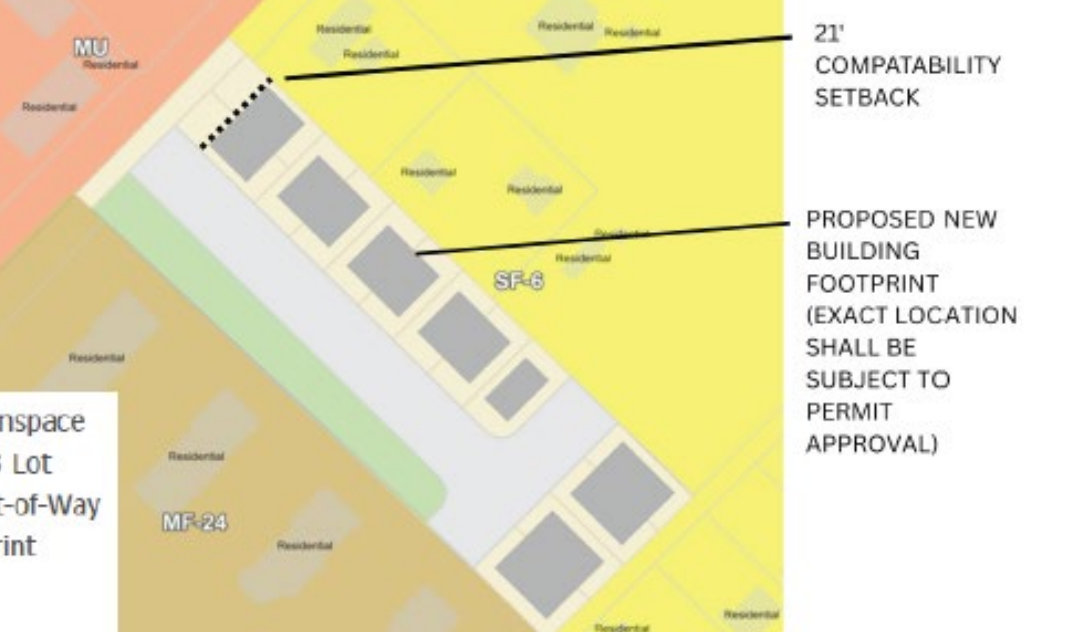
They would look and feel like duplexes, but they’re technically different, because of how they can be bought and sold. The property line runs through the two halves of the house, so you can purchase one half of it, while someone else owns the other half. (It’s called a “zero lot-line house”.)
Basically it’s a good way to fit more, smaller homes onto a street, and they tend to be a little cheaper, too.
What does Council say?
Question: will fit the character of the rest of the neighborhood? Developer answer: We have good intentions!
(One block over, there are some extremely modern houses. The neighborhood is salty about this.)
Question: Will the alley still exist? Answer: nope.
…
Nobody really asked about flooding. The 2015 floods are starting to fade from memory for the rest of San Marcos. But not in Blanco Gardens – they were the epicenter of the floods.
I would have liked to know what the 2015 flood water line was for nearby houses – I bet it was about 3-4 feet of water deep. How elevated will these houses be? Will they be above the 2015 water line?
My memory is that, in a 100-year flood plain, you have to build 1-2 feet above the Base Flood Elevation, based on FEMA flood maps. Does that get you to 3-4 feet off the ground? I just don’t know.
…
The vote on this cute row of sorta-duplexes:
Yes: Everyone No: nobody
The good news is that Council is enthusiastic about infill housing. (When I first started blogging in 2022, Council wouldn’t let a home owner build two small houses on a subdivided lot, on Lockhart street. That was crazy.) They’ve definitely gotten the message that San Marcos needs more housing.
As long as the homes are safely elevated, I’m okay with this project. But the flooding risk makes me very uneasy.
…
Item 14: HSAB Funding
HSAB stands for Human Services Advisory Board.
These are city grants to nonprofits, for things like food assistance, eviction prevention, domestic violence help, mental health services, etc. For the past few years, we’ve given out $500K in grants. This year, Council bumped it up to $750K. (Of course, federal funding has gotten slashed, so the need has also grown. THANKS OBAMA.)
It’s always a grueling process. All the nonprofits all do incredibly important work.
In the past, we kinda made non-profits cagefight against each other. [Read all the gory details for thepast few years.] The process was murky. The recommendations would come to council, and council members would start horse-trading around.
It was a bad look! It always seemed very fickle – “Oh, we’ll take $20,000 from those guys and give it to these guys!” It felt like the main criteria was being friendly with council members.
We’ve been working on tightening the process. It’s a super time-intensive:
the HSAB board meets weekly from August to October
They hear presentations from all 32 applications
Each one gets discussed and each board member ranks them on a bunch of different criteria
Eventually they recommend how much of each request to fund.
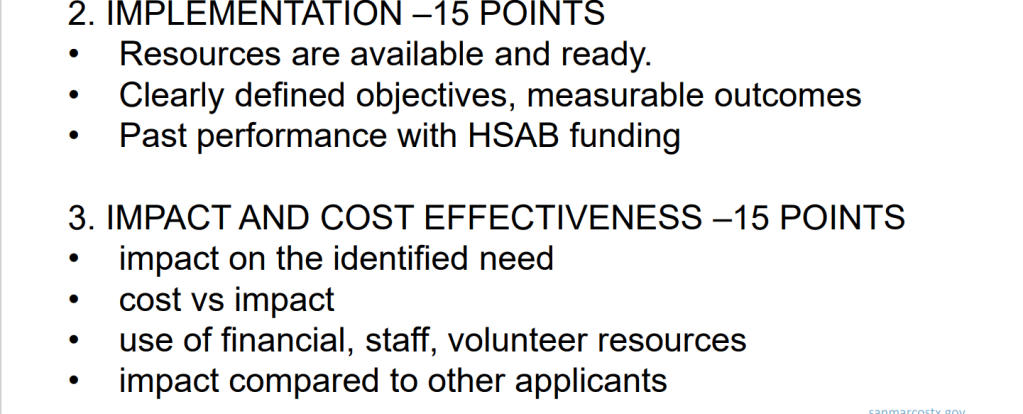
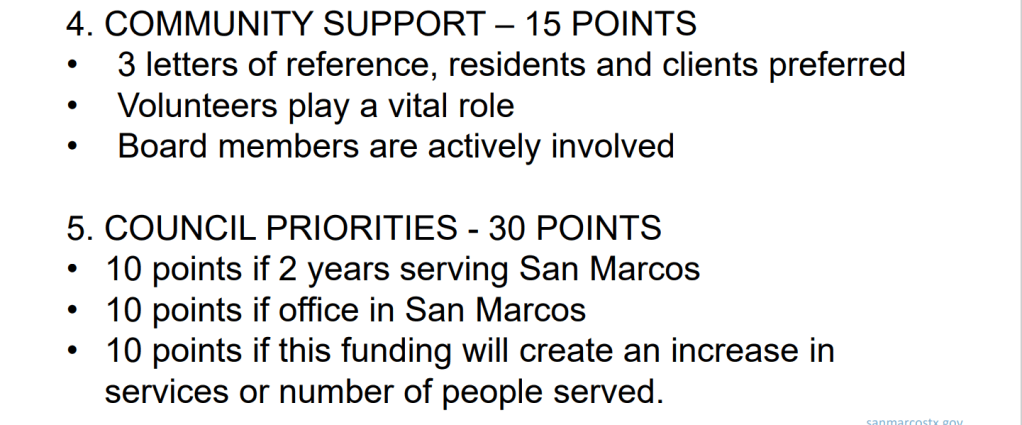
Here’s the criteria:
After all the ranking and discussion, they bring it to Council.
…
Just for funsies, let’s add up how much other non-HSAB money is getting allocated in this meeting!
All this was approved in one single vote, on Tuesday:
“On-Call Title Research Services Contract with Hollerbach & Associates, Inc., to increase the price by up to $200,000.00, resulting in a total contract amount not to exceed $299,999.00”.
“RMO P.C. for legal services associated with land acquisitions to increase the price by up to $300,000.00, resulting in a total contract amount not to exceed $699,000.00”.
“Change in Service to the agreement with Baker Moran Doggett Ma & Dobbs, LLP for legal services associated with land acquisitions to increase the price by up to $300,000.00, resulting in a total amount not to exceed $600,000.00”.
“STV Incorporated to provide On-Call General Engineering Services for various projects in the amount of $900,000.00”.
“Halff Associates, Inc. to provide On-Call General Engineering Services for various projects in the amount of $900,000.00”.
“a 2025 Ford F550 Crew Cab Chassis from Rush Truck Center, through a Sourcewell Purchasing Cooperative Contract, in the amount of $82,043.63, and outfitted by E.H. Wachs, through a BuyBoard Contract, in the amount of $156,865.65, for a total purchase cost of $238,906.28”.
“SHI Government Solutions, through Omnia Partners, for a City of San Marcos job application tracking software system in the annual amount not to exceed $112,000.00, and up to four one-year renewals with a total amount of $560,000.00”.
It comes to about $2.95 million. I’m not saying any of those were a mistake! I trust the city officials. Most likely, those are all totally reasonable.
I’m just pointing out who gets scrutinized, in society, and who doesn’t. We approved almost $3 million without blinking, when it goes to those contracts above. But if it’s hungry kids, homelessness, mental health emergencies, etc, we rigorously grind these applications into pulp.
…
Back to the grant grind!
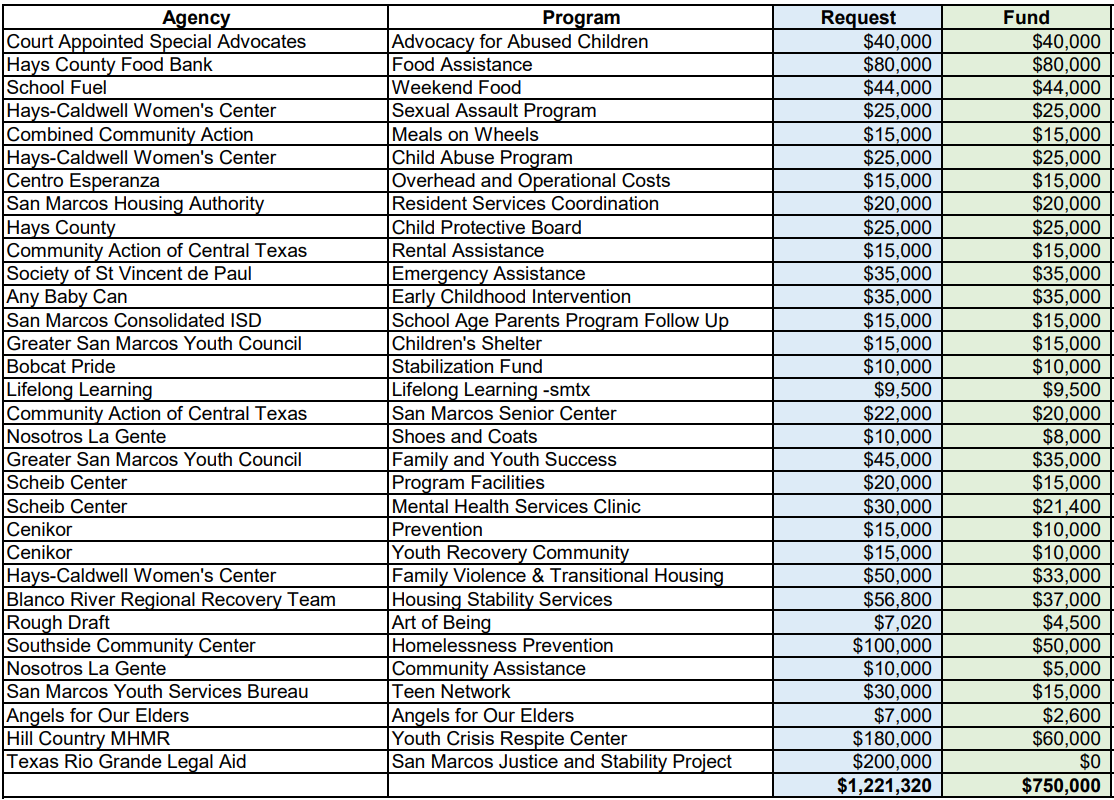
There were 32 applications, and the total amounts requested added up to $1.2 million.
Here’s the full list of scores and funding:
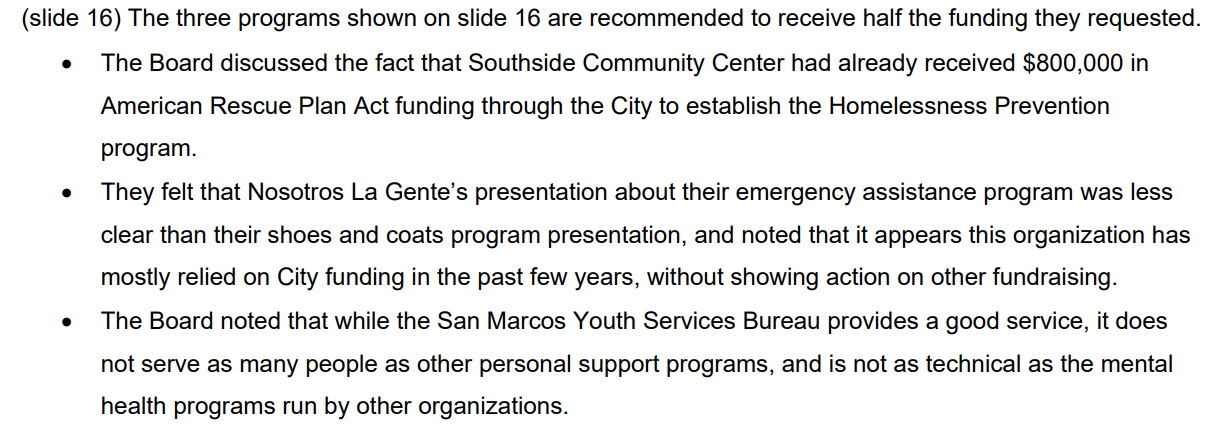
In the presentation, they went through all of them, and why the committee might not have fully funded the request.
For example:
The rest of their thoughts are on pp 435-437, here.
They were very thorough.
…
Back to Citizen Comment
Three speakers from Southside show up to talk. Here’s what they say:
Southside is in a funny position. In 2024, the city gave Southside $800K of Covid money to implement a Homeless Action Plan.
They came up with a plan and put in all the work to get it up and running. Now they’re trying to sustain it over time. They asked for $100K from HSAB, but were only granted $50K.
The $100K is for their homeless prevention program – giving families $1000-2000 to get through a one-time financial crisis, so that they don’t get evicted.
…
Let the horse-trading begin!
Matthew kicks it off. He wants to try to get Southside back up to the full $100K that they asked for, for homelessness prevention.
Matthew proposes:
Take $4500 from Rough Draft
Take $5000 from Lifelong Learning
Take $10,000 from Hill Country MHMR
Give that $19,500 to Southside.
Ok, what are these things?
Rough Draft:
Their funding would go to $0.
Lifelong Learning:
Ok. Their funding would go from $9000 to $4500.
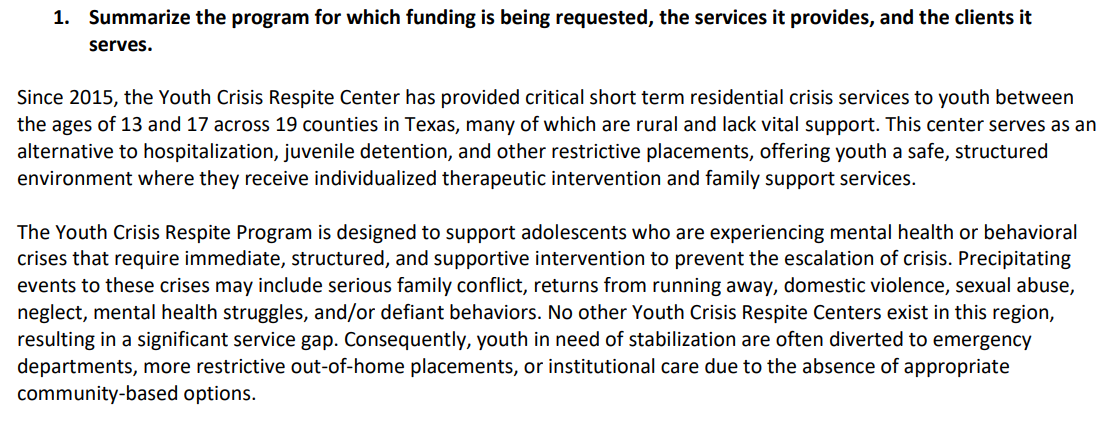
Hill Country MHMR
Their funding would go from $60,000 to $50,000.
….
What does Council think?
Question: How many people would Southside be able to help, with this $19K? Answer: About ten families. Average cost to stabilize someone after a financial emergency is $2k.
It’s actually a huge bargain. If they’d been evicted, it would cost $15-30K+ to stabilize a family once they become homeless. (Plus, y’know, becoming homeless is awful. This is way more humane for the families.)
Question: Are you all applying for other grants? Answer: SO MANY. Funding is scarce, and federal funds have been slashed.
Alyssa: The entire premise of horse-trading these dollars is problematic. Most agencies didn’t send someone here tonight to answer questions. We don’t have context and expertise. This is haphazard. I am not on board with any of this.
Amanda: Matthew, what about moving some money from the School Age Parents Program? They said they’d be able to keep the program open on $7,500, but they’re being awarded $15K.
Matthew: How dare you. Abso-fucking-lutely not!
[I’m paraphrasing. Matthew just said something like, “They do great work!”.]
Amanda: I’m trying to throw you a bone here!
Matthew: Hard no.
Amanda: Well, I’m a no on Hill Country MHMR especially. Their work is desperately needed. We are in a mental health services desert, and this program will fund teenagers without insurance.
Alyssa: I’m a NO on all of this, but especially NO on Hill Country MHMR. Homelessness and mental health are completely intertwined. There’s so much need here.
The votes are each held individually:
Move all $4500 from Rough Draft to Southside Homelessness Prevention?
Yes: Matthew, Jane, Amanda, Lorenzo, Saul
No: Alyssa, Shane
2. Move $5000 from Lifelong Learning over to Southside?
This motion dies without getting a second. So it never comes to a vote. That kinda surprised me.
3. Move $10K from Hill Country MHMR over to Southside?
Yes: Matthew
No: Everyone but Matthew
4. Amanda throws in a vote on the SMCISD School Age Parents Program:
They get $15K.
Should we take $5K from them, and give it to Southside?
Yes: Amanda, Saul
No: Matthew, Lorenzo, Alyssa, Jane, Shane
So that fails.
..
Me, personally: It’s an awful decision to make. I probably would have taken money from Rough Draft, Lifelong Learning, and maybe SMCISD School Age parents. But not Hill Country MHMR.
….
So that’s where it lands. Southside picked up $4500 more, and Rough Draft went to $0.
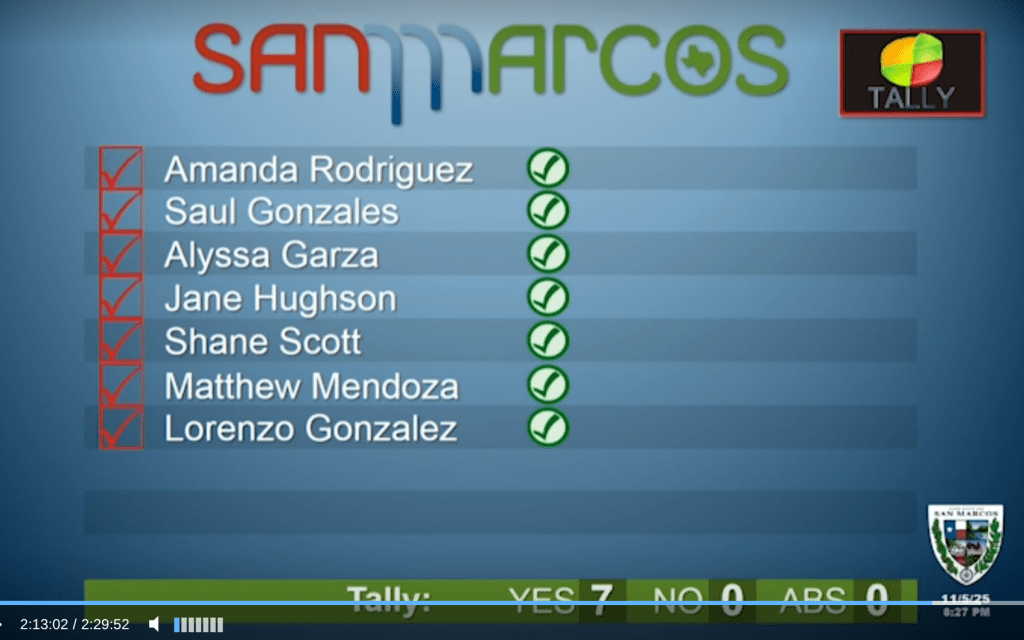
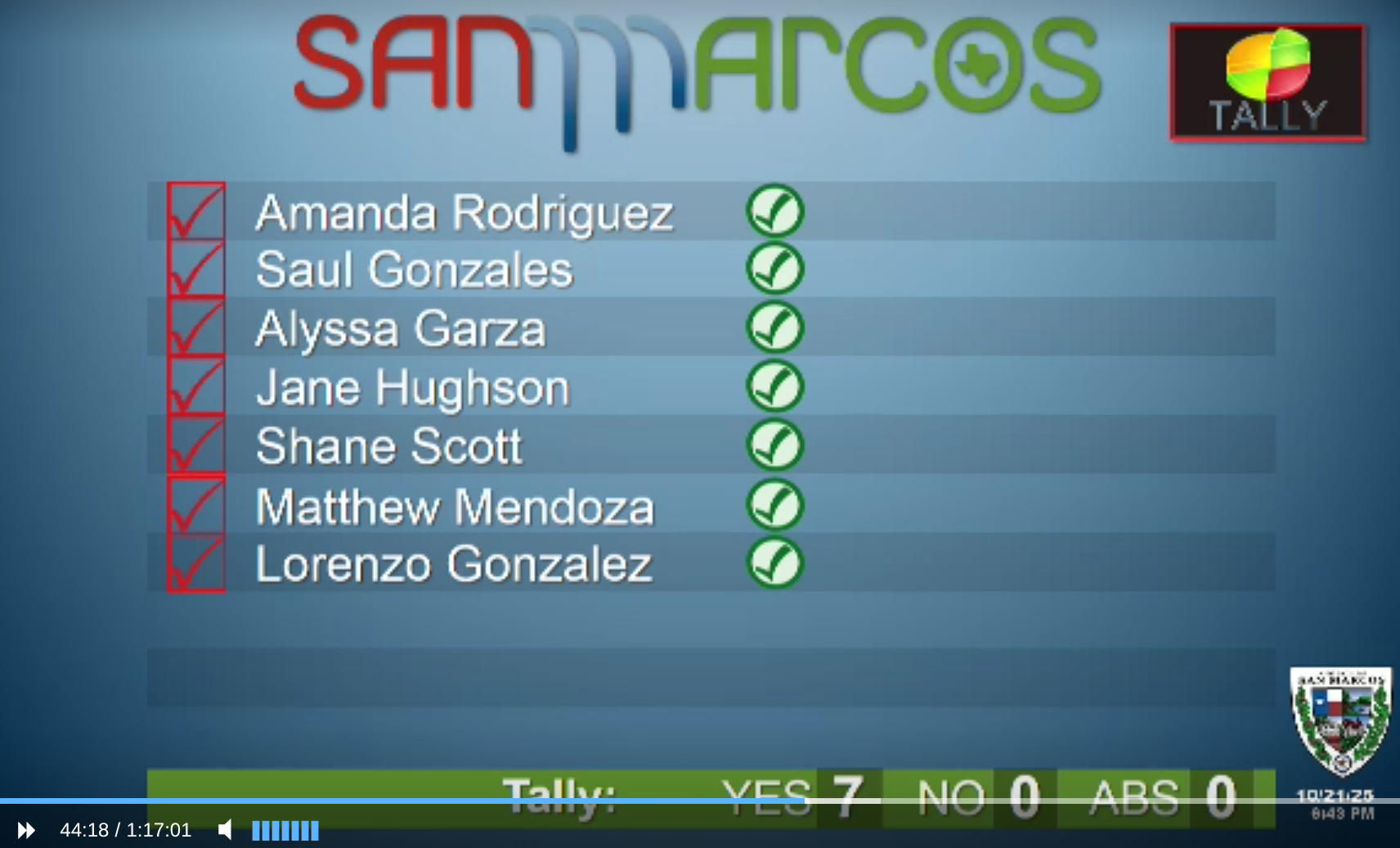
The final official vote on HSAB funding passes 7-0.
…
One more note!
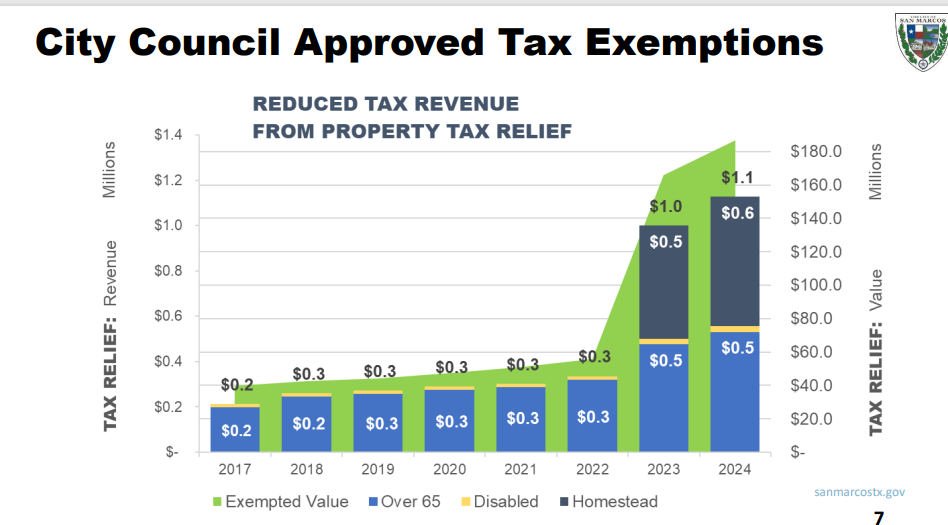
We just spent $750K on the poor and vulnerable.
But we also spend $1.1 million on tax breaks to home owners every year:
About 30% of San Marcos owns their own home. That $1.1 million is just for them.
People who want to slash property taxes never seem to appreciate how much of their own lifestyle is being subsidized.
….
Item 19: Dunbar Recreation Center
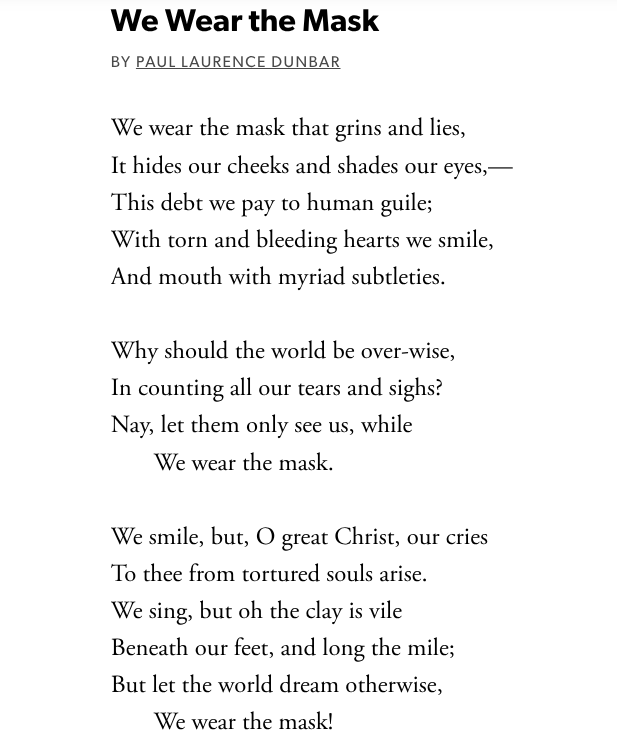
Dunbar was named for Paul Laurence Dunbar. He was the first black poet to get widespread recognition. (He was not from San Marcos in any way. He’s from Ohio.)
Originally, the Dunbar neighborhood did not have a specific name, besides being called “the colored neighborhood”. The school was called The Negro School. In 1961, that was renamed after Paul Laurence Dunbar, and then gradually the whole neighborhood came to be known as Dunbar. So the Dunbar Rec Center just got the name “Dunbar”.
Would we like to include the poet’s full name here? Everyone says yes.
Great!
Lots of interesting history on the Dunbar neighborhood here and here!
….
Item 20-21: Jorge’s Mexican Restaurant.
Jorge’s is on Hunter Road:
Separately, Miller Middle School is on Foxtail Road:
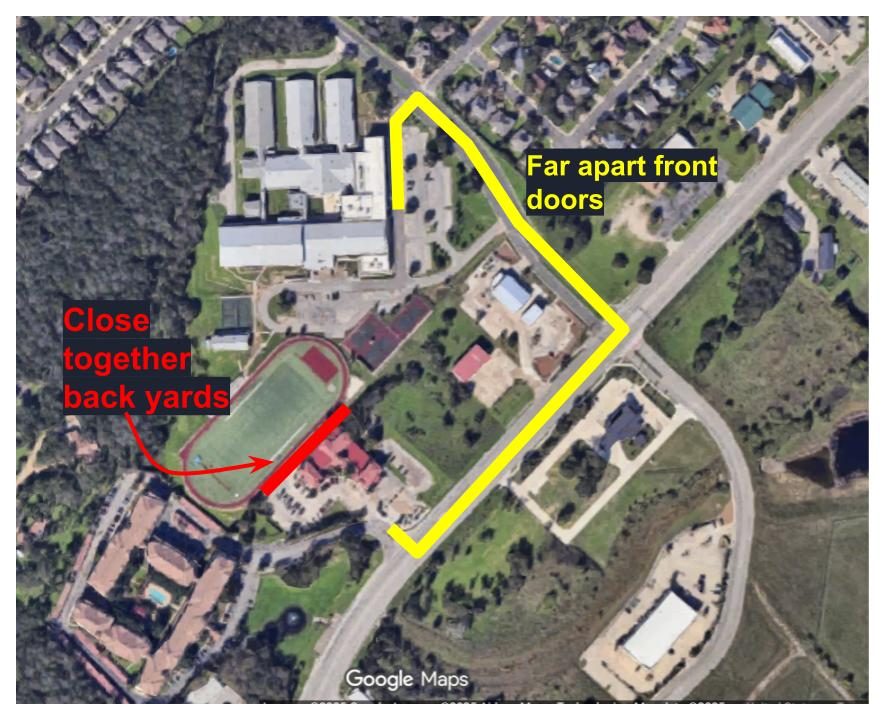
Their front doors are far apart:
…but they share a back fence.
This causes all kinds of problems for Jorge’s, because there are extra-strict rules for selling alcohol within 300 feet of a school.
This means that Jorge’s has to do a lot more:
Renew their alcohol permit every year, instead of every three years like everyone else.
Renew their distance variance every year, which grants them an exception to the 300 foot rule.
The main problem is the fees – both of those cost $750, so Jorge’s is paying $1500 every year.
Why is it so expensive?!
Mostly because of postage. The city has to notify everyone within 400 ft. The rest of the cost is to cover staff time, to process the paperwork.
Everyone wants to at least refund half of Jorge’s fees, since the city can save costs by processing both the alcohol permit and distance variance at the same time.
They’re going to try to come up with a long term solution, too.
Workshop: Heritage Tourism and Preservation Grants
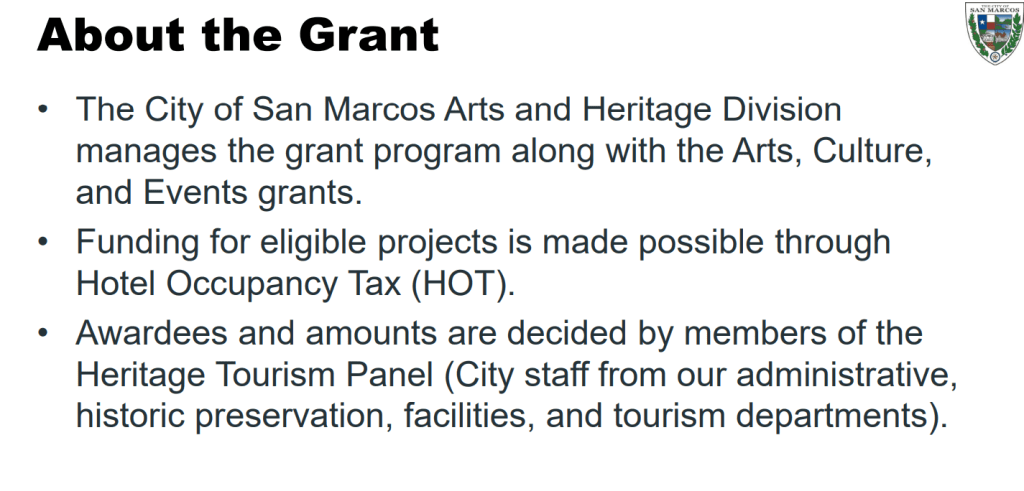
“HOT” stands for Hotel Occupancy Taxes. How shall we spend our HOT money?
The city is proposing offering some grants to nonprofits who have some kind of historical preservation project.
City staff goes through a long list of slides. Who would be eligible? What kinds of projects are okay? How much are the grants for? What’s the rubric for evaluation? What’s the timeline? It’s very detailed.
What does Council say?
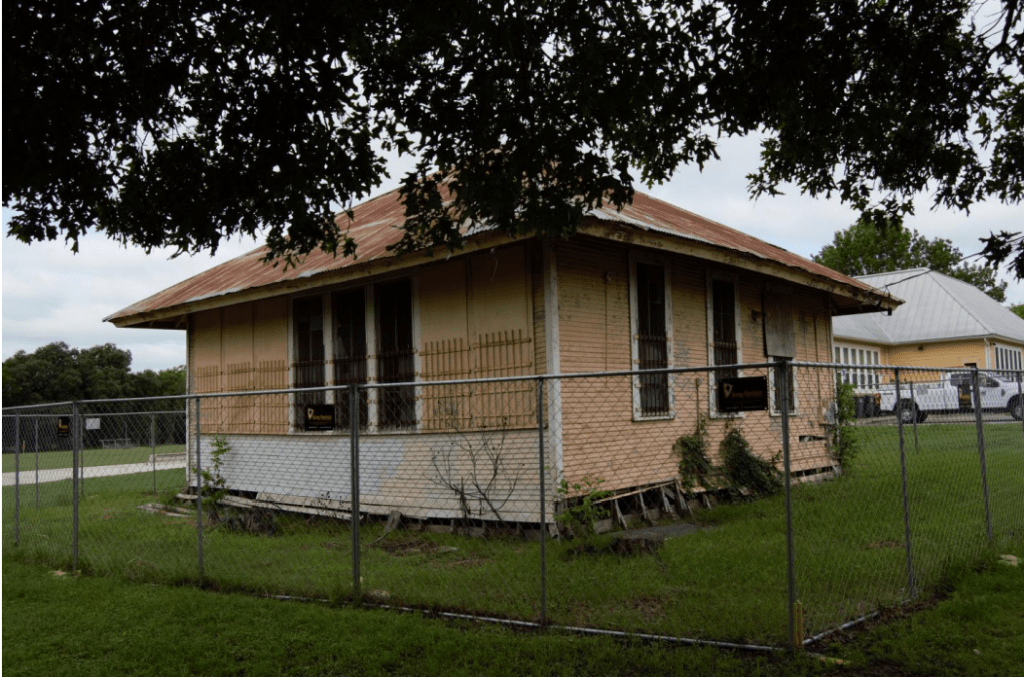
“Let’s kill this whole thing and just use the money for repairing the Dunbar School Home Education Building.”
It’s not a bad idea! I felt a little bad for the presenter, though.
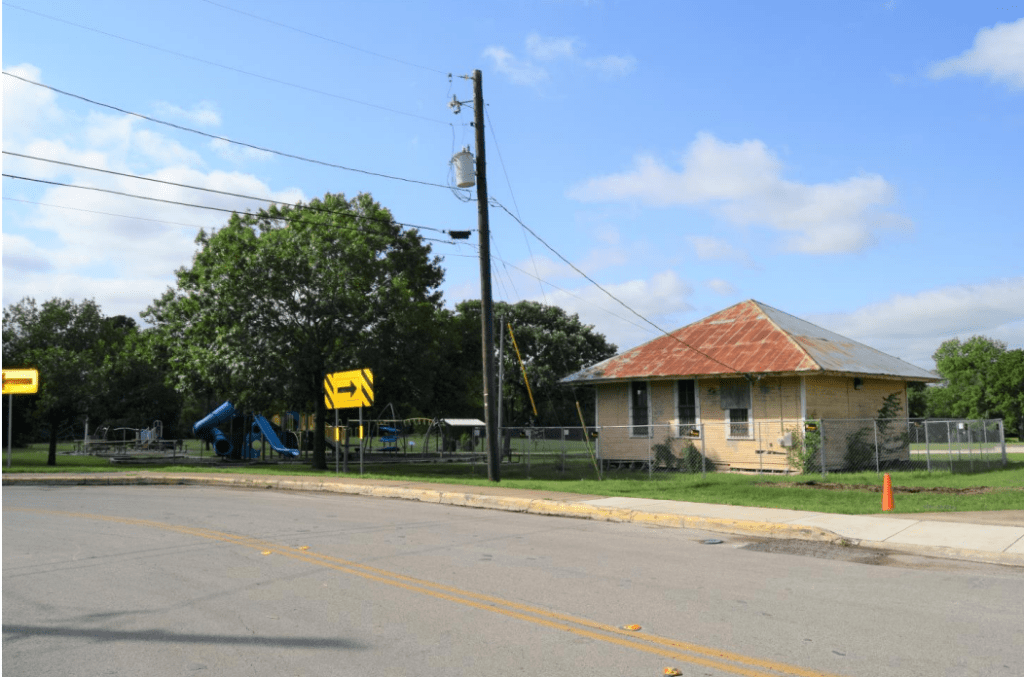
It’s the only building left from the original campus of the Dunbar School.
We just talked about the Dunbar School a moment ago – it’s the original school for black children during segregation, named for the poet Paul Laurence Dunbar.
The Dunbar School was put on the National Register of Historic Places in 1983.
This week: contracts for SMPD and SM Fire Fighters, with a win for transparency. Also a Dunbar Historic Walk, some election talk, and a call to support our school librarians.
Here we go!
Hours 0:00 – 2:29: Basically all about contracts for SMPD and SMFD. How transparent should the process be?
But first! Two quick bits on the election and school libraries.
1. Well, we had an election.
Matthew Mendoza won re-election against Chase Norris.
Saul Gonzales and Josh Paselk are headed to a run-off, on December 13th.
I’m still grossed out by that PAC dumping $50K to sway a local election towards their preferred candidates.
Here’s the problem: we actually have some local limits on campaign donations:
If you receive more than $300 from someone, you must recuse yourself from votes related to that.
No one can donate more than $500 to any campaign, period.
Now look at the donor amounts to the Brighter Future for San Marcos PAC. Almost all are over $300, and most are between $600-$10,000. (And that list is not up to date.)
That PAC spent $35,000* supporting Matthew Mendoza and Josh Paselk. But they don’t donate it to campaigns, so the local laws don’t apply. The PAC just directly buys mailers and newspaper ads. So Matthew and Josh benefit, but would not be required to recuse themselves from votes that benefit the donors.
This is legal, but it’s deliberately sabotaging the intent of our local laws. What bullshit, right?
*also out of date. My understanding is it’s more like $50K+.
2. Our school libraries
At the past two school board meetings, around 10 or so people from New Braunfels, Seguin, Corpus, etc have shown up to harass our district. They find the spiciest parts of any book at any school library, and berate our school board for it. (They also post the spiciest parts to social media! Everyone gets titillated at the thought of saying such naughty words in public.) Then there’s a whole procedure where they flag books, we have to pull the books, review them, and bring the recommendations to the school board.
It might be nice to have some local voices supporting our librarians, our libraries, and our school district at these meetings?
Obviously say whatever you want, but if you’re stuck, I think the major points are things like:
you trust the judgement of our school librarians that they’re only including books with mature themes when there’s age-appropriate value to the book.
Parents are free to monitor the reading choices of their own children, but shouldn’t enforce their personal rules on everyone else.
Want to speak in person?
The next meeting is at 6 pm on Monday, November 17th, at the Felipe Reyna District Offices located at 1331 Hwy 123. (Right by Goodnight Middle School.)
You are supposed to sign up ahead of time. Swing by the Superintendent’s office (same address) or call (512) 393-6700 ext. 6767.
Three people show up, plus one more at the 3 pm workshop. The basic themes are:
Yes on pay raises for police and fire fighters
What’s with the shootings and mayhem downtown?
If we’re so broke, why are we spending money on Kissing Alley and other frivolous things?
Remember, Mark Gleason got reprimanded by the Ethics Review Commission in 2023. This was because he received campaign contributions above the limit from SM fire fighters, but then didn’t recuse himself from the vote on their contract. Any council members need to recuse themselves?
That last point is exactly the problem with the PAC!
There’s also a short note from the city manager about the shootings downtown. Condolences to those grieving, thank yous to first responders, that sort of thing.
….
Items 4-5: Contract Extensions and Raises for SMPD and Fire fighters
Let’s start with some backstory!
Backstory
Unions are massively constrained in Texas. This is because:
Texas is a right-to-work state. You can’t make joining a union automatic. But unions are still required to represent all employees.
Texas allows at-will employment, so it’s easy to find a pretext to fire people
Public sector unions are especially helpless in Texas. In addition to the constraints above, there are explicit laws:
No collective bargaining. Literally, you can’t have your union negotiate contracts on behalf of the employees.
That all is a massive bummer. It means that public employees can’t speak in a coordinated, unified voice. (For a state that claims to worship freedom, it seems a bit off to outlaw employees from coordinating their actions, yes?)
Anyway, there are two exceptions: Fire fighters and police departments are allowed full strength unions! They get a special carve out! How nice for them, and no one else.
You’ll need some vocabulary: SMPOA: San Marcos Police Officers Association, which is their union. SMPFFA: San Marcos Professional Fire Fighters Association, the fire fighter union.
“Meet and Confer” – the collective bargaining process. This is the negotiation process to come up with new SMPD and SMFD contracts.
More backstory
In 2021, SMPD officer Ryan Hartman blew through a stop sign and killed a woman, Jennifer Miller, in Lockhart. He was treated with kid gloves. He had an open container in his car, but wasn’t given a breathalyzer test. Etc. This all happened right when Chief Standridge was first arriving at SMPD. Hartman wasn’t indicted, and got right back on the force. (Hartman was later fired for excessive force in a separate incident.)
Mano Amiga was FURIOUS at how poorly the Hartman investigation was run. In response, they came up with five Hartman Reforms that they wanted the city to adopt:
In 2022, the SMPD contract was up, and it was time for Meet and Confer. The city ignored the Hartman Reforms and just passed a standard contract.
Spring 2023: Negotiations re-open. Some mild concessions are made towards the Hartman Reforms, and the contract is passed.
That’s a breezy summary, but trust me – this was a huge production. Probably hundreds of hours of citizen engagement, all told.
The 2023 contracts expire next October 2026. That means we should start Meet and Confer this spring.
Which brings us to today!
Should we sign a one year extension until October 2027? It includes a 4.5% raise for fire fighters, and a 5% raise for SMPD, effective in October 2026.
Meet and Confer meetings should be open to the public, recorded, and broadcast
There should be a citizen comment portion
Documents should be made publicly available.
Question: How is this different from the current situation? Answer: Really, only the citizen comment would be new. We started recording and broadcasting meetings in 2023, and documents are always available under the Texas Open Records policy.
Why do this?
There are lots of good reasons!
First off, legally there is a clause in Meet & Confer laws that requires transparency and openness to the public. So this is consistent with how these things are supposed to go.
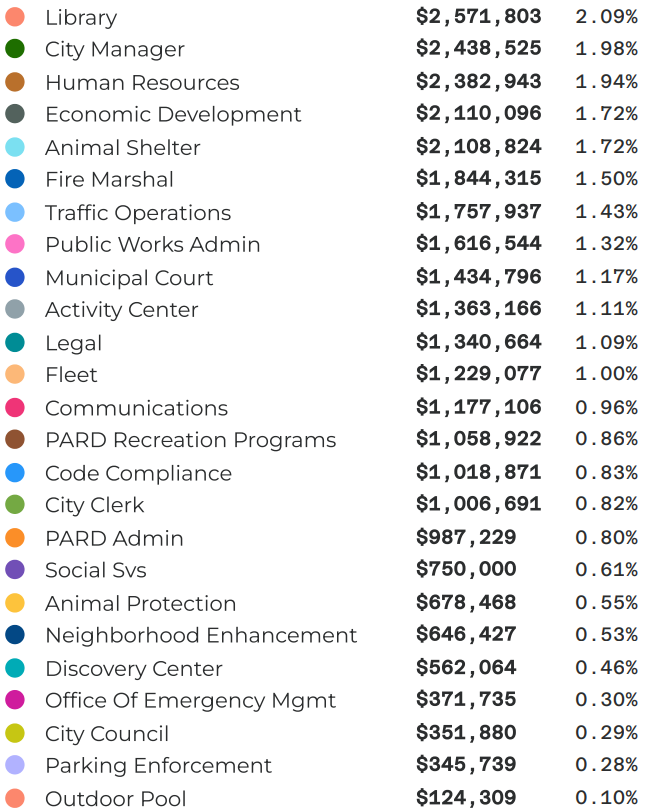
Those big blue and orange slices above are SMPD and SMFD. They make up about 36.7% of the General Fund, and combined, they are about $45 million. Citizens should get to speak up, just as they do for the rest of the budget.
Third, this one-year extension is occurring with virtually no community discussion. It’s a good faith gesture by council to acknowledge the outcry in 2023, and make a move towards transparency.
Finally, Austin has a similar resolution that applies to PD, Fire, and also their labor unions. It seems to work fine.
How would this work?
This is where conversation stalls out for about an hour. I’m going to give your the super abbreviated version.
What would the details of the citizen comment actually be?
Should each person who wants to speak get 1 minute? Should it be capped at 30 minutes? Should it be at the beginning and at the end of each meeting? Should it be on another night altogether, and recorded as a forum? Should there be an email address?
Amanda’s pitch: Let’s leave these details to the negotiating team. Council does not need to micromanage.
Jane is extremely uncomfortable leaving it vague. She wants to know how it will play out. She’s worried if the ground rules aren’t quite right, it will sabotage the collaborative spirit of the negotiations.
2. How exactly does the timeline work?
Does SMPOA and SMPFFA have to agree now, before the extension is approved? Or can this just be where our negotiators start, when Meet & Confer starts, in the spring of 2027?
They settle on the latter. This is the starting point for the future discussion, where they lay the ground rules for the 2027 Meet & Confer contract. It got discussed a LOT, though.
Here are the basic Council member reactions:
Jane: I’m all for transparency but I’m allergic to leaving unspecified details like this.
Saul: I’m all for it. Sounds great.
Shane: This is government overreach. I’m tired.
Alyssa: This shows the community that we are responding to the activism of 2023. This is a good-faith gesture that makes progress towards transparency and community trust.
Lorenzo: I have a lot of detailed technical questions about the legality and timeline, but I’m not exactly opposed to the premise.
Matthew: <crickets>
…
Time to vote!
Here’s the official language they settle on:
And here’s the vote on the amendment:
Should City Representatives start negotiations with a request for transparency and citizen comment?
It sails through.
Hey look – there’s that Matthew guy! The one who was literally just re-elected the day before, with 57% of the vote. He absolutely does NOT want your input on SMPD and SMFD.
(SMPFFA and SMPOA were two separate votes, but everyone voted the same way on both.)
…
And then, the actual vote:
Yes on a one year contract extension and pay increases?
Great.
(Again, there were separate votes for SMPOA and SMPFFA, but they went the same way.)
…
That’s basically the whole meeting! There are some appointments to committees and things, but nothing big.
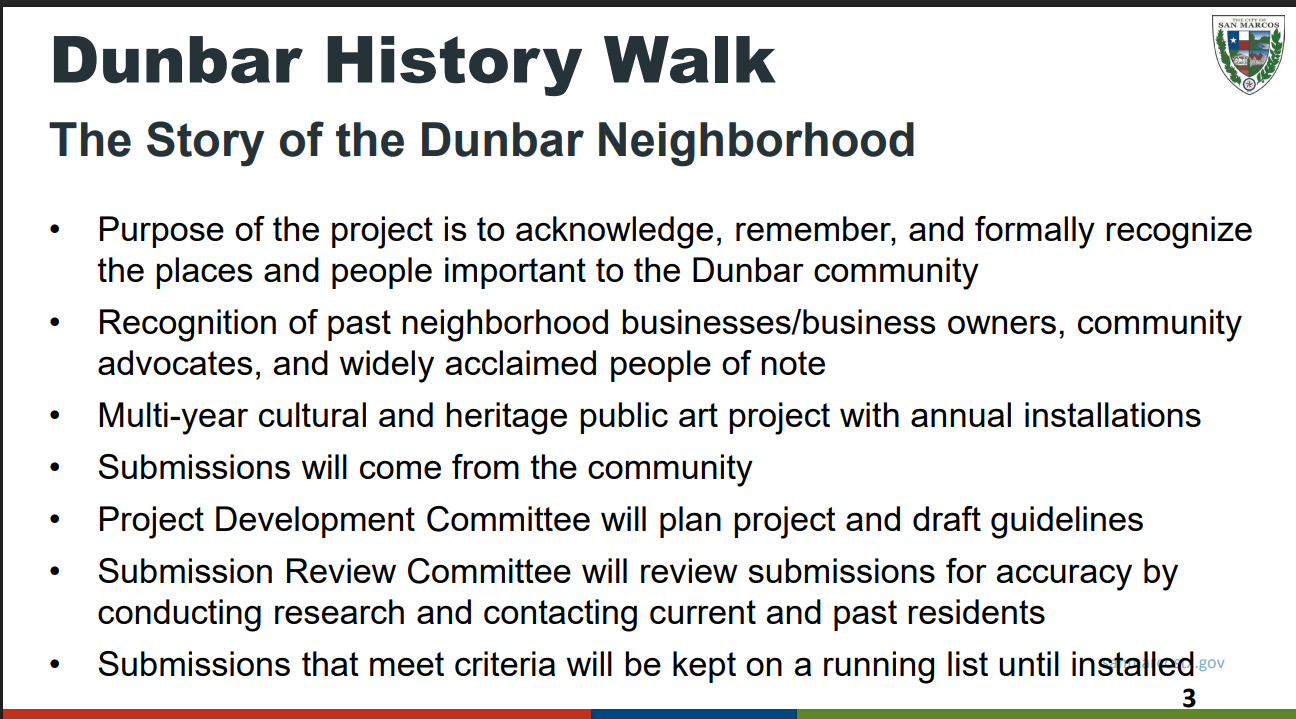
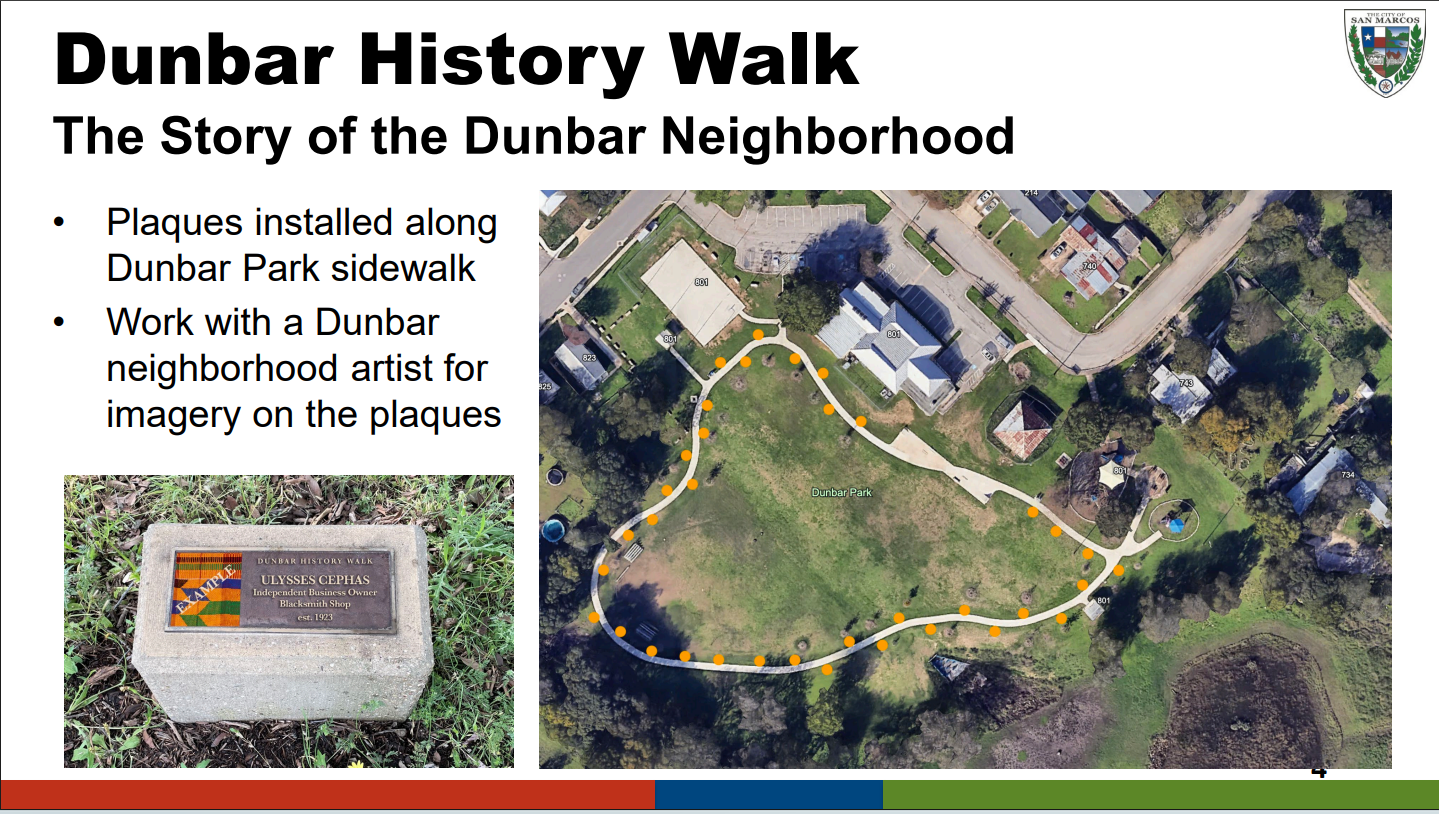
So the Dunbar Sistas are a group of women who played softball together as teens, decades ago, and are now some of the community anchors in San Marcos. They are the ones who originally came up with this idea. Two of them – Mittie Miller and Deborah Giles Webster – both spoke at the meeting about their process.
Here’s the plan:
This sounds great! So all those little plaques would commemorate important people, businesses, churches etc.
One thing that the Dunbar Sistas stress is the process for determining who will be featured on the walk. There’s a large network of Dunbar alumni, people who grew up in Dunbar over the past century, who may now be scattered across the country. They want decision-making to go to Dunbar alumni, as opposed to people who may be recent transplants to Dunbar. This seems reasonable.
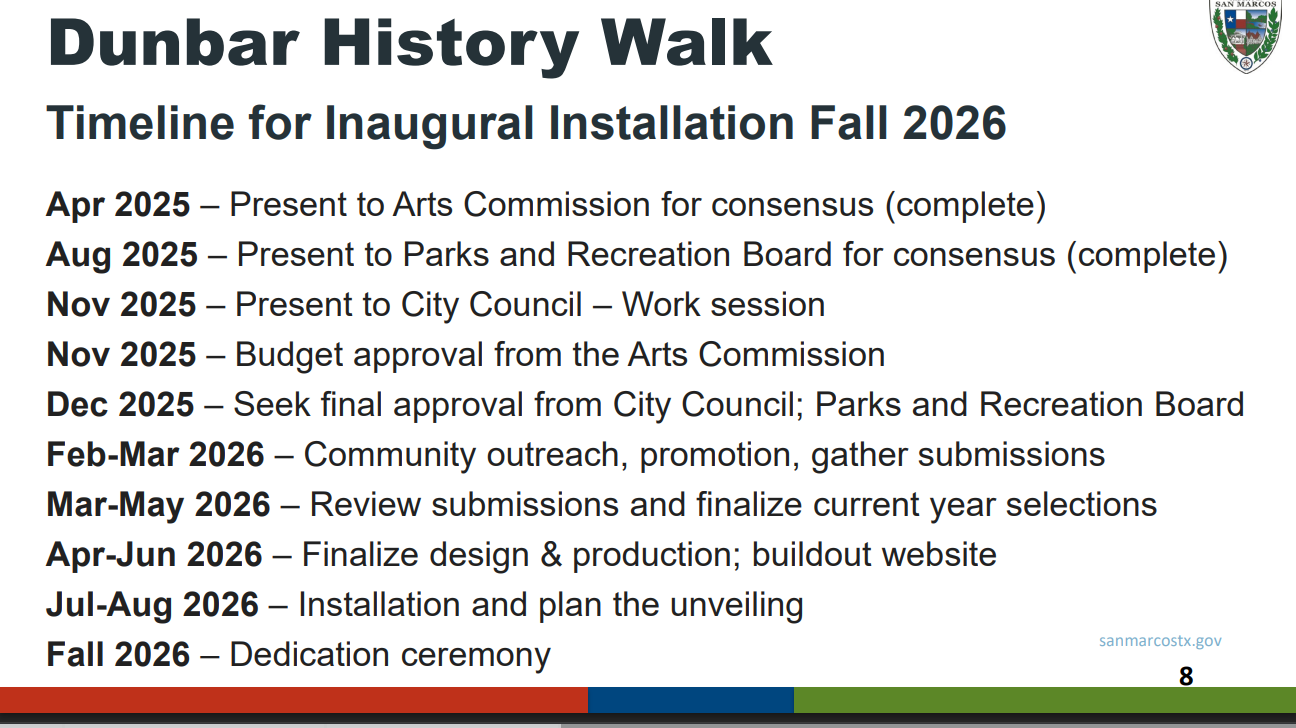
The plan is to roll it out next fall:
Anyway, there weren’t any other neat pictures in the presentation for me to clip for you, but there is a ton of history at the Calaboose Museum and Dunbar Heritage Association.
Super Quick Version: my endorsements and charter recommendations
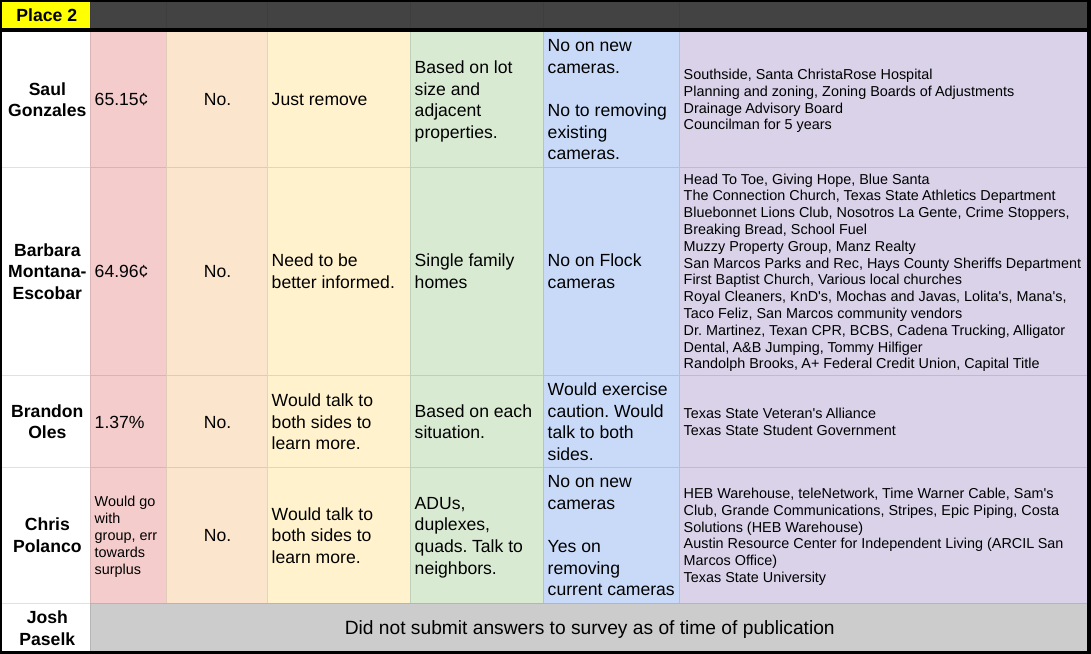
Summary table of candidate answers to my survey questions
Longer opinions on each candidate
Full candidate responses to survey.
Full explanation of charter amendments
External sources
Let’s dive in!
….
The Super Quick Version:
My endorsements for Council:
Place 1: Chase Norris
Place 2: Um. Argh. I have reservations about every candidate. I will probably vote for Saul Gonzales, because of Cape’s Dam.
Charter amendments: there are 12.
All of them besides Prop C: minor and straightforward. Vote in favor.
Proposition C: Should the Mayor’s term be four years long, instead of two? I don’t have a strong opinion. I will probably vote against this. Do whatever you want.
….
Summary Table of Survey Questions
I emailed all the candidates with these six questions:
Property Tax Rate: If you’d been on council last month, and could pick any property tax rate, what number would you have picked? (Background. )
Data Center: It seems likely that the data center could come back around in the next six months. Would you vote in favor of it or against it? (My write-up)
Cape’s Dam: Cape’s Dam will definitely come up in the next six months. Would you vote to remove and rebuild the dam, or just remove it? (My write-up)
Housing Density: If you were amending the Land Development Code, what is the maximum number of units that you’d allow on a lot in an established neighborhood?
Flock Cameras: If Chief Standridge applies for another Flock Cameras grant, would you vote in favor of it? Would you vote to remove existing Flock cameras? (My write-up)
Networking: which organizations (nonprofits, businesses, governmental, commissions, etc) in San Marcos have you collaborated with or worked for?
Full-length questions and everyone’s full answers, below. Keep scrolling.
….
My Opinions of Candidates
Place 1
Matthew Mendoza: First elected in 2022. He mostly focuses on home-owners in old, established neighborhoods. Kissing Tree – ie wealthy senior citizens – has endorsed him. He voted against a responsible budget in September. Also he likes SMPD a lot. We tend to disagree.
Chase Norris: He is running as a progressive challenger to Matthew Mendoza. He has a lot of experience in city planning and municipal government. Seems to give answers that I mostly agree with.
Place 2
Saul Gonzales: First elected to Council in 2016. Voted against a responsible budget in September. Generally quiet, but sometimes speaks up to ask how much something will cost. Generally votes in a cautious manner.
Barbara Montana-Escobar: I’m going off vibes here, but here’s my take on Barbara – I think she gets stuff done. I think she works with everybody, talks to everybody, and is very practical about solving problems. That said, I think she’s much more centrist than I am. Possibly center-right.
Brandon Oles: Very, very conservative. He has ideas like “dissolve SMCISD and absorb into Hays or New Braunfels.” Does not seem to know San Marcos well.
Josh Paselk: He is the darling of the business community. Kissing Tree has endorsed him. Lots of talk about “balancing the budget”. I am not convinced that he would vote to protect vulnerable community members or the environment and river.
Chris Polanco: Honestly, probably aligns with me better than any other candidate, politically. But he is very new to politics. He is running as a working class representative who can be a voice for the poor and disabled communities. He seems like a bright guy, and I encourage him to join a board or commission and keep going.
…
Full Survey Questionnaire and Candidate Responses
Here is the full text that I emailed to all candidates:
And here’s everyone’s full answers
Place 1:
Matthew Mendoza
Chase Norris
Place 2
Saul Gonzales
Barbara Montana-Escobar
Brandon Oles
Josh Paselk – Josh did confirm that he received the survey, but he did not submit answers at time of publication
What if City Hall moved downtown? Let’s dish. Also Tenant’s Right to Organize makes it across the finish line, Sights & Sounds is back, and – always – some election talk.
Your vote will never make a bigger difference! Go vote!
My endorsements for Council:
Place 1: Chase Norris
Place 2: Um. Argh. I have reservations about every candidate. I voted for Saul Gonzales, because of Cape’s Dam.
Charter amendments: there are 12.
All of them besides Prop C: minor and straightforward. Vote in favor.
Proposition C: Should the Mayor’s term be four years long, instead of two? I don’t have a strong opinion, but I voted against it. Do whatever you want.
Four in favor of the Tenants’ Right to Organize ordinance.
But not the landlords from the Austin Apartments Associations. They want us to carve out protections for property managers.
Other speakers, in response: Please do not protect property managers. That would create a loophole. [Note: we didn’t.]
We need managed growth.
Update on the EMS thing?
You all need to stand for the pledge.
Excited for new City Hall proposal
How about making the new City Hall environmentally sustainable? Like a One Water approach?
Pretty breezy and quick.
…
Item 2: Tenant’s Right to Organize
We’ve seen this here, here, and here. This is the final stretch!
Lorenzo: Can tenant organizers go uninvited into apartment complexes? Answer: No, organizers are required to play by vampire rules. They must be invited in.
Lorenzo: Can we fix that?
Amanda: I don’t think we should fix that.
Amanda’s argument goes like so:
I wish this ordinance had more teeth
But Texas is a heavily pre-emptive state. (Meaning Texas micromanages its cities.)
Therefore I strongly recommend that we stick with the language that has held up so far in court.
City Lawyer: It would be weird to meddle in this way. Some apartment complexes let in Domino’s pizza to put out fliers, and others have gates. Organizers are held to the same rules as Domino’s pizza, and it would be weird to carve out extra privileges for them.
City Staff: Plus, tenant organizers are not helpless. They can mail postcards to residents and see if one of the residents invites them in.
So we end up not changing anything.
The vote on Tenant’s Right to Organize:
It’s official!
Really great work by all the community activists! And I’ll single out Max Baker for kudos – he was really the most visible driving force here.
Last year we didn’t see nor hear the Sights & Sounds of San Marcos.
But this year it’s back, baby!
And we’re spending $100,000 on it.
Half of that comes from Hotel Occupancy Taxes, which are supposed to be spent on tourism. So S&S is a good fit.
The other half is for the lights, which are kept up all month long.
Sounds great.
Pro-tip: if you’ve got a kid who wants to win a hot chocolate, they might want to find out what year S&S was founded, how many light bulbs there are, and what most popular food is. It’s all very cute.
…
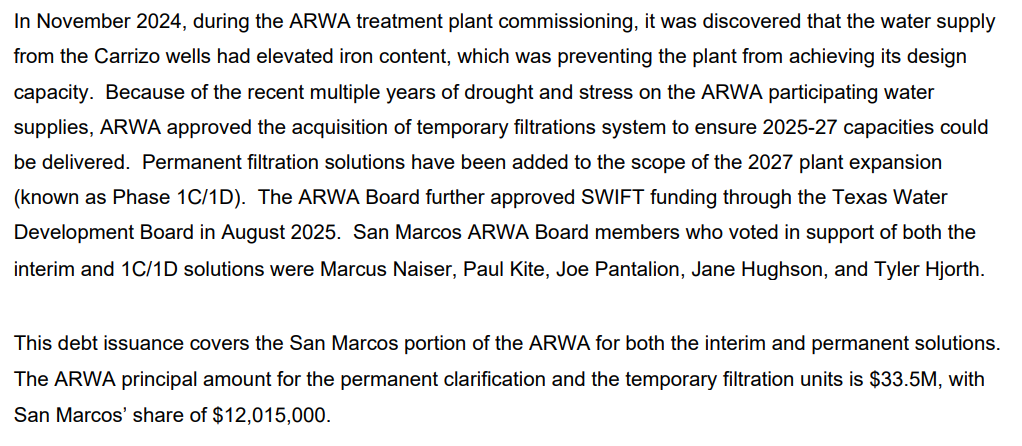
Item 17: ARWA
ARWA stands for Alliance Regional Water Authority. These are the folks trying to arrange water sources for us, for the next 50 years. It includes San Marcos, Kyle, Buda, and also Canyon Region Water Authority.
This started back in 2007, and it was a longterm plan to get water from the Carrizo-Wilcox aquifer. It came online this summer! So this is great. Almost 20 years of longterm planning!
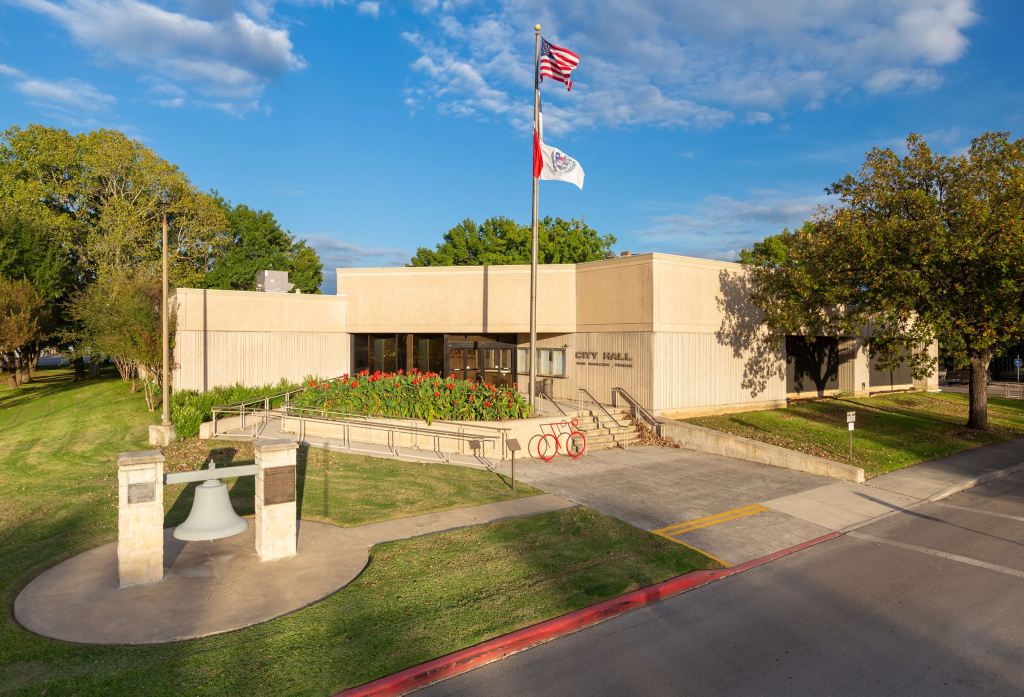
It was built in the early 1970s, when San Marcos had 18K people. So cute! Little baby San Marcos. Now we have about 70K people.
Apparently in the past year, they’ve had to evacuate multiple times due to gas and water problems. And whenever something big comes up at Council, community members don’t fit in the chambers. People spill out into the lobby and listen from there.
So the old building has run its course. We’re looking to build a new one.
…
How is the Texas State Lege going to meddle?
The state won’t let cities borrow money to build city halls without voter approval. This makes everything complicated.
My pet conspiracy theory: this was done to deliberately manipulate cities into the loving arms of local private developers. This is called a Public-Private-Partnership, or P3.
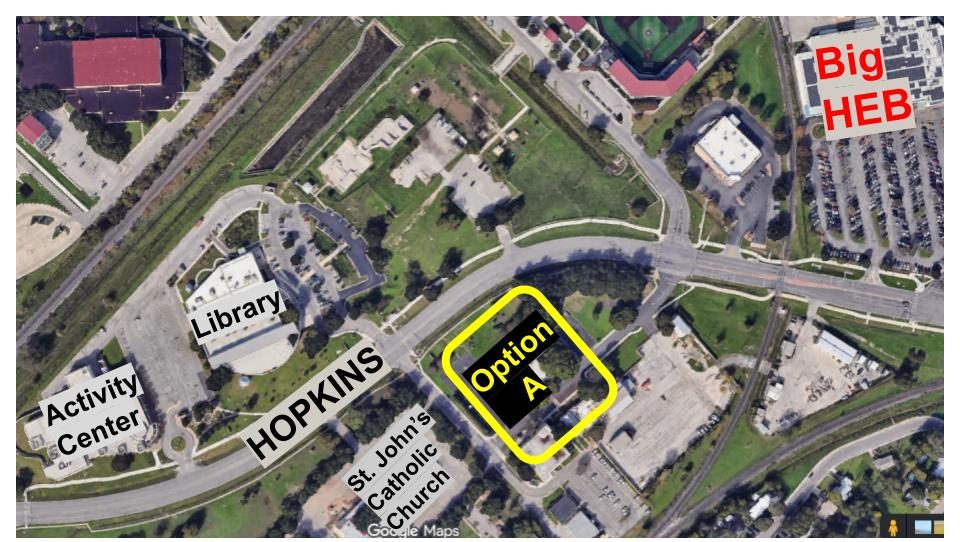
In other words, keep it in the current location. They’d tear down the existing site and rebuild. Council would have to relocate during construction.
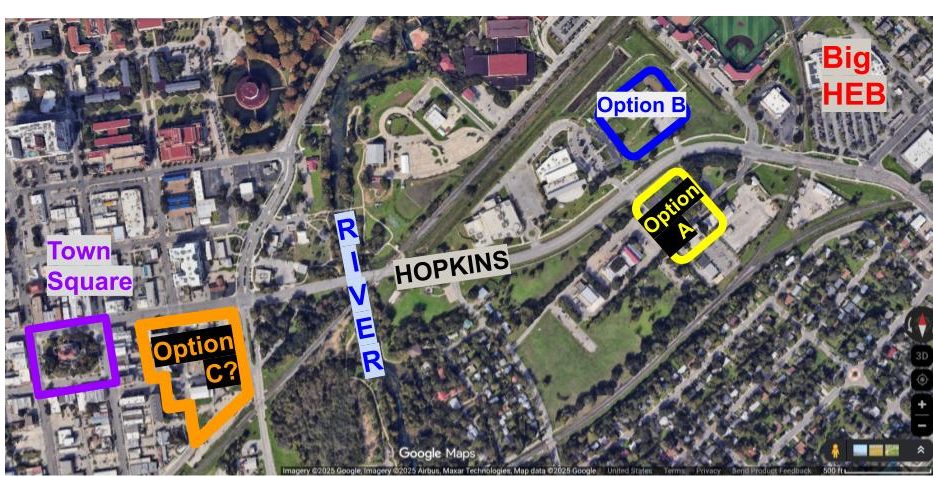
Option B:
ie move across the street, onto park land.
Option B was super unpopular! A lot of community members showed up to argue against it, because of this:
Both of these are heavily used and very popular!
City Council decided that they could keep the skate park where it is. They would just squeeze City Hall in immediately right up against the skate park, looming like a big shadowy Gotham City Headquarters over your rebel anarchist skater good time. (But the dog park would be relocated.)
In the end, Council went with Option B.
My $0.02: This is a terrible option and they got it wrong! Don’t use up your park land!
…
Now, what if there was a Plan C?
Intriguing! Over the summer, an unsolicited option came in.
Here’s the new proposal:
I love this location! There’s nothing particularly sentimental or historical there.
Let’s check it out!
This is the Hopkins view.
Building 1 is this:
No strong feelings from me.
Building 2 is this:
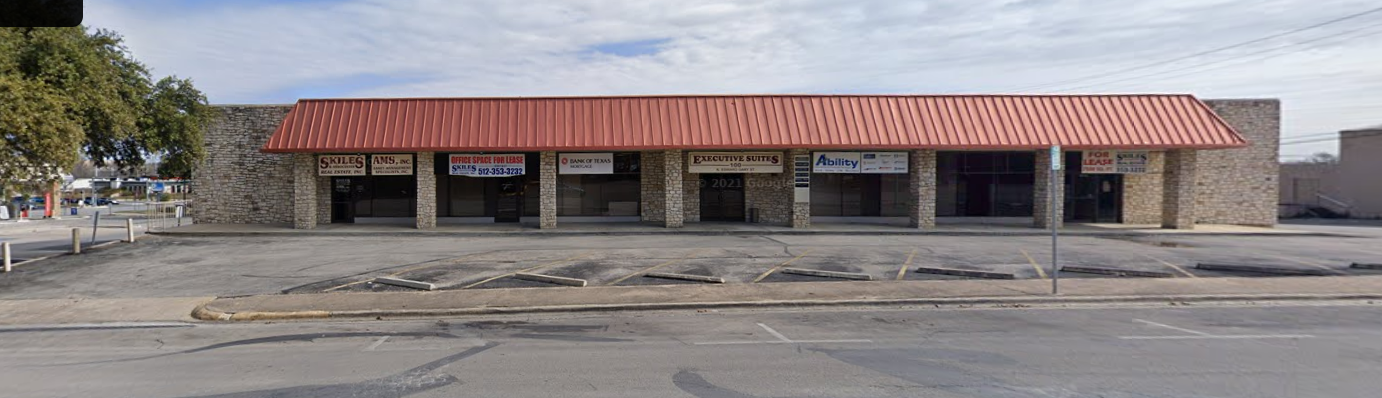
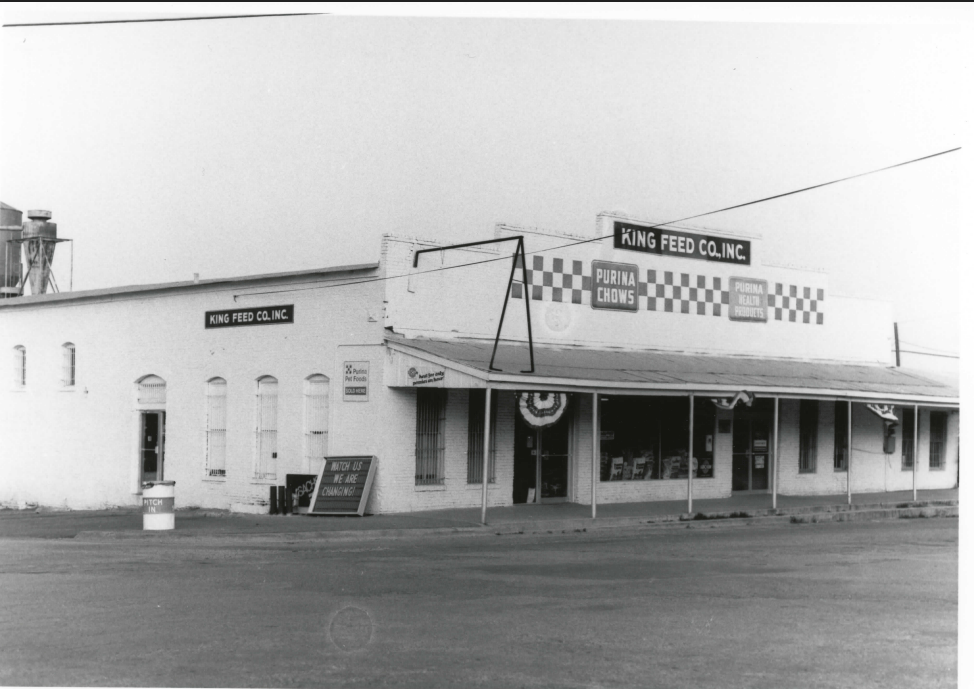
This is a cute old building! It’s been empty forever. It used to be an Ace Hardware store.
Number 3 is an empty lot. It used to be a Mr. Gatti’s Pizza:
and then it briefly became this:
ie a fever dream of a diner, painted all black with neon flowers. Did we collectively hallucinate this?!
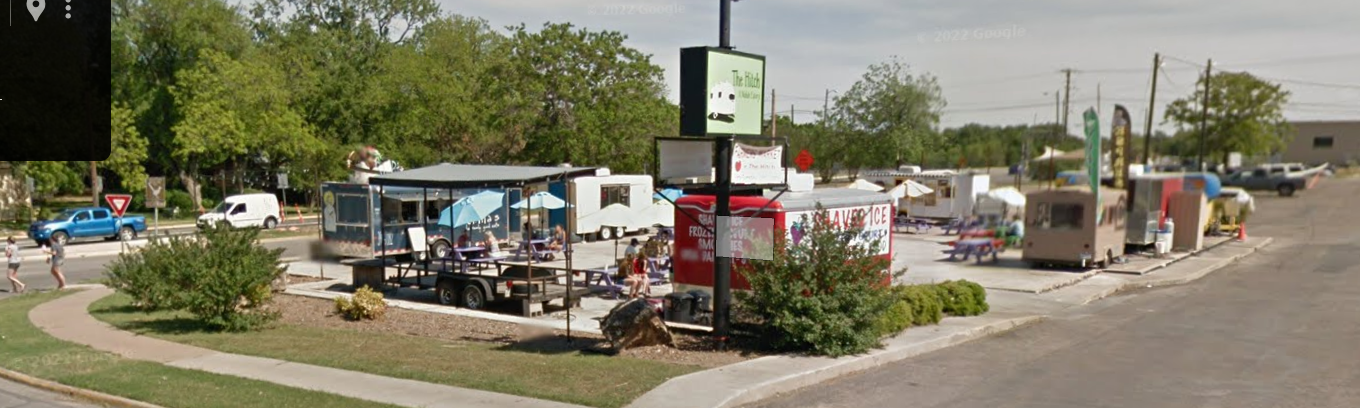
Anyway. Then it was food trucks:
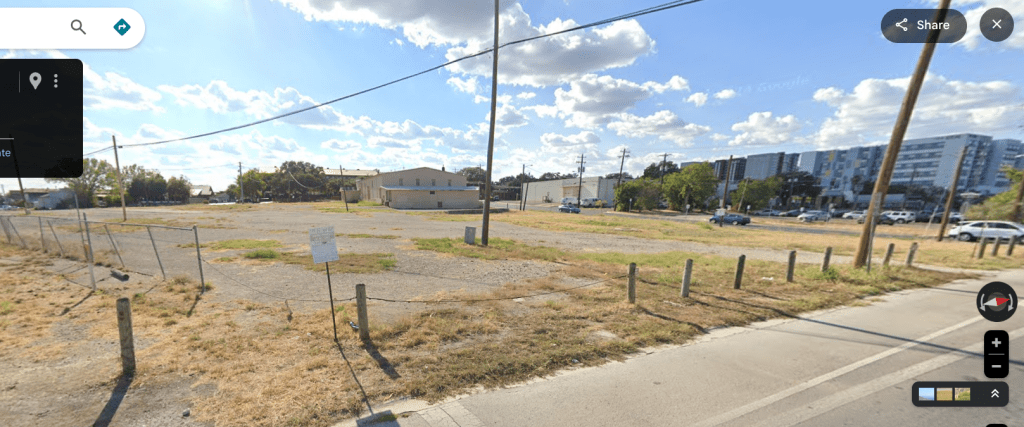
and since then it’s just been parking:
Number 4 used to be where we had Tuesday Farmer’s Markets.
Back then it looked like this:
whereas now it looks like this:
Progress!
…
Back to why this location is great! It would be a really healthy for downtown businesses if our city employees all worked nearby.
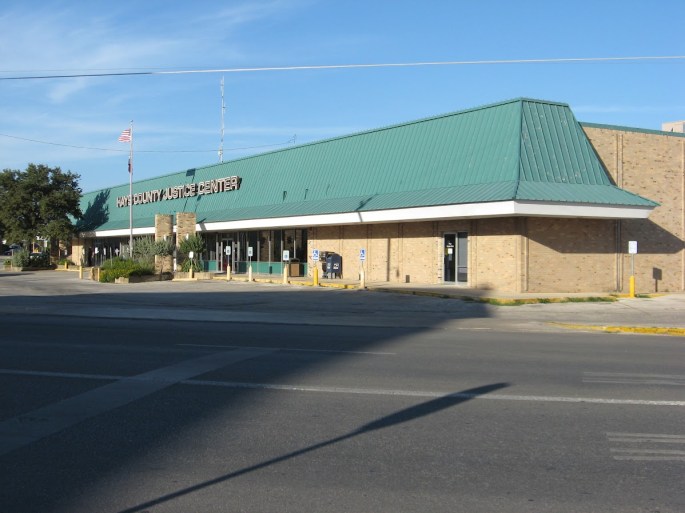
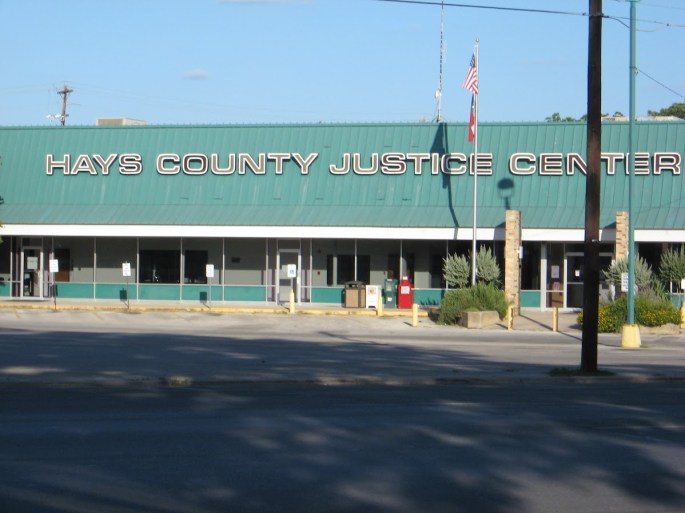
Until around 2011, the county employees used to work here:
I liked to call it the Supermarket of Justice:
That is now where Industry etc are:
In 2011, Hays County built the new County Government building, out on Stagecoach.
All the county employees emptied out of the downtown business area. This was hard on the local downtown restaurants and stores – they no longer had a steady stream of pedestrian foot traffic during weekdays.
So moving City Hall downtown would replenish some of that.
This is all great!
….
What else?
The developers are local. They’re all graduates of either SMHS or Texas State, or both. That’s nice!
In 2020, they pitched an earlier idea to the city – a combination City Hall-hotel-workforce-housing. Jane Hughson says, “They wanted the hotel to face Hopkins and City Hall to go in the back, which was a nonstarter.”
What other projects do they have? Well, they have ideas. They have plans with Hays ISD to build some sort of workforce housing thing, and Lockhart ISD is looking at it, too. But there aren’t any lots or conceptual plans or signs of progress on their website.
We are paying them $767,970.00 for this conceptual plan. That is a hell of a lot of money for our broke government.
Now, we’ve saved up about $12 million towards a new city hall, so that’s the source. It’s not displacing funding for something else. But it’s a lot.
2. They’re actually drawing up plans for this whole area:
Edited to add a corrected update: The map below is not the full scope of these developers. I got it wrong above! Sorry about that.
This map below is just showing the full scope of Plan A, Plan B, and Plan C, all together. The Plan C developers are strictly drawing up plans for the downtown piece. – TSM
WHAT IS GOING ON. Why is the Lion’s Club, and the stage area, the Veteran’s Memorial, the Activity Center, the library, the skate park, and the dog park all included??!
Why would these (probably very nice) bozos have any say in what happens to ANY of those public facilities? They do not have any experience in that. What the hell.
…
What does Council say?
First off, they’re only asking questions about this part:
and not the extended map above, that went through the parks and old City Hall.
Q: What about impervious cover? A: It’s already all impervious cover. It can only get better.
Matthew: The old hardware store is historic, and I’m worried about the elevation drop. A: Architects can handle the elevation drop.
Q: What would happen to the alleys? A: We don’t know yet. Maybe some kind of open air space.
Alyssa: I’m having deja vu of their old proposal. A: The 2020 proposal was much smaller. Jane: Plus they had the hotel out front and the city hall in back. No.
Saul: I like it! But I need to see how much it costs.
Jane: Love a hometown developer!
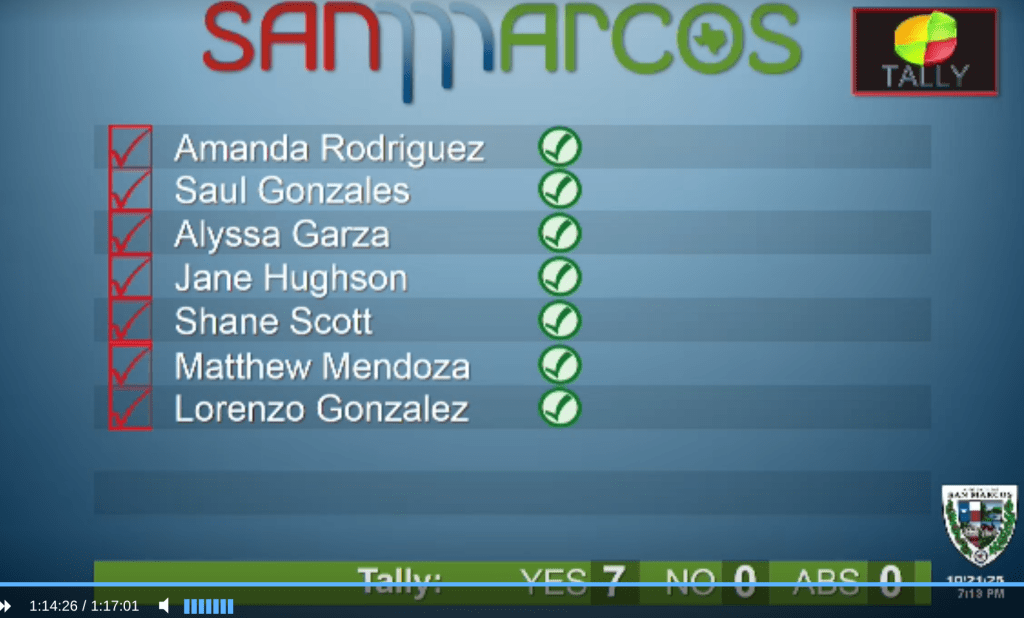
The vote: Should we spend $768K on this conceptual plan?
I probably would have voted yes, because the location is great. I’m just wary because these guys seem inexperienced.
…
Final notes:
Somehow, this City Hall project is going to go off the rails. Really. Not because of this Plan C option, but because the math on this next slide does not make any sense.
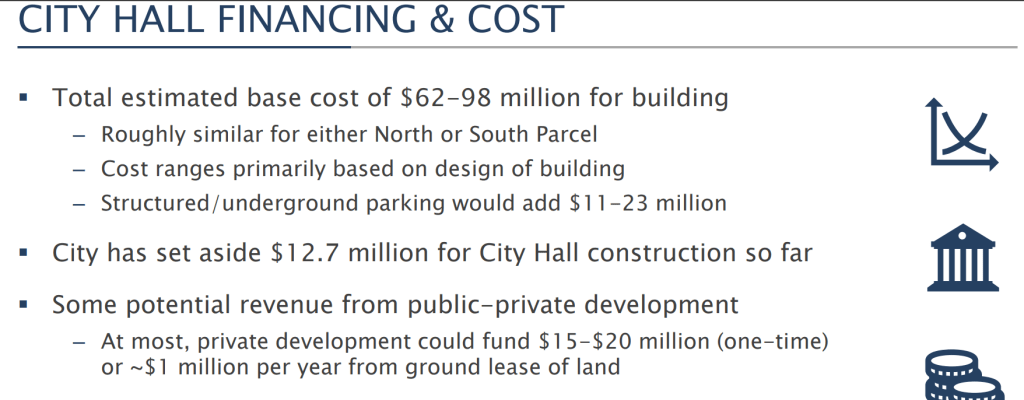
This is from back in April:
Let me see if I’m following: we’ve saved up $12.7 million. We think we can get $15-20 million more from private developers. That adds up to ~$30 million.
But the whole project is supposed to cost $62-98 million! Where is this magical extra money going to come from?
These are the only options I see:
Voters will have to vote to approve a bond to borrow the rest.
This project ends up being about half as big as they’re hoping.
This project takes 25 years to complete
We end up selling our souls to find an extra $50 million from private businesses
In some way or another, reality is going to reassert itself.
We are putting together a Historic Preservation Plan. This will be pretty quick.
First off, I thought this background was interesting:
The presentation itself was mostly “How to Read the Preservation Plan” as opposed to the actual San Marcos content. But the plan is pretty readable, so I’ll just grab one or two interesting bits from it, and send you over.
For example, there’s a very detailed timeline, starting in time immemorial, with bits like so:
(Amanda Rodriguez: Could we add the names of the women to this photo? Staff: Absolutely!)
































 The San Marxist

