Hello from the dregs of summer! Council meets once in July, and you lucky duck: it was this week. Lots of talk about low-income housing, we hear from the city on Malachi Williams, Dunbar is getting some new pipes, and Mano Amiga is taking on Civil Service. Plus some new City Hall details are materializing.
Let’s do this:
Hours 0:00 – 1:32: Malachi Williams, a new LIHTC project, and some smaller items
Hours 1:32 – 2:23: Mano Amiga submits an unsuccessful petition to repeal Civil Service, and we talk about LIHTC projects a lot.
Bonus! 3 pm workshops: Where are we going to build the new city hall? And fixing the sidewalks.
That’s it for July! Regular meetings resume in August. Enjoy your summer.
First off: it was Laurie Moyer’s last meeting, after 36 years with the city. Mostly she’s done engineering-ish things, but also some City Manager-ish things. She took all these great City Hall photos on her road trip last year. Congrats to her!
Citizen comment:
Two people – Noah Brock and Annie Donovan – talked about the latest iteration of SMART/Axis hijinks. I’ll save their comments for that section.
Two people called for a resolution for a ceasefire in Gaza.
The San Marcos Civics Club, and how Council passively assumes they can’t solve city problems
Mano Amiga’s petition to repeal Civil Service. I’ll save these details for later, too.
Finally, the killing of Malachi Williams by the SMPD officer on April 11th. (Discussed previously here, here, and here.)
To recap, the family of Malachi Williams has been asking for: 1. Release the name and badge ID number of the officer that killed Malachi Williams 2. The officer should be placed on leave while the investigation is ongoing. 3. The family should be able to view all officer and storefront footage, with a lawyer present.
Malachi’s grandfather spoke eloquently. This has happened before. But then the City Manager Stephanie Reyes spoke, which is new.
Here’s what Stephanie Reyes says: – Video material is available for the family to view along with their attorney. It’s at the Hays District Attorney’s office. – The DA says that neither the family nor their attorney has reached out to view the footage. – The DA is waiting to discuss how much of the video the family can watch. – Because this has been so awful, Chief Standridge is putting together an SMPD Crisis Communication Policy for future incidents. – the DA Kelly Higgins weighed in on the policy. He has concerns about any public release of video while the investigation is ongoing. He wants videos to be withheld until after a grand jury has reviewed the matter. – the DA knows that the family needs answers. State code authorizes the DA to let the family watch the video. He’s open to conversation with the family.
(I would like a universal policy that applies to all situations. When an officer is killed by a civilian, how quickly does the family see the videos?)
Next Malachi Williams’ grandfather speaks again, which is usually not allowed. “What we have been offered has not had much substance to it. We have not had a fair offer. There’s been an offer, but it’s not fair.”
Alyssa Garza asks, “Was the family offered the entire videos? All the body camera footage?”
Chief Standridge comes up. “The DA and I are offering the family all the body cam footage. But we are not offering the store’s videos. The DA has not agreed to release that. The DA and I will let them see still photos from the store. But the DA has not agreed to store footage.”
After that, the grandfather has a lot of questions and frustration. Council was not really allowed to respond, legally. They redirect him to the DA. He’s already interacted with the DA and is entirely fed up with him.
It ends in a tense place.
…
Item 23: Another LIHTC project!
LIHTC projects are low-income apartment complexes which don’t pay local property taxes. We’ve seen two others recently here. (LIHTC stands for Low Income Housing Tax Credits.)
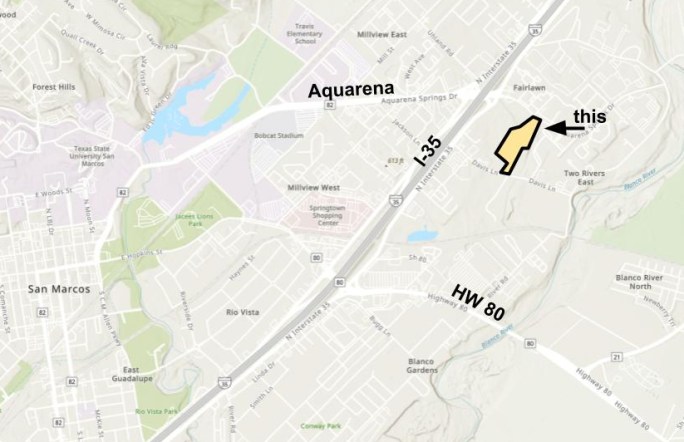
Where’s this one?
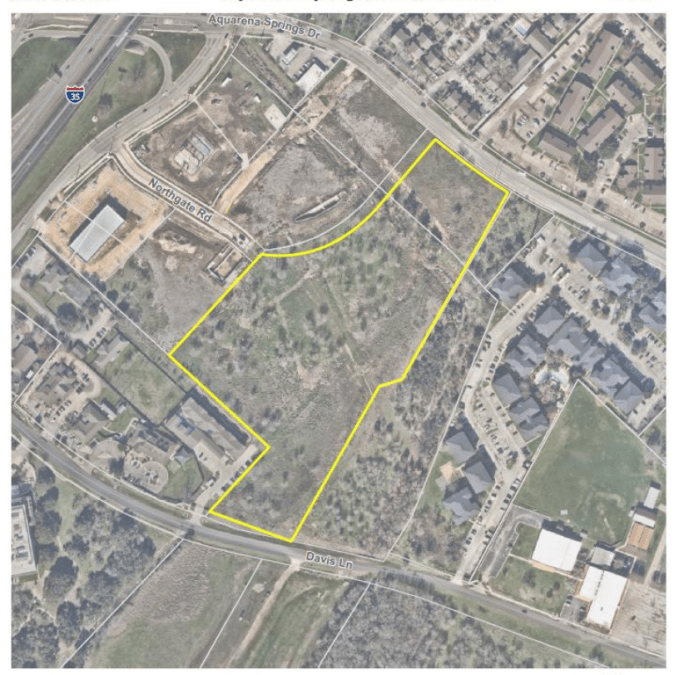
And here’s a close up:
They’re planning on having 304 units. How affordable will these be?
In other words, this is 46 units for low-income community members, and 258 for regular community members. (The median income in San Marcos is $47,394 a year, so 85% of these units are regular old market rate apartments.)
Okay, fine. How much is this costing us?
The estimated loss in tax revenue is $3 million over 15 years, or $200K per year. They’re softening that by giving us a one-time $400K payment.
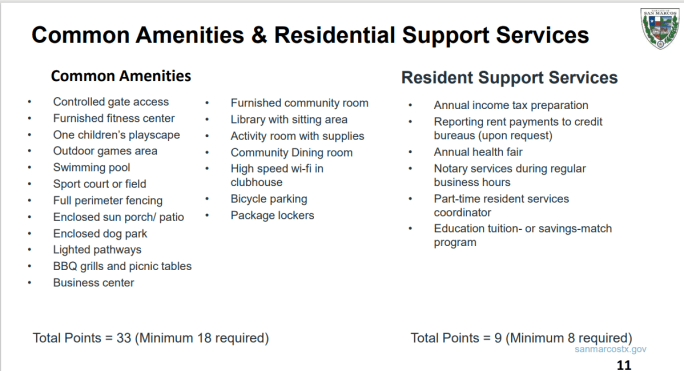
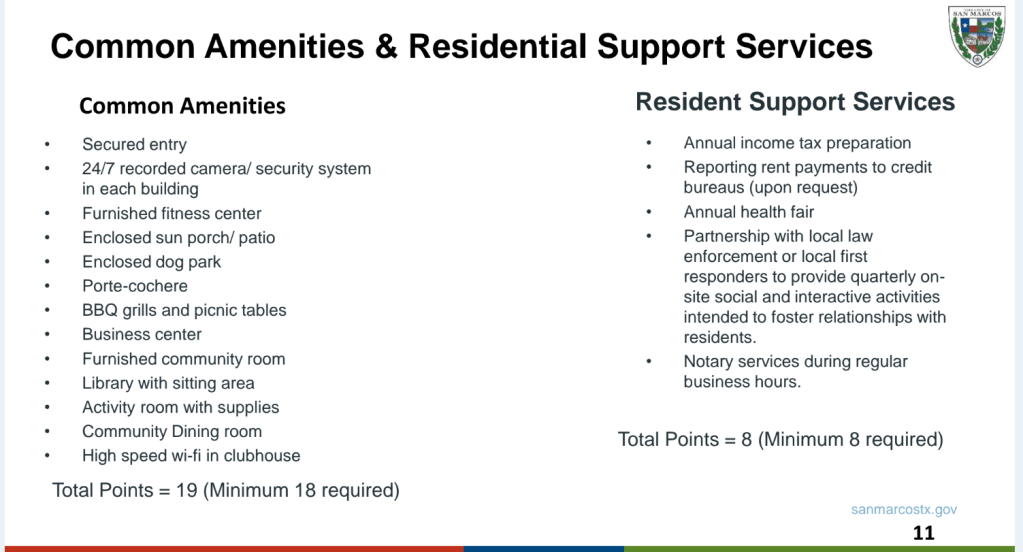
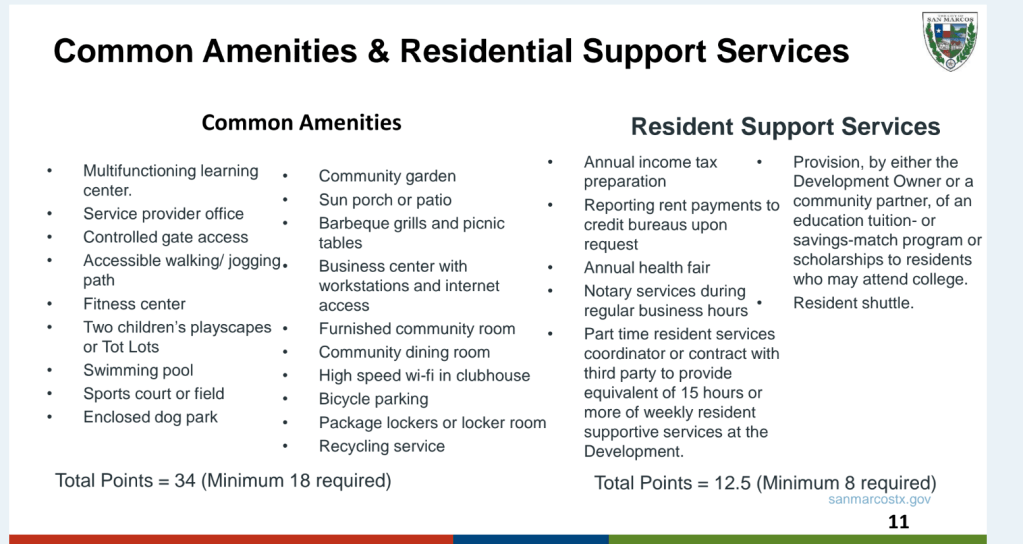
What other services are there going to be?
[Technical note: There’s some mucking about with the number of 3-bedroom apartments. This complex only has half as many as the city San Marcos requires for LIHTC developments. However, there’s a letter from the Housing Authority about the different waitlists for 1, 2, and 3-bedroom apartments, and 3 bedroom apartments are not in demand as much as 1 and 2, so it’s fine.]
Jane Hughson has some questions: – Did this area flood in 2015? Answer: yep. But the buildings weren’t TOO badly damaged. – Will the complex provide residential shuttles? Answer: nope. It’s right on a bus line. – Will the units have individual washer and dryer units? Answer: yep. – Will they have education, services, and after-school tutoring? Answer: yep.
Alyssa: I’ve heard complaints about restrictions and racially biased access to facilities. How do you make sure that doesn’t happen? Answer: We partner with Asset Living. They staff everything and report to us monthly. If something isn’t getting used, we ask them to advertise it.
[I am extremely curious about the complaints of racially-biased access to facilities.]
The vote: Passes 7-0.
However: Council is going to have big conversation about LIHTC projects in general, at the end of this meeting. Stay tuned.
….
Items 23-24: Kissing Tree
Kissing Tree is the senior community, way down on Hunter Road and Centerpoint.
Kissing Tree is a TIRZ. This means they pay taxes, but the taxes don’t go to the city’s General Fund. Instead they get funneled to side projects that benefit Kissing Tree – mostly building out the public roads and utilities that run through Kissing Tree. It’s not wasted money, but it doesn’t go to libraries, parks, firefighters, etc.
Costs have gone up and the assessed value of Kissing Tree has gone up, so they’re re-jiggering all the TIRZ numbers:
This is probably all fine! Before we had estimated that we were sending $32 million over to the Kissing Tree for roads and pumps and parks, and now we’re sending $46 million over.
Over 15 years, we’re keeping $5 million and giving $46 million back.
Let’s compare this to the LIHTC Project above! In that one, we’re keeping $400K and sending $3 million back.
So to be stark about it:
The LIHTC project is giving us 13% of their estimated property taxes and using the rest to subsidize rents on low-income apartments.
Kissing Tree is giving us 10% of their estimated property taxes taxes, and using the rest on local roads and utilities.
Guess which project makes Mark Gleason uncomfortable? The big reveal later on will not surprise you at all.
….
Item 2: SMART Terminal/Axis Logistics
The SMART/Axis people want San Marcos to annex about 7.5 acres of land for a road and right-of-way.
In January 2023, Council signed a development agreement with SMART/Axis people. Back then, these agreements happened in one single council meeting, and barely anyone had to be notified. So Council approved a gigantic fucking 2000 acre industrial park without public input and barely any details, and everyone got super angry about it.
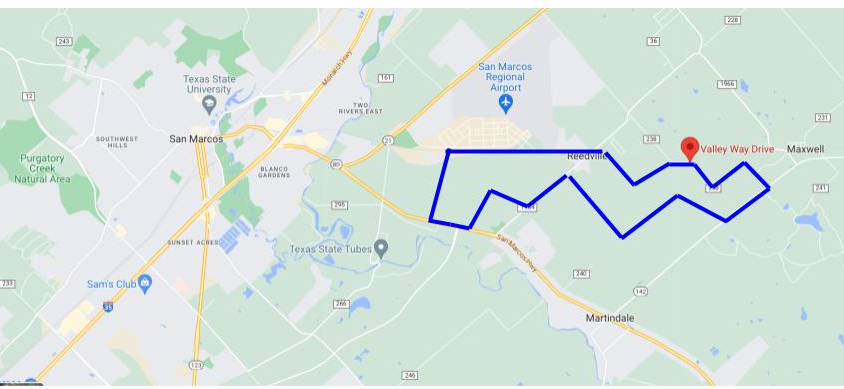
2000 acres is very big:
Like, REALLY big:
The people who live out this way were absolutely livid. But the development agreement was already signed.
The next step of the process was for SMART/Axis to apply for a zoning change to Heavy Industrial and get annexed into the city.
What they could have done was meet with the neighborhoods nearby, provide details of the project, build relationships and be good neighbors. Instead, they met with the neighborhoods and generally acted like supercilious pricks who couldn’t be bothered. The surrounding community got more and more furious, and launched a major activist campaign against the project.
Eventually SMART/Axis withdrew their zoning and annexation request. That was last summer. Since then, it’s been quiet.
Here’s my best guess: SMART/Axis didn’t want to share any details because they didn’t have any yet. They literally want free reign to do whatever they want on this land. They came off as supercilious pricks because they are supercilious pricks. They assumed San Marcos is a backwater rural town that will fawn over fancy business men and give them whatever they want, in hopes of some dollar bill scraps. City Council was happy to play their role!
…
That brings us to today – should San Marcos annex some land and build a road along the side of the land?
First off: Nothing happens today. We are just picking dates for the public hearing and final vote.
However, let’s do some speculation! This is brought to you by Noah Brock and Annie Donovan, during Citizen Comment. (They spearheaded the public campaign against SMART/Axis last year.)
Here’s the case that Noah and Annie are building:
Is this a major change or a minor change? If it’s a major change, the development agreement needs to be amended. That’s a much bigger deal. (The city is saying this is a minor change.)
Originally, the roads lined up with the end of Quail Run. That was the edge of the whole project. But since then, the developer has bought more property, and asked Caldwell County to move some roads over.
It seems clear that they’re expanding the project beyond the development agreement, and this new land is right next to a residential area.
This new ROW annexation is consistent with a bigger, changing project.
The basic problem is that SMART/Axis people are super secretive and seem to want to walk all over us. Maybe they’re sweet little bunnies at heart, or maybe they want to do some toxic battery mining or who knows what. They act like shitty neighbors every time they have a chance to right the narrative.
…
Today’s vote was just to set the dates, and here they are:
Public hearing will be on August 5th
Final vote will be on August 20th
….
Item 25: Dunbar is getting some new pipes!
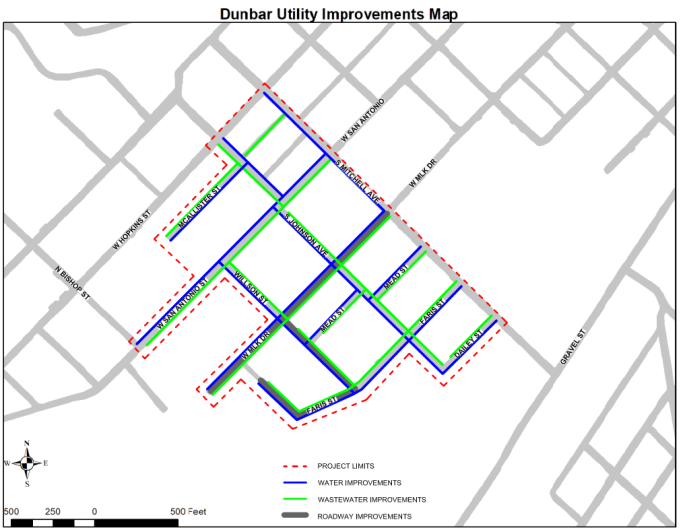
We’re spending $6 million on water and wastewater improvements here:
If you go here and scroll to Dunbar Water and Wastewater Improvements, you can keep an eye on the project.
Supposedly will be done by August 2026. So at least two years of dug up streets and annoying construction, but with a worthwhile payoff.
…
Item 27: Installing sports lighting on six soccer fields at Five Mile Dam.
This money was authorized awhile ago, this is just the contract to make it happen. It’s about $1.3 million.
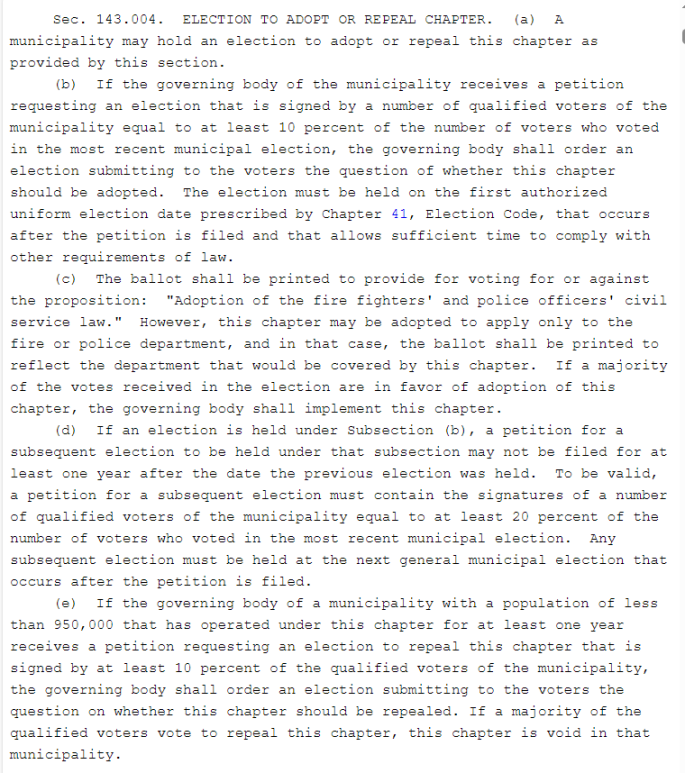
However, cities don’t have to start with Civil Service. You can repeal it and start some other way. So this is what Mano Amiga wants to do. (I don’t know what their strategy or end game is here. I’m sure they’d explain when they launch a public campaign, though.)
And what happened is that the city rejected the petition. Mano Amiga submitted a petition with 850 signatures, which is enough to adopt Civil Service (per Part B), but not enough to repeal Civil Service (per part E).
Mano Amiga is angry because they say the city waited until the last minute to tell them their petition wasn’t valid. But they vowed to fire it up again, and get enough signatures for the next cycle.
…
Item 29: Funding for low-income housing. (LIHTC tax credits)
Mayor Hughson and Mark Gleason had a conversation. Mark went to Jane and said, “We’re spending all this money on LIHTC Housing, and it’s not just this year. It’s not just the next 15 years. It’s decades and decades to come! This is fiscally irresponsible!” Are we being too helpful to poor people?!?
Jane thought he had a good point. We need money for core services! What if the LIHTC tax credits are ruining everything? It’s worth taking a look at.
Hoo boy. Okay, we have to unpack this. Here’s our plan:
How much money are we spending on low-income housing?
Is this a lot, or a little?
How much more low-income housing do we need?
What did Council have to say?
What are we doing next?
Here we go!
1. How much money are we spending on low-income housing?
In 2022, we started requiring LIHTC applications to include a tax estimate. The first application that includes this is in February 2024. So let’s start there.
February 2024: Existing LIHTC housing in Blanco Gardens reapply for state funding. Cost to city: $0. Not asking for local tax exemptions. Units provided: 40 of 54 units are Section 8 housing.
May 2024: Behind Target, by the railroad tracks Estimated tax credit: $7,262,589 over 18 years. (I’m going to scale this to $6,052,158 over 15 years.) Units provided: 34 low income units
May 2024: By Centerpoint, on the railroad tracks Estimated tax credit: $4,000,000 over 15 years One time rebate: $400K Units provided: 55 low income units
Summary: Three developments have applied for tax credits for the city. The total cost is $13,259,157.5 over 15 years, for 135 low-income apartments in those three developments.
This works out to $883K per year. Per apartment, we are knocking $550 off of the monthly rent.
Next question!
2. Is $883K in tax credits a lot, or a little?
Kinda both? Here’s some context from our yearly General Fund budget:
Yearly General Fund budget: – The total General Fund budget is $109 million this year. – SMPD get $24.5 million – Fire Dept gets $17.6 million – Economic Development gets $2.9 million – Library gets $2.1 million – Animal Shelter gets $1.6 million – Parks Department get $850K [Parks Dept gets $6.8 million. I misread the budget at first! Sorry about that.] – Social services get $550K. – The arts get $85K
I just grabbed a few useful categories. You can read all you want here.
So we are spending more on the LIHTC projects than we are on the arts or social services. Those combined are about 0.5% of the yearly budget.
We are spending much less on LIHTC projects than we do on SMPD, the Fire Department, and economic development. Those three categories combined are about 41.2% of the yearly budget.
My guess is that LIHTC projects come out of the $2.9 million for economic development. That money is supposed to create jobs. The thing that bothers Mark Gleason is that LIHTC projects don’t create jobs the way Buccee’s creates jobs. (Kissing Tree also doesn’t create jobs the way Buccee’s creates jobs. Kissing Tree is more like a LIHTC project in this way.)
Next! The three LIHTC projects just kind of came up spontaneously during the last couple meetings, and took everyone by surprise. What are some similar comparisons?
The other things that Council approved at this meeting alone:* – $46 million over 15 years on roads and utilities in Kissing Tree. That works out to $3 million per year. – $6 million on water and wastewater for Dunbar over 2 years. That works out to $3 million per year. – $1.3 million on lighting for soccer fields at Five Mile Dam. – $330K to update the Airport Master Plan – $430K in a wastewater treatment agreement with McCoy’s – $125K with Titan Utilities – Two different Utilities trucks totalling $660K – Energy management contract for $135K – $480K for lawns and beds of city buildings – $439K for Hull Street Stormwater improvements – $215K on tree removal from the storm – $432K on health care contracts
So those are the kinds of amounts we spend all the time, and Mark Gleason does not clutch his pearls.
Look, $883K is a fair amount of money! It is worth planning in advance and being intentional with how we spend it, so that we can best serve our community. Right now we’re approving projects on an ad hoc basis, and so there is room for improvement.
However: Kissing Tree is not put under a microscope. There are never any 5 or 10 year updates for Development Agreements where we give tax credits to private companies. SMPD’s budget is not put under a microscope.
It is always, always the programs that help poor and vulnerable people that make Council say, “I dunno, they might be wasting this shiny nickel we’re giving them. Let’s do a deep dive!”
As of 2017, this was the housing need in San Marcos:
In 2019, Council killed the whole thing off. Years of effort and nothing was ever adopted to help create affordable housing.
In 2023, city staff gave Council a workshop on housing, and recommended that Council resume this project. As far as I know, they have not done this.
Bottom line: in 2017, we had a shortfall of 4233 rental units for all households earning under $35K. This whole conversation is about 135 apartments. We need a lot more affordable housing than that.
LIHTC projects really are too expensive to be the only way we build affordable housing. (Fortunately, there are cheaper things that San Marcos could do! Like allowing ADUs and duplexes everywhere. But I digress.)
….
4. What did Council have to say?
Jane Hughson: – We are not receiving enough tax dollars to support the services (library, police and fire, etc) going to these projects. – We need the housing, though. – Are these San Marcos residents? Or outsiders? I’m frustrated with outsiders.
Shane: How much sales tax revenue do they bring in? Jane: The people would be paying sales tax either way.
Jude: – We should update the formula for the proportion of 1,2, and 3 bedroom units that we require. – We should require cash back, and make a formula for the cash back amount they owe us – But LIHTC projects are still good, they increase housing!
Stephanie Reyes: I’d like to get a demographer to look at how much low income housing we need.
Saul: These LIHTC projects make taxes are higher on everyone else!! We should have a moratorium on LIHTC projects.
Matthew: Can a development be half-LIHTC? Answer: not really.
Jane: Other cities give density bonuses and have inclusive housing incentives. Can we do that? Answer: We already offer these. Since 2018. But we can’t get anyone to take us up on them. Jane: Not to say I told you so, but we could have done this on Lindsey Street.
Mark Gleason: I have so much budget angst. It’s not just this year – we’re giving away tax dollars for decades to come! It’s not just 15 years. It’s 20! And 30! Decades to come!
[Mark! No. That last bit is nonsense. Nothing automatically extends more than 15 years. Everything will be renegotiated at the end of the contract. Stop hyperventilating.]
More Mark: We have to diversify the economy here! We need more data! I cannot approve any more of these without data!
Alyssa, speaking the truth: Can we do this conversation more productively? Instead of focusing on revenue loss, let’s focus on maximizing benefit to community members.
Jane: I just want clarity on how much we’re spending. And also, how can we bring in more jobs?
Shane: The housing waitlist is like a year long. Doesn’t that establish residency?
…
5. What are we doing next?
In the end, they decide that the housing committee will look closely at the housing policy, and then they’ll hold a workshop. They’re particularly concerned with:
How many total LIHTC projects do we have, and what’s the estimated taxes on all of them?
How many low income projects do our peer cities have, per capita?
Can we re-evaluate how many 1,2,3-bedroom apartments are required?
Can we formalize the rebate formula? Can we require rebates?
Can we do a needs assessment survey?
Rebate money should not go to the general fund. Can it be used in an intentional way?
Alyssa requests that our DEI Coordinator be present at the committee meeting. This is a very smart idea. She also recommends this resource for background reading.
…
Look: There is nothing wrong with those actual bullet points. It is good to review our LIHTC policy and see how it can be improved.
But the whole vibe is, “ACK! We’re spending so much money on poor people housing!” and it sets my teeth on edge.
If Council were serious about housing affordability, they would dust off the Housing Action Plan, update it, and implement it. Instead, we get Mark Gleason huffing over $13 million dollars to poor people, while sweetly handing Kissing Tree $46 million without blinking.
* NOTE: I updated this list because I forgot about the Consent Agenda. Originally I pulled amounts from the most recent few meetings, but I realized there were way more examples than I originally thought.
The city needs a new City Hall. (Discussed here and here.)
Laurie Moyer was handling the new City Hall project, but she is retiring. The new person basically gave a presentation to introduce herself and pitch how she sees things unfolding.
Here’s what she was handed:
In other words, City Hall is going here:
across the street from Old City Hall.
So apparently this location is settled? I don’t know how I feel about this. I also have concerns about what might happen to the old site.
However: they’ll need voter approval in 2025 to re-purpose park land as City Hall, so I guess we’ll be hearing some sales pitches. In the end, the voters will decide whether or not it sounds ok.
The new person is imagining making a whole Hopkins Project out of it:
Parts of this sound good to me!
I like the idea that Hopkins could look more like CM Allen.
P3 means “Public-Private Partnership”. This part is inevitable because the city doesn’t think that the voters would pass a bond in an election. So they want to bring in private partnerships. (More things that I feel weird about.)
This whole thing will take forever to complete. If the stars align, it will take seven years.
…
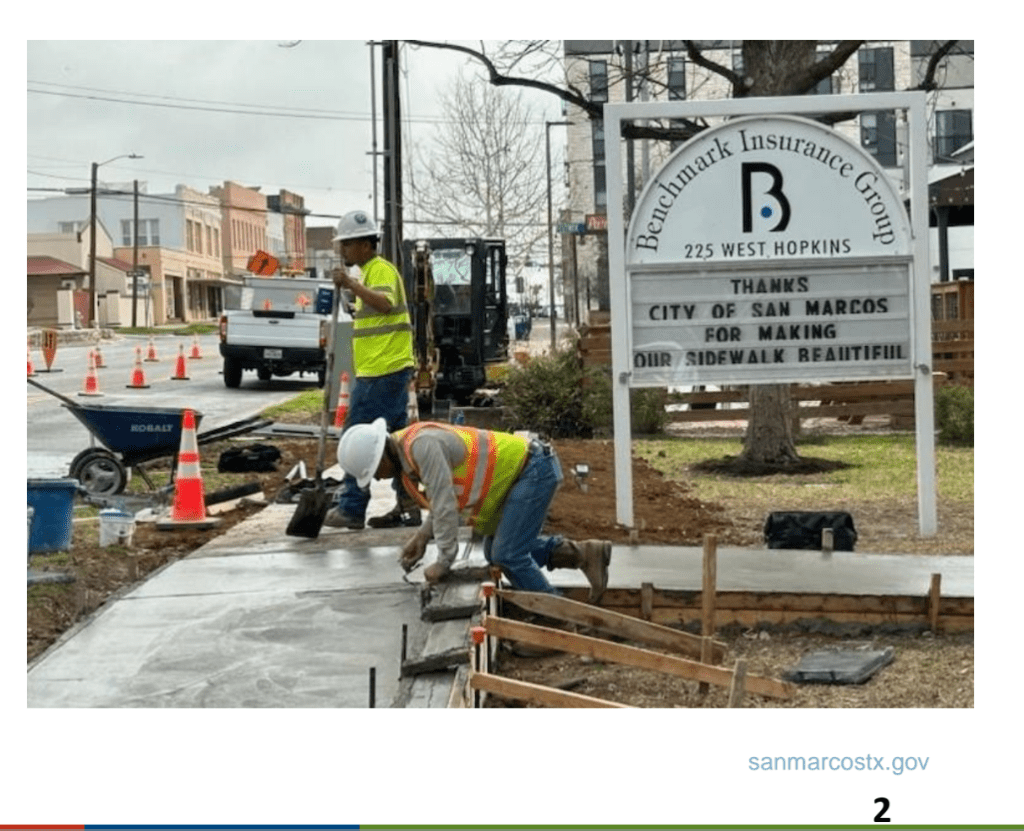
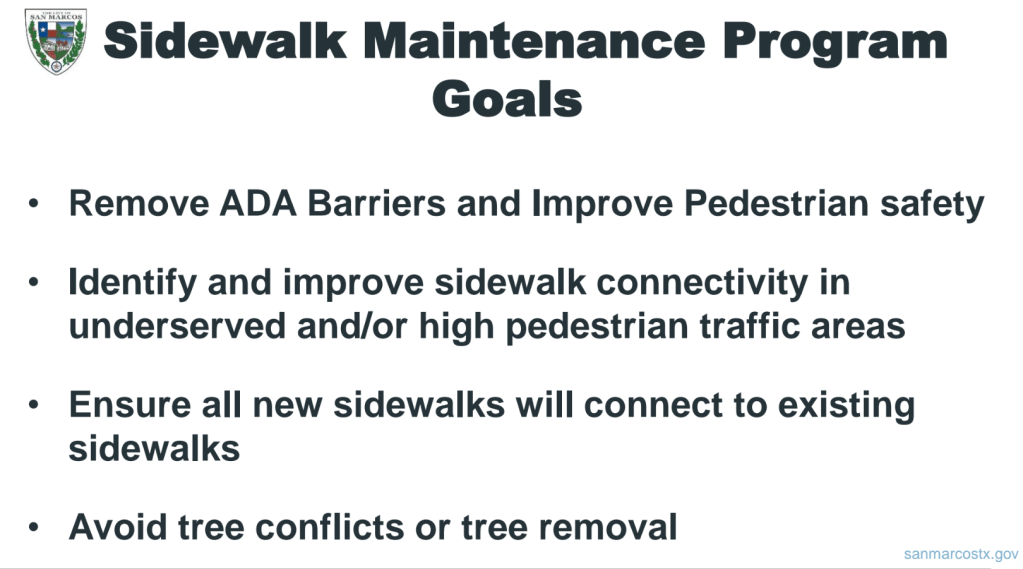
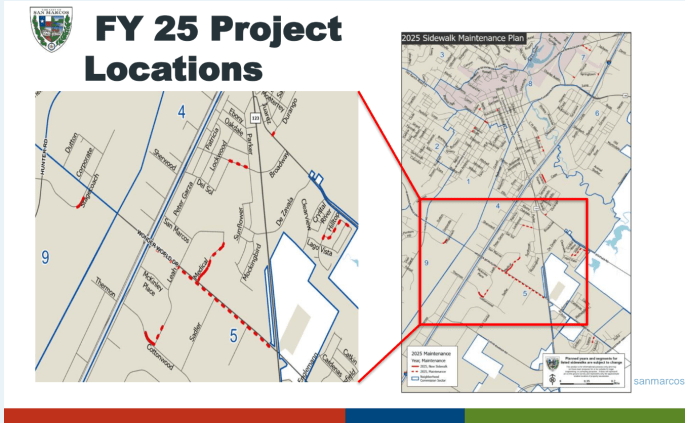
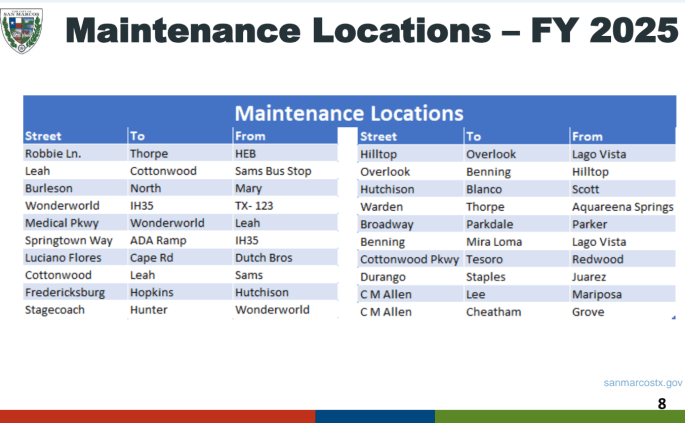
Presentation #2: It’s Sidewalk Maintenance time!
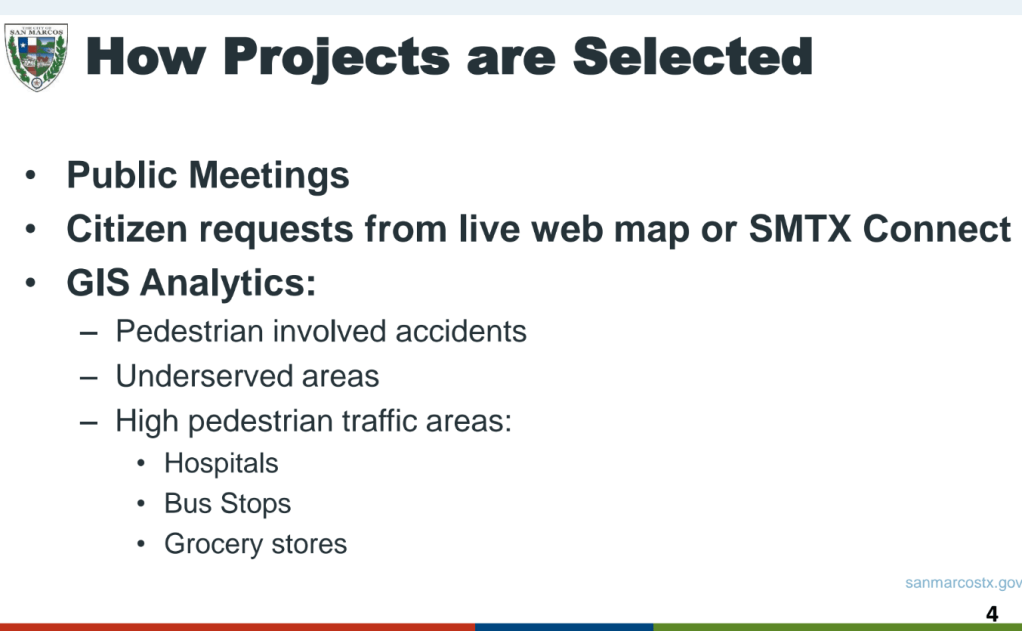
Here’s the game plan:
Here’s what’s coming up in 2025:
or if you prefer a chart:
Would you like to play along at home, over the next year? Go here:
Slow week! This week we talk about Malachi Williams, transit boundaries, CDBG grants, and whether Kissing Tree is a problem for SMCISD.
This is the only meeting for June. Here we go!
Hours 0:00 – 2:06: Malachi Williams, transit issues, CDBG grants, and Kissing Tree. Bonus! 3 pm workshops: How well did the city handle the May 9th storms?
A solid hour of citizen comments to kick things off!
Nearly everyone – 17 speakers – spoke about the issues of Malachi Williams’ death at the hands of SMPD, and calling for a ceasefire resolution for Gaza.
The family and activists are calling for three things:
Release the name and badge ID number of the officer that killed Malachi Williams
The officer should be placed on leave while the investigation is ongoing.
The family should be able to view all officer and storefront footage, with a lawyer present.
It sounds like the chief has offered to let the family watch some of the footage, but not all, and is denying the request to have their lawyer present. That’s pretty goddamn outrageous that you would ever require someone to forgo a lawyer in a legal context. (They don’t have a right to a lawyer, because nobody is under arrest or anything, but plainly it’s what’s fair.)
A lawyer would be able to inform the family about what Chief Standridge is legally able to do, and what he can’t, and a lawyer can advise the family – on the spot – on what’s in their best interests. If a lawyer isn’t there, then Chief Standridge is the authority on what Chief Standridge is legally able to say and do. See the problem?
One guy from Outsiders Anonymous shows up to advocate for their gym/treatment center during the CDBG grants item. (We ended up funding them at about 80% of what they asked.)
One speaker talks about her adult child with disabilities. There’s no day center in San Marcos anymore, and he commutes to New Braunfels.
We absolutely should have a day center for adults with special needs. I’m super uninformed on this topic, but it’s definitely part of serving the needs of your community.
But let’s talk about the other part: there’s no public transportation to get back and forth between San Marcos and New Braunfels.
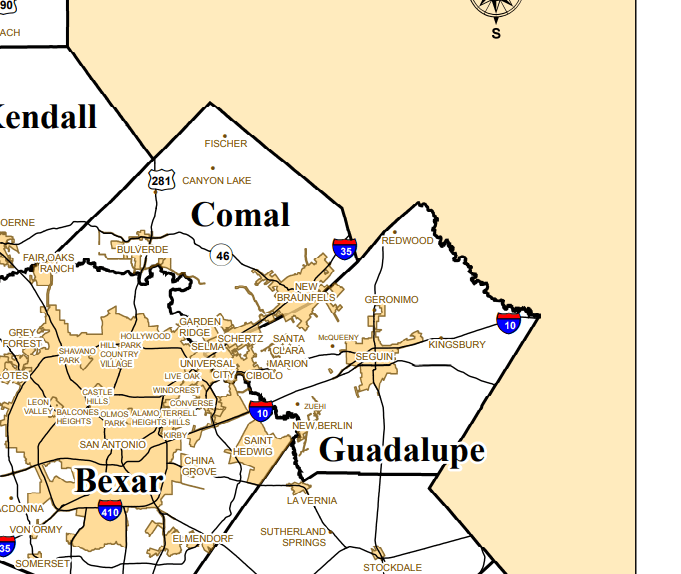
And the two systems don’t overlap or coordinate on their boundaries, so there’s just this cliff dividing San Marcos from its neighbors:
Puzzle pieces! (I had fun making that picture.)
Suppose you use the shuttle service because of your physical disability. How are you supposed to get from Redwood to San Marcos? There are a lot more mental health resources in New Braunfels than in San Marcos, but only if you’ve got the means to get yourself there and back.
Listen: Seguin, New Braunfels, and San Marcos need to triangulate on some shared public transit along I-35 and 123. Austin Metro is not meeting our needs here.
…
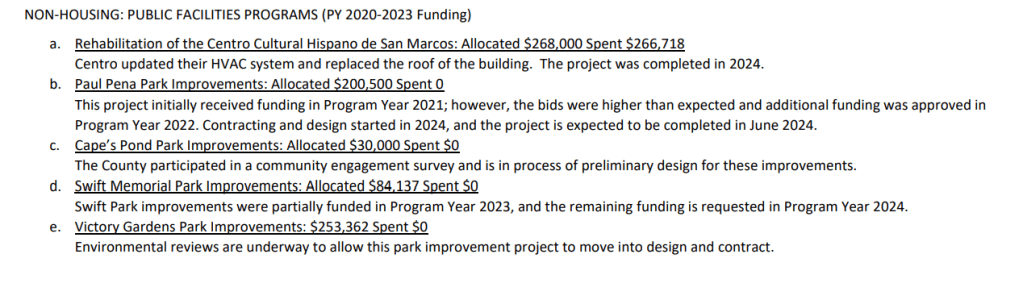
Item 9: Community Development Block Grant applications, 2024-25
HUD gave us $766K this year to give away, and we’ve got $639K rolling over from last year. So total, we’ve got about $1.4 million to give away.
First off: we have $639K leftover? Out of $712K that we were awarded last year? What on earth happened?!
It turns out that it rolls over from year to year, and there are project delays. It’s spelled out in the report here:
So the first two categories – Housing Programs and Public Facilities – are really falling short.
Alyssa Garza asks about the Housing Rehab program?
Answer: Housing Rehab had $800K from CDBG and $800K from ARPA, for a total of $1.6 million. They are running seriously behind. Currently there are 30 houses with bids in place. Five are under construction and 25 are pending, and that will use up the funding.
Alyssa also asks: Can we hire lawyers to help homeowners with title problems? (This is mentioned under the Home Demo program above – “Properties with sub-standard structures also tend to have ownership issues”.)
Alyssa: There are free legal aid programs at St. Mary’s and UT-Austin that have offered to help.
The staff is vaguely friendly about this suggestion, but not in an “omg I’ll do that tomorrow” kind of way.
In the end, they decide to put “paying for a lawyer” on the list of side-projects that can be consulted when there’s a loose bit of money that suddenly becomes available.
Onto 2024! Here’s the criteria that we use:
(For what it’s worth, I don’t love the Council Priorities. I think they risk creating perverse incentives.)
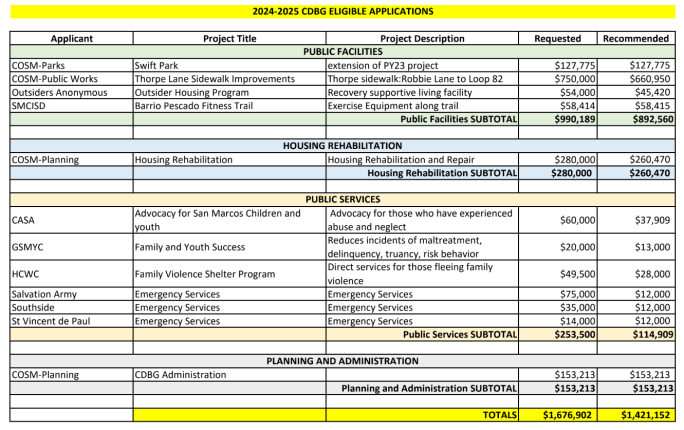
Moving on! There was one ineligible application and 11 eligible applications. Here are the recommended funding amounts from staff:
Anyway: Council does not make any changes.
I believe this is just a first reading, so if you’ve got advice for Council, you’ve got another chance at the July meeting.
…
Items 10-11: Kissing Tree
Kissing Tree was approved in 2010. It’s a PDD – “Planned Development District”. This means the city got to micromanage every last detail of the whole project, and put it in writing, in a contract.
[Quick primer on PDDs: They’re a mixed bag. You can spell out exactly what will be built, but you can also waive a lot of regulations that the developer doesn’t like. In general, PDDs are only as good as the Council that negotiates them.
We got rid of them in 2016, which was an unforced error and I’ve complained about it a lot. Then recently we brought them back again. So now the city has the ability to lock things down again.]
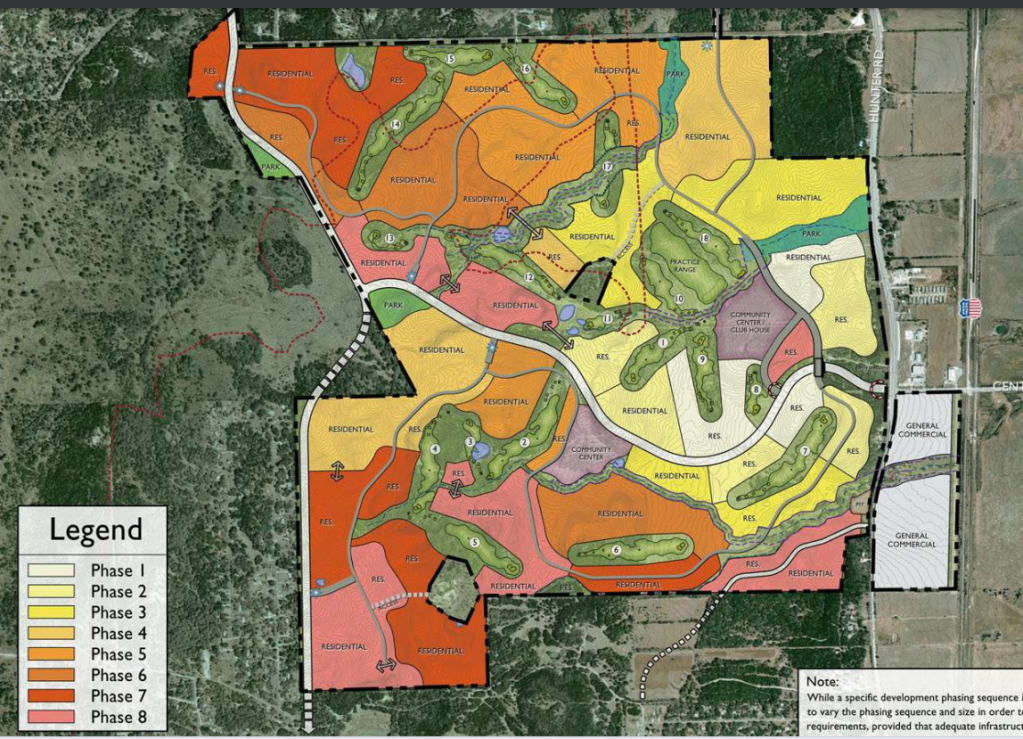
Here’s where it is:
You know, this thing, out on Hunter Road and Centerpoint:
That map has not been updated since 2010, so I have no idea how much has been built out already.
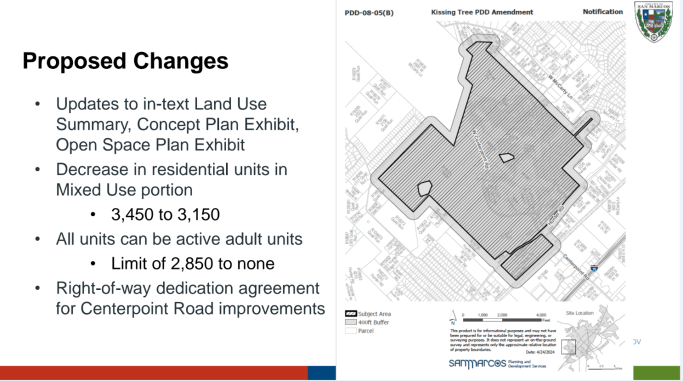
Kissing Tree wants to modify their PDD, so they have to go back to Council. Here’s what Kissing Tree wants to do:
“Active Adult Units” means senior housing.
In other words: The original plan is for 3,450 units: – 2,850 were senior housing – 600 were available for everyone else.
Now they want build 3,150 total units: – 3,150 for seniors – 0 available for everyone else.
It’s not that big a deal – I’m sure this is more profitable for them now – but I’m irritated that no one provided an explanation or talked about consequences. In fact, Council talked about it for roughly 30 seconds, and this was the entire exchange:
Shane Scott: “This is a great example of why PDDs are so useful. We got rid of them, and we should bring them back.”
Jane Hughson: “We are bringing them back. We’ve discussed this.”
Shane: “Was I here for that?”
Jane: “I think so?”
SMCISD gets kind of affected by this kind of decision. The problem is that San Marcos is lopsided – we need more families to balance out all the non-family tax base (ie the university, the outlet malls, and things like Kissing Tree.) From time to time, we get dinged under the state’s Robin Hood law and have to send money back to the state for poorer districts, despite being a Title 1 school district ourself. It’s a complicated mess.
But just remember: Texas squandered a $32 BILLION dollar surplus last legislative session. This was sales tax money – from all Texans – which got sent back to property owners. We literally took money from renters and gave it to home owners.
There is plenty of money in this state to fund all schools properly. We just need to elect a governor and legislature that wants to do so.
….
Item 12: Good news on the Water-Wastewater Treatment Plant front!
We’re getting a new centrifuge:
and a diffuser replacement in aeration basin:
We promise not to spend more than $6,716,477.45.
And a very special San Marxist shout-out to the kind soul on city staff who put these photos in the powerpoint presentation!
These slides didn’t even get shown during the meeting. I see you, I appreciate you.
…
Item 16: We are meekly opening the door for the possibility of maybe someday, beginning a conversation about paid parking downtown.
This is such a tentative baby step that there are no details or decision points yet. We’re just strapping on our sun bonnets, lacing up our sneakers, and sizing up the path ahead of us.
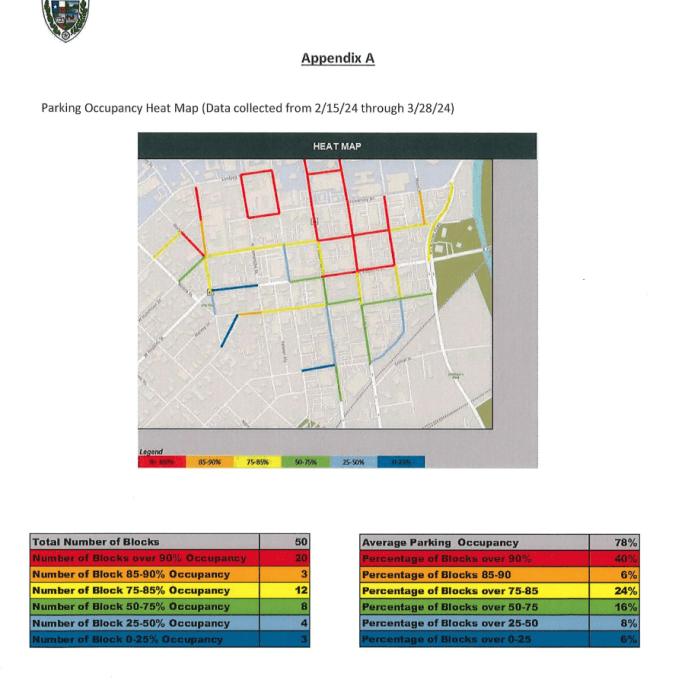
I did think this heat map was interesting:
That map is pretty unintelligible; here’s my attempt to improve:
This is only measuring parking – not traffic congestion or anything.
Here’s what the colors mean: 20 red blocks: street parking is generally over 90% full. Three orange blocks: street parking is usually 85-90% full. Twelve yellow blocks: street parking is usually 75-85% full. Eight green blocks: street parking is usually 50-75% full. Four light blue blocks: street parking is usually 25-50% full. Three dark blue blocks: street parking is usually under 25% full.
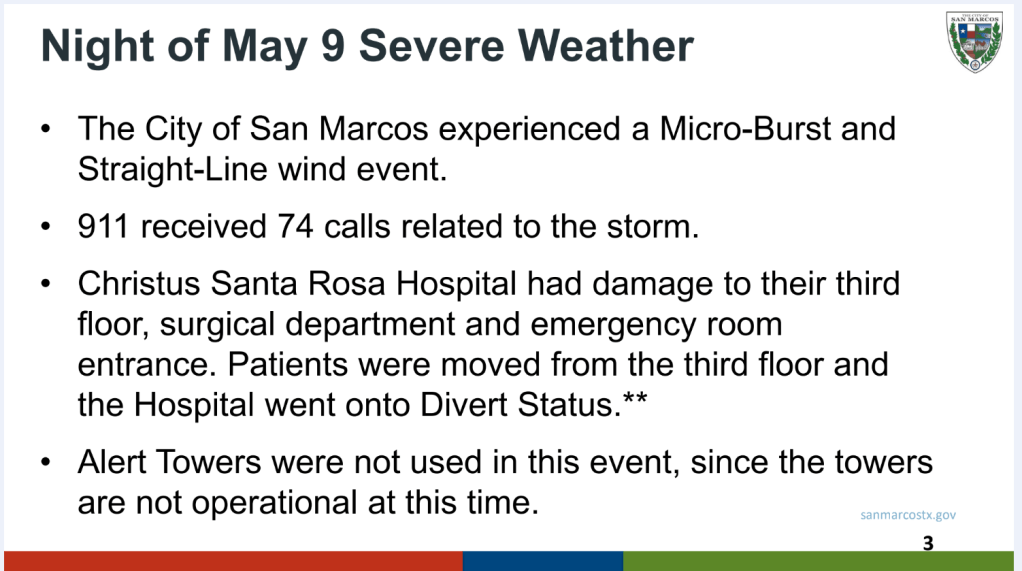
How’d the city do during the May 9th storm? I’m just going to run through some of the slides.
These are the Alert Towers. They’re being tested, but haven’t come online yet. (I think they used to be used years ago, but have been broken for a long time, and now we’re bringing them back?)
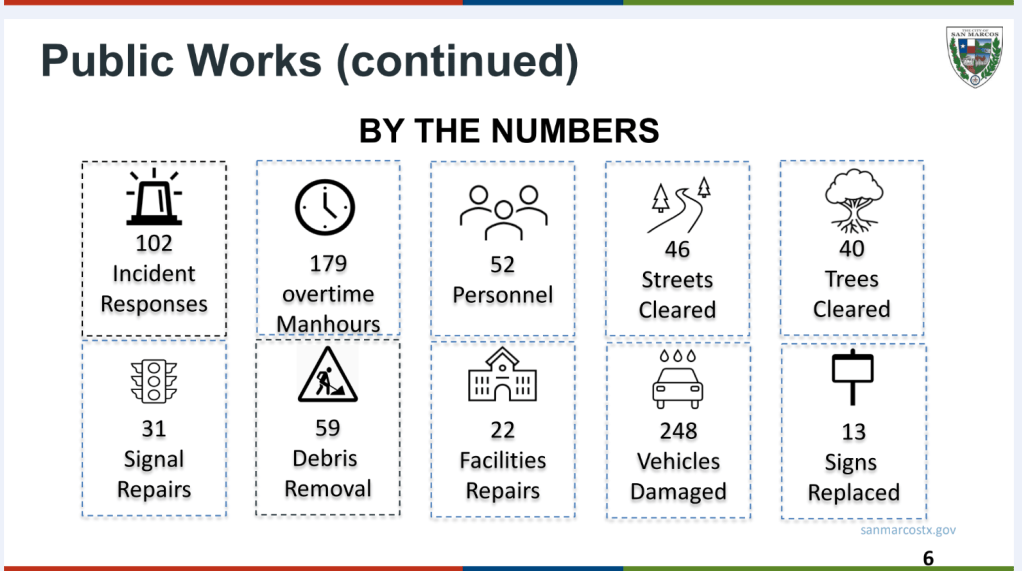
So a ton of work was done overnight and into Friday.
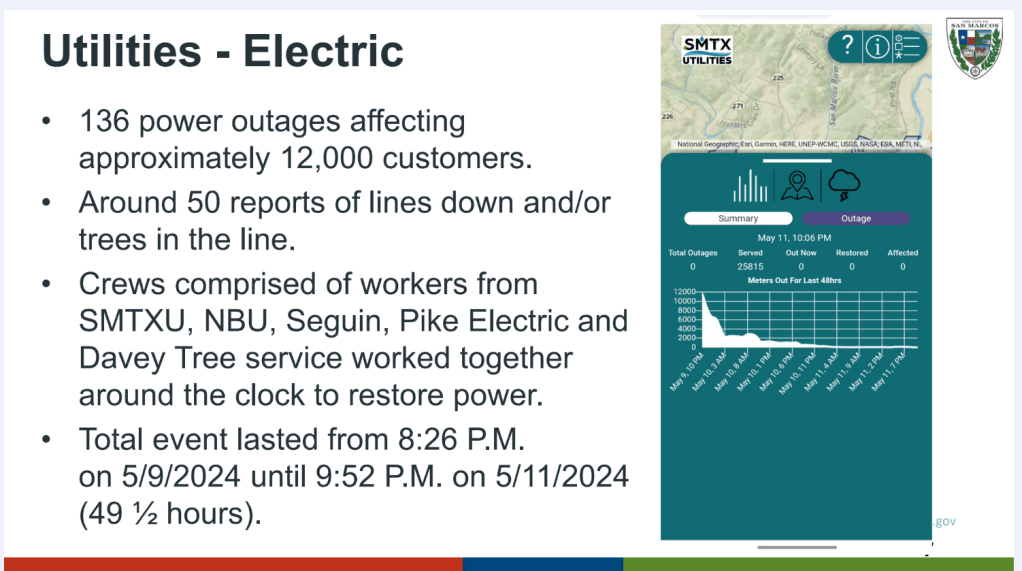
There were a ton of people without electricity:
The last people didn’t get their power back for two full days.
There were a lot of anecdotes about the city not knowing about different outages, and people reaching out directly to councilmembers. Staff says that often the resident is talking to a field worker who doesn’t have access to the master map of all outages. So the resident thinks the city is ignorant about an outage, but really they weren’t talking to the right person.
Still, they conceded they need to do a better job of staying in touch with residents who call in to say they’ve lost power.
What are our zany Councilmembers up to this week? Lots of little things: noise complaints, new low-income housing, that crazy storm, tiny homes, and more. Also, our budget is in trouble, which is definitely a bummer.
Let’s dive in!
Hours 0:00 – 1:36: In which we discuss the Dunbar-Heritage Area Plan split, a noisy warehouse, and two more low-income housing projects.
Hours 1:36 – 2:17: A wee bit of eminent domain, that crazy storm from May 9th, some new developments, Green Guy, and Tiny Houses
Noah Brock spoke about the SMART/Axis right of way annexation again. (The whole agenda item ended up getting postponed until July 2nd.)
…
Item 1: Area Plans
The city is diving into its first Area Plan, which was going to be the Dunbar-Heritage neighborhood. Discussed before, here.
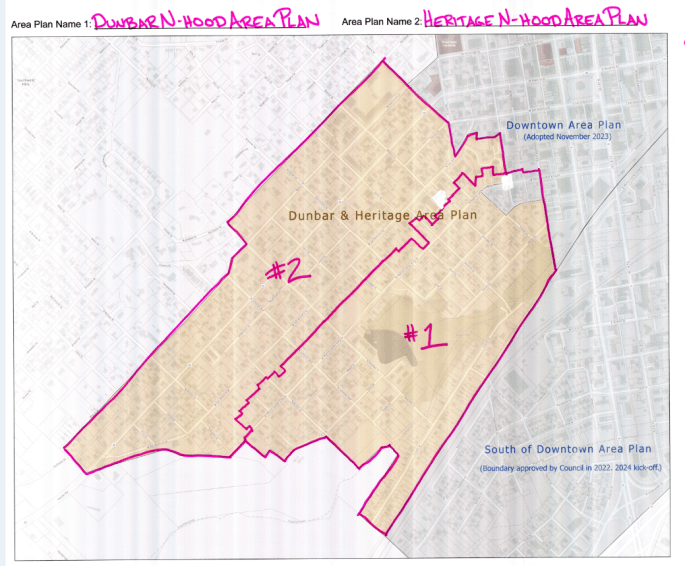
Here was the boundary:
The very first thing that happened is that P&Z declared that this was a terrible idea. It needs to be split into two separate area plans, Dunbar and Heritage. Council agreed.
(Why? Historically, Heritage has always gotten all the resources and city attention, and Dunbar gets neglected. So we’re trying to stop doing that. This way each neighborhood can determine their own priorities and character.)
So tonight, we have new boundaries for two separate area plans:
All done! Splitsville.
(Now to write the actual area plans.) …
Item 16:
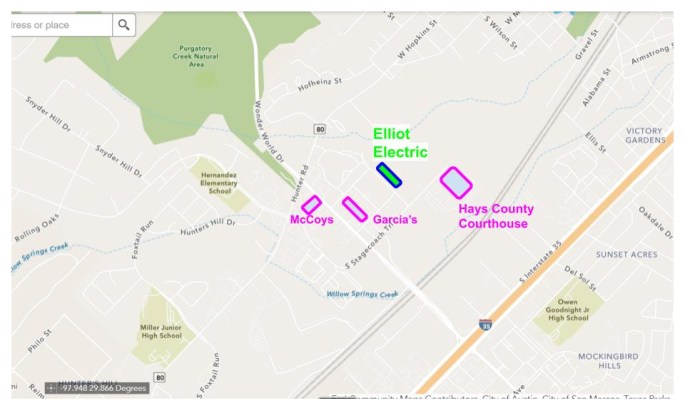
This warehouse place – Elliot Electric Supply – is off Wonderworld:
They’ve been operating since the 90s.
There were townhomes built here:
They were built in 2019.
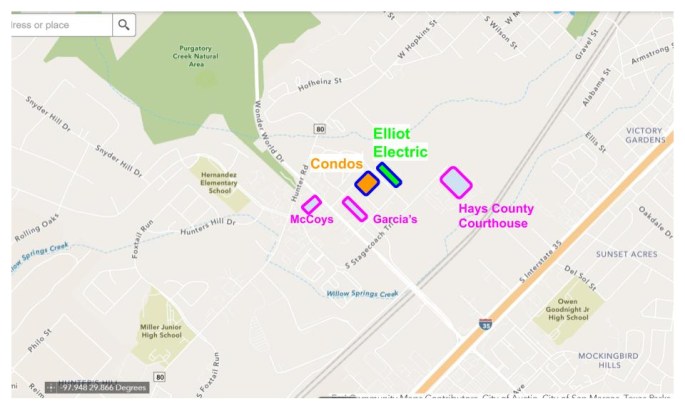
Elliot Electric is in the yellow box below, and you can see the townhomes right across the street:
Here’s the problem: the developer who sold the townhomes did not disclose to the buyers how noisy the warehouse business is. The homeowners get woken up every night around 3 am, with delivery trucks, forklifts beeping when they back up, loud music playing, and so on.
In April, the warehouse guy came to P&Z for a permit to expand his warehouse. A bunch of condo owners showed up with a number of complaints.
The branch manager came across as a very sympathetic guy who had not been told that the neighbors had all these complaints, but was willing to work with them. He gave them his personal phone number and agreed to a fence to block the noise:
It also runs along Dutton Drive, which seems like the important part.
Ultimately, P&Z felt like the business has seniority, since they’d been operating this way for about two decades before the townhomes were built. So they approved the permit.
…
Sidebar: So what went wrong? How did we get here?
The townhomes were approved by this same P&Z, in this meeting. There was no mention of noise nearby. Probably the city staff weren’t aware and P&Z wasn’t informed.
If staff had known about the noise, they probably would have recommended a deed restriction, where the developer had to inform potential buyers about noises next door. But that did not happen.
I don’t think anyone was being a jerk here. But it would still be good to figure out a way for everyone to get some sleep at night, without wrecking this guy’s business model.
….
This brings us to Tuesday’s meeting: the condo association is appealing the P&Z decision to council. They want quiet hours.
There’s two problems.
First, San Marcos already has a noise ordinance. It’s just a matter of getting someone out to document it.
Second, it’s not really the local employees that are playing loud music, driving forklifts, etc at 3 am. It’s delivery drivers from Austin and San Antonio. They have keys to the place, let themselves in, unload the delivery, and head out.
Also, if they get the permit for the extra warehouse, it will (supposedly) help block some of the noise.
Council ends up circling in on some extra requirements:
Apparently there are noise-cancelling and white noise forklift add-ons, for the back up beep. Elliot Electric will put these on.
There will be conspicuous signs about how overnight workers need to keep it quiet
The vote: Should Elliot Electric keep their permit, with these extra requirements?
Yes: everyone No: no one
The actual solution here is to build relationships. The condo owners should use the branch manager’s personal cell phone number to let him know when they’re getting woken up. But they should be nice about it, and assume he’s doing the best he can. (And he should do the best he can.)
…
Items 17-18: Two LIHTC projects.
LIHTC sounds for Low Income Housing Tax Credits. There are two separate projects being proposed.
These were fake-affordable housing. But it was free for the city – they were going to the state for tax breaks.
Whereas these next two are not free for San Marcos, so they’d better be more legit. (Which they are!)
The first one is on McCarty, here:
between Hunter and I-35.
This one is supposed to be a retirement community, so it’s all 1 and 2 bedrooms.
Here’s the affordability part:
The important part is that first row: 34 units will be reserved for people earning under 30% of the Area Mean Income, or AMI. (We’re part of Austin metro, so we use Austin household income levels. It’s not ideal, but we can’t change that.)
Technical note: See in the first row where it says $0-$35,040 as the income range? That’s misleading, because that’s based on a family of 4, but these apartments are reserved for seniors. For one person, the 30% income cut-off is $24,550, and for two people, the 30% cut-off is $28,050. (Full AMI chart here.) You should also ignore the $58,401-$70,080 for the remaining 188 apartments. For one or two seniors, the income cut-off in this bracket is $40,900 or $46,750, respectively.
Point being: those 34 apartments are legitimately reserved for people without much money. This is good!
In addition, there are services for all residents:
I mean, fine. These are fine.
The property tax estimate for 18 years is $7,262,589, which works out to about $400K per year. So that’s the contribution of San Marcos to this project: about $400K per year.
The second LIHTC project is here:
Out between Centerpoint and Posey Road.
Here’s the affordability:
These are 1, 2, and 3 bedroom units. Here the income ranges do make sense, because there will probably be families living here. So there will be 55 units reserved for the lowest income bracket.
Great!
Services:
More services than the first place, but the location is worse. You don’t have Target and everything around the corner.
The property tax estimate is $4,000,000 for 15 years, or $266K per year.
I don’t totally understand how these things work, because:
This is cheaper per year than the first place – $266K vs $400K
There are more low-income units here – 55 vs 34
And in addition, this second place is offering us a cash-back offer. So clearly I’m missing something about why all this makes sense.
For the cash-back offer, Council has a choice:
They’ll pay us $36,666 per year for 15 years, so we’d get $550K total.
Or, they’ll pay us $400K up front.
Council goes with the lump sum payout. Especially in lieu of the 3 pm workshop, where our budget took a beating.
Side note #1: Note that both projects are both along the railroad tracks. Poor people get to live along railroad tracks.
You know how it went. Someone said, “What can we do with this land, along the tracks? No one with money would live here. Maybe we get some poor-people tax credits and make some affordable housing?”
(I loathe wealth segregation so much.)
Side note #2: Both these complexes are reserving 15% of their units for people earning under 30% of the AMI. That’s because the city of San Marcos fixed 15% as the requirement for LIHTC applications.
We used to require that you set aside 25% of your units. But we didn’t get as many applications, and so we changed it to 15%. I don’t know how I feel about this.
But look. This chart is from 2017:
So seven years ago, we had a shortfall of 4233 rental units for all households earning under $35K. We have not updated these numbers since then.
These two LIHTC projects will yield 89 units. That’s a drop in the bucket.
This Council is not serious about housing affordability. If they were, they would start by dusting off the Housing Action Plan (which was deep-sixed in 2019) and updating it. They would listen to the research about what it takes to increase the affordable housing stock. (This is going to come up when we get to Tiny Homes, at the end of the meeting.)
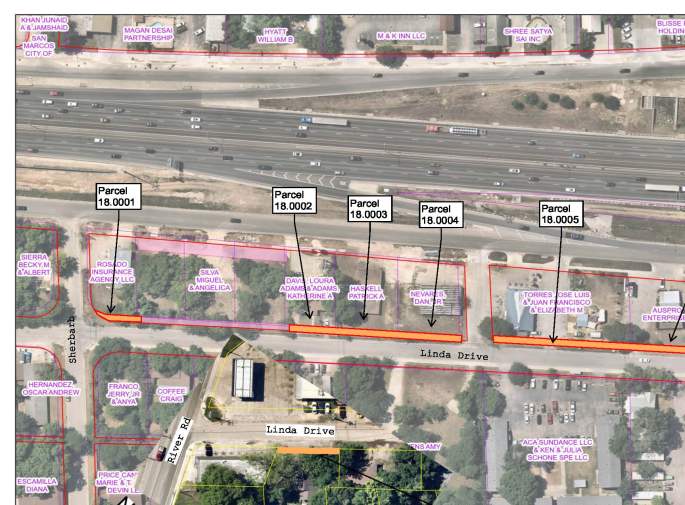
for the Linda Drive project, which you can read about here.
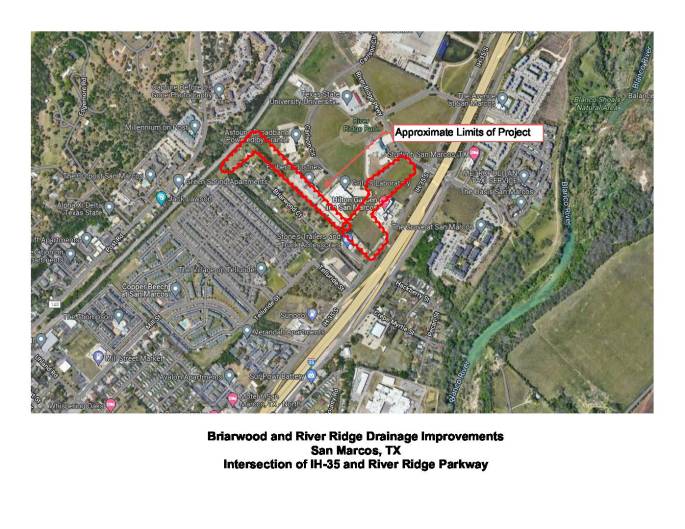
We need this:
for the River Ridge Drainage Improvements Project, which you can read about at that same link as the Linda Drive project.
We aren’t just going in with guns blazing and taking the land. The plan is to go talk to the land owners and try to buy it. The key phrase for eminent domain is “To the extent that negotiations are unsuccessful.”
So, we’ll try. Otherwise we’ll take.
…
Item 19: That wild storm back on May 9th. (I hope everyone is okay.)
We’re pulling $750,000 out of the general fund to cover the associated costs, like all the extra curbside brush pickup and tree removal.
Here’s the thing: Hays County is requesting a disaster declaration. If we get it, then we can get reimbursed for this expense. Which is good, since our budget is kinda tanking at the moment. (See here)
To get the disaster declaration, we have to report at least $1.1 million in damages. And the more we report, the more federal money we can receive. You get reimbursed in proportion to the damages you report.
So really, the community needs to report whatever happened:
Volunteer hours. Did you and some neighbors spend a few hours using a chainsaw on your neighbor’s fallen tree? Report it.
Did you have to pay for tree removal? Report it.
Did your car or your house get damaged? that really sucks and I’m sorry. But also, report it.
Go here and scroll down to “Reporting Damages” and “Reporting Volunteer Hours”.
There, that’s your good deed for the day.
…
Item 21: Project Snapdragon
Ah, such intrigue.
Council approved this with zero discussion and no presentation, so I’m basically winging it here. (There are slides in the packet, but staff didn’t present them during the meeting.)
Let’s see how I do!
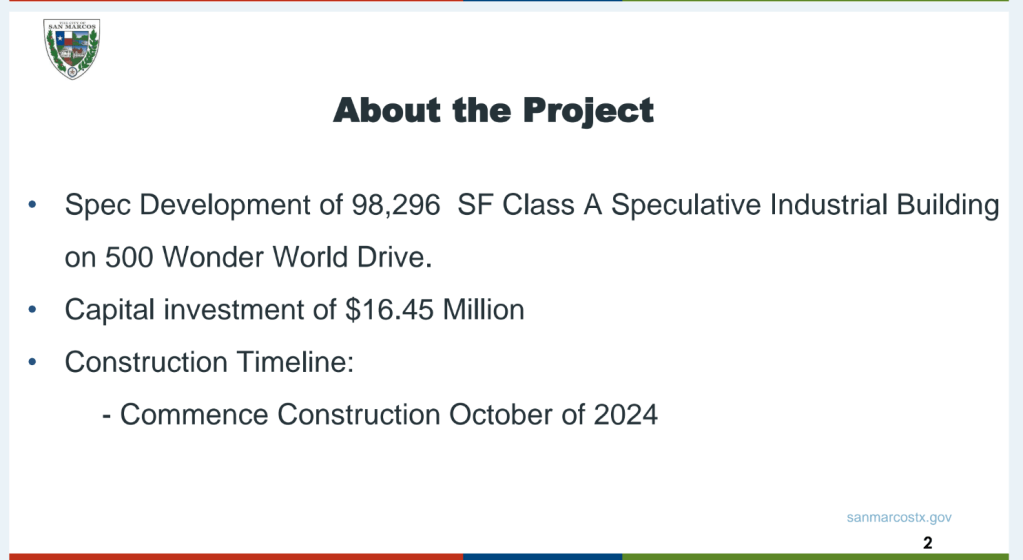
A speculative industrial building. So in other words, they don’t know who exactly will lease it yet, but they’ve got a good feeling in their belly.
It’s going to be here:
In other words, if you’re going southbound on the frontage road, it’s behind these buidlings here:
right behind Floor King, Life Storage, and Classic Collision.
Side note: Do we all think “Floorking, I don’t even know how to floork” when we see that place, or just me? (You will now! Sorry!)
What will it look like?
haha, no it won’t. Renderings are just pretty pictures. They’re not promises. They’ll build whatever they want (as long as it fits city code).
How much money are we giving them?
Ok, so we’re giving them $235K. How much do we think we’ll get?
So someone is projecting that we’ll bring in $97K yearly, once it’s up and running.
Side note: You know what would be nice? To go back 5-10 years at old Chapter 380 agreements, and see how they panned out. In 2014, who did we give tax breaks to? What kind of revenue did they pinky swear to generate? How much money are we actually collecting from them?
Anyway, Chapter 380 agreements now take two readings, so if you hate this, you can tell us all about it at the next meeting.
…
Item 22: 5 year lease with Green Guy Recycling
We went over all the details here, in a workshop back in March. So now it’s official. 💍
….
Item 26: Tiny Homes
Mayor Hughson brought this item up. I think what Jane is saying is that you should be able to build Tiny Homes on weird, tiny lots.
We started allowing Tiny Homes under the land development code in 2021. Right now, there are a few ways to have one:
In a single family zoning, you can put one on a lot, just like a non-tiny home.
If you want to put several of them on a lot, it needs to be zoned for mobile homes. So in most neighborhoods, you can’t do this.
If you had a big lot, you could apply for a zoning change to a zone where you could subdivide it into several small lots. This would go to P&Z and Council, where they’d look at it on a case-by-case basis.
Matthew Mendoza says that he doesn’t want someone subdividing a larger lot into several small lots to put tiny homes on them.
Mark Gleason: As long as we’re not doing what Austin did!
What he’s talking about is this: Austin passed a new ordinance that changes the minimum lot size for houses from 5,750 square feet to 1,800 square feet.
Let’s talk about this, because I think it’s really important. Here’s a 6,000 square foot lot:
That’s a listing from San Marcos. If you set Zillow to lot sizes of 5000-75000 square feet, the vast majority of San Marcos options are in the $300K range.
You can have much bigger lots, but you can’t go smaller than that in a traditional Single Family 6 neighborhood. What this means is that your neighborhoods are sprawling and your prices stay high. It’s bad for traffic, bad for the environment, and bad for creating affordable housing. It’s good for keeping poor people away from middle and upper class people.
So last week, the Austin City Council approved a minimum lot size of 1800 square feet for single family neighborhoods. You can still have bigger lots! But you’re allowed to have small lots, in traditional neighborhoods. This is what is blowing San Marcos City Council’s collective minds.
The arguments against these things are usually about “preserving the character of a neighborhood”. But we’re not talking about bulldozing twenty houses and replacing them with a giant apartment complex. We’re talking about gently increasing the affordability and number of people in a neighborhood. I promise it won’t hurt.
These changes really do bring down housing costs, and higher density really does cut down on traffic, sprawl, and the environmental impact.