Item 23 plus Workshop: Purple Pipe and the Edwards Aquifer.
You guys. This was all so fascinating that I don’t know where to start. Half the reason I wanted to start this blog is that I don’t feel like I’ll retain anything unless I organize my thoughts well enough to explain them to someone else.
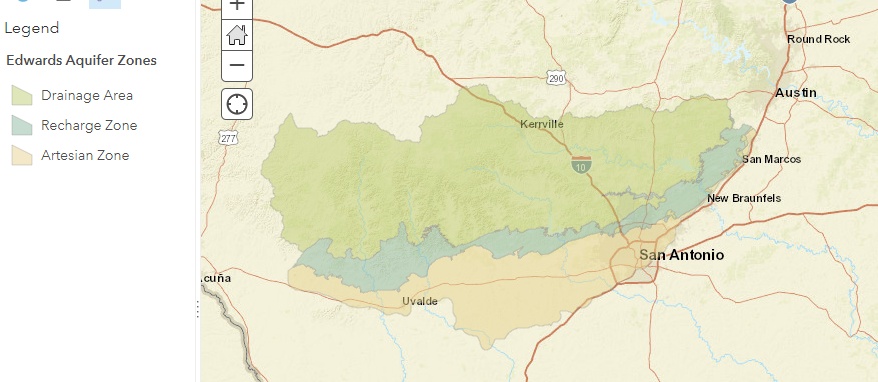
The afternoon workshop is on the Edward’s Aquifer. First off, Edward’s Aquifer is gigantic:
The green part catches all the rainfall. The blue part is all the porous caves and springs, where the aquifer is right at surface. The tan part is the storage tank of the aquifer.
It’s a little weird, because you would think that those three parts – catching rain, rocky and porous, storing rain – would be stacked on top of each other, going towards the center of the earth. You wouldn’t think that they’d be side-by-side on a map. Why would water flow from Kerrville to Uvalde? But it does! Or so I’m told.
The left side of that picture is north, the center is San Marcos-ish, and the right part is south. So underground, water really is flowing from Kerrville to Uvalde.
Next! So, we were using the aquifer too heavily in the 70s and 80s, and water-people were getting nervous, projecting that we’d exceed capacity in the future. During droughts, things would get scarce. In the 1950s, the Comal dried up completely at one point, during a massive drought. Water rights for surface water – lakes, rivers, etc – have been fought in the courts for a long time, but not for ground water (or at least not in Texas). So people were allowed to enforce caps on how much water you take from lakes and rivers, but no one was allowed to enforce a cap on how much water you pump from an underground aquifer.
So in 1991, the Sierra Club files a lawsuit against Texas, because of the endangered species in the San Marcos and Comal rivers. And they won! Texas was ordered to do something to guarantee that the water wouldn’t stop flowing into these spring-fed rivers. And so the state legislature created the Edwards Aquifer Authority.
So the EAA has legal power to protect that quantity and quality of water in our river. That’s amazing! I got legitimately nerdy-emotional, contemplating the sheer amount of effort and science and coordination across different groups of people that goes into protecting our river.
They do a lot:
They issue permits for who is allowed to use aquifer water. So San Marcos has a permit, TXST has a permit, etc. There are only 2000 permits, total. There are 2 million people on the aquifer, but only 2000 permits.
They cap the amount of water that can be by someone holding a permit. During drought, they force permit holders to reduce their usage. (Apparently Drought Stage 1-5 refers to how much you have to reduce your usage. So Stage 1 means reduce by 10%, stage 2 by 20%, etc.) As long as the EAA enforces these caps, your river is going to keep flowing.
They worry about water quality: contamination from abandoned wells, chemicals from firefighters putting out fires over the aquifer, about storing other things underground, besides water. (Like gas tanks for a gas station.) So they have programs in place for all these things. They cap the amount of underground storage under the aquifer. If someone wants to open a new gas station, they’re going to have to buy storage credits from someone else who already has them.
They’ve got a big research facility in San Antonio where they’re studying all these strategies so that they can say with certainty how much each intervention helps.
San Antonio has a program where 1/8th of every cent of their sales tax goes to counties in the west, to help them protect their aquifer. So San Marcos really is not going at this alone! We’re the tip of a large network of scientists and environmentalists who are all coordinating their action to help preserve these rivers. I somehow find that very reassuring.
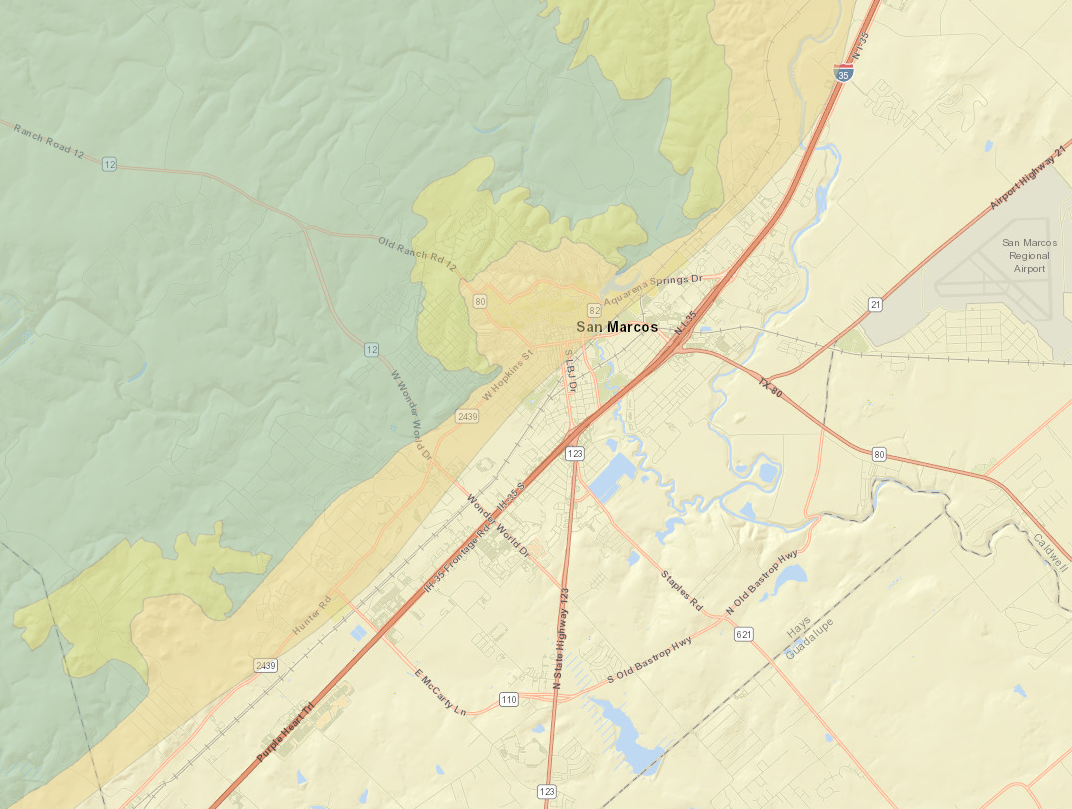
Next: we zoomed into San Marcos at the city level.
Zooming out:
Remember:
green is the part that catches the water,
blue is where the aquifer comes to the surface
tan is where water gets stored.
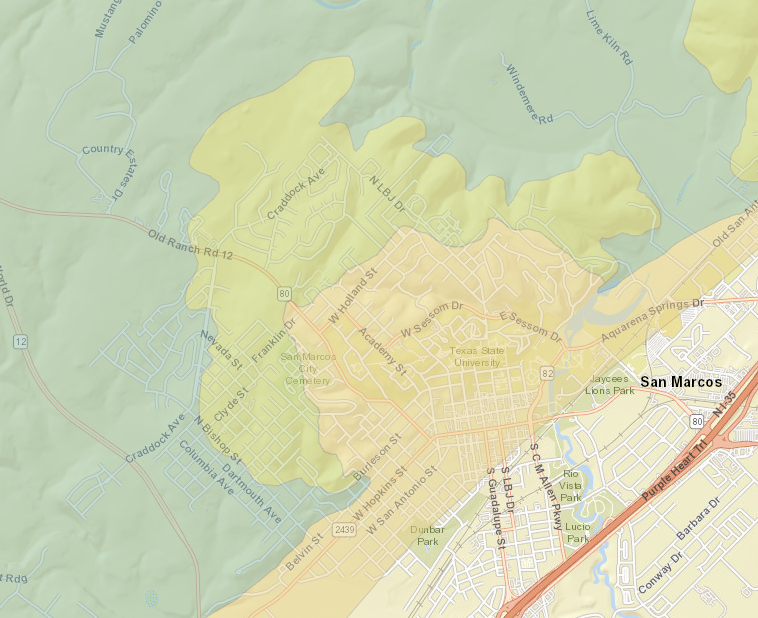
Zooming in:
We have a lot of blue. In total, San Marcos is about ⅓ inside the aquifer.
Zooming in to the green-blue boundary in particular:
Everything south of Bishop, or past Craddock on Old 12, or north on Lime Kiln road: all of that is extremely sensitive land. It’s really important to fight these fights over La Cima, or Mystic Canyon, or wherever.
We actually only get about 7% of our drinking water from it. The rest of our water comes from several different places, through a bunch of different organizations. We’re trying to diversify our sources, so that if one region gets hit by a drought, we still have other options. (It did occur to me that droughts aren’t that local. It’s not like we’re piping water in from New Orleans. Wouldn’t all our sources be hit by the same drought, if it lasted for a few years?)
Moving on! Did you know that San Marcos has a purple pipe program?
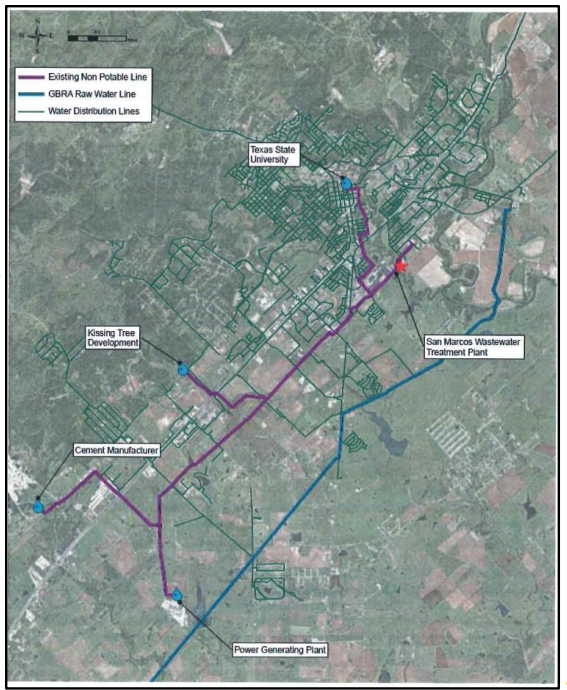
Not like that, you dingbat. Purple pipe is reclaimed water. In other words, you flush your toilet, the water goes to the water treatment plant, and they get it fairly clean. Not clean enough to drink, but fairly clean. Then they can either put it back in the river, or they can pipe it back out in specific Rattler-pride-hued pipes. Then businesses can use it for landscaping and flushing toilets, so that we’re not using drinking water for these things.
Here is a map of the purple pipe in San Marcos:
The Kissing Tree golf course, the downtown landscaping, and some of the stuff at Texas State are all using reclaimed water. That’s so great!
We have the capacity to pump 5.5 million gallons of reclaimed water per day. We’ve got it all contracted out, but they’re only using about a million gallons/day, so we need to renegotiate these contracts so that we can free up the rest of the water for use.
The water pressure is pretty terrible, apparently, enough so that it’s not really available for residential uses yet. And there are concerns about double-piping neighborhoods, and some future plumber using the wrong water line for drinking water. But these are being hammered out. The future is now!
Items 15-16: 38.5 acres is being annexed and zoned. La Cima is growing.
I found myself wanting to do a deep dive on La Cima. How did we get here? I thought maybe I could try to finally wrap my head around La Cima. (I’d also like to do this for Whisper Tract and Trace.)
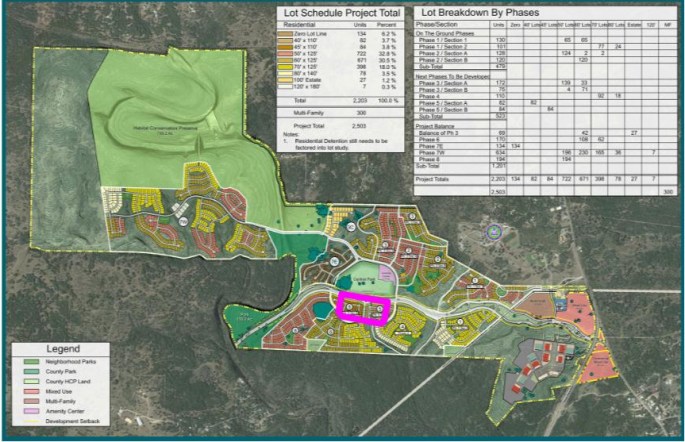
So La Cima was first approved in 2013, as Lazy Oaks. Most of the city’s online archives only go back to 2014 though, so I literally can’t find a map of the original parcel. It was 1,396 acres in size.
In 2014, it grows to 2,029.023 acres (and maybe gets renamed?) It looked like so:
That’s RR12 right at the entrance of the pink part, right where Old 12 meets new 12.
So in 2014, that tan part – all residential houses – didn’t wrap around to the left of the conservation open space, and now it does. Plus they added apartment complexes. (I’m okay with the apartment complexes being added! I don’t like developing over the aquifer, but I don’t want it to be a cloister of wealthy people, either.)
Basic stats, 2018: – 2800 dwelling units: old 2,400 houses + 400 new apartment units – 35.6 acres parkland – 791 acres conservation – 2,029 old acres + 394 new acres = 2,423 total acres
In August of 2020, it grows again:
Adding that new pink part in the lower right hand side.
Basic stats, 2020: – Still 2800 dwelling units – 37.66 acres parkland – 800 acres conservation – 2,423 old acres + 129 new acres = 2,552 total acres
In November 2021, we added amended it to allow for the film studio. The plan seems to be for it to go in that new pink section on the lower right.
Of course, the fights weren’t until the following June, when everyone was super pissed about building on the aquifer. Listen: they are absolutely correct to be mad! It’s just that the fight wasn’t held at the correct time, legally speaking. By this point, City Council was just trading environmental protections for tax credits.
The funny thing is that the really big change came just one month earlier, and no one paid any attention.
This is in May, 2022, and it’s a pretty drastic change:
It jumped clear across RR12!! That whole tri-colored bit on the upper right is brand new!
So what happened? A lot of housing was relocated. That light green piece in the upper left used to be residential, but now it’s conservation. So there are good parts and bad parts.
I don’t know. It’s a complicated thing. There’s a lot more conservation, but a lot more building and living on the aquifer. I feel weird about it.
(Wasn’t I paying attention last May? Apparently not! I listened to the entire meeting and did not have a single thing to say about La Cima! You probably shouldn’t trust me very much.)
Also, not that much of it has actually gotten built yet. They’re chipping away at it.
So now we’re all up to speed on La Cima. So what actually happened last Tuesday? A very a small bit, 38.5 acres, is finally getting annexed and zoned:
That pink square is my best guess of where it is.
Max Baker attempts to persuade the developer to use something water-friendly: either purple pipe or rainwater detention. He gets brushed off for both, in a slightly condescending way.
The vote: Yes: Everyone except Max No: Max
………………
Item 17: There’s an application to rezone 1.35 acres in the middle of Blanco Gardens.
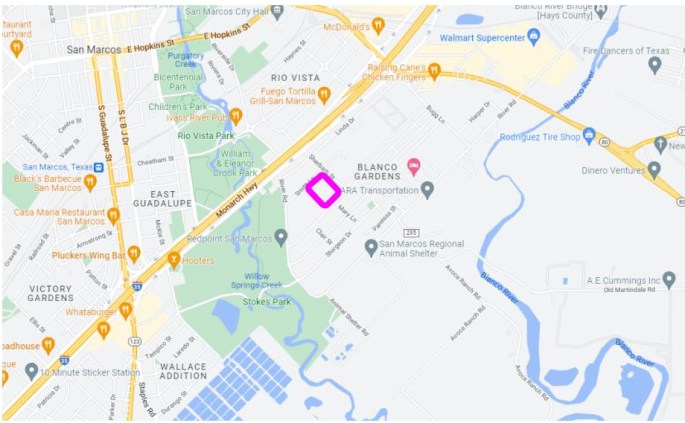
Here’s Blanco Gardens, and they want to rezone this pink square:
So really RIGHT in the middle of Blanco Gardens. Aren’t there houses right there already?
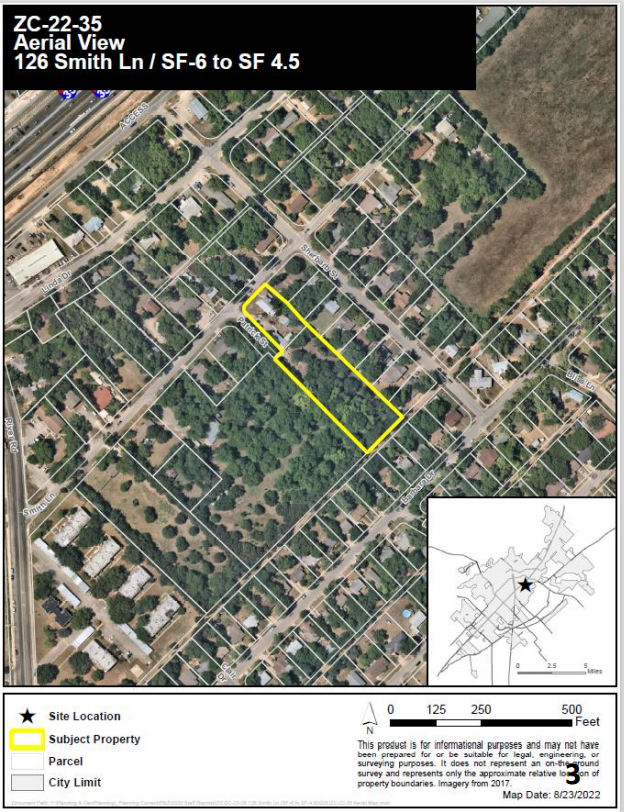
Yes. This is a block full of houses, but it happens to have some undeveloped land interior to it, and the developer wants to add houses inside the block.
Some important details:
They can already develop it, SF6, which means single family housing with lots at least 6000 sq ft big.
They want SF4.5, single family housing with lots at least 4500 sq ft.
So they can fit in more houses under SF4.5 Staff estimates that they could fit 8 houses at SF6, and 11 houses at SF4.5.
Other important details:
WE HAD A BIG FLOOD A FEW YEARS AGO, IN THIS EXACT NEIGHBORHOOD. And a few years before that. And a few years before that. Etc.
P&Z denied this request! So it would take 6 councilmembers to overturn it.
City council also denies it, 7-0, so that is that. The developer can still build their SF6 houses if they want (and if they want to piss off the neighborhood).
The School Board officially gave that land to El Centro Cultural recently, and then came to find out that there’s a weird alley running through the school that still belongs to the city.
So we got a charming history of this alley – before SMCISD was SMCISD, it was the San Marcos Public Free School system. Then in 40s, it spun off. Gradually the city gave SMCISD bits and pieces of this land, through the 70s. But there was still this one alley on the books (but never built).
So we have officially abandoned the alley, which can then be given to SMCISD, which can then be given to the good people over at El Centro.
1. City Council and P&Z members all fill out financial disclosure forms every year.
2. City Council has some caps on campaign finance:
– There is a cap on total fundraising: you can’t raise more than 50¢ per registered voter in an election cycle. (Mayor gets 75¢ per registered voter.)
– No donor can donate more than $500 to a candidate in an election cycle. Any donations over $300 trigger certain mandatory recusals for conflict of interest.
These were passed circa 2018. Since then, the Ethics Review Committee has looked these forms over and followed up with the person for clarifications/omissions/sloppiness. However, that review is not part of their official duties.
Jane Hughson brings this up to formally add it to their duties. After all, we have these laws, someone had better be double-checking the forms, and so it might as well be the ERC.
Shane Scott dislikes the formula for the donation limit. It’s based on the number of registered voters, and Shane argues that voter registrations fluctuate substantially from year to year.
This is true! If medical marijuana is on the ballot, you can register a whole bunch of college students, who then graduate in a few years. Odd years have low turn out, presidential years have especially high turnout. Etc. (Now, it’s fair in the sense that all the candidates running for the same council seat have the same cap. But sure, between different council seats that come up for election in different years, the total will fluctuate.)
Anyway, good news! There is an easy fix: just take the average of the voter registration numbers over the past four years. Then every cycle always includes one presidential cycle and one off-presidential cycle contributing to their voter registration number.
Jude Prather says that the fundraising cap isn’t keeping up with the price to run a campaign. In a way, this is true, but in a more important way, this is silly. The point is to constrain the price tags of campaigns.
Suppose it works out that candidates are capped at $10K total contributions. And suppose further that it would be easy to spend $30K on signs and Facebook ads and whatever else. In that sense, Jude is correct – the cap is not keeping up with the potential cost of the campaign.
But one big reason to impose a cap is to level the playing field. You want candidates with poor friends to be able to wage a successful campaign against candidates with wealthy friends. If everyone is capped at $10K, then great – spend it wisely. Sure, you could spend more, but this is fair. However, if the cap is $30K, and Matthew Mendoza can only raise $2k, then the cap serves absolutely no purpose. It hasn’t leveled the playing field at all.
Bottom line: if the cap doesn’t constrain the spending of the candidates with wealthy connections, then it doesn’t help the candidates without wealthy connections.
(But here’s the counterargument: name recognition is really expensive, and encumbents have a huge advantage. Capping the fundraising means it’s harder for an outsider to challenge an encumbent.)
Saul Gonzales asks, “how do voters get taken off the voter rolls?”
Jane Hughson gives him a detailed answer: in January of odd-numbered years, they send out a mailer to all voters. If it bounces back as return-to-sender, they assume that the person no longer lives at that address, then the voter gets put in a limbo for a while. In this waiting period, if the person tries to vote locally, they can hash it out. After a certain length of time, the person is removed from the voter roll. At any point, if they register and vote somewhere else, they’d be removed locally.*
Mark Gleason raises some other concerns with the cost of elections – what about voters that move out of town and mistakenly get city ballots? What about city residents who vote in Wimberly, so city candidates have to advertise at those polling locations? I dunno, Mark. What about them. He also grumbles about election cycles being 3 years instead of yearly.
In the end, this gets postponed till the end of November. Basically, campaign finance laws are important, but there’s a fox-guarding-the-hen-house thing when Council tries to write its own laws.
The point of tonight’s discussion was that the Ethics Review Committee should keep an eye on these things, but that largely wasn’t discussed.
…
Item 24: Max Baker proposes a committee to talk about noise ordinances and alcohol permits.
I guess it’s not surprising, but Council apparently gets a ton of noise complaints – people in neighborhoods mad about the downtown bars. (I always wonder how fussy people are being – are we talking about hearing music from downtown outside your house, or inside your house? Probably many complaints are completely valid, and others would make me roll my eyes.)
Either way, Max’s suggestion is that venues with repeat offenses could be required to have a sound board person when music is being played, to keep the volume in check.
I know from watching P&Z meetings that determining decibels is a big problem for code enforcement and cops, but I’ve never understood why there isn’t a technological solution. Surely there’s a little device that measures decibels and records the data to an app. If an officer is called in for a noise complaint, then the business should have to produce decibel data for the evening, on the spot.
On alcohol sales: Max wants the committee to look at some things that lead to underage binge drinking downtown. He gives the example of “bottle service”. I know people can buy a bottle of wine or champagne for their table, which they then can pour out as they please, but apparently you can also buy a 5th of vodka and then pour your own drinks. (I was not aware of this, but it seems to be pretty much as Max describes.)
Mark Gleason thinks that venues have tightened up over the past ten years, which amuses me. As you’ve settled down, joined city council, and had a baby, it’s the venues that have tightened up?
Anyway, Alyssa Garza, Jude Prather, and Max Baker will be on the committee, plus a couple folks from P&Z.
…
Item 25: There’s a discussion about the eviction delay. When Covid hit, San Marcos implemented a 3-month eviction delay. We’ve discussed this here before.
Today’s agenda is just for a discussion, but it ends up being a rather thoughtful discussion, and I’m not being sarcastic. Council did well.
Alyssa Garza starts off by noting how poorly the implementation has gone: landlords have strong armed tenants into moving out without going through the actual legal process. Having an eviction on your record prevents you from being able to find anywhere to rent, and so tenants will do anything to avoid this. Therefore many tenants aren’t being given the full 90 days to recoup their back rents.
Shane Scott asks about people abusing the system: are they just using their three free months, skipping out on the rent, and then getting three free months at the next apartment, over and over again? (Oh, Shane. Please.)
The answer: no, they’re not. Getting evicted seriously wrecks your ability to get another place to live.
Mark Gleason argues that landlords are missing out on 7-8 months rent by the time an entire eviction plays itself out, and that dragging out the inevitable is bad for both tenant and landlord. (I don’t know if that 7-8 months bit is accurate or not. I’m sure it occasionally is, but other landlords definitely kick out tenants on much shorter notice.)
It is true that landlords can get screwed over by tenants. But ultimately, landlords have far more power over tenants than tenants have over landlords. It’s an asymmetric power imbalance, and tenants are way more vulnerable than landlords. Therefore our job is to shore up protections for tenants.
Several people make the point that the Covid emergency is over, and it’s time to segue into a permanent solution. I think this is correct: it’s time to look at permanent protections for tenants from abuses of power by landlords. (Evictions are part of this, but so are unsafe living conditions, loss of privacy, illegal rate hikes, and so on.)
Primarily, we need a well-funded tenants’ council, with affordable or free lawyer access. In my fantasy, I would pay for that with a tax on rental properties. (Will that cost get passed onto tenants? Of course, but I can’t think of any other way to fund this.)
One last part of this: underlying this discussion is a lack of close, affordable housing. If it were easy to find an acceptable place to move, then the power dynamics of landlords and tenants would be hugely transformed.
As I always say, we need some things:
An ongoing, updated inventory of apartment complexes, broken out by rental cost.
An ongoing estimate of the population of San Marcos, broken out by income level.
An estimate of how many units are approved to be built over the next few years.
We’ve got to know how much housing we need, and then we need a plan to build it.
But also, go forth and fight for a tenants’ council, with a lawyer! We need that too.
* I just deleted a line – I thought Saul responded rudely to Jane. But I went back and listened again just now, and I misheard him. Sorry for the misunderstanding!
So, the city is in a bind, because the state passed a law that you can’t borrow money to build your city hall. (Unless you get voters to approve a bond.) Our city hall is 50 years old, and staff and council constantly say how inadequate it is.
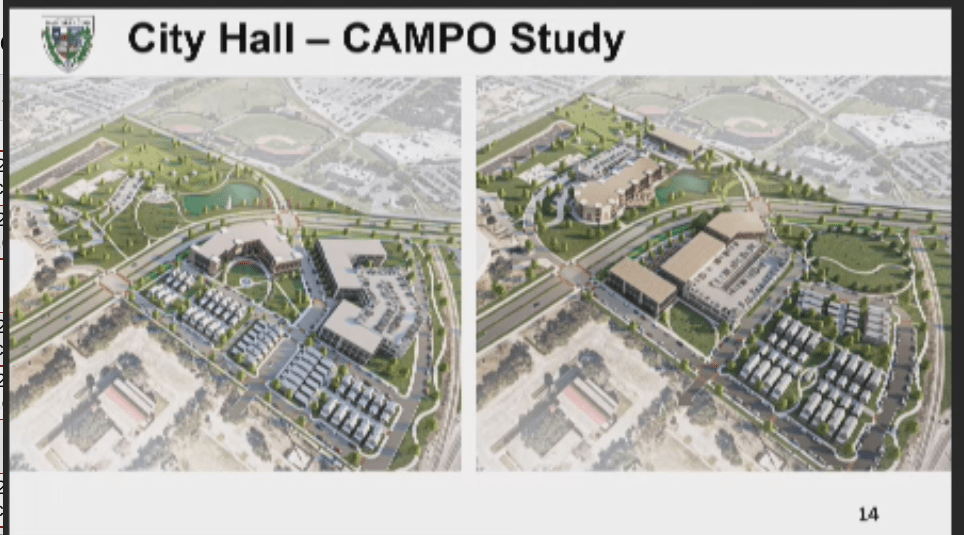
(That’s a screenshot from the workshop. I couldn’t find a packet.)
The plan on the left is a bunch of new buildings on the same site as the current City Hall. The plan on the right has city hall moved across Hopkins, between the library and the dog park.
Funding is tricky, because voters are unlikely to approve a bond project for a new City Hall. So there are some creative ways to fund it, and they’ll probably kludge together a bunch of different solutions. Basically, you tie in a bunch of different purposes and get a lot of organizations to share the cost.
Max Baker and Jude Prather ask staff to consider thinking about a downtown site. The current Hays County Courthouse was built maybe 10-12 years ago. Before that, they used the strip mall that is currently Industry and Aquabrew. And that building, before it was the Hays County Justice Center, had been the old HEB.
Guys. GUYS. I was trying to find a photo online of the old Justice Center, and coming up empty. Then I recalled that I personally took some photos of it, a long time ago.
I used to call it the Supermarket of Justice:
I took that photo back in 2008, back when I was a lower case marxist.
But now I’m a big Marxist. I’ve got a blog, see? (I’m SO pleased that I was actually able to locate those old photos.)
Back to the point. In the days of the Supermarket of Justice, there was a large population of daytime employees in downtown. When the county employees all moved out to Stagecoach, the downtown became empty during the day. It has not quite ever recovered.
So putting City Hall downtown would put a serious number of employees using our restaurants and the fabric of downtown on a daily basis. It would definitely be more expensive, but maybe be worth it.
Saul and Jane are on the side of “Keep it cheap, keep it by the parks.” Max, Jude, and maybe Alyssa and maybe Mark are potentially interested in moving it downtown? I’m intrigued by a downtown city hall. But I do not want us to sell off the current land – surely we can find a quality civic use for it.
(You know what made me sad? When the Government Records department vacated southeast corner of Hopkins and Guadalupe. I’m a softie for public works.)
PS: I also took a few more photos, back in 2008:
There was a church on I-35 that sold clawfoot bathtubs:
right by Riverside Drive. I called it The Clawfoot Bathtub Church, for obvious reasons.
With this menacing Daffy Duck out front.
(I can’t figure out how Daffy is not visible from the first photo, since I would have taken both photos on the same day?! Maybe hidden behind the sign?)
And lastly, our beautiful river, doing what it does best:
being beautiful.
There is one photo that I did not take, and I regret it so much. Back then, the Chamber of Commerce was in the same building as now, on CM Allen, but it had a different sign. The font on the sign was the most ridiculous Mr. Rogers font.
In my memory, it looked something like this:
Maybe with the S, M, and C’s being even more swooping and absurd?
It looked very un-businesslike, and I miss it. If anyone has a photo of it, it would make me so happy.
Last time, we did a deep dive. Here is the executive summary:
Option A: Drop the property tax rate to 59.3¢ from 60.3¢. On average, each household saves $24 for the year. Budget is $700,000 less.
Option B: Keep the property tax rate at 60.3¢. Use the extra $700,000 to pay for six new public safety employees, split up as four fire-fighters and two police officers.
Mayor Hughson, Jude Prather, Shane Scott, and Mark Gleason are all Option B. They all cheer for public safety.
Max Baker, Alyssa Garza, and Saul Gonzalez are all Option A.
Max and Alyssa both represent constituents who are highly skeptical of cops. (hi!) Their basic argument is that more cops does not automatically mean more public safety.
Saul’s reason is different: he is unwilling to put the $24 increase on struggling home owners. He shares that his mother worked at Texas State as a maid when he was growing up, and she’d have to go to financing companies to cover her taxes. His sympathy lies with the most struggling home owners.
The Vote: Should we adopt the budget with the extra $700K? Yes: Mayor Hughson, Jude Prather, Shane Scott, and Mark Gleason No: Max Baker, Alyssa Garza, and Saul Gonzalez
That was so fast! So we’re done? Ha, no. We’re never done. But this time, we’re really not done.
Here’s the problem: the tax rate is a separate vote from the budget. Aaaaaaaannnnd…by Texas state law, the tax rate must pass with a 60% majority. Council needs 5 votes now, to establish the 60.3¢ tax rate. And of course, there were only four “yes” votes above.
Either Max, Alyssa, or Saul has to flip to “yes”, or Council has to go back and undo the budget they just approved.
So now we dig into the deeper arguments, from SMPD Chief Standridge and Fire Chief Stephens.
Chief Standridge’s argument is basically this:
There are a lot of public safety things we can do without more cops, and we’re doing them. (I went over this last time, here.)
You need cops for in-progress, violent 911 calls. There is no public safety alternative. You just need cops for that. We don’t have enough. I need officers specifically to respond to violent-in-progress-911 calls.
Max and Alyssa both concede the first point. They both praise his efforts to be an ally to progressives. He’s worked hard to form this allegiance, and they are right to recognize it.
For this one, narrow context (responding to in-progress-violent-911-calls), I do want SMPD to hire extra cops. I want faster response times to these calls. Standridge says they’re around 8.5 minutes long, and it should be 5 minutes.
Max and Alyssa’s other points are much weaker:
Max argues that it’s hypocritical that cops were so indifferent to safety when it came to wearing masks during covid, but now they need more cops. This is just irrelevant. Yes, cops should have worn masks, and yes, cops died unnecessarily of covid. Either way. right now, we need cops to answer 911 calls.
Alyssa argues that it’s irresponsible to pay for more personnel when we’re doing such a miserable job reaching out to our most vulnerable citizens for feedback and conversations. This is also true, but you can apply it to absolutely any proposal. Government would grind to a halt if we held it to that standard. Public outreach to the most vulnerable citizens is incredibly important, but also incredibly hard.
Chief Standridge says that San Marcos is more dangerous than Georgetown, Kyle, New Braunfels. There’s something called the Violent Crime Index, which is the number of violent crimes per 10K residents. Here’s how we stack up:
Georgetown: 12.4 Kyle: 17.4 New Braunfels: 24.5 San Marcos: 53.5 Statewide: 44.4
Max and Alyssa both question the methodology of that index. But I don’t think their criticisms hold water. I can believe that this statistic is shoddy or inflated, but whatever problems it has, it’s going to affect all those cities, not just San Marcos. It wouldn’t make San Marcos look specifically worse in comparison.
Fundamentally, Max and Alyssa are never going to vote for more cops, because they see it as betraying their constituents. That is fine!
But we still have to pass a budget, and Saul isn’t budging, either.
Next up: Fire Chief Les Stephens.
Fire Chief Les Stephens sounds like he’s about to quit. In a nutshell, “I really resent having to grovel in front of you all. You make me grovel every year. We’ve been underfunded since I took over 13 years ago. I used to think the old chief wasn’t good at his job, but now I realize you put him in that position. I will not be groveling here next year.”
Which brings us to the most absurd moment of the evening, at 1:39:00. Saul Gonzalez attacks Chief Stephens on the flimsiest of pretexts, and then Saul just doubles down and digs in his heels. It just keeps going. It’s so bizarre and inappropriate.
Saul asks Chief Stephens about a $45K charge for landscaping, a few years back. Chief Stephens answers that they do their own landscaping, and that the contract is soil and mowing, and the costs are on par with the rest of the city buildings.
Saul says – and this is a quote – “I just want to know what you value. What’s more important? More fire personnel, or keep your grass looking really nice?” Chief Stephens is like, “Facility maintenance is a council priority. You all literally make me.” Saul cuts him off, saying, “Well, I don’t want to pay $45K for that.”
But Saul is not done! Next, Saul asks if they get fancy firetrucks with bells and whistles, and Stephens is like, “No. Mid-range. Like you all told me to get.”
Jane admonishes Saul for not asking those questions back at the time, and Saul says he did. (If Saul did, it was super out of character for him.)
It’s very weird to see Saul being such a jerk!
Actually, that’s not quite right. Saul seems is acting like someone who is running for re-election, and hasn’t said a word in three years, and is now trying to say a whole lot of words. Way too many words.
Detour over!
So here we are: Either Max, Alyssa, or Saul has to flip to “yes”, or we go back to the old budget.
It’s time to vote. Drum roll …Saul reiterates that he’s looking at the budget hard, but that he’ll change his vote, and support the 60.3¢ rate. “But I’m going to keep an eye on you guys!” he says ominously.
The Vote: Yes: Mayor Hughson, Jude Prather, Mark Gleason, Shane Scott, and Saul Gonzalez No: Alyssa Garza and Max Baker
The budget has passed.
For the rest of the night, LMC relentlessly teased Saul about that line – “I’m going to keep an eye on you guys!” – every chance she got. And I enjoyed it every time.
One final note, for the wonkiest of municipal nerds
Before the first vote, Max Baker asked why he hasn’t heard about his question on the appraisal lawsuits over MLS data. Max has brought this up many times. Based on this, I assumed that the appraisal district was being sued for artificially inflating home prices. I assumed that the appraisers aren’t allowed to use MLS data to appraise houses, because it would be unfair to home owners, and now they were being sued for it.
Jane Hughson replies that she did get a response from the appraisal people, and she reads it on the spot. It says, more or less, “It was legal for us to use the methods that we used.”
Max gets frustrated that she hadn’t asked them the specific question he wanted to know: “Are they being sued for using MLS data?”
Jane Hughson just goes ¯\_(ツ)_/¯.
The thing is, the letter does answer Max’s question. The answer is, “Maybe we’re being sued, maybe not, but we’re on firm legal ground.”
So finally I went and looked up the lawsuit. It’s not about appraisals being too high. It’s about MLS being private data. The MLS people are suing because they don’t want the appraisal district to use their data.
There’s just no smoking gun here, and not one that benefits the community in any way that I can discern.
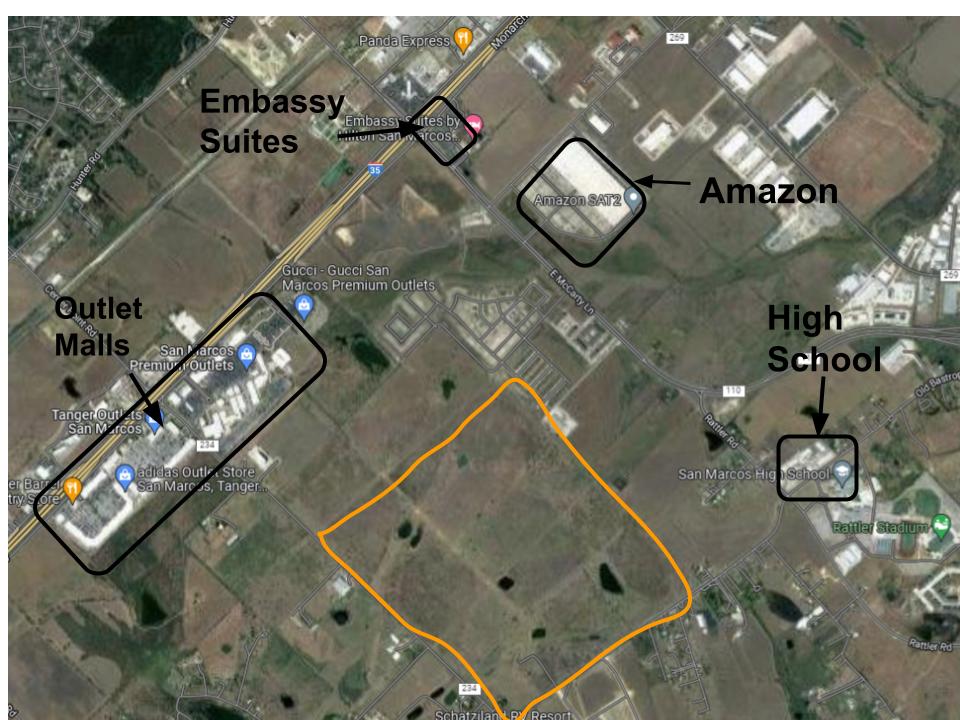
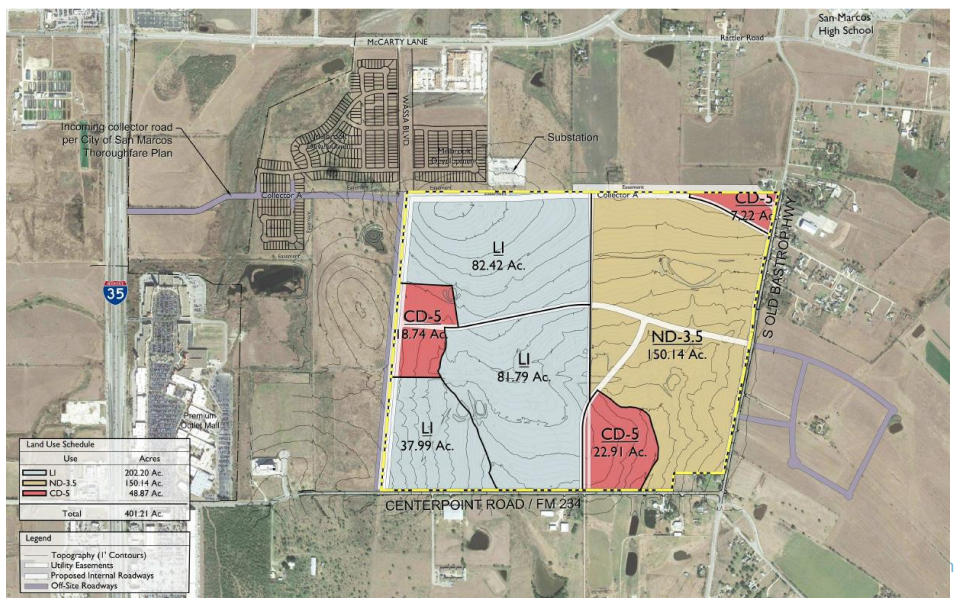
Item 22 Next up: a little light industrial area by the airport:
169 acres, to be exact. They want to zone it to be Light Industrial.
Reminds me of the new park land we bought a few weeks ago:
Eh, I guess it’s not that close. There’s a lot of space out there.
(Also, did you notice that google maps has renamed I-35 “Monarch Highway”? That’s so cute! much better than “Smushed Monarch Highway”.)
Shane Scott asks about flight paths, and the developer concedes that the property is right in the line of Runway 3. But also says that the FAA and the airport both gave this development a thumbs up. I have no idea about such things.
The vote: Yes: Mayor Hughson, Saul Gonzalez, Jude Prather, Alyssa Garza, Mark Gleason No: Shane Scott, Max Baker
So it will come to pass.
…..
Item 23: Alternative Compliance for Cut-and-Fill
Cut-and-fill means that you are trying to build on a rocky, uneven slope. But your building needs a flat foundation. So you decide, “What is the average elevation of this portion?”
Once you know your average elevation, you have some bumpy parts that stick up, and some sunken parts that are too low. So you shave down your bumpy parts and fill in your sunken parts. Ta-da, cut and fill!
The problem is that if you’re on a hillside, you may have to cut out a lot of dirt and move a lot of dirt, and this is going to affect how water runs down the hill. What’s worse is if you’re on a hill in a flood zone. You may have heard, but San Marcos has a flooding problem.
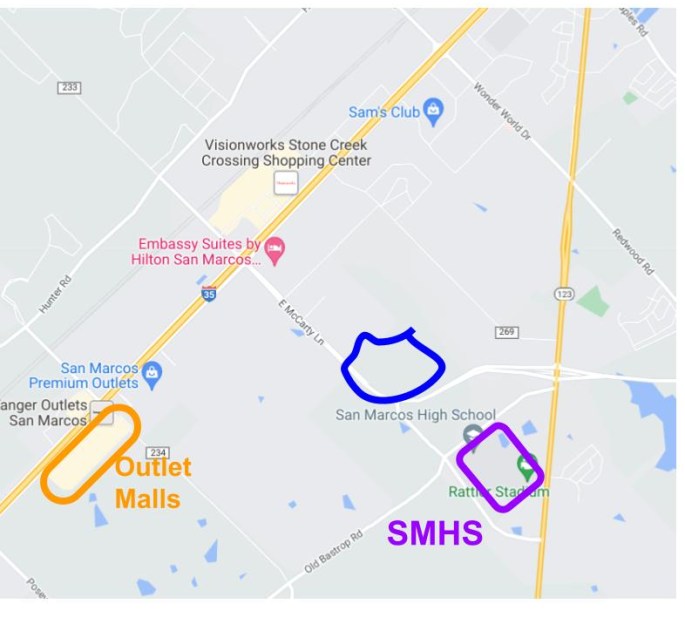
So these folks are trying to develop here, in that blue region:
on the corner of Rattler Road and East McCarty.
They’re allowed to cut-and-fill up to 8 feet, but they want to cut and fill up to 13 feet. And it’s in a flood zone.
But the real reason that I’m interested in this case is because I’m invested in this case, where the water will run downhill to Redwood – also a cut-and-fill ordinance that is coming up soon. I was intently watching this case, to read the tea leaves on the next one.
Max Baker suggests that the developer could offer up some environmentally friendly perks to take the sting out of this flood risk? The developer responds that he’s under the gun to get this approved tonight, and he’d love to try.
So the motion gets tabled for a few hours. The developer goes off with the engineer. They come back with a compromise:
They’ll put a 20,000 gallon rain barrel on each 150,000 square foot building, and use it towards irrigation.
They’ll reduce impervious cover from 80% to 60%
They’ll do some water quality treatment thing that I didn’t follow.
It gets approved unanimously now.
These are good, environmentally, but as a harbinger for the Redwood case, I didn’t like it. For the Redwood case, I want them to deny it altogether.
….
Item 15: Art purchases
The Arts commission is purchasing four sculptures for our San Marcos sculpture garden. I didn’t realize we had a sculpture garden!
Then I looked it up, and realized I did realize it after all!
It’s in between the library and the Activity Center, on Hopkins. (Photo yoinked from the city page.)
Item 16: Back to Boyhood Alley! Shall we name the alley after the film, Boyhood?
Jane Hughson still thinks Boyhood Alley sounds dirty, which still cracks me up. She offers up an amendment. “How about Boyhood Film Alley”? she offers.
Saul Gonzalez likes it.
Max points out that “Boyhood Film Alley” sounds even dirtier than whatever someone is misconstruing Boyhood Alley to be.
Jane concedes this point, and backpedals from “Boyhood Film Alley” to “Boyhood, the Movie Alley”, which is hilariously clunky. We’re almost in High School Musical: The Musical: The Series territory for winky-awkward names. How about “Boyhood, the Movie, Not the Porno, the Alley”? I’m here for it!
The vote on “Boyhood, the Movie, the Alley”: Yes: Jane Hughson and Saul Gonzalez No: All the councilmembers under 60 years old
So it fails.
Should we call it Boyhood Alley?
The vote on just plain “Boyhood Alley” Yes: Everyone except Jane. No: Jane
I will say this for Jane: she takes defeat in good humor. She merrily says, “It’s not the first time I’ve lost a vote in public!” and shrugs it off.
…..
Item 27: Library fines will go away! This was fast and unanimous.
Item 36: Eco-friendly burials are now going to be allowed at San Marcos cemeteries.
People are just dying to have them!
(Thanks, I’ll be here all week. Try the veal.)
…
Items 28-29: We’re going to trade some land with Texas State, right at Sessom and Loquat. Trying to get a map of what’s going on is a disaster, because they didn’t include it in the packet, but here’s where we’re talking about:
So if you’re driving west on Sessom, then Loquat Street is on your right while campus is on your left.
I am not sure I’ve ever been on Loquat before, but I’d better check it out soon, because they’re closing it, as part of this deal. Jane Hughson was kind of bummed out about closing it, since it makes a useful shortcut.
Google streetview tells me it looks like this:
which is probably why I’ve never ended up on it.
So, we’re giving Loquat street to Texas State, and they’re closing it down. In exchange, they’re giving us some land along Canyon Road, which we’re using to stabilize Sessom Creek without polluting it.
Would you like to see a good map of what’s going on? So would I. Unfortunately, the presentation was not included in the packet, so I only have a screenshot of it:
City council videos are the WORST quality. I mean, seriously. Sessom is running along the bottom of the diagram here.
The thick red line is Loquat Street, which we’re giving to Texas State.
Green is the land along Canyon, which Texas State is giving to the city.
Blue is staying as the city property
Yellow is fragile environmentally
So, what is Texas State planning on doing in that big red area? NOBODY ASKED.
Here’s the problem: Texas State University does not have to follow city flood mitigation rules. In our land development code, we have a million rules about floods: limits on impervious cover, catching run-off water, water quality treatment zones, flood zones, recharge zones, and on and on. Texas State follows exactly ZERO of it. By state law, Texas State University does not have to give one whit about city ordinances.
This is insanely sensitive land, and it drains directly into Sessom Creek. It’s uphill from most of the entire city. It should not be paved and it should not be developed. In fact, this is more-or-less where there was a huge fight circa 2013, when a developer wanted to build apartment complexes around there. It’s a TERRIBLE SPOT to build.
Some more googling tells me that the blue part below is owned by the city, called the Sessom Creek Natural Area:
I assume that blue part is staying put. But what about the other side of Loquat?
I am extremely worried that Texas State is going to put dorms or something high intensity on it. There is nothing in the council packet, and no one asked. We just gave them the final piece they needed.
Maybe I’m wrong! But maybe this is a big fucking disaster and we just waltzed into it.
Items 21, 24, and 25: If you want to understand the budget, it’s probably worth going back and listening to the August 18th budget workshop. But I’ll do my best.
First off: it all comes down to property taxes. Property taxes are steep. But let’s zoom out for a second:
Most of San Marcos rents. Indirectly, property taxes get passed on to renters, but that’s not the main reason rent goes up. Rents have gone up because landlords realized they could get away with it. When we talk about property taxes, we’re mostly ignoring renters.
Texas taxes are regressive. Poor people pay 10.9% of their income in taxes, whereas the wealthiest people pay 3.1% of their income in taxes. Details here.
Texas could do a lot to alleviate poverty. For example:
The United States can easily afford for every person to have a safe home, free healthcare, and access to healthy food and education. This country is extremely wealthy. Collectively, we can afford to lift everyone out of basic poverty. But we don’t choose to do so.
So: do property taxes force people from their homes? In one sense, yes. A $5000 tax bill is huge, and it can be the final straw, for a financially precarious person or family.
So should we be mad about property taxes? No. Poverty forces people from their homes. Be mad at the state and national elected officials who are complacent about poverty. Do not misplace your anger about poverty onto property taxes.
We should work hard to keep property taxes from being the final straw that forces anyone out of their home. But the actual problem is not the local property taxes themselves.
Let’s break down property taxes:
Last year, the city had a property tax rate of 60.3¢ per $100. Let’s say you have a house, you lucky home-owner. Now, city taxes aren’t the only property taxes you pay. Total, you would have paid $2.0492 per $100 of value. (Source.) Then that gets divvied up between the city, SMCISD, the county, and the special roads district.
Say your house was worth $250,000. Then you paid $5123 in taxes. It breaks down like so:
$ 2868.88 to SMCISD (56%)
$ 1485.67 to the city of San Marcos (29%)
$ 717.22 to Hays County (14%)
$ 51.23 to Special Roads District (1%)
So far, so good.
The problem is that home prices went through the roof last year, right?
Suppose your $250K house is now appraised at $400K. You should not freak out! First of all, the state of Texas caps the increase for property taxes at 10%. So you aren’t going to be taxed on $400K. The most you could get taxed on is $250,000 x 1.1 = $275,000.
Second, the city has a homestead exemption. If you live in your house (as opposed to renting it out), then you can file the paperwork and get a deduction for $15,000. So instead of getting taxed on $275,000, you’re now getting taxed on $260,000. Fine. (If you’re a senior citizen or have a disability, you can get another $35,000 taken off.)
The city has boiled it down to two scenarios:
They could charge you the same rate, 60.3¢ per $100, and this time you’d pay them $1567.80, based on your house being worth $260,000.
They could charge you one penny less, 59.3¢ per $100, and you’d pay $1541.80.
The city has drawn up a budget based on 59.3¢ per $100. The big issues are:
What’s in the 59.3¢ budget?
What would be done with the extra penny, if we went for the 60.3¢ rate?
What’s in the 59.3¢ budget?
Obviously, everything is in it. It’s a budget. That said, they emphasized a few things in the presentation:
Personnel challenges: We’re terribly understaffed, across the board, and it leads to burn out and people taking jobs elsewhere, which perpetuates the problem. So, personnel challenges. The budget includes a 5% raise for all non-civil service employees. (Ie, the less highly paid public employees.) Everyone gets a one-time retention incentive. Funding for an additional 47 positions (2 funded from elsewhere).
Additional funding for CASA, GSMP/Splash co-working, art center
Squirrel some money away for future City Hall. (There’s a state law that you can’t borrow money to fund you city hall, and the voters will never approve a bond for a new city hall building. So you have to squirrel money away for it.) (Which is actually financially not great, but there you have it.)
All the regular business as usual, of course: CIP projects, parks, planning department, utilities, police, fire department, municipal courts, etc.
What would be done with the extra penny?
If rates are 60.3¢ per $100, then the city will bring in an extra $700,000 with this. According to the city presentation, the average house is worth $245,197, after all the deductions and everything.
– At 59.3¢ , city taxes would be $1,454.02 – At 60.3¢, city taxes would be $1,478.54
So, a difference of $24 per household, on average.
The $700K would be used for six new positions, which could be either fire fighters or police officers.
Mayor Hughson suggests going for the 60.3¢ rate and letting staff decide how the six positions should be split between SMPD and fire fighters.
Alyssa Garza says she’ll vote against the 60.3¢ rate until she’s consulted with more community members.
Shane Scott says he wants the 60.3¢ rate, and he specifically wants 3 firefighters and 3 cops.
Saul Gonzalez is in favor of the 60.3¢ rate.
Jude Prather is in favor of the 60.3¢ rate.
Max Baker is opposed. Largely, he argues that having more cops does not make us safer. Instead, it increases petty citations. He criticizes the outreach efforts of “playing basketball” and instead wants to see more town halls and more data driven discussions.
Max is way off on that last point. “Playing basketball” is shorthand for taking time to build trust and relationships with teenagers in neighborhoods. This is how you begin to counteract the cop mindset that young men are all potential criminals. Cops and young adults need to have healthy, non-punitive interactions and build relationships.
Max Baker says two other things: we should be reviewing officer duties and seeing what can be removed. (I like this!) And he praises the presentations that Chief Standridge has given at the Criminal Justice Reform committee meetings.
Mark Gleason’s take is interesting. He feels tortured over the decision, but comes out against the 60.3¢ rate, at this point. His neighbors are getting forced out of their homes due to property taxes. (Later, he’ll change his mind. But his angst is real.)
Mayor Hughson says she’s also worried, but this is a $24 difference. That’s $2 a month.
Chief Stephens and Chief Standridge both get a chance to plea their cases.
Fire Chief Les Stephens talks:
In 2009, 46% of the city was outside of the effective coverage area of all the fire stations
He’s relocated firestations and done his best, but with the growth, etc, it’s still just slightly lower than 46%
Worst part: far northern part.
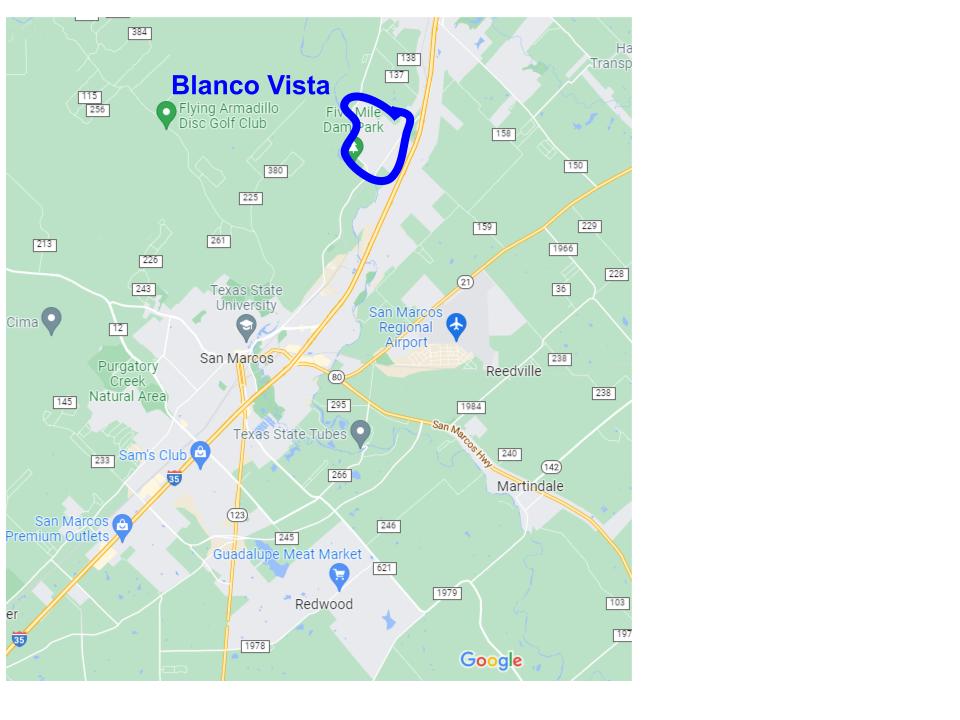
Firestation 5 is the northern most station. Blanco Vista plus Whisper Tract.
Currently, it takes 15 minutes and 10 seconds to get from Firestation #5 to the deepest part of Blanco Vista. That’s the best case scenario.
If Firestation #5 out on any other call, Station #1 downtown is the next best. It will take them 21-22 minutes, in a best case scenario.
I know you know where Blanco Vista is, but look: it’s not close.
Sprawl is a really big problem! It takes 15 minutes to get to someone having a heart attack in the upper corner of that blue region!
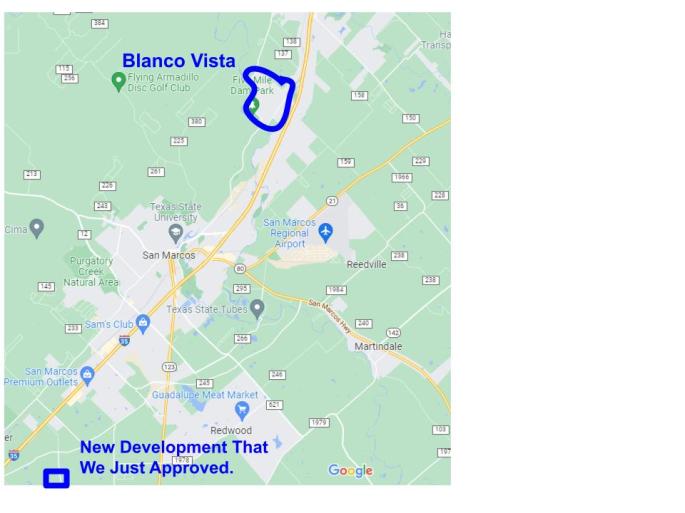
And in this VERY SAME MEETING, we approve the little development by the Hays Power Plant, discussed here:
Equally far away, but in the opposite direction. WHY?!? The Chief just said he needs 27 firefighters to cover the existing city, and we’re funding three of them. The problem is the sprawl!
A few other points from Chief Stephens:
Insurance rates are tied to ratings. If our PPC safety rating goes down, everyone’s insurance goes up. So saving $24/year in taxes could cost you more in insurance, later on.
We want to buy a run down beater firetruck to use as a blocker, on I-35 or any time traffic is blocked, so that they can use their expensive trucks for calls. Takes 1 person to staff instead of 3. Seems like a good idea!
Next, Chief Standridge talks about SMPD:
Philosophically, can a police chief be progressive? Or are they doomed because they’re trapped in a toxic culture? I don’t know. But if it’s possible, Chief Standridge is making an appealing case.
He validates everything that Max says. He agrees that more cops don’t equal less crime, and he builds a case that we are already implementing the crime-reduction things that don’t require extra officers:
Since he got here:
Implementing intelligence-led policing (I love names like this that insult the alternative. What exactly had we been doing before?)
Build an intranet database of everything a cop might need to know
Twice-monthly collaborative crime meets to work on highest repeat offenders and highest repeat call locations (This is really important.)
Stopped sending officers to minor crashes that do not result in injury
Stopped sending officers to child custody calls. The idea is to keep custody disputes in family court, and out of criminal court.
So, to Max’s point about looking to see what duties can be removed, Chief Standridge is saying we are doing that.
Doing some kind of big legwork thing to keep high-repeat violent offenders locked up
Redid the downtown unit. During the afternoon and evening, they serve as a Crime Reduction Unit – preventative violent crime measures. Then they head downtown as the town square heats up.
Re-imagining mental health. Next week someone from some state org will come in to help re-invent how we respond to mental health and our behavioral advisory team
Homeless outreach team. We have 5 members focused on homeless help. Not issuing citations.
Used to have 1 internal affairs manager. Now we have 4 internal affairs investigators, all with state training. (I do NOT approve! Misconduct should be reviewed by external, independent investigators. But still, 4 is better than 1.)
Extra officers needed for in-progress violent 911 calls. Right now, it takes 8.5 minutes to get there, on average. Takes 3 minutes just to find an available officer. We need 10 officers.
Civilian liaisons: this is a new program where SMPD will hire regular civillians to take incident reports and direct traffic, and free up cops to do cop-things. (I am worried about George Zimmerman types being attracted to this job.)
Chief Standridge’s bottom line is that he’d like four more officers to respond in-progress violent 911 calls, and three to work on community outreach. If the $700K goes through, he’d probably get three new hires towards 911 calls.
Council discussion:
Shane Scott asks the cutting questions: SHOULD POLICE OFFICERS BE REQUIRED TO HAVE COLLEGE DEGREES???
Standridge cries, “no! We can incentivize it, but please don’t reduce our applicant pool!”
Saul asks if annexation cause problems?
Standridge answers: “We’re doing a cost study to answer that.” (But seriously. How could it not?!)
Mark Gleason says he’s now in favor of the 60.3¢ rate, after all.
Saul Gonzales says he’s in favor of the 6 new positions, at the 59.3 tax rate.
Jane Hughson tells him he can’t do that. The six new positions come from the 60.3¢ rate. It’s a package deal.
Saul says he’s doing it anyway! He’s in favor of cops, firefighters, and lower taxes, and opposed to staking out unpopular positions. Gotta love Saul-on-the-campaign-trail.
The vote on the budget: Yes: Jane Hughson, Mark Gleason, Jude Prather, Shane Scott No: Alyssa Garza, Saul Gonzalez, Max Baker
Alyssa reiterates that her intent is to find out more from the community, and then base her decision on that. So here’s my two cents:
At the moment, I have a fairly high degree of trust in Stephanie Reyes, Chief Standridge, and Chief Stephens. So I’m mildly in favor of the 60.3¢ rate, although I won’t be heartbroken if we decide against it.
…….
Item 22: Stormwater Rates
We have $25 million of flood projects to be done. We have about $6 million so far. They are proposing raising stormwater rates to help pay for a little more of it. If you have a small house (less than 2000 sq feet), your rates would go up $10/year.
Increase stormwater rates?
Yes: Alyssa Garza, Shane Scott, Max Baker, Jane Hughson, Mark Gleason No: Saul Gonzalez Absent: Jude Prather
It feels like Saul is being weaselly for re-election. What is this.
Item 23: Trash and recycling
Here they will probably not raise rates. There’s some 3% surcharge that we’re contractually obligated for, but the recommended rate hike above that will get voted down.
If you turn that orange square so that it lays flat, it breaks down like this:
The light blue section is “Light Industrial”. Council is voting on a giant package of tax breaks for a developer to build a bunch of light-but-industrial buildings there.
There’s so much that happens in top-secret Executive Session. As far as we plebes know, this land was just zoned during this very meeting, and now there’s a near-instantaneous agreement with someone calling themselves Majestic Reality Co. The project was code-named “Project Thin Mint,” in case you like code names, and thin mints.
Basically, they’ll get a bunch of tax breaks for a while, and then we’ll start to collect taxes on the buildings and businesses that eventually move in. That’s the plan.
Is this good for San Marcos? I have no idea! It depends what gets built and what businesses move in. Ultimately, we lose a ton of control when we approve things like this, and we have very little information about how it will go. (And this is standard, for Texas at least. Texas is set up to let private developers shape cities, instead of elected officials, all the time, because we value their profit so much.)
Max Baker does grill the developer a bit, and comments on how secretive the Chapter 380 process is.
The vote: Yes: Mayor Hughson, Shane Scott, Alyssa Garza, Mark Gleason, Saul Gonzalez No: Max Baker Absent: Jude Prather
….
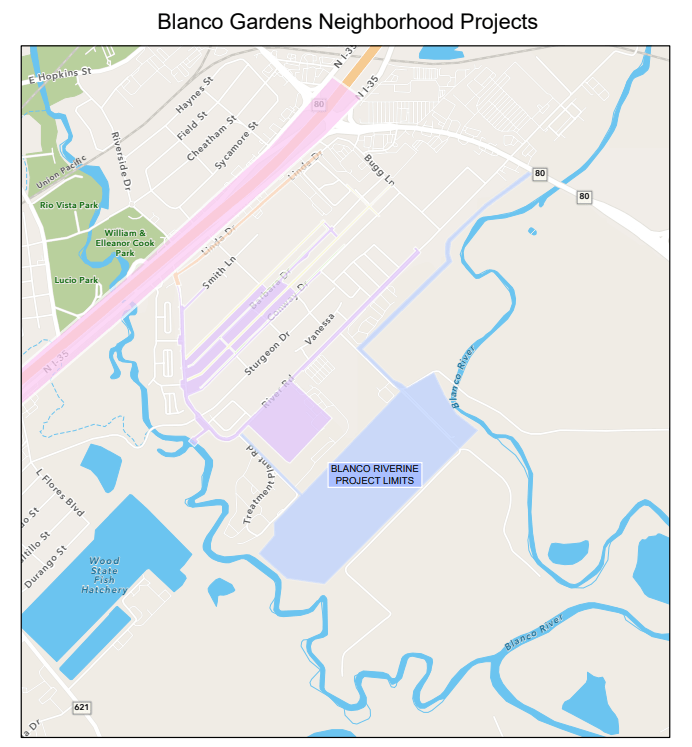
Item 28: Blanco Riverine Flood Mitigation Project
Today they’re awarding some contract to some builder, and it is given all of 15 seconds during the meeting. However, I wanted to give some background to this, because it’s interesting.
In 2015, we had the deadly Memorial Day floods, of course. (More detail here, if you’re new to town.) The Blanco Riverine Flood Mitigation project is supposed to create some extra channels for flood waters to go, instead of running into Blanco Gardens.
Here’s where it will be:
I don’t really know what’s involved, but this picture comes up a lot:
So I picture a massive drainage ditch through that periwinkle-colored rectangle, designed to catch the flood water, and then also, a long earthen hill that makes a wall between the ditch and the neighborhood. So that’s coming.
Presumably when it’s not flooding, this should have trails and green space on it.
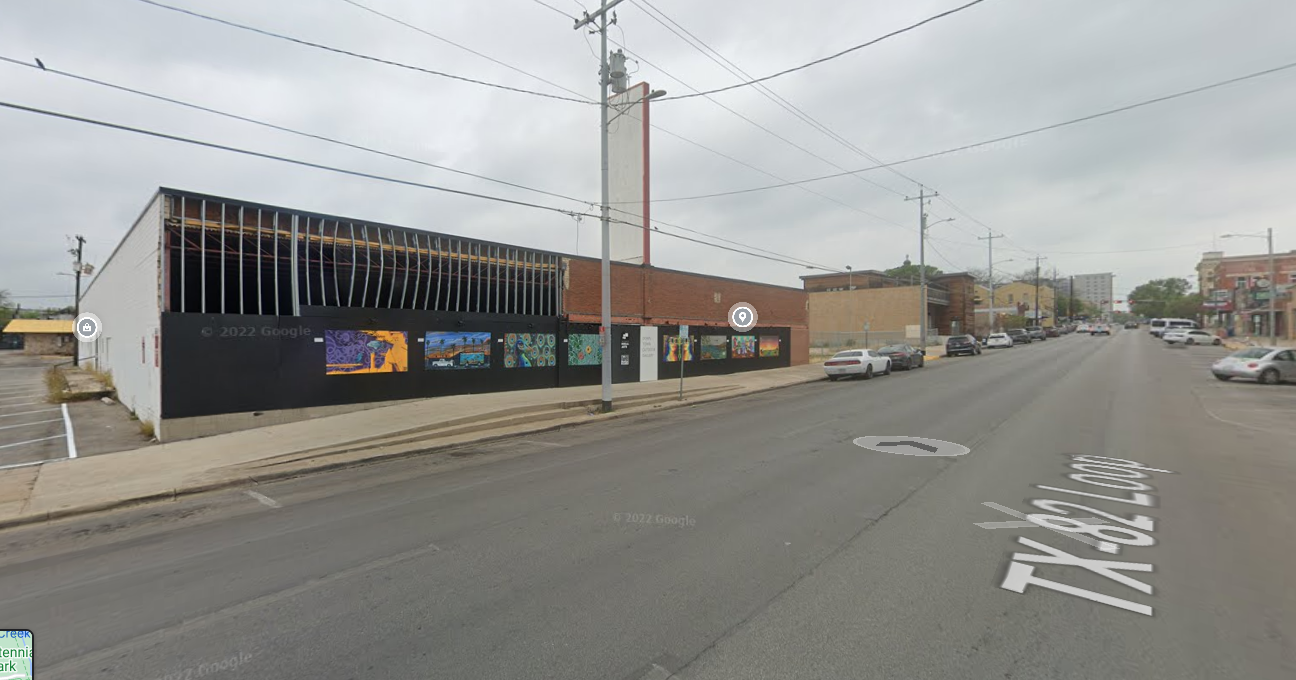
It’s not big enough and there are problems with that street. So we’re moving it.
The new one will someday be here, in this building:
That is the old Diaz Martial Arts center, right across from Toma Taco. Industry is to the left of that photo, and in the background is the old Golden Chick. You’re on LBJ, heading west towards the town square.
The SMPD has a union, SMPOA, which negotiates contracts for cops with the city.
No one else gets to do this, because unions have been undermined in Texas. First, it’s a right-to-work state, which means you can’t be forced to join a union, even though you may benefit from the outcomes. (This is bad, in my book.) Second, unions aren’t allowed collective bargaining powers. If you’re not allowed to bargain for contracts and legal matters, then you’re basically an advocacy group. Underfunded advocacy groups don’t generally have much power.
The exceptions is police and fire fighters (and Houston municipal employees?) Meet and Confer is how the city of San Marcos negotiates contracts with the police and fire fighter unions.
The Ryan Hartman issue: Ryan Hartman was a police officer with SMPD. In 2020, he was in off-duty in Lockhart. He was speeding, ran a stop sign, probably under the influence, and crashed into Pamela Watts and Jennifer Miller, and Miller was killed in the crash. He had an open container in his car, but refused a breathalyzer for a few hours.
He wasn’t indicted in Lockhart, and Chief Standridge was brand new, and dithered on the issue until the 180 day time frame expired, and Hartman was put back on the force. Somewhere in here, Mano Amiga takes up the cause on behalf of Miller’s partner, Pam Watts. Mano Amiga begins a full press assault on Hartman. Back on the force, Ryan Hartman tazes someone under sketchy circumstances, and is suspended again this past January. Finally he’s terminated, this past June.
Mano Amiga has a list of five “Hartman Reforms” that they want implemented (and that are incredibly hard to find online.) Based on this article, I’m pretty sure they are:
End the 180-Day Rule
repeal of the statute of limitations on investigating wrongdoing by officers
“End Delay of Interviews for Misconduct,” due to officers being allowed 48 hours to prepare answers and review materials before giving an official statement.
Public Transparency for Personnel Files
End Third-Party Arbitration.
(I’m not really sure how 1 and 2 are different from each other.) In the Meet and Confer agreement, they are proposing to extend the 180 day rule to a 360 day rule. The other reforms are all ignored.
Max Baker asks about the rest of the Hartman Reforms.
City staff says that the Hartman Reforms were announced on June 15th, but the negotiation meetings had already run from April-May 27th. Max Baker says that the Hartman Reforms overlap with reforms he’s brought up in the past, but he hadn’t gotten the support of council on those.
In Citizen Comment, Mano Amiga made it clear that they do not think this contract holds officers accountable. They’re going to collect signatures to get a repeal of this agreement on a future ballot. Stay tuned!
What do I think? Here are some reforms that I think are important:
Reviews of police misconduct need to be done by independent, external investigators
End qualified immunity for police officers (Currently, officers can’t be sued for violating someone’s civil liberties. San Marcos can’t just unilaterally change this, but it’s important)
Ongoing de-escalation training (this may already be happening, I don’t know) and cops need to be immersed in neighborhoods and build positive relationships with young adults.
Prioritizing mental health of police officers, keeping ongoing relationships with therapists or counselors
Redirect mental illness emergencies to first responders with social work or mental health backgrounds
On one slide in the presentation of the Meet and Confer contract, it says, “Applicants with degree in social work, sociology, psychology, human services, or human relations will receive additional points.” This is good! You want officers with backgrounds in areas that humanize people.
By all appearances, Chief Standridge is implementing progressive principles into SMPD. This seems like an opportunity to collaborate and make progress.
….
Item 32: Chris Cardoza is voted onto the Arts Commission.
Item 33: Should renters get notified when there’s a proposed zoning change? This is sent to a committee.