Bonus! 3 pm workshops, 9/17/24

This week’s workshop was all about the river and parks. It was both so interesting and so depressing. 

The big question is: How’d the can ban go?! 

The big answer is: We broke our river. We were so overwhelmed with record-breaking crowds that we couldn’t even get to the can ban.  The river got really damaged.

Out-of-town crowds were too big.  Bad behavior was high.  There was more trash and destruction than ever before.  We might have to fence in the river parks and start charging admission. It’s all very depressing!

Let’s dive in.

  1. Preparations. We planned on doing the can ban!  (There was a can ban plan.)

Here’s what we did ahead of time to prepare:
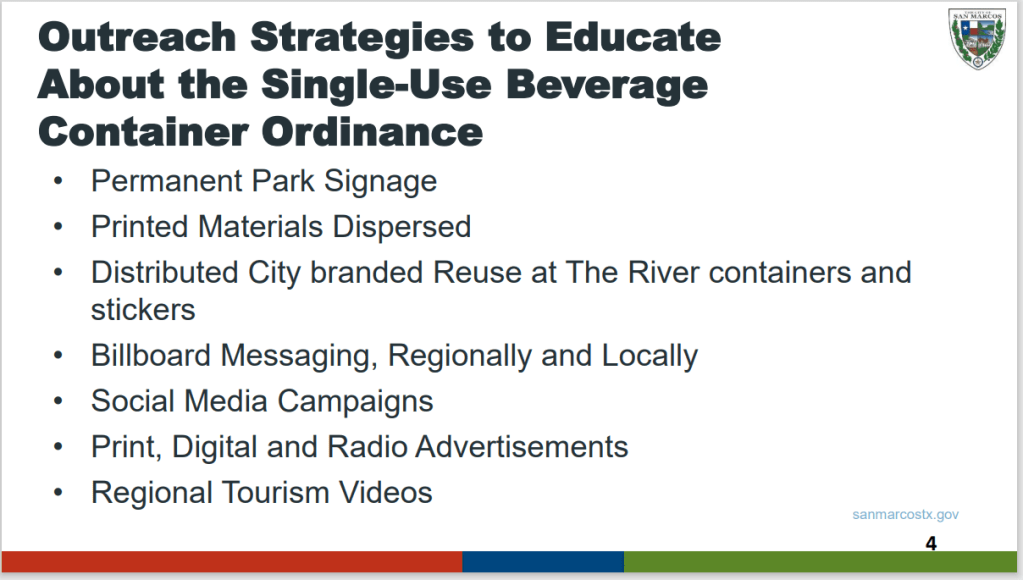
We tried to promote the ban every way we knew how, ahead of time.

We put these signs up in the park:

There were also sidewalk stickers, pointing towards the Go Zones and the No Zones.

You could quibble that the signs and stickers weren’t great at demarcating the Go Zones and No Zones, but this was supposed to be the trial year, where we try things and see what works. ♫ Life’s a dance you learn as you go ♪, and all that.

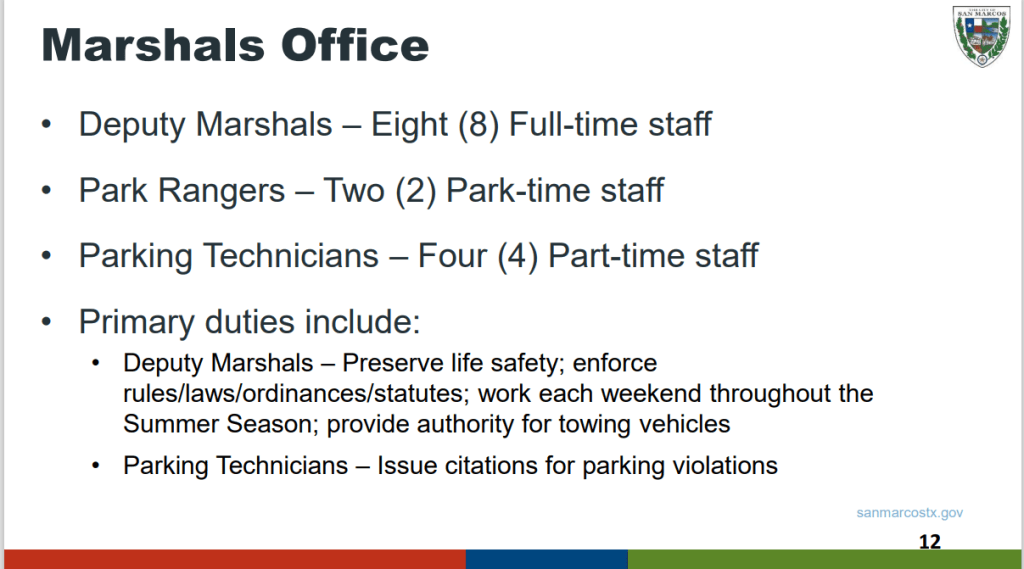
Generally there are both marshals and park ambassadors at the park:
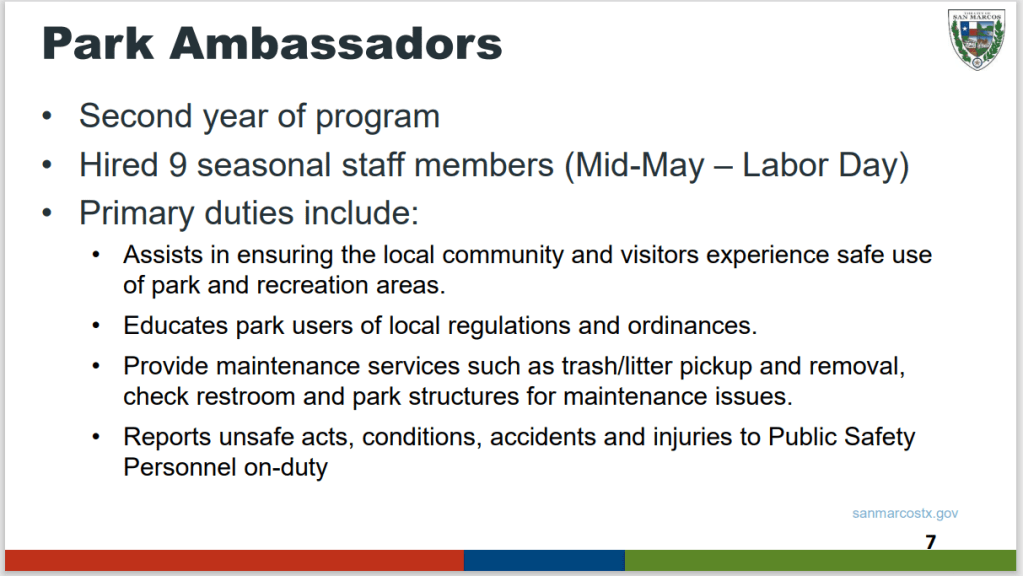
And marshals:
(The can ban plan began.)

  1. But things went really badly:

The big problem is drunk people – they fight, they trip and fall and hurt themselves, they get heatstroke or other medical issues from the heat. Just lots of safety issues that preoccupy city marshal attention. No one has any bandwidth to get to the can ban.

Overparking is a problem, too. And there’s lots of litter that gets left wherever people go to find parking.

Memorial day was a particular disaster:

So in response to Memorial Day, they changed things up for 4th of July weekend and Labor Day weekend.

Mainly, they shut down Cheatham street. This helped with the drop-off and pick-up mess, and the aggressive U-turns that cars make.  They had to staff both ends of the street, so that used up more staffing.

The other big thing was contracting with off-duty police officers. We pulled $100K out of Covid money and spent it on extra staffing.

Finally, they blacked out the dates for the baseball fields, so we weren’t hosting a baseball tournament at the same time. This freed up some parking for the rivers.

So how bad did things go?

Deputy Marshals have a dashboard:

This is the total for the whole summer. Highlights:

  • 329 park evictions.
  • 48 citations. You can see that the most common one is alcohol, by far, and next is parking violations.
  • Only 2 arrests! But that’s because a marshal has to then leave with the person, which leaves the park even more understaffed. So ususally they just kick the person out of the parks.
  • 69 medical incidents. Most of those are drunk people who succumb to the heat.

It sounded pretty grim. They were so understaffed.  All the marshals and park ambassadors worked every single weekend, no exceptions, all summer long, no vacations. 

Staff also said that most of the behavior problems are out-of-towners. Local residents are less likely to cause problems.

This is the main reason the can ban kinda died – we were in survival mode for making sure that everyone stayed alive and safe.

3. So why???

Why is all of this happening?  What changed in the past few years?

The problem is all the other river parks. The other cities have fenced in their parks and started charging admission. We’re the only free river park left, in the San Antonio-Austin general region.

I hate all of this so much.  It pits two things I care deeply about against each other:

  1. Recreation should be available to all people.
  2. You must take care of your river. 

So who exactly uses the river parks so much? We hire these guys to track cell phone data.  Here’s what they tell us:

First:

Area A is downstream – the falls, near the baseball fields, near the children’s park. 
Area B is upstream – near the Lion’s Club and the general Sights and Sounds part of the park.
(I don’t know what Overall Destination means.)

Next, the colors:

Teal means they are San Marcos residents. 
Blue means they come from this radius:

Orange means they’re from outside of that circle.

So roughly 60% out-of-towners. I’m kinda surprised by how many people drive in from Houston:

So how many people actually are showing up on these busy weekends? It wasn’t in the presentation, so I emailed city staff to see if we knew.

They kindly answered: Nope, unfortunately, we don’t. You can’t get that data from this company, because they’re just sampling cell phone data. To know the total number of people, you’d have to have staff literally out there counting by hand.

Crowds looked a little different on the 4th of July weekend, but you get the picture:
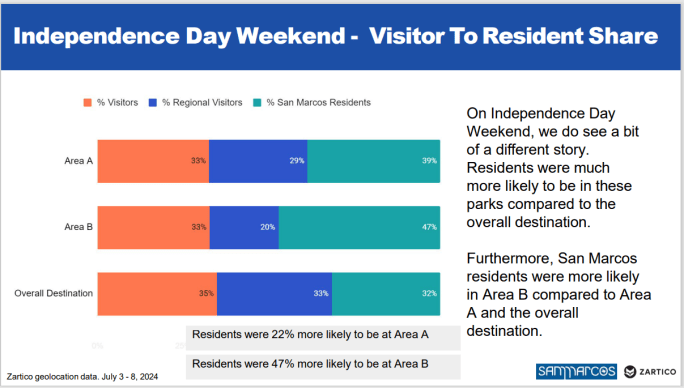
Anecdotally, the speakers said the vast majority of the drug/alcohol/behavior problems were out-of-towners. Also depressing!

4. Onto the poor river.  

First up, litter:
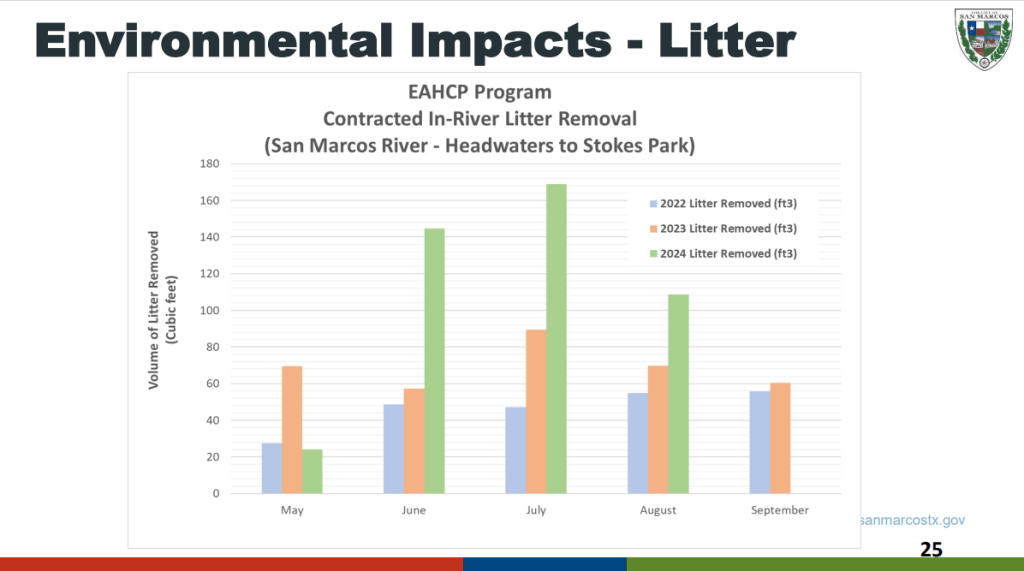
It looks like it went through the roof. But staff said that this graph is misleading, because we doubled our clean up efforts to twice weekly instead of once a week.  Some of that is old trash from years past. 

It’s still depressing!

Also, that’s mostly volunteers out there, doing major clean ups 2x a week. (Like The Eyes of the San Marcos River and Keep San Marcos Beautiful.) So they deserve some big kudos.

We’ve also got those litter boats for tubers:

So maybe some of the tubers were bringing re-usable containers after all? And the can ban helped? Who knows.

Look at this stuff. Ugh ugh ugh.  
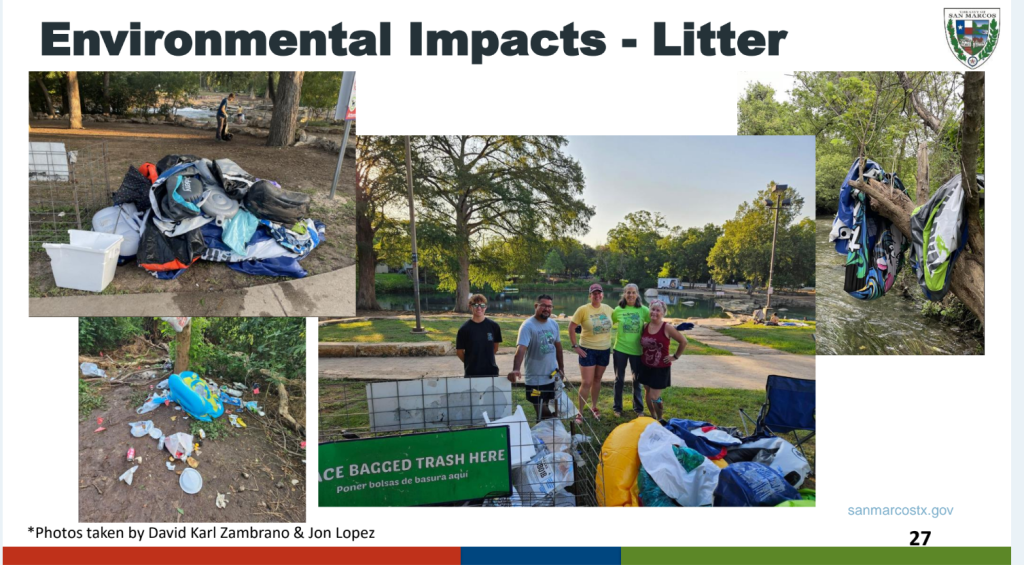
They said that usually on Saturdays and Sundays, they pulled about 50 old dead tubes out of the water each day.   

Apparently Lion’s Club rentals were way down, too. Two years ago, they rented 48,000 tubes. This year they rented 36,000 tubes.  Same with shuttle service. People are buying tubes from stores and walking back up to the top of the river, instead.

A really big problem is that people find new ways to get into the river, and then they destroy the river at these access points.  

The bank erosion looks like this:

And the wild rice, ecosystem, etc everything gets destroyed. 

I told you it was depressing.
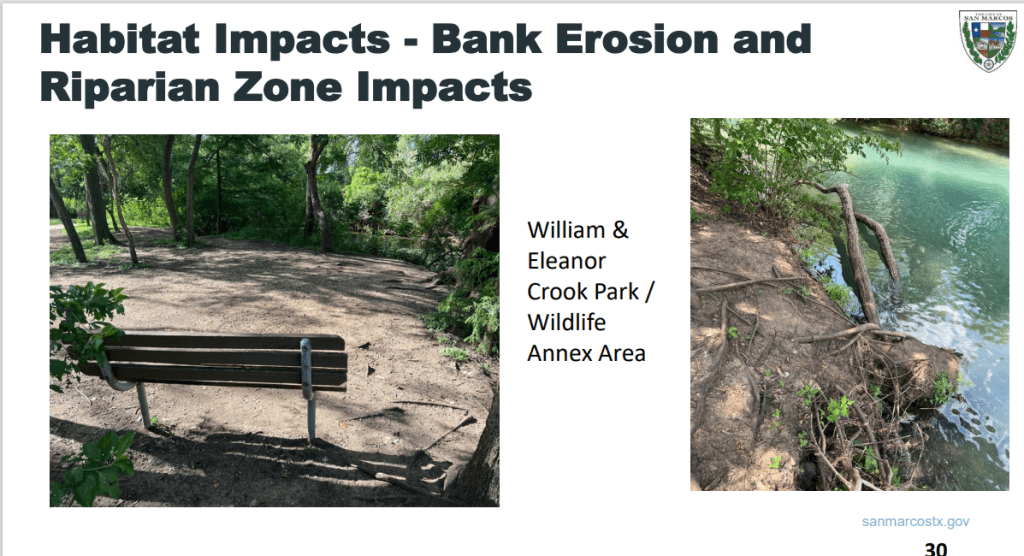
They put lots of photos in, so I’ll pass them along:
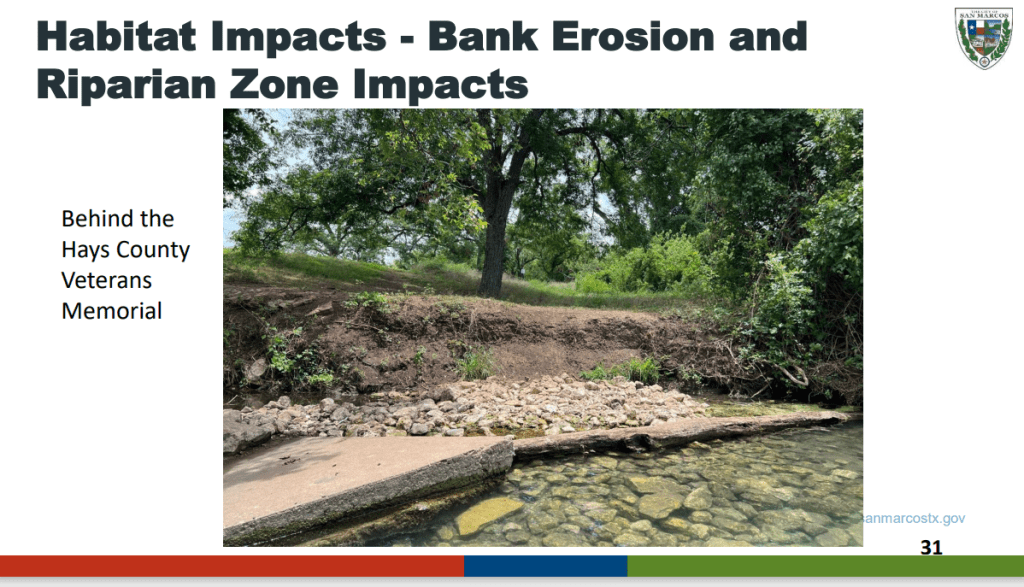
 This presentation was a major bummer. You only get one river! 

My $0.02:

This is a classic example of a tragedy of the commons:

It just makes me very sad.

Solutions:

Staff only has one proposal:  You fence in your parks, you charge nonresidents for admission, and you use the revenue to hire more staff. 

Apparently New Braunfels brings in enough money to pay for it’s entire parks system. That’s a lot more financially sustainable than redirecting $100K of Covid money to contract out with off-duty police officers.

Here’s the thing: inevitably, it will limit access poorer people with fewer resources more than it limits access for wealthier people. Even if you make it free for residents, there will be hoops to jump through.

But what else can you do? I have no other good ideas, either.

So now we turn to Council discussion.

(Only Mark, Matthew, Saul and Jane were here.)

Mark Gleason goes first: he has serious reservations about fencing in the park and charging admission.

  • There’s no such thing as “aesthetically pleasing” perimeter fencing.
  • It might be inevitable, but it’s got such a cost associated with it.
  • Can we fully implement paid parking and the can ban first, and see if that helps?
  • Fences become dams in a flood! They clog with leaves and debris and prevent water flow.

I am really sympathetic to him here. I also want anything but blocking off the parks.

Staff responds to some of these: paid parking is not going to generate the kind of income stream we need to staff these crowds.

Jane Hughson: “Yes on managed access. This is breaking my heart.”

What would a perimeter fence and managed access look like?

There’s nothing concrete to talk about yet. Staff wanted to check with Council before beginning research. So we can’t say where the fences would go, or where the entrances would be, or anything.

How far up would it start? Texas State is having problems at Sewell and the headwaters, and so they want to coordinate with us on this.

How far down would it go? Probably to I-35, at first. Mark Gleason points out that this will drive people to over-use the river on the east side of 35. Staff responds that they’ll have more staff available to cover these other areas, once we get a stable revenue stream.

Apparently New Braunfels does have a problem with people slashing the fence, to sneak in. They have to constantly pay for repairs. So we’d probably have that problem, too.

Some possibilities to explore:

  • Free for residents
  • Free during the week

My read on the mood in the room was that this is inevitable. We will have to fence off the river parks and charge admission.

Top Secret Executive session: Another ridiculous code name: Project Jolly Rancher!

  • Is it a sticky factory?
  • Is it a happy rancher?
  • Is it a green giant? 

Who knows!
Bonus! 3 pm workshops, 9/3/24
Great workshops this week. Best part of the meeting.

We had three presentations this time:

Presentation 1: Purgatory Creek Flood Mitigation project

This is really cool. We last saw it in November 2023, when we bought land for the project.

Purgatory Creek runs from the Purgatory Natural Area over to the San Marcos river. Basically, we’re going to geo-engineer Purgatory Creek to flood less.

So that’s Wonderworld Extension on the far left, where the yellow and blue meet. Then they cross Hopkins and run behind Dunbar, along the railroad tracks, and then cross the edge of downtown, over to the river.

90 buildings are going to have to be removed, because they’re at risk for flooding:

That’s a lot of buildings! Are these houses with people living in them? Are they historic? I could have used more details here.
Correction: I’m an idiot. The structures are being removed from the floodplain. Not removed altogether. It’s safer now for the people living in them.

But on the plus side, it’s going to have a neat little hike-and-bike trail through it. 

I love that.

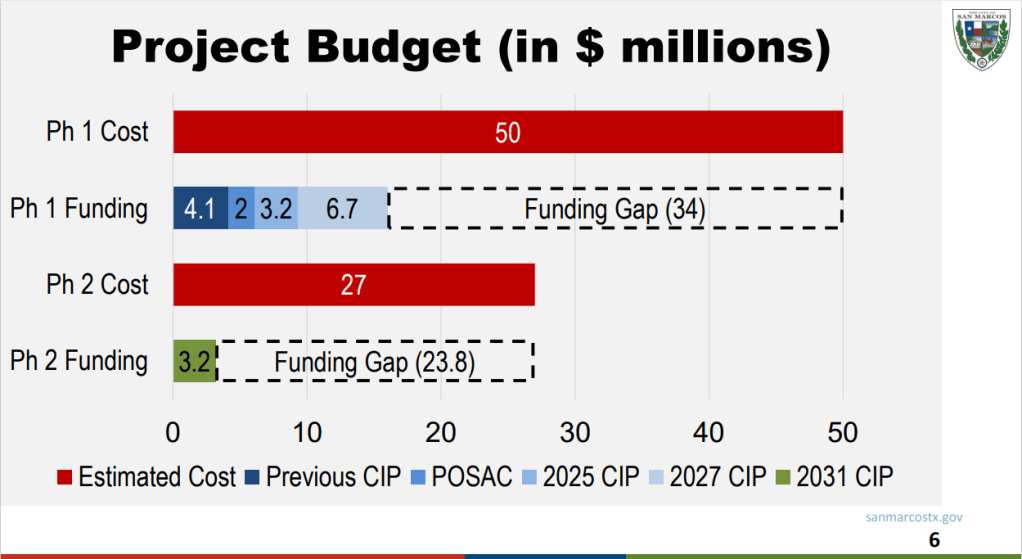
It’s gonna be hella expensive, and we don’t yet have the money:

We’re going to apply for a bunch of grants.

If we get grant funding, we could begin construction in 2026.  If we don’t, we could maybe begin construction in 2030.  It’ll take about two years to finish.

One last detail: On the far right, you can see where Purgatory Creek meets the San Marcos river:

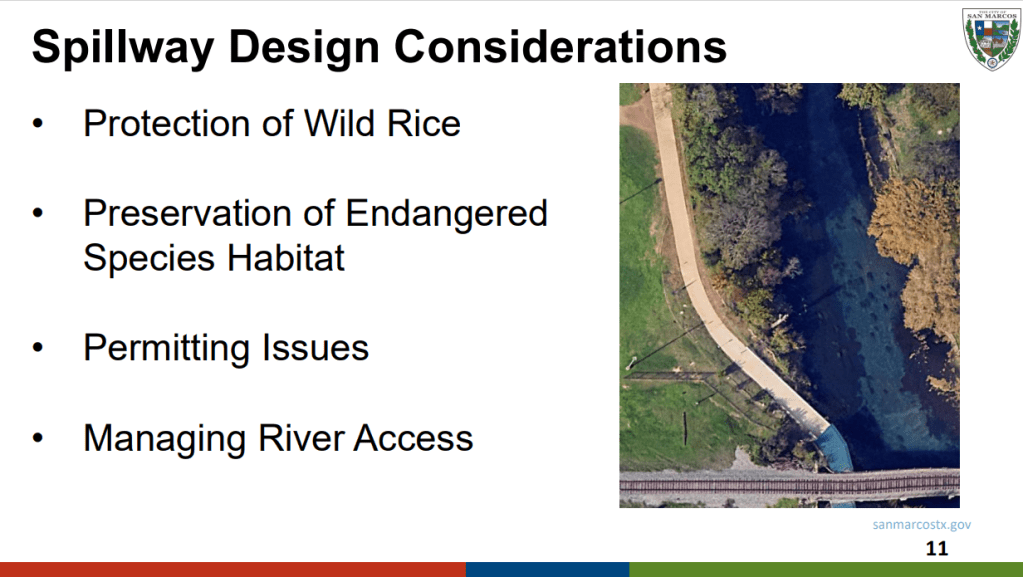
There’s a pale green Spillway, for when it floods. The spillway is in between the Children’s Park and the railroad tracks, so it’s letting into the river right where the sidewalk goes under the railroad tracks.

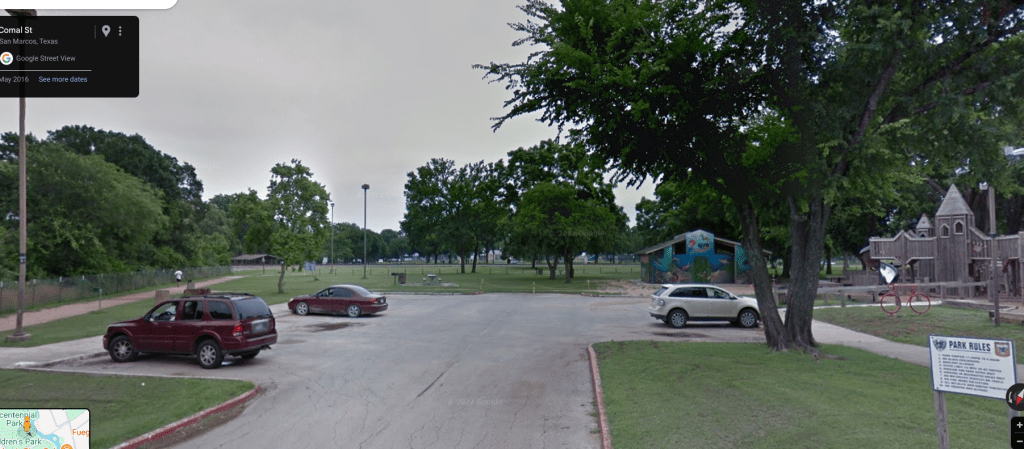
In other words, you’d see it from here:

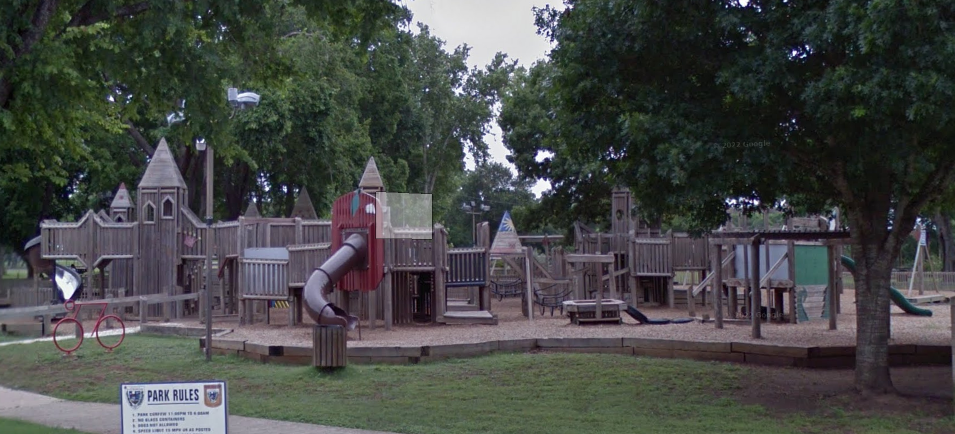
This photo from Google Streetview is so old that the Children’s Park is still the old wooden structure!

Awwww. Makes me a little nostalgic.

Anyway! In the original plan, they were going to use this spillway as an access point for people to easily get in and out of the river.  

But the people from the Parks Department and the river experts are all saying this is a terrible idea, please don’t do this.

There’s a big patch of endangered wild rice there and endangered species that live in the wild rice. And also it’s deep with a brisk current, so it’s not that safe for little kiddos, either.  Just leave this area alone, please.

So the spillway will still end up there, but they’ll make it uninviting for people.

….

Presentation 2: Capital Improvement Projects (CIP)

These are all the major city repairs going on around town. The Purgatory Creek project that we just heard about is one. They get approved alongside the budget. Council saw the current list of projects back in May. (I didn’t really say much about it at the time.)

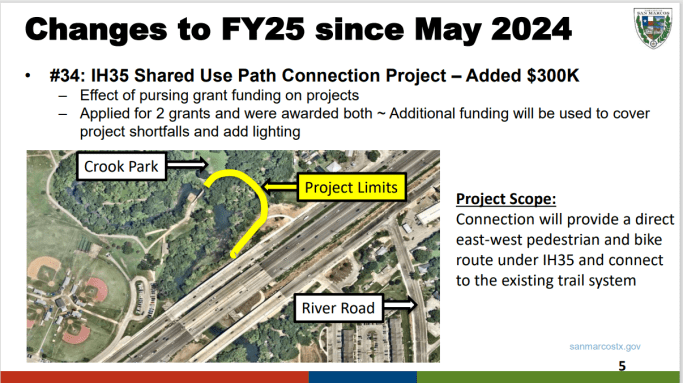
There’s only one major change since May – we’re adding one new project:

What are we looking at here? Let’s back up.

So, I35 has been torn up around the river for years now. TXDoT redid both the access roads, they’re adding I35 lanes across the river, it’s a whole thing.

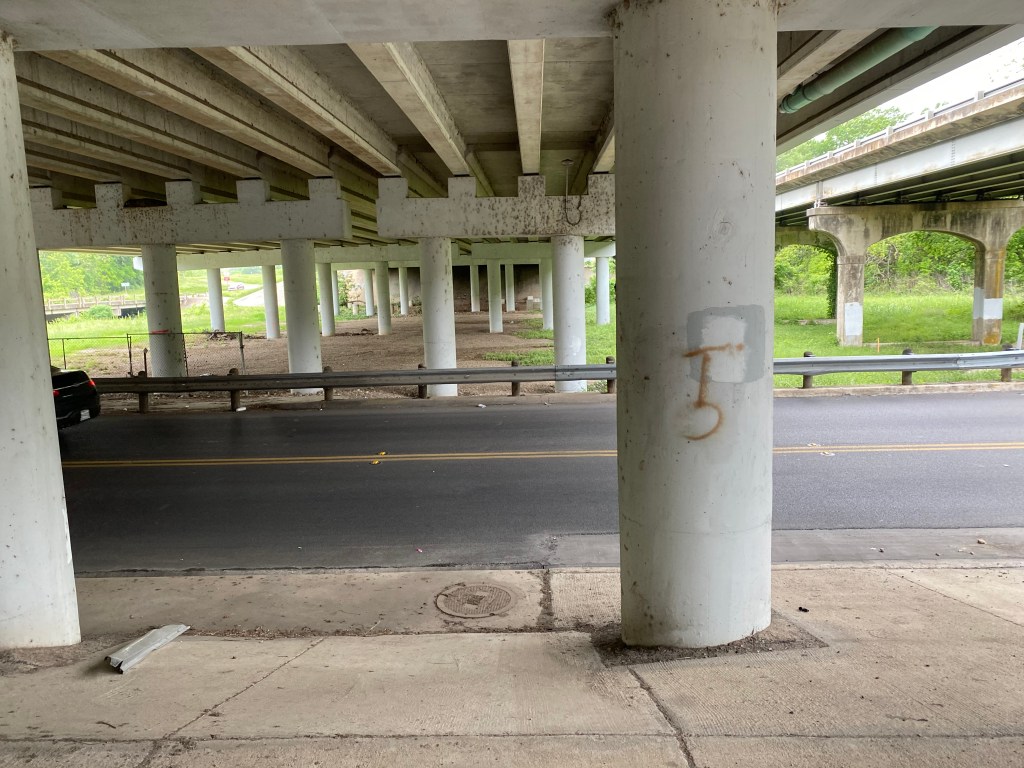
One part of that is that they removed the old underpass along the river:

TxDot photo

So on the right hand side, you can see where they’ve torn up the road that used to go under I35, along the river.

Here’s a photo I took, back in 2020, during lockdown:

So that’s what the underpass looked like at peak pandemic.

Removing it was a major bummer for the good people in the Blanco Gardens neighborhood. They lost their best connectivity across I35. Now they have to go up to Hopkins-80, or down to Guadalupe-123, and deal with a big, busy intersection.

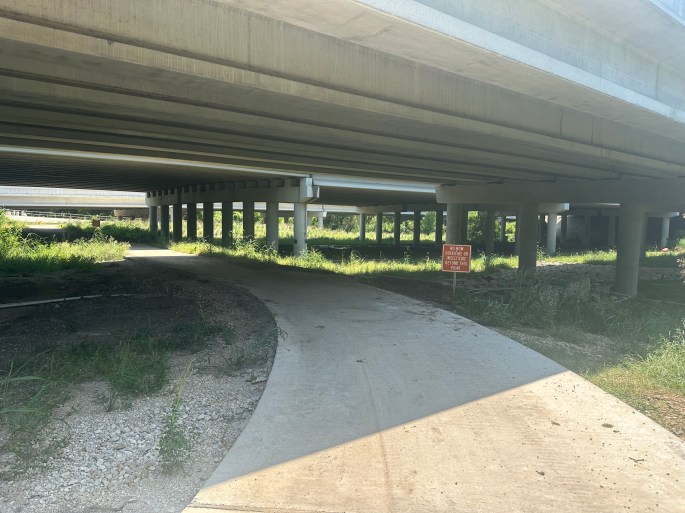
Since then, TXDot has replaced it with a hike and bike trail.

It looks like this:

So you can easily bike from Blanco Gardens over to Riverside, and you end up by Herberts. That part is great!

So what are we doing now? Pink is the route you can currently take on your bike:

Yellow is what’s being proposed. It would connect the east and west sides of the park trails. Great!

This was not in the budget back in May. But since then, we’ve been awarded two grants to cover the cost. The total cost for that little yellow sidewalk is $2 million dollars.

TWO MILLION DOLLARS? Well, yes. Here’s why:

Blue is the main river that you swim in. But there’s this little side channel, in purple, from an old dam built in 1904:

In fact, here’s some of the machinery from the mill:

So that tiny little yellow sidewalk is $2 million dollars, because you have to build a bridge to get across this little side channel.

Now, San Marcos is not paying $2 million for that bridge. What we did was apply for a bunch of grants, and we got almost all the money covered. We just have to pay $300K for that bridge in matching funds. Great!

Mark Gleason is uncomfortable with this $2 million. He lives in Blanco Gardens and actually walks and bikes all over the place, so he’s constantly using this path. He’s just not sure if the cost justifies the increased connectivity that you get. Even though the $2 million is mostly federal money, he just feels weird about it.

I see his point. It’s such a disproportionate cost, compared to the shoestring that San Marcos usually runs on.

But then I just tell myself, “Hey, don’t forget we’re spending $1.2 million on Kissing Tree this year!” Then the $2 million bridge for everyone doesn’t seem so bad. Especially since most of it is covered with federal money.

Plus, once the east side of the river parks gets built out, the parks system will need to be connected, so we might as well do it now.

….

Presentation 3:

We’ve got a big utility assistance program in San Marcos, but it doesn’t always work very smoothly. Let’s talk about it.

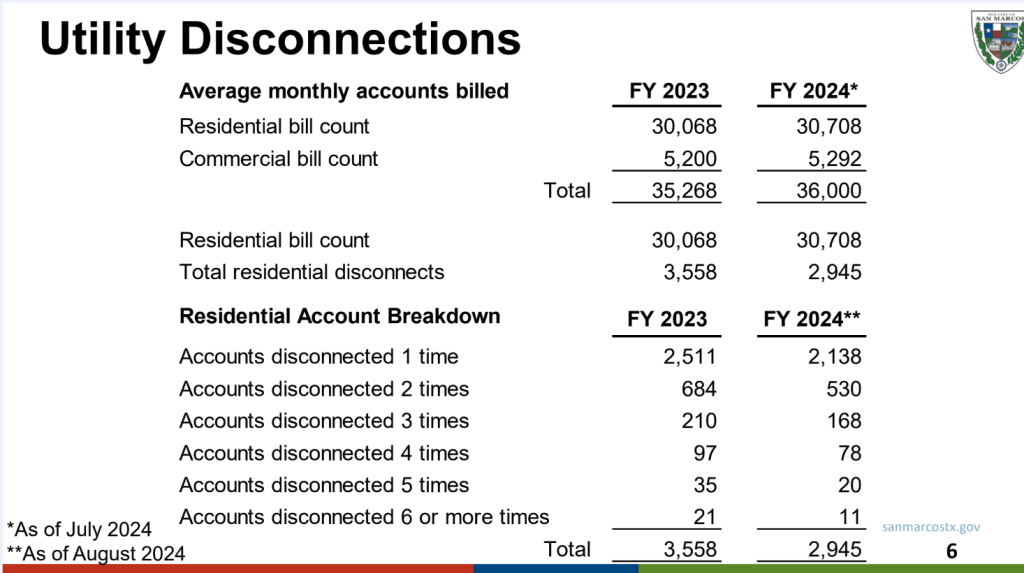
How many people are we talking about?

So there are about 30,000 residential accounts, and almost 3000 accounts have been disconnected so far this year. (Some multiple times.)

Here’s how it’s supposed to go. Suppose you get a disconnect notice on your electricity or water. You call the city. The city does two things:

  1. Offers you a late payment plan
  2. Connects you with the nonprofits that offer utility assistance.

How often does it work like that?

So far this year, we’ve given 580 accounts utility assistance, but 107 of those were still disconnected anyway. There have been 1,948 accounts that have gotten extensions – some of them multiple times – and 586 have still been disconnected.

So out of the 3000 disconnections this year, most people aren’t getting into the system to get help ahead of time. For the people who get in the system, about 75% avoid disconnections.

Ok, so let’s talk about the assistance side of things. San Marcos kicks in $231K to utility assistance. The biggest chunk of that goes to Community Action:

But Community Action also gets some federal money, so there’s actually about $435K available for assistance:

Community Action gets $120K from the city. But when someone comes in for assistance, Community Action tries to spend federal money first. So only $14K of the $120K was spent. However, the federal water assistance program has ended, so Community Action will need to spend more city money to cover that need.

The biggest problem is that federal money is slow. You have to fill out a ton of paperwork. But people need money immediately – cars need to be repaired, babies need diapers, the lights need to stay on, etc – or else small crises spiral into giant crises. So we need a way to get money to people fast.

A few things get discussed:

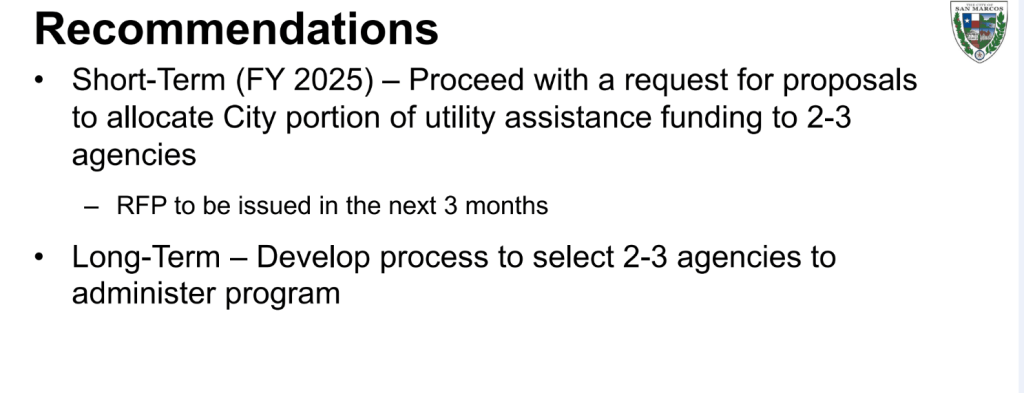
  • Do we have to charge a 10% fee on late payments? Can we just make it a flat $10 fee instead?
  • Should we spread out city money among different agencies?
  • Would the other agencies actually have enough staffing to get the money out quickly?
  • What about San Marcos residents that are on Pedernales electric?
    Answer: they can get federal assistance, but agencies can’t use the credits from San Marcos electric specifically.

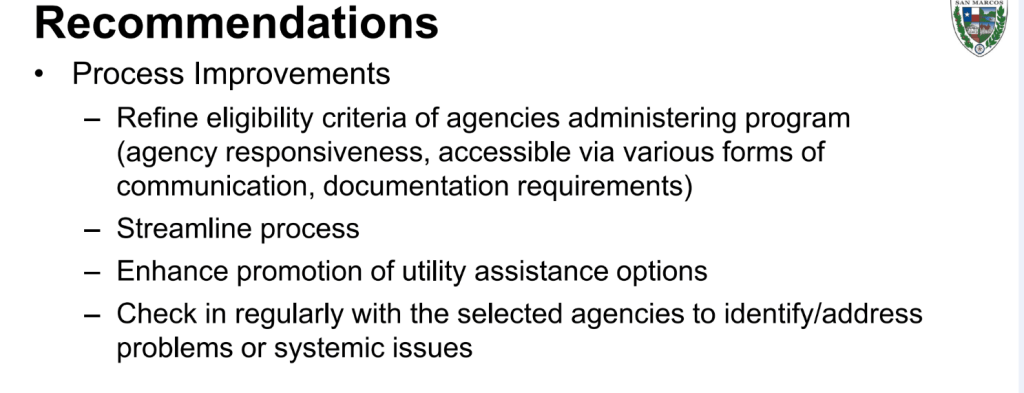
Here’s what we’re talking about doing:

We’re also going to look at our fees and see if we can afford to reduce them.

Here’s my two cents: It is really hard to administer programs to the public well. It’s hard to find people, get their ear, get them to respond, get them to bring in paper work, find funding, and connect all the dots to get the assistance to people.

We tend to see overhead spending as wasteful, but it’s really not. Thoughtfully designed programs that aren’t running on fumes can serve people better.

Finally: if spending $231K of tax dollars on utility assistance gives someone heartburn, just remind them that we’re spending $1.2 million dollars on Kissing Tree this year.

Bonus! 3 pm workshops, 8/5/24

Presentation 1: Hays County Health Department

    I assume all you readers here already agree that health care should be free. Americans pay way too much for way too little, for vague reasons about “freedom”, as if anyone is excited about the freedom to be sick or die early.

    Everyone deserves affordable health care, as a basic right. Great.

    Here’s a second reason that health care should be free and universal: you need a coordinated response in order to launch the best fight against contagious diseases. Do we really want each person to get sick with tuberculosis and see if they can recover, with good old fashioned rugged individualism? Or do we want tuberculosis to actually be eradicated, for everyone, like a bunch of dirty socialists? Maybe grandma doesn’t need to hack up a lung in the first place.

    This is what we mean by public health: often it’s better for everybody when everybody gets basic health care. It’s better for rich people, when poor people aren’t sick! Seems basic, but it’s mindblowing if you’re used to punishing poor people for being poor.

    So we have a Hays County Health Department.

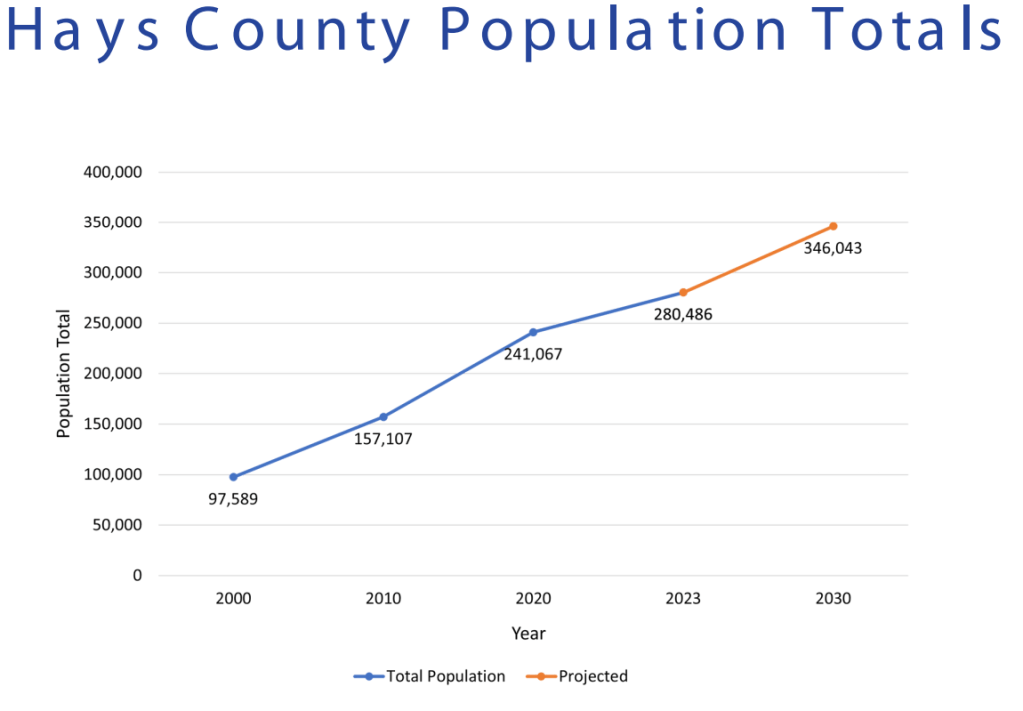
    What’s the need like in Hays County? Well, first, we keep growing:

    Second, we’re in need:

    Some notes:

    1. San Marcos has about 70K people, and Hays County has about 269K people. So the poverty rate is only 12.4% for all of Hays County, because there’s a lot of wealth in the north and west parts of Hays County.

    Most of the poverty is concentrated in San Marcos and Kyle. The poverty rate in San Marcos is about 27%.

    2. Let’s just note that the poverty rate is 12.4%, but unemployment is only 3%. Can you believe that we allow companies to hire people without paying them a living wage? Me neither.

    You’d think we’d be storming the castle over this kind of exploitation, but instead we all just wake up in this world every day, as usual, stressed out over our meager salaries.

    3. That housing crisis is a disaster. Spending half of your meager income on housing is no joke.

    “TVFC” is Texas Vaccines for Children. “ASN” is …American Supplemental Nutrition? American Nephrology Society? Autonomous System Number? I got nothing.

    “TB” is definitely tuberculosis, and we definitely do not want TB cases to be rising.

    The presenter stopped and talked about syphilis for a little bit. It is definitely on the rise in Hays County, across all age groups, ethnicities, and economic classes.

    Here’s statewide syphilis data:

    from here. (The linked report focuses on women, because one of the worst risks is congenital birth defects if she has a baby.)

    In conclusion: the health department does a lot on a shoestring budget, but they could do a lot more if the state funded public health like we should.

    ……………….

    Presentation 2: American Rescue Plans (ARPA) money and Covid Relief money.

    Covid money is running out. It has to all be budgeted by this December, and it has to all be spent by the end of 2025. We started with $22 million, and we’re down to about $1 million. Most of that is because of projects that came in under budget.

    Here’s how staff is recommending we spend the money:

    The LCRA tower is a bargain that came out of nowhere. It’s to give radio access to fire/EMS/etc on the southeast side of town. It was going to cost $4-5 million, but in the last moment, we looped in Guadalupe County and some other partners. So the fire chief Chief Stevens is a big advocate for that.

    Jane Hughson asks about the running list of side-projects that council keeps, to be funded whenever we stumble into some money. Staff does not have that list available.

    Alyssa Garza asks about some of the programs she’s tried to fund with ARPA money, where money never seems to materialize in a meaningful way. Specifically, funding for the Parent-Liaison SMCISD program and translation services. In both cases, money has gone to the program, but not in a way that addresses things well. Like, it’s all well and good to translate the website, but we’re not making events bilingual and bringing parity into public spaces.

    Alyssa points out that the whole Council is being steamrolled into saying yes, for the tower they’ve never heard of before. Chief Stevens pleads that the stars aligned in a special way.

    I get what Alyssa is saying: this is part of a larger pattern. Whose priorities get fast-tracked and whose priorities limp along, half-heartedly? The tower is not a bad project! It’s just a convenient example of a problematic, ongoing pattern.

    Bonus! 3 pm workshops, 7/2/24

    Presentation 1: New City Hall Project

    The city needs a new City Hall. (Discussed here and here.)

    Laurie Moyer was handling the new City Hall project, but she is retiring. The new person basically gave a presentation to introduce herself and pitch how she sees things unfolding.

    Here’s what she was handed:

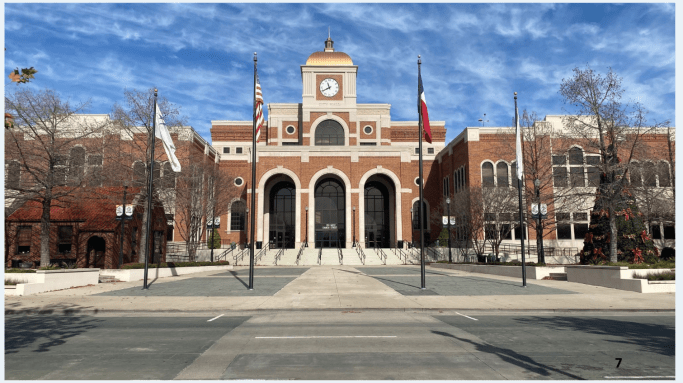
    In other words, City Hall is going here:

    across the street from Old City Hall.

    So apparently this location is settled? I don’t know how I feel about this. I also have concerns about what might happen to the old site.

    However: they’ll need voter approval in 2025 to re-purpose park land as City Hall, so I guess we’ll be hearing some sales pitches. In the end, the voters will decide whether or not it sounds ok.

    The new person is imagining making a whole Hopkins Project out of it:

    Parts of this sound good to me!

    I like the idea that Hopkins could look more like CM Allen.

    P3 means “Public-Private Partnership”. This part is inevitable because the city doesn’t think that the voters would pass a bond in an election. So they want to bring in private partnerships. (More things that I feel weird about.)

    This whole thing will take forever to complete. If the stars align, it will take seven years.

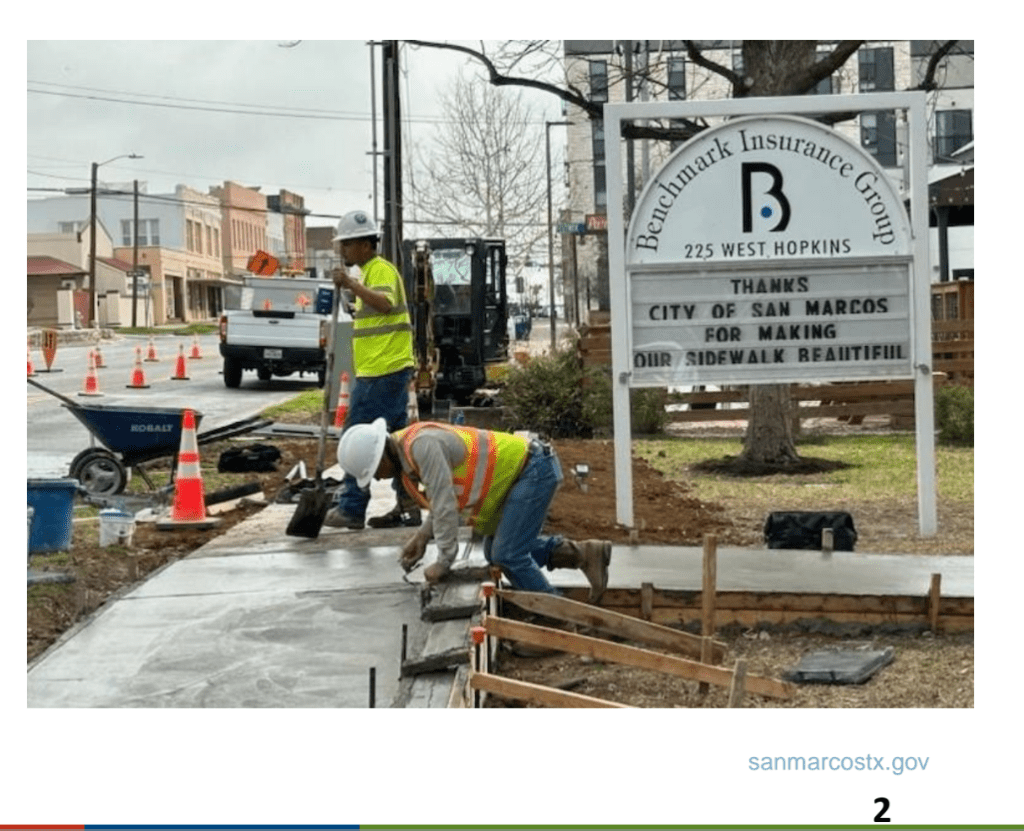
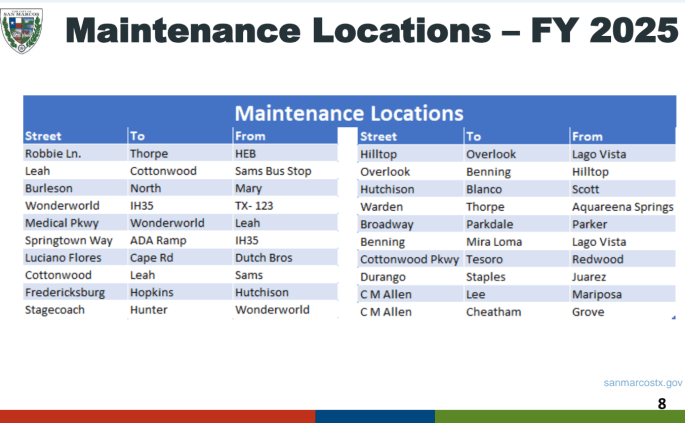
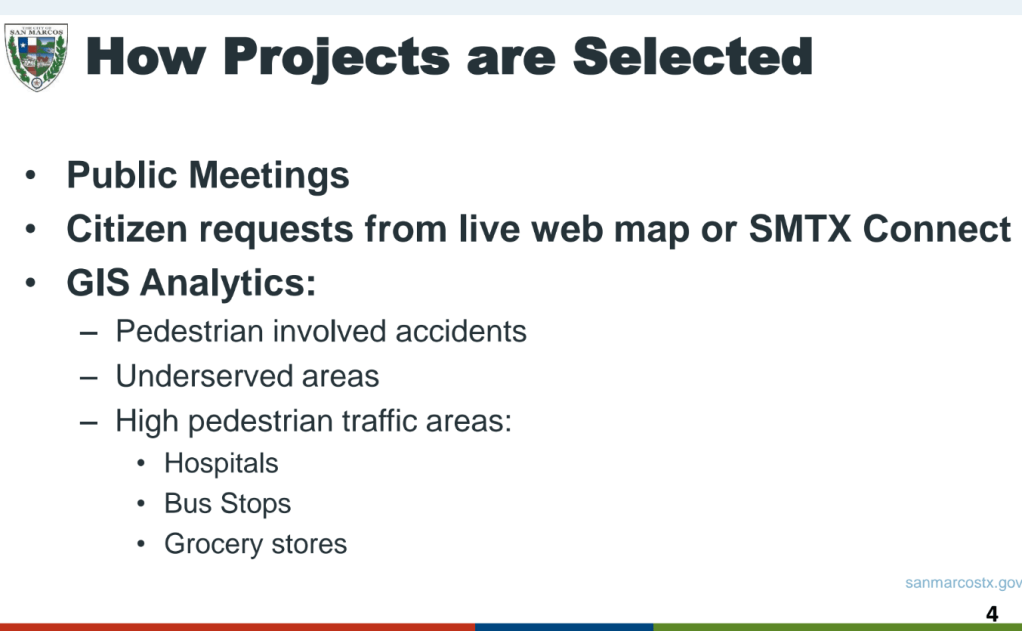
    Presentation #2: It’s Sidewalk Maintenance time!

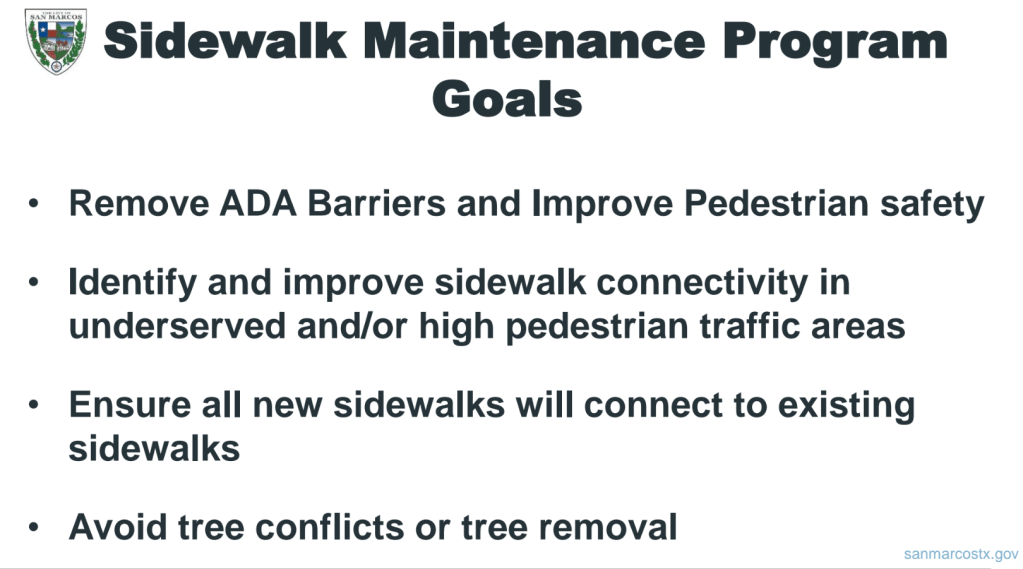
    Here’s the game plan:

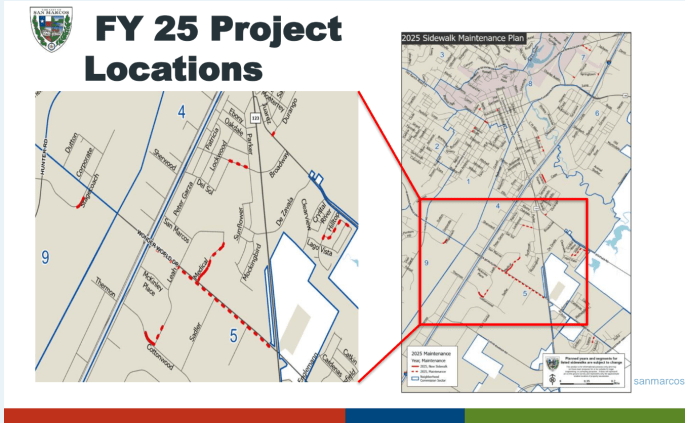
    Here’s what’s coming up in 2025:

    or if you prefer a chart:

    Would you like to play along at home, over the next year? Go here:

    www.sanmarcostx.gov/306/StreetsSidewalks

    Would you like YOUR pet peeve to be selected for a project in 2026?

    Would you like some more photos?

    here you go. Enjoy!

    Bonus! 3 pm workshop, 6/4/24

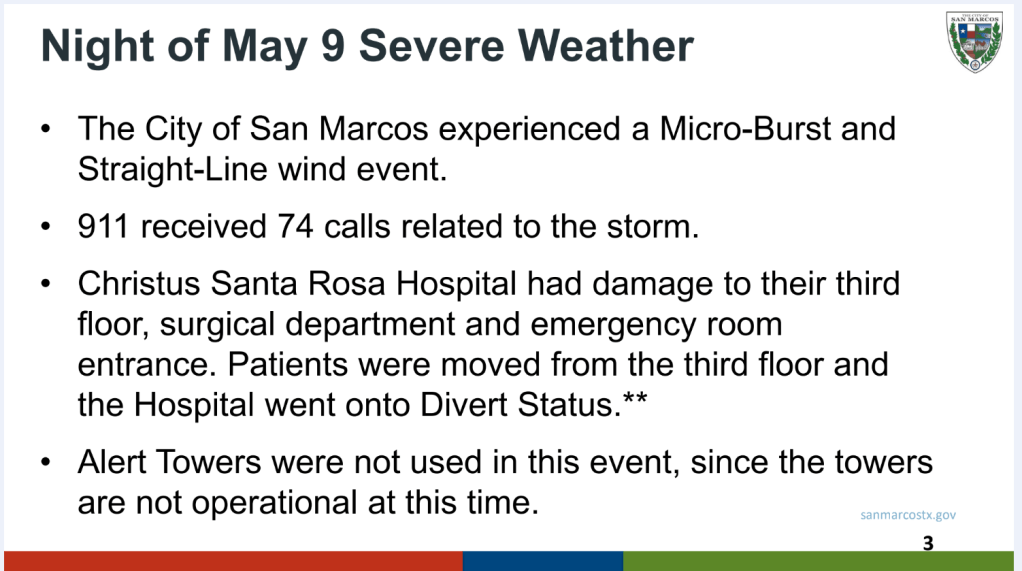
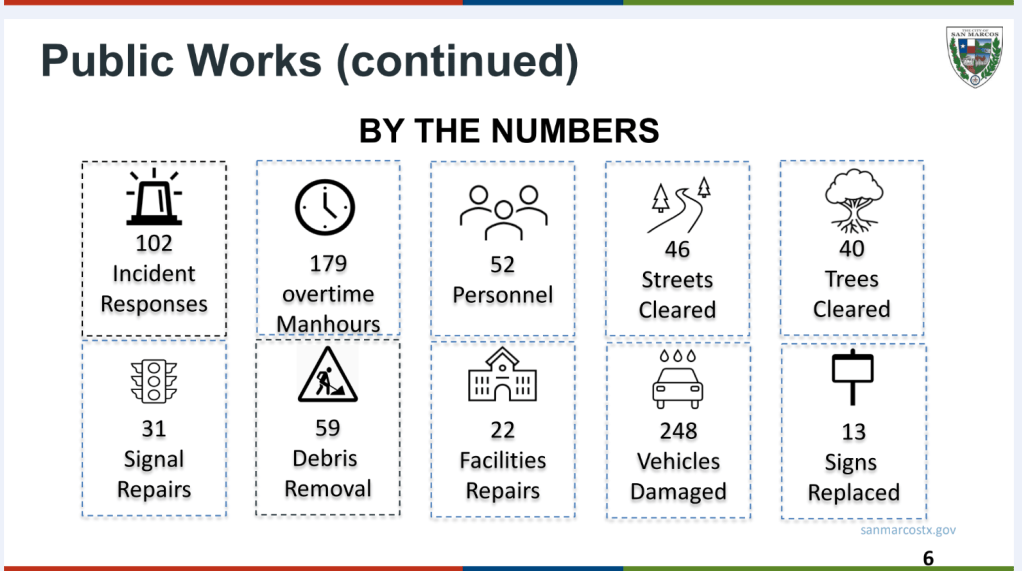
    How’d the city do during the May 9th storm? I’m just going to run through some of the slides.

    These are the Alert Towers. They’re being tested, but haven’t come online yet. (I think they used to be used years ago, but have been broken for a long time, and now we’re bringing them back?)

    So a ton of work was done overnight and into Friday.

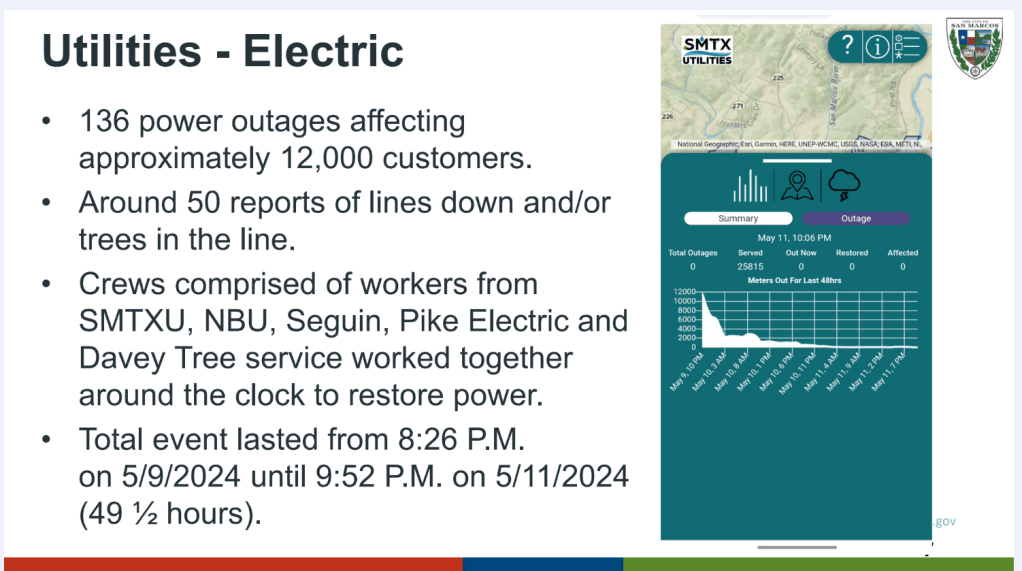
    There were a ton of people without electricity:

    The last people didn’t get their power back for two full days.

    There were a lot of anecdotes about the city not knowing about different outages, and people reaching out directly to councilmembers. Staff says that often the resident is talking to a field worker who doesn’t have access to the master map of all outages. So the resident thinks the city is ignorant about an outage, but really they weren’t talking to the right person.

    Still, they conceded they need to do a better job of staying in touch with residents who call in to say they’ve lost power.

    Kind of a bummer to see all those trees down.

    Lots and lots of community volunteers.

    Some plans for what to do better, next time.

    Bonus! 3 pm workshop, 5/21/24

    Presentation 1: Our budget is not doing well. Let’s look at some slides.

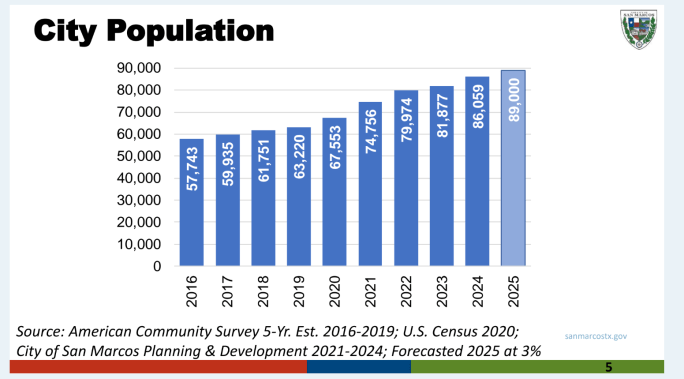
    First, San Marcos keeps growing:

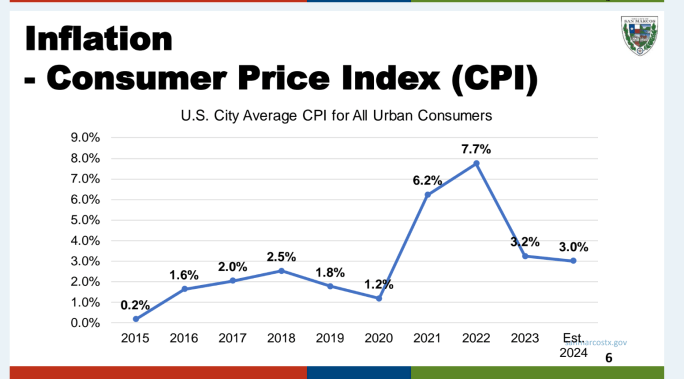
    And while inflation is back to a normal healthy amount, it still exists:

    So due to a larger population and 3% inflation, it will cost more to run the city more next year, even if we don’t change what we’re doing.

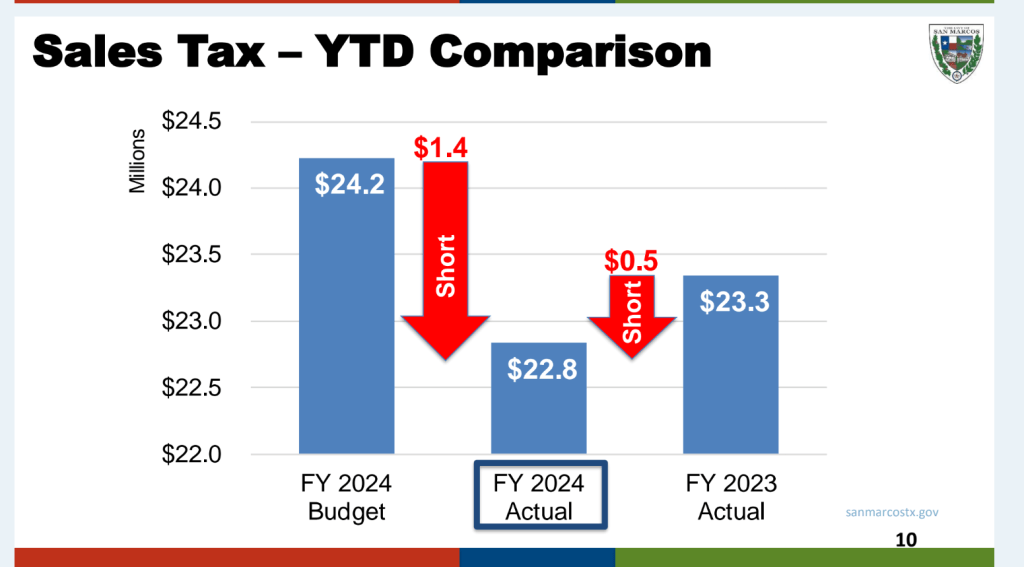
    But unfortunately, we took a big hit on sales tax:

    This is sort of a cumbersome chart. It’s doing a few things simultaneously.

    So you see where it says October 2023 is 6.6%? What that means is:

    1. Average all the sales tax revenue from October 2021 to October 2022.
    2. Average all the sales tax revenue from October 2022 to October 2023.
    3. Work out the percent growth from the first average to the second average. For October, the past 12 months were 6.6% bigger than the previous 12 months. Great!

    But you can see how this plays out over 2024 – we kept shrinking and then turned negative. So the average the sales tax income from April 2023 to April 2024 is smaller than it was over April 2022-April 2023. That is not good.

    Who’s coughing all this up, anyway?

    I would not have guessed that!

    (I would say it’s their customers, not the business, but you get the point.)

    No one else is having this problem. Just San Marcos:

    No one offers up an explanation, because I don’t think anyone has one? Nobody knows if this is a shortterm fluke, or if it’s the beginning of something bad. We can’t know until it plays out a little more.

    Anyway, here’s the bottom line:

    We do not have the money we thought we’d have this year.

    So we have to do two things simultaneously:

    1. Figure out how to tighten our budgets mid-year. There are established contingency plans on how to do this, but it’s not, like, fun to do.
    2. Figure out how to plan for the 2025 budget, if we’ve got more people and slightly higher prices, but less revenue.

    Can property taxes make up the difference? Basically no.

    First off, sales tax is a bigger chunk of our budget than property taxes:

    But second, even though homestead prices are going up:

    they’re not going up by as much as they had been going up.

    The blue portion is the key amount:

    So the city is expecting to collect 1.3 million more dollars next year than this year. It’s growing, but not enough to keep up with inflation and a larger population. Not like the past two jumps: from 2023 to 24, we jumped 6.8 million, and the year before that, an extra 5.8 million dollars.

    So here’s the bottom line:

    We are looking at being 2.3 million short this year, and 1.12 million short next year, if we don’t do anything different. Ouch.

    I mean, we’re going to tighten belts, etc. The city is smart, there are plans to implement. But they involve hard choices and going without good things.

    Here’s how we’re handling 2024:

    Basically, that’s how they’re handling it. And they’re working on making next year’s budget work on a shoestring, as well.

    One last thing:

    There’s a new law that caps the how much business property appraisals can increase each year. Any non-homestead can’t grow more than 20% in a year. Or rather, the appraisal can come in higher than that, but you won’t be taxed on the excess.

    Now, this only affects businesses appraised under $5 million. The problem is that we have a high number of small rental properties, and they all qualify. So we’ve lost $123 million of taxable land value, which works out to $745K from the budget.

    Bottom line: the city has to tighten the budget. Kinda a giant bummer.

    Presentation 2: There was also a presentation on the 2025 Capital Improvement Plan.

    The CIP plan is all the major city projects, like re-doing the drainage for a street so it doesn’t flood anymore, or whatever. Basically it takes a lot of longterm planning. I don’t have much to say about it besides that they emphasized how much they’re trying to apply for lots of grants.

    Bonus! 3 pm workshops, 5/7/24

    We had great workshops this week!

    Item 1: Equity Cabinets

    (Jude Prather recused himself from the discussion, due to his wife’s employment at Texas State. As far as I can tell, there’s nothing remotely conflict-of-interest about this – but sure, why not.)

    I learned that there’s something called an “equity cabinet”.  You pull together a bunch of people who represent traditionally underrepresented groups in your community, and have them thoroughly study a problem in the community, and make policy recommendations.  (Here is the example from the presentation of where it’s been done before.)

    Dr. Rosie Ray is a researcher at Texas State (and we’ve seen her before: here and here and here and here and here). She got some funding to partner with the city of San Marcos – if the city is interested – to put together an equity cabinet to study all things transportation-related.

    Who exactly are the traditionally underrepresented groups?  Biden defines it like so:

    Who are the local partners who can put forth good candidates for this cabinet?

    What would they be focusing on? 

    So about 10 people would be chosen to work closely together over five months.  They’d get paid, it would be structured and well-planned, etc etc. The cabinet would have to get up to speed on the challenges that the city faces and what we’re currently doing.

    So what does council think?

    Everyone’s on board!  Sounds like it’s a go. 

    Here’s the timeline:

    I look forward to hearing the recommendations from the cabinet!

    ….

    Item 2: PIT Count

    How many homeless people are there? It’s not an easy question to answer, for obvious reasons. 

    One way you do it is with a “Point in Time” count (ie, a PIT count). You pick one day (in January, per HUD requirements) and get as many volunteers as possible to go out into your county and try to lay eyes on as many homeless people as possible. But also, you talk to the people and try to get a snapshot of the people who are homeless that night.

     Homeless Coalition of Hays County conducted ours on January 25th this year.  They’re part of the Texas Homeless Network.  It took 50 volunteers that day, and 17 more doing background work.

    It’s not perfect:

    But it’s still useful!

    Keep in mind that homelessness is complicated:

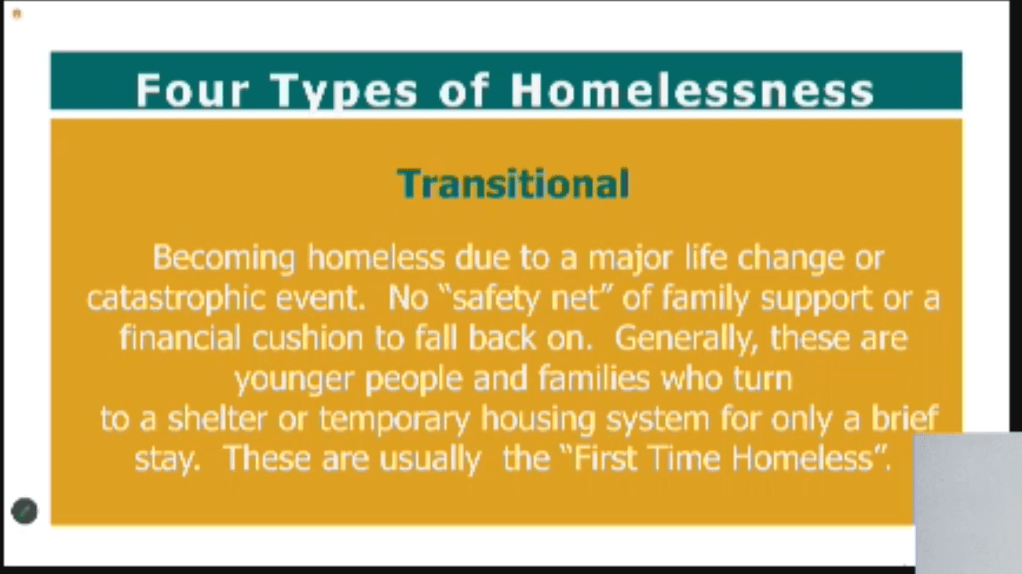
    The chronically homeless people are the most visible. These are the people you see along I-35 or in public areas. These are the people most likely to get counted in the PIT count.

    The hidden or transitional homeless people are much harder to count. Who knows if you’re couch-surfing, or living in your car? Especially if it’s on-again, off-again? A lot of these people are holding jobs and functioning in society, but can’t afford housing.

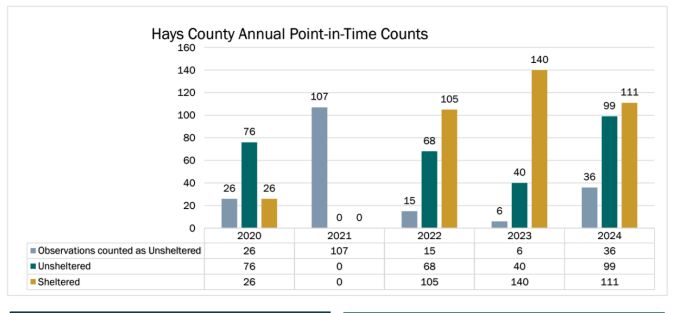
    Results: 

    “Sheltered” means Hays County Women’s Shelter or Southside Community Center/BR3T program with motels.

    So why is the number of unsheltered people going up? Most likely, it’s two things:

    • we’re getting better at locating and counting homeless people, and
    • rising housing costs are displacing more people, so there are actually more homeless people.

    Where are the homeless people in Hays County?

    Mostly in San Marcos.

    This also has a couple reasons! We’ve got most of the resources here. But also, the people conducting the PIT count know San Marcos mostly thoroughly. They know where to check in town. We need cooperation from people with deep knowledge of Dripping Springs and Wimberly homeless communities, if we’re going to find and locate people there.

    On that day, the PIT Count volunteers make 4 sweeps, but all during daylight, for safety reasons. They also chat with the homeless people, if the person is interested in chatting. So we get some informal survey data.

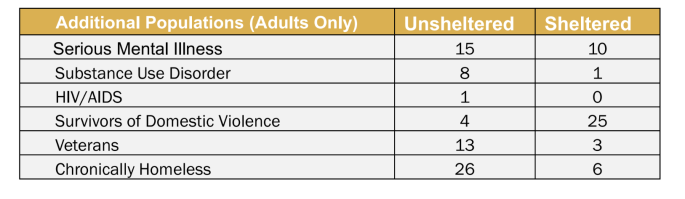
    Survey results:

    So what good is this? First, it allows us to apply for lots of funding.

    Quick Detour: Remember Robert Marbut, from here and here? He was Trump’s homelessness expert, and then we tapped him to write a Homeless Action Plan for San Marcos.

    Marbut advocates for “Treatment First” programs. You do not house someone until they’re stable enough to keep the housing. (If this seems cruel, you might have spotted the fly in the ointment.)

    Under the Biden Administration, HUD funds “Housing First” programs. You get someone off the streets, first. Once they have some basic safety and security, then you can work on mental health and addiction issues. (The main argument against this is, “If you offer housing with no strings attached, you’re threatening capitalism! Workers won’t hustle and turn a profit if they’re not scared of having their life crumble!” Mm-hmm.)

    Presidents matter. They install people to run all the major organizations, like HUD, the EPA, Dept of Education, DoE, etc. Under Biden, you will have sane people implementing humane policies. Those policies affect things like how cities help homeless people. It really matters.

    Anyway, here are the slides from the presentation on why Housing First is more effective than Treatment First:

    It’s more effective and less cruel! Win-win.

    The PIT count is not the only measure of homelessness. There’s also the McKinney-Vento report for kids enrolled in public schools:

    The McKinney-Vento report measures things slightly differently than the PIT Count. They try to record how many kids are couch-surfing, which is the “doubled up” category, and who is temporarily living in a hotel or motel. Whereas the PIT count doesn’t catch either of those unless Southside is paying for the hotel room.

    One last note: Jude Prather volunteered at the PIT count, and works in his job to get vets housed, and he deserves some kudos for that hard work.

    He also made a point of advocating for increased funding for organizations that provide individual case work for homeless people, which I think is a reference to H.O.M.E. Center.

    I agree! They do great work.

    Item 3: Spin Cycles

    You might recognize these scooters from such hits as:

    “I’m abandoned, blocking a sidewalk” or “I hope you didn’t need to use a wheelchair on this sidewalk”.

    All kidding aside, they popped up in San Marcos back in 2021.

    (It’s kind of weird – there’s no history about these scooters on the blog. Council did not discuss them when they were approved in 2021, nor when they were re-upped in 2022. No workshop, no discussion, nada. Did they go straight from Executive Session to the Consent Agenda, with zero public discourse? I think so!)

    I’m actually in favor of this kind of thing! I mostly think the program is great (aside from blocking sidewalks).

    This is my best guess as to how it works: you download an app. It shows you where the nearest scooter is. You can activate the scooter and ride it within a certain zone. The company is supposed to maintain and insure the scooters, and make sure they get tidied up on a regular basis so that they don’t prevent people in wheelchairs from using the sidewalk once they’re discarded.

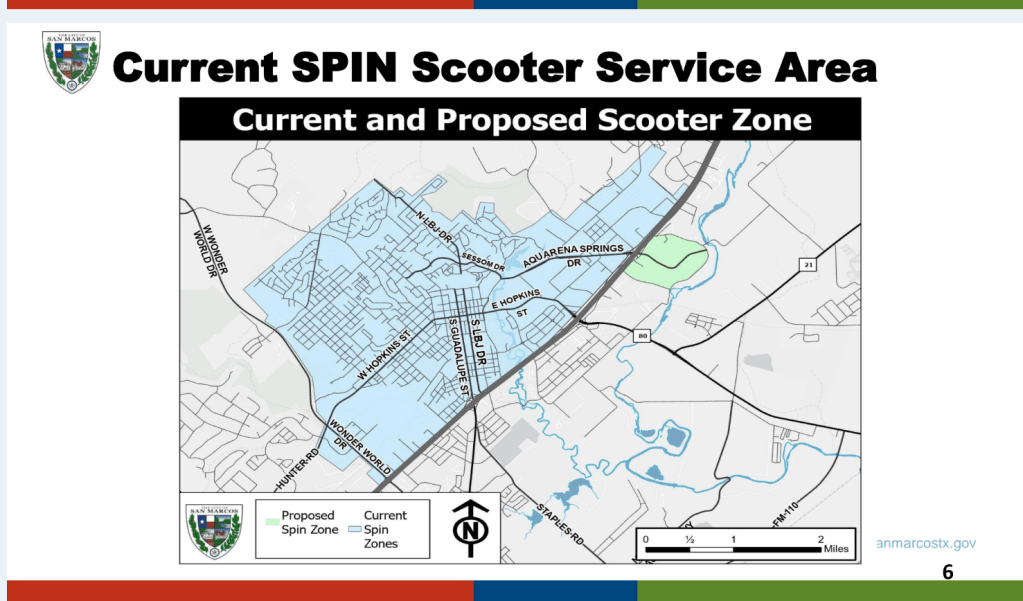
    Here’s the current boundary of where they work:

    I assume when you hit a boundary, they just deactivate, like a sad ghost who hit the wall of their haunting-perimeter.

    They max out at 15 mph, and the company has slow-zones where they max out at 10 mph.

    Overall, the program is successful!

    • They’re heavily used.
    • They’re significantly cheaper than owning a car
    • They’re better for the environment.
    • They’ve had 1 reported safety incident in 2022-2023.
    • They’re great at preventing people in wheelchairs from using the sidewalk. (Kidding. But this is my one major gripe.)

    The company is asking for a two things:

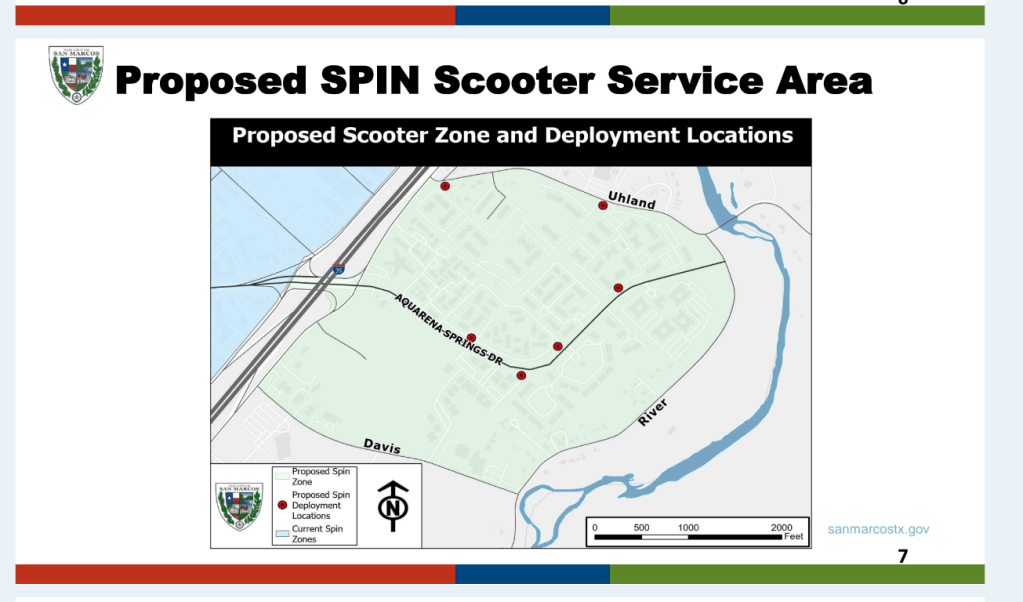
    1. Bigger service area. They want to cross I-35, at Aquarena Springs Road:

    This is a great area to include. There are tons and tons of students there, going back and forth to campus.

    The big issue is I-35, of course. (I sometimes fantasize about what it would be like if I-35 had never split this town in half.)

    Here’s what they’ll have to navigate safely:

    The intersection of Aquarena and I-35 does technically have a sidewalk path that riders can take the entire way, to navigate it.

    [Confidential to anyone who drives a car, truck or SUV: People are fragile. Please drive your 2000 lb vehicle timidly.]

    2. Their second ask is to operate 24/7.

    Right now, the scooters only work 5 am-midnight. So they’re not restricted to daylight hours, but they’re not available when the bars close at 2 am, either. But they’d like to be!

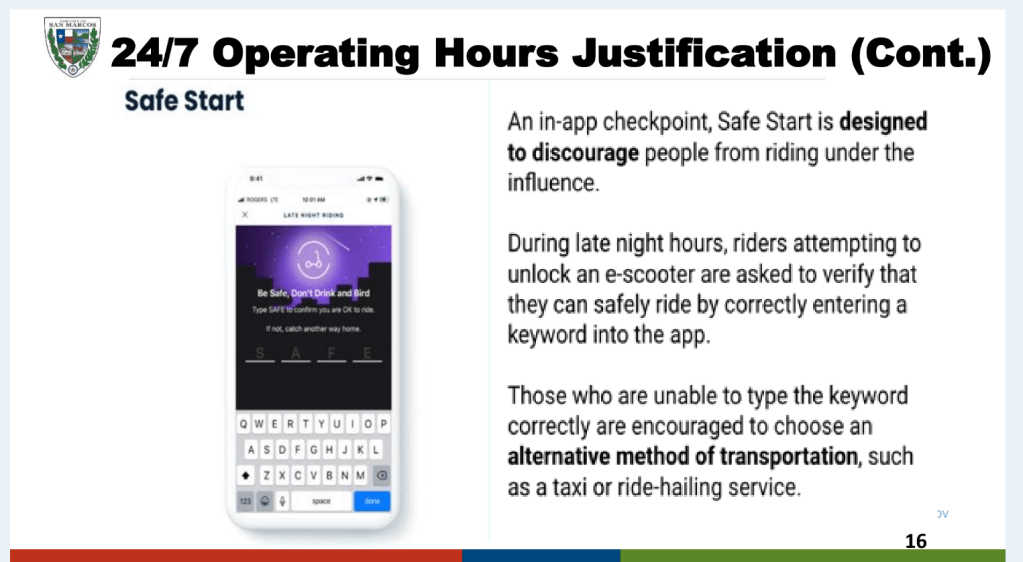
    They have some safety options to mitigate things:

    So I guess you can’t be so drunk that your vision is blurring? This seems like a low bar to clear, but at least they’re not getting behind the wheel of a car?

    They can also throttle the max speed, and cap them all at 10 mph during overnight hours.

    What does Council think?

    Jane Hughson is a little wary of the I-35 exchange, and asks if we can put up some signs or markers directing scooters to take that specific sidewalk path.

    Answer: sure.

    Mark Gleason has some reservations about I-35 as well, but is mostly enthusiastic about looping in the east side and connecting them across 35. He asks if they can extend the zone to Walmart.

    (I agree that stretching it to Walmart is a great idea.)

    Saul Gonzales asks if you can get a DUI on one of these.

    Answer: Yes you can!

    In the end, everyone’s on board with this. Also, it’s a pilot program that will come back in 6 months, so we can see how it’s doing.

    Bonus! Workshop, 3/19/24

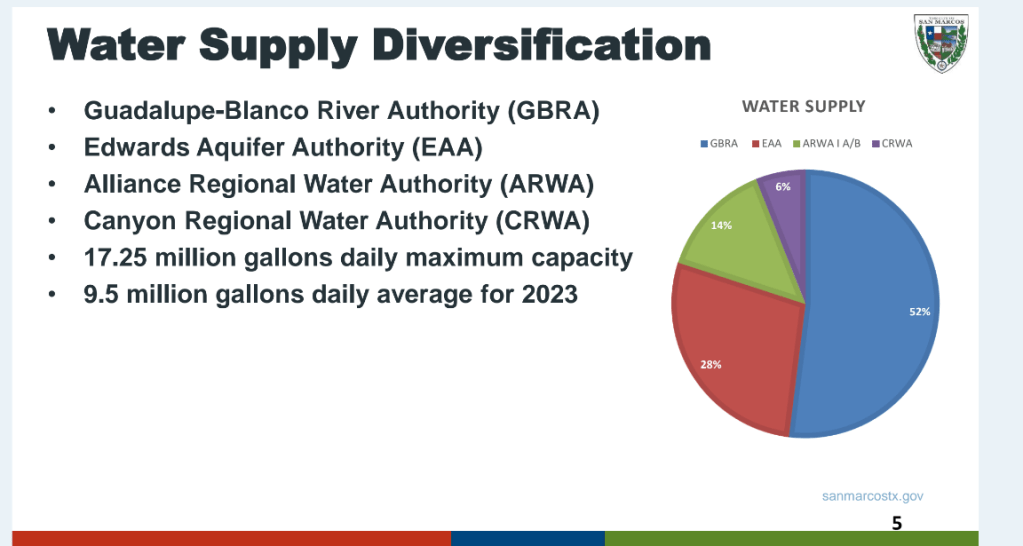
    We get our water from a bunch of different sources:

    We’re actually in pretty good shape, because we invested in ARWA water about twenty years ago. That is water from the Carrizo-Wilcox aquifer. It took a while to get the drilling and treatment set up, but it’s about to start coming online.

    Here’s what our water supply looks like, over the next 50 years:

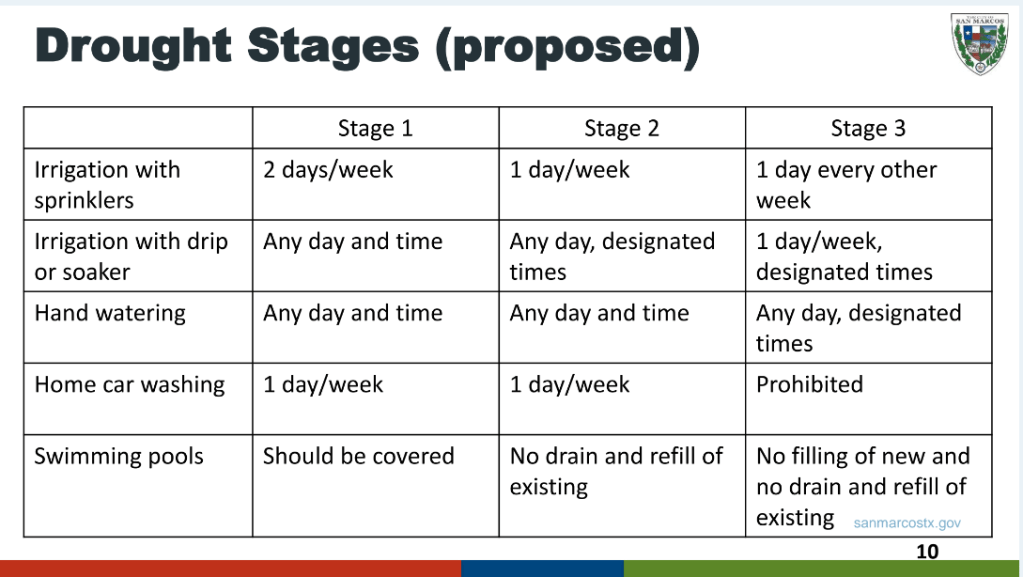
    The main point of the presentation is our drought stages: right now we have five, and life would be simpler if we only had three.

    The five:

    The three:

    Jane Hughson makes an excellent point: it used to be that Stage 2 was mild, and now Stage 2 is serious. It used to be that Stage 3 was Medium, and now Stage 3 is The Worst. It’s hard to get people to update their priors. This is going to require a high degree of messaging.

    (Nevertheless, it’s probably simpler to have 3 stages instead of 5.)

    Updated to add: Someone pointed out to me that the new proposal never bans sprinkler systems, even during the worst droughts. This seems like a bad move. Even if there’s plenty of ARWA water, it’s still resource-intensive to clean and treat it.

    But listen: we can be doing more. Johnson City held an Ugliest Lawn contest, to promote the idea that it’s okay to let your lawn turn yellow. We could have Yellow is the new Green signs, or some other sort of messaging about letting your lawn go fallow.

    Traditional green lawns are an environmental disaster, right? Let’s change the discourse around them, and give people permission to quit watering.

    City Council! Tell the water guys to include this kind of messaging, stat!

    Bonus bonus! 3 pm workshop

    Two presentations, about Green Guy Recycling and SMPD.

    Green Guy Recycling

    We’re renewing our 5 year contract with Green Guy recycling. We’ve been working with them since 2009.  

    San Marcos residents get some free drop-offs per year, because of this contract.

    Per year, you get recycling for: 

    • 24 hour drop off for common items
    • 5 passenger tires
    • 1 TV
    • 2 CRT screens
    • 2 appliances with Freon
    • 2 mattresses or box springs per year

    This costs you $1.85/month.

    They also provide a ton of long dumpsters for recyclables at Community Clean Ups throughout the year, and other things, like nuisance vehicle recycling, for the city.  It all sounds good to me.

    ….

    Police Chief report

    Congratulations! If you made it this far, you get a personal anecdote.  

    I actually come from a family of communists. Literally, Marxists on both sides of my family.  At one point in the early 2000s, I was arguing with my uncle about the 2000 election.  He did not live in the US, but he was saying he would have voted for Bush over Gore.  I was outraged.

    He explained to me why:  he felt that the entire capitalist system is so rotten that the only recourse is a revolution.  Electing Al Gore would placate everyone and delay the revolution by releasing steam, whereas electing Bush would make life worse, and thus hasten the revolution. 

    To an abolitionist, small improvements are counterproductive because they distract from the revolution. When things get worse, it lights a fire under people to fight for a revolution.

    (I still don’t agree with my uncle: I think it would have been better to elect President Gore, and I’m guessing 150,000 Iraqis might agree with me. But here we are.)

    At the same time, sometimes the abolitionists are right, and you need a revolution. This is the WEB Dubois and Booker T. Washington debate about civil rights: can you fix things incrementally? Or do you have to fight for revolution? There wasn’t really an incremental fix for Jim Crow laws – people risked life and safety to fight for the civil rights movement.

    So now we’re talking about SMPD, and there’s a split in philosophy:

    • Small improvements to police departments are good, because it improves policing.
    • Small improvements to police departments are bad, because the whole system is rotten and needs to be thrown out.  Small improvements prevent the fire from building that will motivate real change.  In other words, an abolitionist approach. 

    Here’s where I stand: I’m okay with incremental improvements to SMPD. Waiting for a revolution leaves too many vulnerable people stranded in 2024.

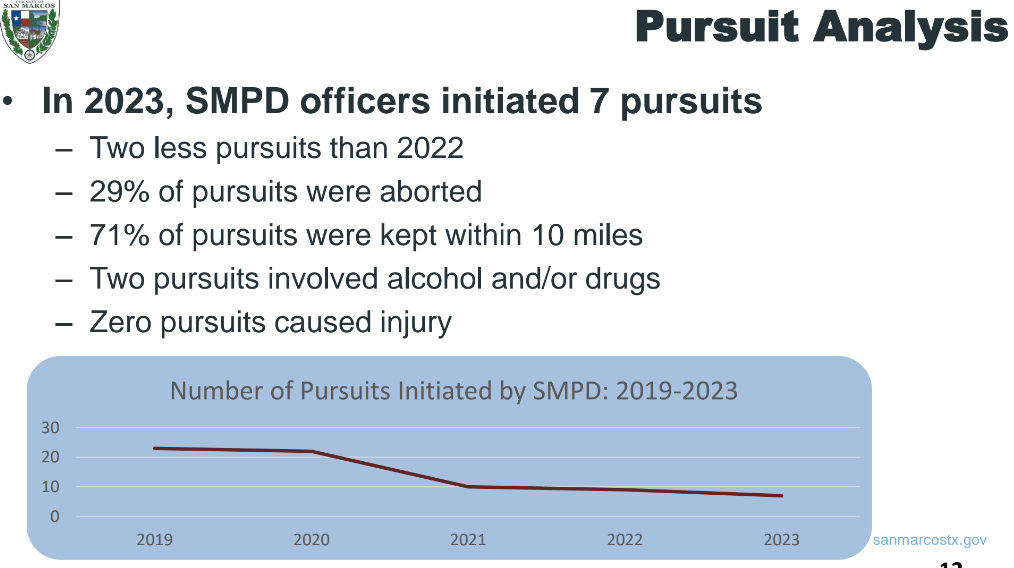
    Chief Standridge’s entire presentation is “Look at these positive incremental changes we’ve implemented, and the modest successes we’re showing!” 

    Here are Chief Standridge’s main talking points:

    • We did a huge amount of community events and outreach in 2023. 
    • We have 60 active volunteers. 
    • School marshall program for the elementary schools, officers for the middle and high schools. (bleagh, but that is a different conversation.)
    • Brought in a qualified mental health professional to respond alongside the mental health unit.  (This is good!)

    Accountability:  

    It sounds like they’re documenting and investigating any significant incident. Do I have the proper context to analyze this stuff? no, of course not.

    We hired a bunch of new people:

    Our crime stats are trending down:

    Two comments:

    1. Nationally, violent crime went down, because we’re getting further away from Covid life disruptions. But the drop in San Marcos does seem bigger than the national average.
    2. Chief Standridge says something like, “You can’t credit the police for a drop in crime, and you can’t blame the police for an increase in crime. Crime is due to complex socio-economic factors.” I give him credit for framing everything in terms of grounded evidence like this.

    There are a bunch of mental health initiatives, collaborations, and new hires made, both to support the mental health of the officers and to take a holistic approach to crime reduction in San Marcos. These are good things!

    There was one interesting question: Shane Scott asks about reserve officers.  Do we let volunteers be officers on the streets?

    Chief says diplomatically, “I’m not comfortable with that. This city is still pretty …challenging.”

    GOOD. I would be worried about George Zimmerman-style volunteers.

    Bonus! 3 pm workshop, 2/20/24

    At 3 pm, there was a workshop on the future city hall.  We’ve discussed this before, back in 2022.

    Basically, we can’t afford a new city hall, and Texas has a law that you can’t take out a bond to pay for a city hall. [Edit! I got that wrong. The law is that you have to get voter approval for a bond. City staff and city council don’t think that San Marcos voters would approve a bond for a city hall. Correction based on the 2022 presentation here.]

    So they’re left with public-private partnerships, where some private entity goes in halvsies with you. You end up building something with both government and commercial appeal.  Bleagh, but here we are.

    The first decision is location. 

    This is the leading contender on location:

    ie, across the street from the current city hall.

    This is supposed to be a mock-up of what City Hall would look like if it were in that spot:

    You’re looking at Hopkins. The old location is the lower right, and that would be converted to commercial and residential. Across Hopkins is the new City Hall, next to the retention pond. You can see the Bobcat baseball stadium in the background.

    So that’s possible location #1.

    Possible location #2 is where the current city hall is located, on the south side of Hopkins.

    Nobody says what’s wrong with the southern side of Hopkins. What they say is, “If City Hall is on the northern side of Hopkins, it will welcome everybody coming from I-35! It will form a Civic Road of City Hall, the library, and the Activity Center.”

    I guess the southern side is less welcoming because of how Hopkins bends? You’d think a big, snazzy, new building would feel big and snazzy on either side of the road, but I guess it’ll feel extra big and snazzy on the northern side.

    Possible location #3 is somewhere downtown. The appeal of this is to bring back some daytime workers back to downtown. When Hays County Courthouse moved out to Wonderworld, the downtown lost a ton of people who would eat lunch at the restaurants and keep the downtown bustling during the day. It would be hard to pull off, though – we only own a tiny bit of land, and it would be pricey to acquire more.

    ….

    Laurie Moyer is one of the assistant city managers, and she gave an extremely charming presentation about her Christmas vacation, which was spent driving all over Texas, observing the City Halls in comparable cities.

    For example:

    and then, her personal photo:

    I was delighted by the whole thing. You should watch it here, if this is also your brand of nerdiness.

    Bottom line: All these cities had city halls built in the past 20 years, and ours is 50 years old. The whole process will move extremely slowly, but we’re going to hire a consultant and get the ball rolling.