It’s hot-button issue night! All the spiciest topics for you. We’ve got proposed downtown apartments next to Little HEB, a resolution for a ceasefire in Gaza, and tension between the new City Hall, and the skate park and dog park. Too hot in the hot tub!
Let’s goooo!
Hours 0:00 – 6:00: Three hours of citizen comments! Plus downtown apartments next to little HEB, and some new speed limits for the Wallace Addition.
Hours 6:00 – 6:59: It’s time to wade into the Israeli-Palestinian conflict. Buckle up.
Bonus! 3 pm workshops: Where do we want to put the new city hall? But what about the skate park and dog parks?
There was 3 hours of citizen comment, and another 45 minutes at the 3 pm workshops. Total, there were about 75 speakers across both meetings.
San Marcos turned out HARD this week.
The biggest topic: Proposed Resolution for a ceasefire in Gaza 37 people showed up to call for City Council to pass a ceasefire resolution, plus one more mentioning it at the 3 pm comments 17 people showed up to advocate against City Council passing a ceasefire resolution.
Both are pretty gigantic turnouts. Much to say. Stay tuned till this part of the meeting.
Next biggest topic: Will the new city hall stomp on the skate park and the dog park? – 12 people showed up to support the dog and skate parks at 3 pm, and two additional speakers at 6 pm.
Everyone loves the parks, and no one wants the city to stomp on them.
Topics with 1-4 people: – Opposed to the proposed apartment complex next to Little HEB, or at least advocating for some tenant protections to be included – Opposed to the proposed AI Data Center. (Not on the agenda tonight, but I think it was supposed to be discussed) – LULAC is holding their state convention in June, in New Braunfels, and you’re invited! Details here.
…
Here we go!
Items 9-10:
Background: About a year ago, there was a pretty big shitshow in town, regarding whether or not to approve some new apartments here:
It pissed off a lot of people! The main arguments against it were:
Student housing is exploitative
This will destroy a peaceful neighborhood
This will make traffic and parking worse
The university will buy it as soon as it’s built, and we’ll lose the tax income (There was a partial compromise to address this.)
It will displace the people who live in the smaller complex there currently. (Also a partial solution worked out here.)
The main arguments in favor:
We need more housing, period.
This will be walkable to campus for students
The tax money is needed, especially since Texas State just bought two giant complexes and they don’t pay taxes.
I was (and still am) in favor of approving these apartments. But I also think it’s urgent for us to address tenants’ rights with some meaningful ordinances.
Ultimately it passed, with some concessions. And it pissed off a lot of people along the way.
…
One final note: Shannon Mattingly was the director of the San Marcos planning department from 2015 to 2022. Then she went to work for the Drenner Group, which are some Austin developers.
Then she showed up back in San Marcos, on behalf of the Drenner Group, pushing for this apartment complex. It felt like a major conflict of interest – like she was using her inside-baseball knowledge to work the system. A bunch of people complained!
Shannon was such an insider on San Marcos codes that she knew she wasn’t technically breaking the rules. That also irritated everyone. Council sent the issues to the Ethics Review Board to make a new rule. I don’t think it’s come back from them yet.
….
Now Shannon Mattingly is back! With the same thing, in the same neighborhood! I found myself a little irritated.
(Different developer. She’s just been hired to get it through San Marcos.)
The new project
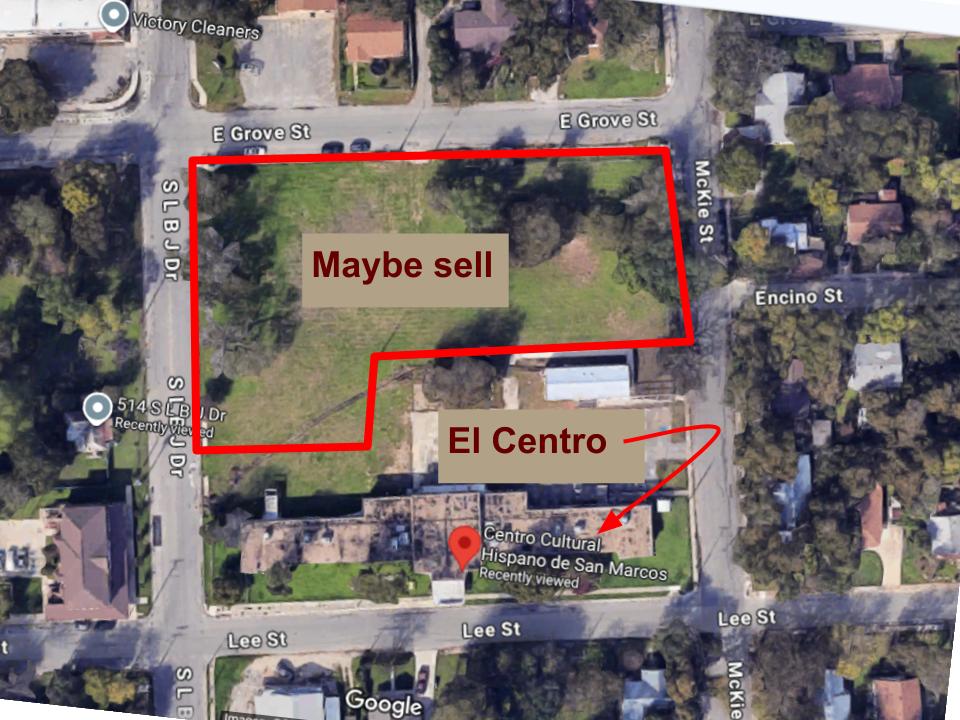
This new project is supposed to go here:
Right now it’s mostly parking lots:
But there are a few things.
These cute little houses are on Pat Garrison:
These dull buildings are on Comanche and W. Hutchison:
And this old D.R. Horton building:
which has since closed down.
There’s also a little hair salon Hair Solutions is on Fredericksburg:
but it’s not part of the project:
So it will be staying.
…
Here’s the thing: it’s not a terrible place for apartments! It’s actually pretty good.
It’s just a little obnoxious to revisit the same exact neighborhood and push more change so quickly. Give us a moment to catch our breath, okay?
…
Onto tonight!
Three people opposed at citizen comment.
Four people spoke against at the public hearing. The main arguments are that student housing is bad for students. Other arguments were made about traffic and character of the neighborhood.
Seven people spoke in favor, but six of those are working with the developer.
Here’s a key detail: they do not need permission from council to build an apartment complex. Here’s what they’re allowed to build right now:
Five stories
75 feet tall
All units have 1, 2, or 3 bedrooms
1 parking space per apartment.
Rent-by-the-Bedroom leases are allowed
They’re here to ask permission for two specific things:
They want the “Purpose Built Student Housing” status. This would letd them put 4- and 5- bedroom apartments in.
They want seven stories instead of five.
Here’s what they’re offering up, by way of concessions:
They’ll double the amount of parking they offer.
The height would stay at 75 feet.
This is the developer’s explanation of how they’ll fit 7 stories into a 5 story building:
I guess? Here, you know you’re waiting for this meme:
mm-hmm.
…
One key detail: P&Z was not amused. They voted it down hard, 9-1. This means that Council needs a supermajority to overturn the recommendation.
…
One more complication:
These two apartment complexes were bought by Texas State back in 2023:
They were both converted to dorms. Texas State doesn’t pay city property taxes, so San Marcos lost a ton of money from this – probably well over a half million per year. Everyone was royally pissed off.
So now, any time one of these apartments gets proposed, council wants to make damn sure that the developer isn’t going to turn around and sell it to Texas State.
….
Questions from Council:
Question: Will these be affordable apartments? Answer: Not really. If we’re allowed 4- and 5-bedroom apartments, they’ll be cheaper than 1-3 bedroom apartments. But we’re not going for affordable here.
Question: Will you charge for parking spaces? Answer: Yes. Not all our students have cars, so it’s not fair to them to include it with the rent.
This is the wrong answer! The developer wants to charge for parking spaces, because if they include it with the rent, the rent will be higher. They want to advertise lower rents.
But Council wants parking spaces automatically included with the rent. If students have to pay extra for parking, many of them will say “screw it” and just park on the street. Council does not want the streets clogged with extra cars.
Matthew Mendoza: Will you put the pool somewhere else, so that people at HEB don’t have to see it?
Here’s what he’s talking about:
I mean, that’s not keeping me up at night, but okay.
…
Wheeling and Dealing:
Parking: Should they make the parking fee included, and students have to sign an affidavit that they don’t have a car, if they want it waived? (Similar to pets.) Council members said they wanted to, but then no one ever made an amendment. So no.
Selling to Texas State: Saul asks for 15 years, or even 10 years? The developer says absolutely not.
What if we say 7 years, but we don’t start clock once it’s built and open for business? The developer says okay.
How many bedrooms per apartment unit? It will be capped at 5 bedrooms. In theory, 4- and 5- bedroom units are “attainable” in price, even if they’re not “affordable” in price.
Can we require a certain number of affordable units, in exchange for the extra stories? This is called a density bonus, and it’s a common thing. But for some reason, in our code, we’ve specifically excluded Student Housing from this incentive. So we can’t.
Pool: You’ve gotta screen that thing in! For our eyes. Good lord. (This amendment passes.)
…
Final comments:
Jane: It’s very walkable. I’m not crazy about the 5 stories. It’s not going to be affordable. But okay.
Matthew: I love our single-family neighborhoods. This will help keep students out of them.
Saul: I’m a no, because of the sale after 7 years.
…
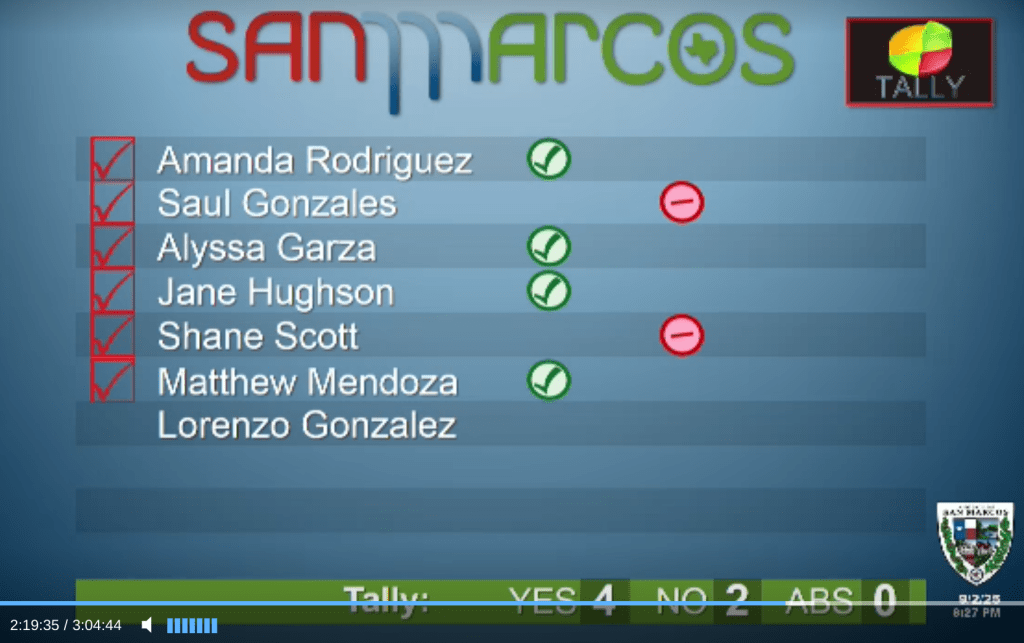
The vote:
Whoops. It FAILS!
Remember, P&Z denied this, so it takes 6 votes to overturn the P&Z vote. This ain’t that.
…
What happens next?
The developer pipes up: “I think we can agree to ten years after all!”
This makes Saul and Amanda both angry: “You’re playing games. You didn’t take us seriously when we asked if you could consider ten years. We’re still voting no.”
Finally it turns out that the developers misunderstood: they thought they weren’t allowed to sell the complex, period. But the city doesn’t care if they sell the complex – we just don’t want them to sell it to Texas State, or anyone else that is tax-exempt. The city just doesn’t want to lose the property tax income!
This is a much easier request! The developers are visibly relieved. “SURE!” they say. “10, 15 years, whatever. As long as we can close this out tonight.”
Council settles on 12 years from whenever it’s built and opens. So in practice, at least 15 years.
…
I’m combining two final votes into one here, but they went the same way:
So it will happen.
…
So: Are student housing complexes exploitative to students?
Basically, these companies play some legal ninjutsu. They avoid the word “lease”, because that’s a legal word with specific tenant protections. Instead, they offer “installment contracts”.
This is a big problem! This means that any time anything goes off-script, you’re still responsible for the entire 12 months worth of rent, ie $12k or $15K or whatever. Then, since they’ve got you over a barrel, they really do screw with tenants in ways that small-scale landlords just can’t do. Really, go skim through this post if you want to know the dirty details.
Nobody made any amendments regarding Tenant’s Rights, but it is on the strategic plan for this coming year.
…
Item 11: Speed limits!
This neighborhood is called the Wallace Addition:
They’re getting new speed limits!
Hopefully things are a little safer now for these folks:
It’s going from 30 mph to 25 mph.
Not that anyone is arguing with me on this, but here’s a nice graph showing how much safer pedestrians are when the car is going 25 mph vs 30 mph:
First, Texas state law says you have to do a traffic study if you want to drop the speed limit below 30 mph. So we did.
That last sentence is so interesting! So if cars were burning down these streets at 40 mph, we wouldn’t be allowed to drop it down to 25 mph? Maybe I’m misinterpreting it, or maybe Texas is dumb sometimes.
Item 16: Council Resolution Calling for a Palestinian Ceasefire:
Hooboy. Contemplating how to explain all this has me going like this:
But here we go!
Background
I cannot provide you with a 3000 year timeline of Israel. I’m just one tiny marxist blogger.
I also can’t provide a timeline from 1948 to the present day. We’d be here for months. Suffice it to say that there has been a lot of hatred and killing by everyone involved. But Vox attempted a timeline and a summary, if you’d like.
Here’s my summary: War is very bad, and Hamas and Israel should stop fighting one.
…
If I had to summarize the three positions in San Marcos, it would be:
Activists: Our federal tax dollars are funding mass amounts of killing!! This is horrifying. We must do something, even if it’s just symbolic.
Passivists: What on earth can little old San Marcos do? This is divisive. Council should stay in their lane.
The Backlash: We’re going to throw the word “anti-semitism” on any criticism of the war, and also drive up actual anti-semitism!
Let’s be clear on a few things:
The activists absolutely have the moral upper hand. The killing of the Palestinians, and leveling of entire cities is a moral black hole.
Actual anti-semitism is also on the rise! It’s a real problem! There is real anti-semitism, but calling for a cease-fire ain’t it.
The US is morally culpable in this specific war because we fund weapons for Israel, in a way that we don’t for other wars around the world. We’re not funding soldiers in Myanmar, Sudan, Ethiopia, etc in the same way.
(We fund Ukraine, but they’re not the aggressor, of course.)
…
Which brings us to today. Alyssa and Amanda put this on the agenda.
Here’s how it’s phrased: “A Resolution Calling for an Immediate, Permanent, and Sustained Ceasefire in Occupied Palestine, Arms Embargo on the State of Israel, Recognition of Palestinian Sovereignty and Protection of Constitutional Rights.” (It’s about three pages long, and you can read it here.)
The Activists: 37 people spoke in favor, and one more at 3 pm.
Therefore we have to do something. Even if it’s symbolic, it matters to the local Palestinian community and to the people showing up.
The Passivists: 17 people showed up against it.
This is an extraordinarily complex topic that has nothing to do with local politics, and City Council should stay in their lane.
The brutality of October 7th, and the remaining hostages have gotten lost in all this focus on Gaza.
I don’t know what kind of letters and emails Council got, because they weren’t included in the packet.
The backlash:
At the actual meeting on Tuesday, the speakers on both sides engaged in respectable civil discourse. However, I get the impression that there was an ugly backlash elsewhere. Here’s what I was told about:
Backlash #1, on Facebook:
Listen, when you threaten to call ICE on someone in 2025 for protesting about Gaza, you’re threatening to potentially have someone detained or deported without due process. That’s not civil discourse.
Backlash #2:
This is wild! Also very in line with Texas. (Did you know that all state contractors over $100K must sign a statement that they will not boycott Israel? Boycotting Israel is against state law, for anyone doing business with the state.)
To be clear: Donna Cambell is not our representative:
Jane starts by reminding everyone that this is just a discussion tonight, and not a vote on the actual ceasefire resolution.
Next Alyssa and Amanda state their cases. I kinda just want to let them use their words?
Alyssa speaks first:
As we begin discussion on the ceasefire resolution, I wanted to take a second – or several minutes – to clarify some things.
This resolution is rooted in the belief that all people deserve safety, dignity, and justice, under both US and international law. If the moral case made by so many today doesn’t move this body, then let’s talk about what this resolution means for local power and public resources, because both are under attack.
I’ve said this several times. Across the country, and right here in Texas, we’re seeing a coordinated rise in pre-emption laws, which are power grabs by higher levels of government, designed to silence local voices and override local control, and that should matter to all of us. And to all our neighbors. This isn’t speculation, it’s already happening, and this council and our city leadership have discussed it repeatedly. These types of laws are actively limiting our ability to govern in ways that reflect the needs and the values of San Marcos.
But it goes beyond this type of over-reach. We’re now seeing very real threats to defund cities, counties and non-profits – especially those who dare to push back – under the guise of reducing government spending.
So I just want us to be for real about what that means. Federal and state grants are being frozen or cancelled, including critical funds for infrastructure, climate resilience, and public safety. Field offices are being shut down in Texas and across the nation, agencies are facing steep cuts to programs that serve many of our residents, from emergency housing, to public health.
Here’s the important part that needs to be said: these threats to our funding existed long before we put this resolution on the agenda. Over the last four years, (and before, but I can only speak to the last four years), this body has worked diligently to strengthen relationships with the federal government, to bring millions of dollars in federal grants and resources for this community. The federal government knows this and is weaponizing this. That’s not just for us, that’s for everybody in our country.
Earlier – I guess technically yesterday – I met with nonprofit leaders across Hays who expressed that they’re terrified of losing more federal and state funding, and frustration that this is all under the guise of federal fiscal responsibility. These neighbors – the people who are doing this work – they are our neighbors. We know them, we love them. We know they are underpaid, overworked, and absolutely essential, yet their work is being politicized and threatened by federal government. And yet some folks who spoke today expect San Marcans to plead with that same government to rely on them to stop a genocide? They won’t even entertain the pleas of those who provide lifelines to people in our own country.
So perhaps if the federal government stayed in their own lane, and stopped funding the continued use of US weapons in violation of international law and humanitarian norms, we might have more money to provide to these lifelines.
On all fronts, caving to political bullies to preserve funding that again is already being stripped from communities across the nation is not leadership. It’s submission and we cannot like literally the numbers, we cannot afford to stay silent, not when silence means enabling intimidation and injustice. I echo the concerns of our neighbors that said, “You know, you were elected to serve San Marcos.” Our duty is to the people of San Marcos, not to the fragile egos of those who govern through coercion and fear.
Another point of clarity that I want to make is the resolution does not distract from local work. As elected officials, we must be able to walk and chew gum at the same time. (I remember a constituent emailed me that and it kinda stuck.) I and several of my colleagues have consistently been present in the community even without the support of city council staff, like we don’t get staff, designated support for constituent services, we’re like a one-person show, right? Even while juggling fulltime jobs, a lot of us, a family, and constant community presence, we do that, right? To further highlight this, I think it’s really important to name what sometimes our community doesn’t see. Or all members of our community don’t see – when state and federal systems fail us, we show up. Right? I show up. During the pandemic, I helped organize food distribution, PPE drives, Mutual Aid for San Marcos. When the county lost that super confusing and ineffective rental assistance program, it was people who came and spoke on the ceasefire resolution who rallied together to set up camp all over the city, with their laptops, to help their neighbors be able to apply, to prevent evictions. Right? And they were helped by current and past members of this dais. And also thank you to those who spoke tonight who also helped San Marcans navigate evictions and secure airship documents needed for our home rehabilitation program. Perfect example of someone with a law degree who uses that power and privilege to help our neighbors, instead of threatening to call federal law enforcement on them. During the winter storm, when our state failed to keep the lights on, who showed up? We showed up. We partnered with unlikely allies to distribute drinking potable water, get warming busses to the east side of San Marcos, and a lot of us, even those of us that weren’t elected and a lot of those who have come and talked about the ceasefire resolution – we showed up to do all that.
So if anything – and this is for those who kept like emailing and just really trying to express that we should focus on local, not let this distract from local work? – I think this resolution is entirely consistent with how I’ve always shown up, practically, compassionately, and rooted in real care for this city, even when it’s not in my lane, especially when it’s an emergency, and this work that a lot of us did, went on to shape several city and county policies reforms or services that benefit us all. I share that to illustrate that all our priority is san marcos, getting policy change requires hard work and imagination that we all do, and when you just read the charter it doesn’t say to do all that, right? it says “Stay in your lane!” But anyways, I think that’s really important to name, and what else?
This is really important. This resolution didn’t happen on a whim. It was brought forward after over a year of reflection, dialogue and listening. Again, it draws on international human rights, echoes values that are rooted in our constitutional rights, including free speech.
I won’t apologize for centering human dignity over political convenience. I won’t apologize for fighting to protect local power, and for asserting that supporting this ceasefire resolution is one way that we reclaim this power. And I also hope that this has helped our local leadership and neighbors begin to recognize interconnectedness of it all, because this isn’t just about this one resolution or one issue, it’s about the broader pattern of overreach, and we should all be worried about that, where those in power – namely the state and federal government, use fear, funding threats, and red tape to control, not just what we can say, but how we’re allowed to care about it. It’s clear to me that when they fund bombs but cut aid to housing and education, that’s connected. When they silence protests here, and crush dissent abroad, that’s connected. When they defund local governments and nonprofits, and they call us distracted for standing up, that’s absolutely connected, it’s to keep us divided, distracted, and disempowered so that they can keep consolidating power. I see the pattern. I think a lot of folks who spoke and emailed see the pattern. We have seen the pattern when we talk about how this pre-emption is going to impact our daily operations, so yeah. I won’t apologize for naming it, even in the face of threats aimed not only at our community, right? So senator Donna Campbell’s letter? But also my person, my physical safety, my family, and those that I love – yeah.
I will continue to resist because my abuelo reminded me on his death bed: Si Dios con nosotros, ¿quien contra nosotros? And that’s all I got, because then I’m gonna cry, you don’t wanna see that.
Amanda goes next:
Thank you all for being here. I’ve spent the past 3-4 days trying to write something down to bring this item forward in a way that does it justice. But after watching this livestreamed for over a year, I don’t know if there’s a word for it. On Council, we’ve been getting a wide range of emails. Many in support, but some threatening.
I’m not interested in being a politician who can only extend care within the geographical boundaries that I represent. That is such a conditional level of care, and if that’s the kind of politician you all want, I am not that. My term is over in 3 years. I will never be that.
This is not a political issue to me. This is a moral issue. This is the moral litmus test, for many of us.
I want to talk about a little girl who has stayed in my mind, for over a year.
Amanda goes on to describe a girl who was killed so brutally, along with her family, that pieces of her body were found hanging off the wall. (This is Sidra Hassouna.)
And people came here today to invoke God and religion to justify that? I think what breaks my heart is that I hope we’re really not that lost as a society, to where something like Sidra Hassouna’s death is okay, is justifiable. I’m not the most spiritual person in the room, never professed to be. But I’ll tell you: the God that I serve is not okay with that. You should feel shame invoking God as a reason to justify that.
Our tax dollars are literally subsidizingover 70% of this genocide. We meet people every day, they come to this dais, and they say “We can’t afford housing. I can’t afford to take care of my kids.” You go to the schools in this school district, the kids are literally waiting to get to school to eat their first meal. Where have we gone wrong, in our society? Where are our priorities?
I don’t mind being a pariah on this body, if it means standing up for what is right. I’ll be honest with you, and for all the people who have been calling my phone, threatening me, my life, threatening deportation, even though I’m a US citizen, calling me a terrorist, calling me this, calling me that. My own mother is not able to sleep at night, because she’s so worried as to whether somebody’s going to pull up to our house, because I’m literally asking for children and civilians to stop dying? to stop being killed?
I’m so desensitized to death, in a way in which I have learned more about death through my screen than I ever thought I could. I have seen children’s bodies lined up – and I’m not talking two, I’m not talking three – I’m talking 10+ bodies lined up, next to one another. And their pants are stained with pee, because they took their last breath.
And people are coming here to me today, with this whole argument, trying to make me convince y’all whether this is a local issue? My colleagues. Saul. You have grandchildren. Two of which are literally the children of my best friend. I held one of them in my arms the other day, and the entire time I thought, “I have seen so many lifeless bodies the size of theirs.” That is wrong.
It was mentioned, “What about the genocides elsewhere?” First of all, free the Congo. Free Syria. Free Puerto Rico. Free Cuba. It’s the same energy for them all. I want to read a quote. This is followinga massacre at Khan Yunis(one of many) on December 15th. This is someone who witnessed literal tents in a hospital being bombed. They said, “Shrieks of rage and grief, coupled with the smell of burned flesh. The only light is the roaring fire in a room of motionless bodies. Those who are left to witness are not the lucky ones.” You have people wishing for death. Because to die is better than to live in the situation that we have helped create.
This isn’t some natural disaster. This is a man-made atrocity. And we are fully subsidizing it.
I have seen doctors who are literally traveling from all parts of the world – including this country! So clearly people of this country can realize this is our fight, too – they describe children who have literally had a bullet sniped through their heads, through their hearts. And for my people who have been in the military? You know how much intentionality it takes to not only set yourself up, look through a scope, and then look at a child and pull that trigger? And we’re not supposed to care about this? Because it’s happening elsewhere?
I’m sorry. But when people on this body go and ask for people’s votes – which you will! – and when you profess to them that you care about them, that you want to see a better livelihood for them, that you want them to be able to take care of their family: all of that is for the birds, if you don’t support this.
This government is choosing not to do those things for our people, in order to fund this. So if somehow, some way, you are so not able to comprehend this on a humanity level? Don’t go and lie to our people, in this city, and say you care about those things. Don’t do it. And I will say, I will actually use a quote by the Israeli Defense Minister,Yoav Gallant, to help people understand how – similar to an email that we all recieved, I know you all probably read it! from a well-known person in this community, but I’ll do her a favor and not call her name out. But referring to Palestinians as “terrorists”, “rapists”, “killers” – he also used that same language. He also said, “We are fighting against human animals. Gaza won’t return to what it was before. We will eliminate everything.”
I appreciate the people who brought up the hostages tonight. I too want to see the hostages returned. But I don’t know how you expect that to be accomplished, with indiscriminate bombing. It was never about the hostages. There was an opportunity, and there have been many opportunities, you have the families of the hostages praying to their own government, saying “STOP. You are going to kill our loved ones.” The bombs don’t sit there and fall and say “oops! let me turn around, that’s a hostage under there!” They hit them, too. So if you care about the hostages, you support a ceasefire.
And I’ll just be quite frank. For all of my friends that are Jewish, who didn’t come here tonight, because of the fact that there has been such a conflation with this resolution being compared to anti-semitism: this resolution explicitly asks and acknowledges both the release of the hostages as well as being absolutely against anti-semitism. But I will say: you cannot tell me that Judaism, as a religion, supports this. Jewish people are not monolithic. That’s why so many people in Israel have spoken out against this. That is why so many people refuse to enlist in an army that is perpetuating a genocide. They don’t want to be a part of it, either.
So I just, I really plead with y’all. It’s been over a year. I sat on that dais a year ago. And I asked each of you, (with the exception of Lorenzo and me), I stayed until a little after the time we’re at now and I asked you explicitly: If a resolution came before you tomorrow, who would support it? For the crowd’s knowledge – and this is on video! – Councilmember Scott and Councilmember Saul Gonzales both raised their hand. They raised their hand.
And so I hope you all would do right today, because I’m telling you, it’s getting more hellish by the day. I don’t know what threshold you all expect us to be okay with. But I’m not okay with this. If I had an opportunity – let’s take it back to the holocaust! – and I was sitting on a city council in America? I would have said the same thing then. Because any genocide is wrong. It’s wrong.
So thank you to the organizers who came, thank you to all the people even who may have come here in opposition, who are able to have conversations with organizers and admit, “Man. I learned something.” I know this may not be favorable to everybody, but this position on this council does not mean more to me than knowing when I go to sleep at night, I did everything I could. Thank you.
…
Council discussion
It is well past midnight at this point, and there is very little Council discussion.
Lorenzo asks about amendments? What’s the best way for everyone to share amendments to the ceasefire resolution? They kick around how best to draft and share amendments.
Several councilmembers express regret that this conversation occurred during Passover – that was not intentional.
Jane Hughson quotes Kirk Watson, from last year when the Austin city council considered a ceasefire resolution:
“The proposed resolution of the Austin City Council will not realistically end the violence on the other side of the globe. Nor will it stop federal taxes from being used to implement foreign policy. That is not in our power. The resolution, however, has the power to divide Austin, and will.”
Jane makes two main points:
We can’t do anything that makes a difference.
Why this one war, and not all the others?
To the first point, Jane and Amanda quibble about whether this makes a difference or not. Amanda argues that yes, it’s symbolic, but it matters to the local Palestinian community. And after all, activists have been showing up for over a year. Clearly it matters to them.
To Jane’s second point: I mean, this is the only current war where the US is funding the aggressor to this extent. It is uniquely different.
The vote: Do we want to discuss this further?
Yes: Lorenzo, Alyssa, Amanda, Saul
No: Matthew, Jane
I’m Stuck on the Fence: Shane
But four is enough!
So this will come back. Stay tuned.
…
Question and Answer from the Press and Public:
Four people stuck around to ask questions, at 1:00 am in the morning:
Will amendments be made public?
Were any of the councilmembers lobbied by rightwing organizations?
We need a new city hall. Ours was built back in the 1970s, when San Marcos had 25K people. It’s falling apart and tiny. (Discussed in 2022 and in 2024.)
The big decision for today: should we build it on the north side or south side of Hopkins?
And here’s where the controversy kicks in. Here’s the city’s versions of those two spots:
Zooming in on the north parcel:
So this is the crux of the controversy – what happens to the skate park and dog park? The city posted about this to Facebook, where it blew up.
…
Citizen Comment: About 12 people show up to defend the parks. This is actually a huge number – both because this is a workshop, and because it’s at 3 pm on a Tuesday.
About halfway through, City Manager Stephanie Reyes breaks in and says:
Early on, consultants talked about maybe moving the skate park and dog park. But listen: We are NOT recommending moving the skate park! We really are not. The dog park, maybe. But definitely not the skate park!
I don’t know how this grew legs – it was just a committee discussion. This wasn’t concrete plans to move the skate park! Anyway, we hear you loud and clear. No one is moving the skate park.
And in all the drawings – like above – and even in this very presentation:
So anyway, the community uses the skate park really heavily. City staff heard many, many comments about how much everyone loves the skate park.
The skate park will NOT be moved. Great!
…
Confidential to council: Seeing how heavily it is used, you could even expand the skate park! That would be pretty popular. Add some bathrooms and shade?
…
Ok, now that the skate park is safe, what is the presentation about?
The steering committee has been meeting over the spring. They’re inspired to bring the old razzle-dazzle:
Sugarland, Wylie, Southlake, and Frisco are all bringing it.
…
So back to the two parcels:
This area has the river, lots of railroads, and Hopkins running through it:
So there are some challenges. Like flooding:
And finicky rules, like this purple part:
The purple part is dedicated park land. In order to build a razzle-dazzle City Hall, you have to have a Public-Private-Partnership. In other words, it’s a city hall with some stores, or coffee shops, or sell some city land to a developer to do whatever.
But the city needs voter approval on the purple part. Since it’s parkland, it stays public unless the voters approve letting private companies use it.
See that little blue square in the middle? It is not dedicated parkland. It’s more flexible.
It used to be the Armory Building:
That’s Google Maps, from June 2013.
Here’s April 2014:
And here’s June 2015:
Going, going, gone!
So that little field already has voter approval – that was dedicated back in 1959. We could put a private company there, without voter approval.
(I don’t like that option.)
….
How much will all this cost, anyway?
So the cost is the same, either way.
There are still plenty of decisions for the future:
Surface parking or underground parking?
Public-Private-Partnership or go it alone?
Where would Council temporarily relocate, if we went with the south side?
Would it be a beautiful gateway on the North Side?
Here’s what the Advisory Committee said:
Here’s the summary of pros and cons:
The Advisory Committee settled on the North Parcel, but still felt good about the South Parcel:
…
So what does Council think?
Matthew: North side!
I’m a neighborhood man! My main concern is drainage. Water runs into Rio Vista neighborhood. Put City Hall in the north side, and install a state of the art drainage system in.
I like the idea of a Civic Corridor, with City Hall, the library, the activity center, and the parks all in a row.
Staff clearly states that the drainage will be all new, on either side.
Jane: South side!
I do like the idea of a big Northside Gateway.
Let’s do two uses: Keep all the business uses on the south side. The public only comes here for birth certificates and developers. On the north side, add some more recreational uses that complement the dog park and the skate park. Restrooms, improvements, etc.
Make the south side entrance more prominent, though.
The north side really does flood, too. Do we want our new City Hall to get flooded? The railroad forms a dam on the back side.
Note: I agree with Jane!
Lorenzo: Is structured parking going to drive up the cost? Answer: Yes, but it’s probably off the table either way. Underground parking will flood. Parking garages are expensive.
Amanda: I’m freaked out by the price tag, and prices are only going to go up. I’m with the Mayor, here.
Shane: I like the North Side because I like new construction! The old one looks dreary and old.
Amanda: The north side loses the dog park, unless you pay a huge price tag for a parking garage. City Manager: We have options for relocating the dog park . This will free up the Parks and Rec building and possibly the land near the Veteran’s Memorial. So the dog park would stay in this same corridor.
Saul: Are the structural problems of the current building caused by the train? That’s my concern with the South side. Answer: Yes, but current architecture would be built to deal with that.
Lorenzo: If we build on the South Side, would we actually improve the north side? Answer: Depends what kind of partnerships we can build. That’s Phase II.
Alyssa: I’m voting for the North Side.
Lorenzo and Matthew are really determined to make an economic argument that really isn’t there. They keep guessing about demolition costs or whatever. City staff keep gently correcting them – no, those costs are very small, relative to all the design decisions yet to come.
…
My two cents: The north side is a terrible idea. Really.
First: You don’t get more park land in town. This is it. Don’t use it up.
Second: a massive number of people turned up to defend the skate park. A giant, razzle-dazzle building will loom over it, literally. It will change the vibe. A skate park is not going to feel the same if it is nestled in the backside of a flashy new business park.
Build up the park side for the people! Add bathrooms, add water refill stations. Rebuild the business half of City Hall on the south side.
…
The vote
North Side: Shane, Matthew, Lorenzo, Alyssa
South Side: Saul, Jane, Amanda
Honestly, I was surprised by this! The steering committee was lukewarm in their recommendation. Their decision reads as “Both options are good, but I guess we tip towards the north.”
The public, then, said cried out, “We feel STRONGLY about keeping the north side as park land.”
And council went with the advisory committee??
…
Q&A from the press and public:
Even knowing the skate park will stay, people are pretty angry! No one seems to like this decision.
I love the skate park. Why was there no representation of the dog park or skate park on the steering committee?
Time line? And will you still push for recreation?
A big building with concrete and fountains is not usable by the public the way the current corridor is.
I have thoughts but not a formal question
I don’t buy the economic argument and I don’t like going with the decision that doesn’t inconvenience you personally.
How does having a flashy new building benefit the citizens of San Marcos?
Why not have the Gateway be beautiful parkland over a flashy parkland? The foundations and drainage, why not address that?
How do we get on this committee? What’s up with this committee?
Short and sweet this week. Some charter suggestions, Flock cameras again, and a new development down by Trace. Also some great workshops, and a short note about Jim Garber.
Let’s go!
Hours 0:00 – 1:19: Literally only three items! Charter Review suggestions, those Flock cameras, and a new development down by Trace.
Bonus! 3 pm workshops: This is where all the action is! Bikes, e-scooters, and how much work goes into keeping our river happy.
A short tribute: Jim Garber passed away this past Monday, and I want to say a few words. We knew each other before I started blogging, and he was probably the first person to figure out who I was on here. And then I turned around and gave him a hard time on the blog! On more than one occasion!
We emailed about it, and I sheepishly thanked him for being a good sport. His response was, “No problem. Healthy discussions with all viewpoints are what moves us forward. Keep up the good work!!!”
That’s the kind of lovely, good-natured person he was. He believed in honest discourse, which is a value I deeply share. He believed in fighting hard for what you believe, but also doing so with a light, good-natured touch. He was on P&Z for over a decade, and knows how P&Z works probably better than anyone in town. He’s been on probably on a dozen different short-term committees. He worked hard and shaped this city, but he did it while being quick to kid around and not take himself too seriously.
I’ll miss him for sure. May his memory be a blessing.
The Teacher Re-Use Center, a non-profit that is housed in a city warehouse, and sounds kind of gigantic in scope
A potential new neighborhood: The Villages on Posey.
This had the most speakers. So, the San Pedro cemetery is right next to Trace Development. It was vandalized in 2003, possibly out of racism. Following that, some researchers at Texas State (like one of the speakers, Dr. Ana Juarez) started doing community-based research there, and the cemetery was designated historic cemetery a few years later.
Now some developers want to build a neighborhood next to it. But – plot twist! – they were good neighbors! They reached out to the cemetery board and made friends.
The developer has offered $5000 for the cemetery, to pay for restoration and damage from cars. The cemetery would be part of the plans moving forward. So these representatives from the cemetery board are here to speak in favor of the development.
More on this in Item 19!
…
Item 1: Charter Review Committee
Every four years, we form a Charter Review Committee. They’re supposed to comb through the City Charter with a fine-tooth comb, and offers up suggestions. Then Council decides which suggestions should go to the voters, and which suggestions should get deep-sixed.
The committee was formed in January. They’ve met weekly since then. Today we’re getting a soft launch of their suggestions. (The actual formal suggestions will come in May.)
Note: Jim Garber was the vice-chair of this committee. The chair, John Thomaides, took a moment to say a nice tribute to Garber, about his contributions and the difference he made here.
…
The Interesting Recommendations:
1. Mayor Term Length: Right now, the mayor’s term is two years long. They can serve four consecutive terms, and then they have to take a 2-year break before running again.
CRC Recommendation: – Mayor serves four year terms instead of two year terms. – After two consecutive terms, they have to sit out a cycle before running again.
Jane did not like this. She’s long been on record as saying that the mayor ought to have to get re-approval from the voters every two years.
2. Single Member Voting Districts.
CRC Recommendation: Neither yes nor no. Instead they recommend that council studies the issue and educates the public and take some time, instead of throwing it on the ballot.
This is a good approach. I’m also torn on this issue
3. Council members attending meetings over zoom. Right now council members can attend by zoom, whenever they want.
CRC Recommendation: Council members get a max of 3 times to zoom in, per year. (With some excused reasons, but I don’t know what those are.)
I don’t know. Are council members more effective in person? Absolutely. Is zooming in better than missing the meeting altogether? Also yes.
Look:
If you think council members are punks who sometimes zoom in for bad reasons, then yes, cap it at three.
If you think council members are legitimately constrained by second jobs, or kids, or illness, or responsibilities, then you should trust that they’re zooming in for good reasons.
We already have a lot of barriers to running for office. Parents, people with disabilities, people with difficult schedules: it’s almost impossible to be a council member. I don’t think we need more obstacles.
Plus, look: if we do have a punk council member who zooms in for funsies, we can vote them out. It’s a democracy. So I think I’m a no on this one.
4. City Council Meeting Minutes
CRC Recommendation: Meeting minutes from each council meeting must be approved in the following council meeting.
Ha. HA. HAAAA. Council has not approved any meeting minutes since May 2022. It’s been almost three years! (I’ve mentioned this before, and before that.)
It’s super annoying! Right now, if you want to find out what happened, you have to go listen to the actual meeting. It takes forever.
(I mean…maybe not having minutes posted has been a little good for this blog? I get to be the sole documentarian, in the absence of minutes.) But anyway, yes to this.
5. Referendum petitions
CRC Recommendation: – Increase the time allowed to file a referendum petition from 30 days to 90 days. – Increase the time for city to verify petitions from 45 to 60 days. – Require a form for financial disclosure for referendums and initiatives.
That last one is AMAZING. Yes, if we’re voting on something, I would love to know who is funding it.
(The first two are good, too.)
Less interesting, but still good
Public Notifications: Right now, the city must notify the public by placing a notification in a public newspaper. Recommendation: Let’s also put notifications on the city website and social media.
Council is required to meet at least 22 times per year. Recommendation: Reduce the minimum number of council meetings from 22 to 20 per year. This just builds in a little extra flexibility for November, December, and January.
Printed copies of city code or ordinance are available for purchase, at cost. (Or free online.)
Reduce residency requirement for P&Z from 5 years to 3 years.
Shuffle around the naming of sections to gather the ethics-things under an “Ethics” section.
Those all sound fine with me.
…
They only somewhat align with the Council suggestions for the committee:
But that’s good – it shows the committee was independent. And Thomaides promised that they really did unpack all those suggestions to death.
“Not so fast!” Council cried. “This has major privacy implications!”
Council decided to hold a review of the privacy policy first, and delay the purchase of the 30 new license plate scanners. Chief Standridge was peeved.
So in March, council reviewed the privacy policy. Chief Standridged tightened up a lot of the loose gaps. It’s not perfect, but it’s much better.
So now the camera purchase has come around again. May SMPD please purchase these 30 license plate scanners now? Pretty please?
“Not so fast!” cries Amanda. “We tabled this item until June. It’s only April.”
Everyone looks at the lawyer, who says, “Yes. I went and watched the video several times. You all voted to postpone until June.”
Lorenzo: “Who cares? We delayed for the privacy policy, and we got the new privacy policy. Why not just do it now?”
Amanda: “Well, the media picked it up, and so the public is under the impression that it will come back in June. If anyone wants to participate in the process, they’re operating under the assumption that they have two more months.”
Jane concedes that she also cares about this.
Question: Will the price go up in June? Answer: nope, same price.
The vote: Re-postpone the cameras until June, like we said we would?
Yes: Everyone
No: No one.
Let’s be frank: Is this really about the people who’ve penciled JUNE in their calendar to show up and protest these cameras? Or is this about slow-playing Chief Standridge?
Tomato/tomato! ¿Por qué no los dos?
…
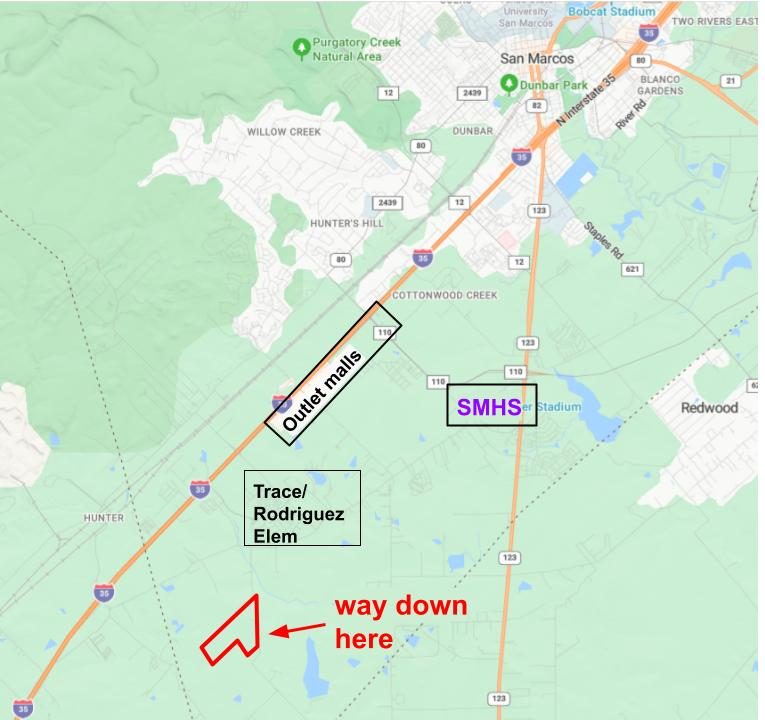
Item 19: The Villages At Posey Road
This doesn’t exist yet, but it will go here:
(We also saw this property back in 2022.) They want to be a PID.
What’s a PID?
PID stands for Public Improvement District. The developers want to make this a PID. What that means is that the houses in the PID all pay a little extra tax money, and that money gets used on the roads and infrastructure for that specific neighborhood.
(This is WAY better than a TIRZ. Kissing Tree is a TIRZ, not a PID, which is why we are giving $1,288,406 to Kissing Tree this year. With a TIRZ, the developer basically says, “hey, what if the fanciest, wealthiest neighborhoods were subsidized, too? We could make them even fancier then.” I’m not kidding about how they work.) (TIRZ stands for Tax Increment Reinvestment Zone, if you care.)
We haven’t had any PIDs in a decade. Trace, Whisper, and La Cima were all approved for PIDS around 2014. After that, council decided not to make any new PIDS until two things happened:
Update the Comprehensive Plan
City decides there is a need for incentives for residential development.
The comprehensive plan (Vision SMTX) was finally approved last fall. Tonight they’re deciding if they want to reboot PIDs with these guys.
So what would this PID be?
Some sort of planned neighborhood community. The details haven’t been hammered out.
Price Tag to the City: Will it bring in taxes that pay for itself, over the lifespan of the infrastructure and future repair? How much will it cost to extend roads, utilities, on fire and police coverage, on water and wastewater?
Housing stock: How long will it take to build? How much housing will it provide? What is the forecasted housing deficit at that point? Is it targeting a price-point that serves what San Marcos needs?
Environment: Is it on the aquifer? Is it in a flood zone? Will it create run off into the river?Are we looking at sprawl? Is it uniformly single-family homes?
Social: Is it meaningfully mixed income? Is it near existing SMCISD schools and amenities?
The San Marxist Special: Is it a mixed-income blend of single family houses, four-plexes, and eight-plexes, all mixed together? With schools, shops, restaurants, and public community space sprinkled throughout? Is it walkable?
You know what I’d go for.
What’s this about a cemetery?
The San Pedro Cemetery is right next door:
This is an old cemetery that served the Hispanic community, especially when other cemeteries wouldn’t bury anyone who wasn’t white. Like I mentioned above, it was vandalized in 2003, and then kinda had a renaissance. It got designated as a historic cemetery and people care about it. (Saul has mentioned how most of his family is buried there.)
The developer wisely reached out to the cemetery board ahead of time.
Here’s how I imagine the conversation going:
Developer: “Hey there, San Pedro Cemetery Board! What would it take to get you on our side?” San Pedro Cemetery Board: “We’ve got a wish list of maintenance and restoration projects. Would you like to fund some of them?” Developer: “We sure would!”
But that’s good communication and collaboration! This is how you keep friction from developing in your working relationships. (Probably both sides were a little more polite about it.)
So the San Pedro Cemetery will be included in the PID.
Council decides to send the whole thing to a PID committee. More to come.
The League of American Bicyclists hands out awards. We’re bronze! We’ve been bronze since 2018, actually. But we were renewed!
Overall, Texas is mid.
It takes a fair amount of work to get this designation. Along the way, we got some survey data:
They also gave us a report card:
Ouch. Hmm. Maybe I don’t know what “bronze” actually means. That we’re trying?
They included 17 recommendations. We’re a work in progress. Read ‘em all here.
Council asks a few questions: – Bike incentives? Access? (no) – Do we reach out to businesses? (no) – Demographics of survey responses? (no)
I’m being pretty negative, but the city is doing good work on a shoestring budget.
Remember: on average, it costs about $1,015/month to own a car, whereas it’s about $29/month to commute by bike. San Marcos is full of people who might prefer to bike – but only if it feels safe, and only if they actually have a bike.
You download an app, and it tells you where the closest one is, and you can rent it and ride around the Scooter Zone.
Originally they were contained to this blue area:
Last May, the Scooter People asked if they could grow. So we gave them a 9 month pilot period to extend to this region:
Also we allowed them to become 24/7. Before, they shut down overnight.
So how did the pilot program go?
There haven’t been any incidents!
Everyone is fine making that region permanent.
Would we like to fire up a new pilot region, here?
Sure.
One final note: Are these actually affordable?
It costs $1 to unlock, and then $.30 plus taxes per minute. So let’s ballpark that it costs $6 for a 15 minute commute. That means that one daily trip would cost about $360/month.
That’s actually kinda pricey. Still cheaper than owning a car, but not, like, frugal.
…
Workshop 3: Edwards Aquifer Habitat Conservation Plan
Okay, this topic is always fascinating.
So back in 1991, there was a lawsuit by the Sierra Club against the U.S. Fish and Wildlife Service. The Sierra Club sued for neglect under the Endangered Species Act. Their case was that if the Edwards Aquifer drops too low, then the endangered species in the Comal and San Marcos rivers could go extinct. And they won!
So the Edwards Aquifer Authority was created, and they got some legal power. This is important!
Probably some of you know all those names, but Jane’s jumped out at me. Good on her.)
Here’s the key: The EAA is allowed to cap much water gets used, and they are allowed to charge organizations to use the water. They sell credits to San Antonio, New Braunfels, San Marcos, Texas State University, Kyle, and so on. Then they use that revenue to fund conservation measures.
Today’s presentation is on the Edwards Aquifer Habitat Conservation Plan, or EAHPC. This is how they actual take care of the rivers.
So what do they do?
SO MUCH! They spent about $10 million on San Marcos alone.
They do a bunch of underwater gardening, to make sure there’s enough habitat for the little endangered fishies, and also the endangered wild rice:
They fence off the spots where the bank is getting eroded and trampled to death, and nurture it back to life:
That photo is just upstream of the falls. It’s as if you’re standing on the island with the big cypress trees, looking back towards the bank.
They hire people to go spear-fishing for non-native species:
The one on the left is those little sucker-fishes that people put in their aquariums to eat the algae and keep in clean. The one on the right is tilapia.
Council asks: what happens to the fish? Answer: The guy who does the spear-fishing holds a big fish fry and serves tilapia fish tacos, down at Ivar’s river pub.
Council: What about the sucker-fish? Answer: Don’t eat those. Gross.
But also: the San Marcos Discovery Center has a fish shelter! Like they’ll take your old fish if you don’t want an aquarium any more, and if you are getting started, you can go adopt fish for free from them.
Don’t dump your old fish in the river, everybody. Take them to the fish library.
…
What else?
They pay for scuba divers and snorkelers to collect trash out of the river, twice a week, all summer long:
They keep those red bobbers around the wild rice and sensitive spots:
They put the big limestone rocks in at certain river swim spots, and then fenced off a bunch of the other spots:
In other words, they were like “Let’s contain the swimming to a few really great swimming spots, and not worry about vegetation there. Then we’ll protect the rest of the river for vegetation.”
Also the limestone rocks keep the bank from eroding.
They did a bunch of stormwater detention that keep the nasty stuff from running into the river:
and they also fixed up Sessom’s Creek:
…
I mean, let’s pause here. This is wild, right? This is the Edward’s Aquifer:
Everyone in that dark blue region would just be draining the aquifer dry, if the EAA wasn’t around. Instead there’s been this massive coordinated effort, resulting in $10 million worth of projects to protect our river?!
That’s insane and beautiful. You’ve got to cherish this and really breathe it in.
(Especially during this larger dark time. I hope this program is not dependent on federal funding.)
…
But wait, there’s more! You can’t hold these deals back!
The scientists study and monitor all the endangered critters:
They scoop them up and take them on field trips, over to McCarty Lane or down to Uvalde:
That way, if there was a massive natural disaster or chemical spill or something, they could re-introduce the species after the river was healthy and cleaned up again.
…
What’s next? The current EAHCP plan runs from 2013-2027. So it’s about to expire, and they’re mapping out the next one to run from 2028 – 2058.
They’ll do a lot of the same stuff – make sure the river stays flowing, make sure the people don’t destroy the environment, make sure the endangered species are still paddling around in healthy numbers. But they’ll also have to respond to a hotter, drier world, which makes this all harder.
There’s some technical details to the new plan, and honestly, you should just watch the whole presentation here. (Or read all the slides here.) 10/10, no notes.
Cape’s Dam is BACK, baby, and we’re going to unpack it all. Also a bunch of shorter items: the budget, the SMCISD stormwater waiver, council compensation, Redwood, and the privacy policy for the SMPD license plate scanners.
Here we go!
Hours 0:00 – 2:50: Some small zoning projects, the budget policy statement, and a bunch of follow-ups: the SMCISD stormwater waiver, council compensation, and the septic problems in Redwood and Rancho Vista.
Hours 2:50 – 3:56: Nothing but Cape’s Dam, coming at you 24/7, baby! Let’s dive deep.
Bonus! 3 pm workshops: Downtown improvements and license plate readers. We’ve got a new privacy policy for the latter.
Malachi Williams: Seven speakers, including family members. They want justice for Malachi. Several of the speakers focus on the detail that Malachi ran because a cop pulled a gun on him. Before the videos were released, this detail wasn’t mentioned. It shows how the officer escalated the situation instead of de-escalating it, which then ended in tragedy.
Human Services Advisory Budget funding: Council is thinking about increasing HSAB funding for next year. Three speakers advocated for this.
Cape’s Dam and the Mill Race: Two people talk about how much they love the river, east of I-35 and want council to keep it. We’ll unpack all of this!
Tenants’ Bill of Rights: The San Marcos Civics Club made this a focus, and got Council to put this in their visioning statement. Now council will need to make it happen. Two speakers focus on this.
Ceasefire in Palestine: four speakers. They still want the city to pass a resolution calling for a ceasefire in Gaza.
…
Onto the meeting!
Items 1-4: A bunch of audits and investment reports.
We got the audit reports for CDBG funding and the 23-24 fiscal year. Plus the quarterly financial report and investment report.
Everything looks normal. No rude surprises. (Apparently we’ve gotten awards for excellence for the past 35 years, on our yearly fiscal audit. OH YEAH BABY.)
…
Item 18: Rezoning about 15 acres
This property is way up north:
Back in 2020, we annexed this yellow and pink bit:
The yellow was zoned Manufactured Home, and the pink was zoned Light Industrial.
There were some concerns then – do we really want to make the folks in the mobile home community live right against an industrial park? But we let it ride.
Now the pink part is coming back for a rezoning – they want to switch it from Light Industrial to Manufactured Home. In other words:
Great! Now nobody has to live near an industrial park.
…
Item 20: Budget Policy Statement
We’re working on the Fiscal Year 26 budget.
First: There was a two days Visioning workshop in January, which lead to approving the Strategic Plan.
The nex workshop was at the end of February. Today we’re approving the thing from that: the Budget Policy Statement.
What’s a Budget Policy Statement?
This is like the guard rails for building the budget over the summer. Most of it is pretty dry? Like “Do you want to budget to maintain 150 days worth of recurring operating expenses in the budget, or just 90?” “Are we okay using the General Fund for Stormwater projects over $5 million?” Etc.
There are two interesting bits:
Each year, the city sets the rate for electricity, water, sewer, trash, etc. To do this, they have to predict what their costs will be. Then they pick a rate that will cover all their costs.
From the Budget Policy Statement
What does this mean? If your utilities get turned off, you have to pay extra late fees to get your utilities back on. All of the late fees, taken together, add up to big chunk of revenue.
The question is: Suppose we are predicting that we’ll bring in $100K in late fees. (I’m making that number up.) Should we use that $100K to lower the rates for the rest of the customers?
Argument in favor: It’s more economical to include the late fees in your calculation. It allows you to set lower rates for the whole city.
Argument against: It’s kind of icky to count on late fees, for two reasons. First, you’re charging your most desperate customers – the ones who already can’t keep up – an extra fee, and then using that fee to help out all the other, less-desperate customers.
Second, it creates an incentive to creep up your late fees over time. When budgets are lean, it’s tempting to lean on late fees as an extra source of revenue you can tap, like cities that ticket their poorest residents into oblivion in order to balance their budgets.
The current council has already been going in the opposite direction. They are already trying to lower the late fees, to make it easier for residents to get their electricity turned back on.
To the original question: they decide that we are not going to use the late-fee revenue in computing utility rates. Then, when late fees come in anyway, they’ll put that money towards the Utility Assistance program.
It’s a small touch, but a good one.
2. Here’s the other one worth paying attention to:
This is what the speakers during Citizen Comment were talking about.
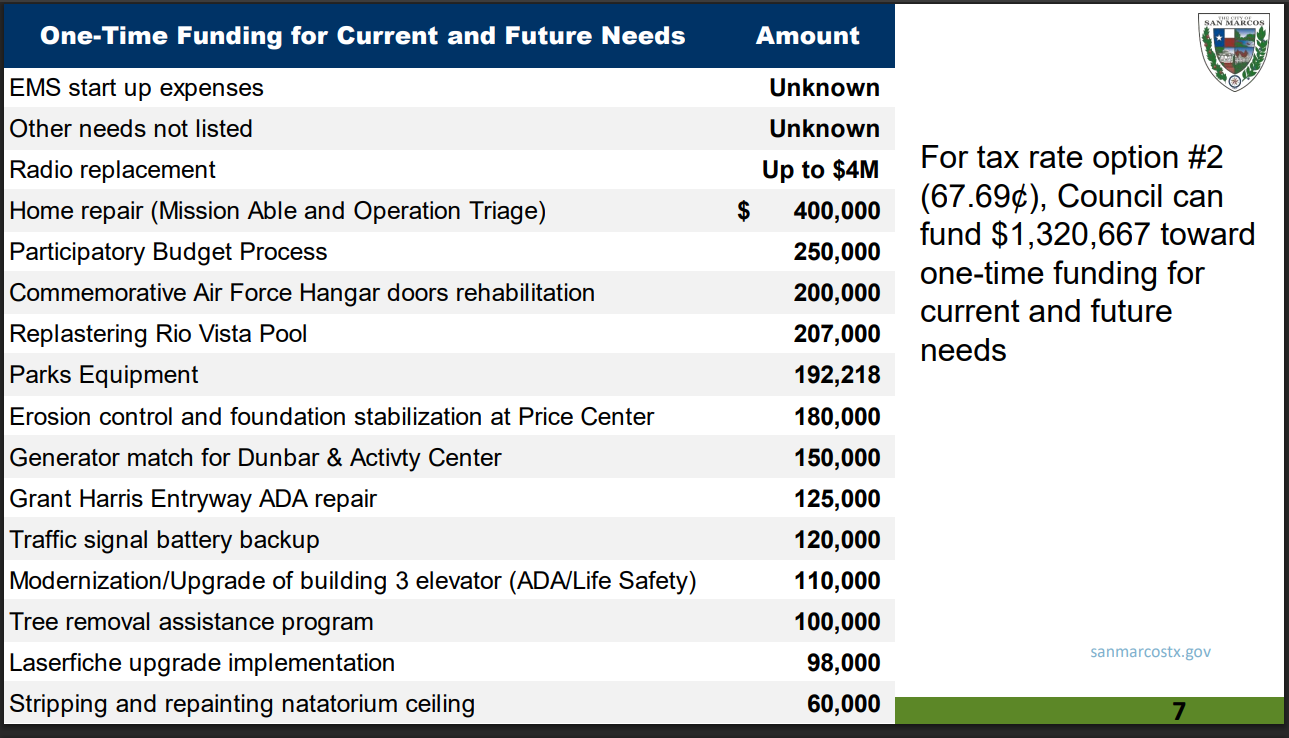
Last December and January, HSAB funding was a total mess. There was too little funding, and Council ended up pitting nonprofits against each other. It was clear that we need to significantly ramp up city funding of nonprofits.
Right now, HSAB gets $550K. Council sets a range of additional funding, between $50K-$200K. When we find out what kind of money we’re getting from property taxes this July, then we’ll determine where we land in that range.
This part makes me extra happy:
Yes!! Peg the HSAB budget to inflation. We do it in contracts with for-profit entities all the time. It should be universal.
(The failure to peg minimum wage to inflation was one of the greatest policy near-misses of the 20th century. Having a federal minimum wage of $7.25/hour is such a mockery.)
…
Item 21: Cut-and-fill in La Cima
Pedernales Electric wants to build a substation here:
But it’s on a hill. Like we saw last time, it’s hard to build on a hill. So they also want to do a cut-and-fill.
This time, no one is worried about flooding.
Matthew Mendoza is a little worried that the people in La Cima might have to look at a substation, though.
Staff reassures him that there is another building, and then the La Cima apartment complex, all separating the substation from the houses. So their eyes won’t be hurt by the substation.
Shane Scott proposed doubling the flex money and travel money, and he wanted it effective IMMEDIATELY. Like, something lit a fire under his butt.
Last time, they went in circles forever, but ultimately landed here:
Travel budget
There’s plenty of travel money already. The total council travel doesn’t go over budget.
Council members can lend each other travel money if one is going over.
If they STILL go over, there can be an extra $15K in a special travel fund that any of them can apply for.
AND, they each get an extra $2K for travel.
Flex budget
Double the Flex amount from $7.5K to $15K.
In other words: right now, a council member earns $24.9K a year, if they choose to take their flex pay as income. This would increase it to $32.4K.
…
The item was put on the consent agenda, which means, “Staff thinks this will sail through.” After all, they hammered out all the votes last time.
Jane said nope! and pulled it off the council agenda. She gives a speech about how none of this is needed, there’s plenty of money in the travel budget. And how we certainly shouldn’t be doing this mid-year.
Amanda agrees on the mid-year part. More responsible to start it with the next fiscal year. She makes that amendment: Delay this until next year’s budget?
The vote: Postpone changes until next year’s budget?
(This is when I first thought, “What the hell is happening? Was this whole thing a ploy to get some quick money?”)
Jane sees her chance and makes a motion to kill both the travel increase and flex spending increase.
On the flex spending, Amanda pleads, “But why?”
Amanda has been quite open about having to resign her state job to take this position, and the impossibility of surviving on $24.9K per year.
Jane: “We don’t need it. We already raised it in 2023.”
What she means is that before 2023, council members got $23.4K per year, if they took their flex money as pay. They gave themselves a raise of $1500 then.
Amanda: I agree on the travel. But on the living expense, who here – anyone? – can live on this little?”
Jane: “It’s not supposed to be a fulltime job.”
Amanda: “Fully agree. But we both know that it is actually a fulltime job.”
Jane: “For some people it is. Not everybody.”
Amanda: “Oh trust me, I understand that too. And I wish everybody shared full interest.”
Jane: “I do too.”
Amanda: “But again, please tell me, who can survive on this? Would anybody in this room?
<crickets>
Then conversation dies.
…
The key issues is this: Is being a councilmember a fulltime job? We pretend it isn’t, but in order to do it well, it definitely is.
If we pay poverty wages, then council members have three options:
Be independently wealthy or have someone who can support you.
Try not to neglect your council job as you juggle multiple jobs
Live in poverty
This is not how you get the best possible council members. This is how you get mostly wealthy and/or distracted council members.
…
But anyway, then they vote:
The vote: Should Councilmembers survive on $24.9K per year?
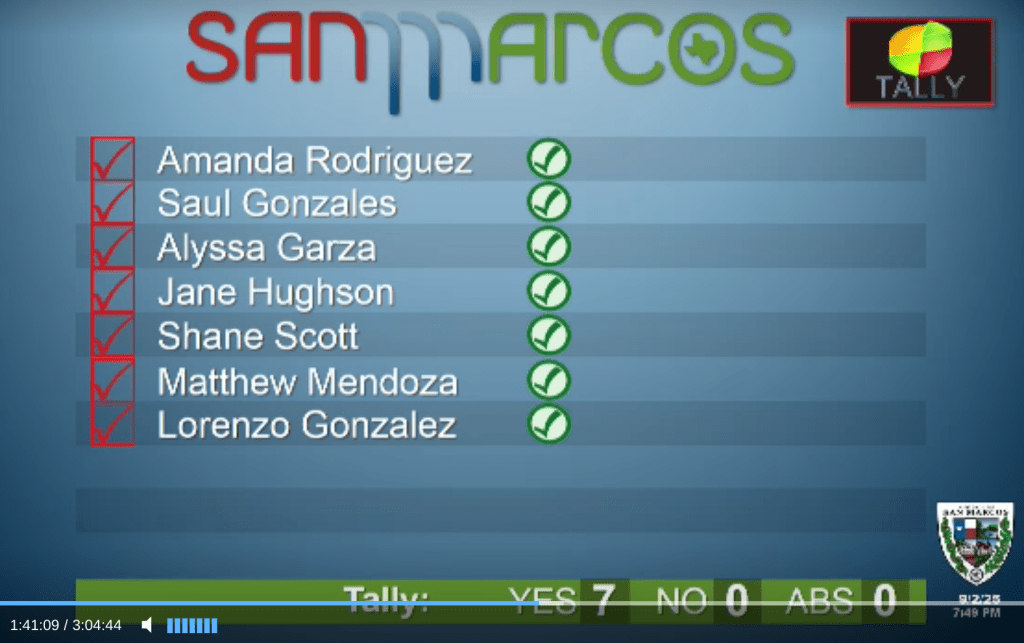
So yeah, no raise.
I’m so baffled. Two weeks ago, Shane and Lorenzo both thought it was reasonable to increase flex spending, and now they don’t? What the hell happened?
….
Then they vote to roll back the travel funds increase:
This one doesn’t bother me so much. There is plenty of travel money, if you allow people to donate funds to each other.
Bottom line: After all these meetings, everything is back where it started, aside from a special bonus travel fund.
Clearly I have no idea what happened, but it felt like petty bullshit, to be honest.
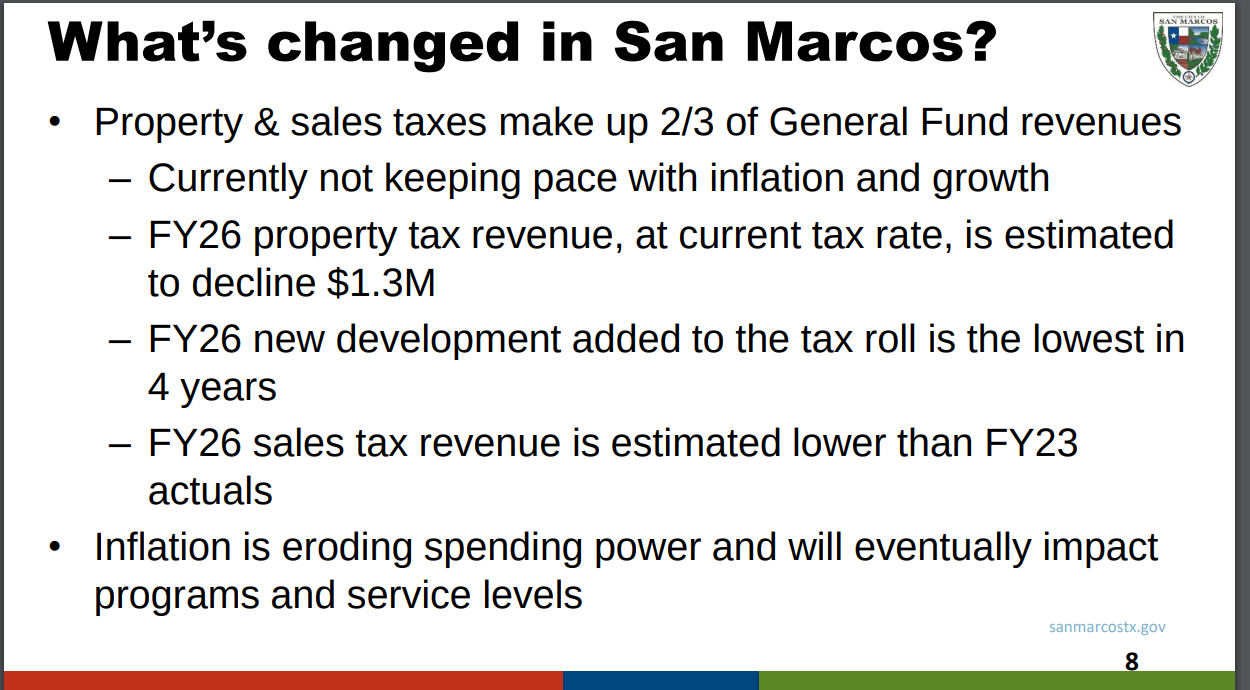
Statewide, the legislature is intentionally starving the school districts. This is not hyperbole. Abbott is hellbent force-feeding school vouchers down everyone’s throat. He’s denying funding to the public schools is a way of increasing the pressure on the state legislature to vote for his deal.
Funding hasn’t increased since 2019, but there have been several unfunded mandates that cost a lot. Plus inflation.
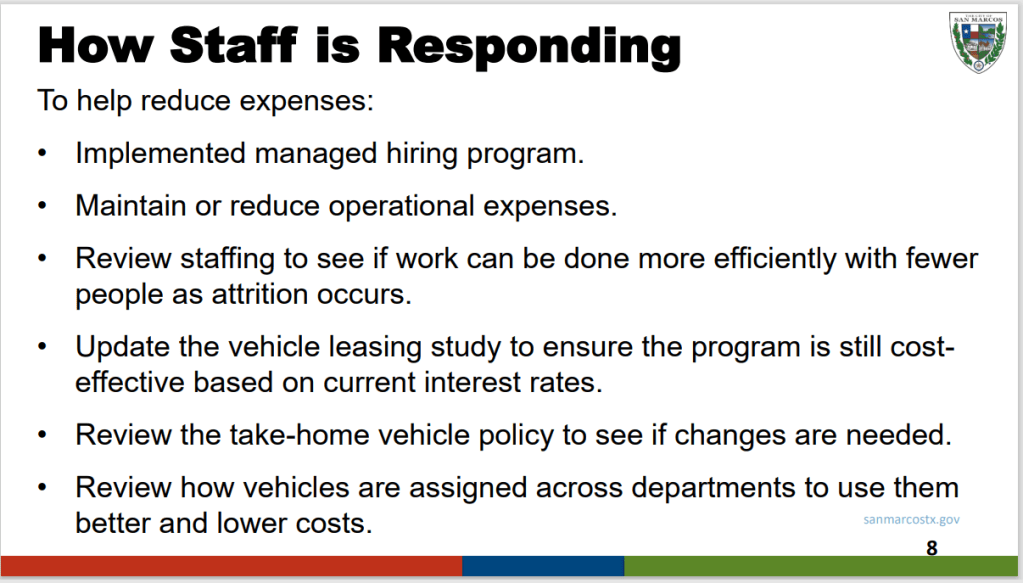
SMCISD is in a $9 million budget crisis. They’ve asked for the city for a stormwater waiver, which would save them about $350K.
Which brings us to today.
First there’s a presentation about the stormwater fund:
Immediately after San Marcos created the stormwater fund, Texas State University asked the State Legislature to grant them an exemption. They were the very first university in Texas to ask for one! What go-getters.
After that, all the other universities thought it was a pretty good idea.
Here’s the total list of state-wide exemptions:
So basically, empty lots, lakes, universities, and ….El Paso school district. Who knows.
…
The state law says that stormwater fees must be equitable. They go into a fair amount of detail about how we put ours together.
Basically, if we want to help out SMCISD, here are the four options:
Option 1 would cost a lot and open the door to other nonprofits asking for a waiver, too.
Option 2 would cost some, and open the door.
Option 3 might open us up to legal challenges of being non-equitable.
Option 4 is the one that Staff clearly favors. In fact, city staff and SMCISD staff have already met, and they’re both open to this.
Option 4 is about Mendez Elementary. Mendez is located in Sunset Acres, which has terrible flooding. The city wants to build a detention pond on Mendez property, to help with the flooding.
All the council members are on board with pursuing 4.
The only thing is that Mendez Elementary is being renovated. Until SMCISD knows the new footprint of the building, they can’t donate the land.
(Now, SMCISD has already submitted the Mendez plans to the city for permitting. So the city could literally go look right now at the Mendez plans. It’s not a mystery. We can see exactly how much space there might be for a drainage pond.)
…
There’s a long, weirdly circular conversation where Lorenzo and Amanda keep saying, “We should meet occasionally with the school board, just to stay informed on what we’re each up to.”
Jane keeps responding with, “It’s no use. Alyssa and I keep trying to think of a reason that all three entities – city, county, schools – should meet, and it’s very hard to think of issues that need attention from all three groups.”
Ok? That’s a different thing? That’s not what Amanda and Lorenzo are suggesting?
Anyway, they vote for 4.
…
Item 25: Redwood/Rancho Vista
Last time, we discussed this property, immediately north of Redwood and Rancho Vista:
We were trying to figure out if that industrial portion would make flooding worse in Redwood.
Redwood and Rancho Vista have severe septic and flooding issues, which leads to a parasite living in the soil. It’s a big health issue, and it usually only happens in developing countries. But the community is quite poor and vulnerable, so it’s happening here. Any solution is going to be very expensive.
Last time Council tried to have it both ways: “We’ll let this development through, but we promise to take action on Redwood.”
So tonight is that action: A strongly worded letter to Guadalupe County about how the septic issue and parasites is a public health and safety issue, which has been going on for years and years.
Jane suggests that we let them know about the Texas Water Development Board, which has a specific Economically Distressed Areas Program. Maybe Guadalupe County could get some money from there.
City Manager Stephanie Reyes mentions looping in SMCISD – after all, these families go to our schools and are part of our community.
So staff will draw something up, and it will come back.
My two cents: this is fine as a first step, but not as a last step.
It is insanely thorough! I can tell that much. They look at three things: fountain darters, Texas wild rice, and recreation. They conclude that removing the dam is good for the fishies, good for the endangered wild rice, and not bad for recreation.
This is their graph on recreation:
The 45 means drought, 100 is normal river, and 173 is after a lot of rain. The bars represent how much of the river is deep enough for you to paddle on. Removing the dam doesn’t really change how much of the river you can paddle down.
In 2014, they reported all this to the Park’s Department. But before they talk to Council, we have…
The 2015 Floods
The 2015 Memorial Day floods come along. A 40 foot wall of water barreled down the Blanco River, 11 people are killed, and tons of homes are flooded.
In the course of all this, Cape’s Dam is destroyed.
I hunted for awhile, but I can’t find any photos of the dam from before it was destroyed.
…
2016: Council hears all of this for the first time
Now the city is trying to cope with post-disaster San Marcos. They’re assessing damage, applying for disaster funding, and so on. For Cape’s Dam, they’ve now got a liability mess on their hands.
The issue is presented: Should Council remove the dam and fill the Mill Race?
Wait, what’s the Mill Race?
I think it’s this:
It’s this little channel that was built back when this was an actual mill. It’s very calm and smooth because it’s got dams on both sides. I think you get this nice little loop around Thompson’s Island. So there are groups, like the scouts and disabled veterans, who have used this stretch for learning to kayak and rehab and growth.
It’s great for those groups!
But as far as I can tell, this is an amazing stretch that’s been kept hidden from public use. That part irritates me. People living east of I-35 have not been able to enjoy the Mill Race or the rest of the parks on that map very easily.
Back to 2016
As far as I can tell, this is the source of all our problems:
I actually went back and listened – you’re welcome – and here’s the problem: if you remove the dam, the Mill Race won’t have enough water 85%-90% of the time. Mostly it will have stagnant mosquito water, or dry up altogether.
So removing the dam wrecks the Mill Race. You could still canoe and paddle on the real river! Just not the Mill Race part.
…
So it’s 2016, the dam is now dangerous, and Council is given this choice:
Use free money from the Army Corp of Engineers to remove the dam.
Good for the health of the river!
Good for the endangered species!
Can still paddle on the regular half.
Use free money from the Army Corp of Engineers to remove the dam, and then use imaginary millions of dollars that we don’t have to rebuild the dam.
Imaginary money is not real. We don’t have it.
In March, 2016, Council votes to remove Cape’s dam.
So now the shit hits the fan. Massive controversy.
This organization springs up to save the Mill Race. They have some sympathetic points, but they also make some crappy arguments.
This is the part I have the least patience for. The argument that takes hold is that Cape’s Dam is so historically significant that we’ve got to save it. For the children! For the historians!
Look: if Cape’s Dam is so sacred, how come I cannot find one single photo of it anywhere, before it was destroyed? Didn’t we love it then?
I do even think there’s interesting history here! What was engineering like a hundred years ago? That’s worth studying.
The part that makes this bullshit is when you use it to say the dam must be preserved, in the river. Want to haul the broken pieces on the bank somewhere? Put up a nice plaque commemorating the dam? Knock yourself out! But don’t pretend that the historical significance means we need a functional dam in 2025.
Thus begins the next phase of the controversy, 2017-2024:
We begin kicking the can down the road. For the next eight years, everyone just punts. You can read a nice summary of all the dithering here!
Kick, kick, kick. We’re kicking the can. kick, kick, kick.
Two extra details from this part of the timeline:
The free disaster money to remove the dam expires. Now we’d have to apply for grant money. But like I mentioned, lots of organizations want old dams removed, so there’s money around.
In 2017, San Marcos River Foundation acquires the land on one side of the bank. They are a hard NO on rebuilding the dam.
They have always been very clear on their position: it is best for the health of the river to remove the dam. You can’t rebuild the dam unless you can access their side of the river. They will not agree to rebuilding the dam on their land. Therefore there is no dam.
So now, in 2025:
I’m no engineer, but I’m pretty sure this is the choice before us:
Find grant money to remove the dam.
Good for the health of the river!
Good for the endangered species!
Can still paddle on the regular half.
Current dam is dangerous and needs to be removed. (A recent tragedy.)
Find grant money to remove the dam.
Then find imaginary millions of dollars more to rebuild the dam
Find an imaginary way to get SMRF to consent to let us rebuild a dam that they are strongly opposed to.
Look, it’s not actually a choice. No matter what, it starts with removing the dam.
This brings us to Tuesday’s meeting!
The issue at hand is spending $340K on a feasibility study. The study would do this:
So this study is going to answer all our questions: – What’s the current conditions of the dam and the whole area? – What would it take to rebuild it? Or partially re-build it? Or just remove it? – What’s the environmental situation? What’s the permitting process? – Do a bunch of public outreach and get public feedback.
….
What does Council say?
There are a few things to keep in mind during the Council discussion.
We need the feasibility study, no matter what. Every outcome requires permits. You need this study to get those permits.
The east side of San Marcos has been majorly neglected for river recreation. We need to develop this. Not necessarily the Mill Race – the public couldn’t access this anyway. They definitely deserve good river access and recreation.
Most likely, you have to remove the dam, no matter what. (I’m no engineer, but look, it’s a pile of rubble.)
Council has a lot of confusion. This is understandable – it’s a big, complicated topic. But you’ve already read 1000 words on this, and trust me, you don’t want to read about them going in circles. There are a LOT of circles, and they go round and round.
Some highlights:
Q: Can we skip the study and just put the money towards re-building? (Shane) A: No. You need it to get permits and apply for grant funding. Plus the re-building would be way more than $340K.
Saul Gonzales is quite clear-headed about keeping safety front-and-center in the conversation. Everyone is focused on this, but Saul is the one who repeatedly mentions it.
Q: What about liability, should someone get injured? A: Yes, we are exposed. This is a man-made thing in a public space, and we’re supposed to be in charge of it, even though the state owns the river. SMRF would maybe have some liability in court, and parks get a little immunity for being outdoors, but this is not a natural outdoorsy thing. It’s a big risk.
Q: Aren’t we partnering with the county on all this? A: Sort of, yes. They’re interested in rebuilding. Or they were, in 2021, when we last talked with them about this.
Several councilmembers point out: The east side needs some good river access!
I agree with that!
Shane, Jane, Matthew, Lorenzo, and Alyssa are all open to rebuilding the dam. They seem to be thinking that this is the way to support river access on the east side. They’re wrong about this, but it’s sympathetic.
Saul’s position: “I’d like us to make this safe, as quickly as possible. Let’s start with taking it out, and see if everyone likes it. After that, if everyone wants a dam, we can rebuild the dam.”
Amanda’s position: “Rip it out and let the river flow. Then create recreation on the East Side.”
This aligns most closely with my beliefs.
…
Jane and Amanda go off on a tangent about getting public input first. Now, the folks doing the feasibility study are already supposed to get a bunch of public input. And it’s a LOT:
But Jane and Amanda are proposing that the city get a bunch of public input, before the folks in the study get a bunch of input.
Look: No. That is just more kicking-the-can down the road.
Alyssa makes the exact right point here: “We have engaged with the public for YEARS. EVERYONE has an opinion. I know what the results will be.”
That is correct.
….
There’s discussion of partial rebuilds. Can the proposal consider that? Answer: Yes. It’s in there.
Jane says: The main problem is that the Mill Race needs more water. Can we fill it with reclaimed water? Answer: Uhhhhhhh…. you’re freaking us out. You want to release sewage into the Mill Race?
Jane: it’s treated, not raw sewage, and it gets released to the river downstream. So why not release it upstream? Answer: We’re feeling woozy just trying to imagine the permitting process involved in releasing reclaimed water into a recreation area. Oh god.
I admire Jane’s problem-solving ambitions!
…
Bottom line: The study should take about 10 months. Then we will have a lot more information!
My belief is that the dam should go, and we should focus on creating recreation access for the public on the East Side. The mill race has always been treated as a fancy, restricted portion of the river, and the exclusiveness is bullshit.
…
If you’re curious:
Here’s a great read from 2000, from an old-timer named Tom Goynes, who has been paddling the river since the 1970s.
And here’s someone’s video, showing what it looks like to kayak through all this stuff we’re talking about: