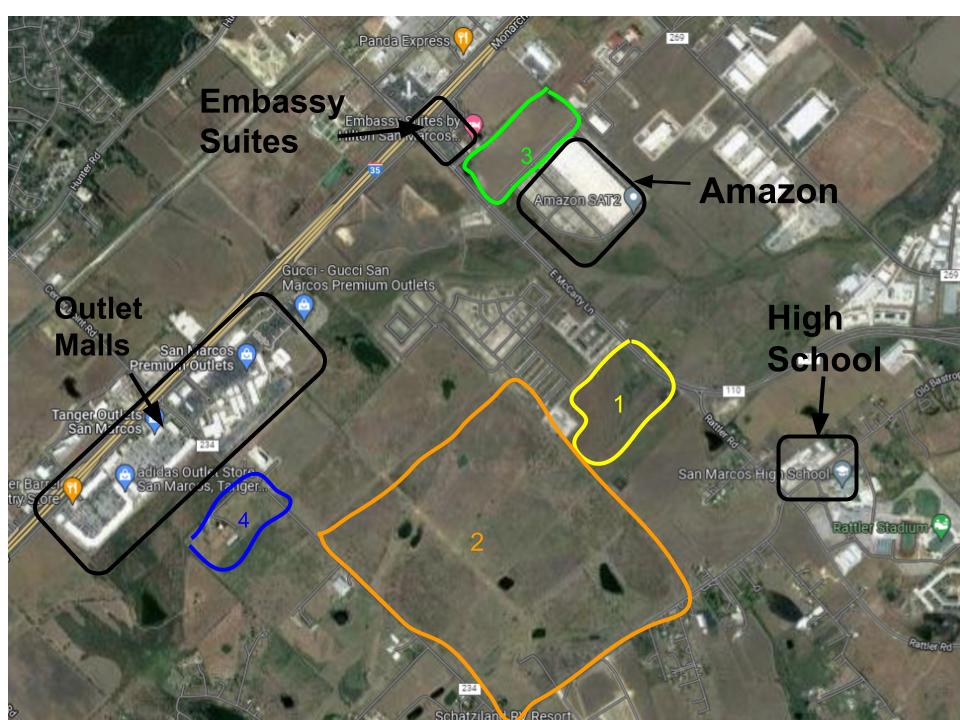
Items 15-18: This little development, the blue rectangle in the lower left, is up for debate:
The developers want to zone it in three parts: – the dark gray part along the railroad tracks would be heavy industrial, – the tan middle part would be light industrial, – the front pink part along I-35, heavy commercial:
I don’t know how to evaluate the merit of a project like this. To be honest, I’m not even sure what kind of information I’d want to know, in order to evaluate it.
Mark Gleason had a dumb rant about how everyone keeps shitting on the working man, and he knows dozens of people at Amazon and the HEB warehouses, and they like their jobs and deserve your respect.
Alyssa Garza responded correctly that no one is disrespecting the worker. You can support the worker and also fight for better working conditions. (In fact, some – like me – might say that’s how you support the workers! And I might also say that until he fights for specific labor reforms, Mark’s support is empty lip service.)
We have no way of ascertaining the labor conditions in these hypothetical future industrial complexes, so this is all made-up anyway.
The vote: Yes: Jane Hughson, Shane Scott, Saul Gonzalez, Jude Prather, Mark Gleason No: Max & Alyssa
Item 4: City Council pay raises
This was discussed last time. City councilmembers need to be paid a living wage. Otherwise the job is not available to all community members. Currently councilmembers earn $17,400, and this would bump them up to $22,200.
Mayor Hughson suggested compensating the mayor position based on additional duties. She was trying to be diplomatic about how much extra she works, but the general consensus was not to itemize the duties. Currently, Mayor Hughson earns $20,400/year.
Shane Scott suggests just bringing her up to $25,800/year. She probably puts in 40-50 hours a week.
The vote: Yes: Alyssa Garza, Max Baker, Shane Scott. No: Jane Hughson, Mark Gleason, Saul Gonzalez, Jude Prather
So it fails.
Mark Gleason is really worked up about the word privilege, because Max and Alyssa use it to talk about who has disposable time and money to run for city council. Mark runs on and on about how it’s a privilege to serve, and it doesn’t mean you’re privileged.
He’s both right and wrong. It is a privilege to serve. Not everyone gets to do it. But it’s also an opportunity for power, and as an opportunity, it’s not equally available to everybody.
Here’s the problem: Gleason does not come from generational wealth, and he highly aware that he has not benefited from economic privilege. But simultaneously, he is a white male and has an extremely simplistic understanding of race and gender. So he is very outspoken about his working class status, while being ignorant about how he has benefited from race and gender privilege. (Also, he understands economic privilege but still believes that we live in a meritocracy. ¯\_(ツ)_/¯ )
Gleason makes a motion that no one should get any raises, and they should only adjust for travel-expenses.
The vote: Yes: Jane Hughson, Jude Prather, Saul Gonzalez, Mark Gleason No: Alyssa Garza, Max Baker, Shane Scott
So that’s that. No raises for any of them.
Jude Prather makes one point: if you earn money from the state or the county, you have to forgo your salary. He is employed by the county, so I guess he wants brownie points? For denying other people a raise that he’s ineligible for?
Here’s the central hypocrisy: Jude Prather, Jane Hughson, Saul Gonzalez, and Mark Gleason all adopt this noble stance that they’re too principled to vote themselves a raise.
You know what would be more noble? If you voted for a raise, and then say you’ll forgo it and save it for future councilmembers. That would be more principled than their entrenchment of the status quo.
I think they all deserve a raise! But if they want, they can be self-denying and still vote to facilitate more citizens running for office.
Four hours of zoning cases! There are five big cases. Oddly enough, the first four are all located very close together. It’s either a weird coincidence, or they’re connected in some way that was not made explicit.
Yellow is at the intersection of East McCarty and Rattler Road. On your right, if you’re going from Amazon to the high school. They want to build apartment complexes. I think it’s okay.
Orange is huge. It stretches all the way to Old Bastrop Highway. Terrible sprawl.
Green is right between Embassy Suites and Amazon. Heavy industrial – bad idea, gets voted down.
Blue is low-income apartments with wraparound services, by the same people who run Encino Pointe and Sienna Pointe. This is complex, but on the whole I think it’s good.
Furthermore, we passed an additional little piece last summer, here:
It’s supposed to be these little rental houses, by these guys. (This is why I want to keep a running list of “what got approved but hasn’t yet gotten built”.)
Anyway. Yellow’s up first!
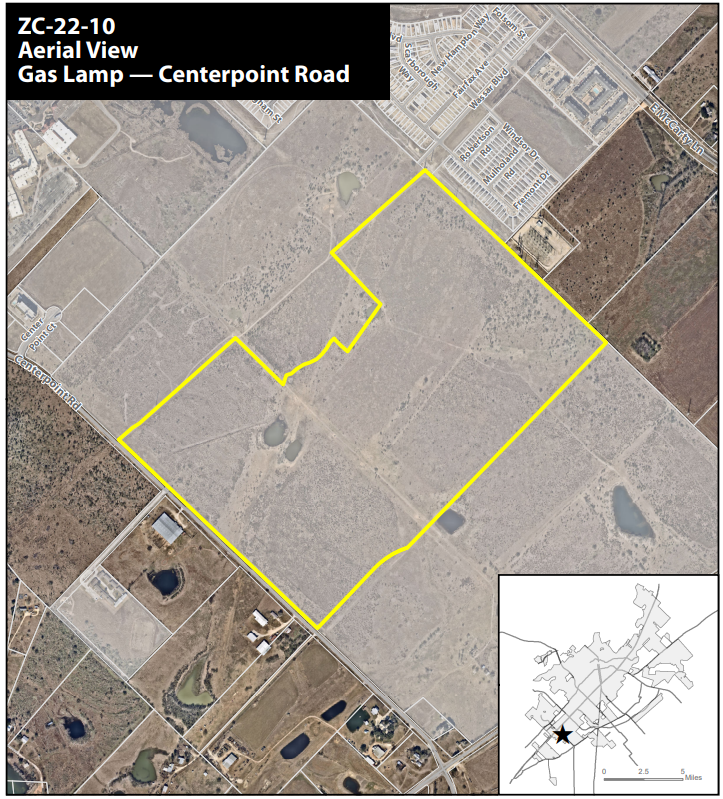
Items 25-26: 40 acres, at the intersection of Rattler Road and east McCarty:
So if you’re driving from Amazon towards the highschool, this is on your right, just as you get to the intersection with Rattler Road.
There’s a big housing/apartment thing going in right next to it. Amazon is near the top of that photo.
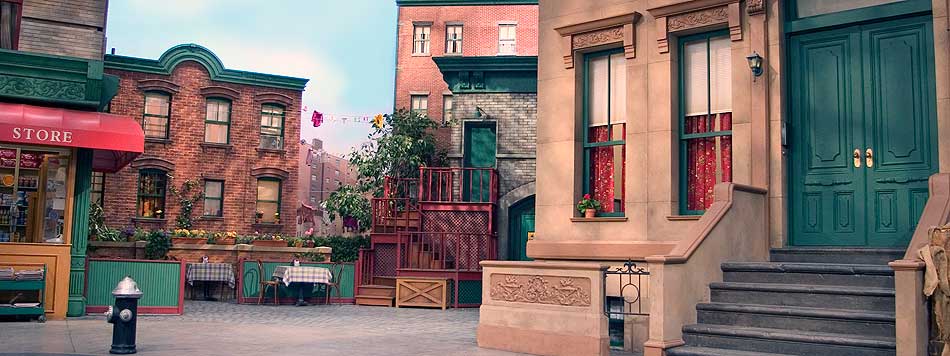
The developer wants CD-5. When City Staff promotes the category “CD-5”, they make it sound like Sesame Street:
A walkable, dense-but-not-overwhelming, charming little scene! Shops and apartments. Sounds great!
In reality, here’s what gets built:
That’s literally the apartment complex that is next door, on McCarty, to this one being proposed. (I just grabbed that photo off Google Streets.)
And listen: I am in favor of apartment complexes! They are more environmentally responsible than single family homes. They are economical. We have a lot of renters in San Marcos.
My point is just the double-speak: we’re pretending that this zoning will bring a charming row of brownstones, with bodegas on the corner, but developers do not buy in. We used to have a way to force developers to build what we wanted: PDDs. But we retired PDDs in 2018, when we redid the Land Development Code. We should not have done this! Totally unforced error.
Back to the yellow plot. Is a giant apartment complex here a good idea? I have a (different) good idea: my five criteria. Let’s do it:
1. Price Tag to the City: Will it bring in taxes that pay for itself, over the lifespan of the infrastructure and future repair? How much will it cost to extend roads, utilities, on fire and police coverage, on water and wastewater?
I’m guessing yes. It’s on roads that are already built for heavy traffic, and there’s already utilities run out in this way. Cops and fire department already cover this area. I think it’s ok.
2. Housing stock: How long will it take to build? How much housing will it provide? What is the forecasted housing deficit at that point? Is it targeting a price-point that serves what San Marcos needs?
We never have this information on hand. Nag the city planners! They need to update the housing deficit! They need to forecast these things!
3. Environment: Is it on the aquifer? Is it in a flood zone? Will it create run-off into the river? Are we looking at sprawl? Is it uniformly single-family homes?
Not the worst sprawl – it’s adjacent to an existing development, and fairly close to Amazon and Embassy Suites, and not as far out as the high school. With the high school already beyond it, it feels like a gap that should get filled in.
It’s not on the aquifer. It’s not single-family homes. I think it’s fine, environmentally.
4. Social: Is it meaningfully mixed income? Is it near existing SMCISD schools and amenities?
Not meaningfully mixed income. Not near existing amenities. Gleason asks about this – any chance of including some commercial? The developer says nope. Just apartments. So it whiffs hard on this category.
5. The San Marxist Special: Is it a mixed-income blend of single family houses, four-plexes, and eight-plexes, all mixed together? With schools, shops, restaurants, and public community space sprinkled throughout?
No, but a blogger can dream.
All in all, I think this project has merit. Affordable housing, between Amazon and the high school. Adjacent to existing housing. I would vote in favor of it.
The vote: Yes: Jane Hughson, Mark Gleason, Jude Prather, Shane Scott No: Alyssa Garza, Saul Gonzalez, Max Baker
I’m honestly not sure why those three voted against it – it makes me wonder if I’m missing something? Max had asked about emergency response times and flooding, and the answers hadn’t been particularly unusual.
Items 26-28: 400 acres, on Centerpoint road. Ie, #2, the orange one:
So first off, this thing is massive, much bigger than the last project. The last item was 40 acres, and this is 400 acres. Also, the last item is on a major road (McCarty) and this one is on dinky country roads.
Okay, the big orange square got split into three sub-projects:
Here they are together:
So the developers want it to be half Light Industrial, half houses, and then a teeny bit of really dense housing.
First up is the Light Industrial:
It sounds like it will be a bunch of warehouses. I’m thinking of the kind of thing you see way out on Hunter Road, past Posey. Max Baker is worried about us becoming a warehouse district that other towns dump their warehouse industries on.
I am not concerned about becoming a warehouse town. Warehouses are cheap to build, and cheap for local businesses to rent, and cheap to re-purpose. The ones on Hunter seem to mostly be small, locally owned businesses. Whereas building a bunch of vacant office parks is much worse: expensive to build, expensive to rent, expensive to repurpose.
However, I would vote no. Not due to warehouses, but due to 400 acres, which might be majorly inconsistent with the upcoming VisionSMTX plan, and is definitely huge sprawl. The totality of this project is not good.
The vote on this light industrial piece: No: Max Baker and Alyssa Garza Yes: Mayor Hughson, Jude Prather, Shane Scott, Mark Gleason, and Saul Gonzalez.
Part 2:
CD-3: massive single family sprawl.
We’ve got our recipe to follow here! Here we go:
1. Price Tag to the City: Will it bring in taxes that pay for itself, over the lifespan of the infrastructure and future repair? How much will it cost to extend roads, utilities, on fire and police coverage, on water and wastewater?
Huge and undeveloped. Very expensive. Thumbs down.
2. Housing stock: How long will it take to build? How much housing will it provide? What is the forecasted housing deficit at that point? Is it targeting a price-point that serves what San Marcos needs?
WE NEVER KNOW. Nag the city planners! They need to update the housing deficit! They need to forecast these things!
3. Environment: Is it on the aquifer? Is it in a flood zone? Will it create run-off into the river? Are we looking at sprawl? Is it uniformly single-family homes?
SPRAAAAAAAWWWWWL. All single family. Not good. (At least it’s not on the aquifer.)
4. Social: Is it meaningfully mixed income? Is it near existing SMCISD schools and amenities?
I doubt this will be meaningfully mixed income. This is so far from any existing amenities, unless you plan on buying groceries at Sak’s Off 5th Avenue.
5. The San Marxist Special: Is it a mixed-income blend of single family houses, four-plexes, and eight-plexes, all mixed together? With schools, shops, restaurants, and public community space sprinkled throughout?
Sigh.
This portion is 0/5. Terrible, horrible, no-good, very-bad project.
The vote on this piece: No: Max Baker and Alyssa Garza Yes: Mayor Hughson, Jude Prather, Shane Scott, Mark Gleason, and Saul Gonzalez.
Part 3: Little pockets of CD-5:
Remember, CD-5 is supposed to look like this:
But is really this:
In the top little bit, Mark Gleason makes a motion for “no residential”. It passes 7-0. I don’t really get why. An apartment complex facing the outlet mall? Spoiler alert: there’s about to be apartments right there anyway, when we get to the little blue square proposal.
He also moves that one of the other two triangles be downgraded to more CD-3: single family housing. Also passes 7-0.
The vote on the three little triangles: No: Max Baker Yes: Everyone else.
My opinion on the whole 400 acres:
It’s a bad idea to pass a sweeping decision on this giant parcel at this moment. We have a new master plan coming up. Do we even want 200 acres of warehouses and 200 acres of single family homes over here?
At one point, it was mentioned that Chief Dandridge is opposed to all this annexation, because we don’t have police staffing to cover all this extended area. When asked why he didn’t speak up, the answer was that he is waiting to discuss their needs at the upcoming budget meetings. So maybe wait for the upcoming budget meetings?
Finally, this fails the five criteria. It’s poorly planned sprawl, with no amenities. Why are we recreating mistakes that the rest of the country made 30 years ago?
………………………………….
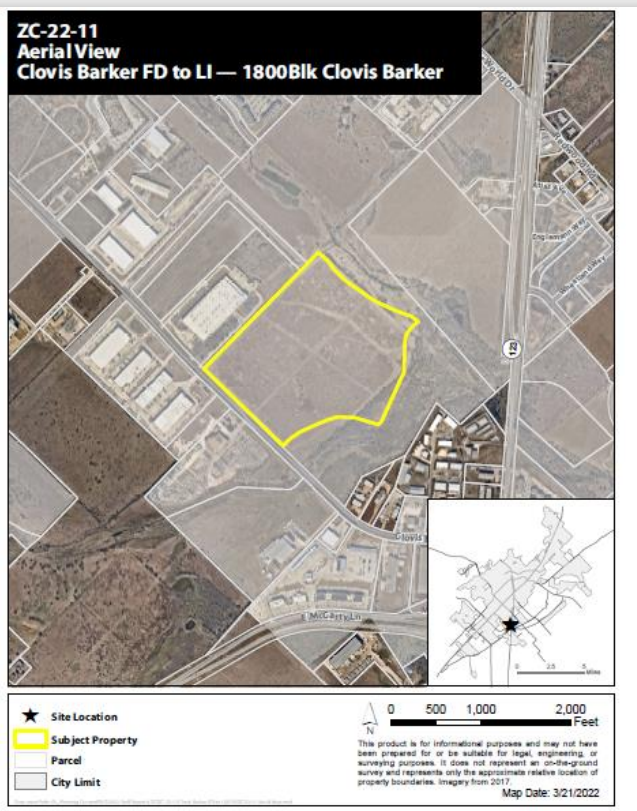
Item 29: Heavy Commercial, the green square between Embassy Suites and Amazon:
Mayor Hughson and Max Baker think this is a terrible idea, because Embassy Suites is supposed to host all our guests. Heavy Commercial is the most hardcore industrial zoning. This sinks like a stone:
The vote: Yes: Jude Prather, Shane Scott No: Mayor Hughson, Max Baker, Mark Gleason, Alyssa Garza, Saul Gonzalez
There’s a second vote on a “hard no” or a “soft no” – essentially some fiddly technicalities with whether to make the developers wait a year or substantially re-tool their application, before coming back.
Hard no: Saul Gonzalez, Max Baker Soft no: Mayor Hughson, Alyssa Garza, Shane Scott, Jude Prather, Mark Gleason
So the developers can bring it back with less effort.
….
Items 30-31: Low income tax credit apartments, the blue square behind the outlet mall:
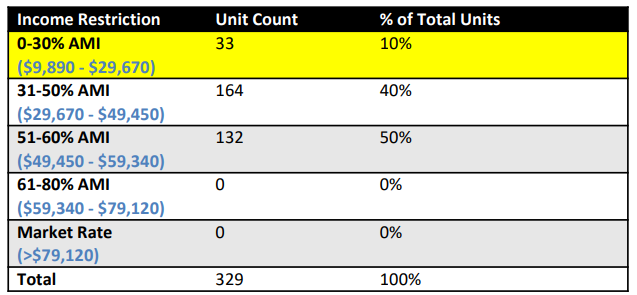
So this is complicated, but I think the good outweighs the bad. It’s going to be apartments that are priced below market rates:
(“AMI” means Area Median Income.)
You have to apply and have a sufficient income to qualify. It would be better if there were more apartments in the lowest income range – these are the most vulnerable people in our community. But: more good than bad.
The Workforce Housing Committee had a number of concerns – not near public transportation, located in a low intensity zone, a higher percentage of apartments reserved for that lowest tier of income, not close to things like grocery stores. But the people running the place were very good at sounding like they’d be happy to change and accommodate all these concerns. For example, they’re providing shuttle service two days a week, for a minimum of ten hours, and they’ll work with residents individually.
So here we go:
1. Price Tag to the City: Will it bring in taxes that pay for itself, over the lifespan of the infrastructure and future repair? How much will it cost to extend roads, utilities, on fire and police coverage, on water and wastewater?
Not relevant. This is a publicly-subsidized program intentionally built to address inequality. (We forgo all local taxes on it, and they qualify for special loans and grants.)
2. Housing stock: How long will it take to build? How much housing will it provide? What is the forecasted housing deficit at that point? Is it targeting a price-point that serves what San Marcos needs?
329 units. And committing to a price-point which is underserved.
3. Environment: Is it on the aquifer? Is it in a flood zone? Will it create run-off into the river? Are we looking at sprawl? Is it uniformly single-family homes?
Not on the aquifer. Not in a flood zone. Not particularly close to town either, but apartments are far more dense than houses, and it’s fairly close to existing development.
4. Social: Is it meaningfully mixed income? Is it near existing SMCISD schools and amenities?
Not meaningfully mixed income, but serving a public good. Not near schools and amenities, but offering transportation and a facilitator to help residents get to the grocery store, doctor’s appointments, etc.
5. The San Marxist Special: Is it a mixed-income blend of single family houses, four-plexes, and eight-plexes, all mixed together? With schools, shops, restaurants, and public community space sprinkled throughout?
Well, no. Nevertheless, I’m cobbling these together to give it a “Pretty Good”.
There’s actually two votes, one on the tax credits and one on the agreements.
Tax Credits vote: Yes: Mayor Hughson, Alyssa Garza, Shane Scott, Saul Gonzalez, Mark Gleason No: Max Baker Abstaining: Jude Prather
Development agreement vote: Everyone voted yes, besides Jude, who abstained.
(I’m not actually sure what Jude’s conflict of interest is, but I’m not concerned about it.)
So there you have it. We have talked about all the colors in the map.
This episode has been brought to you by the colors Yellow, Orange, Green, and Blue, and all the letters inside the City of San Marcos Land Development Code.
…
Items 1-2: But wait! There’s a fifth development! (After all, this part of the meeting really does take four hours.)
Remember last time, we discussed the far flung development with the power plant in the middle?
As best I can tell, it’s that little red triangle waaaaaaaaaay down at the bottom. (I even took the time to draw in the little yellow/orange/green/blue colors for you!)
This is so far away. This is insane. Do not annex this crazy little triangle and build houses on it.
The guy who owns the power plant shows up and discusses the noise and light pollution. He is exempt from city restrictions on noise and light pollution, because it’s loosely connected to maintenance needed to stay prepared for emergencies. However, he doesn’t want to deal with the legal and regulatory headaches of having a bunch of cranky home owners in his backyard.
Do we need to walk through the five criteria?
Terrible on costs to the city.
Housing stock? No idea. It’s 127 acres, so it just depends how big the lots are and how much gets eaten up with power line buffers and power plant buffers, and roads, etc.
Environment? Far from the river but terrible on sprawl.
Mixed income? Near amenities? Who knows on the income, but it’s not near anything but a lot of buzzing power lines and a noisy, brightly lit power plant.
Not my little utopia in any way.
This is a terrible idea. But here’s are how the councilmembers stake their positions:
What a terrible idea: Max Baker, Alyssa Garza, Saul Gonzalez
It’s okay, as long as home buyers are informed that the power plant is noisy AF: Mayor Hughson, Mark Gleason
This is aces! : Jude Prather, Shane Scott
In the end, it’s postponed. Staff will put together a protective covenant that satisfies Hughson and Gleason. Then, together with Jude and Shane Scott, this dumb, far-flung project will get approved.
Item 21: This is a proposal for 470 houses, way out past the outlet mall and past the Trace development. This is sprawl. In general, I do not like isolated subdivisions plopped down in the middle of nowhere. It requires way more mileage of pipes and wires to get them hooked up to the city, it causes more wear and tear on the roads than closer developments, it works against having a functional public transit, and so on. It takes a toll.
It’s that little red pin dropped way at the bottom.
Saul Gonzalez asks my favorite question: Will this pay for itself?
This is a really important question. Approving a development costs the city a lot of money. Much is shared by the developer, who hopes to turn a profit, but not all. Like I said above, a new development needs water lines, wastewater service, electric lines, emergency services, access to city services and facilities, and contributes to wear and tear on streets and infrastructure.
So developments cost the city money. Developments also bring in tax revenue. So will the tax revenue eventually cover the costs? And this bit is crucial: will it cover the lifecycle of the streets/power lines/pipes, as they age and need repairs in 20 years? Have we accounted for this in our budgeting? (Usually not. But we should.)
So that is important question #1: Will this pay for itself, not just costs incurred during the immediate build but also estimating life cycle repairs to infrastructure?
Here is important question #2: When is the estimated time of completion, and what is our predicted housing deficit at that time?
We have mountains of housing that has been approved, but not built. The city staff need to continuously be explaining to council (and P&Z) what our current housing deficit is, and what it is predicted to be in the future, as different developments are built and more people move to town. (Ideally broken out by affordability.)
Important question #3 is: Is this environmentally responsible? Is it on the aquifer? Is it suburban sprawl? Does it incorporate duplexes and 4-plexes and 8-plexes throughout the single-family region? How much driving will residents be required to do?
This one isn’t the worst, insofar as it’s not in the aquifer. But I still resent far-flung communities, and I resent that it’s uniformly going to be single-family.
(We can’t mandate duplexes and townhomes and things like that. This came up at P&Z. We used to be able to, when we had PDDs, and then we threw them away for mysterious reasons.)
Important question #4: Is it mixed income? Is it near amenities?
We have very little meaningfully mixed income housing in San Marcos. Even when new builds like La Cima include multi-family, they segregate it from the single family portion. That’s not great. It is much better for everyone when there is a wide diversity of income levels in a neighborhood, kids attending schools together, different social classes forging connections and co-mingling their lives.
Similarly, developments get built without thinking about where people will shop for groceries, or go for dinner, or whatever. The idea is that the free market will save the day, and you won’t have a food desert. Then you get a food desert, because the free market does not save the day. (Fortunately, city code guarantees access to parks and some public spaces. Because the free market will not save the day.)
So Council should always ask those four questions, in order to evaluate a proposal. As is, we do not have the answers to any of these questions.
Listen: I actually think really highly of city staff. I think they work hard, and I’ve particularly thought that the interim city manager, Stephanie Reyes, seems to be doing a great job. However, on developments, they’re trapped by their forms. The form for the information they put together for P&Z and Council probably hasn’t been updated in at least 15 years. The form needs to be massively revised to provide P&Z and Council with the answers to these four questions.
To recap:
Will it pay for itself, over the lifespan of the infrastructure? (Denser development will score better.)
When is it estimated to be built, and what is the forecasted housing deficit at that point?
Are we looking at sprawl? Is this on the aquifer? Is it uniformly single-family homes?
Is it meaningfully mixed income? Is it near existing amenities?
Answers: who knows, who knows, yes, and no.
….
But wait! There’s more! Back to that red pin at the bottom of the map, above.
One final thing that makes this particular tract unpleasant is that it contains the Hays Electrical Power Plant. A rural neighbor shows up and describes what happens when the boilers are cleaned: for 3-4 days, it sounds like you’re living next to an airport, 24/7.
Is it bad for your health to live very close to an industrial power plant? In my quick look at what counts as environmental health risk factors, I’m seeing things like this: “presence of hazardous waste sites and facilities (landfills, incinerators, Superfund sites)” but I’m not seeing power plants in those kinds of lists. So I’m tentatively thinking it’s a nuisance and not a health hazard.
Here’s what does not count as evidence: the fact that the state of Texas allows it, and there are examples of neighborhoods next to power plants in Austin and Seguin.
Overall, I still don’t like the subdivision.
The vote: Yes: Mayor Hughson, Shane Scott, Mark Gleason No: Alyssa Garza, Max Baker
Abstain: Saul Gonzalez, wanting to find out more about the health risks.
But then Saul switches to “yes” in order to bring it back for a second reading. He is clear that he’s just doing this to get more information, and not because he’s made his decision.
…
Items 23-27: Several items about Whisper Tract, the ginormous development going in on the east side of 35, up north across from Blanco Vista.
One has gone back and forth to P&Z and to a committee, about zoning one part Light Industrial, right near the Saddlebrook mobile home community. The problem is that while we notify the owners of property, we don’t notify the renters. And mobile home residents generally don’t own the land under their home, so they weren’t notified. We’re being jerks here.
Council carves out some bad-neighbor exceptions to light industrial, and passes it. The other Whisper items all pass, too. Whisper is huge.
…
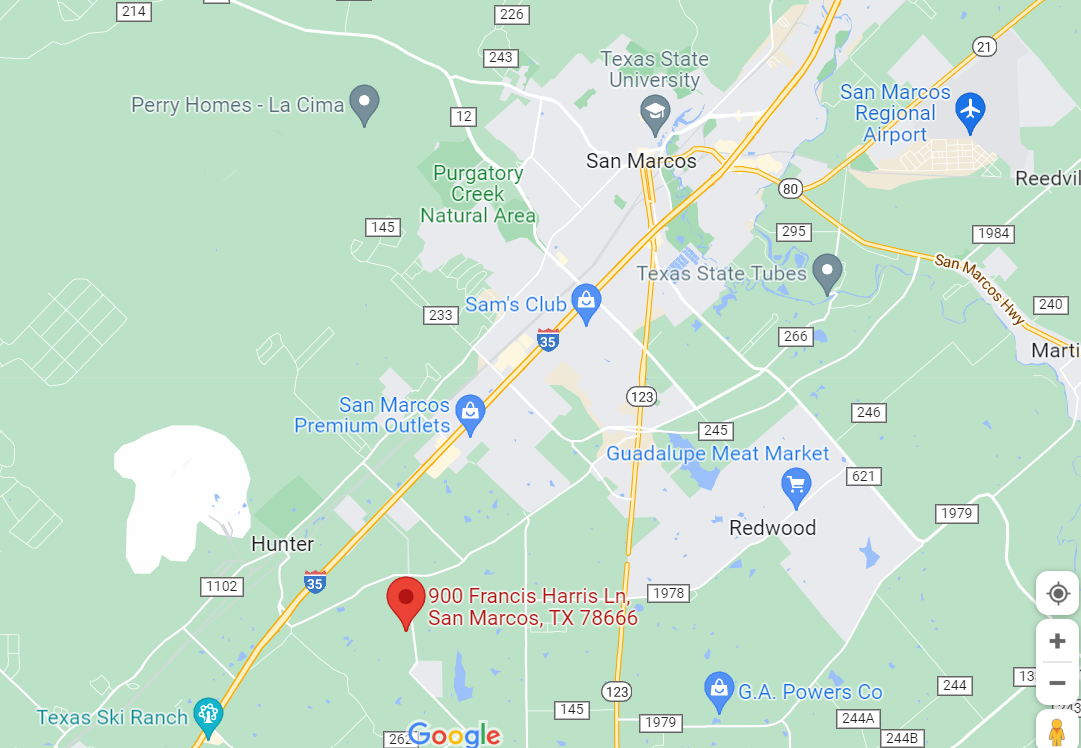
Item 28: There’s a little patch of land west of I-35, between I-35 and Blanco Vista that gets re-zoned. It’s at this red pin:
This is right near the apartment complexes tucked in that same little tract of land. It had been General Commercial, and now it will be CD-4.
CD-4 is fairly dense – picture apartments or townhomes. You’re allowed to put some corner stores in. It’s pretty reasonable for that location.
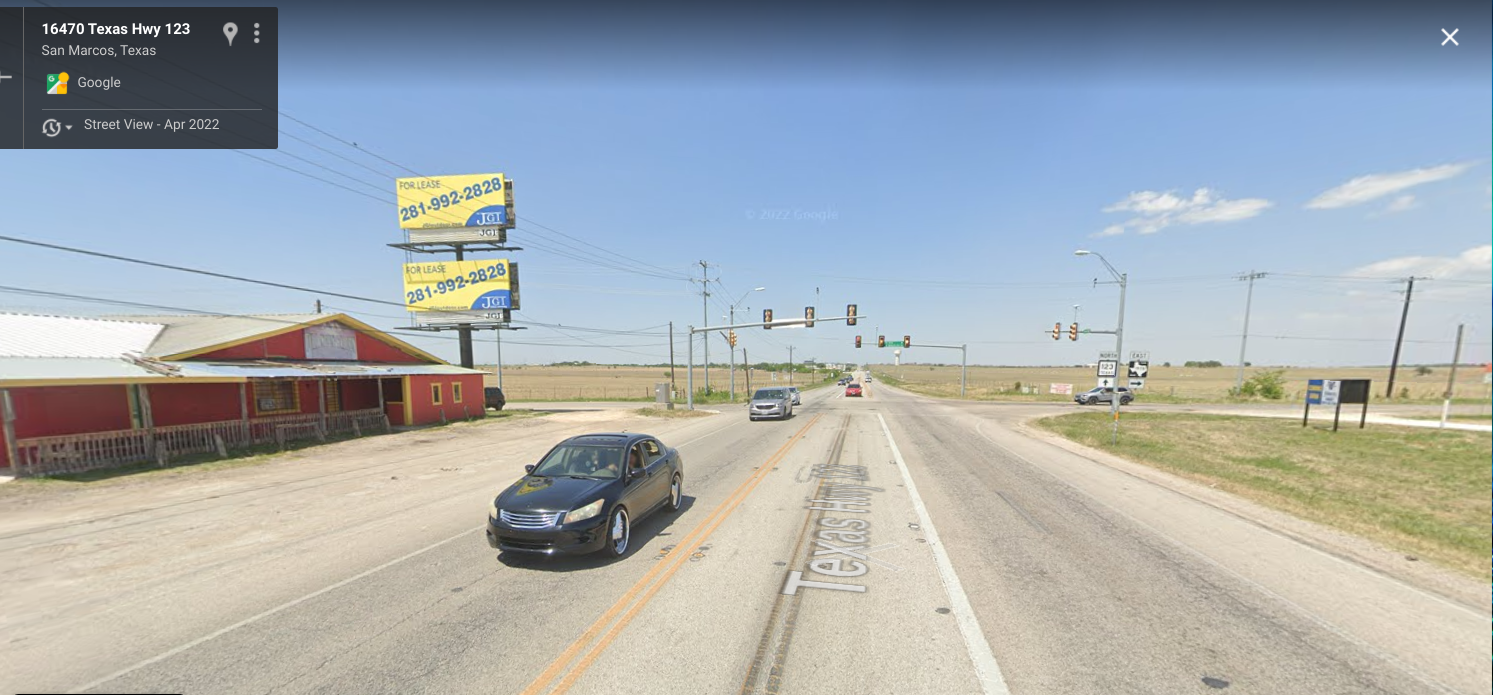
Item 39:
Suppose you’re driving up from Seguin, on 123.
This is the intersection of 123 and Beback Inn Road, which is a really great name for a road. That red house on your left is the Full Moon Saloon. That giant expanse of empty flat space on your right, starting at the light, is the topic for Item 39.
It’s too early to really answer the four questions above, but that’s certainly way out in the middle of farm land. And the presentation claims it will be “predominantly single family with some commercial.”
Council decided to put together a committee to work with the developer. Max Baker, Shane Scott, and Mark Gleason will be on it. Those three make for a highly combustible group, and Max is outnumbered. We shall see how this goes.
CIP projects are Capital Improvement Programs. This is basically public works – which major water/wastewater/electric/roads/facilities projects are coming down the pipeline in the next year? What about the next three or next ten years? It’s big and complicated. We’re looking at roughly $10 million of projects this coming year.
(There are so many projects that I’m not prepared to do a super deep dive, but if you want to know when a project on your street will be completed, this is where you look. For example, Hopkins will be reopened in 2050.)(Kidding. But really, just email the city and ask about whatever project you care about.)
Then there are a bunch of annexation and zoning cases.
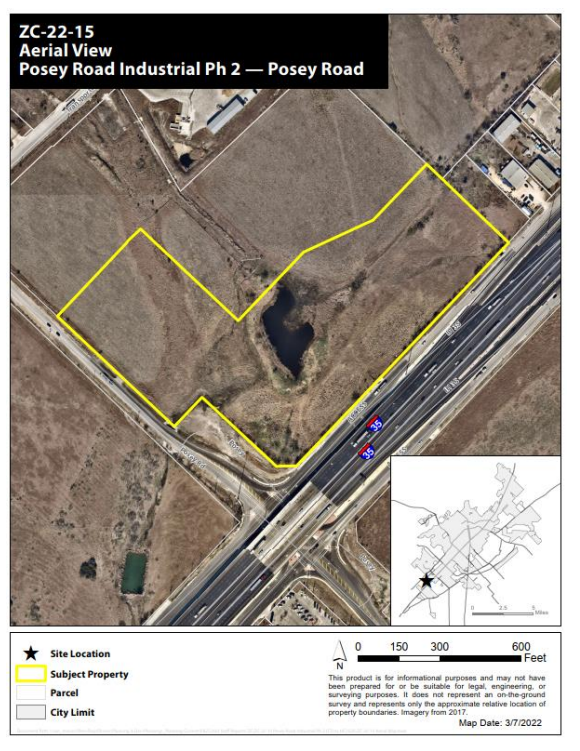
Here’s the first:
That’s I-35 and Posey, right near Trace. They are asking for Heavy Commercial. Think retail and businesses, but they’re allowed to be car shops or other industrial-ish things, like you’d see along I-35.
Max Baker takes issue with how these are such fossil fuel heavy uses. Mark Gleason offers up a proposal: “No waste-related services.” (This is animal waste processing, landfill, composting, recycling, solid and liquid waste, incineration, etc.)
Vote on allowing waste-related services? No: Mark Gleason, Max Baker, Alyssa Garza It’s fine: Jude Prather, Shane Scott, Jane, Saul.
So it’s fine.
Next Max proposes nixing truck stops. Vote on allowing truck stops? No truck stops: Max Baker, Alyssa Garza They’re fine: Jude Prather, Shane Scott, Jane Hughson, Saul Gonzalez, Mark Gleason.
So they’re fine.
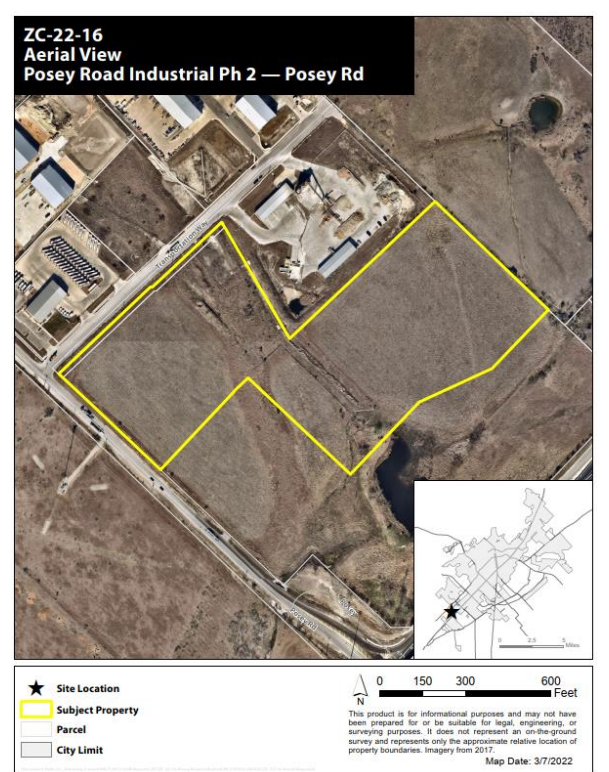
Next, this chunk of land:
Which fits like a tetris piece alongside the last one.
This is going to be heavy industrial. This means basically anything goes – manufacturing, warehouses, etc.
The vote: Yes: All of them except Max Baker. No: Max Baker
Here’s the last one:
That is 123 running north-south, on the right hand side of the photo. In other words, if you’re driving out of town on 123, you’ll get to the overpass over Wonderworld, and you’d be at the top of the photo.
If you keep driving south, the site will be on your right, but set back a little ways, and before you get to the intersection with McCarty.
The owners want to do Light Industrial on part of it and leave the rest vacant. Max Baker proposes an amendment to nix waste-related services.
Vote to allow waste-related services? No: Max Baker, Mark Gleason, Alyssa Garza, Saul Gonzalez, Jane Hughson Keep them! Jude Prather, Shane Scott.
Items 17-22: There are two rezonings that zip through. The first is an extra 76 acres of housing, tacked onto Cottonwood Creek on 123.
I worry a bit about that whole region east of 35 becoming an extreme retail desert. You would not believe the size of the huge tracts of land that have been approved for housing out that way. The vast majority of it seems to be single-family housing. So far, there are no amenities ever discussed – no restaurants, no grocery stores, no daycare centers, no drycleaners, none of the things that make living easier. Maybe I’m short-sighted and the free market will elbow its way in, but it feels very grim to me.
(In general, I don’t understand why Americans are so opposed to having businesses in our neighborhoods. A neighborhood restaurant and laundromat sounds great to me!)
Neither developers, nor P&Z, nor council seem to have any appetite for making new neighborhoods denser. We only seem to approve apartments when they are massive, standalone affairs. Otherwise it’s acres and acres of sprawling single-family homes. When developers are allowed to build duplexes, they don’t seem to want to. Nobody ever attempts to sprinkle 4-plexes and 8-plexes throughout a neighborhood, and it makes me sad.
The other zoning is another patch of La Cima. This is part of the original La Cima agreement, from 2012 or so.
La Cima is a perfect example of the thing that gives me a sad: the original agreement involves both multifamily and single family housing. So they are building a large apartment complex at the front, and then acres and acres of single family homes stretching forever and ever beyond. This authorizes some more of the ever beyond to be turned into single-family homes.
One near the outlet malls, on the other side of 35, got postponed.
One near the high school got approved. Not sure what it is. Light industrial?
A low income housing complex for seniors in the Whisper tract PDD. Everyone hates the location, but it will bring in a ton of money to the San Marcos Housing Authority.
And then…we have the curious case of the narrow house on Lockhart St. This is inconsequential but symbolic. And so weird.
A year ago, the owner asked to build a little house on the lot and split it into two lots. P&Z approved, Council denied. (I did not see that meeting.) From what I gather, Saul Gonzalez rallied against it, saying he used to live in that neighborhood and could speak on behalf of the residents, who did not want it. Fine.
So now it comes back. It was a super feisty P&Z meeting, with Zach Sambrano speaking particularly forcefully in favor of the little house, squeezed onto a tiny plot. Namely, what exactly is the problem with this? But they voted it down 6-3.
To overturn P&Z, Council would need a supermajority of 6 votes. And Shane Scott recused himself, because he lives near there. So there was no way this was ever going to pass. But the discussion was bizarre.
Saul moved to deny. There were the usual points about changing the character of a neighborhood, and traffic.
After a couple comments, Alyssa Garza spoke up and said, “You all are speaking to different residents than I speak to. The neighborhood residents that I spoke to all said that they didn’t mind the house being built.”
This is where the conversation got so very weird. I’m looking at Saul Gonzalez, Mark Gleason, and Jane Hughson.
Saul basically said, “I know a lot of the residents. Unfortunately, they’ve passed away, and their children now live there. Their children said they don’t mind. But still, it’s a slippery slope.”
Mark Gleason and Jane Hughson both said some version of this: “I talked to some residents! They said they don’t care if it’s built. But they said it with cynicism and resignation in their voice. Therefore I’m discounting their words.”
This is just an amazing bit of NIMBY-projection where it doesn’t even exist! “There’s no way they meant what they said, so instead I’ll have to trust the deep longing I imagined in their voice, for heavy-handed NIMBY protectionist measures.” I was genuinely dumb-founded to hear this verbal fancy hot-stepping.
In the end, “Preserving the Uniformity of the Neighborhood” ended up being the holy grail to which we sacrificed this little house. Does one house really affect affordable housing? Not in the grand scheme of things, but it’s symbolic AF.
Voting to deny: Saul Gonzalez, Mayor Hughson, Mark Gleason, and Max Baker. Voting to approve: Alyssa Garza and Jude Prather.










 The San Marxist