Every three years, we run a community survey. The first one was in 2022, and so 2025 is the second.
Methods:
They try to get a random sample of people by sending mailers out to households. They also open the survey up to anyone, online.
The responses are overwhelmingly older white homeowners in Kissing Tree.
I’m really not kidding:
where “Charlie” is the blue #3 area below:
and yes, they are mostly white home-owners:
This is a well-understood phenomenon by people who run surveys – different groups of people respond to surveys with different participation rates.
So they correct for it. What you do is you take the actual composition of San Marcos, based on census data. Then you weight your survey responses until they match the actual proportions.
For example:
Loosely speaking, if you’re 18-34 and you filled out the survey, your answers will get multiplied by 3. If you’re 35-54, your answers will get multiplied by 1/2, and if you’re 55+, your answers will get multiplied by 1/3.
This came up before here. Now we’re workshopping it.
The basic idea is that tenants should be able to meet up and talk about their landlord, or their living conditions, without fear of getting evicted.
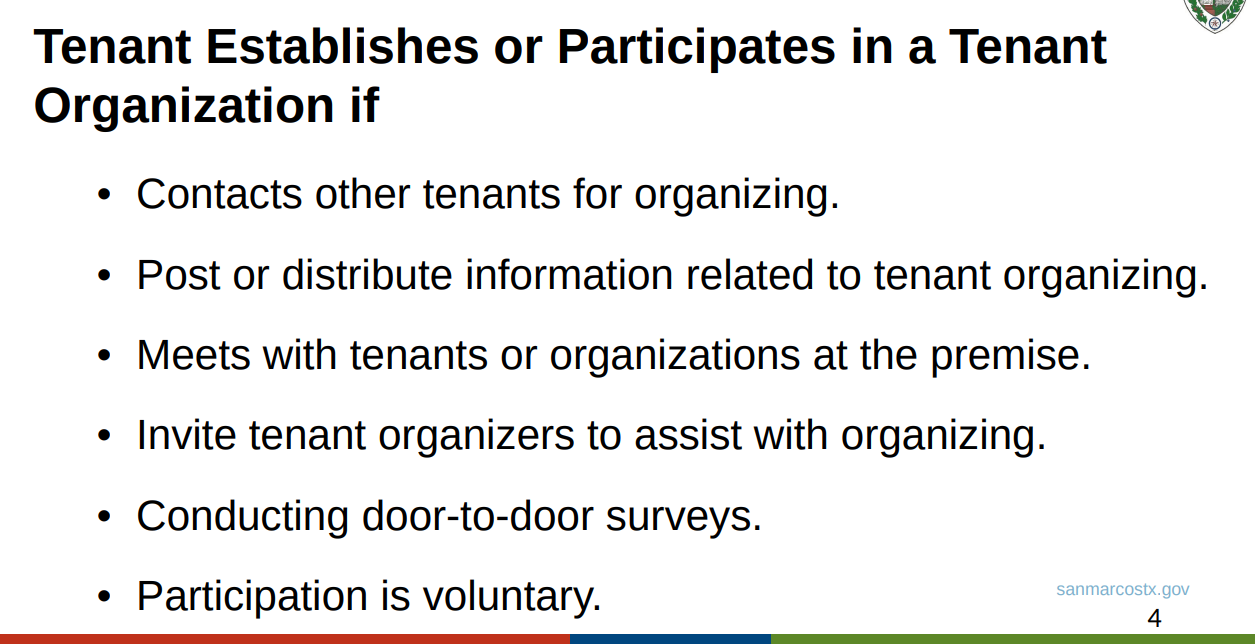
This is the type of behavior that is protected:
Great!
And here’s the type of thing a Landlord is not allowed to do:
Sounds reasonable.
On the other hand, landlords also have some rights:
Seems reasonable.
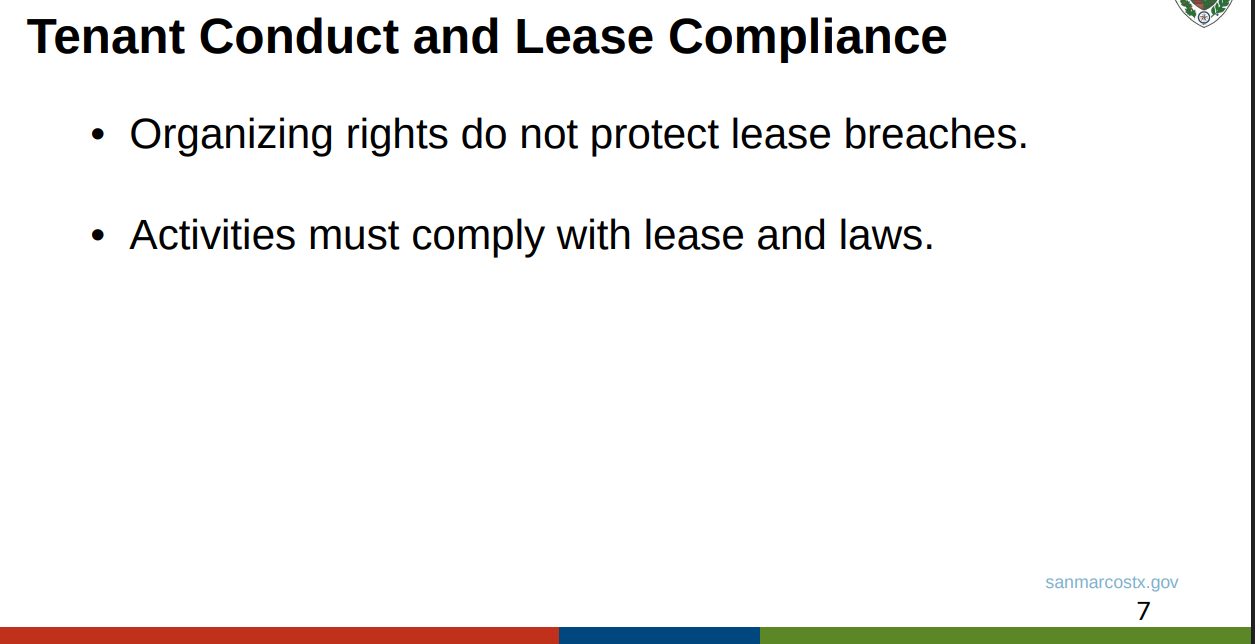
Finally, you still have to abide by your lease.
….
My main question is about Rent-By-the Bedroom. We had a fantastic presentation on these, last year.
RBB complexes skirt rules by avoiding certain legal terms. Tenants don’t sign a “lease”, they sign an “installment contract”. So a lot of laws about tenants and landlords don’t apply to them.
Since that’s their game – swap out magic words to avoid legal status – we need to make very sure that our language is broad enough to include them.
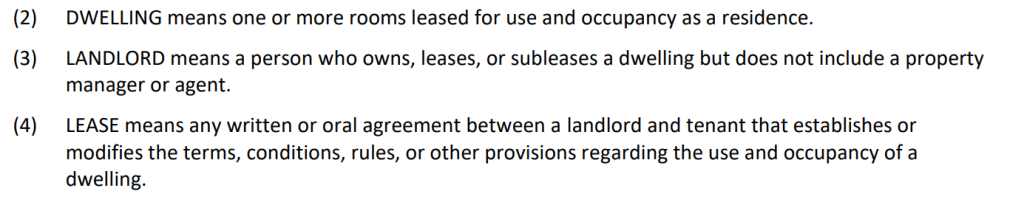
I’m looking at the definitions section from the proposal:
“Dwelling” and “landlord” don’t seem broad enough to include “Installment Contracts”.
(Also: the definition of “Lease” uses the word “Landlord”, and the definition of “Landlord” uses the word “Lease” so things are getting circular here.)
Other than that, this is a great step forward!
…..
Workshop #2: SMPD Vehicle rental policy:
This has also been in the works – literally for years. Here’s where they’re landing:
Great!
….
Workshop #3: Update to the Airport Master Plan:
We have an Airport Master Plan that was approved in 2021.
(Honestly, I’m kind of guessing what they said, based on the slides. I was distracted. Sorry about that!)
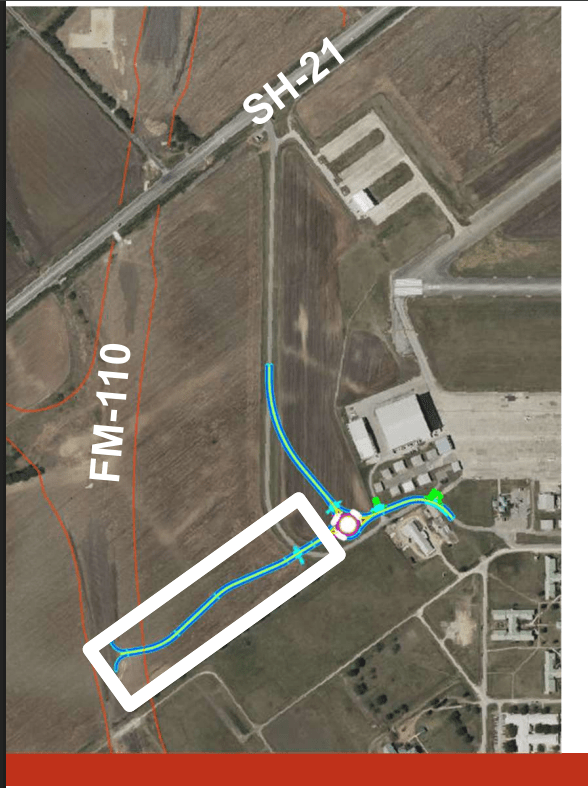
This runway is going to get a glow up:
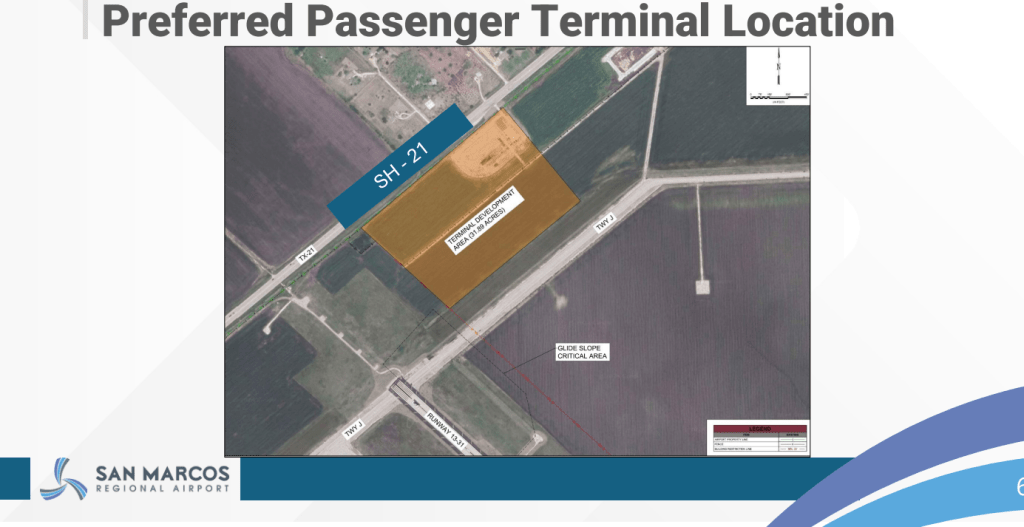
And it sounds like there will some day be a passenger terminal out front:
This will come around for approval during a regular council meeting.
Please don’t let city staff approve restaurant alcohol permits. (Item 9.)
There are some apartments being proposed on Lindsey, between Academy and Comanche. (Item 17.) This gets a lot of traction:
Against it: Three students/former students represent a recently formed group called “Tenants Advocacy group”, to fight on behalf of tenants. (Be still my heart.) They’re strongly opposed to this complex.
Love it: The developer is all in favor of the Lindsey street apartments, and Shannon Mattingly – former director of San Marcos Planning Dept – is now working for this developer.
We’ll get into the details of all this, in due time!
Finally: one of the speakers (Kama Davis) brings up an item from Executive Session (Item 20):
A developer wants the title of this alley, in purple:
The speaker wants it to stay with the city.
This taps into a much larger conversation about What To Do Along CM Allen. Should it be parks? Should it be apartment complexes? You just sit tight, we’ll get to all of this.
…
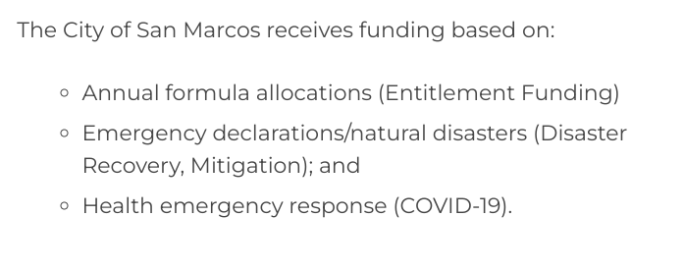
Item 1: We get CDBG funding from the federal government, specifically from HUD. We qualify on a few different points:
Tonight’s presentation is an internal audit, by Deloitte and Touche, on the $34 million we got after the 2015 floods. They’ve looked us over, and say everything was fine. Hooray!
Items 2-3: We get Q2 reports on the budget and our investments. Both seemed unremarkable. We’re a normal-amount of the way through spending and bringing in revenue. Our investments are doing middling-well.
…
Item 8: New airport zonings
So, the FAA and TxDot Aviation both want you to regulate two things:
Stay out of the airways where planes might be flying
Don’t build things right by airports that are going to cause problems later on.
However, neither the FAA nor the state actually control zoning, so they incentivize it. It’s a precondition for various grants and funding opportunities. The state of Texas also gives cities some extra leeway to regulate airports, beyond their city boundaries.
Over the summer, in Georgetown, a plane really did crash into someone’s house. So airport safety is a real thing. We’re all clear on the concept of plane crashes and why they’re bad, yes/yes?
So now it’s time to nail these things down.
Height Hazards: The city staff rep described all these abstract shapes in the air. There were pancakes floating 150’ in the air, cones beyond that, etc. You get the feeling that it looks like a giant invisible stadium around the airport. No one can build into the giant invisible stadium, but you can build below the bleachers, so to speak.
Here’s the bird’s eye view of the invisible stadium:
I don’t think anyone is too fussed by this part. Everyone understands that you need to stay out of the flight path of planes.
2. Compatible Land Use: this is the controversial part.
The main problem is houses and runways: you don’t want houses near your runways. But people already own this land, and no one likes to be bossed around. (Existing houses are grandfathered in.)
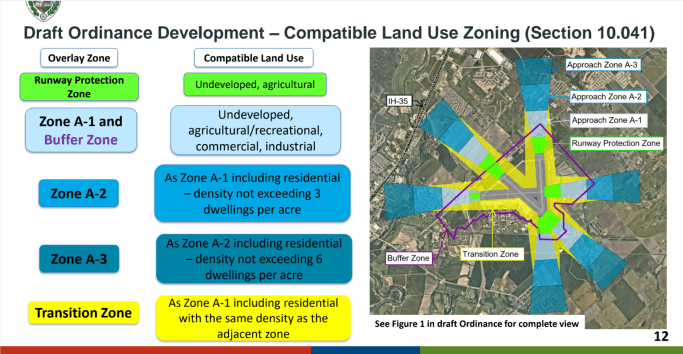
Here’s what’s being proposed:
Obviously all those rainbow-spokes are designed around either end of the runways.
So basically:
Bright green means absolutely nothing can be built.
The city owns almost all the bright green, but are some teeny green bits sticking out past the purple line.
The rest of the blues: feel free to build commercial, industrial, or anything else besides homes. Homes are restricted.
Like I said, anything that’s already built gets grandfathered in. The problem is: what if you own the land in those stripes, and you want to someday sell it to a developer? Or you wanted to build apartments yourself? Once those stripes are zoned, you’re out of luck.
Generally, the city is not allowed to downzone your property. If you own some land where you can build 7 stories, and the city wants to change the zoning to 2 stories, they may have to compensate you for the loss of potential revenue.
Here, they don’t, because airport zones are specifically carved out by the state of Texas for protection. Texas wants cities to make airport zones so that there will not be people living in a runway flight path. Makes sense.
So this decreases your land value, and land owners are mad about it. (On the plus side, your property taxes will go down.)
I’m trying not to sound like a total ass, because my initial reaction is, “You’re mad because you wanted to build homes that would be dangerous to the tenants and now you can’t? Fuck off.” (I guess I am a total ass.) But I mean, you can still build things. Just not homes.
Jane Hughson is more sympathetic to them than I am. She’s worried that we’re doing something to land owners, above what’s required by the state or federal government. She asks that the staff speak directly to the speaker who showed up.
Shane Scott says that he is a pilot, which I did not know, and he is pro-airport safety.
If one of these landowners wants to build something not allowed, they can ask for an exception! There’s a procedure for this:
Apply for a variance with the Zoning Board of Adjustments
If you don’t like what they say, you can appeal the decision to district court
The question is, is this sufficient? Or should we feel so bad for them that we do something additional, to show we care about the landowners who want to build homes in front of runways?
Jude Prather’s take: “I’m okay with the ZBOA and appeals procedure. Let the boards and commissions function like they’re supposed to.”
Alyssa Garza’s take: “I feel like there are more details I should understand.”
Saul: Property rights 4-ever!!
Matthew Mendoza: Can we say no to the feds?
I mean, sure. But it’s only going to get harder to make these airport zones, the longer you wait.
Look, this is common sense. The best time to prevent homes from being built is before the homes get built. Shane and Jude are the only ones willing to say this outright, and everyone else comes off as mealy-mouthed.
The vote:
I truly don’t know why Saul and Alyssa voted against it. I mean, I vaguely understand PROPERTY RIGHTS!! But allowing people to build houses in a runway path is a pretty big abdication of the whole point of government.























 The San Marxist