I just want to point out a pattern. Several times in this meeting, this happens:
“Look, here’s a problem!” “Yes, yes! We all agree that this is a problem!”
Then we sit, waiting for someone to make a motion to fix the problem.
No one makes a motion.
Everyone shrugs and moves on. It drives me crazy. You all just acknowledged it was a problem! You got to third base, but then got bored and never got to home plate.
Oh well, moving right along:
Hours 0:00 – 1:29: A bunch of fiddly little items. And my favorite: the curfew is dead! Hours 1:29 – 2:57: In which the Land Development Code is scrutinized. Some important changes are coming. Bonus workshop: There’s some nasty chemicals in the ground near the town square. Read all about our plan to do nothing! We’re doing it responsibly, though.
Several people from the SMART protest community showed up to talk about Item 18, the revision to the San Marcos Development Codes. We’ll get to this.
A few people talked about different good projects for the CBDG money.
Item 10: CBDG money for 2023-24.
This is $712K of federal money from HUD that’s intended to help community programs for low-income folk.
Here’s the requested amounts, and what ends up being awarded:
The “rec” amounts end up being approved by council.
On the Habitat House Counselling program: The federal department, HUD, requires housing counselling in certain situations. Habitat offers an online course and then individual counselling thereafter. A rep from Habitat for Humanity shows up to explain all this. But it wasn’t persuasive, because the cost is wild: Last year, Habitat charged San Marcos $13,000, and only 11 San Marcos households participated.
HUD offers a free online house counselling course. Sso we’re going with that. (We still work with Habitat on housing construction. Just not counseling.)
Shane Scott asks if we can boost CASA to $60K. The problem is that HUD has categories for this money, so you can’t dip into any project you want to move funds around. They decide that they’ll just boost CASA from the other money they dole out – the city money (HSAB) or the last bit of Covid money (ARP).
Item 11: Running wastewater from Whisper Tract down through Blanco Shoals natural area, to connect with the city wastewater system.
I’m only including this item because it annoyed me. LMC spoke during the public hearing, and asked if this involved tree removal. Would the city hold itself to the standards that it holds its citizens?
Mark Gleason follows up: Will this require tree removal? Answer: It could! Mark: Is there a remediation procedure? Answer: nope! Jane Hughson: Can we add a remediation procedure in? Answer: It’s not in the development agreement with Whisper. [Translation: you can’t make the developer pay for tree remediation.]
Ok, fine, but we can certainly pay for tree remediation. But it just gets dropped, exasperatingly.
This is the Council Dance: – Here, we identified a problem. – Let’s all sit uncomfortably for a sec – Rather than fix it, just pat it on the head and go on our merry way.
Also: Add in tree remediation to your goddamn development agreements, Council!
Item 12: Issuing $3.7 million dollars in bond debt. I didn’t really follow the details, but our AA bond rating was affirmed by Standard & Poors, which was presented as a thing we should feel good about.
Item 14: CURFEWS ARE BACK. This is delicious.
If you’ll remember, there was a three part giant shitstorm over renewing the curfew, last year. Mark Gleason decried the roving gangs of minors in his neighborhood. Mano Amiga turned out a large number of people speaking out against it. I myself made the case that curfews are dumb and wrong.
The final vote on curfews, back on 12/14/22:
So it passed. (I miss the clickers.) In theory, the Criminal Justice Reform committee was going to study the issue and bring it back.
However, the good hypocrites at the state level, in their quest to micromanage cities, felt differently!
H.B. 1819 seeks to ensure that all young Texans have opportunities to succeed without the burden of a criminal record early in life by eliminating the authority of political subdivisions to adopt or enforce juvenile curfews.
It’s really an oddly specific thing for the State Legislature to care about. Based on this flyer, it was supported by a real mix of groups: a conservative think tank, homeschoolers, youth services and racial and social justice organizations.
The common thread seems to be anti-authoritarianism. Works for me.
Upshot: in order to comply with the new state law, the curfew has now been repealed. Hooray!
Item 15: Ending the contractor test requirement to pull a permit. This came up before as a discussion item, and now it’s happening. This is a good thing. Anyone can pull a building permit now.
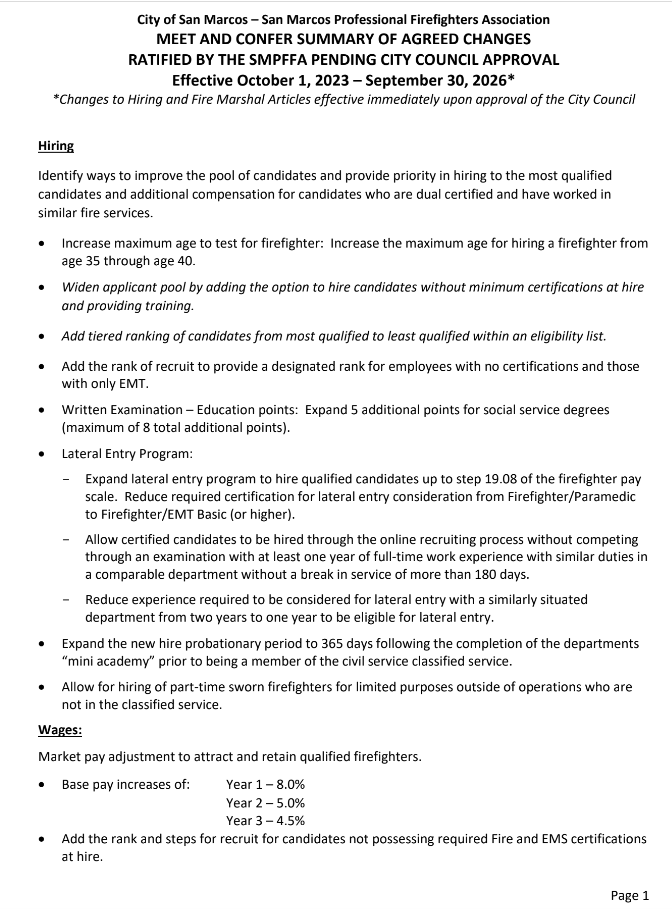
Firefighters also get to unionize and collectively bargain for their contracts. The firefighter’s union is SMPFFA. Since firefighters aren’t known for systematically stopping, harassing, and abusing people of color, SMPFFA gets a lot less attention than the police.
The state just passed a bunch of laws, like repealing all curfews. What else do we need to fix to be legal?
Plats: A plat is the drawing that shows things like roads, bus stops, parks, parking lots, and things like that. Everything but the details of the actual building.
Right now plats get approved by P&Z. But P&Z is legally not allowed to make a judgement call. They’re only allowed to consider if the plat meets the conditions in the land development code.
In the future, plats won’t go to P&Z anymore. City staff will approve them. We’re told this is because the state legislature tightened the shot clock, so we have less time to approve applications. We need to streamline processes to comply. They will publish the plats on a website
Okay: this is a small thing, but city staff is mildly bullshitting their case to City Council here. The shot clock was tightened back in 2019 to 30 days. This most recent bill says it’s okay to skip P&Z approval. So P&Z approval used to be required by the state, but now we’re allowed to let staff approve plats.
What else?
More appeals procedures added in to land at City Council, and we modified the timeline
Private schools must be zoned just like public schools.
City staff is misleading us a teeny bit here, too. This says “Municipalities will be required to treat charters as they would an independent school district for the purposes of permitting, zoning, etc.” It does not say private schools. Just charter schools. We’re allowed to zone private schools however we want, but don’t pretend that the state is making us do this.
Listen: the city staff work hard and they’re good people. I’m just being persnickety here.
Part 2: A new zoning district, called “Business Park”.
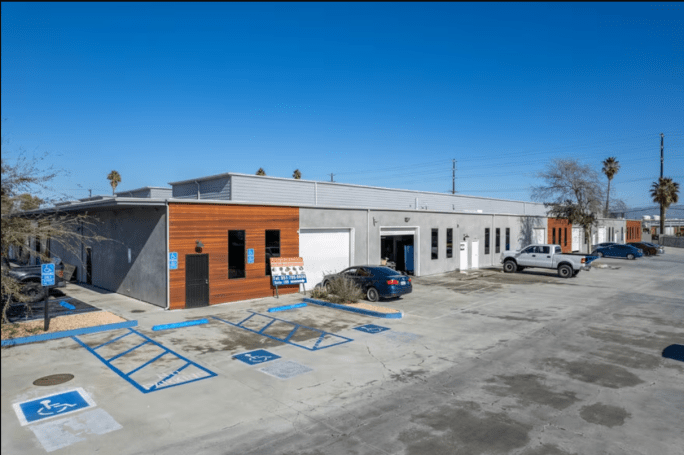
That’s not what we’re talking about. What Jane Hughson means is, “Hey, if you want to put industrial next to residential, it has to be super mild and chill.”
I think she actually means little warehouses, like this:
Either way, it’s going to be capped at 35′ high, and excludes a lot of bad neighbor uses. If you wanted it higher than 35′ or to include warehouse and delivery, you’d have to get a Conditional Use Permit from P&Z.
Part 3: Process improvements
City council keeps getting bit in the butt over Development Agreements. They pass something in the dead of night, and then when everyone finds out the details, they’re furious.
In recent memory:
La Cinema. Council modified the Development Agreement with La Cima to allow for movie studios back in December 2021. There were no notifications sent out and no one noticed. Then it came time to negotiate tax credits, and everyone got super mad that movie studios were allowed over the aquifer. But it was too late.
The SMART Terminal. They doubled the size of the SMART Terminal back in January. But there were no notifications to the public. Afterwards, everyone was furious. I would have to link to every single meeting from the past six months to flesh this out.
Clearly we need to mail out notifications for Development Agreements and for amendments. We’re finally going to start doing this.
How many people should get notified? They’re proposing a 400 foot radius – everyone who lives within 400′ gets mailed a notification. That matches what we do for zoning changes.
Listen: It should not be 400′. It should be proportional to the size of the project. Tiny projects get a tiny notification radius. Giant projects need a larger notification radius.
If you’re looking at the 2000 acre SMART/Logistics park, 400 feet is a tiny sliver around it. If you’re talking about a little 4-plex, 400 feet is plenty.
Note to Council: Since you’re tinkering with Development Agreements, why not also add in tree remediation?
Other changes
Historical Preservation Commission (HPC) can postpone things now.
Timeline for Demolition by Neglect is increased from 30 to 45 days
Park land dedication – this one is a bit weird. Let’s spend a moment here.
Right now, if you want to build anything residential, you have to set aside some land for parks. The equation is 5.7 acres per 1000 people.
The old code says this: “A minimum of 50% of the parkland required under this ordinance shall be dedicated to the City of San Marcos as a neighborhood or regional park under Section 3.10.2.1. The remaining 50% may be owned and managed by one of the entities under Section 3.10.1.6.”. Those entities are the city, a land conservancy or land trust, an HOA, or a public easement.
The new code says: “Appropriate plat notes describing the ownership and maintenance of all proposed parks are provided on the plat.”
In other words, maintenance is expensive and we want to pawn it off onto HOAs. But then the city doesn’t actually own the land. We could just make the developers and HOAs cover the costs, but we still own the land. But that’s not what’s proposed.
Jane Hughson asks: Will the park still be open to the public? Answer: Yes, dedicated parkland is required to be open to the public.
Mark Gleason asks: What can we do if it’s not maintained? Answer: We withhold their final permits until the park looks good. Mark: No, I mean like five years later. What if the bathrooms are all broken and there’s garbage all over the place? What can we do? Answer: [squirming in the uncomfortable silence]
Looking in the code, I see this bit:
That doesn’t quite apply here.
No one offers a motion and the motion passes.
See? This is the Council Dance again: – Here, we identified a problem. – Let’s all sit uncomfortably for a sec – Rather than fix it, just pat it on the head and go on our merry way.
Occupancy restrictions: let’s dish on this.
We have an occupancy ban in San Marcos. No more than two unrelated people can live in the same house. This is an extremely shitty policy that punishes poor people, out of fear that college students will throw wild keggers next door. There is a housing crisis, and people need to be able to move in with each other. (Furthermore, this dumb policy is totally unenforceable, so it only gets trotted out when someone has an axe to grind. It’s the worst!)
Listen: you cannot govern San Marcos solely out of fear of beer cans from college kids. That is a code compliance issue. That is not the basis for good policy.
Somehow it took city staff 15 months to bring it back, so here we are. However, during that 15 months, Max Baker was voted out and Matthew Mendoza was voted in. And Matthew Mendoza is very salty on this issue.
The more he talks, the more conservative Matthew seems. He sees this all the time in his neighborhood: a bunch of unrelated people live together, and it reduces home values for families in his neighborhood, which is how you buld generational wealth. He was calling this New Urbanism and claiming this was a gateway for big apartment complexes. It was kind of unhinged.
Everyone reassured him that there’d been a big conversation. Matthew did not get any traction re-opening the topic. But it was still a weird rant.
Awnings can be now be 7′ clearance instead of 9′ minimum clearance. This is in response to the owner of Chances R Bar downtown, who pointed out that the building literally isn’t tall enough for a 9′ awning.
Mark Gleason is super mad at his neighbor.
Apparently there’s a house in Mark’s neighborhood which is lifted off the ground and is two stories high. It’s got a flat roof, and they made a little patio up there. Mark is livid that they can see into other people’s backyards, but you can’t really legislate that, so instead he is livid that there is a structure up there – “with shingles!” – that allows them to hang out and see into people’s backyards.
Shane Scott says, “Our house in Mexico is like that. It sounds pretty cool.”
This is the Shane I like best, when he needles Mark for being a prig. You can practically see them in the same high school cafeteria, circa 1991: Shane wearing a Metallica t-shirt and black jeans, Mark wearing the same khakis and golf shirts that he wears to city council meetings. Shane leaves his lunch trash behind on the table when he leaves, and Mark urgently flags down the teacher to let them know that it was Shane.
Amanda Hernandez, the planning department director, strongly suspects that this house is probably already violating city code. The top of a house can’t be more than 35′ off the ground. If this is elevated and two stories already, you’ve got to be pretty close. Mezzanine structures count if they’re at least 30% of the area.
Mark makes a motion to measure height from the ground to top of rooftop structures.
Yes: Everyone besides Shane Scott. No: Shane Scott (Jude Prather is absent.)
I prefer to live in a world that facilitates rooftop patios and rejects Mark’s killjoy tendencies. So I’m a “no”, if anyone asks.
So what do you do with a bunch of toxic shit in the ground? There are procedures, it turns out. You need some information:
What contaminants exactly got dumped?
How far underground has it spread? How deep is it, and how far north/east/west/south?
Is it staying put? Or is it moving?
How exactly do you clean up these chemicals?
If you don’t clean up these chemicals, what do they decompose into, and how long does it take for it to decompose?
It turns out we have answers to all these questions!
The chemicals: Tetrachloroethene (PERC) Trichloroethene (TCE) Vinyl Chloride (VC)
Chlorinated solvents are synthetic chlorinated chemicals, I’m told. Bacteria won’t touch them, but they’ll break down on their own over time.
I have no background in chemistry, but if the chemists tell me to stay away from these, I’m going to believe them.
Where are these nasty chemicals currently?
We dug a bunch of different types of wells:
I’ll explain the “MSD” acronym in a bit.
So here’s what you find when you drill down:
The normal soil or whatever on top. Very dense silt and clay. No moisture.
About 22’-23’ down, you get fine sand. It’s got groundwater in it. That’s called silten clay.
Below that, you get Navarro Clay. The Navarro Clay is super thick and water doesn’t pass through it. (The vocabulary word is aquitard, which sounds like an insult but isn’t.)
The Navarro Clay is a shield, and then below is the aquifer water.
So the contaminants – the PERCs, the TCEs, and the VCs – they are all heavier than water, and they sink through all that wet sand and puddle on top of the Navarro Clay. That tells us how deep these things are.
Note: the geologists made it sound like the aquifer was hundreds of feet further below the Navarro Clay, so far away that we should sleep easy at night.
So we are really trusting the aquitardiness of that Navarro Clay.
What about how far north/east/south/west?
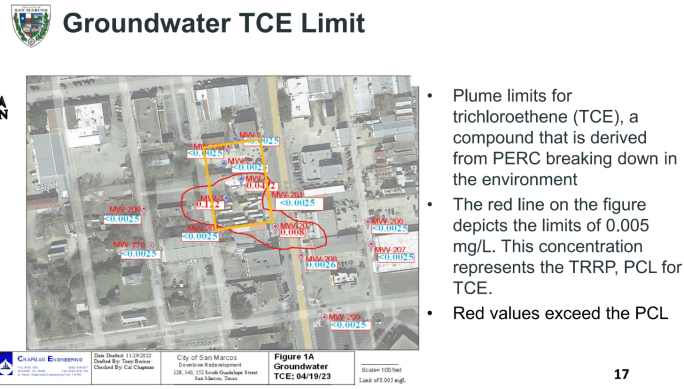
The skinny red line is the boundary of the PERC plume:
And here the TCE plume:
And the VC plume:
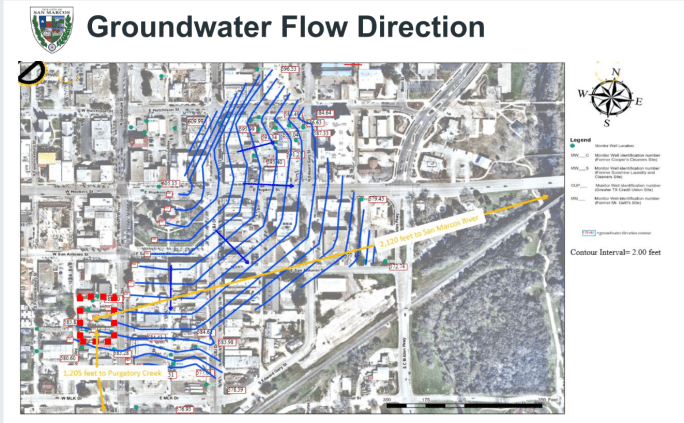
Is it staying put? Or is it moving?
It is moving incredibly slowly in this direction:
Because it’s resting on the Navarro Clay, and it’s all gunked up in there, it’s moving incredibly slowly. It won’t reach Purgatory Creek for another 89-8900 years. It won’t reach the San Marcos River for another 188-18,800 years.
How exactly would you clean this up?
They didn’t actually answer this. They basically said it would be impossible, because of all the sand in the way, and the gunkiness of the Navarro Clay.
What would it decompose to?
The PERC is the stuff that was dumped by the drycleaners. The PERC breaks down into the TCE, which is also nasty. The TCE breaks down into two dichloroethylenes, also bad. That breaks down into VC, still bad. But then after that you get carbon dioxide, a little chlorine, and water, which is not nasty anymore. This process will happen over the next 50-100 years.
Listen: I am sharing what was presented. I am not a scientist. If you are a scientist, and we are being told an overly optimistic picture, please fill me in.
So what do we do?
So if the PERCs and TCEs and VCs will all break down before they reach anything sensitive, what do we do?
You declare an MSD: Municipal Settings Designation.
Back to this slide, which has the perimeter of the MSD:
This means that within these borders, no one is allowed to drink well water. Everyone has to be on city water.
It also means that within a few years, we can “achieve regulatory clearance”.
Congratulations! You have nasty stuff in the ground, but your regulatory conscience is clear!
…
So what happens up top, where people wander around? This was the second half of the presentation.
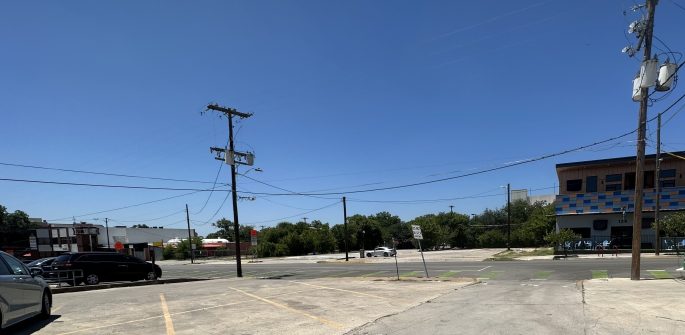
Again, this is what it looks like:
It’s fine, as long as you don’t dig up that concrete.
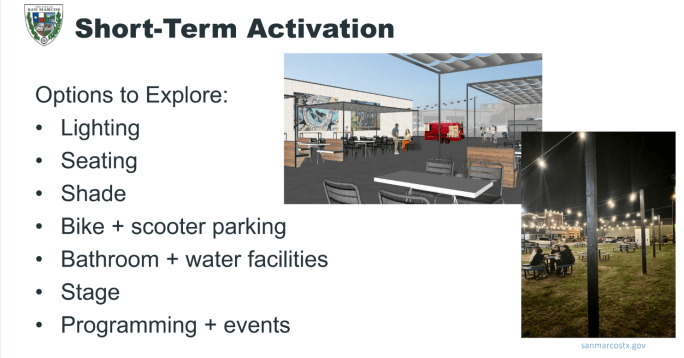
We’re proposing a short term plan: the left and right would be city parking, and the middle will be a little public area. Shade, seating, bathrooms, bike and scooter parking. Room for extra booths for the farmer’s market or Art Squared.
Council was nervous about having a stage there, but liked the rest of it. So this will come back around as an agenda item in the future.
I’m trying something different with this year’s retrospective: I picture it functioning like a table of contents, to help organize the past year into a coherent timeline. (Find last year’s retrospective here.)
It’s really dry, boring reading. Sorry! Tune in next week, when our courageous city council members return to their normal shenanigans, on the 23-24 season premier of the San Marcos City Council.
One more thing: Election season is coming up! Two city council seats are up for election: Seat 3: Alyssa Garza (our noble, lonely progressive representative) Seat 4: Shane Scott (loves small government and business interests)
Currently, Griffin Spell has filed to run against Alyssa Garza. I have lots of thoughts, but I’ll save them for the future.
No one has filed yet to run against Shane Scott. The last day to file is August 21st.
I am not plugged in enough to know if anyone is thinking about challenging Shane Scott. But I’m hoping!
Yearly Summary
Caveat: – Many items show up at multiple meetings. I’m usually listing an item at the meeting that you’d want to consult if you went back to look up details. – when relevant, I’ll include how each person voted – San Marcos is 15 months behind on posting the minutes to city council meetings. The most recent is May, 2022. What’s up with that?
P&Z members rewrite their own Comp Plan, I am annoyed
Satanic Temple leads the council in prayer
Remove 104 acres of commercial from Riverbend Ranch, because why not let developers build 1200 acres endless uninterrupted sprawl like they want?
Meet & Confer comes back around. Negligible changes were made. Council did not bring the Hartmann reforms to the negotiation table in any meaningful sense. The vote:
Yes: Mayor Hughson, Jude Prather, Shane Scott, Mark Gleason, Matthew Mendoza, Saul Gonzalez
No: Alyssa Garza
Eviction delay is set to end
Ending the General Contractor testing requirement to pull permits
Hello everybody from the dregs of summer! Who wants to talk shop about your friendly city council reps over at city hall?
The meeting was unexpectedly short, and so I added in some extras: the P&Z Comprehensive Plan Workshop, and the City Council workshop. You know how I like to do that.
Hours 0:00-1:21: The whole city council meeting. From the end of the SMART chapter, to La Cinema, to some gas company talk.
The SMART/Axis Logistics Semi-Unsatisfying-Partial-Resolution
We were scheduled to have the big vote for zoning the SMART/Axis Logistics 2000 acre monstrosity to Heavy Industrial. But instead: they withdrew their application. So this chapter of the story lurches to its anticlimactic conclusion. (Backstory: here, here, here, here, here, and here.)
This isn’t exactly a bad thing – a bad thing would be if the Heavy Industrial zoning had passed. But it doesn’t mean that the community can let their guard down, either.
Here’s what I imagine: city councilmembers were squirming under the pressure to deny, and told the developers that a denial was likely. It’s better for the developer to withdraw and regroup, rather than get the denial. If they had gotten denied on the zoning request, they’d have to wait a year to re-apply. This way they can play their cards close to their vest and figure out what they want to do.
Besides: the developer still has the original 880 acres zoned Heavy Industrial and ready to go.
Citizen Comment: Mostly frustrated citizens who want answers to the current state of the SMART terminal. Which development agreement is currently in effect? What’s the future hold?
That’s RR 12 going through up through the middle of the pink part. (Everything to the right of RR 12 was added in May 2022.)
Back in November 2021, Council said that La Cima could have movie studios in their commercial zoning areas. Just like with revising the SMART development agreement, this passed on a single reading, and no one in the community got wind of it.
Then in June 2022, it was time to decide what kind of tax credits the studio should get. (Me, in my tiny voice: why should they get any?) This is when the community first heard about the movie studio. Everyone got mad, because we really should not be building on the aquifer. But it was too late: that ship had sailed the previous November.
This past Tuesday, it got annexed and zoned. The film studio is the dangly part of the pink land in the picture above:
That’s about 147 acres.
The inner part is film studio, and the outer part has to stay natural:
So there you have it. It’s been annexed and zoned. In ten years, we’ll know if this was an extremely bad idea, a moderately bad idea, or if it worked out pretty well, after all.
Passes 7-0.
…
Item 14: Universal Gas Franchise.
Apparently in Texas, any gas company can demand to have access to dig up your streets and put their pipes in so that they can sell gas to the people of your town, and you have to let them. More accurately, you have to give them the same contract as the other gas companies have.
In this case, it’s someone called Universal Gas Ltd. The city gets 5% of their profits, and in exchange, they’re allowed to dig up our roads and put pipeline in and whatever else. It sounds like they’re aiming for Riverbend Ranch, but it wasn’t entirely clear.
I got annoyed with the Universal Gas lawyer, who kept answering questions that were directed at city staff. For example, Saul Gonzalez asked if 5% was typical for the cut that the city gets. The Universal Gas lawyer hopped right in and said, “Oh yes! If anything, it’s too high! Usually they’re 2-5%. You wouldn’t want us to have to pass those costs on to the consumer, would you?” [waggles eyebrows in threatening corporate-speak.]
The city manager, Stephanie Reyes, said that every few years we conduct a rate study, and then implement new rates across the board.
Passes 7-0.
…
Item 15: The city is taking over Southside’s home repair project. This has been in the works for awhile.
…
Item 16: The animal shelter has hired a vet, and they’ll be joining the Animal Services Committee.
…
Items 17-18: Top Secret Executive Session about wastewater plants going up way out on 123. I’m guessing this is also related to Riverbend Ranch.
And that’s the whole meeting! It was weirdly short. But the workshops were very interesting, so go read about those next.
Note: I mostly try not to call out P&Z members by name, because they’re not public officials the way that City Council members are. But there are nine of them, and they’re not all equally frustrating. Last time, I gave William Agnew a hard time, and I give Jim Garber a hard time in this post. What can I say? They’re staking out positions that I disagree with, hard.
Markeymoore does the best job of gently pushing back against the crap that I’m describing below. Griffen Spell sometimes does, as well. #notallp&zcommissioners
Quick Timeline: – 2020-December 2022: Team of community members plus consultants and city staff spend two years putting together a comp plan. A huge amount of community input goes into it. – February 2023: P&Z says, “This plan is an utter disaster. We will form a subcommittee to rewrite it.” – May 2023: Now there are two versions of the Comprehensive Plan. The changes are so extensive that they need a workshop to get through them
More background: There’s an area of condos called Sagewood. It’s roughly here:
on the edge of an older, beautiful neighborhood.
The landlords of Sagewood have let Sagewood get really rundown: buildings seem to slant, broken fences don’t get fixed very quickly, trash cans get knocked over and trash stays strewn about, etc.
Here’s what Google Streetview has to say about the matter:
(It actually looks fine in that photo.) It’s mostly college students living here.
The point is: many of your older San Marcos NIMBYs close their eyes at night, and dream of Sagewood taking over their own neighborhood, and presumably wake up screaming.
In the 2000s, tons of new giant apartment complexes were approved: The Retreat, The Cottages, Redwood/The Woods, and probably some I’m forgetting. This angered a lot of citizens, including me! I think it was criminal to build The Woods on the river. (Here’s some backstory if you’re curious.) Many NIMBY types feared that Sagewood was taking over the city.
This is what you must understand, if you want to understand fights over the comp plan: many P&Z members are stuck in 2010, fighting against The Cottages, and suffering from Sagewood night terrors when they try to close their eyes and rest.
What else was 2010 like? I did my best to find some data:
Median rent in 2009: $741/month. (Median is more useful than average – this means that half the units rented for less than $741, and half for more than $741.)
So that’s the world that most of P&Z believes we’re living in: 44K people in San Marcos, many houses cost less than $140K, and median rent is around $700/month.
This is a wildly different world! Rent has almost doubled, home prices have more than doubled, and there are fewer houses on the market.
The comp plan has got to deal with the actual San Marcos in 2023:
we need affordable housing,
we need public transit and safe biking options, and
we have a moral obligation to give a shit that the world is quickly overheating.
The way you do this is by controlling sprawl and increasing density, in small-scale ways. Build 3- and 4-plexes throughout single family neighborhoods. Increase public transit options. Put commerce near where people live, so you can drive less.
This is why the Comp Plan discussions are so frustrating. There are three main coalitions:
Old San Marcos, fighting the battles of 2010.
Developers, who would still love to build those giant apartment complexes that piss everyone off
Progressives, trying to wrangle developers into building small scale, dense housing, and simultaneously trying to convince Old San Marcos not to sabotage it.
I’m really not exaggerating. The chair, Jim Garber, literally states that this is his position at roughly 0:43:00:
The apartment complexes approved in the 2000s drove him to local politics: he got involved in the last Comp plan, in order to save San Marcos neighborhoods from giant student apartment complexes.
This last Comp plan was approved in 2012. In order to get it passed, the Planning Department promised to conduct Neighborhood Character Studies. Every neighborhood was going to get to come together and declare what its personality is. Your personality is things like “no duplexes” and “no carports”. In other words, it’s mostly class-based. The goal is to enshrine these wealth signifiers for all eternity.
However, the neighborhood character studies were never carried out. Jim Garber has been steamed up about this ever since; the planning department cannot be trusted; etc etc.
He just doesn’t understand why “protection of existing neighborhoods” is not in this plan.
He wants to divide all neighborhoods into “existing” and “new”. Once a brand new patch of land has been platted, it switches from “new” to “existing”, and then it’s personality is enshrined, never to be touched again.
What’s the difference? Existing neighborhoods should not have duplexes, triplexes, townhomes, and condominiums. In other words, no small-scale, dense, affordable housing.
Jim Garber is so mad about The Retreat, The Cottages, and other gigantic apartment complexes that he is fighting tooth-and-nail against small-scale affordable housing that would blend in to a neighborhood. He is stuck fighting the battles of 2012, and can’t empathize with 30 year olds in 2023 who can’t afford to live in a little residential neighborhood.
Amanda Hernandez is the planning department director. She responds thoroughly to his points:
First off, she has only been the director for three months. Most of his complaints span previous admins.
She wrote most of the comp plan in 2012, and she now thinks it’s a terrible plan. They started the neighborhood character studies and spent a year or two on them, and then she was told to abandon them and to switch and work on the new Code Development.
But! Now! They are now finally doing character studies. Blanco Gardens and Dunbar are underway. Victory Gardens and north of campus are coming up next.
You know the Cottages, the Retreat, Sagewood, and The Woods? Big complexes in residential areas? Those have not been approved since 2012. The old Comp Plan worked. Those were all passed under the even-older comp plan, two comp plans ago.
Bottom line: we have effective mechanisms to prevent giant apartment complexes from being built in residential neighborhoods. This is no longer happening. The fight against giant apartment complexes is going to sabotage efforts to bring small-scale affordable housing into neighborhoods.
Finally, I’m going to be blunt: the utter narcissism of the Historic District is exhausting. To hear P&Z speak, there is no neighborhood that could merit planning, besides this one. All Historic District, all the time. It’s extremely tiresome and means that nothing else ever gets considered.
At the public comments, speakers try to explain that no one wants to change the Historic District. The Historic District is actually the gold standard of a neighborhood! It’s got small scale tri-plexes and four-plexes sprinkled around, it’s got neighborhood commercial, and nearly every house has an ADU – a mini-house in the back. It is the dream of small scale, dense living!
One of the speakers, Rosie Ray, made some handouts for P&Z, to try to convey this point. She was kind enough to share them with me:
Cottonwood Creek does not have diversity of housing. The residents keep telling the city that they want some stores nearby. The Historic District is chock full of different kinds of functionality. It works great.
When this is brought up, the P&Z folks say, “Yes, but the Historic District happened naturally.”
Basically: Historic Districts usually are older than land use codes. Single-family zoning originated to make sure white, wealthy neighborhoods stayed that way. So along with red-lining, you wanted to make sure there was nothing affordable. Hence you specify that lots have to be big, and houses have to be big and spread out. This is the problematic origin of single-family zoning.
So sure, the Historic district happened naturally, because it’s older than single-family zoning. And now we will prevent that from happening anywhere else.
Bottom line:
P&Z wants to separate all existing neighborhoods and freeze them in carbon, like Hans Solo. Future neighborhoods, in a galaxy far far away, can be built like the Historic District.
Developers will not build future neighborhoods like the Historic District, because the way you maximize profit is to build yet another sprawling single family neighborhood or a giant apartment complex. (Good link on how to get builders to fill in these missing middle housing types. The problem really is single-family zoning.)
In ten years, we’ll have another comp plan, and we’ll beg and plead for this all over again.
I’m struggling to avoid making “OK Boomer” jokes about P&Z, but gerontocracy is a real thing in the US, and in San Marcos. The members of P&Z do not seem attuned to the idea that the financial hurdles of 30 year olds in 2023 are wildly different than the financial hurdles of 30 year olds in 1990.
(I didn’t have a good place to put it, but Rosie also passed out this map:
City Council Workshops were fascinating. There were two topics:
Homeless Action Plan
Housing Action Plan
First, the Homeless Action Plan.
San Marcos hired a guy named Robert Marbut for five months, to write a report about what we should do to help homeless people in San Marcos. He gave the presentation on Tuesday.
First off, Max Baker is very wary of him. And rightly so: the Wikipedia entry on Marbut is pretty awful:
According to The Huffington Post, Marbut’s advice to most communities was to limit food handouts and build a large shelter that stays open all day and doesn’t turn anyone away. He called his approach “The Velvet Hammer”; since then he has said he prefers the phrase “The Velvet Gavel”.[11]
Marbut’s methods were criticized by housing activists who preferred a policy widely adopted since the 1990s called “Housing First,” which finds apartments and houses instead of shelters for homeless people.[11][12][13] Some activists called Marbut’s approach outdated, punitive and patronizing to homeless people, and more effective at hiding them from downtowns than at solving homelessness.[13][2][10]
In response, Marbut said, “I believe in Housing Fourth” — awarding permanent housing after residents have shown their personal lives are in order.[11] “I often say, ‘Having a home is not the problem for the homeless,'” Marbut told the magazine Next City. “It’s maintaining a financial stability that allows you to maintain your homestead.”[14]
In Pinellas County, Florida, Marbut consulted on a 470-bed shelter called Safe Harbor, which opened in 2011 in a former jail building next to the current jail outside of St. Petersburg. It was run by the sheriff’s department and included a “penalty box” in a fenced-in area of the parking lot where residents who broke rules would sleep. Most residents stayed for less than a month, according to sheriff’s department data, and few were known to have found permanent housing afterward. Between 2011 and 2013, 7 percent of those leaving the shelter found permanent housing, 3 percent went to another shelter or a friend or relative, and 67 percent headed for an “unknown” destination.[11][12]
His presentation on San Marcos was mixed. Parts of it were really good! For example, he stated several times that criminalizing homelessness does not work. Arresting homeless people does not work. He was clear and emphatic on this point.
But parts of it were total garbage. For example, he believes that “handouts promote homelessness”. He can fuck right off with that bullshit. You know who gets a lot of handouts? Wealthy people! They get the mortgage interest deduction for big houses and second homes, the estate tax, the social security earnings limit, and many, many more. They get legacy admit assistance for college. Robert Marbut himself gets handouts, and yet he is not homeless! It’s a Christmas miracle.
He criticized “housing first” policies, but his evidence against them was dishonest. He implied that “Housing First” policies have been tried in San Francisco, LA, Phoenix, Portland, Seattle, and Austin, and consequently, homelessness has skyrocketed in all of them. It’s a bad-faith argument, and he should know better. Their homeless populations haven’t skyrocketed because of a housing first policy; they’ve skyrocketed due to the wildly rising rental costs and the shrinking supply of affordable housing. The fact that he gave an intellectually dishonest characterization of the other side makes me suspicious of a lot of what he says.
His argument goes: If you don’t treat the addiction, domestic violence, mental illness, and so on, then the homeless will be right back on the street in six months. (I don’t think that’s how Housing First policies work? I don’t really know.)
But his counter-proposal isn’t entirely bad, either. He says, “Treat your way out.” Give people shelter while connecting them with help for addiction, domestic violence, mental illness, and so on. I’m not disputing the need for services.
I’m just very worried about the part where you withhold housing in the meantime. How long does it take people to “earn” a key to an apartment or some sort of permanent housing? And what do you do with someone who will never overcome their addiction or mental illness? Is your plan that they live their life in a shelter forever?
Anyway, here’s his five major points:
“Stop the Growth”
Marbut wants us to only help locals. “The worst thing you can do is convert out-of-towners to in-towners!” he quips. He claims we get lots of homeless traffic from the I-35 corridor, and we can’t give handouts to everyone.
This is fine if you’re talking about homeless people from Austin. It is absolutely true that San Marcos cannot afford to take care of an Austin-sized population.
This is cruel and inhumane if you’re talking about refugees from Central America.
What exactly does this mean? How would it be implemented?
He is clear about a few details that sound reasonable:
Only ship someone to their hometown in conjunction with a coordinated care team. (But will we actually do this?)
Do not send domestic violence victims home under any circumstances.
I can believe that – sometimes – connecting people with their family can be the path to stability. But it just depends on how humanely it’s implemented.
“Improve the Overall System Through Increased Effectiveness and Efficiencies”
It sounds like he wants a team of people to go break up homeless camps, and connect them to resources.
Again, he stresses that arresting homeless people (for anything short of violent felonies) does not work. And it sounds like we already have a HOTeam that goes out and does this sort of thing, and it includes officers, and they supposedly don’t arrest people for being homeless.
It’s hard to sell me on the idea that cops should go and break up homeless camps. You need to do some work to convince me that they won’t just destroy homeless people’s possessions and make them scatter and start all over.
Expand Capacity
There’s a court case, Martin vs. Boise, where six homeless people were kicked out when a shelter closed, and then promptly arrested. The courts ruled against the city of Boise: you can’t arrest people for being homeless unless there are enough beds for them.
Currently we are not Boise-compliant. We need more shelter space. We should partner with Southside and the Salvation Army. (Updated to clarify: Those are Marbut’s recommendations. Salvation Army has a problematic past.)
Once we’re Boise-compliant, he wants us to have “zero-tolerance of encampments.” What is he picturing, besides arrests? He already said not to arrest non-violent homeless people. How is he imagining forcing people into compliance? (Again, my mind goes directly to things like making homeless people give up their pets and come with you, or else destroying their possessions and making them scatter and start over.)
We should also be partnering with some of the SMCISD and Hays ISD employees who focus on homeless families. We also need a LOT more affordable housing. Both of those sound good.
In the future, build a right-sized Homelessness Assistance Center.
So that’s the spiel. I’m very skeptical of parts of it, but other parts of it are okay, if they’re implemented well.
Mostly City Council has very little to say, aside from some bland platitudes.
Alyssa Garza asks a key question: where did he get his data on San Marcos homelessness? he says he collected it himself, by going out on multiple occasions and talking to people. He’s implicitly claiming that he collected data using sound statistical sampling methods, and didn’t just wing it.
This article is extremely critical of his data claims. It sounds like he does, in fact, just make shit up. (In fact, Marbut claimed on Tuesday that he reduced homelessness in San Antonio by 80% in the 2010s. The linked article points out that homelessness actually grew in San Antonio during that time.)
From here, staff will bring forth a possible plan for City Council to adopt, to help homeless people in a coordinated, effective way.
Now we’re waking up the slumbering giant, and bringing it around again! The numbers are now out of date. City staff will update the numbers, and get the ball rolling. (Incidentally, these are the numbers I’m always crabbing about not having, whenever we’re considering new zoning! I’m very pleased right now.)
It did go to P&Z last time, and P&Z passed a number of amendments. Most of these are focused on wealthy, secure people. Those redlines are still in effect. We shall see.
This week’s meeting is mostly the kind of small scale local dithering that I love best. Parking fee structures and new art installations, all in one week? Count me in!
Hours 0:00-1:39: A little on SMART/Axis Terminal, a little on CDBG money, and a lot on parking.
Hours 1:39-3:02: A little ARP, a little art, and a lot more on parking.
The summer months are quiet: there’s only one meeting in June and one meeting in July. July will have some hot-button items, though – namely, the SMART/Axis Terminal.
The July meeting is on the 3rd, which is a Monday. The 4th of July is a Tuesday. It’s a very weird day to have a big meeting with consequential decisions, but there you have it.













 The San Marxist