Item 21: Stephanie Reyes is being promoted from Interim City Manager to Actual City Manager. She’s been Interim for about a year, since Bert Lumbreras retired.
Everyone – literally everyone – falls all over themselves to be the most enthusiastic in congratulating her. But seriously: everyone is correct. She is great. I kinda want to fall all over myself and be the most enthusiastic, fawning cheerleader for her, too.
Obviously I have no idea what people are like off-camera, so I never know the whole story. But what I’ve seen on camera, Stephanie is always extraordinarily prepared, organized, and poised during meetings. She’s smart and speaks carefully, and her words generally indicate that she’s considering many different perspectives. She knows San Marcos very well. She comes across as a hugely competent leader. And a great leader is worth their weight in gold, no joke.
….
Item 23: Rules and procedures to committees. This was such vague-booking. There was no presentation and no background. I couldn’t figure out what was going on and had to dive into the packet.
Council has a bunch of committees, to study little issues outside of regular council meetings. Think things like the Workforce Housing Committee, or the La Cima Committee, Criminal Justice Reform, or Sustainability. Here, council is amending the rules that govern these committees. In other words, this is dry, dry, in-the-weeds business. They want to divide committees into three categories, and then further subdivide the types of meetings each committee may have into sub-categories. Each subcategory has different rules. And then post the recordings of many city council meetings, which would be new (I think).
Mayor Hughson has a few more amendments:
If a councilmember misses more than two consecutive committee meetings, they get booted from that committee
The staff liaison and the committee chair are in charge of screening which agenda items fit with the purpose of the committee, and which ones don’t. Before it just said, “Agenda items must fit the purpose of the committee” and left it there.
(And some other minor ones.)
This would have seemed like minor organizing, except that Alyssa Garza was clearly biting her tongue.
At one point, Alyssa asked Jane Hughson what her conceptualization of a “subject matter expert” is. Jane gives a few examples from the homelessness committee and the animal welfare committee.
That’s all that is said on that. But I’m reminded of Max Baker raising the point that experts on police reform were being excluded from different meetings, because others didn’t think they qualified as experts. There’ve been implications, although never fully explained on camera.
The key moment comes at 1:07, and look, I’ll just quote Alyssa wholesale:
“I just want the record to reflect that I find the entire packet fundamentally problematic. I think it’s restrictive and unnecessary and quite frankly I have expressed my frustrations over this for the past three years, on multiple occasions. These rules are not applied across the board. We got the receipts, okay. My other question is then who is responsible for ensuring that these committee rules – if approved – are applied across the board?
So historically, as they have not been applied across the board, where is there some sort of road map or guide that shows how to proceed from there? Because historically this is just business as usual. We just ignore the blatant not-following of the committee rules.”
The other committee members respond to the easy parts of what she’s saying: Who will enforce the rules? The committee chair will enforce the rules! How will items get on future agendas? There’s a rule that the last agenda item now to plan future agendas! Everyone ignores the scathing accusation of structural bias behind the scenes.
There’s a complete mismatch in tone: Alyssa is clearly seething. Everyone else is mild and upbeat, like we’re choosing which typefont to use on next year’s internal memos.
I don’t know the backstory, but here’s my guess: Rules can entrench the status quo. People on the inside know the rules well, and they know how to play them. Rules are enforced strictly on outsiders, but loosely on insiders, and that’s how you perpetuate a status quo. My guess is that Alyssa has come to committee meetings ready to roll up her sleeves and get to work, and she’s finding herself cut off by committee rules enforced very strictly, while other councilmembers are given grace and flexibility to work around committee rules in order to get their work done.
It sounds like she raised this point to Jane Hughson, and Jane has responded by saying, “Let’s make the rules more detailed and prescriptive,” and Alyssa is saying, “You’re missing the point. You’re not responding to the underlying problem.”
I actually do think that Jane is acting in good faith, in this moment. She believes that strict, well-written rules enable people from different backgrounds to come together and solve problems. So that’s the philosophy that she’s applying to this problem: let’s tighten up the rules.
But she’s not acknowledging Alyssa’s basic point: that rules have been applied capriciously in the past (and possibly by Jane herself). So I’m skeptical that anything will change in the future.
Last Monday, the 13th, they met and appointed people to various commissions. The most visible of these is Planning & Zoning.
There were four positions to fill:
Matthew Mendoza’s vacant spot has two years left on it, since he moved to council
Zach Sambrano is cycling off, and it sounds like he didn’t re-apply. (As far as I can tell – they didn’t put a packet online.)
Griffin Spell is reapplying for another three year term
Amy Meeks is also reapplying for another three years
Both Griffin Spell and Amy Meeks were easily reappointed. (In general, I’m highly reluctant to criticize individual P&Z members on this blog, since they are citizen volunteers who are still mostly-private, as opposed to council members who have stood for public election. So I’m not passing judgement on Griffin and Amy one way or the other. I appreciate their service!)
So there are two other spots to fill. Total, P&Z has nine people. Including Griffin and Amy, the seven filled spots are not very representative of San Marcos:
Six of the seven are white
Five of the seven are male
I’d guess five of the seven are probably over 50 years old.
The two remaining spots are filled by Michele Burleson and Mark Rockeymoore, which helps balance out the whiteness (although the Hispanic community is still underrepresented). I’m not familiar with Michele, but they gave a long list of community activism and participation. Markeymoore is familiar to me, though! Hi Mark, congratulations on your appointment. You’re a great pick.
Alyssa Garza is concerned with the process, and how we keep perpetuating a mostly older/white/male pool of applicants for committees. She’s bringing something forward next month to look at possible reforms.
…
2/21/23 Workshop: Bike lanes on Craddock. The trial period is over, so how do we like them?
Fears of traffic snarls turned out to be overblown. To his credit, Mark Gleason mentions his own opposition, and how his fears have not come to pass.
The biggest effect is traffic-calming: cars have slowed down. You can’t swerve around someone who is going the speed limit when there’s only one lane. There still isn’t much bike traffic out there. Arguably, that’s because the lanes don’t connect to other lanes that would help you get places.
Craddock is a weird road. It connects two major roads – RR12 and Old 12 – but not in a particularly useful way. Usually either Old 12 or Hopkins is going to be a more direct route, except for a few residential areas specifically along Craddock. It probably didn’t need to be made that big in the first place. (Which is to say: there’s probably not ever going to be a ton of bikers on it. But that’s okay.)
Bike lanes are also coming to Sessom Drive – painted, not with a physical barrier, and it will be one lane in each direction. I think the long term plan is for proper, separated bike lanes. But in the meantime, they are going to just paint on bike lanes, which help slow cars down, because the lanes are narrower. This is called “traffic-calming.”
It seems harrowing to bike down Sessom, period, unless there’s an actual physical barrier separating you from the cars. Drivers, please please please look out for bikers. We are all so fragile.
Most people were there to talk about the repeal of Meet & Confer, and the implementation of the Hartmann reforms. We’ll get to that shortly. A few people were there to talk against the SMART Terminal, or about the sprinkler systems in the new fire codes.
Items 23 and 25: Repeal of Meet & Confer
First item of the day!
Background
How did we get here? Most unions are legally hamstrung in Texas, but cops and fire fighters unions are privileged. They’re allowed to bargain collectively. The San Marcos PD union is SMPOA.
Every year, SMPOA negotiates a contract with the city, through a process called Meet and Confer. They’ve done this since 2009. So each year, they build on last year’s contract, and then they add a little. Each side gives a little and each side gets a little. How nice for cops.
In theory, the city is bargaining on behalf of the people San Marcos. Last summer, Mano Amiga put forth a list of reforms. The city ignored the reforms and passed a meet-and-confer contract without them.
So Mano Amiga vowed to repeal the meet-and-confer agreement. They rounded up 1300 signatures and submitted a petition to repeal the meet-and-confer agreement. That petition is the issue of the night.
So what are the proposed reforms? Here’s their graphic:
They are all fairly reasonable. (Honestly, if you want to understand the Hartman Reforms, go listen to minutes 8:00-25:00 of this video. It’s the citizen comment period of the January 17th City Council workshop, and members of Mano Amiga show up and explain each reform. I found it super helpful.)
The Hartman Reforms are not actually on the table tonight. It’s only about whether or not to repeal the current Meet-and-Confer agreement.
Council has two options:
Undo the contract and return to negotiations, or
Send it to the voters.
Right off the bat, Mark Gleason moved to deny, and Matthew Mendoza seconds it. Not a good start.
Next, the Director of San Marcos HR gives a presentation: Basically, if the entire Meet-and-confer agreement was burned to the ground, the default agreement is called the Civil Service agreement. The Civil Service agreement is very weak and lacks a lot of good parts to our current agreement. We’d be very sad to burn it all down, because we’d lose 14 years worth of negotiations. But that’s the choice before council tonight: keep the current agreement, or burn it all down and feel really sad about it.
This is so dumb that I found it confusing at first. Why are we talking about burning anything down? Mano Amiga doesn’t care about burning down the past 14 years of negotiations. They just want to add in five extra conditions, on top of the past 14 years.
But the HR director was fixated on the idea that repealing Meet-and-Confer meant that the past 14 years of foundational agreements will instantly be tossed in the trash. “These poor Mano Amiga shmucks don’t realize they’re playing with fire! Once you realize what’s at stake, you surely won’t throw away the entire negotiation!”
For example, this was the slide used for most of the presentation:
Over and over again, different staff members say things like, “All of the accountability structures in the current agreement that you all really like, will go away if you repeal” and “Without meet-and-confer, we won’t be able to hire retired cops on a part time basis for Blue Santa anymore.”
Saul Gonzalez, Matt Mendoza, and Jude Prather all ask questions comparing the current 2022 Meet-and-Confer agreement with the burn-it-all-down Civil Service agreement.
Saul asks if the chief has more power to discipline cops under the 2022 agreement than under the Civil Service one?
Answer: Yes! So much better!
Then an interesting thing happened: At 1:23, Saul asked, “Negotiations are supposed to be a win-win for both sides. Let’s say it gets rescinded. There’s things the other side wants and things that we want. It could change a little bit. It’s not guaranteed that it’s all going to go away? It’s going to benefit our interests as well as theirs.”
I think Saul is asking, “Are we allowed to build on the current agreement? If both sides want that, it doesn’t have to go away, right?”
But here’s how it’s answered: “When we meet-and-confer, we use interest-based bargaining, where we all talk about an issue. Both sides come with a list and we work as a team. We get our issues lists from council. Then it’s a give-and-take to come to an agreement.” That’s an answer to an entirely different question. It’s an answer about the normal summer process, not about whether or not we will be forced to burn down 14 years of negotiations if we vote to rescind
Matthew Mendoza asks if a cop can drag out arbitration forever? Answer: No. Both sides have to agree to arbitration.
Jude Prather says, “So there are lots of good things in Meet and Confer?”
The city manager, Stephanie Reyes, steps in. A lot of the good things in Meet and Confer have been there ever since 2009! Therefore if we rescind it, we’d be going back to square one.” ….[ominous music plays]
Finally, Alyssa Garza is the one who untangles the mess. She point blank asks, “Let me see if I’ve got this straight. The fear is that if we rescind, we think SMPOA will erase the whole agreement?” and basically points out that that’s nonsensical. “Why wouldn’t they start from where they are?”
Stephanie Reyes says, “Well, it’s a bargaining process. They’ll expect something in return.”
That’s a very different argument! Sure, if we re-enter negotiations, they’ll ask for something in return. That’s how negotiations work. Nowhere does that imply burn-it-all-down.
Next Chase Stapp speaks up: The reason that the city ignored the Hartman reforms last summer is because Mano Amiga missed a key deadline. The city had already submitted its lists of interests by May 27th. The Hartman reforms didn’t come out until June 10th.
Alyssa speaks pointedly: council regularly does whatever the hell it wants. If we’d wanted to negotiate the Hartman Reforms, we would have negotiated the Hartman reforms. The fact is we ignored them and hoped they’d go away. (She says it far more diplomatically, at 1:37:15 if you want to watch.)
That was pretty much the entire discussion! Even though I knew the outcome already, it still felt like Alyssa was the only person fighting for repeal.
And yet….
The vote: Deny the petition: Mark Gleason, Jane Hughson, Matthew Mendoza Repeal Meet-and-Confer: Alyssa Garza, Saul Gonzalez, Shane Scott, and Jude Prather
I still feel shocked and elated! There was no advance warning in the discussion at all that Saul, Shane, and Jude were listening and open-minded on this topic. Complete surprise to me, at least!
Saul and Jude give brief justifications after the vote:
Saul says he’d rather renegotiate before giving up, and maybe we can come up with a win-win for everyone.
Jude says that under the constitution, citizens have a process to file a grievance against government, and since Mano Amiga used that process, they should get to see due process followed.
After the dust settles, Mark Gleason speaks up again. He just wanted this to go to the voters. He finds it highly ironic that Mano Amiga is being so inconsistent. They wanted Prop A on marijuana decriminalization to go to the voters, but now they want to skip the voters and go straight to renegotiations. So ironic! His contempt for Mano Amiga is palpable.
But let’s take his words at face value for a sec: Mark is being a twat. Mano Amiga is fighting for police and criminal justice reforms. They’re not dedicated to the ballot box per se. If council had decriminalized marijuana, they wouldn’t have wept over the lack of a public vote. If council had voted to send this to a vote, they would have geared up for a fight.
Anyway, big congratulations to Mano Amiga for all their hard work and persistence. Of course, the Hartman Reforms are not actually part of any contract yet. I have no idea how the renegotiations will play out.
….
One last thing: Matthew Mendoza seems to be positioning himself as a yes-man to Mark Gleason, who himself is a yes-man to Jane Hughson.
Confidential to Matthew (if I may call you Matthew): you’ve picked the Dwight Shrute of the bunch to emulate. Maybe back away slowly and reconsider someone a little less authoritarian and preachy?
Next we have a whole bunch of zoning and land use items.
Items 12-13: Trace Development (Scroll down here for quick explainer on Trace.)
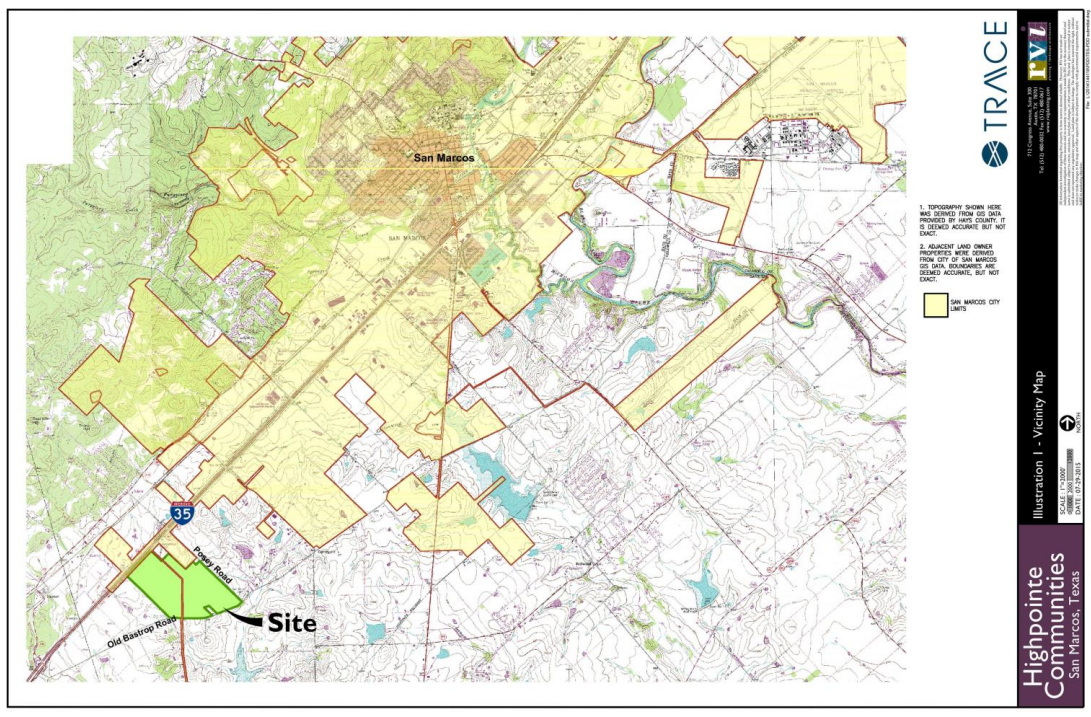
There’s a little rectangular patch of 5 acres which is surrounded on three sides by Trace. You can see it down at the bottom:
The Trace developers didn’t own it when they started Trace, but now they do. They can’t formally absorb it into Trace, but they basically want it to feel like it’s part of Trace.
The developers want to build townhomes. This sounds great – I like townhomes. Still, let’s hit the five questions:
Price Tag to the City: Will it bring in taxes that pay for itself, over the lifespan of the infrastructure and future repair? How much will it cost to extend roads, utilities, on fire and police coverage, on water and wastewater?
Development is already planned for three sides. Infill is very useful.
Housing stock: How long will it take to build? How much housing will it provide? What is the forecasted housing deficit at that point? Is it targeting a price-point that serves what San Marcos needs?
Townhomes hit an underserved price point
Environment: Is it on the aquifer? Is it in a flood zone? Will it create run off into the river?Are we looking at sprawl? Is it uniformly single-family homes?
Not anywhere close to the river, not environmentally sensitive, not single-family homes. Great.
Trace itself is sprawl, but that ship has sailed.
Social: Is it meaningfully mixed income? Is it near existing SMCISD schools and amenities?
Trace is decently mixed income, yes. There’s an elementary school in the middle of it.
The San Marxist Special: Is it a mixed-income blend of single family houses, four-plexes, and eight-plexes, all mixed together? With schools, shops, restaurants, and public community space sprinkled throughout?
Closer than normal. No shops or restaurants nearby. Rather than have four-plexes and eight-plexes, they segregate the apartments into a giant apartment complex section, which I don’t love. But that’s where we’re at.
One detail irritated me: P&Z recommended that council nix 3 story apartments in this small patch, because it is adjacent to future single family houses.
The houses aren’t built yet! No one’s beautiful view is getting thwarted. There is nothing intrinsically offensive about apartments! But city council agrees and passes a restriction.
It doesn’t really matter – the developer is going to build townhomes, and I think townhomes are generally a good, dense-ish product. I just get irritated at displays of contempt towards apartment-dwellers.
The whole thing passes unanimously.
…
Items 14-15: Ringtail Ridge
Ringtail Ridge is a tiny little park off Old 12, outlined in yellow below:
It’s hidden and hard to get to, but very pretty!
Country Estates is the neighborhood next to it, outlined in green. It’s just outside the city limits. A bunch of libertarians live there.
This red part is owned by the city:
It was acquired in 2017/2018. Since it’s owned by the city, the city decided to annex it. This doesn’t really affect anything, but it’s tidier this way.
The plan is to zone it CD-1, which means keeping it as undeveloped as possible. The whole point is that it was acquired for conservation purposes, so they want to keep it natural.
There were a number of speakers from Country Estates on this item at P&Z, on January 10th, and one more at City Council this past Tuesday (who was very annoyed that we were three hours deep in the meeting by the time we got to this item.)
The speakers wanted their natural countryside preserved, but they’re also libertarians, so they were very skeptical about whether or not government can be trusted to help. Sorry, dude-ertarians, the free market is not going to preserve your beautiful nature! But local government to the rescue – the land will now be kept undeveloped, and the longterm goal is to make it available for trails and such.
…
Item 17-18: Tiny houses! What fun.
This is out on Post Road:
There’s going to be a small portion of town homes (6 acres) and then a larger portion of tiny homes (24 acres).
Tiny homes seem delightful, because who doesn’t love a dollhouse? But they only work for a very small portion of people:
you can’t really live with a kid in one.
You have to figure out a plan for all those household items that you need monthly or a few times a year. Either you need disposable income to replace things all the time, or you really need to commit to a spartan existence. Which is tricky, because you’re stuck in the US, which is not set up that way.
However: if you are too prickly to share a wall with someone else and you are a serious minimalist, then it’s perfect. Go live your dreams, Freebird.
One last thing: This property is on the SMCISD side of the boundary between Hays CISD and SMCISD. This is something that Council never talks about, but it ends up affecting San Marcos schools a lot.
SMCISD needs more kids, basically. Tiny houses are going to be for kid-free adults. So it’s a bit of a bummer that this is in SMCISD, whereas all of the families right over in Blanco Vista go to Hays CISD.
(It’s because of the state funding formula. Because of the university, we look like a wealthier district than we are, and so we’re always on the brink of having to send money back to the state. But we’re actually a Title 1 district, because our students are largely poor. We need more families to keep the state of Texas from sabotaging us.)
….
Item 19: Blanco Riverwalk
These guys have come up before, most recently in June 2021, when they were swatted down for proposing an apartment complex in a flood zone.
This time they are proposing… an apartment complex in a flood zone. It went about as well as it did last time. (Mumble mumble definition of insanity.)
It’s actually very close to the tiny houses, but you can see that it’s like two inches from the Blanco River.
P&Z denied the request on January 10th, so it would require 6 votes from Council to overturn the outcome. Council denied it unanimously.
Back in December, they applied to P&Z for a renewal of their alcohol permit.
At the same meeting, Industry was up for a renewal of their alcohol permit, too.
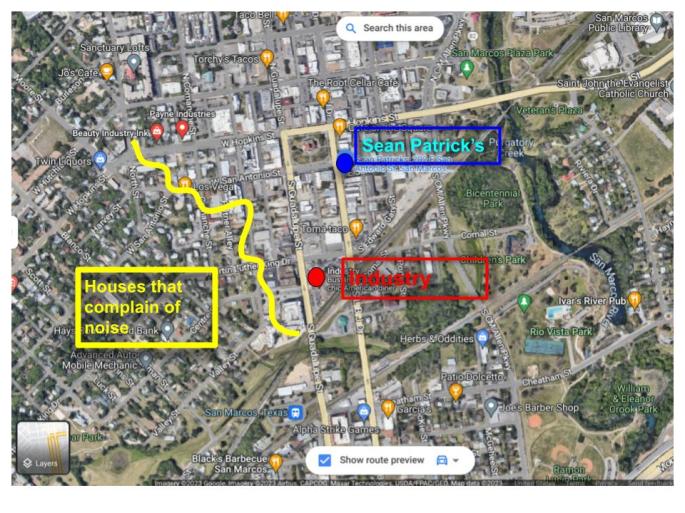
Industry, of course, is right next to the Dunbar neighborhood. A lot of people are very cranky about the noise coming from Industry. In response, P&Z said “No live music after 10 pm.”
Then Sean Patrick’s came up. There haven’t been any noise violations against Sean Patrick’s. But P&Z made an issue out of it, kinda out of nowhere. They changed Sean Patrick’s hours of live music from midnight to 10 pm.
This seemed way off-base to me. Sean Patrick’s is not near houses the way Industry is near houses:
P&Z wanted to be consistent, which is understandable. But the whole point of P&Z is to look at individual circumstances and make a judgement call. You do want consistency when it comes to values and ideology! Just not necessarily when it comes to outcomes.
So Sean Patrick’s appealed P&Z’s decision, and Council agreed. The bar gets its live outdoor music back, after all. At least until midnight.
…
Item 6: The SMART Terminal got revisited for about two seconds.
Alyssa brought the item up for discussion. She is a “no” on the SMART Terminal. But they’ve gotten a lot of complaints and questions over email. So she asks if the other council members – the ones who want the SMART Terminal – could respond to these citizen questions and complaints.
Translation: We all know this is going to pass, and we all know people are furious. Why don’t you all go on record addressing the environmental concerns and all the rest of it?
Jane Hughson said, “Why don’t we update a FAQ about the project? We can make it available to the public online!”
Translation: Or how about we don’t? Staff can script some soothing language about “dialogue” and “different stake-holders” and this will all go away.
And lo, that’s how it’ll go.
…
Item 24: Council appointments to all the various committees
This got postponed. Womp-womp.
It really is understandable. It was getting late, and Council has been there since 3 pm. It takes like an hour to go through all the committees. It’s also kind of a bummer, since many of the nominees have been watching for four hours, waiting for this.
Alyssa speaks up: she crunched the numbers on the applicants, and they’re overwhelmingly old and white. She brought this up last year as well. When are we going to take this seriously?
Jane defends city staff and how they worked hard to publicize the committee process.
That’s not really relevant – staff does work really hard! No one is criticizing staff! But what we’re doing isn’t working.
Jane says that she does think it would be better to push the process out a month and give more people time to apply.
That can’t hurt, but it also won’t solve the problem.
Alyssa says that only part of the problem is the publicity – the process also has to be demystified. It’s intimidating to sign up for a board or commission, especially if you consider yourself to be an outsider to the process.
Jane says it’s much better than it was five years ago. Also true, but not sufficient.
My opinion: it won’t change until we overhaul community outreach. We have to have relationships with the key individuals who work at churches, barber shops, and bars and restaurants that function as community spaces. And I specifically mean venues that cater to underrepresented groups in town: Hispanic communities east of I-35.
There is just no shortcut to building relationships. It’s time-consuming. It goes faster if your staff is also a part of the underrepresented communities, but that’s kind of a chicken-and-egg problem.
…
Items 25-26: Top Secret Executive Session
Obviously I don’t know what happens in the room where it happens, but the topics are very interesting:
1. Albian Leyva vs Ryan Harman and Jacinto Melendrez. This is the excessive force/tasing incident. This incident ispretty extreme. At the January 17th work session, one of the Mano Amiga representatives read outloud from the internal police investigation. (You can go listen here, starting at about 8 minutes in.)
It’s pretty awful. Melendrez is the second officer who also tazes Leyva.
This is from the Mano Amiga FB page:
2. Eric Cervini, et al. vs. Chase Stapp, Brandon Winkenwerder, Matthew Danzer, and City of San Marcos
I’m guessing this is the Biden Bus incident? It’s been two years. I am very interested in there being some consequences for this.
3. Repealing Meet and Confer. Obviously we know how this turned out. (This part of Executive Session was held early on.)
Plus some miscellaneous conservation of land items, and personnel things.
Citizen comment: The big topic for citizen comment is the SMART terminal. Residents of the area are worried about:
Flooding
River pollution
Litter
Traffic
Noise and smells
Representatives from the San Marcos River Foundations also spoke, but they got super specific about policy proposals, so I’m going to save that for actual item.
Max Baker was the last speaker, and he railed against the community survey results and lack of trust in city staff. He also spoke out against the Riverbend Ranch, saying that HK real estate people operate and negotiate in bad faith. Finally, he says, “I’ll have more to say about the SMART Terminal, but I’ll save that for the public hearing.”
That last sentence is supposed to be me foreshadowing for you. Hey everybody, <waves hands>, for no particular reason, note that Max has said that he is planning to speak during the public hearing for the SMART Terminal.
…
First up is the SMART Terminal!
Items 20-21: A few meetings ago, we got introduced to the Cotton Center and the SMART Terminal:
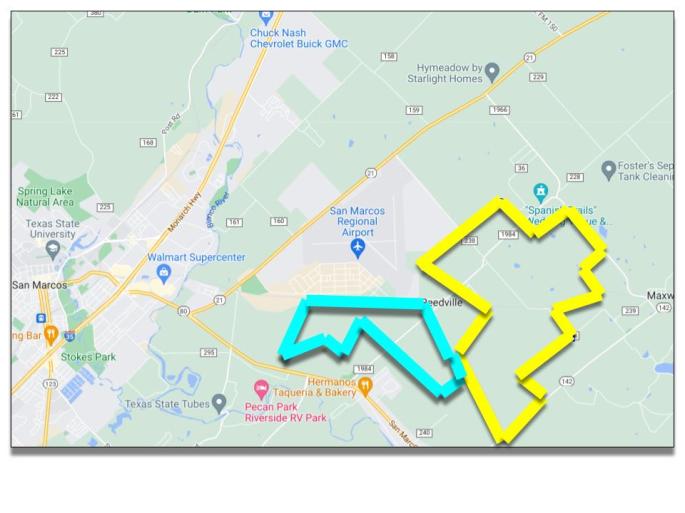
Yellow is the Cotton Center, the gigantic master planned community that was approved in 2016. Aqua blue is the SMART Terminal. The SMART Terminal is supposed to bring together the magic of a tiny airport, all our trains, and Highway 80.
How big are these things? The SMART Terminal blue bit up there is 900 acres. The Cotton center yellow bit is 2500 acres. The issue is that the SMART Terminal wants to take 600 acres from the Cotton center, and then also three more packets of extra land.
So here is the proposed future of the SMART Terminal:
The aqua blue is the old SMART Terminal. Yellow is getting taken from the Cotton center. Green is brand new.
San Marcos River Foundation is concerned because there are two creeks running through the property to the river. You can sort of see the creeks above, and in the map with my janky drawing, you can see the San Marcos river at the bottom.
First is a staff presentation. We learn that “SMART” stands for: San Marcos Air Rail, & Transportation
So that’s a good start!
One detail is this little green box with the yellow highlighting:
That little yellow box lives in Martindale’s ETJ, instead of San Marcos’s ETJ. So we’re not allowed to make a development agreement for that little bit. (I’m guessing maybe that’s part of the mysterious Martindale fuss alluded to here.)
The total acreage of this new, SMARTER Terminal is 2,017 acres. That is huge. Google tells me that 2,017 acres is 3.15 square miles. Google also tells me that Martindale is 2.09 square miles. So the SMART terminal is going to be 150% larger than Martindale. (More like SMARTindale, right?? …I’ll show myself out now.)
Environmental standards
The developers want Heavy Industrial and Heavy Commercial. Here are the creeks that run to the river:
The blue striped parts are floodplain. The green is the creeks themselves. That’s a pretty direct channel to the river.
Here’s what the developer worked out with the planning department:
70% impervious cover, overall. This is stricter than the regular city code, which would allow up to 80% impervious cover.
Impervious cover can be patchy – up to 90% in some places, less in others, as long as it averages out to 70%
Total Suspended Solids (TSS): Here’s my shaky understanding of TSS: when it rains, rainwater is nasty because it carries all the surface pollution with it. So you retain rainwater in retention ponds to prevent flooding, but then you want to clean it before you release it. So you either want to let it settle, or filter it, or whatever. TSS is how much you have to clean it.
They’ve agreed to 70% TSS. I don’t know what our code requires. (The developer claims their sand filtration basin system actually captures up to 89% TSS, but they’re only obligated to maintain 70% that by the contract.)
Water retention: what kind of flood do we want it to be able to handle? They’ve agreed to 1.25” rainfall. My memory is that this should be given as a rate: 1.25″ per hour, or 1.25″ per eight hours, or 1.25″ per day, or whatever. Not just a 1.25″ without any time frame. But in this agreement, there’s no time window given.
My uneducated read is that 1.25″ without a specified time window will get overwhelmed any time we have a mildly disasterous rain, let alone one of the massively disastrous rains that we’re known for.
Run-off: they have to reduce run-off by 10%. This is stricter than the code – code says you can’t make run-off worse than it was before the development, but you don’t have to improve it. So that is good.
San Marcos River Foundation weighs in
Earlier, during Citizen Comment, SMRF made their case. They’ve had good conversations with SMART. They want:
Half of the floodplain acreage should be removed when calculating total gross impervious cover.
In other words, say you’ve got 100 acres, and 20 acres is super sensitive land where you can’t build on it. Suppose you’ve agreed not to pave over more than 70% of it. Should it be 70% of the 100 acres, or 70% of the 80 buildable acres?
SMRF is proposing to split the difference – allow them to compute the 70% based on 90 acres, in this analogy.
The setback to the floodplain should be wider than 30 feet. SMRF observes that 30 feet is really pretty slim.
Any acreage using 90% localized impervious cover be placed farthest away from the river. In other words, the most-paved parts should be furthest from the river.
Council Discussion
Council begins asking questions, and then this very weird thing happens: Jude Prather speaks up and says: “I think we have one more public speaker…”
There is some fumbling around. Over zoom, you hear Max Baker say, “Is it my turn to speak now?” (Remember the foreshadowing, when he said he would be speaking during the SMART Terminal? This is that.)
Jane Hughson says no, Max can’t speak, because he didn’t sign up to speak the day before. She adds, “If you’re in person, you can just get in line to speak. But over zoom, you have to sign up the day before.”
What she means is that back in March of 2020, council had to set up zoom rules. How will citizens get the zoom number? How will they get moved from the waiting room to the main room? Etc. So they said that you have to sign up to talk the day before, to help with logistics.
Now: Max clearly did sign up the day before, because he spoke during Citizen Comment, and so someone gave him the zoom link. Jane is arguing that Max should have signed up for each item that he wanted to speak on, even though it’s the same zoom link. And even though that was really not the intent of the original rule.
Alyssa points out that we’ve revisited Covid-era rules many times, and this one just hasn’t come up, but Jane is firm. “He’s allowed to speak, he just had to sign up yesterday.”
Here’s the thing: generally Jane extends a lot of courtesy and grace to ordinary private citizens who take the time to show up and speak. It seemed like this was a maliciously strict standard that only applied to Max Baker. It felt kinda vicious.
…
Back to the SMART Terminal: So what did our council do?
The whole thing was very, very cordial. Everyone emphasized continuing dialogue with SMRF and other stake-holders. That makes me nervous, because the only thing that is legally binding is the Development Agreement being voted on. Dialogue is very nice, but it doesn’t compel any action. Acting like you believe the developers are our friends is not reassuring when you’re negotiating a contract on behalf of San Marcos residents.
First, Jane Hughson asks about the added truck traffic. The answer seems very thorough: you make some assumptions and do a traffic study before anything else. If they exceed the assumptions, then they have to do more mitigation. Widening roads, adding traffic lights, etc. They’ll keep updating and mitigating. (Fine.)
Matt Mendoza asks about retention ponds. They’re required to have them, so the developer just sort of explains what they are. They talk about the 10% reduction in run-off, which is admittedly an unusual standard for San Marcos. They commit to having more dialogue with stake holders.
Here’s the thing: environmental standards are very wonky and nerdy and specific. Every time Council asks an environmental-ish question, the staff answers in a very narrow, reassuring way. “Oh yes! We already did part of that!” and then the councilmember lets it go.
Example 1: Jane Hughson asks about the list from SMRF. She seems to have this SMRF list in front of her:
She just references the list and says it includes a lot of things, like lift stations.
The engineer, Richard Reynosa, only answers about the lift stations, and nothing else. He says the lift stations haven’t been placed yet, but if they were in the flood plains, you’d have to meet stricter standards.
No discussion of the other nine bullet points.
Example 2: Jude Prather also vaguely tries to get at the environmental standards. He says, “Dialogue is really great and all, but should these environmental things from SMRF be put into the contract? Like the Dark Skies thing?”
In other words, he’s waiving his hand at the long list of technical standards, and the only one that’s coming to mind is the Dark Skies one. (Which was mentioned briefly during the SMRF comments, but is clearly not their primary concern.)
The planning department person, Amanda Hernandez tells him that he can definitely add any provisions that he wants! And says that the Dark Skies one is basically already in the code.
Jude asks, “What about the other environmental features?”
Amanda Hernandez answers that they worked with the developer, and in fact, many of these standards are from the 2019 agreement with the original SMART terminal. (This is at 1:11, if you’d like to go watch this bafflingly useless non-answer.)
And Jude drops the issue. He doesn’t raise any specific line item from SMRF.
Example 3: Mark Gleason’s turn to act environmental-ish is next: on the 1.25” capture, he exclaims, “That’s above and beyond code, isn’t it!” (In other words, he’s just praising the developers.)
Mark does specifically ask about one of SMRF’s concerns: “On the setbacks being 30′: is it longer in the recharge zone?”
Richard Reynosa, the engineer, answers, “There’s not a specific setback in the recharge zone. You have a water quality zone requirement there, based on the size of the tributary.”
Mark says, “Thanks, that’s what I wanted to clarify!”
That’s what I mean: Everyone talked near the SMRF amendments and sounded like they liked them, but no one was willing to actually make a motion and require them.
What the fuck? Every person up there claims to be in favor of the river. SMRF hands you a list of recommended asks from the developer. SMRF highlights the three most important ones, during citizen comment. No one proposes a single one as an amendment, or even discusses them in a meaningful way.
The vote: Yes: Jane Hughson, Mark Gleason, Jude Prather, Saul Gonzalez, Matt Mendoza No: Alyssa Garza
(Shane Scott was absent)
So the SMART Terminal is coming. City Council asked some softball questions and approved it. It was kind of gross.
Now, Alyssa Garza also didn’t offer up the SMRF recommendations, but she voted against the entire project. You could argue that maybe she should have tried to get the amendments passed anyway, but in the end, she is one councilmember and the other five councilmembers wanted the SMART Terminal, and any of them could have pressed for the SMRF recommendations.
Does your friendly local Marxist blogger like the SMART Terminal?
I’m wary of it. I can see why business people might see an opportunity what with the railroad and the airport being right next to each other. (Full disclosure: I guess don’t see it. Why would you ever need your cargo to go from train to plane, or plane to train? I’m sure I’m just lacking enough business sense to understand.)
Anyway, surely it makes logistical sense to business folks. But here came SMRF with three specific amendments, and they were all roundly ignored. That’s enough to undermine my trust in anyone advocating for it.
Item 20: By the way, what happens to the Cotton Center planned community? Here’s the old 2,500 acre version from 2016:
Here’s the new 1900 acre version:
Wow, kind of a fragmented mess!
Okay, it’s making me laugh, the longer I look at it. What a soothing place to raise your kids. Ignore that gaping industrial black hole, please and thank you.
Every six years, the fire department updates the fire codes. At the January 3rd workshop, the fire department recommended some changes. The big one: retroactive automatic sprinkler systems.
Basically, sprinklers entirely prevent mass fatality events from fires. This is great! But they’re super expensive to install.
Who will be required to install sprinklers? Big venues that serve alcohol and hold 300 people or more. Think clubs, restaurants, and banquet halls, but also things like the VFW and Cuauhtemoc Hall.
Here’s how much they cost:
$4-5 per square foot for the sprinkler system
$25K for 150 ft of underground fireline pipe
$5-10K for the sprinkler monitoring system, to make sure you’re maintaining water pressure and things like that.
So if your building is 5000 square feet, you’re looking at upwards of $50K. That’s really expensive. Everyone is very worried about the nonprofits like VFW and Cuauhtemoc Hall. They’re good community partners.
The plan is for the city to help with the one-time costs. The nonprofits will go get bids, and the fire department will use the revenue from inspection fees to offset the costs. The inspection fee will be $100/year, and San Marcos is expecting to bring in maybe $100K/year. So each year they can help out several non-profits, and plus maybe get some grant money in. Council proposes a 3 year grace period for nonprofits to comply.
(I’m anticipating that local private businesses will also balk at spending $50,000 on sprinklers, so maybe this ends up coming around again.)
Item 23: Campaign spending limits
We finalize the campaign contribution details from this meeting. The spending cap will be set at $1 per candidate. Numbers will be based on the previous November’s registered voters.
Item 25: Decorum.
You guys. This item was such extremely weird bullshit. Especially in light of how Jane Hughson shut down Max Baker – a private citizen now – just one hour earlier.
This is Jane Hughson’s item. Here is the key new bit:
To clarify: you’re allowed to identify individuals by name if you want to compliment them. You just can’t identify someone by name during a personal attack.
Jane is really hung up on “personal attacks”, and she believes deep in her soul that “personal attacks” are a well-understood, universally-agreed-upon phenomenon. She believes that “personal attacks” are worse than “personal insults” and that all of us would see eye-to-eye with her on what counts as a personal attack.
Now, this phrase is loaded. Back when Max Baker was on council, she used to accuse him of personal attacks every time they started squabbling. Max would counter that he was angry, yes, and stating his opinion, and that his opinion was grounded in fact. See? No room for ambiguity!
Jane openly says that she is talking about delivery style and not just content. You can say insulting things if you say them calmly. But if you display anger, then it becomes an attack. (Jane has never used this phrase to describe, say, LMC, who generally keeps her composure when lobbing wildly personal insults at people like, say, Bert Lumbreras.)
Alyssa speaks up. She’s uncomfortable controlling anyone’s speech. If someone’s angry, she wants to know. She doesn’t take comments personally. Sometimes she can then unpack how the person got there, other times it sometimes wakes her up to something she’s missing. It makes her uncomfortable when speakers come for staff, but city council can intervene and support the staff in those occasions.
Jane says, “I know what you’re saying. But this is attacks. Not just saying things, but attacks. Tamp down the nastiness.” She explicitly says that insults can be okay, but it’s the angry attacks that are not okay.
Tone-policing Max Baker specifically has come up before. And here’s part of what I said then:
These proposals are all attacking Max on the surface level, and trying to police his tone, word choice, and mannerisms. They are not taking issue with his ideas. This is a very old tactic – you focus on someone’s tone, and then you don’t have to engage with the content. Historically, requirements for the surface level (“professionalism”) were used to prevent anyone besides old white dudes from participating, unless they pandered to the old white dudes. Accusing someone of being unprofessional allows you plausible deniability – you weren’t against their ideas, but they were being so unprofessional!
For the past three years, Jane has lodged this complaint at Max, that when he’s angry, he’s attacking different people. In the past two months, Max has become a private citizen who speaks at public hearings, and Jane is now wanting to add this specific phrase – “personal attacks” – to the rules for decorum. It feels targeted at him with extreme precision.
Alyssa: Anger is a valid feeling, and I’m not uncomfortable with people expressing their emotions.
Jude Prather says that he prefers the phrase “personal insults” over “personal attacks”. He thinks it’s clearer. “Personal attacks” is very vague.
YES.
Alyssa asks what the difference is, anyway?
YES.
Jane’s answer (at 2:16:32, if you’d like to go watch): “My motion is the word attack because to me, it’s clear. Insult is not – to me – removable [from the chambers].”
In other words, her definition is “I know it when I see it. If you get thrown out, it was a personal attack.” Clear as mud.
There’s a little discussion of alternate ways that people can communicate angry, personal attacks. They can email or leave a message on Jane’s office phone. The problem is that then the public – namely me! – does not know what people are mad about. I would like to know when people are mad!
The vote: Yes: Jane, Jude, Saul, Matt, and Mark No: Alyssa
Alyssa says, “I’m voting no because I’m not sure future mayors will be able to differentiate between personal insults and personal attacks in a responsible way.”
HA. HA. That is so diplomatic that it’s making my teeth itch. You, Jane, are clearly an excellent arbiter of personal attacks! We’re just worried that the next mayor may not be dripping with quite as much wisdom.
Anyway, this council (minus Alyssa) just fell in line and approved it. They are the mushiest bunch of marshmallows. Yawn, censor Max Baker? Scratch, readjust, hmm. If we vote yes, can we go home?
We’ve seen this proposed development before, and after P&Z denied their cut-and-fill. Residents of Redwood mobilized like 30 people to come talk to P&Z that night. It was really amazing.
The major issue is that Riverbend Ranch will be on the hill immediately above Redwood. Redwood is home to a lot of extremely vulnerable community members and is dealing with flooding, raw sewage, and significant health challenges due to sewage contamination.
The council could force Riverbend Ranch to be developed in such a way that it helps Redwood tie in to San Marcos water and sewage. Or the council could allow them to develop in a way that increases flooding and sewage contamination. This could be done really well, or it could be a nightmare.
Matt Mendoza, Alyssa Garza, and Saul Gonzalez all volunteered to be on the Riverbend Ranch committee. I am relieved. You can trust Alyssa to remember to protect Redwood, and Matt Mendoza was personally the one who went down and talked to the Redwood community prior to the P&Z council meeting, so he’s also invested. And Saul is generally sympathetic to people without financial means to protect themselves from developers (although he usually takes the safe route when it comes time to actually vote).
….
Item 30: Paid parking in the Lion’s Club parking lot.
We have a lot of out-of-towners who come to tube the river and go to football games. We want to recoup some costs by charging them to park in the Lion’s Club parking lot. So we’re launching a 3 year pilot program.
It’s supposed to be free to San Marcos residents, which means that there has to be some system to tell who is a resident and who is not a resident. It sounds like you go online and ask for a sticker to put on your car? You would either have a license or some sort of photo ID, or something with your address on it. (I might be wrong about the sticker.)
Alyssa gets them to include library cards on the acceptable forms of ID, which is good.
It’s pretty pricey for non-residents:
The biggest discussion came about whether or not the machines should be cash-less. Mark Gleason doesn’t like cash-less machines out of general get-offa-my-lawn old man vibes. (He’s not wrong!) Alyssa doesn’t like them because poor people are less likely to have credit cards. (Also correct.) So the compromise is that there will be one machine that accepts cash, and the others throughout the parking lot will be cashless.
I share Alyssa’s uneasiness about the invisible barriers that arise when you implement cashless payment systems. At the same time, in this case, those bonkers prices are their own impediment for poor people. You can get like three eggs for that kinda money!
…
Item 31: One last time with the Human Services Advisory Board.
San Marcos donates money from the General Fund to nonprofits. The funding process this year was a shitshow (apparently – I don’t really know details) and so council stepped in to give new instructions. So now, on this third meeting on this topic, council is nailing down the final details of how they want grant applications to be evaluated. There are two main sticking points:
Grant money is only available if you’re serving San Marcos residents. The issue is what kind of track record is required. Should nonprofits from Austin and San Antonio who want to expand their service to include San Marcos be allowed to apply for city funds? Or should money be restricted to nonprofits who already serve San Marcos?
Jane wants the nonprofits to already be serving San Marcos. Saul agrees.
Alyssa makes the case that in certain categories, like mental health, we have a dire need for providers. Nonprofits from San Antonio and Austin will be more successful finding other grant money to use on San Marcos if they can use this grant to demonstrate a need here.
Mark Gleason and Matthew Mendoza want to give preference to San Marcos-established nonprofits, but not exclude the others from applying. I didn’t catch what Jude preferred, but this is where Council lands as a whole.
Jane Hughson feels strongly that nonprofits should not depend on this money. She doesn’t want anyone to lose their job if the city has less money one year and can’t fund as many nonprofits. In light of this, there is a rule that no full-time employee should be funded. You can ask for money to fund a part-time employee, but not a full-time employee.
So the issue is: can you split the workload of a full time employee, and ask for partial funding? Can a grant ask for 30% of the salary of the full time employee who is assigned to work on the program for 15 hours per week? Or do they have to hire a standalone part-timer for 15 hours per week?
Jane is a strong no. You must hire a literal part-timer for 15 hours per week. No carving up the time of a full-time employee.
Good news! We have an actual nonprofits expert on council! Alyssa has tons of non-profit experience, and is currently employed writing grants for her job. She explains that this is standard operating procedure in the world of nonprofits. Nonprofits are used to piece-mealing their employee’s salaries together across several grants. As long as the non-profit is basically competent and experienced, they will have a Plan B in place so that no one loses their job if San Marcos doesn’t offer these funds one year.
Out of everyone, Mark Gleason is the only person who seems to hear what Alyssa is saying. Weirdly, Jane keeps marking down that Mark is on Jane’s side, but Mark is persistent in correcting her.
But on the whole, it is the most infuriating goddamn conversation. Everyone is sure that they know what’s best for nonprofits and no one is listening to Alyssa. It comes off as paternalistic and arrogant.
Jane keeps requesting that any councilmember who wants to allow partial funding of full-time employees must give a specific numeric cap. Alyssa keeps explaining that that is arbitrary and counterproductive – the nonprofit will have to justify their request, and the HSAB can make an informed judgement.
They settle on a 20% cap: you can ask the grant to cover up to 20% of a fulltime employee’s salary. Because they know best.
Citizen comment: The intersection of Hunter and Wonderworld is deadly and needs to be fixed. The speaker kept mentioning “new paint” as a solution, which made me think that she specifically meant that weird little island blocking what used to be the right turn lane from Wonderworld, north onto Hunter (on the corner with the CVS store.) I’m glad we’ve added bike lanes, but I also see cars bumble over that island every time I’m at that intersection. And there do seem to be a lot of accidents.
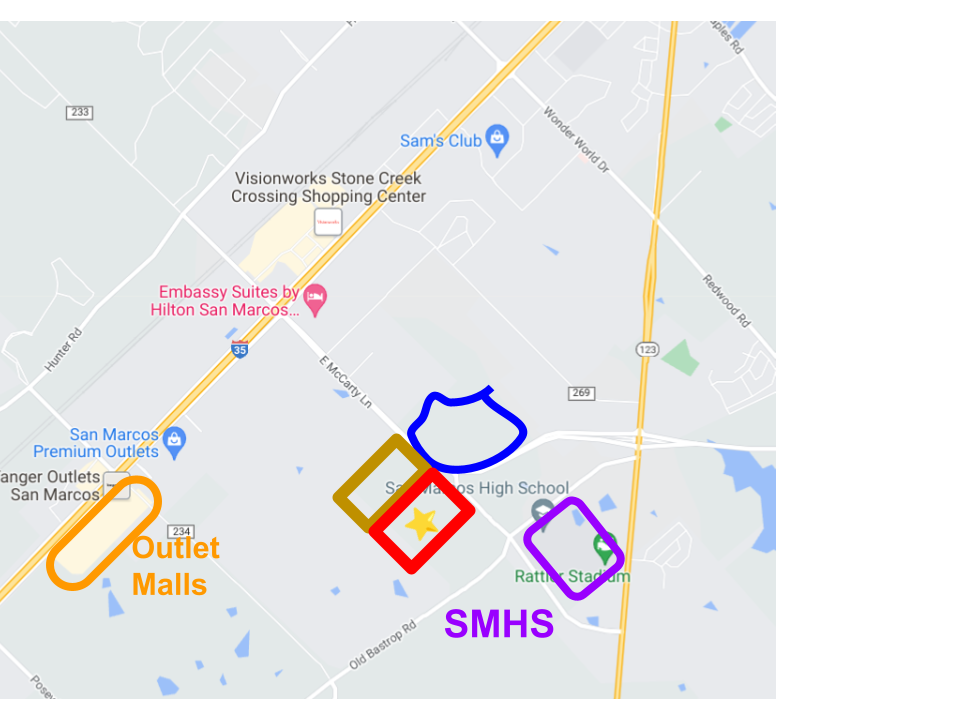
Item 11-12: Annexation and zoning 65 acres on the corner of Rattler Road and McCarty. It’s this little red square with the star in it:
We’ve seen this area several times recently. It’s been a zoning bonanza:
Back in September, these other folks wanted (and got) a cut-and-fill exemption for that blue region. And back in August, the neighboring property (in that yellow-puke color) was zoned CD-5. It’s going to be apartments. (Also, a gigantic development was approved behind the outlet malls at that same meeting.)
The red rectangle is proposed to be CD-4. In that zoning, you’re allowed to build duplexes, townhomes, apartments, cottage courts, and other things that are denser than traditional neighborhoods but still feel small scale. (But you can also just build apartments, I think.)
The red rectangle and the yellow-puke rectangle are owned by the same people. So they’re selling the city on a larger vision where the yellow-puke one is dense, traditional apartments, and then this red one is more varied with all the duplexes and townhomes. Sort of transitional in scale towards single family houses.
Price Tag to the City: Will it bring in taxes that pay for itself, over the lifespan of the infrastructure and future repair? How much will it cost to extend roads, utilities, on fire and police coverage, on water and wastewater?
This is a good spot for infill. There is already infrastructure and coverage for this area.
Housing stock: How long will it take to build? How much housing will it provide? What is the forecasted housing deficit at that point? Is it targeting a price-point that serves what San Marcos needs?
Some day, the planning department will read my blog and hastily fall all over themselves in an effort to answer this question.
Environment: Is it on the aquifer? Is it in a flood zone? Will it create run off into the river? Are we looking at sprawl? Is it uniformly single-family homes?
Not on the aquifer. Not in a flood zone. No run off to the river or any other environmental hazards, as far as I can tell.
Given the duplexes, townhomes, apartments, cottage courts, and other things, it has the potential to be very good. It won’t be uniformly single-family detached houses.
Social: Is it meaningfully mixed income? Is it near existing SMCISD schools and amenities?
It is very close to SMHS, and not that far from Goodnight and elementary schools.
As for whether it’s mixed income, that depends on the developer. If the developer takes advantage of what they’re allowed to build, it could be mixed income. But just because they sell a compelling vision during the approval phase does not make it binding.
The San Marxist Special: Is it a mixed-income blend of single family houses, four-plexes, and eight-plexes, all mixed together? With schools, shops, restaurants, and public community space sprinkled throughout?
The larger region has the potential to become this. We shall see.
Final judgement: It sounds mostly good. Go for it.
…
So what did council do?
There was a little discussion about including a buffer at the back of the property, as a courtesy for the homes right there, which are outside city limits. Staff will bring back a proposal at the next meeting.
And then they voted, and it passed 7-0. (Where’d the clickers go?)
I personally think this project passed all the criteria with flying colors. But you know Max would have had a dozen questions about it. Perhaps all the questions got settled in Secret Executive sessions – it’s just really hard to know.
…
Item 13: Trace PDD
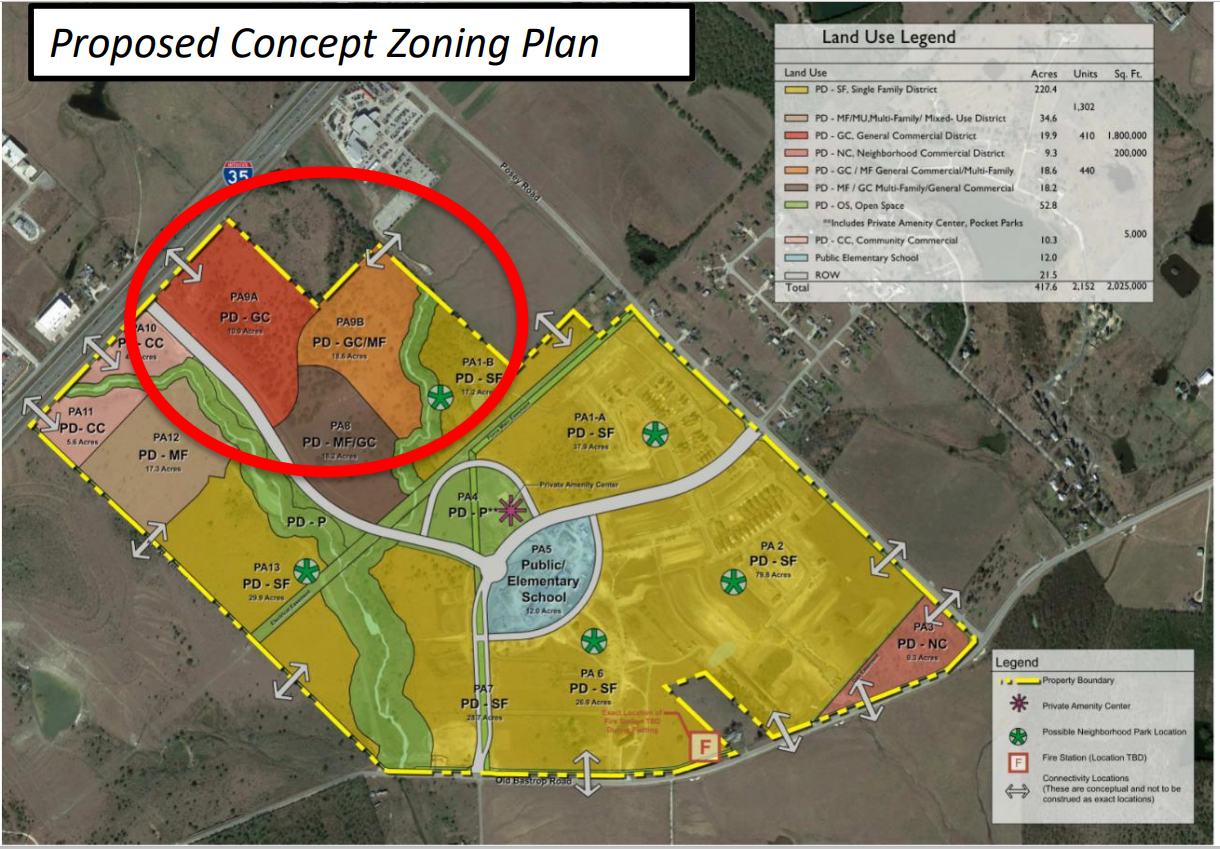
A few months ago, we did a deep dive into La Cima. Time for a Trace Deep Dive? Let’s do it.
That’s not my usual chicken-scratch map – this is the map from the developers. I love our city staff, but their maps are truly for shit.
It’s supposed to be a whole community – houses, apartments, parks, an elementary school, some stores. Mixed income. My only real gripe is that it contributes to sprawl – you’re kinda far from everything out there.
In 2017, there was a bond election to fund an elementary school there, and Rodriguez elementary school opened in August 2019.
It was next amended in 2019 and 2022. All the amendments were kind of finicky and detail-oriented – what should the heights of the apartment buildings be? Can we relocate sidewalks to this other side of the street? That sort of thing.
On the whole, it seems fine. It seems to need far fewer tweaks than La Cima or Whisper. (At some point, we’ll have to unpack Whisper Tract.)
…
So what’s up now? It’s coming up because they want to rezone part of it. Here’s the original zoning of Trace:
The dark orange part facing I-35 is General Commercial, about 44 acres.
Now they want to convert about 37 of those acres to apartments:
Both the light orange and brown parts of that red circle could now be apartments.
Is this good or bad? It’s complicated. At the P&Z meeting in December, Griffin Spell an excellent point: yes, we need housing. But Trace has not fully built the apartment complexes that they’re already allowed to build.
Furthermore, we also need amenities on the east side. It is a huge problem in this town that the east side lacks an HEB and the normal sort of shopping options. People are constantly talking to council and P&Z members about needing more commercial on the east side.
Griffin’s point is basically, “Let the developers finish building the apartment complexes that they’ve already agreed to build. If they still can’t find commercial occupants at that point, they can bring the rezoning back.”
The developer basically says, “Unfortunately, commercial is just not viable in that spot! It’s not visible from I-35!”
To which Griffen dryly responds, “You’re the one that put it there back in 2015, and nothing has changed since it was approved.”
The developer gave a weasely answer about communities maturing. It left me with the impression that they always planned on converting it to apartments, and the original commercial zoning was just there to make it look good.
So what did council do?
At City Council, there was no discussion of this point at all. They just approved it, 7-0. It gives the impression that they are not scrutinizing developers at all. The issue Griffin raised is complex, and at least deserves some air time. On this item, I’m giving the stink-eye to this new Max-less council.
Items 16-18: Various CDBG funding. Moving money around to fund rental and utility assistance, a project where they buy flood-prone land to keep it from being developed, and working on some ongoing flood projects for the Blanco Riverine and around Blanco Gardens.
Item 17: The Planning Department has a lot of fees for various services and permits. How do they set these prices?
It’s been a while since they updated what fees they charge. So they had a consultant come in and analyze how much it costs the city to carry out all these services. Then they compared fees to seven comparison cities. Then they shared all this at the December 14th workshop, and proposed new fees.
The city wants to balance covering at least 50% of their costs, without charging homeowners and small businesses too much or being too out of line with the other cities. I did not dive deep into the fees, but the methodology sounds fine. Council said it was all fine.
Item 20: The result of the HSAB drama from December. At the 3 pm workshop, city council worked on this with city staff. Here’s the outcome:
(Note: It says “The Board should not fund all programs” but they intended “The board should not feel compelled to fund all programs.”)
All seems fine. I think they’re going to go back and re-allocate the December money according to these principles.
Item 21: Mano Amiga circulated a petition to repeal the SMPD contract. Now, I obviously live here in San Marcos. If Mano Amiga were to approach me, I would sign their petition, because I generally support their mission.
But as your local friendly blogger, I’m going to call shenanigans – the actual petition is confusing. As far as I can tell, this is the entire thing:
What’s the actual, specific gripe with the meet-and-confer contract? And what’s the specific, desired outcome? Maybe there’s another page somewhere spelling it out? (Update: It’s the Hartman Reforms. But I still don’t see anything about it on the Mano Amiga website.)
Now this incident is extremely clear-cut abuse by the correctional officer. You’ve got an unarmed inmate in a hospital, wearing ankle shackles for god’s sake. He tries to escape. The officer shoots him six times. That officer had some fantasy that the only way to handle a person running away was to be judge, jury, and executioner. Joshua Wright has to die because this correctional officer can’t properly evaluate and handle the danger of an unarmed guy wearing ankle shackles. What the utter fuck.
Mano Amiga is clearly livid, and sprang into action, demanding bodycam footage and holding events and raising awareness. Of course, I wholly support their efforts for justice for Joshua Wright. This is the most just and deserving of causes to fight for.















 The San Marxist