Citizen Comment: We’re going to focus on the SMART/Axis Terminal here. (It’s not otherwise on the agenda today.) There’s a group, Citizens Against SMART/Axis, which is holding a public meeting at the library on Sunday (6/11) at 3 pm. Here’s their flyer, off Facebook:
Ie, if you’re reading this on Sunday morning and you’re free this afternoon, why not head on over? They seem like nice people.
The big day will be July 3rd, when City Council votes on the Heavy Industrial zoning. If it passes, then we’ve given a massive blank check to a jerk who will then decide which industries come to San Marcos. Right now, there’s a lot of money in batteries and tech fabrication plants and things involving toxic rare metals and lots of water, and Texas has very lax environmental restrictions. That’s the kind of scenario that I’m particularly worried about. (I also think the sheer scale of it is bonkers.)
And if the zoning doesn’t pass? My guess is that there’s a contingency clause in the development agreement – if the zoning doesn’t pass, it invalidates the contract. Then the company could either develop under county regulations, or walk away for a year, or come up with a different proposal.
Have you all seen the yard signs around town?
I think they’re pretty effective. Partly because they put council members on notice that the community is willing to launch a public campaign: vote down Heavy Industrial, or the next public campaign may be against you.
Bottom line: Council shat the bed. It’s really astonishing how they passed this development agreement under so much quiet and stealth. It’s 2000 acres, for god’s sake!
…
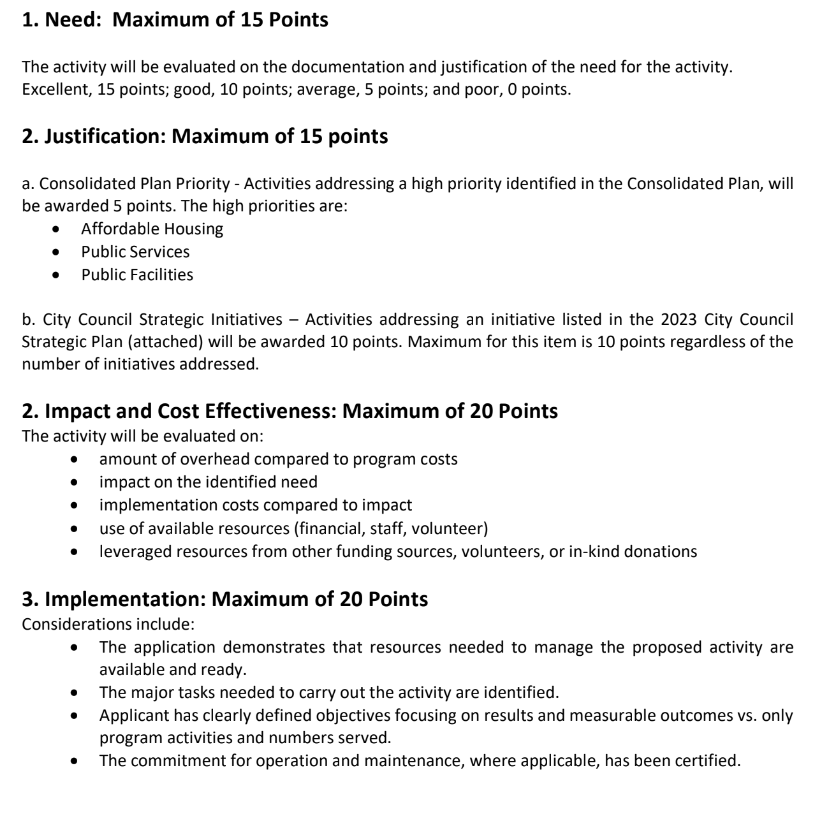
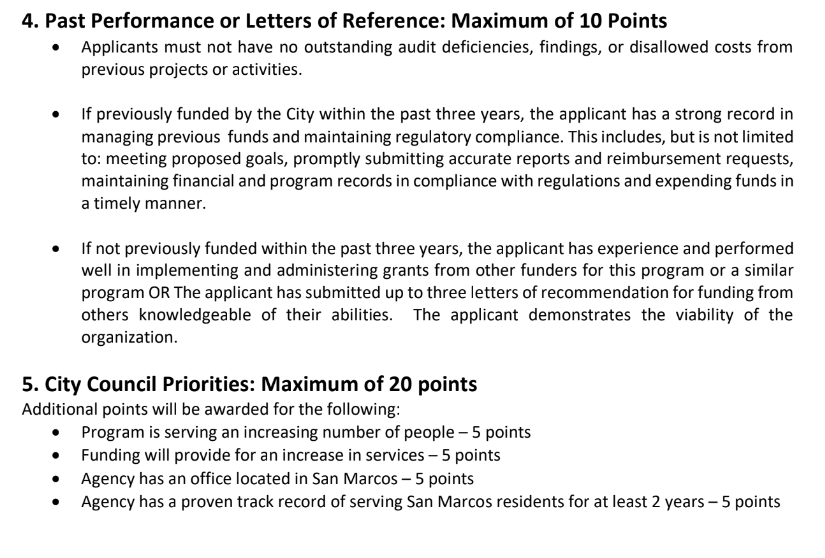
Item 6: Community Development Block Grant money. (CDBG) The city gets federal money to spend on nonprofits. This year, we’ve got about $700K to distribute.
Here’s the criteria that staff uses to assess projects:
And here are staff recommendations:
Saul Gonzales asked about Habitat getting $0 for Housing Counseling. The answer: Habitat is really good at lots of things, but counseling ain’t one of them. Plus they’ve still got leftover money from last year. In general, we’re still partnering with Habitat, but just not for counseling.
As for the Housing Rehab program getting $0: somehow this is good for the city, for reasons I didn’t quite follow.
Alyssa Garza mentions that she hears a lack of trust in the nonprofit community about how these funds get allocated, and that increased transparency would help. I don’t have the expertise to read between the lines! But transparency generally sounds good to me.
…
Item 7: P&Z is going to gain some new powers: the powers of AIRPORTATION. Specifically, some height hazard zone regulations and compatible land use zonings. A lot of this is regulated by the FAA, but P&Z will get to weigh in on the remaining bits.
Whenever the airport comes up, everyone speaks cryptically about scandals that I’m uninformed on. We saw a snippet of it here. Even LMC weighed in on some convoluted past event from ten years ago. Frankly, I’m pretty sure I’m not capable of fully understanding whatever the hell went down.
….
Item 8: The city has a lot of 2 hour parking downtown. Now some of those sites will be relaxed, to 4 hour parking. Here’s where it will go:
Take your time! Shop around! You’ve got four hours now.
Council members asked some worried, nonsensical questions, as though we were tightening up restrictions instead of loosening them. Everything will be fine.
…
Item 9: We’re pretty terrible at paying parking tickets:
So the city is going to start putting boots on cars, if you have 3 or more unpaid tickets.
The point is to force the worst offenders to get in touch with the city and come up with a payment plan (or maybe schedule some volunteer hours instead – more on this later.) The plan is not to turn the screws on someone who is teetering on the edge of economic catastrophe. Of course, it always just depends if the program is implemented in good faith or not.
The top left and top right roads are Craddock and Old 12, where The Retreat is. This is the Crockett elementary neighborhood. The speed limit used to be 30 mph.
Now it will have a new, lower speed limit of 25 mph in on these streets:
Good for them! Drive like a grandma, everyone. Your car is lethal.
….
This is Uhland Road:
It runs from Post Road to I35, and then jumps north, and runs east to Harris Hill road.
Here we’re only looking at the part west of 35. These lucky folks are getting some speed cushions here:
Good job! Drive safe.
Jane Hughson wraps up by saying, “All right! We do listen to our residents! …um …when we’re talking about speed cushions. And changing however many miles per hour you can go in a neighborhood.”
That is hilariously self-aware of Jane Hughson. And it’s true: sometimes we listen to our residents. Other times, we don’t.
…
Item 13: $250K more to GSMP to fund a small business program. Seems fine, as far as capitalism goes. The only reason I noticed it was because Matthew Mendoza made a special point of praising this accomplishment.
Item 14: “ARP” stands for “American Rescue Plan”, ie Covid money. We’re down to our last $3 million. We started off with $18 million. This last bit has to be spent by the end of 2024, or we have to give the remainder back.
Here’s what staff is proposing, based on instructions from council:
The controversial part is spending $1.3 million on Uhland Road quiet district. Here’s what I think that means: Every time the trains cross the road, they blast their horns. If you want that to stop, you have to construct automatic traffic arms, and turn-around barriers, and some other safety things. We’ve done this in other neighborhoods.
Staff is trying to get the quiet zone funded through other grant money, but their most recent grant application was denied, so they stuck it here. It’s not really connected with Covid, though.
Alyssa Garza makes the case that ARP funds should be used to address direct needs. In other words, we shouldn’t be spending $2 million on the two parks and a quiet district. Direct needs are things like financial emergencies, mental health care, and violence prevention programs. Alyssa focuses in on that last one: other cities are using ARP money to pilot communiy violence prevention programs. Why not us?
She’s making a clever case: all of you who are obsessed with the police and crime rates? Let’s address violence in a preventative way. Wouldn’t that be better than just being reactive?
Objectively, Alyssa is right. (Let’s pretend I’m objective.) Support for police departments is generally shrouded in language about public safety and rising rates of violent crime. But police departments respond to violence. They’re reactive. That’s different from proactively working to reduce the causes of violent crime. If you claim you care about public safety, then you should support community violence prevention programs.
So Alyssa asks point blank: Can we re-arrange this money to pilot a violence prevention program?
And…. <crickets> … the silence dragged out, and no one joined in.
The problem is that the rest of council has a semi-acceptable excuse: there really is a fixed deadline to spend this money. Staff’s recommendations are all shovel-ready programs. So the rest of council doesn’t really have to entertain what Alyssa is saying, because momentum is on their side.
Should we be furious at them? It depends on what happens next.
Possibility 1:
Alyssa brings up community violence prevention programs at the next CJR subcommittee meeting.
Mayor Hughson and Shane Scott respond enthusiastically!
They work up a pilot program for Council.
Council enthusiastically finds some funding and moves forward with it!
In this case, everyone is forgiven for squirming uncomfortably and avoiding Alyssa’s proposal to use ARP funding right now.
Possibility 2:
Alyssa brings up community violence prevention programs at the next CJR subcommittee meeting.
It gets bogged down in the slow wheels of San Marcos city government.
Everyone says nice things, but also sandbags the process.
It stays in the background as a nice idea, and never quite makes it into implementation for the next several years.
In this case, City Council is making it clear: “Public safety” is a code word for “We love the police!” and they are going to prioritize SMPD over actual public safety whenever given the choice. Vote the jerks out of office!
…
Item 18: Here’s Trace development, way down south, past the outlet malls:
That’s where Rodriguez Elementary is.
Some sort of development wants to go in here:
The Trace developers are definitely worried about something industrial right going in right behind people’s backyards. Council decides to form a subcommittee: Jane Hughson, Matthew Mendoza, and Jude Prather are going to take care of business for ya.
…
Item 19: File this one under “victories are anticlimactic”: eight months after Max Baker loses his city council seat, they officially change the rules to allow subject matter experts to attend subcommittee meetings. (Discussed here previously.)
This was a flashpoint with Max – he’d bring up new issues, and everyone would cock their heads like a confused golden retriever, and then ignore what he was saying. Max wanted to bring in experts to explain complex issues, so that others would take him seriously, but he couldn’t even get experts in, because no one took him seriously. (Partly, this was because Max generally had 50 issues to solve simultaneously, and everyone kind of just got woozy at the overload. But partly, they just didn’t want to consider new ideas, like the environmental impact of the SMART/Axis Terminal.)
But this can also be abused, as noted by Markeymoore and Forrest Fulkerson in the comments here. If you have councilmembers who are shmoozy with a developer, and they invite the developer to the subcommittee meeting, you may essentially have a developer writing their own agreement with the city.
There’s also a little path to a bridge over the river, which leads to some trails. And there are some art installations, right where you’d head from the parking lot towards the river.
More art is coming!
I am not sure where it will go, but I’m guessing with the other art installations. (Not at the falls, despite that picture.)
It’s big:
This is the winner of a nationwide call for artist submissions, and then an open house forum, and finally the arts commission picked this one.
I didn’t find the price tag anywhere, but I generally think that arts enrich a community, and it’s worth spending money to compensate artists fairly.
Item 20: Finally! I promised you more parking news, and you stayed for it. Here’s your big pay-off:
Things in the works:
Parking Benefit Districts: this is not paid parking, but it’s a necessary pre-condition.
Parking Mobility Funds: if we had paid parking, we’d need a bucket to put the revenue in.
COLAs for fees
Currently, our parking tickets cost $20. They’ve been at that rate since 1974. That’s almost 50 years! Congratulations, $20 parking tickets, you’ve had a great run.
(Just for funsies, I went to an inflation calculator: a $20 ticket in 1974 is equivalent to a $126 ticket in 2023. What a bargain we’re getting!)
What’s proposed is having fees drift upward automatically with inflation. In other words, every three years or so, you’d just set a new, higher fee rate to match inflation. (COLA stands for Cost of Living Adjustments.)
Jane Hughson cracked me up again: “This is a good idea. We should just get it automated, so we don’t have to update it every… fifty years.”
Here’s why I like this so much: First, Jane says that we do this already with other fees that the city charges. Second, we do this with certain city employees. In other words, we are already well-versed in COLAs!
Which brings me to my hobbyhorse: Automatic COLAs for minimum wage. San Marcos does have a minimum wage of $15/hour for any business receiving tax breaks from the city. LET’S PEG IT TO INFLATION! If we can do this for parking tickets and city employees, surely we understand why this is so important for our neighbors earning minimum wage.
But wait! There’s more!
An amnesty/incentive program. Suppose you rack up a huge amount in fines. Maybe you even got booted. This is the program that will make it easier for you to settle up with the city – like signing up for volunteer hours instead of owing money, for example.
Everyone loves this idea. I love this idea, too.
5. Dynamic pricing. In other words, a little sign that says “Violators will be fined $20-$60” or whatever. So if you park illegally in off-peak hours, it’s not so bad. If you park illegally in the middle of Sights & Sounds, you get charged more.
(They claimed this was about deterrence, but surely it’s about making more money. It’s hard to see how dynamic pricing would make a dent in the decision-making of the shmuck clogging up Sights & Sounds, in the middle of four different choir performances.)
All of these will be fine-tuned before Council officially votes on them. But it’s clear: our widdle San Marcos is gwowing up.
We’ve talked a lot about this. Last week, Chief Standridge explained the new contract, and tonight it’s up for a vote. During Citizen Comment, a lot of people spoke in favor of police, and a lot of people spoke in favor of increased oversight and transparency.
A trend I noticed: the pro-police speakers were all happy with the contract and urged Council to approve it. The pro-oversight/transparency speakers were all unhappy with the contract and urged Council to continue negotiations. That tells you who got the better end of the negotiation.
Since this is the second reading, it went straight to discussion.
The Council Discussion
Mark Gleason: “This is fair. Thank you to everyone.”
Alyssa Garza: “Community input is not dialogue. I’ve worked with people on both sides. We’re strongest when we’re unified. Why was there no town hall? Why no community forum?”
Everyone tried to answer Alyssa’s question:
Matthew Mendoza: “I wanted to take it to the voters!”
(Note: that’s not really a response. Alyssa means, “Why didn’t we discuss the Hartman Reforms with the community, and include their input in the negotiations?” Matthew means, “I wanted to let voters decide whether we should reopen negotiations.” These are different.)
Shane Scott: Chief Standridge listens to all this community input.
City Manager Stephanie Reyes: I followed Council direction.
Jude Prather: This is measured progress. We’re moving the needle. But we still need to be able to recruit the best officers.
Alyssa: How would the Hartman Reforms be an impediment to recruiting the best officers? They only affect you if you’re a bad officer. How are we okay with barely any change before and after this community push?!
Mark: We’ve heard what the community said! It’s not one-sided! Retention is so important!
Saul: You can’t have everything, but it’s a start. Being an officer is a terrible job.
Matthew: I appreciate the signature-getters. I have faith in the chief.
Jane: This contract is better than no contract.
Alyssa: This council, in executive session, put forth which reforms we cared about. The people in charge ruled out some.
All of a sudden, it dawned on me what Alyssa saying. She’s asserting that the negotiating team did not actually take the Hartman reforms to the negotiations. That City Council had an executive session, and told the city manager to scrap most of the five reforms. Our opening bid in negotiations was the diluted peanut scraps, and the only thing uncertain was how much SMPOA would want in increased compensation.
Let’s be clear: when you start a negotiation, you should start with your ideal position. Then you bargain back and forth, and chip off parts of the fantasy to get to a realistic compromise. But you start with your full wish list.
The key moment happened at 3:10. City Manager Stephanie Reyes gave the most crucial statement on the matter:
We took the direction from council, as far as the five Hartman reforms that Chief Standridge provided information about, and we asked Council for parameters, and then that’s what we went back to negotiations with.
We did get direction to move forward with the 3rd party arbitrator, and so that’s one that we brought forward to negotiations. We wanted to keep the second 180 days, and that’s what you all asked for. You asked for letters of reprimand to be considered during the promotional process, and we even asked if they could be considered public file vs g file, and SMPOA said no. The video review was something that, because of the difference and nuance, that was one that council said “no, let’s go ahead and keep that”. The vacation – the council discussion was very split on because of the financial aspect, but it’s also the fact of coverage and the fact that discipline doesn’t happen right after an action has happened.
(That’s a transcription, lightly edited for clarity.)
OKAY WHOA. Let’s unpack here.
Here’s my best guess:
Before negotiations start, City Council goes into executive session with Chief Standridge and Stephanie Reyes.
Chief Standridge gives basically the same presentation we heard last time, where he explains why the Hartman Reforms are unacceptable, and offers up two lesser substitutes: 1. End the 180 Day Rule: “We’re already doing the compromise position!” 2. End Delay of Interview Rule: “No.” 3. Public Transparency: “I’m pretending my hands are tied, legally. But we will incorporate reprimands into promotions.” 4. End 3rd party arbitration: “We’ll tighten up a few situations where the 3rd party can’t overrule us.” 5. End Vacation Forfeiture: “No.”
Council – minus Alyssa – thinks this all sounds swell. They direct Stephanie Reyes to go enter negotiation, and only ask for those two things: letters of reprimands and tightening up 3rd party arbitration.
SMPOA really does say no to one thing – making reprimands part of the public file. Everything else they agree to, in exchange for a salary bump.
The very last few sentences that Ms. Reyes says are also infuriating:
What I heard from the council discussion wasn’t “no, no, no, we don’t care what anyone says”. It was more about trying to find that give-and-take. A negotiation is a negotiation. You cannot go in and say “I need all these things or I’m not going to participate or I’m not going to be happy with this.” That’s just simply not what happens. It is a situation that is very difficult as staff that is the ones negotiating the contract. Ultimately they report to us. This is not an adversarial process. This is not a system of them calling the shots or us calling the shots. We’ve gotta work together, we’re a team. Ultimately this is about the betterment of San Marcos. We have to represent ALL interests.
This is just deliberately trying to make Mano Amiga look like jerks. “I need all these things or I’m not going to participate”? Yes, that would be terrible bargaining. But they did expect you to start with all five Hartman Reforms. You are not supposed to start by saying, “Hey guys, we preemptively threw out most of our wish list because your boss doesn’t like it.” That is sabotaging a negotiation.
Most of City Council genuinely didn’t want the Hartman Reforms, so they left them on the cutting room floor before negotiations started. We actually got almost everything we asked for. It’s just that Council decided to ask for crumbs.
Listen: if I were an A+ blogger, I would go watch the videos of the Meet and Confer negotiations. Because I’m lobbing a lot of accusations here, and I haven’t verified what actually happened during the negotiations. Sadly, you are stuck with a B- blogger who just can’t bear to go watch something so boring.
(If YOU want to go watch the negotiations, I would be delighted to hear your favorite parts.)
The Vote: Ratify the new Meet-and-Confer three year contract? Yes: Jane Hughson, Mark Gleason, Saul Gonzalez, Matthew Mendoza, Jude Prather, Shane Scott No: Alyssa Garza
Item 22: Ending the Covid disaster ordinance. Back in March 2020, we passed an emergency declaration. It’s been in effect ever since. Maybe it’s time to let it go?
This is not really about ending the emergency declaration. It’s about the 3 month eviction delay, which we began discussing last time. If the emergency declaration ends, the eviction delay automatically ends, too.
So when should this happen? On what date?
Mark Gleason is very worried about landlords. Thousands of new students will show up in August. Landlords need to be able to evict all their deadbeat tenants and then have another month or so for repairs and remodels before students arrive on August 1st.
Alyssa Garza’s sympathies are with the tenants. She keeps hearing from families whose leases expire this summer, and they just want to patch it through without getting an official eviction on their record, because that’s the kiss of death when you’re trying to find a new place.
Earlier this year, Council specifically set aside some rental relief money. But it won’t be available until August. Alyssa would really like to hang on to the eviction delay until the money is available.
In the end:
What day should landlords be able to evict tenants who are delinquent on their rent?
June 30th: Jane Hughson, Jude Prather, Shane Scott, Mark Gleason
July 15th: Alyssa Garza, Matthew Mendoza
(Saul stepped out for a moment)
So the eviction delay will end sooner rather than later.
…
Item 24: Shane Scott brought this item up. There’s nothing written down on this item in the packet, so I’ll just paraphrase what Shane says:
“You know how SMART turned into a holy mess? I went and talked with Max Baker, since he was on the SMART subcommittee back then with Jane Hughson and Mark Gleason. He said that he tried to talk to the developers about environmental concerns, and he wanted to talk to the public, and he wanted to talk to SMRF, but city staff wouldn’t let him. But when I was on subcommittees a decade ago, we were allowed to talk to whoever we wanted. What gives? Can we get that back?”
City staff confirms: When Bert Lumbreras was city manager, he implemented a policy that Council members can only talk to staff. Staff is the middleman that ferries info back and forth between developers, experts, etc, and city council.
The reason given is that, under the Texas Open Meetings Act, meeting with developers must be posted in advance under an agenda, and recorded for the public.
Mayor Hughson proposes a change: at the end of each subcommittee meeting, the subcommittee can decide if they want the next meeting to be a public meeting or a private meeting. They can also decide on any experts or outside participants that they want to invite in.
For the record, I don’t think this would have fixed the SMART Terminal disaster. I think Mayor Hughson and Mark Gleason were probably reflexively shooting down everything Max Baker said. If the subcommittee had to agree to bring in outside experts, they wouldn’t have let Max pick them.
And even if they’d brought experts, they certainly wouldn’t have let him go public with the whole thing. They never sought large-scale community input. They never launched a charm offensive to try to sell their vision to the community. Basically, they were just determined to royally screwed the pooch on this one.
….
Item 25: To pull a work permit in San Marcos, you have to be a licensed contractor. To be a licensed contractor, you have to pass a specific test.
Regular people have to pay $500 or so to hire a licensed General Contractor any time they want a permit pulled. There are some exceptions, but that’s the gist of it.
Saul Gonzales brings this item forward. He wants to end the GC testing requirement, and make it so that anyone can pull a permit. You’d still need to be licensed in plumbing or electricity before you did any tinkering, and you’d still get inspected before you get your certificate of occupancy.
Plus: there are only two cities in all of Texas that require this!
City staff explains. This law has been on the books since 1993. And actually, the “two cities” thing is wrong. It used to be us and Seguin. But Seguin killed their requirement, so now it’s just us. Ooops.
Everyone agrees that the it’s a terrible policy. So it will come back as a formal policy change.
Landlords are mad about the Eviction Delay still being in effect.
Community members rooting for good SMART re-negotiations
Both of these will come up tonight.
Item 1: Presentation on Meet and Confer negotiations
Background: After the whole mess leading up to Ryan Hartman’s termination, Mano Amiga called for five police reforms. The city negotiated the new SMPD contract and ignored the five reforms. So Mano Amiga circulated a petition to overturn the contract. Legally, City Council had two choices: either re-open the contract, or let the voters decide. Council decided to renegotiate the contract. The negotiation process is called Meet and Confer.
So, We Meet (and confer) Again
Here are the five Hartman Reforms from Mano Amiga:
City staff has met and conferred with SMPOA. They have a new contract they are proposing. At this past Tuesday’s Council meeting, there’s a presentation on the new contract. Then City Council will vote to adopt (or not) the new contract on May 16th. (They will definitely vote to adopt.)
Here’s the short version:
End the 180 Day Rule: “We’re already doing the compromise position!”
End Delay of Interview Rule: “No.”
Public Transparency: “I’m pretending my hands are tied, legally. But we will incorporate reprimands into promotions.”
End 3rd party arbitration: “We’ll tighten up a few situations where the 3rd party can’t overrule us.”
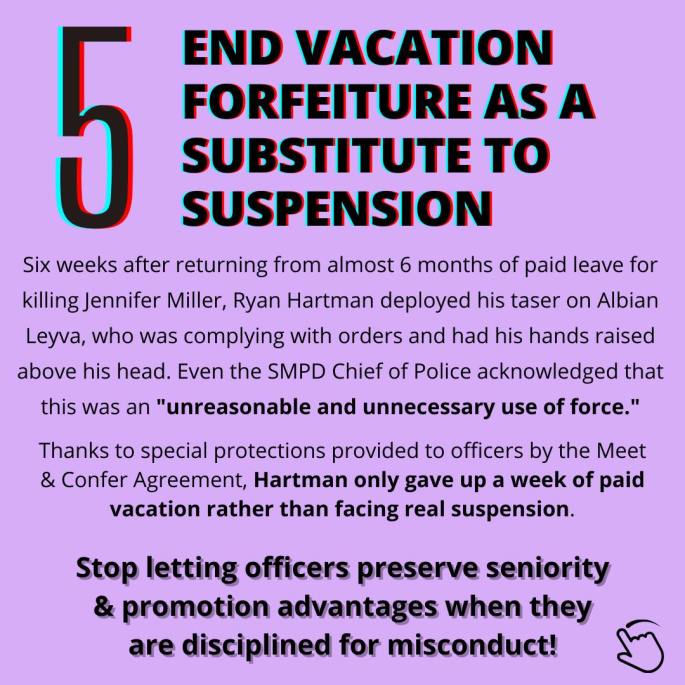
End Vacation Forfeiture: “No.”
City Manager Stephanie Reyes made a point to say that Chief Standridge was not part of the negotiation team, because it would put him in such an awkward position. He was only there as a neutral resource. (Who all actually was doing the negotiations? I couldn’t figure it out. It wasn’t on the agendas of the Meet and Confer meetings. I watched a little bit of the videos – April 7, April 19, April 23 – but didn’t see any introductions, and I could only recognize Stephanie Reyes. There are no documents besides the presentation in the packet. So I have no idea.)
It’s a weird situation, where the police union (SMPOA) is on one side, and city staff are supposed to be on the other side, advocating for these five reforms on behalf of Mano Amiga that they don’t necessarily believe in. So it’s mildly amazing that they moved the needle at all.
In other words, my expectations were low, and they successfully cleared my low expectations.
The main presentation
I found myself getting pretty mad, listening to Chief Standridge. We’re going to unpack what he said, but there’s a couple main themes:
He acts deliberately obtuse about the reason activists are requesting a reform. “Why on earth would you not want to support our valiant officers?”
He is mushy about the difference between holding an employee accountable in their job, and someone’s legal rights in a criminal investigation. These are very different things, but he switches back and forth as if they’re the same.
He acts like something is legally forbidden, when he means “Well, we have the power to change the law in these negotiations. But until we do, it’s forbidden!”
He organizes his presentation according to the five Hartman reforms, so I’m going to do the same here.
So here we go.
The 180 Day Rule:
What Mano Amiga says about it:
What Chief Standridge says about it:
Before San Marcos negotiates a contract, there are some background Texas laws in effect. These are the Civil Service laws. If an officer does something wrong, Chief Standridge has 180 days to investigate, meet with all parties, and dispose of an investigation.
Last summer’s Meet and Confer agreement made it stronger. Now Chief Standridge has 180 days to file a complaint, and then another 180 days from the complaint to carry out the investigation and draw a conclusion or punishment or whatever.
Standridge gives some other contexts:
If it’s not a criminal offense, the 180 day clock starts running at the incident. If it’s criminal, the 180 day clock starts running when the crime is discovered.
Federal law mandates 300 days statute of limitations for sexual harassment
Statute of limitations for misdemeanors is 2 years, for run-of-the-mill felonies is 3 years.
Mano Amiga wants to end the statute of limitations altogether.
Standridge’s argument against this is basically:
That’s absurd! The statute of limitations for most crimes is only 2-3 years!
It’s really hard to get good evidence as more time passes! For example, a lot of video footage auto-rewrites every 30 days or so. It’s hard to collect old evidence. “An unlimited time span is unreasonable if we believe in evidence.”
This is Chief Standridge at his worst. He’s completely ducking the issue. The issue – which he is well-aware of – is that nationally, we have a big problem with police department protecting abusive cops and shielding them from investigations. One good way to do this is to circle the wagons and run out the statute of limitations. Then shrug your shoulders and say, “oops! Too late to do anything!”
Does SMPD do this? Clearly Chief Standridge thinks not. I genuinely have no idea. But Chief Standridge is being a jerk by not acknowledging that this is a broader problem among police departments in general.
The next thing that Standridge is doing is switching back and forth between the employment rules for police officers versus the actual law for civilians during a criminal investigation. When it comes to employment rules, there’s no statute of limitations at your job. Your boss can pull you in and say, “Wait a minute. What were you doing back in 2017?” It doesn’t mean that your boss can file criminal charges against you, but they can certainly open an investigation with HR.
The fact that the statute of limitations is 2 years for misdemeanors and 3 years for low-key felonies is 100% irrelevant. Who cares, Chief. You’re their boss. If you have a bad cop and something comes to light from 2019, don’t you want the option of looking into it?
Which brings me to my final point: some crimes have no evidence, and it’s just the end of the road. If the incident was a year ago and there’s no evidence, then you’ve done what you can do. End of matter. Why do you need to decide preemptively that all crimes from a year ago have no merit? None of them could possibly be investigated? Even if someone was deliberately obfuscating and hiding the matter?
Outcome: nothing changed.
Hartman Reform #2. 48 hour delay of interviews and video review.
Here’s what Mano Amiga says:
Here’s what Chief Standridge says:
Suppose an officer is accused of misconduct. That officer is given 48 hours advance notice and shown the video before they are interviewed. Community members are not. You may think this is unfair towards community members, but it’s actually unfair in the opposite way! It’s unfair for officers, because they can’t plead the 5th like you can. You’re allowed to ask for a lawyer before you talk to the cops. The officer is forced to give a statement and answer questions by Internal Affairs. They can be fired if they don’t cooperate!
Again, Chief Standridge is drawing a false equivalence, and it’s bullshit: if you’re being hauled in for questioning, you’re a civilian being questioned by the cops. You’re entitled to rights under the constitution. Whereas if the cop is hauled into Internal Affairs, he’s an employee being questioned by his job. That is not a criminal investigation.
Chief Standridge almost acknowledges this, because he cites Garrity, which is a court decision that says that a cop’s compelled testimony for Internal Affairs can’t be used in a criminal proceeding. In other words, everything is completely fair:
You can be forced to talk to your boss at work, but you can’t be forced to talk to the cops in a criminal investigation.
A cop can be forced to talk to Internal Affairs at their job, but that testimony can’t be used against the cop in a criminal investigation.
Nothing of substance was said regarding the 48 hour delay. It was just glossed over.
Then Chief Standridge talks about why officers are allowed to watch the video before they testify: studies prove that it improves officer recall by 11% when they watch the video before they testify! Isn’t that amazing?
It is a wild misreading of the situation. He is literally explaining the point that watching a video helps you remember what happened. No shit, Sherlock. That’s not the issue.
The issue – just to be painfully explicit here – is that watching the video allows a cop to get their story straight. Does the video show you planting evidence? Did the video catch something that makes you look bad? Wouldn’t you like time to prepare for that?
If we take Chief Standridge at his word – that he literally believes that showing someone a video is best practices because it improves their memory – then he ought to extend that practice to community members. Everyone should get to watch the video! If you haul in a burglary suspect, you should show them the grainy ambiguous video footage before asking them any questions. It might help jog their memory. RIGHT CHIEF? BEST PRACTICES!
This would have been a respectable answer from Chief Standridge:
“Eye witness testimony is notoriously inaccurate. Showing a video to a witness has pros and cons. It can solidify someone’s memory of what happened, but it also reveals to someone the extent of what the investigator knows. If a person has nothing to hide, it helps them give better testimony. If a person does have something to hide, then it allows them to sharpen what they hide in the testimony.”
But that is not what he said.
Outcome: nothing changed.
Hartman Reform #3: Transparency
Here’s what Mano Amiga wants:
(I know, Chief Standridge went out of order. This is 3rd in his presentation, even though Mano Amiga’s graphic has a 4. Ignore it.)
Here’s what Chief Standridge says:
By law, there are two files on every cop, an “A” file and a “G” file.
The A File: – Anything good that happens to the officer (a commendation, congratulation, or honor) – Any misconduct that ended in a suspension, firing, or demotion – Regular formal evaluations
The G File: – Soft things, like coaching and mentoring and job improvement things. Letters of reprimand go here.
The G files contain complaints by citizens, testimony from fellow officers, body-cam video, written reprimands and memos, and other details that justice advocates think should be accessible to the public.
Chief Standridge tells us that legally, he can’t release anything in the G file. His hands are tied.
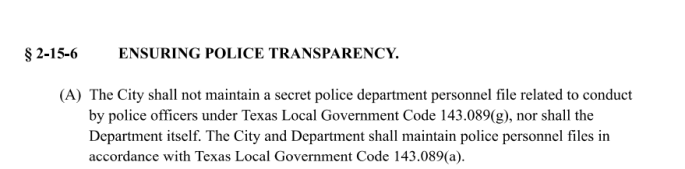
But he’s misrepresenting the situation (and by this point I’m pretty irritated with his whole presentation). Here’s the thing: It’s illegal under Civil Service Laws, yes. But Meet and Confer contracts override Civil Service laws. So it’s only illegal until we pass a contract that says we want the G file released.
This exact issue is currently being debated in Austin:
Subsection (g) applies to Texas municipalities whose police officers (or firefighters) are civil service employees – that is, ones that don’t have unions that negotiate the terms of officers’ employment. Here, the city and the Austin Police Association, through what’s called the “meet-and-confer” process, do hash out a contract that could preempt Subsection (g) should the parties so agree. Both APD and APA leadership insist the G file must remain secret – that it will contain frivolous accusations that officers can’t defend themselves against, particularly under Austin’s current procedures that allow such claims to be made anonymously. However, during this year’s negotiations for a new police contract, the city’s Labor Relations Office is proposing to do away with G files.
In other words: It’s only illegal until your meet-and-confer agreement overrides it. Let’s file the G File in the Chief-Is–Misleading-the-Public File. (Or the circular file.)
And it passed! Unfortunately, San Antonio’s Prop A, also including some police reform, did not pass.)
Anyway! Chief Standridge says that they found a compromise position: G-files and reprimands should play a bigger role in promotions. Or rather, if you’ve got a bunch of reprimands, you’ll get “negative points” and won’t be able to earn a big promotion quite so fast.
Kinda shocking that this wasn’t already happening, but better late than never!
Outcome: Letters of reprimand and suspension will be included in the promotion process.
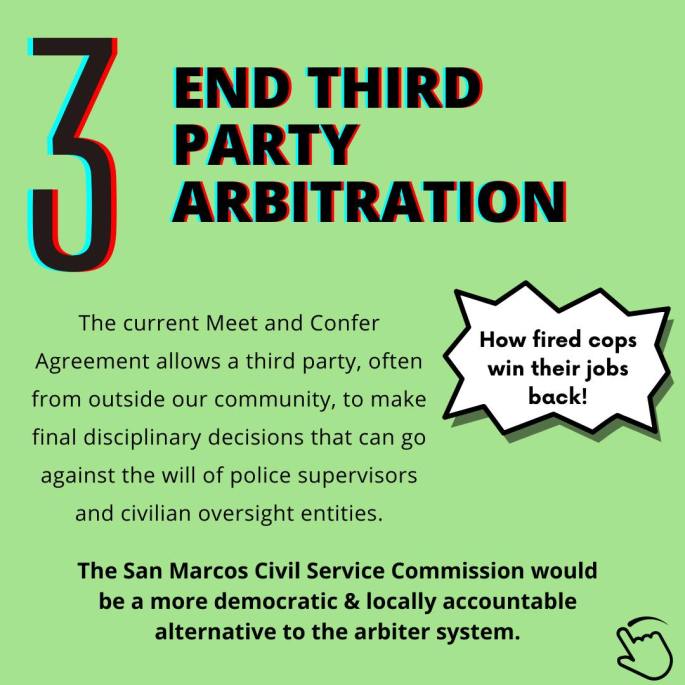
Hartman Reform #4: End 3rd Party Arbitration
What Mano Amiga says:
(I know, still out of order. It’s the least of our worries.)
Here’s what Chief Standridge says:
Suppose an officer gets in trouble. There are three kinds of discipline: – you get fired, – you get suspended, or – you get demoted.
If one of those happens and the officer doesn’t like it, they have two options:
Civil Service Commission Three commissioners hear the appeals. I think they’re local citizens
Hearing Examiner hears the appeals. This is 3rd party arbitration.
What I remember from back in January is Karen Muñoz saying that 3rd party arbitration almost always lightens the discipline, and that arbiters have a motivation to stake out a middle position.
Here’s where Standridge ticked me off in this one: he goes back to Ryan Hartman and says, “Now, Ryan Hartman appealed his discipline to a Hearing Examiner, and the Hearing Examiner upheld the punishment. We prevailed! The system worked! So why would we want to change something that works?!!”
In other words: these dumb, irrational activists! They don’t even realize that their poster child Ryan Hartman was such a shitheel that even the arbiter upheld his punishment! Aren’t they silly?
Okay, you got me? I’m glad that Hartman wasn’t let off with a lighter sentence? Woo-hoo? Now what about the rest of the cases, where they do get a lighter sentence from the arbiter?
Anyway: there’s something called a Dishonorable Discharge on an F5. This means you got fired for criminal conduct, lying, or insubordination.
Standridge proposes using that as a standard: if the appeal is filed for one of those three things – criminal conduct, lying, or insubordination – then the arbiter can’t overturn the chief’s judgment.
Standridge also says this is very progressive. It would be 1st in Texas! Unfortunately I’m too irked by this point to celebrate.
Outcome: Unless there’s evidence that the Chief is violating some ethical conditions, the arbiter can’t override the Chief’s punishment in the most serious cases.
Hartman Reform #5: Vacation Forfeiture.
Mano Amiga:
Using your vacation allow you to avoid a “break of services for promotion”.
Chief Standridge: “I’ll do a pros and cons list.”
Pros of vacation forfeiture : – We avoid a costly appeals process, because they admit wrongdoing. – It helps with understaffing because we’re not down yet another police officer – They still lose those hours of pay, and we don’t have to pay overtime to someone else, so it’s cheaper for us
So it’s a huge win!
Cons: he never got around to this part. (In fact, even in the slide presentation there’s a “pros” slide but no “cons” slide.)
He says the vacation forfeiture will show up on your G-file. So since G-files are now being used in promotions, it will show up there.
Outcome: Double-dipping on the G-file outcome again. Gets used in promotions.
Thus concludes his presentation.
……
There are some outcomes that didn’t show up in my recap above. Here is the full list:
We only discussed bullet points 1, 2, and 5. (And the 5th really isn’t a change.) The 3rd bullet – streaming future meet-and-confer meetings – is a good thing.
So the last bullet: why did SMPOA agree to this? What’s the carrot in it for them?
They make more money. Which, fine.
Both City Manager Stephanie Reyes and Chief Stan chime in about the violent crime rate some more, and their desire to focus on other things beyond this contract. The end!
The Council Discussion
Alyssa asks if the Chief could explain about Ryan Hartman and vacation forfeiture.
Chief Standridge’s answer:
Hartman’s situation is totally different than what’s being discussed here. In the contract, we’re talking about suspension. You can substitute vacation time for suspension.
“Administative leave” is a totally different thing, which means “we don’t trust you with a gun and a badge right now”. Hartman was placed on administrative leave for six months.
…
One moment that I want to highlight:
Chief Standridge gives a very sincere statement on the early part of the Hartman investigation. It wasn’t exactly an apology, but he did show remorse. It was something like, “The early part of the investigation did not live up to SMPD standards. We’re not going to look in the rearview, we’re going to look through the front windshield and move forward, and moving forward, we’ll have higher standards.”
It’s not exactly groveling for forgiveness, but he delivered it with sincerity and I believed him.
…
So what did the rest of Council say?
Jude Prather: This will make us safer!
Mark Gleason: Let’s move on! (And he uses the phrase “so-called Criminal Justice Movement”. I use the phrase “rolling my eyes at him”.)
Saul Gonzalez: Thank you thank you! Win-win. My son is a cop.
Matthew Mendoza: I have faith in this new agreement.
Alyssa Garza: Staff devoted a lot of time. Improvements have been made. It took a ton of work from our neighbors. Town Halls and conversations would help.
Jane Hughson: Thank you to everyone. Everyone worked hard to come up with an agreement that everyone likes.
….
Bottom line: This contract has some legitimate improvements to it. I think the Chief’s presentation was cagey and semi-deceptive, but there are actual improvements to the contract.
There is also still a lot left to fight for!
So there you have it. It will be signed on May 16th and that will be that.
….
Two final notes
1. There was a funny moment at the beginning when Chief Standridge says, “I want to dispel any rumors. I’m not going anywhere. We’ve bought a house here. Abilene is our home.”
Then he waits a couple beats and says, “I just said Abilene, didn’t I. SAN MARCOS! San Marcos is our home!” It was pretty funny.
2. Chief Standridge goes off on a tangent at 1:14 that is very confusing. He seems to think that the activists are being hypocritical by simultaneously believing two things: – there’s a lot of police misconduct – there’s no accountability
Standridge believes these contradict each other. You can’t have a lot of police misconduct and no accountability!
Here’s his reasoning: the public doesn’t find out about misconduct until the police department makes it available. Therefore, any time you hear about police misconduct, you’re also seeing evidence of accountability. If there was no accountability, the misconduct would all be invisible. Ta-da!
This is idiotic, of course. Misconduct is not invisible. People seem to notice when they were tazed, or searched, or intimidated, or stopped and harassed, even if the police try to hide and suppress it. Gossip spreads, reputations get formed.
It’s possible that Chief Standridge really does open an honest investigation into every complaint he hears about. But he’s naive if he believes he hears a complaint about every incident that occurs.
This has come up before. They’re building a fancy new campus here:
Those two red highlighter marks are future roads, according to the Transportation Master Plan.
But if McCoy’s wants their campus, the roads are in the way.
So the hypothetical roads must go. DONE!
(The vote was unanimous and this really isn’t a very big deal.)
…
Item 11: 67 acres here:
They want to turn it into apartments that feel like houses. It will be a complex, with the clubhouse and pool and all of that kind of stuff, but each apartment is a standalone house. I went hunting on the company’s website but I couldn’t find a sample photo.
The part I found mildly delusional was that they expect wealthy renters. Their typical renter has an $85K annual salary and wants a multi-year lease. That sounds like a pleasant fantasy version of San Marcos.
Shall we play The Six Criteria For Housing Developments game? YES!
Price Tag to the City: Will it bring in taxes that pay for itself, over the lifespan of the infrastructure and future repair? How much will it cost to extend roads, utilities, on fire and police coverage, on water and wastewater?
Good location. This is infill.
Housing stock: How long will it take to build? How much housing will it provide? What is the forecasted housing deficit at that point? Is it targeting a price-point that serves what San Marcos needs?
We need an ongoing housing needs assessment. We need to know this.
Environment: Is it on the aquifer? Is it in a flood zone? Will it create run off into the river?Are we looking at sprawl? Is it uniformly single-family homes?
Not on the aquifer. Environmentally reasonable.
While I haven’t seen photos, I get the picture that the units have smaller yards than a house. So denser than single family housing, but less dense than apartments. Not the worst.
Social: Is it meaningfully mixed income? Is it near existing SMCISD schools and amenities?
I can’t imagine their target clientele is going to materialize. They’re imagining something wealthy-ish, though, which is not mixed income. It’s sort of near Hernandez and Rodriguez elementary school, and sort of near Miller middle school. (The developer is imagining adults without kids, though.)
The San Marxist Special: Is it a mixed-income blend of single family houses, four-plexes, and eight-plexes, all mixed together? With schools, shops, restaurants, and public community space sprinkled throughout?
Not really. I suppose you have the outlet mall right there, but they’re not exactly a charming little public gathering space.
(Remember when you used to be able to ride a gondola back and forth for about 100 yards? Good times.
My overall opinion: This is a reasonably good use of space. It’s hard to put housing in between I-35 and some railroad tracks.
The vote: Yes: everyone except Matthew Mendoza No: Matthew Mendoza
I am not sure what he was opposed to!
…
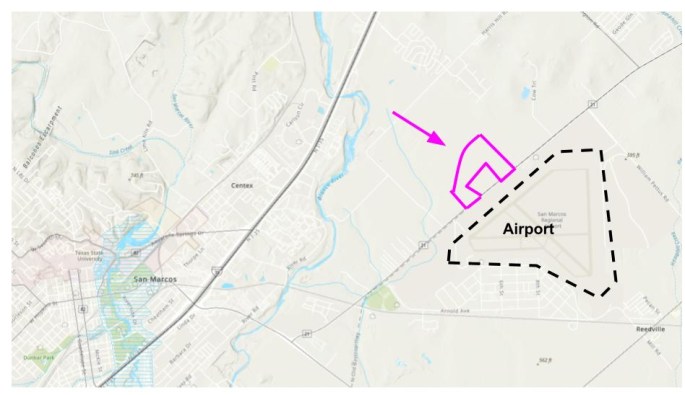
Item 12: 169 acres at the end of the airport:
It’s got a weird cut out due to an airport runway easement, and there are some FAA height restrictions also because of the runway. The developer wants it zoned Light Industrial.
Max Baker spoke during the public hearing, and raised issues of pollution. He kept mentioning the future airport expansion. I don’t think this particular item is the airport expansion? But maybe it’s in the pipeline?
Anyway, apparently it’s easy to measure pollution, but hard to determine the source, and usually it’s vehicle traffic. (Maybe we should reconsider all this sprawl!)
The vote: Yes: Matthew Mendoza, Jude Prather, Shane Scott, Mark Gleason, Jane Hughson No: Alyssa Garza, Saul Gonzales
One last thing:
You can speak during the public hearing, but not during council discussion, unless a council member specifically calls you up to the podium to answer a question.
Which brings me to my favorite moment of the night: Alyssa Garza saying – very deadpan but not mean – “Is it possible for Mr. Baker to tell us what he has ants in his pants about?” I’ve been laughing about that ever since.
(Max was glad to comply, and went to the podium to talk further about CAPCOG and purple machines and air quality.)
The development agreement has been opened back up! Cue angels singing.
First order of business: who is going to do the actual renegotiating with Franklin Mountain?
Staff?
A subcommittee of council?
The entire council?
If you picked 1, then you agree with Jude Prather, Shane Scott, Mark Gleason, and Mayor Hughson.
If you picked 2 or 3, you have the company of Alyssa Garza, Matthew Mendoza, and Saul Gonzalez.
So option 1 wins, and it will go back to staff to renegotiate things.
Alyssa Garza brings up the issue of dialogue: the community has been asking for a back-and-forth conversation. They’re not getting it. Jane Hughson points out that council has heard hours of comments from the community, and she had a three hour conversation with three of the community members. I kinda see where both sides are coming from.
Straight talk: do community members really want dialogue? No, they want the SMART Terminal to be cancelled. But they’ll settle for dialogue because they suspect they’re going to lose the war, the moment they stop talking. If they truly believed that a majority of council was fighting hard for their interests and was willing to cancel the whole SMARTGASBORG, then I bet community members would feel comfortable relinquishing control.
Dialogue without changing the outcome is infuriating. No dialogue, but a responsive government who shuts down the whole SMART boondoggle would be fine. Dialogue is important, but I kinda agree that there’s not a whole lot of team-building to be done here.
Next order of business: which issues should be renegotiated by staff?
The planning director, Amanda Hernandez, gave a quick presentation. They amalgamated the 12 concerns from the community (that I posted here last time), along with an email from Ed Theriot and one from Virgina Parker. In addition, the emails were all included in the packet.
However: you know whose email wasn’t included in the packet? MINE. Since they had specifically invited the community to email any additional suggestions, I sent one in about labor practices, and specifically indexing the minimum wage to inflation.
And….<crickets>. So city staff: I hope you feel the mighty burn of my stink-eye, aimed in your general direction, from the safety of my own living room.
(Jane even asked, “Is that everything that was sent in?” And still they suppressed my wee little marxist voice! For shame.)
Matthew Mendoza proposes that we send all the issues to the negotiating table, and see where it lands. Everybody seems on board with that.
…
Item 14: Coming up in future discussions:
Car boots. Apparently we bought a bunch in the 90s and never used them, in part because we needed a court order to do so.
They’re going to discuss a policy where you can get booted if you have three unpaid parking tickets.
The idea is not to be punitive. In order to get the boot off, all you need to do is get in touch with the city and come up with a payment plan.
Item 17: Eviction Delay: Currently we have a 3 month eviction delay. This is still under the auspices of the Covid Emergency Declaration, which is still in effect.
There’s a couple things going on:
Some landlords are ignoring the delay and illegally evicting tenants early.
Some renters are intentionally skipping out on the last three months of rent, knowing they can’t be evicted
Rents are insanely high in San Marcos, especially with regard to the median income
So there’s bad circumstances all around, plus some bad actors on both sides.
Alyssa is very concerned that we will not be able to properly notify community members that the extension is coming to an end. This is grounded! We’re really terrible about outreach. Or rather, outreach is incredibly hard to do well.
Mayor Hughson puts a call out for media outlets to help spread the word. I GOT YOU, MAYOR HUGHSON! From your lips to my ear! I’m doing it!
There are a lot of details to hammer out, but expect to see it end around July 1st.
Here’s the basic sketch of what happened Tuesday night:
A ton of community members showed up in and drowned council in a mountain of information, concerns, data, suggestions, and so on.
Council got the message loud and clear.
Council is going to revisit the Development Agreement
Then they’ll revisit the zoning in July.
Just a passing thought: these community members with these careful, well-researched, passionate statements to council? perhaps would make really great progressive potential future candidates for public office!
I’m just putting this out in the universe. Granted, a lot of the speakers live outside city limits, but maybe they were just annexed on Tuesday.
The City Staff presentation:
There was a small bit of new information given on Tuesday from the city:
(Crappy quality because it was not in the packet, so I had to screenshot.)
This fiscal analysis is supposed to happen before every annexation. I can’t remember ever seeing one of these before, and there have been a lot of small annexations. What happened here is that the community members noticed and spoke up repeatedly about it. In response, city staff put this together.
However, Noah Brock (one of the community members) independently did his own revenue estimate, using Amazon Warehouse tax revenue rates as a model. His estimates:
Year 5: $1.4 million annually
Year 10: $4.3 million annually
Year 20: $8.1 million annually
The city’s estimates favor the developer, and Noah’s is less rosy. Draw your own conclusions.
(You know what I’d LOVE to see? The fiscal projections from the Amazon warehouse in 2016, or the Outlet Malls, or Embassy Suites, and how those have panned out. I’m sure they’re sitting in some prospectus, aging like milk. I found the Chapter 380 agreement for Amazon, but not the fiscal projections, which leads me to suspect it was never made public.*)
Seeing the writing on the wall, the developer made some small concessions in the days leading up to the meeting:
Double the buffer zone required by San Marcos code (around creeks I think?)
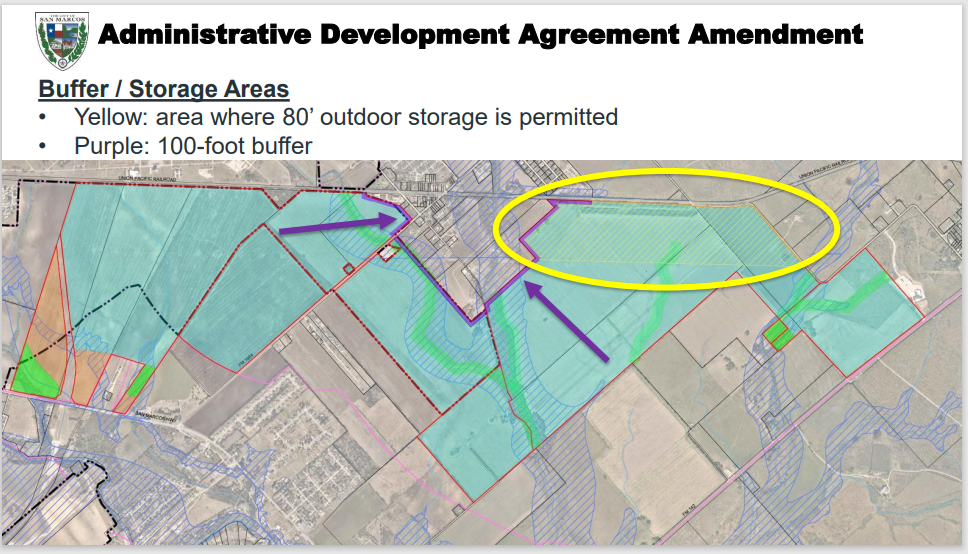
They will only pile shipping containers 80 feet high in certain areas (in the yellow circle below)
At the purple arrows, they’ll put a 100 foot buffer between the SMART Terminal and residential homes.
100 feet is tiny. A typical house sits on 1/5th of an acre. If that lot is square, it’s roughly 92’x92′. I’ve probably made you read 100 feet of my blathering already, and it’s only Sunday morning.
The idea that these two concessions would mollify the community is pretty arrogant. This developer keeps rubbing me the wrong way.
(Who is this developer anyway? Two of the community members filled us in: Franklin Mountain is an investment conglomeration owned by Paul Foster, an oil baron who is the current chair of ERCOT and part of lots of GOP committees, boards, etc.)
What do community members want?
At P&Z, the question was “If we turn this down, will the developer build in the county, with zero environmental protections?” San Marcos River Foundation director Virginia Parker thinks this is definite. However, this is a convenient threat that developers levy all the time, to spook communities into concessions. Maybe both can be true.
Either way, the SMART Terminal fight has morphed. Community members probably still wish it could be shut down altogether, but they recognize that that ship has sailed. On Tuesday, the conversation was no longer about whether it’ll happen, but instead about how to mitigate the damage. They’re fighting for the least-bad option now.
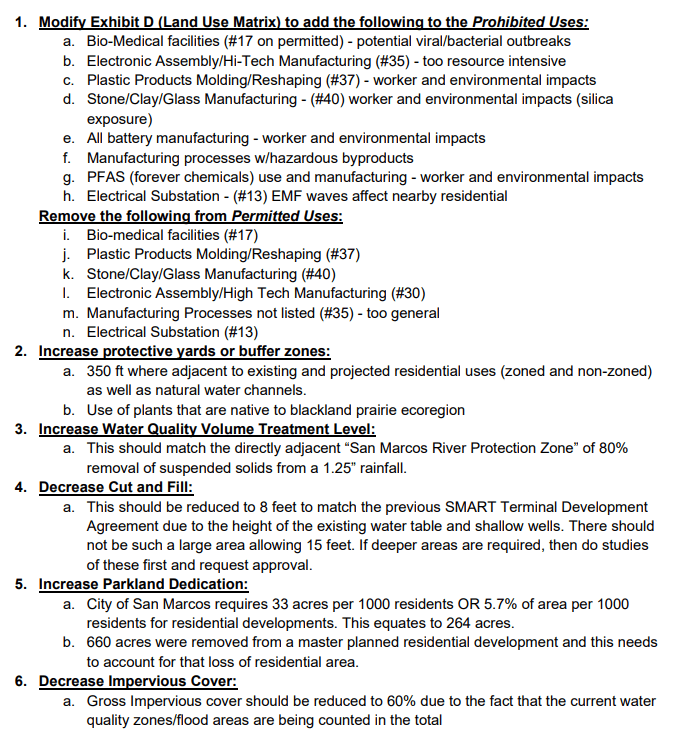
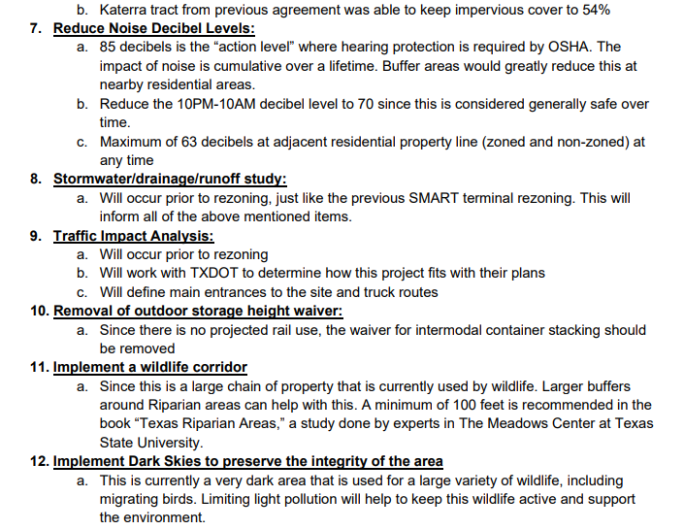
Seven of the community members (Noah Brock, Annie Donnovan, Ana Juarez, Ramona Brown, Ezra Reynolds, Bruce Jennings, and Rocco Moses) put together this list of recommended changes:
To the list above, I’d add:
13. Labor Protections
We keep being told that the point of the SMART Terminal is:
to increase tax revenue without raising property taxes
to bring good jobs to the community.
There needs to be some labor protections in the development agreement. Otherwise you will get shitty, exploitative jobs.
In 2016, we passed an amendment that any company receiving money from San Marcos should pay minimum $15/hour, plus benefits. This is a good start, but there’s one crucial detail missing: it must be pegged to inflation. You should never set a safety net without planning for inflation-adjustment.
(Honestly, this is one of the most underappreciated near-misses of federal policy of the 20th century: not pegging the minimum wage to inflation.)
Other labor protections: regular schedules with advance notice, no drug testing, and there’s a bunch more here. But mandating that the minimum wage keep up with inflation would be a good start!
Other recommendations: Ed Theriot is a local developer who is usually trying to build the things that make neighbors mad. But this time he’s the neighbor, and also one of the Caldwell County Commissioners, to boot. So his perspective is particularly useful.
However, I don’t have his recs yet. He’s writing up a list of recommended changes to the Development Agreement, and I’ll include it here when he sends it to me.
One more thing:
There was one more very interesting thing in Citizen Comment, which doesn’t fit neatly anywhere. Bruce Jennings offered the following history of the land next to Gary Job Corp:
Let me tell you a story about the land you are about to annex. The area in question has significant history of prior pollution. Some of you may be old enough to recall that the airport and the Gary Job Corp property was Camp Gary, a military installation from 1942 to 1956. Now, one of the duties of the base was aircraft maintenance; engines had to be maintained, parts cleaned, fluids changed, detergents, oils, and degreasers disposed of. But in the 40’s and 50’s few knew about the potential of pollution. Camp Gary personnel dumped these chemicals into a landfill and creek at the back of the property…for years.
Those fluids ran downstream to a earthen detention pond before entering the San Marcos river, where they settled as heavy metals on the bottom of that pond. Later, in the 1970’s and 80’s most people had forgotten and the land was developed for residential use. People started fishing for bait in the pond fed by 2 creeks and springs from the hillside. One day I was approached by an elderly gentleman who told those fishing to NEVER eat what they catch in that pond. I was alarmed to say the least, and began to look for information.
We had city, county, state, and federal representatives on site multiple times. It was suggested that the property be identified as a superfund clean up site. Jake Pickle came out one day and walked the property with us.
The price tag for cleanup in 1981 was 5 million dollars. Options were discussed and a decision was made…to leave the contaminants in the soil. The contaminants were left under a 12 foot cap of mud. And instead, let’s improve the sewage treatment and close the landfill that followed, by the ownership of San Marcos, who owned the landfill out on the back end of Camp Gary. Where 69% of it was on two lots, where Camp Gary became Gary Job Corp. That cost about 1 million dollars. So if I remember correctly, you all had to build about 10 test wells out there, and run them for several years!
Now, at the time, the southeast part of the property, where the San Marcos Municipal Landfill was, encompassed an area of approximately 353 acres, of which two Gary Job Corps Center tracts comprise about 69 percent. Hazardous chemicals found included volatile organic compounds (VOCs), polychlorinated biphenyl (PCB), cadmium (Cd), iron (Fe), Ph, and manganese (Mn). Now these chemicals are in the soil out there.
If you do allow the cut and fill, you need to be testing the soil every time you penetrate for a slab out there, because what I understand is that you will be releasing PCBs that have been trapped in the compressed soil, and it will be leaching in the soil and then therefore go into the shallow water system that transfers through those creeks. I know this for a fact because I live two miles from that old landfill, and the pond at the beginning of my street is horribly contaminated! And y’all didn’t want to clean it up. Y’all wanted to just have a cap on it, and y’all went and did improvements over at Camp Gary, did your test wells for several years, y’all came and did tests at my pond for two full years. That shallow water feeds the creeks and the rivers. Any destruction of the soil could release the chemicals that were stored in the soil as hazardous chemicals. There would be a detriment to all of the flow of the water that seeps into and nourishes the river.
(That’s an amalgamation of his spoken and written comments, which he was kind enough to email to me.)
Here is the punchline, an environmental assessment on the land, prepared for the Department of Labor:
The San Marcos Municipal Landfill was once listed as a Texas Superfund Site in Reedville, Texas with the EPA Site # TXD980625222 (USEPA 2021). The landfill is not listed on the National Priorities List (NPL). It is currently registered as an Archived Superfund site by the USEPA (Homefacts.com 2021).
(Link and quote also from Bruce’s email.)
Just think, our very own Archived Superfund Site! With hard work and a fair wind, we could really double down on the legacy of environmental damage here.
Last thoughts:
The point of city planning is to share decision-making with the residents of the city. Developments affect residents, so residents ought to have some decision-making power over what gets built where.
We are giving away our power. Franklin Mountain isn’t an industry, it’s a middle man. They want the power to decide what gets built there.
The SMART Terminal is phenomenally big:
Decision-making power is worth a lot of money on something that big. Franklin Mountain would like to make a lot of money, and so they are working very hard to wrest it from us.
The decision-making power will go to this middle man company. (Specifically, a company owned by a rich oil baron named Paul Foster, as mentioned above.) Then they will hold the power, and they’ll get to decide what happens there, and we’ll be stuck with it.
…
*On the Amazon Chapter 380 agreement, the lack of concrete details is amazing. Here’s the hilariously useless Official Payment Plan:
Have you ever seen an amortization schedule without any, y’know, numbers? Or even percents? Just “yes” or “no”? Me neither.
Price Tag to the City: Will it bring in taxes that pay for itself, over the lifespan of the infrastructure and future repair? How much will it cost to extend roads, utilities, on fire and police coverage, on water and wastewater?
Great location. Fully covered in terms of infrastructure and services.
Housing stock: How long will it take to build? How much housing will it provide? What is the forecasted housing deficit at that point? Is it targeting a price-point that serves what San Marcos needs?
Probably? Sure would be nice if we had an ongoing housing needs assessment!
Environment: Is it on the aquifer? Is it in a flood zone? Will it create run off into the river?Are we looking at sprawl? Is it uniformly single-family homes?
Not on the aquifer. Environmentally reasonable.
Social: Is it meaningfully mixed income? Is it near existing SMCISD schools and amenities?
Not mixed income. That’s the only drawback: I want to intersperse people from all different economic levels. But couldn’t be closer to SMCISD!
The San Marxist Special: Is it a mixed-income blend of single family houses, four-plexes, and eight-plexes, all mixed together? With schools, shops, restaurants, and public community space sprinkled throughout?
Nope. It never is. Bummer.
Overall, this is a reasonably good thing to build here.
Items 12-13: we need some equipment.
Specifically, we are leasing (1) 41′ Digger Derrick-Tracked Backyard, five (5) Ford F350 Supervisor Trucks, two (2) 47′ Digger Derricks (DC47), one (1) AM55 Overcenter Aerial Device, four (4) Articulating Telescopic Aerial Devices (AT41M), for the Electric-Utilities department.
As one of these Odes to Enshrined Sprawl, you can’t build too close to the edge of your property. The size of your setback varies, depending on your zoning.
You are allowed to park your car in your setback, but you can’t put a structure in it. So where does that leave carports? Carports count as a structure that’s not allowed in your setback zone, even though they house your car. So unless your yard is huge, you probably don’t have room for a carport.
So why? What’s so bad about a carport?
First off, setbacks are different from easements and right-of-ways. Easements and right-of-ways are needed for water lines and future sidewalks and things like that. You definitely can’t put structures up over those.
So what’s the reason for banning carports in the setbacks?
The polite version is “neighborhood character”. The blunt version is that people who care about status think they look trashy.
(Do I think they look trashy? No! They’re fine! Protect your cars from the hail. Who cares.)
Mark Gleason phrases it as, “Some neighborhoods are going to hate carports, while they’re fine in other neighborhoods.” Can’t argue with that. HOAs are the worst!
Bottom line: this will get discussed in the future. If you want a carport, try to live in the right kind of neighborhood.
Citizen comment: Mostly community members talking about the SMART Terminal. None of us can stop talking about it! But I think I should go on to other topics.
Items 1-4: Quarterly financial reports and audits and investment reports, etc.
Everything looks fine.
Item 14: East McCarty and Leah.
Developers want to make something of this land:
That yellow L-shape.
This item first came up last summer. The developer applied for Heavy Commercial zoning. P&Z said yes, and then Council said no. Council was concerned about Embassy Suites and the conference center, our beautiful prized jewel of the city. (Which the city is still paying off for another 10+ years or something, by the way.)
In November, the developer applied for Light Industrial. This time, P&Z denied it. That means that it will take 6 votes at council to override P&Z.
So it went to Council in December. Rather than deny it, they formed a committee to try to work something out with the developer. And now the committee is done, and it’s back for the vote.
The committee and the developer made a lot of compromises, but they got stuck on one thing: nighttime truck traffic. Council wants Quiet Hours after 10 pm, because of the people sleeping at Embassy Suites. The developer was saying it’s too restrictive for their business model, because warehouses need to load and unload their wares overnight. Council pointed out that it’s annoying to try to sleep and hear BEEP BEEP BEEP all night long.
Finally the vote:
The vote: Should this be zoned Light Industrial? Yes: Jude Prather, Shane Scott No: Mayor Hughson, Mark Gleason, Alyssa Garza, Saul Gonzalez, Matthew Mendoza
So it failed. The developer can try something else, or sell it off.
Let’s just marvel at the close compassion offered to the weary travelers at Embassy Suites, shall we? What tender thoughtfulness. You can understand that a business traveler might not want to sleep next door to a 43 acre industrial site. What were you saying about the SMART Terminal again?
One final note:
At 1:25:10, the developer is trying to say that we should approve this project because no one else will want to develop it. And he says this exact quote:
“No large grocery store chain will consider this property because of the new HEB which is across the street.”
UH WHAT NEW HEB ACROSS WHICH STREET?
Across I-35? Across McCarty? Across Leah Ave (towards Amazon)? What does he know that I don’t know?
The location of a 3rd HEB has been controversial. First, constantly we’re talking about how few resources there are on the east side. The east side needs amenities.
But also, there’s history here. Back in 2016, City Council approved an HEB going in on the corner of Wonderworld and Hunter. People were furious. The main reasons:
The 2015 floods were just a year earlier, and now we were talking about paving a massive bit of land along Purgatory Creek
this would require a bunch of curb cuts on Wonderworld, which violated the agreement when the greenway was developed.
Quick digression on the Wonderworld extension. Wonderworld used to stop at Hunter Road. You took Old RR12 to go west towards Wimberly. It took decades to design and extend Wonderworld west, because it’s cutting through Purgatory Creek, which is really sensitive area. There was a complicated deal involving donation of greenbelt land and promises to take care of this area.
“We couldn’t find a more environmentally sensitive area to go through,” said Sabas Avila , the city’s assistant director of public services. The area includes a flood control dam, caves, endangered species such as the golden-cheeked warbler and black-capped vireo, aquifer recharge zones and a Native American burial site, Avila said.
“Believe me, we tried! But this was the best we could do.”
(I’m being a jerk, taking the quote out of context. The speaker is probably an environmentalist.)
Anyway: it appears the proposal for the Wonderworld HEB is still on hold.
Bottom line: this developer appears to know about some new HEB, relatively close to Embassy Suites. Eeeeenteresting.