Hours 3:27-4:14, 8/5/25

Item 32: Tenants rights to organize

The Question: Should San Marcos pass an ordinance that would protect tenants’ right to organize?
The Answer: yes! Done. Moving on!

Okay, now let’s get into it.

Backstory: What should you do if you’re a tenant, and there’s mold in your bedroom, or your AC goes out, or you have no hot water, and your landlord refuses to fix it?

In Texas, you have very few options besides suing. You can talk to your landlord, of course. If they start to see you as a problem, you might be evicted. Filing a lawsuit is expensive, of course, and if you try to sue, you might be evicted anyways.

What’s the alternative?

Basically, tenants should be able to talk to each other about their landlord problems, and form tenant organizations, and bring issues to their landlords as a united front, without worrying that they’ll get evicted or face retaliation.

It’s this kinda thing:

via

We actually already have a great tenants organization here in town! The Tenants Advocacy Group, or TAG, has been working on all this with the San Marcos Civics Club, which is why this is here before council. (It’s part of a larger Tenants Bill of Rights that they’re working on.)

How do you protect tenants?

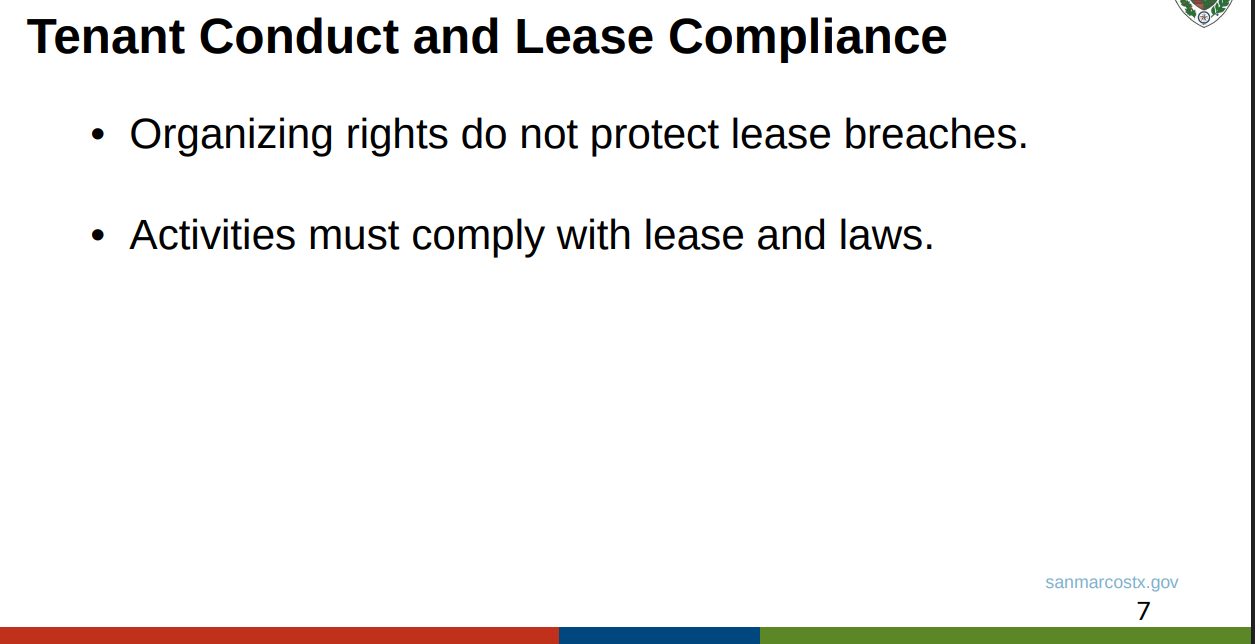
You pass an ordinance that protects tenants from retaliation if they want to organize. There are two parts:

  1. What kinds of tenant activities need protection?
  2. What kinds of landlord retaliation or interference needs to be banned?

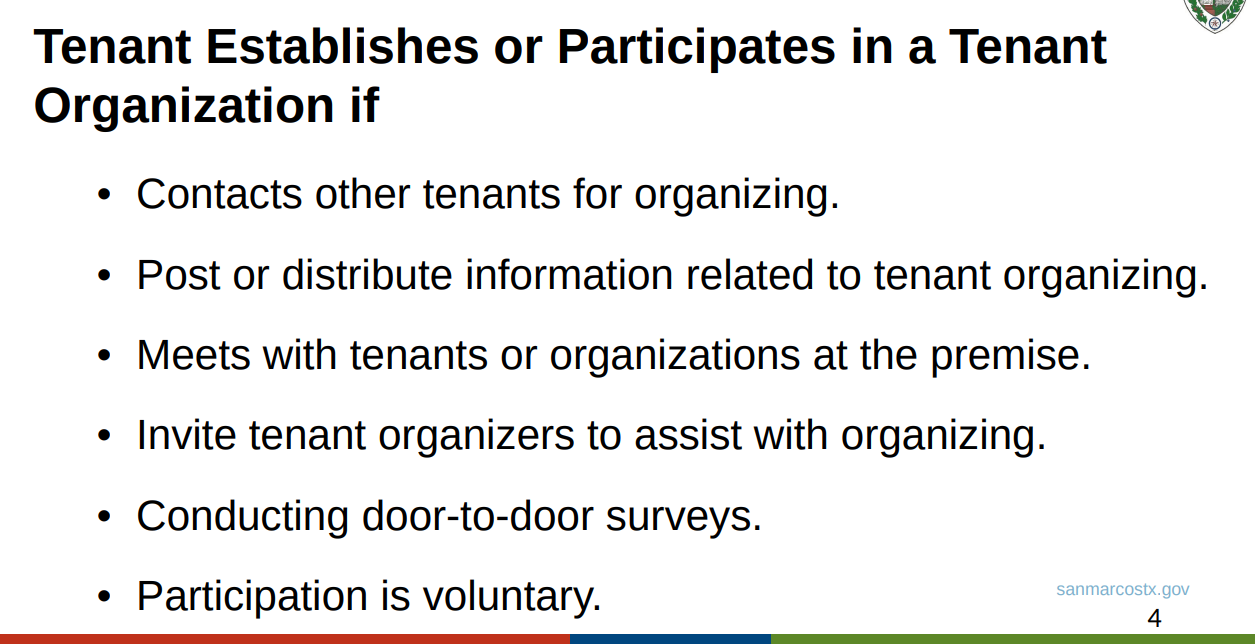
Amanda prepared some helpful slides:

So that covers the tenants. And for the landlords:

The penalty would be a misdemeanor.

Are there any laws that already exist, that protect tenants?

It depends on where you live! City staff made this helpful chart:

So yes: Austin has protections. The state overall has no protections. There are federal protections, but only in subsidized housing.

The idea would be to use the Austin ordinance as a jumping-off point, and then modify it to fit San Marcos.

This brings us to Council Discussion

Jane Hughson brings up a few details – what if a property manager is interfering on behalf of the landlord? Should they be included in the language? What about trained organizers and other non-tenants who might need protection? Can we avoid having the fliers become litter?

Amanda: Great ideas! We should definitely workshop this.

Lorenzo: A Class C Misdemeanor requires a police officer. I don’t want to criminalize landlords.

Note: Historically, marginalized groups are over-policed and criminalized. Fortunately, landlords are not historically marginalized! They’re pretty much the opposite. They’re the marginalizators!

Groups that have historically held outsized power – like landlords, or wealthy people, or police officers, or elected officials – are generally under-policed. In these cases, cities need to be more consistent with enforcement, and not worry about criminalization.

Lorenzo: Can we work out the details in a subcommittee? I don’t want to modify Austin’s ordinance. I want to write ours from scratch.

Jane: I agree. Let’s get a subcommittee going, and write out something homegrown.

Note: These are both bad ideas.

  1. Don’t bury something in subcommittees. As Alyssa puts it, “Council subcommittees are where dreams go to die.”
  2. Don’t reinvent the wheel. If Austin has a workable model, then let’s build on it.

Amanda points out that Austin’s ordinance has also been around for years, without being struck down by the courts. So that’s a more solid foundation to build on than if we just improvised our own thing.

City staff suggests a workshop?

Eventually everyone comes around to this idea, so it will be held on September 16th.

My dear minions: Go forth and tell Council that you think tenant protections are a great idea!

Bonus! 3 pm workshops, 8/5/25

Workshop 1: Community Survey

Back in 2022, the city put out a community survey, to find out how happy people are with life in San Marcos and with city services. Now it’s time for the 2025 follow-up survey.

This workshop was mostly about tinkering with the five freebie questions that the city gets to individualize. It was pretty mundane, so I didn’t bother to write it up.

Keep an eye out for the survey over the next few months! And share it with people who don’t generally respond to city surveys.

Workshop 2: Utility late fees and reconnection fees.

This has been a discussion for the past year, most recently here. Bascially, there was a lot of money available to help people pay their utility bills, but very little of it was getting spent on people who needed help. They’ve (hopefully) fixed that by making the application form much shorter and easier.

The second issue was late fees and reconnection fees. If you already can’t pay, do we really need to charge you more as punishment? The Citizens Utility Advisory Board (CUAB) is bringing back recommendations on what we could change.

There are two main questions:

  1. How much of a penalty do we want to charge people, once their bill is overdue?
  2. How much does it cost the city to disconnect and reconnect someone’s water/gas/electricity?

Penalty:

We used to charge a 10% late fee. CUAB is recommending a 5% late fee.

Disconnect/reconnect:

Here we’re just trying to cover our costs. It’s not a punishment. Back in 2014, we set $40 as the fee. In 2025, it now costs $95 to reconnect the utilities.

The problem is that if you decrease the late fee by 5% and then increase the reconnection fee by $55, they kind of cancel each other out:

So Council is a little bummed out over this.

Jane: Can people get late fees and reconnection fees paid for by the Utility assistance program?
Answer: Just late fees, but not reconnection fees.

Jane: That was an oversight. I wish we’d talked that out when we were dealing with utility assistance.

They end up going in circles for awhile – should they send it back to CUAB? Should they split out water from electricity? Should they subsidize disconnection/reconnection fees? What if the state passes restrictions affecting late fees?

In the end, they decide to accept the proposal for now, and also reduce the water disconnection fee to $40. This will come back around for final approval during a council meeting.

Yearly Clean-up, Summer ’24-Summer ’25

Happy August, everyone! It’s that time of year where I like to organize everything that’s happened over the last 12 months. A little dry, but Council resumes normal shenanigans next week.

Note: Council has not posted minutes for meetings since May 2022! (This may finally get fixed by next year.)

August 2024

First meeting:

  • CDBG money handed out
  • Smart/Axis asks for a road through the eastern part of their gigantic site. (Just a discussion)

Second meeting:

  • Grand jury declines to press charges against the officer who killed Malachi Williams. (Big turnout at citizen comment)
  • Budget details are discussed
  • $800K to Southside from ARPA money to implement the Homelessness plan

September 2024

First meeting:

  • Tax rate and budget debate, part 1
  • SMART/Axis gets its road approved. (Yes: Jude Prather, Jane Hughson, Mark Gleason, Matthew Mendoza. No: Shane Scott, Alyssa Garza, Saul Gonzales)
  • School Resource Officer Contracts increased to two years long
  • First discussion of steering committee for the new City Hall
  • Update on channel and hike/bike path that will connect Purgatory Creek to Rio Vista
  • First discussion on Utility Assistance Program

Second meeting:

  • More discussion on steering committee for the new City Hall
  • Sturgeon street bans non-resident parking on their street.
  • Tax rate and budget discussion, part 3
  • Extreme damage to the river during Summer 2024

October 2024

First meeting:

  • VisionSMTX discussion of final draft
  • Update on Quail Creek Park

Second meeting:

  • Endorsements and coverage of city council candidates
  • Final vote to approve VisionSMTX
  • Gateways sign design is approved
  • Extend TDS contract through 2030
  • New HEB coming to McCarty and I-35!
  • ARWA water updates
  • Renaming downtown alleys
  • Mitchell Center going to the Calaboose museum

November 2024

First meeting:

  • Amanda Rodriguez elected to Place 6, run-off for Place 5
  • Riverside Drive gets their non-resident weekend parking ban
  • New HEB deal is officially approved
  • Final list for steering committee of the new City Hall. (DEI recommendations were ignored, and their recommendations ended up being out-of-sync with what the public wants.)
  • Last bit of ARPA money redirected for rental assistance

Second meeting:

  • Tantra Coffee Shop gets its alcohol CUP back
  • Paid parking coming to the Lion’s Club
  • Acquiring Five Mile Dam parks from the county
  • Presentation on Rent by the Bedroom exploitative rental practices
  • Presentation on LIHTC projects

December 2024

First meeting:

  • Rezoning natural area around Hays County Government Center, in exchange for securing land for the hike-and-bike trail from Rio Vista to Purgatory Creek.
  • mailing parking tickets at City Park
  • SMPD buying seven new Tahoes
  • SMPD establishing a motor vehicle crime prevention unit
  • Shane Scott wants to double the councilmember travel budget from $12K to $24K.
  • Presentation on future growth of Texas State

Second meeting:

  • Lorenzo Gonzalez elected to Place 5 (by 9 votes!)
  • $50K of ARPA money to Evoke Wellness, for a substance abuse treatment program
  • New flood maps are coming, affecting 800 acres of San Marcos
  • First discussion of HSAB funding
  • Topics for lobbying the state legislature
  • Presentation on the mess over the waitlist at the San Marcos Housing Authority in September 2024.

January 2025

First meeting:

  • HSAB funding is approved
  • SMPD gets their total bullet containment system
  • Suggestions for Charter Review Commission, and appointing of the commission

Second meeting:

  • Blanco Gardens Area Plan
  • Bike lanes on Sessom
  • Presentation on the San Marcos water supply

February 2025

First meeting:

  • Townhomes on Post Road
  • Flock License Plate Reader cameras, first discussion
  • Transit Equity Cabinet recommendations

Second meeting:

  • Bystander footage of Malachi William’s death is released
  • First discussion of Data Center proposal
  • Council discusses doubling their travel budget and stipend
  • Strategic Plan for the FY 2026 budget
  • Utility Payment Assistance workshop discussion
  • Update on ARPA money

March 2025

First meeting:

  • HUD grant money plan updates
  • Riverbend Ranch gets cut-and-fill approved
  • Discussion of SMCISD stormwater fee waiver
  • Second discussion of council compensation
  • Presentation by Evoke Wellness on their in-patient treatment program
  • SMPD presentation summarizing what Chief Standridge has implemented over the past four years

Second meeting:

  • Budget Policy Statement discussion
  • Third discussion of council compensation – whole thing goes down the tubes
  • SMCISD stormwater fee voucher approved, in exchange for help building a detention pond at Mendez Elementary
  • Council sends a letter to Guadalupe County about the septic issues in Redwood
  • Cape’s Dam backstory and feasibility study
  • Update on Downtown plan
  • Privacy policy on SMPD License Plate scanners

April 2025

First meeting:

  • Update from the Charter Review Commission
  • Flock License Plate Cameras briefly discussed, but original postponement continues until June
  • Housing development approved down by Trace
  • Presentation on our Bicycle Friendly status
  • Spin Scooters expand region of service
  • Edwards Aquifer Habitat Conservation Plan

Second meeting:

  • New student housing complex by mini-Target, downtown
  • Speed Limits in the Wallace Addition
  • First Discussion of a Gaza ceasefire resolution
  • Controversy over whether or not to move City Hall and overshadow the skate park

May 2025

First meeting:

  • Discussion and vote on the resolution calling for a ceasefire in Gaza. (Does not pass)

Second meeting:

  • Presentation on Homeless 2025 point-in-time count
  • Charter Review Commission submits their recommendations
  • Modifying downtown TIRZ
  • Staffing study for SMPD
  • SMPD police station improvements and grant applications
  • Fiscal update and budget planning
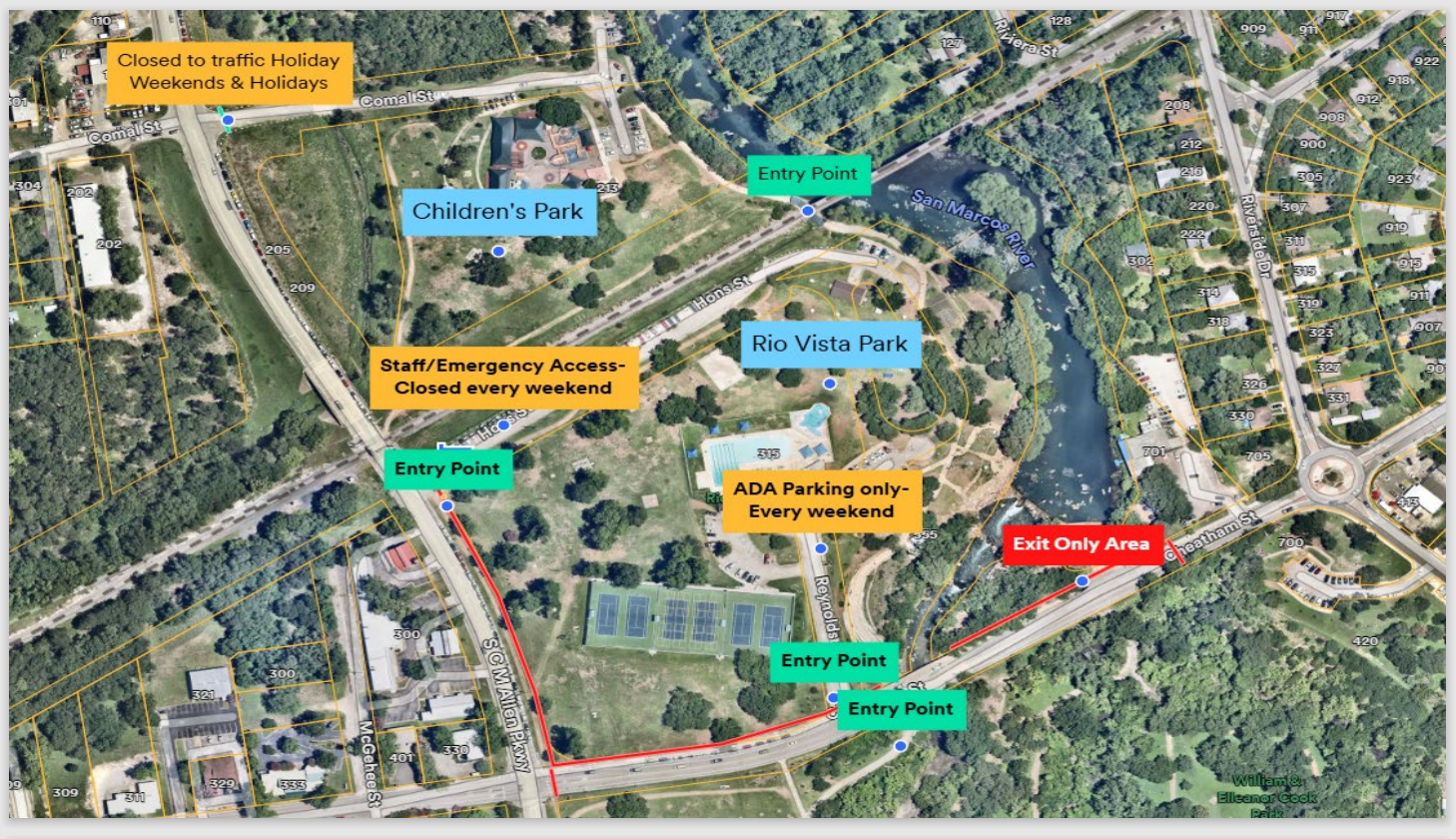
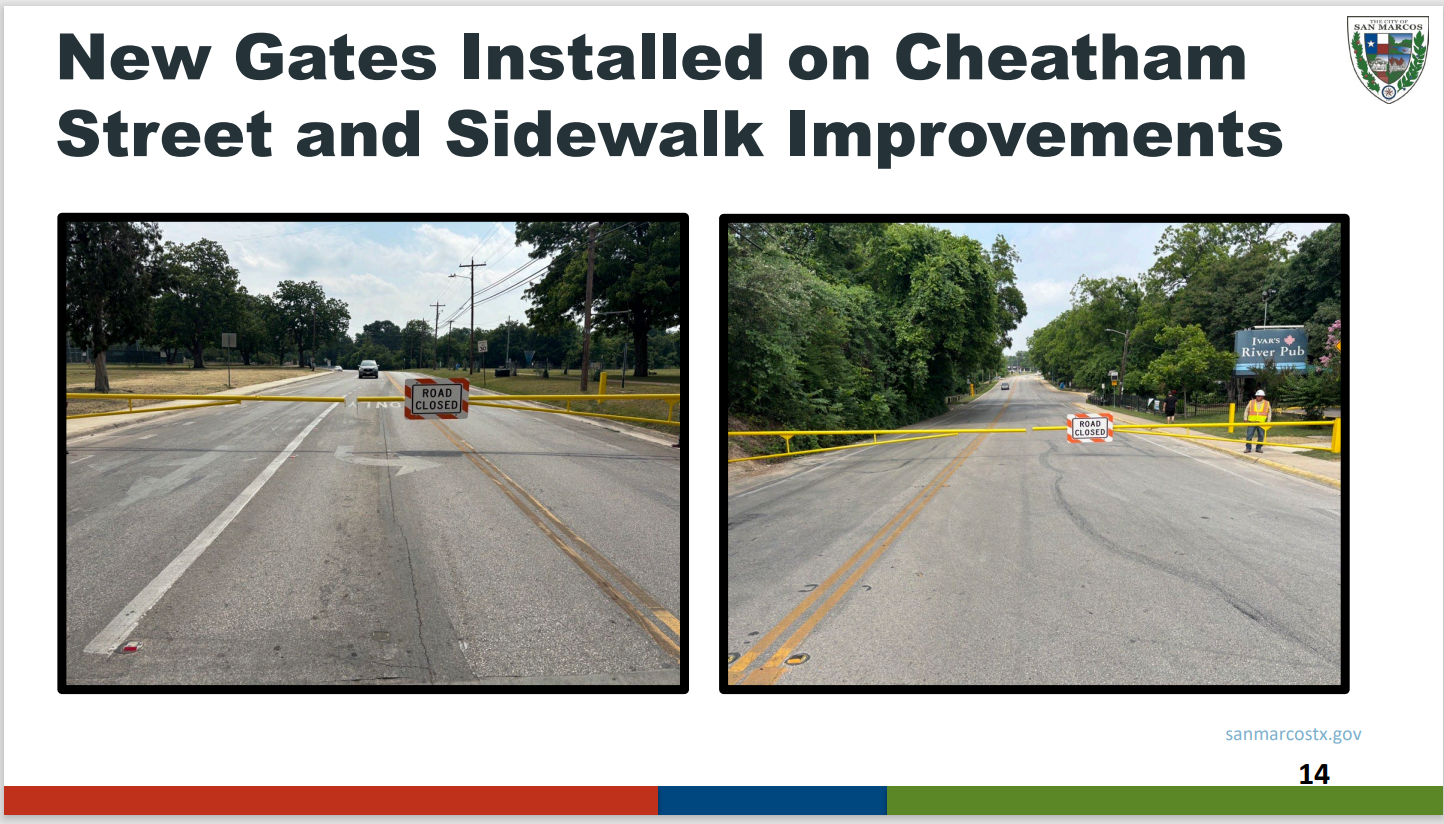
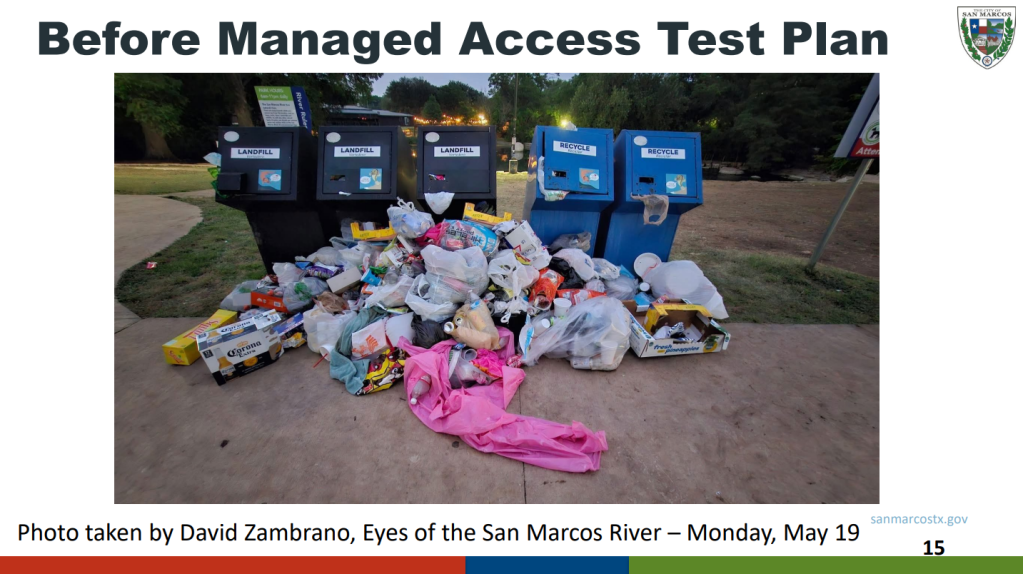
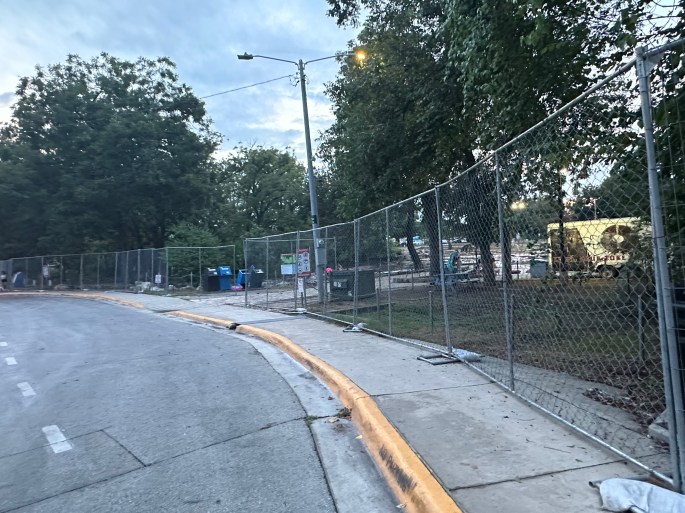
  • River parks update: fencing off the river but not charging admission

June 2025

Only one meeting:

  • Budget and sidewalks update
  • More street parking non-resident bans
  • CDBG funding
  • Discussion of Data Center proposal (no vote)
  • Flock License Plate Reader Cameras are voted down (just the proposed new ones)
  • Spin Scooters are leaving San Marcos
  • Presentation on Capital Improvement Projects
  • Presentation on SMPD vehicle policies

July 2025

Only one meeting:

  • University proposes boutique hotel across from mini-Target
  • Veterans funding discussion
  • Gary Job corps contingency plans in case of shutdown

July 1st City Council Meeting

It’s a city council week! Before the terrible flooding and tragedies – (feels like a million years ago) – council discussed tax breaks for a Texas State boutique hotel, Gary Job Corps, funding for veterans, and more.

My heart goes out to those affected by the flooding and tragedies. What an unimaginable nightmare.

The meeting:

Hours 0:00 – 3:03:  Texas State wants a fancy-shmancy boutique hotel, and we want to give them a lot of money for it.  Plus some zonings, Gary Job Corps, and  funding for veterans.

(There were two workshops: rules for HSAB grant funding, and reallocating the last bits of Covid money.  But I didn’t write them up.)

Finally: this is the only meeting in July. New 2025-26 season of City Council Stars starts in August!

Hours 0:00 – 3:03, 7/1/25

Citizen Comment:

The big topic is the Data Center. It was postponed until August, though, so it’s not actually on the agenda for the meeting.

  • 9 people showed up to talk against it. It is deeply unpopular!
  • Two people spoke in favor. They both happen to work for the developer.

Smaller topics:

  • Two people spoke in favor of Item 22, asking council for money to help fund veterans services in San Marcos
  • Two people spoke in favor of the Texas State hotel, in Item 20.
  • Two people spoke on general national and international political events. (Palestine, Trump’s BBB disaster of a bill, Adriana Smith, and more.)

Item 13: The Data Center proposal

It’s been postponed until August 19th.

😦

Items 14-15: We’re annexing and zoning 10 acres here:

They want to zone it Heavy Commercial.

A few years ago, we signed a Chapter 380 agreement with these guys. Part of the deal was that they get annexed and zoned when they’re ready to open. This is that.

Item 16: This is very close to the previous item!  

It’s here:

It’s supposed to be this:

I mean, that’s super vague.  But okay.

This is part of a whole bigger thing San Marcos is trying to do, called the East Village.  It’s supposed to go here:

It’s supposed to be a dense shopping/living/working urban area. Read all about it, if you’re curious.

Items 18-19: There is a new wastewater treatment plant going in here: 

There have been a ton of developments approved down this way lately.

We’ve talked about this one a bunch:

here and here, because of its impact on Redwood/Rancho Vista and flooding, and sewage problems.

Apparently there are a boatload more developments coming:

These areas are all contributing money to help pay for this wastewater treatment plant.

I don’t recognize most of those names! And I don’t think most of those are built yet? My guess is that they didn’t need city approval, because they’re outside city limits.  

What it really is, is a massive amount of unchecked sprawl.  That’s a big bummer.

(However, it’s not like it was caused by this wastewater treatment plant.)

Item 20: The university wants to build a fancy new hotel.  

They want to put it here:

In other words, if you’re standing with Mini-Target on your right, facing the university, this location will be on your left:

Here are a bunch of beautiful renderings from the presentation:

and

and

ooooooh! aaaaah!

Note: You should not trust beautiful renderings like these.  They’re pretty pictures, not promises.

Here’s what they are willing to promise:

All this sounds great! I can see why the university wants a fancy hotel.  This is also good for downtown businesses. Everything is great.

So why isn’t this great?

The issue is that they want a lot of tax breaks over the next ten years. 

A hotel pays 3 kinds of taxes:

  1. Property taxes
  2. Sales taxes
  3. Hotel Occupancy Taxes, or HOT Taxes.  

Category 1: Property taxes.   The actual ground under the hotel is owned by Texas State.  Texas State does not pay property taxes.   (This is why we lost $1.5 million in property taxes when Texas State bought Sanctuary Lofts and Vistas apartments.)

Texas State is going to lease the land to the hotel people.  The hotel will pay property taxes on the physical bricks-and-mortar building, but not on the dirt underneath the building.

The estimated yearly property taxes will be $241K. We’re not offering any tax rebates in this category:

Ok, great.

My guess is that if the hotel owned the land, property taxes would be closer to $750K per year. But oh well.

Category 2: Sales Tax: Here’s a big rebate.

For the first five years, they pay almost nothing.  Then it steps up a little bit, over the next five years:

Ok, fine.

Category 3: HOT Tax:  Also giving most of this category away:

Ok. This is starting to seem like a lot.  

Total over 10 years:

  • If there was no deal in place, they’d pay $13.76 million in taxes.
  • Under this deal, they pay $4.66 million in taxes.
  • We’re refunding them about $9.1 million.

That seems like a terrible deal?

City staff says that unless we subsidize this hotel, they don’t have a viable business model.  I think that means that… you don’t have a viable business model.  

Listen: every time a luxury thing attempts to come to San Marcos, it goes out of business. This feels like wishful thinking. Like this bit:

In other words: “People will tube the river and then stay overnight in this hotel!”

Sir. SIR. We just spent months trying to keep the river free and affordable, because everyone who comes to tube is broke. A luxury boutique hotel is not going to keep any of them here.

I’m sure that there will be some fancy parents who pay full price, and I’m sure the University will put up lots of people (at a discount rate). Overall, I’m guessing the hotel struggles to turn a profit.

What’s in it for us?

Perk #1: They’re going to bring in some maybe-good jobs:

Amanda asks if these averages wages could be nudged up to $20/hour? 

Answer: They’re open to running some numbers, and will come back with something definitive next time. 

Perk #2: We’re protected if they sell the whole thing to Texas State. Since Texas State pays no taxes, the whole deal goes belly-up, and they have to reimburse us for the rebates:

But look: they could also just straight-up go out of business.

My 2 cents: There’s not much downside for the city, but I’m pessimistic anyway.

If we’re going to do this, we should:

  • Make the wages rise with inflation.  Always. (We do this with every contract we sign with a vendor! This is common. We can extend this norm to low-wage workers.)
  • Get them to agree to be sustainable. Here’s some examples of sustainable University-affiliated luxury hotels.

Council votes on this, but it’s not the final vote.  That will come at the next meeting.

Item 22: Veterans Funding

There’s a committee, the Veteran’s Affairs Advisory Committee. They undertook a big study over the past year, and concluded that there are four big needs in San Marcos:

  • A trained case worker specializing in veteran issues
  • Help figuring out transportation, especially when vets are trying to get up to Austin or down to San Antonio to the main office
  • Some money for the Veterans Memorial
  • Also ask the county to kick in money for the memorial

This item gets discussed for about an hour.  Basically, the committee is making a very compelling case, but the city has very little money.  It goes in circles.

Item 23: Gary Job Corps

What the hell is going on?! 

Background:  Job Corps are free job training sites, run by the federal government.  You get free room and board, and get trained in some sort of vocation. You must be between 16-24 years old. Generally you’re there from 8 months to 3 years. 

In general, the point is to give poor kids a path out of poverty, so that they can land a stable job. 

Gary Job Corps is the one here in town:

Everyone always says it’s the oldest and biggest in the country! (I couldn’t actually verify this. This says the first job corps was opened in Maryland. This says that our site is 775 acres, which is probably the biggest because it’s an old air force base, but I can’t actually find enrollment by campus.)

Here’s my take on Job Corps in general: there’s a huge need in this country to help young people get jobs that will lift them out of poverty. But conservatives have been trying to shut them down since the beginning, so it hasn’t been properly funded in decades. Since the program was broadly popular, Republicans settled on death by a thousand cuts, instead. Here’s a good article on the whole thing.

The current mess

On May 29th, the Trump administration announced that it was shutting down almost all of the Job Corps sites – all the ones run by contractors.  This includes Gary Job Corps here in town.  They gave everyone one month to shut everything down.

On June 5th, a judge ordered an injunction. Things are currently in limbo.  It’s extremely hard to find good information on what’s going on. This is why Mayor Hughson wanted an update from someone involved.

There’s a representative from Gary Job Corps here today. He gives some information:

  • Currently there are 480 students enrolled at Gary. 
  • When the May 29th order came, everyone was sent home.  
  • About 400 students had somewhere to go, but the other 80 did not have anywhere to go.  In other words, they were facing homelessness if Gary closed down abruptly.
  • When the June 5th injunction came out, Gary invited all the students back.  About 25% have returned so far.
  • There are 99 sites nationwide, and 77 of them are being closed.

(He also says some strange things, such as that they were told one year ago that Gary was closing.  This doesn’t seem to be true at all.  In December, Biden announced they were pausing two locations, Maryland and Kentucky, but that’s all. As best I can tell, the May announcement shocked everyone.)

Jane’s big concern is these 80-90 students and families with nowhere to go. If Gary is shut down tomorrow, will they all become homeless? Very possibly, unless we work to secure some emergency housing.

Bottom line:  they’re trying to work with the homeless emergency housing programs, in case Gary is in fact shut down, and 80 students and their families are abruptly turned on the street.

June 3rd City Council Meeting

Here’s the two big issues this week: Data Centers and Flock license plate reader cameras for SMPD. These kept Council up until 2:30 am, last Tuesday.

Wild. Let’s do this:

Hours 0:00 – 3:28:  2.5 hours of citizen comments! Also a bunch of small topics – street parking permits, sidewalks, CDBG funding. 

Hours 3:28 – 6:47:  Here’s your two biggies:  the Data Center(s) and the Flock license plate readers.  This is where all the action is.  (Plus a teeny bit on scooters.)

Bonus! 3 pm workshops:  The CIP list, and should SMPD officers be allowed to use their vehicles whenever they want?

There’s only one meeting in June, so try not to miss me too much. See you in July!

Hours 0:00 – 3:28, 6/3/25

Citizen Comment

You guys, the hits keep coming and they don’t stop coming. This week we had a full 2.5 hours of citizen comments. By the numbers:

53 speakers total! (Many spoke on multiple topics)

AI Data Center:

  • 3 in favor. (Two developers and the Chamber of Commerce)
  • 32 opposed

    Flock Cameras for SMPD

    • 9 speakers in favor
    • 23 opposed.

    I’m saving all the specific arguments until we get to these items. Stay tuned.

    Also, one guy on one other topic: That fence at the river is super ugly.

    It’s a really interesting meeting.

    But first, the parade of little items.

    Items 1-2: Every four months we get a budget updates.  This is for January-March of 2025:

    They spend about 30 seconds on this topic.  

    Also we have our money invested places:


    No one does much with the quarterly investment report either:

    Great.

    Item 3: Sidewalks presentation! 

    We have a program to fix small gaps and issues in the sidewalks around town.  (We’ve seen this before, in July 2024, in December 2023, in November 2022, and in May 2022.) 

    Here’s the type of thing they do:

    Great!  Here’s the game plan:

    So who gets new sidewalks? 

    Are YOU getting new sidewalks?  Maybe! 

    Here’s the actual map where you can zoom into your favorite sidewalk and see what’s up.

    More info here, if you’re so inclined.

    Item 25-26:  Banning Street Parking

    Last fall, we saw that Riverside Drive killed its street parking.  They were sick of people parking in front of their houses and walking over to the river. Now you need a resident permit to park there on weekends.

    This pink part of Rio Vista neighborhood wants to join the fun:

    They don’t want rivergoers to park on their streets, either.  

    These guys live by one of the Spring Lake trail heads:

    They also don’t like hikers parking in front of their houses. They want to require parking permits, too.

    You know me: I’m a world-class scold on this topic.  I did not like it when they did this in Blanco Gardens, I didn’t like it on Riverside, and I don’t like it now. I think this is all bullshit. 

    It’s a privilege to live walking distance from a major park.  You’re very lucky!  But the street does not belong to you.  People should get to park there.

    That said: it is super gross when park visitors leave trash behind in people’s yards! But surely there’s a better solution than quasi-privatization of public streets.

    …  

    Anyway, Council approves both the Rio Vista streets and the Panarama streets:

    It’s two different votes, but they both went the same way.

    So now only residents get to park on those streets.

    Item 26-27: CDBG money.

    CDBG stands for Community Development Block Grant. This is money from HUD for local projects. This year we have $750K to distribute.

    There are some rules:

    Council has priorities, and they also had a survey and public outreach to see which categories to focus on.

    The committee waded through a bunch of recommendations, and is recommending these amounts:

    There’s some explanation that goes with these amounts:

    • Salvation Army, Southside, and Texas Rio Grande Legal Aid are all getting other funding from the city.
    • Thorpe Lane just needs a little more funding to add to last year’s funding. They got $650K last year.
    • Long Street and Cuatehtemoc Hall are just too expensive for this particular fund, and Cuatehtemoc is getting some other city funding.
    • Calaboose is getting roof repairs instead of a new roof, and the city is paying for that instead.
    • City Home Repair/Rehab will cover 4-5 houses.

    The vote:

    Hours 3:28 – 6:47, 6/3/25

    Item 29: The Dreaded Data Center

    First off: apparently there are actually like 7 different companies trying to come to Hays County and put in data centers?!

    Out of those seven companies, there are a few specific ones that keep coming up:

    • This one, on Francis Harris Lane
    • John David Carson’s, discussed later on in this meeting.
    • The Cloudburst one, which keeps popping up in the news.

    As best I can tell, these are the locations:

    I got the address of the Cloudburst site from this article.

    So the one we’re talking about now is this one:

    (Discussed previously here.)

    A few notes:

    • There is no vote tonight. It is just a discussion item.
    • The vote is scheduled for the July 1st meeting
    • P&Z denied the request. So Council needs a 6-1 supermajority to overturn the P&Z vote.

    There are 19 more speakers during the public hearing, along with the 35 from from the top of the meeting. (Some people speak twice, though.)

    Here’s the main points that people make against the data center:

    • We’re in a drought, and this will destroy the San Marcos river
    • We’re in a drought, and this will destroy the San Marcos river
    • We’re in a drought, and this will destroy the San Marcos river
    • We’re in a drought, and this will destroy the San Marcos river
    • We’re in a drought, and this will destroy the San Marcos river

    This really is the most important point. Climate change is pushing us towards permanent water shortages, and data centers use a massive amount of water for cooling.

    And also:

    • This will drive up utility rates
    • There are reports from Granbury that these data centers are unhealthy to live near

    Here are the arguments made in favor:

    • We’re going to get a lot of tax revenue
    • This does not cost the city much in terms of roads, utilities, and fire/police/emergency services.
    • These guys are offering to be more environmentally sustainable than the other six data centers. Take the regulated data center over the unregulated one.
    • Specifically, they’re going to use closed-loop cooling instead of open-loop evaporative cooling. This uses much less water.

    Here is the developer’s basic pitch: “Data centers are definitely, 100% coming to central Texas. I’m the friendliest and the most cooperative one. I’m willing to do things environmentally and sustainably.”

    He’s offering to put a bunch of concessions into a restrictive covenant. This is a contract that stays intact even if he sells the power plant. The next owner will still have to comply with it.

    Here’s what he’s offering:

    • Closed loop, non-evaporative water cooling system. (This is very important.)
    • Limiting water use to an amount equivalent to 235 homes
    • Stricter than San Marcos Code on stormwater detention and impervious cover.
    • Sound and light mitigation
    • Getting water from Crystal Clear, not from San Marcos.
    • Getting electricity from Pedernales, not from San Marcos.
    • Only need San Marcos for waste water.

    Here’s the obvious rebuttal to the last few points:

    • Who cares if it’s San Marcos city water or Crystal Clear water? It’s all coming from the same water table underground.

    One speaker puts it like this: “These are straws pulling on the same water table”. Exactly.

    Will this cause the San Marcos River to dry up???

    Here’s what the developer said: they’ll need about 400-500K gallons of water to initially fill about 6-7 buildings. But after that, they don’t need much water until the buildings need to be re-filled in maybe 10 years.

    I asked Robert Mace how bad that is? He said:

    • 100k of water is about what an average family of three uses in Texas a year (~88k). Won’t make the river run dry!
    • If it was an open loop cooling system (evaporative cooling) and an average system, it would be about 12.5% of San Marcos use. It wouldn’t take many of those to overwhelm local supplies.

    So this is a big picture question. Can our river handle this one data center, on a closed loop system? Yes. Can it handle seven data centers on open loop systems? No.

    So does ANYONE have control over how many data centers come to central Texas?!

    This is an uncomfortable question! There’s only flimsy safeguards.

    • Can San Marcos block them? Only if they’re in city limits, and the developer needs the land to be re-zoned.
    • Can Hays County block them? No, they cannot prevent data centers from coming.
    • Can ERCOT block them? Sort of yes. They have to approve anyone who wants to join the grid.

    The rumor is that ERCOT will approve 1-2 data centers in this region, for now.

    It sounds like Cloudburst is trying to work around ERCOT by building their own natural gas power plants. I don’t know if ERCOT would still have to approve them or not.

    Bottom line:

    1. The overall situation is pretty bad for water use.
    2. The San Marcos river has some unique legal protections, because of the Edwards Acquifer Authority. They have legal authority to sue if companies go over their allotted amounts. But still, do we need to test this?
    3. We’re relying really heavily on ERCOT to gatekeep this situation.

    What does Council say?

    Everyone’s a little annoyed that the actual restrictive covenant is not already prepared and ready to read. But it’s not.

    This is the basic argument that emerges: ERCOT is not going to approve all seven applications. They’ll probably only approve 1-2 applications. So if this data center gets approved by ERCOT, it might prevent an unregulated one from getting approved. That would be a net good.

    Jane: It’s better to have these guys, who we can regulate, than the others who we can’t.

    Shane: The wastewater from the center goes to the city system. How much extra clean up do we have to do to the wastewater, from the extra chemicals?
    Answer: We have a filter standard. They have to clean the wastewater up to our standards before they release it to our system.

    Lorenzo: Are there going to be gas turbines or some sort of power plant?
    Answer: No, that’s Cloudburst. We’re not going to have a power plant.

    Lorenzo: What happens if they violate the restrictive covenant?
    Answer: Two things:
    – Before we issue city permits, we’ll check to make sure they’ve built it the way they’re supposed to. So they can’t get up and running if they don’t build what they say they’ll build.
    – After it’s built, if they violate the covenant, we can get a court injunction. The court will order them to comply.

    The developer is trying to be the most accommodating person ever. Would YOU like to talk to him? He’s got a whole website, and a whole shtick about how he’d like to talk to you.

    (Honestly, he’s refreshing after the SMART-Axis Terminal jerks.)

    Amanda: I’m concerned that we don’t know what company we’re actually talking about.
    Answer: I’m not allowed to say who it is yet. I promise I’ll say before the July meeting. They have facilities in Austin, Carrollton, and San Antonio, if you get my drift.

    [Gentle reader, I got his drift. This appears to be the only Carrollton data center.]

    A lot of citizen comments mentioned how utility and water rates will skyrocket. Alyssa asks about this?
    Answer: Council sets water rates. They don’t skyrocket unless you want them to.

    [Note: This answer is a little disingenuous. Council sets water and electric rates for everyone on San Marcos utilities. So those won’t skyrocket. But if you live down south by all these proposed data centers, you might not be on San Marcos utilities. Who knows what Crystal Clear water and Pedernales Electric will do.]

    Conversation turns to the P&Z denial. Right now, it takes 6 Council votes to overturn P&Z.

    Should Council send this back to P&Z, to take another look? If P&Z changes their mind and approves it, then Council would only need 4 votes to pass this data center.

    However, sending it back to P&Z will delay everything by 4-5 months. It might hurt their chances with ERCOT. Council does not want to risk the possibility that ERCOT denies this application, in favor of some other yahoo developer who throws up something worse, out in the county.

    Bottom line: I think Council will approve this one data center at the July meeting.

    We’re in a kinda terrible situation, but this one data center is probably the least-bad option.

    Item 7: Flock License Plate Reader Cameras

    Flock Cameras are these:

    They read all the license plates that go by, and record the date and time. Then if the police are trying to find someone, they can run a search on all that data and see if there’s any record of it.

    “LPR” means “License Plate Reader”, and we first got some back in 2017. But we didn’t join the Flock network until 2022, when we bought 14 cameras:

    (Also I note that they used seized funds for the first batch. Blech.)

    Back in February, SMPD wanted to purchase 19 more Flock cameras. Council delayed approval in order to revisit our privacy policy. In March, we revisited our privacy policy and made some good improvements.

    So now it’s time to vote on whether or not to approve the grant for these cameras.

    What are the arguments for and against?

    In favor: There are lots of examples of how Flock Cameras are used to solve crimes. From the packet:

    Arguments against : They are tracking your every move. Do you want to live in a police surveillance state? The data gets merged nationwide to have one big nationwide network. Private companies can have Flock cameras. Neighborhoods can have Flock cameras. The ACLU does not like Flock one bit.

    But it’s not just an abstract fear about loss of privacy: ICE has access to Flock data. We’ve got a federal administration that plays out revenge fantasies on brown people, and is in the business of deporting people as recklessly and broadly as possible.

    Here’s a particularly chilling recent example: She Got an Abortion. So A Texas Cop Used 83,000 Cameras to Track Her Down. Those would be nationwide Flock cameras that made that possible.

    How does the Council conversation go?

    Amanda: It’s the times we’re living in. People disappear off the streets because of this technology.
    – The policies aren’t strong enough to protect against a subpoena. Austin didn’t know until they did an audit that ICE was accessing their data. (Austin is now ending their license plate reader program.)
    Senate Bill 9 would require Texas sheriffs to work with ICE. Our data will definitely get shared. Our policies will not protect us.
    – They’re rolling out new technology, like NOVA.
    – Please just don’t do this to people.

    Saul goes next: I see the pros, but there are not enough safeguards yet. I’m a no.

    Council spends the next hour trying to nail down exactly how much control you have over who sees your data. If Dallas PD is looking for a specific red car, can SMPD decide whether or not to release the data on that specific car?

    Eventually the answer comes out: no. You do not get to decide on any specific request for data. Once you set up a reciprocal agreement with Dallas, they get access to all your data. Either the faucet is on, or it’s off.

    The Flock representative keeps repeating “The city of San Marcos owns the data. Flock does not own the data. They’re just the guardians of the data!”
    Alyssa asks: Can you show me where in the contract that exclusive access is guaranteed to San Marcos? Your policy says that you “retain a perpetual, royalty-free license to use aggregated data for your purposes.”
    Flock rep answer: We promise that we use it only for anonymized training data.

    Lorenzo: Does Flock own the physical servers? Or do you rent servers?
    What Lorenzo means is: where are the actual, physical computers where the data is stored? Does Flock have their own computer storage?

    Answer: We use Amazon Webservices.
    This means, no, Flock does not own large-scale computer storage. Flock sends the data to Amazon for storage on Amazon computers.

    Lorenzo: So Amazon is a third party that could also be subpoenaed for the data? You might not even know if they had to hand it over. What if they violate their agreement and fail to delete it?
    Answer: It’s in our contract with Amazon that they’d delete the data after 30 days. If they didn’t, they’d have to charge us extra!
    [Note: that answer does not make any sense. You didn’t misread it.]
    Lorenzo: Amazon is in the business of data collection.
    Jane: You’re not in control of that data.

    Alyssa: This system is dangerous by design.
    – these claims are absurd! Like “license plates aren’t personal information”. You can track a person with it, can’t you? It’s personal information.
    – We own the data, but we don’t. They keep it.
    – They say ICE can’t access our data, but they do.
    – Anyone that we share our data with can then turn around and share it with whoever they want.
    – There are many cases of cops using it to stalk people.
    Peter Theil is a backer of this, for god’s sake.

    Chief Standridge: Look, I can only speak on behalf of what happens locally. In San Marcos, Flock helps solve specific crimes. Locally, I don’t have evidence of any privacy breaches. I am only able to speak to San Marcos.

    Amanda:  I have never thought that you all are the bad actors.  We share with 600 agencies. Our policies don’t matter when we’ve already shared with them. Flock would not be in business without this network.

    Jane: I was a software manager at the university. Here’s how it goes: you get a new technology, and you hammer out all the rules with the company. Then they get bought. All the rules with the first company go out the window, and the new company puts all new rules down. If Flock gets bought, all these rules go out the window.

    Chief Standridge: What about all the safeguards and policies we discussed in March?
    Amanda: All we did is require agencies to follow all applicable rules and laws. But there are no federal rules! This technology is not regulated. Your policy ends the moment you share data with them. We share data with Houston! Houston openly says they work with ICE. Therefore we work with ICE.

    Shane: What about the first 14 cameras we already bought? We still have those, right?
    Jane: Yes. But we could put it on the agenda to get rid of them.
    Alyssa: I guess we should revisit this!

    Jane shares a little of her thinking:
    – Originally I thought these cameras were great. And if Flock were only used like in the examples, then it would be fine. 
    – I’ve learned stuff tonight that’s giving me a really hard time saying Flock is good for the US.
    – Then I thought, “But there’s cameras everywhere. There’s Ring, etc, toll roads, smart phones, etc.”
    – But that’s different. This goes to government agencies. I’m not worried about our department, but I can’t say that about other departments
    – Maybe just at major intersections? Nope, nope, that doesn’t work. It’s the other departments.
    – We just don’t have enough guard rails for this. The more I learn about how the system is being used, it’s pretty scary.

    Something has happened since the last discussion, because Chief Standridge does not seem surprised that it’s unfolding like this.

    He makes one last bid: “What if we only share data within Hays County?”

    Alyssa: What keeps Hays County from turning around and sharing it?
    Amanda: What about the Texas Senate Bill that requires sheriffs to cooperate with ICE?

    City Manager Stephanie Reyes weighs in:  It’s clear that you all are worried about where we are as a nation. It’s not an issue about SMPD.  It’s not about our individuals. It’s about the policy decisions that we can control in the national scene.
    Everyone’s like: Yes! Correct!

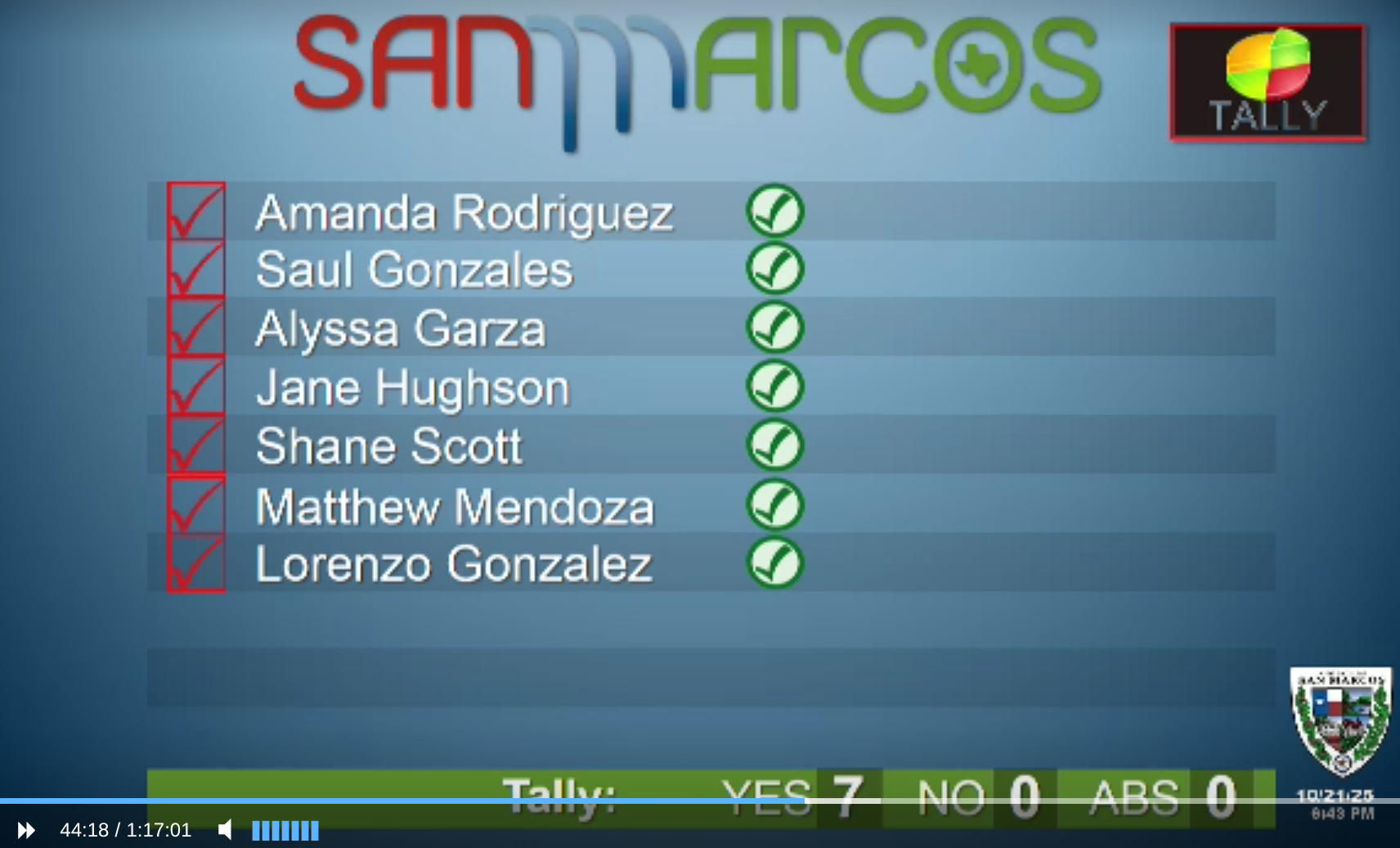
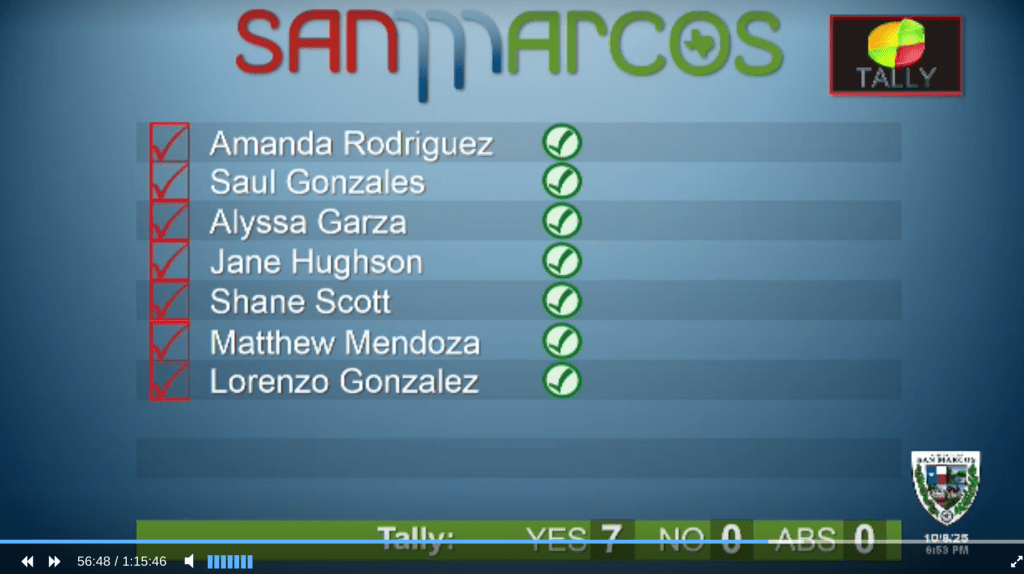
    Finally, the vote: The motion is to deny. So a green check means no on the cameras, red dash means “yay Flock!”

    Are you a NO on the cameras?

    Amazing. Shane and Matthew are the only ones who still want them.

    The council conversation was outstanding to listen to. It was just so sharp. Everyone made really great points.

    Whew! After all that, we’re not quite done yet…

    Item 15: Spin Scooters

    You know them, you love them:

    (We’ve discussed these before, here and here.)

    It turns out they’re breaking up with us? Their contract is up on June 30th, and they don’t want to renew.

    The reasons are:

    • Low ridership
    • Tariffs
    • Finding parts

    Ouch.

    Once they officially break things off, we’ll start looking for a different company who might enjoy our low ridership, tariffs, and lack of parts.

    Item 24: More data centers!

    So, recall there are seven data centers with applications in at ERCOT.

    These are the three that I know about:

    So now we’re on the pink one.

    Yes, it’s gigantic. The red one from earlier is 200 acres, and this one is 785 acres. They’re saying it would also include housing. Unlike the one in red, the developer wants this one to be on San Marcos water.

    It’s past midnight and everyone is exhausted. They decide to just form a council subcommittee to negotiate and discuss the issue further.

    Council subcommittee: Jane, Amanda, Lorenzo.

    I’m good with that.

    Item 32: Proposed Charter Amendments for ballot

    Here’s the legal language for everything that will show up in the November Ballot:

    Q&A: Max Baker:

    • Matthew Mendoza again! Why do you think it’s appropriate to use swear words during the ceasefire conversation?! C, S, and A words?!
    • Would council consider revisiting EDSM policy and how we award benefits when GSMP knows before Council? Would you bring a discussion item that puts Council knowledge before biz privileges?

    Adjourned at 2:35 am.

    Bonus! 3 pm workshops, 6/3/25

    Workshop 1: CIP List

    CIP stands for Capital Improvement Plan. These are all the big city projects – like, more than $100K – where you have to cover them with a bond and they span multiple years.

    There’s basically a fuzzy 10 year plan, a better 5 year plan, a focused 3 year plan, and then an actual budget for the next year.

    There are quick easy projects, long difficult projects, and some that are mid:

    Loosely speaking, these are the categories for the projects:

    Look, here’s some nice photos of projects that have gone great!

    woo-hoo!

    Here’s some of the bigger upcoming projects:

    The hard part is wading through the hundreds of projects, and figuring out what you think about them. That’s what Council has to do.

    So what does Council think about them? Not much! They’re eager to get to Workshop #2.

    Workshop #2: SMPD Vehicles

    How do police vehicles work when officers are off-duty? How much wear-and-tear gets put on them? What about when the officer picks up a second job?

    Basically, we’ve been letting officers take their vehicles home since 1983:

    What’s the benefit of letting police officers take their vehicles home?

    I found the slides confusing, so I’m just going to summarize Chief Standridge’s arguments:

    1. “If it ain’t broke, don’t fix it!” We’ve had a drop in crime since Covid, so don’t meddle with things that work.

    2. 79 of SMPD employees are on-call sometimes, so it makes sense for them to have a vehicle at home. Otherwise they’d have to re-route to the station, check out a car, and go from there, which is a big delay.

    Officers are supposed to keep their radios on, when they’re driving to or from work. He gives a lot of examples of cops that respond to calls nearby, when they happen to be commuting home.

    3. Financial considerations:

    a. If we tried to park all the vehicles in our lot, we’d run out of parking lot space at the station.

    b. If we had cars in use 24 hours a day, we’d have to replace them every 3 years, instead of every 5 years, because they’d wear out more quickly. (This is kind of silly. The force is driving the same number of hours either way. Replace one car after 3 years, or replace two cars every 6 years – you aren’t changing anything.)

    c. This slide:

    I’ll definitely give the Chief this point. Having vehicles spread out over town is good when the station gets flooded in, which happens semi-frequently.

    4. So much time would be wasted checking vehicles in and out. It would take an officer 30 minutes to do a check-out vehicle inspection, and then 30 minutes to do another check-in vehicle inspection at the end! That extra hour would add up to $25,000 in hourly pay per year.

    (This one also seemed silly. Maybe check with the Parks Department or Maintenance Department, and see how they manage to make it work.)

    5. Officers are a little kinder to the vehicle if they know they’re stuck with it for five years, instead of getting rid of it after each shift.

    This one is easy to believe.

    Chief Standridge never answers the main question: Is this cost-neutral? On the whole, if you compare a take-home fleet vs an on-site fleet, how does the total cost compare?

    Here’s what I personally care about: Is this policy similar to the kind of frugality we expect from other departments? Are we keeping SMPD as lean as we keep Parks & Rec, or the library, or maintenance, or anyone else?

    We never really got an answer to that, either.

    ….

    Part 2, same workshop: SMPD Vehicles being used when cops have second jobs.

    This is what Council cares about more. How much wear-and-tear is getting put on the vehicles when officers go on second jobs? Like SMCISD hires them to work a basketball game, or Amazon hires them to direct traffic? What about the wear and tear on the cars that occurs then?

    This is pretty common:

    The problem is the jobs that need the cop to keep his vehicle on and idling. For example, you get hired to direct traffic at Amazon. That ages a vehicle, and means that SMPD has to replace the car sooner.

    So they’re going to charge officers a little rental fee:

    They figured that a rental car company would charge them $163 for 24 hours, so that works out to $6.80 per hour.

    Here’s what we’re going to do:

    Council is fine with this. They’re going to draw up a formal policy and go from there.

    My two cents: Two hours of discussion was way too much for this topic. I lost interest in the finer details of which officer stops for an iced tea on the way to HEB or whatever.

    May 20th City Council Meeting

    The hot issues are all in the workshops this week: the budget and the river parks. Are we fencing the park off?! Kind of yes! (Also a lot of little items. Long meeting this week.)

    Here we go!

    Hours 0:00 – 3:25:  Citizen comment, the annual survey of the homeless population, and the charter review commission

    Hours 3:25 – 4:28: Lots of little items.  Downtown funding, an alcohol permit, three SMPD small items, and who is rocking the best council ‘fit?

    Bonus! Workshop #1:  Our budget situation is grim.  

    Bonus! Bonus! Workshop #2:  What’s up with fencing off the river?!  Find out all the details here.

    See you all next time!