Hello everybody from the dregs of summer! Who wants to talk shop about your friendly city council reps over at city hall?
The meeting was unexpectedly short, and so I added in some extras: the P&Z Comprehensive Plan Workshop, and the City Council workshop. You know how I like to do that.
Hours 0:00-1:21: The whole city council meeting. From the end of the SMART chapter, to La Cinema, to some gas company talk.
The SMART/Axis Logistics Semi-Unsatisfying-Partial-Resolution
We were scheduled to have the big vote for zoning the SMART/Axis Logistics 2000 acre monstrosity to Heavy Industrial. But instead: they withdrew their application. So this chapter of the story lurches to its anticlimactic conclusion. (Backstory: here, here, here, here, here, and here.)
This isn’t exactly a bad thing – a bad thing would be if the Heavy Industrial zoning had passed. But it doesn’t mean that the community can let their guard down, either.
Here’s what I imagine: city councilmembers were squirming under the pressure to deny, and told the developers that a denial was likely. It’s better for the developer to withdraw and regroup, rather than get the denial. If they had gotten denied on the zoning request, they’d have to wait a year to re-apply. This way they can play their cards close to their vest and figure out what they want to do.
Besides: the developer still has the original 880 acres zoned Heavy Industrial and ready to go.
Citizen Comment: Mostly frustrated citizens who want answers to the current state of the SMART terminal. Which development agreement is currently in effect? What’s the future hold?
That’s RR 12 going through up through the middle of the pink part. (Everything to the right of RR 12 was added in May 2022.)
Back in November 2021, Council said that La Cima could have movie studios in their commercial zoning areas. Just like with revising the SMART development agreement, this passed on a single reading, and no one in the community got wind of it.
Then in June 2022, it was time to decide what kind of tax credits the studio should get. (Me, in my tiny voice: why should they get any?) This is when the community first heard about the movie studio. Everyone got mad, because we really should not be building on the aquifer. But it was too late: that ship had sailed the previous November.
This past Tuesday, it got annexed and zoned. The film studio is the dangly part of the pink land in the picture above:
That’s about 147 acres.
The inner part is film studio, and the outer part has to stay natural:
So there you have it. It’s been annexed and zoned. In ten years, we’ll know if this was an extremely bad idea, a moderately bad idea, or if it worked out pretty well, after all.
Passes 7-0.
…
Item 14: Universal Gas Franchise.
Apparently in Texas, any gas company can demand to have access to dig up your streets and put their pipes in so that they can sell gas to the people of your town, and you have to let them. More accurately, you have to give them the same contract as the other gas companies have.
In this case, it’s someone called Universal Gas Ltd. The city gets 5% of their profits, and in exchange, they’re allowed to dig up our roads and put pipeline in and whatever else. It sounds like they’re aiming for Riverbend Ranch, but it wasn’t entirely clear.
I got annoyed with the Universal Gas lawyer, who kept answering questions that were directed at city staff. For example, Saul Gonzalez asked if 5% was typical for the cut that the city gets. The Universal Gas lawyer hopped right in and said, “Oh yes! If anything, it’s too high! Usually they’re 2-5%. You wouldn’t want us to have to pass those costs on to the consumer, would you?” [waggles eyebrows in threatening corporate-speak.]
The city manager, Stephanie Reyes, said that every few years we conduct a rate study, and then implement new rates across the board.
Passes 7-0.
…
Item 15: The city is taking over Southside’s home repair project. This has been in the works for awhile.
…
Item 16: The animal shelter has hired a vet, and they’ll be joining the Animal Services Committee.
…
Items 17-18: Top Secret Executive Session about wastewater plants going up way out on 123. I’m guessing this is also related to Riverbend Ranch.
And that’s the whole meeting! It was weirdly short. But the workshops were very interesting, so go read about those next.
Note: I mostly try not to call out P&Z members by name, because they’re not public officials the way that City Council members are. But there are nine of them, and they’re not all equally frustrating. Last time, I gave William Agnew a hard time, and I give Jim Garber a hard time in this post. What can I say? They’re staking out positions that I disagree with, hard.
Markeymoore does the best job of gently pushing back against the crap that I’m describing below. Griffen Spell sometimes does, as well. #notallp&zcommissioners
Quick Timeline: – 2020-December 2022: Team of community members plus consultants and city staff spend two years putting together a comp plan. A huge amount of community input goes into it. – February 2023: P&Z says, “This plan is an utter disaster. We will form a subcommittee to rewrite it.” – May 2023: Now there are two versions of the Comprehensive Plan. The changes are so extensive that they need a workshop to get through them
More background: There’s an area of condos called Sagewood. It’s roughly here:
on the edge of an older, beautiful neighborhood.
The landlords of Sagewood have let Sagewood get really rundown: buildings seem to slant, broken fences don’t get fixed very quickly, trash cans get knocked over and trash stays strewn about, etc.
Here’s what Google Streetview has to say about the matter:
(It actually looks fine in that photo.) It’s mostly college students living here.
The point is: many of your older San Marcos NIMBYs close their eyes at night, and dream of Sagewood taking over their own neighborhood, and presumably wake up screaming.
In the 2000s, tons of new giant apartment complexes were approved: The Retreat, The Cottages, Redwood/The Woods, and probably some I’m forgetting. This angered a lot of citizens, including me! I think it was criminal to build The Woods on the river. (Here’s some backstory if you’re curious.) Many NIMBY types feared that Sagewood was taking over the city.
This is what you must understand, if you want to understand fights over the comp plan: many P&Z members are stuck in 2010, fighting against The Cottages, and suffering from Sagewood night terrors when they try to close their eyes and rest.
What else was 2010 like? I did my best to find some data:
Median rent in 2009: $741/month. (Median is more useful than average – this means that half the units rented for less than $741, and half for more than $741.)
So that’s the world that most of P&Z believes we’re living in: 44K people in San Marcos, many houses cost less than $140K, and median rent is around $700/month.
This is a wildly different world! Rent has almost doubled, home prices have more than doubled, and there are fewer houses on the market.
The comp plan has got to deal with the actual San Marcos in 2023:
we need affordable housing,
we need public transit and safe biking options, and
we have a moral obligation to give a shit that the world is quickly overheating.
The way you do this is by controlling sprawl and increasing density, in small-scale ways. Build 3- and 4-plexes throughout single family neighborhoods. Increase public transit options. Put commerce near where people live, so you can drive less.
This is why the Comp Plan discussions are so frustrating. There are three main coalitions:
Old San Marcos, fighting the battles of 2010.
Developers, who would still love to build those giant apartment complexes that piss everyone off
Progressives, trying to wrangle developers into building small scale, dense housing, and simultaneously trying to convince Old San Marcos not to sabotage it.
I’m really not exaggerating. The chair, Jim Garber, literally states that this is his position at roughly 0:43:00:
The apartment complexes approved in the 2000s drove him to local politics: he got involved in the last Comp plan, in order to save San Marcos neighborhoods from giant student apartment complexes.
This last Comp plan was approved in 2012. In order to get it passed, the Planning Department promised to conduct Neighborhood Character Studies. Every neighborhood was going to get to come together and declare what its personality is. Your personality is things like “no duplexes” and “no carports”. In other words, it’s mostly class-based. The goal is to enshrine these wealth signifiers for all eternity.
However, the neighborhood character studies were never carried out. Jim Garber has been steamed up about this ever since; the planning department cannot be trusted; etc etc.
He just doesn’t understand why “protection of existing neighborhoods” is not in this plan.
He wants to divide all neighborhoods into “existing” and “new”. Once a brand new patch of land has been platted, it switches from “new” to “existing”, and then it’s personality is enshrined, never to be touched again.
What’s the difference? Existing neighborhoods should not have duplexes, triplexes, townhomes, and condominiums. In other words, no small-scale, dense, affordable housing.
Jim Garber is so mad about The Retreat, The Cottages, and other gigantic apartment complexes that he is fighting tooth-and-nail against small-scale affordable housing that would blend in to a neighborhood. He is stuck fighting the battles of 2012, and can’t empathize with 30 year olds in 2023 who can’t afford to live in a little residential neighborhood.
Amanda Hernandez is the planning department director. She responds thoroughly to his points:
First off, she has only been the director for three months. Most of his complaints span previous admins.
She wrote most of the comp plan in 2012, and she now thinks it’s a terrible plan. They started the neighborhood character studies and spent a year or two on them, and then she was told to abandon them and to switch and work on the new Code Development.
But! Now! They are now finally doing character studies. Blanco Gardens and Dunbar are underway. Victory Gardens and north of campus are coming up next.
You know the Cottages, the Retreat, Sagewood, and The Woods? Big complexes in residential areas? Those have not been approved since 2012. The old Comp Plan worked. Those were all passed under the even-older comp plan, two comp plans ago.
Bottom line: we have effective mechanisms to prevent giant apartment complexes from being built in residential neighborhoods. This is no longer happening. The fight against giant apartment complexes is going to sabotage efforts to bring small-scale affordable housing into neighborhoods.
Finally, I’m going to be blunt: the utter narcissism of the Historic District is exhausting. To hear P&Z speak, there is no neighborhood that could merit planning, besides this one. All Historic District, all the time. It’s extremely tiresome and means that nothing else ever gets considered.
At the public comments, speakers try to explain that no one wants to change the Historic District. The Historic District is actually the gold standard of a neighborhood! It’s got small scale tri-plexes and four-plexes sprinkled around, it’s got neighborhood commercial, and nearly every house has an ADU – a mini-house in the back. It is the dream of small scale, dense living!
One of the speakers, Rosie Ray, made some handouts for P&Z, to try to convey this point. She was kind enough to share them with me:
Cottonwood Creek does not have diversity of housing. The residents keep telling the city that they want some stores nearby. The Historic District is chock full of different kinds of functionality. It works great.
When this is brought up, the P&Z folks say, “Yes, but the Historic District happened naturally.”
Basically: Historic Districts usually are older than land use codes. Single-family zoning originated to make sure white, wealthy neighborhoods stayed that way. So along with red-lining, you wanted to make sure there was nothing affordable. Hence you specify that lots have to be big, and houses have to be big and spread out. This is the problematic origin of single-family zoning.
So sure, the Historic district happened naturally, because it’s older than single-family zoning. And now we will prevent that from happening anywhere else.
Bottom line:
P&Z wants to separate all existing neighborhoods and freeze them in carbon, like Hans Solo. Future neighborhoods, in a galaxy far far away, can be built like the Historic District.
Developers will not build future neighborhoods like the Historic District, because the way you maximize profit is to build yet another sprawling single family neighborhood or a giant apartment complex. (Good link on how to get builders to fill in these missing middle housing types. The problem really is single-family zoning.)
In ten years, we’ll have another comp plan, and we’ll beg and plead for this all over again.
I’m struggling to avoid making “OK Boomer” jokes about P&Z, but gerontocracy is a real thing in the US, and in San Marcos. The members of P&Z do not seem attuned to the idea that the financial hurdles of 30 year olds in 2023 are wildly different than the financial hurdles of 30 year olds in 1990.
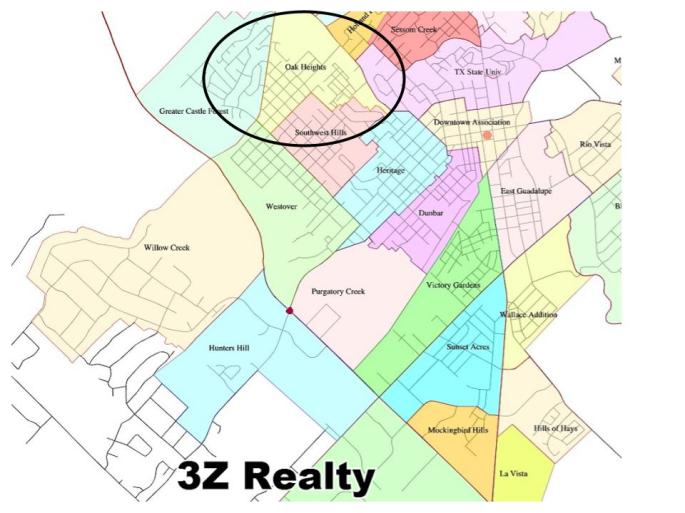
(I didn’t have a good place to put it, but Rosie also passed out this map:
City Council Workshops were fascinating. There were two topics:
Homeless Action Plan
Housing Action Plan
First, the Homeless Action Plan.
San Marcos hired a guy named Robert Marbut for five months, to write a report about what we should do to help homeless people in San Marcos. He gave the presentation on Tuesday.
First off, Max Baker is very wary of him. And rightly so: the Wikipedia entry on Marbut is pretty awful:
According to The Huffington Post, Marbut’s advice to most communities was to limit food handouts and build a large shelter that stays open all day and doesn’t turn anyone away. He called his approach “The Velvet Hammer”; since then he has said he prefers the phrase “The Velvet Gavel”.[11]
Marbut’s methods were criticized by housing activists who preferred a policy widely adopted since the 1990s called “Housing First,” which finds apartments and houses instead of shelters for homeless people.[11][12][13] Some activists called Marbut’s approach outdated, punitive and patronizing to homeless people, and more effective at hiding them from downtowns than at solving homelessness.[13][2][10]
In response, Marbut said, “I believe in Housing Fourth” — awarding permanent housing after residents have shown their personal lives are in order.[11] “I often say, ‘Having a home is not the problem for the homeless,'” Marbut told the magazine Next City. “It’s maintaining a financial stability that allows you to maintain your homestead.”[14]
In Pinellas County, Florida, Marbut consulted on a 470-bed shelter called Safe Harbor, which opened in 2011 in a former jail building next to the current jail outside of St. Petersburg. It was run by the sheriff’s department and included a “penalty box” in a fenced-in area of the parking lot where residents who broke rules would sleep. Most residents stayed for less than a month, according to sheriff’s department data, and few were known to have found permanent housing afterward. Between 2011 and 2013, 7 percent of those leaving the shelter found permanent housing, 3 percent went to another shelter or a friend or relative, and 67 percent headed for an “unknown” destination.[11][12]
His presentation on San Marcos was mixed. Parts of it were really good! For example, he stated several times that criminalizing homelessness does not work. Arresting homeless people does not work. He was clear and emphatic on this point.
But parts of it were total garbage. For example, he believes that “handouts promote homelessness”. He can fuck right off with that bullshit. You know who gets a lot of handouts? Wealthy people! They get the mortgage interest deduction for big houses and second homes, the estate tax, the social security earnings limit, and many, many more. They get legacy admit assistance for college. Robert Marbut himself gets handouts, and yet he is not homeless! It’s a Christmas miracle.
He criticized “housing first” policies, but his evidence against them was dishonest. He implied that “Housing First” policies have been tried in San Francisco, LA, Phoenix, Portland, Seattle, and Austin, and consequently, homelessness has skyrocketed in all of them. It’s a bad-faith argument, and he should know better. Their homeless populations haven’t skyrocketed because of a housing first policy; they’ve skyrocketed due to the wildly rising rental costs and the shrinking supply of affordable housing. The fact that he gave an intellectually dishonest characterization of the other side makes me suspicious of a lot of what he says.
His argument goes: If you don’t treat the addiction, domestic violence, mental illness, and so on, then the homeless will be right back on the street in six months. (I don’t think that’s how Housing First policies work? I don’t really know.)
But his counter-proposal isn’t entirely bad, either. He says, “Treat your way out.” Give people shelter while connecting them with help for addiction, domestic violence, mental illness, and so on. I’m not disputing the need for services.
I’m just very worried about the part where you withhold housing in the meantime. How long does it take people to “earn” a key to an apartment or some sort of permanent housing? And what do you do with someone who will never overcome their addiction or mental illness? Is your plan that they live their life in a shelter forever?
Anyway, here’s his five major points:
“Stop the Growth”
Marbut wants us to only help locals. “The worst thing you can do is convert out-of-towners to in-towners!” he quips. He claims we get lots of homeless traffic from the I-35 corridor, and we can’t give handouts to everyone.
This is fine if you’re talking about homeless people from Austin. It is absolutely true that San Marcos cannot afford to take care of an Austin-sized population.
This is cruel and inhumane if you’re talking about refugees from Central America.
What exactly does this mean? How would it be implemented?
He is clear about a few details that sound reasonable:
Only ship someone to their hometown in conjunction with a coordinated care team. (But will we actually do this?)
Do not send domestic violence victims home under any circumstances.
I can believe that – sometimes – connecting people with their family can be the path to stability. But it just depends on how humanely it’s implemented.
“Improve the Overall System Through Increased Effectiveness and Efficiencies”
It sounds like he wants a team of people to go break up homeless camps, and connect them to resources.
Again, he stresses that arresting homeless people (for anything short of violent felonies) does not work. And it sounds like we already have a HOTeam that goes out and does this sort of thing, and it includes officers, and they supposedly don’t arrest people for being homeless.
It’s hard to sell me on the idea that cops should go and break up homeless camps. You need to do some work to convince me that they won’t just destroy homeless people’s possessions and make them scatter and start all over.
Expand Capacity
There’s a court case, Martin vs. Boise, where six homeless people were kicked out when a shelter closed, and then promptly arrested. The courts ruled against the city of Boise: you can’t arrest people for being homeless unless there are enough beds for them.
Currently we are not Boise-compliant. We need more shelter space. We should partner with Southside and the Salvation Army. (Updated to clarify: Those are Marbut’s recommendations. Salvation Army has a problematic past.)
Once we’re Boise-compliant, he wants us to have “zero-tolerance of encampments.” What is he picturing, besides arrests? He already said not to arrest non-violent homeless people. How is he imagining forcing people into compliance? (Again, my mind goes directly to things like making homeless people give up their pets and come with you, or else destroying their possessions and making them scatter and start over.)
We should also be partnering with some of the SMCISD and Hays ISD employees who focus on homeless families. We also need a LOT more affordable housing. Both of those sound good.
In the future, build a right-sized Homelessness Assistance Center.
So that’s the spiel. I’m very skeptical of parts of it, but other parts of it are okay, if they’re implemented well.
Mostly City Council has very little to say, aside from some bland platitudes.
Alyssa Garza asks a key question: where did he get his data on San Marcos homelessness? he says he collected it himself, by going out on multiple occasions and talking to people. He’s implicitly claiming that he collected data using sound statistical sampling methods, and didn’t just wing it.
This article is extremely critical of his data claims. It sounds like he does, in fact, just make shit up. (In fact, Marbut claimed on Tuesday that he reduced homelessness in San Antonio by 80% in the 2010s. The linked article points out that homelessness actually grew in San Antonio during that time.)
From here, staff will bring forth a possible plan for City Council to adopt, to help homeless people in a coordinated, effective way.
Now we’re waking up the slumbering giant, and bringing it around again! The numbers are now out of date. City staff will update the numbers, and get the ball rolling. (Incidentally, these are the numbers I’m always crabbing about not having, whenever we’re considering new zoning! I’m very pleased right now.)
It did go to P&Z last time, and P&Z passed a number of amendments. Most of these are focused on wealthy, secure people. Those redlines are still in effect. We shall see.
This week’s meeting is mostly the kind of small scale local dithering that I love best. Parking fee structures and new art installations, all in one week? Count me in!
Hours 0:00-1:39: A little on SMART/Axis Terminal, a little on CDBG money, and a lot on parking.
Hours 1:39-3:02: A little ARP, a little art, and a lot more on parking.
The summer months are quiet: there’s only one meeting in June and one meeting in July. July will have some hot-button items, though – namely, the SMART/Axis Terminal.
The July meeting is on the 3rd, which is a Monday. The 4th of July is a Tuesday. It’s a very weird day to have a big meeting with consequential decisions, but there you have it.
Citizen Comment: We’re going to focus on the SMART/Axis Terminal here. (It’s not otherwise on the agenda today.) There’s a group, Citizens Against SMART/Axis, which is holding a public meeting at the library on Sunday (6/11) at 3 pm. Here’s their flyer, off Facebook:
Ie, if you’re reading this on Sunday morning and you’re free this afternoon, why not head on over? They seem like nice people.
The big day will be July 3rd, when City Council votes on the Heavy Industrial zoning. If it passes, then we’ve given a massive blank check to a jerk who will then decide which industries come to San Marcos. Right now, there’s a lot of money in batteries and tech fabrication plants and things involving toxic rare metals and lots of water, and Texas has very lax environmental restrictions. That’s the kind of scenario that I’m particularly worried about. (I also think the sheer scale of it is bonkers.)
And if the zoning doesn’t pass? My guess is that there’s a contingency clause in the development agreement – if the zoning doesn’t pass, it invalidates the contract. Then the company could either develop under county regulations, or walk away for a year, or come up with a different proposal.
Have you all seen the yard signs around town?
I think they’re pretty effective. Partly because they put council members on notice that the community is willing to launch a public campaign: vote down Heavy Industrial, or the next public campaign may be against you.
Bottom line: Council shat the bed. It’s really astonishing how they passed this development agreement under so much quiet and stealth. It’s 2000 acres, for god’s sake!
…
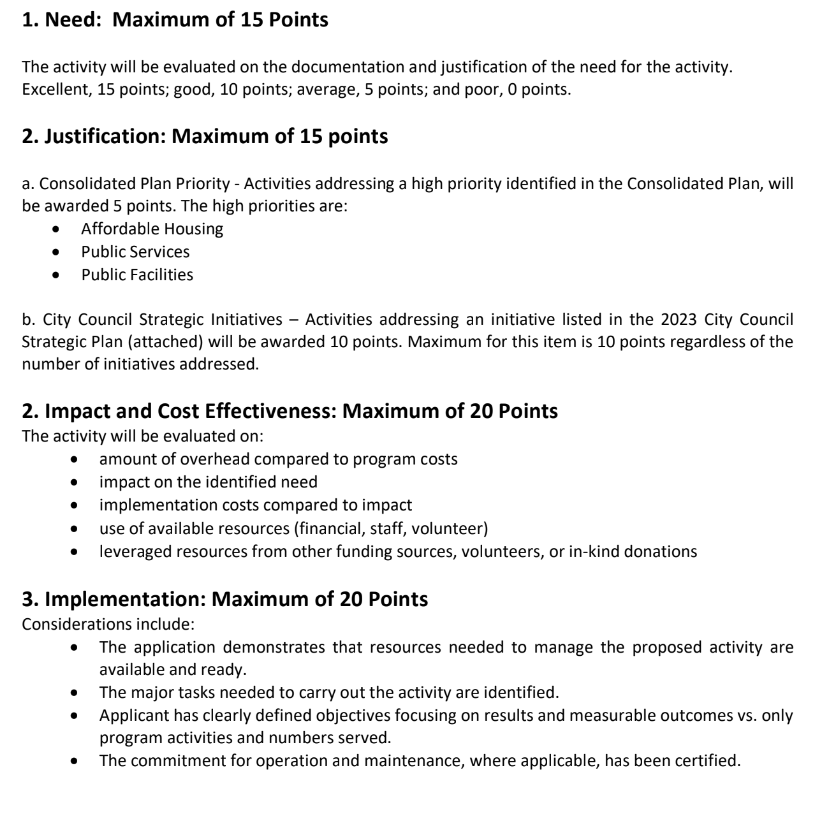
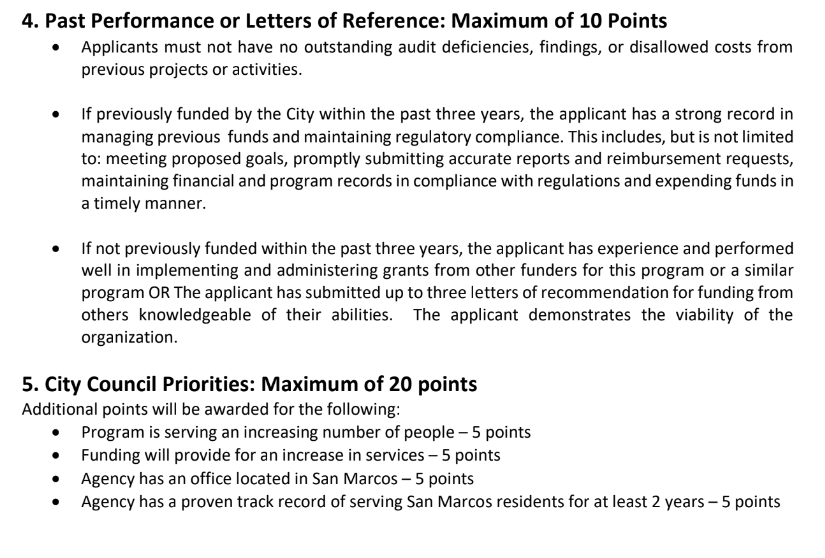
Item 6: Community Development Block Grant money. (CDBG) The city gets federal money to spend on nonprofits. This year, we’ve got about $700K to distribute.
Here’s the criteria that staff uses to assess projects:
And here are staff recommendations:
Saul Gonzales asked about Habitat getting $0 for Housing Counseling. The answer: Habitat is really good at lots of things, but counseling ain’t one of them. Plus they’ve still got leftover money from last year. In general, we’re still partnering with Habitat, but just not for counseling.
As for the Housing Rehab program getting $0: somehow this is good for the city, for reasons I didn’t quite follow.
Alyssa Garza mentions that she hears a lack of trust in the nonprofit community about how these funds get allocated, and that increased transparency would help. I don’t have the expertise to read between the lines! But transparency generally sounds good to me.
…
Item 7: P&Z is going to gain some new powers: the powers of AIRPORTATION. Specifically, some height hazard zone regulations and compatible land use zonings. A lot of this is regulated by the FAA, but P&Z will get to weigh in on the remaining bits.
Whenever the airport comes up, everyone speaks cryptically about scandals that I’m uninformed on. We saw a snippet of it here. Even LMC weighed in on some convoluted past event from ten years ago. Frankly, I’m pretty sure I’m not capable of fully understanding whatever the hell went down.
….
Item 8: The city has a lot of 2 hour parking downtown. Now some of those sites will be relaxed, to 4 hour parking. Here’s where it will go:
Take your time! Shop around! You’ve got four hours now.
Council members asked some worried, nonsensical questions, as though we were tightening up restrictions instead of loosening them. Everything will be fine.
…
Item 9: We’re pretty terrible at paying parking tickets:
So the city is going to start putting boots on cars, if you have 3 or more unpaid tickets.
The point is to force the worst offenders to get in touch with the city and come up with a payment plan (or maybe schedule some volunteer hours instead – more on this later.) The plan is not to turn the screws on someone who is teetering on the edge of economic catastrophe. Of course, it always just depends if the program is implemented in good faith or not.
The top left and top right roads are Craddock and Old 12, where The Retreat is. This is the Crockett elementary neighborhood. The speed limit used to be 30 mph.
Now it will have a new, lower speed limit of 25 mph in on these streets:
Good for them! Drive like a grandma, everyone. Your car is lethal.
….
This is Uhland Road:
It runs from Post Road to I35, and then jumps north, and runs east to Harris Hill road.
Here we’re only looking at the part west of 35. These lucky folks are getting some speed cushions here:
Good job! Drive safe.
Jane Hughson wraps up by saying, “All right! We do listen to our residents! …um …when we’re talking about speed cushions. And changing however many miles per hour you can go in a neighborhood.”
That is hilariously self-aware of Jane Hughson. And it’s true: sometimes we listen to our residents. Other times, we don’t.
…
Item 13: $250K more to GSMP to fund a small business program. Seems fine, as far as capitalism goes. The only reason I noticed it was because Matthew Mendoza made a special point of praising this accomplishment.
Item 14: “ARP” stands for “American Rescue Plan”, ie Covid money. We’re down to our last $3 million. We started off with $18 million. This last bit has to be spent by the end of 2024, or we have to give the remainder back.
Here’s what staff is proposing, based on instructions from council:
The controversial part is spending $1.3 million on Uhland Road quiet district. Here’s what I think that means: Every time the trains cross the road, they blast their horns. If you want that to stop, you have to construct automatic traffic arms, and turn-around barriers, and some other safety things. We’ve done this in other neighborhoods.
Staff is trying to get the quiet zone funded through other grant money, but their most recent grant application was denied, so they stuck it here. It’s not really connected with Covid, though.
Alyssa Garza makes the case that ARP funds should be used to address direct needs. In other words, we shouldn’t be spending $2 million on the two parks and a quiet district. Direct needs are things like financial emergencies, mental health care, and violence prevention programs. Alyssa focuses in on that last one: other cities are using ARP money to pilot communiy violence prevention programs. Why not us?
She’s making a clever case: all of you who are obsessed with the police and crime rates? Let’s address violence in a preventative way. Wouldn’t that be better than just being reactive?
Objectively, Alyssa is right. (Let’s pretend I’m objective.) Support for police departments is generally shrouded in language about public safety and rising rates of violent crime. But police departments respond to violence. They’re reactive. That’s different from proactively working to reduce the causes of violent crime. If you claim you care about public safety, then you should support community violence prevention programs.
So Alyssa asks point blank: Can we re-arrange this money to pilot a violence prevention program?
And…. <crickets> … the silence dragged out, and no one joined in.
The problem is that the rest of council has a semi-acceptable excuse: there really is a fixed deadline to spend this money. Staff’s recommendations are all shovel-ready programs. So the rest of council doesn’t really have to entertain what Alyssa is saying, because momentum is on their side.
Should we be furious at them? It depends on what happens next.
Possibility 1:
Alyssa brings up community violence prevention programs at the next CJR subcommittee meeting.
Mayor Hughson and Shane Scott respond enthusiastically!
They work up a pilot program for Council.
Council enthusiastically finds some funding and moves forward with it!
In this case, everyone is forgiven for squirming uncomfortably and avoiding Alyssa’s proposal to use ARP funding right now.
Possibility 2:
Alyssa brings up community violence prevention programs at the next CJR subcommittee meeting.
It gets bogged down in the slow wheels of San Marcos city government.
Everyone says nice things, but also sandbags the process.
It stays in the background as a nice idea, and never quite makes it into implementation for the next several years.
In this case, City Council is making it clear: “Public safety” is a code word for “We love the police!” and they are going to prioritize SMPD over actual public safety whenever given the choice. Vote the jerks out of office!
…
Item 18: Here’s Trace development, way down south, past the outlet malls:
That’s where Rodriguez Elementary is.
Some sort of development wants to go in here:
The Trace developers are definitely worried about something industrial right going in right behind people’s backyards. Council decides to form a subcommittee: Jane Hughson, Matthew Mendoza, and Jude Prather are going to take care of business for ya.
…
Item 19: File this one under “victories are anticlimactic”: eight months after Max Baker loses his city council seat, they officially change the rules to allow subject matter experts to attend subcommittee meetings. (Discussed here previously.)
This was a flashpoint with Max – he’d bring up new issues, and everyone would cock their heads like a confused golden retriever, and then ignore what he was saying. Max wanted to bring in experts to explain complex issues, so that others would take him seriously, but he couldn’t even get experts in, because no one took him seriously. (Partly, this was because Max generally had 50 issues to solve simultaneously, and everyone kind of just got woozy at the overload. But partly, they just didn’t want to consider new ideas, like the environmental impact of the SMART/Axis Terminal.)
But this can also be abused, as noted by Markeymoore and Forrest Fulkerson in the comments here. If you have councilmembers who are shmoozy with a developer, and they invite the developer to the subcommittee meeting, you may essentially have a developer writing their own agreement with the city.
There’s also a little path to a bridge over the river, which leads to some trails. And there are some art installations, right where you’d head from the parking lot towards the river.
More art is coming!
I am not sure where it will go, but I’m guessing with the other art installations. (Not at the falls, despite that picture.)
It’s big:
This is the winner of a nationwide call for artist submissions, and then an open house forum, and finally the arts commission picked this one.
I didn’t find the price tag anywhere, but I generally think that arts enrich a community, and it’s worth spending money to compensate artists fairly.
Item 20: Finally! I promised you more parking news, and you stayed for it. Here’s your big pay-off:
Things in the works:
Parking Benefit Districts: this is not paid parking, but it’s a necessary pre-condition.
Parking Mobility Funds: if we had paid parking, we’d need a bucket to put the revenue in.
COLAs for fees
Currently, our parking tickets cost $20. They’ve been at that rate since 1974. That’s almost 50 years! Congratulations, $20 parking tickets, you’ve had a great run.
(Just for funsies, I went to an inflation calculator: a $20 ticket in 1974 is equivalent to a $126 ticket in 2023. What a bargain we’re getting!)
What’s proposed is having fees drift upward automatically with inflation. In other words, every three years or so, you’d just set a new, higher fee rate to match inflation. (COLA stands for Cost of Living Adjustments.)
Jane Hughson cracked me up again: “This is a good idea. We should just get it automated, so we don’t have to update it every… fifty years.”
Here’s why I like this so much: First, Jane says that we do this already with other fees that the city charges. Second, we do this with certain city employees. In other words, we are already well-versed in COLAs!
Which brings me to my hobbyhorse: Automatic COLAs for minimum wage. San Marcos does have a minimum wage of $15/hour for any business receiving tax breaks from the city. LET’S PEG IT TO INFLATION! If we can do this for parking tickets and city employees, surely we understand why this is so important for our neighbors earning minimum wage.
But wait! There’s more!
An amnesty/incentive program. Suppose you rack up a huge amount in fines. Maybe you even got booted. This is the program that will make it easier for you to settle up with the city – like signing up for volunteer hours instead of owing money, for example.
Everyone loves this idea. I love this idea, too.
5. Dynamic pricing. In other words, a little sign that says “Violators will be fined $20-$60” or whatever. So if you park illegally in off-peak hours, it’s not so bad. If you park illegally in the middle of Sights & Sounds, you get charged more.
(They claimed this was about deterrence, but surely it’s about making more money. It’s hard to see how dynamic pricing would make a dent in the decision-making of the shmuck clogging up Sights & Sounds, in the middle of four different choir performances.)
All of these will be fine-tuned before Council officially votes on them. But it’s clear: our widdle San Marcos is gwowing up.
This was a busy week! We’re going to talk about comp plans, Meet & Confer, and we’re kicking it all off with a measured and reasoned invocation from the lovely Satanic Temple. Who’s in?
Here we go:
May 9th P&Z meeting: In which I just had to yell and stamp my feet about the stupid new comp plan, VisionSMTX+, for a minute.
Hours 0:00-2:40: In which Lanzifer Longinus graced us with a delightfully Satanic prayer, and I complain about 1100 acres of sprawl
Hours 2:40-3:17: The demoralizing conclusion of Meet-and-Confer. Spoiler: we never actually asked for the Hartman Reforms.
Hours 3:17-4:14: The eviction day now has an end date. There’s a slight reckoning slightly with how the SMART Terminal procedure went so badly. And an end to the General Contractor licensing test to pull a permit in San Marcos.
That’s a wrap for this week! Enjoy the beginning of low traffic season!
We’re going to start with a P&Z blog post, because I think the topic is important. This is nearly two weeks ago, when P&Z discussed the Comprehensive Plan, aka VisionSMTX.
Background
The Comprehensive Plan is the most high level vision of the city, which says things like, “We want more business here, we want to protect the river, we want more housing here,” etc. It’s big, general, and vague. Then when you go to draw up specific master plans – Land Development Code, Transportation Master plan, Housing plan, Environment, etc – you have to be consistent with the Comprehensive Plan. So it drives a lot of choices that get made down the line.
It’s going badly.
Back in 2020, City Council selected a group of 31 citizens, including several city council members and P&Z commissioners. This group met with consultants for two years. City staff also held outreach events every month or two, and sent out online surveys, and generally worked hard to solicit a wide range of community input. All this was drawn up into the VisionSMTX draft.
This draft went to P&Z in February, and the chair, Jim Garber said, “Oh dear. This is such a train wreck that there’s too much to discuss in one meeting. Let’s form a subcommittee.”
So four P&Z members and Mayor Hughson met a dozen times. They had so many revisions that staff just said, “We need to call it an alternate plan, VisionSMTX+.” This subcommittee ends up being so influential that I need to refer to them as “The P&Z Subcommittee”.
So now there are two drafts:
VisionSMTX, which took two years, $350K+ worth of consultants, and thousands of community hours, and
VisionSMTX+, which took five people about a month. (Ie, they added a little plus sign to this one.)
They are substantially different from each other. They’re so different that the staff created a comparison table to help us sort through the differences, and the comparison table is 74 pages long.
….
Listen: I have been struggling to write this up for the past two weeks. It’s really difficult to explain, because the various sides are not all having the same conversation. It’s a total mess.
…
The subcommittee read VisionSMTX and thought, “This document is going to let developers destroy our beautiful neighbohoods. People who live in the historic neighborhood, Dunbar, Barrio Pescado, San Antonio street, and so on, do NOT want their neighborhoods changed!”
What do they fear? Their fears are very slippery.
Giant apartment complexes, like the Cottages or the Woods. Developers are assholes!
Increased density in the form of smaller housing – ADUs, which are the tiny house-behind-a-house. Duplexes, triplexes, 4-plexes
Anything that threatens the “genteel” character of their neighborhoods.
So their fears range from the reasonable (large scale apartment complexes) to the jerky (fear of low income people being able to live near wealthy people).
…
Here are my personal beliefs on increasing the density of housing:
Cars and suburban sprawl are super convenient! I can drive to Target, get exactly what I want, and drive home in 30 minutes. I do not have to plan, or consult a bus schedule, or get sweaty riding my bike.
Literally, cars should never go away. There are plenty of people with mobility issues and resource constraints, and we have to take care of them, as a community. I will fight for your right to drive to work.
That said, we are currently gorging ourselves on cars and sprawl. This is a disaster.
On the global scale, the oceans are rising and extreme weather events are escalating. Sprawl and car-centric communities are not sustainable. Younger people are looking at 50 years of climate change. I worry about future generations.
On the local level, San Marcos literally can’t pay for enough cops and firefighters to cover the distant, sprawling developments. Plus, we’re prone to flooding, and we have a river which is one of the most special things on the planet. We’ve got to take this seriously.
And on the individual level it costs $7K-10Kish per year, to have a car-centric life, but centrally located housing is very expensive. That’s a losing combo for younger or poorer people.
I believe that wealth segregation is immoral. Giant apartment complexes are a way of keeping poor people all housed together. In my opinion, duplexes, triplexes, and 4-plexes should be scattered throughout every housing development. They can even be built to look like beautiful houses!
We are predicted to need 50K homes for people moving to San Marcos over the next 20ish years. It’s irresponsible to put all the housing in relentless swaths of single family housing. So what’s the alternative?
The way you take it seriously is that you create a world where it’s more convenient for people to live close to where they need to go. If it’s sufficiently easy for you to walk to work, you might choose to do so 2-3x per week. Smart people have worked hard to figure out charming, small-scale ways to create this. In fact, it should feel like our historic district! It should feel like San Antonio street.
Finally: I personally adore old homes and the historic district. I am not going to advocate for any plan that puts a large scale apartment complex in a charming historic neighborhood. But any plan that pretends “only wealthy people” is an essential ingredient to a charming neighborhood can fuck right off.
…
This meeting is too big and sprawling, and would be its own multi-part post for me to do it justice. I’ve struggled for two weeks now to write it up. So I’m going to massively shortchange it.
There is one key moment, at 3:30, that I want to zoom in on. William Agnew reads this sentence from the comp plan out loud:
Many of San Marcos’ original neighborhoods, especially those closest to Downtown, benefit from access to shops, restaurants, cultural amenities, employment opportunities, civic offerings, and recreation. The streets are well connected and for the most part, daily needs can be obtained on foot, by bike, or by car. New development can benefit from modeling and drawing inspiration from the treasured Historic character of these neighborhoods.
Then he says:
I live in one of San Marcos’s original neighborhoods. This paragraph’s just not true! I don’t have better access to all these amenities than most other neighborhoods in San Marcos! It just isn’t true. And on top of it, I don’t know how new development can somehow duplicate what it is that you all think I have that I don’t have.
The only place I can really walk from my house that would be considered goods and services is the Little HEB. It’s about 3 blocks from where I live. That’s great if I come back with one sack, but that’s only if I go to the grocery store each and every day. But you can’t walk back with your big shopping trip of the week and 8 or 10 sacks walking down Hutchison. It’s just not true! Other than that, there’s nothing I’m particularly close to anything. I love my neighborhood. It doesn’t bother me to drive to big HEB , Lowe’s, PetSmart, Target. So I don’t think this sentence is true. That’s why I’d like to get it out of there.
This is…delusional. Like, this is astonishingly delusional.
If you can walk 3 blocks to HEB, you are immediately nearby:
multiple churches,
laundromats,
bars and restaurants,
hair salons,
Shipley’s, Mink’s, Zelicks, North Street, Tantra (if it ever reopens)
You’re only another block from the literal town square.
The entire university is only a few more blocks away!
And right past that is the river itself!
Like, Bill Agnew literally thinks that he lives here:
when he is three blocks from this:
Staff continuously tries to explain that people who live in places like Cottonwood Creek complain that they have to drive long distances to get to stores or any other amenities. The “Complete streets” discussion is about places like Cottonwood creek.
But the P&Z subcommittee is on an entirely different planet. The existential threat to Belvin Street is the only conversation to be had. It sucks up all the oxygen in the room, and it will trample anything that the people in Cottonwood Creek might like to have.
…
What are the problems with VisionSMTX+? What was changed from VisionSMTX, without the plus sign?
1. ADUs. “Accessory Dwelling Units” are the little house-behind-a-house. You may have noticed that the Historical District is absolutely chock full of them. This is the gentlest way to increase density as people move to San Marcos.
The original draft, VisionSMTX, is pretty positive towards ADUs. The subcommittee version, VisionSMTX+, removes a lot of this encouragement.
2. “15 minute streets” This is a measure that professional urban planners use. It means this: without driving, what kinds of things can you reach from your home, by walking, biking, or using public transportation, within 15 minutes? It’s a way of quantifying how Bill Agnew can easily walk downtown, while people in Cottonwood Creek have to drive everywhere.
The subcommittee added “driving” into the definition. In other words, when the people in Cottonwood Creek have to drive 15 minutes to Target, it should get measured exactly the same as Bill Agnew being able to walk downtown. What breathtaking bullshit.
3. Comp plans vs Area Plans. So, the Comp Plan is what we’re discussing. It’s the biggest umbrella. Area plans are where neighborhoods get to say, “We are wealthy and we don’t actually like living next to poor people, so can we just not?”
The subcommittee wants Area Plans to take priority over the comp plan. The original comp plan calls for a balance.
4. Split “Neighborhood – Low” into “Neighborhood Low (existing)” and “Neighborhood Low (new)”. This would allow them to write different rules for Belvin than for new neighborhoods.
What about Cottonwood Creek, which would like to be more like Belvin? Fuck those guys! Existing neighborhoods aren’t allowed to change because the subcommittee has Historic District tunnel vision.
There are a ton of other concerns. I emailed back and forth with some of the public commenters – Rosalie Ray and Gabrielle Moore – and have their entire list of critiques. This is just too dense and meaty for me to do it justice.
…
One last point: Markeymoore was pretty amazing in the P&Z meeting, gently pushing back against problematic ideas, without ever being confrontational.
For example: Bill Agnew is taking issue with the sentence “Many areas in San Marcos today are single use.”
Markeymoore gently asks, “Why is that a negative sentence?”
Bill Agnew answers, “Because I think that the people who wrote that consider it negative. If you understand the plan and the new urbanism concepts behind it, that’s negative. To be single use is negative. That’s my objection to it. Yes, some of these neighborhoods are single use, but they’re good neighborhoods, and they don’t need to be presented as an example of something negative.”
In other words, Agnew does not have a problem with the sentence as written. The problem is the bogeyman in his mind that he is imputing to it. Markeymoore was able to ask from a place of curiosity, and he disarmed Agnew, who gave an honest answer.
To Agnew’s credit, he is very consistent and honest. It’s easy to pick on him because he says the quiet parts out loud.
…
So…what happens next?
They decided to have some workshops over the summer, to deal with some of these things. The comp plan is on pause until August.
Let me tell you, I do not have a great feeling about how this is going.
I’ve never blogged the opening prayer before! I usually just skip past it.
If you’re going to have prayers in your public space, you’d better allow any church, or else you’re definitely opening yourself up for a lawsuit. Which is how we found ourselves in the delightful position of having Mayor Hughson introducing Lanzifer Longinus, co-congregation head of the Satanic Temple, and I hope he doesn’t mind me borrowing this photo from his facebook post:
Here’s a transcription of what he said:
Let us stand now, unbowed, and unfettered by arcane doctrines, borne of fearful mind and darkened times. Let us embrace the Luciferian impulse to eat of the tree of knowledge, and dissipate our blissful and conforming delusions of old. Let us demand that individuals be judged for their concrete actions, not their fealty to arbitrary social norms and illusory categorizations. Let us reason our solutions with agnosticisms in all things, holding fast to only that which is demonstrably true. Let us stand firm against any and all arbitrary authority that threatens the personal sovereignty of one or all. That which will not bend must break, and that which can be destroyed by truth should never be spared its demise. It is done. Hail Satan.
The sharp-eyed reader will note that everything he said is entirely sensible and reasonable. (The Satanic Temple generally fights for a lot of great political causes. If you haven’t yet, you should familiarize yourself with them.)
Crushing thy head! That seems like a disproportionately violent response – he only asked that we be judged by concrete actions and reason our solutions. Gee.
(PSA for the kids: there was once a wonderful sketch show called Kids In the Hall, which had a relevant Crushing Your Head skit. If you’re so inclined.)
There were several fire & brimstone prayers during Citizen Comment. I wanted to cherrypick extreme lines from the most frantic prayers, but I started to feel bad. I think these guys honestly are picturing slithering little oily shadows emanating from an air conditioning grate, like 90s era Buffy animation, spreading all over the room and maybe even getting in your nostrils. Must be stressful; let’s just let them be.
Next! Several speakers have some serious conspiracy theories going about Mano Amiga. These speakers were not just pro-police or pro-Meet and Confer contract, but genuinely deranged about Mano Amiga specifically.
A few themes:
Why do they all say “Mano Amigas”, with an extra “s” on the end?! Why pluralize “amiga”? (And wouldn’t the plural be “manos amiga”?)
They are convinced that Mano Amiga is getting millions of dollars, and one of them specifically cited George Soros. (As well as the VERA institute and the Institute of Justice, which are both good organizations, incidentally.)
Several of them mentioned the Marxist agenda. Aw, shucks, guys! I couldn’t help but feel flattered. Now, I’m not actually affiliated with Mano Amiga, but… [bats eyes invitingly in all directions]
Finally we had some regulars: a number of members of Mano Amiga and other pro-transparency speakers spoke up against the current Meet-and-Confer contract. The Meet-and-Confer contract gets voted on tonight. Other speakers are pro-police and pro-contract. And several regular anti-SMART Terminal speakers to give updates.
SMART doesn’t really come up on the agenda tonight, so let me give some updates:
Last time, Council reopened the development agreement and said, “let’s send the entire citizen list of requests over to the negotiation table!”
The developers wrote back a short letter: “Fuck off. PS: You signed a contract, dumbass.” (You can read it here.)
The developers announced that they were changing their name to Axis Logistics and also that they are now open for business.
(Keep in mind that they haven’t actually gotten their zoning for Heavy Industrial passed yet.)
To summarize: Council worked on this project secretly for years, and totally lost track of the fact that the public had no idea this was coming. They then announced and passed the development agreement before the community had had their first cup of coffee that morning. The community is absolutely furious, and Council is shocked, shocked that it played out like this.
…
Item 15: Rezone 104 acres of a giant parcel, out on 123.
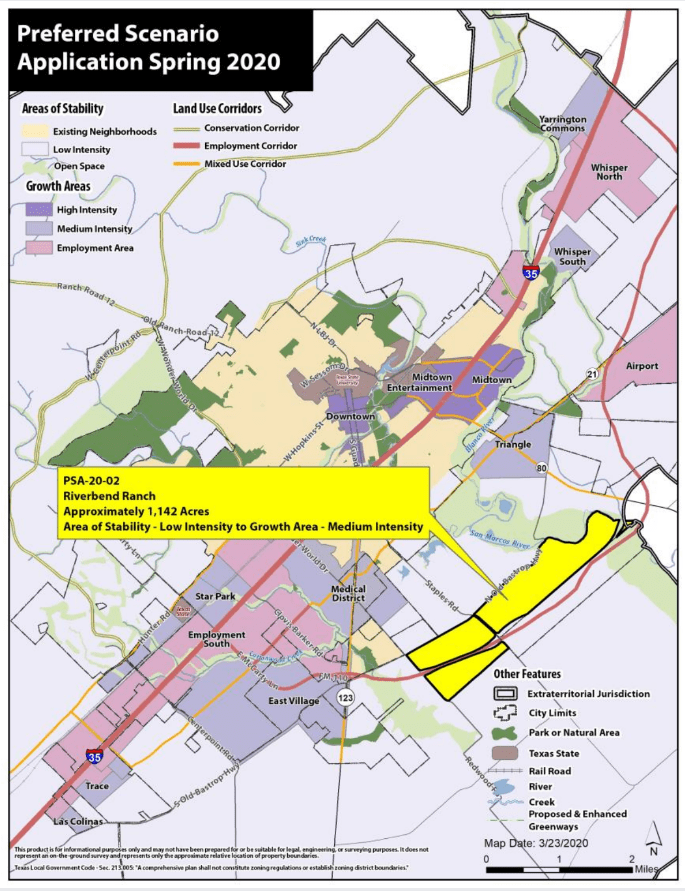
This is weird and infuriating. So there is a giant housing development that’s been approved, called Riverbend Ranch. It won’t materialize for a while. We’ve discussed it here and here.
It’s very big – 1,142 acres. It runs adjacent to Redwood on the southern end, which is a concern, but possibly there’s an opportunity to get some sewer infrastructure to the good people there.
The plan has always been for it to be mostly housing, above the red line. (McCarty extension/Loop 110) (The part south of the red line is zoned industrial, which is the concern for the people of Redwood.)
Here’s how it’s currently zoned:
What do those letters mean? CD-3 is single family sprawl.
ie the charming mixed use downtown from Sesame Street. Or picture San Antonio street.
But in reality it usually looks like so:
Large scale apartment complexes. This is because our land development code lumps together those two types of zonings. So you can’t approve charming Sesame Street-scapes without giving developers the right to build large scale complexes. This is an unforced error – no one made us lump those together in the code.
Anyway, back to this picture:
The striped bits are supposed to be apartments and commercial. The developer is asking to change them the CD4 and CD5 bits to also be CD3. In other words, instead of having pockets of commercial and apartments, the whole thing should be single family sprawl.
THIS IS 1200 ACRES! It will now be 1200 acres of relentless single use housing! This is really shitty! The planning department knows better, because when Riverbend Ranch originally came up for zoning, they had to offer up certain percents at denser amounts, and they had to talk about amenities and commercial areas.
It turns out that you just have to wait a few years until everyone forgets, and then politely ask to get it rezoned into the cheapest and most profitable suburban sprawlscape.
THIS MADE ME SO MAD. This is why we need the comprehensive plan already in place. This should never have been allowed.
















 The San Marxist