
Item 23: Cape’s Dam
Hooboy, CAPE’S DAM. As you know, this is a whole epic story! Let’s see if we can wade through everything.
Background:
Here’s the part of the river that we’re talking about:

(source)
Cape’s Dam is here:

Damn Dams, and the Damn Dammers who Dam them.
In general, old dams are bad for rivers.
US Fish & Wildlife generally recommends removing them, so does this other American Rivers group, and pretty much any other environmental group.
Back in the 2000s, some folks at the Meadows Center began looking at Cape’s Dam. Would removing it be good for the endangered species?
Eventually they wrote up this report for the city: Effects of changing height of Cape’s Dam on recreation, Texas wild rice and fountain darter habitat in the San Marcos River, Texas.
It is insanely thorough! I can tell that much. They look at three things: fountain darters, Texas wild rice, and recreation. They conclude that removing the dam is good for the fishies, good for the endangered wild rice, and not bad for recreation.
This is their graph on recreation:
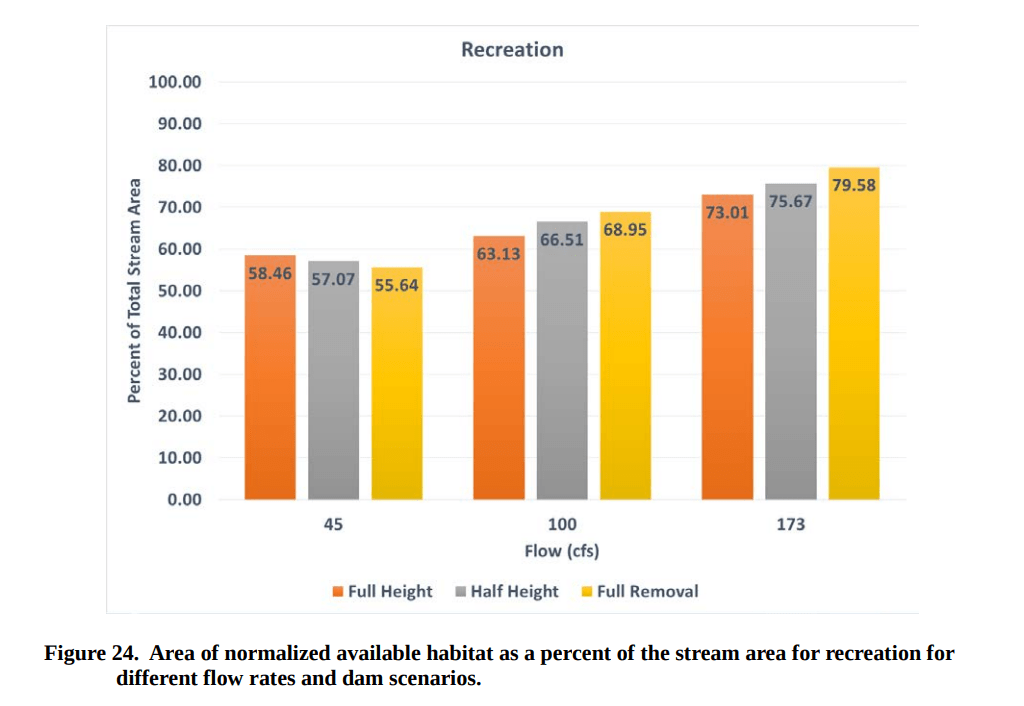
The 45 means drought, 100 is normal river, and 173 is after a lot of rain. The bars represent how much of the river is deep enough for you to paddle on. Removing the dam doesn’t really change how much of the river you can paddle down.
In 2014, they reported all this to the Park’s Department. But before they talk to Council, we have…
The 2015 Floods
The 2015 Memorial Day floods come along. A 40 foot wall of water barreled down the Blanco River, 11 people are killed, and tons of homes are flooded.
In the course of all this, Cape’s Dam is destroyed.
Here’s what it looks like afterwards:

(From this video) and from another angle:

(source)
I hunted for awhile, but I can’t find any photos of the dam from before it was destroyed.
…
2016: Council hears all of this for the first time
Now the city is trying to cope with post-disaster San Marcos. They’re assessing damage, applying for disaster funding, and so on. For Cape’s Dam, they’ve now got a liability mess on their hands.
The issue is presented: Should Council remove the dam and fill the Mill Race?
Wait, what’s the Mill Race?
I think it’s this:

It’s this little channel that was built back when this was an actual mill. It’s very calm and smooth because it’s got dams on both sides. I think you get this nice little loop around Thompson’s Island. So there are groups, like the scouts and disabled veterans, who have used this stretch for learning to kayak and rehab and growth.
It’s great for those groups!
But as far as I can tell, this is an amazing stretch that’s been kept hidden from public use. That part irritates me. People living east of I-35 have not been able to enjoy the Mill Race or the rest of the parks on that map very easily.
Back to 2016
As far as I can tell, this is the source of all our problems:

I actually went back and listened – you’re welcome – and here’s the problem: if you remove the dam, the Mill Race won’t have enough water 85%-90% of the time. Mostly it will have stagnant mosquito water, or dry up altogether.
So removing the dam wrecks the Mill Race. You could still canoe and paddle on the real river! Just not the Mill Race part.
…
So it’s 2016, the dam is now dangerous, and Council is given this choice:
- Use free money from the Army Corp of Engineers to remove the dam.
- Good for the health of the river!
- Good for the endangered species!
- Can still paddle on the regular half.
- Use free money from the Army Corp of Engineers to remove the dam, and then use imaginary millions of dollars that we don’t have to rebuild the dam.
- Imaginary money is not real. We don’t have it.
In March, 2016, Council votes to remove Cape’s dam.
So now the shit hits the fan. Massive controversy.
This organization springs up to save the Mill Race. They have some sympathetic points, but they also make some crappy arguments.
It was in the news a LOT. Like, a whole lot. Like, it’s one of the biggest San Marcos controversies of the decade.
The Argument about Historical Significance:
This is the part I have the least patience for. The argument that takes hold is that Cape’s Dam is so historically significant that we’ve got to save it. For the children! For the historians!
Look: if Cape’s Dam is so sacred, how come I cannot find one single photo of it anywhere, before it was destroyed? Didn’t we love it then?
I do even think there’s interesting history here! What was engineering like a hundred years ago? That’s worth studying.
The part that makes this bullshit is when you use it to say the dam must be preserved, in the river. Want to haul the broken pieces on the bank somewhere? Put up a nice plaque commemorating the dam? Knock yourself out! But don’t pretend that the historical significance means we need a functional dam in 2025.
But this gains traction. Preservation Texas has this blurb about the dam, Hays Historical Commission weighs in, and City Council holds a workshop with the Texas Historical Commision.
Thus begins the next phase of the controversy, 2017-2024:
We begin kicking the can down the road. For the next eight years, everyone just punts. You can read a nice summary of all the dithering here!
Kick, kick, kick. We’re kicking the can. kick, kick, kick.
Two extra details from this part of the timeline:
- The free disaster money to remove the dam expires. Now we’d have to apply for grant money. But like I mentioned, lots of organizations want old dams removed, so there’s money around.
- In 2017, San Marcos River Foundation acquires the land on one side of the bank. They are a hard NO on rebuilding the dam.
They have always been very clear on their position: it is best for the health of the river to remove the dam. You can’t rebuild the dam unless you can access their side of the river. They will not agree to rebuilding the dam on their land. Therefore there is no dam.
So now, in 2025:
I’m no engineer, but I’m pretty sure this is the choice before us:
- Find grant money to remove the dam.
- Good for the health of the river!
- Good for the endangered species!
- Can still paddle on the regular half.
- Current dam is dangerous and needs to be removed. (A recent tragedy.)
- Find grant money to remove the dam.
- Then find imaginary millions of dollars more to rebuild the dam
- Find an imaginary way to get SMRF to consent to let us rebuild a dam that they are strongly opposed to.
Look, it’s not actually a choice. No matter what, it starts with removing the dam.
This brings us to Tuesday’s meeting!
The issue at hand is spending $340K on a feasibility study. The study would do this:

So this study is going to answer all our questions:
– What’s the current conditions of the dam and the whole area?
– What would it take to rebuild it? Or partially re-build it? Or just remove it?
– What’s the environmental situation? What’s the permitting process?
– Do a bunch of public outreach and get public feedback.
….
What does Council say?
There are a few things to keep in mind during the Council discussion.
- We need the feasibility study, no matter what. Every outcome requires permits. You need this study to get those permits.
- The east side of San Marcos has been majorly neglected for river recreation. We need to develop this. Not necessarily the Mill Race – the public couldn’t access this anyway. They definitely deserve good river access and recreation.
- Most likely, you have to remove the dam, no matter what. (I’m no engineer, but look, it’s a pile of rubble.)
Council has a lot of confusion. This is understandable – it’s a big, complicated topic. But you’ve already read 1000 words on this, and trust me, you don’t want to read about them going in circles. There are a LOT of circles, and they go round and round.
Some highlights:
Q: Can we skip the study and just put the money towards re-building? (Shane)
A: No. You need it to get permits and apply for grant funding. Plus the re-building would be way more than $340K.
Saul Gonzales is quite clear-headed about keeping safety front-and-center in the conversation. Everyone is focused on this, but Saul is the one who repeatedly mentions it.
Q: What about liability, should someone get injured?
A: Yes, we are exposed. This is a man-made thing in a public space, and we’re supposed to be in charge of it, even though the state owns the river. SMRF would maybe have some liability in court, and parks get a little immunity for being outdoors, but this is not a natural outdoorsy thing. It’s a big risk.
Q: Aren’t we partnering with the county on all this?
A: Sort of, yes. They’re interested in rebuilding. Or they were, in 2021, when we last talked with them about this.
Several councilmembers point out: The east side needs some good river access!
I agree with that!
Shane, Jane, Matthew, Lorenzo, and Alyssa are all open to rebuilding the dam. They seem to be thinking that this is the way to support river access on the east side. They’re wrong about this, but it’s sympathetic.
Saul’s position: “I’d like us to make this safe, as quickly as possible. Let’s start with taking it out, and see if everyone likes it. After that, if everyone wants a dam, we can rebuild the dam.”
Amanda’s position: “Rip it out and let the river flow. Then create recreation on the East Side.”
This aligns most closely with my beliefs.
…
Jane and Amanda go off on a tangent about getting public input first. Now, the folks doing the feasibility study are already supposed to get a bunch of public input. And it’s a LOT:

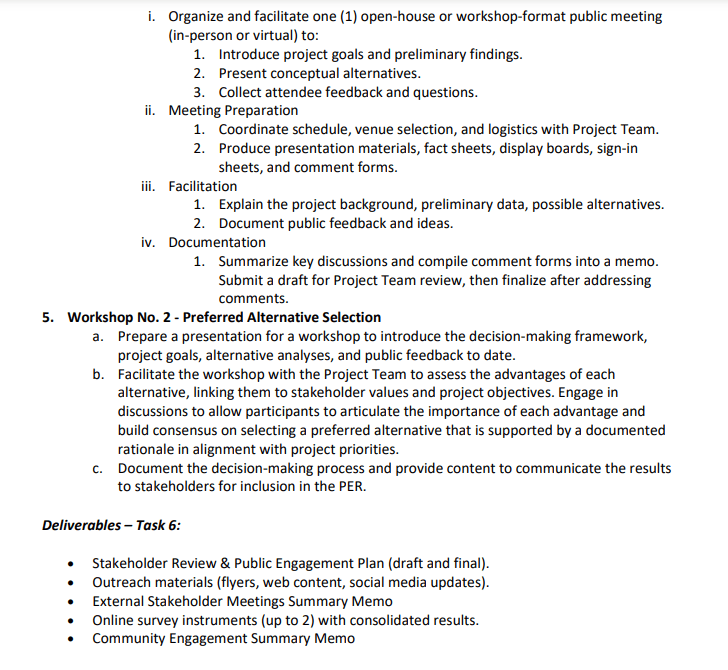
But Jane and Amanda are proposing that the city get a bunch of public input, before the folks in the study get a bunch of input.
Look: No. That is just more kicking-the-can down the road.
Alyssa makes the exact right point here: “We have engaged with the public for YEARS. EVERYONE has an opinion. I know what the results will be.”
That is correct.
….
There’s discussion of partial rebuilds. Can the proposal consider that?
Answer: Yes. It’s in there.
Jane says: The main problem is that the Mill Race needs more water. Can we fill it with reclaimed water?
Answer: Uhhhhhhh…. you’re freaking us out. You want to release sewage into the Mill Race?
Jane: it’s treated, not raw sewage, and it gets released to the river downstream. So why not release it upstream?
Answer: We’re feeling woozy just trying to imagine the permitting process involved in releasing reclaimed water into a recreation area. Oh god.
I admire Jane’s problem-solving ambitions!
…
Bottom line: The study should take about 10 months. Then we will have a lot more information!
My belief is that the dam should go, and we should focus on creating recreation access for the public on the East Side. The mill race has always been treated as a fancy, restricted portion of the river, and the exclusiveness is bullshit.
…
If you’re curious:
Here’s a great read from 2000, from an old-timer named Tom Goynes, who has been paddling the river since the 1970s.
And here’s someone’s video, showing what it looks like to kayak through all this stuff we’re talking about:
It’s pretty amazing and beautiful.
 The San Marxist
I have plenty of pictures of the dam intact.
LikeLike
Really? Would you mind sending me any of them? I would use them the next time it gets discussed! (With attribution.) My email address is thesanmarxist@gmail.com.
LikeLike