
Item 20: Campaign Funding, redux.
So you want to raise money for your city council campaign! Right now there are a few caps:
- Individuals cannot contribute more than $500.
- If you contribute more than $300, then your councilmember has to recuse themself when anything that you’re connected to comes up.
- There’s an overall limit, based on the number of registered voters. Councilmember’s cap is 50¢ per registered voter, and mayor’s cap is 75¢ per registered voter.
Jude Prather and Shane Scott brought this issue up.
Jude Prather goes first. “It’s not the cap that’s the issue. It’s just confusing and too complicated. Things keep getting more expensive, and we’re going to have to revisit this year after year. Make it simpler. What if you get a lot of contributions? There should just be a max of $300 per person.”
Jane: We currently have a limit of $500 per person.
Jude: This is just so complicated. I mean, cost per voter?
Jane explains, “It’s just supposed to grow as San Marcos grows. If they just had a hard cap, the amount wouldn’t grow as San Marcos grows. We could change the scaling factor, though.”
(They keep saying “Teepo signs” when they talk about campaign costs. I have no idea what a Teepo sign is.)
Jude keeps going. He’s on quite a tear. What about ballot initiatives? And PACs? This doesn’t apply to them! What if a ballot initiative affects a race? (He was worried about this with marijuana decriminalization, if you’ll recall. What if we turn out young, liberal voters??)
Jane: I’m having trouble following what your solution is.
Jude Prather: I want it simpler. Just $300 cap per person. Get rid of the complicated charts with different numbers and amounts.
(OH!! T-Post signs! Got it.)
Jane Hughson was my favorite councilmember of the evening. She cannot get over the accusation that the funding cap is “too complicated”. She keeps saying things like, “I’m really trying to understand what you mean. You take the number of voters, and multiply by 50¢. What is the complicated part?” and “I can understand if you want to change 50¢ to $1 or $1.25. But what is the complicated part?”
Eventually Shane and Jude have enough dignity to stop asserting that it’s too complicated, when it’s plainly not. (And they’re not shameless enough to just bluntly say they want unlimited campaign spending.)
Everyone weighs in on what they’d like the scaling factor to be:
Shane Scott and Alyssa Garza: $1.25 per voter, for both mayor and councilmembers
Matthew Mendoza and Mark Gleason: $1 per voter, for both mayor and councilmembers
Saul Gonzales and Jane Hughson don’t seem to care.
Everyone seems to settle on the simplicity of $1 per registered voter. There! We did actually make it simpler!
One final note: last time, there was also griping that the number of registered voters fluctuates with different election cycle. No one really pursued that this time, which is good, because it is a pretty lame complaint.
…
I was surprised that Alyssa Garza is opposed to spending caps. Her argument goes that more money means hiring more local neighbors who might otherwise be disengaged, and increase local involvement.
I can see her point, but I don’t think that outweighs the built-in advantage for candidates with wealthy friends. I put a higher weight on making sure anyone can run a competitive campaign, regardless of economic background. (On the other hand, Alyssa has run for city council and I haven’t. So she has relevant knowledge.)
As a side note, apparently in Texas it is illegal to cap self-donations to one’s own campaign. So wealthy candidates will always have an advantage.
Item 13:
The Ethics Review Committee seems to always be a thorn in the side of Shane Scott, and to a lesser degree Jude Prather and Mark Gleason. I don’t know if they’ve been busted for something, or if they just don’t like the idea that they’re being watched.
Right now, councilmembers have to turn in two sets of documentation:
- Yearly financial disclosure
- Campaign contributions disclosure
The ERC looks over these, and flags anything that looks fishy. They’ve been doing this for years, but it’s not formally city policy. Jane Hughson wanted to formally codify the practice.
Shane Scott moves to deny. “The ERC does not need to meddle,” he says, “There are state rules, and the state will get involved.”
Jane explains where it came from, “After we passed the $500 cap, there was a candidate who took $1000, not knowing about the cap, and people were asking, “What do we do? Where do we report this?” It didn’t violate state rules, so you can’t report it to the Texas Ethics Commission.”
Shane Scott: “We shouldn’t be more restrictive than the state.”
Jane: “Okay, but we are. We just discussed the campaign caps. So…?”
Shane Scott removes his motion to deny, and Mark Gleason makes a motion to approve.
Next, Shane Scott makes an amendment to remove all the parts where the ERC looks at financial disclosure statements. “The state will take care of it!” he says again.
Jane again asks, “How would the state take care of it?”
Shane says, “FOIA requests, etc.”
The lawyer, Michael Consantino, says nope. The state would not get involved.
No one seconds Shane Scott’s amendment, and so it dies.
The overall vote to let the ERC review financial disclosures and campaign contributions:
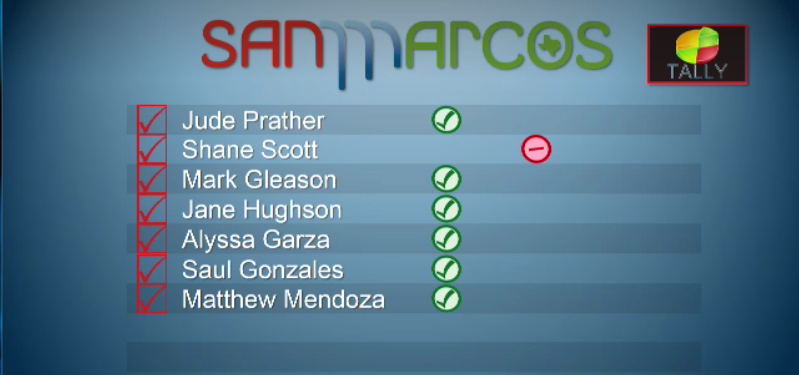
There you have it.
…
Item 21: Jane Hughson wants a new zoning. There are a lot of applications for Heavy Commercial or Light Industrial where council has to write up a bunch of good-neighbor exceptions because there are residents living nearby. Usually they want to rule out uses based on loudness/smell/vibrations/etc. The method is to make a “restricted covenant agreement,” which sounds religious, but isn’t.
Jane is proposing something that she calls “Business Park”. Maybe not storefronts, but businesses that you wouldn’t mind living next door to. Smaller in scale and height, regulations on where loading docks could be, cranking down on noise/smell/vibrations/etc.
Everyone likes this idea. It’ll come back in some form.
 The San Marxist
As s former ethics commissioner, I debated the campaign contribution limit issue which was put forward by Arthur Taylor then debated at City Council. The main concerns were keeping our elections local, financially transparent, and accessible to all. Of course, prohibitions on dark money from PACs or Political Action Committees were preemptied by the Citizen United. There are other issues with the campaign oversight process on accuracy of campaign candidates infrmation and qualifications to apply for a position that lie under the control of the City Clerk also our local government election officer. If one looks back to the mayorial race with Jane and Sam Brannon, Sam had actually claimed to live at his dad’s apartment on Hunter Rd when he actually lived in Wimberley. The Elevtion’s officer should have caught this upon applicafion. Then there was the mayorial race with Miguel Arredondo and Jane where Miguel was erroneously alloweed to run while he had accepted a School Board Trustee position that caused an unnecessary runnoff. This too could have been stopped by the City Clerk in the application phase but was not.
LikeLike
Interesting. There’s a rule that you can’t run if you’re on the school board? Or would he have just had to resign? I would not have thought that they were coordinated positions.
I think it is totally appropriate and natural to have the ERC oversight in this area. You’re saying that Wednesday’s ordinance didn’t go far enough, because it didn’t cover these ancillary issues that need an extra set of eyes?
LikeLike
More on the discussion of Dual Office Incompatibalities, there is a Handbook if dusl office incompatibilifies made easy by the Texas AG’s office or one from TML here:
https://www.tml.org/DocumentCenter/View/268/Dual-Office-Holding-and-Incompatibility-Made-Easy-2018-PDF
The main issue for City Council members and School Board Trustees is having sway or a vote over two overlapping taxing districts. There is case law to back it up I believe.
LikeLike
Yes to more eyes on the campaign applications and action when brought up to the City Clerk. The City Election officer has duties that she was not doing such as going over campaign applications very thoroughly except to see if it is filled out due to shortage in staffing I was told. So yes, maybe the ERC should oversee valudity if applications and possible enforcement if it is made known later that things were not up and up.
LikeLike
I remember now that the School Board election was postponed until November due to CoVid and that the mayorial race was concurrent. So Miguel Arredondo ran for both the School Board Trustee and Mayor, which on the face is incompafible if both elections are won. What happened was that because Mr. Arredondo was allowed to run for mayor erroneously, in which he split the botes for the mayorial race and an expensive runnoff was necessary. Here is the Texas Election Code covering this isdue. Section 141.033 of the Texas Election Code prohibits a candidate filing to run “for two or more offices that:
(1) are not permitted by law to be held by the same person; and
(2) are to be voted on at one of more elections held on the same day.”
LikeLike
Ah, got it. So you can run for one office and resign the other, if you’re currently in office, but he was simultaneously running for both, which could lead to winning an election for a term you can’t accept. And I can see how that’s an obscure enough provision that a county clerk (or a candidate for that matter) wouldn’t have known (and right, as you said, especially if short-staffed).
LikeLike
I have a follow up question which I’d rather leave off the blog, but I don’t have your email address. Would you mind emailing me at thesanmarxist@gmail.com?
LikeLike