
Item 18: 120 acres by trailer park on FM 110:
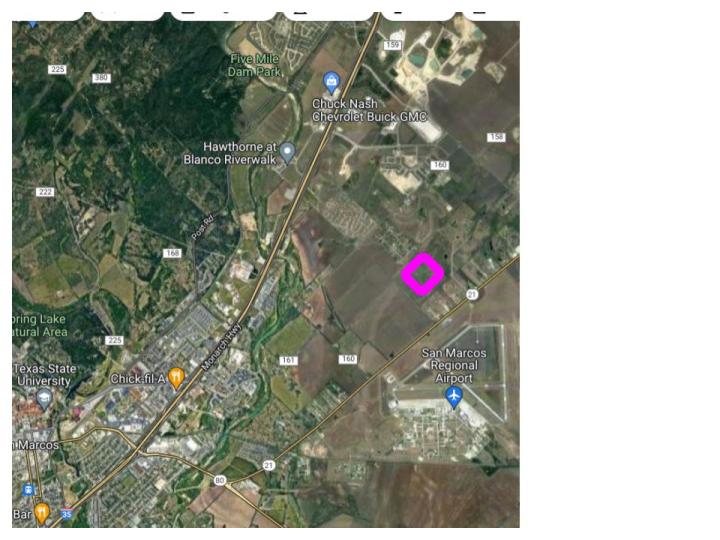
They want it to be light industrial.
Max: These light industrial things only get built next to marginalized groups. No.
Passes 5-1.
Next big topic of the night:
Item 15: I gather that City Council has a legislative committee comprised of Mayor Hughson, Alyssa Garza, and Mark Gleason. Max Baker wanted to be on it, but he is not. The legislative committee goes to the state capital in Austin and lobbies the state for different policy goals.
Max gave the committee a wishlist of issues that he wanted them to tackle, and they did not take his suggestions, so he’s bringing it to the entire council. (Plus a few extra.)
There’s a basic philosophic divide here:
– Jane Hughson says over and over that she’s not exactly against the ideas, but she thinks they are battles that aren’t worth fighting. That the opponents are too big and organized for measly little San Marcos.
– Max feels that the time for change is always now. If no one starts a movement, change will never begin.
Max has nine issues, and they take them one by one. (Boy do I love getting all these councilmembers down on record on these issues! Watch how spicy these get!)
- Area Median Income – what counts as low income?
Anytime something is “affordable”, we use the Austin-Round Rock Median Income as a yardstick for what “affordable” means. But the median San Marcos resident earns way less than the median Austin-Round Rock resident, so “affordable” to San Marcos needs to be adjusted downward from “affordable” for Austin-Roundrock.
For example, the median income for a family of 4 in Austin-Round Rock is $110K. The median income for a family of 4 in San Marcos is $42K. (The median for Austin alone is $75K). We need affordability to be measured specific to San Marcos.
The vote:
Everyone agrees with this! Add it to the list.
- Is Title Insurance is mostly a scam? There’s a kernel of protection, and a whole lot of profit going to title companies who do extraordinarily little. Should we lobby for protections?
Some highlights from the Texas Observer article at that link:
- Title insurance costs more in Texas than in any other state, about $1800 on average.
- The loss-ratio is how much insurance companies spend on payouts to customers. The Affordable Care Act set loss-ratios for medical insurance at 80-85%. The loss ratio for title insurance is 6%.
- And then there’s this gem:
“But Texas doesn’t have a system that allows price competition, like Oregon, where title insurance usually costs between $300 and $600. Nor does it have a socialized system, like in Iowa, where it’s even cheaper. Texas has the worst of both worlds: a state-mandated system that forbids competition and sets rates higher than anywhere else in the country, with all the profit flowing into private pockets.”
Free market, baby!
Jane Hughson agrees with the critique, but particularly feels like we’re tilting at windmills here. It doesn’t get any traction. Not on the list.
(I know I’ve got at least one reader who works at a title company! Hi! Sorry to take an aggressive stance against your industry!)
- Should we lobby for extra money to support homelessness-related issues, like a continuum of care, transitional housing, and case management?
Apparently our local organization, the Homeless Coalition, does already work pretty closely with the Texas Housing Network.
Max Baker points out some specific legislative possibilities, like addressing how redlining, credit scores, and background checks get used to exclude people from renting available apartments. That part kind of gets ignored, though. They end up with just agreeing to pursue more funding for housing-related issues.
The vote: 6-1. So this will get added to the list.
Honestly, who could oppose lobbying for funding for people experiencing homelessness? Mark Gleason can! He doesn’t say why. (Shane Scott is absent, by the way.)
- Should we look at the impact of constitutional carry of guns, as it affects the rise in violent crime?
Max Baker notes that more and more states are loosening up their firearm regulations, and violent crime is on the rise, and wants some data on this possible correlation.
Mark Gleason gets very upset. Law-abiding citizens do not commit crimes!! That’s been proven!
Max Baker points out that anyone can get a gun, not just law-abiding citizens. That’s kinda the point of constitutional carry.
Mark is pretty emotional on this point and flailing. He is very fired up over the wild notion that an endless supply of lethal weapons could end up being used in lethal ways.
Anyway, this doesn’t go anywhere.
The vote:
Yes: Alyssa Garza and Max Baker
No: Jude Prather, Saul Gonzalez, Mark Gleason, and Jane Hughson.
Jane Hughson says that she cares about this issue, but she just thinks it’s useless to go after issues this big. Max calls her apathetic. It’s kinda rude, but she’s also a potential ally who is too timid to sign on to big issues.
- Police Accountability and Access to Records
Suppose you’re sitting in jail, and there’s police bodycam evidence that could exonerate you. Should you be able to see it? Should you be able to share it? In other states, you can. When the issue is raised here, Chief Standridge says he’s constrained by Texas Law.
The vote: Should we take lobby for citizen access to bodycam footage?
Yes: Alyssa Garza, Max Baker, Saul Gonzalez
No: Jude Prather, Mark Gleason and Jane Hughson, who once again points out that she would if it weren’t futile.
Tie votes count as denials. So this does not make the cut.
- Abortion rights
Should San Marcos lobby for Texas to repeal its anti-abortion law?
Alyssa points out that there are a lot of city councils throughout the state to coordinate and work with. We would not be taking this on alone.
The vote:
Yes: Alyssa Garza and Max Bakers
No: Mark Gleason, Saul Gonzalez, Jude Prather, and Mayor Hughson.
They offer mealy-mouthed dilutions, like “I’m pro-choice but can’t speak for the city!” (Mayor Hughson) and “It’s too complicated for 10 pm” (Mark Gleason) and “This is too divisive and complex” (Jude Prather).
After the vote, Jane says, “It’s too bad that the state legislatures won’t just go with what the majority of the people want,” and Alyssa mutters, “That doesn’t happen here, either,” and Max let out a guffaw. I smirked.
- Pre-emption of local code: Vacant buildings
Vacant buildings are a nuisance and a waste of valuable space. They make downtown look sad and depressed. There’s no business inside that contributes to the tax roll. They attract vagrancy and can require extra fire and police services, compared to if they were occupied. Can San Marcos charge owners of vacant buildings a registration fee that kicks in every six months or so that it sits vacant?
Jude suggests that we should just levy such a fee, but Max says that he has only found out-of-state cities which do this, so he suspects it’s not legal here. Hence something to either pursue, or lobby the state about.
Everyone likes this idea.
- Another state pre-emption of local code: Texas State University
Texas State used to pay into our stormwater fund, like the rest of us do. You may have noticed that they occupy a whole lot of pavement which sits uphill of a whole lot of town.
One day, the board of regents asked what this funny-looking stormwater fee was doing on their balance sheets, and then they got mad about it. So they went to the state legislature, who agreed that they shouldn’t have to pay it anymore.
(That’s how Jane Hughson explained it – I couldn’t find anything one way or the other in a quick google search.)
They also don’t pay for the fire department, police department, nor do they have to follow municipal regulations. (They do pay for wastewater services, and they do have their own police department, so there’s that.)
Mark Gleason and Saul Gonzales are on board with lobbying for them to pay for fire department service, but not stormwater. Neither of them offer up a reason why they’d exclude stormwater fees. I’m pretty sure they’re aware that there’s a flooding problem in town.
Mayor Hughson agrees to both, despite saying she thinks it’s unlikely to go anywhere.
Alyssa supports both.
Jude abstains.
So this one will make the cut.
- The SMART Terminal:
I don’t really know what the SMART Terminal is, but it has something to do with the railroad line, north east of town. Max says it’s no longer what it was originally envisioned to be, and he wants it removed from the list of lobbying criteria.
Jane Hughson agrees that it’s no longer what it was going to be, but still wants it left on the list of items that we lobby over in Austin.
Who knows. SMART Terminal stays, by a vote of 5-1.
THAT’S ALL OF THEM!
It’s important to note that this is all preliminary. The real vote is next session. So any of this could get struck down, amended, or voted out.


San, you’re vonfusing me when you interchange tge terms lobbying criteria and lobbying ordinance in the SMART Terminal discussion.
LikeLike
I’m also confused. But from context, it sounds like somehow our legislative committee goes to the state capital, and the SMART terminal is involved in the list of things we lobby Austin about. Max Baker wants to remove it from the list.
So it doesn’t have anything to do with our internal (failed) lobbying ordinance, if that’s what you’re asking? Or am I missing what you’re getting at?
LikeLike
I see where I used “lobbying ordinance” at the bottom now, probably just out of typing-muscle-memory. I edited that sentence to make it clearer.
LikeLike