
Citizen Comment:
The landlords are very mad about the three-month eviction moratorium. It was implemented in March 2020. We’re one of the few holdouts that haven’t lifted it yet, mostly because Hays County did a spectacularly abysmal job giving rental assistance to tenants. The idea was that with a few extra months, maybe more money could be dispersed and keep people in their homes. Evictions lead to homelessness, which derails lives permanently.
This time, the landlords were arguing that the moratorium is bad for tenants, because it allows them to rack up more debt, which then counts against them when they are eventually evicted anyway. Their other argument is that the job insecurity caused by the pandemic is long gone. (Their actual argument is that they would like to collect rent every month. This isn’t itself a crazy argument!)
Look, landlords are generally a problematic group. They leach off renters’ income by virtue of the fact that they had wealth earlier than the renter did. They benefit from a housing crisis and generally try to absorb as much of someone’s disposable income as they can. However: asking landlords to forgo the money that they’re legally entitled to is also a problem.
So here is the key question: is the eviction delay a worthwhile way to prevent homelessness?
Glad you asked – we actually had a council workshop on homelessness just two weeks ago! What are their recommendations?
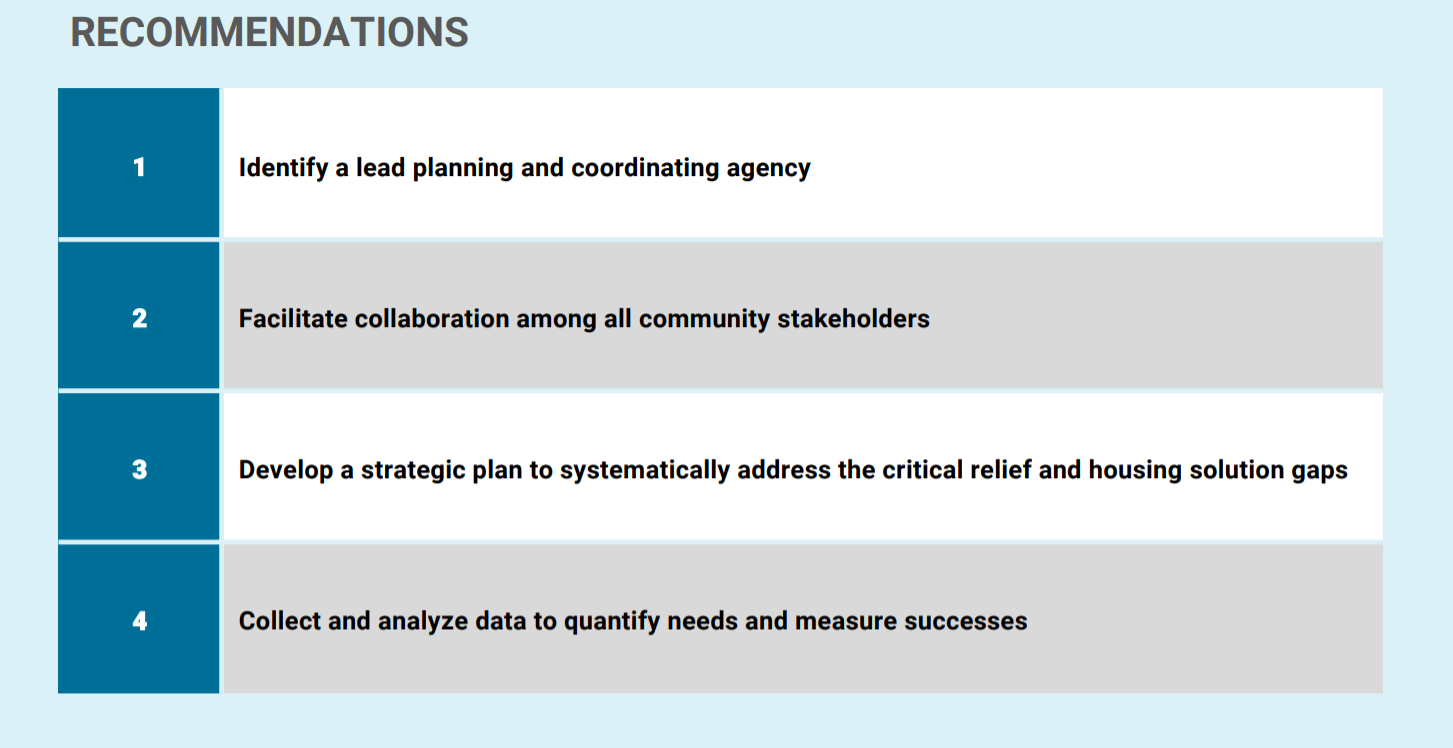
Oh. Those are very high-level. That’s a whole ‘nother geologic time scale from 90-eviction moratoriums.
So here are some more immediate things I would like to know:
- What is our total housing stock, broken down by affordability?
- What is our total housing need, broken down by affordability?
- What were the recommendations in the 2019 Housing Needs study?
- How is the implementation going?
Those questions should be front and center, every time we are discussing zoning, housing, short-term homelessness, or affordability.
In 2019, San Marcos did a major housing needs assessment. There is tons of good data in it, most of it from 2017. We desperately need to be updating this every year.
So for example, here is our rental stock from 2017:

(From here.)
This should be updated every 2-3 years!
– the 3rd/4th columns should come from Census and American Community Survey data, which is released every few years.
– We know the number of new units that get occupancy permits each year. This is already aggregated here and here.
But the hard part would be finding out how much apartments are being rented for. Since 2017, those 15,884 total apartments have all risen in cost, so they’re not in the same categories as they used to be. For example, the 4163 units that were under $875/month in 2017? Those must all be in the < $1250 or < $1875 categories by now.
So the gap is presumably way worse in 2022 than it was in 2017, but we don’t know by exactly how much. Still, two questions down.
What is our total housing stock, broken down by affordability?What is our total housing need, broken down by affordability?- What were the recommendations in the 2019 Housing Needs study?
- How is the implementation going?
So I dove into question 3 next. I found this, and got excited:

Three year implementation! Why, if we started in 2019 then…[counts on fingers…2020…2021…]…we should have really made some great progress!
So I got into the housing needs assessment.
Table of contents:
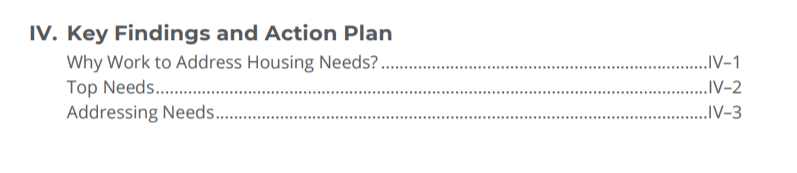
That looks like the right spot.…flipping to chapter IV…
There are four top needs, starting on page IV-2:
- Additional affordable rentals for residents earning less than $25K
- Displacement prevention
- Starter homes and family homes priced near or below $200K and increased ownership product diversity
- Improve condition and accessibility of existing housing stock.
Yes, yes! Those are big needs! (And “Displacement prevention” is right there, tying into the the 90 day eviction notice debate.)
So what is the action plan? What is in the “Addressing Needs” section?

Oh hrm. What the hell.
There are actually some useful recommendations in the glossy brochure version of the Strategic Housing Action Plan, but it was labeled as the draft version. I was trying to find the legal version. But that’s when I realized that everything was still labeled as “draft”. Then I saw this on the city webpage:

So did we really spend a year and drop a bunch of money on consultants, and then just…never adopt the plan? It’s just sitting there in draft form? Or is it just that the website was never updated?
Oh, this is such a riot.
At this point I was rabidly curious. I found the city council minutes from October 15th, 2019, but it wasn’t there. It turns out that it didn’t go to P&Z until October 23rd, and it finally went to council on November 6th, 2019.
The Strategic Housing Action Plan came from P&Z with a number of edits. At council, they discussed it, and punted to a Council Workshop.
So I went hunting for the workshop. Finally I found it, 12/3/19. It wasn’t a workshop on the Strategic Housing Action Plan, it was on the new Comprehensive Plan. Workshops don’t have minutes, and I didn’t watch the video. But this is taken from the packet:
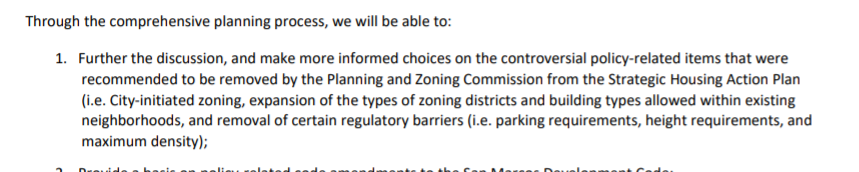
So it was never approved, because it got absorbed into the Comprehensive Plan process, which is in progress. This is VisionSMTX. It still has at least another year to go. And Comprehensive Plans are vague – they’re not going to promise funding or commit to specific details. So it will be years until someone puts together a new housing plan. (I have vivid memories of the SMTX4All housing project – I just assumed it had been passed and implemented!)
To recap: we’re sitting on housing recommendations from 2019, with data from 2017, while we dither about what we might like to look like in 2050.
I really do believe in longterm planning. But waiting to address a housing crisis like this is just lazy and infuriating.
The problem is those “controversial policy-related items” referenced in the workshop snippet. You can read what P&Z wanted to kill here, on pages 17 and 18. The Strategic Housing Plan was seen as a money grab by realtors, and only interpreted as a fight between realtors and the integrity of existing single family neighborhoods. There was no actual focus on the struggle of people in San Marcos to find homes. Basically, it’s a lot of nimbyism and fear of infill. (Infill can be done in a shitty way! Infill needs to be done very carefully! But the recommendations from P&Z just ignored the actual problem.) But at least P&Z actually passed the damn thing, unlike Council.
So we held a massive housing plan and never implemented anything. And rental rates exploded in the meantime. That sounds about right.
(What were we talking about again? Should we end the 3-month eviction moratorium? At some point we’ll have to, but it sure would be nice if we could get rental assistance to those in need beforehand.)
…
Item 1: Presentation by GSMP
The Greater San Marcos Partnership gets $400k/year from the city of San Marcos, per this contract. For context, the entire city budget for 2022 is $260.5 million dollars. So while GSMP is exasperating, we really are only talking about 0.0015 of the city’s budget.
Per the contract, GSMP has to come get updates to the city. GSMP is doing a lot of outreach and education. They’re holding workshops – financial literacy, a mentorship thing, innovations, cybersecurity. Sure. A resources database. Strengthen! Produce! Support! Identify challenges! My brain just turns to mush when I hear corporate verbs.
Max Baker is worried that GSMP will bring businesses in that aren’t good for San Marcos, and attempts to pin him on the quality of jobs at, say, Amazon. But the speaker is perfectly skilled at side-stepping questions.
For example: “You claim you’re working to bring in big businesses and supporting small businesses. Don’t companies like Amazon undercut small businesses that you claim to support?” asks Max, quite rightly.
“The large companies diversify our economy! There are spin offs! Different intellectual properties spin off and source locally!” the GSMP guy responds cheerfully. Which is an irrelevant answer – new spin-off companies don’t protect existing small businesses in any way. He actually has the cajones to claim that Amazon is known for having good labor practices, from what he hears. You can practically see the smoke pour out of Max’s ears.
Anyway, GSMP is dumb, but this whole thing is small potatoes. The speaker doesn’t do anything wrong exactly, but it’s unsatisfying.
 The San Marxist
The ami that the Workforce Housing Committee uses, which changed to Affordable Housing Committee and now Housing Committee, was an Austin-Roundrock HUD study because they hadn’t done a study here around San Marcos. They used it anyway to base their numbers for San Marcos on. Then there is the lack of accurate rental / occupancy data the was also not included in the Workforce Housing studies. The City Council has refused to pass any real rental registration ordinance that could help in that area which would give us much needed data on the 75% and growing rental units here in this town. They have kicked some inconvienient can down the road for going on three years now. I guess that it’s good to wait until after election season for that one. I don’t know what your particular argument for the affordability and infill issue is, but infill can change a neighborhoods culture and character but never really change or make housing affordable. There is no way that affordability can be had as denoted in the targeted areas of the current preferred scenario maps while no rent control or anyway to reign in landlord’s greed. Attacking the endangered species called community of owners while also not focusing on the community of rentors and rentals protections is more than a little misplaced. We must have and keep the protections of both, for they are community. If we want affordability, then we must continue to promote home ownership and pathways to home ownership like Denver is attempting as well as recognizing that renters are community and protect from abuse.
LikeLike
Scattershot response: I don’t think the answer is solely infill, but I don’t think infill should be off the table, either. I’m very annoyed that we’re approving huge tracts of single family housing, instead of including duplexes/4-plexes/more dense housing. The only solution that I see involves having sufficient housing stock on a responsibly-sized footprint, together with meaningful public transportation. I don’t see how promoting home ownership means much that’s uniquely beneficial, aside from increasing the housing stock in general. Rent control would be great, but I assume it’s off the table in Texas, and it would need to still be coupled with increasing the housing stock.
LikeLike
Only 4 states have rent control that I have heard of. Ownership promotes pride and caring for an area vs renting in general. Ownership can shield people from market forces in ways that renting cannot because of more permanent roots . We have the 4 to 6 year kind of rental here in San Marcos, with most owners being out of town I believe. That means that renting can mean disposable housing to some. Ownership can also mean more participation in the local government process, but maybe not unless tax time comes around. Long term renting used to not be part of our housing culture until lately as costs are spiraling. As far as owning and permanence, being in an area longer can allow for people to know their area and people better. This could bring the cost of policing down and safety up. If rents were more stable, then I can see how they can be similar in that way. As to the build out all the areas around with housing, I am not impressed with the quality of housing. If we look to the East and notice that all of the houses are built on an ocean of clay, then it doesn’t take a genius to know that the foundations will start to crack in 5 to 10 years, my guess. The foundations are substandard. That means calamity for the lending industry and another housing bubble imo. So, since we have so many new single family houses being built, and San Marcos is 75% and gaining rental units, why do we need infill to add to more rental housing stock? I don’t think that zoning, or land use zoning, is causing the inequity that it is getting blamed for. It was misused in the past to promote and enforce discrimination, but to a much lesser degree today. If we, in community, are participating with our local government, and we can adjust to the need of housing through zoning and other processes, and our system isn’t being gamed by investors that can afford to pay a whole lot more for property, then our pre new urbanist approach to land development was just fine. It’s the developer with a key to the back door at City Hall that has always been the problem. In my above comment, I said that affordability could not be achieved through any approach that we have know, but availability can, even if it is the Wal Mart of housing, apartments. Denver is promoting housing ownership much like the other versions of affordable housing programs for building rentals, by using deed restrictions to limit flippers and investment firms. I like it, but would go a step further and open the affordable housing program grants, loans, and tax abatements for building/owning to more local builders and homebuyers that want to build. This would be a lot of work to keep up with, but would give local community some work instead of just large developers. Community retention would increase and promote generational housing.
LikeLike
A couple thoughts.
– I’d love to see deed restriction to keep ownership local
– I don’t like “ownership” to be synonymous with “single family home”. Condos, coops, row houses, etc are all more sustainable ways of supplying homes to be purchased.
– And conversely, I think it’s fine for renters to rent houses and for single-family neighborhoods to be less homogenous, although (like you), I’d like the owners to be local.
– Land grant programs are great and should be done on a much larger scale.
– Home owners may be more active participants and know their community, etc, but to me that speaks to the need to work on community organization and relationship-building with renters. I’d like to see more diverse groups being energized and politically active, and feeling a sense of agency to improve the city.
– Shitty new builds is a problem of poorly written code and poor code enforcement. It’s sort of ancillary to the question of quantity.
I think we agree more than we disagree – it’s a complicated problem, and needs a complex solution involving all these ideas, and no single idea will be a silver bullet.
LikeLike