Back in 2022, the city put out a community survey, to find out how happy people are with life in San Marcos and with city services. Now it’s time for the 2025 follow-up survey.
This workshop was mostly about tinkering with the five freebie questions that the city gets to individualize. It was pretty mundane, so I didn’t bother to write it up.
Keep an eye out for the survey over the next few months! And share it with people who don’t generally respond to city surveys.
…
Workshop 2: Utility late fees and reconnection fees.
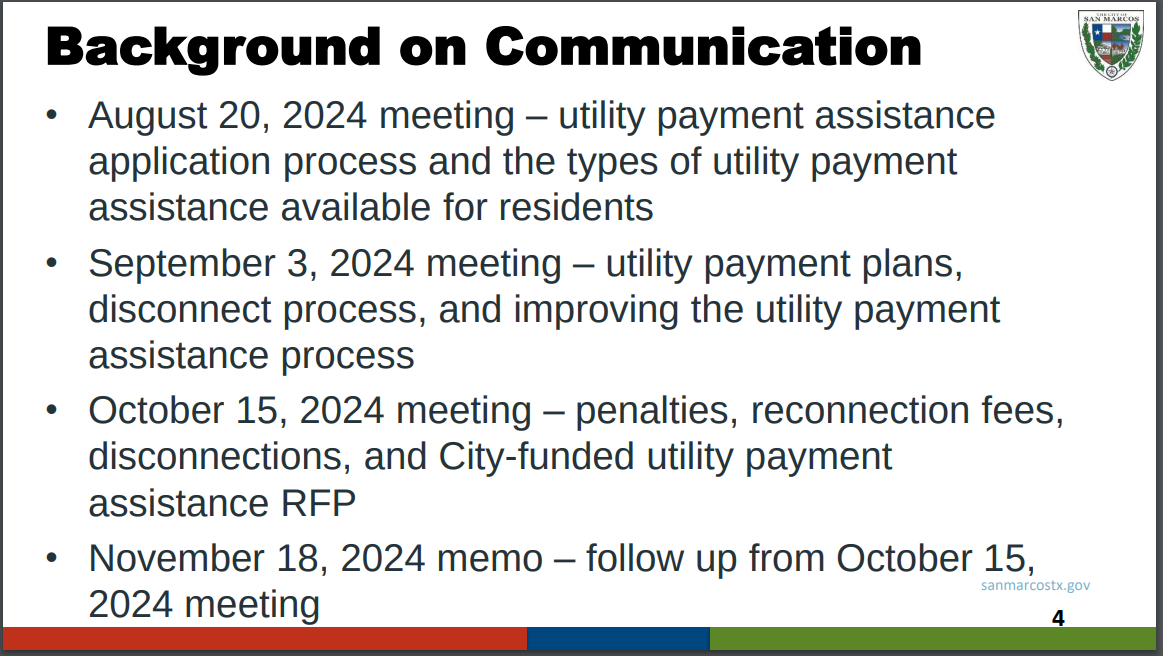
This has been a discussion for the past year, most recently here. Bascially, there was a lot of money available to help people pay their utility bills, but very little of it was getting spent on people who needed help. They’ve (hopefully) fixed that by making the application form much shorter and easier.
The second issue was late fees and reconnection fees. If you already can’t pay, do we really need to charge you more as punishment? The Citizens Utility Advisory Board (CUAB) is bringing back recommendations on what we could change.
There are two main questions:
How much of a penalty do we want to charge people, once their bill is overdue?
How much does it cost the city to disconnect and reconnect someone’s water/gas/electricity?
Penalty:
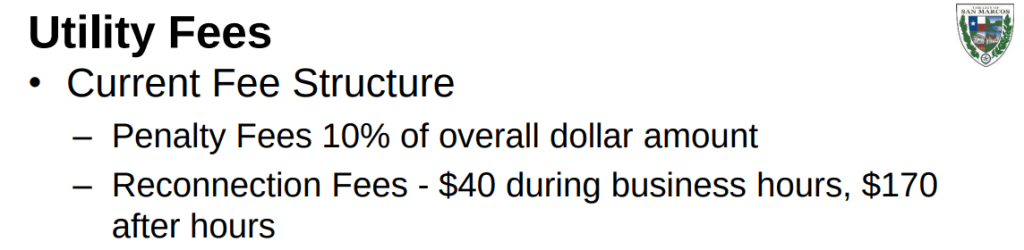
We used to charge a 10% late fee. CUAB is recommending a 5% late fee.
Disconnect/reconnect:
Here we’re just trying to cover our costs. It’s not a punishment. Back in 2014, we set $40 as the fee. In 2025, it now costs $95 to reconnect the utilities.
The problem is that if you decrease the late fee by 5% and then increase the reconnection fee by $55, they kind of cancel each other out:
So Council is a little bummed out over this.
Jane: Can people get late fees and reconnection fees paid for by the Utility assistance program? Answer: Just late fees, but not reconnection fees.
Jane: That was an oversight. I wish we’d talked that out when we were dealing with utility assistance.
…
They end up going in circles for awhile – should they send it back to CUAB? Should they split out water from electricity? Should they subsidize disconnection/reconnection fees? What if the state passes restrictions affecting late fees?
In the end, they decide to accept the proposal for now, and also reduce the water disconnection fee to $40. This will come back around for final approval during a council meeting.
Here’s the situation: We’ve got city-owned water, electric, and wastewater. (Most of the people here are on city utilities, although some people are on Pedernales or Bluebonnet electric.)
When people can’t pay their utility bills, we offer them a two week delay. But we also give $120K to Community Action, to help pay people’s utility bills when they fall behind and can’t afford to catch up.
This has been an ongoing topic of conversation:
The problem is that most of the $120K we set aside for utility assistance isn’t getting used. There’s a ton of need out there in the community, and we’re not getting the money to the people that need it.
Why??
Community Action gets money from us. They also get grant money from the state and feds. So they use that state and federal money first, and then only use the city money if that money’s not available. That is good!
The problem is that their application process is long and a giant pain in the butt, because they’re trying to give out federal money. So people are being asked to provide all kinds of crazy paperwork documenting their employment or residence or whatever, and it takes weeks, and the person just needs their water turned back on so that they can cook dinner. This part is bad.
…
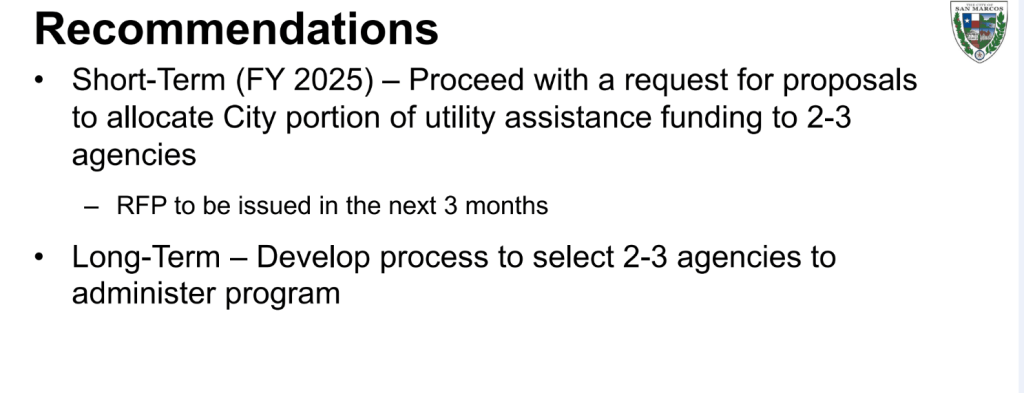
So the city is working on how to get the funds out faster. Would any other organizations like to also hand out utility assistance? (RFP means “Request for proposals”)
No one wanted to apply! They kept advertising and reaching out and extending the deadline.
Eventually they got three more applicants. Here’s what’s being recommended:
The “donated funds” bit means that San Marcos residents have an option to donate when they pay their bill. There’s about $45K in accumulated donations right now.
(Community Action spoke up on Tuesday and said their capacity is actually $30K, so that extra $10K will get re-distributed.)
Discussion points:
Question: How long will the turnaround time be for people needing assistance?
Answer: Different agencies have estimated 3-5 days. Some a little longer. We’ll nail it down for sure in the contract with each agency.
City Manager Stephanie Reyes proposes having a universal application that all the agencies could use for city funds. Everyone likes that.
…
There’s a lot of discussion about how customers can find out about utility assistance.
If your bill is overdue, you get an automatic robo-call on the 16th day.
On the 18th day, your bill is delinquent.
After that, the delinquency notice goes out.
Right now, we don’t mention the utility assistance on the phone call or on the delinquency letter. The person has to call into the city first.
Everyone wants to know, “Why don’t we tell people about the funds earlier?!”
City Manager Stephanie Reyes says tactfully, “It hasn’t always been the philosophy of Council to make this information available at this stage.”
What she means is this: Previous councils have been more obsessed with the random person who might cheat the system than they were with actually connecting people in need with assistance.
This council – thank god – is more obsessed with connecting people to assistance. They want to have the utility assistance mentioned in the robo-call, and put in the delinquency letter.
…
Late Penalties and Reconnection Fees
Suppose you can’t pay your utility bill. This would make it even harder:
In other words, if you’re $140 behind on your utilities, it will cost almost $200 to get everything turned back on. This is pretty typical.
Council looks at each of these individually.
Penalty Fees: on average, people pay about $14 in penalties – a little higher for houses, a little lower for apartments.
They debate capping it at different amounts – $10? $15? $20? – so that you’d pay either 10% or the cap, whichever is less. (This is Lorenzo’s suggestion.)
(This is for residential, not commercial.)
Reconnection Fees: This cost is based on a 2013 estimate of fuel plus labor to go to the house and turn it back on.
Staff is planning on recalculating these fees and see if they can bring it down.
…
Question: If we did away with all fees altogether, how much would rates go up?
Answer: about 0.5 %. Now, we always have rate increases, because costs go up. But if you want to do away with fees, we’ll need to tack on 0.5% on top of that.
…
Q: Can we change how many times they can get assistance per year?
Answer: Right now it’s twice per year. It might be hard to track among different agencies.
Most councilmembers want to change it to four.
Bottom line: This will come up at a future council meeting, along with some of the answers to questions that Council asked tonight.
…
Workshop #2
Update on American Rescue Plan dollars:
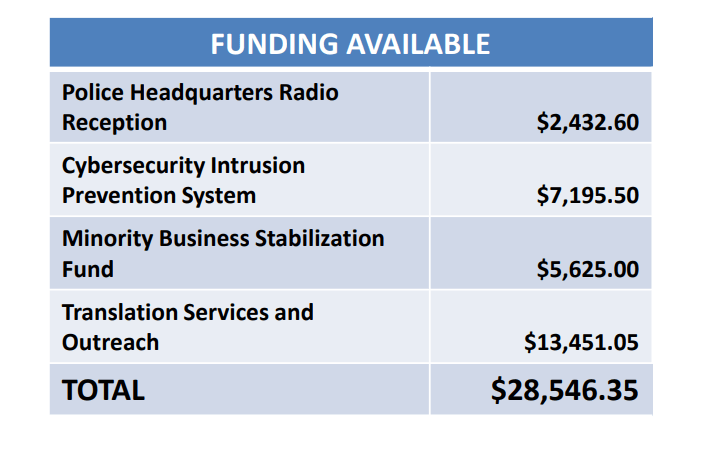
A few programs have a little money leftover:
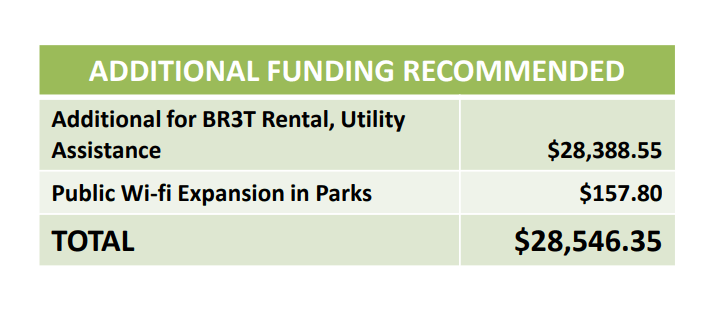
Here’s where we want to re-allocate it:
Alyssa fought long and hard for us to provide rental service, and to use an agency that doesn’t take weeks and weeks in turnaround time. (Same issue as with the utility assistance – federal money comes with a wild amount of paperwork.) It’s nice that this is now becoming the norm.
Any further money that becomes available will also go to Rental Assistance.
Purgatory Creek runs from the Purgatory Natural Area over to the San Marcos river. Basically, we’re going to geo-engineer Purgatory Creek to flood less.
So that’s Wonderworld Extension on the far left, where the yellow and blue meet. Then they cross Hopkins and run behind Dunbar, along the railroad tracks, and then cross the edge of downtown, over to the river.
90 buildings are going to have to be removed, because they’re at risk for flooding:
That’s a lot of buildings! Are these houses with people living in them? Are they historic? I could have used more details here.
Correction: I’m an idiot. The structures are being removed from the floodplain. Not removed altogether. It’s safer now for the people living in them.
But on the plus side, it’s going to have a neat little hike-and-bike trail through it.
I love that.
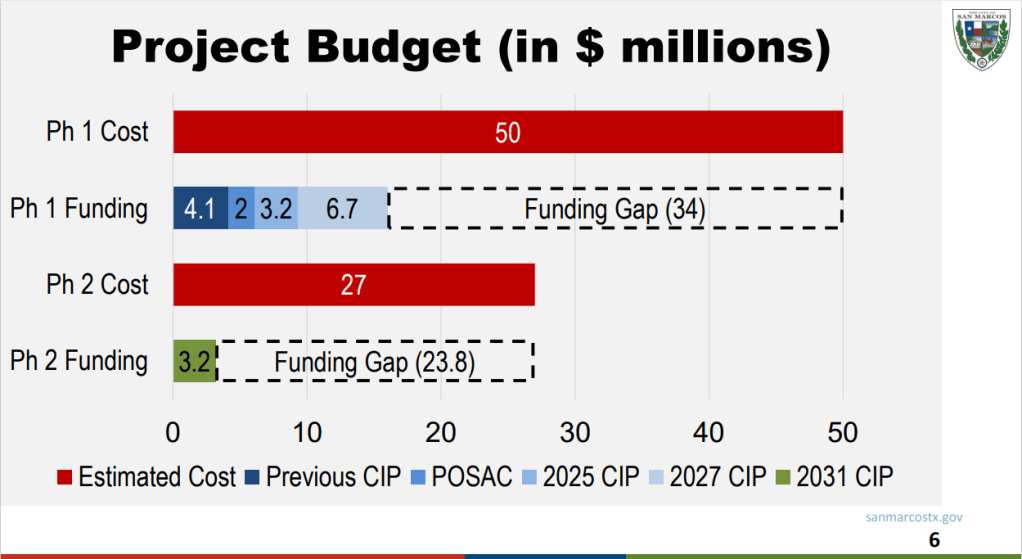
It’s gonna be hella expensive, and we don’t yet have the money:
We’re going to apply for a bunch of grants.
If we get grant funding, we could begin construction in 2026. If we don’t, we could maybe begin construction in 2030. It’ll take about two years to finish.
One last detail: On the far right, you can see where Purgatory Creek meets the San Marcos river:
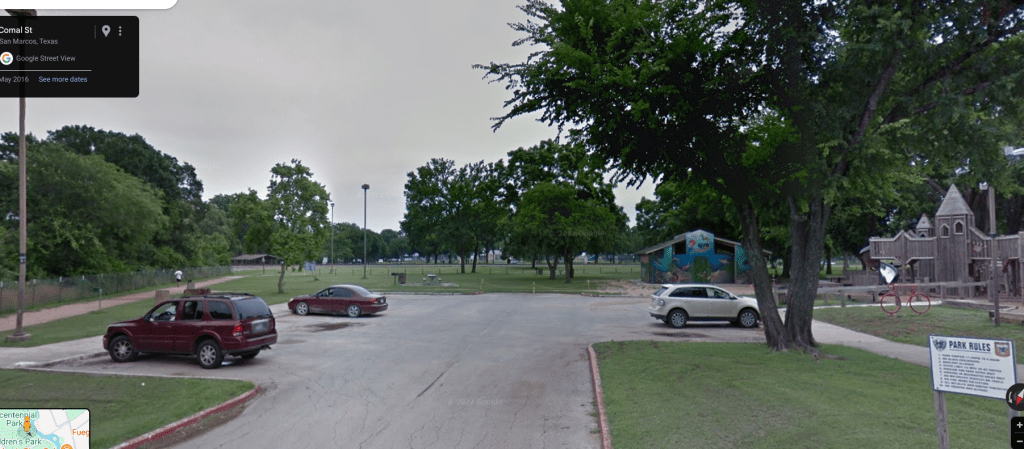
There’s a pale green Spillway, for when it floods. The spillway is in between the Children’s Park and the railroad tracks, so it’s letting into the river right where the sidewalk goes under the railroad tracks.
In other words, you’d see it from here:
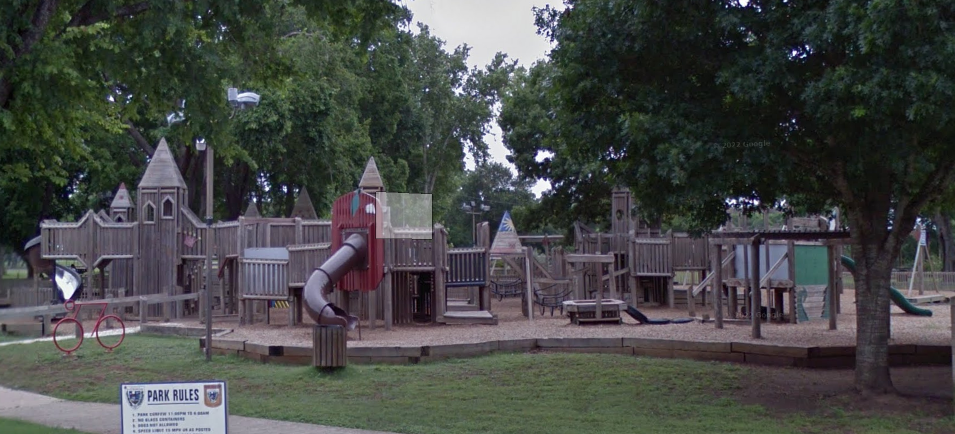
This photo from Google Streetview is so old that the Children’s Park is still the old wooden structure!
Awwww. Makes me a little nostalgic.
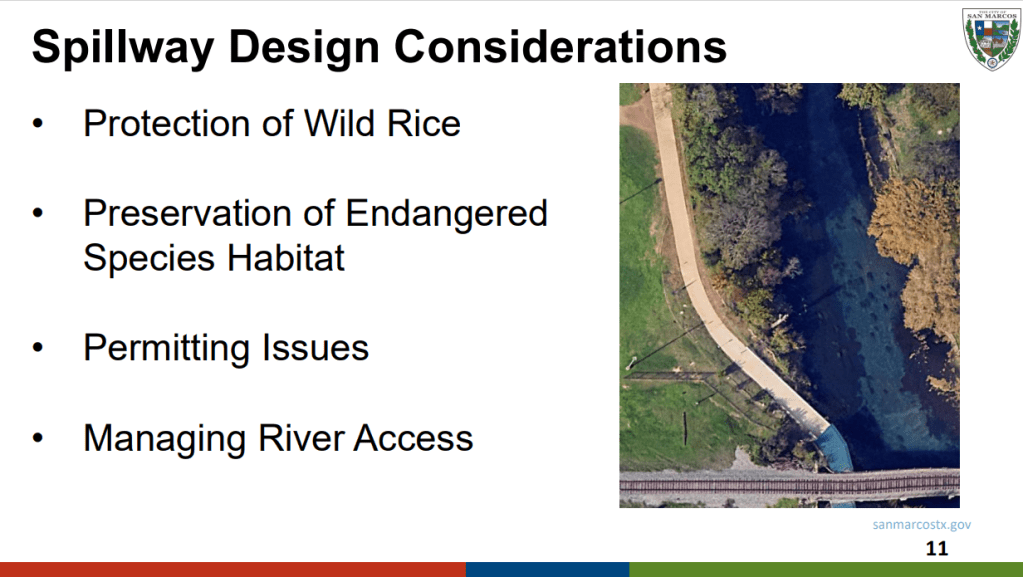
Anyway! In the original plan, they were going to use this spillway as an access point for people to easily get in and out of the river.
But the people from the Parks Department and the river experts are all saying this is a terrible idea, please don’t do this.
There’s a big patch of endangered wild rice there and endangered species that live in the wild rice. And also it’s deep with a brisk current, so it’s not that safe for little kiddos, either. Just leave this area alone, please.
So the spillway will still end up there, but they’ll make it uninviting for people.
….
Presentation 2: Capital Improvement Projects (CIP)
These are all the major city repairs going on around town. The Purgatory Creek project that we just heard about is one. They get approved alongside the budget. Council saw the current list of projects back in May. (I didn’t really say much about it at the time.)
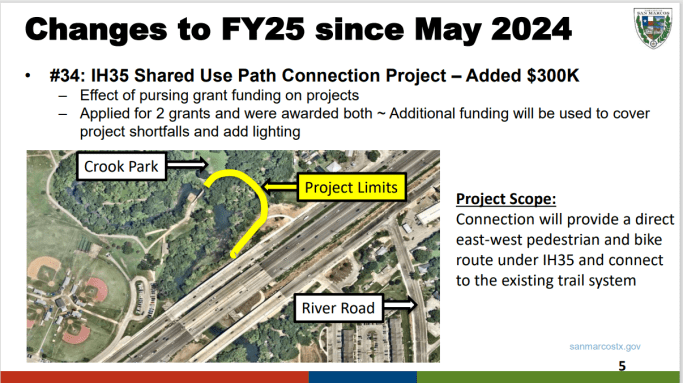
There’s only one major change since May – we’re adding one new project:
What are we looking at here? Let’s back up.
…
So, I35 has been torn up around the river for years now. TXDoT redid both the access roads, they’re adding I35 lanes across the river, it’s a whole thing.
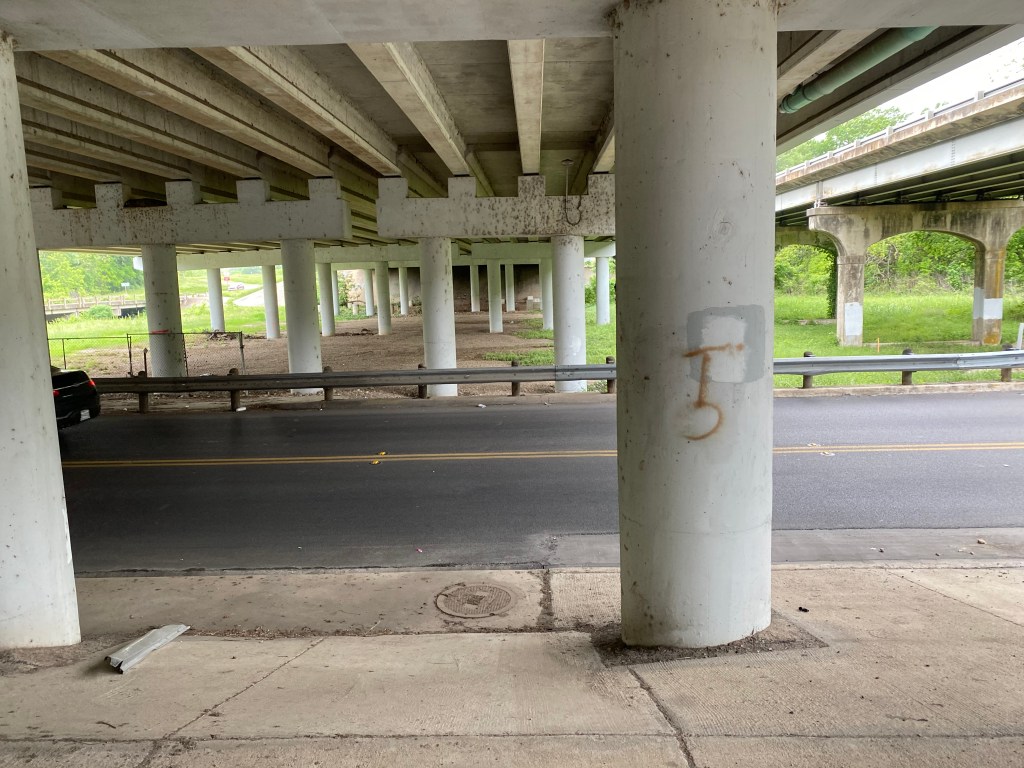
One part of that is that they removed the old underpass along the river:
TxDot photo
So on the right hand side, you can see where they’ve torn up the road that used to go under I35, along the river.
Here’s a photo I took, back in 2020, during lockdown:
So that’s what the underpass looked like at peak pandemic.
Removing it was a major bummer for the good people in the Blanco Gardens neighborhood. They lost their best connectivity across I35. Now they have to go up to Hopkins-80, or down to Guadalupe-123, and deal with a big, busy intersection.
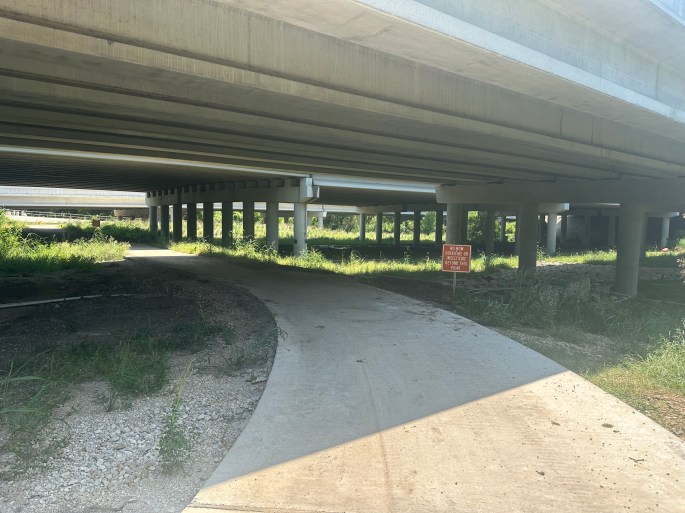
Since then, TXDot has replaced it with a hike and bike trail.
It looks like this:
So you can easily bike from Blanco Gardens over to Riverside, and you end up by Herberts. That part is great!
So what are we doing now? Pink is the route you can currently take on your bike:
Yellow is what’s being proposed. It would connect the east and west sides of the park trails. Great!
This was not in the budget back in May. But since then, we’ve been awarded two grants to cover the cost. The total cost for that little yellow sidewalk is $2 million dollars.
TWO MILLION DOLLARS? Well, yes. Here’s why:
Blue is the main river that you swim in. But there’s this little side channel, in purple, from an old dam built in 1904:
In fact, here’s some of the machinery from the mill:
So that tiny little yellow sidewalk is $2 million dollars, because you have to build a bridge to get across this little side channel.
Now, San Marcos is not paying $2 million for that bridge. What we did was apply for a bunch of grants, and we got almost all the money covered. We just have to pay $300K for that bridge in matching funds. Great!
Mark Gleason is uncomfortable with this $2 million. He lives in Blanco Gardens and actually walks and bikes all over the place, so he’s constantly using this path. He’s just not sure if the cost justifies the increased connectivity that you get. Even though the $2 million is mostly federal money, he just feels weird about it.
I see his point. It’s such a disproportionate cost, compared to the shoestring that San Marcos usually runs on.
But then I just tell myself, “Hey, don’t forget we’re spending $1.2 million on Kissing Tree this year!” Then the $2 million bridge for everyone doesn’t seem so bad. Especially since most of it is covered with federal money.
Plus, once the east side of the river parks gets built out, the parks system will need to be connected, so we might as well do it now.
We’ve got a big utility assistance program in San Marcos, but it doesn’t always work very smoothly. Let’s talk about it.
How many people are we talking about?
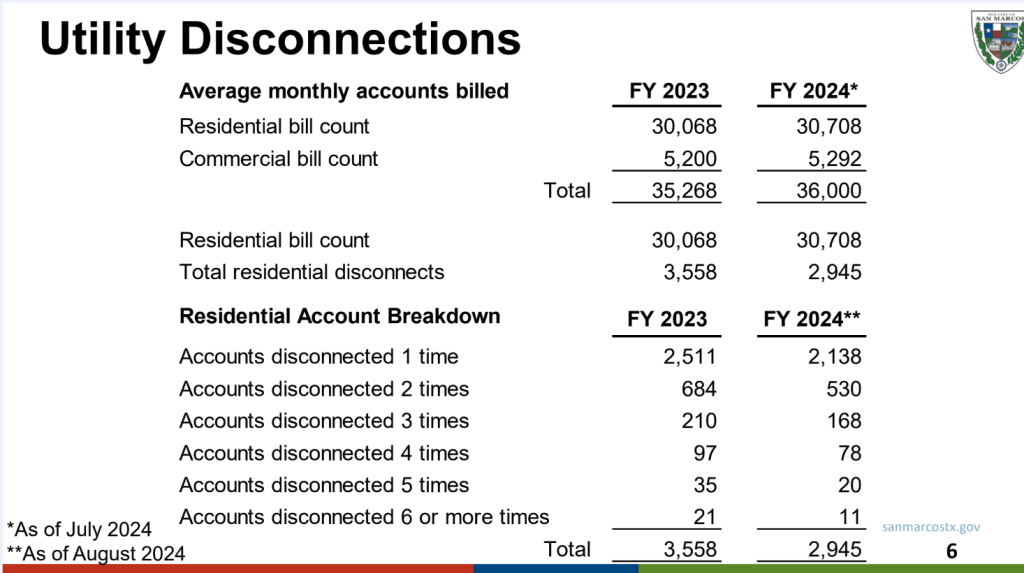
So there are about 30,000 residential accounts, and almost 3000 accounts have been disconnected so far this year. (Some multiple times.)
Here’s how it’s supposed to go. Suppose you get a disconnect notice on your electricity or water. You call the city. The city does two things:
Offers you a late payment plan
Connects you with the nonprofits that offer utility assistance.
How often does it work like that?
So far this year, we’ve given 580 accounts utility assistance, but 107 of those were still disconnected anyway. There have been 1,948 accounts that have gotten extensions – some of them multiple times – and 586 have still been disconnected.
So out of the 3000 disconnections this year, most people aren’t getting into the system to get help ahead of time. For the people who get in the system, about 75% avoid disconnections.
…
Ok, so let’s talk about the assistance side of things. San Marcos kicks in $231K to utility assistance. The biggest chunk of that goes to Community Action:
But Community Action also gets some federal money, so there’s actually about $435K available for assistance:
Community Action gets $120K from the city. But when someone comes in for assistance, Community Action tries to spend federal money first. So only $14K of the $120K was spent. However, the federal water assistance program has ended, so Community Action will need to spend more city money to cover that need.
The biggest problem is that federal money is slow. You have to fill out a ton of paperwork. But people need money immediately – cars need to be repaired, babies need diapers, the lights need to stay on, etc – or else small crises spiral into giant crises. So we need a way to get money to people fast.
A few things get discussed:
Do we have to charge a 10% fee on late payments? Can we just make it a flat $10 fee instead?
Should we spread out city money among different agencies?
Would the other agencies actually have enough staffing to get the money out quickly?
What about San Marcos residents that are on Pedernales electric? Answer: they can get federal assistance, but agencies can’t use the credits from San Marcos electric specifically.
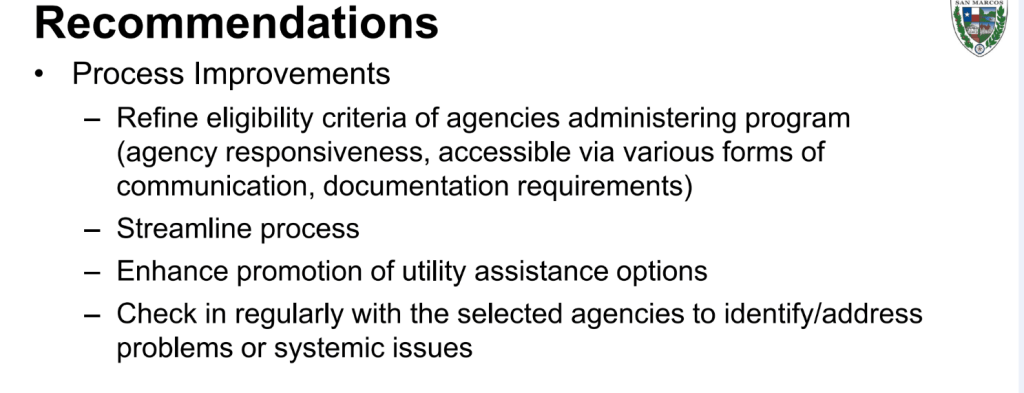
Here’s what we’re talking about doing:
We’re also going to look at our fees and see if we can afford to reduce them.
Here’s my two cents: It is really hard to administer programs to the public well. It’s hard to find people, get their ear, get them to respond, get them to bring in paper work, find funding, and connect all the dots to get the assistance to people.
We tend to see overhead spending as wasteful, but it’s really not. Thoughtfully designed programs that aren’t running on fumes can serve people better.
Finally: if spending $231K of tax dollars on utility assistance gives someone heartburn, just remind them that we’re spending $1.2 million dollars on Kissing Tree this year.
Item 20: Project Robot! Great name, right? Project Robot is a three year property tax break that we’re giving to a giant laundry service that will go in next to the new Amazon facility, on the north side of town. It sounds like it’s mass laundering of hotel sheets and towels.
A lot of attention was paid to requiring the facility to maintain its Clean Green standing for ten years. This is good, but I am not an environmental engineer and can’t really weigh in on what’s greenwashing and what’s substantial.
Supposedly the facility will create 100 jobs at average salary of $44k, with full benefits from day 1. This sound suspect. To me, that sounds like 90 jobs at $25K and ten jobs at $500K. “Average” is not necessarily what you want to know about that situation.
What else was discussed?
Universal utility forgiveness passed unanimously, although Commissioner Derrick allowed herself a small “SURE I GUESS” through gritted teeth. Total price tag comes in at $581K.
(There was a hilariously petty exchange between Commissioner Scott and Mayor Hughson that basically descended into “am not” “are too”, like my kids do, over whether or not it is a sure thing that this won’t affect our budget score. Technically the bickering when “We’ll be fine” “We don’t know that” “I know that” “We’ll see” ad nauseum. I enjoyed it immensely.)
390 acres of Whisper South were annexed, with only Commissioner Baker dissenting. There was no discussion and I have no opinion.
Electric Cab Bus Proposal was postponed for a month. I grokked that the entire council is mad about an extremely shitty proposal that was put forward, although I don’t know what went wrong. The proposers have a month to fix it, or they will go back to the pool of proposals to reassess.
Max tax rate was set, although the actual tax rate will come under that.
Some vacancies were filled. Amy Meeks will join P&Z.
Spear guns will come back around as an ordinance
P&Z and Council will be required to undergo CodeSMTX trainings
And while there were some other fiddly details, I’m declaring that to be a wrap! Thanks, folks, and see you in September!
Top billing of the night goes to Item 42, the update on the emergency utility assistance. At this point, the city has paid out almost half of the million dollars available for utility assistance. In addition, city staff seems to have stepped up its outreach, from last month when this program was stumbling along ineptly.
Shane Scott says, “Can’t we just forgive all debt?” He said this last time, as well.
The city staff, in their neutral way, is timidly-yet-STRONGLY opposed. – This isn’t what the consultants recommend. – This may affect rate hikes. – This could involve cases where the tenant just plain moved without disconnecting the electricity. – This could affect San Marcos’s rating with S&P which we need in order to levy bonds.
Scott points out, quite rightly, that the city owns the utility company and can move its money around.
Alyssa Garza and Max Baker are strongly in favor.
Jane Hughson and Mark Gleason are both convinced that people will not bother to apply for assistance until they get the shut-off notice. So they are opposed. Mark even calls it “a tax on everyone else”.
Melissa Derrick wants to know the consequences more thoroughly – how will this affect rates on everyone else? How will this affect S&P ratings?
Alyssa gives the speech of the night, about how detached City Council is from the actual experience of poverty and being buried in bills. That our “simple application” for relief may be simple, but when you’re getting multiple disconnect notices you stop opening envelopes. That no one is secretly sitting on cash, waiting to get a disconnect notice to sigh and finally pay. They aren’t paying because they don’t have the money, full stop.
(Max does say that he originally proposed this but everyone overrode him. He also notes that this is a drop in the bucket compared to the city budget.)
The vote: Shall we just wipe out all utility balances >30 days past due?
In favor: Saul Gonzalez, Shane Scott, Max Baker, Alyssa Garza, and Mark Gleason
Opposed: Melissa Derrick and Jane Hughson
Motion passes, 5-2!
Mark Gleason gets a prize for the weaselliest comment of the night: after being the most impassioned person against this motion, he abruptly says, “Well, since this is obviously going to pass, I guess I’ll vote yes.” Oh, do you like being on the right side of history once the writing is on the wall?
My own hot take: This is clearly the right move. It’s relatively cheap and helps a lot of people in a way that aligns with our values.
One side point: the city has done a tremendous amount of outreach on the utility assistance program, and it is not reaching people. The number of outreach labor-hours saved by just wiping the slate clean is significant, and should be taken into account in the budgeting of this.
The next recurring theme was a large amount of money to be allocated, across different items.
Items 35-36, $9 million from American Rescue Plan Fund (and it sounds like there will be 9 million more, next summer.)
Item 40, $800K in CBDG proposals for the 21-22 fiscal year
Item 41, $1 million in utility assistance
So these were quite a lot of fun – feeling flush with cash and able to grant all the wishes to all these nonprofits. Down with austerity and belt-tightening!
On the first, the American Rescue Plan Fund:
– they argued about whether tourism and marketing should get quite such a big cut. It seems that this sector is limited in where they can seek funds, and they did take quite a hit during COVID. But maybe not quite as much as was proposed. ($282K)
– they argued a bit about Briarwood, a neighborhood outside of city limits that suffers severe flooding, in part because of how San Marcos has been developing. There’s a 2.5 million stormwater mitigation project there. They managed to thread the needle on that one – postpone it by three months and fund it from several spots.
– A lot of small projects got some money: Southside Community Center, bilingual outreach and communications, KZSM, vaccination outreach, Nosotros la Gente, which provides shoes for local kids. Good feelings all around.
2. On the CBDG funds, nearly everything got funded besides Roland Saucedo’s proposal, which is seeemingly why they chipped in for him in the previous funds.
3. The Utility Assistance fund is interesting. They’ve paid out about 20% of what’s available, and they’re all concerned that people aren’t applying. City staff was put on the defensive about their outreach efforts.
– Everyone who is past due gets a letter with info on how to apply. If the city has an email address, they send an email too. – The city has reached out to the Food Bank and SMCISD. – The application was made fairly short – just one page. – Disconnections have been suspended during the pandemic, but there will be a date set to resume disconnections.
Criticisms:
– how about going through the churches? Commissioner Gonzalez says that he has to KEEP directing city to this and they never do. – Commissioner Gleason, Commissioner Derrick, and Mayor Hughson all feel like until you send them notice of disconnection, no one will be very motivated to apply. – Commissioner Garza talks about how people (meaning the Hispanic community) are more likely to just tighten their belts, out of not wanting to take more than their fair share, and that they’ll want to save the funds for someone who REALLY needs it.
Commissioner Scott, actually, was strongest on this: “Can’t we just see who is past due and pay off their balance without them having to apply?”
Hughson concern-trolled about undeserving people who have the money and could pay. Nothing Texas hates more than someone receiving some crumbs when they could have scraped by without them. Garza is enthusiastic about this proposal.
Scott’s proposal – just pay off the deliquent accounts – has to be put on the agenda and brought back as an item, because it didn’t fit onto the existing agenda. So it still could happen.
…
As an aside: there’s an ongoing dynamic where City Council and Lumbreras are perpetually exasperated with each other. It goes like this:
Council frequently acts like he has done something incompetent.
He then defensively retorts that they tied his hands in the way they made the request.
I am not sure yet who is being a jerk, or if there’s blame to spread to both. Mayor Hughson herself is a generally prickly person, and it often doesn’t mean anything.
…
All three topics will be finalized at some point in August.













 The San Marxist