
Item 19: SMCISD is broke.
Backstory:
For the past few years, the state has been strangling the school districts out of funds, in order to get legislatures to approve Abbott’s vouchers plan. In other words, back in 2019, we received $6,160 per student. It has not been raised since. With inflation alone, it should be $7,774.18 per student now. (And since Uvalde, there’s been a massive increase in unfunded, mandatory safety measures.)
SMCISD is looking at a $4-5 million budget shortfall.
I’m sorry. I need to stop and shout for a second.
This is a huge, wealthy state with budget surpluses! We had a $32 billion surplus in 2023 and a $24 billion surplus in 2025. There is plenty of money.
The reason that funding has been frozen is that Abbott is holding the public schools hostage. He wants a school voucher program. He didn’t get it in 2023, and so public schools were punished.
Furthermore! (My god, I’m going to hyperventilate.) FURTHERMORE!
Here’s Abbott’s voucher proposal: Increase per student funding from $6160 to $6380 at public schools, while private schools get $10,000 per kid from the state, plus whatever additional tuition above that. Everybody got that? Private schools – schools that can turn away kids with disabilities, kids with trauma, kids with behavior problems, and any other kid requiring extra TLC – get a lot more money per student than public schools.
How much money will SMCISD lose if this passes? There’s a handy website here!

And what does it say?
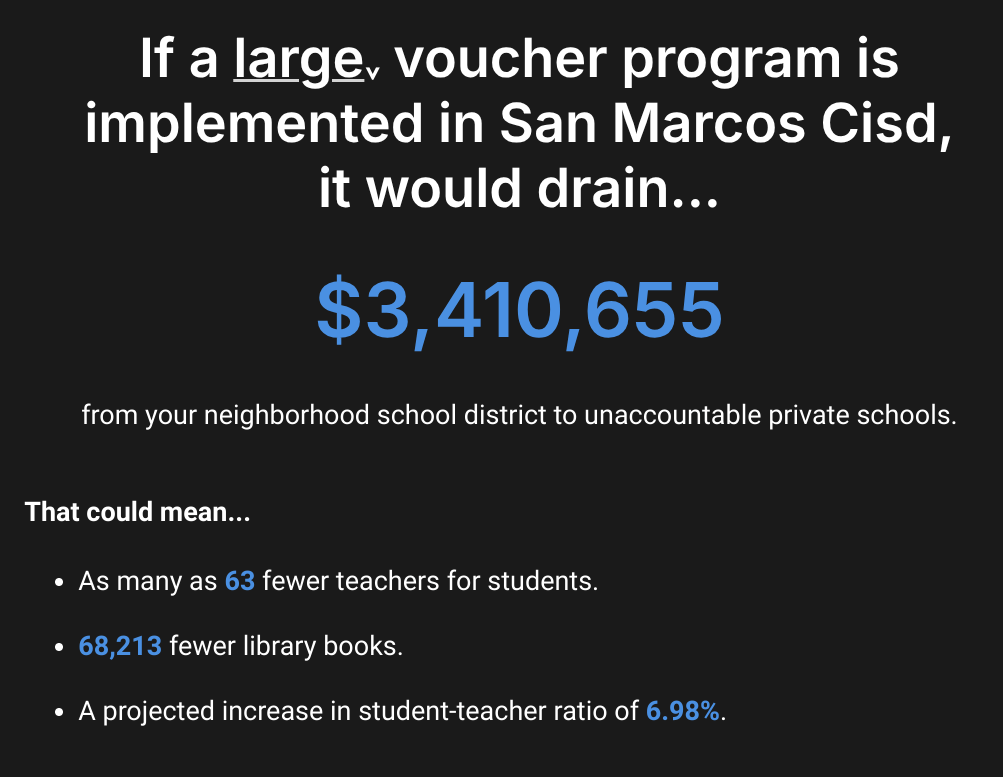
Let’s be super clear: the villains in this whole story are Greg Abbott, Dan Patrick, and the state legislature.
…
Okay, so even before the vouchers scam passes, SMCISD is looking at a $4-5 million shortfall.
This is already going to make San Marcos kids lives harder. Teachers who love them to bits are going to lose their jobs. It’s very real and it’s very awful.
In this context, SMCISD spends $372K on stormwater drainage fees to the city every year. They’re asking for a waiver from the city.
What’s the city side of the equation?
The stormwater fund is $9 million. Stormwater money gets used on two things: big drainage projects and yearly maintenance. But the big projects are covered by debts, and so we’re obligated to keep making payments.
Giving SMCISD this waiver would cut yearly maintenance by 40%. Drains wouldn’t be inspected for clogs, ditches wouldn’t have debris removed, etc. Flooding would get worse.
Do other cities exempt ISDs from stormwater money?
Some do: Austin, San Antonio, and Round Rock all do.
Some don’t: Seguin, New Braunfels, and Kyle all do not.
Remember how I said the state is the villain in this? They strike again! State buildings, federal buildings, schools, nonprofits: everyone pays stormwater fees, and your rate is based on how big your footprint is. More impervious cover means a higher stormwater fee.
But! There’s a specific state law that carves out public universities, and only public universities. So Texas State University has paved the top of San Marcos, and yet does not contribute towards the cost of the flooding, caused when it inevitably all rolls downhill.
(Sometimes I marvel at what this state could be like, if we weren’t constantly suffering from self-inflicted wounds. Stop voting for pricks, everyone.)(I am aware that readers of this site probably didn’t vote for Abbott.)
What does Council say?
First off, there’s no decision tonight. This is just testing the waters – would Council like to have a formal discussion next time?
Lorenzo: Can we look at a 2 year waiver instead of an indefinite waiver?
And can we look at a middle option – some kind of discounted rate tier for SMCISD that’s outside of residential and commercial?
Alyssa: SMCISD fills big gaps in our service. They’re the ones that take care of Redwood, for example. Let’s consider this.
Matthew Mendoza: I’m angry on behalf of Sunset Acres. We’re trying to fix the drainage there, and SMCISD is holding it hostage.
Note: here’s my understanding of what Matthew means:
In November 2022, we took a big look at the flooding in Sunset Acres. It’s really, really bad.
We came up with a semi-fast track solution to get it fixed. The fastest part of the solution hinges on enlarging a detention pond at Mendez Elementary.
The city made two offers SMCISD, in exchange for the easement – about $350K for the land, or a credit for stormwater fees. (Pretty similar to what they’re asking us for, now!)
SMCISD was interested and started to work with us. But then they realized they needed to renovate Mendez. Currently, they’re waiting on permits. Once they can see how big the footprint of the new Mendez will be, then they’ll come back and talk with us about the drainage pond.
So the “quick” solution to fix the flooding has now become yet another holding pattern, going on three years now. The neighborhood was already pessimistic about the city fixing anything, and this kind of thing makes it worse.
Amanda makes a few different points:
– I would entertain two years, but definitely not in perpetuity.
– The Texas Legislature is going to suck just as much in two years as they do now. I need to see what other cuts the school district is making, in order to balance its books on the other $4 million.
– Lots of neighborhoods have lost faith in the city to fix their flooding problems. This money is for those projects.
– If our rationale is that SMCISD covers gaps in our services, then this opens the door for every nonprofit to ask for a waiver as well. We need to be really careful with our precedents.
Jane: I don’t think we should even bring it back for discussion. But enough of you have said yes already. Definitely not just 2 years, because we’ll forget to enforce it.
So this will come back.
The most important thing to understand is that the state of Texas is the only villain here.
…
Item 22: Councilmember compensation:
(Discussed last time.) Councilmembers get three kinds of funding:
- Regular (measly) paycheck
- Travel and expenses (you have to submit receipts)
- Flex money (you choose whether to take it as income or use it for expenses)
Right now, here’s what everyone gets:

So this is Shane Scott’s proposal, and he wants to double the travel and flex spending amounts.
Jane’s got amendments! “First,” she says, “We don’t need this. We’re not running out of travel funds. Some of us go over, some of us go under. We just need to lend each other our un-used amounts.”
Here’s what she means:

So $13,500 is the mayor last year, and $7,500 is each of the council members. (Jude is the $15K, because it includes his flex spending. He worked for the county, so he couldn’t accept a city paycheck.)
So you can see: some went over, some went under, but the total was $51,810, which was under budget.
Great! There’s no problem!
Here come the amendments
Jane Amendment 1: Keep the Flex money at $7,500, instead of doubling it to $15K.
The vote:
Keep at $7,500: Jane, Matthew, Saul
Double to $15K: Alyssa, Shane, Lorenzo, Amanda
So this fails.
…
Jane Amendment 2: Keep the Travel money at $7,500, instead of doubling it to $15K.
The vote:
Keep at $7,500: Jane, Matthew, Saul, Amanda
Double to $15K: Alyssa, Shane, Lorenzo
So this passes.
…
So now we’re looking at doubling the flex spending and leaving travel alone.
At this point, Alyssa balks at this piece-meal approach. She wants to go back and retract her yes vote for the Flex money, and instead double the Travel money.
There’s a lot of confusion around this. Flex money can be used for Travel, so why does it matter? There’s a lot of arguing about what’s easier, and whether the flexibility of Flex Money is too complicated. Ultimately there are not enough votes to reconsider the motion, so it stands.
…
Next: Shane amendment: Okay, just increase Travel money by $2K, then.
Keep at $7,500: Jane, Matthew, Saul
Increase to $9,500: Alyssa, Shane, Lorenzo, Amanda
So this passes.
…
Jane amendment 3: If you want to borrow travel money from another councilmember, you have to get council approval at a meeting:
Yes: Amanda, Jane, Matthew
No: Saul, Alyssa, Shane, Lorenzo
So this fails. Councilmembers can just lend each other money, and notify the finance committee accordingly.
…
Next: it turns out there’s a special travel fund that everyone’s forgotten about. It used to have $25K in it, for council members who went over budget. We let it drop during Covid, when no one was traveling, so now it has $5K in it.
Jane amendment 4: Increase the special travel fund to $15K, but you have to get council approval at a meeting.
Everyone is fine with this. The vote is 7-0.
…
The final vote on the whole thing:
Yes: Everyone but Matthew Mendoza
No: Matthew Mendoza
So Council members will now get:
- $17,400 paycheck
- $15,000 flex spending
- $9,500 travel and exspenses
I am fine with this. You want your council to be able to learn about governance and write good policy. They need time and resources to be good at their jobs.
(No one brought up an amendment about waiting for the next budget cycle. So it goes into effect mid-budget, immediately.)
…
Item 23: Delinquent Apartment Complexses
This is actually great governance in action.
Generally speaking, if you don’t pay your utility bill, your water/electric/etc gets disconnected. But what if you live in an apartment complex, and you pay a flat rate to your landlord, and the landlord doesn’t pay the utility bill? Do we really want to disconnect the electricity on a bunch of renters who didn’t cause the problem?
No, we don’t! So let’s not do that.
Instead we’ll put a municipal utility lien on the property. So only the owner gets affected, and not the tenants.
Everyone likes this. 7-0.
…
Finally there are some various appointments to various boards, and futzing with small rules to some boards and commissions.
This was a very, very long meeting, and there’s still a 3 hour workshop to go, so maybe let’s stop here.
 The San Marxist