This is the same problem that happened with the La Cinema studio over the aquifer last year: by the time the public hears about something and has time to organize and respond, the development agreement has already sailed through Council.
With the SMART Terminal, the developer does still need more approvals. The new land isn’t yet zoned Heavy Industrial. So there are still intervention points. But the foundation has been set, and it’s very frustrating how quickly the basic agreement gets sealed.
In February, the SMART Terminal went to P&Z to be zoned Heavy Industrial. Because so many community members showed up and spoke at that meeting, P&Z delayed the vote a month, to give the developer time to meet with neighbors and gain their buy-in.
The speakers this week described how the meetings are going. It sounds like the developers are being giant pricks about meeting with neighbors, let alone gaining their buy-in.
When they finally met, the neighbors learned some interesting things. First, recall that SMART stands for San Marcos Air Rail Transit. It’s located right where the airport, railway – and unfortunately the river – all meet.
Anyway, here’s what the developers said to the neighbors:
There’s no rail. There’s not going to be any rail. The developers haven’t reached out to the railroad company and have no intention of incorporating the railroad into any of the five stages to be built.
There’s no air traffic, either. And no plan for any future airport tie-in.
So basically they’re planning a 2000 acre truck loading and unloading industrial site, right on the river? It’s gone from SMART to SMT? (Maybe the R was supposed to stand for River. The San Marcos All runs down to the River Terminal. Wheeeee.)
In response, the developers say, “Look, back in 2018, council told us this was the right place for heavy industrial.”
But let’s check that for a second: – First off, in 2018, it was 900 acres, and now it’s 2000 acres. – Second, clearly in 2018, the whole point was that the airport is right next to the railroad. Otherwise, you’re just building a massive industrial complex on the river.
So as best I can tell, that is the plan: a massive industrial complex on the river. This really seems to be a terrible idea. Unfortunately, this council (minus Alyssa) really has heart eyes for corporations.
…
Items 16 and 18: Starting on next year’s budget.
Council and department heads had a big two day workshop, where they envisioned the city for the next year in broad terms. This statement is the result, and it’s supposed to be the starting point for the new budget.
Here’s what they came up with:
Each of those has 5 or 6 sub-points, and then each of those has another 2-3 sub-sub-points. So for example, under Quality of Life & Sense of Place, it says:
The whole thing is pretty long. If you’re curious, read it all here. That document is supposed to be the scaffolding for the actual budget, which gets built over the spring and summer.
As for last Tuesday, there was not much more additional discussion. Max Baker spoke during the public hearing portion, and made some points: – Weren’t you all going to do an Equity-based budget through a DEI lens? – Annexing distant neighborhoods blows a hole in your future budget. As soon as they’re built, you have to provide fire/EMS/PD, as well as utilities, and it costs more to staff new far-flung firehouses than you’re bringing in with taxes. Sprawl is expensive for the city. – Budgets are moral documents.
These are all good points!
Alyssa asks her colleagues to consider a participatory budget process next year. Get the community involved. This would be great. Maybe CONA reps could solicit input from their neighborhoods, and then contribute ideas when Council puts together their strategic goals.
(Because I’m a pessimistic jerk, I can also imagine neighborhoods coming up with goals that I’d find awful, like “let’s keep poor people far, far away.” So there need to be checks and balances.)
Several people (mostly from Mano Amiga) speak on Josh Wright, the guy killed by a corrections officer at the hospital a few months ago. (Six shots in his back, while wearing leg shackles. There’s no way to parse that as anything but cold-blooded murder.)
Several of the speakers point out that none of the councilmembers, besides Alyssa Garza, have issued statements on Joshua Wright’s death, nor offered condolences to the family. It’s true that the corrections officer is part of the Hays County system, not the city system, but councilmembers are still public officials with a platform and influence. Right now, they’re using that influence to quietly twiddle their thumbs.
Several people speak on the SMART Terminal. SMART Terminal was approved two weeks ago. Last week, at P&Z, the SMART Terminal was up for re-zoning to Heavy Industrial. An even bigger turnout of people showed up to speak against it. A ton of people shared stories of flooding downstream of the proposed SMART location. I do not see how Council could have thoroughly vetted stories of flooding before approving the terminal, given the vast number of personal stories that popped up last week.
P&Z ended up postponing it for a month, to give the developer time to meet with community members and gain their support.
As an aside: A lot of people are upset because the SMART Terminal was approved before they even heard it was coming. This is a big problem: how can a city notify the public about a project in their area? The city does actually try pretty hard: there are supposed to be signs posted, in big font, and there are supposed to be notifications mailed out to residents nearby. The problem is that these things are time-consuming, expensive and still don’t work that well. Signs blow over, mailers go out to home owners and not renters, people live further than 400 yards away but still will be affected, etc. (Council is fixing the renter problem – they will start getting notifications too.)
I want to talk about mailing notifications. The notification radius is 400 yards. Everyone who lives within 400 yards of the boundary of a project is supposed to get a notification in the mail. It used to be 200 yards. It was expanded a few years ago. City staff was stressed out by increasing the radius – it increases their workload, and also gets expensive.
So look, here’s an easy solution: the notification radius should be proportional to the size of the project. Rare gigantic project like the SMART Terminal or the entire Riverbend Ranch Development? Should have a very large notification radius. Frequent, ordinary, small scale project? Should have a proportionally smaller notification radius. It’s very weird that the notification for Sean Patrick’s CUP is the same radius as for the Martindale-sized massive-slab-of-concrete-by-the-river future SMART Terminal.
…
Item 17: The speed limit on 123 is going to be reduced from 60 mph to 55 mph.
I mean, this is basically the stretch that half the high school students take to get to the high school. It doesn’t seem crazy to me to knock the speed down just a hair.
(There was an awful tragedy at Goodnight Middle School on Friday, involving a car. We are all so fragile, and the people we love are so fragile, too.)
…
Item 18: Apparently the state of Texas wants to give us $45,000 for us to build a metal awning to protect police cars. Nothing wrong with a metal awning to protect cars.
The problem is that the source of the $45k is deeply tainted: it’s from State Seized Asset Funds. Civil asset forfeiture is a giant gross mess. Basically cops are allowed to confiscate anything potentially related to a crime. But then, regardless of whether the owner was innocent, guilty, or completely unrelated to the crime, the cops end up keeping the property. Police departments end up profiting hugely off it, which then motivates them to grab property even more aggressively and ever so tenuously connected to an actual crime.
Do I think we should turn down the money? I don’t know. This state is so broken on this topic that I don’t think it would do any good, frankly, except as protest. Whether we accept the money has zero bearing on whether or not Texas ever reforms its civil forfeiture policies. But it’s worth adding this to your mental rolodex of ways that police abuse community members.
Back in December, they applied to P&Z for a renewal of their alcohol permit.
At the same meeting, Industry was up for a renewal of their alcohol permit, too.
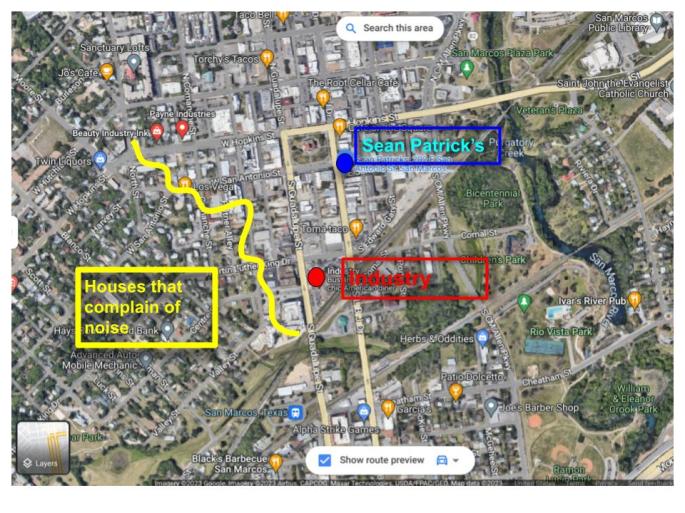
Industry, of course, is right next to the Dunbar neighborhood. A lot of people are very cranky about the noise coming from Industry. In response, P&Z said “No live music after 10 pm.”
Then Sean Patrick’s came up. There haven’t been any noise violations against Sean Patrick’s. But P&Z made an issue out of it, kinda out of nowhere. They changed Sean Patrick’s hours of live music from midnight to 10 pm.
This seemed way off-base to me. Sean Patrick’s is not near houses the way Industry is near houses:
P&Z wanted to be consistent, which is understandable. But the whole point of P&Z is to look at individual circumstances and make a judgement call. You do want consistency when it comes to values and ideology! Just not necessarily when it comes to outcomes.
So Sean Patrick’s appealed P&Z’s decision, and Council agreed. The bar gets its live outdoor music back, after all. At least until midnight.
…
Item 6: The SMART Terminal got revisited for about two seconds.
Alyssa brought the item up for discussion. She is a “no” on the SMART Terminal. But they’ve gotten a lot of complaints and questions over email. So she asks if the other council members – the ones who want the SMART Terminal – could respond to these citizen questions and complaints.
Translation: We all know this is going to pass, and we all know people are furious. Why don’t you all go on record addressing the environmental concerns and all the rest of it?
Jane Hughson said, “Why don’t we update a FAQ about the project? We can make it available to the public online!”
Translation: Or how about we don’t? Staff can script some soothing language about “dialogue” and “different stake-holders” and this will all go away.
And lo, that’s how it’ll go.
…
Item 24: Council appointments to all the various committees
This got postponed. Womp-womp.
It really is understandable. It was getting late, and Council has been there since 3 pm. It takes like an hour to go through all the committees. It’s also kind of a bummer, since many of the nominees have been watching for four hours, waiting for this.
Alyssa speaks up: she crunched the numbers on the applicants, and they’re overwhelmingly old and white. She brought this up last year as well. When are we going to take this seriously?
Jane defends city staff and how they worked hard to publicize the committee process.
That’s not really relevant – staff does work really hard! No one is criticizing staff! But what we’re doing isn’t working.
Jane says that she does think it would be better to push the process out a month and give more people time to apply.
That can’t hurt, but it also won’t solve the problem.
Alyssa says that only part of the problem is the publicity – the process also has to be demystified. It’s intimidating to sign up for a board or commission, especially if you consider yourself to be an outsider to the process.
Jane says it’s much better than it was five years ago. Also true, but not sufficient.
My opinion: it won’t change until we overhaul community outreach. We have to have relationships with the key individuals who work at churches, barber shops, and bars and restaurants that function as community spaces. And I specifically mean venues that cater to underrepresented groups in town: Hispanic communities east of I-35.
There is just no shortcut to building relationships. It’s time-consuming. It goes faster if your staff is also a part of the underrepresented communities, but that’s kind of a chicken-and-egg problem.
…
Items 25-26: Top Secret Executive Session
Obviously I don’t know what happens in the room where it happens, but the topics are very interesting:
1. Albian Leyva vs Ryan Harman and Jacinto Melendrez. This is the excessive force/tasing incident. This incident ispretty extreme. At the January 17th work session, one of the Mano Amiga representatives read outloud from the internal police investigation. (You can go listen here, starting at about 8 minutes in.)
It’s pretty awful. Melendrez is the second officer who also tazes Leyva.
This is from the Mano Amiga FB page:
2. Eric Cervini, et al. vs. Chase Stapp, Brandon Winkenwerder, Matthew Danzer, and City of San Marcos
I’m guessing this is the Biden Bus incident? It’s been two years. I am very interested in there being some consequences for this.
3. Repealing Meet and Confer. Obviously we know how this turned out. (This part of Executive Session was held early on.)
Plus some miscellaneous conservation of land items, and personnel things.
Citizen comment: The big topic for citizen comment is the SMART terminal. Residents of the area are worried about:
Flooding
River pollution
Litter
Traffic
Noise and smells
Representatives from the San Marcos River Foundations also spoke, but they got super specific about policy proposals, so I’m going to save that for actual item.
Max Baker was the last speaker, and he railed against the community survey results and lack of trust in city staff. He also spoke out against the Riverbend Ranch, saying that HK real estate people operate and negotiate in bad faith. Finally, he says, “I’ll have more to say about the SMART Terminal, but I’ll save that for the public hearing.”
That last sentence is supposed to be me foreshadowing for you. Hey everybody, <waves hands>, for no particular reason, note that Max has said that he is planning to speak during the public hearing for the SMART Terminal.
…
First up is the SMART Terminal!
Items 20-21: A few meetings ago, we got introduced to the Cotton Center and the SMART Terminal:
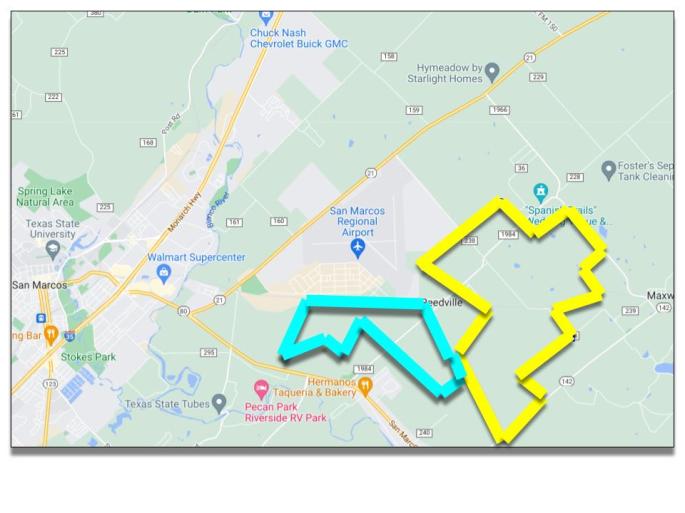
Yellow is the Cotton Center, the gigantic master planned community that was approved in 2016. Aqua blue is the SMART Terminal. The SMART Terminal is supposed to bring together the magic of a tiny airport, all our trains, and Highway 80.
How big are these things? The SMART Terminal blue bit up there is 900 acres. The Cotton center yellow bit is 2500 acres. The issue is that the SMART Terminal wants to take 600 acres from the Cotton center, and then also three more packets of extra land.
So here is the proposed future of the SMART Terminal:
The aqua blue is the old SMART Terminal. Yellow is getting taken from the Cotton center. Green is brand new.
San Marcos River Foundation is concerned because there are two creeks running through the property to the river. You can sort of see the creeks above, and in the map with my janky drawing, you can see the San Marcos river at the bottom.
First is a staff presentation. We learn that “SMART” stands for: San Marcos Air Rail, & Transportation
So that’s a good start!
One detail is this little green box with the yellow highlighting:
That little yellow box lives in Martindale’s ETJ, instead of San Marcos’s ETJ. So we’re not allowed to make a development agreement for that little bit. (I’m guessing maybe that’s part of the mysterious Martindale fuss alluded to here.)
The total acreage of this new, SMARTER Terminal is 2,017 acres. That is huge. Google tells me that 2,017 acres is 3.15 square miles. Google also tells me that Martindale is 2.09 square miles. So the SMART terminal is going to be 150% larger than Martindale. (More like SMARTindale, right?? …I’ll show myself out now.)
Environmental standards
The developers want Heavy Industrial and Heavy Commercial. Here are the creeks that run to the river:
The blue striped parts are floodplain. The green is the creeks themselves. That’s a pretty direct channel to the river.
Here’s what the developer worked out with the planning department:
70% impervious cover, overall. This is stricter than the regular city code, which would allow up to 80% impervious cover.
Impervious cover can be patchy – up to 90% in some places, less in others, as long as it averages out to 70%
Total Suspended Solids (TSS): Here’s my shaky understanding of TSS: when it rains, rainwater is nasty because it carries all the surface pollution with it. So you retain rainwater in retention ponds to prevent flooding, but then you want to clean it before you release it. So you either want to let it settle, or filter it, or whatever. TSS is how much you have to clean it.
They’ve agreed to 70% TSS. I don’t know what our code requires. (The developer claims their sand filtration basin system actually captures up to 89% TSS, but they’re only obligated to maintain 70% that by the contract.)
Water retention: what kind of flood do we want it to be able to handle? They’ve agreed to 1.25” rainfall. My memory is that this should be given as a rate: 1.25″ per hour, or 1.25″ per eight hours, or 1.25″ per day, or whatever. Not just a 1.25″ without any time frame. But in this agreement, there’s no time window given.
My uneducated read is that 1.25″ without a specified time window will get overwhelmed any time we have a mildly disasterous rain, let alone one of the massively disastrous rains that we’re known for.
Run-off: they have to reduce run-off by 10%. This is stricter than the code – code says you can’t make run-off worse than it was before the development, but you don’t have to improve it. So that is good.
San Marcos River Foundation weighs in
Earlier, during Citizen Comment, SMRF made their case. They’ve had good conversations with SMART. They want:
Half of the floodplain acreage should be removed when calculating total gross impervious cover.
In other words, say you’ve got 100 acres, and 20 acres is super sensitive land where you can’t build on it. Suppose you’ve agreed not to pave over more than 70% of it. Should it be 70% of the 100 acres, or 70% of the 80 buildable acres?
SMRF is proposing to split the difference – allow them to compute the 70% based on 90 acres, in this analogy.
The setback to the floodplain should be wider than 30 feet. SMRF observes that 30 feet is really pretty slim.
Any acreage using 90% localized impervious cover be placed farthest away from the river. In other words, the most-paved parts should be furthest from the river.
Council Discussion
Council begins asking questions, and then this very weird thing happens: Jude Prather speaks up and says: “I think we have one more public speaker…”
There is some fumbling around. Over zoom, you hear Max Baker say, “Is it my turn to speak now?” (Remember the foreshadowing, when he said he would be speaking during the SMART Terminal? This is that.)
Jane Hughson says no, Max can’t speak, because he didn’t sign up to speak the day before. She adds, “If you’re in person, you can just get in line to speak. But over zoom, you have to sign up the day before.”
What she means is that back in March of 2020, council had to set up zoom rules. How will citizens get the zoom number? How will they get moved from the waiting room to the main room? Etc. So they said that you have to sign up to talk the day before, to help with logistics.
Now: Max clearly did sign up the day before, because he spoke during Citizen Comment, and so someone gave him the zoom link. Jane is arguing that Max should have signed up for each item that he wanted to speak on, even though it’s the same zoom link. And even though that was really not the intent of the original rule.
Alyssa points out that we’ve revisited Covid-era rules many times, and this one just hasn’t come up, but Jane is firm. “He’s allowed to speak, he just had to sign up yesterday.”
Here’s the thing: generally Jane extends a lot of courtesy and grace to ordinary private citizens who take the time to show up and speak. It seemed like this was a maliciously strict standard that only applied to Max Baker. It felt kinda vicious.
…
Back to the SMART Terminal: So what did our council do?
The whole thing was very, very cordial. Everyone emphasized continuing dialogue with SMRF and other stake-holders. That makes me nervous, because the only thing that is legally binding is the Development Agreement being voted on. Dialogue is very nice, but it doesn’t compel any action. Acting like you believe the developers are our friends is not reassuring when you’re negotiating a contract on behalf of San Marcos residents.
First, Jane Hughson asks about the added truck traffic. The answer seems very thorough: you make some assumptions and do a traffic study before anything else. If they exceed the assumptions, then they have to do more mitigation. Widening roads, adding traffic lights, etc. They’ll keep updating and mitigating. (Fine.)
Matt Mendoza asks about retention ponds. They’re required to have them, so the developer just sort of explains what they are. They talk about the 10% reduction in run-off, which is admittedly an unusual standard for San Marcos. They commit to having more dialogue with stake holders.
Here’s the thing: environmental standards are very wonky and nerdy and specific. Every time Council asks an environmental-ish question, the staff answers in a very narrow, reassuring way. “Oh yes! We already did part of that!” and then the councilmember lets it go.
Example 1: Jane Hughson asks about the list from SMRF. She seems to have this SMRF list in front of her:
She just references the list and says it includes a lot of things, like lift stations.
The engineer, Richard Reynosa, only answers about the lift stations, and nothing else. He says the lift stations haven’t been placed yet, but if they were in the flood plains, you’d have to meet stricter standards.
No discussion of the other nine bullet points.
Example 2: Jude Prather also vaguely tries to get at the environmental standards. He says, “Dialogue is really great and all, but should these environmental things from SMRF be put into the contract? Like the Dark Skies thing?”
In other words, he’s waiving his hand at the long list of technical standards, and the only one that’s coming to mind is the Dark Skies one. (Which was mentioned briefly during the SMRF comments, but is clearly not their primary concern.)
The planning department person, Amanda Hernandez tells him that he can definitely add any provisions that he wants! And says that the Dark Skies one is basically already in the code.
Jude asks, “What about the other environmental features?”
Amanda Hernandez answers that they worked with the developer, and in fact, many of these standards are from the 2019 agreement with the original SMART terminal. (This is at 1:11, if you’d like to go watch this bafflingly useless non-answer.)
And Jude drops the issue. He doesn’t raise any specific line item from SMRF.
Example 3: Mark Gleason’s turn to act environmental-ish is next: on the 1.25” capture, he exclaims, “That’s above and beyond code, isn’t it!” (In other words, he’s just praising the developers.)
Mark does specifically ask about one of SMRF’s concerns: “On the setbacks being 30′: is it longer in the recharge zone?”
Richard Reynosa, the engineer, answers, “There’s not a specific setback in the recharge zone. You have a water quality zone requirement there, based on the size of the tributary.”
Mark says, “Thanks, that’s what I wanted to clarify!”
That’s what I mean: Everyone talked near the SMRF amendments and sounded like they liked them, but no one was willing to actually make a motion and require them.
What the fuck? Every person up there claims to be in favor of the river. SMRF hands you a list of recommended asks from the developer. SMRF highlights the three most important ones, during citizen comment. No one proposes a single one as an amendment, or even discusses them in a meaningful way.
The vote: Yes: Jane Hughson, Mark Gleason, Jude Prather, Saul Gonzalez, Matt Mendoza No: Alyssa Garza
(Shane Scott was absent)
So the SMART Terminal is coming. City Council asked some softball questions and approved it. It was kind of gross.
Now, Alyssa Garza also didn’t offer up the SMRF recommendations, but she voted against the entire project. You could argue that maybe she should have tried to get the amendments passed anyway, but in the end, she is one councilmember and the other five councilmembers wanted the SMART Terminal, and any of them could have pressed for the SMRF recommendations.
Does your friendly local Marxist blogger like the SMART Terminal?
I’m wary of it. I can see why business people might see an opportunity what with the railroad and the airport being right next to each other. (Full disclosure: I guess don’t see it. Why would you ever need your cargo to go from train to plane, or plane to train? I’m sure I’m just lacking enough business sense to understand.)
Anyway, surely it makes logistical sense to business folks. But here came SMRF with three specific amendments, and they were all roundly ignored. That’s enough to undermine my trust in anyone advocating for it.
Item 20: By the way, what happens to the Cotton Center planned community? Here’s the old 2,500 acre version from 2016:
Here’s the new 1900 acre version:
Wow, kind of a fragmented mess!
Okay, it’s making me laugh, the longer I look at it. What a soothing place to raise your kids. Ignore that gaping industrial black hole, please and thank you.







 The San Marxist