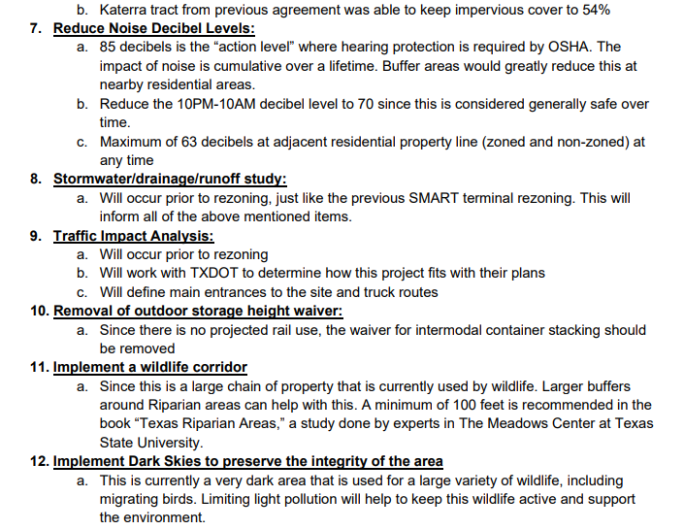
Hours 1:56 – 3:47, 12/17/24

Item 15: The Human Services Advisory Board (HSAB)

Every year, we give money to nonprofits. The HSAB sorts through the applications and gives out money.

This year, they are giving out $550K.

HSAB has a tumultuous past.  In addition, they used to have a bunch of Covid money to give away in 2022 and 2023, and now they don’t.   So this is a tough spot to be in.

This year, they got 37 applications for a total of $1.1 million dollars requested. So that’s also a tough spot to be in!

The HSAB Process

First, some useful guiding principles:

The whole decision process takes months. 

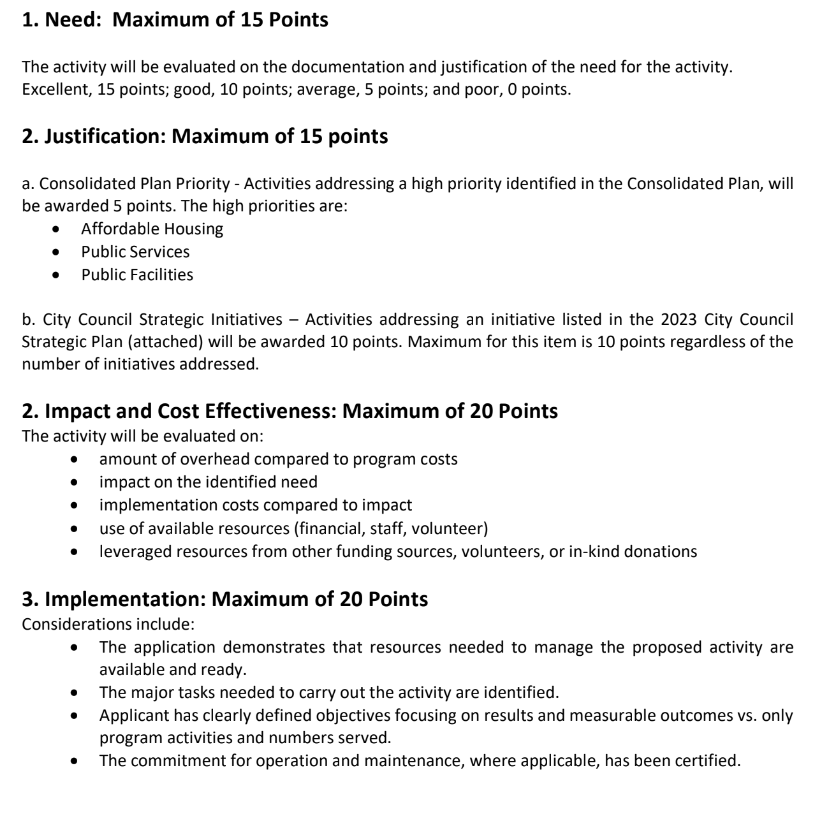
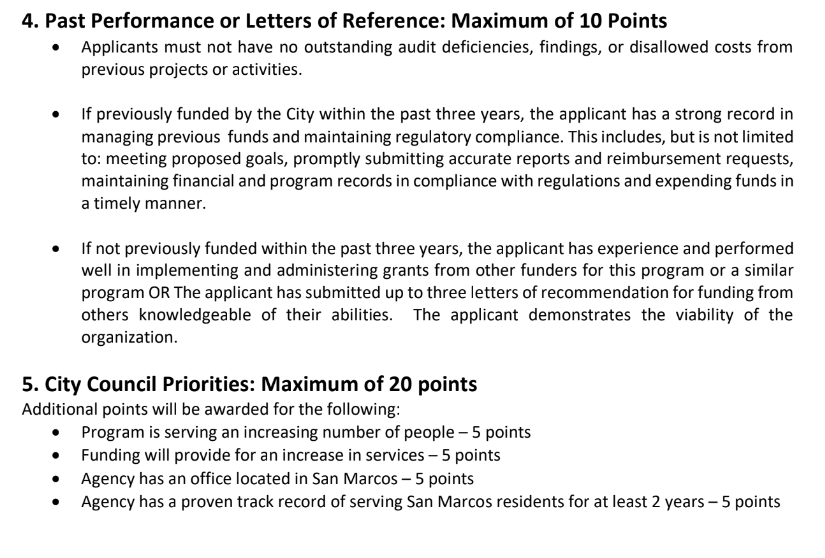
Here’s how they evaluate the applications:

(“Council priorities” always drives me fucking nuts.  It’s all about Council ego, and not what’s best for those in need.)

Here’s how HSAB ranked the applications:

(I know that’s tiny, but I think you can click on it and make it bigger.) Green is highest score, yellow is medium, pink is lowest.

Then the board discusses each application individually.  They consider:

  1. Rankings
  2. Amount of money requested
  3. Need in San Marcos

At the end of all that, here’s what the board recommends:
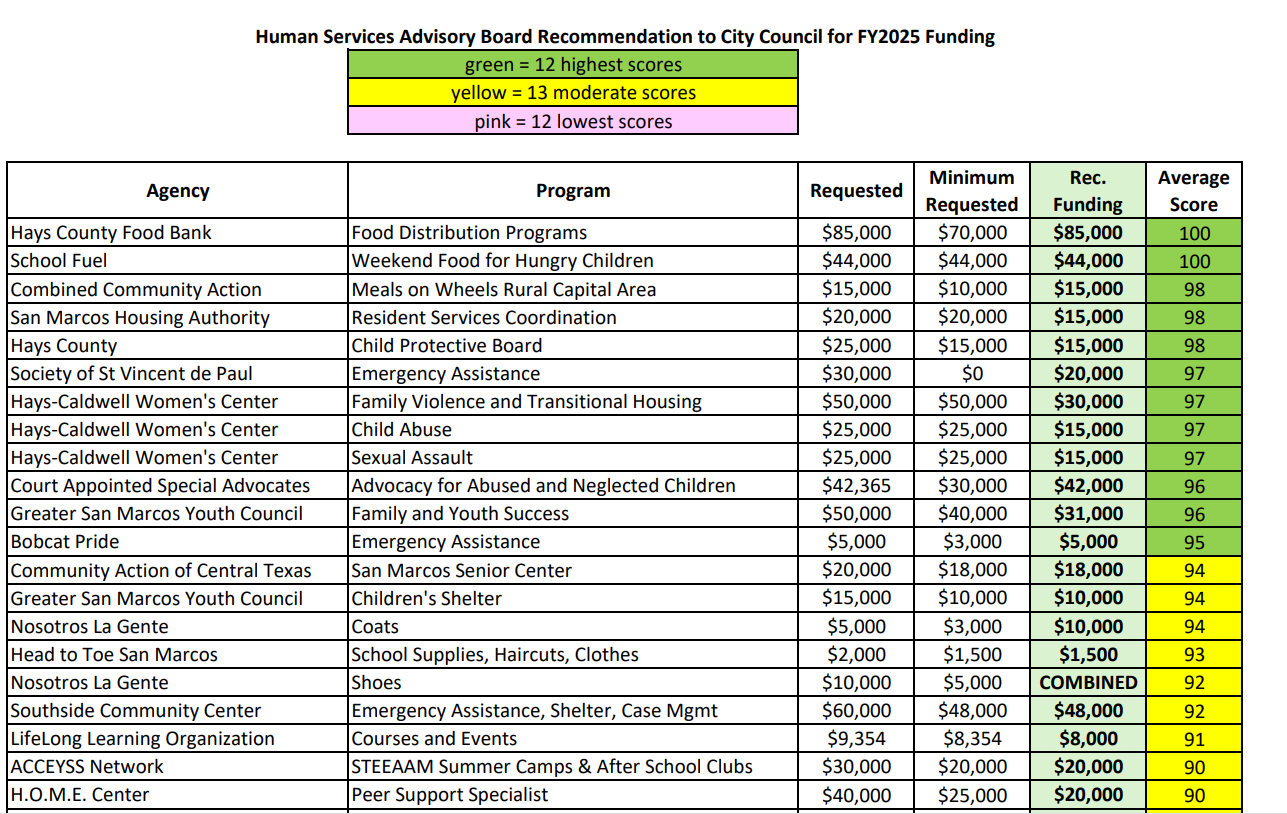
They talk a little bit about why they chose not to fund the agencies at the bottom. Some of them are hard to measure, and they wanted programs that can measure results. Some of them were not aligned with which needs the board wanted to focus on this year. Some are not local.

Summary by category:

What does Council have to say?

OH LORD, YOU GUYS, THIS WILL GET INTERESTING.

Matthew Mendoza kicks things off. He wants to remove $10K from ACCEYSS, and give it to the Salvation Army. 

What is ACCEYSS?

Ok, summer camps and after school programming in Dunbar. They were awarded $20,000 to do this.

Here’s what the Salvation Army wants to do:

They were awarded no money.

Jane asks why? The answer is that one of Council’s priorities is to support locally grown organizations. Since Salvation Army isn’t local, they lost points for that. [Jane deeply sighed, “Ok.”]

Jane explains this away: this is a local chapter of the Salvation Army. They are extremely local.

Note: Roland Saucedo – the council candidate that Jane campaigned for and supports – shows up to speak on behalf of the Salvation Army. That’s how local they are!

Council talks to the Salvation Army representative for a long time, about the Salvation Army budget, and whether or not we could partner with the Salvation Army on utility assistance, which is also an ongoing conversation. Maybe we could direct some utility assistance money over to them?

The vote:

Move $10K from ACCEYSS to Salvation Army: everyone

Keep things as they are: No one

So that money is shifted over.

Next, Jane brings up the HOME Center.

HOME Center is these guys. They do individual case management with homeless people to get them into stable, longterm housing. It is exceedingly difficult work and they do an outstanding job.

I frankly don’t know how to sugarcoat this: the city has a history of being vindictive and retaliatory towards HOME Center. This is because historically, the city has not always been on the up-and-up regarding the homeless community, and HOME Center advocates on behalf of the homeless people who have gotten the raw end of things.

Jane proposes moving $15K from HOME Center, and giving $10K to Salvation Army, $5K to Nosotros La Gente. This would bring the Salvation Army up to $20K, and put HOME Center down to $5k. (Actually, her first proposal is to bring HOME down to zero. Matthew gently chides her to leave HOME Center with $5K.)

Keep in mind that Jane openly endorsed and campaigned for Roland Saucedo, who is loosely affiliated with the Salvation Army. He was present at Tuesday’s meeting and advocated for the Salvation Army.

I like to stick to cut-and-dried facts, but you absolutely have to know that this is a very tense topic. Jane is not a neutral party here, and her proposal feels like a shot across the bow.

Jane’s stated reason is that HOME Center is requesting money for a case manager salary. She says, “We don’t want to fund salaries, because we don’t want someone to be laid off if we don’t fund them.”

The staff member says, “In the application, we said Board can allocate up to 20% of a fulltime position or fully fund a part-time app.”

Jane argues this point, but she is wrong here. Here is the policy from January 2023:
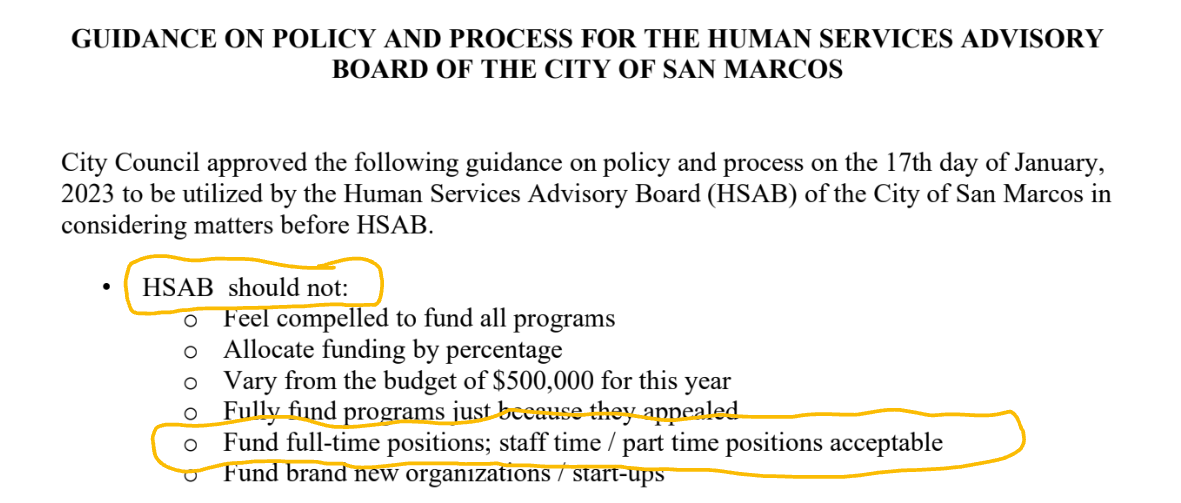
And in the actual discussion, they settled on 20% of a fulltime position is okay, and funding a parttime position is okay.

So first, Jane is technically wrong. But more important, she’s morally wrong. The staff, Alyssa, and Amanda all point out to her that many of these applications asked for staff funding, and yet she’s singling out HOME Center to slash.

Jane: We have given a LOT of money to Southside. They are hiring.  So that’s an issue that I have with HOME Center in particular.  

She is referring to the $800k of Covid money that the city recently gave Southside Community Center, to implement our Homeless Action Plan. She is somehow making the case that Southside’s funding works against HOME Center?

Alyssa comes in hard: Absolutely not.  We gave Southside an obscene amount of money. Initially, there were community concerns and Council concerns about Southside’s capacity. We had grace and did a trust fall.   We need to extend that to HOME Center.  They do boots on the ground hard work. The service and case management they do is unmatched.

She continues: “I know this is not your intention, Mayor, but I need to name this.  Within different groups that do homeless outreach, there is a perception that HOME Center continues to face retaliation because they use their platform to bring to light some historic concerns and trends regarding homeless outreach in general in our community.  And so I  know that’s not your intention, but the community had a very thorough process with feedback and open meetings. It is not a good look, without any process or notification, to be making these moves.”

There’s some continued hectoring from Mark and Jane – they could have asked for money for different costs! They could have shown up to this meeting and defended themselves!

Amanda is furious: “This is not the only organization that asked for staff funding! So many of these organizations are funding staff! I’ll be honest: I’m losing my patience, because as someone who has volunteered with HOME center, as someone who has spoken to the clients that receive what they do: our community benefits in ways that we will never understand…. The reasons you’re giving are not strong enough for me, and this just feels wrong.”

Jane, sweetly, “Then you can vote against it!” 

Amanda, coldly: “I will.”

Jane: “I just wish they’d asked for money for something else!”

Alyssa, “Well, I wish you weren’t nitpicking, but sometimes we don’t get our wishes granted. We need to meet the moment where it’s at.”

(I’m abbreviating all this hugely. Feel free to listen yourself. HSAB item starts at 2:00, and Council discussion starts at 2:19ish.)

Eventually Alyssa makes a motion to postpone. She says, “We need space for community feedback.  We’re overstepping and moving things around without rhyme or reason.  We need to let our neighbors know.” 

The vote to postpone:

Yes: Alyssa, Amanda, Shane, Saul
No: Mark, Jane, Matthew

So the postponement squeaks through. This will come back around in January.

Let’s zoom out for a moment on the HSAB funding:

The committee spends months on these applications. All of the agencies provide metrics and ample documentation of how they spent previous money – literally over 2000 pages of applications in the Council packet this week. Council argues passionately about whether $5000 is better spent on kids in Dunbar, or emergency funding from the Salvation Army.

Here is a list of things that received zero discussion on Tuesday:

  • $45,000.00 to McKimm & Creed, for Leak Detection Services
  • $241,036.36 to Cunningham Recreation, for various playground and outdoor fitness equipment
  • $573,458.79 to Nueces Power Equipment, for the purchase of a Wirtgen Asphalt Milling Machine
  • $2 million (annually) for McCoy Tree Surgery Company, for tree trimming
  • $6 million for Techline, Inc, for materials and supplies for San Marcos Electric Utility
  • $8.6 million for the Lower Colorado River Authority, for various goods and services concerning electrical transmission, control and substation facilities
  • $765 reimbursement to Tantra

Was Jane Hughson worried about us paying someone’s whole salary at McKimm & Creed? Was she worried that the company might become too dependent on us?

Did a committee meet for months, and have a scoring system? Why do we scrutinize $20,000 to HOME Center, and not $6 million to Techline, Inc?

We also give homestead exemptions of $15,000 to all homeowners, and $35,000 to seniors and people with disabilities. We have an estimated 10,295 owner-occupied homes in San Marcos. The tax rate is 60.3 cents per $100. So ballpark, we’re giving homeowners $904,500 yearly in homestead exemptions.

Why don’t we include this $900K in an application to HSAB? We could call it “Subsidies to Home-owners Program” and see if it scores higher than ACCEYSS on the evaluation criteria. We don’t think of this as charity, but we should. And we don’t even make the home owners provide metrics, measurable outcomes, nor turn in performance reports for how they spend their extra charity dollars each year. Isn’t that nice?

(And finally, I will never get sick of reminding you that we’re giving $1.2 million yearly to Kissing Tree. No metrics, no scrutiny, no gnashing of teeth. Just a nice, gated community that’s not for you.)

Item 16: Guiding Principles to lobby the Texas Legislature.

The Texas legislature only meets once every two years, for 140 days. This is to minimize the damage that they can do. 

Or as Molly Ivins put it, “The Texas Legislature consists of 181 people who meet for 140 days every two years. This catastrophe has now occurred 63 times.”

Or, as the old joke goes: “The Texas legislature meets every two years for 140 days. Many citizens believe that the law was incorrectly transcribed and that the legislature was meant to meet for two days every 140 years.”

Anyway! San Marcos lobbies the state legislature on behalf of our interests. So we have a Guiding Principles document, to determine what we’ll lobby.

Amanda comes in with a ton of amendments.  Keep in mind that she’s worked with the state legislature for the past few years. It quickly becomes clear how much expertise she’s bringing to the table.

The first batch is all under the mental health section. Here’s the original:

Amanda #1: Suggested add: Support legislative action to establish a school mental health allotment fund. 

Why? The Legislature passed a School Safety Bill last time, but it doesn’t fund mental health. So this asks the state to create line item funding to address mental health funding. 

Everyone loves this. The vote:  7-0

Amanda #2:  Support legislative action to increase in funding for Local Mental Health Authorities (LMHAs) to provide early intervention services to prevent crises.

The vote: 7-0

Matthew Mendoza is so happy. He says, “Yes, because it will go to SMPD!!” when he casts his vote.

Amanda #3:  Support legislative action to expand access to maternal mental health support throughout pregnancy and the post-partum period. 

The vote:  7-0

Amanda’s on a roll! Everyone loves these!

Amanda #4:  Support legislative action that expands eligibility for Medicaid.

Texas turns down $5 billion in federal money every year for Medicaid. About 19% of Texans are uninsured, which is far and beyond the worst in the country. This is because we never expanded Medicaid under the Affordable Care Act.

Mark has finally had enough of this nonsense! “I’m going to be a no on this. Those are conversations for the state and federal government to have.”

He has a deep moral conviction about staying neutral on healthcare coverage. Should uninsured diabetics die for lack of insulin? Mark refuses to have an opinion, and you can’t make him!

The vote:

Yes, the state should accept Medicaid funding: Everyone but Mark
No, this is none of my business: Mark

Amanda #5: Support legislative action to increase funding for permanent supportive housing programs.  (Housing First programs.)

There is a fake-debate among homelessness experts. Should you provide housing and then treat the mental illness and/or substance abuse? This is Housing First. Or, should you withhold permanent housing until the person gets their issues solved? This is Treatment First.

I’ll give you a hint: in Trump’s first term, his housing guy was a strong Treatment First guy. (And then we hired him as a consultant.)

Mark: I’m a no. Housing First isn’t always the best! 

Mark is wrong. (If that link gets scrubbed under Trump, then we can use this one.) Housing First works better, and it’s more humane. It’s better all around.

The vote:

We support Housing First: Amanda, Alyssa, Jane, Shane, Saul

We don’t: Mark, Matthew

Amanda #6: There is no section on Housing in our Guiding Principles.  We should have a Housing section.

In the Housing Section, Amanda recommends:

  • That we support legislative action that prevents unnecessary evictions
  • To promote housing stability and protecting tenants from undue hardships

The vote: 7-0

Mark is deeply suspicious, though.

Amanda #7: Support legislative action that seals a tenants eviction records in the event that a court rules in their favor

Mark and Matthew are both gobsmacked that this is not already the case. A tenant can win in court, but landlords can still use their eviction against them? Yes, currently.

The vote: 7-0

Mark is so suspicious! He literally says, “How is this not already the case?! WHATEVER. Yes.”

Amanda #8:  Support budgetary measures to increase state funding for low income housing in Texas, especially for the most cost-burdened households that are at or below 50% of the AMI. 

The vote: 7-0.

Amanda #9: Remove the whole carve-out for SMART/Axis. 

This brings us back around to the Citizen Comment, four hours ago! (Backstory on the SMART/Axis development here.)

Mark: Hard no. We have to increase and diversify our tax base! People don’t realize what that development could mean to this community! All the jobs! This is PRIME for development! I-10, Toll road, railroad, and airport!  JOBS! JOBS! Major mistake! In 50 years, this will be the most important bullet point in this whole document!

Matthew: We just postponed due to second-guessing HSAB board and here we are, second-guessing this board!  There aren’t smokestacks. This is environmental protection! Do you really want SMART/Axis to go to Caldwell county?  Plus Gary Job Corp is right there.

(This is the weakest argument I’ve ever heard.)

Amanda: I’m not opposed to diversifying and growing our tax base. This is a very specific major development that arose through shady means. The entire city is not behind this development. Nowhere else in this document are we so specific.

Mark: Because it’s 3000 acres! Nowhere else in the COUNTRY has this opportunity! DC wants to hear how we’re diversifying. This is amazeballs! 

The vote:

Remove the carve-out for SMART/Axis:  Alyssa, Amanda
Keep it:  Jane, Shane, Mark, Matthew, and Saul

So that stays.

That’s all of the amendments!

After this, we have a series of little items:

  • the $2 million on tree-trimming
  • the $6 million to the LCRA
  • we officially the money back to Tantra
  • an appointment to the Animal Shelter Advisory Committee

But Council zips through these, and so will I.

Hours 0:00 – 3:38, 9/3/24

Citizen Comment:

  • Five people spoke against the SMART/Axis road annexation.
  • A guy from the airport asked about his lease rate for his hangar

That was about it.

Items 2-3:  Quarterly financial and investment report.

This is the official report for Jan 1st – March 31st went.  Back in May, we got a sneak preview: sales tax was tanking below projections and we were scrambling to reign in spending. 

This is more re-hashing of that same news. Sales tax was down, so everything got pulled back.

Item 19:  It takes two public hearings to approve the budget.  This is the first, and then final approval will be on September 17th.

Here’s the big picture:

With highlights:

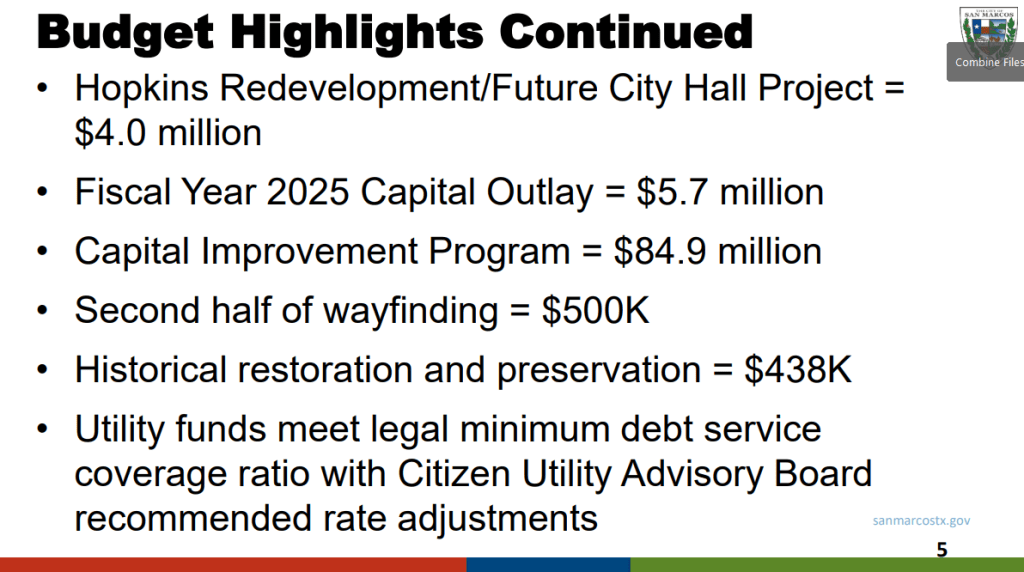
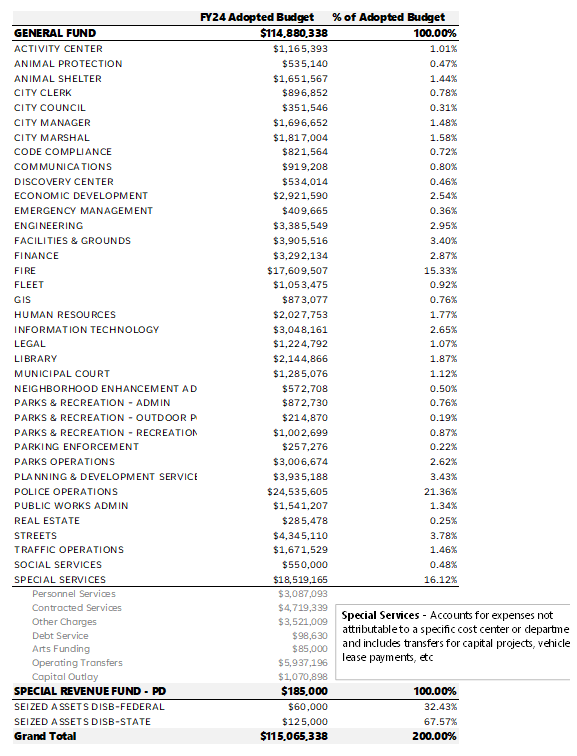
For me, the highlights are only somewhat helpful. I need context in order to makes sense of these notes. What helps me most is a breakdown of the general fund, by department.

Last year’s breakdown of the General Fund, by department:

I got that by submitting a FOIA request last year. I’ve requested this year’s General Fund breakdown, but haven’t yet gotten it.

[Let me put on my tinfoil hat for just a moment. Indulge me in the dullest conspiracy theory of all times:

– The 2024 draft budget has the General Fund breakdown by department, starting on page 82.
– But the 2024 adopted budget has no General Fund breakdown anywhere!
– the 2023 draft budget has the General Fund breakdown by department, starting on page 88.
– But 2023 adopted budget also has no General Fund breakdown anywhere!

For the past two years, it’s disappeared from the actual budget, once it was approved. What on earth.

Finally, even the 2025 proposed budget does NOT have the General Fund breakdown included. This annoys me, hence the FOIA request mentioned above.

I submitted the request back on August 22nd, so we’re past the normal FOIA response time. The information is in the budget, but it’s scattered. It would take hours of work for a layperson to extract it from the online budget, one department at a time.

END OF MY MILDLY EXASPERATING CONSPIRACY THEORY!]

Back to budget discussions. Utility rates are going up:

The average home-owner will pay $13.46 more per month. There’s a big discussion in the workshops about utility assistance, so I’ll cover some details later on.

We’re using the same tax rate as last year, 60.3¢.

Listen: I cannot stress enough how little conversation there is about any of this. Partly this is because there have been a lot of budget workshops already.  Partly this is because the community didn’t show up to complain. (Although they have one more chance.) But mostly because this council is so used to each other that they all know exactly where they all stand.  There’s nothing left to say.

Matthew Mendoza asks a great question. During the section on the Water and Wastewater Fund, he asks: “These contract costs keep increasing every year. Why do we keep contracting out? There’s like 4 water and wastewater contracts. Why not do these things internally?”

The answer has a few parts:

  • Some contracts are management contracts, others are infrastructure and CIP
  • The contracts for the surface water plant and the wastewater treatment plant both have automatic inflation adjustments built in
  • On the wastewater treatment plant, we’re at the end of a 20 year contract. We’re putting a provision in the new contract to have an exit clause, so we could convert staffing to in-house in a few years if we want. When it was built in the 90s, it actually was operated by city staff. We started contracting it out in the 2000s.

This is SUPER interesting! Let’s highlight some things:

  • It’s so common for contracts to have built-in, automatic inflation adjustments! You know what doesn’t? The minimum wage. Failure to peg the minimum wage to inflation is one of the most underappreciated policy failures of the 20th century.
  • The wastewater treatment plan used to be city-run! We privatized it in the 2000s! What. Privatization is not your friend. Let’s get that back.

Mark Gleason asks if trash and recycling contracts also have automatic inflation adjustment?

Answer: Yes on refuse collection.

Alyssa still votes no on the utility fund votes, because of the rate increases. But she acknowledges the workshop on emergency utility assistance. (We will cover this below.) If it were working as it should, she says she’d be able to vote for the regular rate increases.

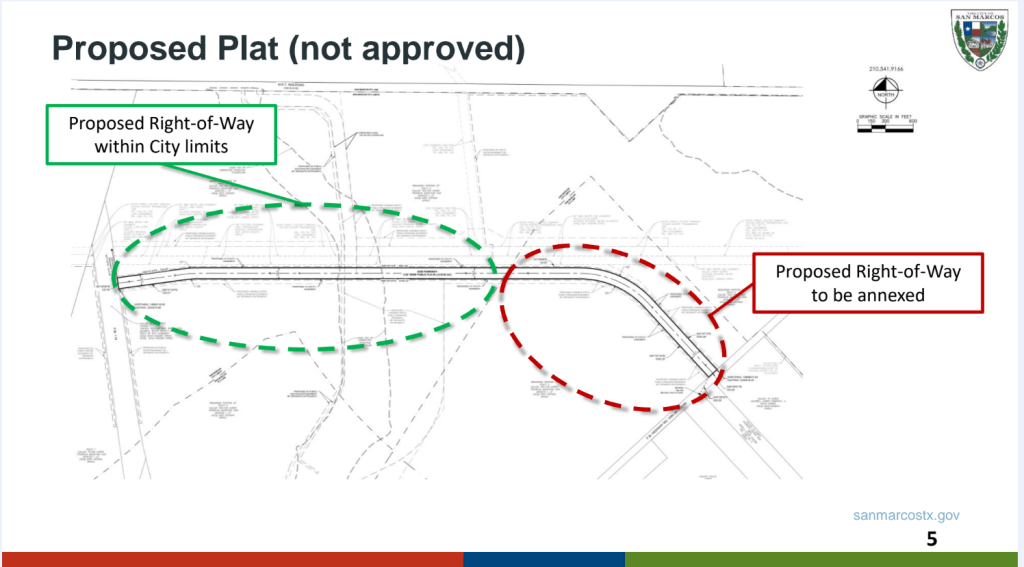
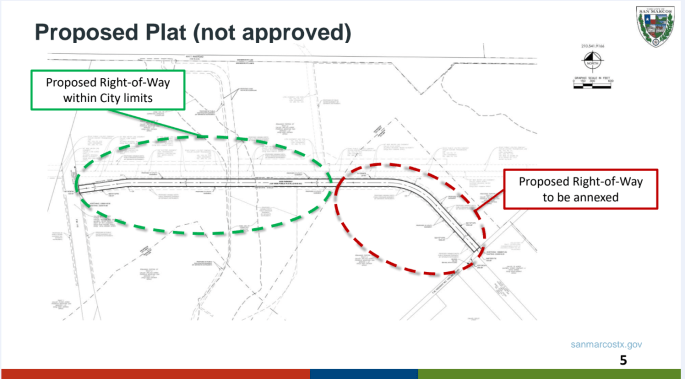
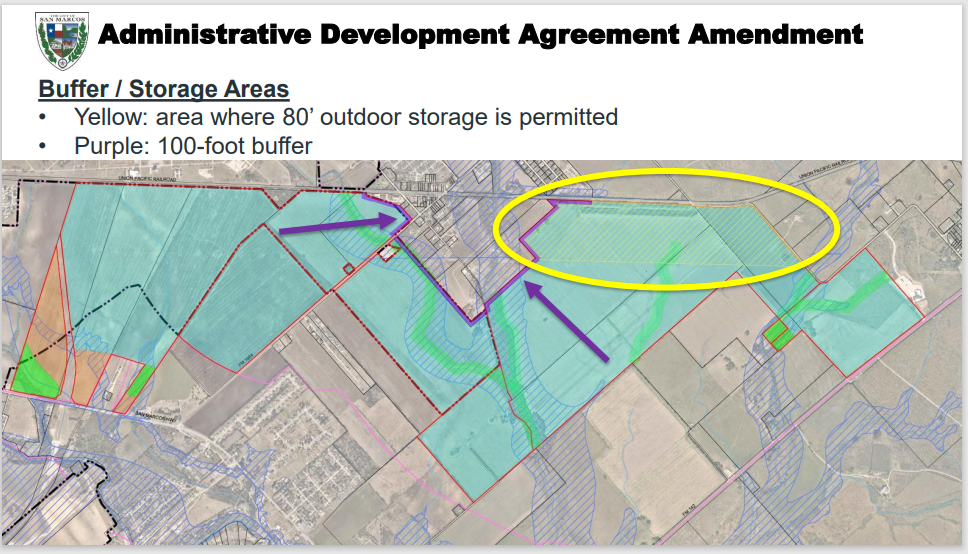
Item 4:  Axis Logistics (aka SMART Terminal) road annexation.

Backstory. The giant Axis Logistics/SMART company:

wants Council to annex city land for a road:

However, the company has made total enemies of the surrounding community, by always being super secretive about their plans. In this case, the road has jumped locations. Originally it was further from houses and now it’s closer to them.

At the August 5th meeting, there was a fair amount of discussion. Everyone seemed concerned. Nothing was resolved.

At the August 20th meeting, it was mysteriously postponed.

Time for the exciting conclusion! So much drama! Buckle up for…

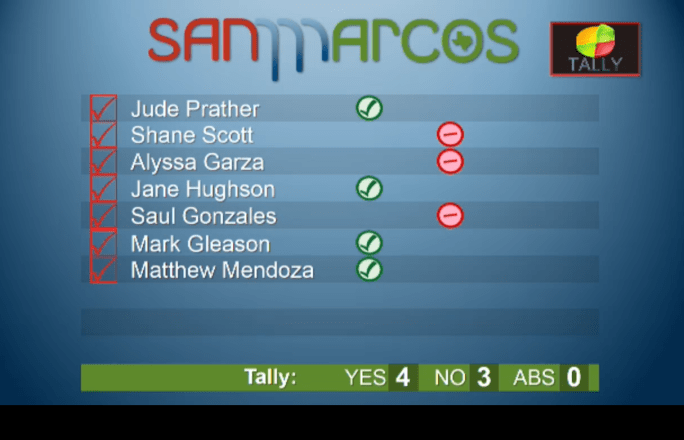
…zip, zero, zilch. Literally, Council spends four minutes total on this item.

The vote:

No one ever asked in public about whether the road could be moved back to the original location.  No one explained whatever Mark needed more time to research since the last meeting.

This is what I mean when I say this council is stale. Everyone knows where everyone stands on everything, and so no one bothers to say anything outloud.

Item 24: School Resource Officers are back, baby!  (School Resource Officers = SROs)

Last meeting, the city approved the SRO contract

Two changes had been proposed by SMCISD:

  • The SRO contract should be two years instead of one
  • The contract can be renewed administratively, without Council approval. 

Council renewed the contract, but nixed those two changes. They wanted to see the contract, in person, every year.

Since then, the school board met: they really want the two year contract and admin renewal.  So they held the line on those two details, and punted it back over here.

Remember last time how I pointed out that Jude Prather should really recuse himself, because his wife is the director of the organization that oversees all SROs, statewide?  

  • He didn’t recuse himself this time, either. 
  • He actually was the one who made the motion to approve
  • Superintendent Cardona even mentioned that Prather’s wife wrote the officer training.
  • At Q&A at the end, a community member (LMC) asked about this conflict of interest.
  • By that point, Prather had gone home.  LMC said it was a question for the city lawyer, but Jane Hughson ended the meeting without giving the lawyer a chance to answer the question.

This is getting into more egregious territory!  Jude certainly knows better. He recuses himself over absurdly flimsy pretexts all the time.

ANYWAY.  Chief Standridge says he could include SROs in his yearly update to Council.  Superintendent Cardona talks about how closely everyone meets and supervises the SROs.

Mark Gleason politely says “I told you so! Stability. Safety. Etc.”

The vote: Should we switch to two year SRO contracts and administrative renewal?

… 

Item 25:  This was a little confusing.

Gather ‘round, children.  Once upon a time, there was a little Municipal Utility District, on the north end of town:

That’s east of I35, on Yarrington road. The year was 2014.

It was actually kind of gigantic if you zoomed out:

But none of the townspeople ever did. 

Here’s what the developers pretended it would look like, some day:

Look at all that water! What the hell is going on here. Here’s the satellite photo of this area:

So much less water!

(Were those lunatics planning on a great new lake? Were they going to tap the Blanco, where it runs underground, to create a watery playground for rich people? Maybe!)

Back to our story.

The village council elders put a weird clause in the development agreement that allowed landowners to opt out.  Usually council elders wouldn’t do such a thing, but in this case they did.

By 2023, these owners had opted out:

The red parts had opted out.

In 2023, the rest of the land owners opted out:

So at Tuesday’s council meeting, the little village dissolved the Municipal Utility District altogether. There’s no development agreement. There’s no lake.

THE END! 

The moral of the story is: there is no moral. 

Item 26: New City Hall and Hopkins Redevelopment project

Back in July, we saw some pretty pictures about what the new City Hall could look like, and what Hopkins could look like, maybe someday:

Today’s task: we’re going to form a steering committee, to help shape the vision. 

Who does Council want to be on the steering committee?

Jane: We could have each councilmember pick a person, and then have a representative from some key constituents – Texas State, River Foundation, Downtown Association.

Alyssa:  Before we have this conversation, we need the DEI coordinator. Otherwise we’ll do what we always do. That leads to the status quo, and the same old people still have the same old power. 

Mark Gleason: I like each councilmember picking two people, plus the key organizations should all have representatives.

Alyssa:  Hey! You guys. We need to stop and get input from the DEI person, before we have this conversation. 

Jane: And councilmembers themselves. What about the mayor?

Alyssa:  Listen. Stop. The DEI coordinator is not here.

Matthew Mendoza: Why should Texas State get a seat on the committee?

Jane Hughson: It’s just part of being good neighbors. They also have a representative on the downtown committee.

Alyssa:  Hello? Anyone? Bueller?

Shane Scott: You know how councilmembers get their names in the building? I think we should have little bobbleheads of ourselves, instead.*

Alyssa:  LALALALALALA AM I SHOUTING INTO THE VOID HERE?

Matthew: We should require that members have lived in San Marcos for at least five years!

Alyssa:  [mumbles to self about DEI coordinator]

Jane: How about a P&Z representative?  How about a library representative?

Alyssa:  [draws pictures of a council consulting the DEI coordinator, and holds them overhead, in the style of Lloyd from Say Anything.]

Saul: Should we require that they be caught up on their taxes?

Jane, dryly: We don’t require that for elected officials. 

Alyssa:  [Launches little confetti cannons. Sends in carrier pigeons with tiny notes tied to their legs, which read “Let’s consult with the DEI coordinator”. Does an interpretive dance for the letters “D”, “E”, and “I”.] 

In the end, everyone agrees to come back next time with their final ideas for the composition of the steering committee.  City staff is going to talk with the DEI coordinator and get best practices from her, and they’ll share those next meeting.

Here’s the thing: You have to get the DEI coordinator to talk to everyone before the brainstorming. Otherwise the brainstorming will perpetuate the same old power imbalances as always.  The point of the DEI coordinator is to gently get everyone to cut that shit out, and redirect them into new territory.

*This is a real comment. I did not make this up.

Hours 0:00 – 1:54, 8/20/24

Citizen Comment:

A few main items:

  1.  Malachi Williams.  (7 speakers)
  2. SMART/Axis Terminal road annexation (3 speakers)
  3. Some one-off topics: San Marcos Civics Club, ceasefire in Gaza, RFP for wastewater, council attentiveness to residents.

Let’s tackle the killing of Malachi Williams first. There have been some major developments – namely the grand jury declined to press charges against the officer, and so he’s not facing any legal repercussions.  SMPD released the name of the officer who killed Williams, but no one else, and the bodycam video from that cop, but not the rest of the footage.

I get to go first, because this is my platform!

Listen: there’s a big gap between what’s legal and what’s moral.* 

Here’s what’s legal:  According to Chief Standridge, the cops followed de-escalation procedure in the convenience store.  Then there was a footrace. Malachi Williams was holding knives, and headed through the HEB parking lot, and so the cop shot at him several times. 

The grand jury did not indict the police officer.  This is legal – it means they thought there was not enough evidence to convict the cop in court.  And the grand jury is probably correct. The Supreme Court standard for cops is that they are allowed to shoot if they perceive a threat. That is a very low bar to clear, which is why it’s unlikely this officer would have been convicted. It is easy to believe that this officer will claim that he perceived a threat.  Therefore he’s allowed to shoot and kill Malachi Williams. 

This is all legal.

None of this is moral.  As a society, we failed Malachi Williams in many, many ways.  Long before the night of April 11th, we had set the stage for this, because we do not provide anywhere near enough investment in mental health services and housing for homeless people. 

Once Malachi Williams is having a mental health crisis on April 11th, we sent police officers in blue uniforms.  These officers may have been trained in current de-escalation techniques, but plainly that training is nowhere close to what this kid needs.  Remember, Malachi Williams had been acting creepy, but not violent. He has not actually threatened anyone with a knife, or even been close enough to anyone to threaten them with a knife. Importantly, he does not have a gun.

Malachi Williams runs away.  You run away when you’re scared.  But the cops do not think of him as being scared. They think of him running towards HEB, with knives.  They themselves are running towards HEB too, with guns.

Malachi, with knives, is considered a worse threat than a cop openly firing a gun in the HEB parking lot. Malachi’s life is not worth the extra police training that it would take for this officer to better understand how to handle this situation. That is not moral.

Ultimately, the only person who did anything violent is the police officer.  Malachi Williams is now dead and his family are now left to grieve.  This is a moral failing by the police department and the larger, complacent society.

Some good links:
why police officers are rarely prosecuted
how to think about police reforms
Guiding Principles on Use of Force, with a whole section on both mental health and people with knives. (That is a police research group, and they argue that police should never need to shoot someone with a knife.)

Onto what the speakers say:

  • The grand jury is unnaccountable and secretive. 
  • SMPD needs to release the full footage. Did the cops deliver immediate medical aid, like they’re legally bound to? [I am very interested to know this, too!]
  • One person (Sam Benavides) submitted a FOIA request for all footage.  She was told that she needed to provide names of officers in order to get their body cam footage. Of course, the only name that has been released is the one officer that held the gun, so this is totally circular obfuscation.

A note about grand juries: proceedings are generally not released to the public, because it’s one-sided. The defense is not present, just the prosecutor. So it would be unfair to the defendant to release a one-sided story.  However: this falls apart with police shootings, because the prosecutor can sandbag the proceedings, out of working so closely with the police. Independent prosecutors would help a lot with police accountability.

*hat tip to my friend for helping me with this framing.

  1. Axis/SMART Terminal road

Just to refresh, here’s what we’re talking about:

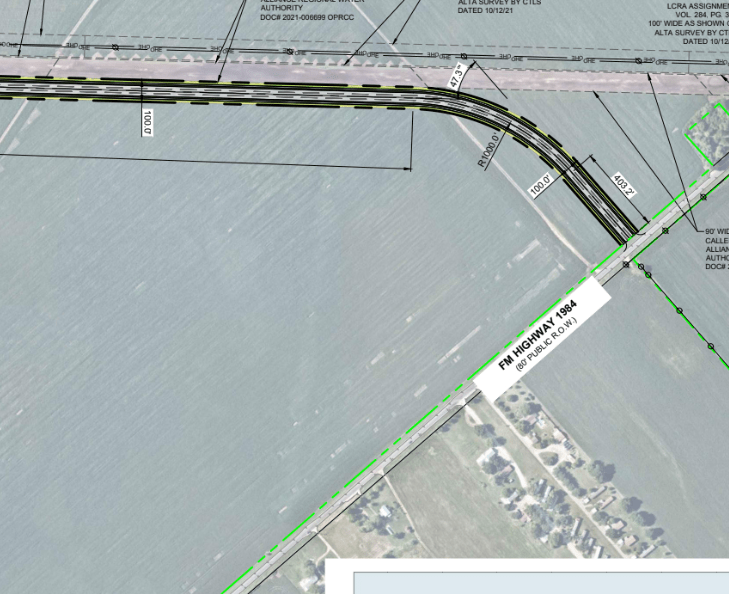
It’s that dotted blue line between Loop 110 and Hwy 1984. Not the whole thing, just the right hand elbow of it:

Speakers brought some numbers from TxDot, CAMPO, and the Traffic Impact Analysis:

  • FM 1984 currently has 2380 cars per day
  • Hwy 80 has 17,400 cars per day
  • The new road is estimated to have 25,000 trucks per day.

So this is adding way more traffic to the surrounding roads.

Speakers also still want to know why the road moved – it used to be away from houses, and now it’s right by them. (We discussed this last time but didn’t get an answer.)

At the 3 pm meeting, the direct of of the San Marcos River Foundation (Virginia Parker) gave their two cents: they are in favor of the road annexation. They spoke to Caldwell County, who said that they’re stretched too thin to maintain the roads to San Marcos city standards. SMRF’s position is that it’s best for flooding if the city of San Marcos is responsible for maintaining the roads.

At the 6 pm meeting, it was pointed out that San Marcos can surely come up with a workaround there. We make deals all the time to deal with this sort of thing.

….

Onto the meeting!

Item 1:  The SMART/Axis Right-of-way road is up first! (Background here.)

Aaaaaaand…… It got postponed.  Womp-womp. Something was discussed during Top Secret Executive Session that made Mark Gleason want to do more research on the issue? 

One off-topic comment: SMART/Axis’s whole shtick is that they can’t possibly give any details up front, because they don’t know who their tenants will be.  Last year, they just want the whole thing annexed and zoned in one big blank-check chunk. They are still refusing to provide any details whatsoever.

This slide was shown during the presentation:

Wow, look at that magical exponential growth! In 20 years, their property will be worth $10 billion dollars!  They may have make-believe tenants that they can’t yet explain to us, but they will definitely be wildly successful, and the city will swim like Scrooge McDuck in the tax windfall. Let’s make all these important decisions based on this Very Serious Graph of Reality.

Item 12: Intralocal Agreement with the Animal Shelter

Up till now, San Marcos has been running a regional animal shelter, and it’s too much.  So we’re transferring responsibility to Hays County, and operating a local animal shelter just for the city, instead.

Hays County was maybe taken by surprise by this? It’s in their court now.

City Manager Stephanie Reyes has talked with the city managers in Buda and Kyle, and has requested a few things:

  1. Hays County, Kyle, and Buda need to change their ordinances to match ours
  2. They need to market animals at events
  3. Consider participation with PALS to address pet overpopulation

Of course, these other jurisdictions could come back with amendments, which we’d consider. We’re not ordering them to adopt our version so much as asking them to consider this first version. But at some point, the ordinances need to match.

Item 16: School Resource Officers (SROs)

SROs are a joint collaboration between the city and the school district.  This is the yearly re-upping of the contract.

There are a few proposed changes:

  1. Maybe the contract should last two years, instead of one year?
  2. Maybe the contract can be renewed by administrative approval, instead of coming to council?
  3. (Some others, but these are the ones that got discussed.)

Alyssa Garza makes the case that it should be discussed every year.  She’s actually mostly on board with the program, but says she’s only gotten to this place by having lots of detailed conversations every year.

Saul Gonzales agrees. 

Jane Hughson also agrees, and adds that the renewal should really occur in the summer, before the new school year starts.  

Mark Gleason and Matthew Mendoza are both peeved by the discussion.  

Mark: we’re wasting everyone’s time! I just want to bring stability to the program!

Matthew: We should stay in our lanes! This is school board business! 

(They both sure do have a lot more trust and faith in policing than I do.) 

The vote: Should the contract last one year or two years?

One year:  Shane Scott, Alyssa Garza, Jane Hughson, Saul Gonzales
Two years:  Jude Prather, Mark Gleason, Matthew Mendoza

So it’ll be one year.

The vote: Should the contract come to council? Or can it be renewed by administration?

Council:   Everybody except Jude Prather
Admin: Jude Prather

I’m going to call shenanigans on Jude Prather here. This boy recuses himself all the time. He recused himself during the animal shelter discussion ten minutes ago! He recused during a discussion on equity cabinets, the first Lindsey Street Apartments discussion, an environmental Interlocal Agreement with Texas State, and many others. Usually it’s because it involves Hays County, and he’s employed with Hays County, or it involves veterans, and he works with veterans, or it involves Texas State, and his wife works for Texas State. (It’s not a bad thing. He builds a fence around the law.)

Anyway, Jude has a legit conflict of interests on SROs – his wife is actually the director of the organization that trains SROs. This is a literal conflict of interest! He did not recuse himself.

It didn’t affect the vote, and Jude isn’t running for re-election, so I’m not too fussed.  But it’s still a thing.

Overall vote to renew the SRO contract:

Yes: everyone
No: no one

Alyssa says it’s the first SRO contract she’s voted in favor of.

….

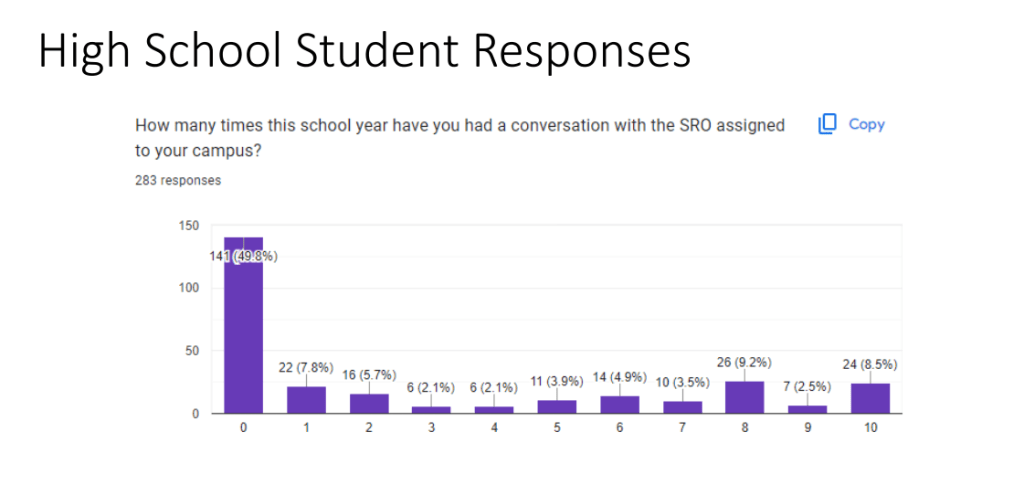
One more note:  In years past, Max Baker and Alyssa Garza kept asking for the SRO survey data, and it never materialized. 

This year, it was here! Good governance in action.

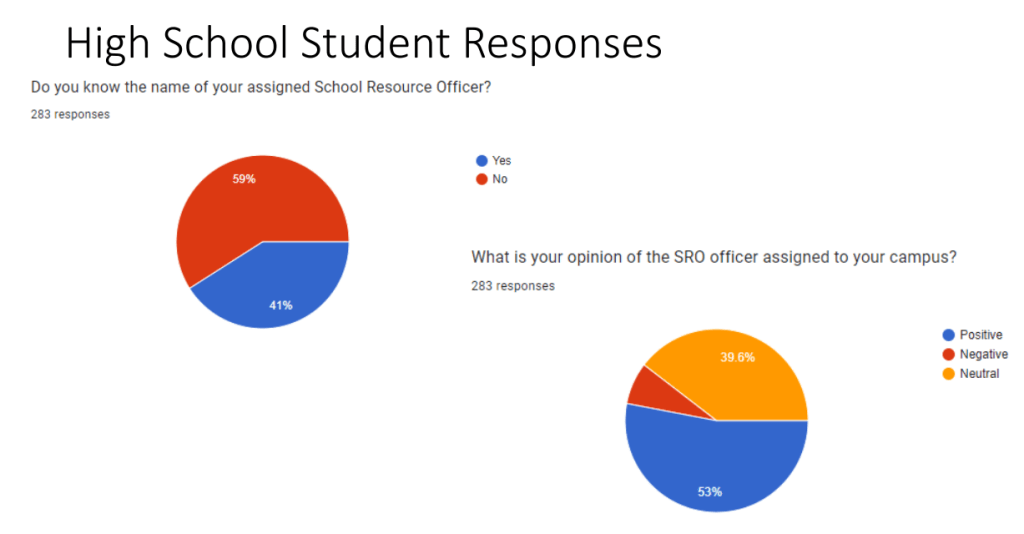
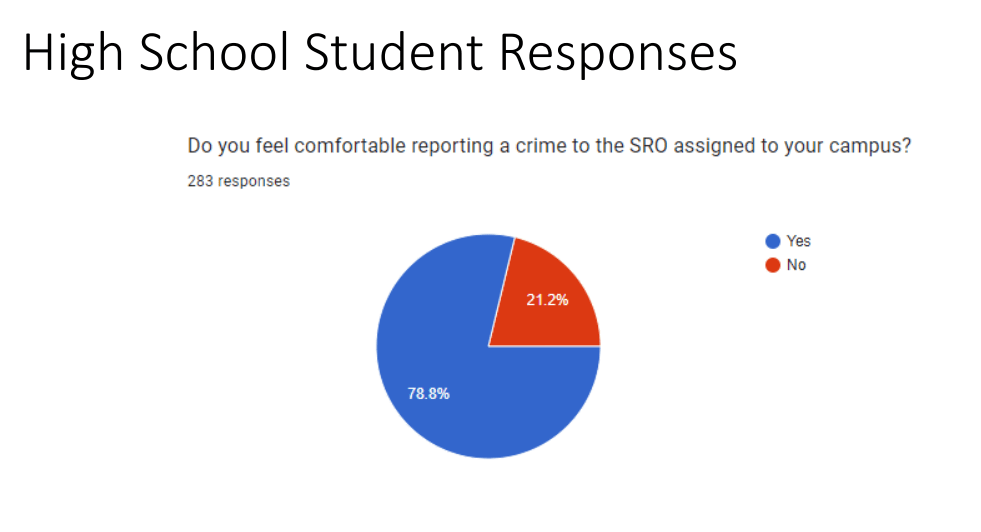
How do middle schoolers at Goodnight and Miller feel about cops in their schools?

How do SMHS students feel about cops in their schools?

How do middle and high school teachers feel about cops in their schools?

So there you have it!

Hours 0:00 – 2:19, 8/5/24

Citizen Comment:

Citizen Comment always starts with Jane Hughson reading a spiel about not being a jerk at the podium. However, this time there’s a new bit about how the security guy will haul you out of the room, if push comes to shove. Jane mentions that this is because of an incident a few weeks ago.

Now I’m all curious! I don’t know what happened, but it sounds exciting.

Here are the big topics for citizen comment:

  1. TDS stands for Texas Disposal Systems. They’re the guys that run San Marcos trash and recycling. Apparently TDS was first awarded the San Marcos contract in 2003, and they’ve been renewed ever since. They are coming up for renewal again.

Five people all have something to say about this. They don’t want TDS to automatically get the contract again. They want council to open up for bids from other companies this time around, instead of automatically going with TDS.

This item isn’t on the agenda tonight, but clearly there’s some sort of backstory here.

2. SMART/Axis, and whether they should get a new road.

This is the big item of the night, so I’ll save the comments for then!

3. Handicap Access around San Marcos.

This has come up before – speakers at Citizen Comment saying that San Marcos does not enforce handicap parking violations and does not prioritize accessibility.

Today they’re focused on Thorpe Lane, which is coming up in the CDBG projects.

4. One person brings up the Gaza ceasefire resolution.

Item 8: CDBG money.

CDBG stands for Community Development Block Grant. This is money the federal government gives us for small projects, for low-income residents.

First off, we have $766K from this year, and $640K rolling over from previous years, so we have $1.4 million total to spend. The new money, $766K, comes with strings attached:

So you have to be a little strategic about which projects get funding in which category.

This is the second reading. We saw this same list of projects back in June:

The second project – Thorpe Lane Sidewalk improvements – is the specific ADA accessibility one that the speakers were talking about, during citizen comment.

What does Council say?

Matt Mendoza: This is a new better council! I live in Rio Vista, so I get it!

What he means is that old city councils might have been jerks about funding the ADA projects, but this version is a kinder, gentler city council. Also he lives in Rio Vista, which is near Thorpe Lane, so he understands about the obstacles facing people in wheelchairs. Sure, why not?

And that’s it! In the past, they’ve tinkered with these amounts, and moved $100 here and there whimsically, but this time they just vote.

The vote to award these CDBG grants:

Yes: everyone.
No: no one.

….

…..

Item 9:  The big item.  We’re talking about annexing a SMART/Axis road.  

Background:  (Dec 22, Jan 23, Mar 23, Apr 23, May 23, June 23, July 23, July 24)

January 2023, Council makes a development agreement with Franklin-Mountain for this property:

Look how big that is! It’s wild.

Here is a complete list of all the details Franklin-Mountain gave for this project:

[ … Silence….

…crickets….

Somewhere, a train whistles in the distance. ]

In other words, they wanted complete freedom to do whatever they want on this land.  And so Council gave it to them! The worst-case scenarios would be some sort of toxic industrial mushpot.

As soon as the community found out, they were super angry.  The development agreement contract had already been signed, though. 

So the community started looking for the next Council decision point, to intervene and turn the ship around. Franklin-Mountain needed annexation and zoning to start their plan.  So the community focused on this.

Franklin-Mountain reluctantly tried to placate the community.  But every time they met with the community, they pissed everyone off.  They would just stonewall and give bland platitudes. Everyone got madder and madder.

Eventually the community put enough pressure on council, and Franklin-Mountain withdrew their application at the last minute. That was in the summer of 2023.

Which brings us to today.

This is the first time they’ve been back since last summer.

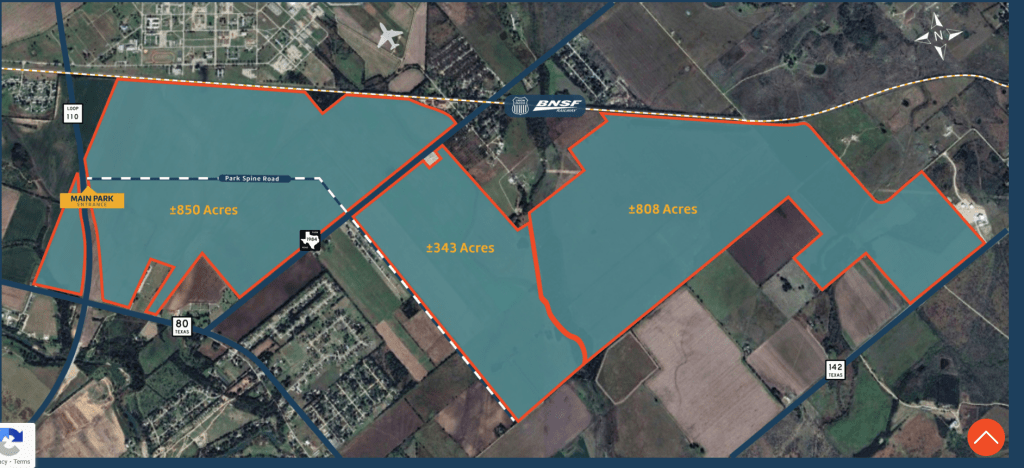
Back to this map:

Here’s the version on the company website:

We’re going to look at the left half of it:

This is just south of the airport.

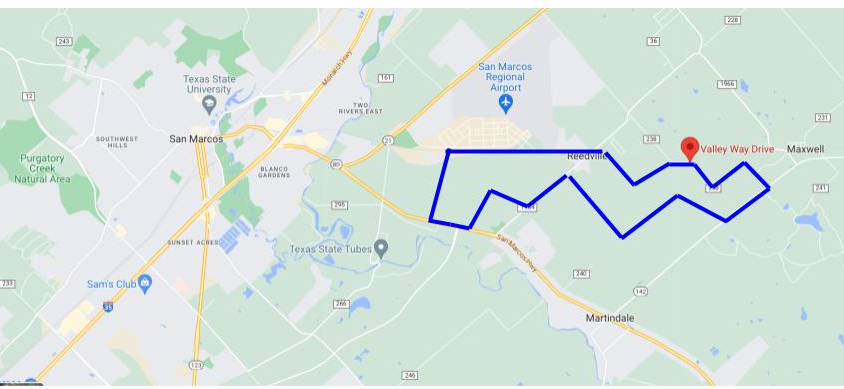
Here are the roads that we care about:

That is, Loop 110, the new loop on the east side, Highway 80, and a tiny country road called Highway 1984.

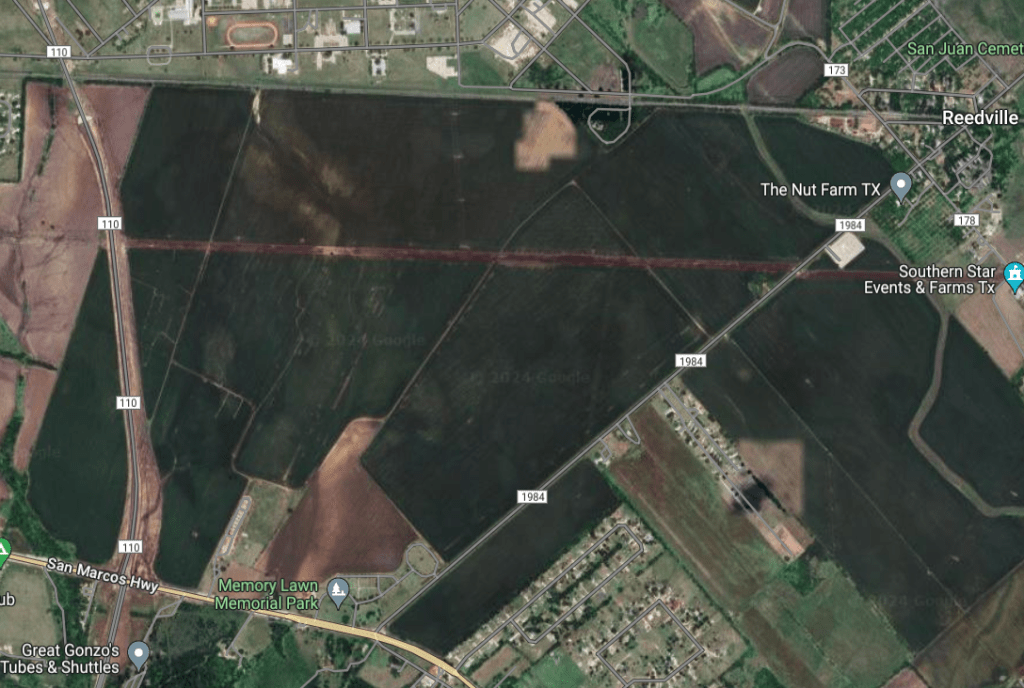
And just for funsies, here’s the aerial view of what we’re talking about:

So notice that dirt road running horizontally across.

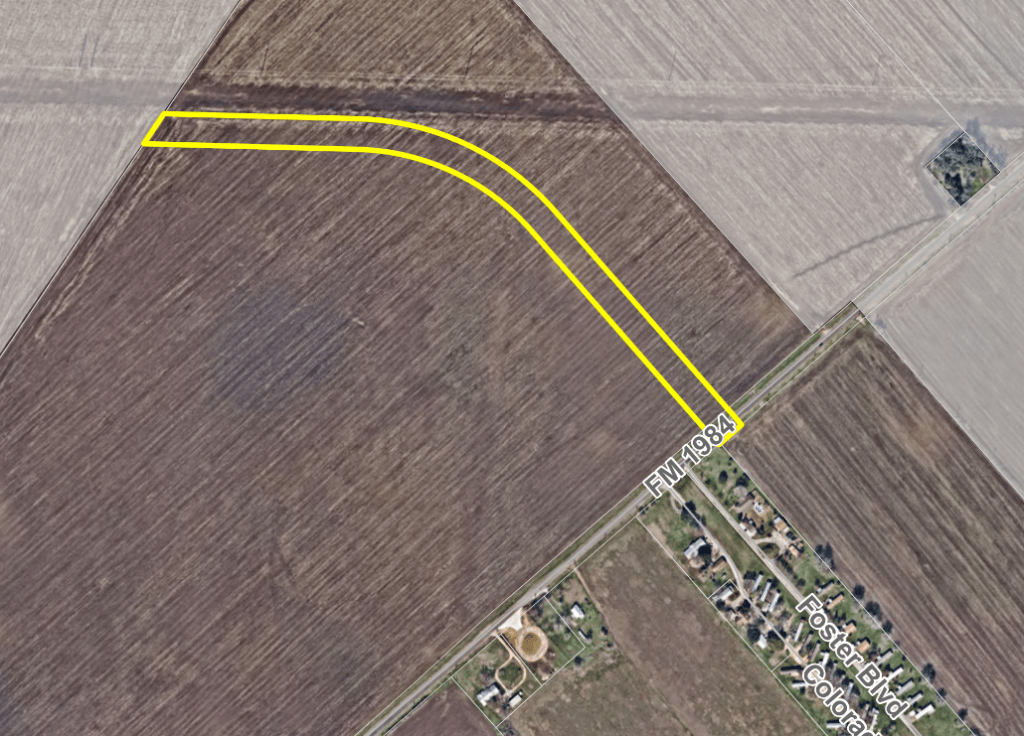
In the original plans, there was a road here:

Now, we don’t care about the WHOLE road. We care about the red portion of the road:

Franklin-Mountain wants San Marcos to annex that part of the road in red.

So first, notice that the road has jumped since the original plan:

You can tell it jumped by looking at the homes off of 1984. It used to be away from them, and now it’s right at the homes. This road is supposed to continue straight along someday. So now it will run along everyone’s back yard, instead of being separated by a field. This is a point of contention.

Franklin-Mountain wants San Marcos to annex the land and maintain the road. I think they’d still pay for the initial costs, though.

…….

Fundamentally, there are two questions: 

  1. Do we loathe and resent SMART/Axis so much that we basically just want to stall/delay/irritate them out of San Marcos? Or at least get them to take our concerns seriously?

For me, the answer is a hard yes!

  1. Does this road benefit anyone besides SMART/Axis? 

Here’s where it gets murky. It’s hard to tell what’s a good faith argument, and what’s a fake argument designed to give cover for Franklin-Mountain.  There’s definitely some bullshit that we’ll try to weed through.

What does the public have to say?

  • This only benefits the developer
  • 1984 is not equipped for this kind of extra traffic, because there will be heavy 18-wheelers constantly going to and from SMART/Axis.
  • They should submit plats and a Traffic Impact Analysis (TIA) first.
  • This runs along people’s homes now.
  • According to the development agreement, if you move a road, you have to get an amendment to the development agreement. Clearly they moved a road.

What does city staff say?

  • This road is supposed to connect big trucks from I-35 to SMART/Axis. Hopefully they won’t use the 1984 part, but we can’t tell them not to.
  • Running along people’s homes is actually a buffer! It’s a good thing.
  • We have a draft of a Traffic Impact Analysis, but the details are super sketchy.
  • The original road location was conceptual, not a major change.

What does council say?

Shane Scott: If this was an HEB, I’d say yes! But traffic is a nightmare out there already.  You want to add more trucks? That sounds like a terrible idea. I’m a no! 

Saul Gonzales: Samesies! I don’t see the benefit. Now is not the time.

Alyssa Garza: Can staff talk about the concerns about all the extra traffic on 1984?

Answer: We can’t prevent trucks from taking 1984.  They have to put signs encouraging trucks to take Loop 110 though. We just don’t know the future.

Jane Hughson: If we deny this annexation, can they still build the road?

Answer: Yes. They would have to work with Caldwell County, and build it to Caldwell standards.

Jane Hughson: If we annex it in the future, we’d have to pay for the upgrade to San Marcos standards?

Answer: Yup.

Alyssa Garza breaks in:  My spidy sense is telling me that Annie Donovan might have a useful point to make here.  

(Citizens can’t talk during the discussion unless a councilmember calls them up.)

So Annie goes up to the podium, and says, “Franklin-Mountain already tried to build the road under Caldwell County standards. But Caldwell requires a full plat and all kinds of information that these guys won’t supply.  So Caldwell wouldn’t grant them a permit. We’re their back up plan because we let them get away with anything.” 

Isn’t that enlightening? Other counties don’t give freebie blank checks to developers like we’ve done! They require the developer to explain what they’re going to be doing to the land. Amazing.

Alyssa: Staff, do we even talk to Caldwell County about these things?

Answer: [Vague mushpot of an answer about Intralocal Agreements and whatnot.]

Jane: Why would trucks come down 1984 to get to SMART/Axis? This seems like an internal road to me.

(I don’t know why Jane thinks this.  Look at the map: 

Definitely not an internal road or dead end. Regular old two-way road from Hwy 1984 to Loop 110.)

Matthew Mendoza: I know 1984 very, very well.  Been out there my whole life. My cousin was killed there. We have to do this, to make 1984 safer!   I wish it weren’t so close to the houses. But this is so important.

Mark Gleason: Thoroughfares are good! I don’t like the proximity to the houses, but development is coming, so we should be the ones to do it.  I’d like to talk directly to the developer, but they aren’t here. But yoo-hoo? If you could show up next time? That would help!

Usually developers send a representative to hearings, especially if it’s controversial like this. The representative would say sympathetic things to the neighbors, in a Bill Clinton “I feel your pain” kind of way. They can also answer questions and discuss compromises with city council. This is the bare minimum to pretending to care about the community.

These shmucks can’t clear that low bar. Mark Gleason wants to ask about the road moving, and maybe find a compromise with them, and so he is trying to alert them that they really should show up and field some questions.

Jane: I also don’t like proximity to houses. But when you think about it, isn’t a road just a different kind of buffer? What, otherwise they want some nasty industrial building in their backyard? This is a WIN!

Mark: I bike to Martindale.  Highway 80 is wild in between 110 and 1984! Be forward thinking!

Alyssa: Could staff explain why this road is life-saving? Is that for real?

Answer: Well, it at least is good for traffic flow.  Always better to have an alternate route in case of an accident!

Staff engineer: We like the San Marcos street and drainage standards better than the Caldwell standards. It’s also good to connect streets.

My thoughts:

First, the safety argument is worthless. This road will absolutely not make Highway 1984 safer.  It will definitely increase traffic on 1984.  There is no way there could possibly be less traffic on 1984. 

Look, if you want to make 1984 safer, you do things like this:

From the Department of Transportation, here.

There is nothing on there remotely related to our situation on that list.

This road is good for traffic flow! If Hwy 80 is backed up, people have a second route to get to I-35. But it is not good for safety.

Let’s be blunt: If SMART/Axis was a great project run by a transparent, forthcoming company, and everyone was thrilled about it, this road would be fine.  

  • People who are opposed to this road are really saying that they’re opposed to giving any ground to SMART/Axis. 
  • The question is: for the people in favor, are they toting water for SMART/Axis, or do they genuinely believe in the beauty of this road?

This meeting is just a first vote – there will be a second reading at the next meeting. 

The Preliminary Vote:

Yes, I want this to come back next meeting: Jane Hughson, Mark Gleason, Jude Prather, Matthew Mendoza

No, shut it down:  Saul Gonzales, Alyssa Garza, Shane Scott

I would have voted no, as a vote against SMART/Axis. In a different world with a different company, the road is probably fine.

….

Items 10,11, 12, 14, 15, 16: A whole bunch of utility stations and electric substations and things like that. 

La Cima is getting a Pedernales Electric Station here:

That is just past the intersection where Old RR 12 meets New RR 12:

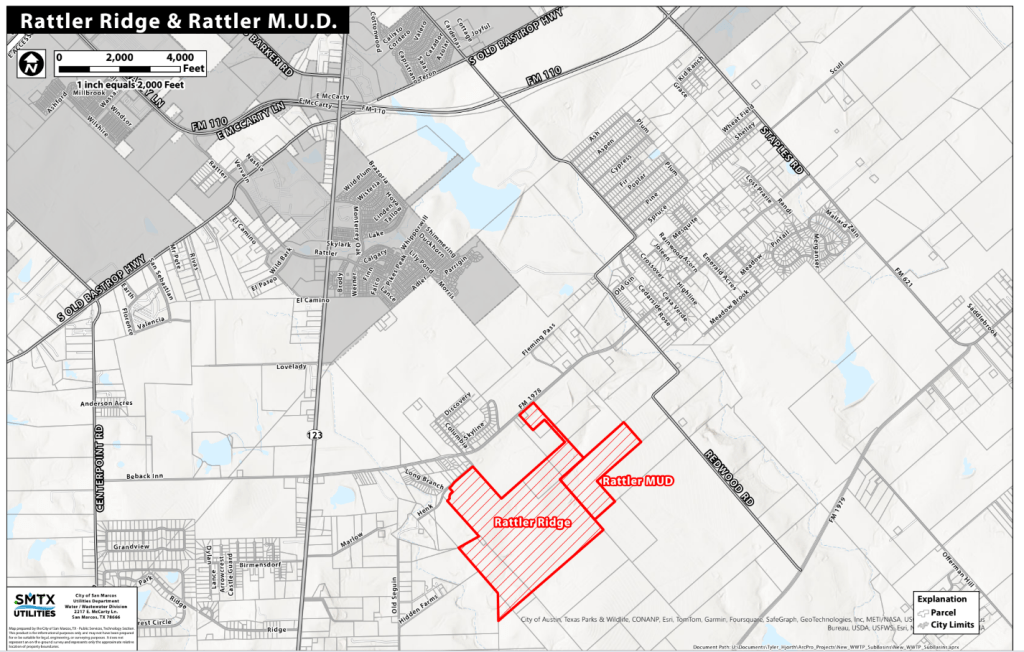
We’re annexing the electric Rattler substation here:

which is here:

We’re annexing the Guadalupe County Municipal Utility District No. 9, which is here:

And creating the new Sedona Municipal Utility District No. 1  here:

and we’re paying $3,218,046.00  to Payton Construction, Inc., for the Comanche Pump Station Improvements Project here:

Also we’re spending $2,340,876.46 for waterline construction along Staples Road.

Item 18: Hail damage

Apparently city cars had $1,483,482 worth of hail damage from the May 9th storm.  

San Marcos is part of something called the TML Intergovernmental Risk Pool, where a bunch of cities all band up together, pay into a pool, and basically self-insure.

So our deductible is $25,000 to cover the $1.5 million in hail damage. Not bad.

Hours 0:00 – 1:32, 7/2/24

First off: it was Laurie Moyer’s last meeting, after 36 years with the city. Mostly she’s done engineering-ish things, but also some City Manager-ish things. She took all these great City Hall photos on her road trip last year. Congrats to her!

Citizen comment:

  • Two people – Noah Brock and Annie Donovan – talked about the latest iteration of SMART/Axis hijinks. I’ll save their comments for that section.
  • Two people called for a resolution for a ceasefire in Gaza.
  • The San Marcos Civics Club, and how Council passively assumes they can’t solve city problems
  • Mano Amiga’s petition to repeal Civil Service. I’ll save these details for later, too.
  • Finally, the killing of Malachi Williams by the SMPD officer on April 11th. (Discussed previously here, here, and here.)

To recap, the family of Malachi Williams has been asking for:
1. Release the name and badge ID number of the officer that killed Malachi Williams
2. The officer should be placed on leave while the investigation is ongoing.
3. The family should be able to view all officer and storefront footage, with a lawyer present.

Malachi’s grandfather spoke eloquently. This has happened before. But then the City Manager Stephanie Reyes spoke, which is new.

Here’s what Stephanie Reyes says:
– Video material is available for the family to view along with their attorney. It’s at the Hays District Attorney’s office.
– The DA says that neither the family nor their attorney has reached out to view the footage.
– The DA is waiting to discuss how much of the video the family can watch.
– Because this has been so awful, Chief Standridge is putting together an SMPD Crisis Communication Policy for future incidents.
– the DA Kelly Higgins weighed in on the policy. He has concerns about any public release of video while the investigation is ongoing. He wants videos to be withheld until after a grand jury has reviewed the matter.
– the DA knows that the family needs answers. State code authorizes the DA to let the family watch the video. He’s open to conversation with the family.

(I would like a universal policy that applies to all situations. When an officer is killed by a civilian, how quickly does the family see the videos?)

Next Malachi Williams’ grandfather speaks again, which is usually not allowed. “What we have been offered has not had much substance to it. We have not had a fair offer. There’s been an offer, but it’s not fair.”

Alyssa Garza asks, “Was the family offered the entire videos? All the body camera footage?”

Chief Standridge comes up. “The DA and I are offering the family all the body cam footage. But we are not offering the store’s videos. The DA has not agreed to release that. The DA and I will let them see still photos from the store. But the DA has not agreed to store footage.”

After that, the grandfather has a lot of questions and frustration. Council was not really allowed to respond, legally. They redirect him to the DA. He’s already interacted with the DA and is entirely fed up with him.

It ends in a tense place.

Item 23: Another LIHTC project! 

LIHTC projects are low-income apartment complexes which don’t pay local property taxes. We’ve seen two others recently here. (LIHTC stands for Low Income Housing Tax Credits.)

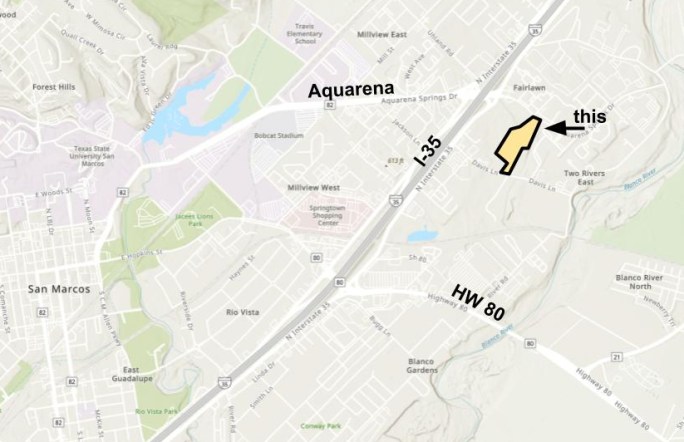
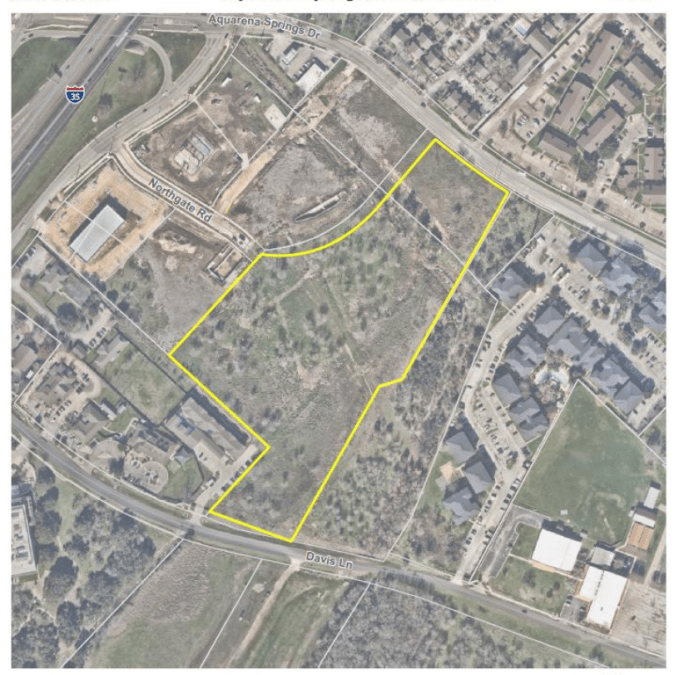
Where’s this one?

And here’s a close up:

They’re planning on having 304 units.  How affordable will these be?  

In other words, this is 46 units for low-income community members, and 258 for regular community members.  (The median income in San Marcos is $47,394 a year, so 85% of these units are regular old market rate apartments.)

Okay, fine. How much is this costing us?

The estimated loss in tax revenue is $3 million over 15 years, or $200K per year.  They’re softening that by giving us a one-time $400K payment. 

What other services are there going to be? 

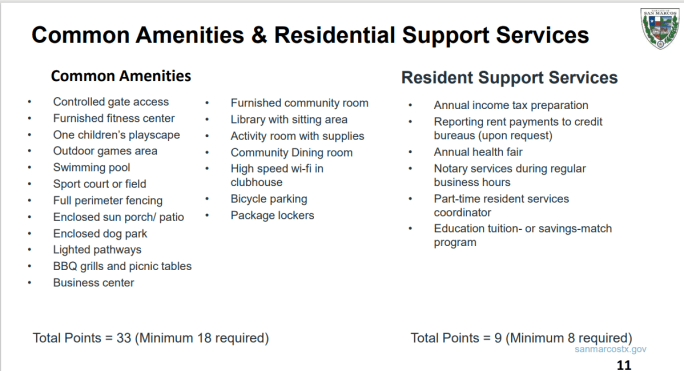
[Technical note: There’s some mucking about with the number of 3-bedroom apartments. This complex only has half as many as the city San Marcos requires for LIHTC developments. However, there’s a letter from the Housing Authority about the different waitlists for 1, 2, and 3-bedroom apartments, and 3 bedroom apartments are not in demand as much as 1 and 2, so it’s fine.]

Jane Hughson has some questions:
– Did this area flood in 2015?
Answer: yep. But the buildings weren’t TOO badly damaged.
– Will the complex provide residential shuttles?
Answer: nope. It’s right on a bus line.
– Will the units have individual washer and dryer units?
Answer: yep. 
– Will they have education, services, and after-school tutoring?
Answer: yep.

Alyssa: I’ve heard complaints about restrictions and racially biased access to facilities.  How do you make sure that doesn’t happen?
Answer: We partner with Asset Living. They staff everything and report to us monthly. If something isn’t getting used, we ask them to advertise it.

[I am extremely curious about the complaints of racially-biased access to facilities.] 

The vote: Passes 7-0.

However: Council is going to have big conversation about LIHTC projects in general, at the end of this meeting. Stay tuned.

….

Items 23-24: Kissing Tree 

Kissing Tree is the senior community, way down on Hunter Road and Centerpoint.

Kissing Tree is a TIRZ.  This means they pay taxes, but the taxes don’t go to the city’s General Fund.   Instead they get funneled to side projects that benefit Kissing Tree – mostly building out the public roads and utilities that run through Kissing Tree.  It’s not wasted money, but it doesn’t go to libraries, parks, firefighters, etc.  

Costs have gone up and the assessed value of Kissing Tree has gone up, so they’re re-jiggering all the TIRZ numbers:

This is probably all fine! Before we had estimated that we were sending $32 million over to the Kissing Tree for roads and pumps and parks, and now we’re sending $46 million over. 

Over 15 years, we’re keeping $5 million and giving $46 million back.

Let’s compare this to the LIHTC Project above! In that one, we’re keeping $400K and sending $3 million back.

So to be stark about it:

  1. The LIHTC project is giving us 13% of their estimated property taxes and using the rest to subsidize rents on low-income apartments.
  2. Kissing Tree is giving us 10% of their estimated property taxes taxes, and using the rest on local roads and utilities.

Guess which project makes Mark Gleason uncomfortable? The big reveal later on will not surprise you at all.

….

Item 2: SMART Terminal/Axis Logistics

The SMART/Axis people want San Marcos to annex about 7.5 acres of land for a road and right-of-way. 

Quick backstory (Read more here.)

In January 2023, Council signed a development agreement with SMART/Axis people.  Back then, these agreements happened in one single council meeting, and barely anyone had to be notified.  So Council approved a gigantic fucking 2000 acre industrial park without public input and barely any details, and everyone got super angry about it.

2000 acres is very big:

Like, REALLY big:

The people who live out this way were absolutely livid.  But the development agreement was already signed.

The next step of the process was for SMART/Axis to apply for a zoning change to Heavy Industrial and get annexed into the city.  

What they could have done was meet with the neighborhoods nearby, provide details of the project, build relationships and be good neighbors.  Instead, they met with the neighborhoods and generally acted like supercilious pricks who couldn’t be bothered.  The surrounding community got more and more furious, and launched a major activist campaign against the project. 

Eventually SMART/Axis withdrew their zoning and annexation request. That was last summer. Since then, it’s been quiet.

Here’s my best guess: SMART/Axis didn’t want to share any details because they didn’t have any yet. They literally want free reign to do whatever they want on this land.  They came off as supercilious pricks because they are supercilious pricks.  They assumed San Marcos is a backwater rural town that will fawn over fancy business men and give them whatever they want, in hopes of some dollar bill scraps. City Council was happy to play their role!

That brings us to today – should San Marcos annex some land and build a road along the side of the land?  

First off: Nothing happens today. We are just picking dates for the public hearing and final vote.

However, let’s do some speculation!  This is brought to you by Noah Brock and Annie Donovan, during Citizen Comment. (They spearheaded the public campaign against SMART/Axis last year.) 

Here’s the case that Noah and Annie are building:

  • Is this a major change or a minor change? If it’s a major change, the development agreement needs to be amended. That’s a much bigger deal. (The city is saying this is a minor change.)
  • Originally, the roads lined up with the end of Quail Run. That was the edge of the whole project. But since then, the developer has bought more property, and asked Caldwell County to move some roads over.
  • It seems clear that they’re expanding the project beyond the development agreement, and this new land is right next to a residential area. 
  • This new ROW annexation is consistent with a bigger, changing project.

The basic problem is that SMART/Axis people are super secretive and seem to want to walk all over us.  Maybe they’re sweet little bunnies at heart, or maybe they want to do some toxic battery mining or who knows what.  They act like shitty neighbors every time they have a chance to right the narrative.

Today’s vote was just to set the dates, and here they are:

  • Public hearing will be on August 5th
  • Final vote will be on August 20th

….

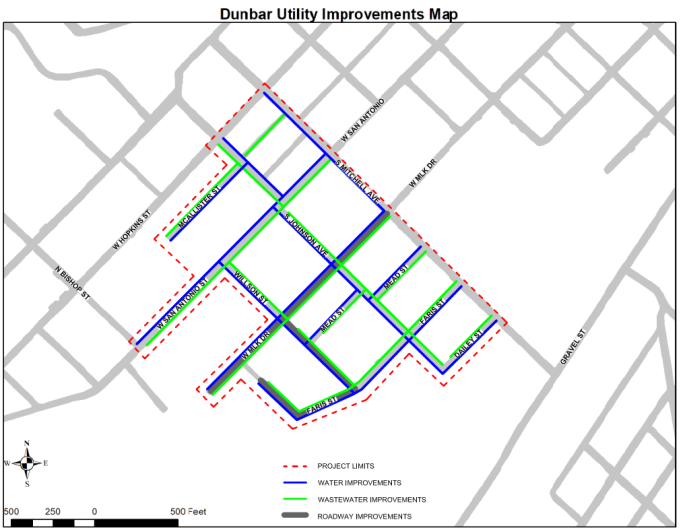
Item 25: Dunbar is getting some new pipes!

We’re spending $6 million on water and wastewater improvements here:

If you go here and scroll to Dunbar Water and Wastewater Improvements, you can keep an eye on the project. 

Supposedly will be done by August 2026.  So at least two years of dug up streets and annoying construction, but with a worthwhile payoff. 

Item 27:  Installing sports lighting on six soccer fields at Five Mile Dam.

This money was authorized awhile ago, this is just the contract to make it happen.  It’s about $1.3 million.

Hours 0:00 – 2:03, 5/7/24

Yowza, you guys. Most of this meeting was Citizen Comments. There were two full hours of citizen comments on Tuesday. A total of 40 speakers. Plus an additional 3 speakers at the 3 pm meeting.

So we are going to park it at Citizen Comment and unpack all this.

Topic 1: Malachi Williams.

We’re going to start with the most heartbreaking part, which is that the family of Malachi Williams spoke to council.  I cannot do it justice – you should go listen yourself.  Here’s the video. 
– Malachi’s grandfather speaks first, at 1:25:40
– His older sister, at 1:29
– His mother at 1:31
– His younger sister at 1:36
– His aunt at 1:38:30
– His third sister at 1:58
– His grandfather also spoke at the 3 pm workshop, here at 11:30.

You should definitely believe that Malachi Williams came from an incredibly loving, supportive family who is devastated by this loss.  They are desperate for some answers.

So what do we know?

Malachi Williams was a 22 year old who was killed by cops on April 11th, 2024.  You can read the basic facts here.

Here’s a video of Chief Standridge explaining the SMPD side. There is a transcript at the YT video, if you don’t feel like watching

The family has three requests:

  • Release the name and badge of the officer
  • Take the officer off duty until the investigation is complete
  • Let the family and their lawyer watch the bodycam videos, as well as gas station and HEB footage.

These are really reasonable.  In the video, Chief Standridge has a big long thing about how legally, the videos are evidence, and so they can’t be released publicly until after the grand jury and/or trials play itself out.  But the family is not asking him to publicly release the videos – they’re asking for family and a lawyer to see them.

The family’s comments are beautiful and heartbreaking. They’re an extremely close family. They just need answers so that they can begin processing this enormous loss.  

The rest of us will not know what happened for a long time. (But look: a knife is not a gun.  He was armed with two large kitchen knives. I have questions about how exactly Malachi could be close enough to pose an immediate risk to someone else, and yet it was safe to fire a gun at him.)

About 20 of the other speakers talked about Malachi Williams and called on Council for justice.

Topic 2: Ceasefire in Gaza.

There were 32 speakers calling on Council to pass a resolution calling for a ceasefire in Gaza.  (Most of these speakers were also the same ones who talked about about Malachi Williams, and they connected these two topics under the same umbrella of state violence against civilians.)

There’s been some drama, because this appeared on the rough draft of the council agenda:

But then it was not on the final agenda, because Shane Scott withdrew his support. (It takes two council members, or the mayor alone, to put something on the agenda.)

Lots of speakers say that Shane withdrew his support due to a threat of some sort? Maybe! Or maybe he just didn’t feel like being in the hot seat. Who knows.

Anyway, 32 speakers is a LOT of speakers. The resolution for a ceasefire has been coming up for months – here, here, here, here, and here – but not this many speakers. Obviously this connects with the mounting protests at Columbia, University of Texas, USC, and so on.

And look, the protests are actually paying off. Biden has paused two shipments of bombs to Israel over the invasion of Rafah. Biden is slowly hardening on Israel. (He’s going too slowly for me to stomach, but he’s miles away from how Abbot or Trump would handle it.  They would escalate the destruction of Palestine to armageddon levels. )

Look, we’ve got a governor who is actively supporting Israel in a number of ways.

This ceasefire resolution is a municipal issue because city councils can amplify the voices of their community. This resolution would send a message to Abbott (which he would ignore) and a smaller message to Biden (which he seems to be responding to). So c’mon, Council, get your act together.

Topic #3: Miscellaneous

Finally, there were a few other topics:

  • The need for more teen programming in San Marcos
  • A great comment about “bro-dozers”. I love this one. You know the guys that rev their engines through town and startle you into spilling your drink, if you weren’t expecting it?

The speaker has an apartment on Hopkins, and so he got himself a decibel reader. When the bros rev their engines, it’s 90-95 decibels in his apartment.

We actually have a noise ordinance against vehicles!

But see, it only covers music coming from the vehicle, and not the engine itself.  

But consider:

Presto! Look how easy to fix!

City staff! File this away for the next round of code updates, please and thank you.

  • Remember the SMART Terminal? Oh yes you do. (Brush up on it here, if you don’t.)

It was originally on the agenda for tonight as well:

But it got pushed back to a future meeting. (Franklin Mountain is the SMART/Axis company.)

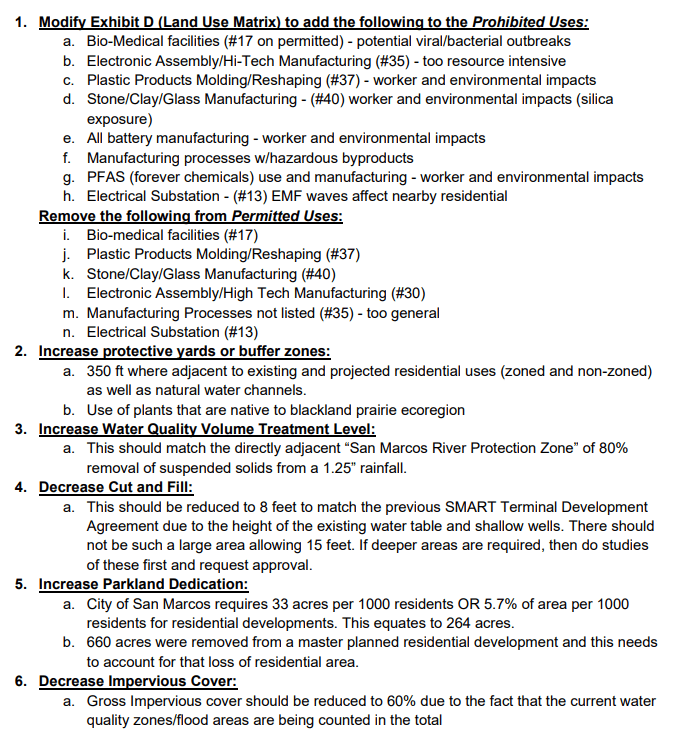
Noah Brock and Annie Donovan were two of the main activist organizers last time. They’ve submitted a ton of open records requests. Here’s what they’re saying about this upcoming issue:

Franklin-Mountain is apparently getting mad at Caldwell County, because Caldwell County doesn’t let developers do whatever the hell they want. Caldwell County requires all these planning documents up front, such as:

  • Subdivision plan
  • Water Protection Plan
  • Phase Development Plan
  • Traffic Impact Analysis
  • and more!

before they’ll process Franklin-Mountain’s application.

Whereas we were all ready to let the developer pinky-swear to be good-hearted, and we’d sign over all rights to do anything they wanted. We didn’t require any of those!

So here, the developer is moving roads around, in ways that seem to violate their good-neighbor promises. This roadway doesn’t match anything they’ve claimed up till now. This annexation seems like it would not benefit San Marcos in any way, but it would off-load costs onto the city.

Stay tuned! This might be on the agenda at the May 21st meeting.

  • Virginia Parker speaks again about the drought triggers passed last time, and asks if there’s any way to revise it.
  • One speaker talks about Purpose Built Student Housing, and has a number of recommendations to address tenants’ rights. Things like increased funding for code enforcement, a right to resolve late payments before evictions, a right to a public defender, just cause evictions, and no-net-loss housing ordinances.

Texas is very pro-landlord, so it would take some research to figure out what’s legal to do here, but I generally support all action in this direction!

Hours 0:00-1:39, 6/6/23

Citizen Comment: We’re going to focus on the SMART/Axis Terminal here.  (It’s not otherwise on the agenda today.) There’s a group, Citizens Against SMART/Axis, which is holding a public meeting at the library on Sunday (6/11) at 3 pm.  Here’s their flyer, off Facebook:

Ie, if you’re reading this on Sunday morning and you’re free this afternoon, why not head on over? They seem like nice people.

The big day will be July 3rd, when City Council votes on the Heavy Industrial zoning.  If it passes, then we’ve given a massive blank check to a jerk who will then decide which industries come to San Marcos.  Right now, there’s a lot of money in batteries and tech fabrication plants and things involving toxic rare metals and lots of water, and Texas has very lax environmental restrictions.  That’s the kind of scenario that I’m particularly worried about.  (I also think the sheer scale of it is bonkers.)

And if the zoning doesn’t pass? My guess is that there’s a contingency clause in the development agreement – if the zoning doesn’t pass, it invalidates the contract. Then the company could either develop under county regulations, or walk away for a year, or come up with a different proposal. 

Have you all seen the yard signs around town?

I think they’re pretty effective. Partly because they put council members on notice that the community is willing to launch a public campaign: vote down Heavy Industrial, or the next public campaign may be against you.

Bottom line: Council shat the bed. It’s really astonishing how they passed this development agreement under so much quiet and stealth.  It’s 2000 acres, for god’s sake!

Item 6: Community Development Block Grant money.  (CDBG) The city gets federal money to spend on nonprofits. This year, we’ve got about $700K to distribute.  

Here’s the criteria that staff uses to assess projects:

And here are staff recommendations:

Saul Gonzales asked about Habitat getting $0 for Housing Counseling.
The answer: Habitat is really good at lots of things, but counseling ain’t one of them. Plus they’ve still got leftover money from last year. In general, we’re still partnering with Habitat, but just not for counseling. 

As for the Housing Rehab program getting $0: somehow this is good for the city, for reasons I didn’t quite follow.  

Alyssa Garza mentions that she hears a lack of trust in the nonprofit community about how these funds get allocated, and that increased transparency would help. I don’t have the expertise to read between the lines! But transparency generally sounds good to me.

Item 7:  P&Z is going to gain some new powers: the powers of AIRPORTATION.  Specifically, some height hazard zone regulations and compatible land use zonings.  A lot of this is regulated by the FAA, but P&Z will get to weigh in on the remaining bits.

Whenever the airport comes up, everyone speaks cryptically about scandals that I’m uninformed on.  We saw a snippet of it here. Even LMC weighed in on some convoluted past event from ten years ago. Frankly, I’m pretty sure I’m not capable of fully understanding whatever the hell went down.

….

Item 8: The city has a lot of 2 hour parking downtown.  Now some of those sites will be relaxed, to 4 hour parking.  Here’s where it will go:

Take your time! Shop around! You’ve got four hours now.

Council members asked some worried, nonsensical questions, as though we were tightening up restrictions instead of loosening them.  Everything will be fine.

Item 9:  We’re pretty terrible at paying parking tickets:

So the city is going to start putting boots on cars, if you have 3 or more unpaid tickets.

(We discussed this before, but now we mean it.)

The point is to force the worst offenders to get in touch with the city and come up with a payment plan (or maybe schedule some volunteer hours instead – more on this later.) The plan is not to turn the screws on someone who is teetering on the edge of economic catastrophe. Of course, it always just depends if the program is implemented in good faith or not.

Stay tuned! There is a lot more discussion of parking coming up at the end of the meeting

….

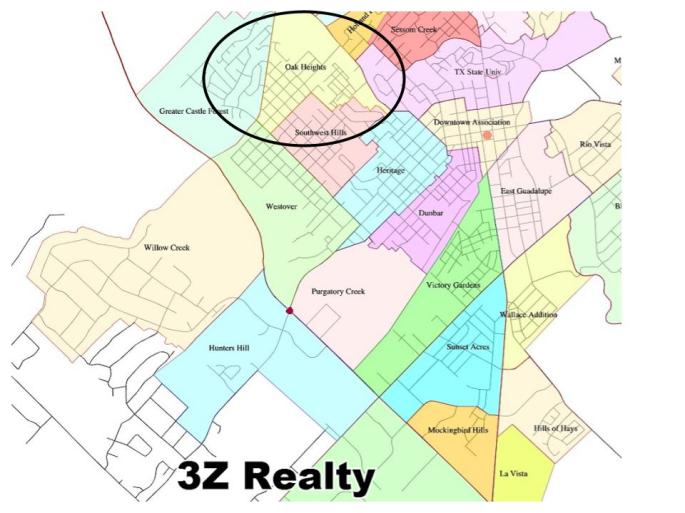
Item 10: This is the Oak Heights neighborhood:

via

The top left and top right roads are Craddock and Old 12, where The Retreat is. This is the Crockett elementary neighborhood. The speed limit used to be 30 mph.

Now it will have a new, lower speed limit of 25 mph in on these streets:

Good for them! Drive like a grandma, everyone. Your car is lethal.

….

This is Uhland Road: 

It runs from Post Road to I35, and then jumps north, and runs east to Harris Hill road.

Here we’re only looking at the part west of 35.  These lucky folks are getting some speed cushions here:

Good job! Drive safe.

Jane Hughson wraps up by saying, “All right! We do listen to our residents! …um …when we’re talking about speed cushions. And changing however many miles per hour you can go in a neighborhood.”

That is hilariously self-aware of Jane Hughson.  And it’s true: sometimes we listen to our residents.  Other times, we don’t.

Item 13: $250K more to GSMP to fund a small business program.  Seems fine, as far as capitalism goes. The only reason I noticed it was because Matthew Mendoza made a special point of praising this accomplishment.

Hours 2:58-4:37, 5/2/23

Item 14: The ever-loving SMART Terminal.

(Background here, here, here, and here.)

The development agreement has been opened back up! Cue angels singing. 

First order of business: who is going to do the actual renegotiating with Franklin Mountain?  

  1. Staff?
  2. A subcommittee of council?
  3. The entire council?

If you picked 1, then you agree with Jude Prather, Shane Scott, Mark Gleason, and Mayor Hughson.

If you picked 2 or 3, you have the company of Alyssa Garza, Matthew Mendoza, and Saul Gonzalez.  

So option 1 wins, and it will go back to staff to renegotiate things.  

Alyssa Garza brings up the issue of dialogue: the community has been asking for a back-and-forth conversation. They’re not getting it.  Jane Hughson points out that council has heard hours of comments from the community, and she had a three hour conversation with three of the community members.  I kinda see where both sides are coming from.

Straight talk: do community members really want dialogue? No, they want the SMART Terminal to be cancelled. But they’ll settle for dialogue because they suspect they’re going to lose the war, the moment they stop talking. If they truly believed that a majority of council was fighting hard for their interests and was willing to cancel the whole SMARTGASBORG, then I bet community members would feel comfortable relinquishing control.

Dialogue without changing the outcome is infuriating.  No dialogue, but a responsive government who shuts down the whole SMART boondoggle would be fine. Dialogue is important, but I kinda agree that there’s not a whole lot of team-building to be done here.

Next order of business: which issues should be renegotiated by staff?  

The planning director, Amanda Hernandez, gave a quick presentation.  They amalgamated the 12 concerns from the community (that I posted here last time), along with an email from Ed Theriot and one from Virgina Parker.   In addition, the emails were all included in the packet.

However: you know whose email wasn’t included in the packet?  MINE.  Since they had specifically invited the community to email any additional suggestions, I sent one in about labor practices, and specifically indexing the minimum wage to inflation. 

And….<crickets>.  So city staff: I hope you feel the mighty burn of my stink-eye, aimed in your general direction, from the safety of my own living room.

(Jane even asked, “Is that everything that was sent in?” And still they suppressed my wee little marxist voice! For shame.)

Matthew Mendoza proposes that we send all the issues to the negotiating table, and see where it lands. Everybody seems on board with that.

Item 14: Coming up in future discussions:

Car boots.  Apparently we bought a bunch in the 90s and never used them, in part because we needed a court order to do so.

They’re going to discuss a policy where you can get booted if you have three unpaid parking tickets. 

The idea is not to be punitive. In order to get the boot off, all you need to do is get in touch with the city and come up with a payment plan. 

Item 17:  Eviction Delay:  Currently we have a 3 month eviction delay.  This is still under the auspices of the Covid Emergency Declaration, which is still in effect.

There’s a couple things going on:

  1. Some landlords are ignoring the delay and illegally evicting tenants early.
  2. Some renters are intentionally skipping out on the last three months of rent, knowing they can’t be evicted
  3. Rents are insanely high in San Marcos, especially with regard to the median income

So there’s bad circumstances all around, plus some bad actors on both sides.

Alyssa is very concerned that we will not be able to properly notify community members that the extension is coming to an end.  This is grounded! We’re really terrible about outreach. Or rather, outreach is incredibly hard to do well.

Mayor Hughson puts a call out for media outlets to help spread the word.  I GOT YOU, MAYOR HUGHSON!   From your lips to my ear!  I’m doing it!

There are a lot of details to hammer out, but expect to see it end around July 1st. 

Hours 0:00-4:50

Items 6/7: The dreaded SMART Terminal

If you’re new here: Giant industrial park going up for zoning, out towards Martindale. Everyone very mad. Read the whole sordid backstory here.

Here’s the basic sketch of what happened Tuesday night:

  • A ton of community members showed up in and drowned council in a mountain of information, concerns, data, suggestions, and so on.
  • Council got the message loud and clear.
  • Council is going to revisit the Development Agreement
  • Then they’ll revisit the zoning in July.

Just a passing thought: these community members with these careful, well-researched, passionate statements to council? perhaps would make really great progressive potential future candidates for public office!

I’m just putting this out in the universe. Granted, a lot of the speakers live outside city limits, but maybe they were just annexed on Tuesday.

The City Staff presentation:

There was a small bit of new information given on Tuesday from the city:

(Crappy quality because it was not in the packet, so I had to screenshot.)

This fiscal analysis is supposed to happen before every annexation. I can’t remember ever seeing one of these before, and there have been a lot of small annexations. What happened here is that the community members noticed and spoke up repeatedly about it. In response, city staff put this together.

However, Noah Brock (one of the community members) independently did his own revenue estimate, using Amazon Warehouse tax revenue rates as a model. His estimates:

  • Year 5: $1.4 million annually
  • Year 10: $4.3 million annually
  • Year 20: $8.1 million annually

The city’s estimates favor the developer, and Noah’s is less rosy. Draw your own conclusions.

(You know what I’d LOVE to see? The fiscal projections from the Amazon warehouse in 2016, or the Outlet Malls, or Embassy Suites, and how those have panned out. I’m sure they’re sitting in some prospectus, aging like milk. I found the Chapter 380 agreement for Amazon, but not the fiscal projections, which leads me to suspect it was never made public.*)

Seeing the writing on the wall, the developer made some small concessions in the days leading up to the meeting:

  • Double the buffer zone required by San Marcos code (around creeks I think?)
  • They will only pile shipping containers 80 feet high in certain areas (in the yellow circle below)
  • At the purple arrows, they’ll put a 100 foot buffer between the SMART Terminal and residential homes.

100 feet is tiny. A typical house sits on 1/5th of an acre. If that lot is square, it’s roughly 92’x92′. I’ve probably made you read 100 feet of my blathering already, and it’s only Sunday morning.

The idea that these two concessions would mollify the community is pretty arrogant. This developer keeps rubbing me the wrong way.

(Who is this developer anyway? Two of the community members filled us in: Franklin Mountain is an investment conglomeration owned by Paul Foster, an oil baron who is the current chair of ERCOT and part of lots of GOP committees, boards, etc.)

What do community members want?

At P&Z, the question was “If we turn this down, will the developer build in the county, with zero environmental protections?” San Marcos River Foundation director Virginia Parker thinks this is definite. However, this is a convenient threat that developers levy all the time, to spook communities into concessions. Maybe both can be true.

Either way, the SMART Terminal fight has morphed. Community members probably still wish it could be shut down altogether, but they recognize that that ship has sailed. On Tuesday, the conversation was no longer about whether it’ll happen, but instead about how to mitigate the damage. They’re fighting for the least-bad option now.

Seven of the community members (Noah Brock, Annie Donnovan, Ana Juarez, Ramona Brown, Ezra Reynolds, Bruce Jennings, and Rocco Moses) put together this list of recommended changes:

To the list above, I’d add:

13. Labor Protections

We keep being told that the point of the SMART Terminal is:

  1. to increase tax revenue without raising property taxes
  2. to bring good jobs to the community.

There needs to be some labor protections in the development agreement. Otherwise you will get shitty, exploitative jobs.

In 2016, we passed an amendment that any company receiving money from San Marcos should pay minimum $15/hour, plus benefits. This is a good start, but there’s one crucial detail missing: it must be pegged to inflation. You should never set a safety net without planning for inflation-adjustment.

(Honestly, this is one of the most underappreciated near-misses of federal policy of the 20th century: not pegging the minimum wage to inflation.)

Other labor protections: regular schedules with advance notice, no drug testing, and there’s a bunch more here. But mandating that the minimum wage keep up with inflation would be a good start!

Other recommendations: Ed Theriot is a local developer who is usually trying to build the things that make neighbors mad. But this time he’s the neighbor, and also one of the Caldwell County Commissioners, to boot. So his perspective is particularly useful.

However, I don’t have his recs yet. He’s writing up a list of recommended changes to the Development Agreement, and I’ll include it here when he sends it to me.

One more thing:

There was one more very interesting thing in Citizen Comment, which doesn’t fit neatly anywhere. Bruce Jennings offered the following history of the land next to Gary Job Corp:

Let me tell you a story about the land you are about to annex. The area in question has significant history of prior pollution. Some of you may be old enough to recall that the airport and the Gary Job Corp property was Camp Gary, a military installation from 1942 to 1956. Now, one of the duties of the base was aircraft maintenance; engines had to be maintained, parts cleaned, fluids changed, detergents, oils, and degreasers disposed of. But in the 40’s and 50’s few knew about the potential of pollution. Camp Gary personnel dumped these chemicals into a landfill and creek at the back of the property…for years.

Those fluids ran downstream to a earthen detention pond before entering the San Marcos river, where they settled as heavy metals on the bottom of that pond. Later, in the 1970’s and 80’s most people had forgotten and the land was developed for residential use. People started fishing for bait in the pond fed by 2 creeks and springs from the hillside. One day I was approached by an elderly gentleman who told those fishing to NEVER eat what they catch in that pond. I was alarmed to say the least, and began to look for information.

We had city, county, state, and federal representatives on site multiple times. It was suggested that the property be identified as a superfund clean up site. Jake Pickle came out one day and walked the property with us.

The price tag for cleanup in 1981 was 5 million dollars. Options were discussed and a decision was made…to leave the contaminants in the soil. The contaminants were left under a 12 foot cap of mud.  And instead, let’s improve the sewage treatment and close the landfill that followed, by the ownership of San Marcos, who owned the landfill out on the back end of Camp Gary.  Where 69% of it was on two lots, where Camp Gary became Gary Job Corp.  That cost about 1 million dollars. So if I remember correctly, you all had to build about 10 test wells out there, and run them for several years!  

Now, at the time, the southeast part of the  property, where the San Marcos Municipal Landfill was, encompassed an area of approximately 353 acres, of which two Gary Job Corps Center tracts comprise about 69 percent. Hazardous chemicals found included volatile organic compounds (VOCs), polychlorinated biphenyl (PCB), cadmium (Cd), iron (Fe), Ph, and manganese (Mn). Now these chemicals are in the soil out there.

If you do allow the cut and fill, you need to be testing the soil every time you penetrate for a slab out there, because what I understand is that you will be releasing PCBs that have been trapped in the compressed soil, and it will be leaching in the soil and then therefore go into the shallow water system that transfers through those creeks. I know this for a fact because I live two miles from that old landfill, and the pond at the beginning of my street is horribly contaminated! And y’all didn’t want to clean it up. Y’all wanted to just have a cap on it, and y’all went and did improvements over at Camp Gary, did your test wells for several years, y’all came and did tests at my pond for two full years. That shallow water feeds the creeks and the rivers. Any destruction of the soil could release the chemicals that were stored in the soil as hazardous chemicals. There would be a detriment to all of the flow of the water that seeps into and nourishes the river.

(That’s an amalgamation of his spoken and written comments, which he was kind enough to email to me.)

Here is the punchline, an environmental assessment on the land, prepared for the Department of Labor:

The San Marcos Municipal Landfill was once listed as a Texas Superfund Site in Reedville, Texas with the EPA Site # TXD980625222 (USEPA 2021). The landfill is not listed on the National Priorities List (NPL). It is currently registered as an Archived Superfund site by the USEPA (Homefacts.com 2021).

(Link and quote also from Bruce’s email.)

Just think, our very own Archived Superfund Site!  With hard work and a fair wind, we could really double down on the legacy of environmental damage here.

Last thoughts:

The point of city planning is to share decision-making with the residents of the city. Developments affect residents, so residents ought to have some decision-making power over what gets built where.

We are giving away our power. Franklin Mountain isn’t an industry, it’s a middle man. They want the power to decide what gets built there.

The SMART Terminal is phenomenally big:

Decision-making power is worth a lot of money on something that big. Franklin Mountain would like to make a lot of money, and so they are working very hard to wrest it from us.

The decision-making power will go to this middle man company. (Specifically, a company owned by a rich oil baron named Paul Foster, as mentioned above.) Then they will hold the power, and they’ll get to decide what happens there, and we’ll be stuck with it.

*On the Amazon Chapter 380 agreement, the lack of concrete details is amazing. Here’s the hilariously useless Official Payment Plan:

Have you ever seen an amortization schedule without any, y’know, numbers? Or even percents? Just “yes” or “no”? Me neither.

P&Z meeting, 3/27/23

Let’s start with some SMART Background

Here’s a quick timeline of events:

  • 2017:  original SMART Terminal (880 acres) is proposed Heavy Industrial.  P&Z denies it.
  • Brought back in 2018.  It sounds like Council leaned on P&Z, and they approved it. Council also approves it.
  • The developer (Katerra?)  backs out.
  • 880 acres zoned Heavy Industrial just sits there for three years.

Here’s my rendition of it:

Just sitting there for three years.

Listen: developers bail on projects, or sell them off.   The developer you talk to is not necessarily the one who ends up building on the land.  But once it’s rezoned, you’re stuck with the zoning.  Zoning lasts forever!

So: The current developer comes along in 2022.  This one wants to increase from 880 acres to 2000 acres:

The blue is the same blue from my map above. The green and yellow are new.

But where is that, really? The city maps are always so terrible! Here’s my best guess, from squinting at tiny country roads on different maps:

That’s how big this thing is.

Council met in December and formed a subcommittee. The subcommittee met.  Then Council approved the development agreement in January.

Why wasn’t anyone mad when the development agreement passed?

Some were! People showed up and spoke at citizen council back in January. But way more people are angry now. And several said that they hadn’t heard about the SMART Terminal until after it had been approved.

So let’s look this up. Who gets notified, according the city code, for a development agreement? Here’s the relevant bit:

So there you have it:  notifications weren’t sent out. All they had to do was post it on a website somewhere. No alerting the neighbors, and no physical sign out on the property.   That seems…. unhelpful.

ANYWAY.  The Development Agreement passes, and this brings us up-to-date.

The current developer has no plans to use the airport or railway. They plan on renting or selling lots off to companies, who will each do their own individual heavy industrial thing.

The new stuff starts here

The first 880 acres is already zoned Heavy Industrial. The developer is applying now to get the other 1200 acres zoned heavy industrial. As you can see from that same chart:

this DOES trigger a bunch of notifications. So now the community finds out that a gigantic, 2000 acre heavy industrial wasteland is imminent, on HW 80, heading east. 

At the February 14th P&Z meeting, a lot of community members showed up to citizen comment. They were angry and concerned. So P&Z postponed the vote for a month, to give the developer time to meet and build goodwill with the community.  

Tuesday, March 27th P&Z meeting

Which brings us to Tuesday, almost two weeks ago. About 20 community members showed up to speak at P&Z, another 7 wrote letters, and there there was an online petition with 600+ people. The in-person comments are really notable – that’s a huge turnout! They were furious and concerned. 

  • The cut-and-fill is going to hit their well water
  • the river is going to be polluted
  • this thing is going to basically eat Reedville and Maxwell and these other little towns.
  • We’re underestimating the flooding
  • Sure does seem like the city of San Marcos is shitting downstream! No one would want this upstream of them.

The developers had held community outreach, but as weakly and limply as possible. Basically the developers held drop-in meetings, and then answered every question as mushy, gray, non-answers. “We’ll abide by the development agreement.” “We don’t know yet.” “We’ll see what the city says.” That kind of thing.

First, I’d like to point out that P&Z grilled the developer more closely than council ever did (at least on camera). Here’s some nice comments by Jim Garber about the sheer size of this thing – how big is 2000 acres, really?

  • 9% of the total area of San Marcos
  • 75x larger than the outlet malls
  • 10x larger than 6 Flags Fiesta Texas
  • 107x bigger than Amazon
  • 4x larger than Disneyland
  • 4.5x larger than the Texas State Campus

Elsewhere he notes that it’s 3 miles long.  That’s really long. 

Next: this thing is a money pit. Fire Chief Les Stevens goes into detail on how much it will cost to supply fire coverage alone, when it’s fully built out: it’ll take two fire stations to cover this land.  The developer is setting aside two 3-acre tracts for future fire stations.

So how much will it cost to build and staff these fire stations? According to Chief Stevens:

  • $8-13 million to construct each station
  • Apparatus: $1 million for a fire engine, need 2 per station.
  • Staffing: $2.5 million annually for 12-15 people

So basically, San Marcos is on the hook for $25 million dollars worth of fire stations, and then an extra $5 million/year to staff these.   And that’s not including SMPD coverage and any utilities or anything else that we agree to. That’s laughable. The entire General Fund budget is about $90 million/year.

(We’re already massively behind in spending for Fire and EMS. Last year, Chief Stevens asked for 32 additional positions. We added 7 of them. And we have several future fire stations already in the queue to be built.)

The plan is to split the tax revenue with Martindale.  And this is not accounting for police coverage and any other services they’re getting from us. It feels like this SMART Terminal is a money pit.

So how is it that P&Z approved this Heavy Industrial?

The San Marcos River Foundation (SMRF) wrote a letter to the P&Z members about this. Now, letters to P&Z are generally included in the packet. You can find seven letters to P&Z on this topic here. (Go to “Written Comments”)  But the letter from Virginia Parker (the head of SMRF) is not there.

So I can’t read the letter, and I generally have a lot of respect for SMRF.  But how this letter got used was disastrous.

Several P&Z members said they were voting “yes” for Heavy Industrial, because of the SMRF letter. The argument goes that if we don’t approve Heavy Industrial, then the SMART Terminal will be built anyway. But it will be built under county codes instead of city codes, which are much more lax. So if you want to protect the river, you must avoid this scenario at all costs.

In other words, “Nice river you got there. Sure would be a shame if anything happened to it.”

It’s true that SMRF got some river protections in the Development Agreement.  But it feels like a compromise level of river protection. Definitely better than nothing, yes.

But is that the choice before us? This development agreement, or the river will be polluted all to hell? If this is the threat on the table, I think the developer is bluffing, in order to threaten us into giving him whatever he wants. My guess is that the SMART Terminal would not develop under the county regulations, because insurance and utilities would be astronomical. I don’t think they’d be able to find tenants. I don’t think these are the only two options.

Jim Garber asks Chief Stevens about this: How much would fire insurance be for the developer, if they weren’t annexed into the city?

Here’s Chief Stevens’ answer:

  • Insurance rates are based on ratings. Most of San Marcos is rated a 2. (1 is the best).  The land out there is rated a 9 or 10.   (10 is the worst.)
  • Every time you go up one number, the insurance costs go up. If you go from a 2 to a 3, commercial rates will go up about 10%.

So their fire rates alone will go up by 1.18, which is a little over double. I haven’t looked into where they’re getting water, sewer, and electricity from, but I bet at least some of that is from us, too.

Dude. You’ve already got 880 acres

Garber makes one last key point:  Why not develop the 880 acres first, and then come back for the other 1200 acres?  Have you looked for tenants for the current parcel?

The developer gives one of those mushy answers: It needs to be one cohesive project with all the same zoning.

Garber says: “One cohesive property? I thought the whole point was that you’re going to have a bunch of little tenants and projects. Can’t some of them move in the existing 880 acres?”

Developer: “They could! We just haven’t marketed that property yet because we’re still in process of zoning everything together.”

That is smoke and mirrors.  That is a worthless non-answer. That is stone-walling.

So P&Z voted to approve Heavy Industrial.

I think this was a mistake. Those who voted “yes” seemed to just trust and believe that the developer was operating in good faith. That the developer would be open to reconsidering the development agreement. I have not seen any evidence that this developer is willing to do anything they aren’t being forced to do.

Bottom line

The developer needs to establish themselves as good neighbors. Find tenants for the original 880 acres, and then come back for rezoning the rest, once the community trusts them a little bit.

Right now we’re giving the developer an unbelievably massive blank check.   We need to verify that they are:

  • Actually good stewards of the environment
  • How the property handles the first few really big storms
  • What are their labor practices like
  • How environmentally disastrous are the clients that end up building there

I don’t understand the rush to give the developer the entire massive 2000 acres. They’re not planning on building one cohesive thing there – it’s going to be subdivided among a lot of companies.  So let’s let them prove themselves first. 

Footnote:

The city used to have PDDs, where the city could find out and negotiate all the details of a project before it’s built. But we threw those out in 2018 with the new Land Development Code. This was a mistake, and I assume we did it because developers hated them. This kind of project should be a PDD.