
Item 32: Tenants rights to organize
The Question: Should San Marcos pass an ordinance that would protect tenants’ right to organize?
The Answer: yes! Done. Moving on!
Okay, now let’s get into it.
Backstory: What should you do if you’re a tenant, and there’s mold in your bedroom, or your AC goes out, or you have no hot water, and your landlord refuses to fix it?
In Texas, you have very few options besides suing. You can talk to your landlord, of course. If they start to see you as a problem, you might be evicted. Filing a lawsuit is expensive, of course, and if you try to sue, you might be evicted anyways.
What’s the alternative?
Basically, tenants should be able to talk to each other about their landlord problems, and form tenant organizations, and bring issues to their landlords as a united front, without worrying that they’ll get evicted or face retaliation.
It’s this kinda thing:

We actually already have a great tenants organization here in town! The Tenants Advocacy Group, or TAG, has been working on all this with the San Marcos Civics Club, which is why this is here before council. (It’s part of a larger Tenants Bill of Rights that they’re working on.)
How do you protect tenants?
You pass an ordinance that protects tenants from retaliation if they want to organize. There are two parts:
- What kinds of tenant activities need protection?
- What kinds of landlord retaliation or interference needs to be banned?
Amanda prepared some helpful slides:
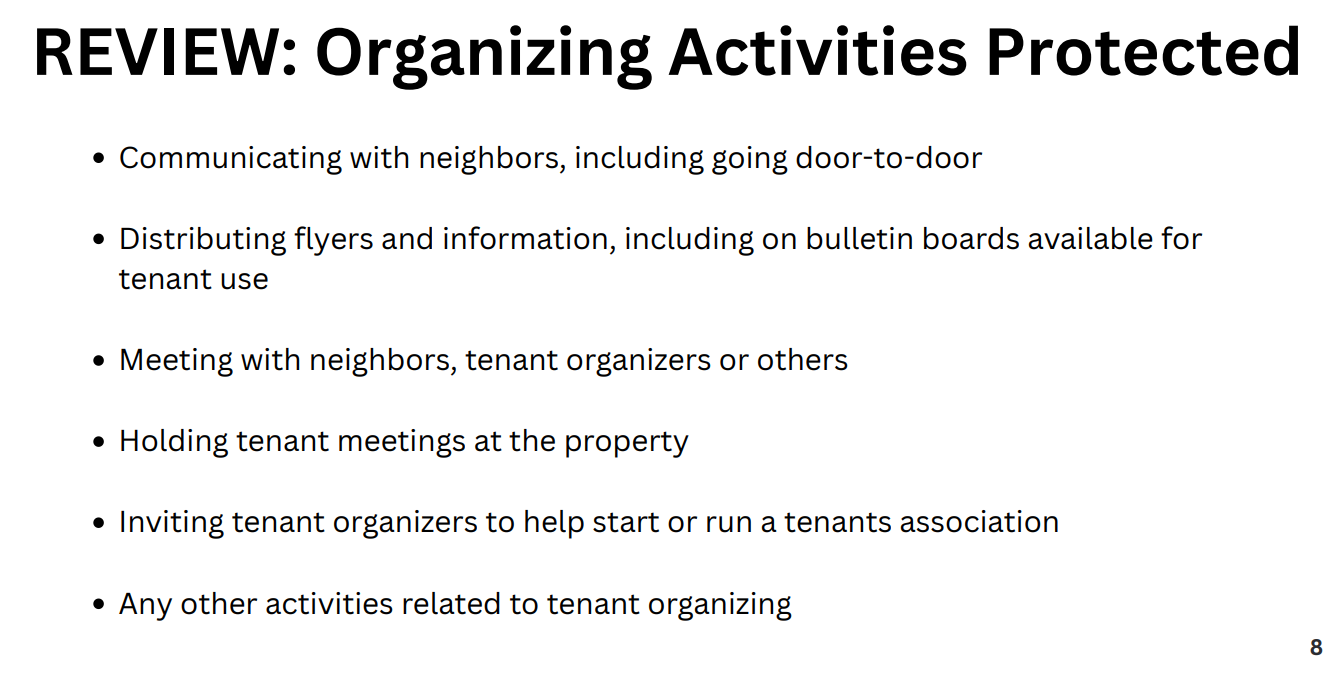
So that covers the tenants. And for the landlords:
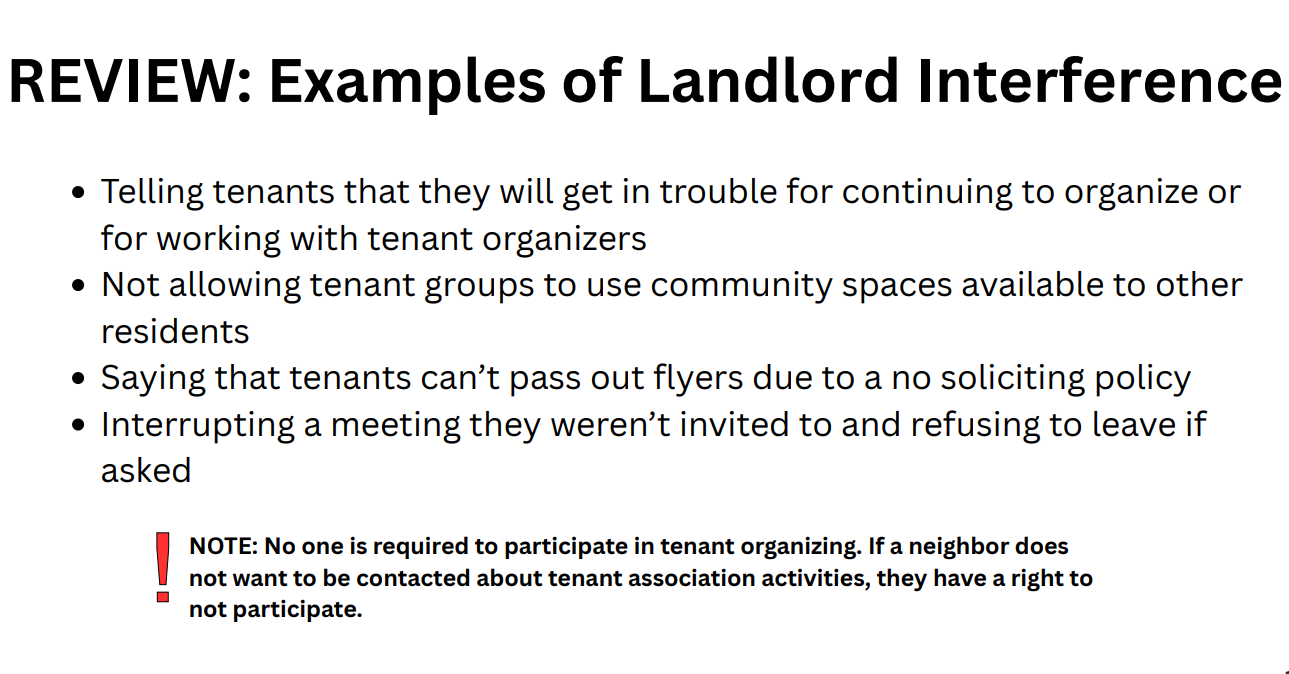
The penalty would be a misdemeanor.
Are there any laws that already exist, that protect tenants?
It depends on where you live! City staff made this helpful chart:

So yes: Austin has protections. The state overall has no protections. There are federal protections, but only in subsidized housing.
The idea would be to use the Austin ordinance as a jumping-off point, and then modify it to fit San Marcos.
This brings us to Council Discussion
Jane Hughson brings up a few details – what if a property manager is interfering on behalf of the landlord? Should they be included in the language? What about trained organizers and other non-tenants who might need protection? Can we avoid having the fliers become litter?
Amanda: Great ideas! We should definitely workshop this.
Lorenzo: A Class C Misdemeanor requires a police officer. I don’t want to criminalize landlords.
Note: Historically, marginalized groups are over-policed and criminalized. Fortunately, landlords are not historically marginalized! They’re pretty much the opposite. They’re the marginalizators!
Groups that have historically held outsized power – like landlords, or wealthy people, or police officers, or elected officials – are generally under-policed. In these cases, cities need to be more consistent with enforcement, and not worry about criminalization.
Lorenzo: Can we work out the details in a subcommittee? I don’t want to modify Austin’s ordinance. I want to write ours from scratch.
Jane: I agree. Let’s get a subcommittee going, and write out something homegrown.
Note: These are both bad ideas.
- Don’t bury something in subcommittees. As Alyssa puts it, “Council subcommittees are where dreams go to die.”
- Don’t reinvent the wheel. If Austin has a workable model, then let’s build on it.
Amanda points out that Austin’s ordinance has also been around for years, without being struck down by the courts. So that’s a more solid foundation to build on than if we just improvised our own thing.
City staff suggests a workshop?
Eventually everyone comes around to this idea, so it will be held on September 16th.
My dear minions: Go forth and tell Council that you think tenant protections are a great idea!
 The San Marxist