
Item 23 plus Workshop: Purple Pipe and the Edwards Aquifer.
You guys. This was all so fascinating that I don’t know where to start. Half the reason I wanted to start this blog is that I don’t feel like I’ll retain anything unless I organize my thoughts well enough to explain them to someone else.
The afternoon workshop is on the Edward’s Aquifer. First off, Edward’s Aquifer is gigantic:
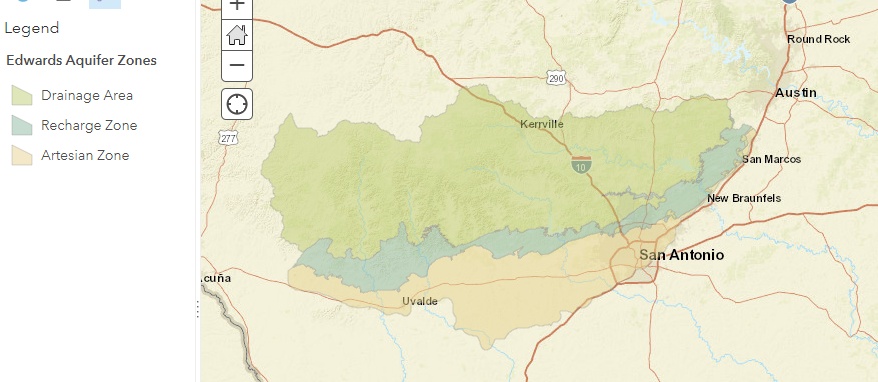
The green part catches all the rainfall. The blue part is all the porous caves and springs, where the aquifer is right at surface. The tan part is the storage tank of the aquifer.
It’s a little weird, because you would think that those three parts – catching rain, rocky and porous, storing rain – would be stacked on top of each other, going towards the center of the earth. You wouldn’t think that they’d be side-by-side on a map. Why would water flow from Kerrville to Uvalde? But it does! Or so I’m told.
It’s kind of both:

The left side of that picture is north, the center is San Marcos-ish, and the right part is south. So underground, water really is flowing from Kerrville to Uvalde.
Next! So, we were using the aquifer too heavily in the 70s and 80s, and water-people were getting nervous, projecting that we’d exceed capacity in the future. During droughts, things would get scarce. In the 1950s, the Comal dried up completely at one point, during a massive drought. Water rights for surface water – lakes, rivers, etc – have been fought in the courts for a long time, but not for ground water (or at least not in Texas). So people were allowed to enforce caps on how much water you take from lakes and rivers, but no one was allowed to enforce a cap on how much water you pump from an underground aquifer.
So in 1991, the Sierra Club files a lawsuit against Texas, because of the endangered species in the San Marcos and Comal rivers. And they won! Texas was ordered to do something to guarantee that the water wouldn’t stop flowing into these spring-fed rivers. And so the state legislature created the Edwards Aquifer Authority.
So the EAA has legal power to protect that quantity and quality of water in our river. That’s amazing! I got legitimately nerdy-emotional, contemplating the sheer amount of effort and science and coordination across different groups of people that goes into protecting our river.
They do a lot:
- They issue permits for who is allowed to use aquifer water. So San Marcos has a permit, TXST has a permit, etc. There are only 2000 permits, total. There are 2 million people on the aquifer, but only 2000 permits.
- They cap the amount of water that can be by someone holding a permit. During drought, they force permit holders to reduce their usage. (Apparently Drought Stage 1-5 refers to how much you have to reduce your usage. So Stage 1 means reduce by 10%, stage 2 by 20%, etc.) As long as the EAA enforces these caps, your river is going to keep flowing.
- They worry about water quality: contamination from abandoned wells, chemicals from firefighters putting out fires over the aquifer, about storing other things underground, besides water. (Like gas tanks for a gas station.) So they have programs in place for all these things. They cap the amount of underground storage under the aquifer. If someone wants to open a new gas station, they’re going to have to buy storage credits from someone else who already has them.
- They’ve got a big research facility in San Antonio where they’re studying all these strategies so that they can say with certainty how much each intervention helps.
San Antonio has a program where 1/8th of every cent of their sales tax goes to counties in the west, to help them protect their aquifer. So San Marcos really is not going at this alone! We’re the tip of a large network of scientists and environmentalists who are all coordinating their action to help preserve these rivers. I somehow find that very reassuring.
Next: we zoomed into San Marcos at the city level.
Zooming out:
Remember:
- green is the part that catches the water,
- blue is where the aquifer comes to the surface
- tan is where water gets stored.
Zooming in:
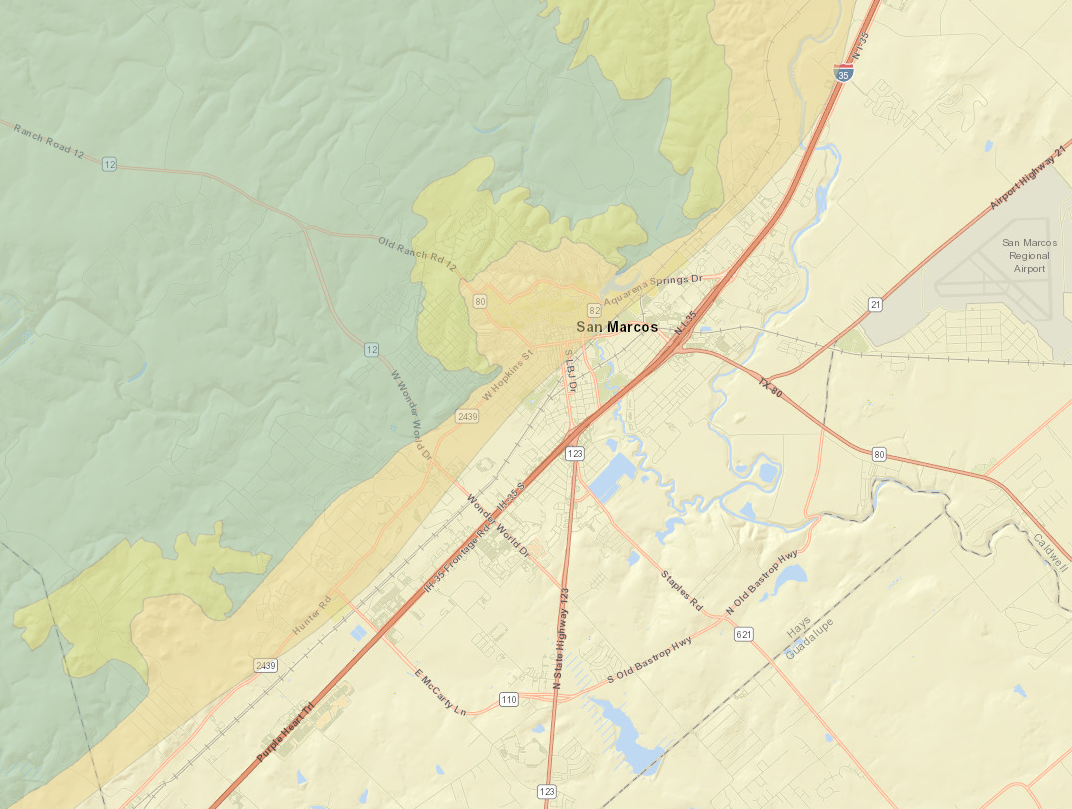
We have a lot of blue. In total, San Marcos is about ⅓ inside the aquifer.
Zooming in to the green-blue boundary in particular:
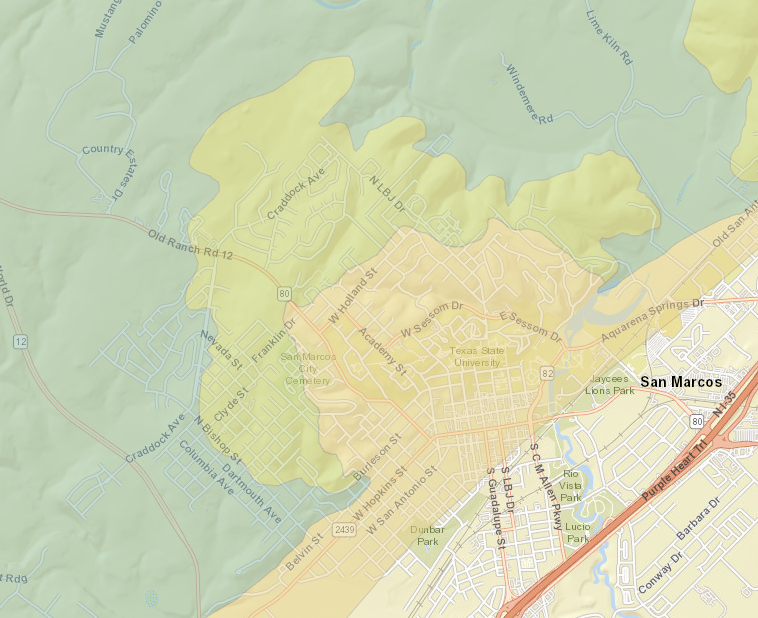
Everything south of Bishop, or past Craddock on Old 12, or north on Lime Kiln road: all of that is extremely sensitive land. It’s really important to fight these fights over La Cima, or Mystic Canyon, or wherever.
We actually only get about 7% of our drinking water from it. The rest of our water comes from several different places, through a bunch of different organizations. We’re trying to diversify our sources, so that if one region gets hit by a drought, we still have other options. (It did occur to me that droughts aren’t that local. It’s not like we’re piping water in from New Orleans. Wouldn’t all our sources be hit by the same drought, if it lasted for a few years?)
Moving on! Did you know that San Marcos has a purple pipe program?

Not like that, you dingbat. Purple pipe is reclaimed water. In other words, you flush your toilet, the water goes to the water treatment plant, and they get it fairly clean. Not clean enough to drink, but fairly clean. Then they can either put it back in the river, or they can pipe it back out in specific Rattler-pride-hued pipes. Then businesses can use it for landscaping and flushing toilets, so that we’re not using drinking water for these things.
Here is a map of the purple pipe in San Marcos:

The Kissing Tree golf course, the downtown landscaping, and some of the stuff at Texas State are all using reclaimed water. That’s so great!
We have the capacity to pump 5.5 million gallons of reclaimed water per day. We’ve got it all contracted out, but they’re only using about a million gallons/day, so we need to renegotiate these contracts so that we can free up the rest of the water for use.
The water pressure is pretty terrible, apparently, enough so that it’s not really available for residential uses yet. And there are concerns about double-piping neighborhoods, and some future plumber using the wrong water line for drinking water. But these are being hammered out. The future is now!
 The San Marxist