Bonus! 3 pm workshops, 9/3/24

Great workshops this week. Best part of the meeting.

We had three presentations this time:

Presentation 1: Purgatory Creek Flood Mitigation project

This is really cool. We last saw it in November 2023, when we bought land for the project.

Purgatory Creek runs from the Purgatory Natural Area over to the San Marcos river. Basically, we’re going to geo-engineer Purgatory Creek to flood less.

So that’s Wonderworld Extension on the far left, where the yellow and blue meet. Then they cross Hopkins and run behind Dunbar, along the railroad tracks, and then cross the edge of downtown, over to the river.

90 buildings are going to have to be removed, because they’re at risk for flooding:

That’s a lot of buildings! Are these houses with people living in them? Are they historic? I could have used more details here.

Correction: I’m an idiot. The structures are being removed from the floodplain. Not removed altogether. It’s safer now for the people living in them.

But on the plus side, it’s going to have a neat little hike-and-bike trail through it. 

I love that.

It’s gonna be hella expensive, and we don’t yet have the money:
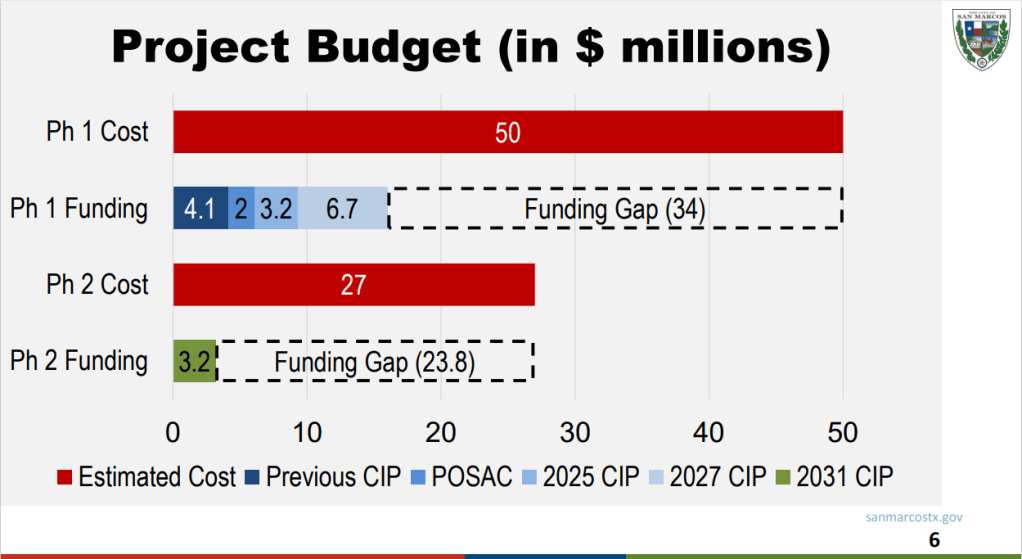
We’re going to apply for a bunch of grants.

If we get grant funding, we could begin construction in 2026.  If we don’t, we could maybe begin construction in 2030.  It’ll take about two years to finish.

One last detail: On the far right, you can see where Purgatory Creek meets the San Marcos river:

There’s a pale green Spillway, for when it floods. The spillway is in between the Children’s Park and the railroad tracks, so it’s letting into the river right where the sidewalk goes under the railroad tracks.

In other words, you’d see it from here:
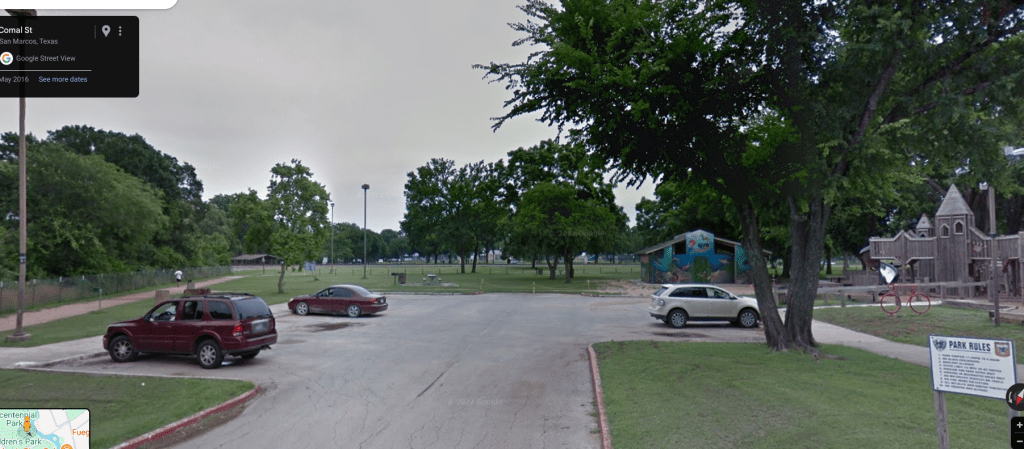
This photo from Google Streetview is so old that the Children’s Park is still the old wooden structure!
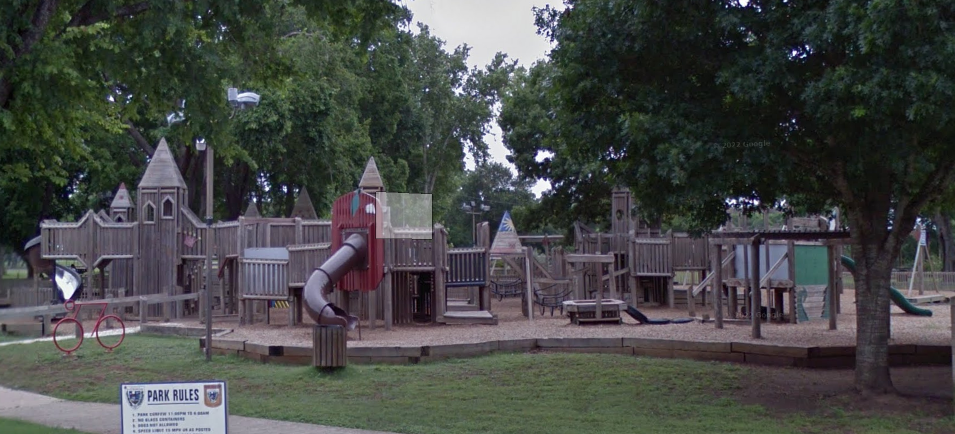
Awwww. Makes me a little nostalgic.

Anyway! In the original plan, they were going to use this spillway as an access point for people to easily get in and out of the river.  

But the people from the Parks Department and the river experts are all saying this is a terrible idea, please don’t do this.
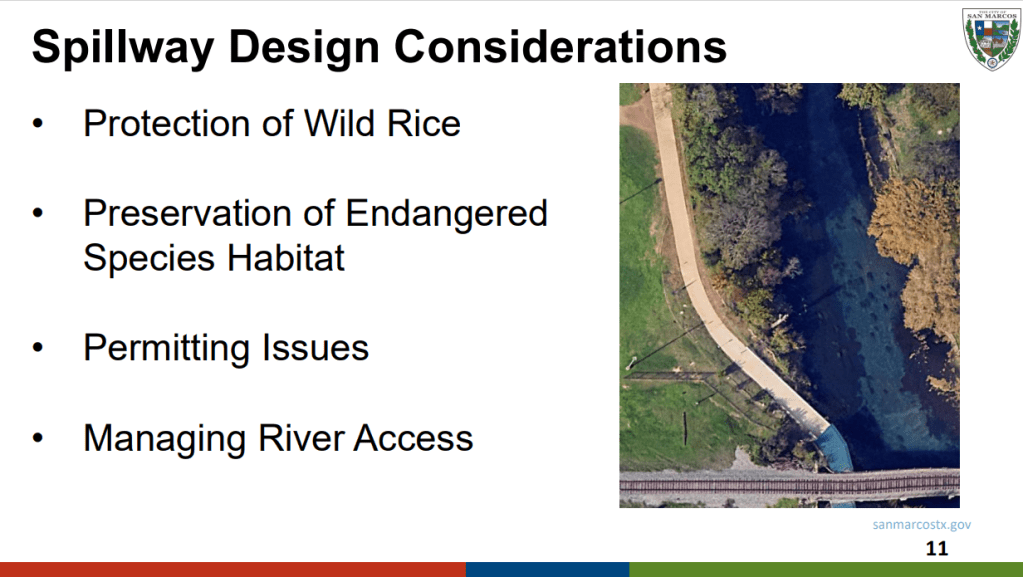
There’s a big patch of endangered wild rice there and endangered species that live in the wild rice. And also it’s deep with a brisk current, so it’s not that safe for little kiddos, either.  Just leave this area alone, please.

So the spillway will still end up there, but they’ll make it uninviting for people.

….

Presentation 2: Capital Improvement Projects (CIP)

These are all the major city repairs going on around town. The Purgatory Creek project that we just heard about is one. They get approved alongside the budget. Council saw the current list of projects back in May. (I didn’t really say much about it at the time.)

There’s only one major change since May – we’re adding one new project:
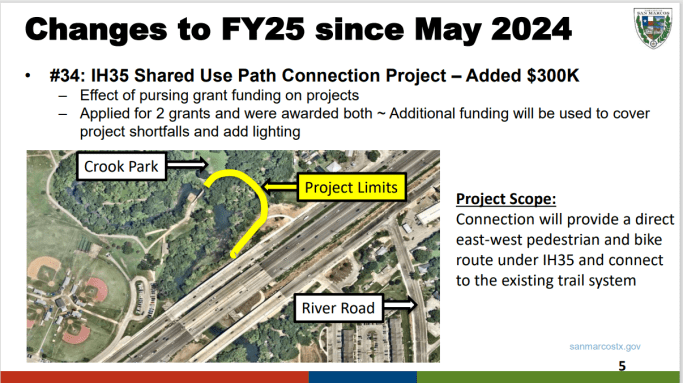
What are we looking at here? Let’s back up.

So, I35 has been torn up around the river for years now. TXDoT redid both the access roads, they’re adding I35 lanes across the river, it’s a whole thing.

One part of that is that they removed the old underpass along the river:
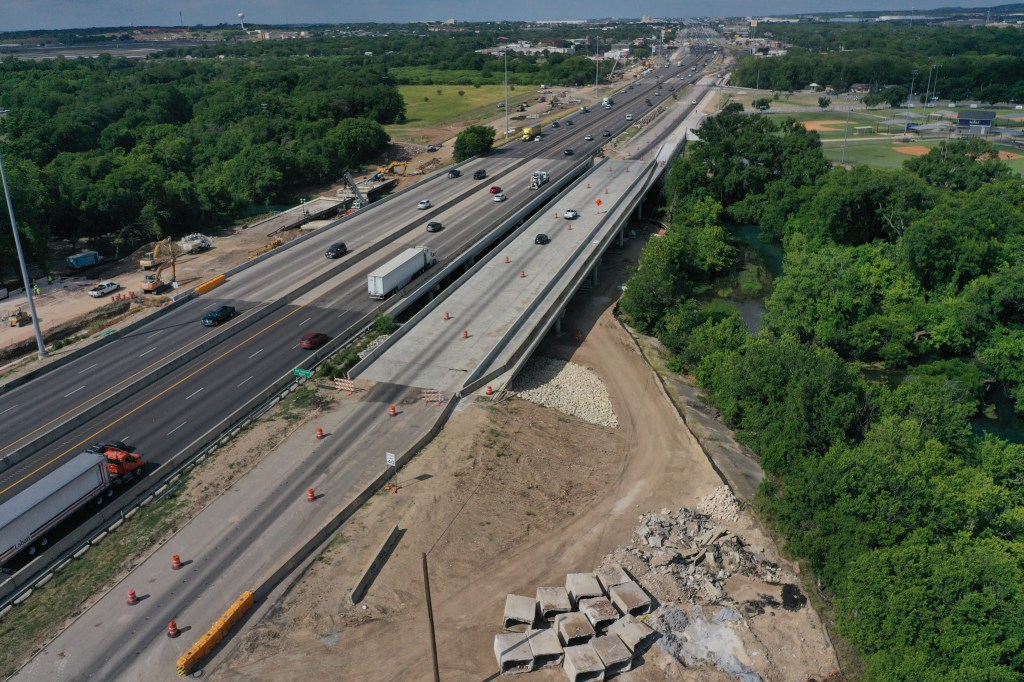
TxDot photo

So on the right hand side, you can see where they’ve torn up the road that used to go under I35, along the river.

Here’s a photo I took, back in 2020, during lockdown:
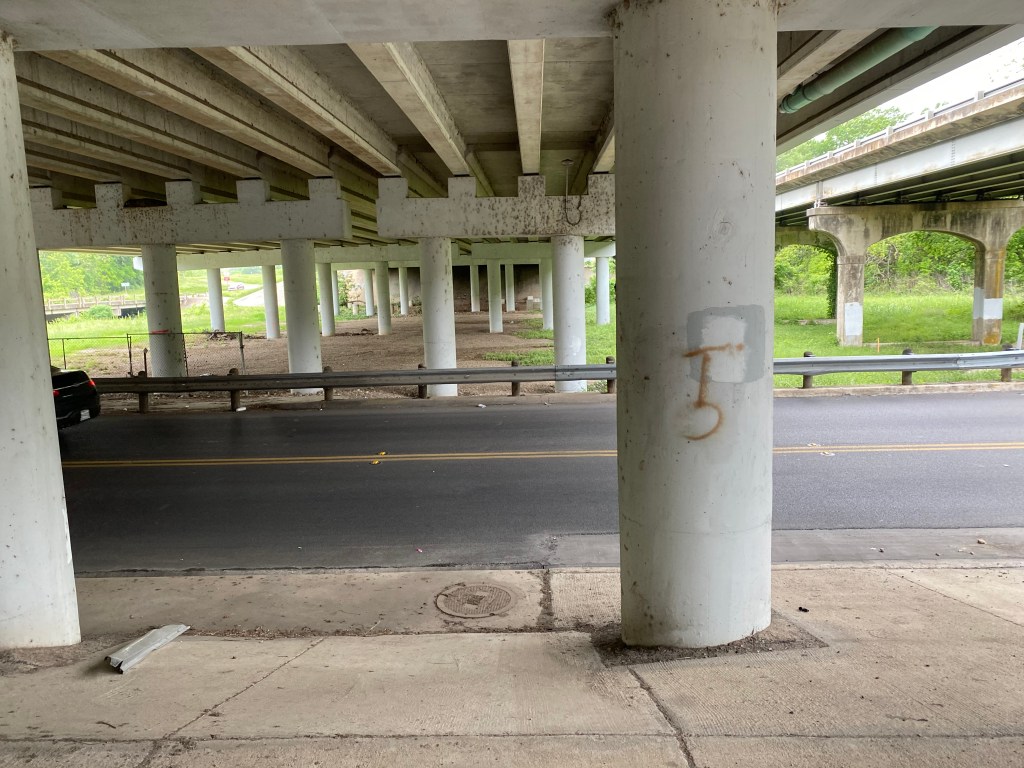
So that’s what the underpass looked like at peak pandemic.

Removing it was a major bummer for the good people in the Blanco Gardens neighborhood. They lost their best connectivity across I35. Now they have to go up to Hopkins-80, or down to Guadalupe-123, and deal with a big, busy intersection.

Since then, TXDot has replaced it with a hike and bike trail.

It looks like this:
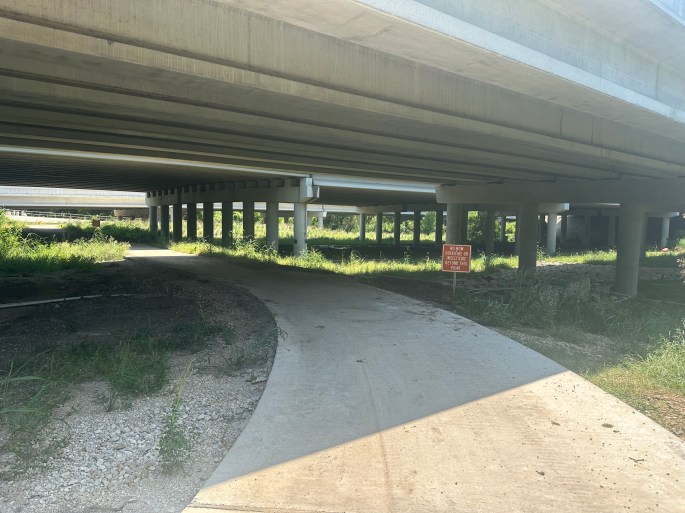
So you can easily bike from Blanco Gardens over to Riverside, and you end up by Herberts. That part is great!

So what are we doing now? Pink is the route you can currently take on your bike:

Yellow is what’s being proposed. It would connect the east and west sides of the park trails. Great!

This was not in the budget back in May. But since then, we’ve been awarded two grants to cover the cost. The total cost for that little yellow sidewalk is $2 million dollars.

TWO MILLION DOLLARS? Well, yes. Here’s why:

Blue is the main river that you swim in. But there’s this little side channel, in purple, from an old dam built in 1904:

In fact, here’s some of the machinery from the mill:

So that tiny little yellow sidewalk is $2 million dollars, because you have to build a bridge to get across this little side channel.

Now, San Marcos is not paying $2 million for that bridge. What we did was apply for a bunch of grants, and we got almost all the money covered. We just have to pay $300K for that bridge in matching funds. Great!

Mark Gleason is uncomfortable with this $2 million. He lives in Blanco Gardens and actually walks and bikes all over the place, so he’s constantly using this path. He’s just not sure if the cost justifies the increased connectivity that you get. Even though the $2 million is mostly federal money, he just feels weird about it.

I see his point. It’s such a disproportionate cost, compared to the shoestring that San Marcos usually runs on.

But then I just tell myself, “Hey, don’t forget we’re spending $1.2 million on Kissing Tree this year!” Then the $2 million bridge for everyone doesn’t seem so bad. Especially since most of it is covered with federal money.

Plus, once the east side of the river parks gets built out, the parks system will need to be connected, so we might as well do it now.

….

Presentation 3:

We’ve got a big utility assistance program in San Marcos, but it doesn’t always work very smoothly. Let’s talk about it.

How many people are we talking about?
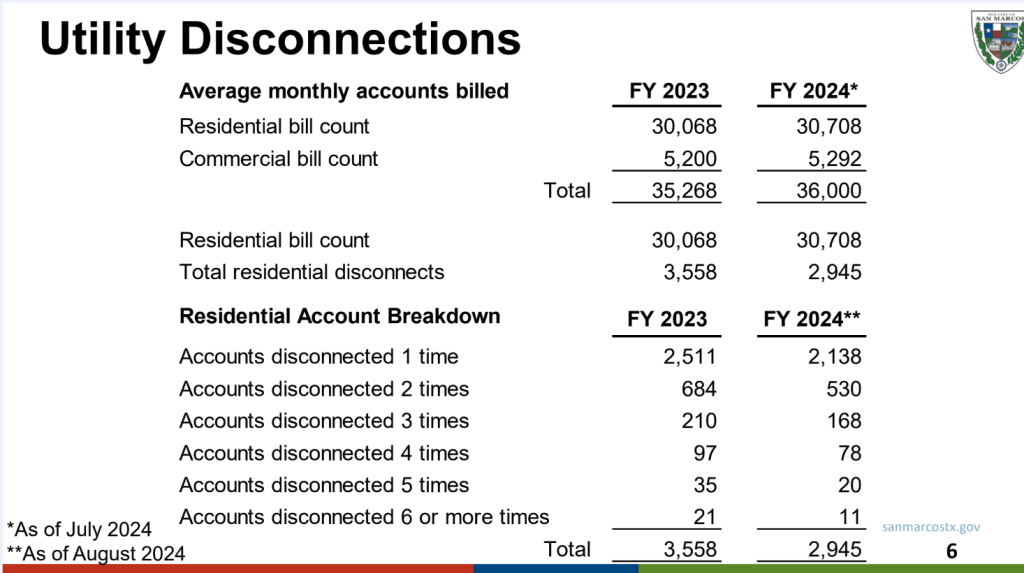
So there are about 30,000 residential accounts, and almost 3000 accounts have been disconnected so far this year. (Some multiple times.)

Here’s how it’s supposed to go. Suppose you get a disconnect notice on your electricity or water. You call the city. The city does two things:

  1. Offers you a late payment plan
  2. Connects you with the nonprofits that offer utility assistance.

How often does it work like that?

So far this year, we’ve given 580 accounts utility assistance, but 107 of those were still disconnected anyway. There have been 1,948 accounts that have gotten extensions – some of them multiple times – and 586 have still been disconnected.

So out of the 3000 disconnections this year, most people aren’t getting into the system to get help ahead of time. For the people who get in the system, about 75% avoid disconnections.

Ok, so let’s talk about the assistance side of things. San Marcos kicks in $231K to utility assistance. The biggest chunk of that goes to Community Action:

But Community Action also gets some federal money, so there’s actually about $435K available for assistance:

Community Action gets $120K from the city. But when someone comes in for assistance, Community Action tries to spend federal money first. So only $14K of the $120K was spent. However, the federal water assistance program has ended, so Community Action will need to spend more city money to cover that need.

The biggest problem is that federal money is slow. You have to fill out a ton of paperwork. But people need money immediately – cars need to be repaired, babies need diapers, the lights need to stay on, etc – or else small crises spiral into giant crises. So we need a way to get money to people fast.

A few things get discussed:

  • Do we have to charge a 10% fee on late payments? Can we just make it a flat $10 fee instead?
  • Should we spread out city money among different agencies?
  • Would the other agencies actually have enough staffing to get the money out quickly?
  • What about San Marcos residents that are on Pedernales electric?
    Answer: they can get federal assistance, but agencies can’t use the credits from San Marcos electric specifically.

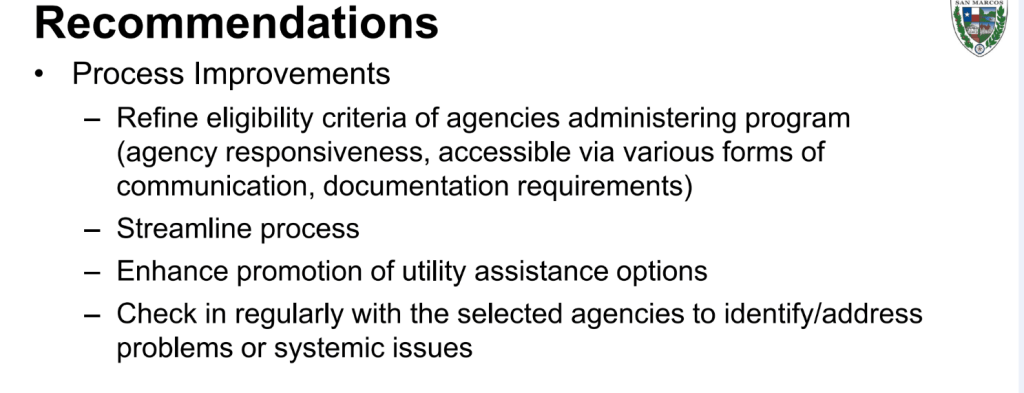
Here’s what we’re talking about doing:
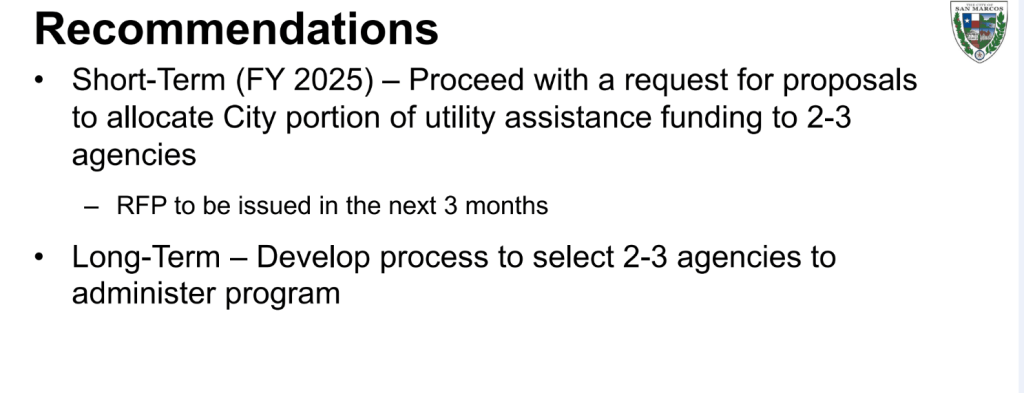
We’re also going to look at our fees and see if we can afford to reduce them.

Here’s my two cents: It is really hard to administer programs to the public well. It’s hard to find people, get their ear, get them to respond, get them to bring in paper work, find funding, and connect all the dots to get the assistance to people.

We tend to see overhead spending as wasteful, but it’s really not. Thoughtfully designed programs that aren’t running on fumes can serve people better.

Finally: if spending $231K of tax dollars on utility assistance gives someone heartburn, just remind them that we’re spending $1.2 million dollars on Kissing Tree this year.

Hours 0:00 – 0:55, 11/14/23

Hello all! Short meeting this week. But still interesting! 

Item 5: We are purchasing 6.28 acres on the corner of Hunter and Dixon, here:

This is exactly where Hopkins turns into Hunter, by the way. We’re talking about the field opposite the VFW:

It sometimes has horses in it.

This is part of a giant $60 million dollar project to address Purgatory Creek flooding.  (We don’t yet have the $60 million. That part will take a while.)

It’s hard to find a map of Purgatory Creek, because everything online refers to the natural area at Hunter and Wonderworld:

via

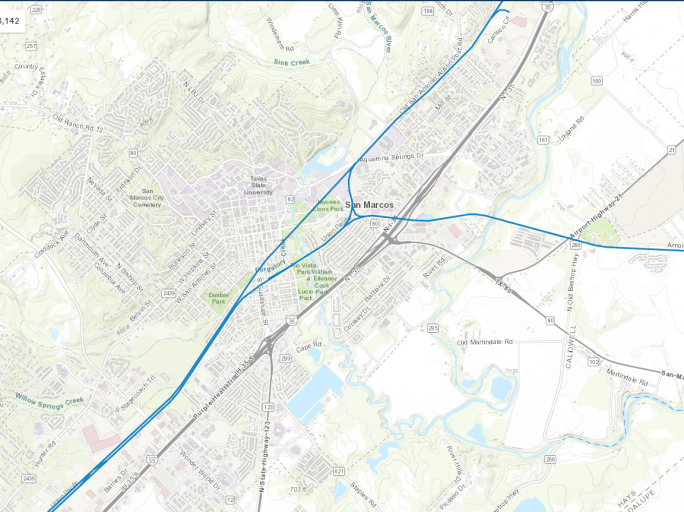
But we’re talking here about the actual creek, which starts at Purgatory Creek Natural Area and flows up towards Belvin, then cuts across Hopkins to Dunbar, and then keeps going toward the river, meeting the river near the Children’s Park:

(This slide wasn’t in the packet, so it’s a low-quality screenshot. Sorry!)

About a decade ago, I had a random conversation with an old-timer, and they told me that Purgatory Creek was re-routed at some point in history – like some hair-brained engineering scheme conceived in a honky-tonk and made real. The idea was that this had caused some of our current flooding problems.

They didn’t provide enough details for me to make sense of the whole thing, so consider this an open invitation: can someone fill me in on how we’ve meddled with Purgatory Creek over the years? I am very curious!

Here’s another view of the whole thing:

(Also low quality! Sorry.) It’s going from Wonderworld over to Dunbar, and then from Dunbar over to the river.

So what is the project? What are they doing?

(More screenshots, sorry.) Basically it’s going to be a giant channel to catch stormwater and take it to the river.

Phase 1 is supposed to start in 2026, going roughly from Dunbar Park to the river:

Phase 2 is still 5-10 years out.  (We move slowly.) This part is Phase 2, Dunbar out to Wonderworld:

It’s also supposed to eventually have some trails and nice features for people to use.

… 

It occurs to me that if they put paved bike trails alongside it, this would be an incredibly handy bike path for getting around town safely.  

Biking directly from the river to Wonderworld, skipping all of downtown and Hopkins? That could be really convenient.

Along these lines, I’ve long thought that we should put bike paths along the railroads – why should bikes be constrained to car-paths when we’ve already got these giant rail lines cutting directly across the city?   

Just look at these railroad lines!

Imagine if there was a little side path that allowed you to use the railroad bridges to get across the river. You could take the future Purgatory Creek path from Wonderworld all the way to the river, and then take the railroad-adjacent path across the river, over to Aquarena, and north up to Blanco Vista. You could avoid all the cars on Post Road, Aquarena, and Hopkins!

And then you could bike directly from Aquarena Springs down to Target! After all, the trains go right along I-35, behind Target. If you work at the Outlet Malls, it would take you almost all the way there. If you live on the northeast side of town, you could easily get back and forth across I-35!

(I didn’t make this up! It’s a real thing, called Rails-with-Trails.

via

There are a ton of resources at the Rails-with-Trails link.)

Back to our little patch of land, across from the VFW.

Saul asks, “Will this help the flooding on Bishop?”

Answer: Not really, no.  There’s a separate project, the Bishop-Belvin project, that is aiming specifically at that.   

….

Item 6:  Each year, Hays County gives San Marcos $85,000 to provide library services to county residents.  The other local libraries – Wimberly, Buda, Kyle, Dripping Springs – all get $35,000 to serve the county.  

The per capita funding has gone down dramatically in the past 20 years.  Our funding has grown, but not as fast as the population of Hays County.

The presenter did mention this: “As the population has grown in Hays County, the percentage of users outside the city has actually gone down.  As these other towns build new libraries, people go to their home library.” But I wasn’t clear if she was referring to the entire 20 year span, or just the past 2-3 years.  

They also get $120,000 from Friends of the Library each year, which is also helpful. (For comparison, the library gets a little over $2 million from the city budget.)

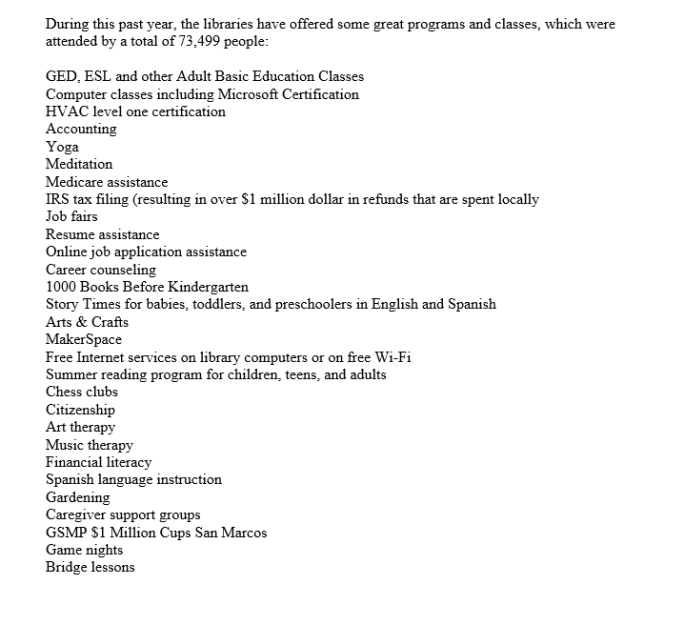
Let’s just take a moment to appreciate how much our library does:

It really warms a crabby marxist’s heart.

Item 12:  We’re going to purchase a Smeal aerial fire apparatus for the Fire Department for $2,300,000.00.

via

That’s my best guess as to what we’re getting.  I’m not a fire truck expert.

Item 17: LIHTC Projects. I feel deeply ambivalent about this item. 

LIHTC stands for  “Low-Income Housing Tax Credit”.

Say you’re a developer and you’re going to build some apartment complexes. The city offers some incentives for you to include some low-income housing. LIHTC is a federal program that helps us give tax credits to developers, in exchange for a certain number of below-market-rate apartments being built. (Another one is a density bonus – you can build more apartments per acre – if you agree to keep a certain number at a cheaper price.)

Here’s what we require from the developer: you have to offer 5 of these 8:

What kind of tax breaks do you get for doing this? I’m not actually sure. This line is on the LIHTC application:

So I suppose you get a 4% discount or a 9% discount on your property taxes.

Here’s the key line for this meeting:

  • A minimum of 25% of all units within the project shall be affordable to households at or below 30% percent of the AMI for the duration of the tax exemption

What does this mean? First, AMI is Area Median Income.  Now, San Marcos gets lumped in with Austin for this computation, so:

  • Median Income for a 4-person household: $122,300
  • Median Income for a 1-person household: $85,600

This is obviously a little ridiculous for San Marcos – our single-household median income was $42,500 from 2017-2021. But still, legally we’re going to use Austin’s $122,300 number as the reference point.

Ok, next: “households at or below 30% percent of the AMI”. In other words:

  • 30% below Austin’s median income for a 4-person household: $35,050
  • 30% below Austin’s median income for a 1-person household: $24,550

These are the people we’re trying to help with these LIHTC projects. This includes roughly 30% of San Marcos, or 21,512 people.

Last time with this key sentence again: “ A minimum of 25% of all units within the project shall be affordable to households at or below 30% percent of the AMI for the duration of the tax exemption”

In other words, if you want the tax breaks, then you need to make 25% percent of your units affordable to people earning less than $35,000.    Let’s say a big apartment complex has 200 units.  So then San Marcos gets 50 units that are affordable to people in poverty, from that one LIHTC project.

Here’s an important question: what’s the current situation? We say there’s a housing shortage, but by how much exactly? How many more apartments need to exist for those 21,512 people, so that everyone can find affordable housing?

We did an excellent Housing Needs Assessment, but it’s out of date – it uses 2017 data.  It desperately needs to be updated yearly. But still, in 2017, this was the situation:  

Adding up the first six rows, we had 9935 total rental households (in 2017) that earned less than $35,000 a year, and we had a shortfall of 4233 rental units.

Since then:

  • Prices have surged
  • A lot has been built (but at what rental price?)
  • A lot more people have moved to San Marcos

So it’s really impossible to speculate. But my read is that we have an increasingly severe housing shortage for the poorest third of San Marcos.  Let’s say we need 4,250 rental units for people earning under $35,000, just because it’s the next nice even number.

To achieve 4,250 affordable units, we only need to build 85 more LIHTC apartment complexes around San Marcos! Right now we have eleven LIHTC projects, and five more that are in the works. This is an excruciatingly slow way to chip away at those 4,250 units.

One last detail on the 25% number: that number was set in March of 2022. Before that, you only had to set aside 10% of your units. So that 200-unit apartment complex would only bring 20 newly affordable units to the table. Only 212 more apartment complexes needed at this rate!

[I’m being a teeny bit of a jerk. This one mechanism is not supposed to solve the housing crisis all by itself. It’s just one tool among many. But in practice, we have very few other ways of generating affordable housing.]

So here was the question being debated on Tuesday: should we stick with requiring that 25% of units be affordable? Should we go back to 10%? Or should we settle somewhere in the middle?

Council quickly settles on 15%: it should only take 15% of your units to qualify for tax breaks. 

So what’s the rationale? What’s wrong with 25%?  Basically, developers have stopped applying for the program at all. The tax credits aren’t enough to offset the cost of setting aside 25% of their units for low-income housing. The math doesn’t math, as the kids say.

Are developers the bad guys? Eh, not really. They’re not here to solve housing affordability.  This is not their problem.

What does this mean then?  It means that this is a terrible way to create enough affordable housing. 

The honest truth is that this is too big a problem for San Marcos.  Poor towns and big cities have high needs and rich towns and rich suburbs have very small needs. Making cities solve their own individual housing crises is idiotic.  We actually live in a wealthy state!  Texas could meaningfully reduce housing unaffordability, if this state cared about anything besides outlawing trans kids and punishing refugees.  

Given that there’s no real solution anywhere in sight, should we:

  1. Require builders provide 25% low-income housing, and have fewer applications? or
  2. Allow builders to only provide 15% low-income housing, and have more applications?

Answer: poor residents lose either way.

One final note: Other places build a lot more public housing than we do. For example, Vienna was written up in the NYT recently. (Gifted link – shouldn’t be paywalled).

Given that the US doesn’t have much appetite for building a lot of high-quality public housing, the best way to bring down housing prices is to build an excess of housing that is close to people’s jobs and schools. Put guardrails on what kind of dense housing developers can build, and then let them build it. (My preference for the guardrails is to allow more condos, duplexes, 4-plexes and 8-plexes in quiet neighborhoods, and then some large scale apartment complexes as their own standalone thing. Clearly the Old Guard in town prefers strictly single family housing and massive apartment complexes. But I digress.)

This is actually something that Texas has done better than California. It’s easier there for a few people to gum up the process for a developer indefinitely, and so you end up only building out in the middle of nowhere. Hence the enormous sprawl and wild housing prices.