Hours 0:00 – 2:06, 6/4/24

A solid hour of citizen comments to kick things off!  

Nearly everyone – 17 speakers – spoke about the issues of Malachi Williams’ death at the hands of SMPD, and calling for a ceasefire resolution for Gaza.

Malachi Williams: backstory here.

The family and activists are calling for three things:

  1. Release the name and badge ID number of the officer that killed Malachi Williams
  2. The officer should be placed on leave while the investigation is ongoing.
  3. The family should be able to view all officer and storefront footage, with a lawyer present.

It sounds like the chief has offered to let the family watch some of the footage, but not all, and is denying the request to have their lawyer present. That’s pretty goddamn outrageous that you would ever require someone to forgo a lawyer in a legal context.  (They don’t have a right to a lawyer, because nobody is under arrest or anything, but plainly it’s what’s fair.)

A lawyer would be able to inform the family about what Chief Standridge is legally able to do, and what he can’t, and a lawyer can advise the family – on the spot – on what’s in their best interests. If a lawyer isn’t there, then Chief Standridge is the authority on what Chief Standridge is legally able to say and do. See the problem?

Resolution for a ceasefire:  

The activists didn’t just make this up on a whim. This is what’s going on all over the country.  They’re working on it in Austin, where they ultimately got fed up and passed a People’s Resolution instead. They’re working on it in San Antonio, which also got stuck. There haven’t actually been any cities in Texas that have been successful, but here’s a full list elsewhere.

There were a few other speakers:

  • One guy from Outsiders Anonymous shows up to advocate for their gym/treatment center during the CDBG grants item. (We ended up funding them at about 80% of what they asked.)
  • One speaker talks about her adult child with disabilities. There’s no day center in San Marcos anymore, and he commutes to New Braunfels.

We absolutely should have a day center for adults with special needs. I’m super uninformed on this topic, but it’s definitely part of serving the needs of your community.

But let’s talk about the other part: there’s no public transportation to get back and forth between San Marcos and New Braunfels.

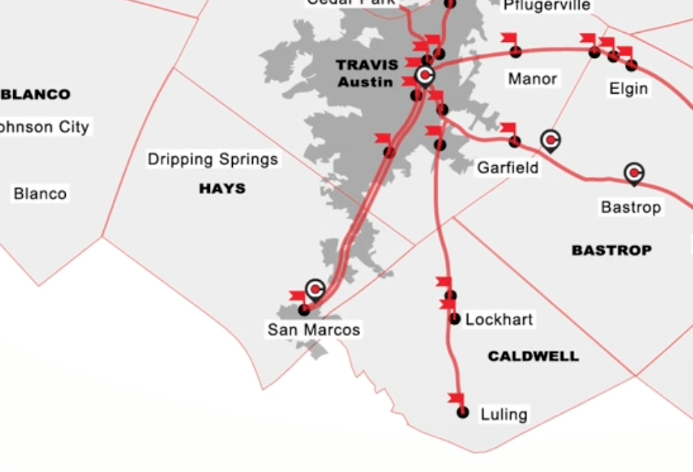
Here’s the problem: we’re on the southern tip of the Austin Cap Metro service area:
New Braunfels, Redwood and Seguin are on the northern edge of the San Antonio Alamo Regional Transit:
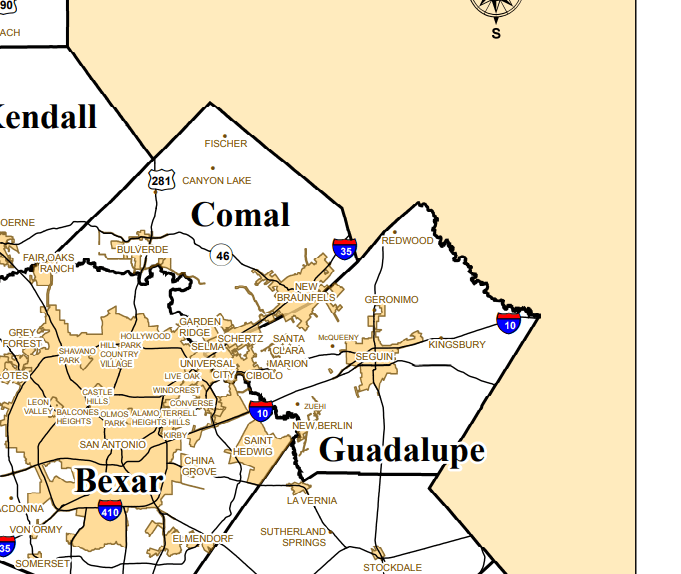
And the two systems don’t overlap or coordinate on their boundaries, so there’s just this cliff dividing San Marcos from its neighbors:

Puzzle pieces! (I had fun making that picture.)

Suppose you use the shuttle service because of your physical disability. How are you supposed to get from Redwood to San Marcos? There are a lot more mental health resources in New Braunfels than in San Marcos, but only if you’ve got the means to get yourself there and back.

Listen: Seguin, New Braunfels, and San Marcos need to triangulate on some shared public transit along I-35 and 123. Austin Metro is not meeting our needs here.

Item 9: Community Development Block Grant applications, 2024-25

HUD gave us $766K this year to give away, and we’ve got $639K rolling over from last year. So total, we’ve got about $1.4 million to give away.

First off: we have $639K leftover? Out of $712K that we were awarded last year? What on earth happened?!

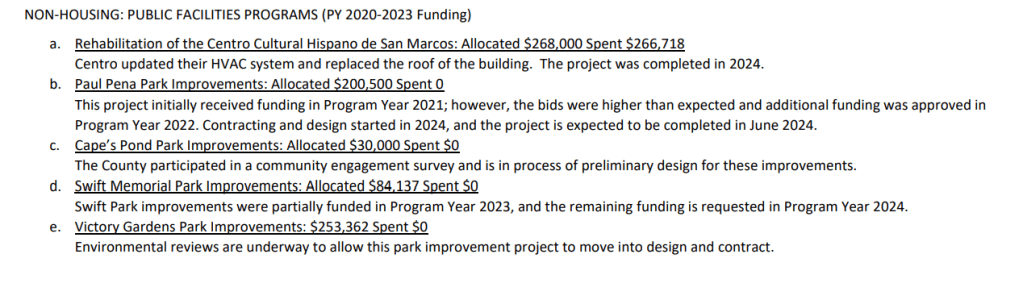
It turns out that it rolls over from year to year, and there are project delays. It’s spelled out in the report here:

So the first two categories – Housing Programs and Public Facilities – are really falling short.

Alyssa Garza asks about the Housing Rehab program?

Answer: Housing Rehab had $800K from CDBG and $800K from ARPA, for a total of $1.6 million. They are running seriously behind. Currently there are 30 houses with bids in place. Five are under construction and 25 are pending, and that will use up the funding.

Alyssa also asks: Can we hire lawyers to help homeowners with title problems? (This is mentioned under the Home Demo program above – “Properties with sub-standard structures also tend to have ownership issues”.)

Answer: We mostly rely on volunteers, because Texas Rio Grande Legal Aid tends to be so backed up.

Alyssa: There are free legal aid programs at St. Mary’s and UT-Austin that have offered to help.

The staff is vaguely friendly about this suggestion, but not in an “omg I’ll do that tomorrow” kind of way.

In the end, they decide to put “paying for a lawyer” on the list of side-projects that can be consulted when there’s a loose bit of money that suddenly becomes available.

Onto 2024! Here’s the criteria that we use:

(For what it’s worth, I don’t love the Council Priorities. I think they risk creating perverse incentives.)

Moving on! There was one ineligible application and 11 eligible applications. Here are the recommended funding amounts from staff:
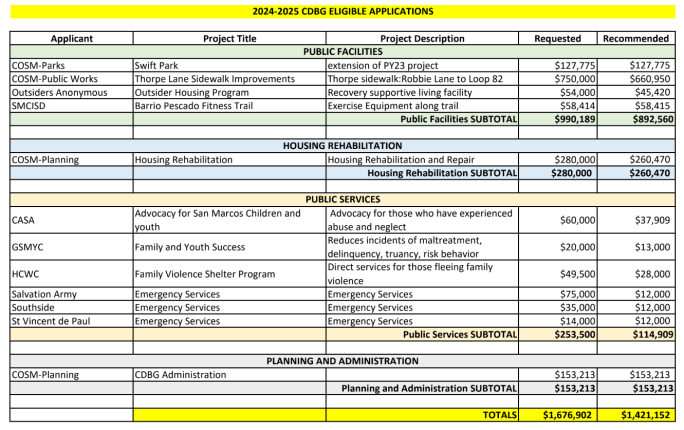
Anyway: Council does not make any changes.

I believe this is just a first reading, so if you’ve got advice for Council, you’ve got another chance at the July meeting.

Items 10-11: Kissing Tree

Kissing Tree was approved in 2010. It’s a PDD – “Planned Development District”. This means the city got to micromanage every last detail of the whole project, and put it in writing, in a contract.

[Quick primer on PDDs: They’re a mixed bag. You can spell out exactly what will be built, but you can also waive a lot of regulations that the developer doesn’t like. In general, PDDs are only as good as the Council that negotiates them.

We got rid of them in 2016, which was an unforced error and I’ve complained about it a lot.  Then recently we brought them back again. So now the city has the ability to lock things down again.]

Here’s where it is:

You know, this thing, out on Hunter Road and Centerpoint:

Here’s the original plan:
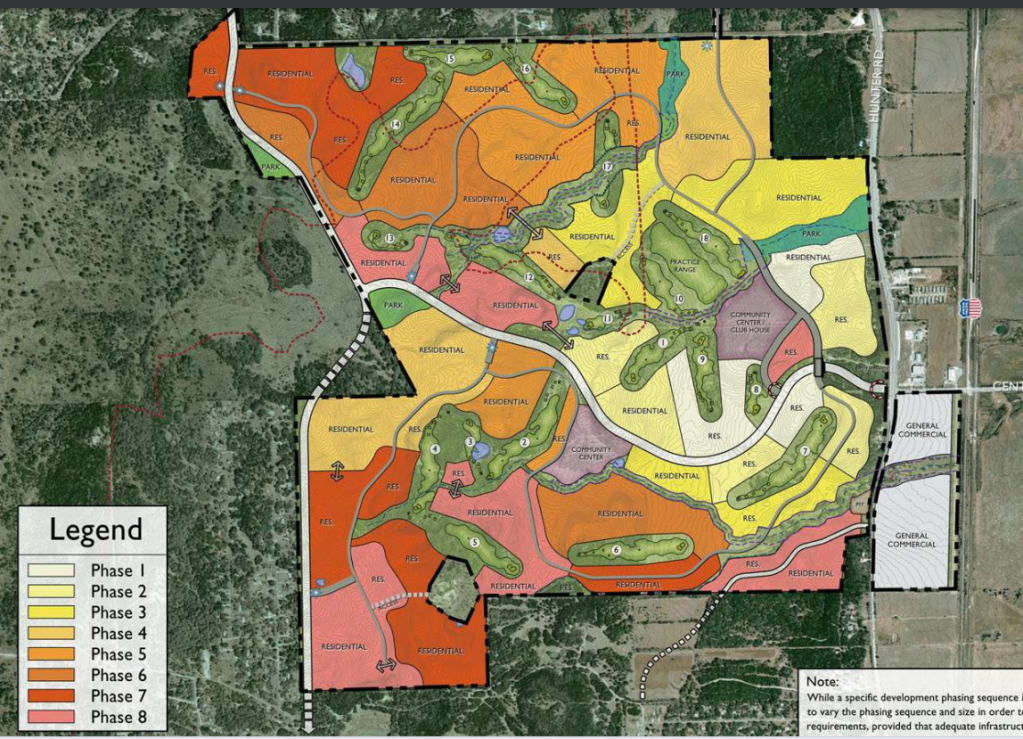
So, a lot of homes around a lot of golf course. (To their credit, they use reclaimed water on the golf course.)

That map has not been updated since 2010, so I have no idea how much has been built out already.

Kissing Tree wants to modify their PDD, so they have to go back to Council.  Here’s what Kissing Tree wants to do:
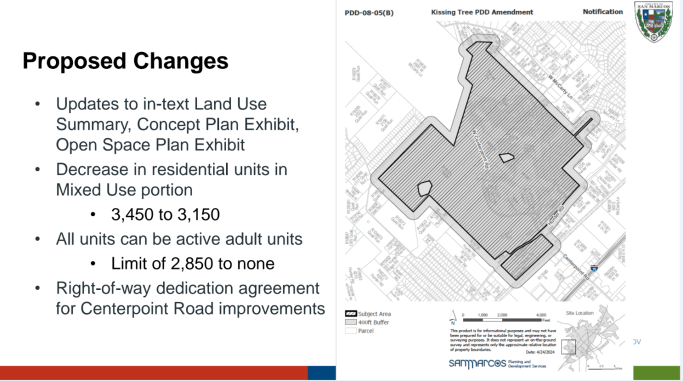
“Active Adult Units” means senior housing. 

In other words:
The original plan is for 3,450 units:
– 2,850 were senior housing
– 600 were available for everyone else.

Now they want build 3,150 total units:
– 3,150 for seniors
– 0 available for everyone else.

It’s not that big a deal – I’m sure this is more profitable for them now – but I’m irritated that no one provided an explanation or talked about consequences.   In fact, Council talked about it for roughly 30 seconds, and this was the entire exchange:

Shane Scott: “This is a great example of why PDDs are so useful. We got rid of them, and we should bring them back.”

Jane Hughson: “We are bringing them back. We’ve discussed this.”

Shane: “Was I here for that?”

Jane: “I think so?”

SMCISD gets kind of affected by this kind of decision. The problem is that San Marcos is lopsided – we need more families to balance out all the non-family tax base (ie the university, the outlet malls, and things like Kissing Tree.) From time to time, we get dinged under the state’s Robin Hood law and have to send money back to the state for poorer districts, despite being a Title 1 school district ourself. It’s a complicated mess.

But just remember: Texas squandered a $32 BILLION dollar surplus last legislative session.  This was sales tax money – from all Texans – which got sent back to property owners. We literally took money from renters and gave it to home owners.

There is plenty of money in this state to fund all schools properly. We just need to elect a governor and legislature that wants to do so.

….

Item 12:  Good news on the Water-Wastewater Treatment Plant front!   

We’re getting a new centrifuge:

and a diffuser replacement in aeration basin:

We promise not to spend more than $6,716,477.45.

And a very special San Marxist shout-out to the kind soul on city staff who put these photos in the powerpoint presentation!

These slides didn’t even get shown during the meeting. I see you, I appreciate you.

Item 16:  We are meekly opening the door for the possibility of maybe someday, beginning a conversation about paid parking downtown.

This is such a tentative baby step that there are no details or decision points yet.  We’re just strapping on our sun bonnets, lacing up our sneakers, and sizing up the path ahead of us.

I did think this heat map was interesting:
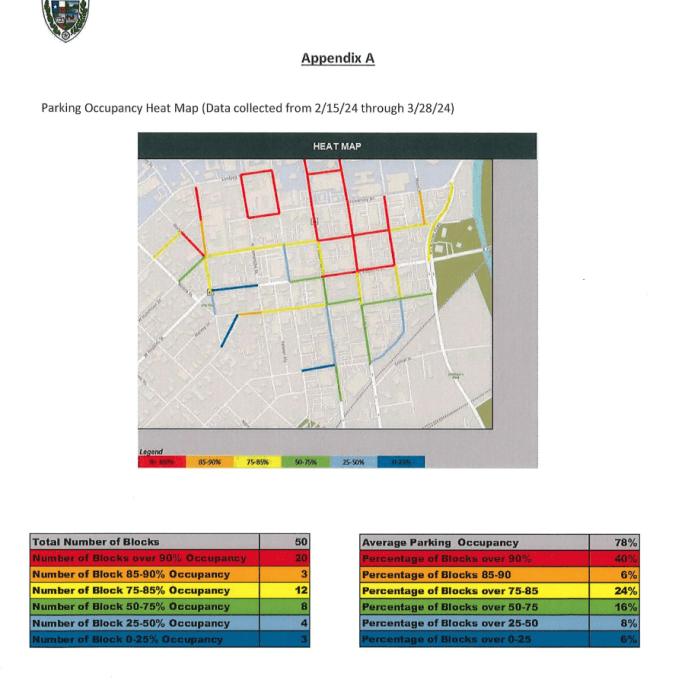
That map is pretty unintelligible; here’s my attempt to improve:

This is only measuring parking – not traffic congestion or anything.

Here’s what the colors mean:
20 red blocks: street parking is generally over 90% full.
Three orange blocks: street parking is usually 85-90% full.
Twelve yellow blocks: street parking is usually 75-85% full.
Eight green blocks: street parking is usually 50-75% full.
Four light blue blocks: street parking is usually 25-50% full.
Three dark blue blocks: street parking is usually under 25% full.

It was a very short meeting!
Hours 0:00 – 1:58, 10/17/23

Citizen Comment

Here are the main things people care about:

  • CM Allen district – we want Option 2! There’s too much student housing and not enough parking. Last riverfront property.
  • CM Allen district – we do not want Option 2! There’s not enough housing and not enough parking, and there’s better ways to spend money.
  • CM Allen district Option 2 was conceived in the dead of night behind closed doors, and we object to being locked out of the process.
  • Big $36 million grant available for river restoration.  Letter of intent deadline is coming quick. Could use this to study Cape’s Dam? (SMRF)
  • San Marcos does a miserable job of making this city accessible for people in wheelchairs.
  • San Marcos does a miserable job of taking care of our heritage trees. You all recently cut down a big one on the town square, and another one across from the Veterans Memorial.
  • We’re going to sue you if you pass those airport rezonings.

We’ll get to the Great Option 2 Debate when we discuss the Downtown Master Plan. The rest of the topics raised don’t really show up again this evening.

(The airport rezoning passed with the Consent Agenda.)

….

Item 13: The bus.

Everyone loves the Austin Powerplant sign for using that Gotham City font, but may I humbly submit that the San Marcos Station font is a serious contender for charming font choices?

(I think it’s actually the same font, but we don’t go making such a fuss about it.)

Anyway, good news: Buses are free in San Marcos! Paratransit services are free, too! These have all been free since the beginning of Covid, actually. Maybe there’s a route that suits your needs?

This is all very good! No changes are coming.

All they did on Tuesday was set up a procedure so that someday, if service or fares do need to change, there’s a procedure in place, which includes a public hearing. Also good!

The vote: 7-0. Good job, Council!

Item 14: VisionSMTX++

We are almost to the sad end to an excruciating process.

Background:
VisionSMTX++ is the Comprehensive Plan, the big vague guiding document for how we want the city to grow and change over the next ten years. Or rather: growth is coming regardless of whether or not we want it, so let’s have a plan for where to put it.

A 30-person citizen steering committee met with consultants for two years to produce VisionSMTX. Tons of extra community input was solicited.

Mayor Hughson and P&Z read it and got mad about it. So they formed a subcommittee and made 74 pages worth of changes to a 300 page document. Given that a lot of the 300 page document is fluff and filler – pretty pictures, etc – you can see that they really dug in and tore it apart. (We first discussed this here.)

A lot of the committee – including me! – got mad about it. P&Z held a workshop and approved the new version. (Discussed here.)

City staff adds an extra “+” to pour one out for their homies, each time P&Z wrecks something important. So by now, it’s become VisionSMTX++.

Public Hearing:

It is almost entirely people mad about the subcommittee changes.

  • P&Z subcommittee destroyed all the community input that was solicited for original plan.
  • Original is the right version, not the P&Z shadow version
  • In their effort to protect the Historic district, they’ve now hamstrung all the other neighborhoods from getting basic services
  • Support for a second city center on the east side, but please be sure to commemorate the El Camino Real trail running through it.

(Guys. GUYS! You know how our whole thing is “A River Runs Through Us”? We could have a companion piece, “This Historic Trail Also Runs Through Us.” Yes, yes?)

  • More people saying the original Vision SMTX is better
  • Rosie Ray reiterating her two main points from last time:
    1. please remove “vehicle” from the definition that’s meant to deal with reducing car dependency.
    2. Please add “multiplexes/duplexes/condos” to the things that are currently found in neighborhoods where they currently exist.

What exactly are the substantial changes?

There are roughly three camps:

1. People passionate about the Historic District. We love Belvin and San Antonio street.
2. Developers who want to maximize profit.
3. Lefties who are worried about sprawl, the environment, and unaffordable housing. Hi!

Group 1 holds all the power in this discussion. They have a majority on P&Z and Council. The P&Z subcommittee, plus Jane Hughson, was overwhelmingly Group 1.

Group 1’s perspective:
– They are extremely worried about Group 2 destroying cute old houses and putting up giant apartment complexes in the middle of neighborhoods. To be fair, this is a thing that Group 2 would cheerfully do, if allowed.
– They think Group 3 is kind-hearted idiots who will do inadvertently the bidding of Group 2.

In order to prevent this, they locked down the Historic District into carbonite and said, “We hereby declare that nothing shall ever change!”

However, they actually locked down all single family neighborhoods. This was not an accident. They see a black and white world, where the only two options are this:

  1. For The Haves:

The Haves get massive sprawl, high prices, and car-dependency

and 2. For the Have-Nots:

The Have-Nots get massive utilitarian apartment complexes.

Group one believes there is absolutely no other possibility. (Weirdly though, you need a lot of rules to pretend this.)

The problem is that there is a 3rd possibility: gently densify your neighborhoods.
– Allow accessory dwelling units (ADUs)
– Allow housing that the have-nots can afford, like duplexes, triplexes, or other smallscale affordable housing. You want the neighborhood to still feel like a quiet neighborhood, but just not be such a jerk about keeping poor people out.
– Focus on ways to reduce car-dependency, by providing necessities nearby. In other words, people like having a corner store where you can pick up some groceries or a sandwich.

So: Is Group 3 actually a bunch of well-intentioned idiots? Is that fantasy impossible?

No! It’s very, very possible! It’s the Historic District. There are actually a ton of mini-complexes hidden throughout. Pretty much every single house along Belvin has an ADU. Isn’t that great? And they can quickly reach little HEB and all of downtown without driving.

It is great for them! Just not for anyone else.

Here are the specific major changes from the subcommittee:
– Remove ADUs from being allowed in single family neighborhoods.
– Remove smallscale multiplex from being in low intensity areas.
– Measure “walkability” by what you can drive to. Like, in your car.
– Declare that all existing low-intensity neighborhoods only contain houses. They don’t, but we’re declaring it!
– Infill must match existing housing types. In other words, if there are only houses as far as the eye can see, then that’s what you’re stuck with. Forever and ever.
– Remove language that helps people bike around town for transportation. (Seriously, what are you, a grinch? You can’t enjoy yourself if someone else is able to bike to work?)

The list of changes is 74 pages long. Just the changes!! Many of them are minor, but it’s a nightmare to wade through. ( I got to page 26 and gave up.)

But now I’m going to step back and try to see things from a bird’s eye view:

How much does a comprehensive plan matter? I don’t know. I can see it both ways:

1. Not that much: Developers will continue to build single-family sprawl and massive complexes, because fundamentally they’re not in it for social change and progressive rallying cries. They play it safe, because they want profits to be safe.

2. Matters a whole lot: Incremental change adds up over time. These little nudges towards affordable housing and against car-dependency wouldn’t solve problems, but they’d help keep us from making things worse as quickly as possible.

Ultimately I think it matter quite a lot, or else I wouldn’t spend my Saturdays writing all this out, over and over again.

The Council Debate:

Jane starts off with her apology tour, which I found wholly unconvincing. Basically:

  • The shadow P&Z committee was supposed to be a good thing! The point was transparency! If she’d saved her concerns for Council, fewer people would have had a chance to see all the changes.
  • She just wanted to protect existing neighborhoods.  (She seems to think this is an unassailable good thing, instead of the utter heart of the issue.)
  • She talked to a wise person who explained the accusation of “watering it down”: the issue was this word swap from “objectives” to “considerations” and so Jane has changed it back. 

Jane is truly missing the point.  She’s unable to consider that the content of her changes is why people are mad. 

Side note: I don’t know if city council reads this blog.  They are all aware of it, because I’ve emailed them as The San Marxist, and included a link (and also because San Marcos is small and gossipy).

If a councilmember claims they want as much community input as possible, then they should be reading this blog. 

If a councilmember chooses not to read this blog, I am going to infer that they don’t actually want to maximize the amount of community input that they hear. 

Jane seems wholly unaware of the arguments I’ve made over and over and over.  In fairness, she also seems unaware of the public comments that were made 10 feet away from where she’s sitting, 15 minutes earlier. So who knows.

Let’s dive in!

Jude: So how big are these changes exactly?  Why are we taking out ADUs? Why not incentivize diverse housing types? Why so many 4th quarter changes?

Answer from staff: We were focused on transparency! 

Jude: I feel uncomfortable with making all these changes by the seat of our pants. We should respect the process.

Jane: I made these changes back in March. Hardly the seat of our pants.

Alyssa: You’re saying the subcommittee rewrite was justified because it was open to the public and transparent. But look, the subcommittee really does not reflect our community. When considering these issues, I try to use two questions as guideposts:

  1. Who is this leaving behind?
  2. Are we doing something that we’ll have to undo later?

People feel like they’ve been dismissed. We can see who we’re leaving behind based on the composition of P&Z. When we are taking suggestions from a tiny body, we can expect to have to rewrite things.  I support the original plan.

[Note: I like these two questions. We are leaving behind most of San Marcos. We will definitely end up having to undo this comp plan eventually. ]

Shane: I’m not ready to vote on this tonight. More research is needed.

Mark Gleason: I don’t have a problem with the changes, philosophically. I’m ready to move forward.

Saul: I’m okay moving forward.

Matthew Mendoza didn’t weigh in at this point, but he’s so obviously pro-neighborhoods-in-carbonite that it’s unnecessary. 

So at this point, the game is over. The new plan has the four votes it needs.  Its fate is sealed. Here is the status of all the existing neighborhoods now:

The thing that’s absolutely wild is how little time Council spends discussing any of this.

  • The original community group spent 2 years on this.
  • P&Z took eight months and a workshop, and a re-write to wade through all of this.  
  • The above conversation takes about 20 minutes.

After this, Jane has a bunch of worthwhile amendments on other issues – after all, the entire thing is 300 pages long. But they’re on new and different details.

All those changes described above? ADUs, walkability, definitions, etc? Just absolute radio silence.

Why not take these large issues one at a time, and discuss them? Why not offer up an amendment, or hunt for a compromise, or at least make the majority defend their reasons? Why not do something

Obviously Jane, Mark, Saul, and Matthew all like the new plan. (I disagree with all of them.)

But Shane, Jude, and Alyssa all don’t like the new plan! My dudes. You could dig in and try to repair it. You’ve been spoonfed two mild, palatable amendments by Dr. Rosie Ray, on two separate occasions! The very least you could do is offer those up.

Jude even explicitly asked about ADUs and diverse housing types, but then lets it go! (Which is his signature dance move, of course.) And Shane – “I need to do more research” – Scott is also being absurd.  He was on the actual steering committee for two years! Be a councilmember, make an amendment, hammer out a compromise. 

The actual final vote is next meeting. Maybe one of them will surprise me.

Should LBJ and Guadalupe Stay 1-Way Streets?

Next Jane makes a series of amendments.  Most of them are minor and fine.  The one that’s more notable is about LBJ and Guadalupe downtown. In the Comp Plan Appendix, they bring up converting them to be two-way.

Jane’s take:  Over the years, we’ve debated this thing until we were blue in the face. We voted and laid this issue to rest. Plus, the price tag to reverse course now is super steep, and it would mess up the bike lanes.

Saul: It used to be 2 way.

Jane: I remember! It switched in 1971, right before I got my license.

Jude: Longterm, we all know they will have to be 2 way.

Note: We do? Why is it a foregone conclusion that eventually we’ll have to have two way streets? 

I do remember the debates on this, but I wasn’t paying close attention.  My memory is:

  • Businesses prefer two-way because it’s easier for people to locate their store
  • People seem to like one-way out of preference for the status quo
  • Possibly traffic moves better with one-way?

I personally am used to one-way and it seems to work pretty smoothly, and so I stand with those who prefer the status quo. Plus, I don’t want to undo the bike lanes. But I’m open to hearing the arguments for two-way, especially if it’s supposedly “inevitable” and all.

The vote on one-way streets:

Keep ‘en one-way: Jane, Saul, Matthew, Mark

Two way is the future! Shane, Jude, Alyssa

Alyssa stated earlier that she’s a “no” on all of this, protesting the process. So she is not necessarily weighing in on 1-way vs 2-way streets here.  

… 

Jude ends by saying he’s still super concerned about the process. Not concerned enough to make any actual amendment.  Just concerned, y’know, in general.

The first vote on the whole VisionSMTX++:

Lock down the sprawl! Jane, Mark, Saul, Matthew, and Jude

I’m protesting the process! Shane and Alyssa

Like I said, this will come back one more time, in November. (Feel free to read the whole thing yourself – all the versions, and the summary table of changes. Go nuts.)

Hours 0:00 – 1:26, 8/15/23

Citizen Comment: Max Baker was the only speaker. He showed up to comment on several things:

  • Damage to the river at Sewell park – litter, wild rice.
  • Working with Chief Standridge: do our cops run unnecessary background checks?
  • Upcoming elections: will the student center be properly staffed?

All good points!

Item 17: Platinum Drive

First, Leah Ave is one of those streets that you know you’ve been on a million times, but you may be vaguely confused about. That’s because there are two parts to Leah Ave, and they don’t currently connect:

The top half starts behind the hospital, crosses Wonderworld, and ends after Lowe’s and Petsmart and Marshalls.

The other half picks up again by Amazon:

I assume at some point the plan is to connect the two Leahs. But not today!

Today we’re talking about this little street that never got a name:

The solid part is the unnamed street, the dotted part is private. There’s a company, PGM, down that road and no one can find them, because their address is on I-35.  

So that little road is now getting christened “Platinum Drive”.

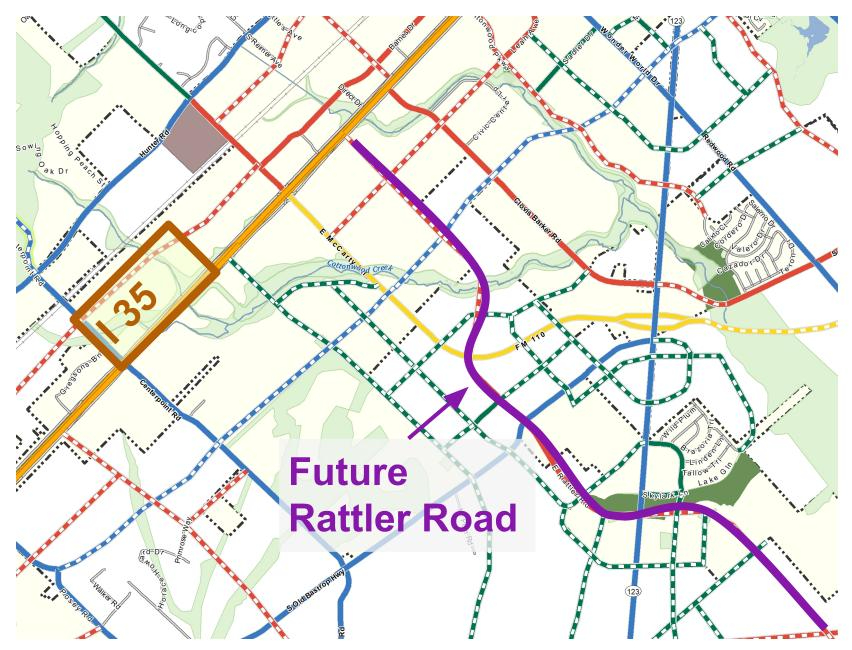
According to the Transportation Master Plan, that road may some day hook up with Rattler Road:

The transportation master plan is tiny and detailed, but someday Rattler Road will in fact cross McCarty, head over to Leah Ave and connect with Platinum Drive. But not any time in the next decade or so.

So for now, the fire marshalls did not want to name it Rattler Road, lest there be confusion in an emergency.  I guess the folks on Leah Ave can just deal with a disconnected street.

Item 18: Cut and Fill

This is a development going in next to the Hills of Hays neighborhood:

They want an exemption for cut-and-fill. Cut-and-fill means you’re building on a hill and you need it to be flat. So you want turn it into level pieces. If you have just a few large stair steps, then each riser is taller. If you have more stair steps, then each riser is smaller.

The problem with cut-and-fill is that this affects how water flows. You don’t want to cause someone else to flood. The code places a limit on how big the riser can be. You’re not allowed to cut-and-fill more than eight feet. Here, they want to cut to 22 feet and fill to 18 feet.

The Hills of Hays neighborhood is right next door:

That neighborhood has a lot of drainage and flooding problems with stormwater. This is exactly the type of thing that can get worse if some developer does a bunch of cut-and-fill uphill from you.

Back in May, the cut-and-fill permit came to P&Z. Several residents from Hills of Hays showed up and talked about their constant flooding problems. P&Z voted unanimously to recommend denial to City Council.

Now, there is a big city project to fix the flooding in Hills of Hays, and in fact it got started this summer. So this is what city staff tells council on Tuesday: hey, we met with the residents of Hills of Hays. Construction on their drainage project got started since the P&Z meeting. Things are different now!

No one from Hills of Hays showed up to comment on Tuesday, but Saul Gonzalez asked a good question – Did they think the issue was settled when P&Z voted it down? Staff said that they’d sent out more notices for this hearing, so probably not? (Only the back street of Hills will be in the 400′ notification radius, though. Not the entire neighborhood.)

Here’s my question: the drainage project for Hills of Hays has been planned for years. Did the engineers re-tool the stormwater drainage models to account for this cut-and-fill? How much excess capacity is being built into the new drainage system?

The vote:

Yes: Mayor Hughson, Jude Prather, Shane Scott, Matthew Mendoza

No:  Alyssa Garza, Saul Gonzalez

I probably would have voted “no”, because developers can follow the goddamn rules. But I do think that Jane at least was torn.

(The items go out of order because the Items 17 and 18 were Public Hearings, and so those go first.)

Item 8: the Interlocal Agreement (ILA) with the university over the river.

The city and the university have an agreement on river management. It’s not new, and they’re just minorly updating it this time around.

The city pays Texas State $276K a year, and the university does things like:
– non-native plant removal
– planting more Texas Wild Rice
– managing recreation and educating river users
– removing floating plant mats and any litter that’s part of them.

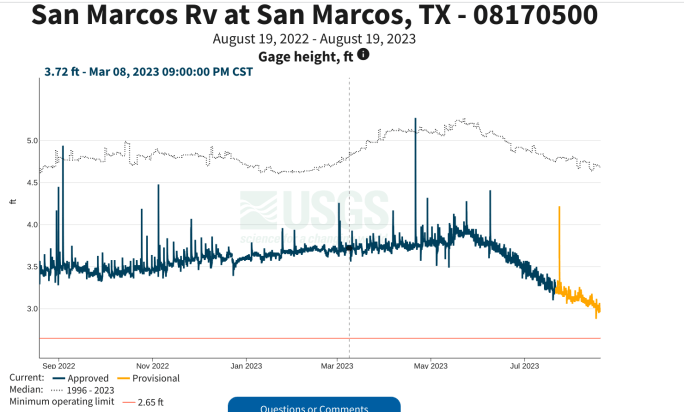
This isn’t changing much. I just bring this up because the river is incredibly low right now, and it’s upsetting.

Here’s the water level over the past year, compared to the previous 27 years:

via

The speaker at City Council said it’s the lowest in 25-30 years. This article from June said that the June level was the lowest in 70 years.

It’s all very anxiety-provoking!

Item 19: Property tax rate for the new year.

Last year, the city tax rate was 60.3 ¢ on every $100 of property value.

The budget isn’t decided yet, but the city sets an upper limit on the tax rate. 

There’s a couple possible property tax rates that get discussed:

  1. Last year’s rate: 60.3 ¢ on every $100.
  2. “No New Revenue Rate”: 53.05 ¢ per $100.  This is the rate that undoes the effect of inflation.  If you lowered the tax rate to 53.05 ¢, then you’d get the same amount of money from the properties that were taxed in both years, even though the value of those properties have gone up.
  3. “Voter approval rate”: 68.87 ¢ per $100: By state law, the is the highest you can go without having to hold a citizen vote on it.

Every penny increase brings in about $800K in tax revenue to the city.  So Option 2 is about $6 million lower than Option 1, and Option 3 is about $7 million higher than Option 1.

Here’s an interesting chart from the presentation:

Hence everyone complaining that their property taxes are going up, even when the rate doesn’t change.

Useful things I feel compelled to remind everyone about:

  • We have no state income tax! Wealthy people benefit the most from this. 
  • Property taxes are somewhat regressive.
  • Sales taxes are really regressive.

Today’s task is just to set an upper limit on the tax rate. I’m not sure exactly why Texas requires city council to do this, but here we are. 

City staff has proposed a budget based on a 60.3 ¢ tax rate, so Council sets 60.3 ¢ as their upper bound.  I’m also not sure why they wouldn’t give themselves a little wiggle room on this vote. Why not set your upper bound at 61 ¢, and then approve the lower amount when the budget actually gets approved?

….

Item 20: Public transit is a great thing.  But only when it works well. When it doesn’t work well, nobody uses it unless they’re in a bind. 

What makes public transportation easy to use?

  • Frequency.  If you don’t need to consult a schedule because busses come every 15 minutes, it’s easier to use.
  • Lots of stops: no one wants to walk very far in this heat.
  • Range: it has to get you where you’re going, preferably without too many changes

There is federal money available for all this, if you can demonstrate ridership.  This is the tricky part – how do you demonstrate demand, if your system is underfunded?  It’s a little bit of a catch-22.

ENTER: THE INTERLOCAL AGREEMENT WITH TEXAS STATE UNIVERSITY! 

A few years ago, Texas State started reporting its ridership numbers to the federal agency that keeps track of these things. Now we’re going to pool our systems. So we get a giant boon because Texas State has high ridership. 

This opens up a lot of funding and growth opportunities! This is great!  Hooray!