Hours 1:32 – 2:23, 7/2/24

Item 28: Petition to repeal the Police Officer’s Civil Service Law

This was very hard to follow. Here’s my best guess:

Backstory:
In 2022, Mano Amiga organized a petition to repeal and renegotiate the city contract with the PD union. (“Meet and Confer” is the contract process.) They were successful! But then the city sandbagged the renegotiation process. There were some small but meaningful changes, and some cosmetic changes, and then the new contract was signed.

This time: Mano Amiga organized a different petition, to repeal Civil Service.  

So what is Civil Service? It’s a State of Texas thing. It’s the basic “framework for the hiring, promotion and discipline of police officers and fire fighters”. So when the city negotiates the contract with the police union (SMPOA), everyone starts with Civil Service, and then negotiates on top of that. 

However, cities don’t have to start with Civil Service.  You can repeal it and start some other way. So this is what Mano Amiga wants to do. (I don’t know what their strategy or end game is here. I’m sure they’d explain when they launch a public campaign, though.)

Here’s how you repeal Civil Service. It’s long and confusing:
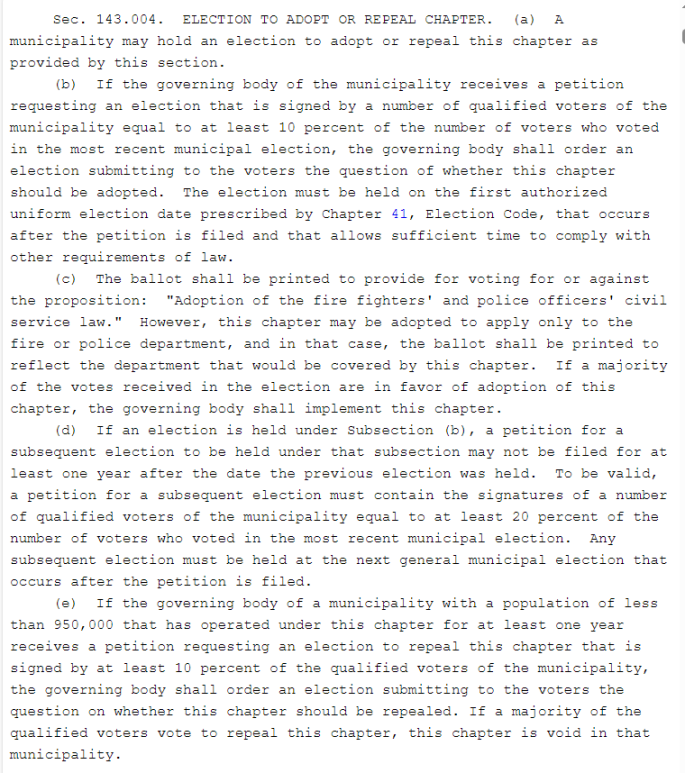
And what happened is that the city rejected the petition. Mano Amiga submitted a petition with 850 signatures, which is enough to adopt Civil Service (per Part B), but not enough to repeal Civil Service (per part E).

Mano Amiga is angry because they say the city waited until the last minute to tell them their petition wasn’t valid.  But they vowed to fire it up again, and get enough signatures for the next cycle.

Item 29:  Funding for low-income housing. (LIHTC tax credits) 

Mayor Hughson and Mark Gleason had a conversation.  Mark went to Jane and said, “We’re spending all this money on LIHTC Housing, and it’s not just this year. It’s not just the next 15 years. It’s decades and decades to come! This is fiscally irresponsible!” Are we being too helpful to poor people?!?

Jane thought he had a good point. We need money for core services! What if the LIHTC tax credits are ruining everything? It’s worth taking a look at.

Hoo boy. Okay, we have to unpack this. Here’s our plan:

  1. How much money are we spending on low-income housing?
  2. Is this a lot, or a little?
  3. How much more low-income housing do we need?
  4. What did Council have to say?
  5. What are we doing next?

Here we go!

1. How much money are we spending on low-income housing?

In 2022, we started requiring LIHTC applications to include a tax estimate. The first application that includes this is in February 2024. So let’s start there.

  1. February 2024: Existing LIHTC housing in Blanco Gardens reapply for state funding.
    Cost to city: $0.  Not asking for local tax exemptions.
    Units provided: 40 of 54 units are Section 8 housing.
  2. March 2024: Fake affordable housing near the high school
    Cost: $0. Not asking for local tax exemptions.
    Units provided: 0 for low-income residents.
  3. May 2024: Behind Target, by the railroad tracks
    Estimated tax credit: $7,262,589 over 18 years. (I’m going to scale this to $6,052,158 over 15 years.)
    Units provided: 34 low income units
  4. May 2024: By Centerpoint, on the railroad tracks
    Estimated tax credit: $4,000,000 over 15 years
    One time rebate: $400K
    Units provided: 55 low income units
  5. July 2024: Earlier in this very meeting, on Aquarena Springs
    Estimated tax revenue: $3,207,000 over 15 years
    One time rebate: $400K
    Units provided: 46 low income units

Summary: Three developments have applied for tax credits for the city. The total cost is $13,259,157.5 over 15 years, for 135 low-income apartments in those three developments.

This works out to $883K per year. Per apartment, we are knocking $550 off of the monthly rent.

Next question!

2. Is $883K in tax credits a lot, or a little?

Kinda both? Here’s some context from our yearly General Fund budget:

Yearly General Fund budget:
– The total General Fund budget is $109 million this year.
– SMPD get $24.5 million
– Fire Dept gets $17.6 million
– Economic Development gets $2.9 million
– Library gets $2.1 million
– Animal Shelter gets $1.6 million
Parks Department get $850K [Parks Dept gets $6.8 million. I misread the budget at first! Sorry about that.]
– Social services get $550K.
– The arts get $85K

I just grabbed a few useful categories. You can read all you want here.

So we are spending more on the LIHTC projects than we are on the arts or social services. Those combined are about 0.5% of the yearly budget.

We are spending much less on LIHTC projects than we do on SMPD, the Fire Department, and economic development. Those three categories combined are about 41.2% of the yearly budget.

My guess is that LIHTC projects come out of the $2.9 million for economic development. That money is supposed to create jobs. The thing that bothers Mark Gleason is that LIHTC projects don’t create jobs the way Buccee’s creates jobs. (Kissing Tree also doesn’t create jobs the way Buccee’s creates jobs. Kissing Tree is more like a LIHTC project in this way.)

Next! The three LIHTC projects just kind of came up spontaneously during the last couple meetings, and took everyone by surprise. What are some similar comparisons?

The other things that Council approved at this meeting alone:*
– $46 million over 15 years on roads and utilities in Kissing Tree. That works out to $3 million per year.
– $6 million on water and wastewater for Dunbar over 2 years. That works out to $3 million per year.
– $1.3 million on lighting for soccer fields at Five Mile Dam.
– $330K to update the Airport Master Plan
– $430K in a wastewater treatment agreement with McCoy’s
– $125K with Titan Utilities
– Two different Utilities trucks totalling $660K
– Energy management contract for $135K
– $480K for lawns and beds of city buildings
– $439K for Hull Street Stormwater improvements
– $215K on tree removal from the storm
– $432K on health care contracts

So those are the kinds of amounts we spend all the time, and Mark Gleason does not clutch his pearls.

Look, $883K is a fair amount of money! It is worth planning in advance and being intentional with how we spend it, so that we can best serve our community. Right now we’re approving projects on an ad hoc basis, and so there is room for improvement.

However: Kissing Tree is not put under a microscope. There are never any 5 or 10 year updates for Development Agreements where we give tax credits to private companies. SMPD’s budget is not put under a microscope.

It is always, always the programs that help poor and vulnerable people that make Council say, “I dunno, they might be wasting this shiny nickel we’re giving them. Let’s do a deep dive!”

…………..

Next!

3. How much more low-income housing do we need?

We don’t know! In 2018, we undertook a giant housing affordability project.

As of 2017, this was the housing need in San Marcos:

In 2019, Council killed the whole thing off. Years of effort and nothing was ever adopted to help create affordable housing.

In 2023, city staff gave Council a workshop on housing, and recommended that Council resume this project. As far as I know, they have not done this.

Bottom line: in 2017, we had a shortfall of 4233 rental units for all households earning under $35K.  This whole conversation is about 135 apartments. We need a lot more affordable housing than that.

LIHTC projects really are too expensive to be the only way we build affordable housing. (Fortunately, there are cheaper things that San Marcos could do! Like allowing ADUs and duplexes everywhere. But I digress.)

….

4. What did Council have to say?

Jane Hughson:
– We are not receiving enough tax dollars to support the services (library, police and fire, etc) going to these projects.
– We need the housing, though.
– Are these San Marcos residents? Or outsiders? I’m frustrated with outsiders.

Shane: How much sales tax revenue do they bring in?
Jane: The people would be paying sales tax either way.

Jude:
– We should update the formula for the proportion of 1,2, and 3 bedroom units that we require.
– We should require cash back, and make a formula for the cash back amount they owe us
– But LIHTC projects are still good, they increase housing!

Stephanie Reyes: I’d like to get a demographer to look at how much low income housing we need.

Saul: These LIHTC projects make taxes are higher on everyone else!! We should have a moratorium on LIHTC projects.

Matthew: Can a development be half-LIHTC?
Answer: not really.

Jane: Other cities give density bonuses and have inclusive housing incentives.  Can we do that?
Answer: We already offer these. Since 2018. But we can’t get anyone to take us up on them.
Jane: Not to say I told you so, but we could have done this on Lindsey Street.

Mark Gleason: I have so much budget angst. It’s not just this year – we’re giving away tax dollars for decades to come! It’s not just 15 years. It’s 20! And 30! Decades to come!

[Mark! No. That last bit is nonsense. Nothing automatically extends more than 15 years. Everything will be renegotiated at the end of the contract. Stop hyperventilating.]

More Mark: We have to diversify the economy here!  We need more data! I cannot approve any more of these without data!

Alyssa, speaking the truth: Can we do this conversation more productively? Instead of focusing on revenue loss, let’s focus on maximizing benefit to community members. 

Jane: I just want clarity on how much we’re spending. And also, how can we bring in more jobs?

Shane: The housing waitlist is like a year long. Doesn’t that establish residency?

5. What are we doing next?

In the end, they decide that the housing committee will look closely at the housing policy, and then they’ll hold a workshop.  They’re particularly concerned with:

  • How many total LIHTC projects do we have, and what’s the estimated taxes on all of them?
  • How many low income projects do our peer cities have, per capita?
  • Can we re-evaluate how many 1,2,3-bedroom apartments are required?
  • Can we formalize the rebate formula? Can we require rebates?
  • Can we do a needs assessment survey?
  • Rebate money should not go to the general fund. Can it be used in an intentional way?

Alyssa requests that our DEI Coordinator be present at the committee meeting. This is a very smart idea. She also recommends this resource for background reading.

Look: There is nothing wrong with those actual bullet points. It is good to review our LIHTC policy and see how it can be improved. 

But the whole vibe is, “ACK! We’re spending so much money on poor people housing!” and it sets my teeth on edge.

If Council were serious about housing affordability, they would dust off the Housing Action Plan, update it, and implement it.  Instead, we get Mark Gleason huffing over $13 million dollars to poor people, while sweetly handing Kissing Tree $46 million without blinking.

* NOTE: I updated this list because I forgot about the Consent Agenda. Originally I pulled amounts from the most recent few meetings, but I realized there were way more examples than I originally thought.
Hours 0:00 – 1:50, 2/7/23

Citizen comment:

Most people were there to talk about the repeal of Meet & Confer, and the implementation of the Hartmann reforms.  We’ll get to that shortly. A few people were there to talk against the SMART Terminal, or about the sprinkler systems in the new fire codes.

Items 23 and 25: Repeal of Meet & Confer

First item of the day!

Background

How did we get here? Most unions are legally hamstrung in Texas, but cops and fire fighters unions are privileged. They’re allowed to bargain collectively. The San Marcos PD union is SMPOA.

Every year, SMPOA negotiates a contract with the city, through a process called Meet and Confer. They’ve done this since 2009. So each year, they build on last year’s contract, and then they add a little. Each side gives a little and each side gets a little. How nice for cops.

In theory, the city is bargaining on behalf of the people San Marcos. Last summer, Mano Amiga put forth a list of reforms. The city ignored the reforms and passed a meet-and-confer contract without them.

So Mano Amiga vowed to repeal the meet-and-confer agreement. They rounded up 1300 signatures and submitted a petition to repeal the meet-and-confer agreement. That petition is the issue of the night.

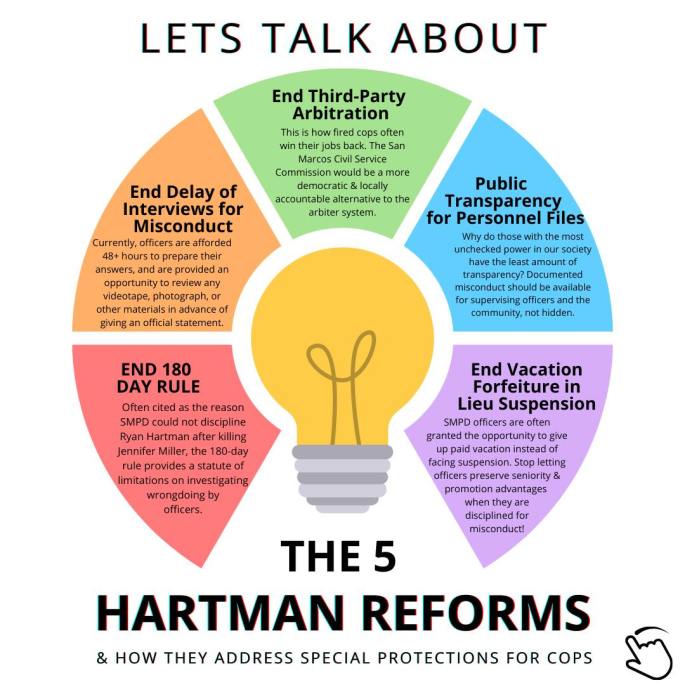
So what are the proposed reforms? Here’s their graphic:

They are all fairly reasonable. (Honestly, if you want to understand the Hartman Reforms, go listen to minutes 8:00-25:00 of this video. It’s the citizen comment period of the January 17th City Council workshop, and members of Mano Amiga show up and explain each reform. I found it super helpful.)

(Background on who Ryan Hartman is and how he killed Jennifer Miller by driving drunk and later got in trouble for excessive force, for tazing a compliant community member and was eventually fired, under immense pressure from Mano Amiga.)

Onto Tuesday’s meeting.

The Hartman Reforms are not actually on the table tonight.  It’s only about whether or not to repeal the current Meet-and-Confer agreement.

Council has two options:

  1. Undo the contract and return to negotiations, or
  2. Send it to the voters.

Right off the bat, Mark Gleason moved to deny, and Matthew Mendoza seconds it.  Not a good start.

Next, the Director of San Marcos HR gives a presentation: Basically, if the entire Meet-and-confer agreement was burned to the ground, the default agreement is called the Civil Service agreement. The Civil Service agreement is very weak and lacks a lot of good parts to our current agreement. We’d be very sad to burn it all down, because we’d lose 14 years worth of negotiations. But that’s the choice before council tonight: keep the current agreement, or burn it all down and feel really sad about it.

This is so dumb that I found it confusing at first. Why are we talking about burning anything down? Mano Amiga doesn’t care about burning down the past 14 years of negotiations. They just want to add in five extra conditions, on top of the past 14 years.

But the HR director was fixated on the idea that repealing Meet-and-Confer meant that the past 14 years of foundational agreements will instantly be tossed in the trash.  “These poor Mano Amiga shmucks don’t realize they’re playing with fire! Once you realize what’s at stake, you surely won’t throw away the entire negotiation!” 

For example, this was the slide used for most of the presentation:

Over and over again, different staff members say things like, “All of the accountability structures in the current agreement that you all really like, will go away if you repeal” and “Without meet-and-confer, we won’t be able to hire retired cops on a part time basis for Blue Santa anymore.”

Saul Gonzalez, Matt Mendoza, and Jude Prather all ask questions comparing the current 2022 Meet-and-Confer agreement with the burn-it-all-down Civil Service agreement.

  • Saul asks if the chief has more power to discipline cops under the 2022 agreement than under the Civil Service one?  

Answer: Yes! So much better!

Then an interesting thing happened: At 1:23, Saul asked, “Negotiations are supposed to be a win-win for both sides. Let’s say it gets rescinded. There’s things the other side wants and things that we want. It could change a little bit. It’s not guaranteed that it’s all going to go away? It’s going to benefit our interests as well as theirs.”

I think Saul is asking, “Are we allowed to build on the current agreement? If both sides want that, it doesn’t have to go away, right?”

But here’s how it’s answered: “When we meet-and-confer, we use interest-based bargaining, where we all talk about an issue. Both sides come with a list and we work as a team. We get our issues lists from council. Then it’s a give-and-take to come to an agreement.” That’s an answer to an entirely different question. It’s an answer about the normal summer process, not about whether or not we will be forced to burn down 14 years of negotiations if we vote to rescind

  • Matthew Mendoza asks if a cop can drag out arbitration forever?
    Answer: No. Both sides have to agree to arbitration.
  • Jude Prather says, “So there are lots of good things in Meet and Confer?” 

The city manager, Stephanie Reyes, steps in.  A lot of the good things in Meet and Confer have been there ever since 2009!  Therefore if we rescind it, we’d be going back to square one.” ….[ominous music plays]

Finally, Alyssa Garza is the one who untangles the mess. She point blank asks, “Let me see if I’ve got this straight. The fear is that if we rescind, we think SMPOA will erase the whole agreement?” and basically points out that that’s nonsensical.  “Why wouldn’t they start from where they are?”

Stephanie Reyes says, “Well, it’s a bargaining process. They’ll expect something in return.”

That’s a very different argument! Sure, if we re-enter negotiations, they’ll ask for something in return. That’s how negotiations work. Nowhere does that imply burn-it-all-down.

Next Chase Stapp speaks up: The reason that the city ignored the Hartman reforms last summer is because Mano Amiga missed a key deadline. The city had already submitted its lists of interests by May 27th.  The Hartman reforms didn’t come out until June 10th.  

Alyssa speaks pointedly: council regularly does whatever the hell it wants. If we’d wanted to negotiate the Hartman Reforms, we would have negotiated the Hartman reforms. The fact is we ignored them and hoped they’d go away. (She says it far more diplomatically, at 1:37:15 if you want to watch.)

That was pretty much the entire discussion! Even though I knew the outcome already, it still felt like Alyssa was the only person fighting for repeal.

And yet….

The vote:
  Deny the petition:  Mark Gleason, Jane Hughson, Matthew Mendoza
  Repeal Meet-and-Confer:  Alyssa Garza, Saul Gonzalez, Shane Scott, and Jude Prather

I still feel shocked and elated! There was no advance warning in the discussion at all that Saul, Shane, and Jude were listening and open-minded on this topic.   Complete surprise to me, at least!

Saul and Jude give brief justifications after the vote:

  • Saul says he’d rather renegotiate before giving up, and maybe we can come up with a win-win for everyone.
  • Jude says that under the constitution, citizens have a process to file a grievance against government, and since Mano Amiga used that process, they should get to see due process followed.

After the dust settles, Mark Gleason speaks up again. He just wanted this to go to the voters. He finds it highly ironic that Mano Amiga is being so inconsistent. They wanted Prop A on marijuana decriminalization to go to the voters, but now they want to skip the voters and go straight to renegotiations.  So ironic! His contempt for Mano Amiga is palpable.

But let’s take his words at face value for a sec: Mark is being a twat. Mano Amiga is fighting for police and criminal justice reforms. They’re not dedicated to the ballot box per se. If council had decriminalized marijuana, they wouldn’t have wept over the lack of a public vote. If council had voted to send this to a vote, they would have geared up for a fight.

Anyway, big congratulations to Mano Amiga for all their hard work and persistence. Of course, the Hartman Reforms are not actually part of any contract yet. I have no idea how the renegotiations will play out.

….

One last thing: Matthew Mendoza seems to be positioning himself as a yes-man to Mark Gleason, who himself is a yes-man to Jane Hughson. 

Confidential to Matthew (if I may call you Matthew): you’ve picked the Dwight Shrute of the bunch to emulate. Maybe back away slowly and reconsider someone a little less authoritarian and preachy?

Hours 1:01-2:10, 1/3/23

Some quick items:

Items 16-18: Various CDBG funding.  Moving money around to fund rental and utility assistance, a project where they buy flood-prone land to keep it from being developed, and working on some ongoing flood projects for the Blanco Riverine and around Blanco Gardens.

Item 17: The Planning Department has a lot of fees for various services and permits.  How do they set these prices?

It’s been a while since they updated what fees they charge. So they had a consultant come in and analyze how much it costs the city to carry out all these services.  Then they compared fees to seven comparison cities.  Then they shared all this at the December 14th workshop, and proposed new fees.  

The city wants to balance covering at least 50% of their costs, without charging homeowners and small businesses too much or being too out of line with the other cities.  I did not dive deep into the fees, but the methodology sounds fine.  Council said it was all fine.

Item 20: The result of the HSAB drama from December.  At the 3 pm workshop, city council worked on this with city staff. Here’s the outcome:

(Note: It says “The Board should not fund all programs” but they intended “The board should not feel compelled to fund all programs.”)

All seems fine. I think they’re going to go back and re-allocate the December money according to these principles.

Item 21: Mano Amiga circulated a petition to repeal the SMPD contract. Now, I obviously live here in San Marcos. If Mano Amiga were to approach me, I would sign their petition, because I generally support their mission.

But as your local friendly blogger, I’m going to call shenanigans – the actual petition is confusing. As far as I can tell, this is the entire thing:

What’s the actual, specific gripe with the meet-and-confer contract? And what’s the specific, desired outcome? Maybe there’s another page somewhere spelling it out? (Update: It’s the Hartman Reforms. But I still don’t see anything about it on the Mano Amiga website.)

Anyway, this petition got started this fall. And then on December 12th, Joshua Wright was killed by a correctional officer at the hospital in Kyle.

Now this incident is extremely clear-cut abuse by the correctional officer. You’ve got an unarmed inmate in a hospital, wearing ankle shackles for god’s sake. He tries to escape. The officer shoots him six times. That officer had some fantasy that the only way to handle a person running away was to be judge, jury, and executioner. Joshua Wright has to die because this correctional officer can’t properly evaluate and handle the danger of an unarmed guy wearing ankle shackles. What the utter fuck.

Mano Amiga is clearly livid, and sprang into action, demanding bodycam footage and holding events and raising awareness. Of course, I wholly support their efforts for justice for Joshua Wright. This is the most just and deserving of causes to fight for.

Hours 4:30-5:10, 9/6/22

Item 30: Meet and Confer agreement

The SMPD has a union, SMPOA, which negotiates contracts for cops with the city.

No one else gets to do this, because unions have been undermined in Texas.  First, it’s a right-to-work state, which means you can’t be forced to join a union, even though you may benefit from the outcomes.  (This is bad, in my book.)  Second, unions aren’t allowed collective bargaining powers.  If you’re not allowed to bargain for contracts and legal matters, then you’re basically an advocacy group.  Underfunded advocacy groups don’t generally have much power.  

The exceptions is police and fire fighters (and Houston municipal employees?)  Meet and Confer is how the city of San Marcos negotiates contracts with the police and fire fighter unions.

The Ryan Hartman issue:  Ryan Hartman was a police officer with SMPD. In 2020, he was in off-duty in Lockhart. He was speeding, ran a stop sign, probably under the influence, and crashed into Pamela Watts and Jennifer Miller, and Miller was killed in the crash.  He had an open container in his car, but refused a breathalyzer for a few hours.

He wasn’t indicted in Lockhart, and Chief Standridge was brand new, and dithered on the issue until the 180 day time frame expired, and Hartman was put back on the force. Somewhere in here, Mano Amiga takes up the cause on behalf of Miller’s partner, Pam Watts.  Mano Amiga begins a full press assault on Hartman.  Back on the force, Ryan Hartman tazes someone under sketchy circumstances, and is suspended again this past January.  Finally he’s terminated, this past June.

Mano Amiga has a list of five “Hartman Reforms” that they want implemented (and that are incredibly hard to find online.)  Based on this article, I’m pretty sure they are:

  • End the 180-Day Rule
  • repeal of the statute of limitations on investigating wrongdoing by officers
  •  “End Delay of Interviews for Misconduct,” due to officers being allowed 48 hours to prepare answers and review materials before giving an official statement.
  • Public Transparency for Personnel Files
  • End Third-Party Arbitration.

(I’m not really sure how 1 and 2 are different from each other.) In the Meet and Confer agreement, they are proposing to extend the 180 day rule to a 360 day rule. The other reforms are all ignored.

Max Baker asks about the rest of the Hartman Reforms. 

City staff says that the Hartman Reforms were announced on June 15th, but the negotiation meetings had already run from April-May 27th. Max Baker says that the Hartman Reforms overlap with reforms he’s brought up in the past, but he hadn’t gotten the support of council on those.

In Citizen Comment, Mano Amiga made it clear that they do not think this contract holds officers accountable. They’re going to collect signatures to get a repeal of this agreement on a future ballot. Stay tuned!

What do I think?   Here are some reforms that I think are important:

  • Reviews of police misconduct need to be done by independent, external investigators
  • End qualified immunity for police officers (Currently, officers can’t be sued for violating someone’s civil liberties. San Marcos can’t just unilaterally change this, but it’s important)
  • Ongoing de-escalation training (this may already be happening, I don’t know) and cops need to be immersed in neighborhoods and build positive relationships with young adults.
  • Prioritizing mental health of police officers, keeping ongoing relationships with therapists or counselors
  • Redirect mental illness emergencies to first responders with social work or mental health backgrounds

On one slide in the presentation of the Meet and Confer contract, it says, “Applicants with degree in social work, sociology, psychology, human services, or human relations will receive additional points.”    This is good!  You want officers with backgrounds in areas that humanize people. 

By all appearances, Chief Standridge is implementing progressive principles into SMPD. This seems like an opportunity to collaborate and make progress.

….

Item 32: Chris Cardoza is voted onto the Arts Commission.

Item 33: Should renters get notified when there’s a proposed zoning change? This is sent to a committee.
