Hours 0:00 – 4:32, 3/3/26

Citizen Comment

Two big topics!

  1. Should we reduce speaking time from 3 minutes to 1 minute, when the public gets to speak at Citizen Comment?
  2. Revisions to the Land Development Code. Are we creating a fast track to permitting Data Centers more easily in the future?

There were 41 speakers, and 40 of them covered the two topics above.

Main points on Topic 1:

  • No one wants this! In fact, everyone is furious.
  • This sure feels like a response to the Data Center turnout.
  • Austin lost a lawsuit when they restricted people’s comment time
  • It’s very hard to speak concisely when you’re new to citizen comment
  • Emailing council is no substitute for citizen comment, because other people don’t get to read the emails, and council can ignore emails. This is how the public informs each other.
  • The nationwide average is 3 minutes per speaker.

Main points on Topic 2:

  • Are we making it easier for Data Centers by allowing them in the Business Park zoning?
  • Are we making it easier for Data Centers by giving the permitting decision to P&Z?
  • Why aren’t we proposing regulations on their water use, air quality and waste water quality, power usage, and other things like that?

We will get to this! Sit tight.

Finally, that last 41st speaker, on his own topic: Clearly last meeting, everyone said they love the river. Can we monetize the river? There aren’t any billion-dollar industries besides data centers. How are we going to bring businesses to this town?

One last comment that’s worth noting:

At the 3 pm meeting, Max Baker asked: Hey, the executive session was all about “Confidential Utility Competitive Matters” with the Lower Colorado River Authority. Is this a data center thing?

City Lawyer: Legally we cannot say, but no, this was not a data center thing.

Good to know!

Item 7: Youth Standards of Care

This is a yearly item. San Marcos runs a bunch of affordable camps for kids. The big one is Summer Fun, which is $40 for the entire week, including meals. This is really a lifesaver for lots of families. There’s also a discovery camp, and a spring break camp, and other helpful camps.

City run camps are exempt from state licensing the way other childcare centers are licensed. Instead, they have to pass a Standards of Care. So this is that.
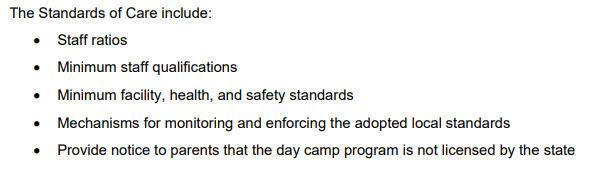
If you want, you can dive deep here.

Item 8: SiEnergy

SiEnergy is a natural gas company. They are not in San Marcos. They’re in Houston, Dallas-FortWorth, and Austin.

If they want to come to San Marcos, they have to get a franchise agreement with the city. Then they’d have to pay the city a surcharge once they’re operating.

The franchise agreements last five years. They’ve had one for the past five years, which they got one back in 2021. They’ve just been sitting on it. Now it’s 2026, and they want another one, for another five years.

Everyone says fine.

Item 9: CDBG Money

CDBG stands for “Community Development Block Grants”. This is money from the federal Housing and Urban Development (HUD) department. San Marcos gets about $740K every year.
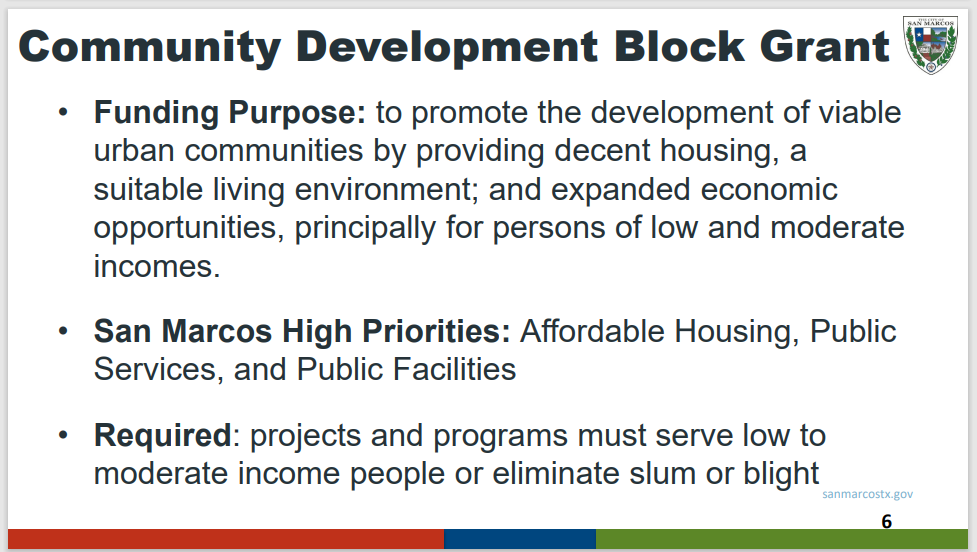
Applications from nonprofits were due last week. City staff are about to wade through them. So tonight is to find out if there’s anything specific that Council wants staff to think about while reading applications.

Max Baker speaks up during the public hearing: Hey, the Civics Club has been working on the Tenants Bill of Rights. Can we steer some funding towards those efforts?

The Tenants Bill of Rights dovetails nicely because it can keep housing decent. They say they’ll look into this.

Item 10: The LDC

This is the first hot potato of the night!

Background

“LDC” stands for Land Development Code. The Land Development Code is where all the planning and zoning rules are spelled out in excruciating detail. 

Because it’s so weedy, it requires lots of revisions. If a law gets changed, you have to change the LDC. If you change one thing, you have to change 20 other details that are all connected. People find typos or extraneous details that didn’t need to be there. New situations arise and we need new rules to deal with them. Council has new ideas about how to do things better. Etc.

The planning department takes notes, and stockpiles all of these changes for two years. Then they take the pile out and implement all the changes, all at once. This is that.

There are 320 proposed changes. They range from boring and insignificant to exciting and controversial. 

What does the public say?

Everyone’s worried that this is a stealth maneuver for data centers. (Thirteen speakers.)

What does staff say?

Data Centers: Let’s start here. The staff proposal is terrible and I promise that it is not going to happen. Multiple council members said they had amendments to fix this. They know everyone hates it.

So what was it? The proposal was to require a permit for the Business Park zone and the Light Industrial zone, and automatically allow data centers in Heavy industrial.

My $0.02: Is there any way to put standards on water and electric use, as part of the permit process?

Here are a bunch more of the LDC changes, mentioned in the staff presentation:

  • Revising the Valid Petition rules for protesting a rezoning, to match the new state law.
  • My personal favorite: the state struck down Occupancy Restrictions.

    Occupancy Restrictions are the city rules that say things like “No more than two unrelated people may live in the same house”. It’s micromanaging what people do in their own homes, and it’s very classist. It’s never enforced unless you’re hunting around for a reason to harass someone.

    We’ve had big fights about it here and here and here. We loosened it from two unrelated people to three unrelated people. And now it’s gone! Haha. Good riddance.
  • Mellow out on when a historical property needs a Certificate of Appropriateness
  • Modifies when a Qualified Watershed Protection Plan is required:
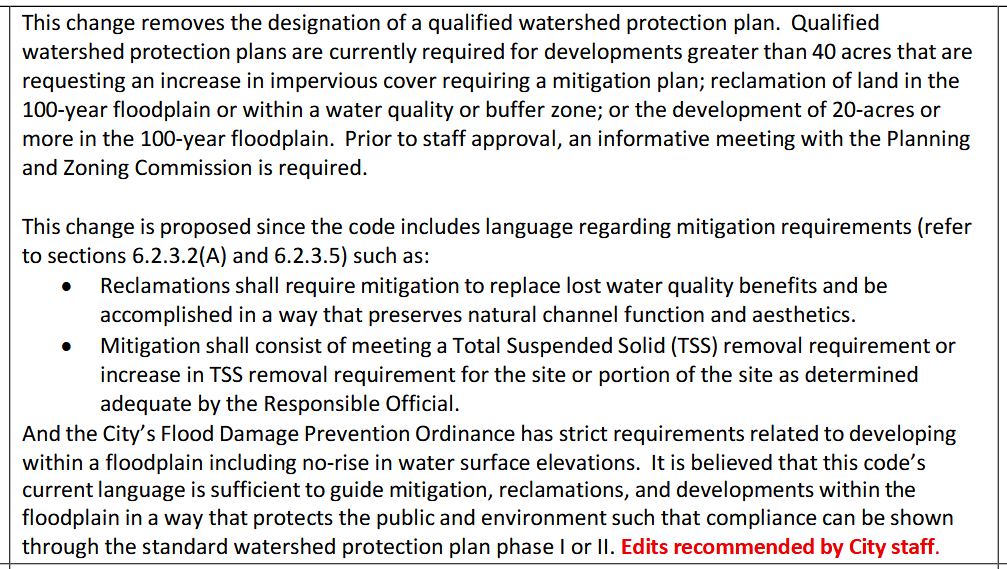
I don’t know how to evaluate that!

I’m not clear on how generous this is.

  • Zero lot line houses and cottage courts in CD-3 (this is good!)
  • Including microbreweries into the possible land uses
  • Add “sensitive features protection zones” around Environmental Protection Zones
  • Allow street parking to count towards parking requirements downtown. This is good for walkability and density.
  • Require bike parking racks to be provided with parking lots. (This is good!)
  • Add pollinator plants to what can be planted downtown. (yay for butterflies!)
  • Instead of the city putting up signs about public hearings, the applicant is responsible for putting up signs. The city has to supervise, so I don’t know if this helps much, though.
  • We used to have something called PDDs, where the city could micromanage what a developer built, and developers could get all kinds of breaks. Then we got rid of them. Now we’re bringing a lite version back: you can put constraints on developers, but no freebies.
    Note: Maybe this is a good place to put water and power use considerations?
  • Formalizing what we mean by amplified sound and background sound, so that P&Z can put restrictions on downtown bars.
  • Add in Demolition Delays to one of the tables
  • Eliminate number of rooms from hotel categories.
  • Tree surveys required any time someone wants to develop around a heritage or protected tree
  • Require downtown businesses to clean 100 feet out from their exits instead of just 50 feet.

It’s a lot.

I didn’t go through the other 250 changes to verify that they were all minor. There’s always a judgement call on whether something is a big deal or not.

What does Council say?

It takes about 2 seconds for Amanda to motion to postpone. This is such a gigantic topic that no one has properly vetted all 300+ changes.

Note: The data center thing will definitely be changed. Several council members said this. But feel free to weigh in with your preference!

What’s next?

Basically, you have homework. Or maybe I do.

Here’s where you can find all the proposed changes. And here’s the City Council message board and this will be the dedicated thread for their questions the Land Development Code.

  • If you’ve got opinions, share them with council ASAP.
  • Council will get all their thoughts on the message board by March 31st.
  • City staff will take all the thoughts and try to organize it and bring it back for the April 21st City Council meeting.

Item 14: Should Citizen Comment be reduced from 3 minutes to 1 minute?

Everyone is super mad about this! And with good reason!

Background: During a city council meeting, here’s how you can speak up:

  • Citizen Comment: anyone can speak for 3 minutes, on any topic, at the beginning of the meeting.
  • Some items are “Public Hearings”.  If it’s a public hearing, you can sign up to speak at the beginning of that item, as well.
  • At the end of the meeting, there’s a Q&A from the press and public.  So you can weigh in then, too.

Citizen comment can run long.  Since I’ve been blogging:

So this is not a new thing. (But I went and looked up some old controverseys – Cape’s Dam, and the Sessom Creek apartments, and the Woods Apartments, and the HEB on Wonderworld – all of these citizen comment periods were at most an hour. So things are getting longer.)

Which brings us to today

So the last meeting was a doozy. This meeting, Jane proposes that we should cut people off after 1 minute.

DUDE JANE. What the hell? This idea monumentally dumb in so many ways:

  1. Don’t restrict people’s participation. Citizen Comment is heavily utilized because it holds so much value.
  2. The timing is tone-deaf – are you trying to come off like you’re retaliating?
  3. If you don’t like going until 3 am, then focus on that. Your policy should address your problem. Right now, it sounds like you think the problem is people having three minutes to talk.

Jane speaks first! Here’s her argument:

  • She’s not trying to remove Citizen Comment altogether!
  • She’s willing to go to 2 minutes, to avoid the Austin lawsuit.
  • You can say if you’re a Yes or a No on an item in 1 minute.
  • If you have more to say, send an email. (Preferably before 5 pm the Friday before the meeting.)
  • Right now, the 100th speaker speaks at 11 pm. This way, the 100th speaker would speak at 8 pm. This is good for the public citizens who want to speak!

Alyssa claps back hard: Absolutely not. Give our neighbors every opportunity to speak. Organizing is hard and stressful and we’re not going to create more obstacles.

But Alyssa does also admit: it’s true that none of us are at our best at 1:00 am.

Amanda goes next: Hard no on reducing citizen comment time. But there is a problem with these ultra long meetings. Why don’t we brainstorm creative solutions for that?

Lorenzo:
– I’m open to brainstorming other creative solutions.
– I’m open to reducing citizen comment.
– And also, have you all heard yourselves ramble? Maybe some limits on council monologues?

Oh Lorenzo. You drag things out during council meetings!

For the record: I’ve been hard on Lorenzo lately, between his tax rate mess and his motion to postpone the data center decision.

But Lorenzo also brings good ideas to council discussions! He notices details and is good at brainstorming creative solutions. But he’s not quick about it. He sometimes gets hung up on tiny details and goes down rabbit holes trying to hash them out.

Josh: When people aren’t sure what they’re walking into, it sparks fears and leads to citizen comments that drag on. If we’re more prepared, it leads to more clarity and better-run meetings.

Bottom line: they’re going to have a future council discussion on how to shorten meetings.

My $0.02: you’re going to have to meet more often. Clearly San Marcos has outgrown two meetings per month.

Either:

  • Cut meetings off at 11 pm and come back on Wednesday?
  • Meet weekly occatsionally?
  • Special sessions for hot topics?

I personally do not like the last option, because my schedule for cranking out these posts hangs by a thread sometimes. But I guess the world doesn’t revolve around me. Sadly.

Hours 1:58 – 4:01, 10/17/23

Item 15: The Downtown Area Plan

The Downtown Area Plan is more than just the CM Allen District, but that’s definitely the part that sucks up all the oxygen in the room.  (Discussed here last time.)

Still, let’s take a moment to pay attention to the rest:

And here are the major points:

The thing is: downtown is already owned and zoned. You can’t demand or legislate hardly anything. All you can do is entice and form partnerships and collaborate with the people who run the things located there.

So let’s move onto the CM Allen District, which we discussed last time:

There was a Downtown Area Plan committee, who came up with Option 1:

Option 1:

Five Story Loaves of Bread:

Similarly to VisionSMTX, the shadow subcommittee of P&Z plus Jane Hughson was horrified, and rewrote it.

Hence Option 2:

Given that the city doesn’t actually own all that land, the Planning Department tried to thread the needle and come up with a compromise option:

Option 3:

Colorful, vibrant, smaller loaves of bread:

At P&Z, we heard about the unaffordability of Option 2. P&Z voted for Option 2 anyway.

This time the staff presentation spends even longer on the complete unaffordability of it:

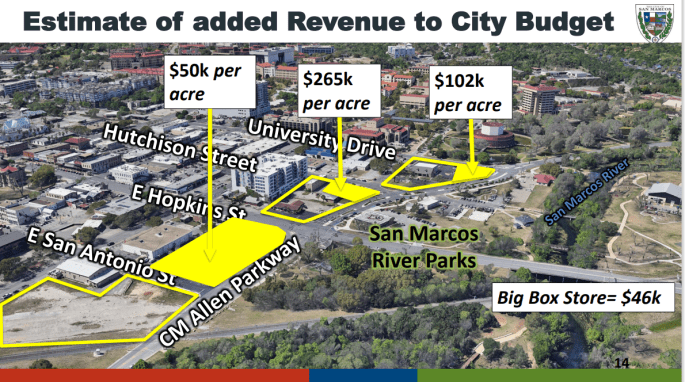
  • Basically, downtown land is worth much more than anywhere else in town. 
  • Right now, the 6.25 acres are mostly undeveloped, but they bring in this much taxable revenue:

The whole thing is 6.25 acres, so I’m going to ballpark the yearly revenue at $456K for the three lots marked.  A community member says that if they were developed, they’d pull in $3 million/year for the city.  Maybe?

No one can really say how much it would cost to acquire the parks, but if we had to say, staff puts the market value at $27 million dollars.

The city staff are always so professional, and so they presented all options neutrally, but I definitely got whiffs of Springfield Monorail from Option B:

Besides the magical thinking of the price tag, there’s also serious equity issues here.

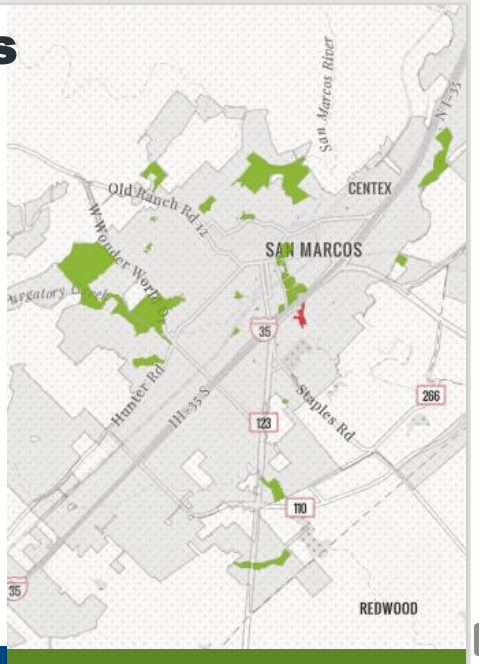
Here is how the current parks are distributed throughout the city:

You may notice that there’s barely anything east of 35. People who live east of 35 have noticed this too, and are not amused. (They’ve also noticed a bunch of other patterns of systematic disregard. Isn’t that something!)

So what does the public think?

MO-NO-RAIL! MO-NO-RAIL!  Ahem.

  • Giant student housing will make parking way worse downtown.
  • There’s a shallow water table under CM Allen, and drilling into the rock wil fracture it.
  • If Texas State buys this land, we’re hosed.
  • The procedure was not democratic. Option 2 preys on emotions.
  • There are serious accessibility issues downtown for people in wheelchairs. This plan doesn’t address any of that.
  • The college students run downtown and grown ups don’t feel welcome.
  • We can find much better ways to spend $27 million dollars than this.
  • Car dependency is bad, it’s better to put more housing in walkable areas like downtown.

In actuality: there are three in favor of Option 2, five opposed, and one speaking on accessibility issues.

Council discussion:

Mark Gleason goes first:

  • He loves the vision of #2. He wishes we could afford it.
  • There’s absolutely no way he can go face constituents on the East Side and tell them he voted to spend $27 million on more West side parks.
  • It’s already zoned, it’s not undeveloped like the Woods
  • This won’t stop flooding.
  • Not ideal, but #3 is best. We must to something to help the rest of town.

I certainly agree with all of that! He also talks about how there’s going to be a trail around the whole city, which is a reference to the Elsik Tract.

(I can see the marketing now! “A River Runs Through Us, That Historic Trail Also Runs Through Us, and a Loop Runs Around Us.” Practically a spaghetti bowl of significance!)

Jane goes next: She literally says “I need to do some ‘splaining,” which is endearing.

  • Her ‘splaining: The graphics freaked her out, and she wanted some green space. Never pictured golf course style mock up. Never said “Eminent Domain” or millions of city money. 
  • The idea was that if you don’t explicitly ask for green space, you’ll get zero. If you do ask, maybe you’ll get a little.

Jude: There are better places to turn into parks than this. Could City Hall move here? Hotel, civic space?

Alyssa: I don’t like any of them, but I agree with Jude and Mark. 

Shane: What about a splash pad downtown? I’m here for families! Families first! These are the last tracts along the river. Option 2!

Saul: I’m born and raised in San Marcos. There were no skyscrapers back then. Whenever I talk to anyone, they say “Why are there so many skyscrapers downtown? Why is there so much student housing?” That’s not San Marcos. Plus, it’s a slippery slope. What’s next, high rises all the way to 35? What if Texas State buys it? They don’t pay taxes or fees!  It’s for the kids. Bring back how it was!

[Side Note: “Why is there so much student housing?” Because the town loses their goddamn minds if students live anywhere else. Students are actually people, and they’re entitled to live in this town.

Sometimes students act like jerks! But so do rich people, and also middle-class people, and also poor people. People are jerks.]

Matthew: I had been a big fan of #2. Rio Vista Relief! But paid parking is coming. Where would this park’s parking be? 

We had a community meeting with Blanco Gardens on crime. Wasn’t well attended, and just me and Mark. They kept saying, “Why does the west get EVERYTHING?” Park distribution is not fair. East side is always neglected.

Matthew gave this huge impassioned speech about the plight of the east side, and then finished by saying, “And that’s why I’m on the fence!” which made me laugh. Way to undercut your own passion. 

Saul: Cape’s Dam is coming to the east side!

Matthew: But not, like, anytime soon.

The Vote on the CM Allen District:


Love me some Option 3!: Mark Gleason, Jane Hughson, Alyssa Garza, Matthew Mendoza, Jude Prather

Option 3 Gives Me a Sad: Shane Scott, Saul Gonzales

So there you have it.

The entire downtown plan will get revised to incorporate Option 3, and then will come back on November 6th for a final vote.

Item 12: Sights & Sounds

Apparently people ask Alyssa every year to keep an eye on S&S.  The former city manager gave her the runaround when she asked for documentation.  She asks if she could please get some straight answers. She’s told “no problem!”

Item 16: Land Development Code:

Last meeting, we were going to kick this back for two months, to give committees a chance to meet.  Now the planning department is asking if we could please just pass it, since it’s holding up a bunch of stuff, and they promise the committees will all meet promptly.

Sure: 7-0. So that’s that.

Hours 1:55 -2:55, 10/2/23

Next up! 

Item 9: Updates to the Land Development Code.

We discussed this in August and in September. There are just a few remaining issues to hash out. Here we go:

  1. Should staff be able to approve the most mild, least controversial restaurant alcohol permits, or should they all go to P&Z?

For now, all restaurants and all bars will go through P&Z to get their permit. (Discussed here before.)

A subcommittee will look at carving out some exceptions. For example, hotel bars generally aren’t close to neighborhoods, and aren’t generally rowdy. Maybe City Staff can just renew those on their own.

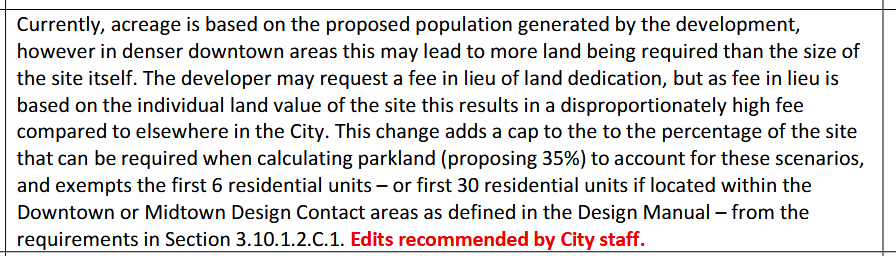
2. Developers have to donate land for parks, or pay a fee instead. If you’ve got just a little infill development of 4 to 8 units, should you have to pay a fee towards the park system?

No one on council really felt strongly about this. They compromised at 6 units: if you’re building a little development with 6 or more units, you need to pay a fee towards the park system.

3. If houses are only allowed to be 2 stories in your neighborhood, and you’ve got a little rooftop patio, does that count as an extra story?

It used to be 25%. If 25% of your roof has a structure on it, it counted as an extra story. Now it’s any structure at all counts as an extra story.

(Discussed here and here before. I accused them of being killjoys.)

4. Should we continue beating a dead horse on this occupancy restriction thing?

Yes, yes we should.

Quick background: San Marcos has restrictions on how many unrelated people can live together.  It’s been two. Back in May 2022, Council agreed to loosen them from 2 to 3.  

Matthew Mendoza balked at this in August, and then tried to roll it back to 2 in September.  The vote failed 4-3.  But he’s still all heated up about it, and makes another motion to amend it back to 2.

So first, some facts:

  • In San Marcos, it’s only certain housing that has occupancy restrictions. Basically, single family neighborhoods. 
  • In these neighborhoods, you can have any number of people, but only up to two unrelated people.  
  • Here’s how we define unrelated: “A family is defined in the Land Development Code as any number of individuals living as a single housekeeping unit who are related by blood, legal adoption, marriage, or conservatorship.” 

Here’s what city staff say:

Whenever neighbors complain, they’re not actually mad about the number of unrelated people.  It’s always noise, or parking, or the trash, or yard not being kept up.   We can deal with the noise/parking/yard complaint.  It’s not literally the marital status of any of the tenants that’s the issue, so this ordinance is not needed.

Here’s what Matthew and Jane Hughson say:

Landlords want to be able to rent to three tenants. So if you increase this, landlords will buy up housing stock and let it crumble into shitty, ill-maintained housing that exploits tenants.  It’s bad for renters, and decreases the available housing stock for people who want to purchase a home. 

Here’s what I say:

Actually, I want to say two things. I want to refute Matthew’s argument, and I also want to make a separate argument on why you should get rid of occupancy restrictions all together.

Look at Matthew’s argument:

When your chain of cause and effect becomes really long and stretched out, that is often a sign that you are writing bad policy.

If you’re worried about those Bad Consequences – low housing stock and shitty landlords – this would not make it onto the top 100 of effective things to do. 

What you’d do is:

  1. Build more housing. (All sorts.)
  2. Hold landlords accountable. Enforce code violations and fund a city lawyer to send letters to landlords on behalf of tenants. 

Furthermore, his facts aren’t right.  Letting bedrooms go unfilled reduces available housing.  Occupancy restrictions decrease housing, which is the opposite of Matt’s Bad Consequence #1. 

So I have yet to see a compelling argument for these restrictions. 

Arguments against – and here’s where I get pissed off:

  1. Why is the city meddling with whether people are married or not?  A married couple can take in a tenant, but an unmarried couple cannot?  Three friends can’t rent a house? This is gross.
  2. There is a serious housing shortage.  You should be able to put people in bedrooms. You should be able to flexibly problem-solve to provide housing on the fly, when someone you care about is in a pinch. 
  3. We just talked at length for two meetings about the burden of property taxes on Grandma.  Grandma should be allowed to take in her friend’s grandkids as tenants.  Grandma’s primary asset is her house, and she doesn’t want to move, but it’s more house than one person needs. Let her share.

The common thread is non-traditional living situations.  Why should non-traditional living situations be banned?  A few people want to live together, and they can’t, because the city can’t crack down on shitty landlords? That’s dumb as fuck.

Bottom line:

  1. Hold landlords accountable for providing safe, well-maintained housing.
  2. Build a variety of housing in neighborhoods, not just 3- and 4-bedroom houses. Build four-plexes alongside houses so that people can rent apartments in quiet neighborhoods.
  3. Stop micromanaging who is married and who isn’t.

One final point: Yes, landlords buy up housing stock. But listen: being a good landlord is a lot of work. Make bad landlords be good landlords, and some of them will decide it’s not worth it. Hold landlords accountable for maintaining safe and well-maintained properties, and their profit margins will go down, and they’ll be less likely to buy up your housing stock, and it’s better for tenants, and neighbors.  Win-win-win.

Here’s how the conversation goes, after Matthew makes his basic argument:

  • Shane Scott points out that letting someone rent a room may help them afford their property taxes.
  • No one knows the occupancy restrictions in other cities more generally, but College Station sets it at 4 unrelated people.

(I went hunting, and couldn’t find much. Austin puts it at 6 unrelated people.)

  • Jude Prather: I’ve been in this situation. I know plenty of respectable, good neighbors who have had three unrelated people living together at various times. How do you tell people they can’t do this, when housing is unaffordable?
  • Matthew: but Minneapolis got rid of their occupancy restrictions and they went to hell in a handbasket!!
  • Jude: Actually, Minneapolis went the other way. Their housing costs actually resisted inflation. What about a compromise, where you can take in extra tenants if it’s owner-occupied?
  • Alyssa: Let’s remember that occupancy restrictions are rooted in racism and classism.
  • Jane Hughson: NOT IN SAN MARCOS, IT’S NOT! The history here is NOT racist!

 In San Marcos, its origins are mostly anti-college students. But the folks in power did not shed a tear that it was also disproportionately impacting poor and non-white community members.

Also, confidential to Jane: I wouldn’t go betting the farm on San Marcos being a bastion of anti-racism.

  • Matt: I’m trying to protect renters!

(Ahem. Establish a tenant’s council, then.)

  • Mark Gleason: My worry is keeping people in their homes. So I’m in favor. I think people should be able to rent out a room or two.  I don’t think it affects whether or not investors buy up houses.  I’m okay with owner-occupied only, though.
  • Jane: Let’s postpone the whole thing for two weeks!
  • Matthew: I’m just sad about the historic district.
  • Jude: San Marcos is clearly an outlier. We’re not trying to get rid of the rule altogether. 3 unrelated people seems like a good compromise.

The vote:

Jane keeps talking about creating a subcommittee and postponing it for two weeks.  It feels like she’s just unwilling to recognize that she’s lost this vote.  Both Jude and Alyssa gently say that they would be fine just letting it go.  

She forms a committee anyway – Matthew Mendoza, Alyssa Garza, and Mark Gleason – and Alyssa says if there’s a committee, she at leasts wants to be on it.  

When actually forced, 6-1 vote in favor of committee.  The committee will consider whether three unrelated people should only be allowed when one of them owns the house. (We really only want to micromanage the marital status of renters, I guess.)

5. Should the notification radius for a giant ungodly thing like the SMART Terminal be bigger than for a dinky little development?

Yes. The notification radius should be proportional to the size of the development. We’ve been over this multiple times.

Staff says no, and gives this as their reason why not: “If we made the cutoff at 500 acres, then developers will just come it at 499 acres!”

In other words: it can’t be done because developers will game the system.

Give me a fucking break. How about this: “For every 25 acres, you have to notify 400 ft out.” Not to brag, but that took me all of ten seconds to write down. I bet someone can spend 10 more seconds and come up with something even better.

Thankfully, Jane is also not satisfied with staff’s lame evasion, and says, “I don’t know the best way to do it, but there’s gotta be a way.”

So this will go to committee.

In the end, the whole set of revisions will be postponed until December 5th, to give all these committees time to meet

Hours 4:07-5:45, 9/19/23

Item 20: Updates to the Land Development Code. 

We went over the proposed updates last month.

Public Comment

  • We relaxed parking restrictions downtown and it is having unintended consequences – The Parlor has bought up several private parking lots.
  • Several speakers talk about the development agreement notification radius again. They use that the radius needs to be “proportional to the size of the project”, and my little blogger heart swelled three sizes.

Council Discussion

One of the changes being proposed is to increase the occupancy restriction from 2 to 3 unrelated people.

(What does this mean? In San Marcos, in single-family zonings, you get only one roommate. You cannot have three unrelated people living together. This is a great way to maintain wealth segregation. And yes, this is totally unenforceable but we do it anyway.)

Matthew Mendoza starts off with a rousing cry against it.

You guys: the speech Matthew gave made my little blogger heart shrivel back down to the size of a blackened pea.  I could not disagree more with him.  

Matthew’s basic claim: if we let three unrelated people live together, then we’re on a slippery slope to ending single family zoning.  He claims that Minneapolis tried this, and it failed so hard that they’re undoing it.

For what it’s worth, it looks like he got every detail of the Minneapolis example wrong. They ended their occupancy restrictions, and then liked it so much that they doubled down.

And then, Minneapolis did exactly what Matthew is scared of – in 2019, they were the first major city to end single-family zoning. So far it’s providing gentle, incremental densification, the way it’s supposed to. (But rents and housing prices are actually falling there for an entirely different reason – elimination of parking minimums.  But yowza, we cannot handle a topic that spicy on this particularly epic-length entry.) Since then, several states and many cities have ended single-family zoning.

Matthew!! Why are you micromanaging everyone’s lifestyle? Let people have a goddamn roommate.

But also: YOU ALL JUST BEMOANED HOW EXPENSIVE TAXES ARE. LET GRANDMA RENT OUT AN ADU, FOR GOD’S SAKE! Let people live with their friends!

See how crazy-making this meeting was? The cognitive dissonance fried my wee brain.

(Alyssa does respond to Matthew, wearily: Who are we to dictate what counts as family, anyway?)

Here we go:

The vote on occupancy restrictions:

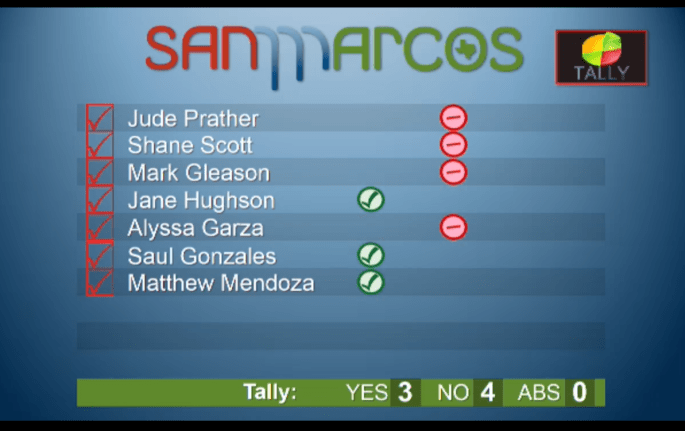
Restrict back to 2: Matthew Mendoza, Saul Gonzalez, Jane Hughson
Relax it to 3: Shane Scott, Jude Prather, Mark Gleason, Alyssa Garza

So it barely passed.

A stray thought: Jane voted 6th in line. She was a reluctant yes when this was discussed 18 months ago. I think she switched her vote mid-stream, because she could see it would pass either way. If Mark had voted after Jane, he might have switched his vote to match hers, and the whole thing might have failed.

Bottom line: It should never have taken 18 months after extensive discussion to bring this to a vote. It almost undid all that hard work.

But whatever: it passed.

Still on the Land Development Code: Businesses that serve alcohol have to get a Conditional Use Permit. (CUP). These get renewed by P&Z every three years. Should we separate out bars from restaurants, and only make the bars go to P&Z? Staff is proposing this, because it would save time and effort.

Jane Hughson makes a motion to say no, and stick with the current situation – all CUPs, both restaurants and bars – should go to P&Z for renewal.

The reasoning goes like this: sometimes restaurants are jerks, and are bad neighbors to nearby residents. Noise complaints aren’t addressed by the police. But at P&Z, neighbors can state their case and the restaurant owner will actually pay attention because they don’t want to lose their CUP. Then P&Z can attach conditions to the CUP – make the restaurant come back for renewal in one year instead of three, put quiet hours on the restaurant, that kind of thing.

I agree with Jane here. And sometimes you do get a lot of people from a single street, all pissed off about the same restaurant. This is a really important opportunity for community input, and we shouldn’t take this power away from community members.

As Jane puts it, “Sometimes our biggest problem child is a restaurant.”

One extra thought: It’s already a thing where bars try to pretend that they’re restaurants in order to get more relaxed treatment. If you let restaurants skip P&Z approval, even more bars will try to get reclassified as restaurants, to avoid scrutiny.

The vote:

Restaurants have to go to P&Z: Matthew Mendoza, Mark Gleason, Jane Hughson, Saul Gonzalez
Let restaurants skip all that: Jude Prather, Shane Scott, Alyssa Garza

So it passes 4-3.

Finally, Mayor Hughson has a few issues that are queued up for next time:

  • In the new (poorly named) “business park” zoning, Jane just doesn’t want truck bays for 18 wheelers. Little delivery trucks are fine, but she doesn’t want semis.

    The point of this new zone is to be “good neighbor industrial” (which is what I’d name it). I agree that 18 wheelers are less neighborly than delivery trucks. Staff is worried that no one will apply for this zoning if you rule out 18 wheelers.
  • Notification radius for development agreements: Jane is listening. She agrees that it should be larger for larger projects.

    She also wants you to know that the city already goes above and beyond the notifications that are required by state law. (Sure, kudos. But state laws are mostly written by jerks, so that’s a low bar to clear.)

    At any rate, getting her on board here is a huge win, because no one else was responding.
  • A month ago, Mark Gleason got really mad about some house on Sturgeon with a rooftop patio. In response, staff is proposing that rooftop patios count as a “story” if they cover 25% of the roof.

    Jane wants it to be much lower: any rooftop structure counts as an extra story.

    My opinion: stop being a bunch of killjoys. Let people have their rooftop patios. Quit harshing my mellow, man.
  • Developers have to either donate parkland, or pay a fee. We’re updating the calculations to be more fair. If you’re only developing 4-8 lots, you can skip the fee.

    Jane: Why wouldn’t people in the 4 or 8 houses use our parks? Why exempt them from park fee? I’ll bring this back next time, too.

So there are a lot of fiddly details still to hash out.

The first vote, which is not the final vote:

Yes, let’s update the code: Everyone besides Matthew
No, I’m still mad about occupancy restrictions: Matthew

Item 21: SMPD body cams.

We rent them from this company called Axon. The company’s prices are going up. If we renew early, we can stay at the old rates. Save a million dollars.

We have 10 drones, btw. 

Alyssa: There are multiple grants available for body worn cameras. Did we seek any of these opportunities? 

Chief Standridge: We do not have an Equal Employment Opportunity Plan (EEOP) so we can’t apply for grants. We are aware and trying to fix that.

This is an interesting point. It turns out that we can’t apply for a lot of federal funding until we have an EEOP. It includes any Department of Justice or SAFER grants. We are definitely taking this seriously and working on one.

The vote to re-up on the body cams:
Yes: Everyone but Alyssa
No: (no one)
Abstain: Alyssa Garza

Alyssa explains that she hasn’t reviewed our SMPD body cam policy since it was last updated, and she can’t in good conscience vote on these in the meantime.

Item 23: Single use container ban!!

You guys. It’s been SUCH a long meeting. This last item is so popular and great – it’s a shame that I’m just now getting to it.

If you’ll recall, five hours earlier we had boatloads of community members show up to speak in favor of banning single-use containers from the river and parks. Volunteers pull out epic tons of trash from the river as often as possible, and we just can’t keep up. It flows down river and to the gulf. It’s bad for the river itself. 

So what happens tonight?

This is just the very beginning of the process. Mark Gleason and Matthew Mendoza are bringing it up to see if council is interested in moving forward with this.

So who’s in?

Mark is a hard yes. 

Jude: let’s do it!

Saul: Me too!

Matthew Mendoza: I live in Rio Vista! I’m desperate to see this pass.

Alyssa: Let’s focus on the education piece, and secure the buy-in of the community. Lean on park ambassadors instead of marshalls. Best practices. No unnecessary policing of our neighbors.

Jane: I’m in to move forward.

So everyone is enthusiastic! It’ll take some time and work.  I definitely want to give Mark and Matthew props for initiating the issue, though.

Q&A from the Press and Public

Listen, Max Baker spoke as many times as possible this evening, and he has a tendency to pack ten ideas into a three minute speech. So I’m cherry-picking, because this was entertaining.

First, Axon is the company that makes the body cams. Max accuses, “Are you all aware that there is a SUPREME COURT CASE against them for antitrust issues? Do your homework!!”

He’s right but he’s wrong: It’s exactly that – some anti-monopoly wonky lawsuit brought against them by the Federal Trade Commision. But I can’t see how that’s a big scandal.

Max also says, “This same company wants to design TASER DRONES. Lotta concerns about civil liberties in that regard.”

Max is entirely correct – they are batshit crazy and they definitely wanted to design m-f-ing taser drones. But also, shortly thereafter “Axon halts its plans for a Taser drone as 9 on ethics board resign over the project.” So at this point we can just marvel at the human capacity for inventing really, really bad ideas.

I’m not saying this company is any good. But given that they’re involved in an anti-trust lawsuit, I’m guessing we don’t have terribly many choices either way. Have fun dreaming about TASER DRONES!

Hours 1:29-2:57, 8/1/23

Item 18: Updating the San Marcos Development Code

This is big and interesting. It has four parts:

  1. Compliance with State Laws
  2. Business Park Zoning
  3. Process Improvements
  4. Clarification and Corrections

Part 1: Compliance with State Laws

The state just passed a bunch of laws, like repealing all curfews. What else do we need to fix to be legal?

  • Plats: A plat is the drawing that shows things like roads, bus stops, parks, parking lots, and things like that. Everything but the details of the actual building.

    Right now plats get approved by P&Z. But P&Z is legally not allowed to make a judgement call. They’re only allowed to consider if the plat meets the conditions in the land development code.

    In the future, plats won’t go to P&Z anymore. City staff will approve them. We’re told this is because the state legislature tightened the shot clock, so we have less time to approve applications. We need to streamline processes to comply. They will publish the plats on a website

Okay: this is a small thing, but city staff is mildly bullshitting their case to City Council here. The shot clock was tightened back in 2019 to 30 days. This most recent bill says it’s okay to skip P&Z approval. So P&Z approval used to be required by the state, but now we’re allowed to let staff approve plats.

What else?

  • More appeals procedures added in to land at City Council, and we modified the timeline
  • Private schools must be zoned just like public schools.

City staff is misleading us a teeny bit here, too. This says “Municipalities will be required to treat charters as they would an independent school district for the purposes of permitting, zoning, etc.” It does not say private schools. Just charter schools. We’re allowed to zone private schools however we want, but don’t pretend that the state is making us do this.

Listen: the city staff work hard and they’re good people. I’m just being persnickety here.

Part 2: A new zoning district, called “Business Park”.

To me, this is a business park:

via

That’s not what we’re talking about. What Jane Hughson means is, “Hey, if you want to put industrial next to residential, it has to be super mild and chill.”

I think she actually means little warehouses, like this:

via

I would call it “Good Neighbor Industrial”.

Either way, it’s going to be capped at 35′ high, and excludes a lot of bad neighbor uses. If you wanted it higher than 35′ or to include warehouse and delivery, you’d have to get a Conditional Use Permit from P&Z.

Part 3: Process improvements

City council keeps getting bit in the butt over Development Agreements. They pass something in the dead of night, and then when everyone finds out the details, they’re furious.

In recent memory:

  • La Cinema. Council modified the Development Agreement with La Cima to allow for movie studios back in December 2021. There were no notifications sent out and no one noticed. Then it came time to negotiate tax credits, and everyone got super mad that movie studios were allowed over the aquifer. But it was too late.
  • The SMART Terminal. They doubled the size of the SMART Terminal back in January. But there were no notifications to the public. Afterwards, everyone was furious. I would have to link to every single meeting from the past six months to flesh this out.

Clearly we need to mail out notifications for Development Agreements and for amendments. We’re finally going to start doing this.

How many people should get notified? They’re proposing a 400 foot radius – everyone who lives within 400′ gets mailed a notification. That matches what we do for zoning changes.

Listen: It should not be 400′. It should be proportional to the size of the project. Tiny projects get a tiny notification radius. Giant projects need a larger notification radius.

If you’re looking at the 2000 acre SMART/Logistics park, 400 feet is a tiny sliver around it. If you’re talking about a little 4-plex, 400 feet is plenty.

Note to Council: Since you’re tinkering with Development Agreements, why not also add in tree remediation?

Other changes

  • Historical Preservation Commission (HPC) can postpone things now.
  • Timeline for Demolition by Neglect is increased from 30 to 45 days
  • Park land dedication – this one is a bit weird. Let’s spend a moment here.

Right now, if you want to build anything residential, you have to set aside some land for parks. The equation is 5.7 acres per 1000 people.

The old code says this: “A minimum of 50% of the parkland required under this ordinance shall be dedicated to the City of San Marcos as a neighborhood or regional park under Section 3.10.2.1. The remaining 50% may be owned and managed by one of the entities under Section 3.10.1.6.”. Those entities are the city, a land conservancy or land trust, an HOA, or a public easement.

The new code says: “Appropriate plat notes describing the ownership and maintenance of all proposed parks are provided on the plat.”

In other words, maintenance is expensive and we want to pawn it off onto HOAs. But then the city doesn’t actually own the land. We could just make the developers and HOAs cover the costs, but we still own the land. But that’s not what’s proposed.

Jane Hughson asks: Will the park still be open to the public?
Answer: Yes, dedicated parkland is required to be open to the public.

Mark Gleason asks: What can we do if it’s not maintained?
Answer: We withhold their final permits until the park looks good.
Mark: No, I mean like five years later. What if the bathrooms are all broken and there’s garbage all over the place? What can we do?
Answer: [squirming in the uncomfortable silence]

Looking in the code, I see this bit:

That doesn’t quite apply here.

No one offers a motion and the motion passes.

See? This is the Council Dance again:
– Here, we identified a problem.
– Let’s all sit uncomfortably for a sec
– Rather than fix it, just pat it on the head and go on our merry way.

  • Occupancy restrictions: let’s dish on this.

We have an occupancy ban in San Marcos. No more than two unrelated people can live in the same house. This is an extremely shitty policy that punishes poor people, out of fear that college students will throw wild keggers next door. There is a housing crisis, and people need to be able to move in with each other. (Furthermore, this dumb policy is totally unenforceable, so it only gets trotted out when someone has an axe to grind. It’s the worst!)

Listen: you cannot govern San Marcos solely out of fear of beer cans from college kids. That is a code compliance issue. That is not the basis for good policy.

Back in April ’22, Alyssa Garza fought hard to get everyone to consider relaxing the occupancy ban. Eventually she built consensus: council asked city staff to bring back a policy loosening the restriction to 3 unrelated people. Hooray, sort of.

Somehow it took city staff 15 months to bring it back, so here we are. However, during that 15 months, Max Baker was voted out and Matthew Mendoza was voted in. And Matthew Mendoza is very salty on this issue.

The more he talks, the more conservative Matthew seems. He sees this all the time in his neighborhood: a bunch of unrelated people live together, and it reduces home values for families in his neighborhood, which is how you buld generational wealth. He was calling this New Urbanism and claiming this was a gateway for big apartment complexes. It was kind of unhinged.

Everyone reassured him that there’d been a big conversation. Matthew did not get any traction re-opening the topic. But it was still a weird rant.

  • Awnings can be now be 7′ clearance instead of 9′ minimum clearance. This is in response to the owner of Chances R Bar downtown, who pointed out that the building literally isn’t tall enough for a 9′ awning.
  • Mark Gleason is super mad at his neighbor.

Apparently there’s a house in Mark’s neighborhood which is lifted off the ground and is two stories high. It’s got a flat roof, and they made a little patio up there. Mark is livid that they can see into other people’s backyards, but you can’t really legislate that, so instead he is livid that there is a structure up there – “with shingles!” – that allows them to hang out and see into people’s backyards.

Shane Scott says, “Our house in Mexico is like that. It sounds pretty cool.”

This is the Shane I like best, when he needles Mark for being a prig. You can practically see them in the same high school cafeteria, circa 1991: Shane wearing a Metallica t-shirt and black jeans, Mark wearing the same khakis and golf shirts that he wears to city council meetings. Shane leaves his lunch trash behind on the table when he leaves, and Mark urgently flags down the teacher to let them know that it was Shane.

Amanda Hernandez, the planning department director, strongly suspects that this house is probably already violating city code. The top of a house can’t be more than 35′ off the ground. If this is elevated and two stories already, you’ve got to be pretty close. Mezzanine structures count if they’re at least 30% of the area.

Mark makes a motion to measure height from the ground to top of rooftop structures.

Yes: Everyone besides Shane Scott.  
No: Shane Scott
(Jude Prather is absent.)

I prefer to live in a world that facilitates rooftop patios and rejects Mark’s killjoy tendencies. So I’m a “no”, if anyone asks.