
Rally the troops. We’ve got to keep going. This meeting is just so densely packed with important information.
Next up:
Item 19: VISION SMTX.
We’ve talked about Vision SMTX a lot. It’s the new comprehensive plan. (What is a comprehensive plan? It’s the vague, conceptual plan for how we want San Marcos to grow over the next 30 years.)
Quick background:
There was a 30 member citizen committee that met with a consultant over two years and came up with a plan. Then P&Z looked at it and said “fuck no!” Mayor Hughson and three P&Z members rewrote large parts of it, and that’s basically what’s before council now.
It now comes up three times before council:
– This current meeting: informational, with public comment
– First vote on October 17th, where the public can give feedback again
– Final vote on November 6th , (with no public comment)
Comments from the community:
- we should tax businesses instead of giving them tax breaks
- “Low Intensity” shouldn’t allow for heavy industrial. (In other words, SMART Terminal should never have been taken up for consideration out in a bunch of cow fields.)
Some philosophical ramblings
The comp plan does not end single-family zoning. San Marcos is not wading into that debate. But it’s simmering in the background.
The problem with single family zoning is that it’s very sparse. That means you’re building a lot of roads and utility pipes and lines, and increasing coverage of fire and police, without covering many people. That’s all very expensive to maintain over time. Single family zoning does not bring in enough money to pay for itself. If you live in a house, you are subsidized by apartments and businesses. In most cities, 70% of the land is zoned single-family.
Why has our city budget swollen to $315 million dollars? Because San Marcos has to run services Whisper Tract up north, Trace down south, La Cima out west, and Riverbend Ranch out east. All sprawl.
On top of that, we pretend there are only two ways to live:
1. sprawling single family neighborhoods, or
2. gigantic apartment complexes.
That’s it! Only two choices! Sorry! But that’s just super not true. The idea is to allow slow, incremental change, where now and then you can put a small four-plex on a single lot. It still feels like a neighborhood, but there’s housing for people who don’t need 3+ bedrooms in a house.
(In fact, it would feel like the goddamn Historic District, which was built before single family zoning was a thing, and now weeps piteously about it’s own demise any time you try to discuss any other neighborhood in the city.)
Then you can spread the tax burden across more units per acre, without driving up costs for the city. This actually reduces taxes!
Listen, council just spent THREE HOURS talking about the budget. The community seems to care a LOT about property taxes.
You want to know why the city struggles to balance it’s budget? Single family zoning. You want to know why traffic keeps getting worse? Single family zoning. You know who benefits from single family zoning? Anyone who got their house early or who can afford to pay a lot. Fuck everyone else.
If you want taxes to go down, you’ve got to spread the costs of government over more people, without creating more work for the city. In other words: less sparse. More dense.
- Allow people to rent rooms in their houses to others. (End occupancy restrictions!)
- Allow people to build ADUs in their backyards
- Allow 2, 3 and 4-plexes throughout any neighborhood.
And my personal beef with single family zoning: stop segregating by wealth. It’s toxic and destructive. We are all part of the same community.
I agree with Max about taxing businesses. But you also need more people to share the tax burden.
End of philosophical rant. Back to Vision SMTX.
Dr. Rosie Ray is probably the smartest person in town on this stuff. She spoke about Vision SMTX, back at the beginning of the meeting, but I saved it till now. She’s advocating for two small tweaks:
- City planners have a concept of a 15 minute city.
Here’s what wikipedia says about it:
The 15-minute city (FMC or 15mC)[1][2][3][4][5][6] is an urban planning concept in which most daily necessities and services, such as work, shopping, education, healthcare, and leisure can be easily reached by a 15-minute walk or bike ride from any point in the city.[7] This approach aims to reduce car dependency, promote healthy and sustainable living, and improve wellbeing and quality of life for city dwellers.[8][9]
But the P&Z/Jane Hughson subcommittee put the phrase “or vehicles” into the definition for San Marcos. In other words “15-minute walk, bike ride, or car ride”. You can understand how that makes the whole “reduce car dependency” thing totally worthless, yes/yes?
So Dr. Ray (diplomatically) suggests we use the actual definition that the rest of the world uses. She’s much friendlier about it than I am.
2. P&Z/Jane Hughson created something called “Neighborhood Low – Existing” in the Preferred Scenario Map. The idea here was to freeze all existing neighborhoods in carbon, like Hans Solo, and prevent any of that gentle densification like ADUs, townhomes, or four-plexes that I talked about earlier. So they said that all existing neighborhoods are single family.
The problem – which Dr. Ray points out – is that a lot of current neighborhoods are not strictly single family. She herself lives in a condo! So they’ve made a lot of existing neighborhoods out-of-conformance with being existing neighborhoods. If you don’t allow multiplexes – that are already there! – from being part of existing neighborhoods, then the people who live in them will have much more trouble making changes to their property. Dr. Ray asks that they restore the multi-plex housing type to existing neighborhoods.
These are the least possible asks. Dr. Ray is wise and I’ll just go with banging the drum in support of her asks.
…
There’s not much discussion, because the night is so blisteringly long already. Just one important comment, from Mayor Jane Hughson, regarding the P&Z/Jane rewrite:
“Everybody keeps saying that we watered down the plan, when me and P&Z got together and rewrote it. For the longest time, I didn’t know what they meant. Watered down? What did we water down?
“Then I realized what they meant! They didn’t like the word swap of objectives to considerations! That’s all! So I’m going to go through and change it back!”
NO. No. Jesus, Jane, that is not at all what we’re saying. How on earth did you get that impression? Dr. Ray literally said:
- Remove the word “vehicle” in the definition of 15-minute City
- Allow townhomes and other existing multiplexes in the definition of Neighborhood Low – Existing.
Those are actual meaningful changes. This is not a case of “What a wacky misunderstanding! We meant the same thing all along.”
One final note: No city council member made a peep about either of Dr. Ray’s suggestions. There are still two more opportunities, but I have a bad feeling about this.
…
Item 22: Kyle is running out of water. Specifically, they’ve used up all their Edward’s Aquifer alottment. They want to buy our unused Edward’s Aquifer water from us. This also happened last year!
Recall that during citizen comment, most people said, “Yes, give Kyle the water, because they’re our neighbors. But for the love of god, attach some strings to it! They shouldn’t waste their water and then just dip into ours!”
Here’s how the city presentation goes:
1. Kyle will take the water either way. They will either pay someone else, or they will default on their contract, but the water is going to be used, for sure. So the aquifer will be depleted by the same amount, regardless of our decision
2. Kyle uses different water conservation stages than we do. So yes, they just entered Stage 3, but that’s pretty similar to our Stage 4.
3. As part of this deal, they have to match San Marcos water conservation efforts.
4. We stand to make $344K off this deal-io.
So first: are Kyle’s water restrictions similar to ours? It’s surprisingly hard to tell.
Ours has a handy graphic with all our stages:

We’re Stage 4.
Their website has their current stage, but not all the stages:
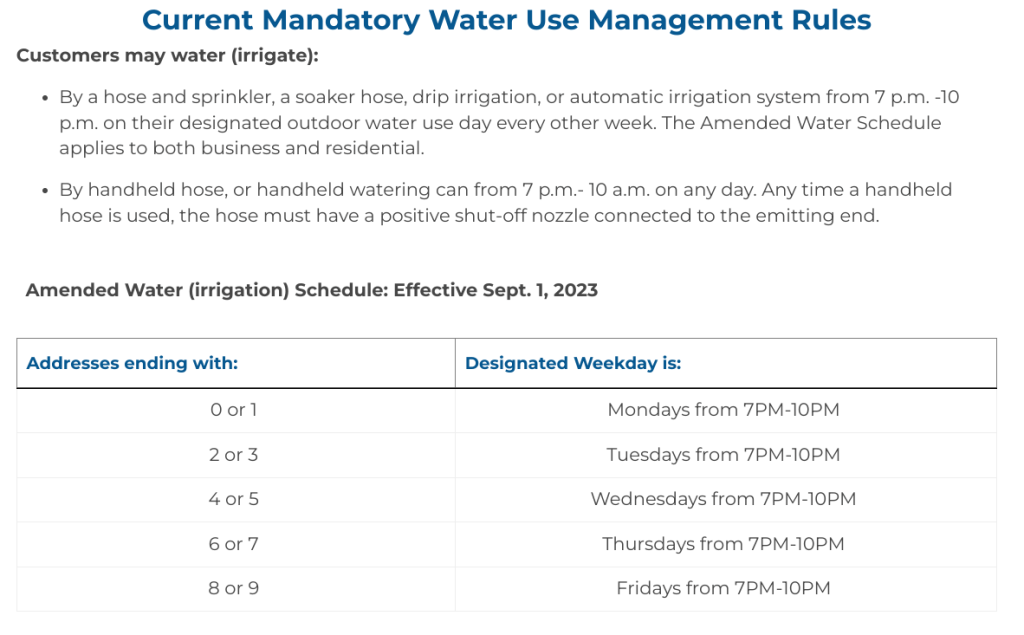

But they only entered this stage last week. Before that, they were Stage 2, and I can only find all their stages in this cumbersome, unreadable thing.
So has Kyle been irresponsible with their water usage? It depends. It could be that they’ve been watering golf courses all summer, while Rome burns. It could be Tesla or other new businesses. It could be that they’ve approved a bunch of housing developments without thinking about the water issues.
And yes: approving too many housing developments or signing unsustainable development agreements with Tesla would be totally irresponsible. But it’s the kind of irresponsible that Texas does unconsciously. We don’t think through the ramifications of sprawl or corporate resource abuse very well. Like, at all.
Jude Prather speaks up on behalf of the public speakers: What about the next year? Can we put something in there about conservation in the future, so that they don’t need to borrow more water next year?
Answer: Kyle is just waiting for ARWA water to show up! Then this won’t be an issue!
The Kyle representative clarifies: Actually, ARWA water won’t show up to the west side of town until December 2025! Those are the folks that need this water.
But Jude does the thing that Council always does:
– Asks about an issue that is a real problem
– Gets told “yes, it is a problem”
– Does nothing. Ta-da!
Yes, Kyle will have to use our water next year. Whatever they did this year was not enough, and they’ll do the same exact thing next year. The new water will not be here in time. La la la la la.
The vote: It passes 7-0.
 The San Marxist