
Citizen Comment:
There were five people who showed up to talk.
Tonight’s the night that Council determines their HSAB grants, and so almost everyone speaking was representing nonprofits – one speaker from School Fuel, and three from Southside. I’ll save it for that item.
One last speaker talked about Meet and Confer, and whether or not it was okay for Council to make recommendations to the negotiators who represent the Council in the negotiations.
…
Item 13: Rezoning a little street in Blanco Gardens
Here’s Blanco Gardens:

It’s a very cute old neighborhood with gorgeous trees.
Here’s a close-up:
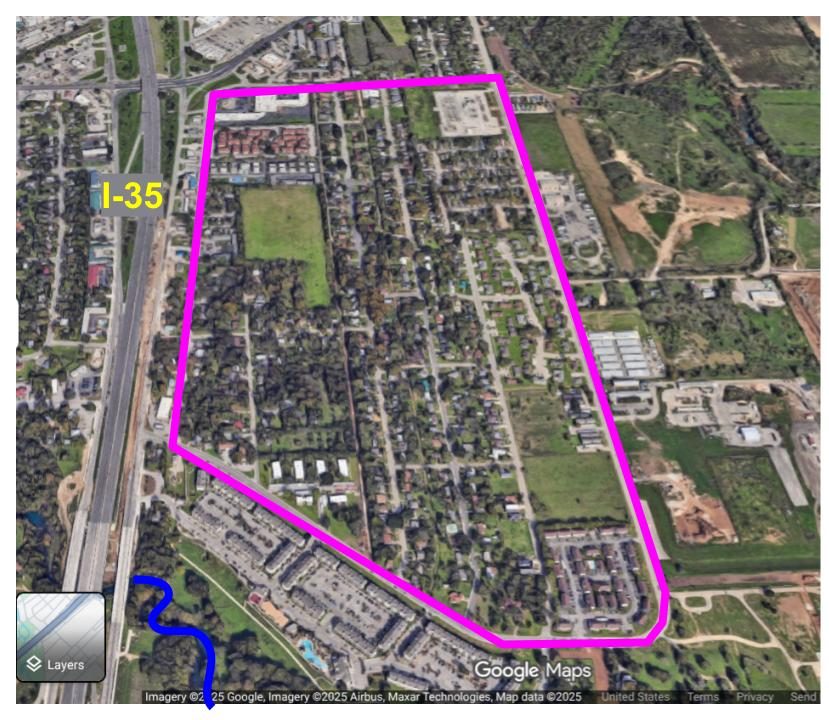
Blanco Gardens has come up a lot over the years in the blog. They were ground zero for the 2015 floods, and they’ve gotten some some flood mitigation projects since then. They got some speed bumps and parking permits. Most recently, they were the first neighborhood to get its neighborhood character study. It’s also the closest neighborhood to Cape’s Dam.
For an old neighborhood, there’s a surprising amount of undeveloped land in the middle of it:

(I wondered briefly if that was because homes had been torn down after the floods. But nope, you can see on the 2014 satellite image that there’s just always been space there for years.)
Over the years, developers have occasionally tried to put something in part of it, but so far it’s always gotten nixed.
Today’s proposal is about this bit:

A developer wants to build houses on it.
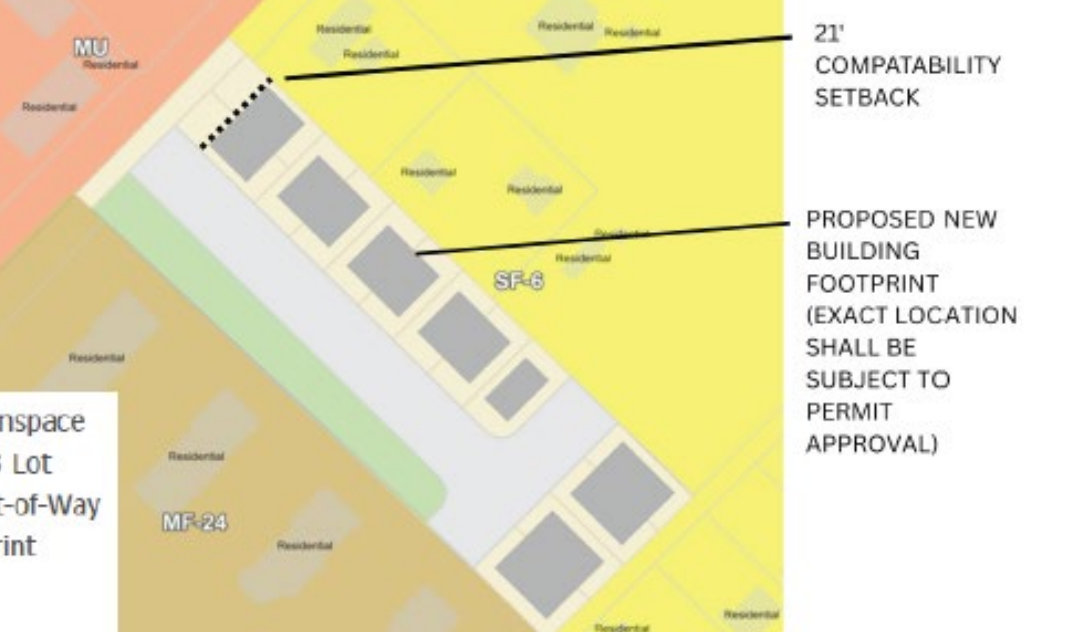
They would look and feel like duplexes, but they’re technically different, because of how they can be bought and sold. The property line runs through the two halves of the house, so you can purchase one half of it, while someone else owns the other half. (It’s called a “zero lot-line house”.)
Basically it’s a good way to fit more, smaller homes onto a street, and they tend to be a little cheaper, too.
What does Council say?
Question: will fit the character of the rest of the neighborhood?
Developer answer: We have good intentions!
(One block over, there are some extremely modern houses. The neighborhood is salty about this.)
Question: Will the alley still exist?
Answer: nope.
…
Nobody really asked about flooding. The 2015 floods are starting to fade from memory for the rest of San Marcos. But not in Blanco Gardens – they were the epicenter of the floods.
I would have liked to know what the 2015 flood water line was for nearby houses – I bet it was about 3-4 feet of water deep. How elevated will these houses be? Will they be above the 2015 water line?
My memory is that, in a 100-year flood plain, you have to build 1-2 feet above the Base Flood Elevation, based on FEMA flood maps. Does that get you to 3-4 feet off the ground? I just don’t know.
…
The vote on this cute row of sorta-duplexes:
Yes: Everyone
No: nobody
The good news is that Council is enthusiastic about infill housing. (When I first started blogging in 2022, Council wouldn’t let a home owner build two small houses on a subdivided lot, on Lockhart street. That was crazy.) They’ve definitely gotten the message that San Marcos needs more housing.
As long as the homes are safely elevated, I’m okay with this project. But the flooding risk makes me very uneasy.
…
Item 14: HSAB Funding
HSAB stands for Human Services Advisory Board.
These are city grants to nonprofits, for things like food assistance, eviction prevention, domestic violence help, mental health services, etc. For the past few years, we’ve given out $500K in grants. This year, Council bumped it up to $750K. (Of course, federal funding has gotten slashed, so the need has also grown. THANKS OBAMA.)
It’s always a grueling process. All the nonprofits all do incredibly important work.
In the past, we kinda made non-profits cagefight against each other. [Read all the gory details for the past few years.] The process was murky. The recommendations would come to council, and council members would start horse-trading around.
It was a bad look! It always seemed very fickle – “Oh, we’ll take $20,000 from those guys and give it to these guys!” It felt like the main criteria was being friendly with council members.
We’ve been working on tightening the process. It’s a super time-intensive:
- the HSAB board meets weekly from August to October
- They hear presentations from all 32 applications
- Each one gets discussed and each board member ranks them on a bunch of different criteria
- Eventually they recommend how much of each request to fund.
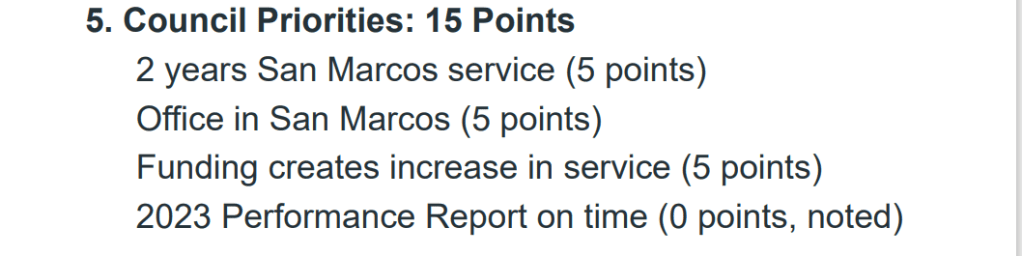
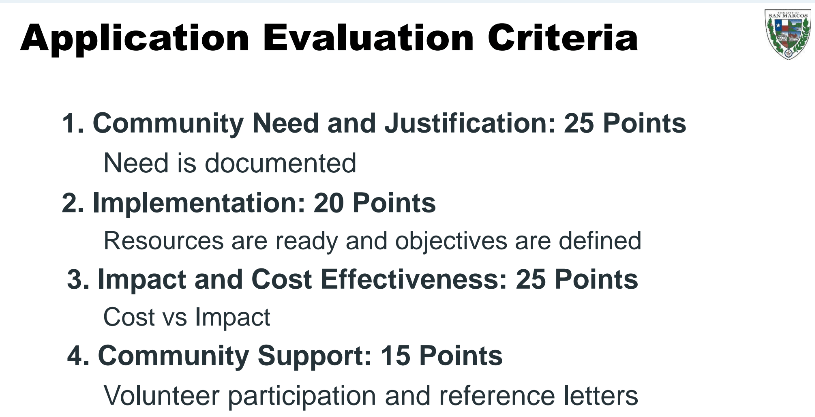
Here’s the criteria:

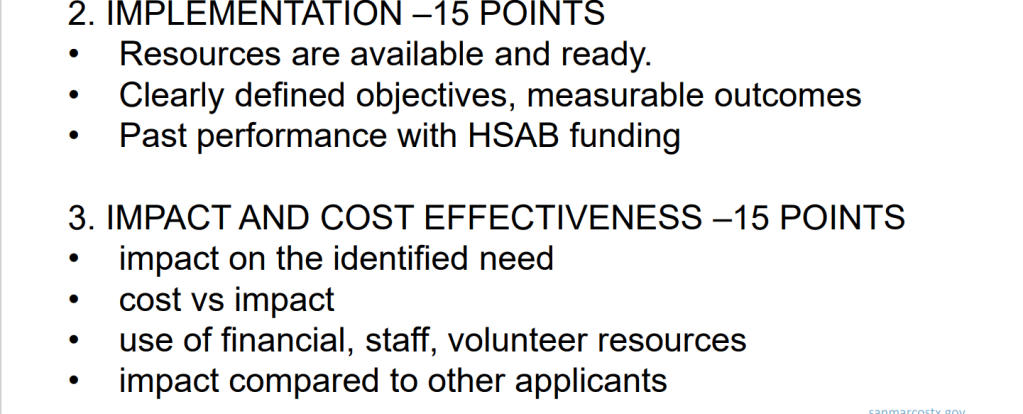
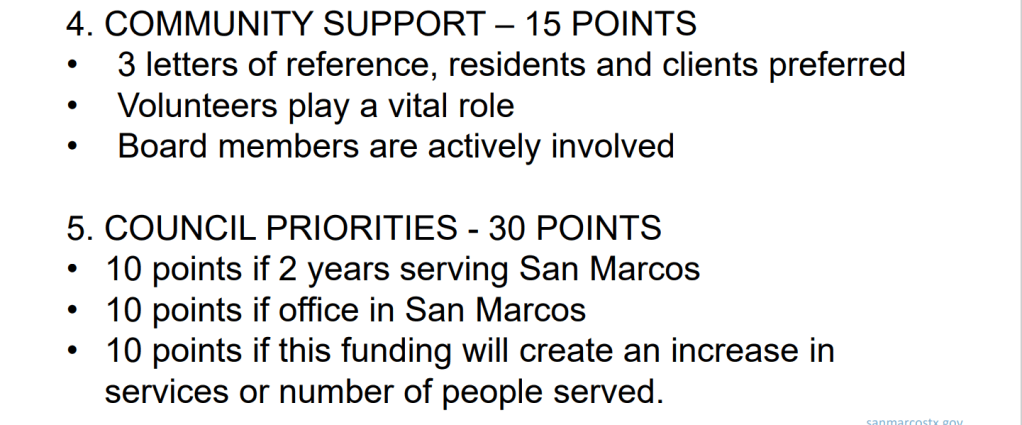

After all the ranking and discussion, they bring it to Council.
…
Just for funsies, let’s add up how much other non-HSAB money is getting allocated in this meeting!
All this was approved in one single vote, on Tuesday:
- “On-Call Title Research Services Contract with Hollerbach & Associates, Inc., to increase the price by up to $200,000.00, resulting in a total contract amount not to exceed $299,999.00”.
- “RMO P.C. for legal services associated with land acquisitions to increase the price by up to $300,000.00, resulting in a total contract amount not to exceed $699,000.00”.
- “Change in Service to the agreement with Baker Moran Doggett Ma & Dobbs, LLP for legal services associated with land acquisitions to increase the price by up to $300,000.00, resulting in a total amount not to exceed $600,000.00”.
- “STV Incorporated to provide On-Call General Engineering Services for various projects in the amount of $900,000.00”.
- “Halff Associates, Inc. to provide On-Call General Engineering Services for various projects in the amount of $900,000.00”.
- “a 2025 Ford F550 Crew Cab Chassis from Rush Truck Center, through a Sourcewell Purchasing Cooperative Contract, in the amount of $82,043.63, and outfitted by E.H. Wachs, through a BuyBoard Contract, in the amount of $156,865.65, for a total purchase cost of $238,906.28”.
- “SHI Government Solutions, through Omnia Partners, for a City of San Marcos job application tracking software system in the annual amount not to exceed $112,000.00, and up to four one-year renewals with a total amount of $560,000.00”.
It comes to about $2.95 million. I’m not saying any of those were a mistake! I trust the city officials. Most likely, those are all totally reasonable.
I’m just pointing out who gets scrutinized, in society, and who doesn’t. We approved almost $3 million without blinking, when it goes to those contracts above. But if it’s hungry kids, homelessness, mental health emergencies, etc, we rigorously grind these applications into pulp.
…
Back to the grant grind!
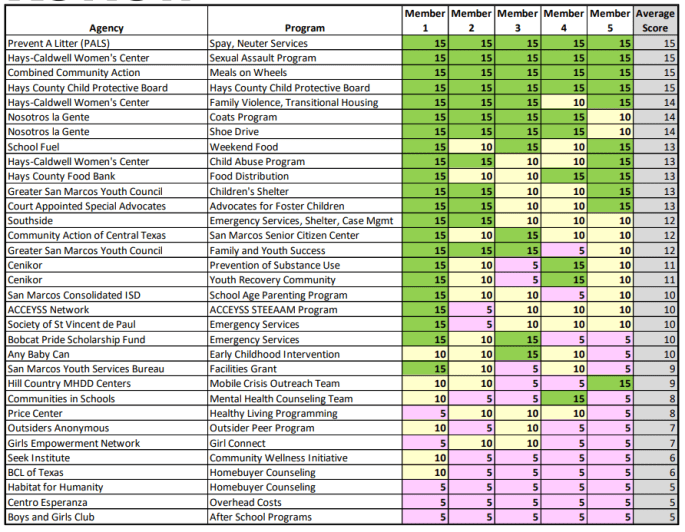
There were 32 applications, and the total amounts requested added up to $1.2 million.
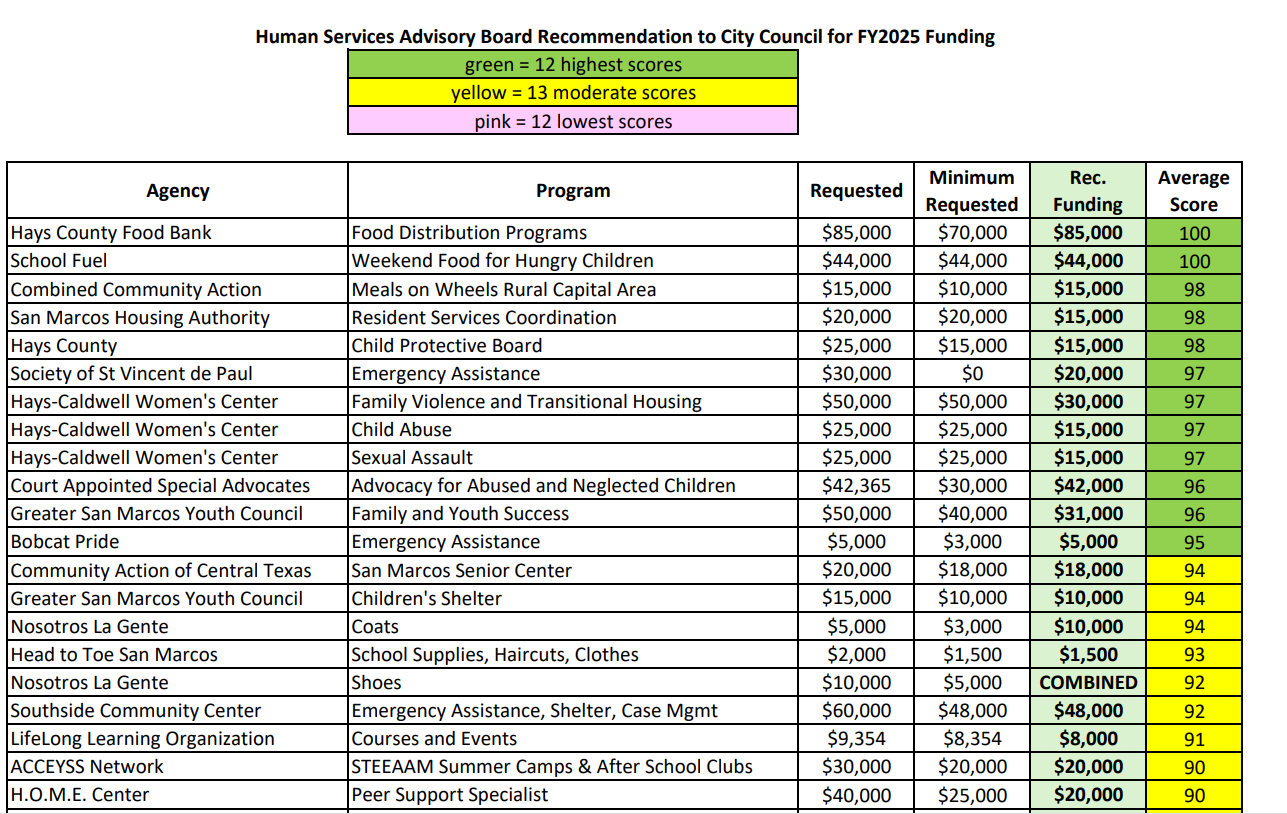
Here’s the full list of scores and funding:
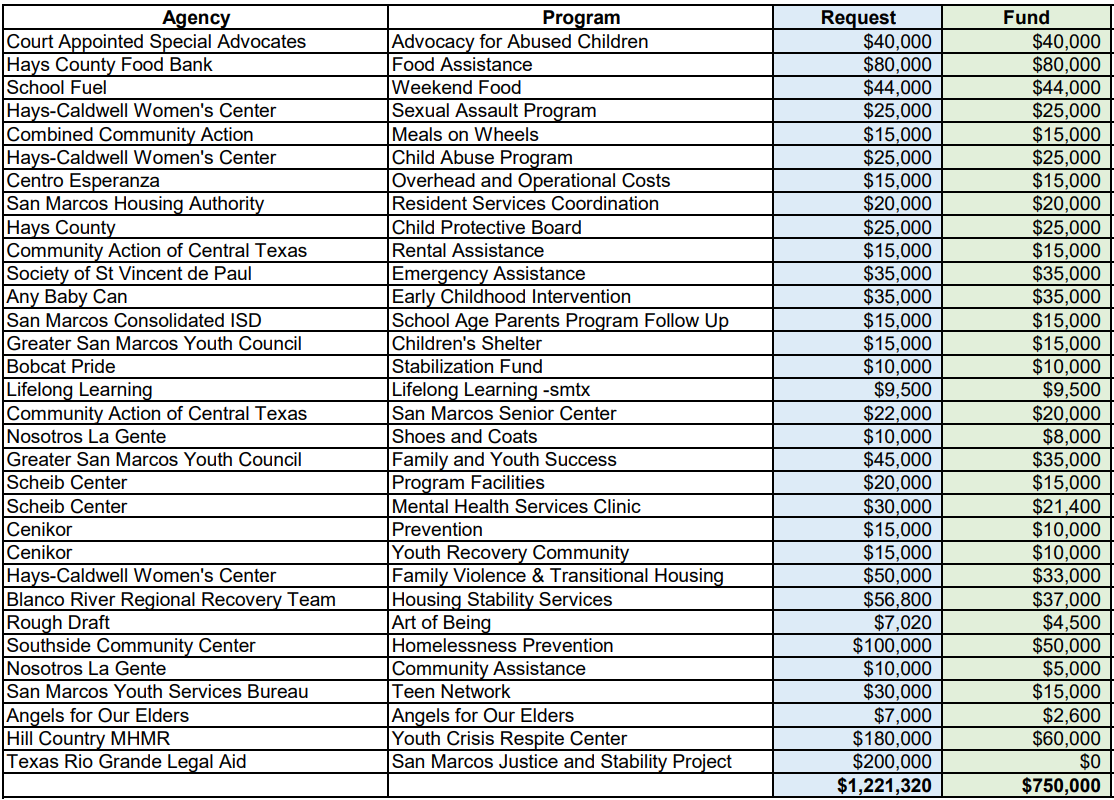
In the presentation, they went through all of them, and why the committee might not have fully funded the request.
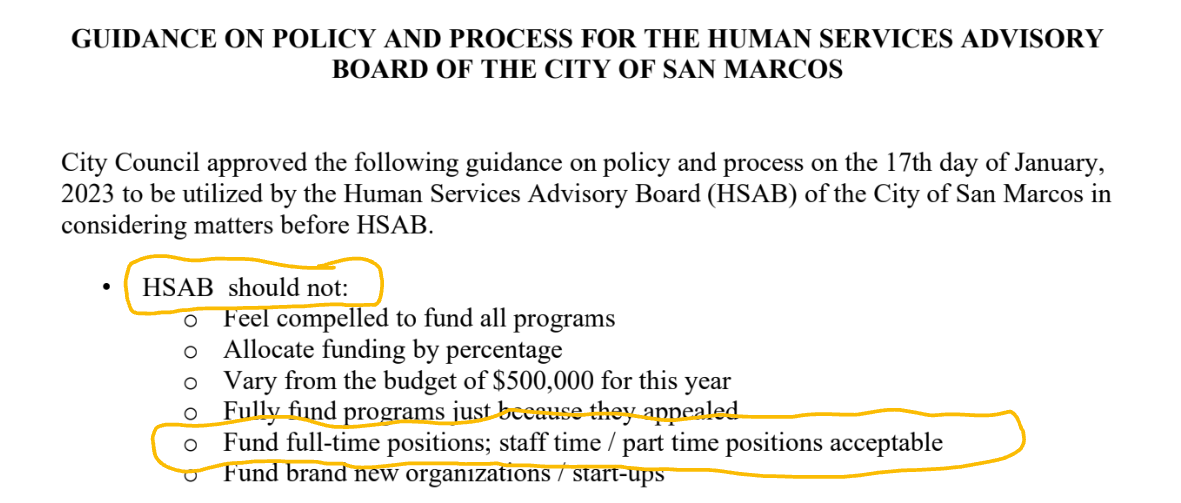
For example:
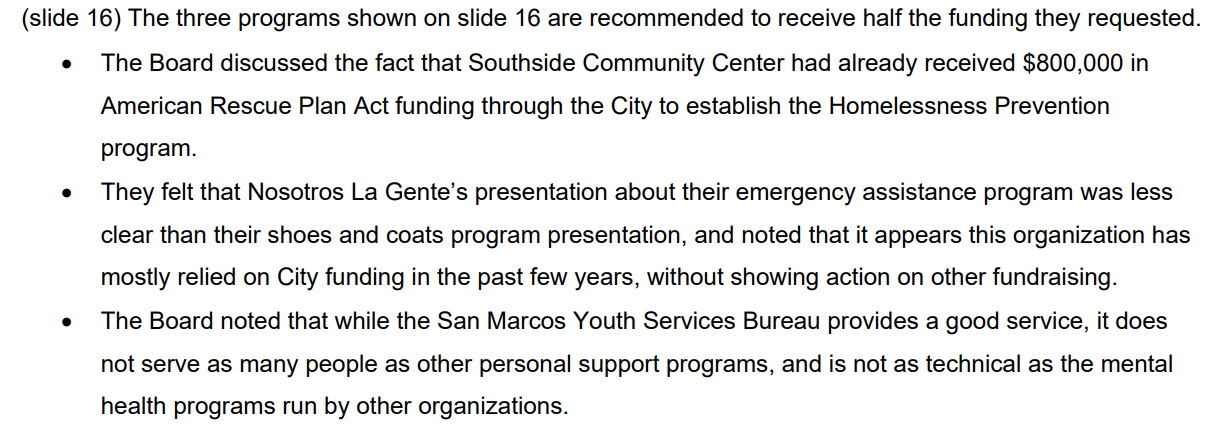
The rest of their thoughts are on pp 435-437, here.
They were very thorough.
…
Back to Citizen Comment
Three speakers from Southside show up to talk. Here’s what they say:
Southside is in a funny position. In 2024, the city gave Southside $800K of Covid money to implement a Homeless Action Plan.
They came up with a plan and put in all the work to get it up and running. Now they’re trying to sustain it over time. They asked for $100K from HSAB, but were only granted $50K.
The $100K is for their homeless prevention program – giving families $1000-2000 to get through a one-time financial crisis, so that they don’t get evicted.
…
Let the horse-trading begin!
Matthew kicks it off. He wants to try to get Southside back up to the full $100K that they asked for, for homelessness prevention.
Matthew proposes:
- Take $4500 from Rough Draft
- Take $5000 from Lifelong Learning
- Take $10,000 from Hill Country MHMR
Give that $19,500 to Southside.
Ok, what are these things?
Rough Draft:

Their funding would go to $0.
Lifelong Learning:

Ok. Their funding would go from $9000 to $4500.
Hill Country MHMR
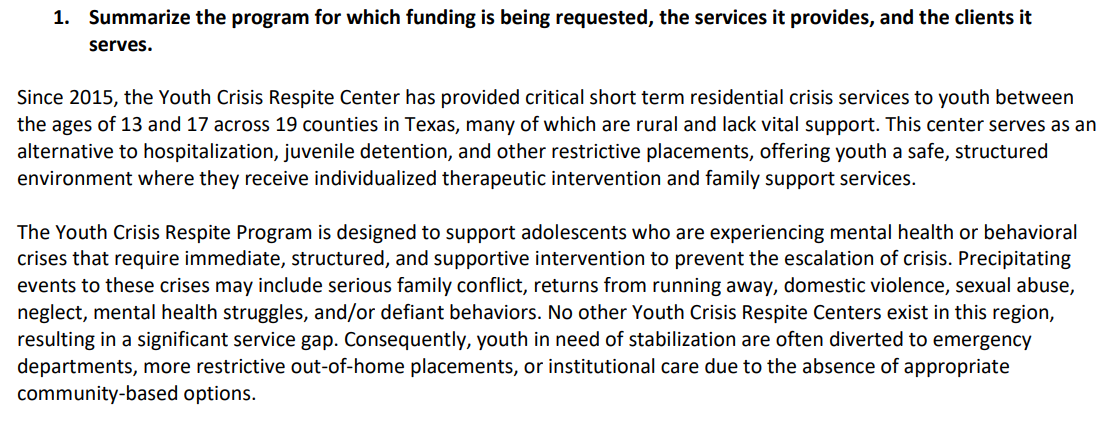
Their funding would go from $60,000 to $50,000.
….
What does Council think?
Question: How many people would Southside be able to help, with this $19K?
Answer: About ten families. Average cost to stabilize someone after a financial emergency is $2k.
It’s actually a huge bargain. If they’d been evicted, it would cost $15-30K+ to stabilize a family once they become homeless. (Plus, y’know, becoming homeless is awful. This is way more humane for the families.)
Question: Are you all applying for other grants?
Answer: SO MANY. Funding is scarce, and federal funds have been slashed.
Alyssa: The entire premise of horse-trading these dollars is problematic. Most agencies didn’t send someone here tonight to answer questions. We don’t have context and expertise. This is haphazard. I am not on board with any of this.
Amanda: Matthew, what about moving some money from the School Age Parents Program? They said they’d be able to keep the program open on $7,500, but they’re being awarded $15K.
Matthew: How dare you. Abso-fucking-lutely not!
[I’m paraphrasing. Matthew just said something like, “They do great work!”.]
Amanda: I’m trying to throw you a bone here!
Matthew: Hard no.
Amanda: Well, I’m a no on Hill Country MHMR especially. Their work is desperately needed. We are in a mental health services desert, and this program will fund teenagers without insurance.
Alyssa: I’m a NO on all of this, but especially NO on Hill Country MHMR. Homelessness and mental health are completely intertwined. There’s so much need here.
The votes are each held individually:
- Move all $4500 from Rough Draft to Southside Homelessness Prevention?
Yes: Matthew, Jane, Amanda, Lorenzo, Saul
No: Alyssa, Shane
2. Move $5000 from Lifelong Learning over to Southside?
This motion dies without getting a second. So it never comes to a vote. That kinda surprised me.
3. Move $10K from Hill Country MHMR over to Southside?
Yes: Matthew
No: Everyone but Matthew
4. Amanda throws in a vote on the SMCISD School Age Parents Program:

They get $15K.
Should we take $5K from them, and give it to Southside?
Yes: Amanda, Saul
No: Matthew, Lorenzo, Alyssa, Jane, Shane
So that fails.
..
Me, personally: It’s an awful decision to make. I probably would have taken money from Rough Draft, Lifelong Learning, and maybe SMCISD School Age parents. But not Hill Country MHMR.
….
So that’s where it lands. Southside picked up $4500 more, and Rough Draft went to $0.
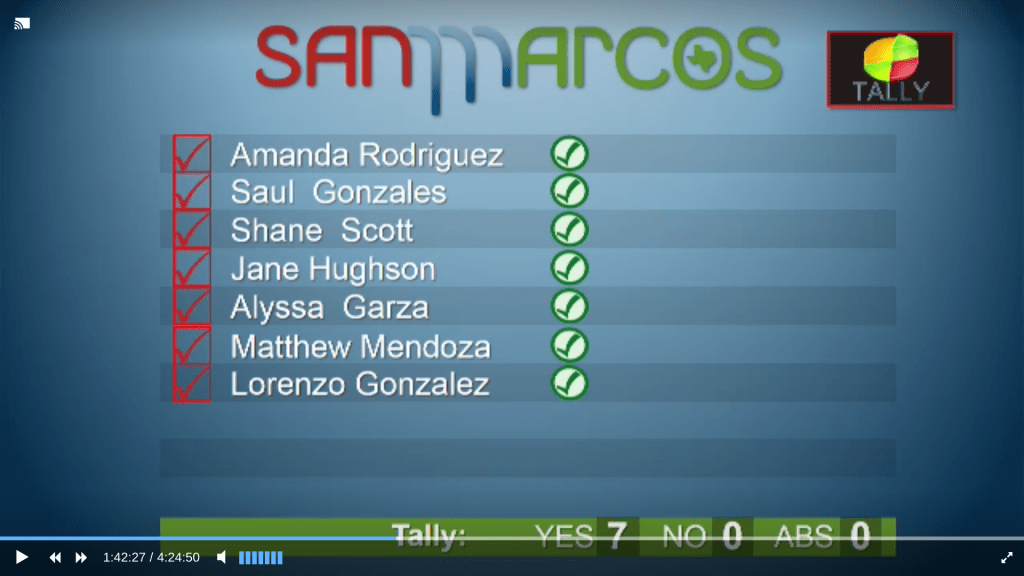
The final official vote on HSAB funding passes 7-0.
…
One more note!
We just spent $750K on the poor and vulnerable.
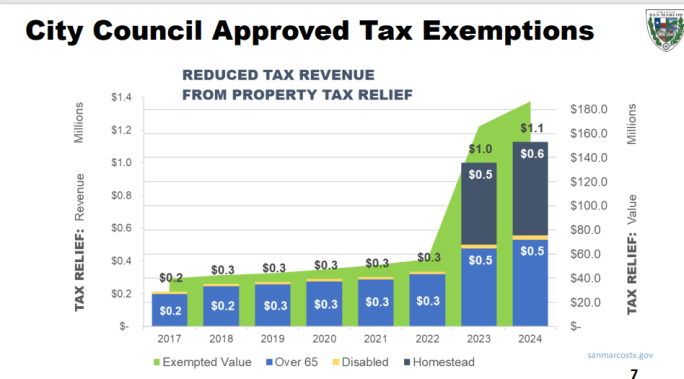
But we also spend $1.1 million on tax breaks to home owners every year:
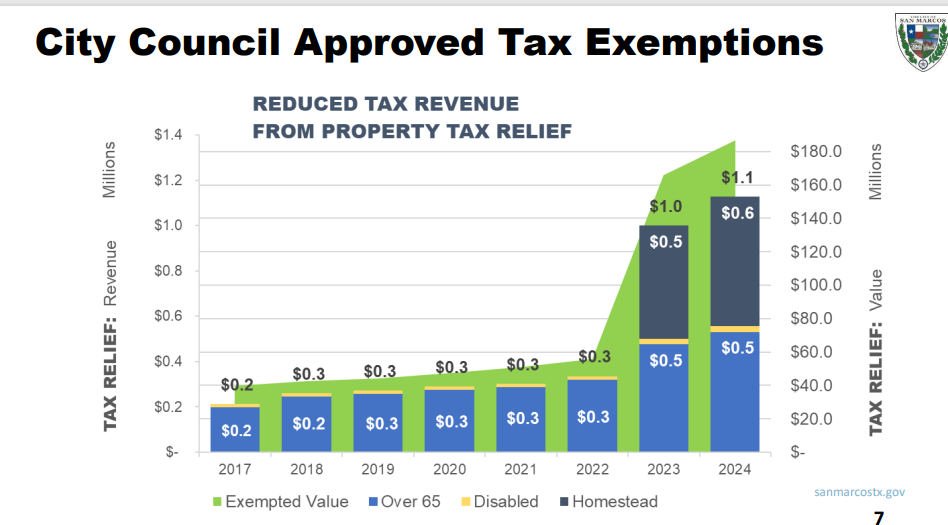
About 30% of San Marcos owns their own home. That $1.1 million is just for them.
Also, remember that Kissing Tree is keeping $46 million of San Marcos tax dollars, for nice streets and trees that are then gated off from the rest of San Marcos! You can’t go visit the tax dollars. Sorry.
This is why I get cranky about this:

People who want to slash property taxes never seem to appreciate how much of their own lifestyle is being subsidized.
….
Item 19: Dunbar Recreation Center
Dunbar was named for Paul Laurence Dunbar. He was the first black poet to get widespread recognition. (He was not from San Marcos in any way. He’s from Ohio.)
Here’s one of his poems, from 1895:
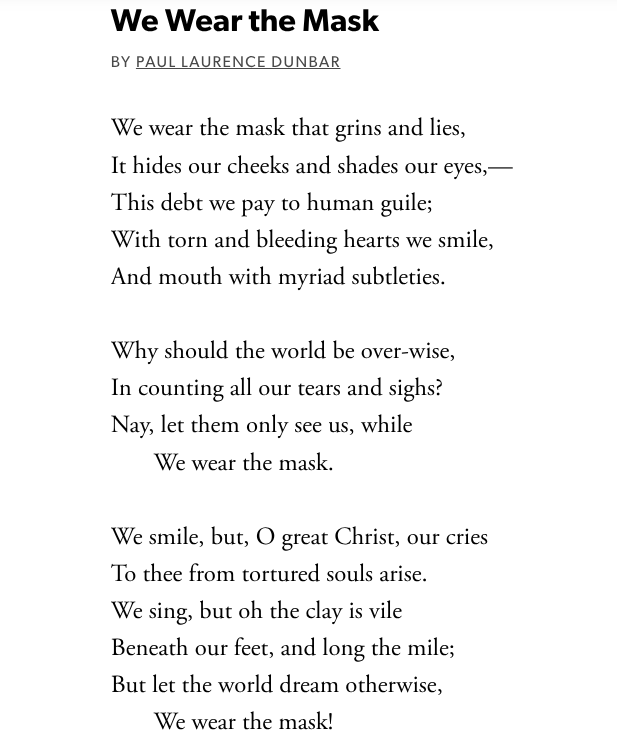
Originally, the Dunbar neighborhood did not have a specific name, besides being called “the colored neighborhood”. The school was called The Negro School. In 1961, that was renamed after Paul Laurence Dunbar, and then gradually the whole neighborhood came to be known as Dunbar. So the Dunbar Rec Center just got the name “Dunbar”.
Would we like to include the poet’s full name here? Everyone says yes.
Great!
Lots of interesting history on the Dunbar neighborhood here and here!
….
Item 20-21: Jorge’s Mexican Restaurant.
Jorge’s is on Hunter Road:

Separately, Miller Middle School is on Foxtail Road:

Their front doors are far apart:
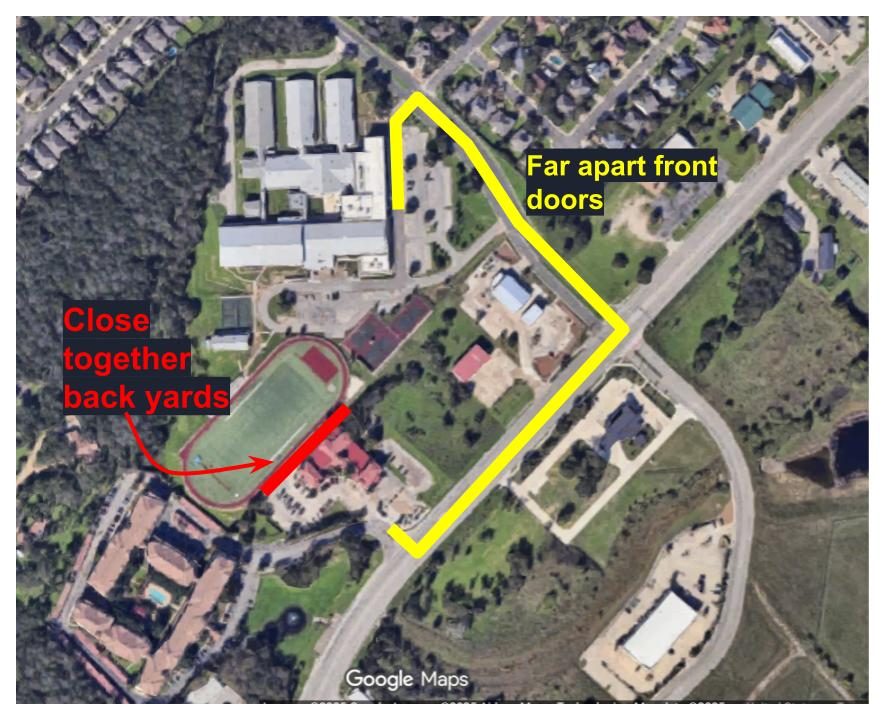
…but they share a back fence.
This causes all kinds of problems for Jorge’s, because there are extra-strict rules for selling alcohol within 300 feet of a school.
This means that Jorge’s has to do a lot more:
- Renew their alcohol permit every year, instead of every three years like everyone else.
- Renew their distance variance every year, which grants them an exception to the 300 foot rule.
The main problem is the fees – both of those cost $750, so Jorge’s is paying $1500 every year.
Why is it so expensive?!
Mostly because of postage. The city has to notify everyone within 400 ft. The rest of the cost is to cover staff time, to process the paperwork.
Everyone wants to at least refund half of Jorge’s fees, since the city can save costs by processing both the alcohol permit and distance variance at the same time.
They’re going to try to come up with a long term solution, too.


















 The San Marxist