Hours 0:00 – 3:25, 5/20/25

Citizen Comment

So much quieter than it’s been. Only seven speakers! Only twenty minutes long!

Here are the topics:

  • Four speakers: You should have voted for the Gaza ceasefire resolution!
  • Two speakers: No on the ceasefire! Also we support SMPD and public safety!
  • One speaker (Rob Roark, of KZSM fame): The Charter Review Commission worked hard and has some good recommendations. Hear them out!

….

Item 1: Homeless population PiT Count

“PiT” stands for Point in Time.   Nationwide, everyone picks one day in January where everyone tries to get a physical headcount of how many people are homeless on that one specific day.  This is how you get funding from HUD.  

We did our PiT count on January 23rd this year. This is the report on it. 

….

What counts as unhoused, according to HUD?

What doesn’t?

It’s not a perfect measure!

But it’s not worthless, either.  

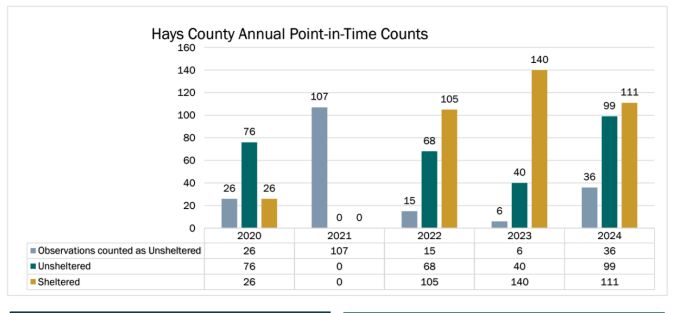
Here’s how the numbers have shaken out over the past five years:

The blue is a subset of the orange.  Those are people who appear to be homeless, but we weren’t able to talk with them.

The vast majority of homeless people of Hays County are in San Marcos:
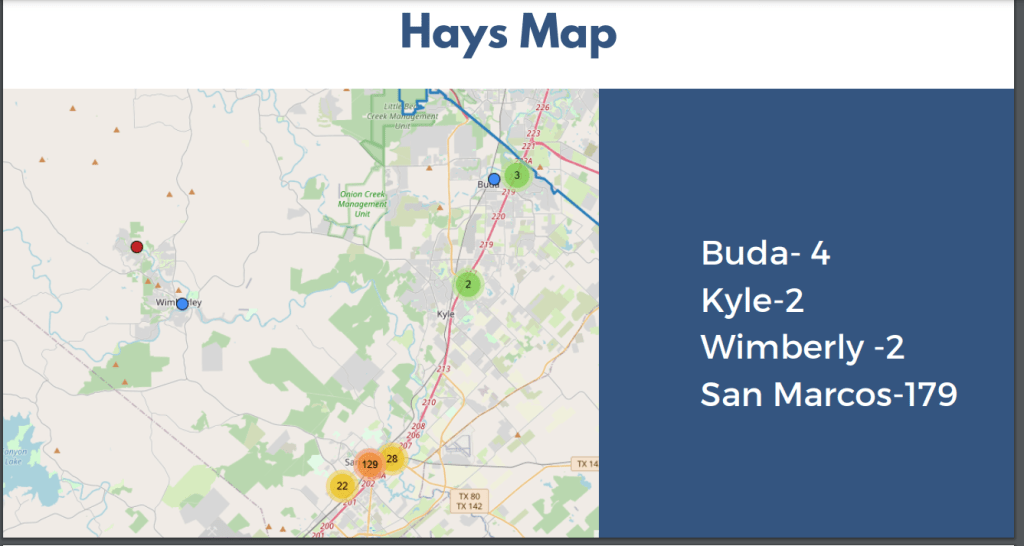
This is partially because the Hays County Women’s Shelter, Southside Shelter, and emergency hotel housing programs are all located here. But also partially because we’re just a much poorer, more precarious community than the rest of Hays County.

What does Council think?

The speaker makes a plea: can you help us get the county to work on its emergency response plan? For example, during the freeze, their plan was “Send everyone to Southside.”

They decide to send the issue to the Homelessness Committee to think about harder.

Item 2: Charter Review Commission

Every four years, we take a fine-tooth comb to the city charter, and look for improvements. Council appointed a commission of residents, back in January. They met weekly all spring, and returned back with a list of recommendations.

Council takes these recommendations, and either rejects them, accepts them, or puts them on the ballot.

Today is just the rough draft. Basically, they’re weeding out anything that they hate. Anything that Council likes will come back in formal, legal language, and then they can argue about the details.

There are 15 total proposed amendments:

  1. Better pronoun use
  2. Notifications on social media
  3. Mayor gets 4 year terms
  4. Tweaking the number of yearly council meetings
  5. Cap on councilmembers zooming in to meetings
  6. Approving council meetings minutes on time
  7. Buying hard copies of city code, grammar tweaks
  8. Auditing anyone who gets public funds
  9. Financial disclosures for referendums and initiatives
  10. More time to file referendum petitions
  11. More time to verify citizen petitions
  12. Change P&Z residency requirement
  13. Review the comprehensive plan a little less often
  14. State budgets using plain, clear language
  15. Tweak some headings
  16. Study single-member districts and launch education and conversation, but don’t take any major action right now.

Warning: This item takes about 2.5 hours to wade through. I’ll do my best to keep it snappy.

Let’s dive in.

Everyone is fine with this.

Everyone like this, too.

This is the first contentious one. This is about election turnout. Presidential elections have the biggest voter turnout. Midterm elections are the next-biggest. The odd years are called off-year elections, and they have the lowest turnouts.

For example, the committee chair read out the mayor vote total for the past four years:

  • 2021: there were 3,800 votes for mayor (off-year)
  • 2022: there were 17,000 for mayor (Midterm election)
  • 2023: there were 3,900 votes (off-year)
  • 2024: there were 23,000 votes (Presidential election)

So the key is those extra 10-20K voters who only show up for big elections: do you think they will vote for your candidate? If so, then you want to align elections to land on presidential years. If not, then you like elections to land on off-years.

The Charter Review Commission is arguing that we should switch to 4 year terms, aligned with Presidential elections. Here are their reasons:

  • It’s very expensive to run for mayor. Lengthening the term may induce more people to decide it’s worth it.
  • Two year terms means you’re always campaigning. This may mean you’re overly beholden to your donors.
  • We should prioritize all voters, not just the well-connected ones.
  • Often times subcommittees take more than two years to get their work done, so a mayor can’t complete their campaign promises in one term.

What does Council think?

Jane goes first:

  • She likes 2 year terms. The mayor should have to earn the votes of the people often.
  • She proposes splitting the difference and going with 3 year terms.
  • It’s easier to run in odd years because there’s less competition for attention.
  • It’s cheaper to run in odd years.

The conversation kind of deteriorates. People keep making opposite assertions that directly contradict each other:

  • Off-year elections are cheap, because there’s less competition!
  • Off-year elections are expensive, because it’s harder to get donations!
  • Off-year elections are easier, because it’s quiet so you can get more engagement!
  • Big years are easier, because you can piggy-back on the extra opportunities and everyone is paying attention!

These things can all be true – it just depends which voters you’re talking about. If you try to get students to turn out, then you like the big years. If you rely on Old San Marcos and personal networks, then off-years are easier.

More contradictions:

  • People may not want to commit to 2 year terms, because they only get a year before they have to start campaigning!
  • People may not want to commit to 4 year terms, because they may feel like it’s too long for something they’re not sure about!
  • Big years are harder, because the ballot gets so long! People don’t want to check all those boxes.
  • Small years are harder, because people don’t want to make a special trip to go vote!

Everyone’s just making random guesses – no one actually knows how these factors play out.

Alyssa: I strongly prefer 4 year terms.
Saul: Two years is better, for accountability.
Lorenzo: 2 or 4 year terms.
Matthew: 2 or 3 year terms.
Shane: 4 years.
Amanda: I have issues with all the choices. But I guess 4 years.

This one will go to the people! You get to vote on this, in November! (Which is admittedly an off-year election.)

Spontaneous side quest: What about the rest of council? Should there be 4 year terms for all council members?

Yes: Shane, Lorenzo, Alyssa
No: Matthew, Jane, Saul, Amanda

So this fails. It will not go on the ballot.

This is not controversial. Sometimes it’s hard to have two meetings in November, because of elections, and in January, because it means staff has to prepare a meeting over the holidays. We’re allowed to have as many extra meetings as we want. Everyone’s fine with this.

SIGH. This is dumb. This is about former council member Max Baker.

During Covid, everyone else came back in person, and he kept zooming in for an extra year or so. He was also a pretty contentious person who argued a lot, and pissed a lot of people off.

Would he have gotten along better with the rest of council if he’d been in person? Who knows. But many people believe that him zooming in made everything worse. Anyway, the voters did not re-elect Max, so the situation resolved itself.

In my opinion, that’s how it should go. Do something that pisses off a lot of people, and let the voters decide whether or not they approve. Democracy!

This recommendation is not that. It’s about micromanaging who zooms in for which kinds of reasons, but simultaneously pretending not to micromanage these things. “We trust you to give honest reasons, but you’re only allowed to give three bad reasons per year before you get an unspecified consequence.”

Look, these things are all true:

  • Meetings go better when people are in person
  • People can have good reasons to zoom in.
  • People can have bad reasons to zoom in, and you can’t tell the difference

Do not get into the business of policing how conscientious someone is at their job. You’ll end up writing a fractal maze of tedious, detailed rules. Extreme cases make bad policy.

Should this be a charter amendment?

Yes: Matthew Mendoza. 
No: Shane, Jane, Amanda, Saul, Alyssa, Lorenzo

Should Council discuss this further as an internal, lowkey rule?

Yes: Lorenzo, Amanda, Jane, Saul, Matthew
No: Shane, Alyssa

Sure, that’s fine. It’s just weird to micromanage from the charter.

Heh. They have not updated City Council minutes since May 2022. Apparently there was some staff turnover, and it fell by the wayside.

This moves forwards.

Everyone is fine with this.

This one is odd. Basically, Council already puts a clause in its contracts that they can request audits like this. In practice, they almost never do.

The question is: do they need extra firm legal footing to do this? Should they put it in the charter, and authorize themselves with extra authority to do this thing we already do?

Yes: Lorenzo, Matthew, Shane
No: Alyssa, Amanda, Jane, Saul

So it fails. I probably would have voted yes, though.

I liked this one, but the lawyer did say that it’s not really a Charter-level thing. The charter is like your constitution – it’s your high-level principles, but not your detailed little laws.

Yes: Saul, Jane, Matthew
No: Alyssa, Shane, Amanda, Lorenzo

So this fails.

Council goes with this one.

Council goes with this one, too.

Keep five year residency: Jane, Saul, Shane, Matthew
Shorten to three years: Alyssa, Lorenzo, Amanda

So this fails, and will not go on the ballot.

This just builds in flexibility, since it takes so many years to review a comprehensive plan.

Everyone on Council likes this! City Staff does not like this. The city manager is worried about how you balance formal legal language with plain, understandable language.

Jane Hughson has an example:

“Hotel occupancy taxes, utility revenues, and public private partnerships agreements currently secure self-supporting debt. In the event such amounts are insufficient to pay debt services, the city will be required to assess an ad valorem tax to pay such obligations.”

Can that be stated more clearly?

Probably the best practice is to keep the formal, legal language, but add in clear little summaries from time to time. This moves forward.

This is fine.

LAST ONE!

In other words, it’s too rushed to put single-member districts on the ballot. We should study and have community conversations about this, instead.

Do we want to have a conversation about this?

Yes to a conversation: Lorenzo, Amanda, Alyssa, Matthew, Jane
No to even a conversation: Shane, Saul

Jane and Amanda are both pretty sure that they’re “No”s on single member districts. But they’re willing to have a conversation.

BUT WAIT! THERE’S ONE MORE!

Jane brings up one last issue: The Texas legislature might eliminate all local elections besides November. If something happens to a council member, you could have a vacancy for 10 or 11 months.

Do we want the option to have council appoint an interim, un-elected councilmember?

It sounds like most of council does not want this, but they decide to at least bring it back for a conversation.

I agree that this is a terrible idea.

Hours 1:54 – 5:32, 8/20/24

Item 20: The Budget

This one item is nearly three hours long.  

The budget is long and complicated.  First off, city starts having workshops in January and runs them through the end of September, when they pass the budget.  

These workshops are deathly boring and I am unable to sit through them.  I’m sorry about this.

Notice that they present twice to the Neighborhood Commission:

heh. (via)

Anyway! Here are the strategic goals:

Sure, why not.

The budget is split across a bunch of different funds:

Each of those colored headers is a different fund. So you can see the General Fund on the left is the big one, and there are a lot of little ones as you move right.

Revenue

Last year, we took in $37 million in property tax, and $42 million in sales tax.  So sales tax is huge for us.

The problem is that sales tax revenue took a big hit this spring:

I know that’s not very dramatic-looking.  Here’s how they presented it over the summer:

They kinda know what went wrong now. Here’s the biggest sources of sales tax:

Basically, some of the top sales taxpayers had unusually high sales for the past few years, and now they’re reverting back to normal. But we had banked on those returns to keep increasing. Whoops. (I’m guessing it was post-covid supply chain kinks working themselves out, especially Matheus Lumber.)

We’re going to start a sales tax volatility fund to help hedge against this kind of fluctuation.

Most departments are going to have the same budget as last year.  Since inflation is about 3% and the town is growing, that means they have to cover more ground with less money. So that sucks.  

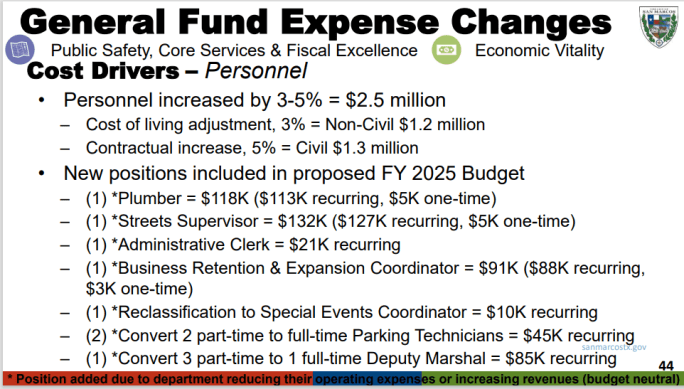
We’re doing a little hiring.  These are the budget-neutral positions being added:

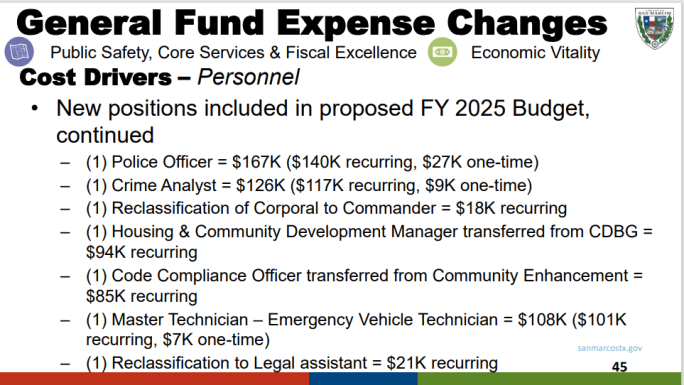
These are the ones that aren’t budget neutral:

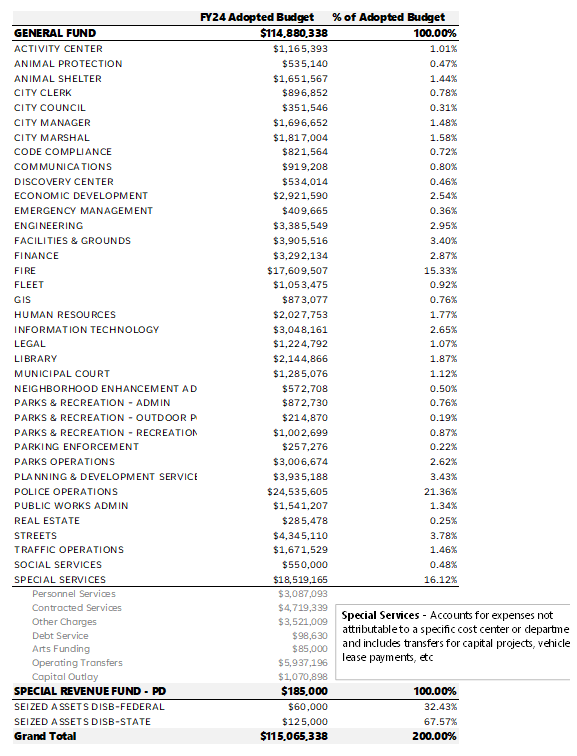
I find it extremely hard to get a handle on the General Fund budget. So last year, I filed a FOIA to have them send me a list of how much each department gets from the General Fund.

This is what they sent me:

This is really helpful! This is how my brain works. That’s very clear to me.

What I plan on doing is put this side-by-side with next year’s proposed budget, so we can see what areas are growing and what is shrinking.  (I filed a FOIA for the new one, but it’s still being processed.)  

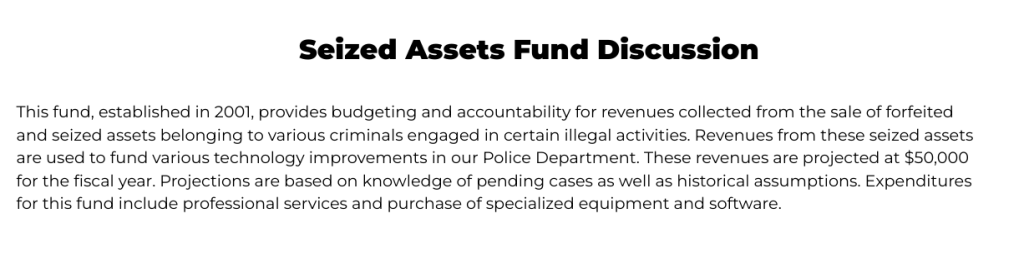
Another day, we should have a conversation on the $185K of seized assets, at the bottom of that chart. Seized asset forfeiture is wildly unethical! Have another link. It’s really bad.

Here’s what it says in the 24-25 budget:

There are not enough details on the $185K – what’s it being spent on? Was that all seized in San Marcos? Why is there a state and federal part? I have no idea.

….

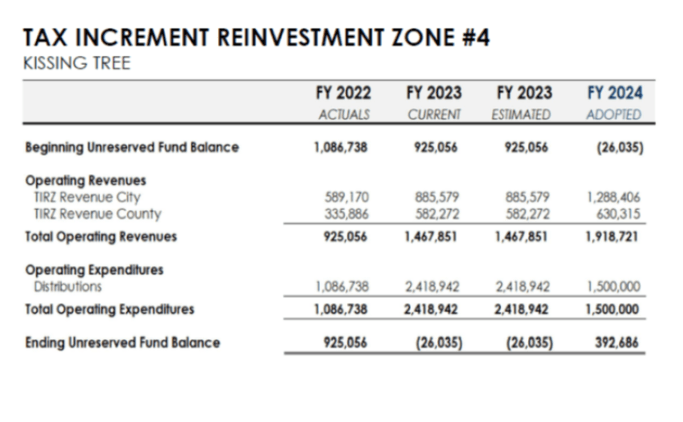
Let’s talk about TIRZes. These also aren’t discussed much.

A TIRZ is a Tax Increment Reinvestment Zones. What this means is that the taxes from those zones mostly go back to those zones. We have six of them, maybe?

The example you’ll hear about most often is the Mainstreet Downtown TIRZ, because we can all appreciate it. We all want a thriving downtown! Taxes from downtown stay downtown, to keep downtown nice and vibrant.

But let’s focus on the Kissing Tree TIRZ, instead. Here are the details from the 23-24 budget:

So San Marcos sent $1,288,406 of tax dollars back to this one single gated community last year. Did you enjoy a thriving Kissing Tree or a thriving downtown more? Which ones benefit all of San Marcos? Feel free to compare $1,288,406 to your favorite category in the General Fund, above.

The other TIRZes are Loop 110, the Downtown plan, the Embassy Suites Conference Center, and maybe Blanco Vista? I can’t tell if that one ended in 2022 or not.

This year’s budget does not have a TIRZ breakdown either, which I find annoying. 

Let me be clear: city staff does an amazing job trying to clearly communicate the budget. No one is withholding anything maliciously.  

I just think that the breakdown of the general fund is a bit of a blindspot. It would help if it were there. 

Here’s the city budget webpage, if you’re curious to poke around yourself.

I’m skipping over a lot – there’s SO MUCH.  

Utility rate increases are being discussed.  It’s generally much wiser to raise rates by small amounts every year, rather than letting it accumulate and then needing a giant increase.

Alyssa Garza is opposed, out of economic concern for our neighbors.  I think she’s wrong here.  Starving your government is how you let capitalism run unfettered. Don’t be a shill for Reagan.

That said, we do have a utility assistance program.  The DEI coordinator gives a presentation on it.

The city puts about $230K from various sources into utility assistance:

And here’s what we handed out:

There is lots of anecdotal evidence that we do a mediocre job connecting with community members who need help:

One thing that makes it complicated is that there are two kinds of people who need assistance.
– First, people who need wraparound services in lots of areas. These people benefit from filling out the mountain of paperwork needed for federal programs. Community Action does this.
– Second, people who just need a one-time boost to get out of a hard spot. These people benefit from a low-barrier process and quick payment, so that their utilities don’t get turned off.

There is going to be a work session to try to make all this more effective.

Final notes:

  • There’s some discussion on how the Airport has been in the red for a long time, but I can’t find this info in the slides. 
  • As ARPA money comes to a close, we’ll have to pick up a bunch of slack in the budget next year.  So more expenses are looming.

That’s the end of the three hour budget discussion!

But wait! There’s more!

Item 21: Setting the max tax rate for the new budget.

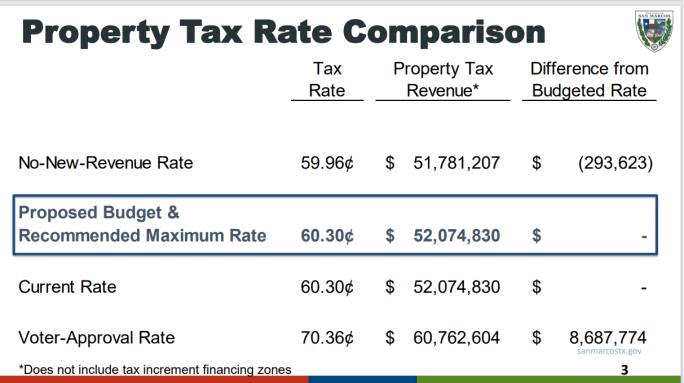
Background: here are some different tax rates: 

That’s all just different vocabulary for levels of property tax rates. City Council can pick any number it wants, although if they go over 70.36 ¢, they’d have to get voter approval.

This whole budget above has been planned on the 60.3¢ number. Here’s how it would affect the budget if we raised or lowered the tax rate:

The 60.3¢ rate is the same rate as last year. Of course, if your home value goes up, then your taxes go up, even if the rate stays the same.

Home values really have shot up:

So how much more is the average home owner paying?

If Council goes with the 60.3¢ rate, the average homeowner will pay $164 more this year, or $14/month.

My prediction: The next few meetings will see a lot of focus on home owners in poverty, and whether its fair to ask them to pay $14 more per month. Some considerations:

  • Most people in poverty do not own homes. But there are definitely some, and they deserve compassion. However, they’re likely to own less expensive homes. So if $14/month is the average increase, maybe for a homeowner in poverty, it’s more like maybe $10/month.
  • Focusing on home owners in poverty allows us to avoid a conversation about wealthy home owners.

Today: just setting a ceiling.  What’s the upper bound for the tax rate this year?   (This is just a weird Texas quirk.)

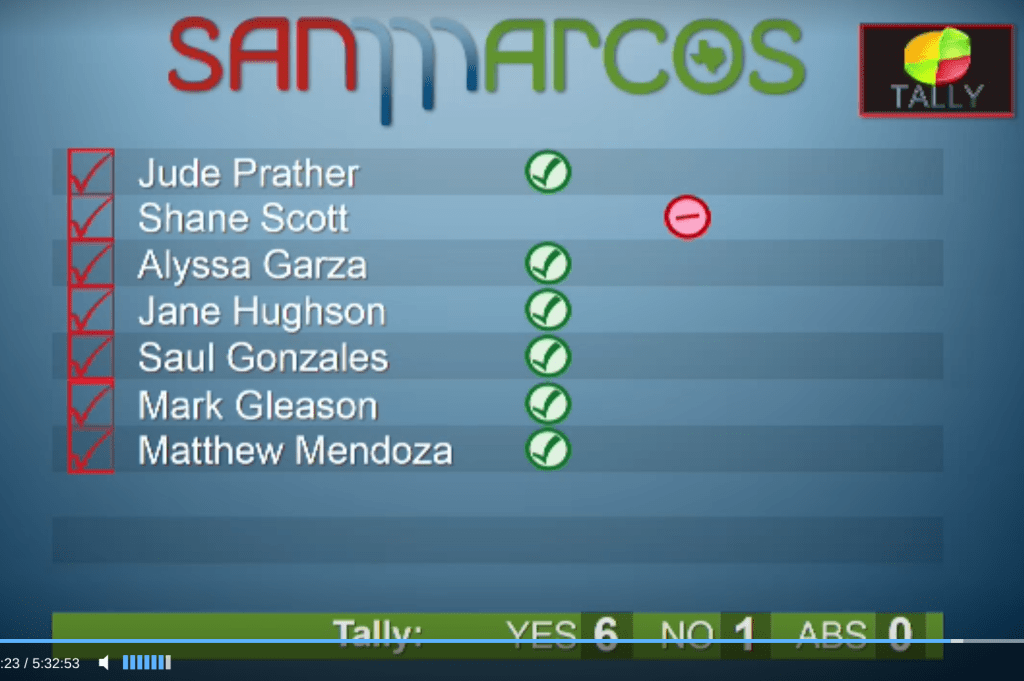
The vote to set the maximum at 60.3¢:

I have no idea why Shane voted no. 

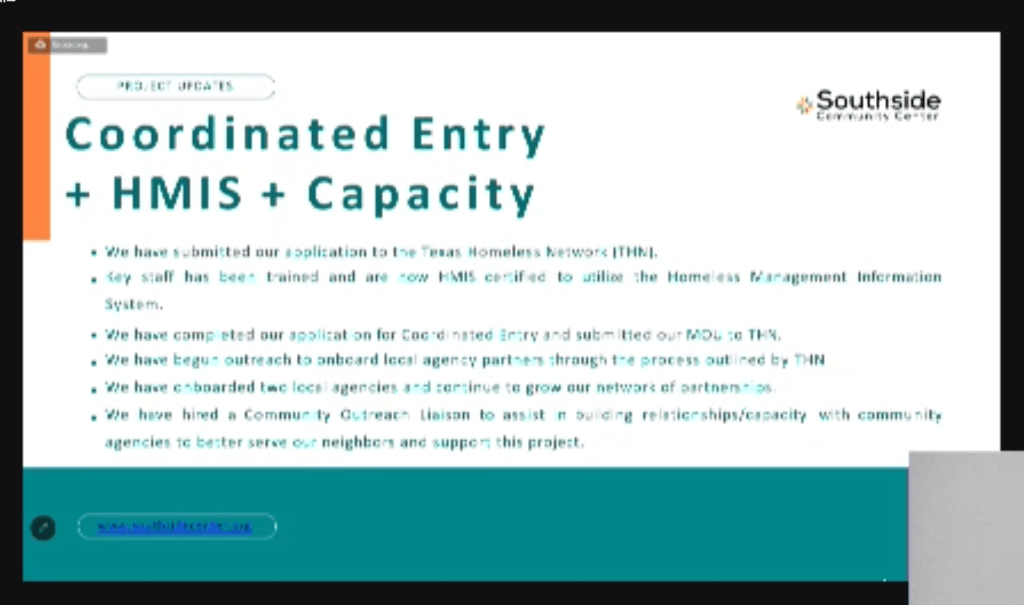
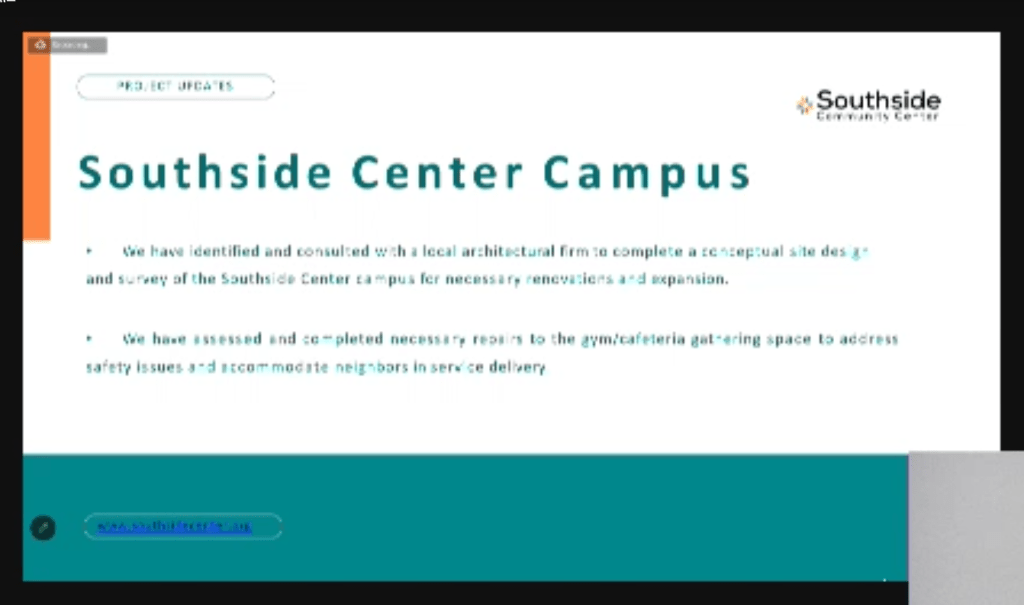
Item 26: We’re giving Southside $800K to Southside from ARPA money to implement the Homelessness plan.  

Over the summer, we fronted them $50K to come up with a working plan, which they’re now presenting. It’s really thorough! Unfortunately, the slides aren’t in the packet, so I’m relying on screenshots.

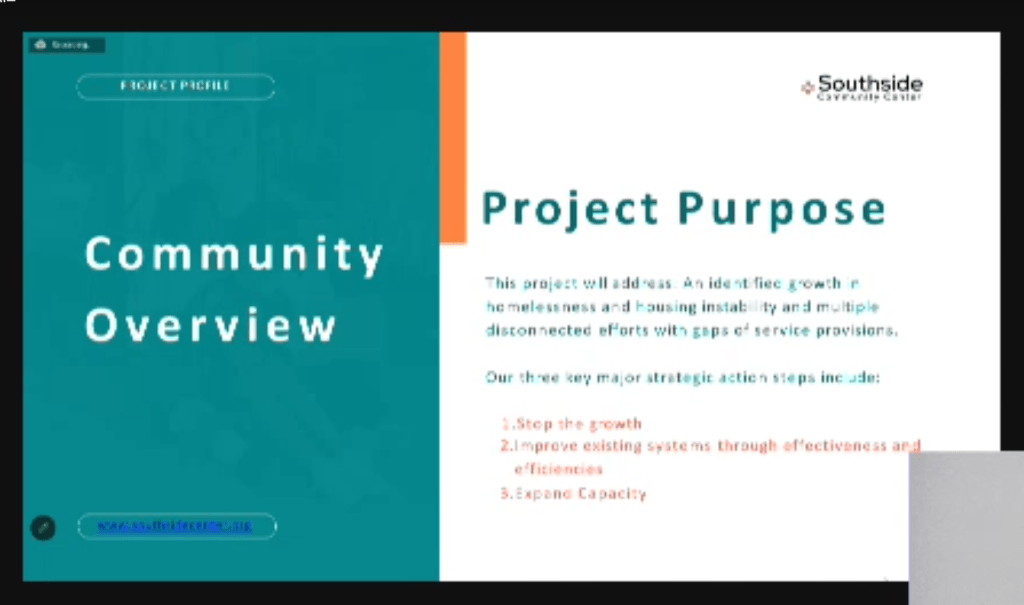
The three strategies:

  1. Stop the growth
  2. Improve existing systems through effectiveness and efficiencies
  3. Expand Capacity

Honestly, I’m not an expert, but she sounded way better than Robert Marbut. Feel free to listen, starting at about 4:56 here.

These are just some of the slides:

” – We will hold a community-based network to help neighbors in need.
– We will use best practices and data-driven decisions to guide our work
– We will implement collaborative technologies to support coordinated services
– We will honor the humanity and dignity of all people and help the entire community to thrive”

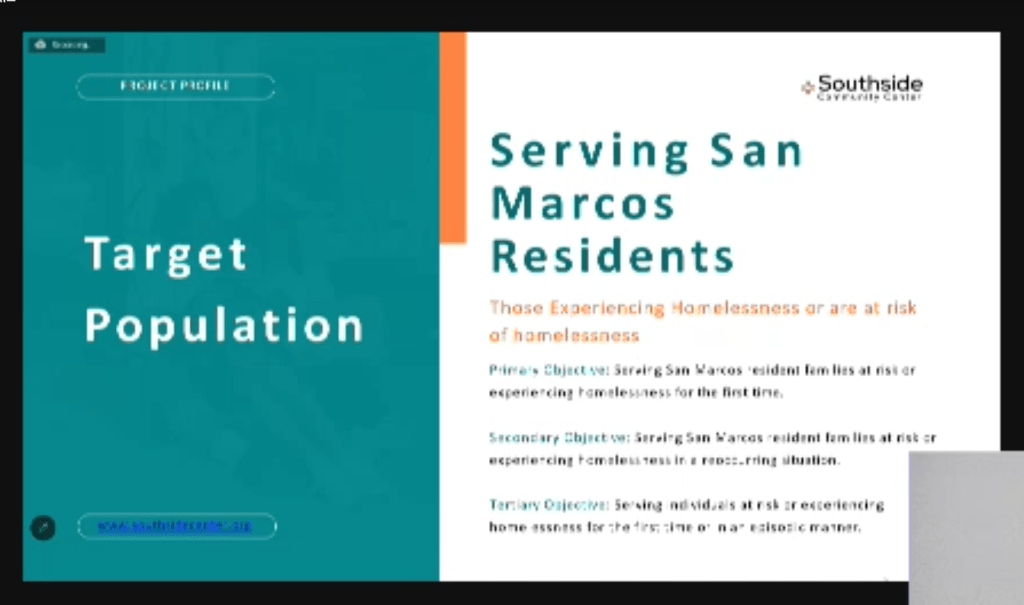
Target population: Those experiencing homelessness or at risk of homelessness

  • San Marcos resident families at risk or experiencing homelessness for the first time
  • Those with a recurring situation
  • Individuals at risk or experiencing homelessness for the first time, or in an episodic manner.

Key Deliverables:

  • Activate a network of community partners and volunteers to help neighbors in need
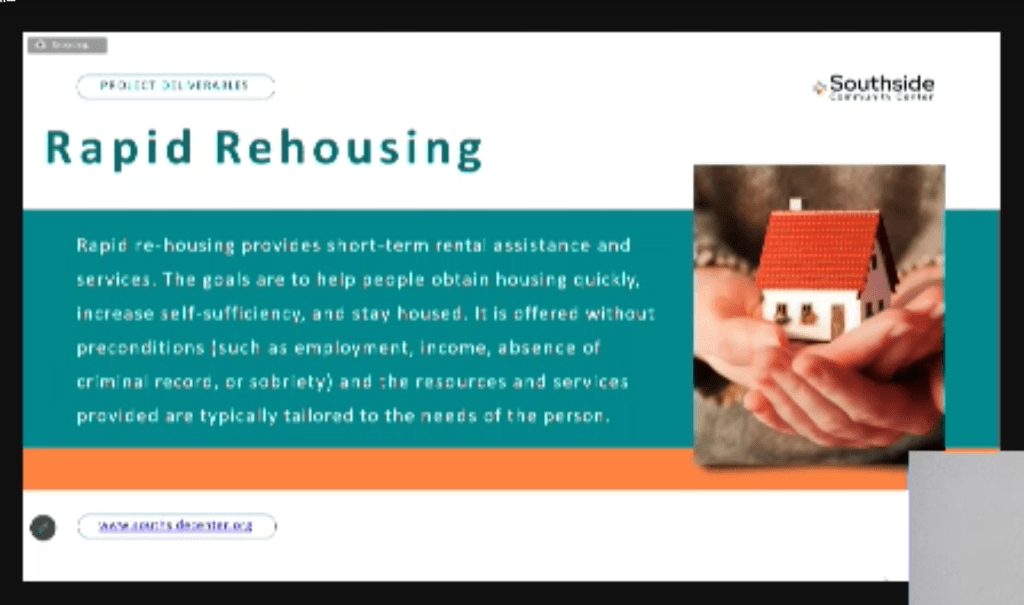
  • Develop a homelessness prevention and rapid rehousing framework
  • Implement coordinated entry processes for easier access to services
  • Establish standard intake procedures for streamlined client onboarding and information sharing
  • Implement a client management system, like HMIS, for secure data storage and reporting

So you don’t want homeless people having to supply data and information to a dozen different people in order to get help. You want to get someone in the system one single time, and then let the providers talk to each other and coordinate a response to get help to that person.

It sounds like we’re going to use HMIS:

A big piece of this is stabilizing people who are right on the brink of becoming homeless, or who just went through a crisis:

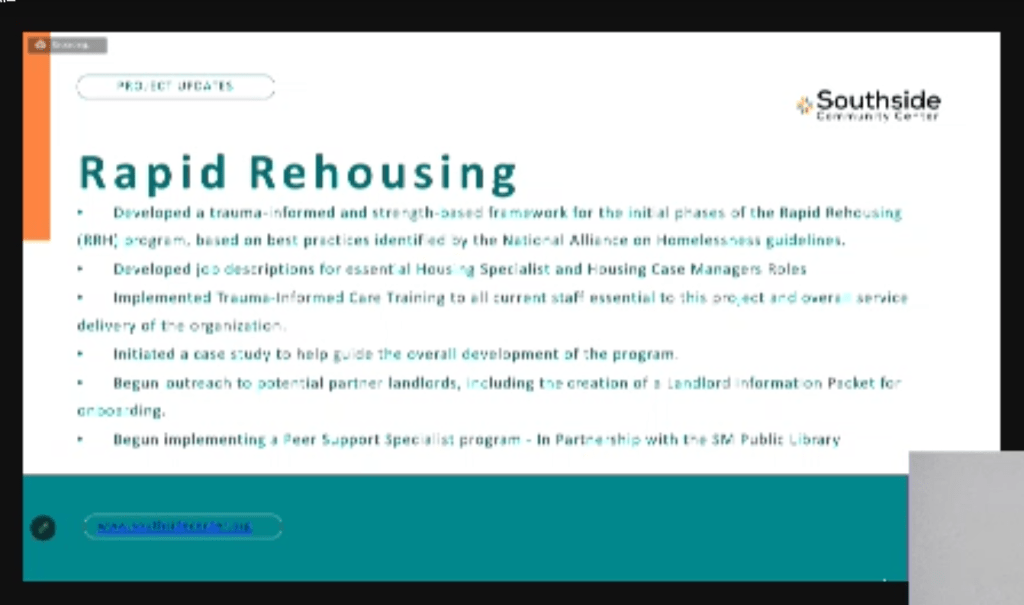
They’ve already started on this:

It’s just an extremely complicated problem that requires lots of human scale collaboration to put all this together.

One big piece of this is expanding capacity – we literally need more beds.

Again, it’s probably worth it just to listen for yourself. I’m struggling after a long meeting here.

….

After this, Council zips through a ton of items super quickly:

  • Whisper North and South, and Trace all get their annual thumbs-up. (Whisper North and South are giant planned neighborhoods on the east side of 35, at Yarrington Road. Trace is down south, past the outlet malls, also east of I35. These are all PIDs: Public Improvement Developments. It’s similar to a TIRZ. This is where my knowledge ends. Maybe they’re smaller? idk.)
  • The Intralocal Agreement with CARTS to provide transit in San Marcos gets re-upped for another year. Also one with the university.
  • Something something new roles on the Finance and Audit committee, we’re all pretty drowsy at this point. Shane Scott tries to kill off the whole Finance and Audit committee, but its very existence was not on the agenda, so he’s stymied.

That’s about it!

Bonus! 3 pm workshops, 5/7/24

We had great workshops this week!

Item 1: Equity Cabinets

(Jude Prather recused himself from the discussion, due to his wife’s employment at Texas State. As far as I can tell, there’s nothing remotely conflict-of-interest about this – but sure, why not.)

I learned that there’s something called an “equity cabinet”.  You pull together a bunch of people who represent traditionally underrepresented groups in your community, and have them thoroughly study a problem in the community, and make policy recommendations.  (Here is the example from the presentation of where it’s been done before.)

Dr. Rosie Ray is a researcher at Texas State (and we’ve seen her before: here and here and here and here and here). She got some funding to partner with the city of San Marcos – if the city is interested – to put together an equity cabinet to study all things transportation-related.

Who exactly are the traditionally underrepresented groups?  Biden defines it like so:

Who are the local partners who can put forth good candidates for this cabinet?

What would they be focusing on? 

So about 10 people would be chosen to work closely together over five months.  They’d get paid, it would be structured and well-planned, etc etc. The cabinet would have to get up to speed on the challenges that the city faces and what we’re currently doing.

So what does council think?

Everyone’s on board!  Sounds like it’s a go. 

Here’s the timeline:

I look forward to hearing the recommendations from the cabinet!

….

Item 2: PIT Count

How many homeless people are there? It’s not an easy question to answer, for obvious reasons. 

One way you do it is with a “Point in Time” count (ie, a PIT count). You pick one day (in January, per HUD requirements) and get as many volunteers as possible to go out into your county and try to lay eyes on as many homeless people as possible. But also, you talk to the people and try to get a snapshot of the people who are homeless that night.

 Homeless Coalition of Hays County conducted ours on January 25th this year.  They’re part of the Texas Homeless Network.  It took 50 volunteers that day, and 17 more doing background work.

It’s not perfect:

But it’s still useful!

Keep in mind that homelessness is complicated:

The chronically homeless people are the most visible. These are the people you see along I-35 or in public areas. These are the people most likely to get counted in the PIT count.

The hidden or transitional homeless people are much harder to count. Who knows if you’re couch-surfing, or living in your car? Especially if it’s on-again, off-again? A lot of these people are holding jobs and functioning in society, but can’t afford housing.

Results: 

“Sheltered” means Hays County Women’s Shelter or Southside Community Center/BR3T program with motels.

So why is the number of unsheltered people going up? Most likely, it’s two things:

  • we’re getting better at locating and counting homeless people, and
  • rising housing costs are displacing more people, so there are actually more homeless people.

Where are the homeless people in Hays County?

Mostly in San Marcos.

This also has a couple reasons! We’ve got most of the resources here. But also, the people conducting the PIT count know San Marcos mostly thoroughly. They know where to check in town. We need cooperation from people with deep knowledge of Dripping Springs and Wimberly homeless communities, if we’re going to find and locate people there.

On that day, the PIT Count volunteers make 4 sweeps, but all during daylight, for safety reasons. They also chat with the homeless people, if the person is interested in chatting. So we get some informal survey data.

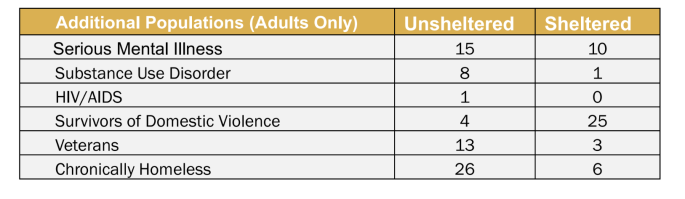
Survey results:

So what good is this? First, it allows us to apply for lots of funding.

Quick Detour: Remember Robert Marbut, from here and here? He was Trump’s homelessness expert, and then we tapped him to write a Homeless Action Plan for San Marcos.

Marbut advocates for “Treatment First” programs. You do not house someone until they’re stable enough to keep the housing. (If this seems cruel, you might have spotted the fly in the ointment.)

Under the Biden Administration, HUD funds “Housing First” programs. You get someone off the streets, first. Once they have some basic safety and security, then you can work on mental health and addiction issues. (The main argument against this is, “If you offer housing with no strings attached, you’re threatening capitalism! Workers won’t hustle and turn a profit if they’re not scared of having their life crumble!” Mm-hmm.)

Presidents matter. They install people to run all the major organizations, like HUD, the EPA, Dept of Education, DoE, etc. Under Biden, you will have sane people implementing humane policies. Those policies affect things like how cities help homeless people. It really matters.

Anyway, here are the slides from the presentation on why Housing First is more effective than Treatment First:

It’s more effective and less cruel! Win-win.

The PIT count is not the only measure of homelessness. There’s also the McKinney-Vento report for kids enrolled in public schools:

The McKinney-Vento report measures things slightly differently than the PIT Count. They try to record how many kids are couch-surfing, which is the “doubled up” category, and who is temporarily living in a hotel or motel. Whereas the PIT count doesn’t catch either of those unless Southside is paying for the hotel room.

One last note: Jude Prather volunteered at the PIT count, and works in his job to get vets housed, and he deserves some kudos for that hard work.

He also made a point of advocating for increased funding for organizations that provide individual case work for homeless people, which I think is a reference to H.O.M.E. Center.

I agree! They do great work.

Item 3: Spin Cycles

You might recognize these scooters from such hits as:

“I’m abandoned, blocking a sidewalk” or “I hope you didn’t need to use a wheelchair on this sidewalk”.

All kidding aside, they popped up in San Marcos back in 2021.

(It’s kind of weird – there’s no history about these scooters on the blog. Council did not discuss them when they were approved in 2021, nor when they were re-upped in 2022. No workshop, no discussion, nada. Did they go straight from Executive Session to the Consent Agenda, with zero public discourse? I think so!)

I’m actually in favor of this kind of thing! I mostly think the program is great (aside from blocking sidewalks).

This is my best guess as to how it works: you download an app. It shows you where the nearest scooter is. You can activate the scooter and ride it within a certain zone. The company is supposed to maintain and insure the scooters, and make sure they get tidied up on a regular basis so that they don’t prevent people in wheelchairs from using the sidewalk once they’re discarded.

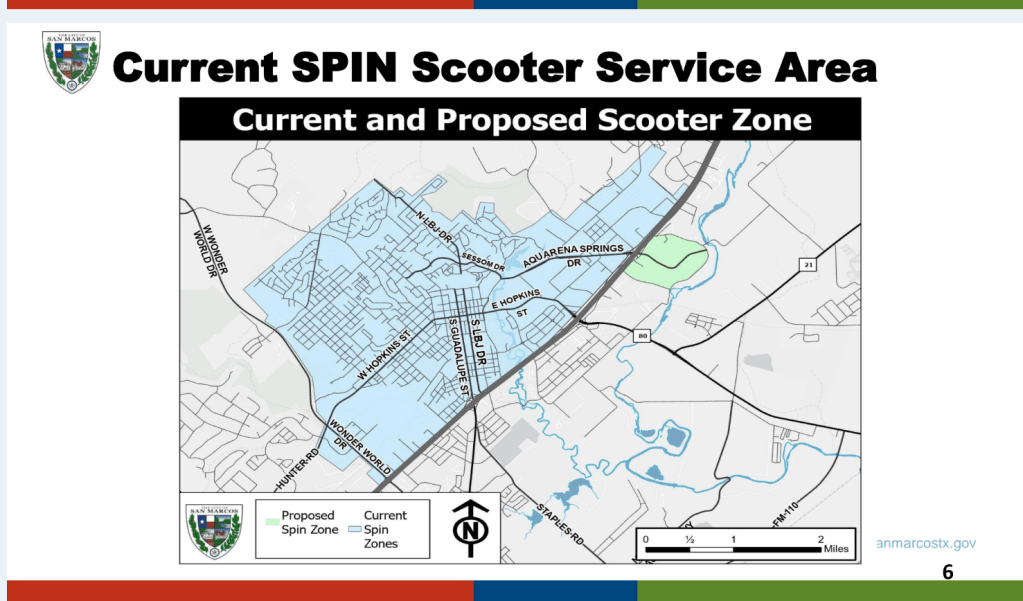
Here’s the current boundary of where they work:

I assume when you hit a boundary, they just deactivate, like a sad ghost who hit the wall of their haunting-perimeter.

They max out at 15 mph, and the company has slow-zones where they max out at 10 mph.

Overall, the program is successful!

  • They’re heavily used.
  • They’re significantly cheaper than owning a car
  • They’re better for the environment.
  • They’ve had 1 reported safety incident in 2022-2023.
  • They’re great at preventing people in wheelchairs from using the sidewalk. (Kidding. But this is my one major gripe.)

The company is asking for a two things:

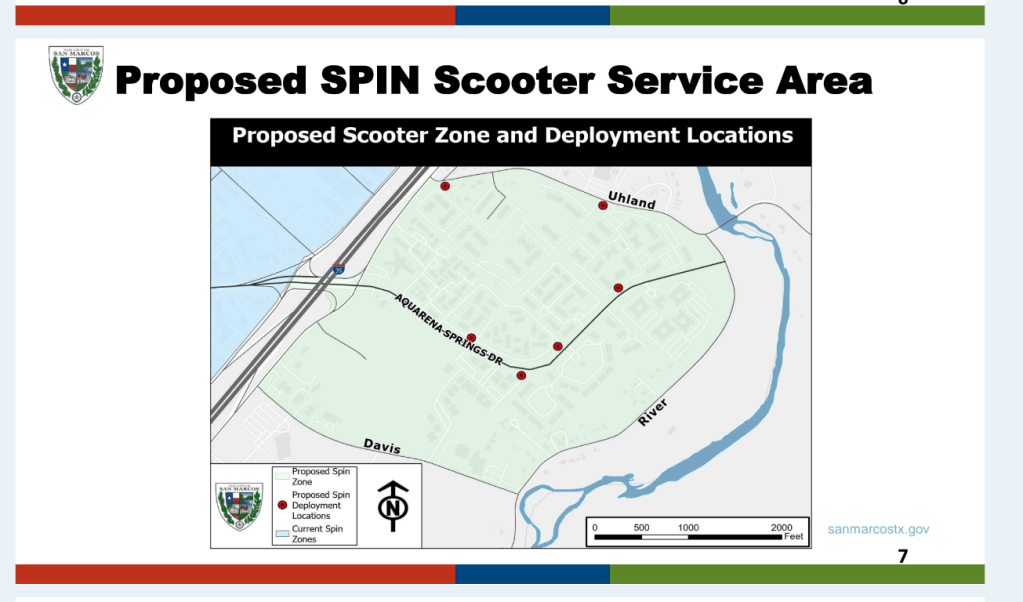
  1. Bigger service area. They want to cross I-35, at Aquarena Springs Road:
This is a great area to include. There are tons and tons of students there, going back and forth to campus.

The big issue is I-35, of course. (I sometimes fantasize about what it would be like if I-35 had never split this town in half.)

Here’s what they’ll have to navigate safely:

The intersection of Aquarena and I-35 does technically have a sidewalk path that riders can take the entire way, to navigate it.

[Confidential to anyone who drives a car, truck or SUV: People are fragile. Please drive your 2000 lb vehicle timidly.]

2. Their second ask is to operate 24/7.

Right now, the scooters only work 5 am-midnight. So they’re not restricted to daylight hours, but they’re not available when the bars close at 2 am, either. But they’d like to be!

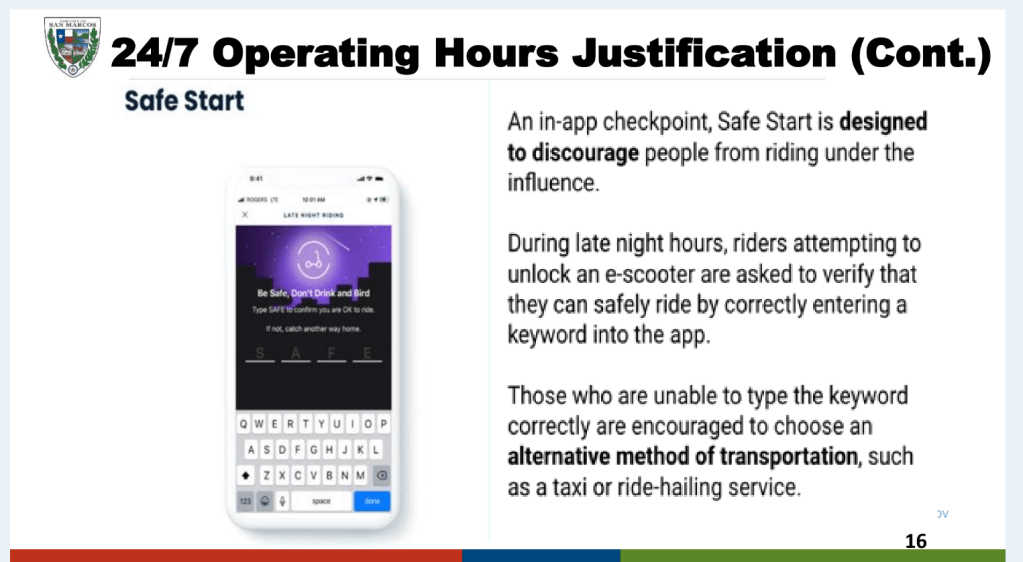
They have some safety options to mitigate things:

So I guess you can’t be so drunk that your vision is blurring? This seems like a low bar to clear, but at least they’re not getting behind the wheel of a car?

They can also throttle the max speed, and cap them all at 10 mph during overnight hours.

What does Council think?

Jane Hughson is a little wary of the I-35 exchange, and asks if we can put up some signs or markers directing scooters to take that specific sidewalk path.

Answer: sure.

Mark Gleason has some reservations about I-35 as well, but is mostly enthusiastic about looping in the east side and connecting them across 35. He asks if they can extend the zone to Walmart.

(I agree that stretching it to Walmart is a great idea.)

Saul Gonzales asks if you can get a DUI on one of these.

Answer: Yes you can!

In the end, everyone’s on board with this. Also, it’s a pilot program that will come back in 6 months, so we can see how it’s doing.

Hours 1:44 – 3:40, 3/19/24

Item 19:  Last time, we dove into the P&Z meeting where they discussed this:

The developer wants to put student housing there. (The developer is Shannon Mattingly, former head of the San Marcos Planning Department, which is pretty shady, yes. She was hired by The Dremer Group out of Austin about two years ago.)

There were actually four decision points at the P&Z meeting:

  1.  Should downtown include that pentagon on the left?  (No.)
  2. Should the mishmash of different zonings all be consolidated to a single zoning?  (Somewhat.)
  3. Should they be allowed to have Purpose Built Student Housing? And is this the same as Rent by the Bedroom?  (Yes.)
  4. Should they be allowed to go to 7 stories?  (No.)

This week, council tackled the first question. The rest of the questions are being saved for next time.

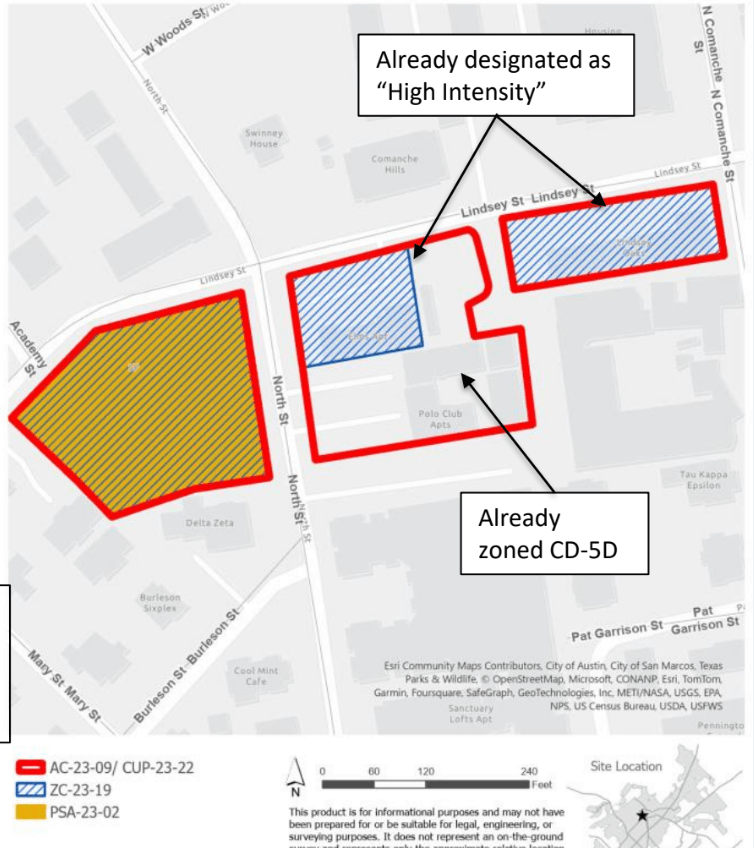
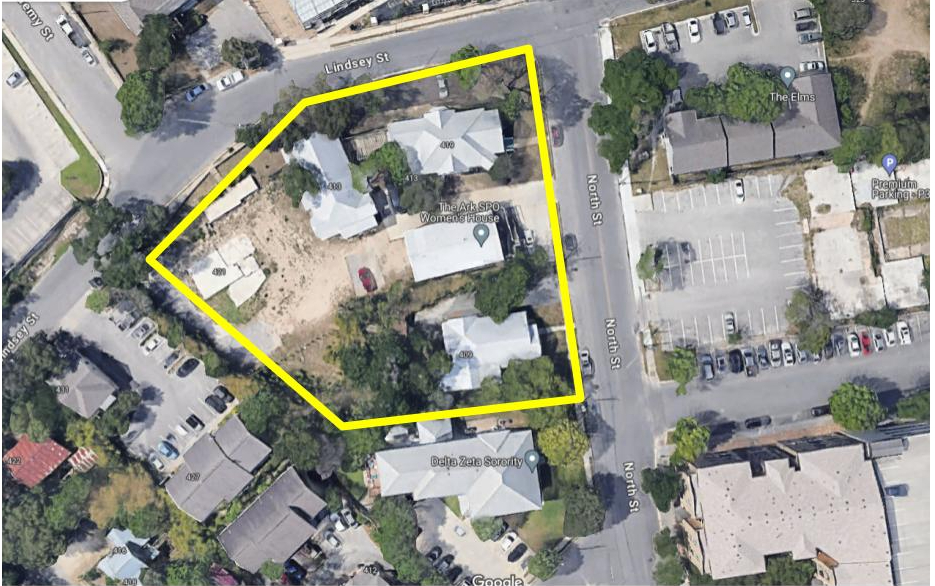
So today, we’re only talking about the yellow, striped pentagon:

Basically, if you start at Zelicks, and walk uphill past North Street, and keep going until you hit the university, we’re talking about the houses on the left when you reach Texas State.

I believe it’s these houses:

One of them burned down maybe five years ago. One of them was transplanted from Riviera Street about ten years ago. Two are bungalows from the 1920s, and one of them is considered a High Priority Historical Resource from around 1900.

This one is the high priority one:

It is very cute!

First off, Jude Prather recuses himself because his wife works for the university, in a building close to this spot.  This is probably a reasonable recusal, but it affects the vote calculation coming up.

Second: today is just discussion. No vote until next time.

So: should downtown include that yellow, striped pentagon to the left?

If Council says yes, then they can apply for a zoning (CD-5D) that lets them build up to 5 stories and have 100% impervious cover.

If Council says no, then the developer might back out, and not buy the property. (Or they could build whatever they’re allowed to under the current zoning, which does allow apartment complexes.)

Public Hearing:

Against: Four speakers.

Similar to the P&Z meeting, they were concerned about student housing, expanding downtown to encroach on neighborhoods, and the preservation of historical buildings.

In favor: 10 speakers.

Some of these speakers made sense to me – the current owner, the developers, etc.

But a bunch were totally ludicrous. Lots of students spoke about how passionate they were about this housing complex. “Simple laws of supply and demand!” they kept saying, as if they’d all been given the same script. One collected 1200 signatures of students who are also super passionate. One of the hardcore Historical Preservation Committee people, who would usually spit on this sort of thing, instead turned up and openly raved about only having heart-eyes for this project.

I mean… come on. The developer must have paid students $15/hour to all read from a script.  “We students are just madly in love with the application of supply and demand curves to the inelasticity of housing supply near campus! Please, ya gotta approve this Preferred Scenario Amendment, mister! For the kids!” Come again?

The developer is offering some new concessions, since the P&Z meeting.  For the left hand yellow-striped pentagon:

  • they’ll cap at 4 stories now,
  • only have 1, 2, and 3 bedroom units, 
  • no Rent by the Bedroom leases,
  • limit impervious cover to 80% instead of 100%. 
  • Have the cute old historic houses relocated elsewhere, instead of demolishing them.

Would that sweeten the pot? 

Matthew Mendoza kicks things off: he talked to constituents in traditionally Latino neighborhoods. They all say, “Keep students away from me. Why aren’t the students by campus? Why aren’t students staying on their side of town?”   

He went over to the proposed neighborhood. The whole character of the neighborhood is university.  This makes sense. Alyssa Garza agrees with him.

Saul Gonzales goes next: 

I see it just a little bit different. I’ve lived here almost 62 years, and I saw the town when I was on P&Z many years back. It was only a few bars, and that’s all we were going to have.  And before you knew it, it spread and it spread and it spread. Now there’s no stopping it.  It’s too late.

With a property like this, I see the same thing.  Where does this stop? This is still a neighborhood, as far as I can see it. People that I talked to tell me, “Saul, what happened to downtown? What happened? Look at all these apartments. Look at this, look at that.” And I’m going to tell them this time “well, we just put another one up.”

I’m just not in favor of it. There’s other reasons – the flooding, the parking, and I just don’t think… It has to stop. I’ll be voting against it, just because it has to start with me voting no.” 

Saul, my good man, what the utter fuck are you talking about.  Are you really trying to tell me that in your adult lifetime, San Marcos didn’t used to have a lot of bars? In the 1980s, this was a sedate little sober town?  Dude, this town has been soaked to the gills since Prohibition.  That is some wishful thinking.

More earnestly: Saul is making a slippery slope argument.  He’s saying he doesn’t mind any one particular development, but over time, the neighborhood will hit a tipping point where it starts to feel like a university student housing neighborhood, instead of a traditional neighborhood of houses.

The problem is that this ship has sailed. This neighborhood is already university housing.

Literally, the university owns Sanctuary Lofts and the Vistas apartments now. Everything north of Lindsey street is campus.

Let’s pause to count the votes:

 P&Z denied this motion.  This means that council must have 6 votes to overturn P&Z.  Since Jude recused himself, that means it has to be unanimous to override the P&Z denial. 

If Saul really is a hard NO, then this whole item is sunk.

(The actual vote is not until next meeting. Today is just discussion.)

Back to Council discussion:

Mark Gleason talks next: I take each case individually. I haven’t made up my mind.  But the bright line between downtown and the neighborhoods is not North Street. That’s absurd. C’mon, you all know that I will fight for the neighborhoods. This isn’t that.  Clearly Moore Street is the bright line.   I will need restrictive covenants to enforce the offer that the developer made, and I haven’t totally made up my mind, but I’m here for it.

Mark Gleason is making the most sense.  He’s entirely right. 

Jane Hughson asks about the flooding? 

Answer: the reason there’s flooding in this area is that it’s coming down from Texas State in waves. This property would have to follow city code, which says you can’t make flooding worse. But you can’t fix flooding from Texas State with this project.

Jane: North Street is a bright line for downtown, for me.  But maybe a lesser zoning?

Quick lesson: all the zonings have confusing names. CD-5D, CD-5, CD-4, ND-4, and many more.

As far as I tell, all anyone cares about (in this situation) is the number of stories and the percent impervious cover. Loosely speaking, the choices are:

  1. Up to 5 stories and 100% impervious cover (CD-5D or CD-5)
  2. Up to 3 stories and 80% impervious cover. (CD-4 or ND-4)

The developer is asking for the Option 1, and offering to only build 4 stories at 80% impervious cover. It sounds like Jane is going to try to build a coalition to get them Option 2 under a lesser zoning.

Maybe Saul will go for that! Maybe the developer won’t! Exciting times.

There’s no vote this time – it’s just discussion. Stay tuned!

….

Item 15:  American Rescue Plan Act (ARPA) money is coming to an end. The first deadline is the end of 2024: you have to have contracted out all your money by the end of 2024, and it must be spent by the end of 2026.

San Marcos put $900K from ARPA money for homelessness initiatives. We then hired Robert Marbut to tell us how to proceed. We discussed it here, and I was not a fan of him.

(It’s not just me:

In 2019, journalists just could not stop writing bad articles about this guy.)

After the study, $800K was left to actually carry out Marbut’s plan. You can read his San Marcos study here. It’s loosely stated enough that it has wiggle room – it all depends on whether it gets implemented humanely or not. The council homelessness committee determined that Southside is the best organization to implement Marbut’s plan.

Southside wants to use $50K of the $800K to hire two part-time people to write the implementation plan. One of them worked under Dr. Marbut before. Southside has to have this implementation plan written by June 2024, and so they’re under the gun to get it done quickly and well. 

Jane Hughson is skeptical about what the city is getting for this $50K. Just an implementation plan? That’s all?

The counterargument is that we are investing in Southside and setting them up for success. Everyone goes with it in the end.

I’m not bothered by the $50K, but I am definitely nervous about whether Marbut’s worst instincts will show up in the details of the implementation.

Item 20: Short Term Rentals (STRs)

We saw this at a council workshop, back in January. Our current regulations are illegal: you can’t outlaw parties and you can’t require that the owner live on site. So we have to pass something new.

The new proposal states:

  • All STRs would need a permit. 
  • Owners can only have one STR.
  • Only one STR on a block, or at least 600 ft apart.
  • Short-term tenants can have parties, but not excessively noisy ones, just like any other resident.
  • Everyone who lives within 400’ gets a postcard with a hotline number to call if you’re having any trouble.

Shane Scott and Alyssa Garza are opposed to the proposal, but they’re extremely cagey about why.  Alyssa says the zones are weird.  Shane is opposed on general libertarian grounds.

Look: hand-wavy arguments like that are lazy. Spell out your reasons. If you can’t spell out your reasons, go think harder about why you’re arguing your case.

Anyway:  Jude Prather gives the impression that probably what’s bothering Shane and Alyssa is the bit about how STRs must be 600 feet apart.

Jane makes the same point as I made – Alyssa and Scott should specify what they don’t like in the ordinance, so that we can modify it instead of throwing the whole thing out.

Alyssa is kinda prickly in her response – she doesn’t have unlimited time or any staff to go work on this ordinance.

Confidential to all council members: you can always consult your friendly Marxist blogger for sound guidance, when you’re short on time! I got you.

….

Item 23: There have been a lot of opioid settlements:

We’re contracting with Cenikor to start spending the $325K-ish we’ve got:

That’s running us about $100K. Seems like as good a place to start as any.

City Council workshop, 7/3/23

City Council Workshops were fascinating. There were two topics:

  1. Homeless Action Plan
  2. Housing Action Plan  

First, the Homeless Action Plan. 

San Marcos hired a guy named Robert Marbut for five months, to write a report about what we should do to help homeless people in San Marcos. He gave the presentation on Tuesday.

First off, Max Baker is very wary of him. And rightly so: the Wikipedia entry on Marbut is pretty awful: 

According to The Huffington Post, Marbut’s advice to most communities was to limit food handouts and build a large shelter that stays open all day and doesn’t turn anyone away. He called his approach “The Velvet Hammer”; since then he has said he prefers the phrase “The Velvet Gavel”.[11]

Marbut’s methods were criticized by housing activists who preferred a policy widely adopted since the 1990s called “Housing First,” which finds apartments and houses instead of shelters for homeless people.[11][12][13] Some activists called Marbut’s approach outdated, punitive and patronizing to homeless people, and more effective at hiding them from downtowns than at solving homelessness.[13][2][10]

In response, Marbut said, “I believe in Housing Fourth” — awarding permanent housing after residents have shown their personal lives are in order.[11] “I often say, ‘Having a home is not the problem for the homeless,'” Marbut told the magazine Next City. “It’s maintaining a financial stability that allows you to maintain your homestead.”[14]

In Pinellas County, Florida, Marbut consulted on a 470-bed shelter called Safe Harbor, which opened in 2011 in a former jail building next to the current jail outside of St. Petersburg. It was run by the sheriff’s department and included a “penalty box” in a fenced-in area of the parking lot where residents who broke rules would sleep. Most residents stayed for less than a month, according to sheriff’s department data, and few were known to have found permanent housing afterward. Between 2011 and 2013, 7 percent of those leaving the shelter found permanent housing, 3 percent went to another shelter or a friend or relative, and 67 percent headed for an “unknown” destination.[11][12]

His presentation on San Marcos was mixed.  Parts of it were really good! For example, he stated several times that criminalizing homelessness does not work.  Arresting homeless people does not work.  He was clear and emphatic on this point. 

But parts of it were total garbage. For example, he believes that “handouts promote homelessness”. He can fuck right off with that bullshit.  You know who gets a lot of handouts? Wealthy people! They get the mortgage interest deduction for big houses and second homes, the estate tax, the social security earnings limit, and many, many more. They get legacy admit assistance for college. Robert Marbut himself gets handouts, and yet he is not homeless! It’s a Christmas miracle.

He criticized “housing first” policies, but his evidence against them was dishonest.  He implied that “Housing First” policies have been tried in San Francisco, LA, Phoenix, Portland, Seattle, and Austin, and consequently, homelessness has skyrocketed in all of them.  It’s a bad-faith argument, and he should know better.  Their homeless populations haven’t skyrocketed because of a housing first policy; they’ve skyrocketed due to the wildly rising rental costs and the shrinking supply of affordable housing. The fact that he gave an intellectually dishonest characterization of the other side makes me suspicious of a lot of what he says. 

His argument goes: If you don’t treat the addiction, domestic violence, mental illness, and so on, then the homeless will be right back on the street in six months. (I don’t think that’s how Housing First policies work? I don’t really know.)

But his counter-proposal isn’t entirely bad, either. He says, “Treat your way out.”  Give people shelter while connecting them with help for addiction, domestic violence, mental illness, and so on. I’m not disputing the need for services.

I’m just very worried about the part where you withhold housing in the meantime. How long does it take people to “earn” a key to an apartment or some sort of permanent housing?  And what do you do with someone who will never overcome their addiction or mental illness? Is your plan that they live their life in a shelter forever?

Anyway, here’s his five major points:

  1. “Stop the Growth”

    Marbut wants us to only help locals.  “The worst thing you can do is convert out-of-towners to in-towners!” he quips. He claims we get lots of homeless traffic from the I-35 corridor, and we can’t give handouts to everyone.
    • This is fine if you’re talking about homeless people from Austin.  It is absolutely true that San Marcos cannot afford to take care of an Austin-sized population.
    • This is cruel and inhumane if you’re talking about refugees from Central America.  

What exactly does this mean? How would it be implemented?  

He is clear about a few details that sound reasonable:

  • Only ship someone to their hometown in conjunction with a coordinated care team.  (But will we actually do this?)
  • Do not send domestic violence victims home under any circumstances.

I can believe that – sometimes – connecting people with their family can be the path to stability. But it just depends on how humanely it’s implemented.

  1. “Improve the Overall System Through Increased Effectiveness and Efficiencies”

It sounds like he wants a team of people to go break up homeless camps, and connect them to resources. 

Again, he stresses that arresting homeless people (for anything short of violent felonies) does not work.   And it sounds like we already have a HOTeam that goes out and does this sort of thing, and it includes officers, and they supposedly don’t arrest people for being homeless. 

It’s hard to sell me on the idea that cops should go and break up homeless camps. You need to do some work to convince me that they won’t just destroy homeless people’s possessions and make them scatter and start all over.

  1. Expand Capacity

There’s a court case, Martin vs. Boise, where six homeless people were kicked out when a shelter closed, and then promptly arrested.  The courts ruled against the city of Boise: you can’t arrest people for being homeless unless there are enough beds for them.

Currently we are not Boise-compliant.  We need more shelter space. We should partner with Southside and the Salvation Army. (Updated to clarify: Those are Marbut’s recommendations. Salvation Army has a problematic past.)

Once we’re Boise-compliant, he wants us to have “zero-tolerance of encampments.” What is he picturing, besides arrests? He already said not to arrest non-violent homeless people. How is he imagining forcing people into compliance? (Again, my mind goes directly to things like making homeless people give up their pets and come with you, or else destroying their possessions and making them scatter and start over.)

We should also be partnering with some of the SMCISD and Hays ISD employees who focus on homeless families. We also need a LOT more affordable housing.  Both of those sound good.

  1. In the future, build a right-sized Homelessness Assistance Center.

So that’s the spiel. I’m very skeptical of parts of it, but other parts of it are okay, if they’re implemented well.

Mostly City Council has very little to say, aside from some bland platitudes.

Alyssa Garza asks a key question: where did he get his data on San Marcos homelessness? he says he collected it himself, by going out on multiple occasions and talking to people. He’s implicitly claiming that he collected data using sound statistical sampling methods, and didn’t just wing it.

This article is extremely critical of his data claims. It sounds like he does, in fact, just make shit up. (In fact, Marbut claimed on Tuesday that he reduced homelessness in San Antonio by 80% in the 2010s. The linked article points out that homelessness actually grew in San Antonio during that time.)

From here, staff will bring forth a possible plan for City Council to adopt, to help homeless people in a coordinated, effective way.

Housing Action Plan

In 2018-2019, we carried out a big housing action plan.  Then City Council just… didn’t approve it.  They just shrugged it away.  It’s really insane. It’s just been collecting dust here, ever since.

Now we’re waking up the slumbering giant, and bringing it around again! The numbers are now out of date.  City staff will update the numbers, and get the ball rolling. (Incidentally, these are the numbers I’m always crabbing about not having, whenever we’re considering new zoning! I’m very pleased right now.)

It did go to P&Z last time, and P&Z passed a number of amendments. Most of these are focused on wealthy, secure people.  Those redlines are still in effect. We shall see.

September 21st City Council Meeting

The big ticket item of the day was clearly Item 44: Hold discussion on not allowing the homeless to camp out or panhandle in San Marcos or in ETJ.  This was brought by Commissioner Scott, who came off looking pretty terrible.

First of all, nearly 20 people turned out to speak forcefully against this item.  They basically all said some version of, “Are you crazy? We’re trying to help homeless people gain access to social services and get out of this vicious cycle, and you’re trying to arrest them for existing. That is cruel and exacerbates all the problems these people face already.”  (Especially since a criminal record can make you ineligible for some of the housing programs, so it can directly sabotage the efforts towards transitional housing.)  And so on.

However, there was one speaker in favor: Gre/en Guy Recycling. I was kinda dismayed, because I like to see them as a progressive ally. They plainly believe that much of the property damage and vandalism they deal with is from the homeless community.

Sidenote: Clearly we are in transition from saying “homeless” to “houseless” but no one has explained why. Maybe there’s a good reason?  Idk.

The item came up for discussion roughly three hours into the meeting. Commissioner Scott spoke first. Annnnnd ….he backpedaled so hard that he nearly bulldozed his way right out of the council chambers, reverse-Kool-aid-man style.   I cannot do his mumbo-jumbo justice, but it roughly went: “Homelessness is a huge problem and we need to think outside of the box! Our current strategies aren’t working! We need a new plan.  I don’t know, maybe some sort of dormitory? Maybe some federal funding? It’s too big for one city. Have I said that we need to think outside the box yet?”

Of course, the problem is that Scott has no idea what’s actually in the box of tools for dealing with homelessness. We don’t need to think outside the box. We need to fund the solutions that are documented to work.

Furthermore, there is already an October 4th work session scheduled, where council will talk through different models for addressing homelessness, and decide how to direct the $400K from the American Rescue Funds. So the idea that Scott put “ban camps and panhandling” on the agenda in order to begin a conversation about building transitional housing is just disingenuous bullshit at its finest.  Truly a “Shane Scott, don’t pee on my leg and tell me it’s raining” moment. 

Furthermore, there is a city council committee on homelessness. It’s chaired by Councilmember Derrick, and Councilmembers Garza and Gonzalez are also on it. 

If you want to hear the full ridiculousness of the about-face, it starts at 3:13:59 on the video. I can’t do it justice.

Anyway, at that point, all the allies of homeless people – Commissioner Baker, Garza, Derrick, and Hughson – said all the normal things.  Baker called for staff and the PD to deprioritize citing and arresting homeless people.

Chief Dandridge said that he’d like to draw a distinction between citations for homeless camps and those for solicitation, since getting out into the I-35 lanes of traffic is a safety issue to both the panhandler and the drivers. He also said that so far in 2021, there have been 88 calls for service involving homeless people and only 3 arrests. Two arrests were for outstanding warrants and one for public intoxication.  So they’re not in the habit of arresting homeless people.  There have been six citations for panhandling, but that includes church groups from Austin who come down and panhandle.  So he provides evidence that the PD doesn’t automatically escalate things, and he outlined the steps that get taken before a citation would be issued.

Commissioners Gleason, Scott, and Gonzalez all say things along the lines of how much they trust and admire the police and how they don’t want to get in their way, but of COURSE they also don’t want to see anyone arrested. Of course.

In sum: “Told by an idiot, full of sound and fury, signifying nothing.” Nothing comes of this whole thing. The October 4th work session was already on the books. If anything, this mobilized the network of advocates to be on high alert and to provide data, resources, and information to shape the conversation during the October 4th session.