Hours 0:00 – 2:04, 11/18/24

Citizen Comment:

There were five people who showed up to talk.

Tonight’s the night that Council determines their HSAB grants, and so almost everyone speaking was representing nonprofits – one speaker from School Fuel, and three from Southside. I’ll save it for that item.

One last speaker talked about Meet and Confer, and whether or not it was okay for Council to make recommendations to the negotiators who represent the Council in the negotiations.

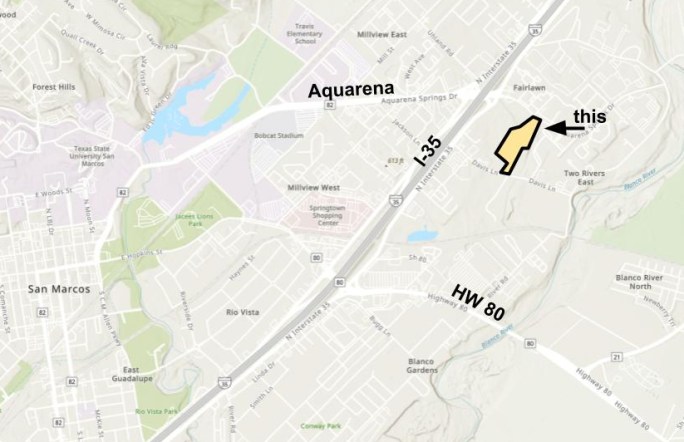
Item 13: Rezoning a little street in Blanco Gardens

Here’s Blanco Gardens:

It’s a very cute old neighborhood with gorgeous trees.

Here’s a close-up:
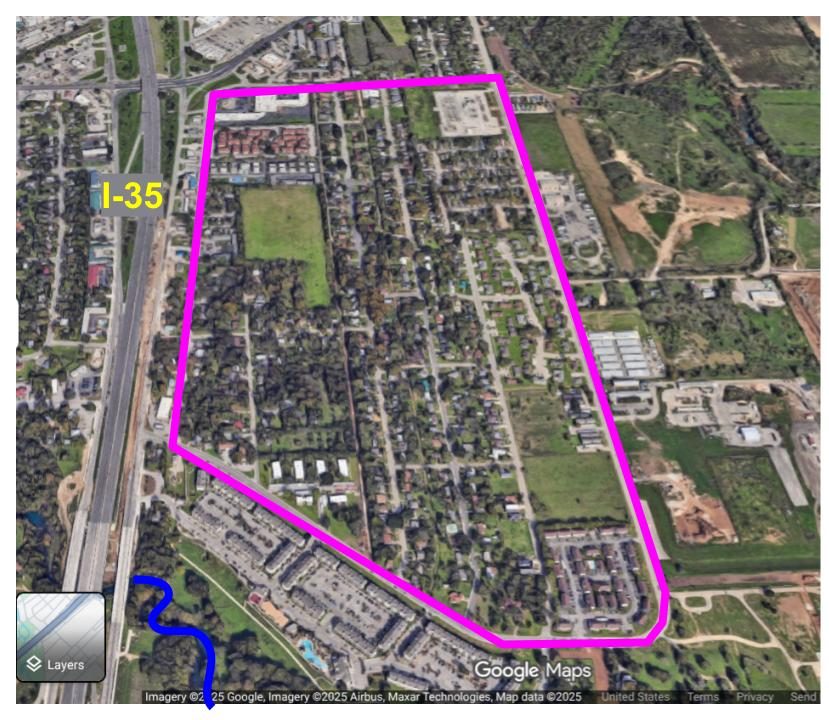
Blanco Gardens has come up a lot over the years in the blog. They were ground zero for the 2015 floods, and they’ve gotten some some flood mitigation projects since then. They got some speed bumps and parking permits. Most recently, they were the first neighborhood to get its neighborhood character study. It’s also the closest neighborhood to Cape’s Dam.

For an old neighborhood, there’s a surprising amount of undeveloped land in the middle of it:

(I wondered briefly if that was because homes had been torn down after the floods. But nope, you can see on the 2014 satellite image that there’s just always been space there for years.)

Over the years, developers have occasionally tried to put something in part of it, but so far it’s always gotten nixed.

Today’s proposal is about this bit:

A developer wants to build houses on it.
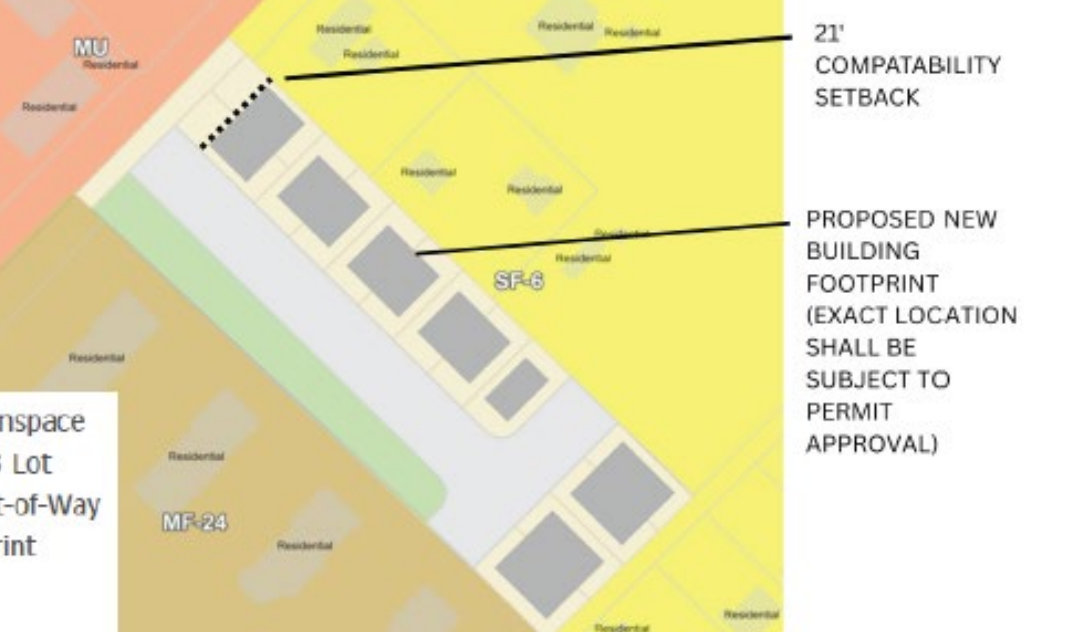
They would look and feel like duplexes, but they’re technically different, because of how they can be bought and sold. The property line runs through the two halves of the house, so you can purchase one half of it, while someone else owns the other half. (It’s called a “zero lot-line house”.)

Basically it’s a good way to fit more, smaller homes onto a street, and they tend to be a little cheaper, too.

What does Council say?

Question: will fit the character of the rest of the neighborhood?
Developer answer: We have good intentions!

(One block over, there are some extremely modern houses. The neighborhood is salty about this.)

Question: Will the alley still exist?
Answer: nope.

Nobody really asked about flooding. The 2015 floods are starting to fade from memory for the rest of San Marcos. But not in Blanco Gardens – they were the epicenter of the floods.

I would have liked to know what the 2015 flood water line was for nearby houses – I bet it was about 3-4 feet of water deep. How elevated will these houses be? Will they be above the 2015 water line?

My memory is that, in a 100-year flood plain, you have to build 1-2 feet above the Base Flood Elevation, based on FEMA flood maps. Does that get you to 3-4 feet off the ground? I just don’t know.

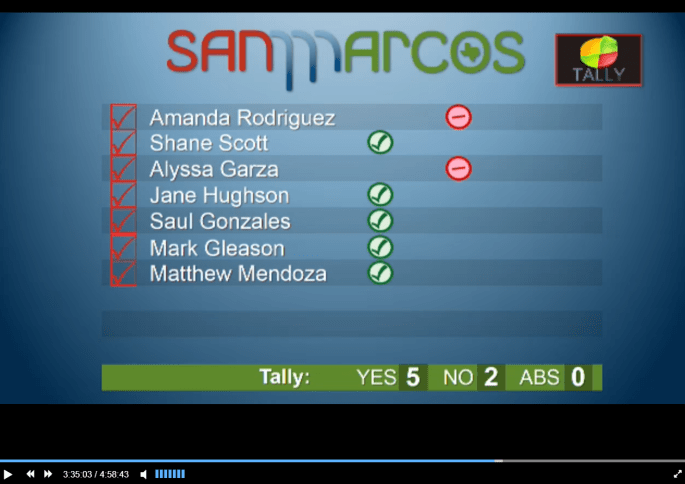
The vote on this cute row of sorta-duplexes:

Yes:  Everyone
No:  nobody

The good news is that Council is enthusiastic about infill housing. (When I first started blogging in 2022, Council wouldn’t let a home owner build two small houses on a subdivided lot, on Lockhart street. That was crazy.) They’ve definitely gotten the message that San Marcos needs more housing.

As long as the homes are safely elevated, I’m okay with this project. But the flooding risk makes me very uneasy.

Item 14: HSAB Funding

HSAB stands for Human Services Advisory Board.

These are city grants to nonprofits, for things like food assistance, eviction prevention, domestic violence help, mental health services, etc. For the past few years, we’ve given out $500K in grants. This year, Council bumped it up to $750K. (Of course, federal funding has gotten slashed, so the need has also grown. THANKS OBAMA.)

It’s always a grueling process. All the nonprofits all do incredibly important work.

In the past, we kinda made non-profits cagefight against each other. [Read all the gory details for the past few years.] The process was murky. The recommendations would come to council, and council members would start horse-trading around.

It was a bad look! It always seemed very fickle – “Oh, we’ll take $20,000 from those guys and give it to these guys!” It felt like the main criteria was being friendly with council members.

We’ve been working on tightening the process. It’s a super time-intensive:

  • the HSAB board meets weekly from August to October
  • They hear presentations from all 32 applications
  • Each one gets discussed and each board member ranks them on a bunch of different criteria
  • Eventually they recommend how much of each request to fund.

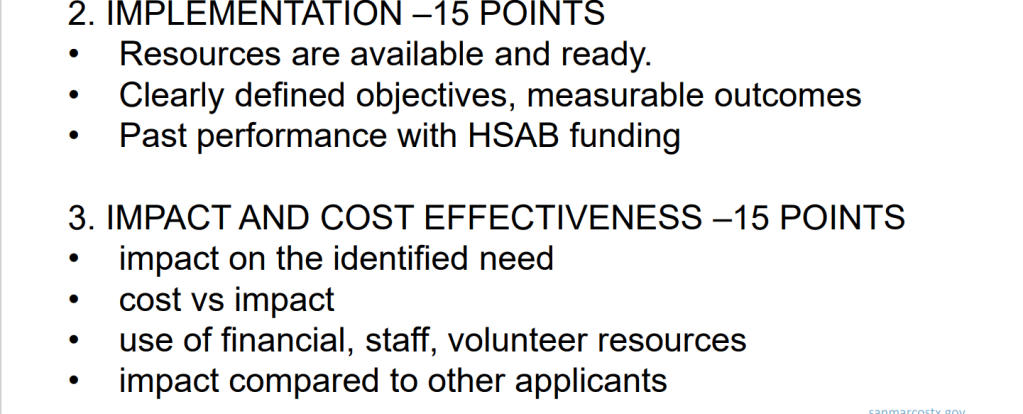
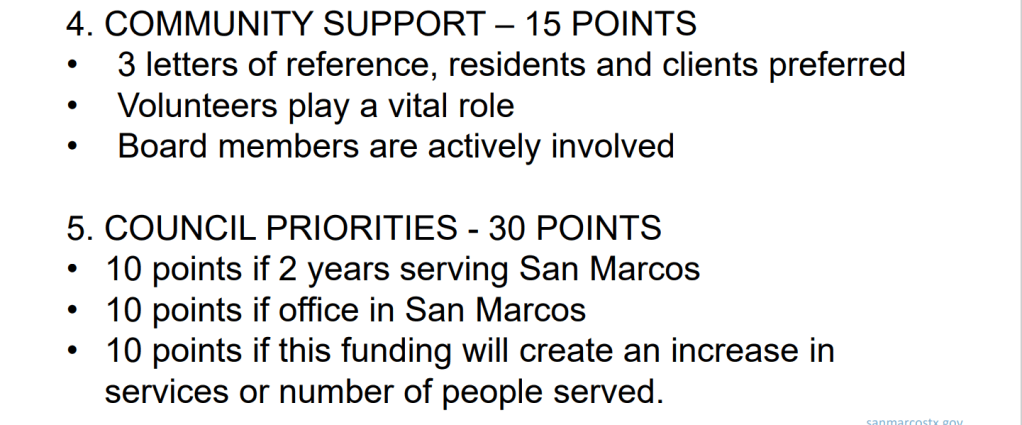
Here’s the criteria:

After all the ranking and discussion, they bring it to Council.

Just for funsies, let’s add up how much other non-HSAB money is getting allocated in this meeting!

All this was approved in one single vote, on Tuesday:

  • “On-Call Title Research Services Contract with Hollerbach & Associates, Inc., to increase the price by up to $200,000.00, resulting in a total contract amount not to exceed $299,999.00”.
  • “RMO P.C. for legal services associated with land acquisitions to increase the price by up to $300,000.00, resulting in a total contract amount not to exceed $699,000.00”.
  • “Change in Service to the agreement with Baker Moran Doggett Ma & Dobbs, LLP for legal services associated with land acquisitions to increase the price by up to $300,000.00, resulting in a total amount not to exceed $600,000.00”.
  • “STV Incorporated to provide On-Call General Engineering Services for various projects in the amount of $900,000.00”.
  • “Halff Associates, Inc. to provide On-Call General Engineering Services for various projects in the amount of $900,000.00”.
  • “a 2025 Ford F550 Crew Cab Chassis from Rush Truck Center, through a Sourcewell Purchasing Cooperative Contract, in the amount of $82,043.63, and outfitted by E.H. Wachs, through a BuyBoard Contract, in the amount of $156,865.65, for a total purchase cost of $238,906.28”.
  • “SHI Government Solutions, through Omnia Partners, for a City of San Marcos job application tracking software system in the annual amount not to exceed $112,000.00, and up to four one-year renewals with a total amount of $560,000.00”.

It comes to about $2.95 million. I’m not saying any of those were a mistake! I trust the city officials. Most likely, those are all totally reasonable.

I’m just pointing out who gets scrutinized, in society, and who doesn’t. We approved almost $3 million without blinking, when it goes to those contracts above. But if it’s hungry kids, homelessness, mental health emergencies, etc, we rigorously grind these applications into pulp.

Back to the grant grind!

There were 32 applications, and the total amounts requested added up to $1.2 million.

Here’s the full list of scores and funding:
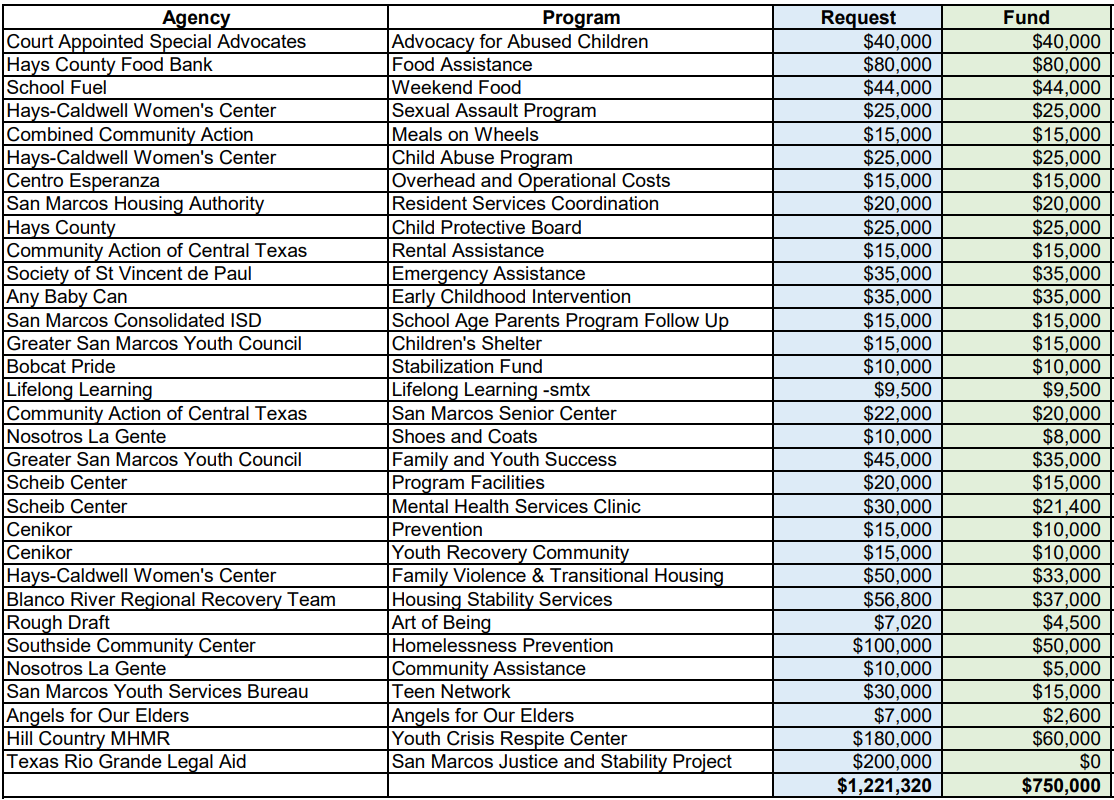
In the presentation, they went through all of them, and why the committee might not have fully funded the request.

For example:
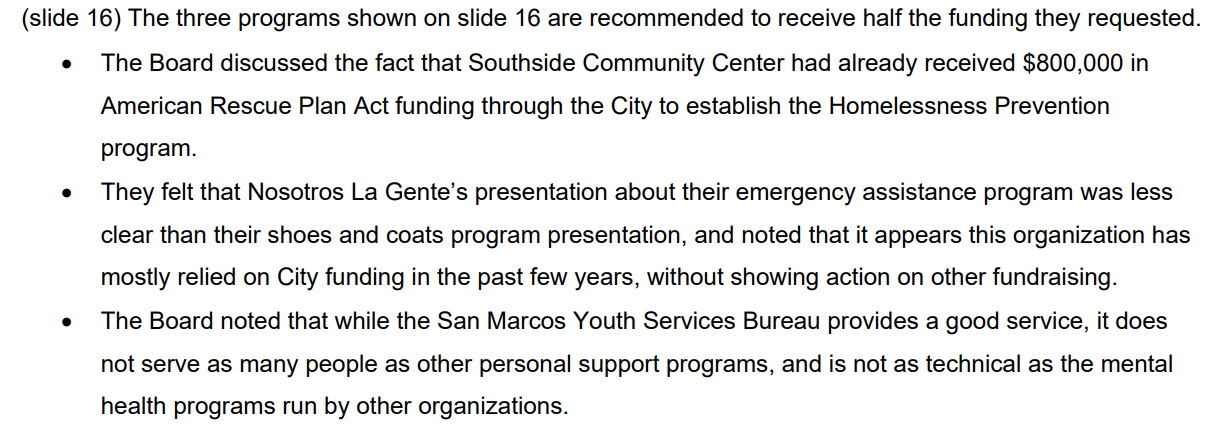
The rest of their thoughts are on pp 435-437, here.

They were very thorough.

Back to Citizen Comment

Three speakers from Southside show up to talk. Here’s what they say:

Southside is in a funny position. In 2024, the city gave Southside $800K of Covid money to implement a Homeless Action Plan.

They came up with a plan and put in all the work to get it up and running. Now they’re trying to sustain it over time. They asked for $100K from HSAB, but were only granted $50K.

The $100K is for their homeless prevention program – giving families $1000-2000 to get through a one-time financial crisis, so that they don’t get evicted.

Let the horse-trading begin!

Matthew kicks it off. He wants to try to get Southside back up to the full $100K that they asked for, for homelessness prevention.

Matthew proposes:

  • Take $4500 from Rough Draft
  • Take $5000 from Lifelong Learning
  • Take $10,000 from Hill Country MHMR

Give that $19,500 to Southside.

Ok, what are these things?

Rough Draft:

Their funding would go to $0.

Lifelong Learning:

Ok. Their funding would go from $9000 to $4500.

Hill Country MHMR
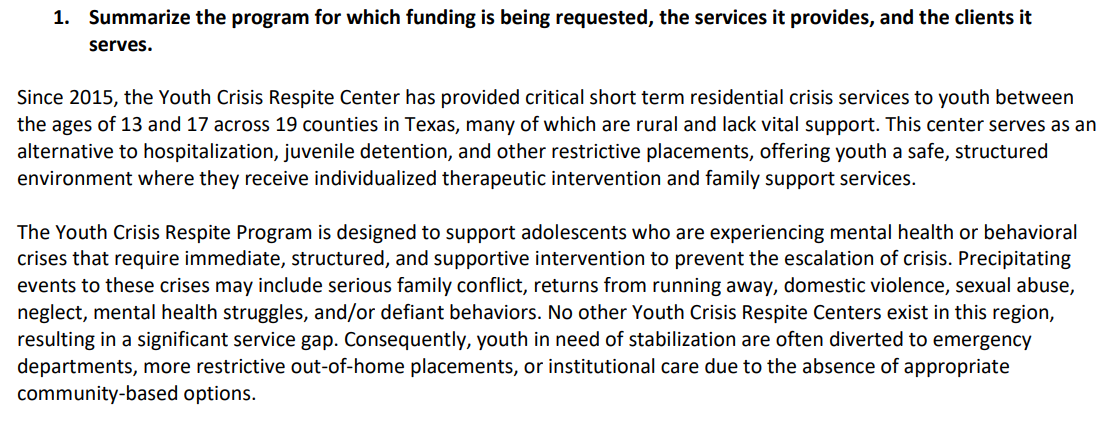
Their funding would go from $60,000 to $50,000.

….

What does Council think?

Question: How many people would Southside be able to help, with this $19K?
Answer: About ten families. Average cost to stabilize someone after a financial emergency is $2k.

It’s actually a huge bargain. If they’d been evicted, it would cost $15-30K+ to stabilize a family once they become homeless. (Plus, y’know, becoming homeless is awful. This is way more humane for the families.)

Question: Are you all applying for other grants?
Answer: SO MANY. Funding is scarce, and federal funds have been slashed.

Alyssa: The entire premise of horse-trading these dollars is problematic. Most agencies didn’t send someone here tonight to answer questions. We don’t have context and expertise. This is haphazard. I am not on board with any of this.

Amanda: Matthew, what about moving some money from the School Age Parents Program? They said they’d be able to keep the program open on $7,500, but they’re being awarded $15K.

Matthew: How dare you. Abso-fucking-lutely not!

[I’m paraphrasing. Matthew just said something like, “They do great work!”.]

Amanda: I’m trying to throw you a bone here!

Matthew: Hard no.

Amanda: Well, I’m a no on Hill Country MHMR especially. Their work is desperately needed. We are in a mental health services desert, and this program will fund teenagers without insurance.

Alyssa: I’m a NO on all of this, but especially NO on Hill Country MHMR. Homelessness and mental health are completely intertwined. There’s so much need here.

The votes are each held individually:

  1. Move all $4500 from Rough Draft to Southside Homelessness Prevention?

Yes: Matthew, Jane, Amanda, Lorenzo, Saul

No: Alyssa, Shane

2. Move $5000 from Lifelong Learning over to Southside?

This motion dies without getting a second. So it never comes to a vote.  That kinda surprised me.

3. Move $10K from Hill Country MHMR over to Southside?

Yes:  Matthew

No:  Everyone but Matthew

4. Amanda throws in a vote on the SMCISD School Age Parents Program:

They get $15K.

Should we take $5K from them, and give it to Southside?

Yes: Amanda, Saul

No: Matthew, Lorenzo, Alyssa, Jane, Shane

So that fails.

..

Me, personally: It’s an awful decision to make. I probably would have taken money from Rough Draft, Lifelong Learning, and maybe SMCISD School Age parents. But not Hill Country MHMR.

….

So that’s where it lands. Southside picked up $4500 more, and Rough Draft went to $0.

The final official vote on HSAB funding passes 7-0.

One more note!

We just spent $750K on the poor and vulnerable.

But we also spend $1.1 million on tax breaks to home owners every year:
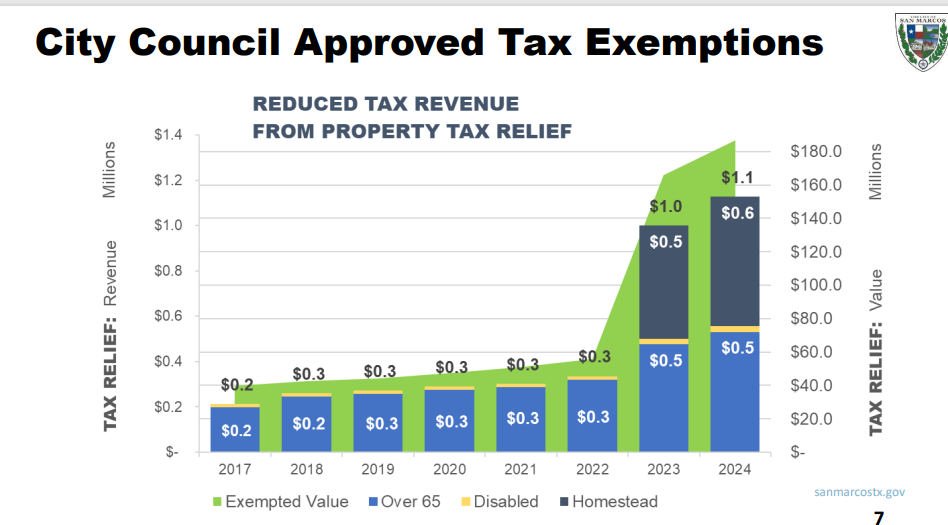
About 30% of San Marcos owns their own home. That $1.1 million is just for them.

Also, remember that Kissing Tree is keeping $46 million of San Marcos tax dollars, for nice streets and trees that are then gated off from the rest of San Marcos! You can’t go visit the tax dollars. Sorry.

This is why I get cranky about this:

People who want to slash property taxes never seem to appreciate how much of their own lifestyle is being subsidized.

….

Item 19: Dunbar Recreation Center

Dunbar was named for Paul Laurence Dunbar. He was the first black poet to get widespread recognition. (He was not from San Marcos in any way. He’s from Ohio.)

Here’s one of his poems, from 1895:

via

Originally, the Dunbar neighborhood did not have a specific name, besides being called “the colored neighborhood”. The school was called The Negro School. In 1961, that was renamed after Paul Laurence Dunbar, and then gradually the whole neighborhood came to be known as Dunbar. So the Dunbar Rec Center just got the name “Dunbar”.

Would we like to include the poet’s full name here? Everyone says yes.

Great!

Lots of interesting history on the Dunbar neighborhood here and here!

….

Item 20-21: Jorge’s Mexican Restaurant.

Jorge’s is on Hunter Road:

Separately, Miller Middle School is on Foxtail Road:

Their front doors are far apart:
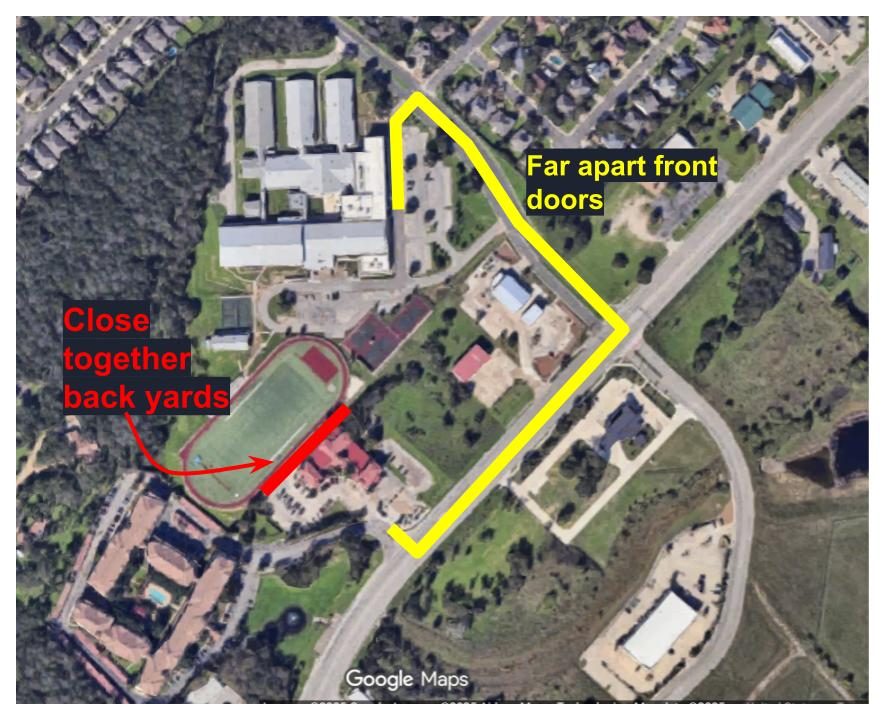
…but they share a back fence.

This causes all kinds of problems for Jorge’s, because there are extra-strict rules for selling alcohol within 300 feet of a school.

This means that Jorge’s has to do a lot more:

  • Renew their alcohol permit every year, instead of every three years like everyone else.
  • Renew their distance variance every year, which grants them an exception to the 300 foot rule.

The main problem is the fees – both of those cost $750, so Jorge’s is paying $1500 every year.

Why is it so expensive?!

Mostly because of postage. The city has to notify everyone within 400 ft. The rest of the cost is to cover staff time, to process the paperwork.

Everyone wants to at least refund half of Jorge’s fees, since the city can save costs by processing both the alcohol permit and distance variance at the same time.

They’re going to try to come up with a long term solution, too.

Bonus! 3 pm workshop, 11/18/25

Workshop: Heritage Tourism and Preservation Grants

“HOT” stands for Hotel Occupancy Taxes. How shall we spend our HOT money?

The city is proposing offering some grants to nonprofits who have some kind of historical preservation project.

City staff goes through a long list of slides. Who would be eligible? What kinds of projects are okay? How much are the grants for? What’s the rubric for evaluation? What’s the timeline? It’s very detailed.

What does Council say?

“Let’s kill this whole thing and just use the money for repairing the Dunbar School Home Education Building.”

It’s not a bad idea! I felt a little bad for the presenter, though.

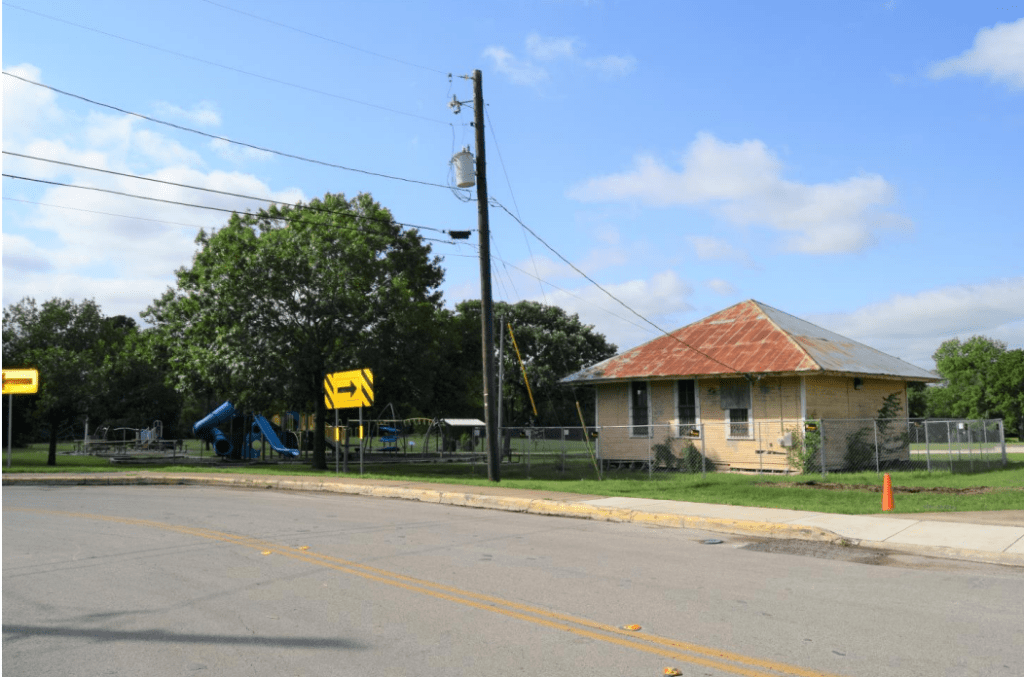
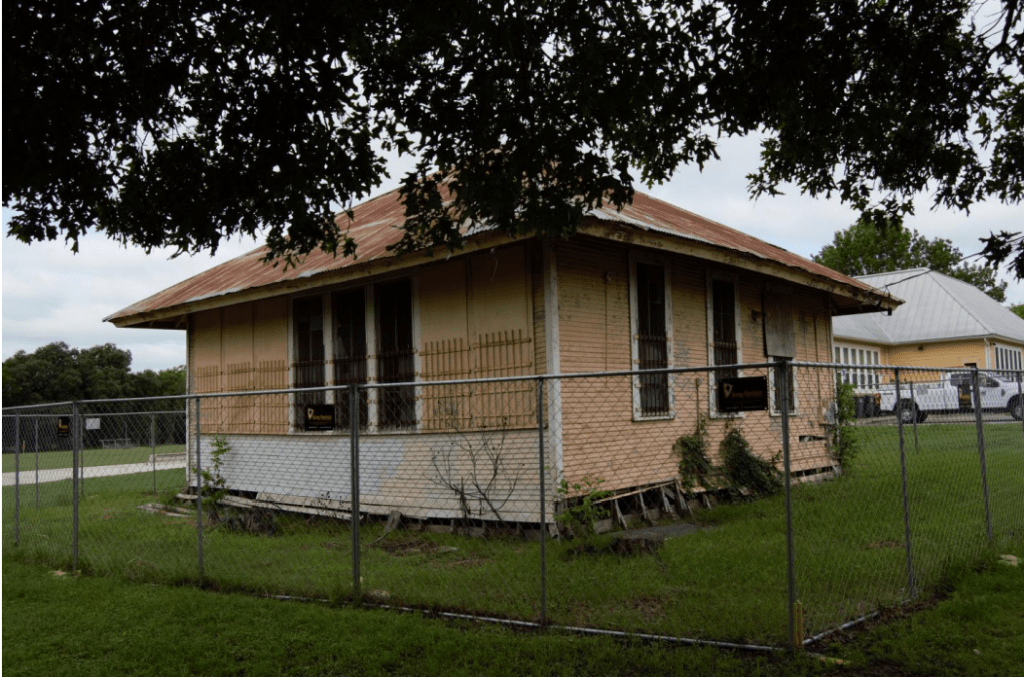
What’s the Dunbar School Home Education Center?

It’s this little building in Dunbar Park:

via

right behind the main Dunbar Recreation Building:

It’s the only building left from the original campus of the Dunbar School.

We just talked about the Dunbar School a moment ago – it’s the original school for black children during segregation, named for the poet Paul Laurence Dunbar.

The Dunbar School was put on the National Register of Historic Places in 1983.

But then in 1986, someone deliberately burned down most of the school, leaving just this little building. (Not the only time that major buildings of the African-American community in San Marcos have been destroyed by arson.)

The plan is to put this HOT money into the Dunbar Home Economics Building each year. Once it’s restored, Council will revisit this whole grant idea.

Bonus! 3 pm workshops, 11/5/25

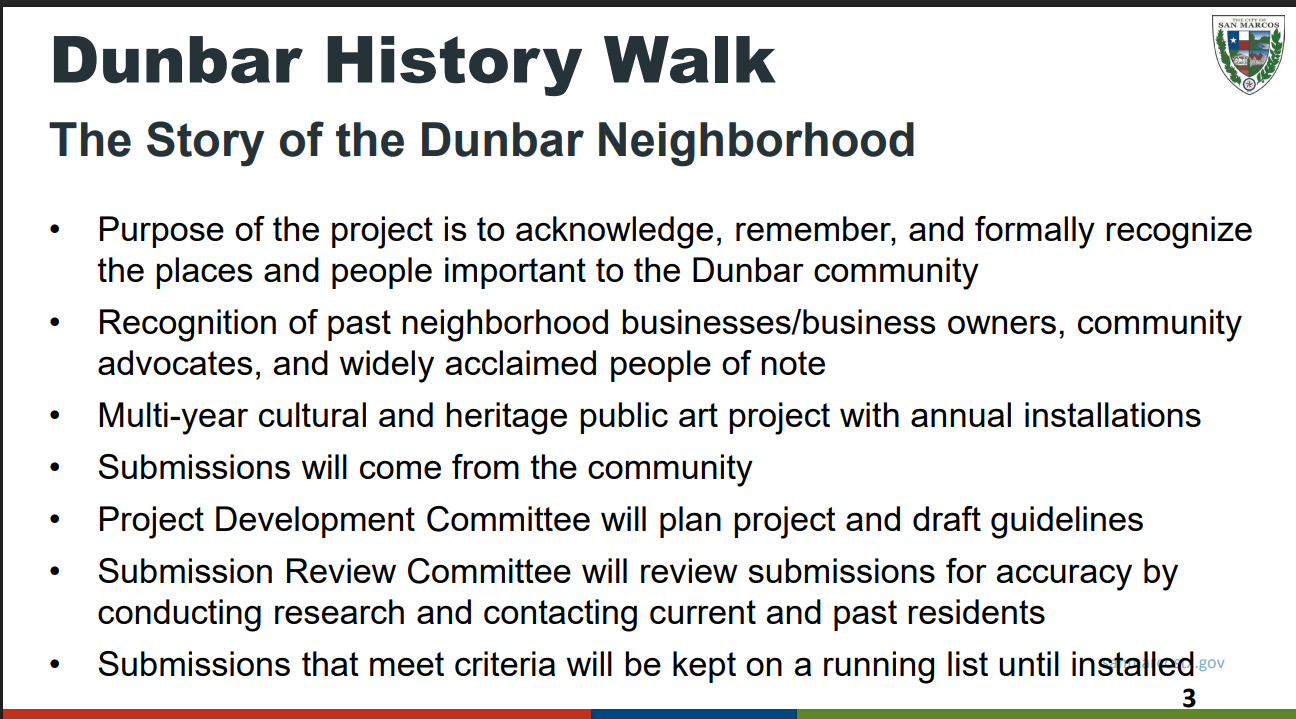
Workshop: The Dunbar Neighborhood History Walk

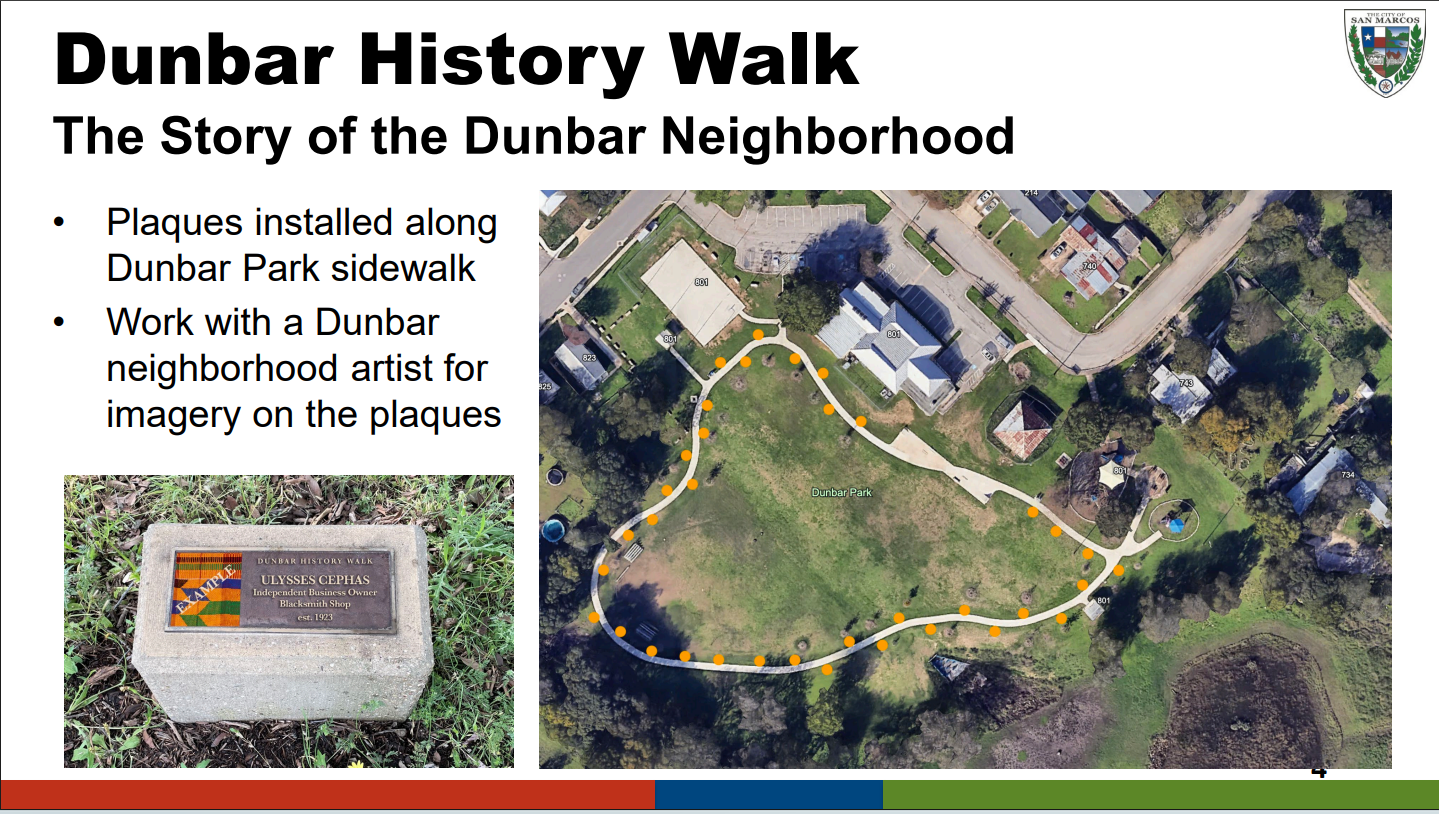
Dunbar park is going to get a history walk!

So the Dunbar Sistas are a group of women who played softball together as teens, decades ago, and are now some of the community anchors in San Marcos. They are the ones who originally came up with this idea. Two of them – Mittie Miller and Deborah Giles Webster – both spoke at the meeting about their process.

Here’s the plan:

This sounds great! So all those little plaques would commemorate important people, businesses, churches etc.

One thing that the Dunbar Sistas stress is the process for determining who will be featured on the walk. There’s a large network of Dunbar alumni, people who grew up in Dunbar over the past century, who may now be scattered across the country. They want decision-making to go to Dunbar alumni, as opposed to people who may be recent transplants to Dunbar. This seems reasonable.

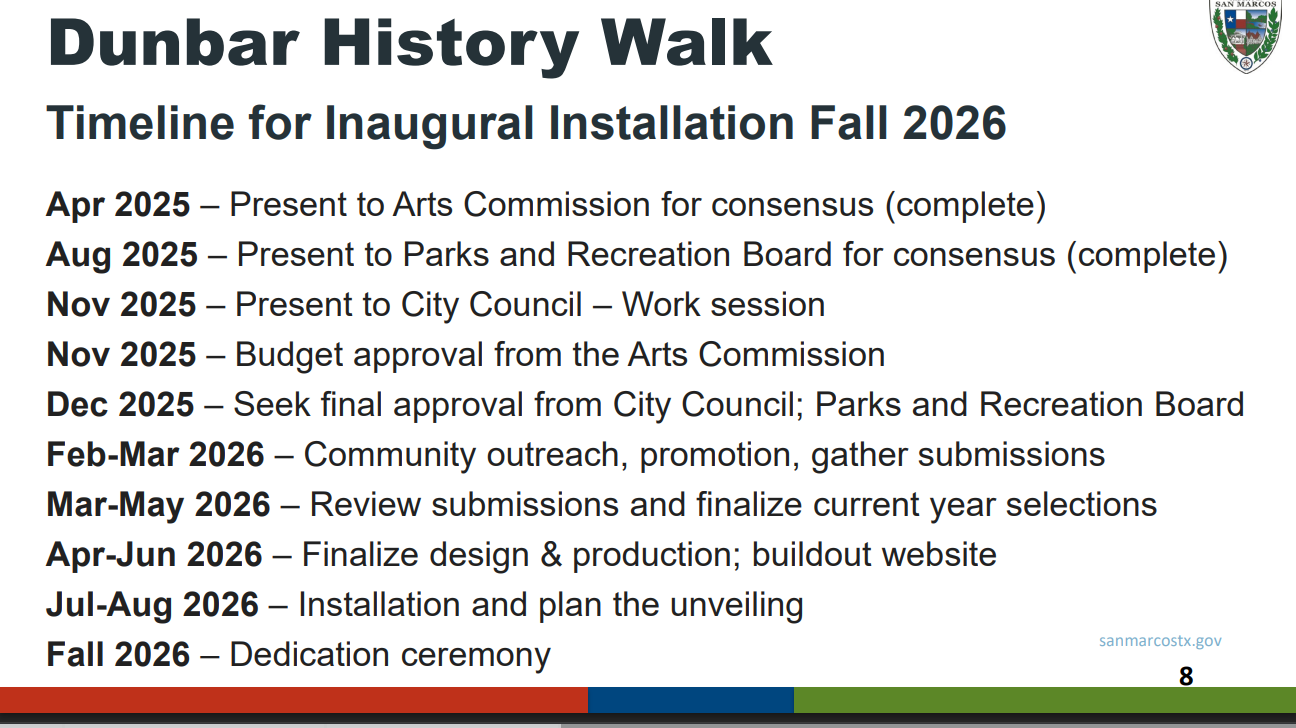
The plan is to roll it out next fall:

Anyway, there weren’t any other neat pictures in the presentation for me to clip for you, but there is a ton of history at the Calaboose Museum and Dunbar Heritage Association.

Enjoy!

Hours 0:00 – 2:39, 12/3/24

Citizen comment

Comments are a hodge-podge this week:

  • Salvation Army was denied some grant funding, they’d like it restored.
  • Demolition notices on Valley Street
  • Rio Vista incident with SMPD that we heard about last time
  • One person in favor of the Purgatory Creek rezoning, and one person opposed.
  • Ok, this last one is fun. This guy wants to build a Glidescape in town, which is a solar powered roller rink, with vertical farms that grow fresh food, immersive STEM workshops, virtual reality tournaments, and planetarium, which can transform into a disaster-resistant facility when the community needs a shelter. He wants a Chapter 380 agreement and maybe some tax breaks to bring this vision to San Marcos.

I honestly assumed the speaker was maybe someone on a manic phase. But he seems to be an active person with a lot going on on this website and also this one? I still am not sure if San Marcos can support a planetarium-vertical-farm-roller rink, but we can’t know for sure until we try.

Item 1: San Marcos got a bunch of federal money after the 2015 floods, to help with recovery.

As of December 2024, the grants are all done. We’re officially done with flood recovery funds, and hopefully the community feels restored.

Items 2-3: Fiscal reports for April-May-June 2024 and July-August-September 2024.

We had ample warning that sales tax was coming in low, and we adjusted and pulled things back.

This is April-June:

The striped green and blue is what we thought we’d have. But then the solid green and blue are what we ended up having. But the solid blue is still less than the solid green, so our budget stayed balanced.

Then July-September looks even more back to normal:

Our sales tax was down because one specific business had their revenue way down. That’s supposed to go back to normal next year.

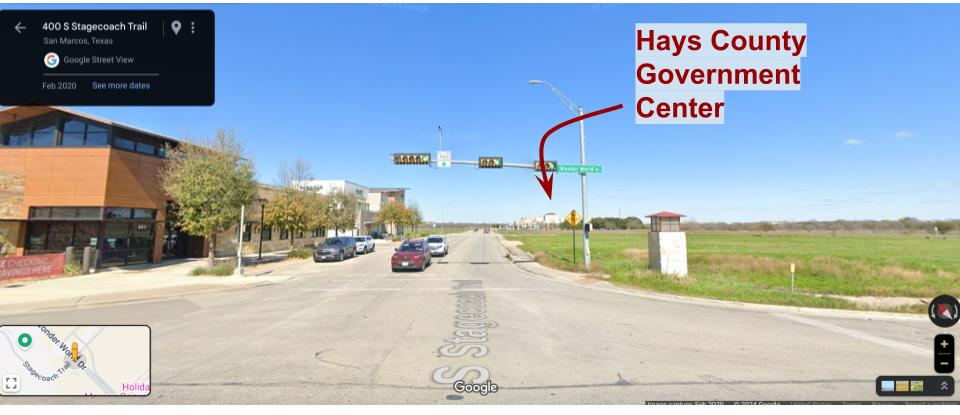
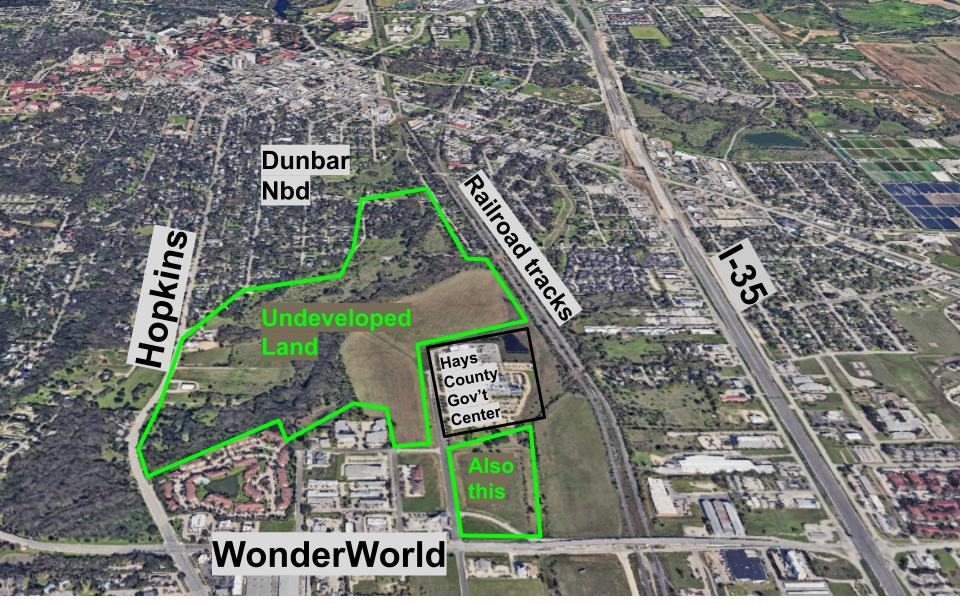
Items 19-21: The Hays Government Center is off Wonderworld, on Stagecoach:

All around it is a big chunk of undeveloped natural land:

It separates the Dunbar neighborhood from Wonderworld.

It’s never been developed, mostly because Purgatory Creek and Willow Springs Creek both run through it:

So it can get very wet and marshy in there.

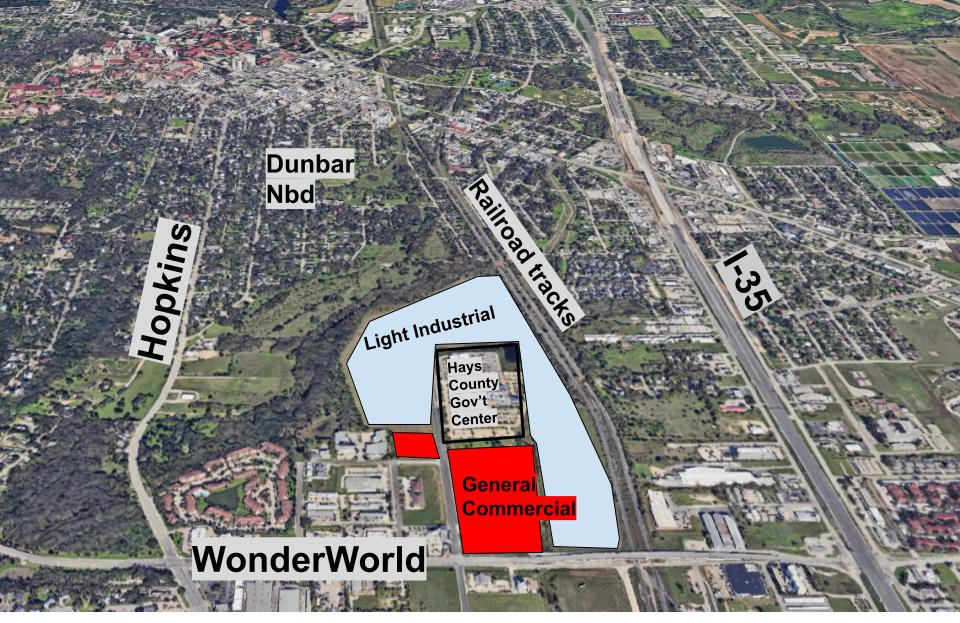
Way back in the 1980s, this land was all zoned Light Industrial and General Commercial:

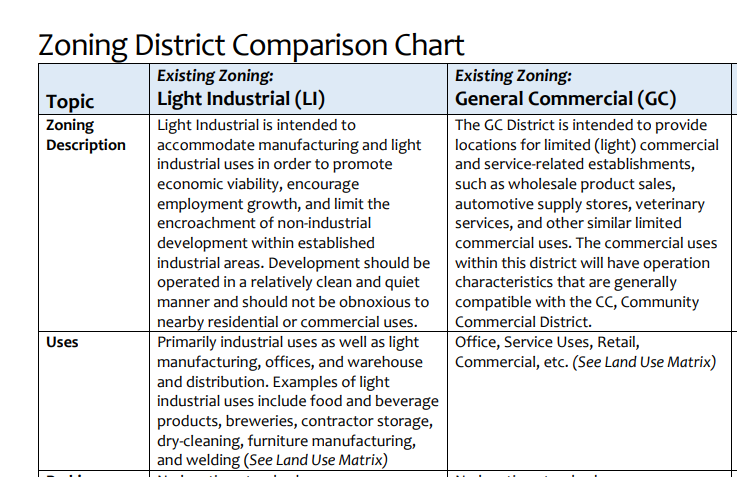
Here’s what General Commercial and Light Industrial mean:

So the owner, currently, is allowed to build anything in that chart, without getting permission from the city.

Honestly, back in the 1980s, this area was basically outside of town. And the people in charge did not worry about Dunbar neighborhood flooding.  

Fastforward to 2024

Now we do care about Dunbar flooding! How we’ve grown.

The city is working on the Purgatory Creek Mitigation Project, stretching from the river out to Purgatory:

(That’s my kludged-together map, joining Phase 1 and Phase 2.)

It’s going to be a big trench to help with flooding, with a big hike-and-bike trail running through it:

and the trail will connect the the river, through Dunbar, and over to Purgatory Creek Natural Area on Hunter and Wonderworld.

This trail cuts across the land that we’re talking about:

They’re calling this part of the trail “Hun-Dun” because it connects Hunter Road and Dunbar. Very cute, you all.

So the city approached the owner and asked about acquiring this land for that part of the trail: 

The owner of the land said, “Well, as long as we’re looking at this land, what if we change it all around?” He is proposing the following zonings:

The green part will contain the Hun-Dun trail.

So what about the pink and blue parts?

First off, both are down-zoning. They are less intensive than Light Industrial and General Commercial. So that’s good, but it’s also pretty weak, because the old zonings were kind of ridiculous.

Blue will be CD-5. Mostly this means large apartment complexes.   Pink will be CD-4, which usually means slightly smaller complexes, or things like townhomes.  

What did Council say?

There are two main themes to the conversation: flooding and new roads.

  1. Flooding.  If all this housing is built, will it increase flooding in Dunbar? After all, it’s going to displace a bunch of water. That’s basically why this area hasn’t been built out yet.

Answer:  According to our Land Development Code, you aren’t allowed to build something that makes flooding worse for people downstream.

Jane Hughson kind of laughs darkly, saying “We know how well that works.”

Amanda Rodriguez asks exactly how this gets enforced?

Answer: It’s prepared and checked by engineers.

Note: “Prepared and checked by engineers” is all well and good, but that’s not enforcement.  What happens if the builder cuts a bunch of corners? Enforcement has to come after that. Will city staff actually withhold their building permit and require them to fix it? Or will we just good-naturedly punch them on the shoulder and say, “Bro! You know better! Try not to do this again, but here’s your permit.” 

The answer is: who knows! That step is invisible. 

The second enforcement comes with maintenance: if you have a retention pond, do you check the drain and pumps regularly? Does the city? What happens if the drains get clogged and no one pays to have them cleaned? Will the city actually remove your permit? Or will they just wring their hands and say, “I hope this gets fixed!”

2.   The roads

Which roads should connect into this new neighborhood?

Councilmembers talk in particular about Gravel Road and Bintu road:

Gravel Road is a sleepy little dead-end with some houses on it. Bintu is a sleepy little road with a Holiday Inn on it.

Here’s the Transportation Master Plan:

So you can see that in theory, MLK and Gravel are both going to be extended across Purgatory Creek, into this new neighborhood. And Bintu is supposed to be extended across the tracks, to connect the I-35 frontage road into the neighborhood.

Is this a good idea?

It depends!!

Bintu Road extension: Yes, I think this is a great idea. No one lives there. Another way to get across the tracks would be great. Let’s do it.

Gravel Road and MLK extensions:

If you have two sleepy neighborhoods that are back-to-back, it is generally a good idea to connect them.  You want the people in these neighborhoods to have multiple ways to leave in case of flooding, for example.  Connectivity is good.

However! If you connect two sleepy neighborhoods and Gravel Road becomes the New I-35 Workaround, then that’s a whole lot of traffic that these neighbors didn’t bargain for.  All of a sudden, cars are zooming down Gravel Road at 50 mph.  

At the same time, the city does need more roads running parallel to I-35, aside from just Hopkins.  Maybe MLK? (My vote is also for Leah Drive, on the east side, and to extend the road that runs by Target, Barnes Drive, all the way to Wonderworld.)

Answer: Stay tuned! This will be a fiery debate when the Transportation Master Plan comes up for revision in the next 1-2 years!

Here’s the bottom line: currently, the developer is allowed to build all kinds of nasty things.  Our hands are tied here.  We’re not zoning new, rural land.  We’re re-zoning land where the owner has current rights to build all sorts of things.  This is a least-bad-decision.

Each part – blue, pink, green – gets its own vote:

The Blue Vote: Should the blue part be big apartment complexes?

The Pink Vote: Should the pink part be smaller scale dense housing, like townhomes?

I probably would have voted yes. It’s a good place for town homes and moderately dense housing. We just have to be thoughtful about the Transportation Master Plan.

The Green Vote: Should the green part be set aside for the trail?

That last one is easy. 

One final note: The developer says he doesn’t actually have any plans right now. This is not going to be immediately developed in the next 2-3 years.

Hours 2:39 – 4:58, 12/3/24

Now we get into the weeds. These next five items are pulled from the Consent Agenda by Amanda Rodridguez. This means that Staff guessed that no one would want to discuss anything, and Amanda said, “Not so fast!”.

(Alyssa and Jane also pulled items, but just had a quick question on each one.)

The five items are:
– Mailing parking tickets directly to people
– New bathrooms at Dunbar park
– Covid money for mental health collaboration between SMPD and a mental health treatment center.
– SMPD buying seven new Tahoes for $350K
– SMPD applying for a grant to start a Motor Vehicle Crime Prevention Unit

A few observations:

First, Amanda is thorough. Holy moly. She is reading everything with a fine tooth comb.

Second, what is Amanda’s point?

Her larger point is that these are the kinds of things we approve automatically. Taken together, these five items add up to $709K. (For perspective, keep in mind that we budget $550K yearly on social services.)

We just aren’t this generous – both in dollars and spirit – in other areas. Recall how it took Alyssa years of banging on about it to get $115K extra Covid money set up for emergency housing. Why is $350K for police cars so easy, and $115K for emergency housing so difficult? What Amanda is doing in these next five items is scrutinizing items that usually pass uninspected.

Honestly, I would vote in favor of all five items. I don’t actually think they are abusing city dollars.

It’s just that this level of generosity should be the standard, and it’s not. When it comes to my pet issues – homelessness, holding landlords accountable, transit, the parks department, etc – we should be as quick and gracious to fully fund them, as we are when it’s time to spend $350K on new police cars.

“BUT WAIT!” you cry, “We can’t afford to spend a million dollars all over the place like that! We’re broke!”

Gentle Reader: never forget that we spend $1.2 million on Kissing Tree each year. And it’s gated, and you’re not allowed in. Sorry.

….

Anyway! Onto the weedy details.  Brace yourself.

Item 4: Mailing parking tickets

The parking lot next to the Lion’s Club is going to become a pay lot. Supposedly it’s going to be free for residents (but the details are murky). Out-of-towners will get their parking tickets mailed to them. (We discussed this last time.)

The first issue: In general, there’s an Early Bird discount – 50% off! – if you pay your tickets off early. You get 14 days to get the discount.

But if you’re mailing tickets out, you’d want to extend that window to account for the mail. Staff said 17 days. Amanda wants 30 days.

This is a little tricky because there’s also a late fee that kicks in at 30 days. Council decides to extend the Early Bird discount to 29 days on tickets-by-mail. The very next day, the late fee deadline will kick in.

Amanda Rodriguez has a number of other notes:

  • She wants to fully fund the parks department, but not through fees and fines.  (This is a big issue, nationwide. Map here showing that San Marcos is not a big offender, though.)
  • There’s a bunch of murkiness in the policy language: operators versus car owner? Standing vs parking?  Are robots writing tickets here?

They clean up the ordinance a little bit.  Robots are only scanning license plates as you enter or exit the parking lot.  The rest of tickets are being written by people, and the system mails them automatically.

You’re supposed to be allowed to load and unload for up to 30 minutes in this lot. But right now, the ordinance is ambiguous:

The Vote: Should we clean up language to allow for lawful loading and unloading?

Yes, of course:  Jane, Amanda, Alyssa, Saul, and Mark
HELL NO! Ticket them to smithereens:  Matthew Mendoza. 

Okay Matthew, if you think that’s best.

Amanda’s next point: Paid parking for out-of-town residents reflects an “Us vs. them” mentality. We should welcome our visitors, not shake them down. 

The counter argument to this is put forth by Mark Gleason and the city manager, Stephanie Reyes:

  • San Marcos residents don’t use the river, because they’re too full of out-of-towners.
  • The out-of-towners aren’t spending money in our downtown, or hotels, or restaurants. They pack in a cooler and leave town after they get out of the river.
  • The parks and river are getting trashed and destroyed, and there’s a lot of drunken fights and medical problems.  San Marcos is stuck paying for this unless we can collect some money from the out-of-towners.

Jane also has a good point: why is this ordinance so narrow?  Right now, it’s only city park.  Why not write it to include future paid parking lots?  (This does not get fixed.)

More points from Amanda:

  • This is 6 am – 11 pm every day.  No free parking after 5 pm? Holidays or something?
  • Registration process for San Marcos residents – how will that work? It’s supposed to be free for them.

Answer: there will be a big education campaign! We’ll hold events at the library.

Alyssa chimes in: San Marcos has a big problem with roll outs. How many people have microchipped their pets? How many people have signed up for the Enhanced ID at the library? How did the can ban PSA go?

All of those public information campaigns sounded great in paper, but in practice, we just don’t connect with people.

(Note: good public outreach is extremely time-intensive. It’s not enough just to translate everything into Spanish and promote things on social media. You basically need to maintain close and healthy relationships with a lot of community leaders who are in close contact with your hard-to-reach populations. What church does your population go to? What barbershop? Etc.)

Finally: This is just a pilot program. If Council wants to shut this down next year, there will be an opportunity.

As Parks and Rec director Jamie Lee Case says, “City Council will have a chance to decide if the juice is worth the squeeze.” She wins my most-favorite line of the night, hands down.

The final vote: Should we mail parking tickets from the City Park parking lot?

Amanda and Alyssa are both no, mostly due to lack of details on how the registration process will work.

I probably would have voted for it? It seems like a pretty cautious step.

Note: The vast majority of conversation these days is between Alyssa Garza, Amanda Rodriguez, and Jane Hughson.   Just because I’m a shit-stirrer and this made me laugh:  

At 3:01: Shane Scott, Mark Gleason, and Matthew Mendoza are all clearly on their phones.  I guess someone does not find the intricacies of parking violations as thrilling as I do?  Talk about a violation of Municode Chapter 23.46, Section 3.0045, paragraph 8.243. 

Item 6:  We’re spending some Covid money on installing new bathrooms at Dunbar.

Amanda Rodriguez is thorough.  Like thorough

She catches that the contract does not include baby changing tables nor little trashcans for used period products, and asks that those be added in.  

Everyone agrees that this is a good idea.

….

Item 8: Oh, so confusing. 

Here’s the caption:

But here’s what was originally posted, back in November:

The problem is that there’s no such thing as “the City Mental Health Court Program”.  So they changed it on the agenda to SMPD. (Currently this is how the program works: SMPD mental health unit identifies people who need mental health or substance abuse treatment, and refers them out to Evoke Wellness for treatment. Then Evoke Wellness provides in-patient and out-patient substance abuse and mental health treatment.)

What Amanda brings up, though, is that there’s an entire contract in the packet between the City, the treatment center, and the non-existent City Mental Health Court Program. 

No one seems to know what’s going on.

This gets postponed. However, this is Covid money, which expires on December 31st. So it absolutely has to get squared away at the next council meeting.

Item 9: SMPD wants $371K to buy seven new shiny Chevy Tahoes.

Ideally they like to replace police cars every five years. But due to Covid shortages, these are more like 7-8 years old.

Amanda Rodriguez points out that plenty of people drive cars much longer than that.

Chief Standridge explains that the game is to optimize resale value. The Tahoes we’re selling are 7-8 years old, have about 80-85K miles on them, and about 6500 idle hours. (Reddit tells me each idle hour is equivalent to 25 miles driven.) If they wait any longer, repair costs go up and resale costs go down, and everyone gets bummed out.

Each car is $52K, plus each car gets its own fancy Police costume. Installing the costume on the Tahoe, inside and out, is about $20K per car.

Alyssa Garza follows up: SMPD officers use police cars to do their off-duty work. So they’re putting wear and tear on these cars. Can the private companies pay to offset the cost of the vehicles?

(Max Baker and Alyssa actually first brought this up back in 2021. )

Chief Standridge says he actually just met with someone about this just last month! Nothing happened. One of the off-duty employers is SMCISD, and we don’t want to spring it on them.

(I mean, it’s been over three years.)

They also say that we should be leasing SMPD vehicles instead of buying them. This is cheaper in the long run. But because of the tax shortfall this summer, we couldn’t budget for an ongoing expense, so we have to use special one-time money to purchase them.

The vote:

I warned you that these items were weedy! There’s still one more to go.

Item 14: Autocrimes Unit

SMPD is applying for a state grant for $177K. This would pay for establishing a Motor Vehicle Crime Prevention Unit, with one full-time officer and a bunch of license plate cameras.

It’s not free – the city pays $35K in matching funds.

Amanda points out that there were 157 stolen cars last year. Out of 70,000 residents, that’s 2.2 vehicles per 1000 people. Her point is that this is inflated in people’s minds. Everyone acts like it’s a giant issue, but that’s actually fairly small.

Here are some other problems, for perspective:

  • 27.7% of San Marcos residents live under the poverty line. That is 277 per 1000 people.
  • I don’t know how many jobs pay minimum wage, but it is definitely more than 2.2 per 1000 people. We could raise the minimum wage.
  • As of 2017, we needed almost 6000 more low-income housing units. Obviously housing prices have gone up, but let’s use the 6000: that works out to 85 units needed per 1000 people.
  • The uninsured rate in San Marcos is 16.1%. That works out to 161 uninsured people per 1000 people.

Chief Standridge is a hard no on any mitigating context! He wants zero crime!

Amanda grills him on the value of education, and why is it deprioritized in this grant application?

Chief Standridge argues that they do tons of other education! Also, out-of-towners come in to take cars. We can’t educate out-of-towners. Education is only one piece of the larger approach.

Mark Gleason is furious. This is an epidemic! There is a 50% increase in stolen vehicles from 2023 to 2024! These stolen vehicles get used for crimes!

(Repo man)

Mark and Amanda have an angry exchange. If you want to listen, it goes from 4:30:49 – 4:34:15.

Mark is furious that others aren’t taking car theft seriously. He sees a stolen car as derailing someone’s livelihood, and he’s furious that Amanda is challenging Chief Standridge’s plan to reduce this epidemic.

Amanda is furious that we don’t take other problems as seriously as we take car theft. Yes, it’s super shitty if your car gets stolen. But here we are, prepared to drop $35K to match a grant without any discussion, and we don’t apply this same eagerness and dollar amounts to issues that affect a lot more people. As policy makers, council’s job is to figure out how to compare apples and oranges and apply some consistency across many different issues. Right now it’s wildly inconsistent.

Alyssa and Matthew Mendoza also get snippy with each other – if you want to listen, it’s at 4:29-4:30.

Saul doesn’t get snippy with anyone! But he does ask: How do we pay for this two years from now, when the grant runs out?

Answer: It’s a recurring grant. We expect to get it again.

The vote:

Phew! That’s it for the items pulled from the consent agenda.

The rest of the meeting is extremely short.

Item 24: Tantra is going to get reimbursed the $750 fee for appealing the noise violation. Yay!

Item 25: Right now each councilmember gets $12K to travel to conferences.

Shane Scott wants to double this to $24K. City Manager Stephanie Reyes gets a little faint at the notion of magically locating $84K extra dollars in the budget for this.

This will come back around, with more details. Like do all the council members even spend all their money? Maybe they can share the pool a little bit amongst themselves.

Hours 0:00 – 1:32, 7/2/24

First off: it was Laurie Moyer’s last meeting, after 36 years with the city. Mostly she’s done engineering-ish things, but also some City Manager-ish things. She took all these great City Hall photos on her road trip last year. Congrats to her!

Citizen comment:

  • Two people – Noah Brock and Annie Donovan – talked about the latest iteration of SMART/Axis hijinks. I’ll save their comments for that section.
  • Two people called for a resolution for a ceasefire in Gaza.
  • The San Marcos Civics Club, and how Council passively assumes they can’t solve city problems
  • Mano Amiga’s petition to repeal Civil Service. I’ll save these details for later, too.
  • Finally, the killing of Malachi Williams by the SMPD officer on April 11th. (Discussed previously here, here, and here.)

To recap, the family of Malachi Williams has been asking for:
1. Release the name and badge ID number of the officer that killed Malachi Williams
2. The officer should be placed on leave while the investigation is ongoing.
3. The family should be able to view all officer and storefront footage, with a lawyer present.

Malachi’s grandfather spoke eloquently. This has happened before. But then the City Manager Stephanie Reyes spoke, which is new.

Here’s what Stephanie Reyes says:
– Video material is available for the family to view along with their attorney. It’s at the Hays District Attorney’s office.
– The DA says that neither the family nor their attorney has reached out to view the footage.
– The DA is waiting to discuss how much of the video the family can watch.
– Because this has been so awful, Chief Standridge is putting together an SMPD Crisis Communication Policy for future incidents.
– the DA Kelly Higgins weighed in on the policy. He has concerns about any public release of video while the investigation is ongoing. He wants videos to be withheld until after a grand jury has reviewed the matter.
– the DA knows that the family needs answers. State code authorizes the DA to let the family watch the video. He’s open to conversation with the family.

(I would like a universal policy that applies to all situations. When an officer is killed by a civilian, how quickly does the family see the videos?)

Next Malachi Williams’ grandfather speaks again, which is usually not allowed. “What we have been offered has not had much substance to it. We have not had a fair offer. There’s been an offer, but it’s not fair.”

Alyssa Garza asks, “Was the family offered the entire videos? All the body camera footage?”

Chief Standridge comes up. “The DA and I are offering the family all the body cam footage. But we are not offering the store’s videos. The DA has not agreed to release that. The DA and I will let them see still photos from the store. But the DA has not agreed to store footage.”

After that, the grandfather has a lot of questions and frustration. Council was not really allowed to respond, legally. They redirect him to the DA. He’s already interacted with the DA and is entirely fed up with him.

It ends in a tense place.

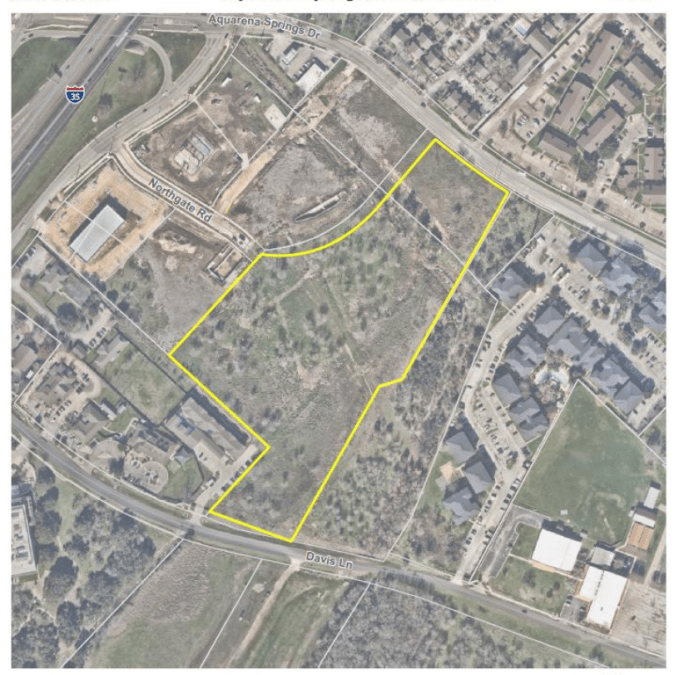
Item 23: Another LIHTC project! 

LIHTC projects are low-income apartment complexes which don’t pay local property taxes. We’ve seen two others recently here. (LIHTC stands for Low Income Housing Tax Credits.)

Where’s this one?

And here’s a close up:

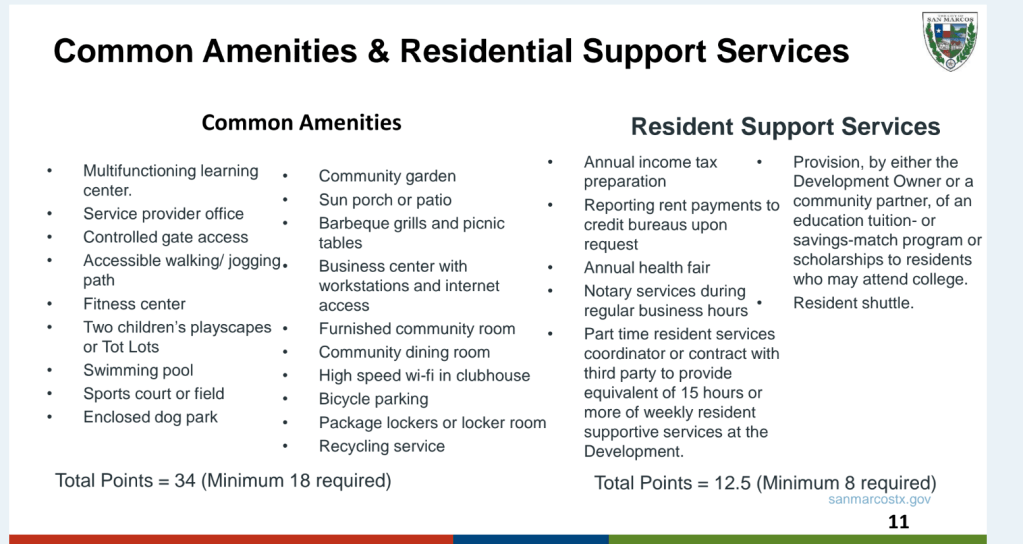
They’re planning on having 304 units.  How affordable will these be?  

In other words, this is 46 units for low-income community members, and 258 for regular community members.  (The median income in San Marcos is $47,394 a year, so 85% of these units are regular old market rate apartments.)

Okay, fine. How much is this costing us?

The estimated loss in tax revenue is $3 million over 15 years, or $200K per year.  They’re softening that by giving us a one-time $400K payment. 

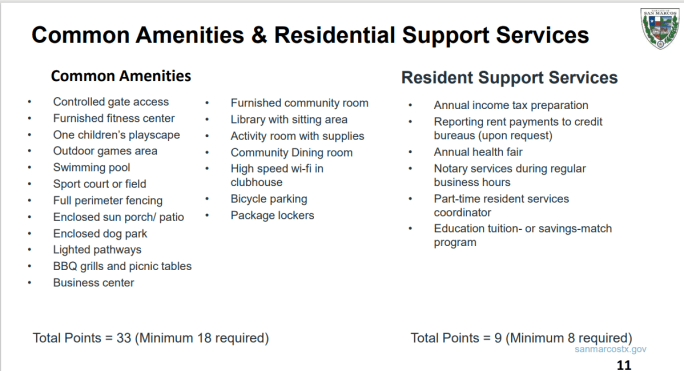
What other services are there going to be? 

[Technical note: There’s some mucking about with the number of 3-bedroom apartments. This complex only has half as many as the city San Marcos requires for LIHTC developments. However, there’s a letter from the Housing Authority about the different waitlists for 1, 2, and 3-bedroom apartments, and 3 bedroom apartments are not in demand as much as 1 and 2, so it’s fine.]

Jane Hughson has some questions:
– Did this area flood in 2015?
Answer: yep. But the buildings weren’t TOO badly damaged.
– Will the complex provide residential shuttles?
Answer: nope. It’s right on a bus line.
– Will the units have individual washer and dryer units?
Answer: yep. 
– Will they have education, services, and after-school tutoring?
Answer: yep.

Alyssa: I’ve heard complaints about restrictions and racially biased access to facilities.  How do you make sure that doesn’t happen?
Answer: We partner with Asset Living. They staff everything and report to us monthly. If something isn’t getting used, we ask them to advertise it.

[I am extremely curious about the complaints of racially-biased access to facilities.] 

The vote: Passes 7-0.

However: Council is going to have big conversation about LIHTC projects in general, at the end of this meeting. Stay tuned.

….

Items 23-24: Kissing Tree 

Kissing Tree is the senior community, way down on Hunter Road and Centerpoint.

Kissing Tree is a TIRZ.  This means they pay taxes, but the taxes don’t go to the city’s General Fund.   Instead they get funneled to side projects that benefit Kissing Tree – mostly building out the public roads and utilities that run through Kissing Tree.  It’s not wasted money, but it doesn’t go to libraries, parks, firefighters, etc.  

Costs have gone up and the assessed value of Kissing Tree has gone up, so they’re re-jiggering all the TIRZ numbers:

This is probably all fine! Before we had estimated that we were sending $32 million over to the Kissing Tree for roads and pumps and parks, and now we’re sending $46 million over. 

Over 15 years, we’re keeping $5 million and giving $46 million back.

Let’s compare this to the LIHTC Project above! In that one, we’re keeping $400K and sending $3 million back.

So to be stark about it:

  1. The LIHTC project is giving us 13% of their estimated property taxes and using the rest to subsidize rents on low-income apartments.
  2. Kissing Tree is giving us 10% of their estimated property taxes taxes, and using the rest on local roads and utilities.

Guess which project makes Mark Gleason uncomfortable? The big reveal later on will not surprise you at all.

….

Item 2: SMART Terminal/Axis Logistics

The SMART/Axis people want San Marcos to annex about 7.5 acres of land for a road and right-of-way. 

Quick backstory (Read more here.)

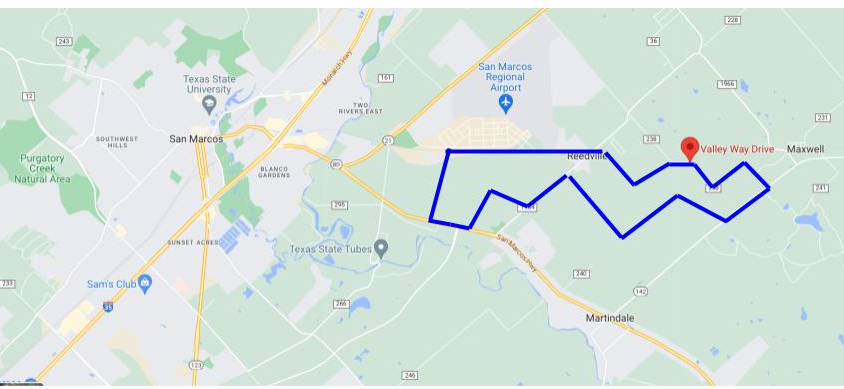
In January 2023, Council signed a development agreement with SMART/Axis people.  Back then, these agreements happened in one single council meeting, and barely anyone had to be notified.  So Council approved a gigantic fucking 2000 acre industrial park without public input and barely any details, and everyone got super angry about it.

2000 acres is very big:

Like, REALLY big:

The people who live out this way were absolutely livid.  But the development agreement was already signed.

The next step of the process was for SMART/Axis to apply for a zoning change to Heavy Industrial and get annexed into the city.  

What they could have done was meet with the neighborhoods nearby, provide details of the project, build relationships and be good neighbors.  Instead, they met with the neighborhoods and generally acted like supercilious pricks who couldn’t be bothered.  The surrounding community got more and more furious, and launched a major activist campaign against the project. 

Eventually SMART/Axis withdrew their zoning and annexation request. That was last summer. Since then, it’s been quiet.

Here’s my best guess: SMART/Axis didn’t want to share any details because they didn’t have any yet. They literally want free reign to do whatever they want on this land.  They came off as supercilious pricks because they are supercilious pricks.  They assumed San Marcos is a backwater rural town that will fawn over fancy business men and give them whatever they want, in hopes of some dollar bill scraps. City Council was happy to play their role!

That brings us to today – should San Marcos annex some land and build a road along the side of the land?  

First off: Nothing happens today. We are just picking dates for the public hearing and final vote.

However, let’s do some speculation!  This is brought to you by Noah Brock and Annie Donovan, during Citizen Comment. (They spearheaded the public campaign against SMART/Axis last year.) 

Here’s the case that Noah and Annie are building:

  • Is this a major change or a minor change? If it’s a major change, the development agreement needs to be amended. That’s a much bigger deal. (The city is saying this is a minor change.)
  • Originally, the roads lined up with the end of Quail Run. That was the edge of the whole project. But since then, the developer has bought more property, and asked Caldwell County to move some roads over.
  • It seems clear that they’re expanding the project beyond the development agreement, and this new land is right next to a residential area. 
  • This new ROW annexation is consistent with a bigger, changing project.

The basic problem is that SMART/Axis people are super secretive and seem to want to walk all over us.  Maybe they’re sweet little bunnies at heart, or maybe they want to do some toxic battery mining or who knows what.  They act like shitty neighbors every time they have a chance to right the narrative.

Today’s vote was just to set the dates, and here they are:

  • Public hearing will be on August 5th
  • Final vote will be on August 20th

….

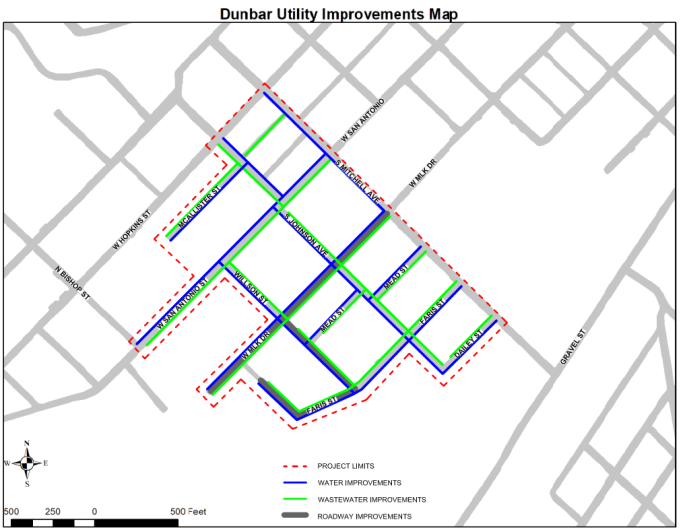
Item 25: Dunbar is getting some new pipes!

We’re spending $6 million on water and wastewater improvements here:

If you go here and scroll to Dunbar Water and Wastewater Improvements, you can keep an eye on the project. 

Supposedly will be done by August 2026.  So at least two years of dug up streets and annoying construction, but with a worthwhile payoff. 

Item 27:  Installing sports lighting on six soccer fields at Five Mile Dam.

This money was authorized awhile ago, this is just the contract to make it happen.  It’s about $1.3 million.

Hours 0:00 – 1:36, 5/21/24

Citizen Comment: much briefer than last time, but hitting most of the same points:

  • Seven people spoke about Malachi Williams and calling for a ceasefire resolution in Gaza.
  • Max Baker attended the UniverCity class that the city offers, and is calling for increased transparency.
  • Noah Brock spoke about the SMART/Axis right of way annexation again. (The whole agenda item ended up getting postponed until July 2nd.)

Item 1: Area Plans

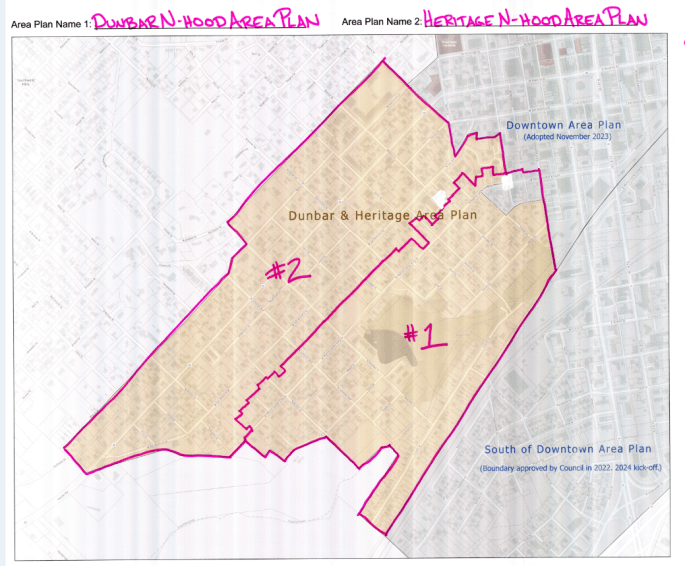
The city is diving into its first Area Plan, which was going to be the Dunbar-Heritage neighborhood. Discussed before, here.

Here was the boundary:

The very first thing that happened is that P&Z declared that this was a terrible idea. It needs to be split into two separate area plans, Dunbar and Heritage. Council agreed.

(Why? Historically, Heritage has always gotten all the resources and city attention, and Dunbar gets neglected. So we’re trying to stop doing that. This way each neighborhood can determine their own priorities and character.)

So tonight, we have new boundaries for two separate area plans:

All done! Splitsville.

(Now to write the actual area plans.)

Item 16:

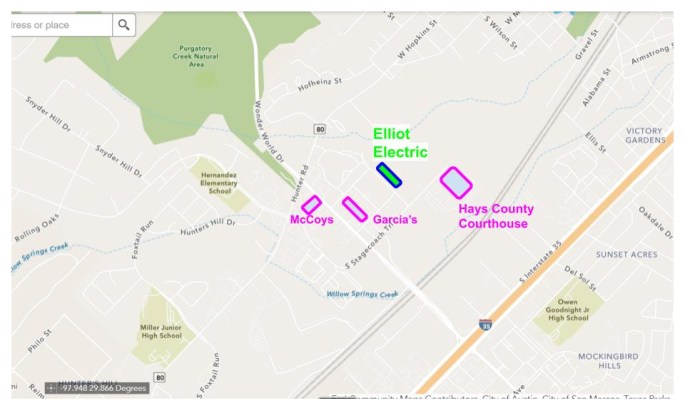
This warehouse place – Elliot Electric Supply – is off Wonderworld:

They’ve been operating since the 90s.  

There were townhomes built here: 

They were built in 2019.

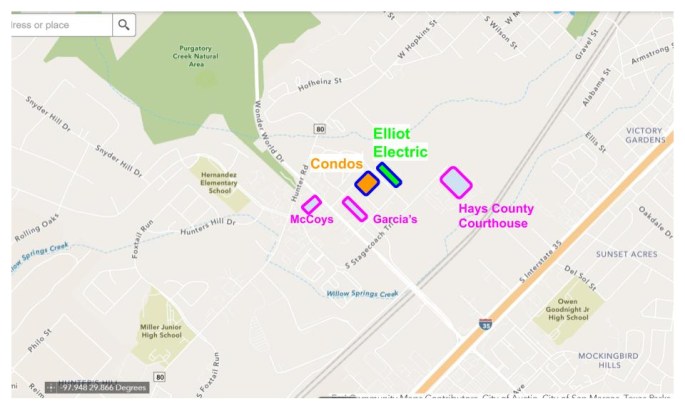
Elliot Electric is in the yellow box below, and you can see the townhomes right across the street:

Here’s the problem: the developer who sold the townhomes did not disclose to the buyers how noisy the warehouse business is. The homeowners get woken up every night around 3 am, with delivery trucks, forklifts beeping when they back up, loud music playing, and so on. 

In April, the warehouse guy came to P&Z for a permit to expand his warehouse.  A bunch of condo owners showed up with a number of complaints.

The branch manager came across as a very sympathetic guy who had not been told that the neighbors had all these complaints, but was willing to work with them.   He gave them his personal phone number and agreed to a fence to block the noise:

It also runs along Dutton Drive, which seems like the important part.

Ultimately, P&Z felt like the business has seniority, since they’d been operating this way for about two decades before the townhomes were built.   So they approved the permit.

Sidebar: So what went wrong? How did we get here?

The townhomes were approved by this same P&Z, in this meeting.  There was no mention of noise nearby.  Probably the city staff weren’t aware and P&Z wasn’t informed.

If staff had known about the noise, they probably would have recommended a deed restriction, where the developer had to inform potential buyers about noises next door. But that did not happen.

I don’t think anyone was being a jerk here. But it would still be good to figure out a way for everyone to get some sleep at night, without wrecking this guy’s business model.

….

This brings us to Tuesday’s meeting: the condo association is appealing the P&Z decision to council. They want quiet hours.

There’s two problems.

First, San Marcos already has a noise ordinance. It’s just a matter of getting someone out to document it.

Second, it’s not really the local employees that are playing loud music, driving forklifts, etc at 3 am. It’s delivery drivers from Austin and San Antonio. They have keys to the place, let themselves in, unload the delivery, and head out.

Also, if they get the permit for the extra warehouse, it will (supposedly) help block some of the noise.

Council ends up circling in on some extra requirements:

  • Apparently there are noise-cancelling and white noise forklift add-ons, for the back up beep. Elliot Electric will put these on.
  • There will be conspicuous signs about how overnight workers need to keep it quiet

The vote: Should Elliot Electric keep their permit, with these extra requirements?

Yes: everyone
No: no one

The actual solution here is to build relationships. The condo owners should use the branch manager’s personal cell phone number to let him know when they’re getting woken up. But they should be nice about it, and assume he’s doing the best he can. (And he should do the best he can.)

Items 17-18: Two LIHTC projects.

LIHTC sounds for Low Income Housing Tax Credits. There are two separate projects being proposed.

The last time we saw a LIHTC project was here:

These were fake-affordable housing. But it was free for the city – they were going to the state for tax breaks.

Whereas these next two are not free for San Marcos, so they’d better be more legit. (Which they are!)

The first one is on McCarty, here:

between Hunter and I-35.

This one is supposed to be a retirement community, so it’s all 1 and 2 bedrooms.

Here’s the affordability part:

The important part is that first row: 34 units will be reserved for people earning under 30% of the Area Mean Income, or AMI. (We’re part of Austin metro, so we use Austin household income levels. It’s not ideal, but we can’t change that.)

Technical note: See in the first row where it says $0-$35,040 as the income range? That’s misleading, because that’s based on a family of 4, but these apartments are reserved for seniors. For one person, the 30% income cut-off is $24,550, and for two people, the 30% cut-off is $28,050. (Full AMI chart here.) You should also ignore the $58,401-$70,080 for the remaining 188 apartments. For one or two seniors, the income cut-off in this bracket is $40,900 or $46,750, respectively.

Point being: those 34 apartments are legitimately reserved for people without much money. This is good!

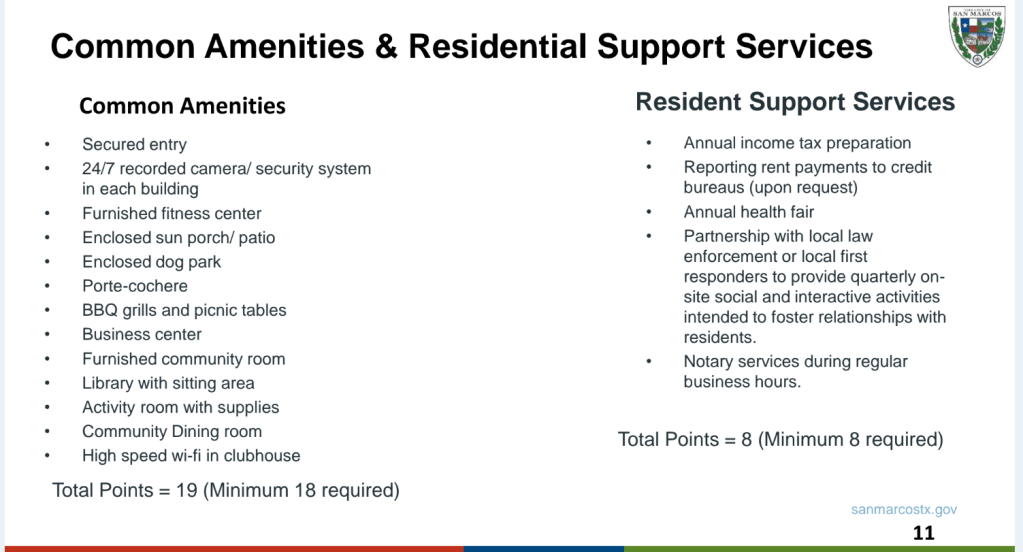
In addition, there are services for all residents:

I mean, fine. These are fine.

The property tax estimate for 18 years is $7,262,589, which works out to about $400K per year. So that’s the contribution of San Marcos to this project: about $400K per year.

The second LIHTC project is here:

Out between Centerpoint and Posey Road.

Here’s the affordability:

These are 1, 2, and 3 bedroom units. Here the income ranges do make sense, because there will probably be families living here. So there will be 55 units reserved for the lowest income bracket.

Great!

Services:

More services than the first place, but the location is worse. You don’t have Target and everything around the corner.

The property tax estimate is $4,000,000 for 15 years, or $266K per year.

I don’t totally understand how these things work, because:

  • This is cheaper per year than the first place – $266K vs $400K
  • There are more low-income units here – 55 vs 34

And in addition, this second place is offering us a cash-back offer. So clearly I’m missing something about why all this makes sense.

For the cash-back offer, Council has a choice:

  1. They’ll pay us $36,666 per year for 15 years, so we’d get $550K total.
  2. Or, they’ll pay us $400K up front.

Council goes with the lump sum payout. Especially in lieu of the 3 pm workshop, where our budget took a beating.

Side note #1: Note that both projects are both along the railroad tracks. Poor people get to live along railroad tracks.

You know how it went. Someone said, “What can we do with this land, along the tracks? No one with money would live here. Maybe we get some poor-people tax credits and make some affordable housing?”

(I loathe wealth segregation so much.)

Side note #2: Both these complexes are reserving 15% of their units for people earning under 30% of the AMI. That’s because the city of San Marcos fixed 15% as the requirement for LIHTC applications.

We used to require that you set aside 25% of your units. But we didn’t get as many applications, and so we changed it to 15%. I don’t know how I feel about this.

But look. This chart is from 2017:

So seven years ago, we had a shortfall of 4233 rental units for all households earning under $35K. We have not updated these numbers since then.

These two LIHTC projects will yield 89 units. That’s a drop in the bucket.

This Council is not serious about housing affordability. If they were, they would start by dusting off the Housing Action Plan (which was deep-sixed in 2019) and updating it. They would listen to the research about what it takes to increase the affordable housing stock. (This is going to come up when we get to Tiny Homes, at the end of the meeting.)

In fact, city staff gave a workshop on the Housing Action Plan last July. But since then … <crickets>. It is up to Council to put things on the agenda and actually make them happen, and they are not doing that.

August 3rd City Council Meeting, (Part 4)

Anything else of note?

  • Some housing developments are moving forward:
    • a block of condominiums buried back by the Hays County Government Center. Good location – infill without threatening any neighborhoods. Close to schools, parks, and businesses. The drawback is that it’s near Purgatory Creek, and it’s not great to develop that close to it, but the entire plat is already mostly developed. There was some conversation about making sure that they do an archeological survey first, which is also good.
    • More on that Whisper Tract, northeast of town. That whole area is a little bit sprawl-y for my tastes, but at least it’s not environmentally sensitive.
  • The funding opportunities that were discussed in July were finalized. Important but not controversial
  • Mr. Exotic’s Steakhouse. Oh lord, these guys. Here is my best speculation: a couple dudes said, “We want to open a nightclub on the square! But we’ll never get permits. Let’s open as a restaurant and then run it like a bar!”
    “Yes, yes, this will be great!” they all congratulated themselves.
    “We need a name that straddles both a plausible restaurant and a plausible nightclub. How about Mr. Exotic’s?”
    “yes, yes, great! It can masquerade as an exotic game steakhouse.”

    So they trotted off for an alcohol CUP to P&Z, where they got swatted down HARD. The kitchen was way too small to be a restaurant, the menu was laughable, they’d gotten in trouble for starting renovations on a historical building without work permits, and then they’d violated the stop work orders and gotten busted doing so.

    Now they were appealing the decision to Council. They came, quite contrite, apologetic and asked for more time to get their act together. Commissioner Derrick pointed out that the one dude who now claimed to live in San Marcos was staying at a short-term rental with a long history of disturbing the peace. It seems he owns the rental, but has been a crappy landlord?

    In my opinion, this was all the flimsiest of facades. “Oh, we have to play hangdog to get the alcohol permit? Look at our sad, sad faces!”

    A guy from Code Enforcement basically said these guys were truly unusual in how many violations they’d racked up in short order.

    Commissioner Scott went on the dumbest of rants, first accusing the Code Enforcement guy of having an axe to grind, and then about how the people need restaurant choices! A steakhouse would be great on the square! (Yes, but if you think this will actually result in a steakhouse, then I’ve got a bridge to sell you.)

    It was pointed out that you can run a steakhouse without a CUP. Have it be BYOB for a year, and then they can re-apply.

    In the end, the vote to postpone passed.
    In favor: Scott, Gleason, Garza, and Hughson
    Opposed: Baker, Gonzalez, and Derrick

    Garza did her extreme naivete thing, where she appeared to genuinely feel that both Derrick and Scott were equally sincere in their rants.

    So this item will come back around in another month or so. Amusing but ultimately doomed and not important, in my opinion.
  • A discussion on raises for four city employees, who were individually named. I guess these four are hired directly by council. Commissioner Baker sparked a long discussion by asking for reports on their SMART outcomes from the year before.

    Hughson was literally like, “I’ve never heard this acronym before and I’m confused and suspicious.”

    The discussion was very unclear to me: did they set these goals only in May 2021, or did they set goals both in May 2020 and in May 2021? Baker’s request to see outcomes only makes sense if there were SMART goals set in May 2020, which could then be measured, etc, a year later. But Hughson et al were clearly acting like they were brand new to this topic and hadn’t heard these terms before, and were acting like it Baker was proposing to evaluate the employees on their brand new goals. The whole thing was a mess.

    Finally they settled on having a workshop to explain what SMART goals are. Hughson seriously needs this – she was saying things like, “It’s not fair to make them accountable for measurable goals that they don’t have control over! If they say they’re going to process 20 applications and then 10 come in, that’s not THEIR fault!” (To be explicit, that would never be a SMART goal. You’d make it something like, “If there are fewer than 10 applications in a week, they will be processed within 7 days.” Or whatever.)
  • A discussion on reducing the number of false alarms for residents before fines kicked in. To be clear, this has nothing to do with 911 calls, which was my concern. This is home alarm systems that automatically call the police when they go off. Furthermore, it was just aligning a discrepancy between two ordinances. Truly nbd.
  • Mexican-American and Indigenous Heritage and Cultural District was postponed.
  • The Dunbar School Building. This is the small, currently shuttered building behind the Dunbar building. It is very old, and served as the African-American school historically. Clearly it should be renovated and given its proper historical accolades.

    At some point, a city form implied that it might be converted into bathrooms. The city maintains that this was a straight up clerical error. It could be, or it could have been someone who was ignorant, or racist, or both, and sincerely thought it was a great location for bathrooms for the playground.

    There was a heartfelt letter from a citizen whose name I recognized but couldn’t quite make out, who was deeply offended by the implication of converting the building to bathrooms. She is a long-standing member of the African-American community, I believe, and likely either attended or knew people who attended the school.

    City council members, for their part, are falling all over themselves trying to really, really make sure that NOWHERE is the suggestion that it should be bathrooms. The error has been long since corrected, and they are GRAVELY sorry for the mix-up.

    LMC, for her part, is fanning the flames on this, and citing the issue in nearly every comment she gives, which is generally ~3-5 per meeting.

    Anyway: There was actually an agenda item on the Dunbar School Building. Everyone enthusiastically voted to support the restoration of the building.

And that’s a wrap! The August 3rd meeting is on the books!