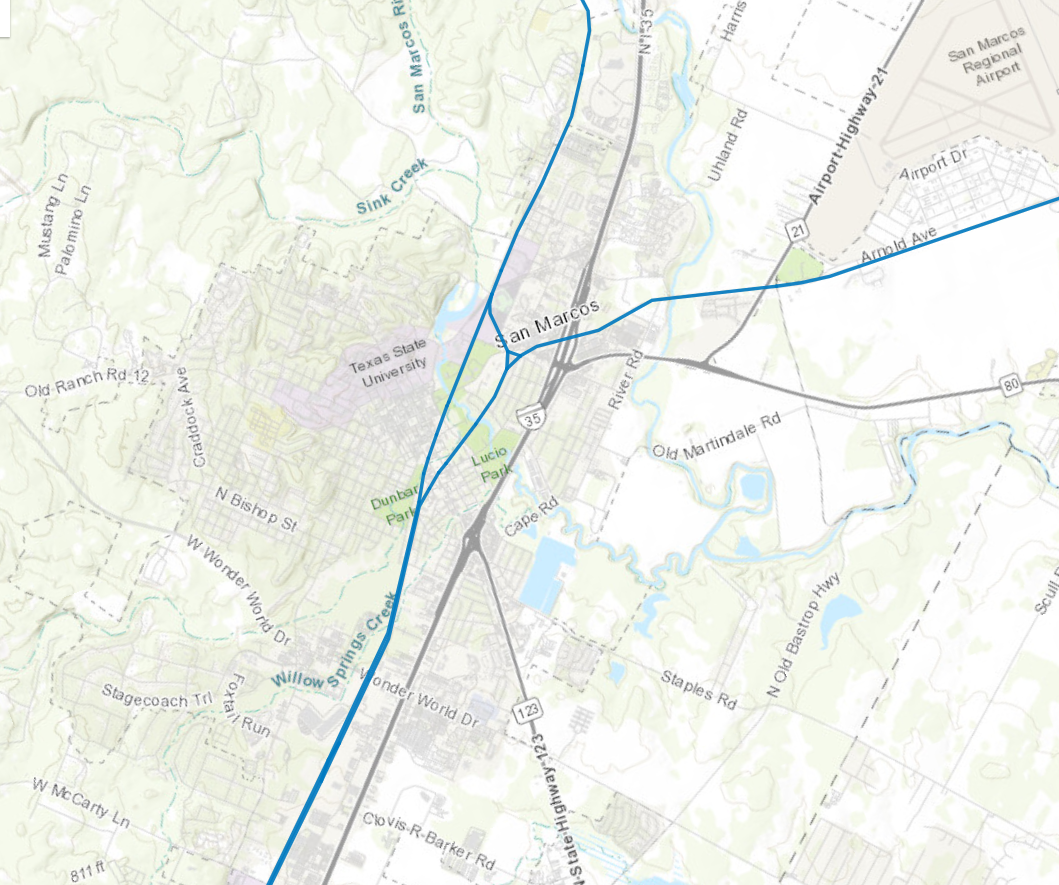
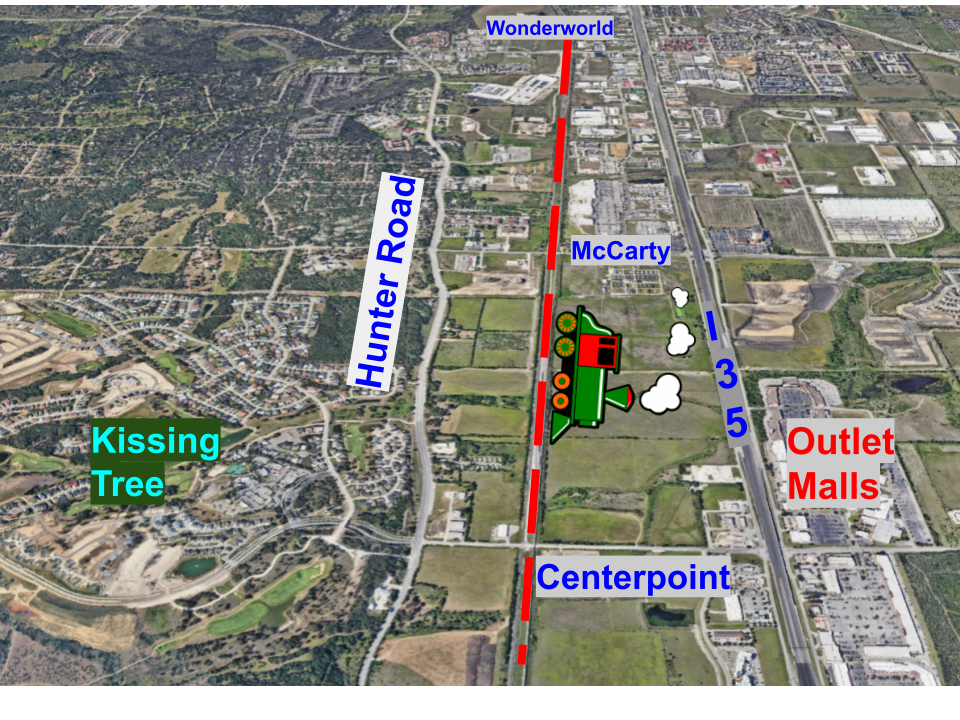
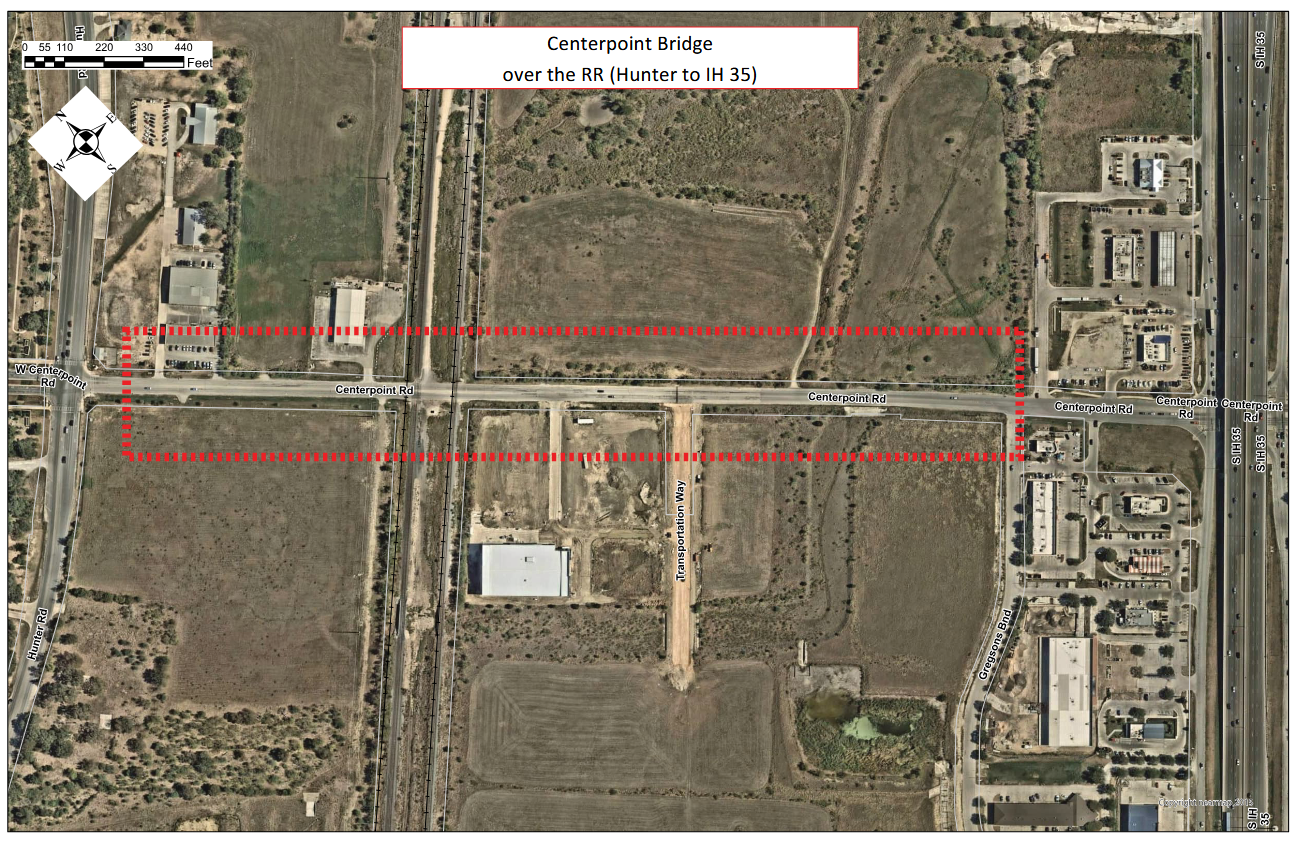
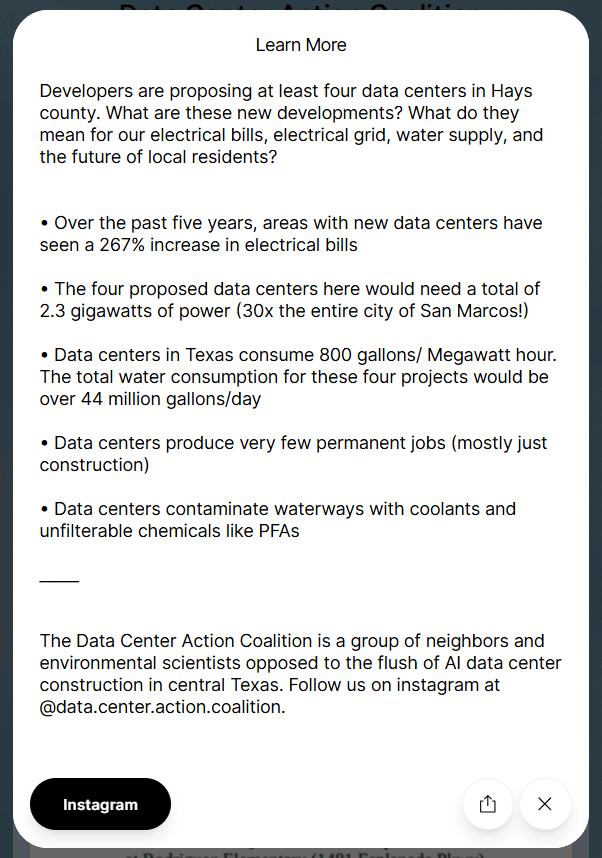
Hours 0:00 – 3:21, 12/16/25

Citizen Comment:

Two big topics! (I’m combining comments from 3 pm and 6 pm.)

Cape’s Dam nomination to be on the historic registry:

  • 5 people opposed
  • No one in favor

    The Data Center

    • 2 people (both developers) in favor
    • 10 people opposed.

    Details on what people actually said when we get to these!

    Other comments:

    • Update on the San Pedro cemetery: replacing historic pillars, repairing fences, surveying property bounds. Issues of drainage and erosion. We support low impact development nearby, but we’re concerned about something busier.
    • Kissing Tree gets called wealthy, but we worked for decades. We pay a lot in taxes. We need good jobs to fix poverty. Yay development!
    • San Marcos Civics Club is going to start issuing environmental score cards for each council member.
    • Support for naming the new airport road after Lieutenant Colonel George C Carruthers

    Item 8: Cape’s Dam

    This item was pretty infuriating!

    It’s also not the most important thing ever?  I’m trying to keep perspective? I was irritated, but this is small potatoes.  

    Backstory:

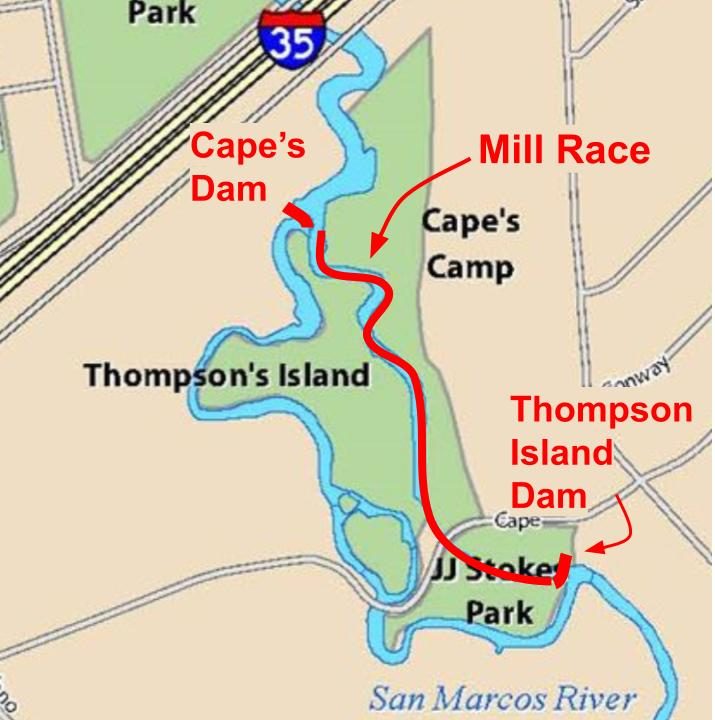
    From 1867-1942, Cape’s Dam was a functioning dam. The dam creates a calm little side channel to the river, called the Mill Race:

    Since the dam closed, the Mill Race has basically been treated as quasi-private property for kayak and paddling retreats.

    The Army Corps of Engineers often likes to remove old dams. In the 2000s, the folks at the Meadow’s Center started working on this study saying Cape’s Dam is bad for endangered species.

    Around 2015, Council is looking at whether they should remove the dam. But before they decide, Cape’s Dam is destroyed by the 2015 floods.  It’s now dangerous.  The Mill Race is also not usable anymore.

    2016: Council approves removing the dam and filling the Mill Race. The federal government will pay for it.

    This turns into a huge controversy. There’s a campaign launched – Save the SMTX River! – challenging the Meadow’s Center report and saying they’ve got different scientists who say different things. They basically want the Mill Race to be preserved for recreation, but they’re making an environmental argument? and a historical argument?

    (Incidentally, the Save the SMTX River guy is also one of the Brighter Future for San Marcos PAC guys.)

    Council backtracks on their decision. The federal funding expires.

    Everything grinds to a halt for a decade.  Council keeps passing the hot potato.

    Ten years go by. In the meantime:

    This past March, Council finally dusted this whole issue off. 

    They authorized a feasibility study, to answer these questions:

    1. What’s the current conditions of the dam and the whole area?
    2. What would it take to rebuild it? Or partially re-build it? Or just remove it?
    3. What’s the environmental situation? What’s the permitting process?
    4. Do a bunch of public outreach and get public feedback.

    I can already tell you some answers!

    • The current dam has to first be removed, whether or not it is rebuilt afterwards.
    • You cannot rebuild without permission from SMRF, because they own half the land, and they have said many times that they are a hard no.
    • You cannot rebuild without lots and lots of money, which we do not have.

    This will all come to a boil in the next few months! Exciting times. (Full backstory here.)

    Which brings us to tonight! Cape’s Dam has been nominated for placement on the national historical registry.

    Is there a legitimate historical claim? 

    Kind of yes!   The area was has a historical plaque with the Texas Historical Commission from 1979, in 1985 it was declared eligible for the National Register, and in 2017, it was included with a broader number of dams declared eligible for inclusion in the National Register. In addition, there’s credible evidence by a Texas State prof about the role of slave labor in building the dam.  

    So what’s new tonight?

    Preservation Texas is nominating the Thompson-Cape Dam and Millrace to actually be on the National Register of Historic Places.  

    Lots of things about this are irritating!

    1. This is a rush job. You can submit nominations every three months, but the nomination people are determined to submit by the January 16th deadline.  This one is URGENT, full stop, no flexibility.
    2. Whoever is behind this is keeping their name hidden*.  The nomination came from Preservation Texas.  No one with local ties has put their name on it in any way.
    3. The complex already has plenty of historical recognition! There is no new development.
    4. All land owners are supposed to consent, but SMRF was not notified, and has not consented.

    *Aren’t I the biggest hypocrite! I also love hiding out in shady anonymity. I’m a jerk.

    ….

    How does that long, tiring backstory affect Council’s thinking on this issue?

    Council: LALALALALALA WE CAN’T HEAR YOU!

    Basically, Council members all pretend to be brand new babies born yesterday, who have never heard of the 10 year fight I just told you about.

    The most generous interpretation: council members are willing to nobly set aside long-standing feuds, and consider this on its merits.

    The least generous interpretation: council members are gleefully taking part in a craven attempt to sway the larger outcome by miring it in bureaucracy.

    You be the judge!

    What did people say at Citizen Comment?

    • This is a ruse to force Council to rebuild the dam.
    • The dam is full of contemporary materials, like concrete sandbags
    • No effort has been made since 1950 to preserve the historic nature of the dam
    • This was a timber dam, which is a low cost, quick dam
    • There are 8 other dams on the river, and they’re also all super old

    And most importantly, the San Marcos River Foundation: Look, we own the land on one side of the bank, and we were not notified. The rules require that all owners give consent. We didn’t.

    Council discussion!

    Jane: What exactly do they need from us?
    Answer: The Texas Historical Commission (THC) wants two letters – one from Council and one from the San Marcos Historical Preservation Committee (HPC) – saying they support the nomination. 

    Jane: Can we postpone this?  It seems very rushed.  The State Board reviews these every three months. Can we just wait till March?
    Answer: The applicant specifically said they are not willing to postpone until March.

    Amanda: Yes, this seems very rushed.  What about just waiting until after the San Marcos HPC meets, and hear what they recommend?

    Answer: Usually yes.  We prefer to have committees present their recommendations to Council.  But the timing doesn’t work out.  SM-HPC will meet on Jan. 8th, and then you all don’t meet until Jan 20th. But the letter is due Jan 16.

    Saul: The dam is not even close to the original structure. It’s got cement sandbags. I’m a no.

    Lorenzo: I’m a yes!  Wouldn’t that be great for people to see SAN MARCOS on the national historic register, when tourists come to town? 

    Jane:  Why didn’t the people who nominated this reach out to the city?  Where are they? We have a priority list of historical places. This leap-frogged over a bunch of other places on our list.

    Saul: Would this prevent us from making a decision about whether to rebuild or remove the dam?
    Answer: It carries political weight, but not legal weight.

    In other words: this vote sends a message to the public about which side your bread is buttered on. But it’s not legally binding.  You’re allowed to tear down the dam. 

    Amanda: This nomination provides a specific historical narrative.  It was white-washed to make white people look like noble saviors of enslaved people. If we send a letter of support, then that’s the version that will end up in the national registry.

    Alyssa: Yes, they’ve romanticized it.

    Jane: That’s why I want to send a very minimal letter.  We won’t address the historical narrative part of the application. We’ll just say, “Yes, there is a historical element!”

    Alyssa: Omissions are just as bad! That’s how status quos continue to flourish!  Whatever is in this application will be the skeleton of the final narrative.  That’s how these things work.

    Jane: Then let’s just be vague!

    Alyssa: That doesn’t make sense as a response to what I’m saying.  We’re writing a letter in support of a nomination. 

    Jane: I’m trying to be minimal! 

    Alyssa: …which will be interpreted as support, unless we’re explicit about what we don’t agree with.

    Matthew:  None of this matters!

    Shane: What’s the harm? 

    Lorenzo: Surely the Historic Registry will do their due diligence.  Let’s just pass this and let them do the heavy lifting. 

    Amanda: I want the narrative to acknowledge the role of enslaved people. 

    Matthew: The Cape family did not own slaves!

    Jane: The whole slavery thing is very contentious. Different people think different things.

    Amanda: Slavery is actually in the nomination already.  Didn’t you guys read it? I just don’t like how they handled the topic.

    Amanda is correct:

    and

    Alyssa: Clearly this is going to pass, so I’m going to suggest some language for the letter. 

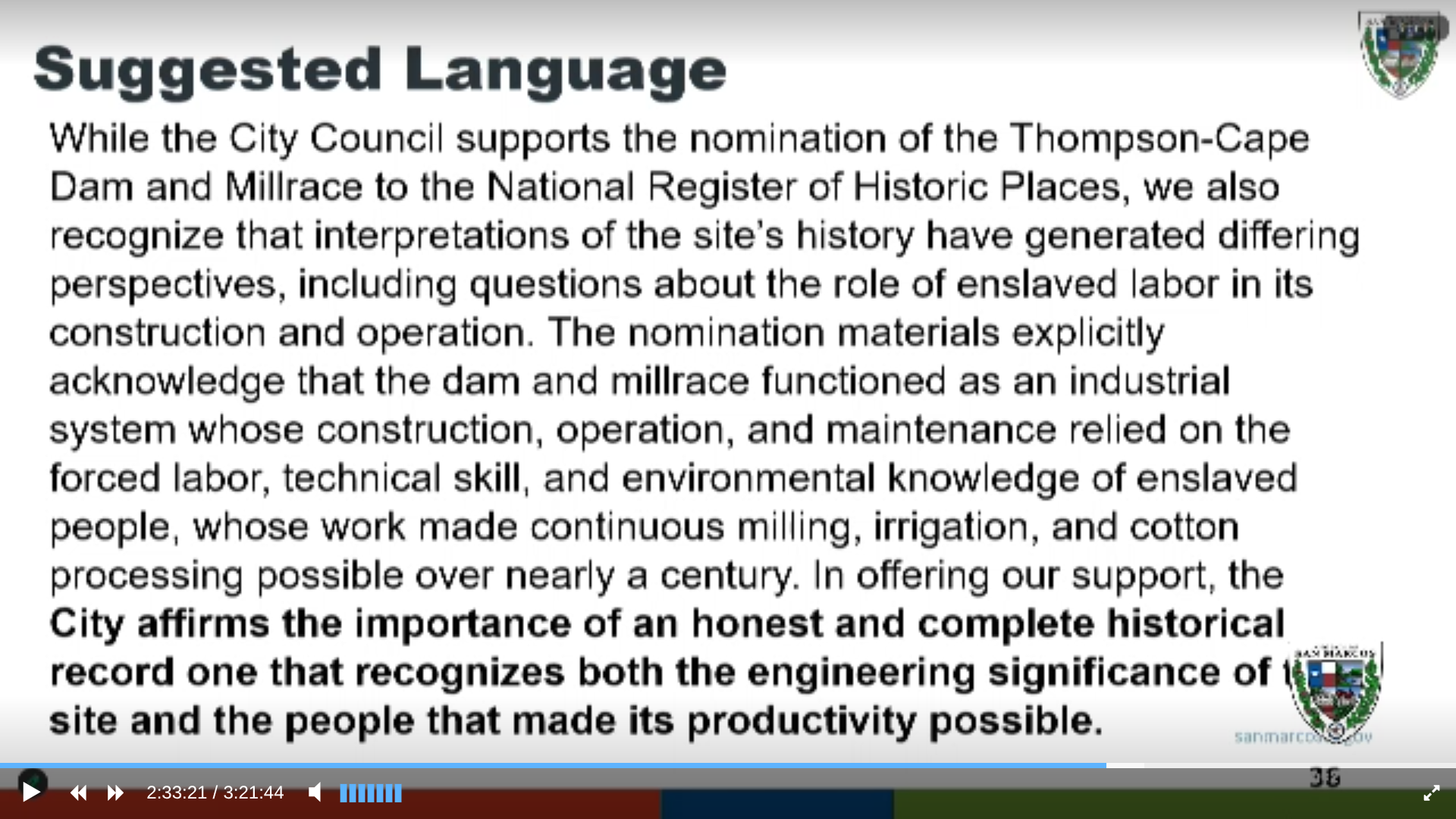
    Proposed language, after some tinkering:

    They also include a note about how SMRF wasn’t notified.

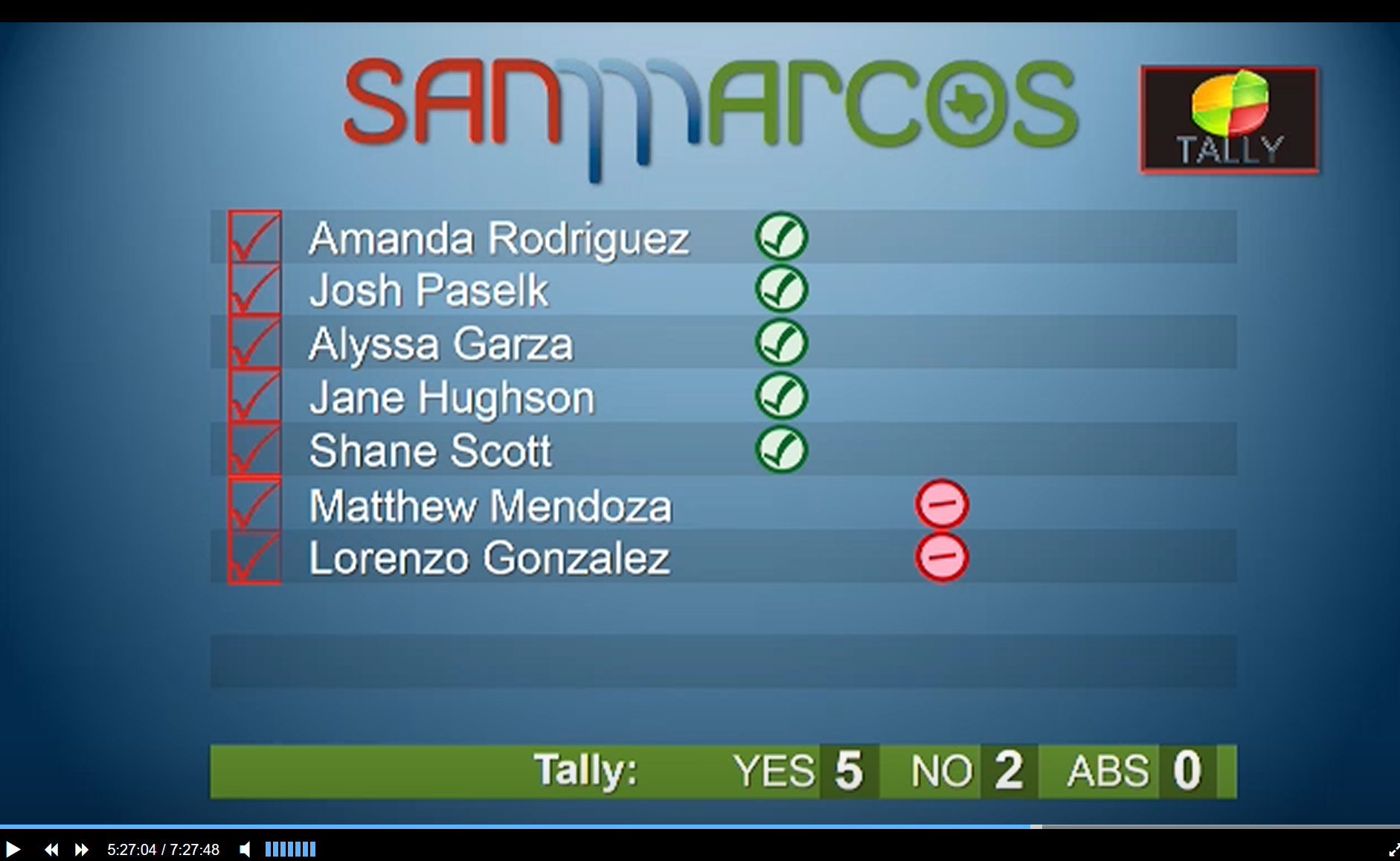
    The vote: Should we support the super urgent nomination that absolutely cannot wait until March?

    So there you have it.

    ….. 

    Finally, let’s have a little reality check!

    The national registry is a big deal. Currently there are four historic landmarks for central Texas on the national register:

    1. The San Antonio Missions
    2. LBJ’s childhood home
    3. El Camino Real trail
    4. Mammoth Caves in Waco
    via

    Will Cape’s Dam be the 5th most historic thing in the entire greater Austin-San Antonio corridor?!?

    Seems unlikely.  Like I said, this is small potatoes. 
    Item 9: The Data Center

    Backstory: This developer, Mayberry, bought some land down here, a few years ago:

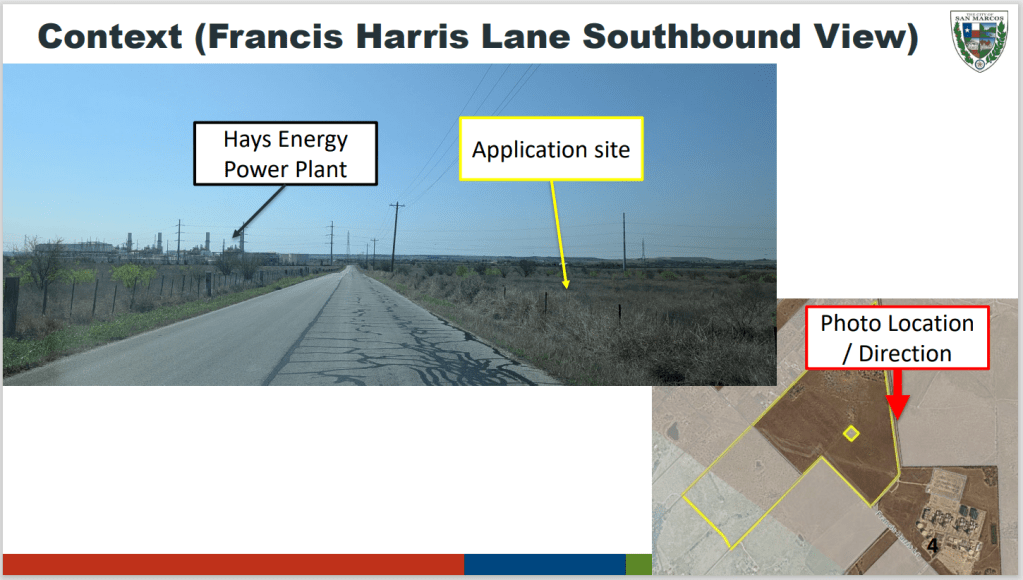
    Right next to the Hays County Power Plant:

    He wanted to build some homes. It turns out this was a terrible investment. Now he’d rather build a data center, instead. Could he please have a rezoning?

    The town responded HARD against this. People who live on nearby farms say it will ruin their way of life. People are worried about extreme water use during a drought and heavy electrical use from the shaky ERCOT grid. Tons of people have put in a lot of effort into fighting this data center.

    Last spring, P&Z turned him down. It went to Council in August, and Council didn’t have enough votes to overturn P&Z. So it failed.

    However, Council did not put the final nail in the coffin. They left a trail of breadcrumbs for Mayberry to come back.

    He dutifully followed the trail, and here we are. (Full version of the backstory here.)

    Tonight is just a presentation.

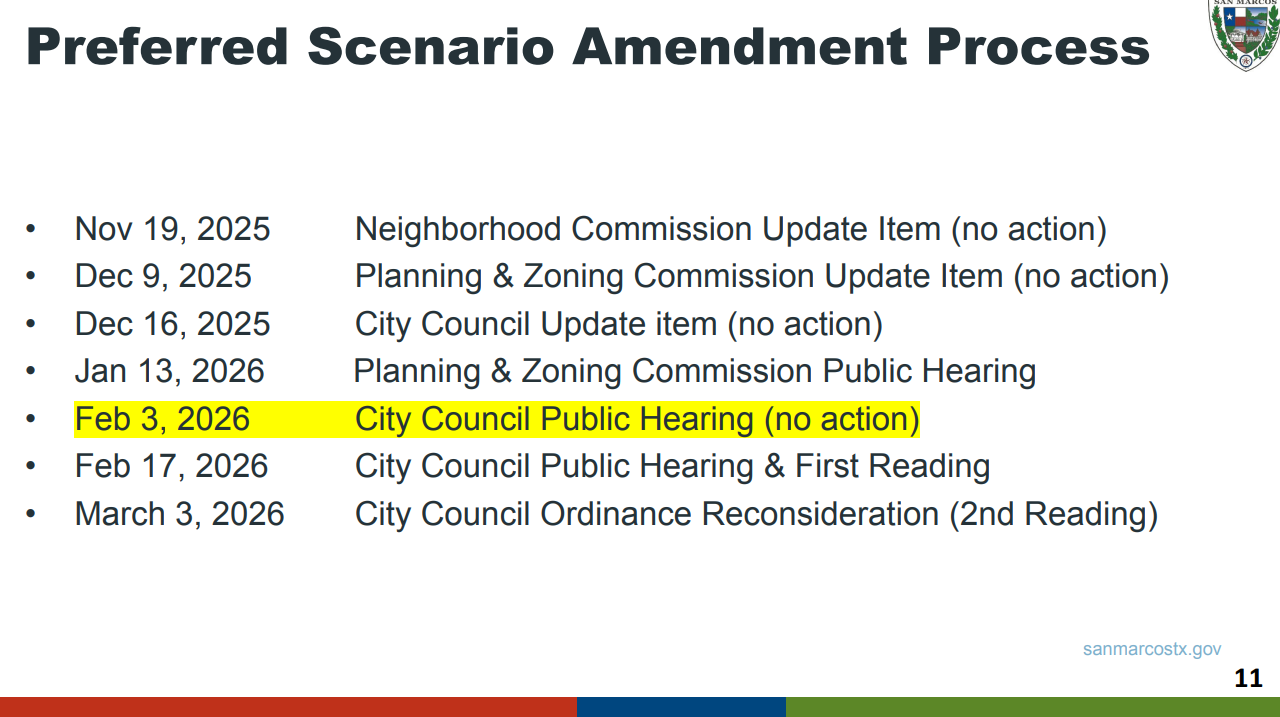
    Mayberry is back. Here’s the timeline:

    His pitch is going to be that he will sweeten the deal via a restrictive covenant.

    Here’s what he’s proposing:

    We don’t have the formal contract yet, though.

    The two big issues are water and electricity.
    Water: Texas has a big water shortfall. The 2022 State Water Plan projected big shortfalls, and everyone is working with those numbers. But ChatGPT didn’t come out until November 2022. There are now already over 400 data centers in Texas. The water use from these data centers is not included in the 2022 projections, but it’s all we’ve got.
    This data center would get their water from Crystal Clear. Crystal Clear gets their water from:

    • Edwards aquifer
    • Lake Dunlap
    • Carrizo-wilcox
    • SM River 

    By 2040, Crystal Clear is projected to be -40 acre-feet of of water. As in, they don’t have enough water rights to cover projected demand. And that’s using the 2022 pre-data center usage projections! Crystal Clear cannot deny service either. (This info was from an expert at citizen comment.)

    The proposal here is not the worst possible proposal. Evaporative cooling systems are the worst. This is a closed-loop cooling system. (I have no idea how many of the 400 data centers are evaporative.)

    Mayberry is estimating that they’ll use 25K-30K gallons of water per day, and they’ll put a hard cap at 75K gallons per day in the contract. That’s equivalent to the water used by about 235 homes. (Evaporative cooling centers are probably in the 100K-500K gallons per day range.)

    Electricity

    There’s a tradeoff between water and electricity. If you use less water, you’ll use more electricity. In addition, the Texas ERCOT grid uses water to cool the electrical generation plants.

    There is a longterm solution here – the more ERCOT switches to solar and wind-based energy, the less water needed to generate the electricity. (This is already cheap and available, if we want it.)

    Will utility rates rise? It depends on who you get your electricity from. This plant will be on Pedernales electric, so if you are too, then yes, it’s likely your rates will rise, too. But if you’re on San Marcos city utilities, your rates will not go up (yet).

    ….

    My $0.02: I’m conflicted, but I’m still basically in favor of this data center.

    Argument in favor: the data center industry is an absolute goddamn disaster for Texas. There are almost 100 between San Antonio and Austin. There are already four in the Hays-Caldwell area. This is catastrophic for the water shortage.

    But it is not a city fight. The heart of the problem is that Texas counties cannot regulate water and electricity usage. If we care about the water shortage and strain on the electrical grid, we have to fight that fight. Fight for county regulations of water and electricity use, and statewide data center regulation.

    In the meantime, we might as well take the tax revenue.

    Argument against: Maybe denying this one data center contributes momentum to a bigger movement against the other 400+ statewide?

    Listen, all you activists: You are on the right side of the issue, but you absolutely must join forces on a larger scale. The only meaningful answer is regional and statewide regulation.

    If I had to guess, good places to start might be:

    City Councils are much closer to everyday people than regional and state organizations are, but Council cannot move the needle on the problem. Any progress has got to deal with county land, outside of cities.

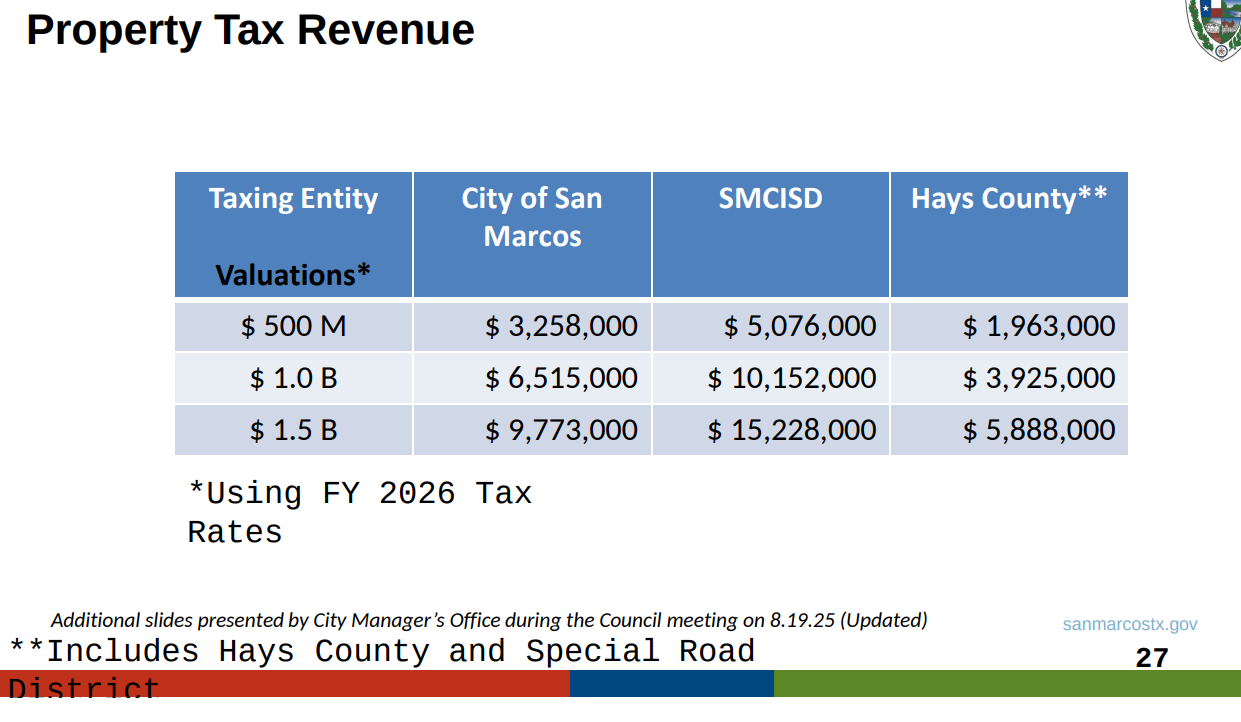
    Just for kicks, how much money are we talking?

    I don’t really believe those numbers. It takes years to build these things, markets can crash, etc etc. But still, a fraction of that tax revenue would be helpful.

    Hours 0:00 – 7:58, 8/19/25

    Citizen Comment:

    There is only one topic, but there are over two hours of comments. It’s all data center, baby.

    There were 14 speakers in favor. Here are the main arguments made by the people who want us to approve it:

    • These are all over the place already.
    • San Marcos needs the tax revenue.
    • I am the property owner, or I’m going to work in some way on this project, and it sounds great to me

    There were 29 speakers opposed. Here are the main arguments made by the people who oppose it:

    • We’re in a drought, and data centers use a massive amount of water.
    • Data centers use a massive amount of electricity. Our rates will go up, this is bad for the environment, and the grid can’t handle it.
    • Don’t sell out the San Marcos river to greedy corporations
    • Cyrus One is secretive and unwilling to answer basic questions.
    • Anecdotally, people have stories of odd illnesses from living next to data centers.

    There were another few speakers opposed at the 3 pm workshop, and then another 25 at the public hearings. (The vast majority were people speaking more than once, though.)

    This will take up the vast majority of the meeting, so we’ll unpack all these points. Stay tuned.

    Items 10-13: But first! we have the quickest little rezoning.

    Have you ever been driving south on I35, towards New Braunfels, and noticed these guys?

    They make concrete, and they’re here:

    The owner wants to zone two little blocks of land, between Heldenfels and I-35:

    He wants these to also be Heavy Industrial.

    No one is fussed. Everyone says okay.

    Items 14-16: Ok, it’s time for the AI Data Center. This is a doozy.

    Background: We are talking about land here:

    The property owner wants to zone this land Light Industrial, so that he can sell it to Cyrus One, a data center company.

    Let’s talk about data centers

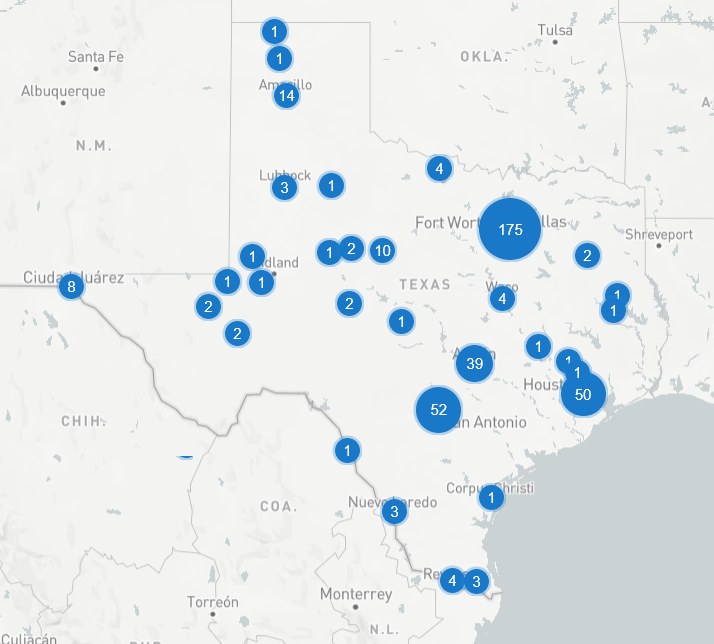
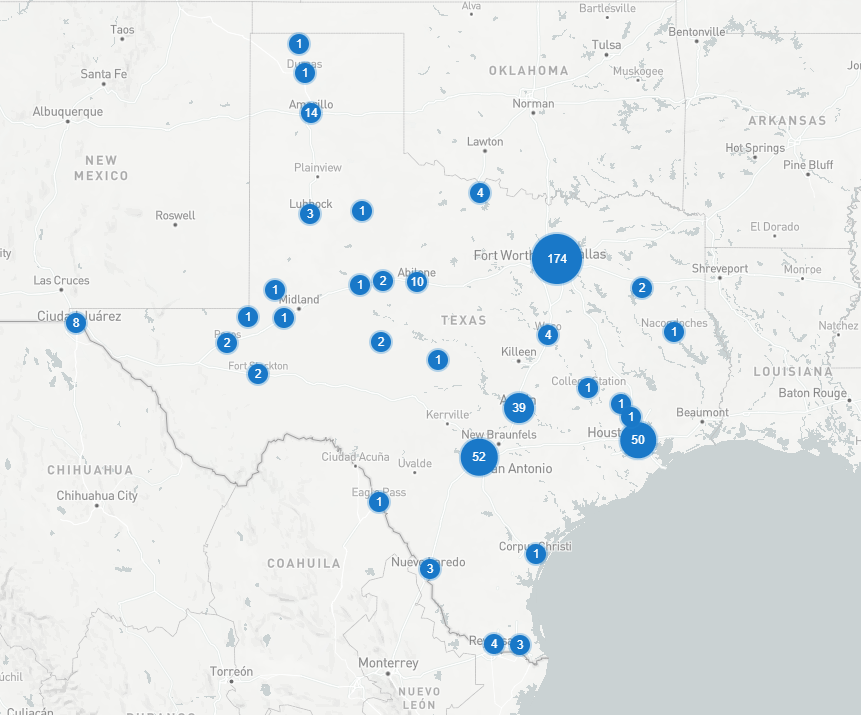
    Apparently there are 300+ data centers already in Texas. Of those, 40 are in the Austin and 49 are in San Antonio:

    via

    Not counting the one on tonight’s agenda, there are apparently two being developed in Caldwell County and three more in Hays.

    Data centers have two big problems: they use a lot of water and they use a lot of electricity. Texas makes this worse, because counties aren’t allowed to regulate use of natural resources. (Virginia Parker, director of the San Marcos River Foundation, said we’re the only state with this particular idiocy.)

    So as long as data centers stay outside of cities, there is currently no way to regulate how many get built.

    This specific data center

    The owner is a guy named Mayberry, and the property has a funny history. (Not funny haha.)

    Back in 2022, he asked the city to annex most of this land into San Marcos. He wanted to sell the land to a developer, to build single-family homes out there.

    This was always a weird, terrible idea! First, the sprawl would be insane. It’s farm land out there, not close to anything.

    Second, there is a massive power plant next door:

    Council had endless discussions about whether it was fair to build homes next to an extremely loud, bright, flashing power plant. In the end, they settled on a mandatory disclosure to potential buyers and some fencing.

    It’s been three years, and clearly no one wants to build these houses. So Mayberry has moved onto the next idea, which is this Data Center.

    But since most of the land has been annexed into San Marcos, he now has to get permission from the city to rezone.

    In this one data center, and only this one, we now have a say.

    Back in March, Planning and Zoning denied the rezoning. (In fact, this was Jim Garber’s last meeting.) Planning and Zoning had a ton of concerns.

    When P&Z votes down a rezoning, it takes a supermajority at Council to overturn them. So tonight, the data center will need 6 votes out of 7, in order to pass.

    We’re going to cover these topics next:

    1. Noise and lights
    2. Water
    3. Electricity
    4. Impact on San Marcos, and the Restrictive Covenant
    5. Property taxes

    Buckle up!

    1. Noise and lights:

    Staff basically says, “Look, plenty of data centers are in residential areas already and everyone seems to be chill with it. Look!”

    “Isn’t that so close? See?”

    “And also, what if Mayberry had built those homes! Wasn’t that an even worse idea?”

    (For the record, Jane, Shane, Mark Gleason, Saul, Alyssa, and Jude Prather voted yes for those homes, in 2022. Max Baker voted no.)

    The comparison to the imaginary, nonexistent homes is silly. The homes don’t exist.

    Here’s the real argument the city should have made: this data center is next door to the Hays County Power Plant.

    Seriously, the noise, lights, and weird vibes that come from this data center will be dwarfed by what’s already coming from the power plant.

    2. Water:

    Data centers run hot, and so they use a lot of water to keep the computers from overheating. A traditional, evaporative system uses maybe 550,000 gallons/day?

    Technology has gotten better, and now they use a closed loop system. You fill up the building one time, and then it keeps re-using that water for the lifespan of the building. After that, the only water needed is for employee bathrooms and kitchens.

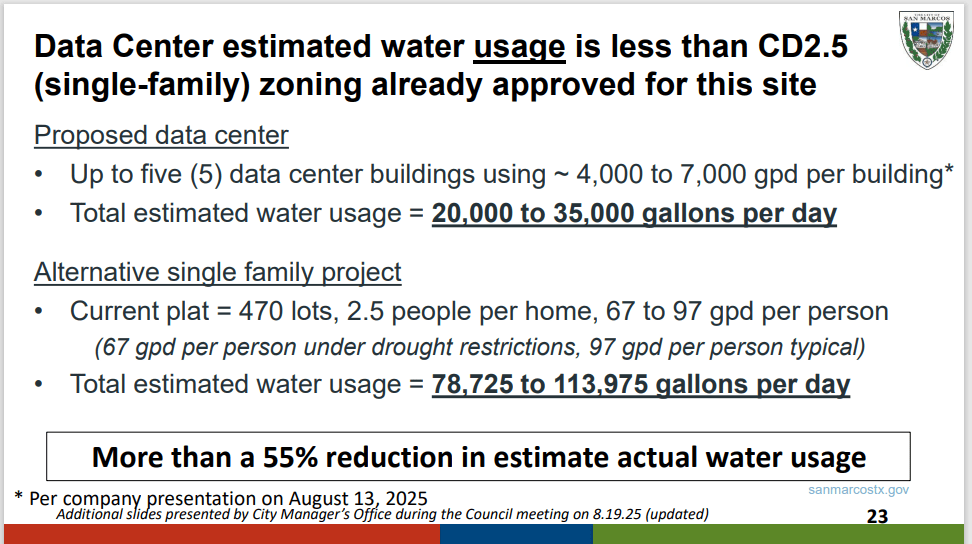
    Mayberry says that the initial fill up will require 60K-70K gallons of water per building, and there are 5 buildings. So roughly 400,000 gallons will be needed to fill the buildings, one time.

    After that, he says that each building will use about 4-7K gallons of water each day. That’s pretty normal for a business:
    3. Electricity:

    The electricity is insane.

    Mayberry says that each building will use about 75 megawatts of power. So over five buildings, they will use 375 megawatts.

    City staff says that all of San Marcos, at peak usage, is about 150 megawatts. Every single one of us, on the worst day in August! That’s insane. On a typical October day, all of San Marcos uses about 25 megawatts. So these data centers really do gobble up a ton of energy.

    Two questions come up:
    – Will this drive up water use, indirectly?
    – Will this drive up rates?

    Both answer are yes, sort of.

    Producing electricity requires water. But it’s not using San Marcos water – it would be from any power plant, in the entire state. All the electricity from all of the power plants gets dumped in the grids, and it gets blended around. When you draw electricity, you’re getting a random blend of all those sources.

    (Also, not all energy sources require water. Gas, coal, and nuclear all do, but wind and solar don’t.)

    The same is true for electric utility rates: all 300 data centers are putting a huge strain on the grid. More power needs to be generated, and that is going to cost money. But that cost is going to get spread across the entire state.

    Electric rates are spiking and will continue to spike, over the entire state.

    4. Impact on San Marcos and the Restrictive Covenant:

    This data center will not use San Marcos water or San Marcos electric. Water would be supplied by Crystal Clear water, and they’d get electricity from Pedernales.

    All data centers in central Texas are harming all of central Texas. The bad effects are distributed pretty evenly. We’re all using the same water table and tapping into the same electric grid.

    This specific data center does not specifically damage San Marcos or the San Marcos river.

    The Restrictive Covenant: A restrictive covenant is a legal contract of all the hoops that the developer is willing to jump through, for the city.

    Since getting knocked down at P&Z, Mayberry is trying to do whatever he can to get approved. Here’s his offer:

    and

    5. Why even do this?! (Property taxes)

    Allegedly, it would bring in an enormous amount of money.

    To put that in perspective: This past year, we’ve had a budget crisis, and city departments had to make cuts. Total, across all departments, we cut $100,000, and it was a huge strain. $9 million would go a very, very long way.

    My two cents

    I’m out of step with my readers here, and I apologize. I think we should take the money.

    Data centers are run by greedy, irresponsible corporations that do not care about local resources. They will exploit and destroy all the beauty in this state, if they can. Texas desperately needs to regulate this industry and limit the number of data centers that are being built.

    And yet!! I think we should hold our nose and let them pay us lots of money. There is so much need in San Marcos, and so much poverty.

    Rejecting this does not move the needle on the actual problem. Take the money.

    Here is what Council says:

    Matthew Mendoza goes first, and he is fired up. He says:

    • I voted against putting houses by the power plant. Terrible idea.
    • We didn’t annex SMART/Axis because of local activism, and now they’re building anyway, except unregulated. I get complaints every day from people who live in Pecan Park. Annexation means regulation, and that’s good.
    • We cannot run this city on tax income from neighborhoods. It’s not sustainable. You all don’t pay enough in taxes for how much it costs to run a city.
    • We need opportunities in this town. My blood is in the river and soil! Jim Garber was my scout leader!

    Jane Hughson goes next:

    • I have a ton of water cred. I was the first chair on the board of the Edwards Aquifer Authority, senior board member of ARWA, etc.
    • I’ve got some concerns, but I also am open to negotiation.
    • Listen up: you think you hate living next to a data center, but you would really hate living next to manufacturing. I’m trying to keep that from happening to you.
    • The amount of power needed is crazy. I have a lot of questions that we’ll get to.

    Saul Gonzales goes next:

    • No. I’m a hard no. I listen to my constituents, and they know more than me. Everyone knows my reasons why. No.

    (Ahem… everyone knows his reasons why)

    Amanda Rodriguez goes next:

    • I’m also a hard no. I’m not going to dismiss the voices of this many people.

    Let’s pause and talk strategy:

    This item needs 6 out of 7 votes to pass. Saul and Amanda are voting no. Therefore it can’t pass.

    But everyone pretends like this didn’t just happen! We proceed to have a detailed discussion for the next hour. It was a little weird.

    However: the ending is not black and white, so I’m going to force us to walk through all this slowly.

    The nitty-gritty questions

    Q: Can the restrictive covenant be changed?
    A: Yes. This is just a first reading. Staff can bring back changes for second reading.

    Q: Is the property owner willing to make the covenant permanent, instead of expiring in 20 years?
    A: Sure.

    Q: How can we enforce the covenant?
    A: A bunch of different ways:

    1. The biggest items are how buildings are built. We withhold occupancy permits until it passes inspection. We have a lot of leverage there.

    2. We can require them to submit their monthly water bill to the city, and make it publicly available.

    3. We have an (overworked, underfunded) code compliance division who will make the rounds out there and check for things like noise violations.

    4. For any other violations, we’d take them to court and get an injunction. Court orders them to stop doing whatever they’re doing.

    Q: How do you end up using 4-7K gallons of water in each building, each day?
    A: That’s pretty standard for a regular office building with a bathroom and kitchen. Nothing major.

    Q: If you ever had to drain the closed loop, what would you do with all that water?
    A: It’s got a ton of awful chemicals in it. It would need to be disposed of as a hazardous waste. That can’t go down the drain.

    Q: Can they build their own gas power plant and get around ERCOT?
    A: Not if they’re in the city limits. They’d need approval from P&Z. If they’re outside the city, yes.

    Q: Why does everyone have stories of how this will cause electric rates to rise?
    A: Electric rates will definitely rise, because of the 300 data centers across Texas. Whenever there are new grid costs, those costs are spread across the entire state. So we’re already facing this. This particular one doesn’t affect us any more than the rest.

    Q: Can you use reclaimed water on all your landscaping and stuff? Will you be sustainable?
    A: Sure.

    Q: Can you fill the original big amount of water using reclaimed water?
    A: Probably not worth it, to run pipe across the street for a one-time use.
    Q: but could we use a water truck?
    A: Yes, that would solve the pipe problem. We don’t know if it’s okay for a data center.

    Q: Go back over the part about how much water it takes to make electricity.
    A: It does take water to make electricity, if you’re using non-renewable energy. But not for wind or solar. But all the electricity goes into a big mushpot. So data centers just draw a big blend of energy. It’s not coming from the San Marcos river or anything.

    Also, if you’re starting a new power plant, you have to show ERCOT that you’ve purchased the water rights before you connect to the grid. You can’t just start using the Edwards Aquifer for your new power plant.

    Q: Remember that KUT article about how we’re running out of water? It was factually incorrect and scared a lot of people.
    A: I know, right?! That was crazy. It was like the author missed the part of the presentation with the good news. We reached out to them, but they ignored us.

    Q: Go back over the electricity usage again.
    A: Each building uses 75,000 MW of power, and there are 5 buildings. So they use 375K megawatts, altogether. On a typical day in October, San Marcos uses about 25K megawatts, and our peak usage is about 150K megawatts.

    HOLY MOLY.

    A: But keep in mind, they’re not on San Marcos power. But also keep in mind, the grid costs are shared by all Texans.

    Q: How easy would it be for them to go through disannexation from the city, and build here anyway?
    A: It’s actually pretty hard to disannex. They’d end up having to sue us.

    Q: So is Cyrus One backing out of the project? Why are they not here?
    A: No. They said they are “withdrawing from the zoning case.”

    Translation: Cyrus One does not want to deal with San Marcos residents. To be super duper clear, they are 100% assholes who will screw over everyone and anyone. (I’m still okay taking their money.)

    The vote

    By this point, it’s well past midnight.

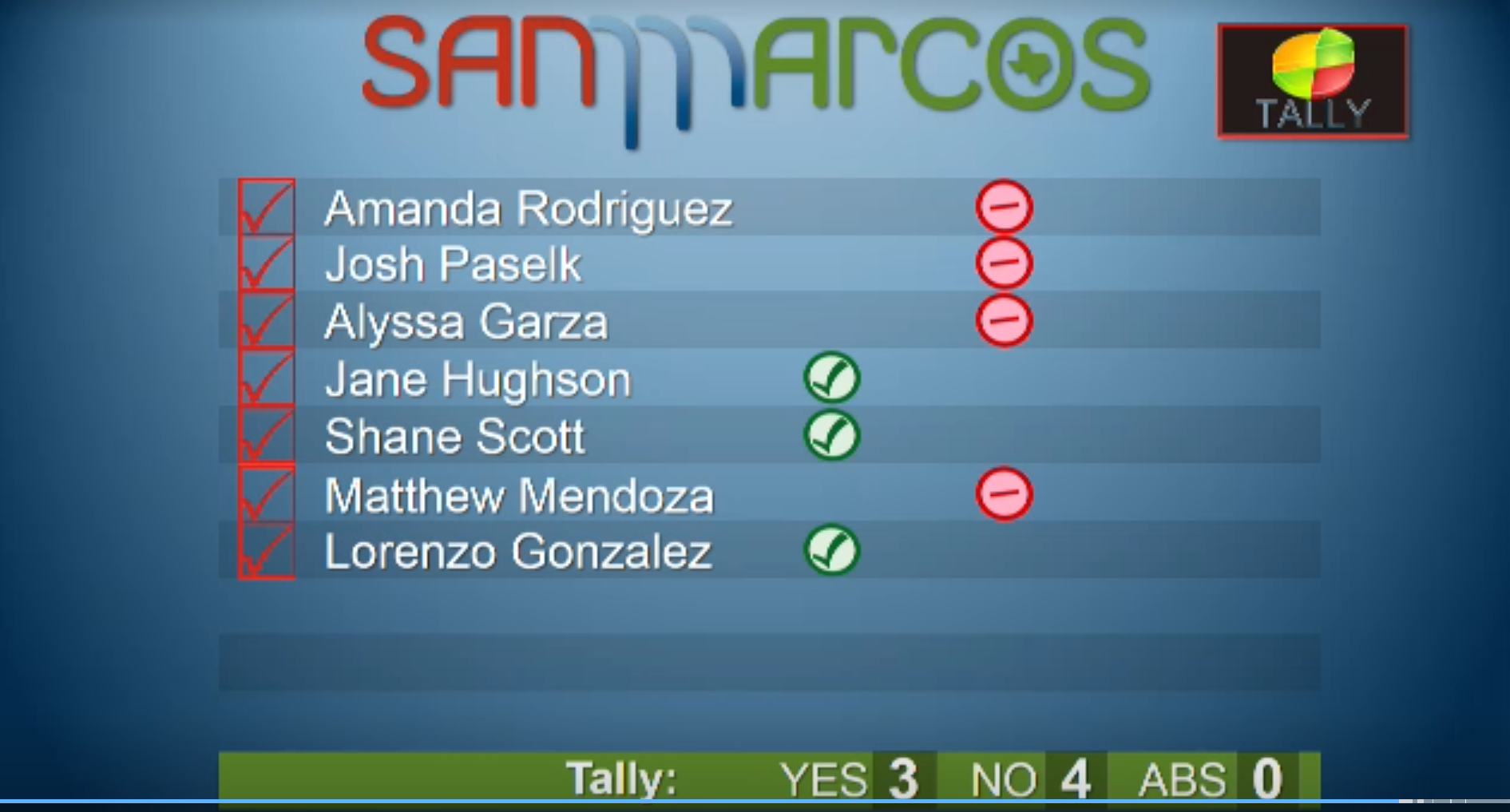
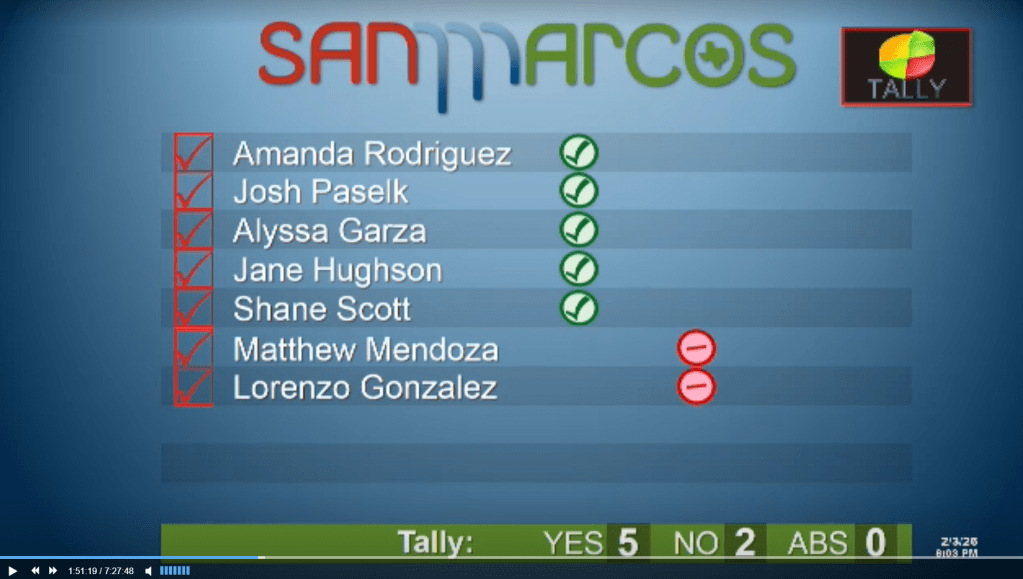
    It’s finally time to vote:

    So it fails! Remember, it takes 6 votes to override P&Z.

    Remember an hour ago, when Saul and Amanda both said they were “no” votes? Lo! it hath come! As heralded.

    The vote has failed.

    SO IS IT DEAD???

    No. This is where it gets murky.

    Council dabbles in entertaining the notion to send it back to P&Z. The argument goes like this: “P&Z didn’t see the restricted covenant. Maybe they would have approved it, if they saw the current version! And if they approve it, then council only need 4 votes to pass this, and not 6 votes.”

    However, Council cannot just send it back to P&Z. Either Saul or Amanda have to agree to reopen the issue. They both say no.

    Amanda, in fact, is quite angry: “You lost a vote. Quit trying to find a workaround.”

    (I mean, I’d be furious if I opposed the data center, as well.)

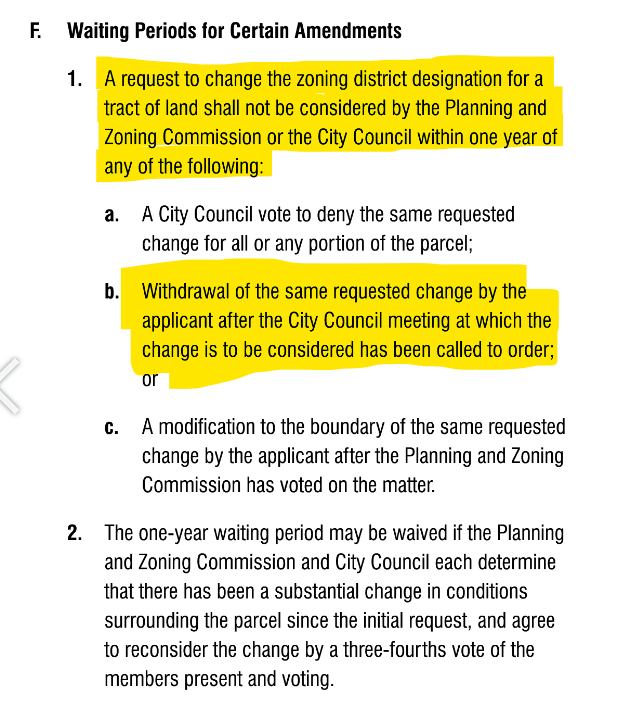
    Council does not quit trying to find a workaround! They have a giant conversation about it. In fact, they break out the giant rule book of technicalities, to figure out what’s allowed and what’s not allowed. Will the developer have to wait 6 months or 12 months to re-apply? Or can they waltz in tomorrow with this exact paperwork, and re-apply, and go to P&Z for approval?

    Answer: [This answer takes a while. Picture much shuffling of paper, scrutinizing all these detailed scenarios, double-checking what exact words were said. But eventually…] There is no waiting period. They can waltz in tomorrow.

    So there you have it.

    Bottom line: This application is dead. But Council left a trail of bread crumbs for the applicant to re-apply to P&Z and get a better outcome.

    Item 19: Upcoming budget details!

    We’re beginning budget season. At this meeting, Council sets an upper bound for the property tax rate for next year.

    In many ways, this is a continuation of the 3 pm workshop conversation.

    Normally there would be a big presentation. But it’s 1:30 am by now. I’m just going to zip through some key details.

    Our property taxes are down:

    If you add in newly built property, it’s a little better, but you can still see the problem:

    Here are the different property tax rates that Staff proposes for Council:

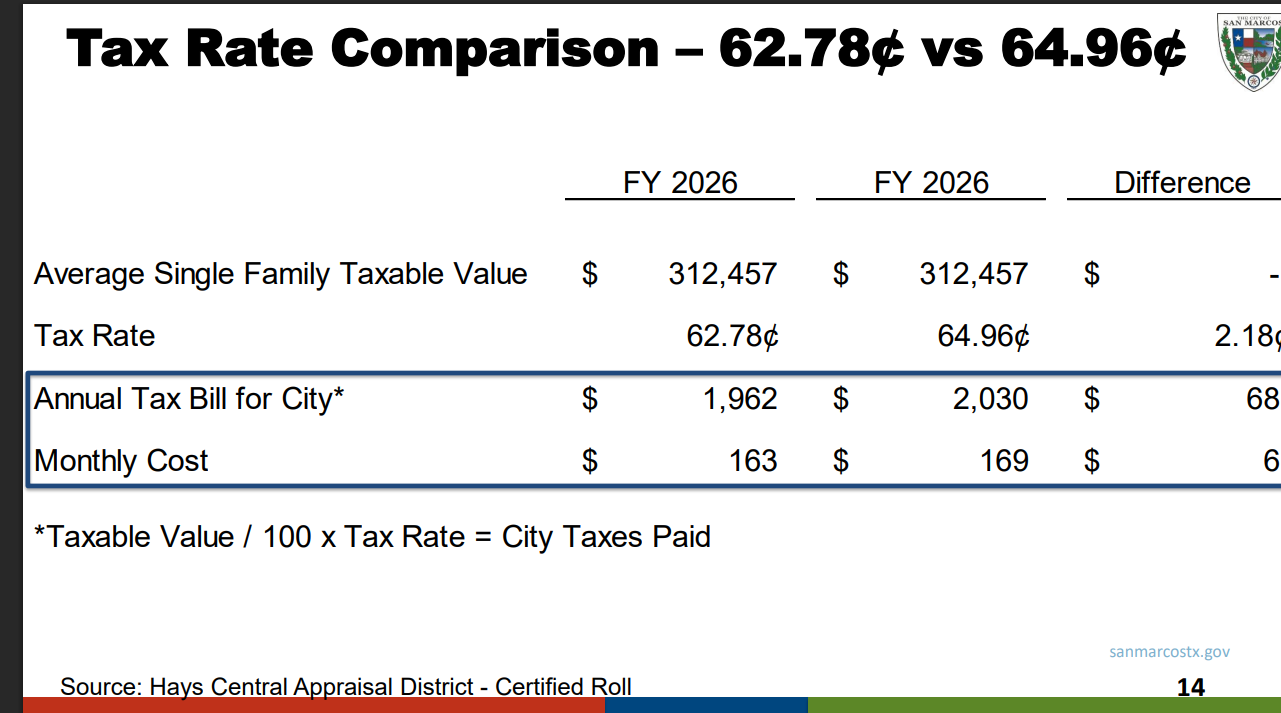
    and here’s what that means in terms of your property tax bill, if you’re a home owner:

    Council ends up choosing ¢67.69 as their upper bound.

    There is a really long discussion of how they got to this number at the 3 pm workshops. So if you’re curious, keep reading.

    Item 20: Changes to the LDC

    “LDC” stands for Land Development Code. All year long, staff makes notes about all the little improvements that anyone ever mentions. There are also things they have to change, based on the new laws passed by the legislature.

    This is a big, long complicated process that will take months.

    Everyone is exhausted, and they don’t go through the details. It’s going to come around a few more times, though, so we’ll unpack it before it passes.

    The meeting was finally over at 3:11 am.

    In other words, council members just spent TWELVE HOURS sitting in those chairs, up at the dais. That’s rough!

    Hours 3:28 – 6:47, 6/3/25

    Item 29: The Dreaded Data Center

    First off: apparently there are actually like 7 different companies trying to come to Hays County and put in data centers?!

    Out of those seven companies, there are a few specific ones that keep coming up:

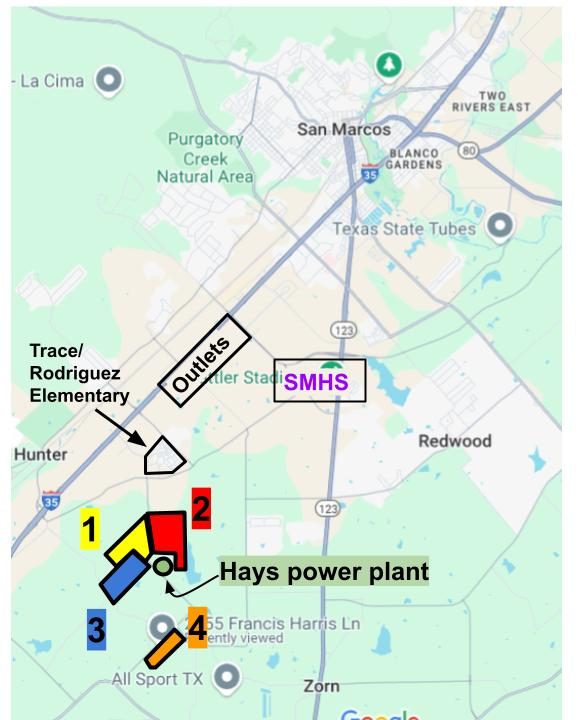
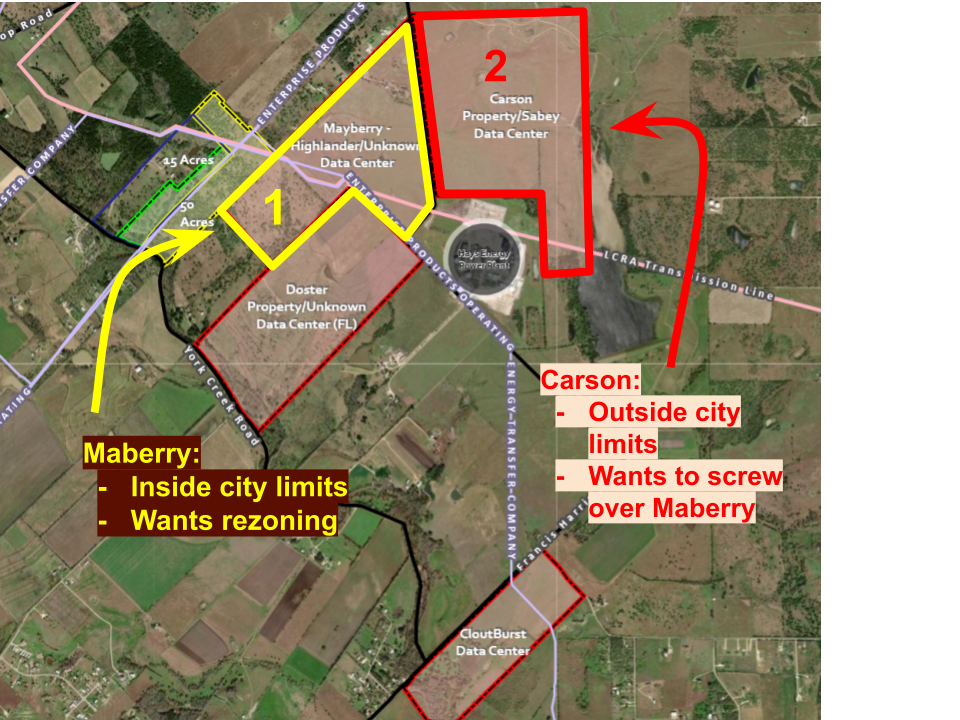
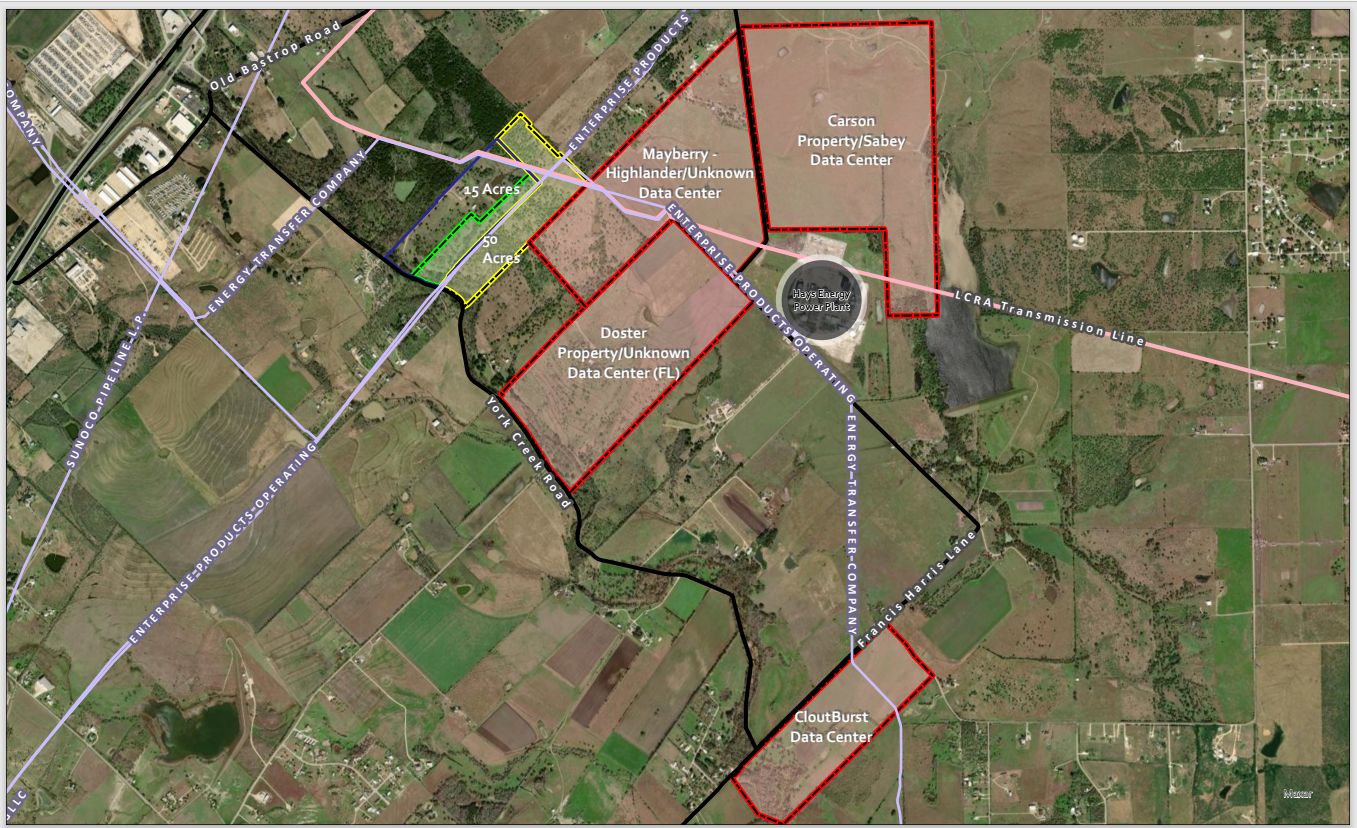
    • This one, on Francis Harris Lane
    • John David Carson’s, discussed later on in this meeting.
    • The Cloudburst one, which keeps popping up in the news.

    As best I can tell, these are the locations:

    I got the address of the Cloudburst site from this article.

    So the one we’re talking about now is this one:

    (Discussed previously here.)

    A few notes:

    • There is no vote tonight. It is just a discussion item.
    • The vote is scheduled for the July 1st meeting
    • P&Z denied the request. So Council needs a 6-1 supermajority to overturn the P&Z vote.

    There are 19 more speakers during the public hearing, along with the 35 from from the top of the meeting. (Some people speak twice, though.)

    Here’s the main points that people make against the data center:

    • We’re in a drought, and this will destroy the San Marcos river
    • We’re in a drought, and this will destroy the San Marcos river
    • We’re in a drought, and this will destroy the San Marcos river
    • We’re in a drought, and this will destroy the San Marcos river
    • We’re in a drought, and this will destroy the San Marcos river

    This really is the most important point. Climate change is pushing us towards permanent water shortages, and data centers use a massive amount of water for cooling.

    And also:

    • This will drive up utility rates
    • There are reports from Granbury that these data centers are unhealthy to live near

    Here are the arguments made in favor:

    • We’re going to get a lot of tax revenue
    • This does not cost the city much in terms of roads, utilities, and fire/police/emergency services.
    • These guys are offering to be more environmentally sustainable than the other six data centers. Take the regulated data center over the unregulated one.
    • Specifically, they’re going to use closed-loop cooling instead of open-loop evaporative cooling. This uses much less water.

    Here is the developer’s basic pitch: “Data centers are definitely, 100% coming to central Texas. I’m the friendliest and the most cooperative one. I’m willing to do things environmentally and sustainably.”

    He’s offering to put a bunch of concessions into a restrictive covenant. This is a contract that stays intact even if he sells the power plant. The next owner will still have to comply with it.

    Here’s what he’s offering:

    • Closed loop, non-evaporative water cooling system. (This is very important.)
    • Limiting water use to an amount equivalent to 235 homes
    • Stricter than San Marcos Code on stormwater detention and impervious cover.
    • Sound and light mitigation
    • Getting water from Crystal Clear, not from San Marcos.
    • Getting electricity from Pedernales, not from San Marcos.
    • Only need San Marcos for waste water.

    Here’s the obvious rebuttal to the last few points:

    • Who cares if it’s San Marcos city water or Crystal Clear water? It’s all coming from the same water table underground.

    One speaker puts it like this: “These are straws pulling on the same water table”. Exactly.

    Will this cause the San Marcos River to dry up???

    Here’s what the developer said: they’ll need about 400-500K gallons of water to initially fill about 6-7 buildings. But after that, they don’t need much water until the buildings need to be re-filled in maybe 10 years.

    I asked Robert Mace how bad that is? He said:

    • 100k of water is about what an average family of three uses in Texas a year (~88k). Won’t make the river run dry!
    • If it was an open loop cooling system (evaporative cooling) and an average system, it would be about 12.5% of San Marcos use. It wouldn’t take many of those to overwhelm local supplies.

    So this is a big picture question. Can our river handle this one data center, on a closed loop system? Yes. Can it handle seven data centers on open loop systems? No.

    So does ANYONE have control over how many data centers come to central Texas?!

    This is an uncomfortable question! There’s only flimsy safeguards.

    • Can San Marcos block them? Only if they’re in city limits, and the developer needs the land to be re-zoned.
    • Can Hays County block them? No, they cannot prevent data centers from coming.
    • Can ERCOT block them? Sort of yes. They have to approve anyone who wants to join the grid.

    The rumor is that ERCOT will approve 1-2 data centers in this region, for now.

    It sounds like Cloudburst is trying to work around ERCOT by building their own natural gas power plants. I don’t know if ERCOT would still have to approve them or not.

    Bottom line:

    1. The overall situation is pretty bad for water use.
    2. The San Marcos river has some unique legal protections, because of the Edwards Acquifer Authority. They have legal authority to sue if companies go over their allotted amounts. But still, do we need to test this?
    3. We’re relying really heavily on ERCOT to gatekeep this situation.

    What does Council say?

    Everyone’s a little annoyed that the actual restrictive covenant is not already prepared and ready to read. But it’s not.

    This is the basic argument that emerges: ERCOT is not going to approve all seven applications. They’ll probably only approve 1-2 applications. So if this data center gets approved by ERCOT, it might prevent an unregulated one from getting approved. That would be a net good.

    Jane: It’s better to have these guys, who we can regulate, than the others who we can’t.

    Shane: The wastewater from the center goes to the city system. How much extra clean up do we have to do to the wastewater, from the extra chemicals?
    Answer: We have a filter standard. They have to clean the wastewater up to our standards before they release it to our system.

    Lorenzo: Are there going to be gas turbines or some sort of power plant?
    Answer: No, that’s Cloudburst. We’re not going to have a power plant.

    Lorenzo: What happens if they violate the restrictive covenant?
    Answer: Two things:
    – Before we issue city permits, we’ll check to make sure they’ve built it the way they’re supposed to. So they can’t get up and running if they don’t build what they say they’ll build.
    – After it’s built, if they violate the covenant, we can get a court injunction. The court will order them to comply.

    The developer is trying to be the most accommodating person ever. Would YOU like to talk to him? He’s got a whole website, and a whole shtick about how he’d like to talk to you.

    (Honestly, he’s refreshing after the SMART-Axis Terminal jerks.)

    Amanda: I’m concerned that we don’t know what company we’re actually talking about.
    Answer: I’m not allowed to say who it is yet. I promise I’ll say before the July meeting. They have facilities in Austin, Carrollton, and San Antonio, if you get my drift.

    [Gentle reader, I got his drift. This appears to be the only Carrollton data center.]

    A lot of citizen comments mentioned how utility and water rates will skyrocket. Alyssa asks about this?
    Answer: Council sets water rates. They don’t skyrocket unless you want them to.

    [Note: This answer is a little disingenuous. Council sets water and electric rates for everyone on San Marcos utilities. So those won’t skyrocket. But if you live down south by all these proposed data centers, you might not be on San Marcos utilities. Who knows what Crystal Clear water and Pedernales Electric will do.]

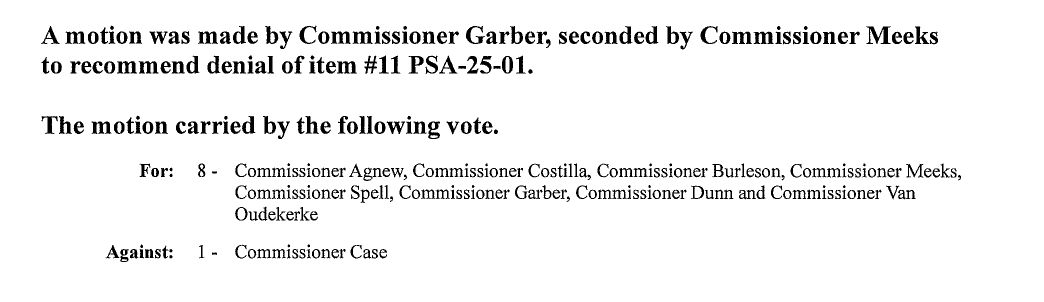
    Conversation turns to the P&Z denial. Right now, it takes 6 Council votes to overturn P&Z.

    Should Council send this back to P&Z, to take another look? If P&Z changes their mind and approves it, then Council would only need 4 votes to pass this data center.

    However, sending it back to P&Z will delay everything by 4-5 months. It might hurt their chances with ERCOT. Council does not want to risk the possibility that ERCOT denies this application, in favor of some other yahoo developer who throws up something worse, out in the county.

    Bottom line: I think Council will approve this one data center at the July meeting.

    We’re in a kinda terrible situation, but this one data center is probably the least-bad option.

    Item 7: Flock License Plate Reader Cameras

    Flock Cameras are these:

    They read all the license plates that go by, and record the date and time. Then if the police are trying to find someone, they can run a search on all that data and see if there’s any record of it.

    “LPR” means “License Plate Reader”, and we first got some back in 2017. But we didn’t join the Flock network until 2022, when we bought 14 cameras:

    (Also I note that they used seized funds for the first batch. Blech.)

    Back in February, SMPD wanted to purchase 19 more Flock cameras. Council delayed approval in order to revisit our privacy policy. In March, we revisited our privacy policy and made some good improvements.

    So now it’s time to vote on whether or not to approve the grant for these cameras.

    What are the arguments for and against?

    In favor: There are lots of examples of how Flock Cameras are used to solve crimes. From the packet:

    Arguments against : They are tracking your every move. Do you want to live in a police surveillance state? The data gets merged nationwide to have one big nationwide network. Private companies can have Flock cameras. Neighborhoods can have Flock cameras. The ACLU does not like Flock one bit.

    But it’s not just an abstract fear about loss of privacy: ICE has access to Flock data. We’ve got a federal administration that plays out revenge fantasies on brown people, and is in the business of deporting people as recklessly and broadly as possible.

    Here’s a particularly chilling recent example: She Got an Abortion. So A Texas Cop Used 83,000 Cameras to Track Her Down. Those would be nationwide Flock cameras that made that possible.

    How does the Council conversation go?

    Amanda: It’s the times we’re living in. People disappear off the streets because of this technology.
    – The policies aren’t strong enough to protect against a subpoena. Austin didn’t know until they did an audit that ICE was accessing their data. (Austin is now ending their license plate reader program.)
    Senate Bill 9 would require Texas sheriffs to work with ICE. Our data will definitely get shared. Our policies will not protect us.
    – They’re rolling out new technology, like NOVA.
    – Please just don’t do this to people.

    Saul goes next: I see the pros, but there are not enough safeguards yet. I’m a no.

    Council spends the next hour trying to nail down exactly how much control you have over who sees your data. If Dallas PD is looking for a specific red car, can SMPD decide whether or not to release the data on that specific car?

    Eventually the answer comes out: no. You do not get to decide on any specific request for data. Once you set up a reciprocal agreement with Dallas, they get access to all your data. Either the faucet is on, or it’s off.

    The Flock representative keeps repeating “The city of San Marcos owns the data. Flock does not own the data. They’re just the guardians of the data!”
    Alyssa asks: Can you show me where in the contract that exclusive access is guaranteed to San Marcos? Your policy says that you “retain a perpetual, royalty-free license to use aggregated data for your purposes.”
    Flock rep answer: We promise that we use it only for anonymized training data.

    Lorenzo: Does Flock own the physical servers? Or do you rent servers?
    What Lorenzo means is: where are the actual, physical computers where the data is stored? Does Flock have their own computer storage?

    Answer: We use Amazon Webservices.
    This means, no, Flock does not own large-scale computer storage. Flock sends the data to Amazon for storage on Amazon computers.

    Lorenzo: So Amazon is a third party that could also be subpoenaed for the data? You might not even know if they had to hand it over. What if they violate their agreement and fail to delete it?
    Answer: It’s in our contract with Amazon that they’d delete the data after 30 days. If they didn’t, they’d have to charge us extra!
    [Note: that answer does not make any sense. You didn’t misread it.]
    Lorenzo: Amazon is in the business of data collection.
    Jane: You’re not in control of that data.

    Alyssa: This system is dangerous by design.
    – these claims are absurd! Like “license plates aren’t personal information”. You can track a person with it, can’t you? It’s personal information.
    – We own the data, but we don’t. They keep it.
    – They say ICE can’t access our data, but they do.
    – Anyone that we share our data with can then turn around and share it with whoever they want.
    – There are many cases of cops using it to stalk people.
    Peter Theil is a backer of this, for god’s sake.

    Chief Standridge: Look, I can only speak on behalf of what happens locally. In San Marcos, Flock helps solve specific crimes. Locally, I don’t have evidence of any privacy breaches. I am only able to speak to San Marcos.

    Amanda:  I have never thought that you all are the bad actors.  We share with 600 agencies. Our policies don’t matter when we’ve already shared with them. Flock would not be in business without this network.

    Jane: I was a software manager at the university. Here’s how it goes: you get a new technology, and you hammer out all the rules with the company. Then they get bought. All the rules with the first company go out the window, and the new company puts all new rules down. If Flock gets bought, all these rules go out the window.

    Chief Standridge: What about all the safeguards and policies we discussed in March?
    Amanda: All we did is require agencies to follow all applicable rules and laws. But there are no federal rules! This technology is not regulated. Your policy ends the moment you share data with them. We share data with Houston! Houston openly says they work with ICE. Therefore we work with ICE.

    Shane: What about the first 14 cameras we already bought? We still have those, right?
    Jane: Yes. But we could put it on the agenda to get rid of them.
    Alyssa: I guess we should revisit this!

    Jane shares a little of her thinking:
    – Originally I thought these cameras were great. And if Flock were only used like in the examples, then it would be fine. 
    – I’ve learned stuff tonight that’s giving me a really hard time saying Flock is good for the US.
    – Then I thought, “But there’s cameras everywhere. There’s Ring, etc, toll roads, smart phones, etc.”
    – But that’s different. This goes to government agencies. I’m not worried about our department, but I can’t say that about other departments
    – Maybe just at major intersections? Nope, nope, that doesn’t work. It’s the other departments.
    – We just don’t have enough guard rails for this. The more I learn about how the system is being used, it’s pretty scary.

    Something has happened since the last discussion, because Chief Standridge does not seem surprised that it’s unfolding like this.

    He makes one last bid: “What if we only share data within Hays County?”

    Alyssa: What keeps Hays County from turning around and sharing it?
    Amanda: What about the Texas Senate Bill that requires sheriffs to cooperate with ICE?

    City Manager Stephanie Reyes weighs in:  It’s clear that you all are worried about where we are as a nation. It’s not an issue about SMPD.  It’s not about our individuals. It’s about the policy decisions that we can control in the national scene.
    Everyone’s like: Yes! Correct!

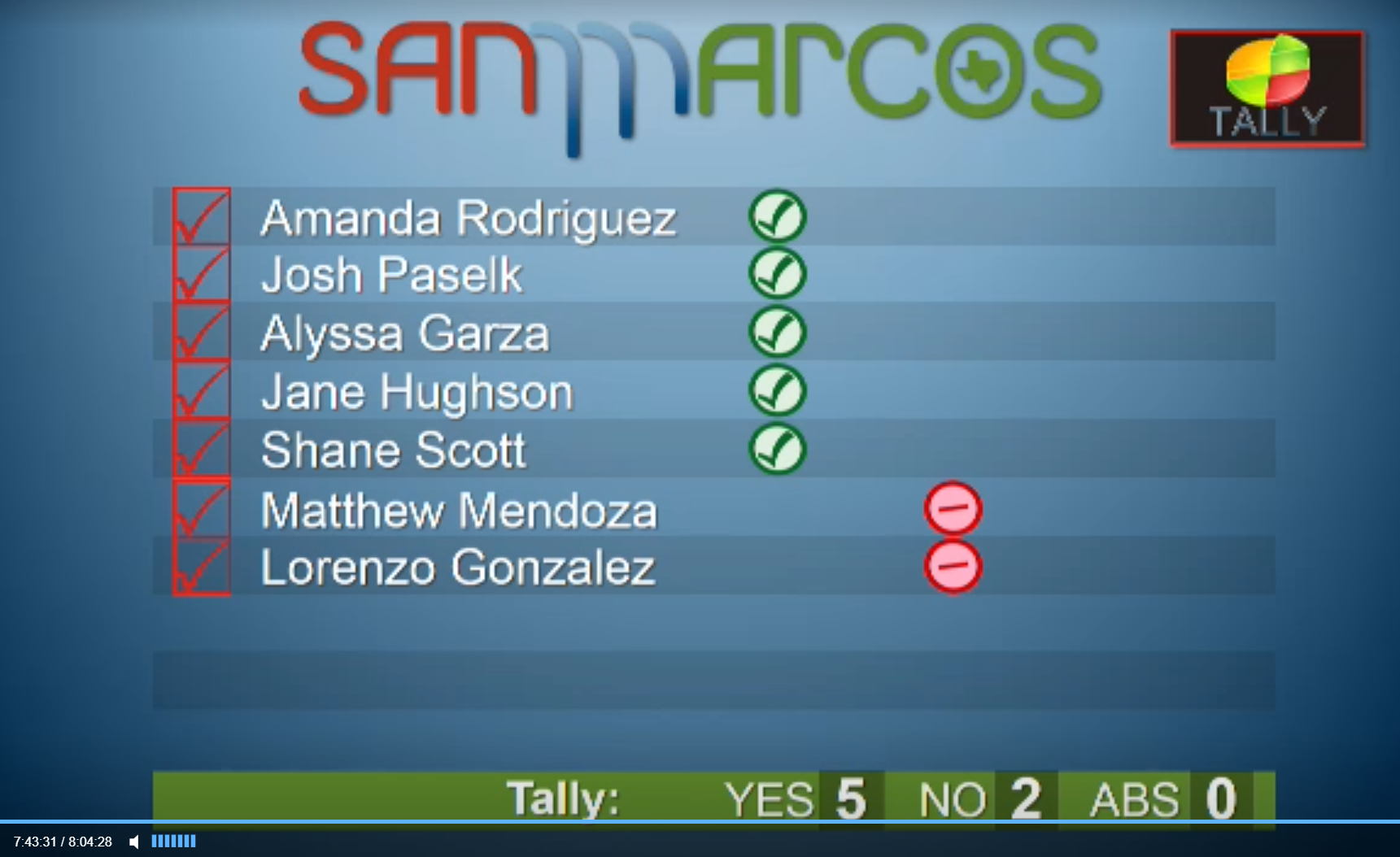
    Finally, the vote: The motion is to deny. So a green check means no on the cameras, red dash means “yay Flock!”

    Are you a NO on the cameras?

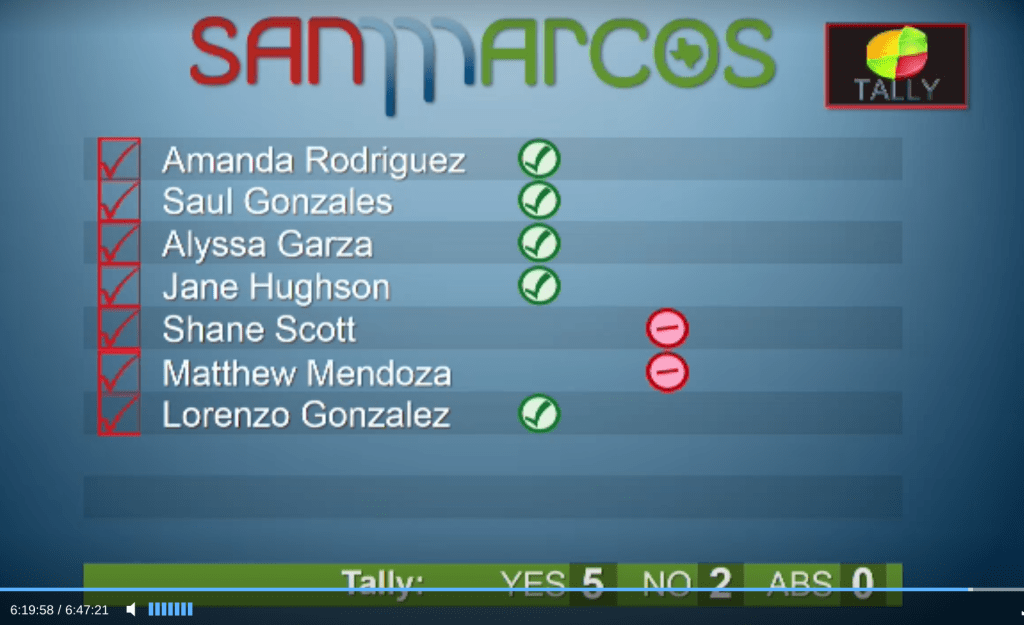
    Amazing. Shane and Matthew are the only ones who still want them.

    The council conversation was outstanding to listen to. It was just so sharp. Everyone made really great points.

    Whew! After all that, we’re not quite done yet…

    Item 15: Spin Scooters

    You know them, you love them:

    (We’ve discussed these before, here and here.)

    It turns out they’re breaking up with us? Their contract is up on June 30th, and they don’t want to renew.

    The reasons are:

    • Low ridership
    • Tariffs
    • Finding parts

    Ouch.

    Once they officially break things off, we’ll start looking for a different company who might enjoy our low ridership, tariffs, and lack of parts.

    Item 24: More data centers!

    So, recall there are seven data centers with applications in at ERCOT.

    These are the three that I know about:

    So now we’re on the pink one.

    Yes, it’s gigantic. The red one from earlier is 200 acres, and this one is 785 acres. They’re saying it would also include housing. Unlike the one in red, the developer wants this one to be on San Marcos water.

    It’s past midnight and everyone is exhausted. They decide to just form a council subcommittee to negotiate and discuss the issue further.

    Council subcommittee: Jane, Amanda, Lorenzo.

    I’m good with that.

    Item 32: Proposed Charter Amendments for ballot

    Here’s the legal language for everything that will show up in the November Ballot:

    Q&A: Max Baker:

    • Matthew Mendoza again! Why do you think it’s appropriate to use swear words during the ceasefire conversation?! C, S, and A words?!
    • Would council consider revisiting EDSM policy and how we award benefits when GSMP knows before Council? Would you bring a discussion item that puts Council knowledge before biz privileges?

    Adjourned at 2:35 am.

    Hours 0:00 – 2:03, 2/18/24

    Citizen Comment

    Two topics today:

    1. Nine people spoke about Malachi Williams. 
    2. Three people talked about the Data Center that might come to town.

    I’ll save the Data Center comments for when we get to that item, and just focus on the Malachi Williams speakers here.

    Backstory: Malachi Williams was a 22 year old who was killed by an SMPD officer last April. It was reported that he was carrying knives. Two officers started to detain him at the convenience store on Cheatham and Hopkins. (He was not holding the knives at that point.) He took off running. They chased him over to HEB, and then shot and killed him in pursuit.

    Since last April, a number of activists and family members have been pursuing justice for Malachi, and fighting for a fair process for the family and some kind of consequence for the cops.

    Last August, a grand jury decided not to press charges against the officer. That basically brings us up to the present day.

    Why now?  There was an event recently hosted by Malachi’s family. From what I gather, attendees were able to view some bystander footage for the first time. 

    The focus today is on inconsistencies between what Chief Standridge and SMPD have claimed, and what actually happened last April.  

    The biggest problem:

    Chief Standridge has been asserting that a fire marshall was there and able to administer first aid in under a minute. Officers are trained in first aid, but they didn’t need to jump in, because the fire marshal is a certified paramedic.

    The speakers say that is definitely not what the videos show.

    Here’s what the speakers describe: Malachi doesn’t get first aid for about three minutes. During that time, SMPD got mad at him for not putting his hands behind his back. They rolled him around, so they could handcuff him. They checked his pockets. In fact, when first responders did arrive, they had to ask the cops to take the handcuffs off the guy they’d shot, who was bleeding out.

    Malachi’s grandfather  

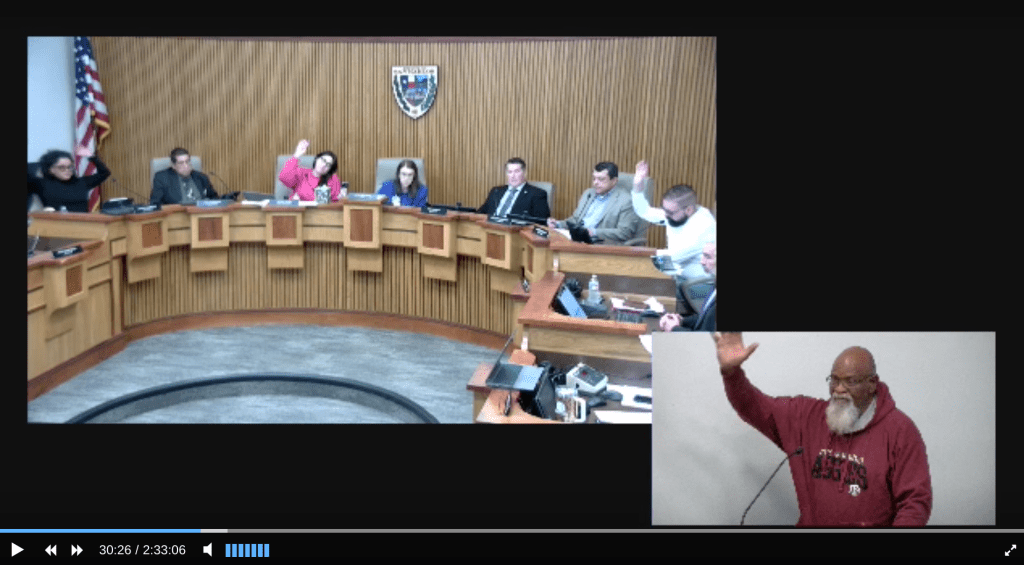
    I’ve mentioned before what a compelling speaker he is. In his measured way, he asks council, “Think. If what we’re hearing today is true, are you disgusted? Can I get a show of hands, please?” – and he puts his own hand up – “If we’re telling the truth, if we’re telling the truth, are you disgusted?”

    Here’s who raises their hands:

    That would be Amanda Rodriguez on the left, with both hands up, Alyssa Garza in pink, and Lorenzo Gonzalez on the right. (I will say that so far, Lorenzo Gonzalez is proving to be a good council member.  I don’t have any complaints.)

    Jane, Saul, Matthew, and Shane refuse to go along with the requested show of sympathy. (Is it performative? Sure, but I also think they genuinely just might not care.)

    ….

    Now for an abrupt change in tone:

    5.  Fireworks!  We put on a fireworks show every 4th of July.  

    The amount we spend fluctuates from year to year:

    This is because some years we get donations, and other years we don’t:

    For the record, it’s always a 20 minute show.  As they put it, “The more donations we get, the bigger the booms.” 

    Jane Hughson wants to know why we have to keep making the shows bigger.  If donations come in, can’t it just free up some city money that we could send over to the parks department?

    Answer: People complain when it’s big one year and smaller the next.

    Me personally: I’m with Jane here. I’m having a hard time caring about the size of the fireworks.  I’d rather use the donations for fireworks, and free up some money for the parks department.

    But then again, I’m a grouchy old tree stump. If other people care, who am I to harsh their mellow?

    Item 10:  Data Centers!

    You may have seen this KXAN article, “A new AI data center is coming to San Marcos“?

    This isn’t that.  In fact, there’s a lot of confusion about what that article exactly is about! We’ll try to unpack it all here.

    So if this isn’t that, what is this?

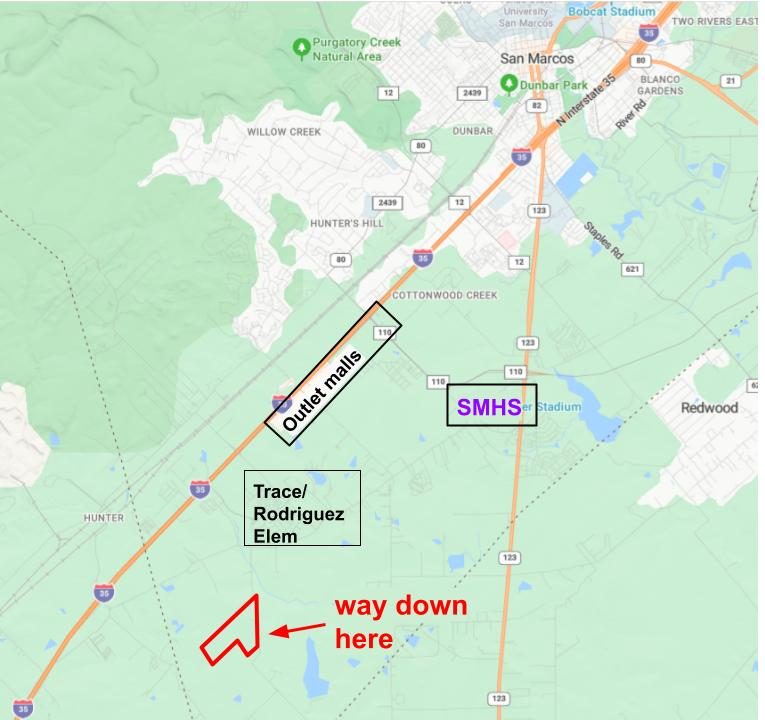
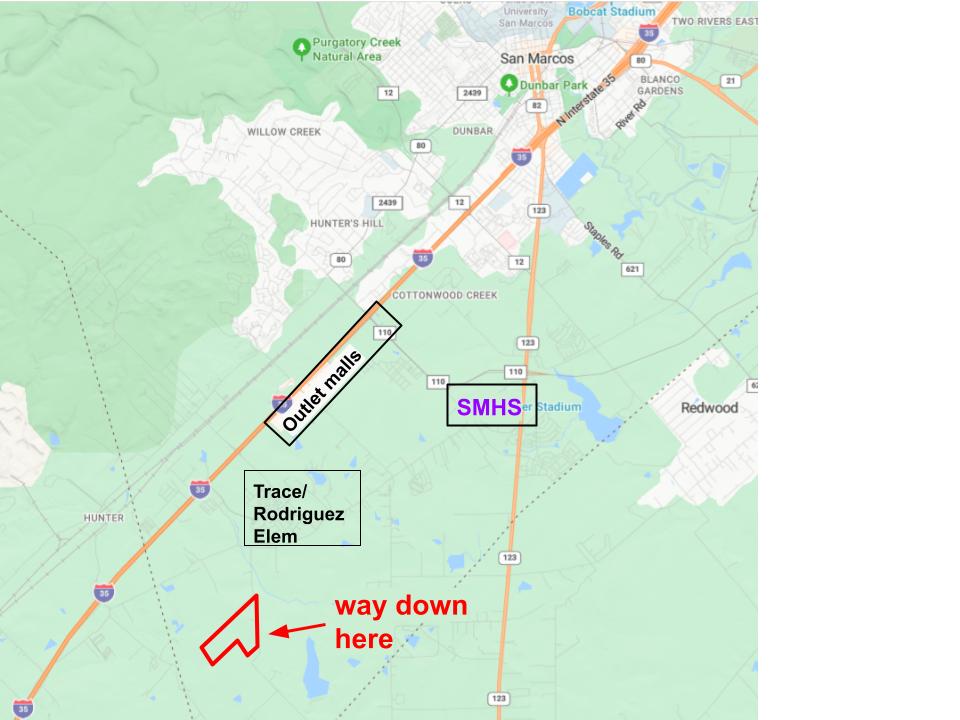
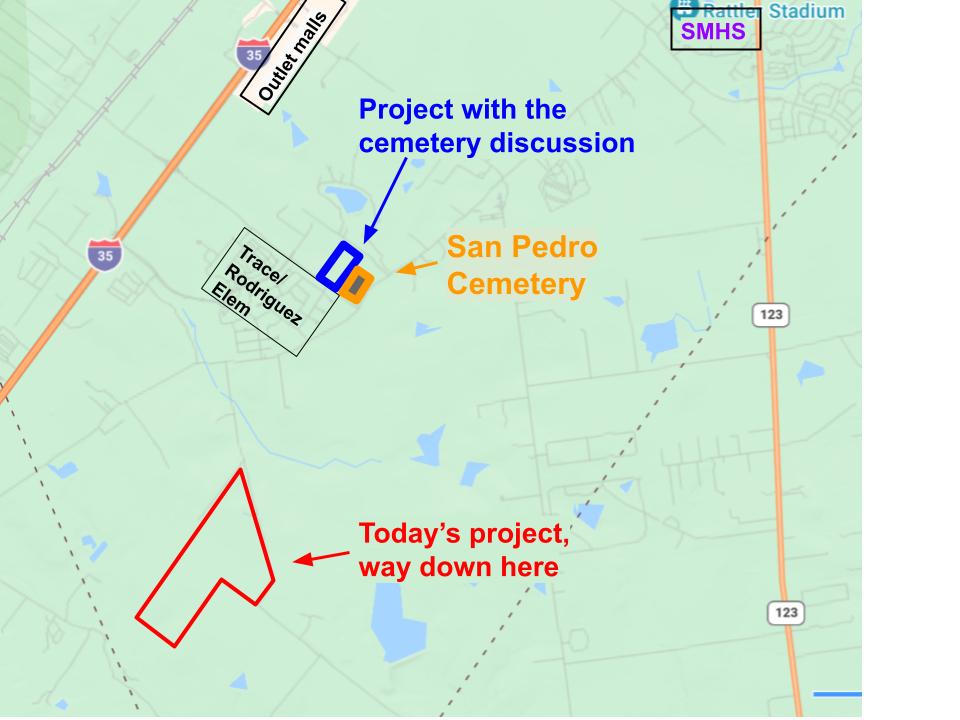
    First off, it’s way down here:

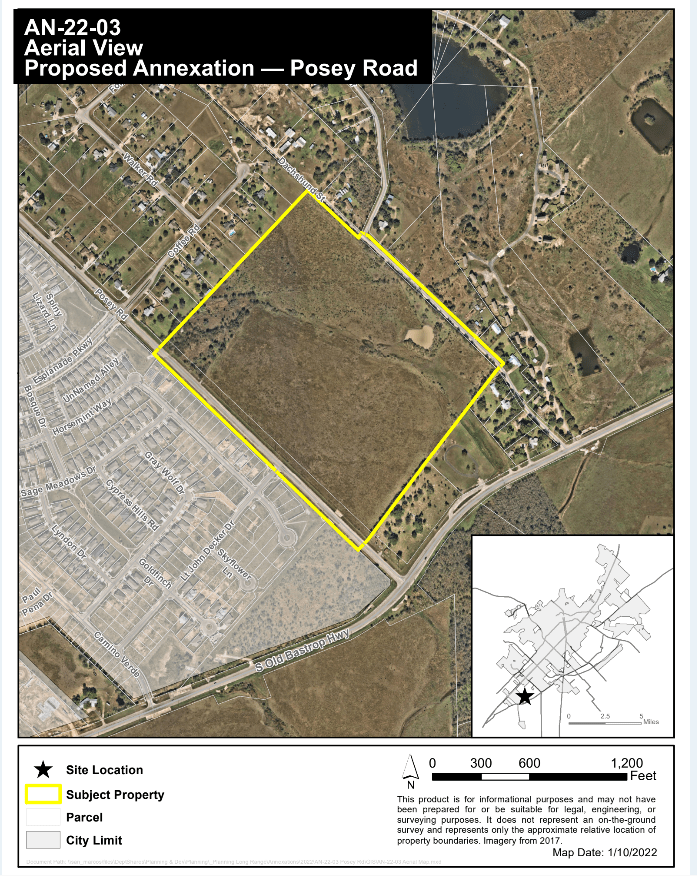
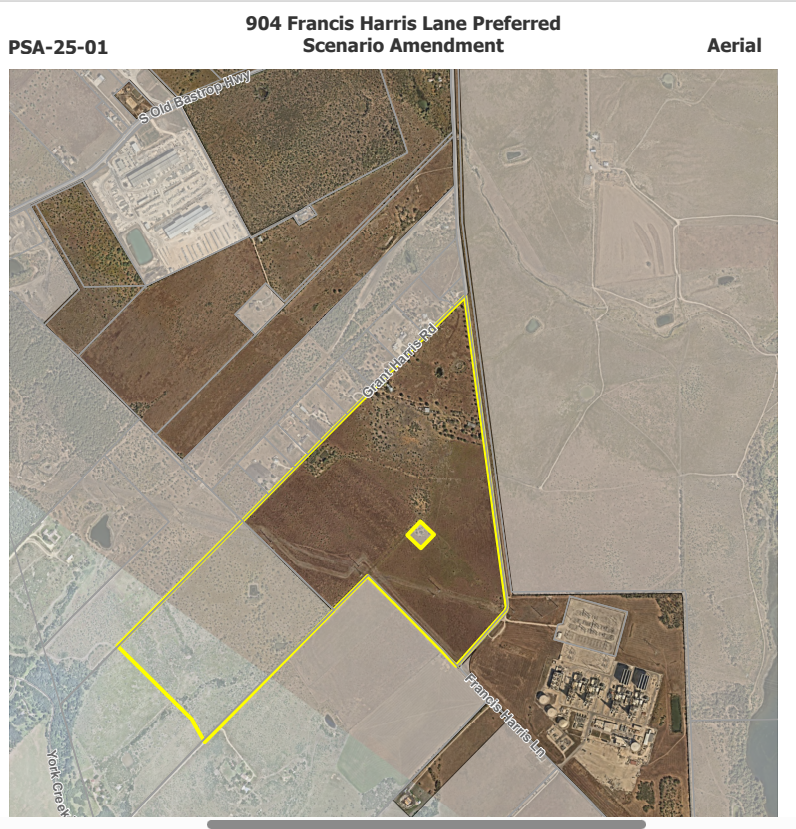
    (We’ve actually seen this property before, back in August 2nd, 2022.  They wanted to put houses out there.  I thought it sounded like a super terrible idea!)

    Here’s a close-up of that property:

    See that funny little yellow square?  That’s an old cemetery.  Access to the cemetery will be preserved.

    Listen: I have some extremely boring confusion regarding this cemetery. I’m sticking it at the end of this page, because it’s truly too weedy to bore you with. This way you can opt out from the dumbest of my dumb shit.

    What’s a data center? 

    Basically a giant computer that takes up an entire building, where AI can perform its massive amount of computations.  So there are very few people working here, besides security and some technicians to monitor it.

    What are the pros and cons?

    The pros:

    • This is in the middle of nowhere, next to a giant power station.
    • The city is not going to have to spend much on infrastructure or maintenance.
    • The city should see some revenue from property taxes.

    The cons:

    • Data centers take a massive amount of water.
    • Data centers use a massive amount of electricity.

    This particular project would not be on city water or electric. They’d use Crystal Clear Water and Pedernales Electric for power.  (They’d be on San Marcos wastewater, though.)

    Here’s the thing:  Crystal Clear Water draws from ARWA, just like we do.  It might not be city water, but it’s the same underlying water table, either way.

    Can this be done responsibly?  Maybe!

    Water is the biggest problem. The water is needed to cool the data center, because computers generate a lot of heat, which would then make them overheat and shut down otherwise.

    The land-owner says that this will be a closed-loop water cooling system, which means less will be lost to evaporation. Matthew Mendoza says Google developed this technology 8 years ago. (I don’t know if this is the same as this technology, which only rolled out last year, but maybe.)

    It’s great to implement the latest water-saving technology! But if quantities are still way too big, it doesn’t help you much.

    Bottom line:  We can’t make an informed decision unless we have a concrete gallon amount of potable water usage.    

    How much water does a data center use? This says an average estimate is 550K gallons per day for a hyperscale data center. (I’m pretty sure AI means a hyperscale data center). This closed-loop Microsoft system coming next year is claiming to only use 99.5K gallons per day. So we’ll probably be somewhere between those two estimates.

    How much water do we have? According to the presentation in January, our current capacity is 4.8 million gallons per day.

    NOTE: They would be using 550K gallons of Crystal Clear Water, not San Marcos water! But I couldn’t find a total capacity for CCW, so I just used San Marcos as a reference point. Both draw on the same underlying water table, so it’s best to still think about water conservation.

    Can data centers use reclaimed water?  Maybe!

    This link says yes, they can, but if the water quality is bad enough, it causes corrosion and microbial growth and other problems.

    We do actually have a reclaimed water line that goes very close to there.  What’s the quality of the reclaimed water in that pipe? Could they use it?

    I think this is the most essential question to answer.

    Energy usage:  Honestly, this is probably less of a concern than the water.  Texas may have a shitty grid system, but we have a fairly healthy renewable energy supply, mostly because of all those windfarms out west.  This is a great state for both wind and solar energy, if we’d only stop electing such counterproductive leaders.

    On energy, there is something called ASHRAE guidelines for data centers:

    So maybe we could ask them to achieve that.

    Do we have any leverage? 

    Sort of! This is a tricky thing to answer.

    First, they’re not asking for tax cuts. If they were, we could come back with all kinds of environmental restrictions. But they aren’t.

    Second, they’re asking for a Preferred Scenario Amendment and a rezoning. There are rules around how cities make these decisions. You’re not allowed to base it on one specific project. You have to approve or deny based on all the allowed uses, and whether you like the location or not. And specifically, you can’t attach any requirements to these.

    You might be able to require a Planned Development District, but I don’t know if water usage is an allowable reason to trigger one.

    My opinion: If we can get them to agree to reclaimed water, then we should do this. Otherwise they’ll find another location that still uses the same water source, but isn’t within San Marcos jurisdiction.

    I think many data centers will get built in Central Texas, no matter what.  I would like them to be as tightly regulated as possible. 

    Note to Council: An ordinance requiring future data centers to be on reclaimed water might be handy to have!

    What do citizen comments say?

    Let’s go back to the beginning of the meeting. During citizen comment, one speaker had a list of extremely great questions:

    • What is the current noise ordinance for Light Industrial, within the city of San Marcos?
    • Will Dark Sky Lighting be considered for all outdoor buildings?
    • What will the setbacks be for both Francis Harris Road and the private Grant Harris Road?
    • Do we have a general idea of the size of the buildings?
    • What will be the estimated daily water usage?
    • Will it be public drinking water?
    • Will any measures be taken to lessen the impact of the large amount of impervious cover?
    • Cloudburst has stated on their website that this site will be part of their flagship data center in central Texas, and plans to aggressively grow its data center network. With a large amount of open farmland around the proposed site, should we expect further development from this company?
    • Since Cloudburst has already signed a longterm contract with Energy Transfer, the power plant already located on Francis Harris Lane, and KXAN reported on February 13th an AI data center is coming to San Marcos, should we assume decisions to change zoning and city limit boundaries are already confirmed?
    • Will Cloudburst be responsible for answering any of these questions or have to provide plans for the development, prior to the zoning change and incorporation into the city?

    The very next speaker happened to be the land owner. His major points:

    • I’m working with the Data Center company to answer those questions above. The previous speaker submitted the questions to us in writing, after the P&Z meeting.
    • We have confirmed that the Data Center uses a closed loop water system. We are still working to quantify the amount of water lost to evaporation.
    • Hey look, we’re not going to put much wear and tear on the roads, at least!
    • And the biggie: We have no affiliation with Cloudburst or Energy Transfer. That is not us. The first time I ever heard of them is when that KXAN article came out.

    What does Council say?

    What the hell is going on with the KXAN article about Cloudburst?!

    No one knows.  The owner swears up and down that he’s never heard of Cloudburst until that article came out, and has no idea what’s going on.

    Amanda Rodriguez has headed over to the Cloudburst website, and they have the same exact timeline posted as this project:

    Are there two projects? 

    City staff says that it’s extremely unlikely a project of this size would operate on stealth-mode like this.  Companies tend to reach out to either the city for permits, or to the Economic Development Partnership to find out more about working in the area, or whatever.

    The city manager Stephanie Reyes does also say that the city has gotten approached by multiple companies about data centers.  But no one else has an active application in progress.

    Basically: no one knows what’s up with Cloud Center and they’re going to follow up.

    ….

    What next?  Tonight was just informational. This is going to drag out all the way to April:

    So there was no vote today. Stay tuned.

    Item 11: Council members don’t get paid much.

    Shane Scott wants to double the travel budget and increase the stipend that council members get.

    First off: yes, we should pay our council more.  If you don’t pay your council enough, then you only get council members who are either independently wealthy, or who are willing to live in poverty in order to serve in council.  That’s not a recipe for healthy representation. 

    Second: yes, we should increase their travel budget.  Inflation has made expenses go up.  We want council members to attend conferences and gain expertise, and make connections.  That’s how you get stronger representation. 

    However, this is Shane Scott’s proposal, so it comes with a whiff of ridiculousness. 

    Like at 1:18:30:

    Shane: “At these conferences that I go to, I even get AWARDS for doing all the classes and stuff.”

    Alyssa in the background: “he does, it’s so good.”

    Jane: “I don’t really care about the awards. What value have you brought back to this council?”

    Shane: “If I were to pass all the writing and stuff that I’ve learned before, I’d have a whoooole book of stuff that I’ve provided to council about doing stuff.”

    I am dying to know more about these awards he’s winning for participation.

    That’s my blogger dream, that Shane has a whole trophy case of these things.

    Back to the proposal

    The total increase of his proposal is $90K.

    One ridiculous thing he’s doing is saying that he wants to increase amounts halfway through this year, instead of just waiting and budgeting the increases into next year’s budget.  So city staff had to scramble to figure out where to cut $45K from, in case Council approves Shane’s proposal.  

    The city manager was not enthusiastic at all about this, back in December, but she managed to find $45K by raiding two budgets, one called “Council- related” and the other is a Contingency fund, for when projects go over their budget.

    Here’s how much more money Council members would get, under this proposal:

    “Expenses Elected” means your travel budget. This is anything where you have to provide receipts for what you did. So Shane wants to double everyone’s travel budget.

    “Compensation” isn’t changing, but “Additional Expenses” is being doubled. “Additional Expenses” is basically extra compensation.  Councilmembers take it as a monthly lump sum for expenses where they don’t have to provide receipts. 

    Why not combine “Compensation” and “Additional Expenses”?  Just call it all compensation? 

    There’s actually a good reason: you can’t collect two paychecks from the government.  So if you work for the university, or the county, or the state, you can’t collect “Compensation”.  You can still collect “Additional Expenses” though – this is what Jude Prather did, since he works for the county.

    Amanda is horrified to learn this – “You mean I could have kept my job?!  I took a huge paycut to accept this position.  I’m struggling.  I live with my mom, y’all.”  

    I’m kind of infuriated on her behalf:  there was a better path available and she wasn’t informed?? 

    Other council comments:

    Alyssa:  Our community members treat us as though we’re fulltime and have staff.  Other cities pay their councilmembers to be fulltime, with staff, and they also slice their cities into districts so that you’re not answering to as many people.

    Jane: Austin and Dallas pay their councilmembers fulltime and give them staff.  Not Kyle, Buda, or New Braunfels.  They pay zero.

    Note: remember, paying $0 is strategic.  If you require someone to work for free, only wealthy people can do the work.  That’s not aspirational.

    In the end, they move to postpone this.  Everyone’s going to come back with amendments and chop it up. 

    Ok, back to the cemetery: The owner of the larger land does not own the cemetery. By state law, he will preserve access to that cemetery. At P&Z, Michele Burleson said she appreciates that – she was just there last weekend.

    The owner also says, “Last time, there was some concern about the placement of the fence along the cemetery. So we did a fancy x-ray type survey. No folks beyond the perimeter of the cemetery!”

    That’s reassuring! Also I remember that exact conversation. It’s here. But that’s not the same property!!

    Here’s the property from the cemetery conversation:

    That’s a different cemetery altogether:

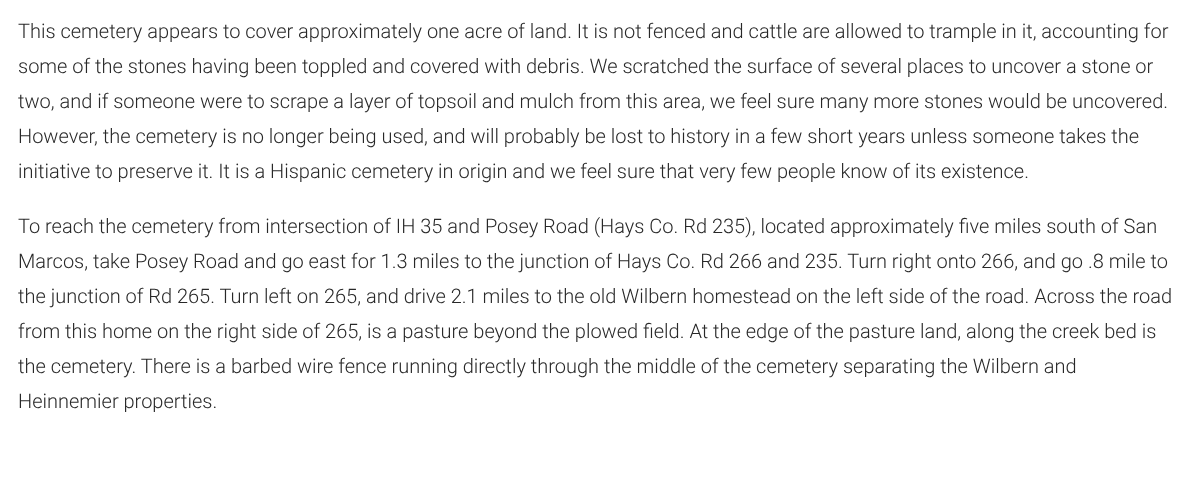
    Everyone is remembering a conversation about the San Pedro Cemetery, not this one! So what cemetery is in the middle of this current patch of land? I think I found it, in this list of all the cemeteries in Hays County.

    I think it must be the one called York Creek Cemetery. From that link:

    Those directions put it squarely in the middle of today’s project, but they also don’t make it sound like a very active cemetery that people are visiting often.

    [Updated to add: I’ve been corrected by a reader – thank you! – and the graveyard in the middle of this property is the Nichols-Berry Cemetery.

    So that settles one question!]

    (Which one did the land owner do the x-ray survey on? Is he confused about his own property? Or did he do surveys on both cemeteries? More unimportant questions I have lingering!)

    Thank you all for accompanying me on this edition of Untangling Old Cemeteries of San Marcos.