
Citizen Comment: Max Baker was the only speaker. He showed up to comment on several things:
- Damage to the river at Sewell park – litter, wild rice.
- Working with Chief Standridge: do our cops run unnecessary background checks?
- Upcoming elections: will the student center be properly staffed?
All good points!
Item 17: Platinum Drive
First, Leah Ave is one of those streets that you know you’ve been on a million times, but you may be vaguely confused about. That’s because there are two parts to Leah Ave, and they don’t currently connect:

The top half starts behind the hospital, crosses Wonderworld, and ends after Lowe’s and Petsmart and Marshalls.
The other half picks up again by Amazon:

I assume at some point the plan is to connect the two Leahs. But not today!
Today we’re talking about this little street that never got a name:

The solid part is the unnamed street, the dotted part is private. There’s a company, PGM, down that road and no one can find them, because their address is on I-35.
So that little road is now getting christened “Platinum Drive”.
According to the Transportation Master Plan, that road may some day hook up with Rattler Road:
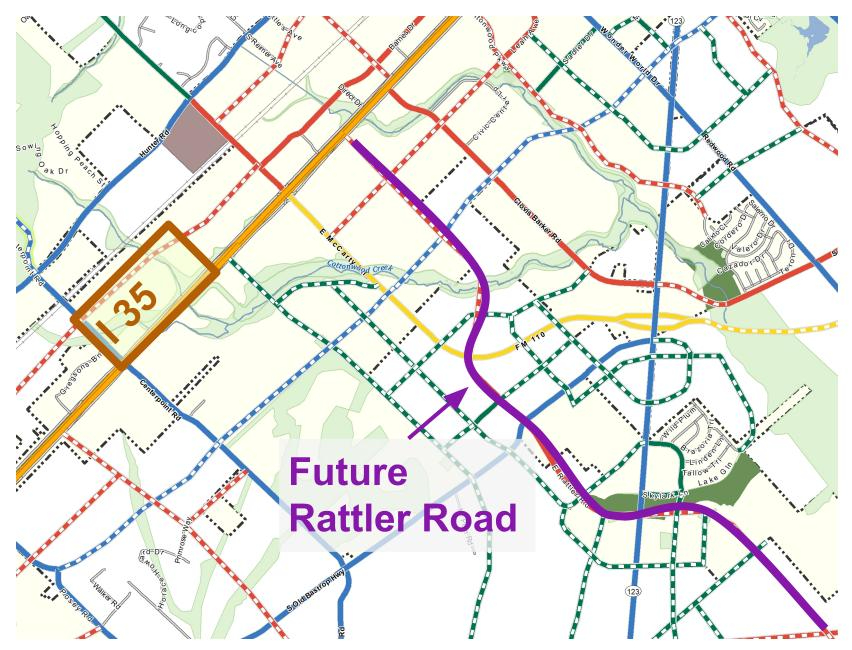
The transportation master plan is tiny and detailed, but someday Rattler Road will in fact cross McCarty, head over to Leah Ave and connect with Platinum Drive. But not any time in the next decade or so.
So for now, the fire marshalls did not want to name it Rattler Road, lest there be confusion in an emergency. I guess the folks on Leah Ave can just deal with a disconnected street.
…
Item 18: Cut and Fill
This is a development going in next to the Hills of Hays neighborhood:

They want an exemption for cut-and-fill. Cut-and-fill means you’re building on a hill and you need it to be flat. So you want turn it into level pieces. If you have just a few large stair steps, then each riser is taller. If you have more stair steps, then each riser is smaller.
The problem with cut-and-fill is that this affects how water flows. You don’t want to cause someone else to flood. The code places a limit on how big the riser can be. You’re not allowed to cut-and-fill more than eight feet. Here, they want to cut to 22 feet and fill to 18 feet.
The Hills of Hays neighborhood is right next door:

That neighborhood has a lot of drainage and flooding problems with stormwater. This is exactly the type of thing that can get worse if some developer does a bunch of cut-and-fill uphill from you.
Back in May, the cut-and-fill permit came to P&Z. Several residents from Hills of Hays showed up and talked about their constant flooding problems. P&Z voted unanimously to recommend denial to City Council.
Now, there is a big city project to fix the flooding in Hills of Hays, and in fact it got started this summer. So this is what city staff tells council on Tuesday: hey, we met with the residents of Hills of Hays. Construction on their drainage project got started since the P&Z meeting. Things are different now!
No one from Hills of Hays showed up to comment on Tuesday, but Saul Gonzalez asked a good question – Did they think the issue was settled when P&Z voted it down? Staff said that they’d sent out more notices for this hearing, so probably not? (Only the back street of Hills will be in the 400′ notification radius, though. Not the entire neighborhood.)
Here’s my question: the drainage project for Hills of Hays has been planned for years. Did the engineers re-tool the stormwater drainage models to account for this cut-and-fill? How much excess capacity is being built into the new drainage system?
The vote:
Yes: Mayor Hughson, Jude Prather, Shane Scott, Matthew Mendoza
No: Alyssa Garza, Saul Gonzalez
I probably would have voted “no”, because developers can follow the goddamn rules. But I do think that Jane at least was torn.
…
(The items go out of order because the Items 17 and 18 were Public Hearings, and so those go first.)
…
Item 8: the Interlocal Agreement (ILA) with the university over the river.
The city and the university have an agreement on river management. It’s not new, and they’re just minorly updating it this time around.
The city pays Texas State $276K a year, and the university does things like:
– non-native plant removal
– planting more Texas Wild Rice
– managing recreation and educating river users
– removing floating plant mats and any litter that’s part of them.
This isn’t changing much. I just bring this up because the river is incredibly low right now, and it’s upsetting.
Here’s the water level over the past year, compared to the previous 27 years:
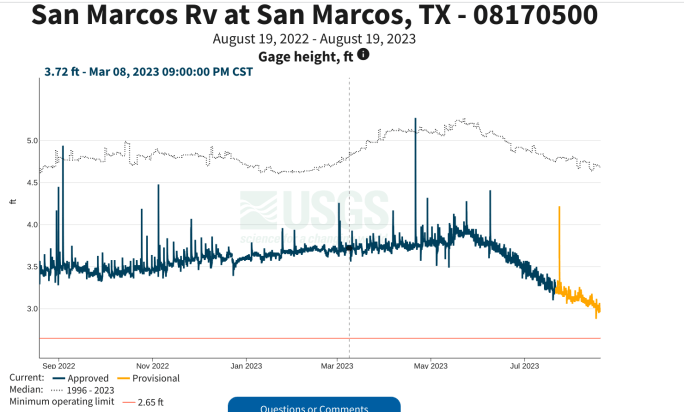
The speaker at City Council said it’s the lowest in 25-30 years. This article from June said that the June level was the lowest in 70 years.
It’s all very anxiety-provoking!
…
Item 19: Property tax rate for the new year.
Last year, the city tax rate was 60.3 ¢ on every $100 of property value.
The budget isn’t decided yet, but the city sets an upper limit on the tax rate.
There’s a couple possible property tax rates that get discussed:
- Last year’s rate: 60.3 ¢ on every $100.
- “No New Revenue Rate”: 53.05 ¢ per $100. This is the rate that undoes the effect of inflation. If you lowered the tax rate to 53.05 ¢, then you’d get the same amount of money from the properties that were taxed in both years, even though the value of those properties have gone up.
- “Voter approval rate”: 68.87 ¢ per $100: By state law, the is the highest you can go without having to hold a citizen vote on it.
Every penny increase brings in about $800K in tax revenue to the city. So Option 2 is about $6 million lower than Option 1, and Option 3 is about $7 million higher than Option 1.
Here’s an interesting chart from the presentation:

Hence everyone complaining that their property taxes are going up, even when the rate doesn’t change.
Useful things I feel compelled to remind everyone about:
- We have no state income tax! Wealthy people benefit the most from this.
- Property taxes are somewhat regressive.
- Sales taxes are really regressive.
Today’s task is just to set an upper limit on the tax rate. I’m not sure exactly why Texas requires city council to do this, but here we are.
City staff has proposed a budget based on a 60.3 ¢ tax rate, so Council sets 60.3 ¢ as their upper bound. I’m also not sure why they wouldn’t give themselves a little wiggle room on this vote. Why not set your upper bound at 61 ¢, and then approve the lower amount when the budget actually gets approved?
….
Item 20: Public transit is a great thing. But only when it works well. When it doesn’t work well, nobody uses it unless they’re in a bind.
What makes public transportation easy to use?
- Frequency. If you don’t need to consult a schedule because busses come every 15 minutes, it’s easier to use.
- Lots of stops: no one wants to walk very far in this heat.
- Range: it has to get you where you’re going, preferably without too many changes
There is federal money available for all this, if you can demonstrate ridership. This is the tricky part – how do you demonstrate demand, if your system is underfunded? It’s a little bit of a catch-22.
ENTER: THE INTERLOCAL AGREEMENT WITH TEXAS STATE UNIVERSITY!
A few years ago, Texas State started reporting its ridership numbers to the federal agency that keeps track of these things. Now we’re going to pool our systems. So we get a giant boon because Texas State has high ridership.
This opens up a lot of funding and growth opportunities! This is great! Hooray!
 The San Marxist