Hours 0:00 – 2:50, 3/18/25

Citizen Comment:

Main topics:

  1. Malachi Williams: Seven speakers, including family members. They want justice for Malachi. Several of the speakers focus on the detail that Malachi ran because a cop pulled a gun on him. Before the videos were released, this detail wasn’t mentioned. It shows how the officer escalated the situation instead of de-escalating it, which then ended in tragedy.
  2. Human Services Advisory Budget funding: Council is thinking about increasing HSAB funding for next year. Three speakers advocated for this.
  3. Cape’s Dam and the Mill Race: Two people talk about how much they love the river, east of I-35 and want council to keep it. We’ll unpack all of this!
  4. Tenants’ Bill of Rights: The San Marcos Civics Club made this a focus, and got Council to put this in their visioning statement. Now council will need to make it happen. Two speakers focus on this.
  5. Ceasefire in Palestine: four speakers. They still want the city to pass a resolution calling for a ceasefire in Gaza.

Onto the meeting!

Items 1-4: A bunch of audits and investment reports.

We got the audit reports for CDBG funding and the 23-24 fiscal year.  Plus the quarterly financial report and investment report.

Everything looks normal. No rude surprises. (Apparently we’ve gotten awards for excellence for the past 35 years, on our yearly fiscal audit. OH YEAH BABY.)

Item 18: Rezoning about 15 acres

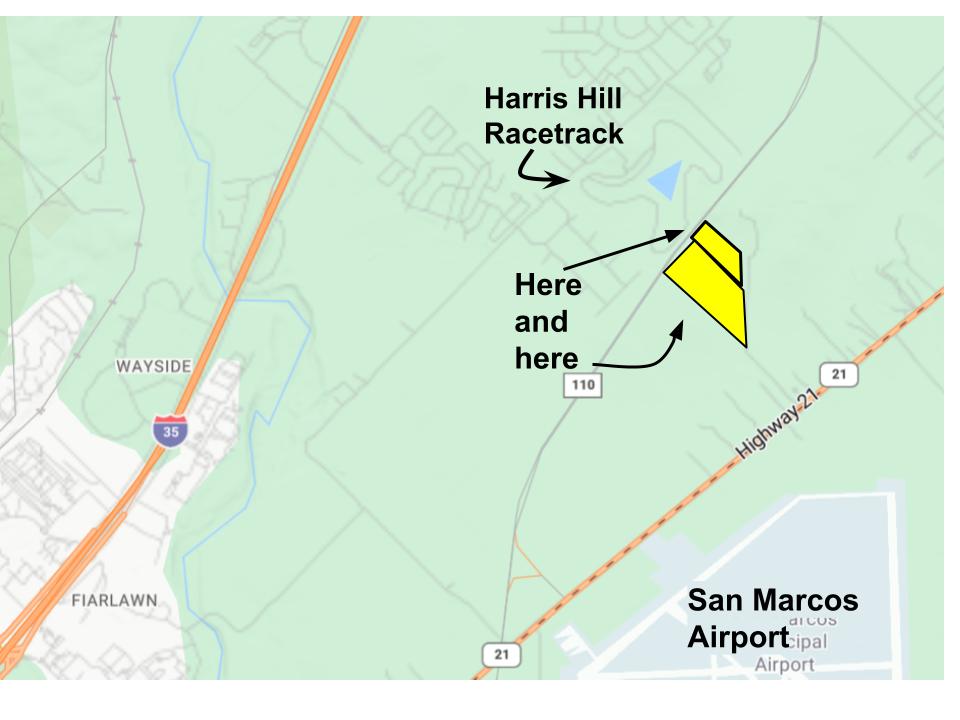
This property is way up north:
Back in 2020, we annexed this yellow and pink bit:
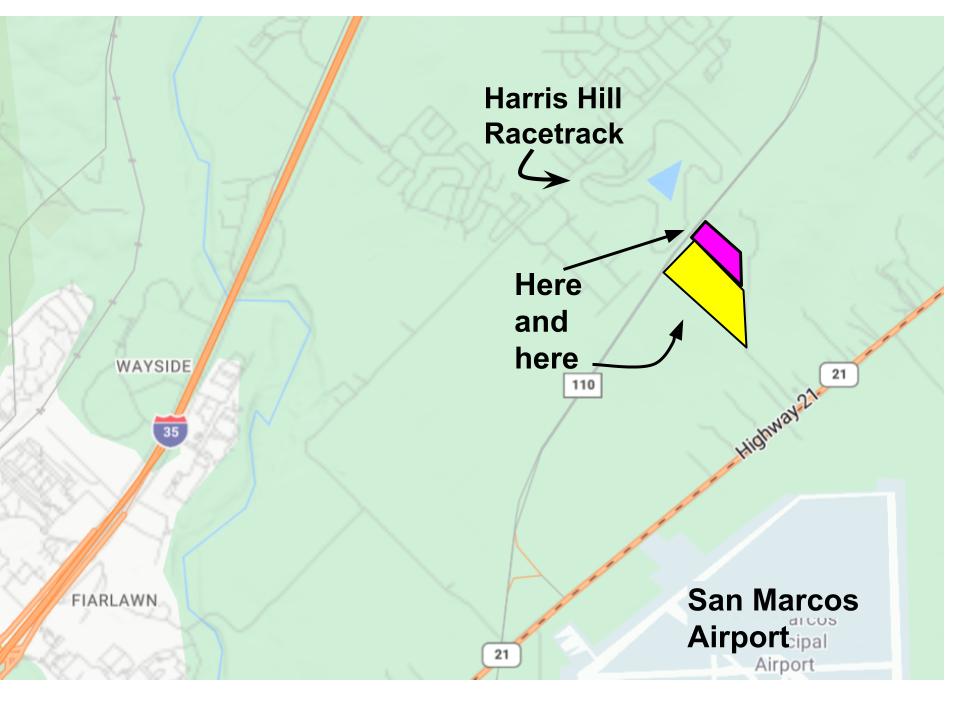
The yellow was zoned Manufactured Home, and the pink was zoned Light Industrial.

There were some concerns then – do we really want to make the folks in the mobile home community live right against an industrial park? But we let it ride.

Now the pink part is coming back for a rezoning – they want to switch it from Light Industrial to Manufactured Home.  In other words:
Great! Now nobody has to live near an industrial park.

Item 20: Budget Policy Statement

We’re working on the Fiscal Year 26 budget.

First: There was a two days Visioning workshop in January, which lead to approving the Strategic Plan.

The nex workshop was at the end of February. Today we’re approving the thing from that: the Budget Policy Statement.  

What’s a Budget Policy Statement?

This is like the guard rails for building the budget over the summer. Most of it is pretty dry? Like “Do you want to budget to maintain 150 days worth of recurring operating expenses in the budget, or just 90?”  “Are we okay using the General Fund for Stormwater projects over $5 million?” Etc.

There are two interesting bits:

  1. Each year, the city sets the rate for electricity, water, sewer, trash, etc.  To do this, they have to predict what their costs will be. Then they pick a rate that will cover all their costs.

From the Budget Policy Statement

What does this mean? If your utilities get turned off, you have to pay extra late fees to get your utilities back on. All of the late fees, taken together, add up to big chunk of revenue.

The question is: Suppose we are predicting that we’ll bring in $100K in late fees. (I’m making that number up.) Should we use that $100K to lower the rates for the rest of the customers?

Argument in favor: It’s more economical to include the late fees in your calculation. It allows you to set lower rates for the whole city.

Argument against: It’s kind of icky to count on late fees, for two reasons. First, you’re charging your most desperate customers – the ones who already can’t keep up – an extra fee, and then using that fee to help out all the other, less-desperate customers.

Second, it creates an incentive to creep up your late fees over time. When budgets are lean, it’s tempting to lean on late fees as an extra source of revenue you can tap, like cities that ticket their poorest residents into oblivion in order to balance their budgets.

The current council has already been going in the opposite direction. They are already trying to lower the late fees, to make it easier for residents to get their electricity turned back on.

To the original question: they decide that we are not going to use the late-fee revenue in computing utility rates. Then, when late fees come in anyway, they’ll put that money towards the Utility Assistance program.

It’s a small touch, but a good one.

2. Here’s the other one worth paying attention to:
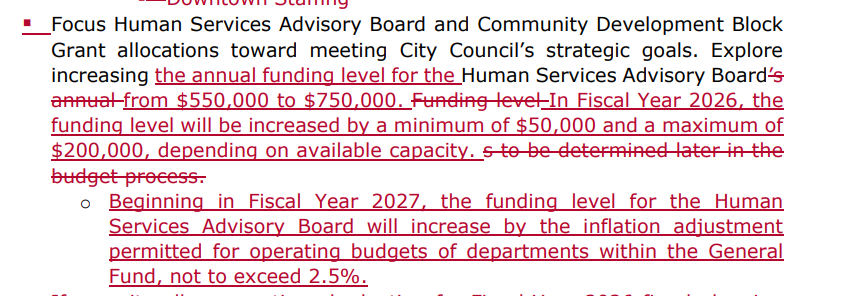
This is what the speakers during Citizen Comment were talking about.

Last December and January, HSAB funding was a total mess. There was too little funding, and Council ended up pitting nonprofits against each other. It was clear that we need to significantly ramp up city funding of nonprofits.

Right now, HSAB gets $550K. Council sets a range of additional funding, between $50K-$200K. When we find out what kind of money we’re getting from property taxes this July, then we’ll determine where we land in that range.

This part makes me extra happy:

Yes!! Peg the HSAB budget to inflation. We do it in contracts with for-profit entities all the time. It should be universal.

(The failure to peg minimum wage to inflation was one of the greatest policy near-misses of the 20th century. Having a federal minimum wage of $7.25/hour is such a mockery.)

Item 21: Cut-and-fill in La Cima

Pedernales Electric wants to build a substation here:
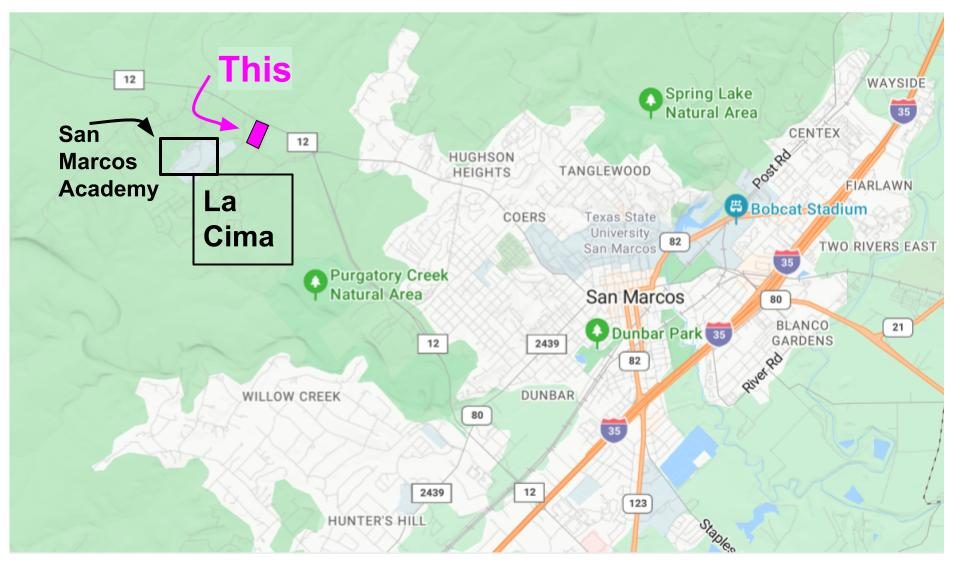
But it’s on a hill. Like we saw last time, it’s hard to build on a hill. So they also want to do a cut-and-fill.

This time, no one is worried about flooding.

Matthew Mendoza is a little worried that the people in La Cima might have to look at a substation, though.

Staff reassures him that there is another building, and then the La Cima apartment complex, all separating the substation from the houses. So their eyes won’t be hurt by the substation.

This passes 6-0.

Item 5: Council Compensation

This was so weird. 

Quick Recap: (Full story here.)

Councilmembers get three kinds of money:

  1. Monthly stipend
  2. Travel and expenses
  3. Flex money (either)

Shane Scott proposed doubling the flex money and travel money, and he wanted it effective IMMEDIATELY. Like, something lit a fire under his butt.

Last time, they went in circles forever, but ultimately landed here:

Travel budget

  • There’s plenty of travel money already.  The total council travel doesn’t go over budget.
  • Council members can lend each other travel money if one is going over.
  • If they STILL go over, there can be an extra $15K in a special travel fund that any of them can apply for.
  • AND, they each get an extra $2K for travel.

Flex budget

  • Double the Flex amount from $7.5K to $15K.

In other words: right now, a council member earns $24.9K a year, if they choose to take their flex pay as income. This would increase it to $32.4K.

The item was put on the consent agenda, which means, “Staff thinks this will sail through.” After all, they hammered out all the votes last time.

Jane said nope! and pulled it off the council agenda. She gives a speech about how none of this is needed, there’s plenty of money in the travel budget.  And how we certainly shouldn’t be doing this mid-year.

Amanda agrees on the mid-year part. More responsible to start it with the next fiscal year. She makes that amendment: Delay this until next year’s budget?

The vote: Postpone changes until next year’s budget?
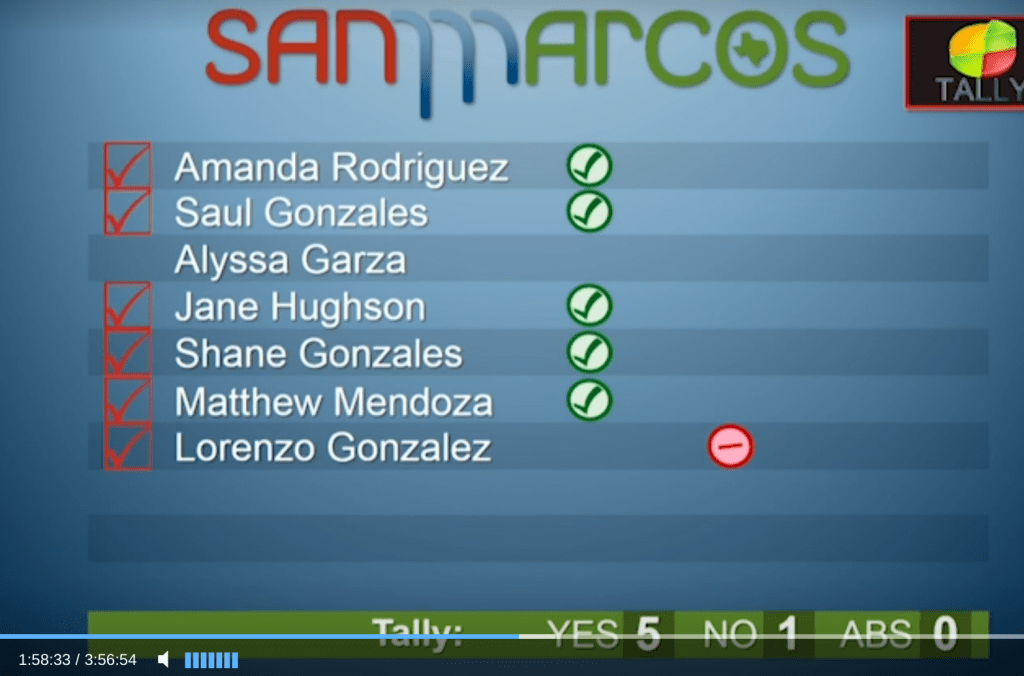
Ok, great.

But then Shane – who started this whole conversation back in December! – says, “Let’s just kill the whole thing, who cares. We don’t need it anymore.” 

(This is when I first thought, “What the hell is happening? Was this whole thing a ploy to get some quick money?”)

Jane sees her chance and makes a motion to kill both the travel increase and flex spending increase.

On the flex spending, Amanda pleads, “But why?”

Amanda has been quite open about having to resign her state job to take this position, and the impossibility of surviving on $24.9K per year.

Jane: “We don’t need it. We already raised it in 2023.”

What she means is that before 2023, council members got $23.4K per year, if they took their flex money as pay. They gave themselves a raise of $1500 then.

Amanda: I agree on the travel. But on the living expense, who here – anyone? – can live on this little?”

Jane: “It’s not supposed to be a fulltime job.”

Amanda: “Fully agree.  But we both know that it is actually a fulltime job.”

Jane: “For some people it is.  Not everybody.” 

Amanda: “Oh trust me, I understand that too. And I wish everybody shared full interest.”

Jane: “I do too.” 

Amanda: “But again, please tell me, who can survive on this?  Would anybody in this room? 

<crickets>

Then conversation dies.  

The key issues is this: Is being a councilmember a fulltime job? We pretend it isn’t, but in order to do it well, it definitely is.

If we pay poverty wages, then council members have three options:

  1. Be independently wealthy or have someone who can support you.
  2. Try not to neglect your council job as you juggle multiple jobs
  3. Live in poverty

This is not how you get the best possible council members. This is how you get mostly wealthy and/or distracted council members.

But anyway, then they vote:

The vote: Should Councilmembers survive on $24.9K per year?
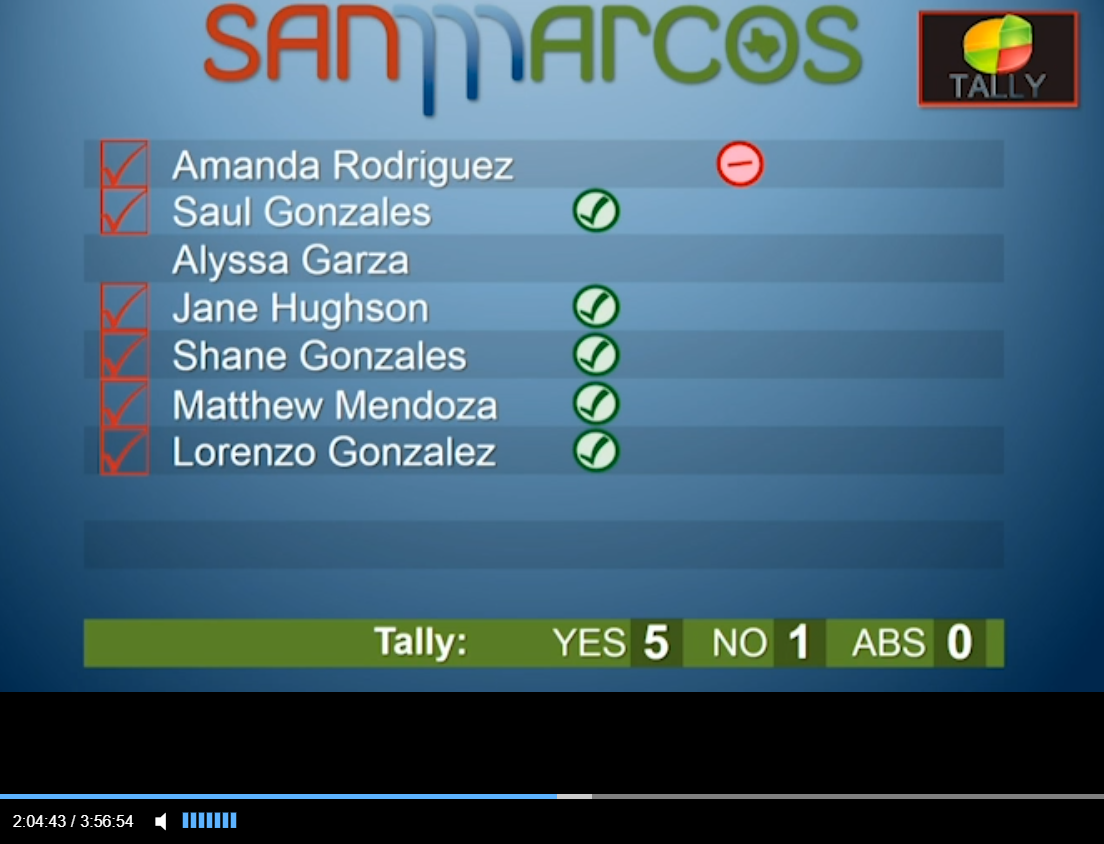
So yeah, no raise.

I’m so baffled.  Two weeks ago, Shane and Lorenzo both thought it was reasonable to increase flex spending, and now they don’t? What the hell happened?

….

Then they vote to roll back the travel funds increase:

This one doesn’t bother me so much. There is plenty of travel money, if you allow people to donate funds to each other.

Bottom line: After all these meetings, everything is back where it started, aside from a special bonus travel fund.  

Clearly I have no idea what happened, but it felt like petty bullshit, to be honest.

….

Item 24: SMCISD stormwater voucher

This is a continuation from last time.  (Full backstory here.)

Super quick background:

Statewide, the legislature is intentionally starving the school districts. This is not hyperbole. Abbott is hellbent force-feeding school vouchers down everyone’s throat. He’s denying funding to the public schools is a way of increasing the pressure on the state legislature to vote for his deal.

Funding hasn’t increased since 2019, but there have been several unfunded mandates that cost a lot. Plus inflation.

SMCISD is in a $9 million budget crisis. They’ve asked for the city for a stormwater waiver, which would save them about $350K.

Which brings us to today.

First there’s a presentation about the stormwater fund:
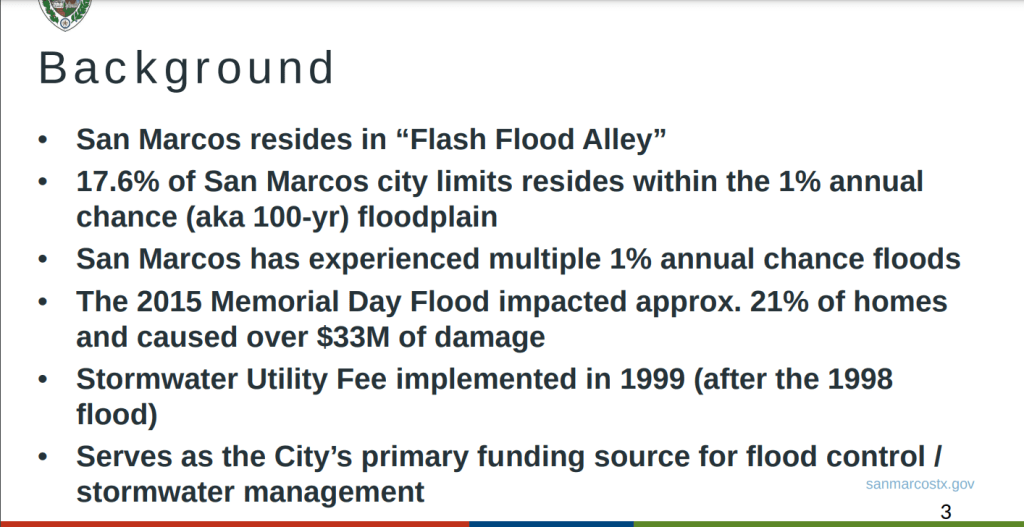
Immediately after San Marcos created the stormwater fund, Texas State University asked the State Legislature to grant them an exemption.  They were the very first university in Texas to ask for one!  What go-getters.

After that, all the other universities thought it was a pretty good idea.

Here’s the total list of state-wide exemptions:

So basically, empty lots, lakes, universities, and ….El Paso school district.  Who knows.

The state law says that stormwater fees must be equitable. They go into a fair amount of detail about how we put ours together. 

Basically, if we want to help out SMCISD, here are the four options:
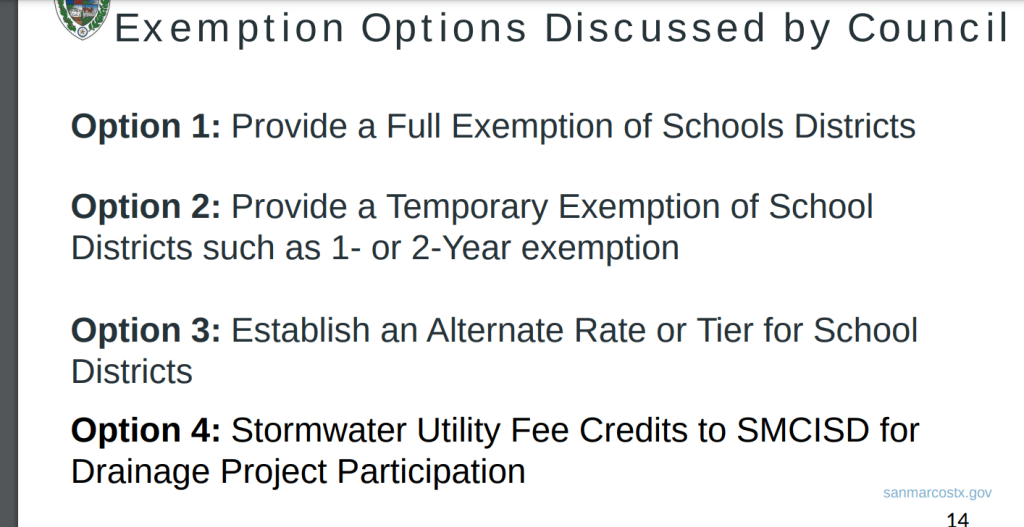
Option 1 would cost a lot and open the door to other nonprofits asking for a waiver, too.

Option 2 would cost some, and open the door.

Option 3 might open us up to legal challenges of being non-equitable.

Option 4 is the one that Staff clearly favors. In fact, city staff and SMCISD staff have already met, and they’re both open to this.

Option 4 is about Mendez Elementary. Mendez is located in Sunset Acres, which has terrible flooding. The city wants to build a detention pond on Mendez property, to help with the flooding.

All the council members are on board with pursuing 4. 

The only thing is that Mendez Elementary is being renovated. Until SMCISD knows the new footprint of the building, they can’t donate the land.

(Now, SMCISD has already submitted the Mendez plans to the city for permitting. So the city could literally go look right now at the Mendez plans.  It’s not a mystery. We can see exactly how much space there might be for a drainage pond.)

There’s a long, weirdly circular conversation where Lorenzo and Amanda keep saying, “We should meet occasionally with the school board, just to stay informed on what we’re each up to.”

Jane keeps responding with, “It’s no use.  Alyssa and I keep trying to think of a reason that all three entities – city, county, schools – should meet, and it’s very hard to think of issues that need attention from all three groups.”

Ok?  That’s a different thing?  That’s not what Amanda and Lorenzo are suggesting?

Anyway, they vote for 4. 

Item 25: Redwood/Rancho Vista

Last time, we discussed this property, immediately north of Redwood and Rancho Vista:
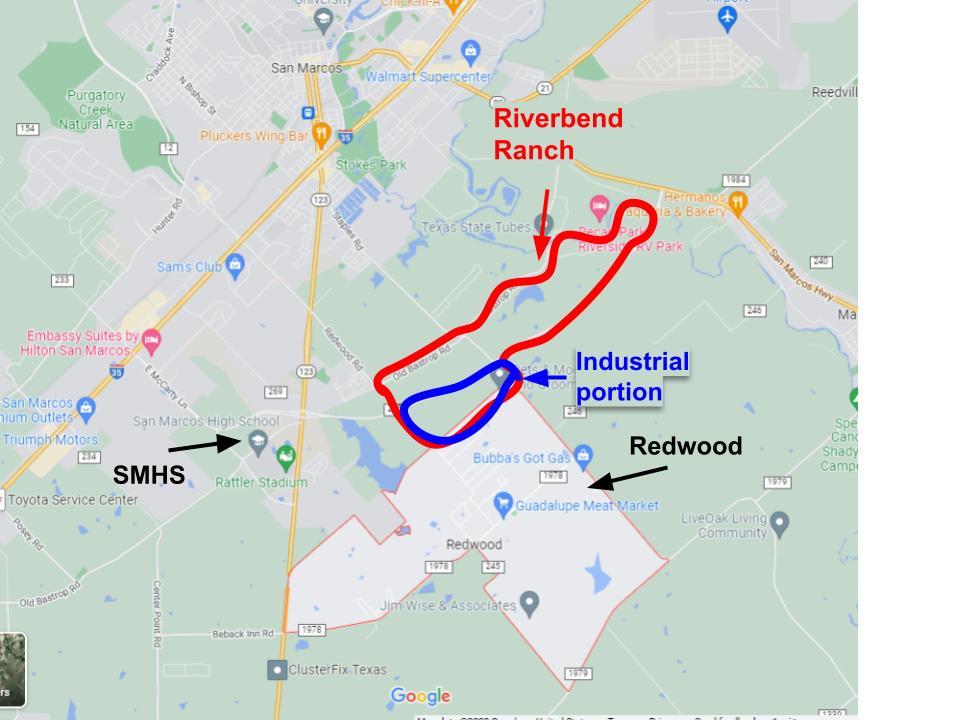
We were trying to figure out if that industrial portion would make flooding worse in Redwood.

Redwood and Rancho Vista have severe septic and flooding issues, which leads to a parasite living in the soil. It’s a big health issue, and it usually only happens in developing countries. But the community is quite poor and vulnerable, so it’s happening here. Any solution is going to be very expensive.

Last time Council tried to have it both ways: “We’ll let this development through, but we promise to take action on Redwood.”

So tonight is that action: A strongly worded letter to Guadalupe County about how the septic issue and parasites is a public health and safety issue, which has been going on for years and years.

Jane suggests that we let them know about the Texas Water Development Board, which has a specific Economically Distressed Areas Program. Maybe Guadalupe County could get some money from there.

City Manager Stephanie Reyes mentions looping in SMCISD – after all, these families go to our schools and are part of our community.

So staff will draw something up, and it will come back.

My two cents: this is fine as a first step, but not as a last step.

Hours 2:16 – 4:28, 3/4/25

Item 19:  SMCISD is broke.

Backstory:

For the past few years, the state has been strangling the school districts out of funds, in order to get legislatures to approve Abbott’s vouchers plan.  In other words, back in 2019, we received $6,160 per student. It has not been raised since. With inflation alone, it should be $7,774.18 per student now. (And since Uvalde, there’s been a massive increase in unfunded, mandatory safety measures.)

SMCISD is looking at a $4-5 million budget shortfall.  

I’m sorry. I need to stop and shout for a second.

This is a huge, wealthy state with budget surpluses! We had a $32 billion surplus in 2023 and a $24 billion surplus in 2025.  There is plenty of money.

The reason that funding has been frozen is that Abbott is holding the public schools hostage. He wants a school voucher program. He didn’t get it in 2023, and so public schools were punished.

Furthermore! (My god, I’m going to hyperventilate.) FURTHERMORE!

Here’s Abbott’s voucher proposal: Increase per student funding from $6160 to $6380 at public schools, while private schools get $10,000 per kid from the state, plus whatever additional tuition above that. Everybody got that? Private schools – schools that can turn away kids with disabilities, kids with trauma, kids with behavior problems, and any other kid requiring extra TLC – get a lot more money per student than public schools.

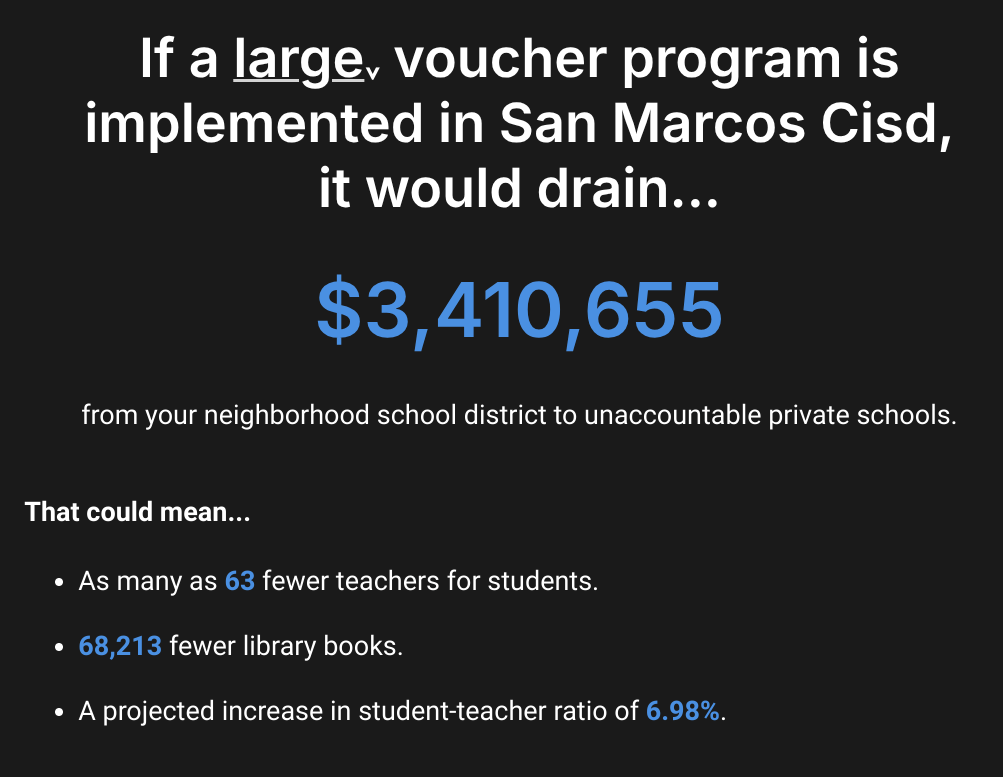
How much money will SMCISD lose if this passes? There’s a handy website here!

And what does it say?

Let’s be super clear: the villains in this whole story are Greg Abbott, Dan Patrick, and the state legislature.

Okay, so even before the vouchers scam passes, SMCISD is looking at a $4-5 million shortfall.

This is already going to make San Marcos kids lives harder. Teachers who love them to bits are going to lose their jobs. It’s very real and it’s very awful.

In this context, SMCISD spends $372K on stormwater drainage fees to the city every year.  They’re asking for a waiver from the city.

What’s the city side of the equation? 

The stormwater fund is $9 million.  Stormwater money gets used on two things: big drainage projects and yearly maintenance. But the big projects are covered by debts, and so we’re obligated to keep making payments.

Giving SMCISD this waiver would cut yearly maintenance by 40%.  Drains wouldn’t be inspected for clogs, ditches wouldn’t have debris removed, etc.  Flooding would get worse.

Do other cities exempt ISDs from stormwater money?  

Some do: Austin, San Antonio, and Round Rock all do.
Some don’t: Seguin, New Braunfels, and Kyle all do not.

Remember how I said the state is the villain in this?  They strike again! State buildings, federal buildings, schools, nonprofits: everyone pays stormwater fees, and your rate is based on how big your footprint is. More impervious cover means a higher stormwater fee.

But! There’s a specific state law that carves out public universities, and only public universities. So Texas State University has paved the top of San Marcos, and yet does not contribute towards the cost of the flooding, caused when it inevitably all rolls downhill.  

(Sometimes I marvel at what this state could be like, if we weren’t constantly suffering from self-inflicted wounds.  Stop voting for pricks, everyone.)(I am aware that readers of this site probably didn’t vote for Abbott.)

What does Council say? 

First off, there’s no decision tonight.  This is just testing the waters – would Council like to have a formal discussion next time?  

Lorenzo: Can we look at a 2 year waiver instead of an indefinite waiver?
And can we look at a middle option – some kind of discounted rate tier for SMCISD that’s outside of residential and commercial?

Alyssa:  SMCISD fills big gaps in our service.  They’re the ones that take care of Redwood, for example. Let’s consider this.

Matthew Mendoza:  I’m angry on behalf of Sunset Acres.  We’re trying to fix the drainage there, and SMCISD is holding it hostage.

Note: here’s my understanding of what Matthew means:

In November 2022, we took a big look at the flooding in Sunset Acres.  It’s really, really bad.

We came up with a semi-fast track solution to get it fixed.  The fastest part of the solution hinges on enlarging a detention pond at Mendez Elementary.

The city made two offers SMCISD, in exchange for the easement – about $350K for the land, or a credit for stormwater fees. (Pretty similar to what they’re asking us for, now!)

SMCISD was interested and started to work with us.  But then they realized they needed to renovate Mendez.  Currently, they’re waiting on permits. Once they can see how big the footprint of the new Mendez will be, then they’ll come back and talk with us about the drainage pond.  

So the “quick” solution to fix the flooding has now become yet another holding pattern, going on three years now. The neighborhood was already pessimistic about the city fixing anything, and this kind of thing makes it worse.

Amanda makes a few different points:
– I would entertain two years, but definitely not in perpetuity.
– The Texas Legislature is going to suck just as much in two years as they do now.  I need to see what other cuts the school district is making, in order to balance its books on the other $4 million. 
– Lots of neighborhoods have lost faith in the city to fix their flooding problems.  This money is for those projects.
– If our rationale is that SMCISD covers gaps in our services, then this opens the door for every nonprofit to ask for a waiver as well. We need to be really careful with our precedents.  

Jane:  I don’t think we should even bring it back for discussion. But enough of you have said yes already. Definitely not just 2 years, because we’ll forget to enforce it. 

So this will come back.

The most important thing to understand is that the state of Texas is the only villain here.

Item 22: Councilmember compensation:  

(Discussed last time.) Councilmembers get three kinds of funding:

  1. Regular (measly) paycheck
  2. Travel and expenses (you have to submit receipts)
  3. Flex money (you choose whether to take it as income or use it for expenses) 

Right now, here’s what everyone gets:

So this is Shane Scott’s proposal, and he wants to double the travel and flex spending amounts.  

Jane’s got amendments!  “First,” she says, “We don’t need this.  We’re not running out of travel funds.  Some of us go over, some of us go under. We just need to lend each other our un-used amounts.”

Here’s what she means:

So $13,500 is the mayor last year, and $7,500 is each of the council members. (Jude is the $15K, because it includes his flex spending. He worked for the county, so he couldn’t accept a city paycheck.)

So you can see: some went over, some went under, but the total was $51,810, which was under budget.

Great! There’s no problem!

Here come the amendments

Jane Amendment 1:  Keep the Flex money at $7,500, instead of doubling it to $15K.

The vote:

Keep at $7,500: Jane, Matthew, Saul
Double to $15K: Alyssa, Shane, Lorenzo, Amanda

So this fails. 

Jane Amendment 2: Keep the Travel money at $7,500, instead of doubling it to $15K.

The vote:

Keep at $7,500: Jane, Matthew, Saul, Amanda
Double to $15K: Alyssa, Shane, Lorenzo

So this passes.  

So now we’re looking at doubling the flex spending and leaving travel alone.

At this point, Alyssa balks at this piece-meal approach.  She wants to go back and retract her yes vote for the Flex money, and instead double the Travel money.  

There’s a lot of confusion around this.  Flex money can be used for Travel, so why does it matter? There’s a lot of arguing about what’s easier, and whether the flexibility of Flex Money is too complicated. Ultimately there are not enough votes to reconsider the motion, so it stands.

Next: Shane amendment: Okay, just increase Travel money by $2K, then.

Keep at $7,500: Jane, Matthew, Saul
Increase to $9,500: Alyssa, Shane, Lorenzo, Amanda

So this passes.

Jane amendment 3:  If you want to borrow travel money from another councilmember, you have to get council approval at a meeting:

Yes: Amanda, Jane, Matthew
No: Saul, Alyssa, Shane, Lorenzo

So this fails.  Councilmembers can just lend each other money, and notify the finance committee accordingly.

Next: it turns out there’s a special travel fund that everyone’s forgotten about. It used to have $25K in it, for council members who went over budget.  We let it drop during Covid, when no one was traveling, so now it has $5K in it.

Jane amendment 4: Increase the special travel fund to $15K, but you have to get council approval at a meeting.

Everyone is fine with this. The vote is 7-0.

The final vote on the whole thing:

Yes: Everyone but Matthew Mendoza
No: Matthew Mendoza

So Council members will now get:

  • $17,400 paycheck
  • $15,000 flex spending
  • $9,500 travel and exspenses

I am fine with this. You want your council to be able to learn about governance and write good policy. They need time and resources to be good at their jobs.

(No one brought up an amendment about waiting for the next budget cycle. So it goes into effect mid-budget, immediately.)

Item 23:  Delinquent Apartment Complexses

This is actually great governance in action.

Generally speaking, if you don’t pay your utility bill, your water/electric/etc gets disconnected.  But what if you live in an apartment complex, and you pay a flat rate to your landlord, and the landlord doesn’t pay the utility bill? Do we really want to disconnect the electricity on a bunch of renters who didn’t cause the problem?

No, we don’t! So let’s not do that.

Instead we’ll put a municipal utility lien on the property. So only the owner gets affected, and not the tenants.

Everyone likes this. 7-0.

Finally there are some various appointments to various boards, and futzing with small rules to some boards and commissions. 

This was a very, very long meeting, and there’s still a 3 hour workshop to go, so maybe let’s stop here.

Hours 0:00 – 2:03, 2/18/24

Citizen Comment

Two topics today:

  1. Nine people spoke about Malachi Williams. 
  2. Three people talked about the Data Center that might come to town.

I’ll save the Data Center comments for when we get to that item, and just focus on the Malachi Williams speakers here.

Backstory: Malachi Williams was a 22 year old who was killed by an SMPD officer last April. It was reported that he was carrying knives. Two officers started to detain him at the convenience store on Cheatham and Hopkins. (He was not holding the knives at that point.) He took off running. They chased him over to HEB, and then shot and killed him in pursuit.

Since last April, a number of activists and family members have been pursuing justice for Malachi, and fighting for a fair process for the family and some kind of consequence for the cops.

Last August, a grand jury decided not to press charges against the officer. That basically brings us up to the present day.

Why now?  There was an event recently hosted by Malachi’s family. From what I gather, attendees were able to view some bystander footage for the first time. 

The focus today is on inconsistencies between what Chief Standridge and SMPD have claimed, and what actually happened last April.  

The biggest problem:

Chief Standridge has been asserting that a fire marshall was there and able to administer first aid in under a minute. Officers are trained in first aid, but they didn’t need to jump in, because the fire marshal is a certified paramedic.

The speakers say that is definitely not what the videos show.

Here’s what the speakers describe: Malachi doesn’t get first aid for about three minutes. During that time, SMPD got mad at him for not putting his hands behind his back. They rolled him around, so they could handcuff him. They checked his pockets. In fact, when first responders did arrive, they had to ask the cops to take the handcuffs off the guy they’d shot, who was bleeding out.

Malachi’s grandfather  

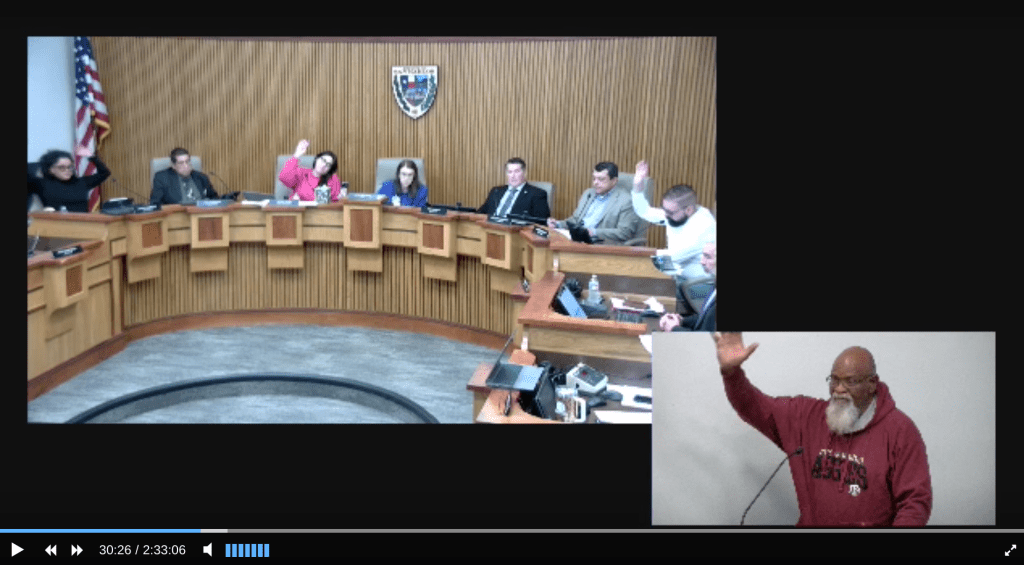
I’ve mentioned before what a compelling speaker he is. In his measured way, he asks council, “Think. If what we’re hearing today is true, are you disgusted? Can I get a show of hands, please?” – and he puts his own hand up – “If we’re telling the truth, if we’re telling the truth, are you disgusted?”

Here’s who raises their hands:

That would be Amanda Rodriguez on the left, with both hands up, Alyssa Garza in pink, and Lorenzo Gonzalez on the right. (I will say that so far, Lorenzo Gonzalez is proving to be a good council member.  I don’t have any complaints.)

Jane, Saul, Matthew, and Shane refuse to go along with the requested show of sympathy. (Is it performative? Sure, but I also think they genuinely just might not care.)

….

Now for an abrupt change in tone:

5.  Fireworks!  We put on a fireworks show every 4th of July.  

The amount we spend fluctuates from year to year:

This is because some years we get donations, and other years we don’t:

For the record, it’s always a 20 minute show.  As they put it, “The more donations we get, the bigger the booms.” 

Jane Hughson wants to know why we have to keep making the shows bigger.  If donations come in, can’t it just free up some city money that we could send over to the parks department?

Answer: People complain when it’s big one year and smaller the next.

Me personally: I’m with Jane here. I’m having a hard time caring about the size of the fireworks.  I’d rather use the donations for fireworks, and free up some money for the parks department.

But then again, I’m a grouchy old tree stump. If other people care, who am I to harsh their mellow?

Item 10:  Data Centers!

You may have seen this KXAN article, “A new AI data center is coming to San Marcos“?

This isn’t that.  In fact, there’s a lot of confusion about what that article exactly is about! We’ll try to unpack it all here.

So if this isn’t that, what is this?

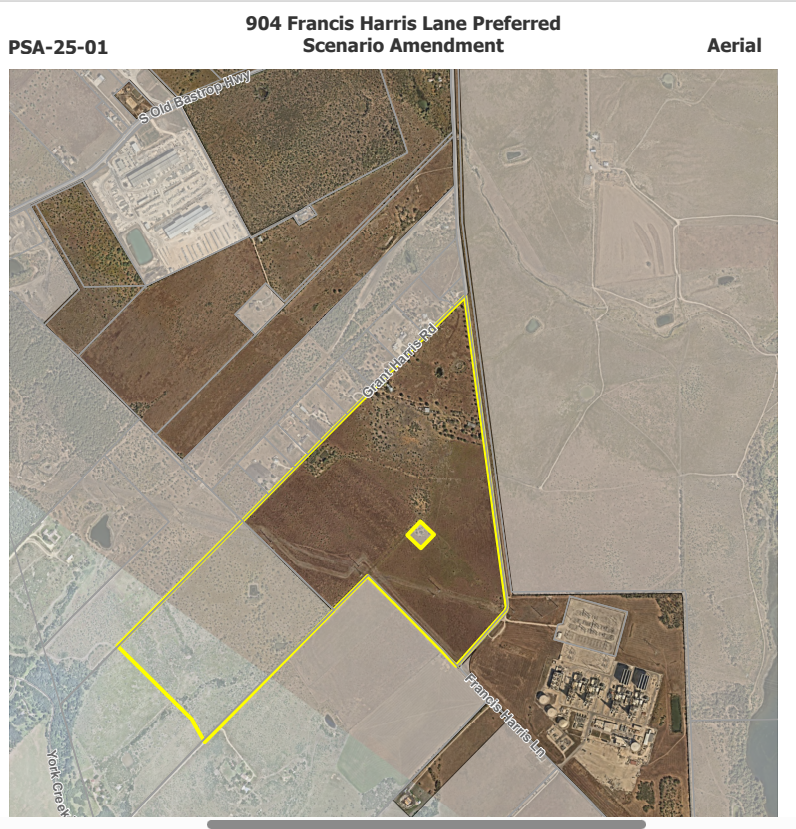
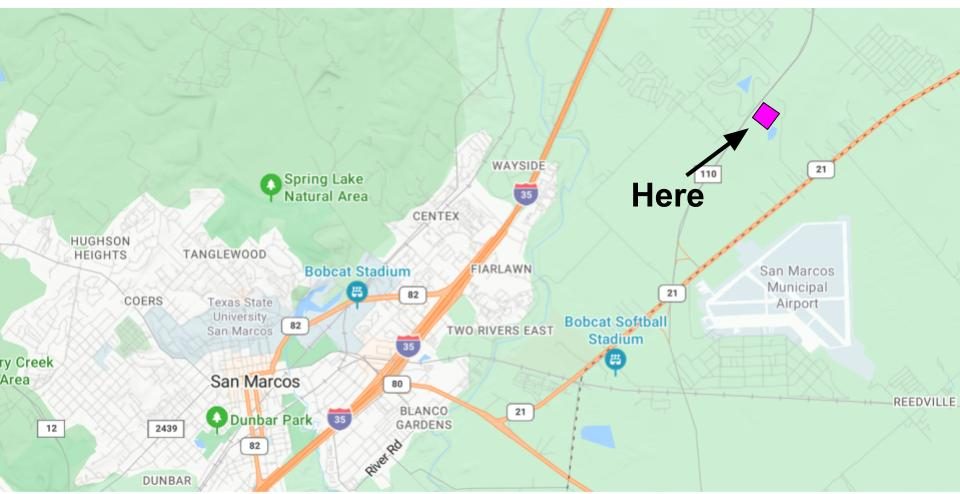
First off, it’s way down here:

(We’ve actually seen this property before, back in August 2nd, 2022.  They wanted to put houses out there.  I thought it sounded like a super terrible idea!)

Here’s a close-up of that property:

See that funny little yellow square?  That’s an old cemetery.  Access to the cemetery will be preserved.

Listen: I have some extremely boring confusion regarding this cemetery. I’m sticking it at the end of this page, because it’s truly too weedy to bore you with. This way you can opt out from the dumbest of my dumb shit.

What’s a data center? 

Basically a giant computer that takes up an entire building, where AI can perform its massive amount of computations.  So there are very few people working here, besides security and some technicians to monitor it.

What are the pros and cons?

The pros:

  • This is in the middle of nowhere, next to a giant power station.
  • The city is not going to have to spend much on infrastructure or maintenance.
  • The city should see some revenue from property taxes.

The cons:

  • Data centers take a massive amount of water.
  • Data centers use a massive amount of electricity.

This particular project would not be on city water or electric. They’d use Crystal Clear Water and Pedernales Electric for power.  (They’d be on San Marcos wastewater, though.)

Here’s the thing:  Crystal Clear Water draws from ARWA, just like we do.  It might not be city water, but it’s the same underlying water table, either way.

Can this be done responsibly?  Maybe!

Water is the biggest problem. The water is needed to cool the data center, because computers generate a lot of heat, which would then make them overheat and shut down otherwise.

The land-owner says that this will be a closed-loop water cooling system, which means less will be lost to evaporation. Matthew Mendoza says Google developed this technology 8 years ago. (I don’t know if this is the same as this technology, which only rolled out last year, but maybe.)

It’s great to implement the latest water-saving technology! But if quantities are still way too big, it doesn’t help you much.

Bottom line:  We can’t make an informed decision unless we have a concrete gallon amount of potable water usage.    

How much water does a data center use? This says an average estimate is 550K gallons per day for a hyperscale data center. (I’m pretty sure AI means a hyperscale data center). This closed-loop Microsoft system coming next year is claiming to only use 99.5K gallons per day. So we’ll probably be somewhere between those two estimates.

How much water do we have? According to the presentation in January, our current capacity is 4.8 million gallons per day.

NOTE: They would be using 550K gallons of Crystal Clear Water, not San Marcos water! But I couldn’t find a total capacity for CCW, so I just used San Marcos as a reference point. Both draw on the same underlying water table, so it’s best to still think about water conservation.

Can data centers use reclaimed water?  Maybe!

This link says yes, they can, but if the water quality is bad enough, it causes corrosion and microbial growth and other problems.

We do actually have a reclaimed water line that goes very close to there.  What’s the quality of the reclaimed water in that pipe? Could they use it?

I think this is the most essential question to answer.

Energy usage:  Honestly, this is probably less of a concern than the water.  Texas may have a shitty grid system, but we have a fairly healthy renewable energy supply, mostly because of all those windfarms out west.  This is a great state for both wind and solar energy, if we’d only stop electing such counterproductive leaders.

On energy, there is something called ASHRAE guidelines for data centers:

So maybe we could ask them to achieve that.

Do we have any leverage? 

Sort of! This is a tricky thing to answer.

First, they’re not asking for tax cuts. If they were, we could come back with all kinds of environmental restrictions. But they aren’t.

Second, they’re asking for a Preferred Scenario Amendment and a rezoning. There are rules around how cities make these decisions. You’re not allowed to base it on one specific project. You have to approve or deny based on all the allowed uses, and whether you like the location or not. And specifically, you can’t attach any requirements to these.

You might be able to require a Planned Development District, but I don’t know if water usage is an allowable reason to trigger one.

My opinion: If we can get them to agree to reclaimed water, then we should do this. Otherwise they’ll find another location that still uses the same water source, but isn’t within San Marcos jurisdiction.

I think many data centers will get built in Central Texas, no matter what.  I would like them to be as tightly regulated as possible. 

Note to Council: An ordinance requiring future data centers to be on reclaimed water might be handy to have!

What do citizen comments say?

Let’s go back to the beginning of the meeting. During citizen comment, one speaker had a list of extremely great questions:

  • What is the current noise ordinance for Light Industrial, within the city of San Marcos?
  • Will Dark Sky Lighting be considered for all outdoor buildings?
  • What will the setbacks be for both Francis Harris Road and the private Grant Harris Road?
  • Do we have a general idea of the size of the buildings?
  • What will be the estimated daily water usage?
  • Will it be public drinking water?
  • Will any measures be taken to lessen the impact of the large amount of impervious cover?
  • Cloudburst has stated on their website that this site will be part of their flagship data center in central Texas, and plans to aggressively grow its data center network. With a large amount of open farmland around the proposed site, should we expect further development from this company?
  • Since Cloudburst has already signed a longterm contract with Energy Transfer, the power plant already located on Francis Harris Lane, and KXAN reported on February 13th an AI data center is coming to San Marcos, should we assume decisions to change zoning and city limit boundaries are already confirmed?
  • Will Cloudburst be responsible for answering any of these questions or have to provide plans for the development, prior to the zoning change and incorporation into the city?

The very next speaker happened to be the land owner. His major points:

  • I’m working with the Data Center company to answer those questions above. The previous speaker submitted the questions to us in writing, after the P&Z meeting.
  • We have confirmed that the Data Center uses a closed loop water system. We are still working to quantify the amount of water lost to evaporation.
  • Hey look, we’re not going to put much wear and tear on the roads, at least!
  • And the biggie: We have no affiliation with Cloudburst or Energy Transfer. That is not us. The first time I ever heard of them is when that KXAN article came out.

What does Council say?

What the hell is going on with the KXAN article about Cloudburst?!

No one knows.  The owner swears up and down that he’s never heard of Cloudburst until that article came out, and has no idea what’s going on.

Amanda Rodriguez has headed over to the Cloudburst website, and they have the same exact timeline posted as this project:

Are there two projects? 

City staff says that it’s extremely unlikely a project of this size would operate on stealth-mode like this.  Companies tend to reach out to either the city for permits, or to the Economic Development Partnership to find out more about working in the area, or whatever.

The city manager Stephanie Reyes does also say that the city has gotten approached by multiple companies about data centers.  But no one else has an active application in progress.

Basically: no one knows what’s up with Cloud Center and they’re going to follow up.

….

What next?  Tonight was just informational. This is going to drag out all the way to April:

So there was no vote today. Stay tuned.

Item 11: Council members don’t get paid much.

Shane Scott wants to double the travel budget and increase the stipend that council members get.

First off: yes, we should pay our council more.  If you don’t pay your council enough, then you only get council members who are either independently wealthy, or who are willing to live in poverty in order to serve in council.  That’s not a recipe for healthy representation. 

Second: yes, we should increase their travel budget.  Inflation has made expenses go up.  We want council members to attend conferences and gain expertise, and make connections.  That’s how you get stronger representation. 

However, this is Shane Scott’s proposal, so it comes with a whiff of ridiculousness. 

Like at 1:18:30:

Shane: “At these conferences that I go to, I even get AWARDS for doing all the classes and stuff.”

Alyssa in the background: “he does, it’s so good.”

Jane: “I don’t really care about the awards. What value have you brought back to this council?”

Shane: “If I were to pass all the writing and stuff that I’ve learned before, I’d have a whoooole book of stuff that I’ve provided to council about doing stuff.”

I am dying to know more about these awards he’s winning for participation.

That’s my blogger dream, that Shane has a whole trophy case of these things.

Back to the proposal

The total increase of his proposal is $90K.

One ridiculous thing he’s doing is saying that he wants to increase amounts halfway through this year, instead of just waiting and budgeting the increases into next year’s budget.  So city staff had to scramble to figure out where to cut $45K from, in case Council approves Shane’s proposal.  

The city manager was not enthusiastic at all about this, back in December, but she managed to find $45K by raiding two budgets, one called “Council- related” and the other is a Contingency fund, for when projects go over their budget.

Here’s how much more money Council members would get, under this proposal:

“Expenses Elected” means your travel budget. This is anything where you have to provide receipts for what you did. So Shane wants to double everyone’s travel budget.

“Compensation” isn’t changing, but “Additional Expenses” is being doubled. “Additional Expenses” is basically extra compensation.  Councilmembers take it as a monthly lump sum for expenses where they don’t have to provide receipts. 

Why not combine “Compensation” and “Additional Expenses”?  Just call it all compensation? 

There’s actually a good reason: you can’t collect two paychecks from the government.  So if you work for the university, or the county, or the state, you can’t collect “Compensation”.  You can still collect “Additional Expenses” though – this is what Jude Prather did, since he works for the county.

Amanda is horrified to learn this – “You mean I could have kept my job?!  I took a huge paycut to accept this position.  I’m struggling.  I live with my mom, y’all.”  

I’m kind of infuriated on her behalf:  there was a better path available and she wasn’t informed?? 

Other council comments:

Alyssa:  Our community members treat us as though we’re fulltime and have staff.  Other cities pay their councilmembers to be fulltime, with staff, and they also slice their cities into districts so that you’re not answering to as many people.

Jane: Austin and Dallas pay their councilmembers fulltime and give them staff.  Not Kyle, Buda, or New Braunfels.  They pay zero.

Note: remember, paying $0 is strategic.  If you require someone to work for free, only wealthy people can do the work.  That’s not aspirational.

In the end, they move to postpone this.  Everyone’s going to come back with amendments and chop it up. 

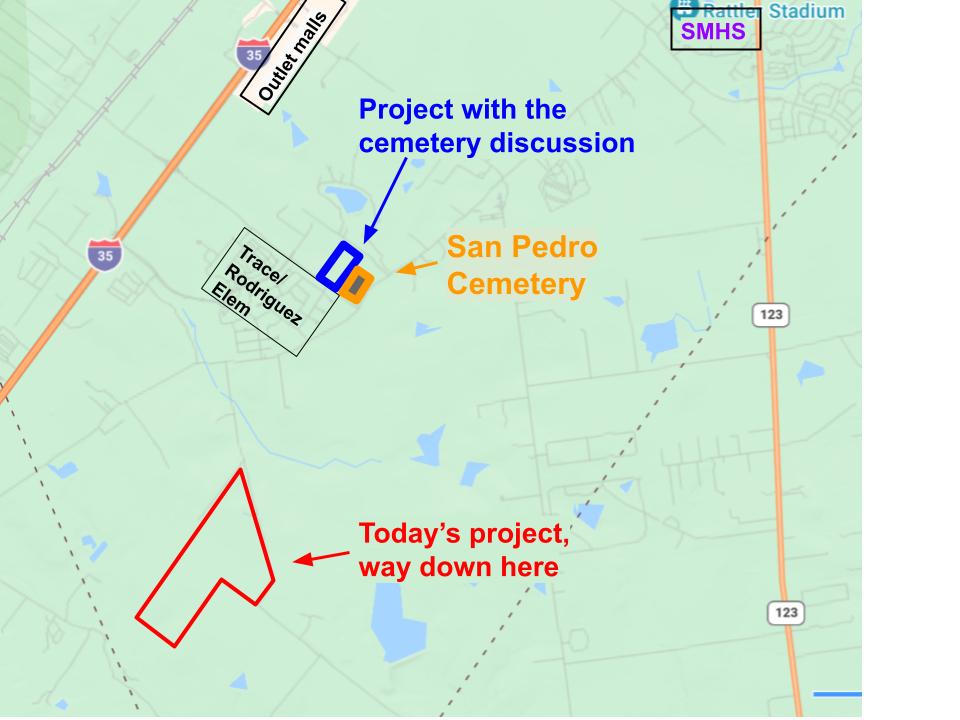
Ok, back to the cemetery: The owner of the larger land does not own the cemetery. By state law, he will preserve access to that cemetery. At P&Z, Michele Burleson said she appreciates that – she was just there last weekend.

The owner also says, “Last time, there was some concern about the placement of the fence along the cemetery. So we did a fancy x-ray type survey. No folks beyond the perimeter of the cemetery!”

That’s reassuring! Also I remember that exact conversation. It’s here. But that’s not the same property!!

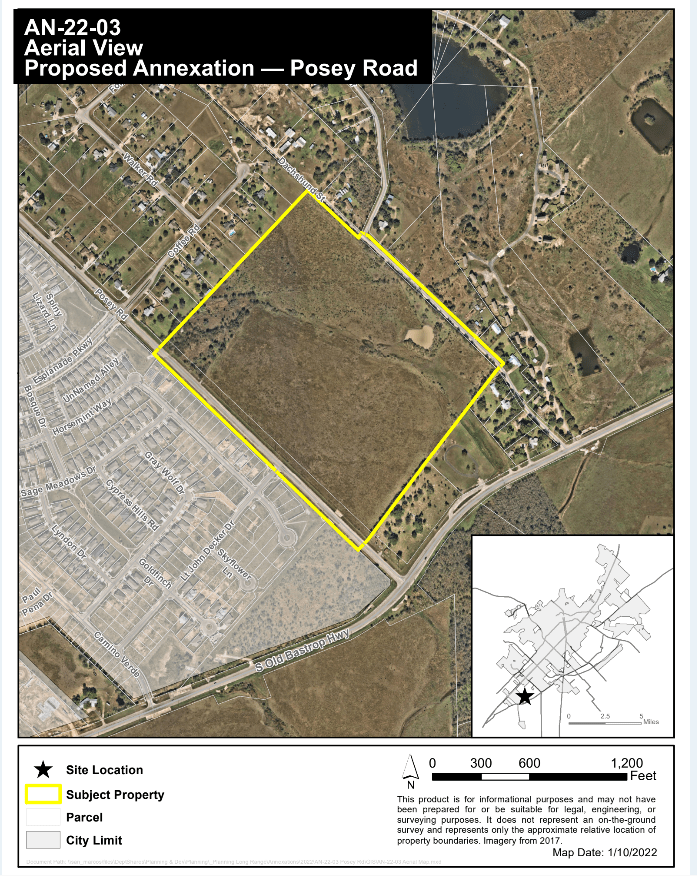
Here’s the property from the cemetery conversation:

That’s a different cemetery altogether:

Everyone is remembering a conversation about the San Pedro Cemetery, not this one! So what cemetery is in the middle of this current patch of land? I think I found it, in this list of all the cemeteries in Hays County.

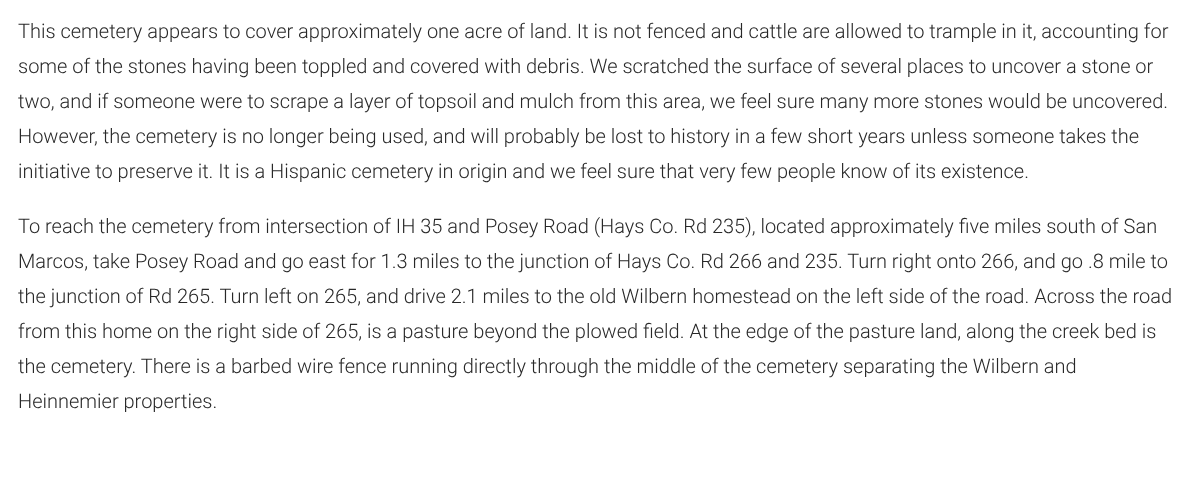
I think it must be the one called York Creek Cemetery. From that link:

Those directions put it squarely in the middle of today’s project, but they also don’t make it sound like a very active cemetery that people are visiting often.

[Updated to add: I’ve been corrected by a reader – thank you! – and the graveyard in the middle of this property is the Nichols-Berry Cemetery.

So that settles one question!]

(Which one did the land owner do the x-ray survey on? Is he confused about his own property? Or did he do surveys on both cemeteries? More unimportant questions I have lingering!)

Thank you all for accompanying me on this edition of Untangling Old Cemeteries of San Marcos.