
Note: I mostly try not to call out P&Z members by name, because they’re not public officials the way that City Council members are. But there are nine of them, and they’re not all equally frustrating. Last time, I gave William Agnew a hard time, and I give Jim Garber a hard time in this post. What can I say? They’re staking out positions that I disagree with, hard.
Markeymoore does the best job of gently pushing back against the crap that I’m describing below. Griffen Spell sometimes does, as well. #notallp&zcommissioners
Quick Timeline:
– 2020-December 2022: Team of community members plus consultants and city staff spend two years putting together a comp plan. A huge amount of community input goes into it.
– February 2023: P&Z says, “This plan is an utter disaster. We will form a subcommittee to rewrite it.”
– May 2023: Now there are two versions of the Comprehensive Plan. The changes are so extensive that they need a workshop to get through them
This workshop was so exasperating. It was aggravating for the exact same reasons that the previous P&Z comp plan discussion was aggravating.
More background: There’s an area of condos called Sagewood. It’s roughly here:
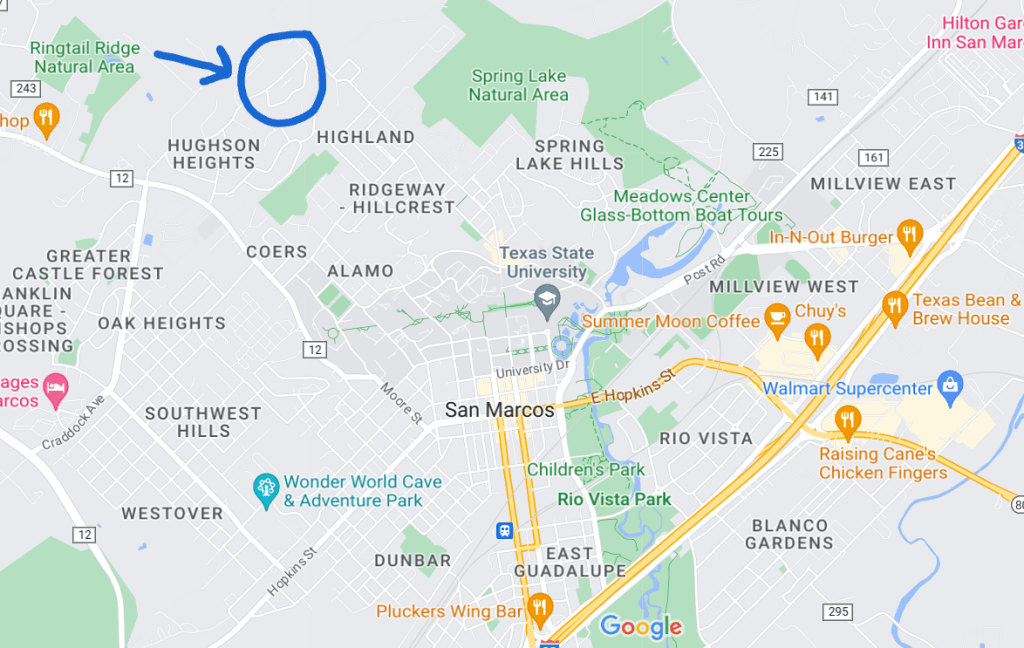
on the edge of an older, beautiful neighborhood.
The landlords of Sagewood have let Sagewood get really rundown: buildings seem to slant, broken fences don’t get fixed very quickly, trash cans get knocked over and trash stays strewn about, etc.
Here’s what Google Streetview has to say about the matter:

(It actually looks fine in that photo.) It’s mostly college students living here.
The point is: many of your older San Marcos NIMBYs close their eyes at night, and dream of Sagewood taking over their own neighborhood, and presumably wake up screaming.
In the 2000s, tons of new giant apartment complexes were approved: The Retreat, The Cottages, Redwood/The Woods, and probably some I’m forgetting. This angered a lot of citizens, including me! I think it was criminal to build The Woods on the river. (Here’s some backstory if you’re curious.) Many NIMBY types feared that Sagewood was taking over the city.
This is what you must understand, if you want to understand fights over the comp plan: many P&Z members are stuck in 2010, fighting against The Cottages, and suffering from Sagewood night terrors when they try to close their eyes and rest.
What else was 2010 like? I did my best to find some data:
- Median rent in 2009: $741/month. (Median is more useful than average – this means that half the units rented for less than $741, and half for more than $741.)
- In 2011, the median house in San Marcos sold for $140K.
- There were 165 total listings for houses on the market
- the 2010 census puts San Marcos at 44K people.
- Median household income in 2009: $26,357
So that’s the world that most of P&Z believes we’re living in: 44K people in San Marcos, many houses cost less than $140K, and median rent is around $700/month.
Here’s the most current numbers I could find:
- Median rent in 2021: $1,311/month
- in 2022, the median house in San Marcos sold for $353,838
- There were 113 total listings for houses on the market
- the 2020 census puts us at 67K people
- Median household income in 2021: $36,080
This is a wildly different world! Rent has almost doubled, home prices have more than doubled, and there are fewer houses on the market.
The comp plan has got to deal with the actual San Marcos in 2023:
- we need affordable housing,
- we need public transit and safe biking options, and
- we have a moral obligation to give a shit that the world is quickly overheating.
The way you do this is by controlling sprawl and increasing density, in small-scale ways. Build 3- and 4-plexes throughout single family neighborhoods. Increase public transit options. Put commerce near where people live, so you can drive less.
This is why the Comp Plan discussions are so frustrating. There are three main coalitions:
- Old San Marcos, fighting the battles of 2010.
- Developers, who would still love to build those giant apartment complexes that piss everyone off
- Progressives, trying to wrangle developers into building small scale, dense housing, and simultaneously trying to convince Old San Marcos not to sabotage it.
I’m really not exaggerating. The chair, Jim Garber, literally states that this is his position at roughly 0:43:00:
- The apartment complexes approved in the 2000s drove him to local politics: he got involved in the last Comp plan, in order to save San Marcos neighborhoods from giant student apartment complexes.
- This last Comp plan was approved in 2012. In order to get it passed, the Planning Department promised to conduct Neighborhood Character Studies. Every neighborhood was going to get to come together and declare what its personality is. Your personality is things like “no duplexes” and “no carports”. In other words, it’s mostly class-based. The goal is to enshrine these wealth signifiers for all eternity.
- However, the neighborhood character studies were never carried out. Jim Garber has been steamed up about this ever since; the planning department cannot be trusted; etc etc.
- He just doesn’t understand why “protection of existing neighborhoods” is not in this plan.
- He wants to divide all neighborhoods into “existing” and “new”. Once a brand new patch of land has been platted, it switches from “new” to “existing”, and then it’s personality is enshrined, never to be touched again.
- What’s the difference? Existing neighborhoods should not have duplexes, triplexes, townhomes, and condominiums. In other words, no small-scale, dense, affordable housing.
Jim Garber is so mad about The Retreat, The Cottages, and other gigantic apartment complexes that he is fighting tooth-and-nail against small-scale affordable housing that would blend in to a neighborhood. He is stuck fighting the battles of 2012, and can’t empathize with 30 year olds in 2023 who can’t afford to live in a little residential neighborhood.
Amanda Hernandez is the planning department director. She responds thoroughly to his points:
- First off, she has only been the director for three months. Most of his complaints span previous admins.
- She wrote most of the comp plan in 2012, and she now thinks it’s a terrible plan. They started the neighborhood character studies and spent a year or two on them, and then she was told to abandon them and to switch and work on the new Code Development.
- But! Now! They are now finally doing character studies. Blanco Gardens and Dunbar are underway. Victory Gardens and north of campus are coming up next.
- You know the Cottages, the Retreat, Sagewood, and The Woods? Big complexes in residential areas? Those have not been approved since 2012. The old Comp Plan worked. Those were all passed under the even-older comp plan, two comp plans ago.
Bottom line: we have effective mechanisms to prevent giant apartment complexes from being built in residential neighborhoods. This is no longer happening. The fight against giant apartment complexes is going to sabotage efforts to bring small-scale affordable housing into neighborhoods.
Finally, I’m going to be blunt: the utter narcissism of the Historic District is exhausting. To hear P&Z speak, there is no neighborhood that could merit planning, besides this one. All Historic District, all the time. It’s extremely tiresome and means that nothing else ever gets considered.
At the public comments, speakers try to explain that no one wants to change the Historic District. The Historic District is actually the gold standard of a neighborhood! It’s got small scale tri-plexes and four-plexes sprinkled around, it’s got neighborhood commercial, and nearly every house has an ADU – a mini-house in the back. It is the dream of small scale, dense living!
One of the speakers, Rosie Ray, made some handouts for P&Z, to try to convey this point. She was kind enough to share them with me:


Cottonwood Creek does not have diversity of housing. The residents keep telling the city that they want some stores nearby. The Historic District is chock full of different kinds of functionality. It works great.
When this is brought up, the P&Z folks say, “Yes, but the Historic District happened naturally.”
Basically: Historic Districts usually are older than land use codes. Single-family zoning originated to make sure white, wealthy neighborhoods stayed that way. So along with red-lining, you wanted to make sure there was nothing affordable. Hence you specify that lots have to be big, and houses have to be big and spread out. This is the problematic origin of single-family zoning.
So sure, the Historic district happened naturally, because it’s older than single-family zoning. And now we will prevent that from happening anywhere else.
Bottom line:
- P&Z wants to separate all existing neighborhoods and freeze them in carbon, like Hans Solo. Future neighborhoods, in a galaxy far far away, can be built like the Historic District.
- Developers will not build future neighborhoods like the Historic District, because the way you maximize profit is to build yet another sprawling single family neighborhood or a giant apartment complex. (Good link on how to get builders to fill in these missing middle housing types. The problem really is single-family zoning.)
- In ten years, we’ll have another comp plan, and we’ll beg and plead for this all over again.
I’m struggling to avoid making “OK Boomer” jokes about P&Z, but gerontocracy is a real thing in the US, and in San Marcos. The members of P&Z do not seem attuned to the idea that the financial hurdles of 30 year olds in 2023 are wildly different than the financial hurdles of 30 year olds in 1990.
(I didn’t have a good place to put it, but Rosie also passed out this map:

It’s pretty stark!)
 The San Marxist