
Workshop 1: CIP List
CIP stands for Capital Improvement Plan. These are all the big city projects – like, more than $100K – where you have to cover them with a bond and they span multiple years.
There’s basically a fuzzy 10 year plan, a better 5 year plan, a focused 3 year plan, and then an actual budget for the next year.
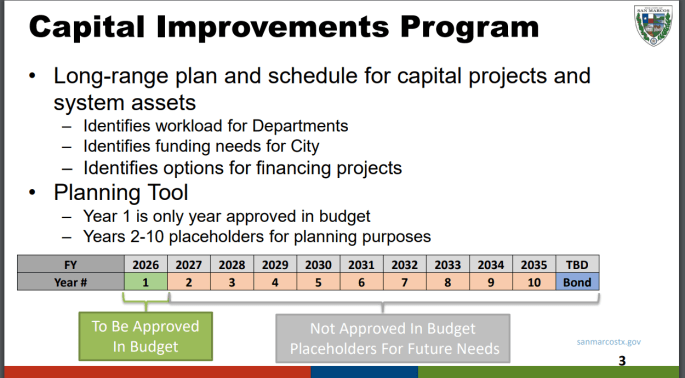
There are quick easy projects, long difficult projects, and some that are mid:

Loosely speaking, these are the categories for the projects:

Look, here’s some nice photos of projects that have gone great!

woo-hoo!
Here’s some of the bigger upcoming projects:

The hard part is wading through the hundreds of projects, and figuring out what you think about them. That’s what Council has to do.
So what does Council think about them? Not much! They’re eager to get to Workshop #2.
…
Workshop #2: SMPD Vehicles
How do police vehicles work when officers are off-duty? How much wear-and-tear gets put on them? What about when the officer picks up a second job?
Basically, we’ve been letting officers take their vehicles home since 1983:

…
What’s the benefit of letting police officers take their vehicles home?
I found the slides confusing, so I’m just going to summarize Chief Standridge’s arguments:
1. “If it ain’t broke, don’t fix it!” We’ve had a drop in crime since Covid, so don’t meddle with things that work.
2. 79 of SMPD employees are on-call sometimes, so it makes sense for them to have a vehicle at home. Otherwise they’d have to re-route to the station, check out a car, and go from there, which is a big delay.
Officers are supposed to keep their radios on, when they’re driving to or from work. He gives a lot of examples of cops that respond to calls nearby, when they happen to be commuting home.
3. Financial considerations:
a. If we tried to park all the vehicles in our lot, we’d run out of parking lot space at the station.
b. If we had cars in use 24 hours a day, we’d have to replace them every 3 years, instead of every 5 years, because they’d wear out more quickly. (This is kind of silly. The force is driving the same number of hours either way. Replace one car after 3 years, or replace two cars every 6 years – you aren’t changing anything.)
c. This slide:

I’ll definitely give the Chief this point. Having vehicles spread out over town is good when the station gets flooded in, which happens semi-frequently.
4. So much time would be wasted checking vehicles in and out. It would take an officer 30 minutes to do a check-out vehicle inspection, and then 30 minutes to do another check-in vehicle inspection at the end! That extra hour would add up to $25,000 in hourly pay per year.
(This one also seemed silly. Maybe check with the Parks Department or Maintenance Department, and see how they manage to make it work.)
5. Officers are a little kinder to the vehicle if they know they’re stuck with it for five years, instead of getting rid of it after each shift.
This one is easy to believe.
…
Chief Standridge never answers the main question: Is this cost-neutral? On the whole, if you compare a take-home fleet vs an on-site fleet, how does the total cost compare?
Here’s what I personally care about: Is this policy similar to the kind of frugality we expect from other departments? Are we keeping SMPD as lean as we keep Parks & Rec, or the library, or maintenance, or anyone else?
We never really got an answer to that, either.
….
Part 2, same workshop: SMPD Vehicles being used when cops have second jobs.
This is what Council cares about more. How much wear-and-tear is getting put on the vehicles when officers go on second jobs? Like SMCISD hires them to work a basketball game, or Amazon hires them to direct traffic? What about the wear and tear on the cars that occurs then?
This is pretty common:

The problem is the jobs that need the cop to keep his vehicle on and idling. For example, you get hired to direct traffic at Amazon. That ages a vehicle, and means that SMPD has to replace the car sooner.
So they’re going to charge officers a little rental fee:
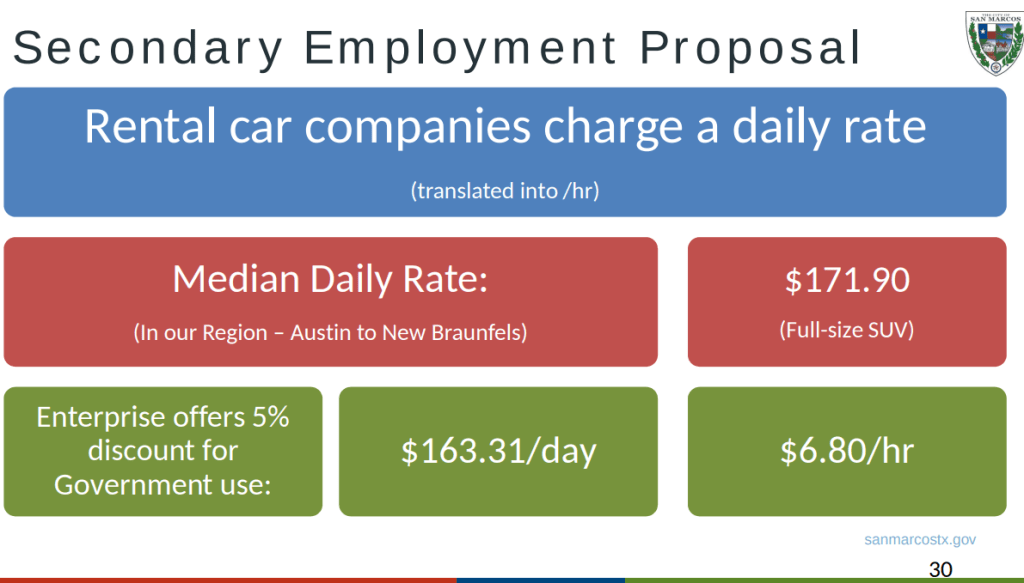
They figured that a rental car company would charge them $163 for 24 hours, so that works out to $6.80 per hour.
Here’s what we’re going to do:

Council is fine with this. They’re going to draw up a formal policy and go from there.
My two cents: Two hours of discussion was way too much for this topic. I lost interest in the finer details of which officer stops for an iced tea on the way to HEB or whatever.
 The San Marxist